




Introduction
Antarctica hosts some of the most pristine biomes remaining on Earth and, at the same time, faces some of the most extreme environmental conditions (Convey & Biersma Reference Convey, Biersma and Scheiner2024). However, parts of the continent, in particular the Maritime Antarctic, which includes the Antarctic Peninsula and South Shetland Islands (SSIs), have experienced considerable increases in air and marine temperatures, as well as widespread glacial retreat and other environmental changes, since the second half of the twentieth century (Turner et al. Reference Turner, Bindschadler, Convey, Di Prisco, Fahrbach and Gutt2009, Convey & Peck Reference Convey and Peck2019, Kreczmer et al. Reference Kreczmer, Dąbski and Zmarz2021). Even without this warming, the Maritime Antarctic region, particularly the SSIs, is characterized by the least extreme conditions in Antarctica (Convey & Biersma Reference Convey, Biersma and Scheiner2024). Regional warming in the Maritime Antarctic has resulted in reports of vegetation expansion at a local scale (Fowbert & Smith Reference Fowbert and Smith1994, Cannone et al. Reference Cannone, Guglielmin, Convey, Worland and Favero Longo2016, Reference Cannone, Dalle Fratte, Convey, Worland and Guglielmin2017, Reference Cannone, Malfasi, Favero-Longo, Convey and Guglielmin2022). However, even though this region is known as Antarctica’s most vegetated region, only ~1.34% of its ice-free ground has been estimated to be currently vegetated (Fretwell et al. Reference Fretwell, Convey, Fleming, Peat and Hughes2011).
Câmara et al. (Reference Câmara, Lopes, Bones, Rodrigues, Carvalho-Silva and Stech2023), in a metabarcoding study of airspora, investigated a 40° latitudinal transect from Brazil to the SSIs, generating data that suggested that long-distance aerial dispersal may play a role in colonizing new environments (see also Rosa et al. Reference Rosa, Silva, Pinto, Stech, Convey and Carvalho-Silva2020, Câmara et al. Reference Câmara, Stech, Convey, Šantl-Temkiv, Pinto and Bones2024), in concert with previous aerobiological studies (e.g. see Marshall et al. Reference Marshall1996, Pearce et al. Reference Pearce, Alekhina, Terauds, Wilmotte, Quesada and Edwards2016, Kleinteich et al. Reference Kleinteich, Hildebrand, Bahram, Voigt, Wood and Jungblut2017). Some surface habitats in Antarctica such as rock surfaces are generally not suitable for macroscopic plant vegetation, although they do provide habitats for epilithic mosses (Ochyra et al. Reference Ochyra, Smith and Bednarek-Ochyra2008) and lichens (Øvstedal & Smith Reference Øvstedal and Smith2001), as well as microorganisms such as fungi (Gonçalves et al. Reference Gonçalves, Alves, Oliveira, Schaefer, Turbay, Rosa, Rosa and Rosa2019) and algae (van Thielen & Garbary Reference van Thielen, Garbary and Seckbach1999). Câmara et al. (Reference Câmara, de Menezes, Oliveira, Souza, Amorim and Schaefer2022) applied DNA metabarcoding to rocks obtained from the Ellsworth Mountains at the base of the Antarctic Peninsula in Continental Antarctica, where climatic conditions are much harsher than in the SSIs, and reported sequence assignments of 48 non-fungal eukaryotic taxa, including algae, bryophytes and flowering plants (even though the latter two groups do not occur in this mountain range).
DNA metabarcoding enables the detection of DNA from environmental samples containing multiple different organisms simultaneously (known as environmental DNA, or eDNA; Rippin et al. Reference Rippin, Borchhardt, Williams, Colesie, Jung and Büdel2018, Ruppert et al. Reference Ruppert, Kline and Rahman2019), including stages that are typically not detected in morphological surveys (e.g. pollen, spores, small fragments, single cells). This has been considered as an effective tool for detecting the presence and diversity of eukaryotic (including plant) DNA in extreme environments (Fraser et al. Reference Fraser, Connell, Lee and Cary2018, Rippin et al. Reference Rippin, Borchhardt, Williams, Colesie, Jung and Büdel2018, Garrido-Benavent et al. Reference Garrido-Benavent, Pérez-Ortega, Durán, Ascaso, Pointing and Rodríguez-Cielos2020, Câmara et al. Reference Câmara, de Menezes, Oliveira, Souza, Amorim and Schaefer2022), although we recognize from the outset that the assignment of a DNA sequence as belonging to a particular taxon does not confirm the presence of that specific taxon (commonly due to coverage and accuracy limitations in available sequence databases) or that of a living or viable organism or propagule. In this study, we used DNA metabarcoding to investigate the cryptic diversity of non-fungal eukaryotes associated with rocks obtained at Lions Rump on King George Island in the SSIs.
Materials and methods
Sampling
The studied material was collected during the summer of 2021–2022 at Lions Rump, Mazurek Point, King George Island (62°08′30.81′′S, 58°07′34.25′′W; Fig. 1). Lions Rump is an ice-free area located at the western side of the entrance to King George Bay, ~30 km from the nearest research station. It has an area of ~1.61 km2 and was designated in 2002 as an Antarctic Specially Protected Area (ASPA 151) in recognition of its important geological features as well as significant populations of penguins and many other species of marine birds and mammals. Terrestrial vegetation is also present but not recognized as a ‘major’ value in the ASPA management plan.
Map showing the location of Lions Rump (Antarctic Specially Protected Area (ASPA) 151) on King George Island. Obtained from the ASPA 151 management plan (https://www.ats.aq/devph/en/apa-database/55). ASMA = Antarctic Specially Managed Area.

For the purposes of this study, five sampling locations were selected from the Mazurek Point Formation (Troedson et al. 2002) and numbered S1–S5. They were obtained from different heights in a stratigraphic profile (9.0, 24.0, 34.7, 48.8 and 57.2 m, respectively) and were placed in sealed sterile bags and frozen on ship from soon after collection until being processed (see Rabelo et al. (Reference Rabelo, Gonçalves, Carvalho, Scheffler, Santiago and Sucerquia2024) for a detailed description of this collection, storage and subsequent processing).
DNA extraction and sequencing
Samples were pulverized using a sterilized drill and a mortar. Total DNA was extracted using the FastDNA Spin Kit for Soil (MPBIO, OH, USA), following the manufacturer’s instructions. DNA quality was analysed using agarose gel electrophoresis (1% agarose in 1× Trisborate-EDTA) and then quantified using the Quanti-iT™ Pico Green dsDNA Assay (Invitrogen). We selected the internal transcribed spacer 2 (ITS2) of the nuclear ribosomal DNA (Chen et al. Reference Chen, Yao, Han, Liu, Song and Shi2010, Richardson et al. Reference Richardson, Lin, Sponsler, Quijia, Goodell and Johnson2015, Câmara et al. Reference Câmara, de Menezes, Oliveira, Souza, Amorim and Schaefer2022) as a barcode, which has been widely used to identify a diverse range of eukaryotic organisms, including fungi, animals, protozoans, chromists and plants (Ruppert et al. Reference Ruppert, Kline and Rahman2019) and has proved effective in recent eDNA studies of Antarctic diversity (Carvalho-Silva et al. Reference Carvalho-Silva, Rosa, Pinto, Da Silva, Henriques, Convey and Câmara2021, Ogaki et al. Reference Ogaki, Pinto, Vieira, Neto, Convey and Carvalho-Silva2021, Câmara et al. Reference Câmara, de Menezes, Oliveira, Souza, Amorim and Schaefer2022). Polymerase chain reaction (PCR) amplicons were generated using the primers ITS3 and ITS4 (White et al. Reference White, Bruns, Lee, Taylor, Innis, Gelfand, Swinsky and White1990) and were sequenced commercially using high-throughput sequencing by Macrogen, Inc. (South Korea) on an Illumina MiSeq sequencer (2 × 300 bp).
Data analyses and taxa identification
Quality analysis was carried out using BBDuk v. 38.87 in BBmap software (Bushnell 2014) with the following parameters: Illumina adapters removing (Illumina artefacts and the PhiX Control v3 Library); ktrim = l; k = 23; mink = 11; hdist = 1; minlen = 50; tpe; tbo; qtrim = rl; trimq = 20; ftm = 5; maq = 20. The remaining sequences were imported to QIIME2 version 2023.9 (https://qiime2.org) for bioinformatics analyses (Bolyen et al. 2019). The qiime2-dada2 plugin was used for filtering, dereplication, turning paired-end fastq files into merged files and removing chimeras, using default parameters (Callahan et al. Reference Callahan, McMurdie, Rosen, Han, Johnson and Holmes2016). Taxonomic assignments of amplicon sequence variants (ASVs) were determined using the qiime2-feature-classifier (Bokulich et al. Reference Bokulich, Kaehler, Rideout, Dillon, Boylern and Knight2018) classify-sklearn against different databases, with a sequence similarity threshold set to 97%. First, ASVs were classified against the PLANiTS2 database (Banchi et al. Reference Banchi, Ametrano, Greco, Stankovi, Muggia and Pallavicini2020). After this step, ASVs that remained unclassified were filtered and classify-sklearn classified against the UNITE Eukaryotes ITS database version 9.0 (Abarenkov et al. Reference Abarenkov, Zirk, Piirmann, Pöhönen, Ivanov, Nilsson and Kõljalg2020). Finally, the remaining unclassified ASVs were filtered and aligned against the filtered National Center for Biotechnology Information (NCBI) non-redundant nucleotide sequences (nt) database (October 2024) using BLASTn (Camacho et al. Reference Camacho, Coulouris, Avagyan, Ma, Papadopoulos, Bealer and Madden2009) with default parameters; the nt database was filtered with the following keywords: ‘ITS1’, ‘ITS2’, ‘Internal transcribed spacer’ and ‘internal transcribed spacer’. Taxonomic assignments were performed using MEGAN6 (Hudson et al. Reference Hudson, Beier, Flade, Gorska, El-Hadidi, Ruscheweyh and Tappu2016). For simplicity, we henceforth refer to the assigned ASVs as ‘taxa’. Venn diagrams were prepared as described by Bardou et al. (Reference Bardou, Mariette, Escudié, Djemiel and Klopp2014). For comparative purposes, we consider reads as a proxy for relative abundance (Deiner et al. Reference Deiner, Bik, Mächler, Seymour, Lacoursièreroussel and Altermatt2017, Hering et al. Reference Hering, Borja, Jones, Pont, Boets and Bouchez2018, Carvalho-Silva et al. Reference Carvalho-Silva, Rosa, Pinto, Da Silva, Henriques, Convey and Câmara2021, Câmara et al. Reference Câmara, de Menezes, Oliveira, Souza, Amorim and Schaefer2022). Rarefaction curves were generated using the software PAST 3.26 (Hammer et al. Reference Hammer, Harper and Ryan2001).
Results
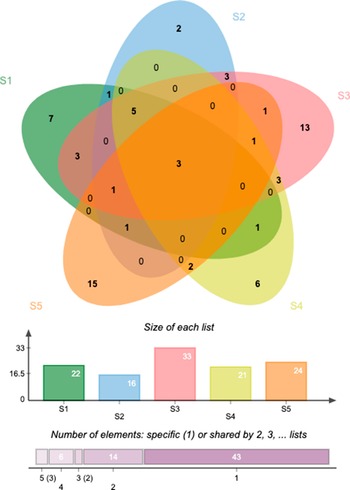
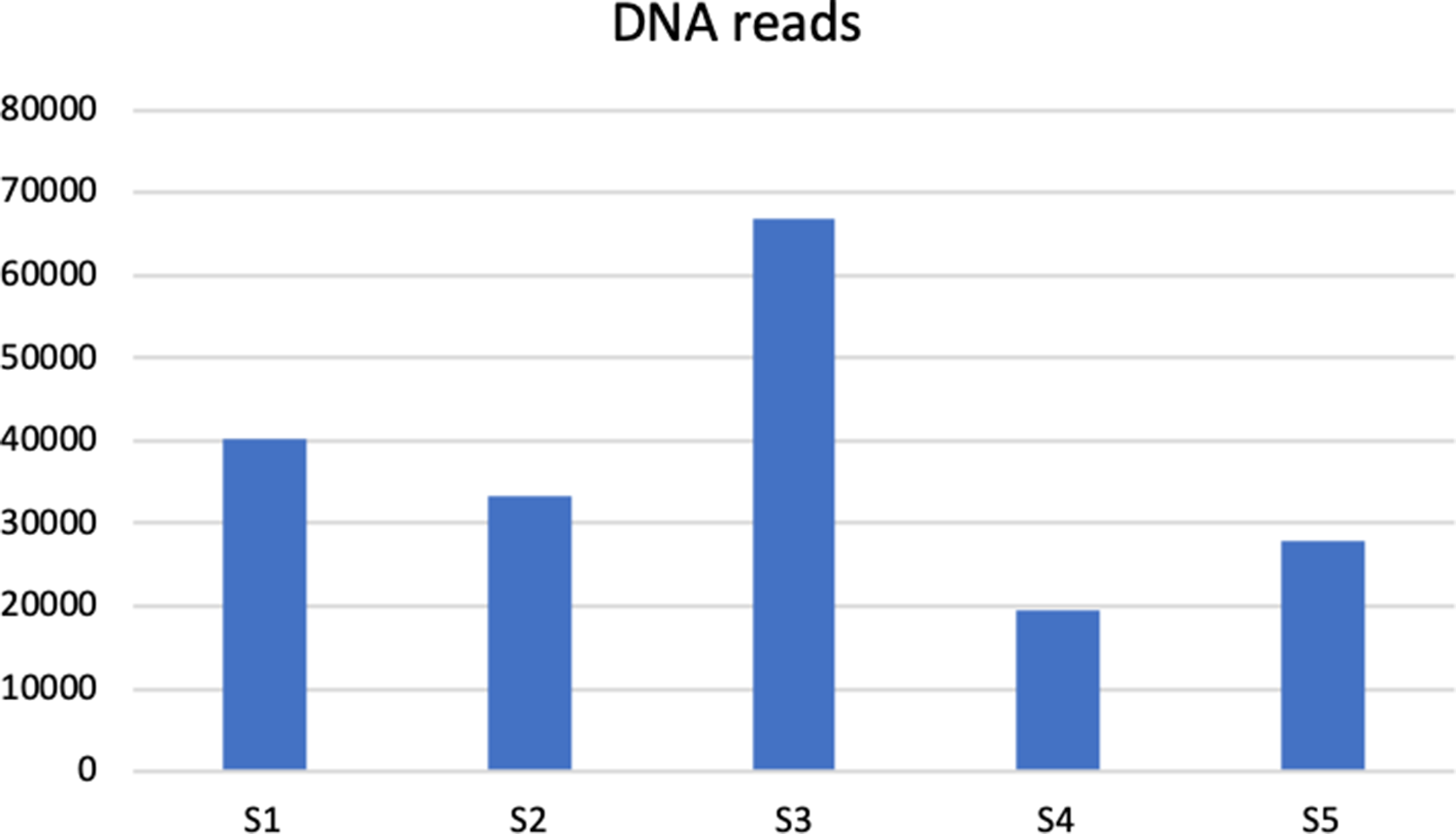
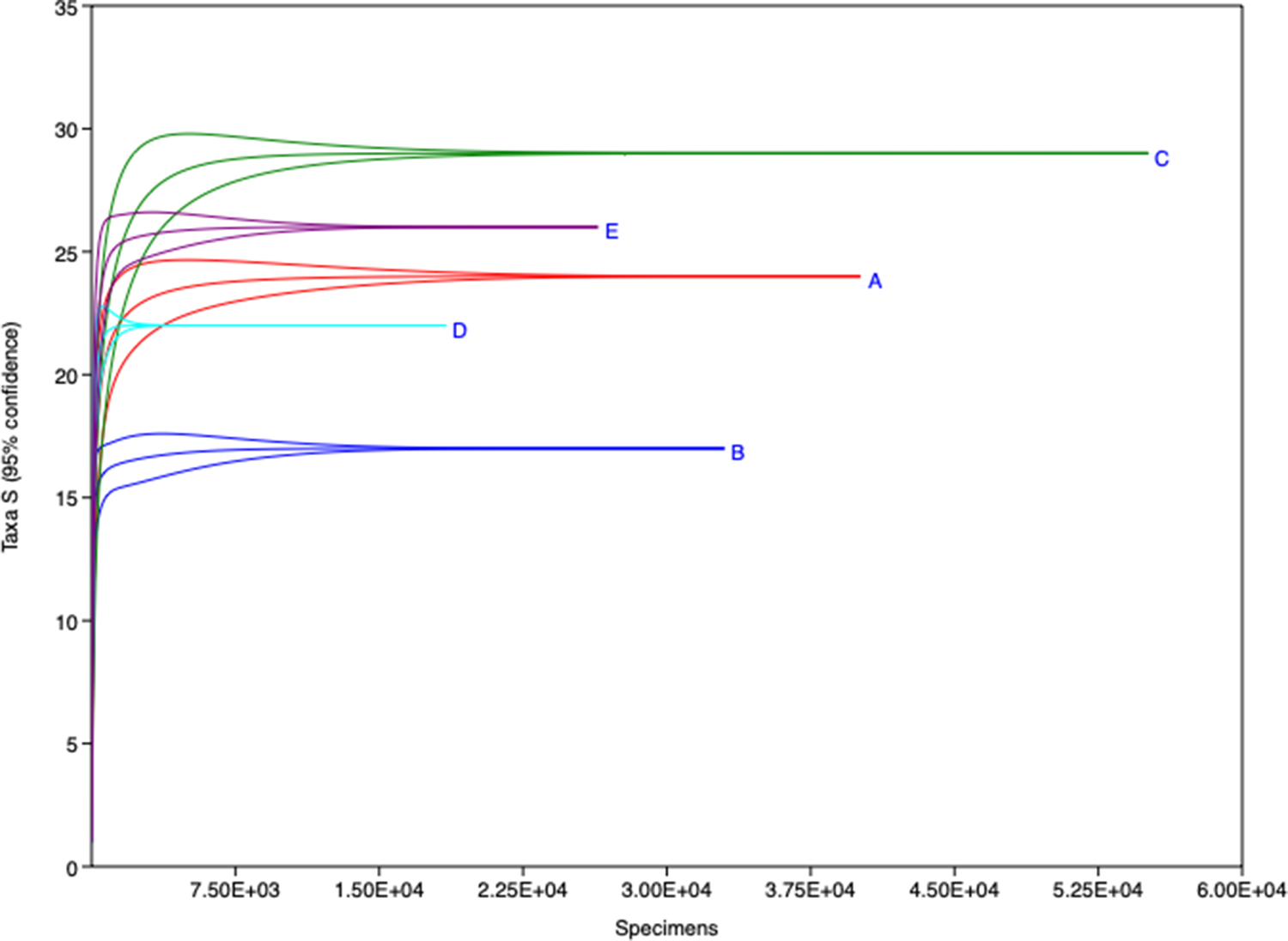
A total of 187 664 DNA reads from non-fungal eukaryotic taxa were obtained (fungal data are presented by Rabelo et al. Reference Rabelo, Gonçalves, Carvalho, Scheffler, Santiago and Sucerquia2024), representing 70 assigned taxa. The rock sample with the highest numbers of reads and assigned taxa was S3 (33 taxa), followed by S5 (24), S1 (22), S4 (21) and S2 (16). Only three taxa were shared across all five samples (order Chlamydomonadales, Chloromonas sp. and Prasiola sp.; Figs 2 & 3). Representatives of five kingdoms and nine phyla were assigned (Table I). The kingdom Viridiplantae was the most diverse group, with 42 assigned taxa, followed by Chromista, with 22 assigned taxa. The most abundant individual taxa were also representatives of Viridiplantae (Prasiola, Chloromonas and Chlamidomonadales). Rarefaction curves all reached a plateau, suggesting that the data obtained provide a good representation of the sequence diversity in the crushed rock samples (Fig. 4).
Venn diagram showing the numbers of non-fungal eukaryotic taxa detected in all five crushed rock samples and the numbers shared between samples from Lions Rump, King George Island, examined in this study.

Numbers of DNA reads obtained from each of the five crushed rock samples obtained from Lions Rump, King George Island, in this study (y-axis = DNA reads, x-axis = sample number).

Discussion
Our data confirm that DNA metabarcoding provides an effective tool to describe the DNA sequence diversity associated with a rock substrate from Antarctica. The large majority of the assigned DNA diversity detected in this study represents common and widespread taxa globally, although some could only be assigned to higher taxonomic ranks (e.g. class), limiting any inferences that can be made. We accept that the assignment of a DNA sequence does not confirm the presence of a viable organism, and such research is also limited by the quality and coverage of the available sequence databases. As the samples examined were immediately stored on collection in sterile containers and frozen before being processed in sterile flow hoods, we consider that the DNA obtained is unlikely to result from sample contamination, supported by the blanks and controls not suggesting contamination. In addition, if contamination were a contributing factor, we would expect more plausible contaminants to be present in multiple individual samples.
The presence of assigned marine taxa is unsurprising, as this coastal study site commonly experiences marine spray during periods of strong winds. Assignments to unknown taxa ranged from 3% to 10%, probably representing taxa not currently included in the consulted databases, and possibly including unsequenced or undescribed taxa. Future studies applying a wider range of markers (e.g. 16S, 18S, Cox1) are required to generate a more comprehensive taxon list.
Many of the taxa assigned (Table I) are likely to be found in the local environment and/or have previously been reported from Antarctica. Furthermore, the non-fugal eukaryotic diversity of our study location is poorly known, and no comprehensive biodiversity assessment has been made. The management plan for ASPA 151 (https://www.ats.aq/devph/en/apa-database/55) is vague in its description of the biodiversity present (e.g. noting that ‘knowledge of freshwater algae in this area is poor’) and provides no references, making it more difficult to address more precisely what is expected to be present. We expect that the local vegetation is quite similar to the overall King George Island description of Ochyra et al. (Reference Ochyra, Smith and Bednarek-Ochyra2008). Other assigned taxa are not known from Antarctica, and the inclusion of some tropical taxa (e.g. Callicostella, Guazuma ulmifolia) provides some support for the proposal of Câmara et al. (Reference Câmara, Lopes, Bones, Rodrigues, Carvalho-Silva and Stech2023, Reference Câmara, Stech, Convey, Šantl-Temkiv, Pinto and Bones2024) that some biological material can be transported in the air column over long distances. However, such assignments could also indicate anthropogenic influence or contamination, such as the those of Brassica, Malus, Musa and Solanum, which are human foodstuffs commonly present onboard vessels and at camping sites and research stations. Small fragments of such contaminants can be dispersed long distances, and their DNA can remain detectable after many years (Nobile et al. Reference Nobile, Freitas-Souza, Ruiz-Ruano, Nobile, Costa and de Lima2019, Ferreira et al. Reference Ferreira, Azevedo, Barroso, Duarte, Egas and Fontes2024). Although we have no means of confirming the origin of such ‘exotic’ DNA, it is pertinent to note that King George Island is one of the most visited locations in Antarctica, hosting the highest concentration of research stations and facilities on the continent, multiple tourist landing locations and even an airstrip.
Numbers of DNA sequences assigned to specific taxa from each of the five crushed rock samples obtained from Lions Rump, King George Island. Habitat (Hab.) and distribution (Distr.) descriptors: As = Asia; An = Antarctica; Au = Australia; B = brackish; Bi = bipolar; C = cosmopolitan; Eu = Europe; F = freshwater; Fk = Falkland/Malvinas Islands; M = marine; ME = Middle East; Neo = Neotropical; Sa = South America; St = subtropical; T = terrestrial; Tr = tropical; W = widespread.

a Previously unreported taxon for Maritime Antarctica.
Rarefaction curves of sequence assignments (’taxa’) obtained from each of the five crushed rock samples based on taxa profile (0.03 similarity) and showing 95% confidence limits (A = S1, B = S2, C = S3, D = S4 and E = S5).

Assignments to taxa that are associated with or causes of disease are notable. For instance, members of the genus Myzocytiopsis are widely known as parasites of nematodes, but they can also infect rotifers and amphipods (Rocha et al. Reference Rocha, Rocha and Machado2017), while members of Pythium are plant parasites responsible for a wide range of diseases affecting hosts including soybean, peanut, tomato and maize, and they can even affect humans (Calvano et al. Reference Calvano, Blatz, Vento, Wickes, Sutton and Thompson2011). The finding of the latter genus could also be linked with the import of human food to Antarctica.
The sequence diversity differed between samples obtained at different stratigraphic positions, but this may simply have resulted from the single sample obtained from each position not capturing variability at each. Sample S3 (34.7 m), the part of the stratigraphic profile closest to the top of the profile close to the edge of the escarpment, generated the greatest diversity and relative abundance. The least diverse and abundant assemblage was that of sample S2 (24.0 m), located in the part of the profile that is driest and steepest. However, lithology appeared to have little or no influence on diversity detected, but a larger sample size would be required to draw further conclusions. The most diverse sample, S3, and the least diverse sample, S2, were both conglomerates - a coarse-grained rock type characterized by high porosity. Meanwhile, sample S4, which was finer grained and consequently had lower porosity, showed diversity similar to that of sample S1, another conglomerate. The sample with the lowest relative abundance, S4, was a siltstone - a low-porosity rock (see Rabelo et al. Reference Rabelo, Gonçalves, Carvalho, Scheffler, Santiago and Sucerquia2024).
Rabelo et al. (Reference Rabelo, Gonçalves, Carvalho, Scheffler, Santiago and Sucerquia2024) reported the assignment of 198 fungi taxa from the same samples, compared with only 70 other eukaryotic taxa found in the present study. This could reflect that fungi are commonly very diverse in various Antarctic substrates (Ogaki et al. Reference Ogaki, Pinto, Vieira, Neto, Convey and Carvalho-Silva2021, Rosa et al. Reference Rosa, de Menezes, Pinto, Convey, Carvaho-Silva and Simoes2022 ), but it could also represent an artefact of the primers used, as our study used ITS2 alone. As there are no universal barcoding markers for all organisms, using a wider range of markers would probably reveal more taxa from different groups (e.g. 18S for protists and COX1 for metazoans). Furthermore, although the interpretations of Rabelo et al. (Reference Rabelo, Gonçalves, Carvalho, Scheffler, Santiago and Sucerquia2024) focused on endolithic organisms, it is not possible here to differentiate for most microbial taxa whether they might represent true endoliths or those present on the rock surface. However, none of the taxa reported here have been reported as true endolithics, although there is limited information on endolithic taxa in Antarctica other than fungi and associated photobiont algae, as well as bacteria (Hughes & Lawley Reference Hughes and Lawley2003, Martins et al. Reference Martins, Ramos, Hentschke, Castelo-Branco, Rego and Monteiro2020).
Câmara et al. (Reference Câmara, de Menezes, Oliveira, Souza, Amorim and Schaefer2022) investigated plant sequence diversity derived from seven rock surface samples obtained in the Ellsworth Mountains at the base of the Antarctic Peninsula in Continental Antarctica using the same methodology and marker (ITS2) as here. They reported 48 distinct assignments, of which 40 were flowering plants, a group not present in that region and that reaches the southern distributional limit of the two native Antarctic species on northern Alexander Island, ~10° of latitude further north. These assignments also included some for taxa commonly associated with human activities (e.g. Musa, Curcubita, Pimpinella), as well as others with no such association but with known wind dispersal of pollen, such as the grass family Poaceae. Fraser et al. (Reference Fraser, Connell, Lee and Cary2018) investigated nine sites near Mount Erebus on Ross Island, also in Continental Antarctica, using three different markers, and they also reported sequence assignments to exotic species, including trees (ash) and human foodstuffs such as soy and wheat.
The use of morphology alone to study endolithic and hypolithic communities has been employed before. Hughes & Lawley (Reference Hughes and Lawley2003) investigated endolithic communities in the Dry Valleys and reported only prokaryotes and fungi. Khan et al. (Reference Khan, Trindade, Stafford, Cary, Lacap-Bugler, Pointing and Cowan2011), using molecular tools, reported the presence of green algae and mosses on hypolithic communities also in the Dry Valleys, but mostly only at a higher-rank taxonomic level.
Conclusions
Our study indicates that rock surfaces in the Lions Rump ASPA host a significant diversity of DNA sequences representing eukaryotic taxa. Many of these are plausible indicators of native taxa, while others suggest potential human influence, and some others may indicate the presence of potentially pathogenic taxa. While further directed studies are required to confirm the presence of living or viable organisms or propagules, the continued use of metabarcoding approaches will represent an important contribution to monitoring habitats in the Antarctic Peninsula region as climatic conditions become progressively more environmentally favourable, particularly in the context of identifying the establishment of new incoming organisms.
Acknowledgements
We thank the crews of the Brazilian polar vessels Ary Rongel and Alte Maximiano. Thanks also to congresswoman Jô Moraes, to the Instituto de Ciências Biológicas at Universidade de Brasília and to the Brazilian Navy and Air Force for logistical support. We would like to especially thank the Commander of the Ary Rongel and the ‘Sea and War Captain’ Fabiano de Medeiros Ichayo.
Financial support
This study received financial support from the Brazilian Conselho Nacional de Desenvolvimento Científico e Tecnológico (CNPq), Ministério da Ciência, Tecnologia e Inovação (MCTI) and Programa Antártico Brasileiro (PROANTAR). PC is supported by Natural Environment Research Council (NERC) core funding to the British Antarctic Survey (BAS) ‘Biodiversity, Evolution and Adaptation’ Team. SMS was funded by the National Council for Scientific and Technological Development (CNPq, process 311057/2022-5) and MAC thanks the Brazilian National Council for Scientific and Technological Development (Conselho Nacional de Desenvolvimento Científico e Tecnológico (CNPq/PROANTAR)) through grant no. 442765/2018-5 (Project FLORANTAR).
Competing interests
The authors declare none.
Author contributions
PEASC and LHR designed the study and secured funds, NGR and MC-S performed laboratory work, FACL performed the bioinformatics analyses, MAC, SMS, GS and PAS performed the fieldwork, VNG performed the analyses and PC contributed to data interpretation and the development of the manuscript. All authors contributed to the final writing of the text.



 Open access

