

1 Introduction
Scholars have long recognized the importance of political regime types and transitions for a wide range of political and economic phenomena, from economic development (Acemoglu et al. Reference Acemoglu, Naidu, Restrepo and Robinson2019) and foreign aid effectiveness (Boone Reference Boone1996) to interstate (Bremer Reference Bremer1992) and civil conflict (Hegre et al. Reference Hegre, Ellingsen, Gates and Gleditsch2001). Despite the general consensus on the descriptive nature of different regime types, there is no universal agreement on the exact characteristics considered intrinsic to democracy or other regime types. This lack of consensus is evident in the plethora of measures in the literature, sometimes representing different institutional, behavioral or opinion-based features of an underlying regime construct. One side effect of this diversity in measurement is that comparing empirical findings based on different measures can be difficult (Vaccaro Reference Vaccaro2021). While recent studies adopted an item-response-theory (IRT) approach to incorporate information from multiple sources (e.g., Pemstein, Meserve, and Melton Reference Pemstein, Meserve and Melton2010; Treier and Jackman Reference Treier and Jackman2008), continuous democracy measures that are derived from these models neither uniquely identify distinct political regime categories like democracy or autocracy, nor provide a clear methodology for identifying transitions from one regime type to another.
To address this mismatch between the categorical conceptualization of regimes and reliance on continuous measures, a common practice is to use cut-offs to identify different regime categories and transitions among them. However, as Kasuya and Mori (Reference Kasuya and Mori2022) note, these cutoffs can result in significant variations in classifying regime types, and hence, regime transitions across different studies. For example, democracy cut-offs for Polity range from $-$
2 (Kurzman and Leahey Reference Kurzman and Leahey2004) to +10 (Bennett Reference Bennett2006). Bogaards (Reference Bogaards2012) shows 18 different ways these cut-offs are defined in the literature for Polity and 20 for Freedom House, which can make it challenging to compare findings across different studies.Footnote
1
Other studies require a minimum point, percentage or standard deviation change on a regime measure over a specified time window to identify regime transitions (e.g., Fearon and Laitin Reference Fearon and Laitin2003). However, the lack of consensus over the optimal cut-off point, the width of the time window or the magnitude of change again has led to many different ways to identify regimes or transitions in the literature, even when using the same underlying regime dataset. The consequence is significant disagreement over the existence or timing of regime transitions across different studies (Bogaards Reference Bogaards2012; Jee, Lueders, and Myrick Reference Jee, Lueders and Myrick2022).
$-$
2 (Kurzman and Leahey Reference Kurzman and Leahey2004) to +10 (Bennett Reference Bennett2006). Bogaards (Reference Bogaards2012) shows 18 different ways these cut-offs are defined in the literature for Polity and 20 for Freedom House, which can make it challenging to compare findings across different studies.Footnote
1
Other studies require a minimum point, percentage or standard deviation change on a regime measure over a specified time window to identify regime transitions (e.g., Fearon and Laitin Reference Fearon and Laitin2003). However, the lack of consensus over the optimal cut-off point, the width of the time window or the magnitude of change again has led to many different ways to identify regimes or transitions in the literature, even when using the same underlying regime dataset. The consequence is significant disagreement over the existence or timing of regime transitions across different studies (Bogaards Reference Bogaards2012; Jee, Lueders, and Myrick Reference Jee, Lueders and Myrick2022).
Moreover, when identifying regime transitions based on such coding rules, many measurement approaches fail to capture multi-year, more gradual changes, even if they lead to significant shifts in the political system over time. Consider a hypothetical example: suppose that a scholar requires an annual three-point change in the Polity score to register a regime transition. If a country’s Polity score gradually changes from $-$
10 to +10 over ten years, with an annual increase of just two points, the measurement approach would fail to register a transition in any of those years despite the significant long-term shift overall. On the flip side, such choices may lead to coding temporary threats to democratic or authoritarian stability as full-fledged regime transitions despite the transient nature of such seeming reversals (Lueders and Lust Reference Lueders and Lust2018). For instance, if a brief coup attempt occurs in a democratic system, a swift return to democratic rule after the coup would be a strong indication that the democratic institutions are resilient, and the system remains fundamentally democratic despite the temporary challenge. In sum, measuring regime transitions requires an approach that accounts for both the historical trajectory of a political system and the resilience of the pre-existing regime type.
$-$
10 to +10 over ten years, with an annual increase of just two points, the measurement approach would fail to register a transition in any of those years despite the significant long-term shift overall. On the flip side, such choices may lead to coding temporary threats to democratic or authoritarian stability as full-fledged regime transitions despite the transient nature of such seeming reversals (Lueders and Lust Reference Lueders and Lust2018). For instance, if a brief coup attempt occurs in a democratic system, a swift return to democratic rule after the coup would be a strong indication that the democratic institutions are resilient, and the system remains fundamentally democratic despite the temporary challenge. In sum, measuring regime transitions requires an approach that accounts for both the historical trajectory of a political system and the resilience of the pre-existing regime type.
Finally, alternative measurement approaches, in addition to the variation in their systematic coding rules that may capture different aspects of regime types, may contain measurement error from various sources during data aggregation. While scholars have attempted to address this by using multiple measures to ensure robustness (e.g., Bernhard, Orsun, and Bayer Reference Bernhard, Orsun and Bayer2017; Orsun, Bayer, and Bernhard Reference Orsun, Bayer, Bernhard and Thompson2017) or adopting IRT-based measures (e.g., Pemstein et al. Reference Pemstein, Meserve and Melton2010; Treier and Jackman Reference Treier and Jackman2008) that incorporate measurement error, these approaches still require making decisions on cut-offs, magnitudes of change and time windows in identifying categorical regime types and transitions. Moreover, the decision to treat some observations as missing due to suspected noise in them (e.g., interregnum and years of transition in Polity IV) might manifest itself as an extreme form of measurement error (Blackwell, Honaker, and King Reference Blackwell, Honaker and King2015), and the failure to address it might lead to biases in applied research (Plümper and Neumayer Reference Plümper and Neumayer2010).
In this article, we introduce UNIfied Transitions And Stability (UNITAS), a unified approach that offers a solution to all these challenges.Footnote 2 First, UNITAS integrates the classification of regime types and identification of regime transitions into a single model, directly capturing short and long-term temporal dynamics in a latent variable framework.Footnote 3 Second, rather than imposing priors on how regime indicators should relate to underlying regime types, UNITAS empirically estimates these relationships and can reveal non-linearities that purely deductive aggregation frameworks might miss. This flexibility allows us to incorporate information from multiple indicators rather than committing to a single regime dataset, assuming they represent various imperfect signals of institutional, behavioral or opinion-based features of an underlying multi-dimensional latent regime construct. Our Monte Carlo simulations demonstrate that this unified approach significantly enhances measurement accuracy; reduces bias in empirical applications; consistently outperforms individual regime measures, even the most precise ones; and is robust under various misspecifications. Third, instead of relying on predetermined cut-offs and magnitudes of change on continuous regime scores to identify transitions with unwarranted certainty, our approach probabilistically identifies transitions and estimates the most likely points in time for their occurrence. Fourth and relatedly, UNITAS takes into account measurement uncertainty and efficiently handles missingness when identifying regime types and transitions, which makes it possible to adjust inferences accordingly when regime types and transitions are used as variables in empirical analyses.
We illustrate the substantive importance and the practical utility of our approach with an empirical application on civil wars to address two important research questions in the literature: first, we re-evaluate the hypothesis that regime change is inherently detrimental to civil peace (e.g., Cederman, Hug, and Krebs Reference Cederman, Hug and Krebs2010). By combining inferences from commonly used democracy datasets, accounting for temporal dynamics to identify regime changes and incorporating measurement uncertainty, we find that while autocratic transitions and failed transitions increase the risk of violence, democratic transitions do not exhibit a substantive and consistent association with civil war onset. Second, in the Supplementary Material, we investigate whether semi-democracies are more susceptible to civil war (e.g., Hegre et al. Reference Hegre, Ellingsen, Gates and Gleditsch2001). We show that the apparent higher conflict involvement associated with semi-democracies is not inherently due to the regime type itself but results from conflating the effect of regime type with transitions and regime instability.
2 UNITAS: A unified measurement approach
In this section, we propose a method that offers significant flexibility in operationalizing a variety of theoretical conceptualizations of political regimes. Rather than imposing a single “correct” conceptualization, our approach lets researchers operationalize their own theoretical conceptualization by selecting appropriate regime categories and choosing indicators that align with their specific theoretical focus. As an illustration, we implement an inclusive, multi-dimensional conceptualization based on Dahl’s (Reference Dahl1956, Reference Dahl1971) eight institutional guarantees for polyarchy: (1) freedom to form and join organizations, (2) freedom of expression, (3) the right to vote, (4) eligibility for public office, (5) right of political leaders to compete for support, (6) alternative sources of information, (7) free and fair elections and (8) dependence of government policies on citizens’ preferences. To operationalize this conceptual framework, we incorporate information from a variety of regime indicators that collectively capture these eight guarantees. These institutional guarantees have been influential in measuring democracy, though their emphasis and aggregation have varied across different indicators in the literature.
We incorporate information from indicators with a minimalist focus on (5), (7) and (8) that examine the presence of multiparty elections (e.g., UTIP, Magaloni, PACL and GWF) and institutional rules on how leaders gain power (e.g., Reign and BMR), or indicators that emphasize (4) and (8) by looking at actual leader turnover (e.g., Svolik, PACL, BMR and PIPE). Among multi-dimensional indicators, we include those that focus on (1), (2) and (6) by evaluating the supporting conditions involving civil society (e.g., V-Dem Participatory Democracy Index), the deliberative quality of decision-making (V-Dem Deliberative Democracy Index) and by examining the civil liberties (e.g., PRC, Ulfeder, Freedom House, V-Dem Liberal Democracy Index and V-Dem Deliberative Democracy Index); and (3) and (4) by examining the level of equality in the exercise of formal rights and liberties (e.g., V-Dem Egalitarian Democracy Index).Footnote 4
In our illustrative application, we include all relevant indicators to fully operationalize Dahl’s framework as no single indicator captures all eight guarantees.Footnote 5 Unlike simple additive (Polity IV and Freedom House) or multiplicative (Munck and Vanhannen) aggregation methods that may miss important variations in the underlying regime characteristics by simply summing or multiplying underlying subcomponent values, a limitation highlighted by Gleditsch and Ward (Reference Gleditsch and Ward1997) and Treier and Jackman (Reference Treier and Jackman2008), our approach goes beyond simply combining these different indicators by empirically estimating the relationship between each indicator and different regime types, as we detail below. For instance, rather than automatically associating high participation with democracy, we can evaluate whether high participation is common only among democracies or also observed in other regimes. Indeed, coercion in some authoritarian regimes can lead to higher voter turnout than in democracies as a tactic often employed for authoritarian stability (Martinez i Coma and Morgenbesser Reference Martinez i Coma and Morgenbesser2020). Thus, instead of just relying solely on single measures like Vanhanen’s (Reference Vanhanen2014) measurement of participation as an indicator of democracy, our approach synthesizes information from multiple imperfect indicators by empirically verifying the relationship between each individual indicator and different regime types. While recognizing that each indicator represents a theory-driven attempt to operationalize specific aspects of these eight guarantees, our approach empirically validates these connections and reveals potential non-linearities that purely deductive aggregation methods might miss.Footnote 6 We provide further details and examples in Appendix B.1 of the Supplementary Material.
To sum, in this illustration, our method bridges the eight guarantees underlying these diverse indicators and makes a systematic assessment of the institutional characteristics in place (such as suffrage, multiparty elections and strength of civil society organizations); behavioral patterns that reveal the dynamics of power in practice (such as peaceful alternation of power through elections, absence of coups, foreign interventions and incumbents’ power abuses); and evidence based on citizens’ and international observers’ perceptions (including evaluations by election observers, and the perceptions experts, business leaders and the general public have on the integrity of elections, freedoms of expression and association and media freedom) to identify regime types, and transitions among them.
In operationalizing Dahl’s framework in our illustrative example, a key conceptual question arises: should political regimes be defined as distinct categories or as attributes that vary in degree?Footnote 7 There are two existing approaches to this question. The first approach categorizes regimes as distinct objects, implying that a political system either fulfills Dahl’s guarantees or it does not (e.g., Sartori Reference Sartori1987). The second approach views political regimes as a property, suggesting that these guarantees can be more or less present within a particular political system (e.g., Bollen and Jackman Reference Bollen and Jackman1989). Neither approach is perfect: the object conceptualization offers clear categorizations but can miss gray-zone regimes which may share characteristics with more than one regime type. The property conceptualization can account for variations in the regime attributes, but faces challenges when aggregating multiple regime attributes into a single continuous scale.Footnote 8 Our approach is categorical: it places each political system into distinct regime categories, as in the object conceptualization. While the underlying model is categorical, we also obtain continuous probability estimates for each regime category, which reflect the degree of certainty for classification based on the pattern of regime indicators.Footnote 9 This allows us to identify both abrupt, clear-cut shifts from one distinct regime type to another (e.g., from autocracy to democracy) as in the object conceptualization, and more gradual movements within (e.g., strengthening civil liberties) and between these distinct regime types, as in the property framework.
Hence, regime types in our illustration represent different configurations of political systems with varying degrees of alignment with Dahl’s eight guarantees. Each regime type exhibits a unique combination of institutional, behavioral and perceptual patterns related to these guarantees. A regime transition, then, represents a gradual or abrupt change in how a political system aligns with these guarantees. This could manifest itself as changes in institutions (e.g., introduction of multiparty elections), changes in the actual exercise of power (e.g., leader turnover) or shifts in how the regime is perceived by citizens and international observers. We present a detailed discussion of the mapping between latent regime types and the regime indicators in Appendix B of the Supplementary Material.
Finally, in our framework, the number of latent regime types is a choice parameter for the researcher, which can range from a dichotomous one focusing on the democracy–autocracy distinction (Sartori Reference Sartori1987), or a trichotomous one adding a middle category (Diamond, Linz, and Lipset Reference Diamond, Linz and Lipset1990), to classifications involving more categories (e.g., Goldstone et al. Reference Goldstone2010; Skaaning, Gerring, and Bartusevicius Reference Skaaning, Gerring and Bartusevicius2015). In our illustrative application, we construct our measure assuming that the underlying latent regime construct has three categories: democracy, autocracy and semi-democracy. This trichotomous categorization allows for substantial variability in political regimes while maintaining simplicity in presenting the properties of our approach. Moreover, the trichotomous approach allows us to engage with established research programs, such as the “murder in the middle” literature (e.g., Hegre et al. Reference Hegre, Ellingsen, Gates and Gleditsch2001), which finds semi-democracies to be more conflict-prone than either democracies or autocracies, and the regime transition literature (e.g., Cederman et al. Reference Cederman, Hug and Krebs2010), which examines how transitions across regime types affect conflict propensity. That being said, one can further unpack each regime type and easily incorporate more regime categories following the same steps we describe below.Footnote 10
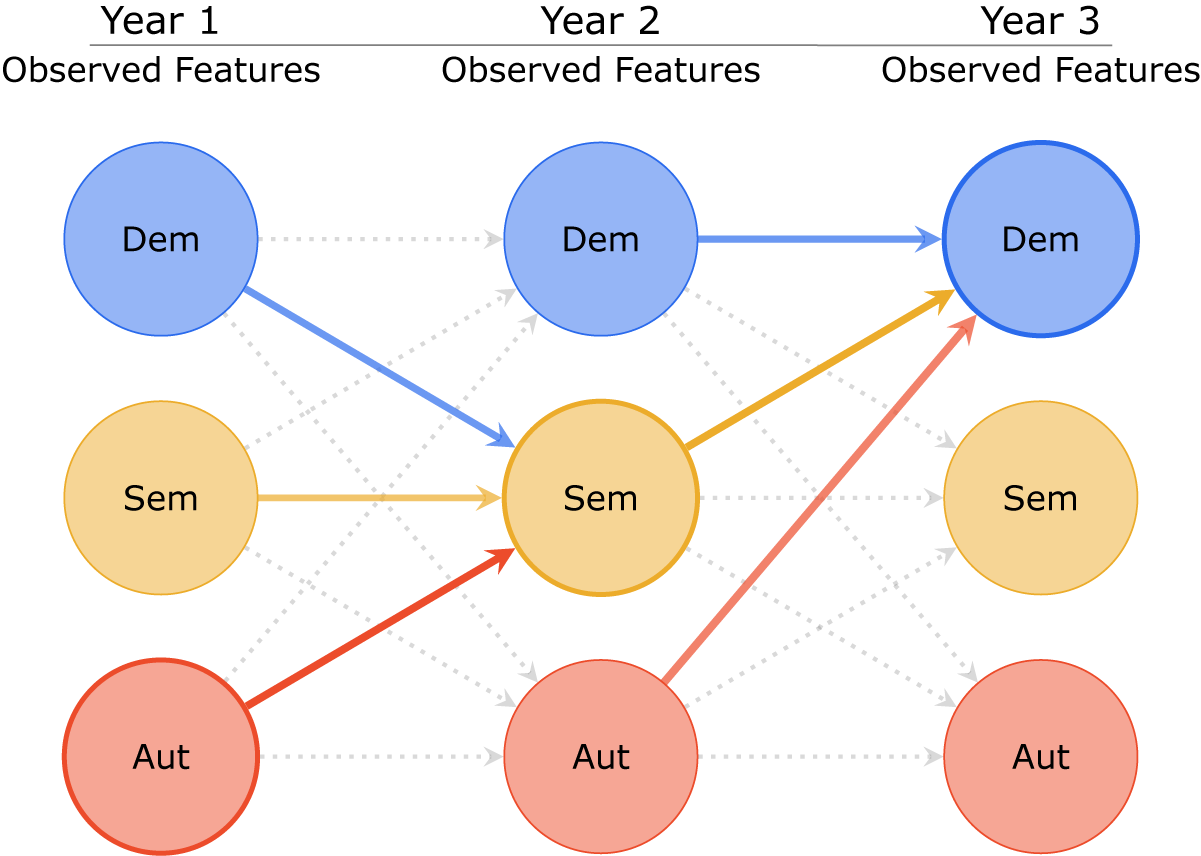
Given that we conceptualize (i) regimes as distinct types and (ii) transitions as movements among these types, an important strength of our approach is that it unifies the measurement of the two. To illustrate, consider a three-year period regime for a hypothetical country, as shown in Figure 1. The figure illustrates the possible regime types in a given year as democracy (blue), semi-democracy (yellow) and autocracy (red), along with the observable indicators (institutional, behavioral and perception-based features). It shows an example scenario where autocracy, semi-democracy and democracy have the highest probabilities in Year 1, Year 2 and Year 3, respectively, as indicated by the thick borders on these nodes. Suppose that we want to determine the probability that the country is a democracy in Year 3. To do so, we calculate the probability of all pathways that can lead to democracy in Year 3 through Year 1 and Year 2. There are three such paths from Year 2 to Year 3: the regime could have remained democratic, or transitioned from an autocracy or semi-democracy. Summing the probabilities of each of these three pathways would give us the probability of democracy in Year 3. To estimate the probability of each pathway, we need to know (1) what the observable features suggest today, (2) what the regime was in the previous period, and (3) how likely it is for a regime to move from one type to another (e.g., from semi-democracy to democracy). These probabilities are recursively calculated through time as a natural requirement of categorical conceptualization of regimes.
UNITAS: Unifying regime types and transitions. Note: The blue, yellow and red colors, respectively, indicate democracy, semi-democracy and autocracy. The figure illustrates a scenario where autocracy, semi-democracy and democracy have the highest probabilities in Year 1, Year 2 and Year 3, respectively, as shown by the thick borders on these nodes. The bold colored arrows trace the primary transition path (autocracy $\rightarrow $
semi-democracy
$\rightarrow $
semi-democracy $\rightarrow $
democracy). The gray dotted arrows show all other possible transitions with lower probabilities.
$\rightarrow $
democracy). The gray dotted arrows show all other possible transitions with lower probabilities.

2.1 Construction of UNITAS
The following algorithm summarizes our approach to measuring regime types. Building on the Hidden Markov Model (HMM) framework (Rabiner Reference Rabiner1989), we offer researchers flexibility in selecting regime indicators and the number of latent categories in operationalizing their theoretical regime construct. We present the technical details and mathematical derivations in Appendix A of the Supplementary Material.
-
1. Specify the number of regime types: Based on the theory and conceptualization, specify the number of regime types (e.g., dichotomous, trichotomous or more categories).
-
2. Select manifest regime indicators: Based on conceptualization, select regime indicators to include in estimation.
-
3. Fit the HMM: Estimate the initial, transition and emission probabilities for latent regime categories using the HMM approach, detailed in Appendix A of the Supplementary Material.
-
4. Calculate the probability of regime type sequences of interest: Use the parameters of the HMM to calculate the probabilities of short- and long-term regime type sequences.
-
5. Multiple imputation for subsequent empirical analyses: Draw m random regime datasets from the multinomial distribution based on calculated probabilities in Step 4. Using m imputed datasets, compute quantities of interest (e.g., regression coefficients). Calculate point estimates and standard errors from these multiple analyses.
2.2 Properties of UNITAS
Applying the steps above generates our unified measure of regime types and transitions in our illustrative application. The resulting measure provides information on 23,787 country-years from 1800 to 2017. As we described above, for each country-year, our model provides an estimated probability of being an autocracy, semi-democracy and democracy, as three mutually exclusive and exhaustive categories in our example. Country-years can either be hard-assigned deterministically to the regime type with the highest estimated probability (modal assignment), or soft-assigned probabilistically and incorporated into empirical analyses using multiple imputation, as detailed in Appendix A of the Supplementary Material. For presentational purposes, we briefly present hard-assignment for descriptive results here. Soft assignment through multiple imputation is used in the subsequent empirical application below. We treat regime transitions similarly.
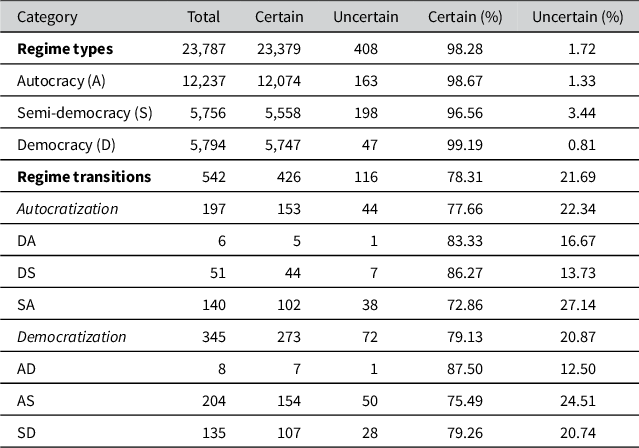
Table 1 shows that autocracy is the most frequent regime category (51.44%) during this time period, followed by democracies (24.36%) and semi-democracies (24.20%). Our approach also identifies 542 regime transitions (2.3%), with democratization (n = 345) being more common than autocratization (n = 197). In democratization episodes, transitions from autocracy to semi-democracy (n = 204) are more common, followed by semi-democracy to democracy (n = 135), with direct transitions from autocracy to democracy being highly rare (n = 8). Similarly, autocratization typically involves a shift from semi-democracy to autocracy (n = 140) or democracy to semi-democracy (n = 51), with direct democracy to autocracy transitions being the least frequent (n = 6). These patterns indicate that most transitions from autocracy to democracy (and vice versa) predominantly experience a semi-democracy period, for example, Greece’s multi-year transition from autocracy to democracy through a semi-democratic phase in 1975, consistent with previous findings by Epstein et al. (Reference Epstein, Bates, Goldstone, Kristensen and O’Halloran2006). Among the 14 cases of direct regime transitions between autocracy and democracy in a given year out of 23,787 country-years analyzed, all direct democracy–autocracy transitions involved military coups or seizures of power, while direct autocracy–democracy transitions occurred under exceptional circumstances, including post-war reconstruction, regime collapses or external interventions.Footnote 11
UNITAS regime types and transitions, 1800–2017
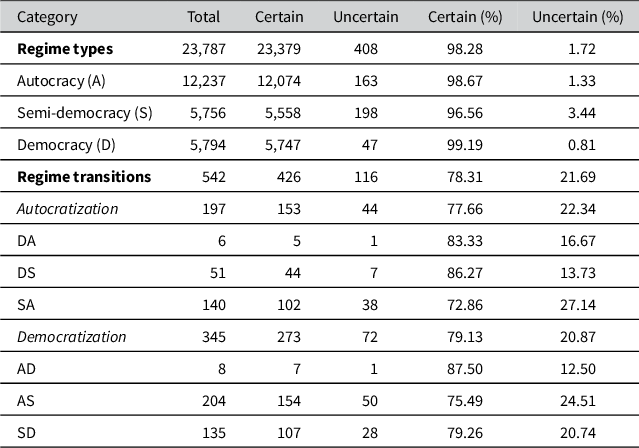
UNITAS quantifies the uncertainty in regime type and transition classifications using the estimated probabilities for regime categories and transitions.Footnote 12 For instance, one can classify an observation as certain if the estimated probability for the regime type assignment is 0.9 or higher, and uncertain otherwise, as we do in Table 1. Doing so reveals that 0.81% of democracy country-years are uncertain, while this rate is 1.33% and 3.44% for autocracy and semi-democracy classifications, respectively.Footnote 13 Moreover, uncertainty in regime transition classifications is far more common than in regime types: 21.69% of regime transitions overall are classified as uncertain with the above criterion, reflecting the often ambiguous nature of these shifts. For example, our measure indicates that Angola transitioned from autocracy to semi-democracy in 2009; however, this is a democratization process with uncertainty (the probability of this transition is 0.55) because the recent parliamentary elections, which were seen as a step toward multiparty democracy, were nevertheless marked by widespread reports of intimidation and irregularities. Given the relatively large number of similarly uncertain transition cases, unwarranted precision can lead to misleading conclusions in empirical analyses.
UNITAS has six desirable properties in identifying regime types and transitions, which we detail in Appendix B of the Supplementary Material. First, it combines information from regime indicators, treating them as imperfect signals of an underlying latent construct. Second, it jointly estimates regime types and transitions through a probabilistic framework. Third, it effectively captures both abrupt changes triggered by major events and gradual, multi-year changes driven by subtle shifts in political systems. Fourth, it captures long-term temporal dynamics by estimating probabilities of regime sequences of any length, allowing researchers to test implications of different historical trajectories, such as sustained transitions or failed democratization episodes. Fifth, it incorporates measurement uncertainty into inferences through multiple imputation, which avoids unwarranted certainty in empirical analyses while producing a fully rectangular dataset.Footnote 14 Our Monte Carlo simulations in Appendix C of the Supplementary Material show that, in estimating regime types, our approach successfully combines information from multiple imperfect indicators and accounts for measurement uncertainty.Footnote 15 In doing so, it achieves higher accuracy than individual regime indicators, including the most precise ones. Our HMM approach is also robust under various misspecification scenarios. Finally, as an indicator of its validity, comparisons with two existing continuous latent variable models, Unified Democracy Scores (UDS) (Pemstein et al. Reference Pemstein, Meserve and Melton2010) and Robust-Dynamic UDS (Reuning, Kenwick, and Fariss Reference Reuning, Kenwick and Fariss2019), show that UNITAS performs comparably in predicting regime indicator levels while achieving better performance in predicting year-to-year changes in indicators, as detailed in Appendix E of the Supplementary Material. We demonstrate the utility of this approach in an empirical application next.
3 Regime change and civil conflict: An empirical application
In this section, we replicate a widely cited study on regime transition and civil war by Cederman et al. (Reference Cederman, Hug and Krebs2010) using the UNITAS measure. In this study, the authors code periods in which the Polity score does not change more than two points around a center-point as periods of stability. If there is more than a two-point positive (negative) change, democratization (autocratization) is recorded in that year. The authors employ the UCDP/PRIO Armed Conflicts dataset (Gleditsch et al. Reference Gleditsch, Wallensteen, Eriksson, Sollenberg and Strand2002) to identify civil war onsets with an annual fatality threshold of 25 and include population, GDP per capita, as well as peace years and cubic splines to control for temporal dependence. They find support for the hypothesis that associates civil wars with democratization and provide some evidence for a similar relationship with autocratization (Cederman et al. Reference Cederman, Hug and Krebs2010, 387).
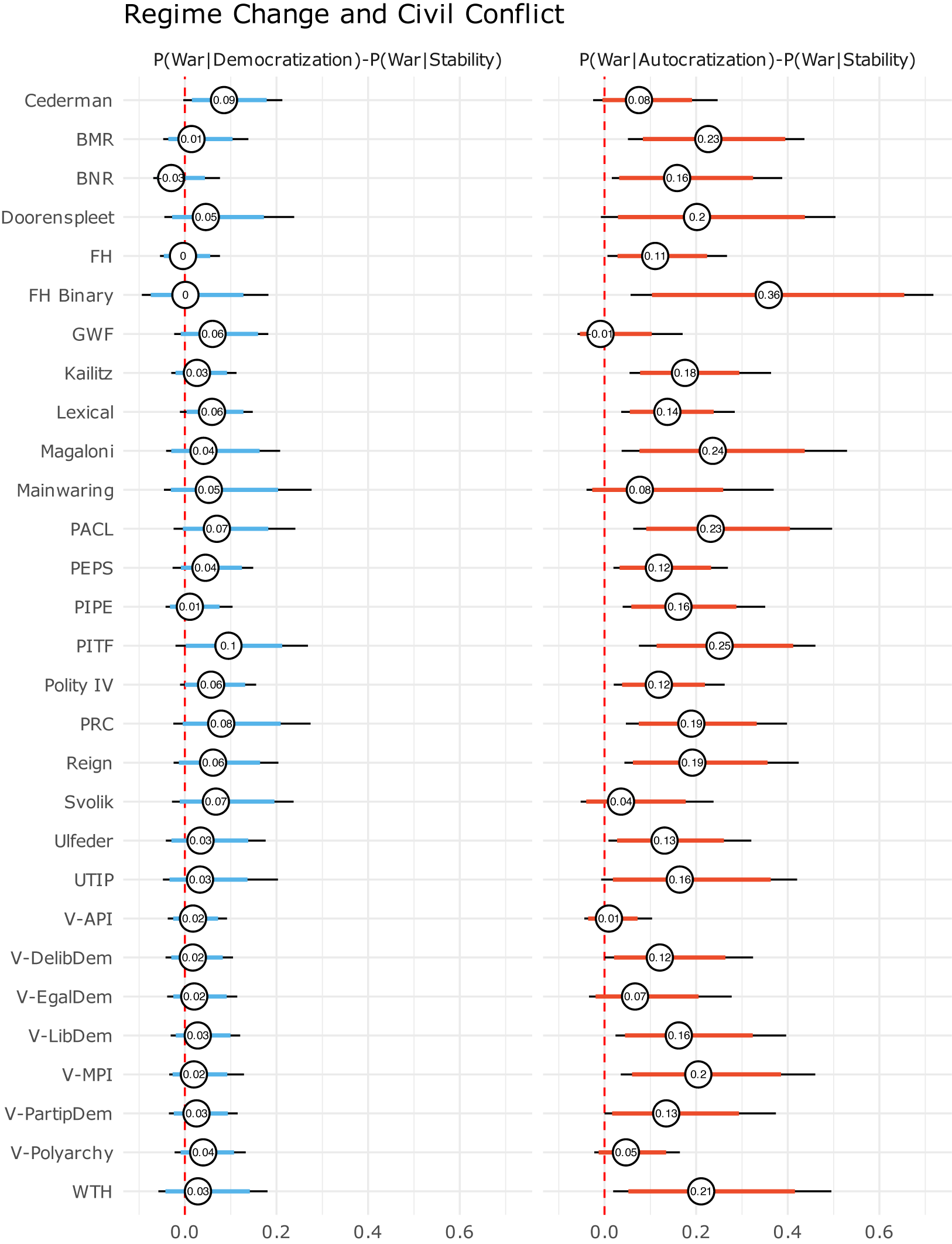
The first row in Figure 2 replicates the findings in Cederman, Hug and Krebs (Reference Cederman, Hug and Krebs2010, 383, Table 1, Model 1) and calculates the substantive effect of democratization and autocratization on the probability of civil war onset.Footnote 16 Compared to stability, democratization is associated with a 0.09 higher probability of civil war (with a 95% confidence interval from 0.015 to 0.18), and autocratization is associated with a 0.08 higher probability of civil war (with a 90% confidence interval from 0.002 to 0.17; the effect is not statistically significant at the 0.05 level).
The effect of regime change on civil war across datasets. Note: The figure plots the effect of autocratization and democratization compared to stability along with the 95% (thick) and 99% (thin) confidence intervals based on Table 1, Model 1 in Cederman et al. (Reference Cederman, Hug and Krebs2010, 383) with commonly used democracy indicators.
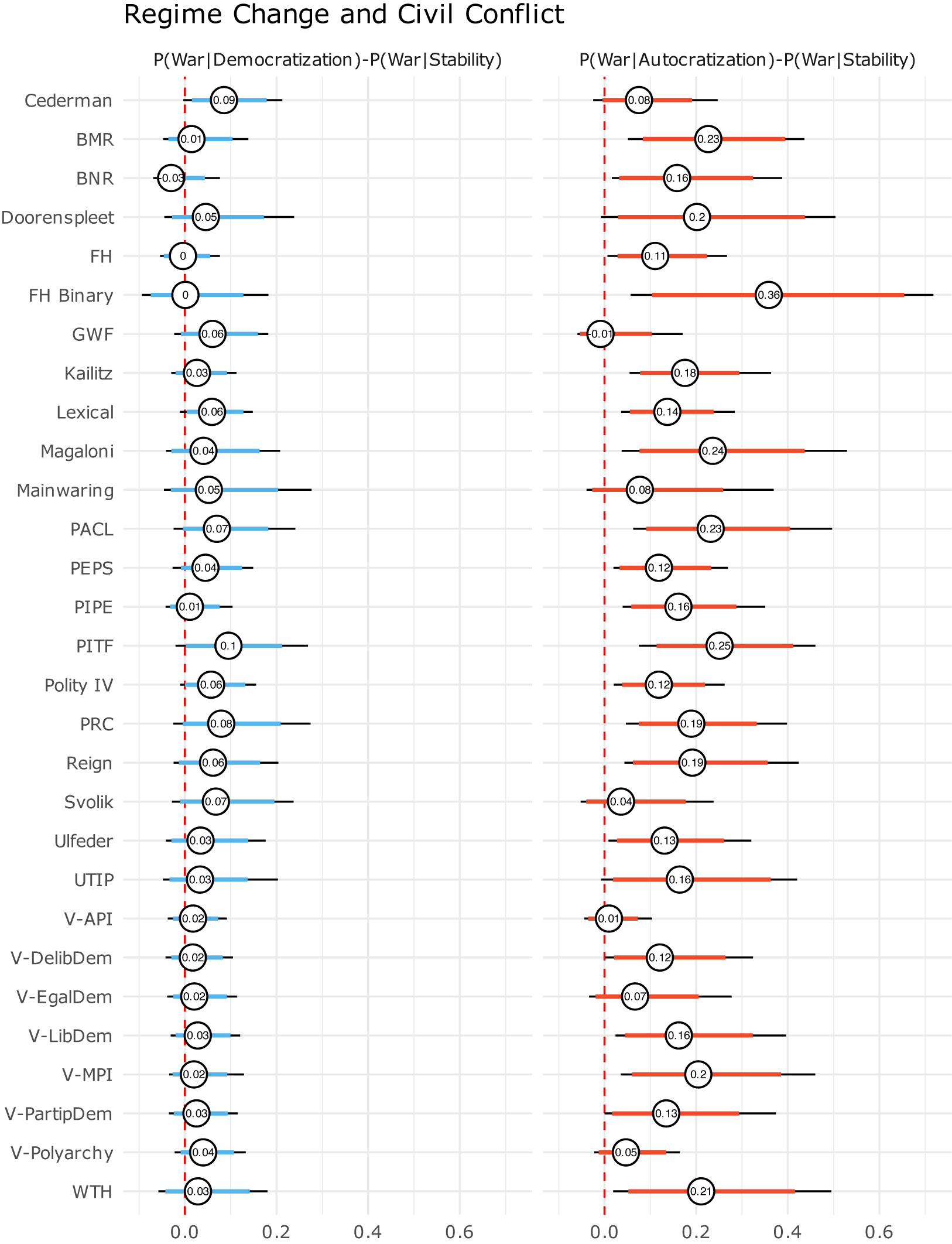
In the same figure, the remaining rows replicate the analysis by operationalizing regime transitions based on commonly used democracy indicators.Footnote 17 The results illustrate an important challenge in the field: measurement choices shape the conclusions about the relationship between regime transitions and conflict. When testing the same hypothesis with different democracy measures, 4 out of 29 specifications show that democratization significantly increases the probability of civil war, whereas the remaining 25 models report insignificant results. In contrast, 22 models report that autocratization does so, and the remaining seven models report null results. Without a systematic approach to reconcile these different results, it is hard to draw conclusions that extend beyond specific measurement choices.Footnote 18 UNITAS addresses this problem by combining information from these measures to capture a wide range of institutional, behavioral and perception-based features in the political system to identify democratization and autocratization episodes. As our Monte Carlo simulation results also demonstrate, UNITAS outperforms individual regime indicators in prediction accuracy, producing predictions closer to the data-generating process than any of the individual measures used.
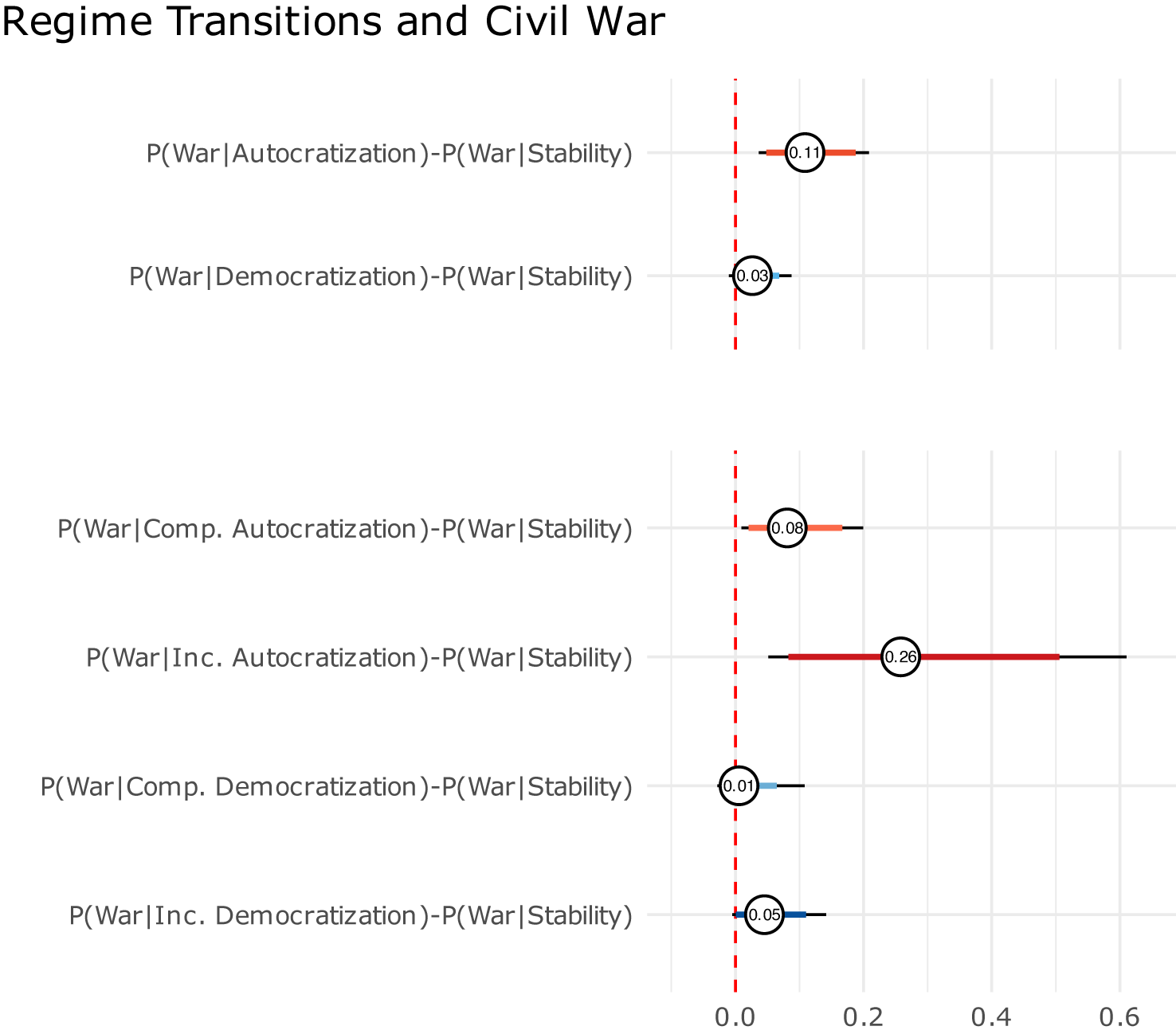
For empirical analysis, we first impute democratization, autocratization, stable democracy, stable autocracy and stable semi-democracy based on UNITAS probability distributions for each observation and generate 100 different datasets that contain regime type information. Next, we replicate the previous analysis in each simulated dataset and combine the regression results from these 100 imputations. The top panel in Figure 3 presents our comparable results, capturing the effect of a transition that takes place in a given year. Our findings indicate that while both democratization and autocratization are positively associated with civil war onset, only the effect of autocratization is statistically significant at $p < 0.05$
. More specifically, autocratization is associated with a 0.11 (95% CI: 0.05–0.19) higher probability of civil war.Footnote
19
Rather than leaving researchers to choose between conflicting findings from 29 different measures, UNITAS produces a single point estimate with the relevant confidence intervals.Footnote
20
$p < 0.05$
. More specifically, autocratization is associated with a 0.11 (95% CI: 0.05–0.19) higher probability of civil war.Footnote
19
Rather than leaving researchers to choose between conflicting findings from 29 different measures, UNITAS produces a single point estimate with the relevant confidence intervals.Footnote
20
Regime transitions and civil war. Note: The figure plots the effect of autocratization and democratization compared to stability along with the 95% (thick) and 99% (thin) confidence intervals. The top error bars combine all transitions by direction, whereas the bottom panel disaggregates transition types following Mansfield and Snyder (Reference Mansfield and Snyder2002).
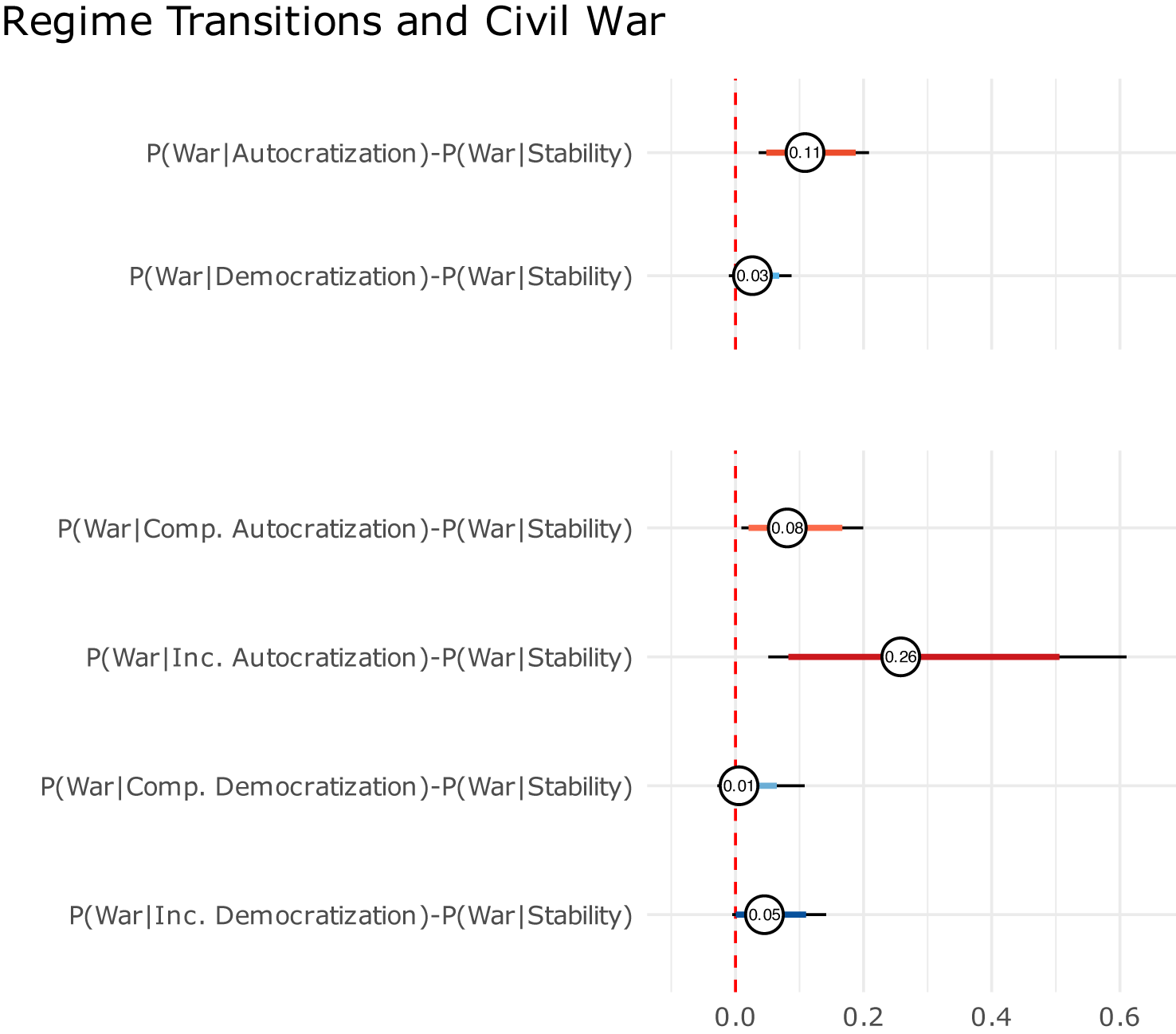
To examine which transitions drive these results, the bottom panel in Figure 3 further disaggregates regime transitions into four types based on origin and destination following Mansfield and Snyder (Reference Mansfield and Snyder2002): incomplete democratization (transitions from autocracy to semi-democracy), complete democratization (transitions from autocracy or semi-democracy to democracy), incomplete autocratization (transitions from democracy to semi-democracy) and complete autocratization (transitions from democracy or semi-democracy to autocracy). Our analysis reveals striking heterogeneity: incomplete autocratization, that is, democratic backsliding to semi-democracy, shows strong association with civil war onset, with a 0.26 (95% CI: 0.08–0.49) higher probability, while incomplete democratization, that is, transition from autocracy to semi-democracy is associated with only a 0.05 higher probability (95% CI: 0.00–0.11). This difference suggests that the erosion of existing democratic institutions is associated with substantively higher conflict risk than partial liberalization. Additionally, complete autocratization shows a moderate association, with a 0.08 (95% CI: 0.02–0.17) higher probability of civil war onset, whereas complete democratization shows no significant association (0.01, 95% CI: $-$
0.02 to 0.06). By incorporating information from multiple regime indicators and examining both aggregated and disaggregated transitions, we find that partial or complete erosion of democratic institutions seems to be the source of heightened conflict risk associated with regime transitions.
$-$
0.02 to 0.06). By incorporating information from multiple regime indicators and examining both aggregated and disaggregated transitions, we find that partial or complete erosion of democratic institutions seems to be the source of heightened conflict risk associated with regime transitions.
4 Conclusions
In this article, we introduced UNITAS, a unified approach to measuring political regime types and transitions that addresses several key challenges in the existing literature. By incorporating information from multiple indicators and capturing temporal dynamics in a single model, UNITAS reduces the dependence of inferences on specific datasets, cut-offs, magnitude-of-change and time-window assumptions, while efficiently handling missingness and measurement uncertainty. Monte Carlo simulations demonstrate that this unified method improves measurement accuracy and consistently outperforms individual regime measures, even the most precise ones. Our validation comparisons with existing continuous latent variable models (Pemstein et al. Reference Pemstein, Meserve and Melton2010; Reuning et al. Reference Reuning, Kenwick and Fariss2019) show that UNITAS performs comparably in predicting regime indicator levels while achieving better performance overall in predicting year-to-year changes in indicators.
We illustrated the practical utility of our approach with an application on the link between regime transitions and civil war onset. When testing identical hypotheses using 29 different regime measures, one reaches different conclusions on the link between regime transitions and conflict. Our unified approach contributes to this long-standing debate in two ways: First, we find that autocratization is associated with a higher probability of civil war, whereas democratization is not. Second, among incomplete transitions, democratic backsliding (transitions from democracy to semi-democracy) is associated with far greater conflict risk than partial liberalization (transitions from autocracy to semi-democracy). Furthermore, our analyses presented in the Supplementary Material show that the apparent association between semi-democracies and conflict is not an inherent feature of these regime types, but rather results from conflating the effect of regime type with transitions and regime instability, which our measure disentangles by explicitly modeling temporal dynamics.
Our approach advances regime measurement in three significant ways: First, it offers flexibility to researchers in operationalizing their specific regime conceptualizations. For instance, using the HMM approach, one can easily estimate regime types and transitions in Polity IV based on its three dimensions (executive recruitment, executive constraints and political competition). Alternatively, drawing on recent research, one can dissect authoritarian regimes further by considering specific dimensions, such as the mechanisms of power transfer or institutional structures. In doing so, scholars can maintain theoretical precision in operationalizing their conceptual construct and benefit from our model’s strength in handling temporal dynamics and measurement error. Second, for scholars with specific theoretical reasons to use a single regime indicator, our approach can provide insights into the properties of that measure, its effectiveness in distinguishing regime types and its alignment with other measurement approaches. Third, our Monte Carlo simulations demonstrate that cut-offs on ordinal/continuous measures can introduce significant bias. Instead, alternative functional forms (e.g., quadratic and linear) implied by theory, or non-parametric approaches (e.g., Jones and Lupu Reference Jones and Lupu2018) may offer better alternatives.
Acknowledgements
We thank Ekrem Baser, Reşat Bayer, Kristian Skrede Gleditsch, Barry Hashimoto and Elena McLean for their invaluable feedback. We also thank the participants of the Eurasian Peace Science Conference and the Peace Science Society Conference for valuable insights. Special thanks to Rhiane Kall for research assistance and Philip Rodenbough for editorial support.
Funding statement
We thank NYU Abu Dhabi for financial support.
Data availability statement
Replication code for this article has been published in the Political Analysis Harvard Dataverse at https://doi.org/10.7910/DVN/QPAALU (Orsun and Bas Reference Orsun and Bas2026).
Competing interests
The authors declare no competing interests.
Supplementary material
The supplementary material for this article can be found at https://doi.org/10.1017/pan.2026.10042.





 Open access

