


1 Introduction
The total cost of preventing someone from dying of malaria has been reported as being about $3,340 USD (Reference HillebrandtHillebrandt 2015). While progress has been made, malaria and other diseases that we already have the tools to address are still responsible for millions of deaths each year and disproportionately kill young children. Non-governmental organizations (NGOs) like the Against Malaria Foundation, the Schistosomiasis Control Initiative, and GiveDirectly have been demonstrated to be very effective in using donations to save lives and produce other positive health outcomes for some of the poorest people in the world. But what does it take to convince ordinary people to devote some of their resources to these worthy causes?
In this paper we present a novel study that shows that, in addition to emotional appeals, which have already been demonstrated to promote charitable giving, a rational appeal in the form of a philosophical argument can also do so. Indeed, the rational appeal that we developed based on Peter Singer’s “shallow pond” argument (Reference SingerSinger, 1972) produced an effect on charitable giving behavior similar to a type of powerful emotional appeal, involving the photo of a single child in need. The relative success of emotional appeals has been taken by many to show that rationality has little place in motivating prosocial behavior. While we found no evidence for our hypothesis that a combined rational-and-emotional appeal would perform best, or that one particular combined ordering would be better than the other, our hypothesis that an ethical argument can affect donations was supported. Further, there wasn’t a significant difference between the effect of the argument and the single-child-style emotional appeal. We describe these findings and reflect on their implications for moral psychology, ethics, and the practical task of motivating charitable giving.
2 Emotional and rational appeals
As suggested above, the view that emotions are the primary – if not exclusive – drivers of moral decision-making is highly influential in moral psychology (Reference HaidtHaidt, 2001, 2012). In the domain of charitable giving, some attempts to provide rationally relevant information to decision-makers have been ineffective, and even counterproductive. Reference Small, Loewenstein and SlovicSmall, Loewenstein and Slovic (2007) found that appeals that include a photo of a single girl named Rokia living in poverty in Mali were more effective in garnering charitable donations than appeals that provided information about the number of people in need of assistance. Donations to this single victim of poverty were considerably higher than donations to “statistical” victims, in line with the “identifiable-victim effect” (Reference Genevsky, Västfjäll, Slovic and KnutsonGenevsky et al., 2013, Reference Schelling and ChaseSchelling, 1968; Reference Jenni and LoewensteinJenni & Loewenstein, 1997; Reference Small and LoewensteinSmall & Loewenstein, 2003). Most notably, adding statistical information to an appeal featuring a single identifiable person in need reduced the amount donated (Reference Small, Loewenstein and SlovicSmall, Loewenstein & Slovic, 2007). Reference SlovicSlovic (2007) presented further evidence in support of this view and argued that the phenomenon of “psychic numbing” (Reference LiftonLifton, 1967) explains the turning off of feeling as participants move from considering one individual to considering two or more. More generally, other research indicates that pro-social behavior is primarily intuitive and often inhibited by reasoning and reflection (Reference Rand, Greene and NowakRand, Greene & Nowak, 2012; Reference Rand, Peysakhovich, Kraft-Todd, Newman, Wurzbacher, Nowak and GreeneRand et al., 2014; Reference RandRand, 2016; Reference Everett, Ingbretsen, Cushman and CikaraEverett et al., 2017). These findings do not show that all attempts to encourage charitable giving through rational persuasion are doomed, but they illustrate the formidability of the challenge.
On the other hand, the rise of the Effective Altruism movement, which was inspired by the work of Peter Singer (e.g., Reference SingerSinger 1972, 2015), strongly suggests that many people have been convinced to donate their money to aid the world’s neediest people through rational argumentation. Philosophical arguments are rational appeals, and it is striking that these arguments generally have not had their effects tested empirically. One of the few examples of an argument being tested comes from a study in which researchers attempted to persuade participants using an evolutionary debunking argument (Reference Paxton, Ungar and GreenePaxton, Ungar & Greene, 2012). There is also evidence that a tendency toward reflection and actively open-minded thinking can influence moral judgment (Reference Baron, Scott, Fincher and MetzBaron et al., 2015; Reference Paxton, Ungar and GreenePaxton, Ungar, & Greene, 2012; Reference Paxton, Bruni and GreenePaxton, Bruni & Greene, 2013). But the efficacy of philosophical arguments remains, on the whole, unknown.
3 Motivation for the study
Putting these two perspectives together, in this paper we examine how a rational appeal of the type put forward by Singer fares against the type of prominent image-based emotional appeal used by Reference Small, Loewenstein and SlovicSmall, Loewenstein and Slovic (2007). The dominant view’s pessimism about the role of rationality in moral motivation can be defensible only if the efficacy of the best rational appeals is tested empirically. Given the track record of philosophical arguments in inspiring movements like the Effective Altruism movement and the Animal Rights movement (Reference Jasper and NelkinJasper & Nelkin, 1992), we maintain cautious optimism concerning the potential for reasoned persuasion in this domain.
In a pilot study we found that a rational appeal can perform just as well in motivating people to help those living in severe poverty as a photo-of-a-child style appeal. We also observed in the pilot that a combined appeal, presenting the one-child emotional appeal and then providing the rational appeal, was even more effective. The theoretical basis for testing the combined appeal was that a strong basic motivation would be activated by the emotional appeal, whereas the rational appeal will provide a justification that further increases motivation.
In this study, we aimed to investigate whether these preliminary findings hold in a pre-registered study. We hypothesized that (1) the rational appeal that we have developed would increase donations, (2) the emotional appeal would also have a positive effect, and (3) that a combined appeal involving both the emotional and rational appeals, in that order, would be more effective in increasing donations than either appeal on its own.
In addition to examining the efficacy of a combined emotional-rational appeal, our study asked whether the effect of a combined appeal depends on the ordering of its components. A fourth tentative hypothesis of ours was that (4) presenting the emotional appeal first and the rational appeal second would perform better in garnering donations than the reverse order. Our reason for this expectation about ordering was that presenting the emotional appeal first would put people in the mode of thinking and caring about actual people living in severe poverty. The rational appeal that followed would then provide a strong justification for taking these thoughts and emotions seriously and donating, and this would have additional motivational force. Conversely, starting with a rational appeal, we thought, might not provide the same initial grip on participants (even if, as hypotheses (1) and (2) predict, the rational and emotional appeals would both have positive effects when presented on their own). Such a possible order effect, while of secondary concern, is still of interest in seeking a better understanding of the relationship between rationality and emotion in motivating charitable giving.
To summarize, our hypotheses:
1. that the rational appeal will have a positive effect in garnering donations compared to no appeal.
2. that the emotional appeal will also have a positive effect compared to no appeal.
3. that a combined appeal consisting of the emotional appeal first and the rational appeal second will result in greater mean donations than either appeal alone.
4. that presenting the emotional appeal first and the rational appeal second will result in greater mean donations than the reverse order.
We did not hypothesize that the effects of the rational appeal and the emotional appeal would differ in mean donations given. However, given that the content of these two appeals is very different, they could differ in other ways (e.g., personal emotional reaction, rate of donation).
To test these hypotheses, we designed a between-participants study. Participants were randomly assigned to one of the four appeal conditions (emotional, rational, combined-emotional-first, combined-rational-first) or the control condition involving no appeal. They were then told at the beginning of the survey that they would be paid $1.50 for their participation, but would also be entered in a drawing for a chance of winning an additional $100. After reading the appeal to which they were assigned, or as the first step if they were assigned to the control condition, they had the opportunity to commit to donating some portion of the $100 they might win. It was explained that their donation, if given, would go to an organization that works effectively to address the poverty-related problems of children in developing countries, more specifically, one of the top organizations working on global poverty as rated by GiveWell. They were given the GiveWell website address (http://www.givewell.org/), and it was explained that GiveWell is an independent organization that carries out research to find the organizations that do the most good per dollar received according to a number of strict, testable criteria. They were then asked to write in some number between 0 and 100 to indicate how much of the $100 they wanted to donate if they won. This contingent donation method has been used in other studies examining donation behavior (e.g., Reference Soyer and HogarthSoyer & Hogarth, 2011) and allowed us to examine decisions with significant real-world effects while keeping the cost of our study manageable.
Data quality was assessed by two factors: survey completion time and a 3-item, multiple choice attention check section administered at the end of the survey. These questions sought information that was obvious in the scenario (e.g. “What was the name of the girl that was helped by the charity?”). Participants answering fewer than 2 of these questions correctly were removed from the analysis. Participants with completion times more than 2 standard deviations below the mean were removed.
Because we used specific rational and emotional appeals, we were aware that we would not be able to draw conclusions about other rational and emotional appeals, nor about such appeals in general. Of course, the number of possible rational and emotional appeals is effectively infinite, and we don’t see a way to test a truly representative sample of all these possibilities. Nor was this our goal. We chose the specific appeals that we did based on prior research and theory. The emotional appeal was modeled on the Rokia studies described above, which have been highly influential both in moral psychology and in the work of international organizations, including UNHCR. We chose the specific rational appeal that we developed because it is modeled on the apparently successful appeal made by Peter Singer in his classic article “Famine, Affluence, and Morality” (Reference SingerSinger, 1972), which is cited as a core motivating essay by Effective Altruists and has been reiterated by many others. Thus, we tested a specific strategy that had some theoretical and historical motivation behind it. And while our work is not directly applied, we hope that it might pave the way for more directly applied research.
4 Study on rational and emotional appeal
Note: The experimental methods and analyses described below (unless otherwise noted) follow our pre-registered analysis plan, as described at https://osf.io/bdnz2.
4.1 Method
4.1.1 Participants
Participants were 1,260 American adults recruited through Prolific, paid $1.50 to participate in a short online survey. To increase the representativeness of the data for the US population, Prolific’s “Representative Sampling” service was employed, using quota based sampling with criteria for age, gender, and ethnicity. Participants who passed data quality checks were included in further analysis (N = 975). The resulting sample analyzed was 53.7% female (45.3% male, 0.9% other) with a mean age of 44.82 (SD = 15.86). Allowing multiple racial identity selection, 77.2% of participants identified as white, 13.4% black, 7.5% Asian, 4.3% Latino, 1.2% Native American, and 1.0% other. In terms of socioeconomic status, 54.1% possessed a bachelor’s degree or higher and median household income was $40,000–$49,999. Political orientation was assessed separately for social and economic issues; 65.2% identified as at least slightly liberal in social issues (14.5% moderate, 20.4% conservative); 54.2% identified as at least slightly liberal in economic issues (17.3% moderate, 28.5% conservative). In terms of reported monetary donation frequency, 14.7% were regular donors, 25.3% periodic donors, 29.4% donated on occasion, 25% donated very rarely, and 5.5% reported never donating.
4.1.2 Materials and design
The appeals from our pilot studies (in the Appendix) were presented at the beginning of the survey. In the case of the combined appeal conditions, either the rational or the emotional appeal appeared first and a bridging statement was used between them (“Now please also read the following appeal”). In the appeal conditions (emotional, rational, combined-emotional-first, combined-rational-first), participants read the appeal(s) assigned to them and then the donation prompt. In the control condition (no appeal), participants went straight to the donation prompt. The donation prompt asked participants what amount of the additional $100 that they might win, from $0 to the full amount, they would like to donate to one of the top organizations working on global poverty as rated by GiveWell. After the donation prompt, participants completed affective measures including ratings of upset (“I feel upset”), sympathy (“I feel sympathy for children in severe poverty”), closeness (“I feel close to children in severe poverty”), moral responsibility (“I have a moral responsibility to help children in severe poverty”), and efficacy (“I can make a difference in helping children in severe poverty”). Next, participants responded to an open-ended prompt to describe their thoughts during reading of the appeal. Finally, participants completed an individual difference measure of affect responses (Emotional Reactivity Test) and a demographic information form.
4.2 Results
Descriptive statistics for donation amounts, split by appeal condition, are shown in Table 1. All appeal conditions resulted in higher mean donations than the control condition with no appeal (M = 35.66, SD = 32.78). The donation frequencies were trimodal, with peaks at $0, $50, and $100. A plot of the fitted residuals and Q-Q plot revealed a non-normal distribution of error values, although a Levene’s test did not indicate heterogeneity of variances (F(4, 970)=0.57, p=.69). To account for these issues, non-parametric tests were added to supplement traditional least-squares tests. The percentage of participants who donated varied little across the conditions with 80.6–86.7% choosing to donate at least some amount.

For affective and reaction measures (Table 2), the appeal conditions differed little in terms of reported degrees of being upset following reading the appeal, but were noticeably higher than the control condition, t(973) = 4.19, p < .001). Reported sympathy (F(4, 970) = 2.03, p = .09), closeness (F(4, 970) = 0.90, p = .47), moral responsibility (F(4, 970) = 1.07, p = .37), and perceived efficacy (F(4, 970) = 1.63, p = .17) did not differ significantly across the conditions.

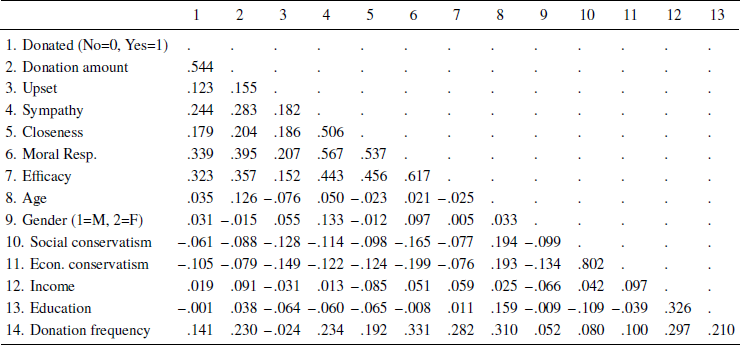
Table 3 presents the Pearson-correlation matrix for donation behaviors, affective and reaction measures, and demographic variables. Notable findings concerning donation decisions are as follows: The decision to donate significantly correlated with the rated upset following the appeal (r = .12), sympathy for children in severe poverty (r = .24), closeness (r = .18), moral responsibility (r = .34), and perceived efficacy (r = .32), as well as economic political orientation (r = −.11, p = .001) and reported frequency of donations in general (r = .14, p = .001). Donation amount was also significantly correlated with the rated upset following the appeal (r = .16), sympathy for children in severe poverty (r = .28), closeness (r = .20), moral responsibility (r = .40), and perceived efficacy (r = .36), as well age (r = −.13, p = .001) and reported frequency of donations in general (r = .14). Donation amount was also related to social and economic political orientations (r = −.09; r = −.09, respectively), with liberals donating more than conservatives. Not surprisingly, participants who donated more frequently in general donated higher amounts in this context (r = .23).
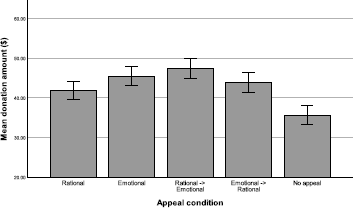
Donation amounts were analyzed using regression with planned orthogonal contrast codes to compare the appeal conditions (Figure 1). Due to the non-normal distribution of the residuals, Mann-Whitney U tests supplemented linear contrasts to assess for differences in donation distributions between conditions. Significance is reported using one-tailed tests. The rational appeal significantly increased donations over the control condition (std. b = −.057, p = .036, 95% CI = [−6.45, .28], Mann-Whitney U p = .023. The emotional appeal also increased donations significantly over the control condition, std. b = −.092, p = .002, CI = [−8.27, −1.57] Mann-Whitney U p = .001. When the appeals were combined (emotional appeal, then rational), it increased the donation amount similar to the single appeals, not differing significantly from the rational appeal alone (std. b = .020, p = .270, CI = [−2.31, 4.42], Mann-Whitney U p = .298), the emotional appeal alone (std. b = −.015, p = .324, CI = [−4.14, 2.57], Mann-Whitney U p = .298), or when collapsing across the single appeals, std. b = .003, p = .464, CI = [−1.85, 2.03], Mann-Whitney U p = .499. The two combined appeal conditions also did not significantly differ in terms of donation amount, std. b = −.032, p = .160, CI = [−5.14, 1.68], Mann-Whitney U p = .199.
Mean donation amount by appeal condition, error bars represent +/- 1 S.E.
5 Overview of findings and concluding remarks
The results supported our first two hypotheses, which were that (1) a rational appeal and (2) an emotional appeal can have a significant positive effect on charitable giving behavior. Notably, the effects of the philosophical argument and the emotional appeal on donations did not differ significantly. Our hypotheses that (3) a combined appeal would be more effective than either appeal alone and that (4) an emotional-first combined appeal would do better than a rational-first combined appeal were not supported. In fact, the rational-first combined appeal performed the best of the four appeals, though not significantly better than the others.
In highlighting the effects of the rational and emotional appeals, as compared to the no-appeal control condition, one might object that these results are simply due to “experimenter demand”. However, taken in context, this is not a deflationary alternative explanation. Requests for charitable donations are intended as “demands” – not in the sense of being insistent or impolite, but as explicit requests for a specific behavioral response. Given that the requested behavior involves a costly risk, responding positively to the request is not trivial, as it might be in other contexts. The challenge for the present research program, then, is not to avoid making “demands” of our participants, but rather to determine which kinds of “demands” are effective, in both relative and absolute terms.
It is also worth noting that the inclusion of a philosophical argument in the combined appeals did not significantly dampen the effect of the emotional appeal. The rational-first combined appeal performed slightly better than the emotional appeal alone, and the emotional-first combined appeal performed slightly worse than the emotional appeal, but again, these differences were not statistically significant. By contrast, Reference Small, Loewenstein and SlovicSmall et al. (2007) found that the addition of information on the number of people in need to an emotional appeal significantly suppressed donations. This observation, along with the significant effect of the philosophical argument in the rational appeal condition, suggests that it may be worth examining differences within the broad and loosely-defined category of rational appeals.
We acknowledge that our distinction between “rational” and “emotional” appeals is a rough one and that all effective appeals are likely – if not guaranteed—to have both rational and emotional aspects. Reference Hume, Selby-Bigge and NidditchHume (1739/1975) argued long ago that the apparent distinction between “reason” and “passion” is better understood as a distinction between “calm” and “violent” passions. Likewise, the distinction between emotion and reason is a perennial target of (legitimate) criticism among psychologists (e.g., Cunningham et al. 2007; Reference Van Bavel, Xiao and CunninghamVan Bavel, Xiao & Cunningham 2012; Reference CushmanCushman, 2013; Reference Phelps, Lempert and Sokol-HessnerPhelps, Lempert & Sokol-Hessner 2014). Consistent with this view, we note that participants reported being more upset by what they read in the rational appeal condition, as compared to the control condition. Thus, for present purposes, we regard “rational” and “emotional” as convenient labels for familiar styles of persuasion, reflecting degrees of difference along multiple psychological dimensions. We do not take them to refer to sharply defined and wholly distinct sets of psychological processes. Further research will be required to dissociate the relevant underlying processes and their respective contributions.
Our results do, however, cast doubt on the standard view that appeals that are rational in this familiar sense are invariably less effective than conventionally emotional appeals in garnering charitable donations. A philosophical argument, we found, can be as effective as an emotional appeal of the kind that has led many to adopt the standard view. Of course, this is not to say that philosophical arguments will be effective in general, and again, when they do have motivational force this may be partially or entirely due to their affective influence. But some arguments, it is reasonable to think on the basis of our results, may be able to convince people to donate more, and so perhaps there is a role for rational appeals in motivating prosocial behavior after all. This work complements recent work showing that Rawlsian veil-of-ignorance reasoning can influence moral judgment, including decisions to donate to more effective causes (Reference Huang, Greene and BazermanHuang, Greene & Bazerman, 2019).
There may be additional benefits to studying the impact of arguments as opposed to emotional appeals that we haven’t been able to explore in this paper. Emotional appeals would seem to work primarily on people’s immediate emotional affect, which is subject to depletion based on repeated exposure and over time. Ethical arguments, however, often aim to convince people to change their way of thinking about their own behavior and how they should treat other beings, human and non-human. When arguments succeed in changing people’s thinking, they may lead to longer term changes in behavior – more sustained giving, changes to diet and food choices, lowering one’s carbon emissions, and so on. This is consistent with the prior points recognizing that affect may play an important role in the motivational force of ethical arguments. Further research must be conducted to examine the long-term effects of exposure to arguments on behavior and the relation of these effects to the arousal of affect, but our study provides evidence that, at least in the short term, a philosophical argument can have a significant effect in motivating prosocial behavior.
While some philosophers have thought that the study of morality is no different from inquiry into any other topic, others have held that moral and political concepts should be fruitful in helping us to solve problems that we face as agents interacting with other agents and non-agent sentient creatures (Lindauer forthcoming). Our work demonstrates that thinking about charitable giving in terms of duties of assistance, a positive duty, has the virtue of motivating moral action and so meets this desideratum. Insofar as the shallow pond argument motivates moral behavior, it is practically fruitful in a way that other arguments may not be, and this, according to some philosophers, should go into the evaluation of the argument, in addition to its validity and soundness. Other approaches may also be examined, such as comparing positive duty arguments with arguments that focus on negative duties or duties not to harm (Buckland et al.). While many philosophers have been committed, often implicitly, to the practical effects of their ideas and arguments mattering for their evaluation, we take a step further here and attempt to directly test the effectiveness of a particular argument. We look forward to seeing more research conducted on the practical effects of philosophical arguments, including arguments that focus on other pressing moral problems, such as climate change and the plight of refugees.
Despite the restrictions in the scope of our study discussed above, our findings provide insight into the factors that motivate people to address global poverty and perhaps other pressing moral issues. They will also help us to understand the range of possible forms of moral motivation, promoting a more nuanced account of the role of reason and emotion in prosocial behavior.
We hope that this line of research can inform the work of NGOs. As noted above, prior research has suggested that rational appeals will generally suppress the positive effects of emotional appeals, but this wasn’t the case in our study. If, as our results suggest, philosophical arguments have some motivating force of their own and need not undermine more conventionally emotional appeals, it may be wise to employ both types of persuasion, deploying them at different times, with different audiences, and with different types of goals. As the history of these ideas suggests (Reference SingerSinger, 1972, 2015), rational appeals may prove especially effective in producing long-term changes in values, attitudes, and behaviors regarding pressing moral problems.
Appendix
The following appeals were used in our study.
Rational Appeal
Please read the following appeal:
As you know, there are many children who live in conditions of severe poverty. As a result, their health, mental development, and even their lives are at risk from lack of safe water, basic health care, and healthy food. These children suffer from malnutrition, unsanitary living conditions, and are susceptible to a variety of diseases such as malaria, dysentery, and cholera. Fortunately, effective aid agencies know how to handle these problems, but their resources are limited.
Almost all of us think that we should save the life of a child in front of us who is at risk of dying (for example, a child drowning in a shallow pond) if we are able to do so. Most people also agree that all lives are of equal moral worth. The lives of faraway children are no less morally significant than the lives of children close to us, but nearby children exert a more powerful emotional influence. Why?
Scientists have a plausible answer: We evolved in small groups in which people helped their neighbors and were suspicious of outsiders, who were often hostile. Today we still have these “Us versus Them” biases, even when outsiders pose no threat to us and could benefit enormously from our help. Our biological history may predispose us to ignore the suffering of faraway people, but we don’t have to act that way.
By taking money that we would otherwise spend on needless luxuries and donating it to an effective aid agency, we can have a big impact. We can provide safe water, basic health care, and healthy food to children living in severe poverty, saving lives and relieving suffering
Shouldn’t we, then, use at least some of our extra money to help children in severe poverty? By doing so, we can help these children to realize their potential for a full life. Great progress has been made in recent years in addressing the problem of global poverty, but the problem isn’t being solved fast enough. Through charitable giving, you can contribute towards more rapid progress in overcoming severe poverty.
Emotional Appeal
Please read the following appeal:
As you know, there are many children who live in conditions of severe poverty. As a result, their health, mental development, and even their lives are at risk from lack of safe water, basic health care, and healthy food. These children suffer from malnutrition, unsanitary living conditions, and are susceptible to a variety of diseases such as malaria, dysentery, and cholera. Fortunately, effective aid agencies know how to handle these problems, but their resources are limited.

This is Aisha. Aisha lives in Chad, and is one of the children who was helped by charitable donations that were sent to an effective aid organization working on global poverty. Great progress has been made in recent years in addressing the problem of global poverty, but the problem isn’t being solved fast enough. Through charitable giving, you can contribute towards more rapid progress that will mean children like Aisha do not have to live in severe poverty.
Donation Prompt
You will be paid the amount specified earlier for participating in this study. However, you will also be entered in a drawing for a chance of winning an additional $100.
We offer you the opportunity, should you receive the additional $100, to donate some of this money to an organization that works effectively to address the poverty-related problems of children in developing countries. You can use the box below to choose the amount that you are willing to commit to giving, if you are selected to receive the $100. Select 0 if you do not wish to donate anything, or 100 if you wish to donate all your winnings, or any number in between to indicate how much you wish to donate. We will pay you the remaining part of the bonus and will donate the amount you chose to one of the top organizations working on global poverty as rated by GiveWell (http://www.givewell.org). GiveWell is an independent organization that carries out research to find the organizations that do the most good per dollar received, according to a number of strict, testable criteria.


 Open access

