


Despite no great influx of illegal immigrants and what the mayor himself admits has been little trouble, Valley Park, Mo., Mayor Jeffery Whitaker decided his town would tackle the issue.
–Janet Shamlian, “Town’s Mayor Tackles Illegal Immigration”, NBC News, 2006.
Introduction
Since the rapid growth of immigrant populations in the early 2000s, hundreds of municipalities and counties across the United States have proposed or implemented immigrant-related policies. These policies range from restrictive ordinances aimed at driving out undocumented immigrants to permissive policies that support the basic rights of the newcomers (Steil and Vasi Reference Steil and Vasi2014; Walker and Leitner Reference Walker and Leitner2011). Studies that have examined the recent wave of municipal immigration policy-making have theorized that a rapid shift in local demographics threatens native-born residents’ status, leading to exclusionary policies to halt migration (Hopkins Reference Hopkins2010; Newman et al. Reference Newman, Hartman and Taber2012; Ramakrishnan and Lewis Reference Ramakrishnan and Lewis2005).
While these studies have developed an important theoretical framework for understanding policies that target immigrants at a local level, less understood are the ways in which policies are impacted by the spatial relationships among localities. That is, in examining demographic changes that happen in a given locality, prior studies have treated each place as an ontologically separate unit, isolated from factors in nearby areas. Here, we investigate whether local policymakers take into consideration demographic patterns in neighboring localities when considering immigrant-related policy.
The core motivation of this research is to expand our definition of the factors that influence local ordinances beyond the current focus on the locality in question, thereby enriching our theoretical understanding of the determinants of anti-immigrant legislation and local policy writ large. Specifically, we focus on the spatial relationships in local immigration policies by examining whether the presence of immigrants in a nearby locality influences whether a city considers an anti-immigrant ordinance. Are local policymakers attentive to the presence of immigrants in their neighboring areas in addition to their own? Upon observing a large stock of immigrants in their surrounding regions, do their legislative behaviors change in anticipation of future spillovers?
We document evidence of just such a pattern, and argue that it is consistent with a story of ex ante immigration policymaking in which policymakers attempt to “close the door” to potential foreign-born populations before they arrive. In addition to previous scholarship that predicts hostile political reactions to a change in local demographics, we find an important role played by the level of the immigrant population in neighboring areas. When it comes to the population beyond its jurisdiction, our findings suggest that city governments are sensitive to the stock of neighboring immigrant populations and consider policies in anticipation of future inflows.
We evaluate two potential pathways by which a local government learns about what goes on in the nearby areas: through direct observation (proxied with commuting flows) and through local news coverage (proxied with shared designated market areas and radio broadcast service areas). We document patterns consistent with direct observation, but not with local news coverage, although we suspect the latter null result might reflect data limitations, and consider this an important area of future research.
We also test explanations for why these cities might seek to prevent future inflows, looking at heterogeneous effects across three commonly discussed theories found in the existing literature: economic theories regarding labor market competition; political theories regarding conservative emphasis on law and order; and cultural threat theories emphasizing that more culturally distinct foreign-born populations elicit stronger anti-immigrant responses. We find little support for either economic or political motivations, suggesting that the concern with barring new entrants is not a function of labor market competition felt by local employees, and manifests similarly in Democratic- and Republican-leaning localities. Instead, we show that the relationship between a city’s consideration of anti-immigrant policies and the demographic composition beyond the city’s border is strongest when neighboring foreign-born populations hail from Latin America. These patterns do not obtain when focusing on immigrants from Asia, Africa, or Europe, suggesting that ex ante anti-immigrant policymaking is a manifestation of racialized xenophobia in which more easily identifiable and nationally salient non-American groups engender greater legislative effort to bar their movement into neighboring cities.
Our findings extend the literature examining the relationship between local demographic changes and attitudes toward immigration in the U.S. (Arora Reference Arora2020; Enos Reference Enos2014, Reference Enos2017; Hopkins Reference Hopkins2010). While prior research has largely focused on demographic changes within the localities of interest, we find that the demographic levels near the localities of interest also impact the way immigration-related policies are considered. In so doing, our finding emphasizes the importance of geographic space in the study of local public policy in American politics: local ordinance “here” is a constitutive reaction to both demographic change “here” and demographic characteristics “there”.
Local Policy Response to Demographic Shift
The sharp increase in foreign-born populations during the 2000s placed mounting pressure on local governments to address shifting demographics. From 1990 to 2013, the number of immigrants more than doubled in 25 states that had previously had relatively small immigrant populations (Migration Policy Institute 2015), and by 2010, the suburban immigrant population surpassed that of central cities (Wilson and Singer Reference Wilson and Singer2011). Coupled with Congress’s failure to pass comprehensive immigration reform legislation in 2006 and 2007, local governments have become increasingly engaged in passing their own immigration laws in an often-explicit effort to maintain their city as “a white community as much as possible” (Taylor Reference Taylor2019). These anti-immigrant policies vary across cities, including some cities enforcing employment verification via E-Verify laws (Newman et al. Reference Newman, Johnston, Strickland and Citrin2012), enforcing existing ordinances on housing and public spaces, creating new ordinances, and exercising unofficial tactics, such as harassment and intimidation (Benson et al. Reference Benson, Smith and Song2022; Dotsey and Lumley-Sapanski Reference Dotsey and Lumley-Sapanski2021; Varsanyi Reference Varsanyi2008).
Early explanations of local responsiveness emphasized that rapid immigrant dispersion, combined with federal inaction, compelled local governments to experiment with their policy responses. Localities experiencing sharp increases in immigrant populations were seen as especially likely to adopt exclusionary measures intended to deter further inflows. The dominant theoretical framework to explain these patterns draws on group threat theory, which holds that sufficiently large immigrant communities can be perceived as threatening the political influence and economic security of native-born residents (Blalock Reference Blalock1967; Key 1949).
While empirical evidence relating immigrant group size and anti-immigrant attitudes has been mixed (see Pottie-Sherman and Wilkes Reference Pottie-Sherman and Wilkes2017), a recent set of innovative studies points to the importance of salient population change as the primary source of immigration attitudes. Namely, Hopkins’s (Reference Hopkins2010) “politicized places hypothesis” predicts that when communities undergo sudden demographic shifts in combination with salient national rhetoric on immigration, immigrants can quickly become the targets of local antipathy.
Why do local governments react to demographic change? Is it merely a matter of perceived cultural threat, or are there more instrumental calculations at play? Critical scholarship highlights the interplay of economic, political, and cultural dimensions, which shape the demands residents place on local policymakers. Much of the broader literature on local policy adoption emphasizes economic considerations (Betz et al. Reference Betz, Partridge, Kraybill and Lobao2012). From the perspective of local business owners, incoming immigrants may represent lower labor costs and increased control (Champlin and Hake Reference Champlin and Hake2006; Ruhs and Anderson Reference Ruhs and Anderson2010). However, from the native residents’ perspective, immigrants are potential competitors for natives’ jobs (Olzak Reference Olzak1992; Scheve and Slaughter Reference Scheve and Slaughter2001), or for public goods and services (Facchini and Mayda Reference Facchini and Mayda2009; Hainmueller and Hiscox Reference Hainmueller and Hiscox2010). A number of studies find strong evidence for the labor market competition theory through a negative correlation between education or skill level and immigration attitudes (Chandler and Tsai Reference Chandler and Tsai2001; Citrin et al. Reference Citrin, Green, Muste and Wong1997; Mayda Reference Mayda2006; Scheve and Slaughter Reference Scheve and Slaughter2001).
A second line of explanation emphasizes cultural threat. Drawing on social identity theory, scholars argue that individuals have a fundamental need to distinguish and elevate their own group relative to others (Tajfel et al. Reference Tajfel, Turner, Austin and Worchel1979). In the immigration context, this translates into heightened hostility toward immigrants who are perceived as culturally distant—whether by country of origin, language, religion, or visible social practices (Hainmueller and Hopkins Reference Hainmueller and Hopkins2015; Valentino et al. Reference Valentino, Brader and Jardina2013). Exclusionary ordinances and anti-immigrant sentiments often emerge in tandem with, or as a direct response to, the arrival of immigrant groups perceived as culturally distinct from the native-born population (Ellis Reference Ellis2006; Varsanyi Reference Varsanyi2008). In such cases, rapid demographic change generates fears of cultural displacement, as “local communities and residents feel threatened by a fast-growing immigrant population” (Benson et al. Reference Benson, Smith and Song2022, 2).
Recent scholarship further demonstrates that demographic context operates through political institutions and local governing environments. Rocha and Espino (Reference Rocha and Espino2009) show that racial and ethnic context shapes policy attitudes among Anglos through perceived threat mechanisms, particularly in settings marked by residential segregation. Extending this perspective, Rocha et al. (Reference Rocha, Longoria, Wrinkle, Knoll, Polinard and Wenzel2011) find that ethnic context conditions immigration policy preferences among both Latinos and Anglos, highlighting that demographic change interacts with local political incorporation and group position.Footnote 1 Consistent with these findings, empirical studies show that partisanship matters: cities with stronger Republican electorates are more prone to adopt exclusionary policies, whereas localities with larger Latino populations or higher levels of educational attainment tend to favor more inclusive approaches (Hopkins Reference Hopkins2010; Lewis et al. Reference Lewis, Provine, Varsanyi and Decker2013; Ramakrishnan and Wong Reference Ramakrishnan and Wong2010; Steil and Vasi Reference Steil and Vasi2014). Rather than viewing demographic change as operating mechanically, this body of work emphasizes that its political consequences are mediated by local institutional arrangements and political alignments.
While this rich literature establishes that local demographic and political contexts shape immigration policy adoption, it largely conceptualizes context as internal to the jurisdiction itself. That is, scholars focus on how the demographic composition, partisan control, and civic environment within a city or county influence local decision-making. Less understood is whether policymakers also respond to demographic conditions beyond their jurisdictional boundaries—a possibility that would extend contextual theories of immigration policymaking into a spatial domain.
Demographic Factors beyond the “Local”
While prior studies have developed an important theoretical framework for understanding retrospective responses to immigration at a local level, we have little knowledge of how local governments take into consideration the changes happening in nearby localities and adjust their laws prospectively. As discussed, the effect of local demographics—especially an abrupt change in the immigrant population—has been found to be a potent determinant of hostility towards immigrants both at the individual and government levels. But does local government also react to what goes on beyond its jurisdiction?
There is good reason to believe that the neighboring context matters for policy adoption at a local level. Scholarly work examining spatial patterns in local governments finds that governments do not make policy decisions in isolation (Rincke Reference Rincke2006; Salmon Reference Salmon1987; Sapotichne et al. Reference Sapotichne, Reese and Ye2019). Instead, policies are interdependent as legislators anticipate beneficial or harmful externalities in neighboring regions and take political actions accordingly (e.g., Solé-Ollé Reference Solé-Ollé2006). Therefore, the complicated nature of local immigration policies throughout the country may in part be explained by the interaction between what happens “in” and “around” the locality in question.
For a concrete illustration, consider Fremont, Nebraska, and Eagle, Idaho. Fremont passed Ordinance 5165 in 2010 which required adult renters in the city to obtain an “occupancy license” and for landlords to verify and report tenants’ immigration status.Footnote 2 The justification offered by ordinance proponents was largely prospective: they argued the ordinance would act as a deterrent to new undocumented immigrants considering moving to Fremont, rather than only managing a large existing population (Hammel Reference Hammel2018; McGreal Reference McGreal2010; Zavaldi Reference Zavaldi2010). Despite these fears, Fremont was a relatively small city (roughly 25,000) at the time, with a modest immigrant share; the ordinance, in many respects, was more about signaling and prevention than addressing a large immigrant-settled population. Similarly, the city of Eagle, Idaho, passed a resolution in 2024 declaring itself a “non-sanctuary city” (Komatsoulis Reference Komatsoulis2024; Rosenberger Reference Rosenberger2024). This ordinance was driven by concern from residents about immigrant inflow into neighboring Ada County—even before Eagle itself saw large demographic change: “Earlier this year, an Eagle woman stood in front of the City Council. She’d seen a widely circulated video showing Latino people at a strip mall in Ada County … But legally, what the city can do isn’t much … because immigrants without legal status make up only 2% of Idaho’s population” (Komatsoulis Reference Komatsoulis2024). The concern appears largely anticipatory, triggering policy even before large-scale settlement.
These instances show that even localities with small foreign-born populations may take legislative or symbolic action in anticipation of demographic change. We therefore begin from the premise that anti-immigrant policymaking, while often linked to demographic shifts, can also be understood as a response to anticipated shifts that have not yet materialized. In this sense, such policies are fundamentally preventative–crafted in fear of future inflows rather than as reactions to current conditions. While the details of specific policies are designed to regulate social and economic behaviors within their jurisdiction, they all share a deterrent effect on future inflows. By signing 287(g) agreements,Footnote 3 legislating against informal work solicitation, restricting access to cheap multi-family housing, and prohibiting local business owners from hiring immigrant labor, these policies are designed to make their localities inhospitable to potential inflows. Furthermore, the preventative nature of anti-immigrant legislation makes fiscal sense. It is far cheaper to deter future inflows than it is to evict those who have already migrated.
Given this intuition, we hypothesize that the immigrant populations in neighboring areas represent a stock of potential future inflows which are observed by the city’s policymakers, and acted upon accordingly, which we refer to as “ex ante immigration policy.” For cities adjacent to large foreign-born populations, the specter of future inflows is greater than for those cities that are adjacent to predominantly native-born populations. Importantly, since these populations have not yet spilled over, they better capture the anxieties over future inflows, providing an opportunity to evaluate prospective laws that would not be identifiable in equilibrium.
(Ex Ante Context Hypothesis). Cities with higher shares of foreign-born residents in neighboring counties will be more likely to consider anti-immigrant ordinances.
Beyond this intuition about anxiety over future inflows, we are agnostic about which mechanisms are at play in explaining the ex ante restrictive measures against immigrants. Local policymakers (or their constituents to whom they are accountable) may learn about a large stock of immigrant population in nearby areas in the news and act accordingly, or they may directly perceive these populations due to commuting patterns. We test each of these mechanisms in our extensions.Footnote 4
Furthermore, we examine the source of anti-immigrant attitudes. Drawing on existing literature, it may be that the anxieties over future inflows are stimulated primarily by economic concerns, by ideologically conservative politicians, or by more fundamental perceptions of cultural threat. We test each of these three theories in our extensions as we explore conditions under which the effects are more pronounced.
We underscore that the precise motivations for the anti-immigrant ordinance may not be explicitly preventative. For example, if policymakers are motivated by perceptions of cultural threat, either within themselves or among their constituents, their decision to enact anti-immigrant ordinances needn’t be “strategic” in the classic sense of rational calculation. Yet we argue that this behavior is still fundamentally preventative if it is stimulated by the observation of foreign-born populations in neighboring areas, which is a theoretically distinct understanding of these types of legislation, neglected in the existing research.
Empirical Approach
To assess the relationship between local policy decisions and nearby immigrant populations, we apply a standard event history analysis (EHA) approach commonly used in the policy diffusion literature (e.g., Gilardi Reference Gilardi2010; Volden Reference Volden2006). EHA focuses on the longitudinal study of the occurrence of events (Box-Steffensmeier and Jones Reference Box-Steffensmeier and Jones2004). Using this technique, scholars have conceptualized the dependent variable as the adoption of a policy (the “event”), with each unit of analysis being tracked over time until the policy is adopted, and have used various statistical models to investigate factors that influence the likelihood of the policy adoption. EHA is well-suited to isolate the initial moment when a city becomes willing to consider an anti-immigrant ordinance in light of nearby demographic conditions, as it allows us to examine how proximate immigrant populations shape the timing of initial policy consideration, before subsequent institutional or media dynamics complicate the process.
Following the conventional approach of EHA, our dependent variable captures whether a city considers an anti-immigrant ordinance in a given time, which is initially set equal to 0. In the period the city proposes a law, this outcome variable is set equal to 1, and in the following periods the city’s observations are removed from the data, as the city is no longer “at risk” of a policy consideration.
Analyses of policy consideration, rather than passage, are well established in the literature (Gulasekaram and Ramakrishnan Reference Gulasekaram and Ramakrishnan2015; Walker and Leitner Reference Walker and Leitner2011). We contend that consideration is an appropriate measure because it captures the initial response of local governments to immigration pressures and, more directly, the underlying willingness of a locality to entertain xenophobic policy options. Relying on policy passage would also introduce noise to our quantity of interest, as enacted ordinances are often challenged by external actors. For example, both anti-immigrant ordinances in Hazleton, PA, and Fremont, NE were challenged by the ACLU, and parts of the ordinance were later struck down as inconsistent under federal law (ACLU 2012, 2007). In such cases, the ultimate fate of a policy reflects institutional and legal dynamics beyond the local government’s initial efforts, which are not the focus of this study. Furthermore, in the extreme where none of the considered policies are enacted, our outcome captures an Overton Window shift separating areas’ differential willingness to consider exclusionary ordinances.Footnote 5
By linking a city’s policy decision to its surrounding areas’ demographics over time, the EHA method allows us to predict the probability that an event will occur given that it has not already occurred, and how this probability changes in relation to changes in the value of the neighboring factors.
Measuring Anti-immigrant Ordinances
Our dependent variable captures whether or not a city considered the passage of anti-immigrant policies. We rely on ordinance data collected by Steil and Vasi (Reference Steil and Vasi2014) and Walker and Leitner (Reference Walker and Leitner2011) that identify cities with a population of 25,000 or more in 2000, which is the population to which we speak.Footnote 6 The ordinance data capture formal legislative actions recorded in municipal and county public records, including housing restrictions, employment verification mandates, rental ordinances, English-only measures, and participation in federal enforcement partnerships such as 287(g) agreements. These measures thereby represent observable institutional decisions requiring formal authorization rather than informal or discretionary enforcement practices—such as changes in arrest intensity, policing priorities, or informal cooperation with federal immigration authorities—that may occur without a formal ordinance. To the extent that jurisdictions respond to demographic context through discretionary enforcement rather than legislation, our outcome captures only the legislative channel of response.
Note that the ordinance data collected by the original authors cover the period up to 2008 and 2011, respectively. Therefore, we limit our analysis to periods between 1990 and 2010. Of these 1,423 cities, 101 of them considered anti-immigrant policies during the period of analysis. Our main outcome variable is a binary indicator for whether the city considered anti-immigrant legislation.
Measuring Demographics
Our primary explanatory variable of interest is the presence of immigrants in surrounding areas. To measure this variable, we use the share of the foreign-born population in adjacent counties for each city in each time period. The choice of using neighboring counties, rather than neighboring cities, is motivated by both theoretical and empirical considerations. First, we are interested in geographically contiguous areas—that is, places directly adjacent to the city that might realistically contribute to immigration inflows or demographic spillovers. Cities are not always spatially contiguous; many are separated by jurisdictional gaps, whereas counties provide a continuous geographic unit that better captures potential spillover populations. Second, empirical evidence shows that foreign-born populations in recent decades have increasingly settled in suburban and exurban areas, which are more naturally captured at the county level. Driven by factors like housing cost, employment opportunities, and co-ethnic networks, studies find that many newcomers settle directly in suburban counties rather than first locating in central city cores (Huang and Liu Reference Huang and Liu2018; Singer et al. Reference Singer, Hardwick and Brettell2008). For instance, Wilson and Singer (Reference Wilson and Singer2011) find that, by 2010, more immigrants resided in suburbs than in central cities (Wilson and Singer Reference Wilson and Singer2011). This operationalization thereby aligns with our interest in cities’ anticipatory responses to immigration pressures: cities are likely to respond not only to the immigrant population already within their limits, but also to immigration growth just outside their borders, especially in suburban counties that contribute to their greater metropolitan area’s population, labor force, and service demands.
Because data on county foreign-born populations are available by the decennial U.S. Census (and the 2008–2012 5-year data from American Community Survey), we can only observe our key contextual variable for three points in time: 1990, 2000, and 2008. In order to match the demographic data to the year in which a city considers a restrictive immigration policy, we apply the following rule: cities that proposed anti-immigrant ordinances in years zero through six of the Census cycle use the prior Census year as the decade in which the city considered the ordinance. Meanwhile, ordinances considered in years seven through nine use the subsequent Census. For example, Lancaster, Pennsylvania’s passage of an anti-immigrant policy in 2006 is matched to its neighboring areas’ demographics in 2000, while Montgomery, Alabama’s enactment of an exclusionary ordinance in 2008 is matched to its adjacent regions’ demographics in 2010. This approach is consistent with a measure adopted by Hopkins (Reference Hopkins2010), who validates the adequacy of using Census data in representing local demographic changes.Footnote 7
We define adjacent counties as the regions comprising the main county to which each city belongs, as well as counties that are contiguous to the main county. For example, Houston, TX, is the county seat of Harris County, which is contiguous to seven other counties, as shown in Figure 1. Houston’s considerations of anti-immigrant ordinances are thus examined in relation to the demographic composition in these eight counties combined.
Adjacent Counties of Houston, TX.

Figure 1. Long description
The map displays the adjacent counties of Houston, Texas in 2000, with a focus on Harris County. Harris County is prominently marked in black, indicating a significant area of interest. Surrounding counties such as Montgomery, Liberty, Chambers, Galveston, Brazoria, Fort Bend, and Waller are also labeled. The map uses red lines to delineate boundaries and highlight specific regions within Harris County. This visual representation helps to understand the geographic distribution and demographic shifts in the Houston metropolitan area during the 2000s.
To avoid double counting the population values in the counties where cities are located, we exclude the proportion of the foreign-born population in county j that is expected to reside in city i located within the county j using the following formula. For county j which seats a city i, or a portion of i, in year t: ${\rm{Populatio}}{{\rm{n}}_{j,t}} = {\rm{Populatio}}{{\rm{n}}_{j + i,t}} - {\rm{Populatio}}{{\rm{n}}_{i,t}}*{{{\rm{Are}}{{\rm{a}}_{j \cap i}}} \over {{\rm{Are}}{{\rm{a}}_i}}}*{{{\rm{Densit}}{{\rm{y}}_{j + i}}} \over {{\rm{Densit}}{{\rm{y}}_i}}}$
Here, we apply the relative population density between the region j + i and the city i in order to account for the uneven spatial population distribution. If city i is more densely populated than the overall area j + i, the formula reduces the expected number of city residents in county j by the ratio of overall area’s density to that of the city alone. In so doing, we attempt to capture a more realistic number of residents in the overlapping region.Footnote 8 Figure 2 displays the geographic dispersion of cities and their neighboring localities from which we collected data.Footnote 9
U.S. map indicating cities (red) and counties (blue) used in the analyses.

Figure 2. Long description
The map of the United States shows cities marked in red and counties marked in blue, indicating areas used in the analyses. The highlighted regions are distributed across various states, reflecting a broad geographic scope. The red markers represent specific cities, while the blue shading indicates counties. This visual representation supports research on the relationship between local demographic changes and attitudes toward immigration in the U.S.
City and County Controls
Our analysis uses a set of controls for city-level factors that may influence the adoption of anti-immigrant ordinances. Existing research demonstrates that changing demographics in the city itself is a strong predictor of local attitudes and legislation (Hopkins Reference Hopkins2010; Newman Reference Newman2013). Therefore, we include both the level and change in the foreign-born population of the city.
Scholars have also shown that partisanship is a powerful predictor of both restrictive and permissive local ordinances when it comes to immigration issues (Ramakrishnan and Lewis Reference Ramakrishnan and Lewis2005; Ramakrishnan and Wong Reference Ramakrishnan and Wong2010). Therefore, we include city-level Republican presidential election vote share estimated for each decade from 1990 through 2010.Footnote 10
We further include a variable accounting for the partisanship of the neighboring counties. Scholars of intergovernmental relations demonstrate an increased likelihood of policy adoption when neighbors adopt the policy (Shipan and Volden Reference Shipan and Volden2008; Volden Reference Volden2006). In the context of immigration, it is possible that, if a nearby governmental unit adopts an anti-immigrant ordinance, a city policymaker may follow suit because they either observe the effectiveness of the policy and/or fear that the resulting policy may cause the outside immigrants to spill over to the city’s jurisdiction. Due to data availability, we cannot directly measure whether a neighboring municipal government imposed exclusionary measures against immigrants. However, because the adoption of immigrant legislation is a highly political matter over which liberals and conservatives adopt starkly different positions, we use the Republican vote share of the neighboring counties as a proxy for these types of policies.
To account for the possibility that anti-immigrant proposals stem from local competition over resources, we include measures of logged median household income and real estate prices in the city.Footnote 11 We also control for the city’s reliance on industries that are heavily dependent on immigrant labor. On the one hand, cities that rely on industries that demand immigrant labor may be less likely to consider anti-immigrant policies because of the value of low-skilled migrants to the city’s economy. However, having a large share of low-skilled job availability may induce wage competition with local residents and group conflict over resources, thereby increasing the likelihood of the restrictive measures (Gay Reference Gay2006). To account for this economic competition effect, we include the percent of residents employed in industries that are understood to rely heavily on immigrant workers—namely agriculture, mining, and construction.Footnote 12 Finally, the model also conditions on the share of the population that is African American, the share Hispanic, the share Asian, the logged population, and the logged population density.Footnote 13
Model
We apply a standard EHA specification, which models the predicted probability of anti-immigrant policy adoption by decade for municipalities that have not yet adopted the policy in the previous decade. Our main specification uses a linear probability model for ease of exposition, although we confirm our results are robust to limited dependent variable models such as logistic and probit regression.Footnote 14 Our baseline specification predicts variation in local ordinance proposals as a function of both the level and change in the share of immigrant populations in neighboring areas. Formally, for city i in t = {1990, 2000, 2010}, ${\rm Ord}_{i,t} = \alpha _i + \delta _t + \beta _1 {\rm Imm}_{j,t} + \beta _2 \Delta {\rm Imm}_{j,t} + \rho {\bf X}_{i,t} + \gamma {\bf X}_{j,t} + \varepsilon _{i,t}$
where Ord
i, t
= {0, 1} is the conditional expectation that a city considers a proposal for an anti-immigrant ordinance. Imm
j, t
represents the share of immigrants in city i’s surrounding areas j in year t, and ΔImm
j, t
represents the change in the share of immigrants between t and a decade prior. ${\bf X}_{i,t}$
and
${\bf X}_{i,t}$
and ${\bf X}_{j,t}$
are vectors of the city- and neighboring area-specific controls, respectively. α
i
and δ
t
are fixed effects for city and year, respectively.
${\bf X}_{j,t}$
are vectors of the city- and neighboring area-specific controls, respectively. α
i
and δ
t
are fixed effects for city and year, respectively.
While we account for both the level and change of the immigrant population in neighboring areas, our primary quantity of interest is β 1, which, under conditional ignorability, identifies the total effect of the level of immigrant population in nearby areas. We include both the level and change in neighboring foreign-born populations. While a city may be sensitive to abrupt demographic changes happening to its residents’ “backyards,” a city may be less sensitive to dynamic changes occurring beyond its borders. Instead, a city may exhibit more threatened responses upon observing nearby localities with immigrant-heavy communities, as these represent a stock for potential future inflows. For instance, a city whose adjacent regions carry an insignificant number of immigrants may not even notice their presence, regardless of how fast the population has grown. Conversely, a city neighboring a large immigrant community is likely both aware of this population, but also views it as a source for future inflows, regardless of whether this community is growing or shrinking.
Given that we are collapsing to decades, we might be ignoring important variation over time that may explain the city’s decision to consider a particular policy. In order to exploit the within-decade variation in estimating the effect, we also run an EHA model using annual-level data from 2000 to 2011, where we define the neighboring areas’ immigrant populations in 2000 as the time-invariant treatment variable. Formally, for city i in t = {2000, …, 2011} ${\rm Ord}_{i,t} = \alpha _i + \delta _t + \beta _1 {\rm Imm}_{j,2000} + \beta _2 \Delta {\rm Imm}_{j,2000} + \rho {\bf X}_{i,2000} + \gamma {\bf X}_{j,2000} + \varepsilon _{i,t}$
where Ord i, t is now the conditional expectation that a city considers an anti-immigrant ordinance in year t, and Imm j, 2000 and ΔImm j, 2000 represent percent immigrant in city i’s surrounding areas j in year 2000 and the change in the percent immigrant between 1990 and 2000, respectively. Given this setup, it is crucial that we use time-invariant control variables measured at the start of our period of analysis in order to avoid post-treatment bias (Egami Reference Egami2020). Therefore, we use the city- and neighboring area-specific controls measured in 2000. Please see Appendix D.2 for these results.
Assumptions
Our methods must be evaluated in light of their required assumptions, which we make explicit here. First, EHA models assume that units do not revert, meaning that once a municipality considers an anti-immigrant ordinance, it is removed from the analysis. We argue that our approach is appropriate because we are interested in how the neighboring environment influences how local government makes legislative decisions on immigration issues for the first time. In doing so, we isolate the spatial effect of proximate immigrant populations on the local government’s policy decision from other external factors (e.g., media coverage after the policy adoption) that may complicate the government’s decision after the initial decision. Insofar as our interpretation of the consideration of anti-immigrant ordinance is akin to a “willingness” to consider certain types of policy in the sense of a shifting Overton Window, we believe this assumption is justified. Nevertheless, while it may be the case that a given ordinance we observe may be tabled, modified, or repealed in the next time period, we never observe an instance where an anti-immigrant ordinance converts to a pro-immigrant ordinance in the data we analyze, further supporting our modeling decision.Footnote 15
Second, the binary outcome measure only accounts for restrictive versus no policy targeting immigrants, which does not account for pro-immigrant ordinances. Following previous scholars with a similar approach (Huang and Liu Reference Huang and Liu2018; Ramakrishnan and Wong Reference Ramakrishnan and Wong2010; Walker and Leitner Reference Walker and Leitner2011), we argue that it is more accurate to “model policy making as starting in a neutral state, from which cities can go ‘pro’ or ‘con’ by building separate models to estimate deviations from the neural status-quo state” (Ramakrishnan and Wong Reference Ramakrishnan and Wong2010, 83). However, we confirm our findings are robust to the inclusion of pro-immigrant ordinances in Appendix E.1. We also predict consideration of pro-immigrant ordinances, dropping cities that consider anti-immigrant ordinances, and find a negative association between neighboring populations and pro-immigrant ordinances (see Appendix E.2).
Third, a causal interpretation of our estimates requires an assumption of conditional ignorability, meaning that, after conditioning on other predictors of local anti-immigrant ordinances, proximity to neighboring foreign-born populations is as-good-as-random. The plausibility of this claim rests on both a belief that we have sufficiently identified these confounds and that a linear regression model is sufficient to partial out their variation. We implement covariate balancing propensity scores (CBPS; Imai and Ratkovic Reference Imai and Ratkovic2014) to bolster the latter claim, relaxing the parametric functional form of our estimation strategy.Footnote 16 Nevertheless, we acknowledge the limitations inherent in our analysis of observational data, and argue that—even when viewed as conditional correlations—our findings are nevertheless important and instructive to the existing literature on local policymaking in the context of immigration.
Results
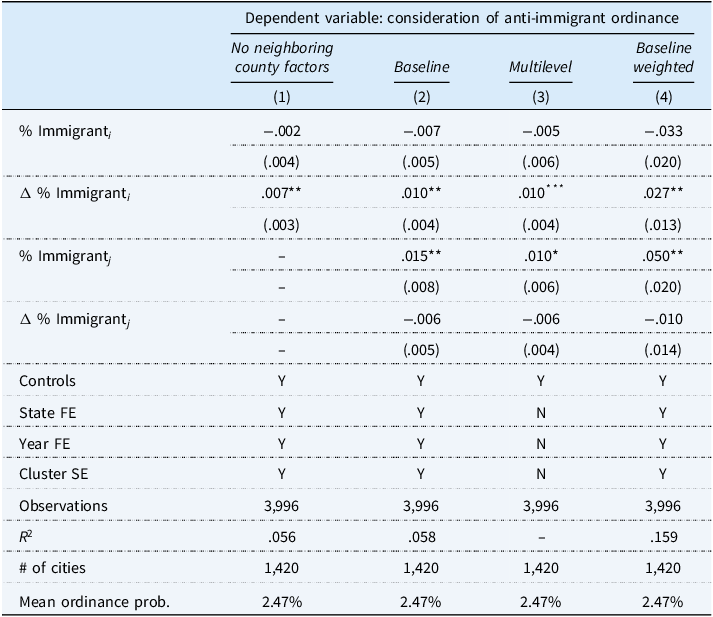
First, we run our model excluding the neighboring area-related factors, as shown in Table 1, column 1. The result indicates a positive effect of a change in local demographics: when all other predictors are held constant, a shift from a community whose immigrant population represents the 10th percentile to one representing the 90th percentile results in a 1.5 percentage point increase in the probability of considering an anti-immigrant proposal. The result confirms that local immigrant populations—specifically the change thereof—are important determinants of the city’s proclivity toward anti-immigrant legislation.
Effect of immigrant populations in neighboring counties on city ordinance

Table 1. Long description
The table presents analysis on the effect of immigrant populations in neighboring counties on city ordinance considerations. It includes four columns: No neighboring county factors, Baseline, Multilevel, and Baseline weighted. Each column contains rows with variables such as percentage immigrant in the city, change in percentage immigrant in the city, percentage immigrant in neighboring counties, and change in percentage immigrant in neighboring counties. The table also includes controls, state fixed effects, year fixed effects, cluster standard errors, number of observations, R-squared values, number of cities, and mean ordinance probability. Notable trends include the positive effect of changes in local immigrant demographics on the probability of considering anti-immigrant proposals.
Note: *p < .1; **p < .05; ***p < .01. All variables are standardized to mean 0 and standard deviation 1 based on the full data. Reported standard errors, excluding model 3, are clustered by city and year and rely on Huber/White robust standard errors. For the full regression results, see Appendix D.1.
Next, to test our hypothesis, we include our main variables of interest, namely the change in the share of foreign-born populations, along with the levels of the neighboring counties’ demographics. The results, reported in column 2, indicate that the level of immigration in neighboring counties, rather than the change, increases the probability that a city considers an anti-immigrant proposal. Substantively, when the stock of immigrants living in neighboring counties increases by 10 percentage points (which is equivalent to the standard deviation of the predictor), the probability of a city considering anti-immigrant legislation increases by almost two percentage points, all else equal. Given that the mean probability of considering anti-immigrant legislation is roughly two percent in our data, this estimate implies that the probability a city would consider an exclusionary measure against immigrants increases by 62% if their neighboring counties have a noticeable immigrant community. Furthermore, including these county-specific explanatory variables in the model augments Hopkins’s (Reference Hopkins2010) finding as the change in a city’s immigration level becomes an even stronger predictor of a city’s decision to consider anti-immigrant policies. These results are robust to alternative estimation strategies that use multilevel models with state and year random effects (column 3).
The preceding discussion focuses on simple correlations between the foreign-born populations in a city’s neighboring counties and the likelihood that the city considers a restrictive measure against immigrants. To bolster this interpretation, we apply covariate balancing propensity scores (CBPS, Imai and Ratkovic Reference Imai and Ratkovic2014), which balances cities in our sample data on their pre-treatment covariates. We choose pre-treatment covariates that capture the most plausible alternative explanations for why we would observe variation in anti-immigrant ordinance proposals, including the political preferences of these cities and their neighbors (measured with Republican presidential vote shares); financial measures of overall wealth (household income and real estate values); the city’s own measures of immigrant populations (both decennial changes and the current level); and additional city-specific socioeconomic predictors such as share of Asian, Black, and Hispanic population and the unemployment rate.
Column 4 of Table 1 reports our results using the covariate balancing propensity score method. Our main findings are strengthened by the inclusion of these covariate-balancing propensity score weights, reinforcing the causal interpretation of our results. After balancing on the pre-treatment covariates, the estimated coefficient on the adjacent counties’ immigration level doubles from our baseline model reported in column 2: comparing two similarly situated cities, the one whose surroundings have a one standard deviation (roughly 10%) larger share of immigrant population is 5 percentage points more likely to consider anti-immigrant policies, or an increase of over 200%.
Taken together, these results suggest that (1) a city’s consideration of an anti-immigrant ordinance is influenced not just by the changing demographics within its borders, but also by the demographic composition of its neighboring areas, and (2) the dynamics of these influences differ. Specifically, a city is more likely to propose an anti-immigrant ordinance when its internal foreign-born population increases abruptly, but is more likely to consider the policy when its neighboring foreign-born population is large.Footnote 17
Mechanisms: How Information Transmits
Our main results demonstrate that areas with adjacent foreign-born populations enact more restrictive ordinances. Implicit in this finding is the assumption that the relevant actors—either the constituents to whom the policymakers are accountable, or the policymakers themselves—are aware of the neighboring foreign-born populations, which requires some information transmission mechanism from “there” to “here.” We provide descriptive evidence of two potential mechanisms: direct observation via commuting and local media coverage.
The first mechanism is direct exposure, in which city residents are more likely to travel to or through the adjacent areas, which are home to foreign-born populations. If city residents frequently travel to neighboring areas, they are more likely to witness the immigrant populations residing there. On the other hand, in cities where most of the resident mobility is confined within the boundary of the city itself, the information about the adjacent populations may not travel as far. We test this mechanism using detailed data on commuting patterns obtained from the 1990, 2000, and 2010 Census data. Treating the flow of commuting patterns as a proxy for direct exposure, we examine whether the relationship between nearby foreign-born populations and increased restrictive ordinances is stronger when the city has heavier commuting flows with the adjacent counties.
The second mechanism is a shared information environment, in which city residents learn about neighboring foreign-born populations via local news coverage. We test this mechanism by constructing two different measures of the local media environment. First, we measure the proportion of neighboring counties that are in the same Designated Market Area (DMA) as the city of interest, thereby receiving the same local channels. Second, we obtain Frequency Modulation (FM) radio service contour data from the Federal Communications Commission (FCC) to measure common radio media zones. These data provide the polygon area in which the service of each station propagates to. We overlap this radius information with shapefiles of cities and adjacent counties to measure the extent to which the city-county dyads have access to the same radio broadcast service.
Across all measures, we treat our proxies as interaction terms and test whether the relationship between nearby foreign-born populations and increased restrictive ordinances is stronger when the city has heavier commuting flows with the adjacent county, shares a DMA, or has a greater overlap in radio and television broadcasts. Formally, we run the following specification: $\eqalign{{\rm Ord}_{i,t} & = \ {\alpha_i} + {\delta_t} + \rho {\bf X}_{i,t} \cr & \;\;\;\;+ {\beta_1} Imm_{j,t} + {\lambda_1} Trans_{i,j} + {\lambda_2} Imm_{j,t} * Trans_{i,j} \cr & \;\;\;\;+ {\beta_2} \Delta Imm_{j,t} + {\lambda_3} \Delta Imm_{j,t} * Trans_{i,j} \cr & \;\;\;\;+ \gamma {\bf{X}}_{j,t} + {\lambda_4} {\bf{X}}_{j,t} * Trans_{i,j} + {\varepsilon_{i,t}} \cr }$
where Imm
j
,t
is the foreign-born share, Trans
i
,j
is either the commuting zone, DMA, or FCC measure of information transmission, ${\bf X}_{j,t}$
is a vector of controls described above, and i indexes the city considering the ordinance and j indexes the neighboring areas. As above, we implement city and year fixed effects with α
i
and δ
t
respectively. We are interested primarily in the λ
2 coefficient which captures the marginal effect of larger immigrant populations in county j on restrictive ordinances when j has a stronger transmission pathway, measured as either commuting flows or one of our three proxies for media information environments.
${\bf X}_{j,t}$
is a vector of controls described above, and i indexes the city considering the ordinance and j indexes the neighboring areas. As above, we implement city and year fixed effects with α
i
and δ
t
respectively. We are interested primarily in the λ
2 coefficient which captures the marginal effect of larger immigrant populations in county j on restrictive ordinances when j has a stronger transmission pathway, measured as either commuting flows or one of our three proxies for media information environments.
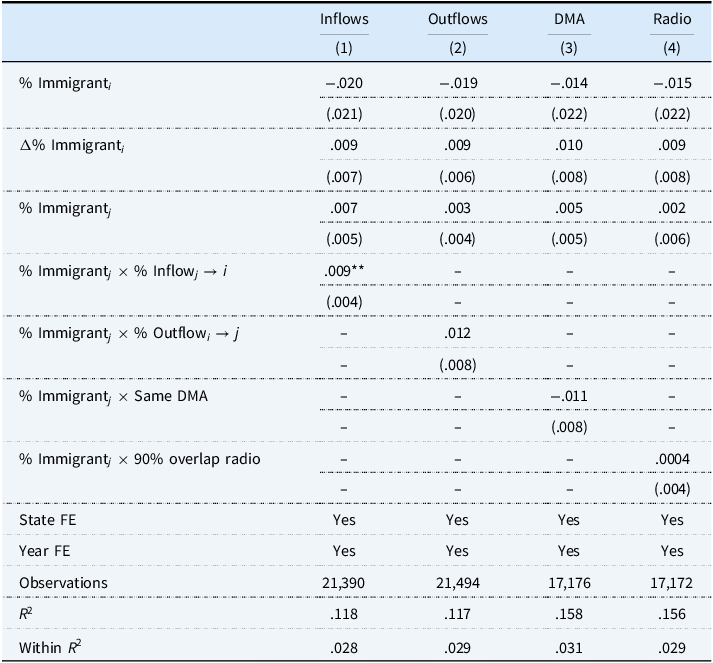
Our findings are summarized in Table 2, where the first two columns summarize the results on commuting patterns, and the subsequent two columns display the results for the media pathway, broken out into shared DMAs and shared radio stations. We find a significant and positive interaction coefficient only for the inflow measure (column 1), capturing the proportion of total inflows to city i that come from neighboring county j. While the outflow measure is also positive (column 2), it is not significant at conventional levels.
Descriptive tests of mechanisms
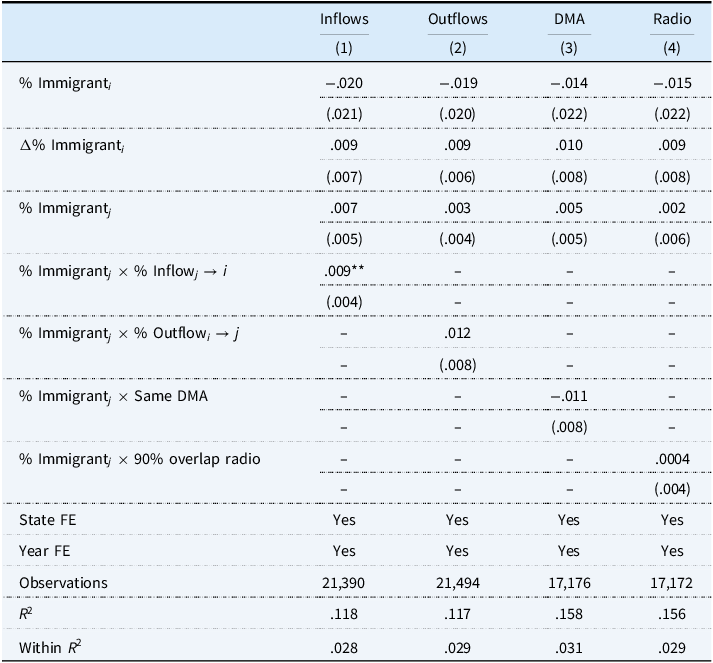
Table 2. Long description
The table presents findings on commuting patterns and media pathways, structured into four columns: Inflows, Outflows, DMA, and Radio. The first two columns summarize results on commuting patterns, while the last two columns display results for the media pathway, broken out into shared DMAs and shared radio stations. The table includes various percentage and change in percentage metrics for immigrants in different contexts. Notable trends include a significant and positive interaction coefficient for the inflow measure in column 1, capturing the proportion of total inflows to city i that come from neighboring county j. The outflow measure in column 2 is also positive but not significant at conventional levels. The table includes state and year fixed effects and provides fit statistics such as the number of observations, R-squared values, and within R-squared values.
Note: *p < .1; **p < .05; ***p < .01. Standard errors are clustered at the city-level. Column (1) looks at heterogeneity of neighboring populations by the proportion of commuting inflows that come from the neighboring county. Column (2) looks at heterogeneity of neighboring populations by the proportion of commuting outflows that traveled to the neighboring county. Column (3) looks at heterogeneity of neighboring populations by whether they share the same designated market area (DMA) as the city. Column (4) looks at heterogeneity of neighboring populations by whether 90% of both the city and the neighboring county are serviced by the same radio signal. See Appendix D.3 for full regression results.
Importantly, there is no evidence that sharing a media environment between the city where the ordinances are considered and the adjacent counties where the immigrant populations reside matters to our story, regardless of whether the media is defined as DMA or the overlap of radio broadcast service. In the case of the DMA, the coefficient is of the opposite sign. One possible explanation might be that our measure of shared media environments is too coarse to test our theory. For example, if sharing a media environment means more positive coverage of immigrant populations, this might explain the negative coefficient estimate for the DMA indicator. Future work that incorporates richer measures of local news content (i.e., the proportion of coverage pertaining to immigrants and the tone thereof) and more detailed measures of commuting patterns (i.e., Census block group level flows) would be useful to confirm the suggestive evidence documented in Table 2.
Motivations: Sources of Anti-immigrant Attitudes
Our main analysis finds support for our ex ante immigration policy hypothesis, in which city policymakers attempt to disincentivize future inflows of foreign-born populations that reside nearby. But what are their motivations for doing so? We test three mechanisms—economic, political, and cultural—that may explain why a policymaker might pursue the type of ex ante anti-immigrant legislation we document. As further described in Appendix F, we find little support for either economic or political motivations, suggesting that the concern with barring new entrants is not a function of labor market competition felt by local employees, and manifests similarly in Democratic- and Republican-leaning localities. Here, we document evidence in support of the cultural threat hypothesis wherein the effect of restrictive policy is strongest when neighboring foreign-born populations hail from Latin America.
Region of Origin Heterogeneity
The main analyses indicate that anti-immigrant ordinance at the city level is more likely to be considered in cities whose neighboring areas have higher shares of foreign-born residents. One plausible explanation for this pattern proposed in the existing research emphasizes the theory of group conflict, which focuses on humans’ need for positively differentiating their own group from other groups (Tajfel et al. Reference Tajfel, Turner, Austin and Worchel1979). According to this cultural threat perspective, members of distinct out-groups (i.e., immigrants) are seen as threatening as they challenge the cultural identity of native residents. Observational studies find a positive association between anti-immigrant attitudes and negative attitudes toward multicultural practices (Chandler and Tsai Reference Chandler and Tsai2001; Citrin et al. Reference Citrin, Green, Muste and Wong1997; Espenshade and Calhoun Reference Espenshade and Calhoun1993). Recent studies compare natives’ responses to immigrants by manipulating immigrant characteristics such as country of origin or language skills, and also find strong support for this claim (Hainmueller and Hopkins Reference Hainmueller and Hopkins2015; Malhotra et al. Reference Malhotra, Margalit and Mo2013; Valentino et al. Reference Valentino, Brader and Jardina2013).
In this framework, immigrant populations differ in the degree to which they threaten group cohesion based on ethnic characteristics such as religion, culture, and language. These differences generate prejudice and stereotypes that can further inflame out-group antipathy among local natives. We probe for evidence consistent with this explanation by asking whether the ex ante anti-immigrant legislation is more likely where neighboring immigrant populations are from a particular continent-of-origin.Footnote 18
We re-estimate our main analyses in two ways. First, we reproduce our main specification by substituting the neighboring counties’ foreign-born population measures with each of the four continent-of-origin-specific measures foreign-born population one by one. For example, the key variables Imm j, t and ΔImm j, t in equation 2 are replaced with Europe j, t and ΔEurope j, t , respectively, to estimate the effect of European immigrant populations in neighboring counties on a city’s policy decision. This analysis replicates the weighted specification from Table 1, focusing on each continent of origin in isolation. Second, we test the relationship between neighboring foreign-born populations and ex ante immigrant policy by including all four continent-of-origin-specific measures foreign-born population in a single regression.
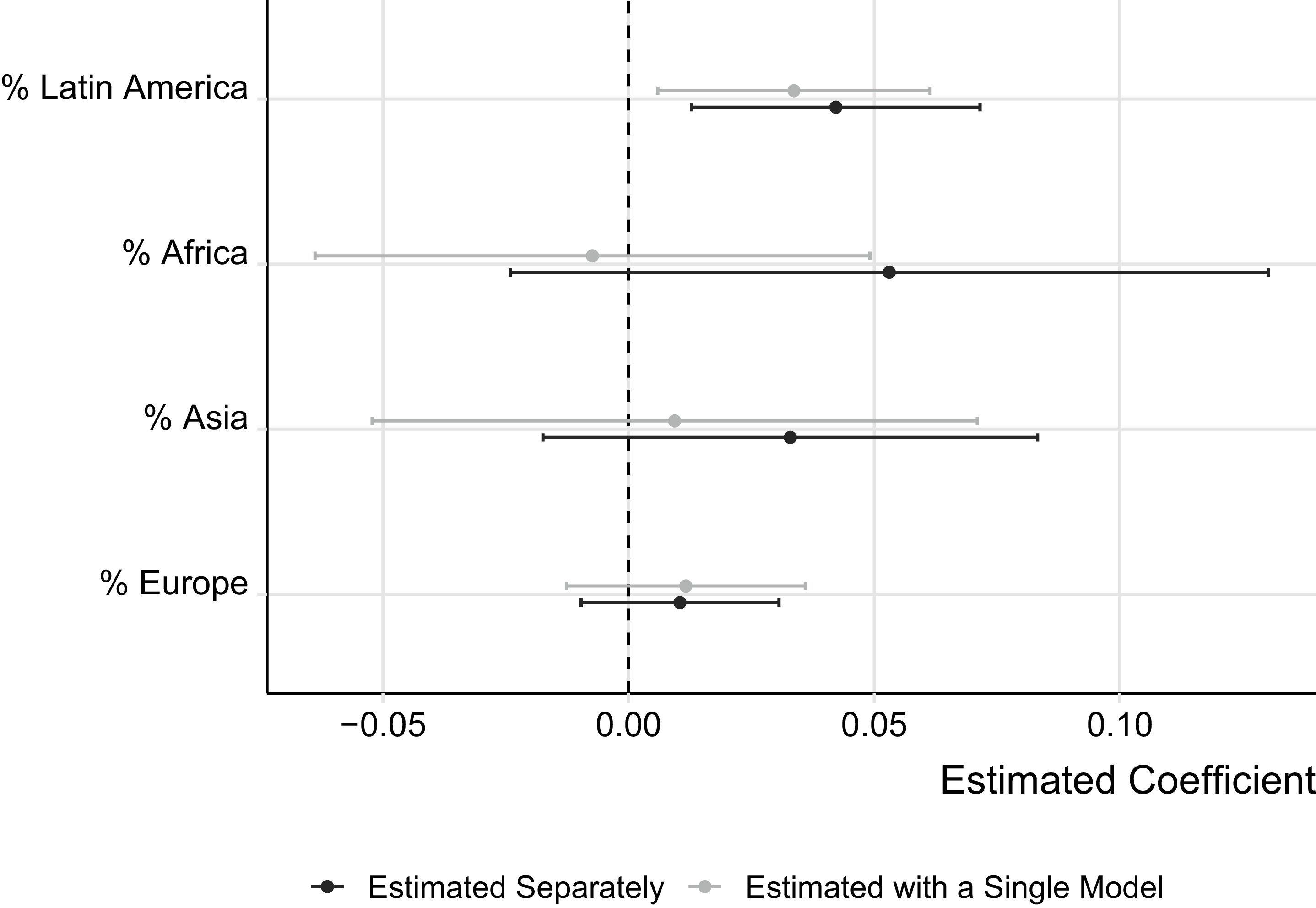
These estimates are summarized in Figure 3, with black points representing the estimates from models in which each of the continents-of-origin-specific factors are estimated separately and the gray points representing the estimates from the combined analysis.Footnote 19 As illustrated, there is consistent evidence that foreign-born populations in neighboring areas increase the likelihood of a city pursuing anti-immigrant legislation regardless of the continents of origin of these groups, albeit to varying degrees of statistical and substantive significance. When estimated separately, the estimates on immigrant populations from Latin America exhibit a large and statistically significant relationship with the probability of a city’s anti-immigrant ordinance. The estimates on immigrant populations from Africa and Asia are not significant at the conventional thresholds, but they are positive and of a similar magnitude to the estimates on Latin American-originating groups. The estimated coefficient on immigrants originating from Europe is consistently the smallest and, while positive, is not statistically significant.
Coefficient estimates and 95% confidence intervals (x-axis) for the share of foreign-born populations in neighboring counties by continent of origin (y-axis).

Figure 3. Long description
The plot presents coefficient estimates and 95% confidence intervals on the x-axis for the share of foreign-born populations in neighboring counties by continent of origin on the y-axis. The continents listed are Latin America, Africa, Asia, and Europe. The graph includes two sets of data points: one estimated separately and the other estimated with a single model. Each data point is represented by a dot, with horizontal lines indicating the confidence intervals. The estimates for Latin America and Europe are close to zero, while those for Africa and Asia show wider confidence intervals, indicating more variability.
However, some of these patterns may bundle the influence of multiple foreign-born populations together. For example, if immigrants from Africa and Latin America co-locate geographically, a specification that separately estimates their correlation with anti-immigrant ordinance is unable to disentangle their relative influence. Thus, we combine all measures together and plot these coefficient estimates in gray, finding much weaker relationships between foreign-born populations from all continents of origin, with the exception of Latin America, whose estimate increases in both substantive and statistical significance.
These findings are broadly consistent with the cultural threat hypothesis, which predicts that anti-immigrant attitudes and policies are exaggerated in the face of more culturally distant immigrant groups (i.e., Latin Americans) relative to culturally proximate ones (i.e., Europeans). Although we do not test the types of cultural distinctions that might be at play, we posit that the significant findings for Latin America alone reflects the greater salience of this immigrant group in the national discourse about immigration, perpetuated by both media and elite cues, and is consistent with much of the recent work on immigration attitudes and the information environment (Hopkins Reference Hopkins2010; Valentino et al. Reference Valentino, Brader and Jardina2013). For example, prior studies have found that the tension between local communities and a fast-growing immigrant population is specifically pertinent in locations that are not traditional immigrant gateways but have seen increases in their immigrant populations, particularly from Mexico and South/Central America (Chandler and Tsai Reference Chandler and Tsai2001; Hainmueller and Hopkins Reference Hainmueller and Hopkins2015; Lichter and Johnson Reference Lichter and Johnson2009; Marrow Reference Marrow2020; Zúñiga and Hernández-León Reference Zúñiga and Hernández-León2005).
Conclusion
In this paper, we test the influence of geographically proximate foreign-born populations on anti-immigrant ordinances at the city level in the United States. We argue that nearby immigrant populations induce a perceived threat among native residents and local policymakers, as they represent the stock from which potential future inflows might enter their jurisdiction. The presence of immigrant populations in surrounding areas can prompt an ex ante response by city policymakers in an attempt to prevent future immigrant residents even before they arrive. We show that these neighboring populations exhibit an independent effect on a city’s anti-immigrant legislation, even after controlling for city-level measures of the stock and change in immigrant groups.
How do policymakers and/or their constituents come to learn about these neighboring populations? We provide exploratory evidence of heterogeneous effects by either “direct” exposure or media coverage. For the former, we demonstrate that the increase in anti-immigrant ordinances in response to neighboring foreign-born populations is larger in cities that experience larger commuting flows with these neighboring areas, although the interaction coefficient is statistically significant only for inflows (i.e., neighboring populations driving into the city for work). Conversely, we find no evidence to support the media transmission mechanism. Sharing similar radio stations has a positive but small and insignificant moderating relationship, and sharing the same DMA is negatively associated with increased anti-immigrant ordinance, although this too is not statistically significant. We tentatively conclude that learning of these neighboring populations in a way that stimulates the consideration of anti-immigrant ordinances is primarily via direct exposure, especially when neighboring populations commute into one’s city. However, a more careful exploration of the media pathway is warranted, particularly one that separates positive from negative media coverage. We leave this to future work.
In evaluating the explanatory power of three dominant explanations behind the ex ante anti-immigrant attitudes, we find that the influence of neighboring foreign-born populations is not related to the labor market demand for foreign workers in the city, nor does it vary significantly across the partisan affiliation of city residents. However, in line with recent research on the cultural threat hypothesis, we find that the relationship is stronger when focusing on immigrant populations originating in Latin America compared to Asia, Africa, and Europe. Taken together, our research contributes to the study of xenophobic policy-making at the local level, while introducing a previously neglected dimension: neighboring foreign-born populations.
Our research suggests several extensions beyond the scope of this paper. First, our findings raise the question of whether deterrence-oriented strategies meaningfully reduce inflows or instead reshape regional settlement patterns. A substantial body of research shows that policy environments influence migration decisions, affecting both destination choice and settlement trajectories. Migrants respond strategically to expected policy regimes, moving toward jurisdictions perceived as more permissive and avoiding those seen as restrictive (e.g., Borjas Reference Borjas2003), and enforcement intensity shapes return migration and settlement patterns (Durand and Massey Reference Durand and Massey1992, Reference Durand and Massey2004, Reference Durand and Massey2019). At the subnational level, immigration enforcement has been shown to alter location choices, residential mobility, and housing stability (Anadón Reference Anadón2023; Bohn and Pugatch Reference Bohn and Pugatch2015; Rocha et al. Reference Rocha, Hawes, Fryar and Wrinkle2014).Footnote 20 In this light, our results capture one side of a broader feedback process: policymakers respond anticipatorily to nearby immigrant populations, yet those policies may subsequently reshape migration patterns, whether by deterring entry or redirecting settlement elsewhere. Future research linking ordinance adoption to subsequent migration flows would allow scholars to trace this dynamic feedback loop more directly.Footnote 21
Second, our empirical setting precludes our ability to determine whether these patterns reflect local policymakers responding to constituent preferences (a “delegate” model of political accountability) or are acting on their own initiative (a “trustee” model of political accountability). It is possible that the patterns we describe arise because constituents themselves notice these nearby immigrant populations and desire preventative policies, which are then considered and show up in our data. Or it is possible that local officials are the ones who are aware of, and act to stem the inflow of, these nearby immigrant populations. In the discussions that follow, we treat the democratic policymaking process as a black box and leave unpacking the question of delegate versus trustee models of accountability to future research.
Third, our empirical results are descriptive analyses of observational data. While we implement a variety of methods to bolster the causal interpretation of our findings, future work should confirm our findings with more internally valid causal evidence. Relatedly, our tests of the transmission mechanisms are coarse, which may explain their marginal statistical significance. In particular, future work that characterizes the content of local media coverage within a DMA would better disentangle how much of the effect of neighboring populations is driven by media framing.
Finally, our theoretical focus has been on anxiety over future inflows, which leads us to treat anti-immigrant policies as the most direct manifestation of anticipatory behavior. Yet, a growing number of cities have also passed measures designed to protect immigrant residents, including “sanctuary ordinances” that limit cooperation with federal law enforcement, establishing or funding day labor centers, and providing city-issued identification cards regardless of legal status. These permissive policies reflect a different orientation toward immigration—one that seeks to integrate newcomers rather than deter them—and may likewise be influenced by the presence of demographic shifts in neighboring areas. While our analysis isolates the exclusionary side of local policymaking, future research should examine whether similar anticipatory dynamics operate in the case of pro-immigrant ordinances. Doing so would provide a fuller account of how local governments negotiate demographic change and the tension between exclusionary and inclusionary responses to immigration.
Supplementary material
The supplementary material for this article can be found at https://doi.org/10.1017/rep.2026.10087.
Data availability statement
The data, code, and any additional materials required to replicate all analyses in this article are available at https://doi.org/10.7910/DVN/JEJWJ3.
Acknowledgments
We would like to thank Justin Steil and Kyle Walker for sharing data. We also thank Shigeo Hirano, Naoki Egami, Jessica Trounstine, and the participants of the 2021 Midwest Political Science Association Conference for helpful comments.
Competing interests
The author(s) declare none.




 Open access

