


Introduction
Neolithization was, in essence, a project of domestication, not only of food resources but, perhaps more importantly, of space and time (Banning & Chazan Reference Banning and Chazan2006; Hodder Reference Hodder1990; Kuijt Reference Kuijt2000; Mlekuž Reference Mlekuž, Fowler, Harding and Hofmann2015). By the end of this process, habitation, subsistence and social activities were restructured within and between artificial or modified spaces in the village-based societies that emerged during the dispersal of the Neolithic package. Less clear was the status of the arenas left beyond the mundane sphere of activity of these early sedentary communities and, more specifically, of landscapes that represent the remaining wild. In recent years, it has been shown that these wildscapes—e.g. mountain peaks, gushing springs, prominent rocks and wooded areas—were deeply intertwined in the life cycle, culture and collective memory of complex societies (Bradley Reference Bradley2000; Carmichael et al. Reference Carmichael, Hubert, Reeves and Schanche1994; Harmanşah Reference Harmanşah and Harmanşah2014). Nonetheless, concrete archaeological evidence concerning the role of these features in early complex societies is still rare in the Levant, one of the primary regions of the Neolithic revolution.
Complex caves—multi-component underground systems sprawling over hundreds or thousands of metres—comprise some of the challenging landscapes that humans can interact with (Montello & Moyes Reference Montello, Moyes and Moyes2012; Sauro et al. Reference Sauro, de Waele and Payler2021; Zuccarelli et al. Reference Zuccarelli, Galasso, Turner, Coffey, Bessone and Strapazzon2019). As opposed to small, simple caves and rock-shelters, it has been globally shown that complex caves were rarely, if ever, used for ‘regular’ habitation purposes. Rather, they were exploited for a variety of off-settlement activities, including burial, ritual, refuge and rare resource procurement (e.g. Bergsvik & Skeates Reference Bergsvik and Skeates2012a; Bonsall & Tolan-Smith Reference Bonsall and Tolan–Smith1997; Brady & Prufer Reference Brady and Prufer2005; Büster et al. Reference Büster, Warmenbol and Mlekuž2019; Davidovich et al. Reference Davidovich, Ullman and Langford2018; Moyes Reference Moyes2012). Interestingly, human activity in complex caves began in the Levant—a region dominated by carbonate rocks prone to diverse speleogenetic processes—no earlier than the Late Neolithic (e.g. Gopher & Tsuk Reference Gopher and Tsuk1996; Ullman et al. Reference Ullman, Frumkin, Langford and Davidovich2024), in tandem with the final phases of crystallization of Neolithic lifeways, social structures and ideologies (Banning Reference Banning1998; Belfer-Cohen & Goring-Morris Reference Belfer-Cohen and Goring-Morris2011; Cauvin Reference Cauvin2000; Gopher Reference Gopher and Gopher2012a; Goring-Morris & Belfer-Cohen Reference Goring-Morris and Belfer-Cohen2011; Kuijt Reference Kuijt2002). This is certainly not a coincidence; rather, it implies that complex caves emerged during this period as favourable arenas for social performance that could not be executed within the daily sphere. As such, complex caves constitute significant components of the archaeology of early sedentary Levantine societies, yet they remain sparsely explored due to the objective difficulties involved in their investigation (Davidovich et al. Reference Davidovich, Ullman and Langford2018; Gopher & Tsuk Reference Gopher and Tsuk1996).
Deciphering the motivation behind and meaning of the activity of prehistoric societies in the deep underground is a notoriously challenging task, heavily affected by the scale, diversity and level of preservation of studied archaeological records in their speleological contexts (e.g. Dirks et al. Reference Dirks, Berger and Roberts2015; Reference Dirks, Roberts and Hilbert–Wolf2017; Leroi-Gourhan Reference Leroi-Gourhan1982; Moyes Reference Moyes2001; Whitehouse Reference Whitehouse1992). This paper presents the results of our speleological and archaeological study of Har Sifsof Cave, a complex subterranean system in Upper Galilee, Israel. The cave was discovered in 2016 and yielded well-preserved, single-period archaeological assemblages dated to the early fifth millennium bce within a composite natural arena that underwent relatively minor post-depositional alterations (Ullman et al. Reference Ullman, Laugomer and Shicht2023). Owing to these qualities, it provides a rare opportunity to study the social significance of complex caves in an earlier phase of their exploitation as cultural devices.
Cultural and geographic framework
The timespan between c. 6500 and 4500 bce, which saw the emergence of the earliest pottery-producing cultures in the southern Levant, is framed by some authorities as Late Neolithic (e.g. Gilead Reference Gilead, Lovell and Rowan2011; Gopher Reference Gopher, Goldfus, Mayer, Shamir and Fabian2019; Gopher & Gophna Reference Gopher and Gophna1993), or Pottery Neolithic and Early/Middle Chalcolithic by others (e.g. Garfinkel Reference Garfinkel1999; Reference Garfinkel, Shea and Lieberman2009; Getzov Reference Getzov2015; Reference Getzov2016; Getzov et al. Reference Getzov, Liberman-Wander, Smithline and Sion2009; Shalem & Getzov Reference Shalem and Getzov2023). This era is typified by a succession of sedentary cultures that occupy the dry Mediterranean regions of the southern Levant (e.g. Yarmukian, Jericho IX/Lodian, Wadi Rabah), each lasting c. 300–500 years and attested in no more than a few dozen sites, mostly small-scale settlements (<10 ha) located in lowland regions. These cultures manifest specific typo-technological differences in pottery production as well as in building techniques and layout, lithics and stone tools. In tandem, they share subsistence economies that are based on animal husbandry of domesticated sheep and goat and, to a lesser extent, cattle and pig, with declining importance of hunted game (Agha et al. Reference Agha, Nadel and Bar-Oz2019; Marom & Bar-Oz Reference Marom and Bar-Oz2013; Namdar et al. Reference Namdar, Vardi, Paz and Sapir-Hen2021), and cultivation of staple grains and legumes, with the growing importance of olives (Galili et al. Reference Galili, Stanley, Sharvit and Weinstein-Evron1997; Graham Reference Graham2014; Langgut & Garfinkel Reference Langgut and Garfinkel2022; Namdar et al. Reference Namdar, Amrani, Getzov and Milevski2014). Designated burial and ritual spaces or public edifices were not identified in relation to most Late Neolithic/Early–Middle Chalcolithic communities, and it appears that economic and ritual activities were commonly performed at the household level (Garfinkel et al. Reference Garfinkel, Ben-Shlomo and Freikman2020; Getzov et al. Reference Getzov, Shalem, Haklay, Milevski, Eirikh-Rose and Leyfirer2022; Gopher Reference Gopher and Gopher2012a; Shalem & Getzov Reference Shalem and Getzov2023; for an exception, see Galili et al. Reference Galili, Rosen and Eshed2009).
In the highland regions of the southern Levant, where most complex caves are located, the archaeological data concerning settlement configuration from the entire cultural sequence spanning the mid seventh through mid fifth millennium bce is restricted (Garfinkel Reference Garfinkel1999). This picture owes probably both to the less favourable conditions for sedentism in these regions, typified by hilly and rocky terrain with discontinuous patches of deep soils and limited water sources with low discharge, and the paucity of research on the archaeology of the Middle Holocene in Levantine upland regions (Banning et al. Reference Banning, Siggers and Rahimi1994; Gopher & Gophna Reference Gopher and Gophna1993; Rowan & Golden Reference Rowan and Golden2009). This situation is clearly manifested in the Galilean Highlands in modern-day northern Israel, where only a handful of Late Neolithic/Early–Middle Chalcolithic sites are known (Fig. 1:c; e.g. Frankel et al. Reference Frankel, Getzov, Aviam and Degani2001; Getzov Reference Getzov2016; Shalem Reference Shalem and Bar2008; Uziel et al. Reference Uziel, Ben Efraim, Khalaily, Marder, Bar-Oz and Raban-Gerstel2007). Excavations in several sites, always on a very restricted scale, exposed segments of rectilinear stone-built structures (possibly houses) associated with fixed installations and material residues, including pottery, lithic and groundstone tools; no evidence for symbolically laden activities was noted in these sites. Significantly, though, a series of complex caves with late sixth-/early fifth-millennium bce remains was surveyed in this region in recent years (Frankel et al. Reference Frankel, Getzov, Aviam and Degani2001; Ullman et al. Reference Ullman, Frumkin, Langford and Davidovich2024), pointing to the prominent role of the deep underground in the regional cultural trajectory (Fig. 1:c). Har Sifsof Cave, the focus of the present study, is the largest of these caves, and contains the best preserved, numerous and diverse archaeological remains within this group.
(a–b) Study area; (c) Har Sifsof Cave and early fifth-millennium bce sites in northern Israel. Purple = settlement sites, yellow = caves, grey = modern cities; (d) general view of the cave surroundings in springtime, with Mount Meron looming at the back (the white arrow marks the entrance to the cave); (e) the cave entrance, looking up from Chamber A.
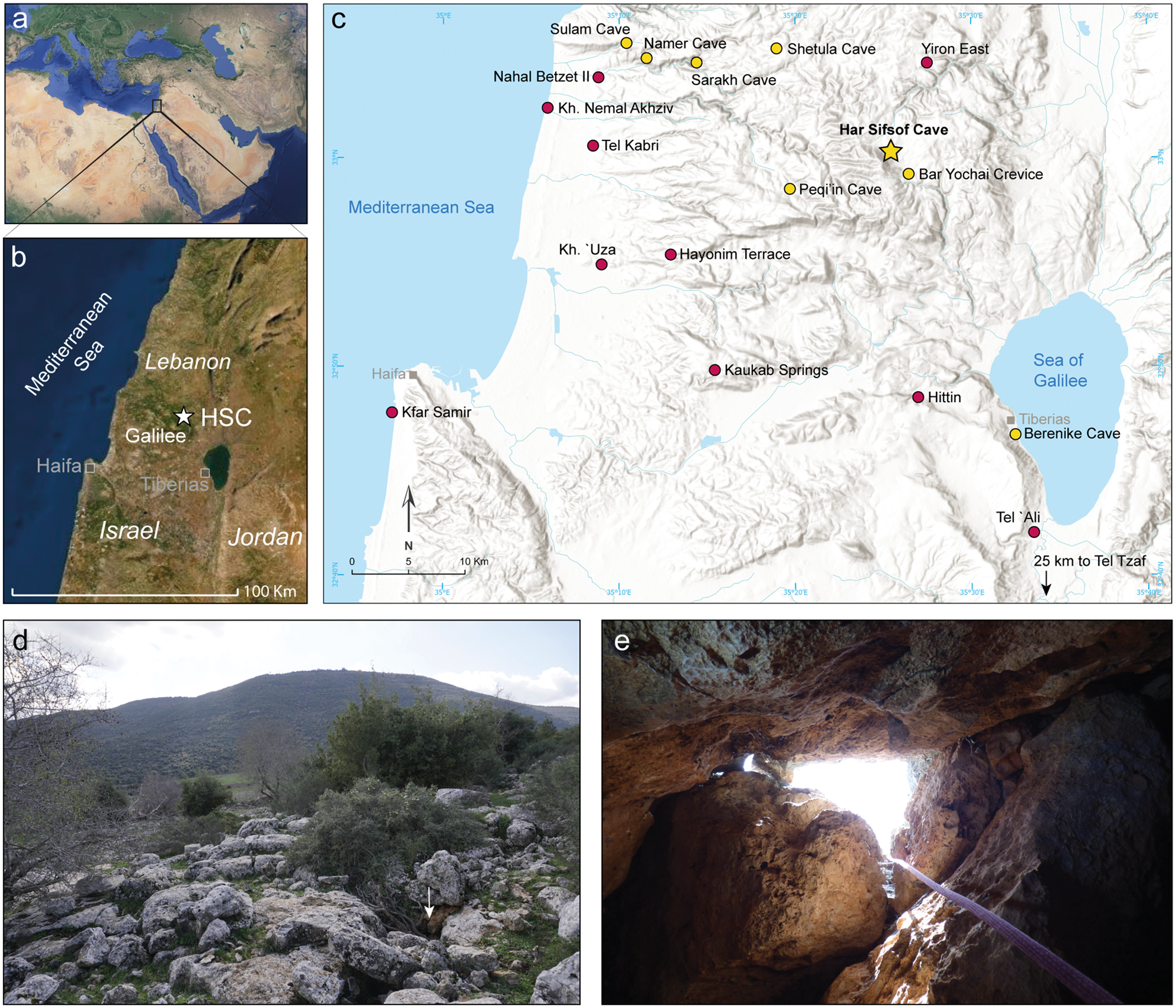
Har Sifsof Cave (henceforth HSC) is located on a moderate south-facing hillslope, at an elevation of 806 masl, in the eastern part of Upper Galilee (33°00′32″N, 35°25′35″E) (Fig. 1). The climate regime in this region is dry Mediterranean with hot and dry summers (May to October) and cool and rainy winters (November to April). The mean annual precipitation is ~750 mm. The highly soluble calcareous rocks and relatively high annual precipitation make karst a dominant process in landscape formation and speleogenesis in Upper Galilee (Frumkin et al. Reference Frumkin, Barzilai, Hershkovitz, Ullman and Marder2021). Throughout the Holocene, these caves experienced humid conditions and intensive speleothem deposition (Bar-Matthews & Ayalon Reference Bar-Matthews, Ayalon, Shalem, Gal and Smithline2013; Bar-Matthews et al. Reference Bar-Matthews, Ayalon, Gilmour, Matthews and Hawkesworth2003; Frumkin & Comay Reference Frumkin and Comay2021). While the formation of HSC is attributed to ancient phreatic dissolution (see below), most subterranean spaces in its vicinity comprise swallow-holes and closed depressions associated with vadose shafts (Frumkin et al. Reference Frumkin, Barzilai, Hershkovitz, Ullman and Marder2021; Langford et al. Reference Langford, Frumkin, Aharon, Zissu, Didonna and Maurano2021). Other complex caves with early fifth-millennium bce remains are primarily located in more westerly areas of Upper Galilee, where phreatic conditions for speleogenesis prevail (Fig. 1:c).
The archaeology of Har Sifsof Cave
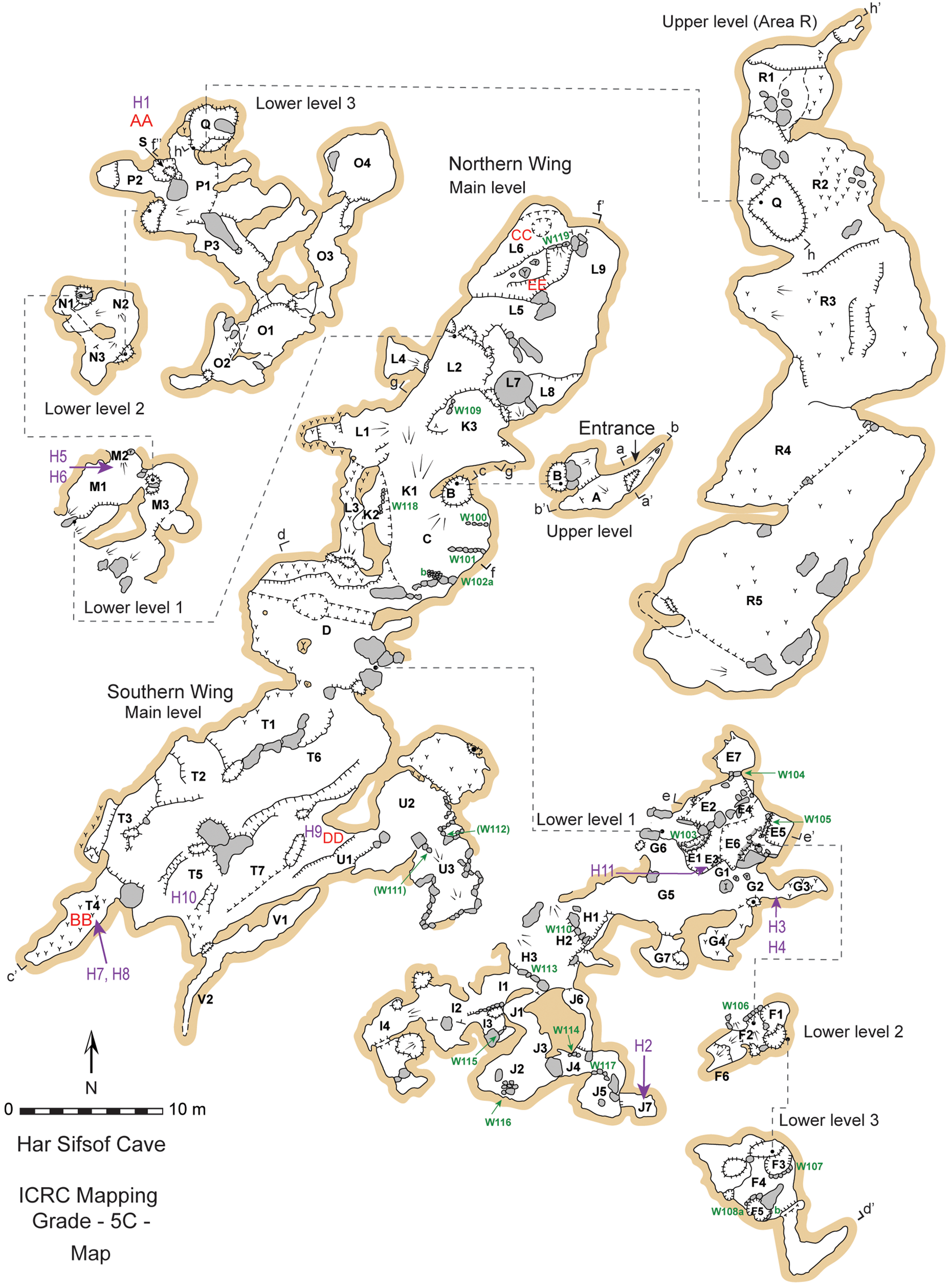
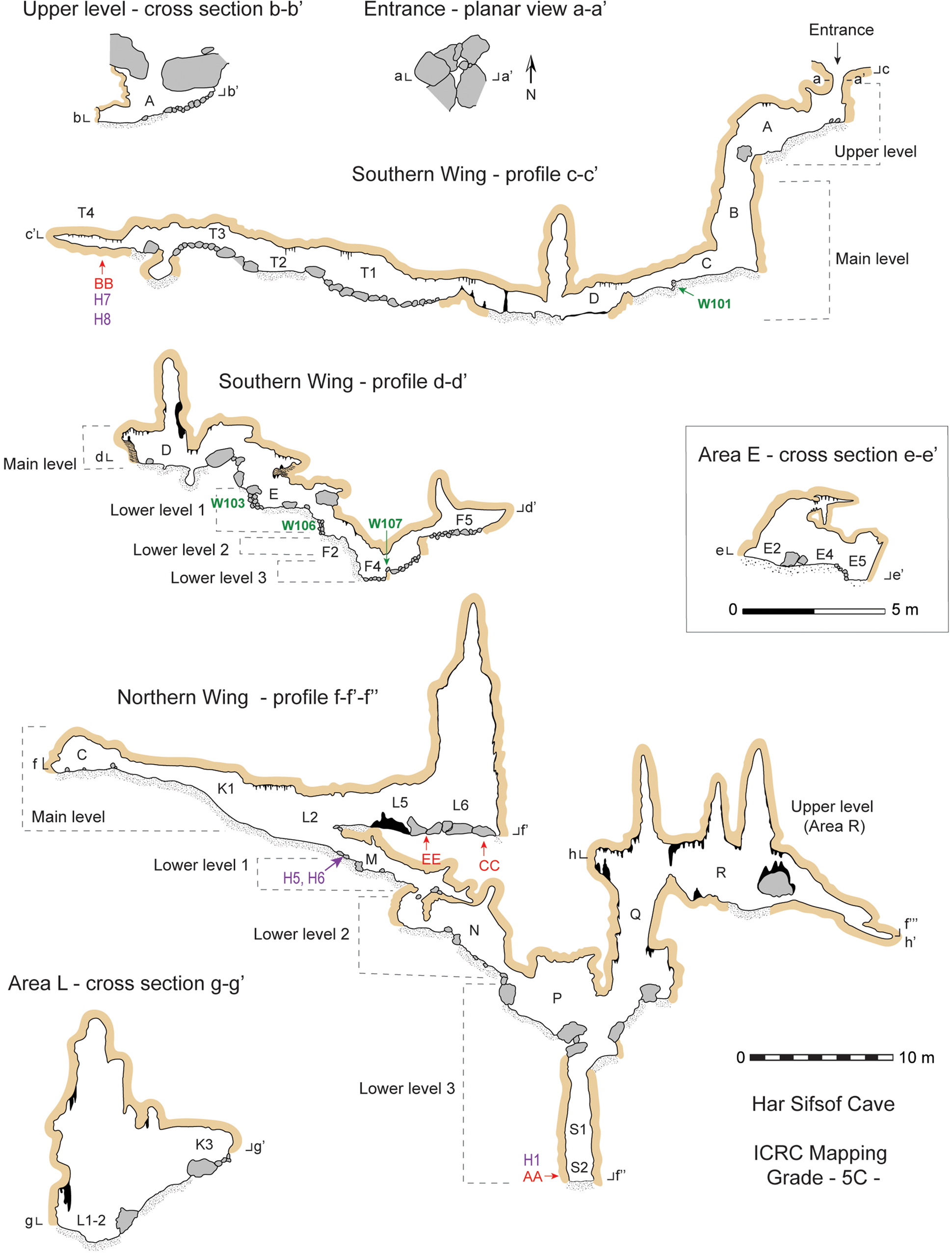
Har Sifsof Cave was discovered in 2016 by two experienced cavers, V. Boslov and Y. Lisovets, from the Israel Cave Research Center (ICRC). The initial discovery of the small entrance to the underground system involved widening a very narrow, semi-vertical cavity by removing several boulders that concealed it from sight. A rope was then used to descend from the small space below the entrance down an 8 m vertical shaft into the main level of the cave. Following four days of subsequent exploration and mapping, it became evident that HSC is one of the largest subterranean systems in Upper Galilee, comprising a complex maze of chambers, galleries, passages and shafts that reach a total length of 518 m and a vertical extent of 49 m (Figs 2–3).
Har Sifsof Cave, planar view. Black = space designations; red = excavation areas; green = architectural elements; purple = human remains. (Mapping: SY, Y. Zissu, N. Sagi & MU (ICRC), 2016.)
Har Sifsof Cave, profiles and cross sections (see Figure 2 for location). Black = space designations; red = excavation areas; green = architectural elements; purple = human remains. (Mapping: SY, Y. Zissu, N. Sagi & MU (ICRC), 2016.)
Following its discovery, a four-day intensive survey was conducted in the cave in the summer of 2016, headed by MU and UD. The survey was followed by a short, three-day excavation in the winter of 2017, which was led by MU, R. Lavi, O. Marder, IH, HM and UD. The survey encompassed the entire subterranean system, that was divided into distinct surface collection units based on cave geometry and artificial features (compare Davidovich et al. Reference Davidovich, Ullman and Langford2018). Since post-depositional sedimentation and transportation processes in the cave are limited to certain areas (below), surface survey was sufficient to recover and document much of the archaeological record. The excavation was mainly reserved for the removal of thin accumulations associated with human skeletal remains observed in specific locations during the survey (for details, see Supplementary materials). Recently, the cave was mapped using a SLAM-based LiDAR scanner, resulting in a comprehensive three-dimensional model of the subterranean system and its surface environs. This model complemented the standard, two-dimensional speleological mapping (Figs 2–3) and was particularly informative in analysing cave-formation processes (Ullman et al. Reference Ullman, Laugomer and Shicht2023).
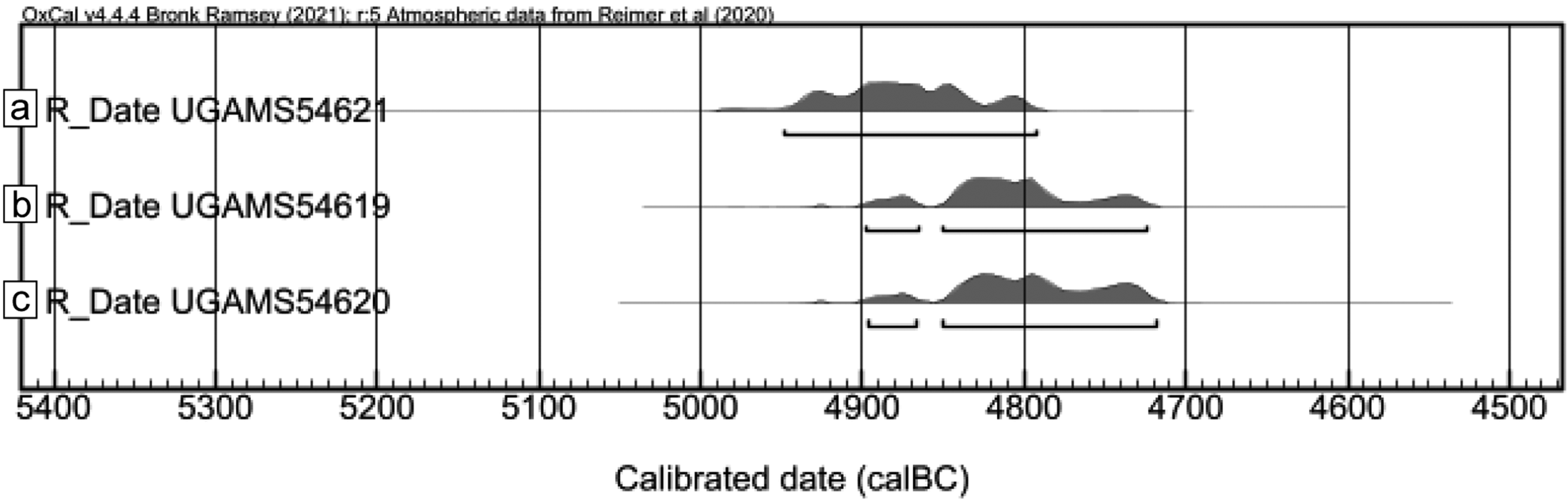
Other than small-sized flint implements and animal bones that infiltrated the cave system through vertical shafts from the outer surface, and a single bi-metal bowl dated to the first or early second millennium ce (Shivtiel & Osband Reference Shivtiel and Osband2018), the cultural and ecofactual remains recovered in HSC date to the early fifth millennium bce (c. 4950–4750 bce; Fig. 4). The dating is based on typo-technological analyses of the ceramic, lithic and groundstone assemblages found in the cave, as well as on radiocarbon dating of charred grain and human remains (see Supplementary materials for a complete presentation of the material assemblages and radiometric data). The most frequent medium uncovered in the cave is pottery, with numerous sherds representing more than 60 vessels found scattered in various cave segments, in addition to several complete vessels that were deliberately concealed in specific locations (Fig. 5). Other artifact categories include groundstone objects, flint tools, bone objects and beads. Archaeobotanical remains include concentrations of wood charcoal and charred cereals. A significant component of the cultural deposits in the cave is human remains, found as both scattered bones and complete skeletons located in remote cave sections (below). Architectural elements are also abundant, consisting mainly of retaining walls built to support, level, or delineate specific activity areas and facilitate movement through sub-vertical shafts. The late prehistoric remains were retrieved from most cave segments, including its remotest edges and deepest sections. These remains primarily reflect on-site deposition, slightly altered by gravitational deformations (Ullman et al. Reference Ullman, Laugomer and Shicht2023).
Probability distribution of radiocarbon dates: (a) collagen sample from a human bone of Individual H2, Area J7; (b) grain sample from Square EE, Area L5; (c) collagen sample from a human bone of Individual H1, Square AA, Area S2. (OxCal v4.44: Bronk Ramsey Reference Bronk Ramsey2021; Atmospheric data: Reimer et al. Reference Reimer, Austin and Bard2020.)
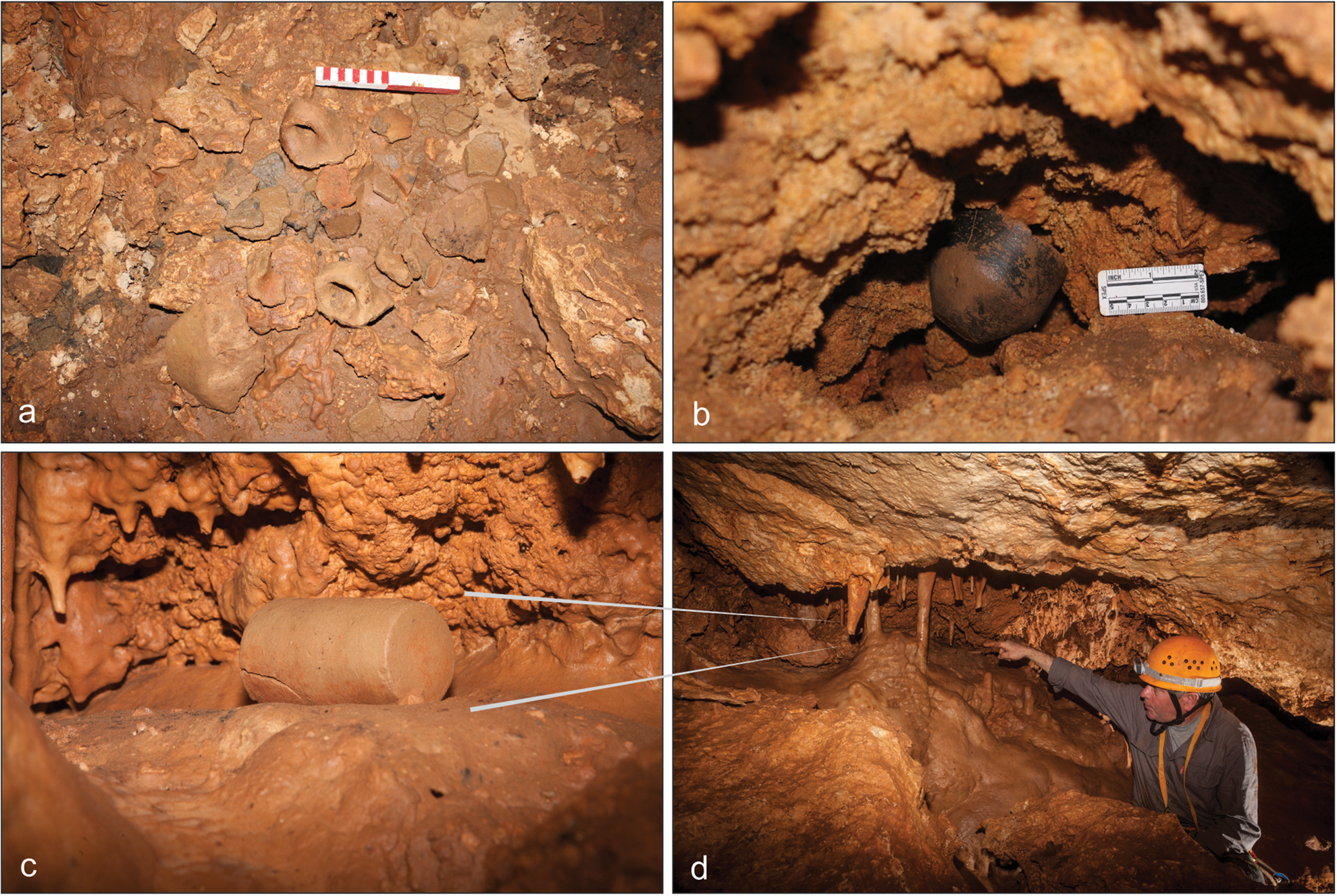
Depositional contexts in HSC: (a) scatter of pottery sherds on the cave surface; (b) a miniature bowl tucked in a bedrock fissure in Area E; (c–d) a cylindrical cup placed on a bedrock shelf between speleothems in Hall T.
The high level of preservation of the archaeological remains, which include numerous architectural elements, large and unrounded pottery sherds, as well as a fully articulated human skeleton located at the bottom of Shaft S, suggest that the cave structure remained essentially unchanged since the early fifth millennium bce. Accumulation of exogenic sediments is restricted to a few locations, including the northern segment of Chamber C, and Areas K1, K3, L6, U3 and R. It is hypothesized that in antiquity, access to the cave was achieved through its current opening by descending the 8 m deep vertical passage of Shaft B (Figs 2–3). An alternative entry may have existed through Section U3, where the ceiling is located only ~3 m below the surface, and its floor is covered with a talus of exogenic sediments, although on the surface there are no signs indicating the existence of such an opening. In addition, as animal activity in the cave is restricted to small rodents (Apodemus, spiny mice), bats and insects, with no indications for the presence of medium- or large-sized mammals (e.g. porcupine, hyena), it is less plausible that an easier entrance existed in the past. In any event, ancient human activity within the cave would have faced physical obstacles and sensory difficulties similar to those encountered in the cave today (Ullman et al. Reference Ullman, Laugomer and Shicht2023).
Spaces of activity
The morphology of HSC is typical of ‘ageing’ chamber caves scattered in the upland Mediterranean regions of the Levant (Frumkin & Fischhendler Reference Frumkin and Fischhendler2005; Frumkin et al. Reference Frumkin, Karkanas and Bar-Matthews2009; Reference Frumkin, Barzilai, Hershkovitz, Ullman and Marder2021). The initial formation of these caves is attributed to dissolution under unconfined conditions close to the watertable. Their relatively large roof span rendered them prone to collapse, enhanced by loss of buoyancy due to watertable drop following tectonic uplift. Space deformation (‘ageing’) occurred in multiple cycles of roof collapse and gravitational movement, resulting in the creation of chaotic 3D maze-like structures, which took over the original chamber shape. As a result, bedrock in HSC is exposed only at the margins of the cave, whereas its space is occupied by collapsed boulders with numerous secondary spaces and passages created between them.
HSC is divided into two ‘wings’, northern and southern, branching off at the bottom of the entrance shaft (Chamber C). Each wing comprises chambers, galleries and passages arranged in multiple ‘stories’ connected by vertical or sloping voids, many of which require crawling or squeezing (Fig. 6b). Short sub-vertical passages abound, some of which were modified by the construction of retaining walls to facilitate movement (Fig. 6c). In addition, three deep vertical shafts that can only be negotiated by designated equipment (ropes, ladders, or scaffoldings) are located within the cave. One shaft (B) leads from the entrance, a second shaft (S) descends to the lowest point in the cave (see below), and a third shaft (Q) leads to a large, concealed segment of the cave (Area R) that was found devoid of ancient remains (Figs 2–3, 6a).
Types of passages in HSC: (a) rappelling down vertical Shaft B; (b) tight squeeze in Area J; (c) a tall retaining wall modifying the vertical passage between Chambers E and F; (d) distribution of passage types on a composite profile of the cave. V = vertical; T = tight; M = modified by retaining walls (cave areas are indicated by white letters).

The results of our exploration indicate that the underground system houses three main types of activity spaces associated with late prehistoric remains. The first type comprises relatively spacious halls and chambers, some with high ceilings, located primarily in the main level of the cave (Figs 2-3, spaces C, D, K, L and T). These spaces may accommodate large groups of people (>10) and allow for relatively comfortable stays. The second type comprises low and narrow chambers and passages created as subsidiary spaces below and between collapsed rocks, which characterize the lower levels of both wings. These spaces are difficult to manoeuvre through and congregate in, and each may accommodate only a few persons simultaneously. The third type comprises tight squeezes and small voids found in dead-end locations within the cave; only one or two persons may operate in these areas at any given time.
Intriguingly, the three space types clearly differ in their archaeological and speleological traits. The spacious halls and chambers in the main level are associated with the most remarkable speleothem formations found in the system, which include stalagmites, stalactites, columns and flowstone sheets. Archaeologically, they contain diverse material-cultural remains and hardly any human remains. The subsidiary chambers and passages in the lower levels also produced large material assemblages, found in narrow spaces bridged (or separated) by stone-built walls, and yielded clear indications for the deliberate use of fire (remains of which, in the form of decayed ash and charred wood, are especially abundant in the southern wing). Most flint, stone and bone tools were retrieved from these chambers. In addition, scattered human remains were found in several locations. The third type of activity space, comprising four dead-end locations, three in the southern wing (G3, J7 and T4) and one in the lowest point of the cave located in the northern wing (S2), produced complete or semi-complete human skeletons with no relation to other, artifactual or ecofactual, remains. In what follows, we will detail the spatial distribution of archaeological remains in relation to the three identified space types. This survey will facilitate an attempt to uncover the underlying significance of the late prehistoric activity in the cave.
The spacious halls and chambers of the main level
Chamber C is a medium-sized chamber with a relatively low ceiling located immediately below the vertical shaft leading into the cave. It serves as the branching point of the two wings of the cave, and all movement between the two wings must pass through this chamber. Its floor slopes westwards, and this slope was artificially terraced by three low stone walls, the lowest of which also delineates a rounded, 2 m in diameter ‘cell’ at the bottom of the chamber. Even though this space was clearly modified in antiquity, its surface was found almost devoid of material remains.
Manoeuvring from Chamber C through a tight squeeze-and-slide, one enters Chamber D. The latter has numerous active speleothems along its circumference and a relatively flat, muddy floor. While no artificial modifications were noted here, the survey of this chamber yielded several artifacts, including three flint tools—a retouched cortical blade, a rectangular sickle blade and an awl—and two bone points, in addition to a few pottery sherds (Fig. 7). Narrow passages in the southeastern part of the chamber provide access to the lower levels of the southern wing (Areas E and F). Another tight squeeze in the southern part of Chamber D leads to the most spacious hall in this wing—Hall T. The floor of this hall is strewn with large collapsed blocks which result in substantial topography, a probable reason for the rarity of material remains in this space. A complete cylindrical cup was found tucked between the speleothems on a natural shelf along the wall of this hall (Fig 5c-d). Hall T provides further access points into the lower levels of the southern wing (Areas H, I) and to higher levels in the southeastern part of the cave (U).
Chamber D, location marked by yellow shading on the cave's planar view and profile, and archaeological finds from this chamber: (1) ceramic bowl; flint items: (2) retouched cortical blade; (3) rectangular sickle blade; (4) awl; (5–6) bone points.

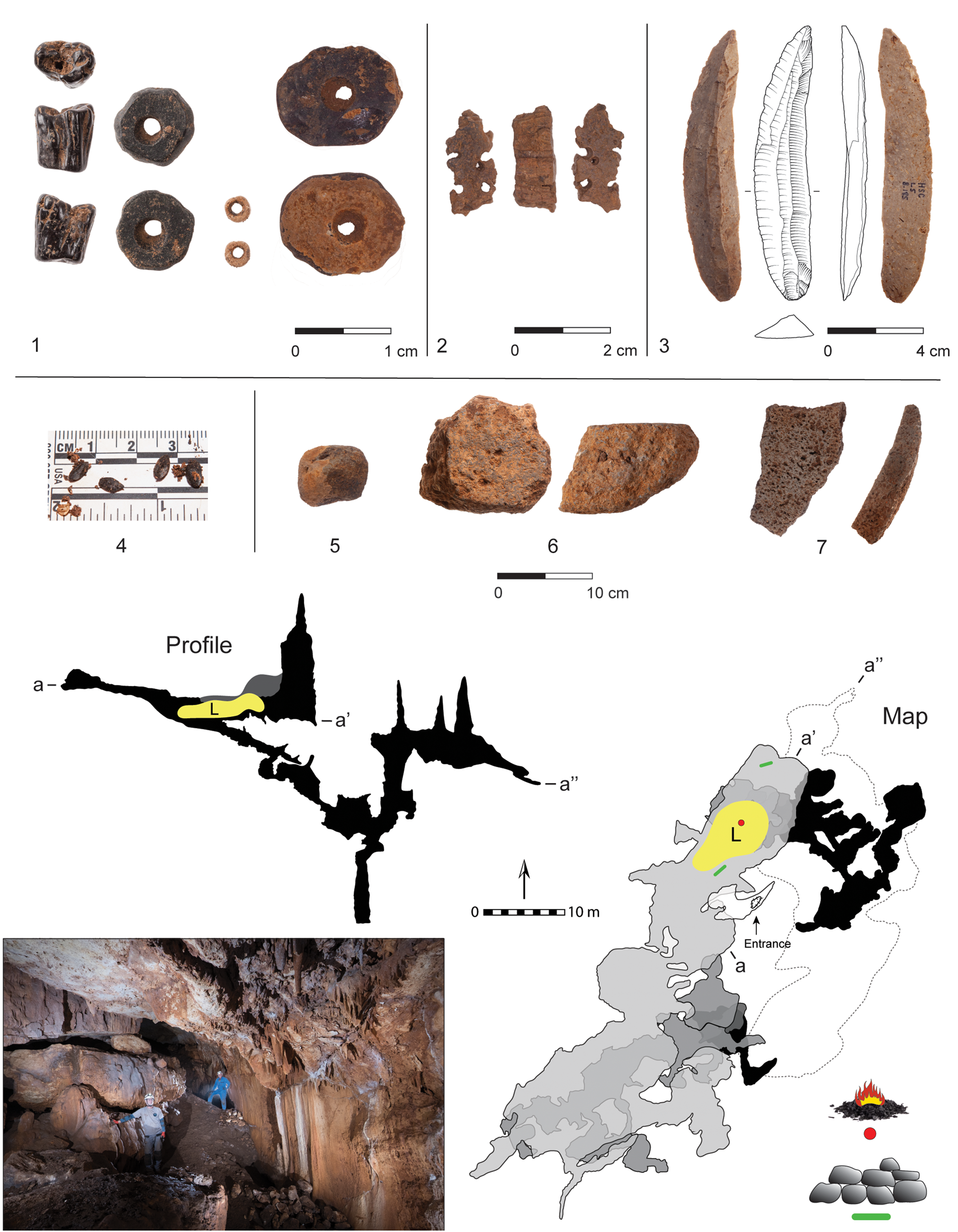
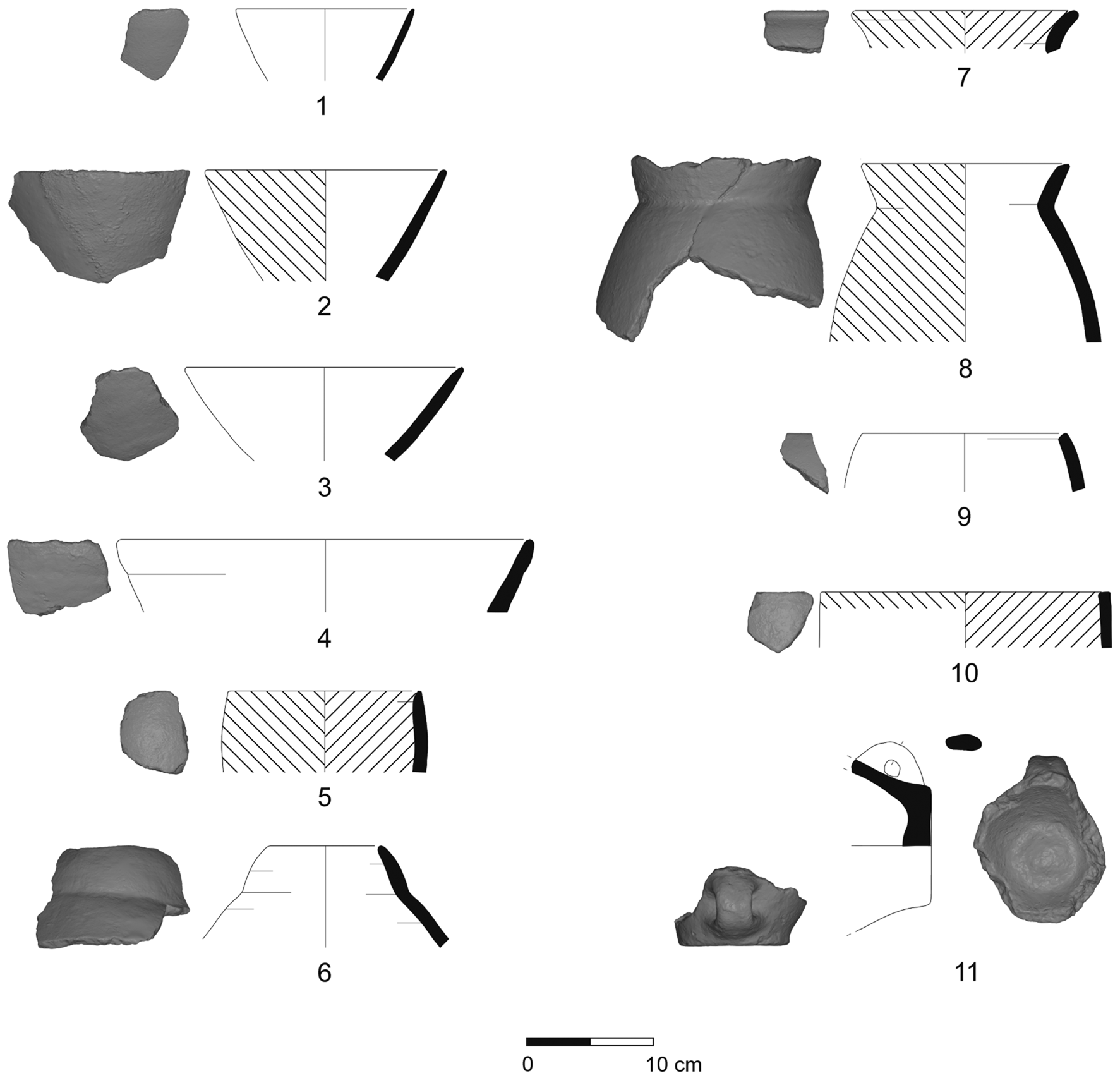
Going back to Chamber C, a low passage leads through its northern wall to Areas K and L, constituting a continuous spacious hall in the main level of the northern wing. Area K contains a steep talus of sediments from external sources that infiltrated the cave through the entrance shaft and additional voids in the high ceiling (see Ullman et al. Reference Ullman, Laugomer and Shicht2023), while Area L is a boulder-strewn, quasi-flat area from which one can descend into the lower levels of this wing. The hall's walls are adorned with marvellous speleothems, especially in its southern part. Its space allows for a large group of people to gather comfortably (Fig. 8). The central area of the hall yielded numerous pottery sherds of bowls, necked jars, holemouth jars and churns (Fig. 9). In addition, several groundstone tools and beads were found in this area (Fig. 8), as well as a dense concentration of charred grains (estimated number >1000).
Hall L, location marked by yellow shading on the cave's planar view and profile, and archaeological finds from this hall: (1) beads; (2) fragment of a bone plaque; (3) flint blade; (4) charred cereal grains; (5) pebble; (6) fragment of a lower grinding slab; (7) fragment of a basalt bowl. The location of the charred grains and wood charcoal concentrations is marked as a red circle on the cave's planar view, and architectural elements are marked by green lines.
Pottery from Hall L: (1–5) bowls; (6–8) necked jars; (9–10) holemouth jars; (11) churn handle.
The subsidiary spaces in the lower levels
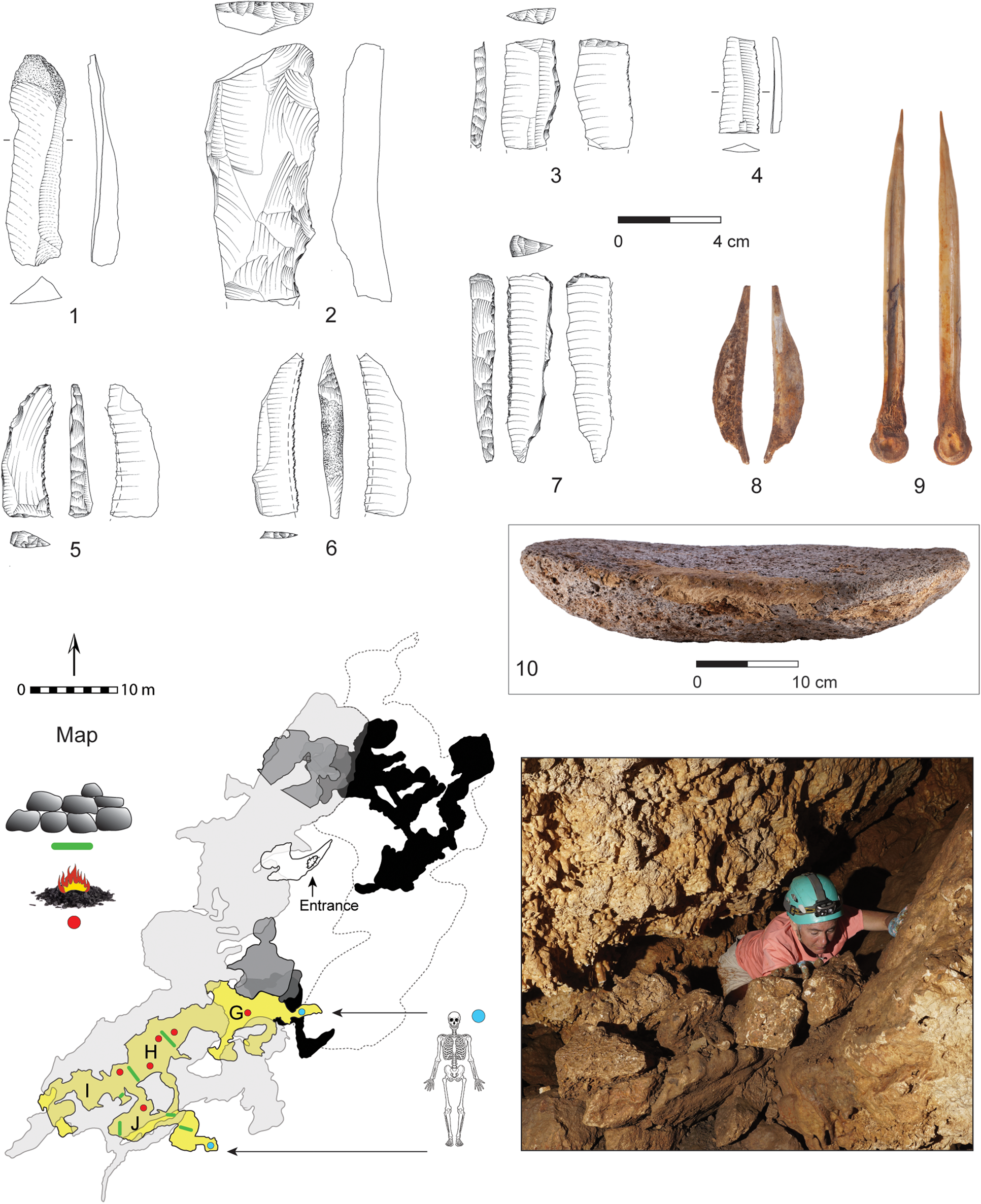
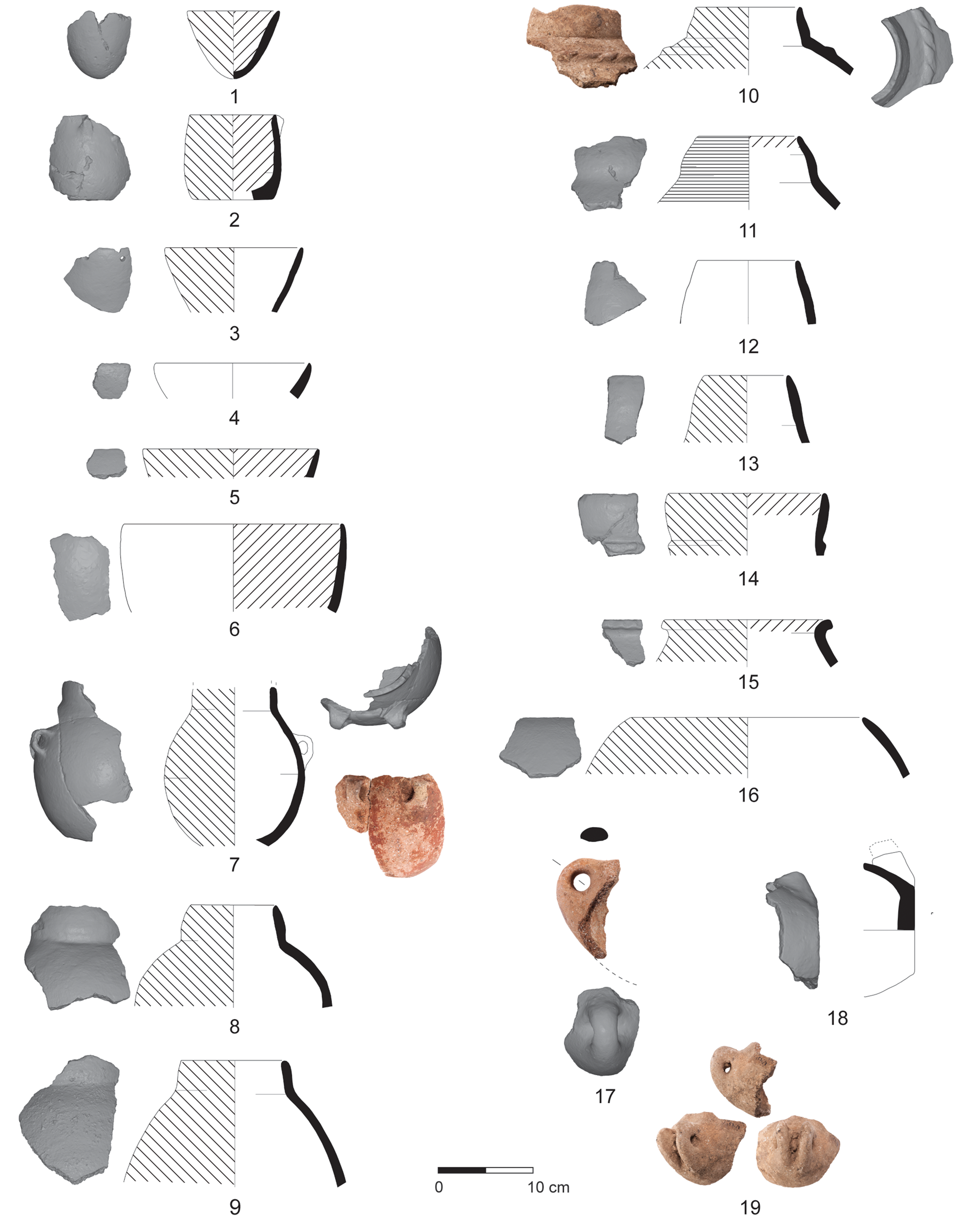
A system of low and muddy chambers and passages (G, H, I and J) stretch parallel to and below Hall T in the southern wing of the cave. These are adjoined by two spaces (E, F) connected via stone-built retaining walls that allow movement through sub-vertical passages (Fig 6c, d). The subsidiary chambers are interconnected via multiple passages, creating a maze-like structure in this part of the cave. Movement requires crawling and squeezing, while upright movement is severely restricted. The narrow and winding maze limits visibility and orientation, and the damp and humid environment leaves the skin clammy and the clothes covered in mud. Despite the inhospitable conditions, evidence for intensive human activity abounds in these areas. Numerous stone walls were encountered, some of them built in very narrow and low spaces. Thick ash and charcoal concentrations observed in multiple locations constitute the remains of fireplaces, while smaller ash traces may be related to the use of wooden torches for illumination. The archaeological assemblages uncovered include numerous pottery vessels (necked jars, churns, bowls and cups), four sickle blades and some knapping debitage, a complete lower grinding stone made of basalt, and two bone points (Figs 10–11).
Areas G-H-I-J, location marked by yellow shading on the cave's planar view, and archaeological finds from these areas: flint items: (1) blade; (2) truncation on retouched blade; (3) square sickle blade; (4) retouched blade; (5–7) triangular sickle blades; (8–9) bone points; (10) lower grinding slab. The location of ash and charcoal concentrations is marked as red circles on the cave's planar view; architectural elements are marked by green lines and human remains by blue circles.
Pottery from Areas G-H-I-J: (1) cup; (2–6) bowls; (7) small multiple-handled jar; (8–15) necked jars; (16) holemouth jar; (17–19) churn handles.
The subsidiary spaces in the northern wing are generally arranged as a series of small chambers located one above the other (M, N and P), with a very narrow and winding path leading from the boulder-strewn floor of Hall L down to Chamber P, the largest of the secondary spaces in this wing (Fig. 6d). In the upper part of this system, the small chambers M1 and M2 yielded fragments of two human skulls (H5 and H6), alongside a complete basalt implement—a solid high-pedestal stone bowl (compare Getzov et al. Reference Getzov, Shalem, Haklay, Milevski, Eirikh-Rose and Leyfirer2022)—and several other finds. H5 is a 35- to 40-year-old male, while H6 is a 24- to 30-year-old adult whose sex could not be determined (see Supplementary materials). Below these chambers, the path comprises several tight squeezes that eventually give way to the spacious Chamber P; the material remains here solely comprise several pottery vessels, including one complete bowl. All in all, the subsidiary spaces in the northern wing yielded considerably smaller material assemblages compare with those of the southern wing.
Human burials in cul-de-sac locations
The deepest point within the cave, and the most remote location in relation to the cave entrance, is the bottom of Shaft S, descending from the floor of Chamber P. This 11 m deep vertical shaft requires designated equipment to rappel down and climb up. The top of the shaft (c. 1 m in diameter) is hidden between several boulders, hanging above the abyss. The bottom of the shaft is flat and can accommodate two people at most. A 2 m long, 0.8 m wide crevice is opened to the south at the lower part of the shaft. Within the crevice, a complete and articulated skeleton of a 20- to 25-year-old female was discovered lying on its back (H1), partially covered by clayey brown sediments that washed down from the upper levels (Fig. 12). The skeleton was found intact, fully articulated and in an excellent state of preservation, except for an unhealed, rounded trauma-induced fracture on the forehead, probably the cause of death. No material remains were found in association with this skeleton.
Cul-de-sac burials in locations G3 (H3 and H4), J7 (H2), S2 (H1), and T4 (H7 and H8), indicated by blue circles and shading on the planar views and profiles.
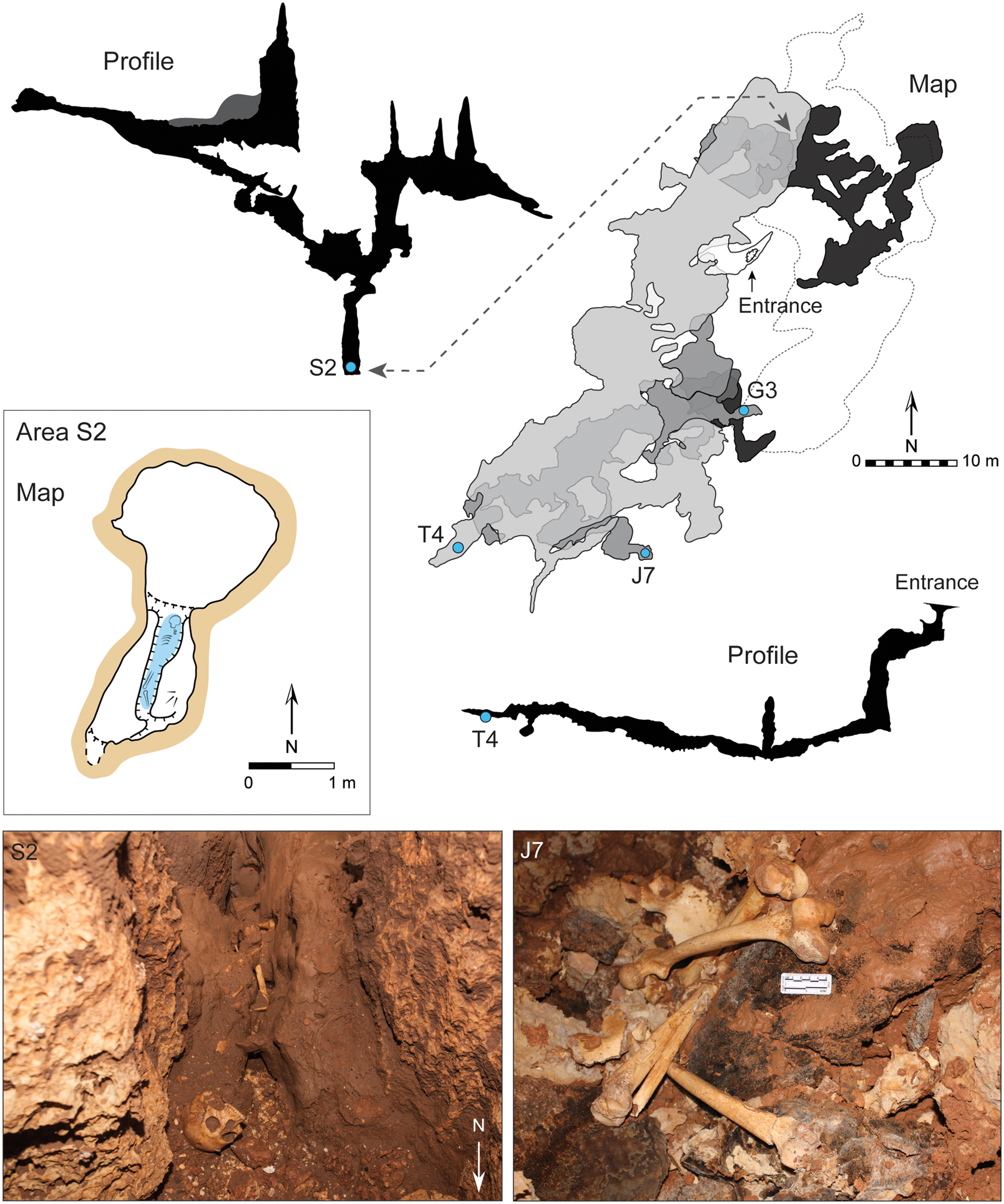
In addition to the skeleton from Shaft S, three dead-end locations in the southern wing of the cave yielded semi-complete, non-articulated skeletal remains (Fig. 12). One is a narrow, low cul-de-sac passage (T4) branching off the southwestern part of Hall T. This passage measures c. 6 m in length, 2 m in width, and no more than 0.9 m in height. The floor consists of eroded limestone bedrock, while the ceiling is adorned with numerous small ‘straw’ stalactites. At the far end of the passage, two adults were placed (H7 and H8), aged 20–30 and 35–40 years respectively; sex could not be determined for both. The bones of these skeletons were found crumbly and fragmented. The second location (J7) is a narrow fissure situated at the end of a local maze of passages and low chambers below Hall T. This barely reachable location, which requires squeezing through several tight passages, contained the bones of one male (H2), aged 16–20, collected from a small-stone scree that covers the floor of a tiny space (c. 1 m in diameter). Nearly all skeletal components of this individual were retrieved, mostly in good preservation. The third location is behind a screen of speleothems in a small cul-de-sac in the northeastern part of the same maze (G3). The bones of individual H3, aged 20–25, and H4, a c. 8-year-old child, were collected from the muddy floor on this narrow crevice. A large number of skeletal components were retrieved in a relatively good state, but sex could not be determined for both individuals. As in the case of the Shaft S burial, none of the three burial locations in the southern wing produced material objects associated with the skeletal remains. In all cases, it is impossible to determine whether the corpses were initially laid as primary burials (i.e. in articulation), similar to the burial from Shaft S, or as secondary deposits of bone collections.
Discussion
The cave as a wildscape
Natural subterranean features, and complex caves in particular, display a diverse range of morphologies, micro-environments and speleological phenomena, that affect and condition their selection by human groups for various purposes (Bergsvik & Skeates Reference Bergsvik and Skeates2012a; Bonsall & Tolan-Smith Reference Bonsall and Tolan–Smith1997; Brady & Prufer Reference Brady and Prufer2005; Büster et al. Reference Büster, Warmenbol and Mlekuž2019; Moyes Reference Moyes2012; Skeates Reference Skeates2010; Ullman et al. Reference Ullman, Frumkin, Langford and Davidovich2024). Among the caves situated in mountainous Galilee, HSC stands out as one of the most intricate underground systems, combining a small and concealed entrance, vertical segments that require the use of ropes and ladders, and sensory challenges created by the damp and dark environment and three-dimensional labyrinth. The cave is not located in proximity to contemporaneous settlements, which are hardly known in eastern Upper Galilee (Fig. 1c), but rather in a rugged, hilly terrain that probably lay beyond the diurnal sphere of sedentary communities (compare Robb Reference Robb and Robb2007; Tomkins Reference Tomkins2009). The cave's concealed opening, which can easily be missed, and the vertical drop found immediately inside the entrance, contribute to its secretive and isolated nature. These qualities suggest that the cave was deliberately selected as a wild domain of activity, removed from the mundane sphere of surrounding communities (compare Gopher Reference Gopher and Gopher2012b, 1495–1501). In this sense, complex caves that share the qualities of HSC constitute, both physically and conceptually, ‘other’ (heterotopic) spaces (sensu Foucault & Miskowiec Reference Foucault and Miskowiec1986) within the fabric of the inhabited landscape (Bergsvik & Skeates Reference Bergsvik, Skeates, Bergsvik and Skeates2012b; Robb Reference Robb and Robb2007).
The early fifth-millennium bce activity in HSC covers the entire horizontal and vertical extension of the subterranean system, except for several very narrow crevices and the concealed and hardly accessible segment in its eastern sector (Area R). Operating in the various segments of the cave required intimate, exploratory knowledge of its structure, overcoming all-encompassing sensory deprivation (especially with regard to sight, sound, orientation and time perception), and the use of technical equipment that was transported and erected in hazardous locations (compare Clottes Reference Clottes and Moyes2012; Conkey Reference Conkey, Nash and Mazel2018; Medina-Alcaide et al. Reference Medina–Alcaide, Garate and Intxaurbe2021). The results of human actions contributed to these impediments, i.e. the lighting of open fires and mobile torches in narrow spaces with poor ventilation, the transportation of heavy paraphernalia (e.g. grinding stones) and the inclusion of human corpses. The operation in most cave segments, highlighted by the placing of designated corpses in remote cul-de-sac locations (representing, and possibly symbolizing, the edges of the subterranean system), seem to reflect a deliberate attempt to claim the entire cave space. The distancing of human remains to dead-end locations cannot be interpreted in ‘functional’ terms (e.g. the removal of corpses due to hygiene and smell hazards), as these could easily have been met elsewhere (e.g. in a single blocked area, or outside the cave). These corpses were not just removed from the main activity areas, but were purposefully transported to and placed at the fringes of the cave, in multiple, spatially separated locations.
Given the cave's secluded nature, as well as the physical and cognitive challenges involved with operating in its depth, it is possible that the activities in HSC were performed by a restricted group, and that the cave was not accessible to the public. In her study of ritual cave use in Neolithic Italy, Whitehouse (Reference Whitehouse1992) suggested that access to cave depths was restricted to young men as part of ritual initiation associated with cults of secret knowledge. Her arguments were based on the relative abundance of male figure depictions in the depth of the studied caves and the nearby presence of juvenile handprints. In a different context, Prufer (Reference Prufer, Brady and Prufer2005) suggested that entry into and activity within narrow and dangerous cave interiors in the Mayan Highlands was restricted to ritual specialists (i.e. shamans). Unfortunately, the severe paucity of contemporaneous settlement remains in Galilee and the limited archaeological data concerning social organization in the early fifth-millennium southern Levant do not permit associating the activity in HSC with a specific community or social subgroup. Nonetheless, it may be hypothesized that the entry to the cave was reserved to select agile individuals, drawn from surrounding communities and trained in the arduous tasks involved with conducting rituals in the deep underground.
Death and the agricultural cycle
The material assemblages uncovered in HSC, including pottery, lithic, groundstone, and other objects, consist of vessel types and artifacts mostly found, in changing frequencies, in broadly contemporary settlement sites in Galilee and beyond. In this sense, the materiality of the cave replicates that of settlement sites, dominated by ‘mundane’ artifacts used in everyday, household activities. This replication is also present in other realms of the cultural milieu of the cave, including the construction of stone-built walls, fire making, presence of staple foods, and incorporation of human burials and skeletal remains—all of which are typical of late sixth–early fifth-millennium bce settlement sites in the northern regions of the southern Levant (Garfinkel Reference Garfinkel1999; Garfinkel et al. Reference Garfınkel, Ben–Shlomo and Kuperman2009; Reference Garfinkel, Ben-Shlomo and Freikman2020; Gopher Reference Gopher and Gopher2012a). This contrasts with late fifth-millennium bce patterns, which show growing spatial and material distinction between settlement and cave sites, specifically in relation to the mortuary realm (Nativ Reference Nativ2014; Rowan & Ilan Reference Rowan, Ilan and Moyes2012; Shalem et al. Reference Shalem, Gal and Smithline2013; van den Brink Reference van den Brink, van den Brink and Gophna2005).
Beyond the commonalities mentioned above, the anthropogenic signature in HSC is overwhelmingly associated with the production, preparation and consumption of staple cereals. This is evident in the presence of cereal grains placed in the centre of the largest hall in the cave, that may be interpreted as seeds intended to be sown or as reaped crops ready to be consumed. The occurrence of sickle blades, which dominate the small and highly selective flint assemblage found in primary deposition in the cave, is significant, as these items were clearly non-usable in the cave, and therefore were brought owing to their symbolic value. Interestingly, the majority of the blades retrieved are triangular in shape, of the type specifically designed to be hafted at the end of a sickle; these triangular blades are typically less common in lithic assemblages (compare Rosen Reference Rosen1997; Vardi Reference Vardi2011). The processing of grains is manifested by the presence of grinding stones, with an emphasis on the two complete, heavy lower grinding slabs that were carried into the cave and concealed in difficult-to-access niches. While the pottery assemblage cannot be directly linked to food preparation or consumption of cereal foods, it is worth noting that it is dominated by small serving, storing and eating/drinking vessels (bowls, cups, small jars). At the same time, large containers and cooking utensils are rare. The open fires lit inside the cave, especially in the low chambers and passages of the southern wing that produced many of the ceramic, lithic and groundstone objects, may well have been associated with the preparation of cereal foodstuffs (e.g. bread).
The remarkable frequency of artifacts and other remains associated with the agricultural cycle of staple grains in HSC, and the simultaneous presence of human burials, invoke the notions of fertility and reproduction, themes that feature prominently in the symbolic and ritual world of the Late Neolithic southern Levant (Getzov Reference Getzov2011; Gopher Reference Gopher and Gopher2012a, 1568; Milevski et al. Reference Milevski, Getzov, Galili, Yaroshevich and Horwitz2016; Orrelle Reference Orrelle2014; Orrelle & Gopher Reference Orrelle, Gopher and Kuijt2002), as well as in numerous later Near Eastern contexts (e.g. Bar-Yosef & Ayalon Reference Bar-Yosef and Ayalon2001; Bradley Reference Bradley and Bradley2005; Frazer Reference Frazer1890; Jacobsen Reference Jacobsen1976; Mettinger Reference Mettinger2001). In the broadly contemporary settlement of Tel Tsaf in the Central Jordan Valley, primary burials of selected women and infants were uncovered within and next to large-scale grain storage facilities (silos). The suggested interpretation of these burials connected the belief in human regeneration with agricultural reproduction (Garfinkel et al. Reference Garfınkel, Ben–Shlomo and Kuperman2009). A similar connection can be proposed for HSC, where human remains are found both in association with material and ecofactual remains related to cereal agriculture, and at the edges of the subterranean system, marking its boundaries. Thus, HSC could be interpreted as a wildscape devoted to ritual performances associated with the interconnected themes of agricultural and human fertility. The cave, an ‘other’ space possessing the vital powers of the untamed wild, is an ideal location for rituals oriented towards reassurance of the revival and growth of crops, as it mimics the environmental conditions (moist, muddy) needed for successful sowing (compare Tomkins Reference Tomkins2009). Indeed, the entire ritual performance in the cave, including the placement of selected dead in remote locations, may be regarded as an imitation of planting, while the vertical entrance and the high chimneys in the ceiling of the main hall K–L invoke the notion of growing, and provide the necessary connection to the overground world.
Domesticating the underground
The shifting of rituals related to fertility and regeneration from the village, the center of life of sedentary agricultural communities, to the untamed subterranean sphere, as seen in HSC, recalls the ideas proposed by Hodder (Reference Hodder1990) concerning the shift from the ‘domus’ to ‘agrios’ as a main arena of symbolic activity in Neolithic Europe. In this capacity, the culturing of wildscapes blurred (at times) the dichotomy between the domesticated and the wild (Hodder Reference Hodder1990, 86). Similarly, the replication of village materiality in the subterranean sphere in HSC marks a conscious effort to domesticate the underground. This notion is emphasized in two remarkable aspects: the construction of stone walls, and fire-making. Stone architecture and fireplaces symbolize permanency, durability and home-making in Neolithic communities (e.g. Banning Reference Banning1998; Banning & Chazan Reference Banning and Chazan2006; Watkins Reference Watkins2004). Burning inside poorly ventilated chambers may cause sensorial uneasiness and physical harm, but it did not deter those who operated in HSC, for whom fire-making was a vital and habitual activity. Even more surprising is the construction of multiple stone walls (n = 19) across the subterranean system; while these walls were used to delineate designated areas and alleviate the movement in sub-vertical passages, their construction was clearly not required to allow human activity inside the cave. This is evident by the absence of walls within numerous other parts of the cave, and the weak and partial connection between walls and deposition of material and other remains. Therefore, the construction of walls, observed in numerous other complex caves in the southern Levant (e.g. Gopher & Tsuk Reference Gopher and Tsuk1996; Shalem et al. Reference Shalem, Gal and Smithline2013; Ullman et al. Reference Ullman, Frumkin, Langford and Davidovich2024), seems to imply a premeditated symbolic behaviour rather than a functional necessity.
The domestication of natural or wild features and landscapes, observed in other spheres of the Levantine Late Neolithic (e.g. water: Garfinkel et al. Reference Garfinkel, Vered and Bar–Yosef2006), seems to entail an ostensible duality in the perception of the wild within Late Neolithic cosmologies. On the one hand, the wild (the cave in our case) was the ultimate ‘other place’, a sensorial world that stands in contrast to everyday experiences, and therefore desired as a heterotopic arena of performance (Badiella Reference Badiella2020; Tomkins Reference Tomkins2009). In tandem, the wild is ritually annexed, tamed and controlled in the course of ritualized action (Hodder Reference Hodder1990). Owing to the natural characteristics of sizeable karst systems, their ‘domestication’ was effectively partial, and they retained their ‘extreme’ and unique environment through continuous formation and deformation processes (Prijatelj & Skeates Reference Prijatelj, Skeates, Büster, Warmenbol and Mlekuž2019). The emergence of complex caves as favourable off-settlement arenas of activity during the later stages of the Neolithization is strongly connected to this duality, while sowing the seeds for the enduring connection observed in later Levantine societies between mortuary rituals, fertility, and the underground.
Supplementary material
To view supplementary material for this article, please visit https://doi.org/10.1017/S0959774325000022
Acknowledgements
We wish to thank colleagues and ICRC members who participated in the discovery, mapping and survey of the cave: V. Boslov, Y. Lisovets, Y. Zissu, N. Sagi, L. Haviv, H. Ashkenazi, Y. Shivtiel, M. Osband, S. Cooper-Frumkin, A. Cooper, S. Aharon, D. Belinson, R. Porat, G. Shelach-Lavi and I. Wachtel. We are also grateful to the excavators and volunteers who participated in the 2017 excavation of HSC: O. Marder, R. Lavi, M. Goder, H. Hammer, D. Yegorov, R. Shavit, Y. Feigelson, Y. Inbar, I. Ullman, A. Getzov, T. Golobinof, H. Levin, I. Dan, A. Pochytsev and I. Harel. E. Rahamim and S. Avidan were responsible for safety management and technical climbing/rappelling during the excavation. The Namura Farm allowed us to use their facilities during fieldwork. The Israel Antiquities Authority granted licensing for the survey (License S-656/2016) and excavation (License #G-14/2017). We want to thank K. Zutovski, Tel Aviv University, and T. Golobinof, Ben Gurion University, for their assistance with processing the chipped flint assemblage; R. Shafir, The School of Archaeology and Maritime Cultures, University of Haifa, for his assistance in the analysis of faunal remains; N. Getzov and D. Shalem, Israel Antiquities Authority, for consultation on pottery issues; T. Rogovski, for field and studio photography; M. Lavi, and H. Misgav, the Conservation Laboratory, the Institute of Archaeology of the Hebrew University of Jerusalem, and E. Kamaisky, Israel Antiquities Authority, for conservation and curation of archaeological materials; and S. Alon, for drawing the flint items. The pottery was scanned by O. Ganchrow in the Computational Archaeology Laboratory at the Institute of Archaeology, The Hebrew University, using methods described in Karasik & Smilansky (Reference Karasik and Smilanski2007). Radiocarbon dates were produced by A. Cherkinsky at the Center for Applied Isotope Studies, University of Georgia, USA. The field and lab work were sponsored by the Dan David Foundation, the Broad Institute-Israel Science Foundation Program for Collaborative Projects (#2632/18) and the United States-Israel Binational Science Foundation (#2019041) (Tel Aviv University), and the Ruth Amiran Fund (Institute of Archaeology, The Hebrew University of Jerusalem).


 Open access

