





1 Introduction
A challenge in word learning is that the relation between a word and what it denotes is not readily observable. Thus, the intended meaning cannot simply be learned by association; it must be inferred somehow (Quine & Van, Reference Quine and Van1960; Sperber & Wilson, Reference Sperber and Wilson1995). Contemporary research has investigated how word learners know the relationships between words and their referents – that is, how they interpret the referential meaning of words (e.g., Bloom, Reference Bloom2002; Markman, Reference Markman1991; Pinker, Reference Pinker2003; Tomasello, Reference Tomasello2008).
Two major and distinct theoretical accounts that address this core issue of referential interpretation in word learning are the lexical constraint account and the social-pragmatic account. The lexical constraint account proposes that word learners are naturally equipped with lexical assumptions that constrain the possible meanings of given words. Two of the most important learning constraints are whole object and mutual exclusivity (Markman, Reference Markman1991; Markman & Wachtel, Reference Markman and Wachtel1988). The whole object assumption states that when a word is used for an object, the learner thinks that this word refers to the whole object rather than to any of its parts or substance. The assumption of mutual exclusivity states that the learner assumes that only one word can refer to one referent because two object categories must be mutually exclusive. Au and Glusman (Reference Au and Glusman1990) reported that adults as well as children resisted assigning two novel names to the same object when there was no additional information, such as a hierarchy of names or names from different languages. Similarly, Merriman, Bowman, and MacWhinney (Reference Merriman, Bowman and MacWhinney1989) claimed that mutual exclusivity is a default option that both children and adults use to integrate new and old words in their vocabulary. Some researchers have also suggested that these language-specific biases, rather than being innate, may initially derive from domain-general statistical learning of associative patterns and regularities (Smith, Reference Smith, Bowerman, Levinson and Levinson2001; Yu & Smith, Reference Yu and Smith2012).
In contrast, social-pragmatic accounts propose that words are learned by inferring speakers’ referential intentions within a joint social-constructive process (Bruner, Reference Bruner1981; Clark, Reference Clark1997, Reference Clark2009; Tomasello, Reference Tomasello2000, Reference Tomasello2008; Tomasello & Haberl, Reference Tomasello and Haberl2003). Rather than being equipped with language-specific adaptations for making initial lexical assumptions, the learner uses the speakers’ pragmatic gestures or cues such as pointing, directional eye gaze, facial expression, or conversational contexts to make inferences about the speaker’s intended use of words. For example, children consider the attentional focus of a speaker when learning word labels for objects (Baldwin, Reference Baldwin1991); they distinguish accidental from intentional labeling contexts, which suggests against simple associations (Diesendruck, Markson, Akhtar & Reudor, Reference Diesendruck, Markson, Akhtar and Reudor2004). They learn labels not only for visible objects but also for absent objects and even for actions, depending on the speaker’s intention as determined by shared experience (Akhtar, Carpenter & Tomasello, Reference Akhtar, Carpenter and Tomasello1996). Further, the learning does not appear to be language-specific as children also apply it when, for example, learning about facts rather than words (Diesendruck & Markson, Reference Diesendruck and Markson2001).
Indeed, subsequent research has shown that infants understand speakers’ referential intentions at an age when word learning is only beginning, even outside word learning situations, to determine what others communicate about with them (e.g., Behne, Liszkowski, Carpenter & Tomasello, Reference Behne, Liszkowski, Carpenter and Tomasello2012; Gliga & Csibra, Reference Gliga and Csibra2009; Rüther & Liszkowski, Reference Rüther and Liszkowski2020). For example, one-year-olds are able to determine the referent of an ambiguous request that an adult directs at an array of three objects on the basis of what they have or have not previously experienced with the adults (Moll, Koring, Carpenter & Tomasello, Reference Moll, Koring, Carpenter and Tomasello2006; Tomasello & Haberl, Reference Tomasello and Haberl2003; see also Saylor, Sabbagh & Baldwin, Reference Saylor, Sabbagh and Baldwin2002 for three- to four-year-olds), and they are able to determine whether an exciting exclamation refers to a whole object in sight or to a specific aspect of that object depending on the utterer’s intention as determined by what she has or has not seen (Moll et al., Reference Moll, Koring, Carpenter and Tomasello2006).
While some researchers have subsequently suggested that social-pragmatic accounts sufficiently and more parsimoniously explain word learning compared to lexical accounts (e.g., Carston, Reference Carston2008; Tomasello, Reference Tomasello2008, Reference Tomasello2009), other researchers have suggested that social-pragmatic cues may interact or refine lexical constraints. The latter idea has been investigated with conflicting cue paradigms to directly test what conditions are necessary for different accounts to make the best predictions. For example, Jaswal and Hansen (Reference Jaswal and Hansen2006) asked young children to choose referent objects when pragmatic information of eye gaze and pointing conflicted with mutual exclusivity. They reported that children disregarded pragmatic cues and followed mutual exclusivity. Jaswal (Reference Jaswal2010) further examined children’s tendency to relate a novel label to a novel object in a familiar-novel object pair in the presence of pragmatic cues of pointing and gazing at objects. They reported that children use mutual exclusivity to disambiguate speakers’ meaning but that a combination of pragmatic cues may help override the notion that one object has only one label. However, in contrast to these conclusions, Grassmann, Stracke, and Tomasello (Reference Grassmann, Stracke and Tomasello2009) found that when two-year-olds shared the common experience of interacting with an object and an adult, and the adult later excitedly uttered a novel label, children did not expect it to refer to the already commonly known object. Instead, they searched for an alternative referent. Grassmann et al. concluded that children did not use “purely” lexical principles; rather, they treated novel labels and objects in a pragmatic manner considering the speaker’s intention.
An important test case is children’s learning of part names. Learning part names should be challenging for young children if they purely follow a whole-object assumption. However, in their seminal study, Markman and Wachtel (Reference Markman and Wachtel1988) claimed that by combining the whole object and mutual exclusivity assumptions, children can also learn the names of object parts. With three-year-old participants, Markman and Wachtel showed that in an unfamiliar-object condition, children simply use the whole-object constraint, mistakenly thinking that the whole object (lung) is a “trachea.” However, in a familiar-object (fish) condition, children use mutual exclusivity to correctly learn the name “dorsal fin,” referring to part of the familiar object. On the other hand, social-pragmatic cues may also provide context to overcome possible whole-object constraints, as social-pragmatic information conveyed through gaze and gesture is an important source for word learning (e.g., Clark, Reference Clark2009; Kita, Reference Kita and Kita2003; Tomasello, Reference Tomasello2008).
Hansen and Markman (Reference Hansen and Markman2009) directly tested the whole-object principle and an effect of specific pointing gesture in part name learning with two- and three-year-olds. They taught children part names using a social-pragmatic gesture of tracing the contour of the object part. In the familiar whole-object condition, they showed a baseball cap and traced the contour of its brim (a novel name), saying, “This is a brim. See this brim.” In the test, the experimenter placed the cap on the table so that the critical brim part was facing away from the child. The experimenter then asked the child, “Can you put your finger on the brim?” Their idea was that if children put their finger on the far part of the object, or if they moved so that they could more easily point at the part, then it could be concluded that children referred to the object part. Participants were also asked the same question in a novel whole-object (tea infuser) and a novel part-object (globe-shaped metal mesh) condition. Results from Hansen and Markman (Reference Hansen and Markman2009) clearly supported the lexical constraint account of part-word learning over the social-pragmatic account. That is, study participants correctly identified novel part labels only in the known whole-object and novel part (baseball cap and brim) condition. This condition was intended to be the “mutual exclusivity is available” condition because children could use mutual exclusivity to discern the meaning of the novel word. However, in a condition with an unknown whole object and novel part, children did not respond correctly. If children mainly used the social-pragmatic gesture of tracing the part, they should have learned the novel part name in the unfamiliar object condition because the tracing gesture was presented in all experimental trials. Hansen and Markman concluded that children learned novel names for object parts only when mutual exclusivity could be used: “Mutual exclusivity is indispensable even when part labeling is accompanied by naturalistic communicative gestures” (Reference Grassmann, Stracke and Tomasello2009, p. 592).
However, in Hansen and Markman’s (Reference Hansen and Markman2009) study, the possible effect of the social-pragmatic gesture may have been masked by their design because the whole-object response was easier to make than the part-object response. In their experiment, the target object part (brim) was always placed facing away from the child to ensure that the child made a part response. Consequently, this procedure meant that even when children randomly pointed at or touched the nearby object, their responses would be counted as a whole response. Thus, the two choices of the whole and the part were not equally accessible for participating children; rather, there was a design bias toward whole object responses.
The current study examined whether social-pragmatic gestures could help young children learn the names for novel parts of novel objects. By design, therefore, an assumption of mutual exclusivity could not be used regarding learning the part label. If social-pragmatic gesture alone could lead children to learn the names of unfamiliar parts of unfamiliar objects, this would speak against rigid lexical constraint accounts and instead suggest that children make flexible inferences about the gesturer’s referential intentions. In order to assure that participants could not use mutual exclusivity, all whole objects and target-object parts were unfamiliar to children.
As a social-pragmatic gesture, we focused on pointing because it is an essential gesture in language development and human communication (Clark, Reference Clark2009; Kita, Reference Kita and Kita2003; Tomasello, Reference Tomasello2008) and an important source of joint attention in word learning (e.g., Hansen & Markman, Reference Hansen and Markman2009; Kobayashi, Reference Kobayashi1997, Reference Kobayashi1998; Kobayashi & Yasuda, Reference Kobayashi, Yasuda, Scott-Phillips, Tamariz, Cartmill and Hurford2012; Mervis, Golinkoff & Bertrand, Reference Mervis, Golinkoff and Bertrand1994). Experimental evidence has revealed that one-year-olds comprehend and express the communicative, referential, and social intentions of pointing and can infer the referent of pointing acts in a variety of situations when the referent is a new, known, hidden, or sometimes even an absent object depending on the shared context (for an overview, see Liszkowski, Reference Liszkowski2018). Beyond shared context and common ground, the meaning of pointing gestures also derives from their accompanying characteristics (Liszkowski, Reference Liszkowski2014). For example, infants distinctly mark their social intentions to either obtain an object or help others find it through distinct intonation of accompanying vocalizations and gesture shape (Grünloh & Liszkowski, Reference Grünloh and Liszkowski2015). Further, they use adults’ distinct marking to make appropriate inferences about adults’ social intentions (Esteve-Gibert, Prieto & Liszkowski, Reference Esteve-Gibert, Prieto and Liszkowski2017). Liebal, Carpenter, and Tomasello (Reference Liebal, Carpenter and Tomasello2011) showed that such “markedness” of pointing also modulates two- and three-year-olds’ referential interpretation of pointing. When children were presented with a big object (box) with a small “aspect” (e.g., a sticker attached to the back side of the box) and the experimenter then pointed in a “marked” way with repeated motion and exaggerated facial expression and intonation, children chose the aspect more often than when the experimenter used “unmarked” still pointing. Therefore, accompanying or marking characteristics of pointing may provide children with an additional source of information in interpreting a speaker’s referential intention of a word label.
We adopted materials and procedures from Kobayashi (Reference Kobayashi1998). Kobayashi showed that when the function (e.g., turning the nut) of the object part (nut) was demonstrated in addition to pointing at the part, two-year-old children could learn the names for object parts. In a test trial, when confronted with the label and a choice of the whole object or the separated part of the object, children systematically chose the part object. Hansen and Markman (Reference Hansen and Markman2009) noted that, in Kobayashi’s study, the children might have had difficulty recognizing the part (nut) that was separated from the whole object (U-shaped bolt). This seems a reasonable criticism; however, half of Kobayashi’s trials included “transfer” trials in which the target part appeared on another whole object with a different shape (I-shaped bolt). Kobayashi (Reference Kobayashi1998) reported that there was no difference in the frequency of part objects chosen between the isolated part set and the transferred part set, supporting the interpretation that children had learned the part label.
In the current study, participants were presented with an object having an identifiable additional part and then heard a spoken label. In addition, the label was accompanied by different types of pointing gestures. In our main test, the “isolated trials,” the whole object and the part object were separately presented, and participants were asked to choose whether the label referred to the whole or part object. In additional adjacent trial (“transfer trial”), to confirm the child’s interpretation as a part name, participants were then presented with a choice of the same part object on a different whole object and the previous whole object. Our main question was how participants would interpret the reference in the first trial type, the “isolated trials.” In a pure lexical constraint account, in the “isolated trials,” participants should take the word label to denote the whole object, following the whole object constraint. Instead, in a social-pragmatic account, participants should be influenced by the labeler’s intention conveyed through distinct pointing gestures. We then tested participants with a supposedly more difficult “transfer test” in which the participants needed to recognize that the learned object part can be attached to other whole objects.
We used two types of social-pragmatic cues to mark the intended part-whole choice of reference: distance and motion. The point either touched the object part or was 7cm away; it was also either accompanied by a small circular motion of the index finger or not accompanied by such a motion. Our prediction was that if markedness of the pointing gestures helps learn a part label, a shorter distance of pointing should produce more part responses. We reasoned that touch-pointing requires more effort than distant pointing because it requires moving one’s arm closer to the referent, which results in an exaggerated and thus marked form of attention-directing. We also predicted that adding a circular motion to the pointing finger will produce more part responses, again, because it requires more effort than still pointing and should thus mark some specific aspect. We reasoned that the combination of touch and motion could be especially helpful for the youngest age group to learn part names. To see whether these effects would be present in children, we first tested adults to check for the predicted effects, and then we tested four-and-a-half-year-olds who should exhibit flexibility in word learning as well as a more contested younger age group of two-and-a-half-year-olds, for whom word learning has been suggested to be more strongly constrained by mutual exclusivity (Gollek & Doherty, Reference Gollek and Doherty2016; Jaswal & Hansen, Reference Jaswal and Hansen2006; Kalashnikova, Mattock & Monaghan, Reference Kalashnikova, Mattock and Monaghan2016). If children rely on social-pragmatic cues from the beginning, then the youngest children should already show sensitivity to marked pointing and learn labels for parts of objects in the “isolated trials” showing no difference from the “transfer trials.” The case of distant pointing without motion presents a kind of “unmarked” pointing cue. Because the distant still pointing cue does not reveal a clear intention to refer to a specific aspect or part of an object, participants could be expected to interpret it as referring to the whole object. Thus, for the “unmarked” distal pointing cue in “isolated trials,” there was no empirical distinction between lexical constraints and social-pragmatic accounts.
2 Method
2.1 Participants
Participants were 35 two-and-a-half-year-old children (M month = 30.91, SD = 4.58, range = 24-40; 18 boys) and 42 four-and-a-half-year-old children (M month = 54.19, SD = 3.93, range = 48-62; 21 boys) from two preschools in Yokohama and Saitama, Japan. The data of three additional two-and-a-half-year-old children (two boys) were excluded from data analysis because they did not complete the task (one child was fussy; two children did not comply with the task). For practical reasons, data collection was terminated because there were no more participants available at the preschools. The children were from middle-class families. Their preschool teachers reported no delays of cognitive or language development. Before and during the warm-up period, we interacted naturally with the children and did not detect any language delays. The adult participants were 38 undergraduate university students in Saitama, Japan (M year = 20.50, SD = 1.11, range = 19-24, 17 males). Sample sizes were estimated based on conventional sizes reported in the literature as well as practical constraints imposed by time and access to data collection. The experiment was conducted in accordance with the university’s code of confidentiality and ethical treatment of human subjects.
2.2 Materials
Stimuli consisted of four sets of approximately similar sizes used in Kobayashi (Reference Kobayashi1998) and Kobayashi (Reference Kobayashi, Shirai, Kobayashi, Miyata, Nakamura, Ogura and Sirai2002, Reference Kobayashi, Sirai, Arita and Hirakawa2007): a nut set (object part: nut; whole object: U-shaped bolt; Figure 1a), a plate-hanger set (object part: spring; whole object: wire similar to plate-hanger; Figure 1b), a pump set (object part: pump; whole object: bottle of an unfamiliar shape; Figure 1c), and a letter-scale set (object part: clip; whole object: metal-body; Figure 1d).
Stimulus sets a-d. p denotes part choice; w denotes whole choice.

The test items in the first test phase (an isolated-part trial) consisted of the part choice object (e.g., the nut) and the whole choice object (e.g., the U-shaped bolt without the nut). The test items for the second test phase (a transfer trial) consisted of part choice objects with distinct shapes on a different whole object (e.g., an I-shaped bolt with a nut) and the previous whole choice object without the part (e.g., a U-shaped bolt without the nut). Our previous study reported that Japanese four-year-olds (N=20) did not know the whole or part items used in the current experiment or their names (Kobayashi, Reference Kobayashi, Shirai, Kobayashi, Miyata, Nakamura, Ogura and Sirai2002).
2.3 Procedures
Participants were randomly assigned to one of four conditions resulting from crossing two factors with two levels: distance (0 cm: touch; 7cm: distant) and motion (still, circular). In the touch conditions, the extended index finger touched the part object. In the distant conditions, the index finger was 7cm away from the object part. In the circular motion conditions, the index finger moved 1 cm in diameter; in the still conditions, the index finger did not move (Figure 2).
Still pointing and pointing with motion in the part name labeling phrase. The experimenter pointed at the novel part (nut) either with still pointing or pointing with a small circular motion over the part. The experimenter also touched the part with the index-finger or did not touch it.
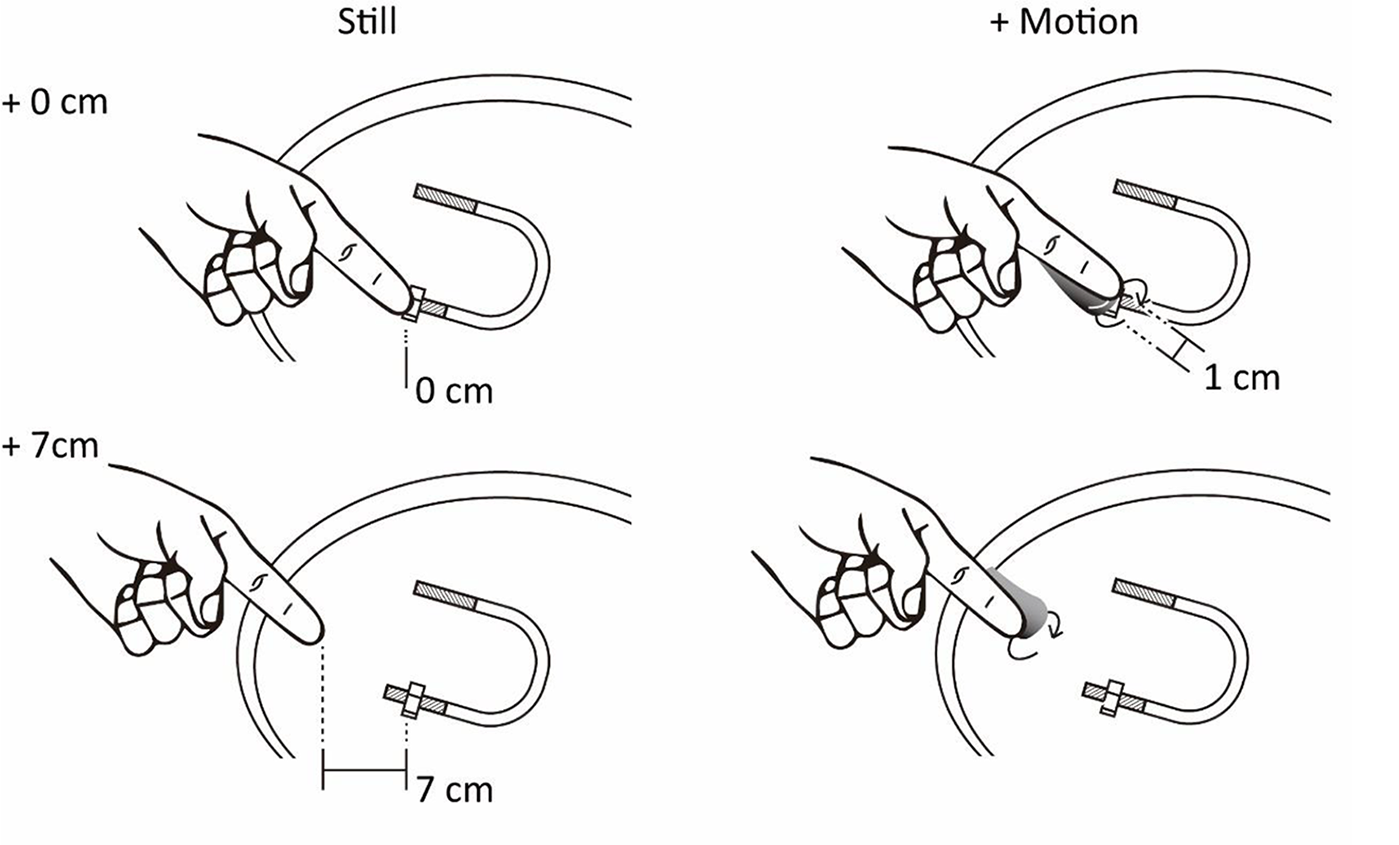
In the labeling phase, the experimenter first placed the connected standard set (e.g., a U-shaped bolt with a nut) on a white paper plate. The experimenter then pointed according to one of the four conditions while saying in Japanese “kore (this) wa (particle) natto (noun: a part name) desu (verb: is)” (“This is (a) nut”) twice. Following the labeling phase, the isolated-part test began. The experimenter presented the two test items disconnected on separate paper plates. The experimenter then asked the child, “Docchi (which) no (particle) osara (plate) ni (particle) natto (noun: a part name) ga (particle) aru (verb) kana (particle)?” (“On which plate do you find (a) nut?”). After the isolated-part test, the transfer test began. The experimenter presented the two transfer test items (i.e., the object part on a different whole object and the whole object of the previous isolated trial) in the same manner and asked, “On which plate do you find (a) nut?” The procedures were identical for each object set, but each set used different target labels. Thus, there were four object sets, and for each object set, there was one isolated-part test and one transfer test, resulting in four isolated-part tests and four transfer tests, totaling eight trials for each participant. For the university students, the same materials and procedures were used as for the children, except that we taught nonsense words as part names in a foreign language to the adult participants so as to control for their prior word knowledge.
2.4 Scoring and analyses
The isolated-part test and the transfer test were scored independently. Each score was calculated based on the participant’s performance across all four trials. Participants received one point when they correctly selected the object part. Thus, in each of the four conditions, scores for each of the two tests ranged from 0 to 4.
In the first step, we submitted the data to an omnibus ANOVA including all factors to reveal the pattern of mean performance across age (three levels), cue distance (two levels), cue motion (two levels), and trial type (two levels). We then analyzed each age group separately. In each analysis, we tested whether the effects would be similar in isolated trials and transfer trials, as predicted by the social-pragmatic account.
In the second step, complementary analysis, we tested whether part-label learning exceeded chance level and compared the averaged binary performance across trials against the expected chance value given a random choice. In the third step, final analysis, we explored whether there was an indication that participants switched their answers, perhaps as a result of pragmatic misunderstanding. Responses were classified into two types: absence-of-change (both trials “whole” response or both trials “part” response) and presence-of-change (change from “whole” response to “part” response or vice versa). Difference scores were then calculated (i.e., (number of absence-of-change - number of presence-of-change) / (number of absence-of-change + number of presence-of-change)). Positive values (i.e., 0 ≤ difference score ≤ 1.0) indicated no systematic change of choice, and negative values (i.e., -1.0 ≤ difference score < 0) indicated change of choice. For each age group, we then planned a one-sample t-test against chance set at 0.
3 Results
3.1 Performance across conditions
Figure 3 shows a jittered boxplot of part choices for each age group, distance, motion, and trial type. An initial omnibus ANOVA with the factors 3 (Age: two-and-a-half-year-olds, four-and-a-half-year-olds, adult) × 2 (Distance: touch, distant) × 2 (Motion: still, circular) × 2 (Trial type: isolated, transfer) on object-part response scores as the dependent measure using R (x64 3.5.1), with Age, Distance, and Motion as between-participants variables and Trial type as a within-participants variable revealed significant main effects of Age (F 2,103 = 5.292, p < .01, η 2 = 0.032), Distance (F 1,103 = 114.642, p < .001, η 2 = 0.349), and Motion (F 1,103 = 27.432, p < .001, η 2 = 0.084). These main effects were qualified by a number of significant interactions: Age × Distance (F 2,103 = 14.067, p < .001, η 2 = 0.086.), Age × Motion (F 2,103 = 3.916, p < .05, η 2 = 0.024), Distance × Motion (F 1,103 = 4.832, p < .05, η 2 = 0.015), and Distance × Trial type (F 1,103 = 4.996, p < .05, η 2 = 0.004). No other effects were significant.
Jittered boxplot of part response scores for each age group and pointing.
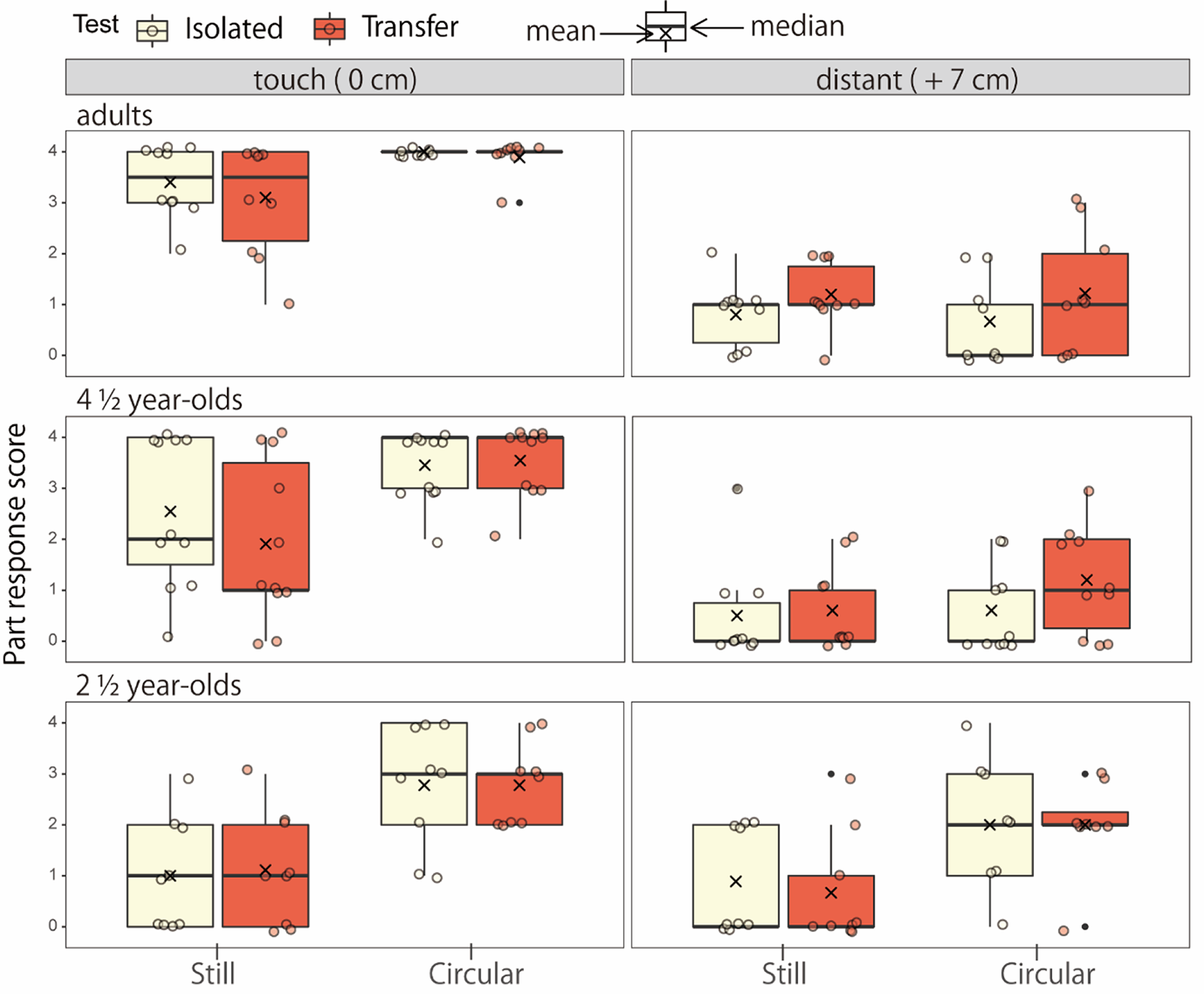
Visual inspection of Figure 3 also suggests that there is a developmental change in the distribution of responses. An age-related difference is clear in the touch condition but not in the distance condition. Given that age interacted with our manipulated variables and our theoretical interest in each age group, we subsequently ran the analyses separately for each age group.
Adults
Regarding adults, a 2 (Distance) × 2 (Motion) × 2 (Trial type) ANOVA revealed a large main effect of Distance (F 1,34 = 122.832, p < .001, η 2 = 0.730), with more part name learning for touching (M = 3.58, SE = 0.17) than 7cm distance (M = 0.97, SE = 0.19). Motion produced no additional significant effects. There was a significant but fairly small interaction effect between Distance and Trial type (F 1,34 = 15.649, p < .001, η 2 = 0.012). Resolving the interaction through direct comparisons, however, confirmed that, for both isolated and transfer trials, touch-pointing yielded more part-name learning than the 7cm distance (isolated trials, touch: M = 3.68, SE = 0.14; 7cm: M = 0.74, SE = 0.22, p < .001; transfer trials, touch: M = 3.47, SE = 0.21; 7cm: M = 1.21, SE = 0.26, p < .001).
Four-and-a-half-year-olds
Regarding four-and-a-half-year-olds, a 2 (distance) × 2 (motion) × 2 (trial type) ANOVA again revealed a significant main effect of Distance (F 1,38 = 50.851, p < .001, η 2 = 0.465), with more part-name learning for touching (M = 2.86, SE = 0.27) than 7cm distance (M = 0.73, SE = 0.18). There was also a main effect for Motion (F 1,38 = 7.319, p < .05, η 2 = 0.067), with more part-name learning for circular motion (M = 2.26, SE = 0.33) than still pointing (M = 1.43, SE = 0.32).
Again, there was a small interaction effect of Trial type and Distance (F 1,38 = 4.713, p < .05, η 2 = 0.01). However, resolving the interaction again revealed that in both the isolated and transfer trials, touch points yielded more part-name learning than the 7cm distance (isolated trials, touch: M = 3.00, SE = 0.27; 7cm: M = 0.55, SE = 0.20; p < .001. transfer trials, touch: M = 2.73, SE = 0.32; 7cm: M = 0.90, SE = 0.22; p < .001). There was also a small interaction effect of Trial type and Motion (F 1,38 = 4.577, p < .05, η 2 = 0.01). In the transfer trials, circular motion (M = 2.43, SE = 0.33) yielded more part-name learning than still pointing (M = 1.29, SE = 0.32), p= .002. In the isolated trials, this pattern was not statistically significant.
Two-and-a-half-year-olds
Regarding two-and-a-half-year-olds, a 2 (Distance) × 2 (Motion) × 2 (Trial type) ANOVA revealed main effects of Motion (F 1,31 = 22.699, p < .001, η 2 = 0.323), with circular motion (M = 2.41, SE = 0.24) leading to more part-name learning than still pointing (M = 0.92, SE = 0.22). Distance produced a marginally significant effect (F 1,31 = 2.917, p = .097, η 2 = 0.041), with slightly more part-name learning for touching (M = 1.92, SE = 0.31) than 7cm distance (M = 1.35, SE = 0.27). No other effects or interactions were significant.
3.2 Learning compared to chance
Next, we compared part choices against chance to test whether participants would actually make more part choices than expected by chance. Visual inspection revealed that performance in both isolated and transfer trials was on the same side of chance levels, and previous analyses revealed no relevant effects of trial type; therefore, we averaged across trial types. One-sample t-tests with chance set to a value of 2 revealed that marked pointing through touch with circular motion yielded significant above-chance choice of the part object in each age group (all ts > 3.0, ps < .05, two-tailed). For adults, the pattern was the same for touch points without circular motion. In contrast, four-and-a-half-year-olds hovered around chance level without the circular motion, and two-and-a-half-year-olds remained below chance without the circular motion (t 8 = 2.712, p < .05, two-tailed). Distal pointing yielded part choices below chance across all age groups when the pointing was still (all ts > 3.0, ps < .05, two-tailed). Adding circular motion to distal pointing raised the youngest group to chance level.
3.3 Analyses of switch responses across isolated trials and transfer trials
The switch analyses were exploratory. Analyzing the difference score between choices in the isolated trials and transfer trials confirmed that participants did not systematically switch interpretations. In each age group, difference scores were significantly above chance in all conditions (all ts > 2.6, ps < .05) except for two-and-a-half-year-olds in the still-and-touch condition (t 8 = 1.793, p = .11). Two-and-a-half-year-olds were less consistent in their response in this condition.
4 Discussion
The current study revealed that marked pointing promotes learning of part names. The markedness of pointing was examined in regard to two aspects, distance and motion. Touch-pointing to the object part led adults to interpret a novel label as reference to the touched object part. Adding circular motion to the touch point also led the younger age groups to interpret the label as referring to the object part. In contrast, canonical pointing with a distance between the index finger and the object part, without markedness, led all age groups to interpret the label as referring to the whole object. In the youngest age group, adding a circular motion to the distal point loosened the whole-object interpretation to chance level. The pattern of findings reveals that the social pragmatic context of gestural reference promotes object-part name learning from the youngest age tested.
The stimulus objects, the target object parts, and the names for these items were all unfamiliar to the children. The assumption of mutual exclusivity requires familiarity with some object label in the task to constrain the interpretation space when learning a new word. Thus, by design, an interpretation of the results in terms of the constraint of mutual exclusivity can be excluded. In support, the pattern of findings was similar in isolated and transfer trials. What differed between conditions were the marking of the referential act through accompanying gestural features, implicating social-pragmatic factors in the process.
All participants predominantly interpreted the reference accompanied by the canonical still, distal, “unmarked” pointing to be referring to the whole object. One could argue that this result supports the assumption of the whole-object constraint: in the absence of marking, one could argue, participants revert to a default that the label must be referring to the whole object. Alternatively, a social-pragmatic account based on relevance assumptions (Sperber & Wilson, Reference Sperber and Wilson1995) would predict that the most parsimonious and effortless inference about the referential intention of the labeler in the distant still condition is the whole object – otherwise, if another detail was intended, the communicator needed to exhibit more effort in conveying a different relevance of the reference. While these two possibilities are difficult to tease apart in the current study when looking only at the still, distal pointing gesture, the pattern of all conditions clearly implicates social-pragmatic inferences. If young word learners used whole-object bias as a default bias, the youngest group’s data will be distributed in a manner that shows their dependency on whole choices in all conditions. However, the youngest group’s data already tended to vary according to conditions, as did those of other age groups. The account of relevance assumptions differs from that of a whole object constraint in that it holds that instead of a default interpretation of a whole object, the recipient makes an inference about the most relevant referent. Certainly, even two-and-a-half-year-olds and four-and-a-half-year-olds showed sensitivity to an adult’s pointing gesture that was either touching a part or showing a small movement. When the touching and the movement were interpreted to be relevant in a certain situation for specifying the object part, such as the touch condition with motion, they chose part responses. When the movement was not interpreted to be relevant in a certain situation for specifying the object part, such as the distant pointing with motion, they chose whole responses. If this consideration is correct, this inference could also regard aspects other than the “wholeness” of an object. In support, studies that have manipulated other aspects of reference find that children flexibly apply a label either to an object or to an action, depending on the preceding shared action contexts (Akhtar et al., Reference Akhtar, Carpenter and Tomasello1996).
The current findings also revealed differences in referential interpretation across age groups. All age groups predominantly chose the object part following touch-pointing with motion; however, only adults chose the object part following touch pointing without motion. On the first pass, children’s preference to choose the whole object following touch pointing without motion may appear consistent with Markman’s (Reference Markman1991) whole object assumption and Hansen and Markman’s (Reference Hansen and Markman2009) proposal that lexical constraints are more dominant than social-pragmatic cues. According to that account, current developmental findings would suggest that the constraint is lost across development. However, the results from the circular motion condition speak against a pure lexical constraint account and instead show that socio-pragmatic gestural information does influence the reference interpretation, even at the youngest age. A social-pragmatic interpretation of the age differences is thus that touch-pointing alone, without motion, does not sufficiently mark a distinct referent for the youngest age group. Young children may be very familiar with touch points from picture-book reading and other pedagogical scenarios with proximal toys and referents, in which a touch point is often used and accordingly interpreted to refer to a whole object. In contrast, in adult interactions, distal pointing is often a casual, effortless way of referring to global aspects of a scene or direction; thus, the effort of precisely touching one aspect clearly marks the referential intention in a distinct way (for a social-pragmatic distinction between “big” and “small” points, see also Enfield, Kita & De Ruiter, Reference Enfield, Kita and De Ruiter2007). Young children may initially be less familiar with the social-pragmatic marking of specific aspects through touch-pointing. Our results suggest that by approximately four and a half years old, children become more sensitive to this type of marking and equally adopt part and whole interpretations.
Human communication is inherently inferential (Grice, Reference Grice1986; Sperber & Wilson, Reference Sperber and Wilson1995). To arrive at intended inferences, participants mark and pick up on relevant cues. Pedagogy theory (Csibra & Gergely, Reference Csibra and Gergely2009) has suggested that, at its base, ostensive cues mark actions as relevant “for you,” that is, as communicative. Communicating episodic as opposed to generic information again requires specific semantic marking (Gelman & Bloom, Reference Gelman and Bloom2007), and in its absence, infants tend to interpret communicated information as generic (Gergely, Egyed & Kiraly, Reference Gergely, Egyed and Kiraly2007). Further studies have shown that infants and children infer the various reasons for communication, not only through common ground but also through distinct expressions and markedness of the act (Liebal et al., Reference Liebal, Carpenter and Tomasello2011; Liszkowski, Reference Liszkowski2014). One can argue that cues of markedness highlight and focus a learner’s attention (Samuelson & Smith, Reference Samuelson and Smith1998). Indeed, when expressing an intended reference, the speaker’s intention is to constrain the attentional focus of the recipient. Gogate, Maganti, and Laing (Reference Gogate, Maganti and Laing2013) showed that when caregivers intended to refer to a whole object, they held the object and shook it in front of the child’s eyes. When they intended to refer to object parts, they tended to touch the object rather than simply holding and showing the object. Thus, expressing referential intentions inherently includes modifying the recipient’s attention. However, social-pragmatic accounts would predict that the attentional focus is successfully constrained by inferences about the sender’s intentions rather than by an endogenous process that directs attention. While the current study was not designed to tease apart these different predictions, other studies have shown that accidental (non-intended) actions, which do direct a recipient’s attention, do not lead to the same referential inferences as intended actions (Diesendruck et al., Reference Diesendruck, Markson, Akhtar and Reudor2004).
The current findings support the interpretation that word learning is governed by social-pragmatic inferences about a speaker’s intention based on the way it is expressed through referential acts. This type of markedness is neither a fixed code nor part of constraints working under certain conditions. Instead, it develops through experience, as our developmental findings suggest. The expression of the relevance-of-reference – that is, the marking of reference in one way or another, accounts for word learning across diverse situations, including part-name learning in the absence of lexical constraints.
Acknowledgements
We would like to acknowledge all of the participants. We would also like to thank Editage (www.editage.jp) for English language editing. This study was partly supported by MEXT/the Japan Society for the Promotion of Science (JSPS) JP17H06382 (HK) and JSPS JP20H01763(HK) and JP20K03375 (TY).


 Open access

