





Introduction
Discovering the functions of the brain is connected to deciphering neuronal codes apropos of the synchronizations and desynchronizations of neuronal activities. On this subject, information on the excitability of neurons and neural oscillations is crucial in understanding its functions. Synchronous neural oscillations pertain to the periodic co-occurrences of a population of neurons arising from neuronal spiking (Jensen et al., Reference Jensen, Kaiser and Lachaux2007). That is, the rhythmic neuronal synchronization is dynamically driven by the effectiveness of communications between higher and lower cortical regions; on the other hand, the synchrony influences a myriad of cognitive processes, like attention, retention, and perception (Engel et al., Reference Engel, Fries and Singer2001; Jensen et al., Reference Jensen, Kaiser and Lachaux2007), which is generally known as brainwave entrainment. In other words, brainwave entrainment is “the use of external stimuli to produce a frequency following response of brainwaves to match the frequency of the external stimuli” (Basu & Banerjee, Reference Basu and Banerjee2020, p. 269).
Grounded in the synchronization of the brainwave entrainment mechanism, multiple neurocognitive products have been introduced (e.g., audio-visual entertainment [AVE] and cranio-electro stimulation [CES]). These noninvasive cognitive therapies convert energies from sensory receptors into neural codes (as in AVE) or modify sympathetic and parasympathetic relations via neuromodulatory impacts (as in CES). Generally, the clinical and non-clinical applications of these devices are in line with the remedy of various experiences (e.g., attention deficit, insomnia, pain, anxiety, etc.) via constant stimulations at specific frequencies (i.e., gamma, beta, alpha, theta, and delta) over the cortex (Collura & Siever, Reference Collura, Siever, Budzinsky, Budzinski, Evans and Abarbanel2009; Frederick et al., Reference Frederick, Lubar, Rasey, Brim and Blackburn1999; Siever, Reference Siever and Evans2007, Reference Siever2012). For instance, Wuchrer (Reference Wuchrer2009) enhanced sustained attention as a particular function of the brain by exciting the nerve pathways through the constant flashes of light (photic stimulation) and pulses of tones (auditory stimulation) at SMR/Beta frequency in a 20-minute AVE session. In addition, Lee et al. (Reference Lee, Lee and Park2019) and Schroeder and Barr (Reference Schroeder and Barr2001) underlined the transmission of electrical potentials through the vagus nerve into the thalamus and examined the enhancement of attention in response to a 100 Hz mode via CES. They reported that the 100 Hz (vs. 0.5 Hz) mode activates the alpha and beta waves, leading to the modifications of thinking activities, in general, and mental load during attention and concentration processes, in particular. The outcomes of these studies provided some initial evidence for the assumption that the use of these safe and cost-effective treatments could give immediate improvements in learners’ attention. It is indeed believed that the attentional engagement of learners may change the initial encoding, reinforce deeper neuronal processing, and enhance learning. This engagement may protect against the loss of information and promote later retrieval.
In addition to the entrainment techniques, recent sensory processing models argue how, in the presence of continuous visual, auditory, tactile, and gustatory stimuli, sensory information can travel through the thalamus (i.e., the thalamocortical loop) and entrain the brain areas (Collura & Siever, Reference Collura, Siever, Budzinsky, Budzinski, Evans and Abarbanel2009). Sensory transductions create efficacious perceptual information, and their contributions (i.e., known as multisensory, intersensory, or crossmodal) establish arch-perception of the world (Ernst, Reference Ernst2008; Rosenberg, Reference Rosenberg2015; Stein et al., Reference Stein, Stanford and Rowland2009). Recent results from behavioral (e.g., Pishghadam & Shayesteh, Reference Pishghadam and Shayesteh2016; Pishghadam et al., Reference Pishghadam, Shakeebaee and Shayesteh2018) and electrophysiological studies (Boustani et al., Reference Boustani, Pishghadam and Shayesteh2021; Pishghadam, Daneshvarfard, & Shayesteh, Reference Pishghadam, Daneshvarfard and Shayesteh2021; Pishghadam, Jajarmi, & Shayesteh, Reference Pishghadam, Jajarmi and Shayesteh2021; Shayesteh et al., Reference Shayesteh, Pishghadam and Khodaverdi2020) verify that the multisensory input processing is in alignment with cortical and neocortical modulations. Accentuating the interplay between multisensory inputs and cognitive processes, studies (e.g., Battich et al., Reference Battich, Fairhurst and Deroy2020; Boustani et al., Reference Boustani, Pishghadam and Shayesteh2021; Shayesteh, Reference Shayesteh2019; Talsma et al., Reference Talsma, Senkowski, Soto-Faraco and Woldorff2010) have clarified the power of multisensory inputs on attention mechanism. In their electrophysiological study, Boustani et al. (Reference Boustani, Pishghadam and Shayesteh2021) argued how different combinations of the senses in instructional practices can yield different results in sentence comprehension and retention mechanisms. However, it is not clear whether these sensory practices can compete with the common noninvasive cognitive therapies of AVE and CES devices.
To compare the rival effects of AVE and CES therapies on attention and retention manipulations, the experiments were designed using vocabulary instructions in L2. Similar investigations about the attention and retention mechanisms were arranged in subjects’ non-native languages (Boustani & Al Abdwani, Reference Boustani and Al Abdwani2023; Boustani et al., Reference Boustani, Pishghadam and Shayesteh2021; Pishghadam, Daneshvarfard, & Shayesteh, Reference Pishghadam, Daneshvarfard and Shayesteh2021; Pishghadam, Jajarmi, & Shayesteh, Reference Pishghadam, Jajarmi and Shayesteh2021). Believing that the neuroelectric oscillations at SMR/Beta frequency serve as crucial protocols in improving attention (designed based on Collura & Siever, Reference Collura, Siever, Budzinsky, Budzinski, Evans and Abarbanel2009; Wuchrer, Reference Wuchrer2009), for the purpose of this exploratory study, we applied DAVID Delight Pro and conducted an AVE session with the Brain Booster protocol. Furthermore, in considering the propositions about the excitability states created by the CES and the linkages that have been emphasized between neurostimulations and brain alterations, we used a 100 Hz mode (by DAVID Delight Pro for CES) with the intention of increasing attention (designed based on Lee et al., Reference Lee, Lee and Park2019; Schroeder & Barr, Reference Schroeder and Barr2001). On the other hand, taking the role of enriched sensory inputs into consideration in attention modifications, we drew upon Pishghadam’s (Reference Pishghadam2015) emotioncy model and conducted a multisensory-based language instruction by simply enforcing the involvement of five senses during learning.
Hence, to highlight the efficacy of incorporating AVE and CES treatments into conventional classroom instructions (i.e., audio-visual) and compare it with that of the multisensory-based instruction for attention and retention mechanisms, we conducted four sessions: (1) control, (2) multisensory, (3) AVE, and (4) CES for each subject. In the control session, they learned a set of target words through the audio-visual method of teaching, but in the AVE and CES sessions, the teaching method was preceded by a round of AVE and CES. However, in the multisensory session, a list of words was taught through the auditory, visual, tactile, olfactory, and gustatory senses. At the end of each session, a pragmatic-Stroop test and a series of true/false statements were arranged to assess the learners’ attention and retention processes, respectively. Following the results of the AVE- (Wuchrer, Reference Wuchrer2009), CES- (Lee et al., Reference Lee, Lee and Park2019; Schroeder & Barr, Reference Schroeder and Barr2001), and multisensory-based (Boustani et al., Reference Boustani, Pishghadam and Shayesteh2021) studies, we hypothesized that the experiences in the experimental sessions (vs. control session) might manifest differences in the learners’ attention and L2 vocabulary retention processes.
Methodology
Subjects
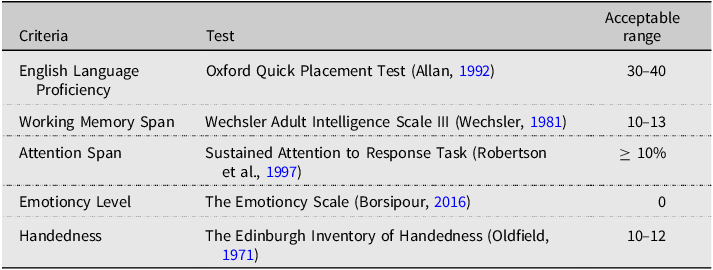
Among the 63 volunteers who participated in the exploratory study, 18 were excluded since they did not comply with the inclusion criteria (Table 1), and 12 of them did not take part in the four-session instruction, leaving 33 native Persian speakers (15 males and 18 females). After handling outliers, one subject was excluded from the final analysis, resulting in a total of 32 participants. This sample size is consistent with Lakens’ (Reference Lakens2022) justification and is influenced by statistical as well as practical considerations, including the availability of participants as well as time and logistical constraints. In addition, the high-power values (1-β) show that our sample size was sufficient for detecting the effects. They were right-handed adults (checked through Oldfield’s (1971) Edinburgh Inventory of Handedness test) and ranged from 18 to 30 years of age. Based on a self-report questionnaire, we found that none of them reported any history of epilepsy, seizure, brain injury, stroke, tumor, ADHD, and motion sickness. The subjects had no heart pacer, neurological impairment, or psychiatric disorder and were with normal or corrected-to-normal vision. They also did not take drugs or use alcohol.
Inclusion criteria and acceptable range

Moreover, they were intermediate English language learners (Allan, Reference Allan1992) with normal working memory (Wechsler, Reference Wechsler1981). It is worth noting that the motivation for using the English proficiency measures was to ascertain the participants’ general level of English comprehension used in both the instructions and test sessions and control it as a variable that may impact EFL learners’ attention (Segalowitz & Frenkiel-Fishman, Reference Segalowitz and Frenkiel-Fishman2005) and retention (Li et al., Reference Li, Wu and Liu2023) processes. In addition, to ensure the subjects’ homogeneity assumption of attention, the Sustained Attention to Response Task (Robertson et al., Reference Robertson, Manly, Andrade, Baddeley and Yiend1997) was used to withhold their sensitivity to rare (vs. frequent) stimuli. Drawing on previous findings (e.g., Alloway & Alloway, Reference Alloway and Alloway2012; Ralph et al., Reference Ralph, Thomson, Seli, Carriere and Smilek2015; Robertson et al., Reference Robertson, Manly, Andrade, Baddeley and Yiend1997), we accepted those volunteers whose scores were less than 10%. Subsequently, we conducted Borsipour’s (2016) emotioncy scale to accept those volunteers who did not have any prior familiarity with the target words. More specifically, it was scaled from not familiar (0 point); heard (1 point), heard and seen (2 points); heard, seen, and touched (3 points); heard, seen, touched, and used (tasted) (4 points); and heard, seen, touched, used, and done research on (5 points).
Target words
To determine the target words for instruction, a 30-item list (designed based on Borsipour, Reference Borsipour2016) including plants, fruits, and vegetables with their Persian equivalent was initially distributed among 130 respondents who were not the subjects of the experiment. Finally, 20 English words (some of them were low-frequency loanwords), with which 93% of the respondents had no familiarity, were chosen as the target words. To control the interfering effect of variables, we selected nouns with a defined number of letters (4–10) and syllables (2–3) (see Figure 1). Remarkably, to make the learning experience more realistic and applicable to real-world situations, the subjects were engaged with real (vs. unreal and pseudo) words. This approach enhanced the ecological validity of our findings and yielded reliable and generalizable results. Moreover, studies (e.g., Binder et al., Reference Binder, Tremblay and Joseph2020; Chen et al., Reference Chen, Jin and Ding2020) in the field of language learning and cognitive psychology support the use of real words in experimental settings to investigate learning processes.
The task design.

Procedure
Figure 1 illustrates the procedure. The details have been explained in the instruction (section 2.3.1), brain wave entrainment devices (section 2.3.2), behavioral measurements (section 2.3.3), and data analysis sections (section 2.3.4). Notably, each subject participated in all four conditions—AVE, control, multisensory, and CES—at different times. This within-subjects design controlled for individual variations in attention and working memory, ensuring that any differences in the results can be attributed to the experimental conditions rather than pre-existing differences between groups.
Instructions
Five words were taught to the subjects in each session (i.e., control, multisensory, CES, and AVE). The reason behind choosing five words came from the Stroop-based studies (e.g., MacLeod, Reference MacLeod1991; Parris et al., Reference Parris, Hasshim, Wadsley, Augustinova and Ferrand2021) pointing to the set-size effects of stimuli. Considering the number of items in this color-word test, we selected five words to meet the stimulus set size limitation.
The explanations in the instructions characterized the physical properties of the target words, like their size, color, and taste. To minimize the bias effect, and maintain the integrity and reliability of the results, the instructions were randomized. Additionally, it was crucial to ensure that there were at least two days between the AVE and CES sessions to prevent any potential carry-over effects. It is remarkable that the order of the words was counterbalanced across the participants. However, to maintain consistency within each learning condition and control the potential effect of confounding variables, the words were not counterbalanced across the sessions. This allowed us to ensure any differences in learning outcomes could be attributed to the specific intervention.
Moreover, the amount of information transferred and the instruction time devoted to the subjects and for each target item were much the same, and the instructions were done by one of the researchers. Importantly, to control the interfering effect of repetition, there were no repetitions of the target words, and the subjects were exposed to them only once. Each session was devoted to one participant, and the instruction time was preferably organized between 8 AM and 1 PM to be consistent with all the subjects. Each subject experienced AVE, control, multisensory, and CES methods on four separate days, with each session lasting for approximately 60 to 100 minutes. This time comprised signing the informed consent, receiving the instruction, preparing the AVE and CES devices, running a sample task, and then doing the attention and retention tasks.
Audio-visual instruction
Following the procedure employed commonly in academic settings, the subjects in the control group, CES, and AVE sessions merely received auditory and visual inputs. More specifically, they underwent verbal explanations while receiving visual input via a PowerPoint presentation. The colored photos were presented at the center of a white background, and the name of each item was typed in black font. The font size was Times New Roman 60 pt bold on the top of a 55-inch television screen.
Multisensory-based instruction
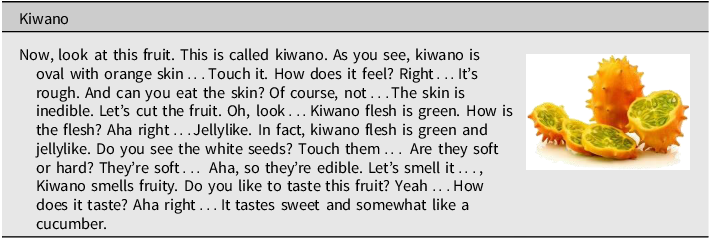
To conduct the multisensory-based language instruction, we relied upon previous studies (Boustani et al., Reference Boustani, Pishghadam and Shayesteh2021; Pishghadam, Daneshvarfard, & Shayesteh, Reference Pishghadam, Daneshvarfard and Shayesteh2021; Shayesteh et al., Reference Shayesteh, Pishghadam and Khodaverdi2020). The subjects received full sensory involvement for the five target words in the multisensory session. In fact, they were exposed to tactile, olfactory, and gustatory inputs besides auditory and visual inputs. In particular, to teach the target words, real plants and fruits, besides, an oral presentation and a PowerPoint were used. Table 2 delineates a sample instruction for the fruit kiwano, in which the subjects received auditory, visual, tactile, olfactory, and gustatory inputs.
A sample instruction

Brain wave entrainment devices
Audio-visual entrainment device (AVE)
The Digital Audio-Visual (David Delight Pro by Mind Alive, Inc., Edmonton, Canada) was applied. The photic and auditory stimulations were administered with the Brain Booster (Left stim 14 Hz, Right stim 20 Hz) session to help the subjects’ focus and concertation processes (Wuchrer, Reference Wuchrer2009). Following the handbook of “Operator’s Manual” (https://mindalive.com/manuals/) and experiments (e.g., Collura & Siever, Reference Collura, Siever, Budzinsky, Budzinski, Evans and Abarbanel2009; Wuchrer, Reference Wuchrer2009), we specifically chose the 24-minute SMR/Beta protocol (Left: 13.5 Hz/Right: 18 Hz) to create a gentle and entraining session that helps to focus mental functioning and memory.
The Tru-Vu Omniscreen Multi-Color Eyeset used yellow (to improve cognition and focus [14–20 Hz]) and cyan (to enhance entrainment while still being calming and relaxing) flickering lights via LEDs implanted on the inner side of the darkened eyeglasses. Adjusting the brightness of the LEDs, the subjects were instructed to close their eyes, be relaxed but not fall asleep, and attend to the lights during the photic training period. Running a sound sync session, we selected the binaural-beat entrainment mode to improve the subjects’ attention (Aparecido-Kanzler et al., Reference Aparecido-Kanzler, Cidral-Filho and Prediger2021; Lane et al., Reference Lane, Kasian, Owens and Marsh1998; Park et al., Reference Park, Kwon, Kang and Lee2018).
To achieve the best results, we conducted the AVE session in the morning (Collura & Siever, Reference Collura, Siever, Budzinsky, Budzinski, Evans and Abarbanel2009) in a sound-attenuated and dimly lit room. The subjects were in a sedentary position in a comfortable chair, and they were asked to drink a glass of water 15 minutes before its commencement (Collura & Siever, Reference Collura, Siever, Budzinsky, Budzinski, Evans and Abarbanel2009). They were also foretold not to consume any drugs and not to drink any caffeine products before the session (On et al., Reference On, Jailani, Norhazman and Zaini2013). All the subjects signed an informed consent form approved by the Ferdowsi University of Mashhad Ethics Committee.
Cranio-electro stimulation device (CES)
The CES ear clip stimulus cable was connected to the CES output jack of the Delight Pro device (Mind Alive, Inc., Edmonton, Canada) powered by a 9-volt alkaline battery. The 20-minute CES session was run at 100 Hz mode to create a positive impact on attention (Lee et al., Reference Lee, Lee and Park2019; Schroeder & Barr, Reference Schroeder and Barr2001). Entraining the CES pulsed electrical current, two sponges were placed on the left and right earlobes while the subjects remained seated in a comfortable chair. For better conductance, we dampened the earlobes with a small amount of water. Each subject was informed about the device with a neutral expectation prime and neutral language (Sansevere et al., Reference Sansevere, Wooten, McWilliams, Peach, Hussey, Brunyé and Ward2022) before signing the informed consent. Due to the enhancements in the production of the neurotransmitters, we had a 20-minute time break between the CES implementation and the audio-visual instruction (Liss & Liss, Reference Liss and Liss1996; Southworth, Reference Southworth1999). Furthermore, the AVE and CES sessions were separated by at least two days each to decrease any carry-over effects.
Behavioral measurements
Immediately following each instruction, a Stroop and a true/false test were arranged to examine the subjects’ attention and retention processes, respectively.
Attention test
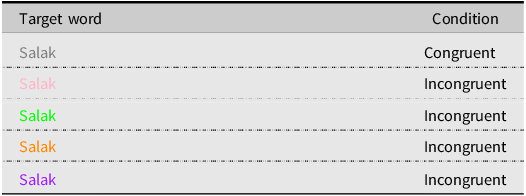
To measure the subjects’ attention to the target words, we used SuperLab (Version 4.0) and designed the neuropsychological test of Stroop (Stroop, Reference Stroop1935). Customizing this color-word test, we designed a pragmatic-Stroop test consisting of the target words (five words for each group), in addition to equal stimuli set size as fillers (4–10 letters and 2–3 syllables) in green, orange, brown, pink, and purple ink colors. The subjects had to determine the congruence (10 items) and incongruence (40 items) of each word in harmony with the appeared color in a 2.5-minute block with 50 trials by pressing the defined keyboard keys. To judge the congruence or incongruence state of the words, the subjects were informed to decide based on the color of the plants, fruits, and vegetables taught (Table 3). For instance, salak skin is brown, so the word salak, which was written in brown, was congruent; however, those words in pink, green, orange, and purple ink colors were incongruent.
Examples of the congruent and incongruent target word

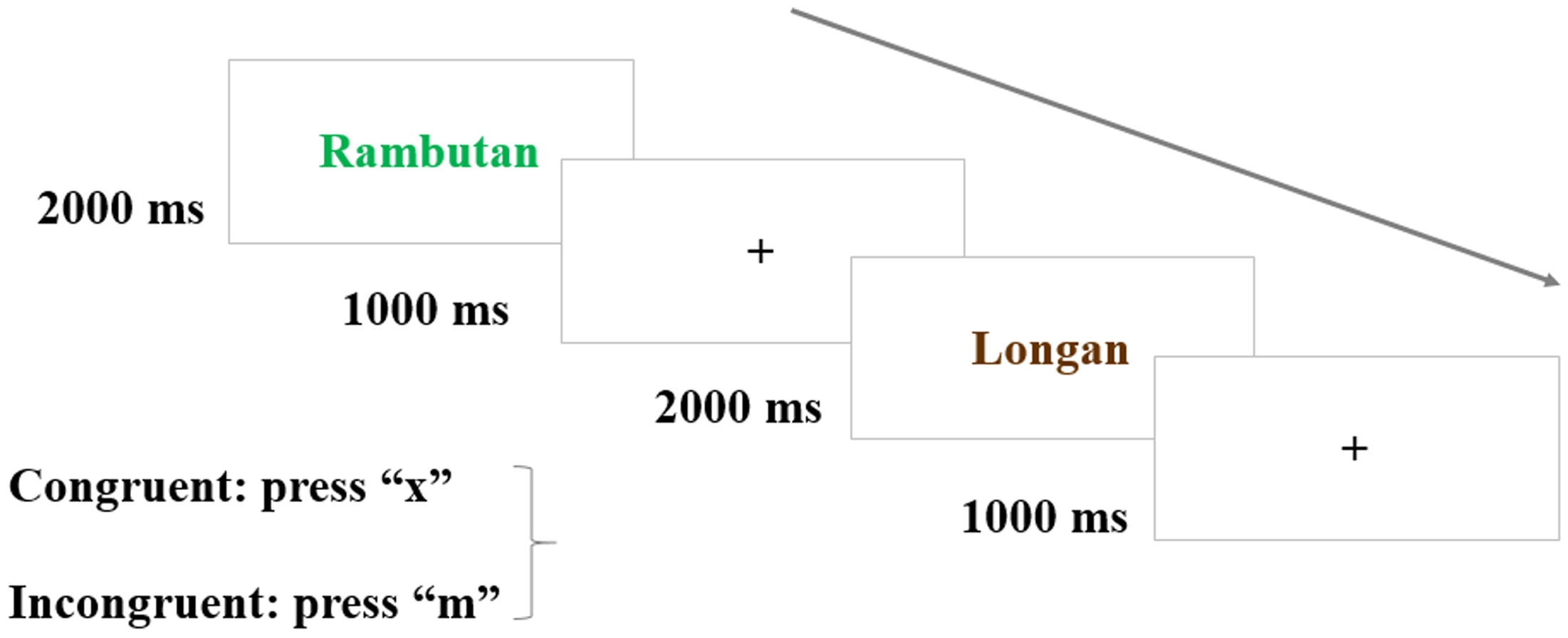
The stimuli appeared randomly in a word-by-word format in the center of a 17-inch computer screen in Times New Roman 58 pt bold font size at the center of a white background. The stimuli were presented for 2000 milliseconds on the computer screen (designed based on https://www.psytoolkit.org), and the inter-stimulus interval between the experimental trials was 1000 milliseconds (Ben-Haim et al., Reference Ben-Haim, Williams, Howard, Mama, Eidels and Algom2016) (see Figure 2).
Stroop trial samples (Rambutan and Longan).

Retention test
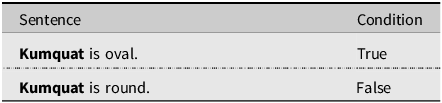
The computerized version (by SuperLab 4.0) of the retention test was designed with 50 (25 correct and 25 pragmatically incorrect) sentences with the target words for each group (see Table 4). The subjects were required to judge the acceptability of the sentences, which appeared randomly in the center of a 17-inch computer screen in black font color and Times New Roman 48 pt bold font size at the center of a white background by pressing “x” or “m” key for correct and incorrect sentences, respectively. To improve the reliability of measures and to maintain the complexity features, the sentences were in a specific range of word counts (i.e., 3–4) and complexity (simple present tense, singular type, and active voice).
Examples of the correct and incorrect sentences

Note: The target words are boldfaced.
Data analysis
To analyze the subjects’ response time (RT) acquired from the pragmatic-Stroop test and response accuracy (RA) from the retention test across different sessions (i.e., control, multisensory, AVE, and CES), IBM SPSS Statistics software (version 25) was run. Additionally, Microsoft Power BI Desktop (version 2.81.5831.1181 64-bit) was utilized for data visualization. An outlier was identified by examining the distribution of the RT and RA data. The data from a subject, which included inconsistent scores with the general pattern of responses, were excluded from both the RA and RT analyses to prevent distortion of the overall results. The normality of data was examined by the classical Kolmogorov–Smirnov test and an alpha level of 0.05 was applied in the post hoc analysis with Bonferroni correction.
Results
Response time
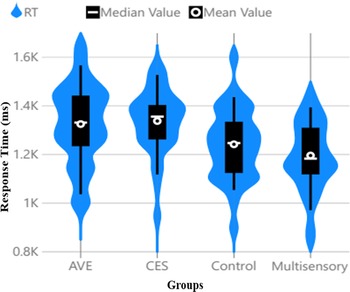
The distributions of data points in the RT dataset across AVE, CES, control, and multisensory groups are depicted in the violin plot (Figure 3). The width of each curve represents the density of RTs in milliseconds. The data for the AVE and control groups suggest multiple peaks, indicating a multimodal distribution, in contrast to the CES and multisensory groups. The central box plots illustrate the median scores and interquartile ranges, summarizing the central tendency and variability within each group. The figure shows that the multisensory group has the lowest median and mean values. This means that the subjects had the fastest reaction time in judging the match or mismatch between colors and words in the multisensory group. The following section provides a detailed statistical analysis of the data.
Violin plot for response time.

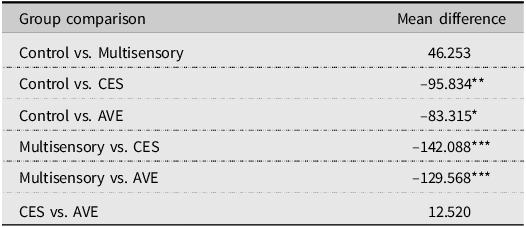
To systematically analyze subject-level variability in a within-subjects design, a linear mixed-effects model was conducted for each dependent variable. This model involved both fixed effects (i.e., the groups) and random effects (i.e., the subjects), allowing us to examine the subjects’ reaction times in judging color-word congruency or incongruency across the control, multisensory, CES, and AVE groups. Consistent with the conventional Stroop effect analysis, which involves calculating the difference in reaction times between incongruent and congruent trials (MacLeod, Reference MacLeod1991), the dependent variable for the RT analysis included both congruent and incongruent trials. The Type III tests of fixed effects confirmed that the group effect was significant [F (3, 93) = 11.186, p < 0.01] and the subjects surpassed in multisensory group (M = 1196.385 ms) compared to the control (M =1242.638 ms), CES (M = 1338.472 ms), and AVE (M = 1325.953 ms) groups. Precisely, the pairwise post hoc results (Table 5) presented that the multisensory group performed significantly faster than the CES (MD = –142.088 ms, p < 0.001) and AVE (MD = –129.568 ms, p < 0.001) groups. The mean differences were also significant between the control and CES group (MD = –95.834, p < 0.01) and the control and AVE group (MD = –83.315 ms, p < 0.01). As a result, the subjects’ attention process and RT meaningfully varied across different groups (i.e., Control/ Multisensory < CES/ AVE).
Pairwise comparisons of the groups for response time

Based on estimated marginal means.
p value significance level: *** < .001, ** < .01, * <.05.
Note: The standard error is 28.73 and the degree of freedom is 93.
Response accuracy
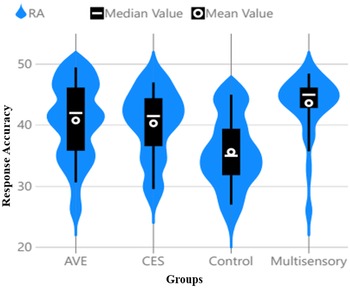
The violin plot (Figure 4) below visualizes the distributions of RA across AVE, CES, control, and multisensory groups. The width of each violin corresponds to the density of accurate responses. Accordingly, the AVE data distribution indicates a multimodal distribution compared to the other groups. The central box plots present the median scores and interquartile ranges, illustrating the central tendency and variability within each group. Based on the figure, the multisensory group has the highest median and mean values, while the control group has the lowest. This conveys that the subjects outperformed in the multisensory group. To delineate the subjects’ performances across the four groups, a mixed-effects statistical analysis was conducted, as explained below.
Violin plot for response accuracy.

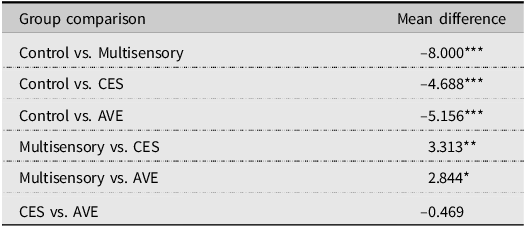
A linear mixed-effects model was run to evaluate the average subjects’ assessment of sentence correctness across the four groups (i.e., control, multisensory, CES, and AVE) and inter-subject variability. The model included both fixed effects (i.e., the groups) and random effects (i.e., the subjects). The Type III tests of fixed effects analysis presented the significant impact of the group [F (3, 93) = 24.92, p < 0.01] with the outstanding performance of the multisensory group (M = 43.625 correct sentences) over control (M = 35.625 correct sentences), CES (M = 40.312 correct sentences), and AVE (M = 40.781 correct sentences) groups. Specifically, the pairwise comparisons (Table 6) revealed significant variations between multisensory and control (MD = 8, p < 0.001), between multisensory and CES (MD = 3.313, p < 0.01), and between multisensory and AVE (MD = 2.844, p < 0.05) groups. In addition, the post hoc pairwise comparisons revealed significant differences between the control and CES (MD = –4.688, p < 0.001) and between the control and AVE (MD = –5.156, p < 0.001) groups. Thus, the various treatments had noteworthy impacts on the subjects’ retention and judgment of the correct and pragmatically incorrect sentences (i.e., Control < CES/ AVE < Multisensory).
Pairwise comparisons of the groups for response accuracy

Based on estimated marginal means.
p value significance level: *** < .001, ** < .01, * <.05
Note: The standard error is 0.939 and the degree of freedom is 93.
Discussion
To discover modifications in attention and retention mechanisms, we used two noninvasive cognitive therapies in competition with multisensory practices. Thus, for the purpose of this experiment, we compared and contrasted the efficacy of DAVID Delight Pro (for AVE and CES) and that of multisensory-based instruction for L2 vocabulary learning and retention. Finally, the learners’ attention and retention processes were assessed by researchers-made pragmatic-Stroop tasks and true/false acceptability judgment tests, respectively. In what follows, we discussed the behavioral results elicited by multiple exposures across the sessions.
Response time
The results revealed that the multisensory input had a meaningful impact on RT. The accumulating evidence has progressively revealed the facilitatory effect of optimal combinations of senses on performances (e.g., Bolognini et al., Reference Bolognini, Frassinetti, Serino and Làdavas2005; Boustani et al., Reference Boustani, Pishghadam and Shayesteh2021; Frassinetti et al., Reference Frassinetti, Bolognini and Làdavas2002; Lovelace et al., Reference Lovelace, Stein and Wallace2003; Pishghadam et al., Reference Pishghadam, Makiabadi, Zabetipour, Abbasnejad, Firoozian Pooresfahani and Shayesteh2020; Shayesteh et al., Reference Shayesteh, Pishghadam and Khodaverdi2020). In fact, the presence of significant differences in the agility of attending to the congruence and incongruence of the color-word pragmatic-Stroop test adheres to the implication that the involvement of the senses is key to fostering reaction time. The effect of the enriched sensory inputs on RT is specifically consistent with Boustani et al.’s (Reference Boustani, Pishghadam and Shayesteh2021) study, which pronounced the predominance of responses to the sentences with the involvement of the five sensory inputs. However, in their study, the weight of senses drove results in a sentence comprehension task, whereas in the current experiment, the multimodality of senses affected the comprehension of words in connection with their color. The impact is specifically accentuated when the sensory inputs are congruent (Li & Deng, Reference Li and Deng2023). Examining the presentation of information through multiple sensory channels and congruency in inputs, Li and Deng propose that multisensory integration allows for the concurrent processing of various information. However, the process can lead to faster recognition and RT in conjunction with inputs that complement each other (i.e., congruent vs. incongruent inputs). Applying Li and Deng’s idea to the current study, the instructor’s explanations (i.e., auditory inputs) were consistent with the presented stimuli features (i.e., visual, tactile, gustatory, and olfactory). This is also in line with Pahor et al.’s (Reference Pahor, Collins, Smith-Peirce, Moon, Stavropoulos, Silva, Peng, Jaeggi and Seitz2021) findings, which discuss that engaging multiple senses can reduce cognitive load and maintain attention, leading to enhanced processing speed. In effect, the multisensory presentation of information enables the simultaneous processing of various inputs, ameliorating the processing speed. Such accounts provide the implication that multisensory inputs enhance agility by directing the learners’ attention toward the instruction.
Moreover, the results revealed that the learners did not surpass significantly after the AVE session in comparison to the control and multisensory sessions. A justification could be the deep relaxation effect that the device creates by the dissociation mechanism disconnecting the subjects from their “thoughts and somatic awareness” (Siever, Reference Siever and Evans2007). The tool may induce a restabilization effect as a result of the cyan flickering light via LEDs, leading to the relaxation of muscles (Siever, Reference Siever and Evans2007), hence, a slow RT. The other potential factor that slows down the RT may be the alterations in the neurotransmitters and cerebral blood flow (CBF). Siever (Reference Siever and Evans2007) believes that during cognitive tasks, the brain’s requirement for CBF increases. On the other hand, they are accompanied by the secretion of norepinephrine and adrenaline because of anxiety (Aston-Jones et al., Reference Aston-Jones, Chiang, Alexinsky, Barnes and Pomeiano1991; Bremner, Reference Bremner2002), degrading performance on tasks. Accordingly, adjusting the flash of photic stimulation regarding the wide array of frequencies is a way to boost CBF (Fox & Raichle, Reference Fox and Raichle1985; Sappey-Marinier et al., Reference Sappey-Marinier, Calabrese, Fein, Hugg, Biggins and Weiner1992; Siever, Reference Siever and Evans2007). However, it seems that the contemporaneous impact of facilitative (vs. debilitative) anxiety (Alpert & Haber, Reference Alpert and Haber1960) may be required for the promotion of learners’ mental agility, while the stimulation apparatus may suppress both facilitative and debilitative anxieties. To minimize the potential confounding effect of the AVE apparatus, incorporating other photic stimulation colors and comparing their impacts may help identify any variable associated with this device.
Another probable justification for the poor performance of the subjects may reside in the influences of binaural beats. Following several studies (Aparecido-Kanzler et al., Reference Aparecido-Kanzler, Cidral-Filho and Prediger2021; Lane et al., Reference Lane, Kasian, Owens and Marsh1998; Park et al., Reference Park, Kwon, Kang and Lee2018), we ran a binaural-beat-based stimulation to entrain the attention-related brain waves, though the exploratory findings did not prove a positive modification in RT. Finding the reason, Robison and colleagues (Reference Robison, Obulasetty, Blais, Wingert and Brewer2022) claim that the binaural-beat stimulation “exhibited a shallower vigilance decrement,” evidencing that this stimulation does not significantly modulate the reaction time and sustained attention. In effect, losses in vigilance and alertness undermine operator effectiveness and performance (Matthews et al., Reference Matthews, Warm, Reinerman-Jones, Langheim, Washburn and Tripp2010). In other words, “measures of attentional resource availability may predict the operator’s subsequent vigilance performance” and CBF velocity as an index of “energization predicted sensory and cognitive vigilance, consistent with resource theory” (Matthews et al., Reference Matthews, Warm, Reinerman-Jones, Langheim, Washburn and Tripp2010, p. 187). Similarly, electroencephalography recordings after a 20-minute binaural-beat stimulation revealed no electrophysiological improvement in focus and concentration mechanisms (Crespo et al., Reference Crespo, Recuero, Galvez and Begoña2013). Siever (Reference Siever and Evans2007) claims that the AVE mechanisms reassure us that the excess experience of relaxation harnesses the speed of mental processes. A suggestion is to replicate the study with the employment of monoaural beats and alterations in the duration of exposure.
Moreover, the absence of a significant performance in attention after a 20-minute session of CES 100 Hz mode runs counter to the results of some studies (e.g., Lee et al., Reference Lee, Lee and Park2019; Schroeder & Barr, Reference Schroeder and Barr2001). The changes were consistent with an evaluation of the brain’s current density that reported a decline in beta activity with concomitant alleviations of anxiety (Kennerly, Reference Kennerly2006). In effect, the beta brainwave is commonly associated with being conscious, vigilant, and awake (Addante et al., Reference Addante, Yousif, Valencia, Greenwood and Marino2021; Siever, Reference Siever2008), whereby the suppression of this wave imposes a sleep state. Another reason may be the secretion of serotonin (as cited in Operator’s Manual, 2021 [https://mindalive.com/manuals/]), creating a calm state of mind. The combination of these findings provides a fair understanding of impairments in mental alacrity after a CES round. It is recommended to apply other voltages across different time spans and engage subjects with tasks designed to intentionally inhibit sleep.
Response accuracy
The results obtained from the retention task confirmed the hypothesis, remarking that the meaningful effects of the experimental sessions orchestrated the successful retention of information in competition with the control session. The significant performance after multisensory inputs was also in accordance with previous studies (e.g., Boustani et al., Reference Boustani, Pishghadam and Shayesteh2021; Frassinetti et al., Reference Frassinetti, Bolognini and Làdavas2002; Lovelace et al., Reference Lovelace, Stein and Wallace2003; Shayesteh, Reference Shayesteh2019; Shayesteh et al., Reference Shayesteh, Pishghadam and Khodaverdi2020) evidencing the major contribution of optimal sensory inputs in learners’ performances. Enriched sensory inputs exert specific impacts on retention, which are apparent not only in immediate recall (Shayesteh, Reference Shayesteh2019) but also in the long-term retention of information (Boustani et al., Reference Boustani, Pishghadam and Shayesteh2021). In fact, the meaningful differences in the number of correct answers highlighted that the multisensory-based instruction maximized comprehension and retention processes. Engaging multiple sensory pathways can stimulate deeper encoding of information, thus enhancing subsequent retention and retrieval of information (Dunn & Dunn, Reference Dunn and Dunn1993). Delving into the neural pathways of multisensory learning, Jensen (Reference Jensen2009) provides insights into the involvement of various brain regions contributing to holistic cognitive development. The process fosters neural connections and memory retention (Bahri Roudposhti & Al Abdwani, Reference Bahri Roudposhti and Al Abdwani2024; Dunn & Dunn, Reference Dunn and Dunn1993; Pishghadam et al., Reference Pishghadam, Al Abdwani, Al-Badi, Boustani and Shayesteh2024). Aligning with the findings, we find that multisensory learning can be a promising solution to retaining and retrieving information effectively. Among the myriad of benefits, we found that this approach can support immersive learning experiences and optimize retention processes.
The accurate performances of learners in the CES and AVE groups, compared to the control group, demonstrate the brain's need to reduce overarousal for effective information retention.. Practically, the use of AVE and CES devices in current learning situations, which are merely based on visual and auditory inputs, can be effective in the consolidation of information. In common educational settings, learners receive an enormous amount of information without being involved in or completely understanding it, which is a source of anxiety (Siever, Reference Siever2012). Hence, to degrade the possible effects, the AVE and CES control variations in levels of neurotransmitters and CBF (Siever, Reference Siever2008). Such a result may be embodied in a host of alterations occurring in neuronal excitability states. In sum, taking the mechanisms of photic and audio stimulations as well as the 100 Hz CES mode into account, we can implicate that an appropriate level of altered CBF is the prerequisite of the retention process.
Last but not least, there are numerous open questions about the effect of the AVE sessions and CES modes on learners’ performances. The study addressed the effectiveness of AVE and CES apparatuses and the multisensory teaching approach within the defined scope of concrete nouns. As a starting point, the tangible nature of concrete nouns allowed us to control variables and establish a baseline of how these methods can aid in L2 vocabulary learning. Though the study is confined to a specific subset of vocabulary, which limits the generalizability of the findings, we believe that the underlying principles have the potential for broader applications. The application of this approach can even be extended to abstract concepts by using creative strategies that make the intangible more tangible. Different representations and cues evoke feelings or themes associated with the abstract concept. Moreover, since some of our words were low-frequency loanwords, it is suggested that future studies consider adopting alternative approaches, such as using pseudowords, to avoid this limitation. Besides, complementary experiments could be conducted to examine the effect of exposure to other photic stimulation colors on performances. In particular, the superior effect of the binaural beat over the monaural beat is speculative and requires further testing. Regarding the CES-related results, repetition of the session with other voltages is also recommended. In effect, replication of this study with repetitions in the AVE and CES sessions will expand the findings. In addition, conducting the study with a larger sample size will provide more reliable results. Finally, incorporating a task specifically designed to measure subjects’ processing speed could enhance the validity of the data.
Conclusion
In conclusion, despite the myriad influences of AVE and CES on brain activities, they cannot rival the effect of senses on attention and retention mechanisms. Tracking the role of senses, we implicated that multisensory instruction can permit a direct effect on the velocity of attention and retention mechanisms. In fact, the primary aim of the AVE and CES devices is to alter CBF and neurotransmitter responses to overcome the arousal and overarousal states emitted from cognitive challenges and to harness negative excitements. However, these modifications are in association with the challenge of slowing down learners’ mental agility and vigilance. It is also concluded that the five-sense combination drives positive results in RT, as well as in RA. In other words, multisensory inputs are committed to the consolidation of new pieces of information, exerting effective influences on attention and L2 vocabulary retention. As such, for effective comprehension and successful retention, creating a learning situation based on the employment of enriched sensory inputs can be a solution to improve learners’ attention and retention processes.
Acknowledgments
Nasim Boustani was partially supported by a grant from Ferdowsi University of Mashhad (No. FUM-61021).


 Open access

