


Introduction
Judges’ decisions reflect their experiences and professional histories. Our study examines how judicial professional diversity relates to case outcomes, focusing on pretrial detention decisions. Drawing on public data,Footnote 1 we statistically analyze New York City judges’ arraignment decisions, including whether they detain defendants and the cash bail amounts they set. To our knowledge, this is the first empirical measurement of how judicial professional backgrounds affect pretrial detention outcomes.
Our findings show a statistically significant link between judges’ law enforcement experience – a common professional background in New York City’s criminal courts – and pretrial detention decisions. Judges with prior service as state or federal prosecutors or police officers are significantly more likely to order detention and set higher bail, even after controlling for factors such as charge severity and defendants’ criminal histories. Our results extend the literature on judicial professional diversity by showing that differences in pretrial outcomes can surface as early as the first court appearance.
Our models estimate that, over a typical ten-year New York City judicial term, replacing one former law enforcement judge with a judge lacking prior criminal legal experience would avert roughly 65 detentions, 17 years of incarceration, and $8.7 million in detention costs. Such a change would also reduce cash bail imposed by approximately $6 million, keeping more funds with defendants and their families, most of whom are from racially minoritized communities (Monaghan, Rempel, and Rodriguez Reference Monaghan, Rempel and Lin2023; Koppel and Rempel Reference Koppel and Rempel2024).
Although our data come from New York City, the implications likely extend to state judges who handle pretrial proceedings nationwide. State courts handle more than 99% of new criminal cases, giving these judges substantial influence over case outcomes (State Courts 2020; United States Courts 2020). We find that the law-enforcement-background effect is concentrated in violent felony cases, where judges in most, if not all, U.S. jurisdictions retain broad discretion to order pretrial detention. Because violent felonies make up a significant portion of detention-eligible dockets nationwide, the patterns we document have broad relevance for efforts to reduce jail populations (Phillips Reference Phillips2012; Heaton, Mayson, and Stevenson Reference Heaton, Mayson and Stevenson2017; Dobbie, Goldin, and Yang Reference Dobbie, Goldin and Yang2018; Gupta, Hansman, and Frenchman Reference Gupta, Hansman and Frenchman2016; Leslie and Pope Reference Leslie and Pope2017).
To place the implications of our work in context, we next review prior research and institutional features that illuminate how judges’ professional backgrounds can shape case outcomes.
Background
This section provides the conceptual and institutional context for our study in three parts. First, we review prior research on how judges’ demographic and professional experiences shape case outcomes. Second, we describe New York City’s pretrial detention framework, highlighting features of the bail reform law and the distribution of judges’ professional backgrounds. Finally, we outline the arraignment process in New York City, the procedural stage at which pretrial detention and bail decisions are made.
Prior research on judicial professional background
Research demonstrates systematic effects of judicial backgrounds on case outcomes, with early scholarship focused on demographic factors. White federal judges have been found less likely than their Black counterparts to rule for plaintiffs in Voting Rights Act cases (Cox and Miles Reference Cox and Miles2008) and more likely than racially minoritized judges to dismiss civil rights claims (Weinberg and Nielsen Reference Weinberg and Nielsen2012). Black judges are significantly more likely to support affirmative action programs (Kastellec Reference Kastellec2013), and the presence of Black judges in a courthouse correlates with fewer incarceration sentences imposed by white judges on Black defendants (Harris Reference Harris2024). Gender also matters: male federal judges are less likely than female judges to rule in favor of women in gender-related cases (Peresie Reference Peresie2005).
More recent studies highlight the relationship between the professional backgrounds of judges and their legal decisions. For example, defendants assigned to federal judges with public defender experience are less likely to receive incarceration sentences than those assigned to judges with prosecutorial backgrounds (Harris and Sen Reference Harris and Sen2025). In search-and-seizure litigation, federal judges with prosecutorial experience tend to deny suppression motions more often, especially if they served as prosecutors for longer, whereas those with public defender backgrounds are more inclined to grant such motions regardless of their service length (Miller and Curry Reference Miller and Curry2023). Professional background interactions may extend to civil litigation as well (Shepherd Reference Shepherd2021).
Researchers have begun to probe how and why professional background may influence judicial decisions. Two explanations dominate: selection and socialization (Berryessa, Dror, and McCormack Reference Berryessa, Dror and McCormack2023). Under a selection account, people predisposed toward punishment or defense of individual rights enter and are chosen for law-enforcement or legal services roles, then carry those preferences to the bench. Under a socialization account, the norms, incentives, and information environments within those professional settings shape attitudes over time, reinforcing role-congruent priorities, including heightened focus on public-safety risk or on the collateral consequences of incarceration. There is some evidence for socialization as the mechanism underpinning the influence of judges’ professional backgrounds on criminal case decisions (Harris and Sen Reference Harris and Sen2025; Miller and Curry Reference Miller and Curry2023). Yet much of the literature documents role-congruent patterns but cannot adjudicate between potential mechanisms (Nir and Liu Reference Nir and Liu2023).
An additional mechanism involves selection to the bench itself, coupled with on-the-bench socialization (Berryessa, Dror, and McCormack Reference Berryessa, Dror and McCormack2023). In many jurisdictions, “tough-on-crime” signals are rewarded at election, retention, and appointment, creating ongoing payoffs for punitive stances and for maintaining the reputation and credentials that may have facilitated a judge’s selection in the first place (Berdejó and Yuchtman Reference Berdejó and Yuchtman2013). These incentives can also (though perhaps asymmetrically) push judges with defense or legal services backgrounds to signal distance from perceived leniency when judicial selectors expect toughness. The result is a form of on-the-bench socialization: not pre-bench attitude change, but reinforcement and entrenchment of role-congruent judging under electoral and appointment pressures.
We now turn to the work most closely related to ours: Harris and Sen’s analysis of federal sentencing (2025), along with a related study by Miller and Curry (Reference Miller and Curry2023). The two main studies correlating judicial professional experience to criminal case outcomes – Harris and Sen on federal sentencing, and Miller and Curry on search and seizure motions – examine criminal case outcomes in the U.S. federal system. State courts, however, oversee more than 99% of U.S. criminal matters (State Courts 2020; United States Courts 2020). By analyzing nearly 70,000 arraignments in New York City, our study adds evidence from institutional level where the vast majority of cases are handled.
Our results both extend and complicate the findings of Harris and Sen. That study presents evidence that federal judges with public defense backgrounds are less likely to impose incarceration and, in some specifications, more likely to impose shorter prison terms. Although it considers prosecutorial experience alongside other professional histories, its primary finding highlights the influence of prior public defender experience on sentencing outcomes. By contrast, we find that judges with law enforcement backgrounds make more severe pretrial decisions on average, while those with legal service experience (including former public defenders) exhibit no offsetting leniency. Moreover, whereas Harris and Sen find that public defender tenure correlates with more lenient sentences, we detect no parallel effect for law enforcement tenure. Taken together, our results pose a challenge for a straightforward socialization account of the effects of judicial professional background.
Arraignment decisions differ from federal sentencing in timing, guidance, and review, making judges’ preexisting orientations more salient. Although federal judges can deviate from the nonbinding U.S. Sentencing Guidelines, these guidelines nonetheless provide a structured framework that can shape sentencing ranges.Footnote 2 By contrast, New York arraignments are fast, information-sparse decisions with no binding framework or numeric anchor; judges face no statutory cap on bail amounts and may remand in eligible cases ( N.Y. C.P.L. § 510.10). The bail statute operates without a grid, schedule, or required quantification, and written reasoning and appellate review are limited. In this setting – early in the case, with thin records and maximal judicial discretion – professional background has more room to shape outcomes than in the guideline-anchored federal sentencing context. These differences from Harris and Sen’s setting help explain why professional experience on the bench can move case outcomes well before motion practice, trial, or plea negotiations.
Our analysis has real-world implications for U.S. criminal justice policy. We show that professional background shapes outcomes from a defendant’s first court appearance. Law enforcement experience elevates pretrial detention risk, a decision with well-documented downstream harms (Phillips Reference Phillips2012; Heaton, Mayson, and Stevenson Reference Heaton, Mayson and Stevenson2017; Dobbie, Goldin, and Yang Reference Dobbie, Goldin and Yang2018; Gupta, Hansman, and Frenchman Reference Gupta, Hansman and Frenchman2016; Leslie and Pope Reference Leslie and Pope2017). Because 99% of criminal cases unfold in state courts, broadening the career paths to the bench could meaningfully reduce incarceration and taxpayer expenditures nationwide.
Because these mechanisms may operate differently depending on the institutional environment, we next examine the structure of New York City’s pretrial detention system, a setting whose legal framework and data availability make it especially well suited to examining how professional background shapes judicial decision-making.
New York City’s pretrial detention system
Under the 2020 New York bail reform law, cases fall into two categories: those eligible for pretrial detention and those that are not (Rahman Reference Rahman2019; Sterne Reference Sterne2023a). In eligible cases, judges can set bail at any amount or remand the defendant (detain without bail). This discretion, coupled with the law’s aim to reduce pretrial detention and address economic disparities (Budget 2019; Scrutinize 2025), enables a clear look at how judicial backgrounds affect detention decisions.
New York City’s rotating calendar system produces quasi-random case assignment, as neither defendants nor prosecutors can predict or select their judge. This feature facilitates robust statistical analysis of judicial background effects. Moreover, the 2020 bail reform law mandates the publication of detailed arraignment data, including judge names and outcomes ( Executive Law § 837-u). These features provide accurate, public data for analyzing how professional experience shapes detention and bail decisions.
Judges with law enforcement experience outnumber those with legal services or civil rights backgrounds in New York City arraignments. Historical precedent, political considerations, and perceived stigma toward public defenders contribute to this imbalance (Wagner Reference Wagner2022; National Public Radio 2022). Attorneys from legal services backgrounds – especially public defenders, a role only mandated since the 1960sFootnote 3 – are relatively new to the judicial candidate pool and often face skepticism about their impartiality. Some officials question former defenders’ objectivity because of their advocacy for people accused of crimes (National Public Radio 2022; Kanu Reference Kanu2022). Low salaries, high caseloads, and undervalued skills also limit their political connections and reduce the likelihood of their nomination or appointment to the bench (Weiss Reference Weiss2019; Pac, Davis, and Strom Reference Pace, Brink, Cynthia G. and Hanlon2023; Aalberts, Boyt, and Seidman Reference Aalberts, Boyt and Seidman2002; Henderson and Shteynberg Reference Henderson and Shteynberg2022).
As a result, decision-makers at the federal, state, and local levels have tended to favor candidates with prosecutorial or law enforcement backgrounds for judicial roles. In 2023, for example, approximately 40% of state supreme court justices had prosecutorial backgrounds, whereas only 11% had public defense or civil rights experience (Barry, Chambers, and Holtzblatt 2023). The federal judiciary similarly consists of about 36% former prosecutors and just 6.5% former public defenders (Neily Reference Neily2021; Buchanan Reference Buchanan2020), with states such as Connecticut, Georgia, and Arizona reflecting comparable disparities (Kennedy Reference Kennedy2022; Corriher Reference Corriher2025; People’s Parity Project 2023).
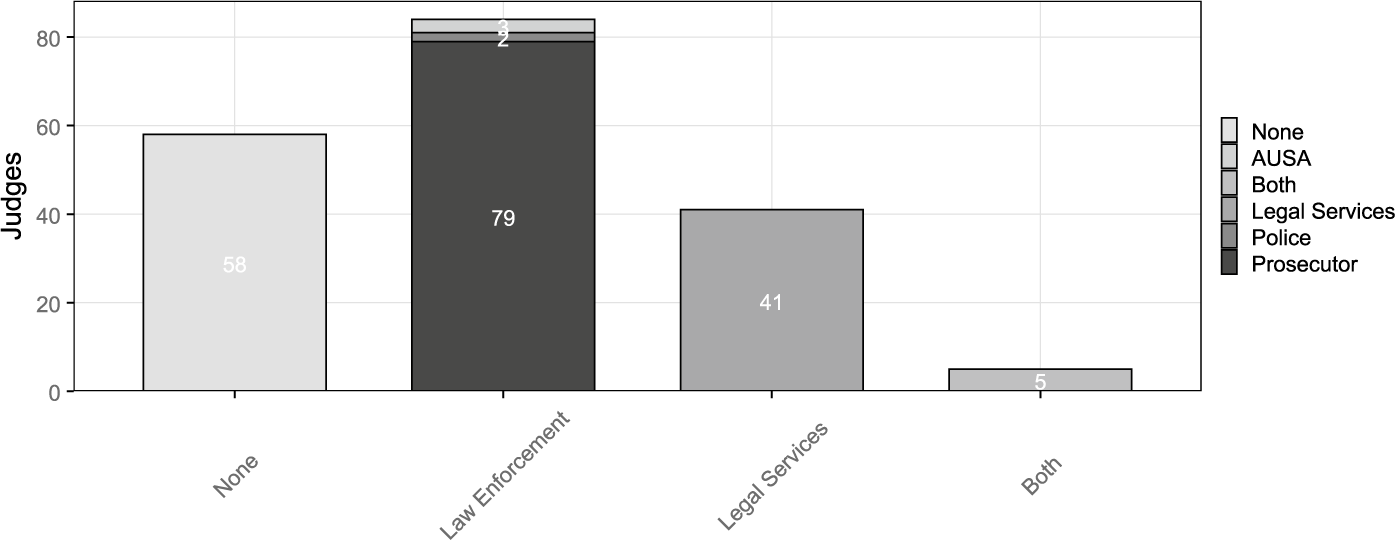
New York City exhibits a similar imbalance at arraignments, where judges with law enforcement experience are disproportionately represented (Figure 1). Understanding how this overrepresentation translates into decision-making requires looking more closely at the arraignment process itself – the procedural stage at which judges make pretrial detention and bail decisions.
New York City Arraignment Judges by Professional Experience.

The arraignment process in New York City
After an arrest, defendants in New York City appear before a judge at arraignment, their first court hearing, where different judges rotate twice daily, and a quasi-random process assigns cases (Arnold, Dobbie, and Hull Reference Arnold, Dobbie and Hull2022; Kleinberg et al. Reference Kleinberg, Lakkaraju, Leskovec, Ludwig and Mullainathan2018). At arraignment, judges determine whether the case qualifies for pretrial detention. If it does, they can release the defendant or order detention, either by remand (no possibility of release) or by setting monetary bail. Alternatively, judges may release defendants with or without supervisory conditions.
Pretrial detention eligibility has evolved under successive bail reforms. Before January 2020, judges could set bail in any criminal case, even for minor offenses (Merkl Reference Merkl2019; N.Y. C.P.L. § 510.10). The 2020 reform limited that discretion by requiring release for most misdemeanors and nonviolent felonies ( N.Y. C.P.L. § 510.10; Rempel and Rodriguez Reference Rempel and Rodriguez2019). Subsequent amendments, however, broadened the list of detention-eligible offenses (Sterne Reference Sterne2023a; N.Y. C.P.L. § 510.10).
In New York, state law requires judges to make their pretrial detention decision based on only one consideration: the defendant’s flight risk. Until 2023, judges had to impose the “least restrictive” conditions necessary to ensure a defendant’s return to court. A recent reform replaced that language with a requirement to impose “the kind and degree of control or restriction necessary to reasonably assure” the defendant’s return to court ( N.Y. C.P.L. § 510.10). For cases eligible for pretrial detention, judges must consider all available information when deciding whether to release the defendant or order detention (Rahman Reference Rahman2019; N.Y. C.P.L. § 510.10). Judges must account for a defendant’s financial circumstances and ability to pay when setting monetary bail ( N.Y. C.P.L. § 510.10; Rempel and Weill Reference Rempel and Weill2021).
In practice, judges begin by determining whether the charges render a defendant eligible for pretrial detention. For eligible cases, they retain broad discretion over whether to remand the defendant or set monetary bail. Bail reform does not cap bail amounts, so judges can impose any amount they deem appropriate, making bail decisions effectively discretionary in detention-eligible cases.
Methodology
Our empirical strategy proceeds in three steps. First, we compile and clean arraignment data from New York City courts, carefully excluding cases that do not allow for judicial discretion in pretrial decisions. Second, we gather and systematically classify information about judges’ professional backgrounds using public sources. Finally, we estimate judge-clustered regression models that control for case, defendant, and administrative characteristics to test whether judicial background predicts detention and bail outcomes.
Arraignment data
We examine how judges’ professional backgrounds relate to pretrial detention decisions in New York City criminal courts, analyzing data from New York’s Office of Court Administration (OCA) and Division of Criminal Justice Services (DCJS). From a comprehensive dataset of New York State Courts arraignments between January 1, 2020, and June 30, 2023, we focus on New York City arraignments, where a rotating schedule system produces quasi-random case assignment to judges. Our analysis examines only regular criminal court docket cases, excluding specialized proceedings, which are the standard first appearance where judges make pretrial detention decisions.
We exclude cases disposed at arraignment (through dismissal or plea), a determination made after judge assignment, because these involve no pretrial detention decisions.
We also exclude cases that are statutorily ineligible for pretrial detention. Although judges formally determine eligibility after their assignment at arraignment, the underlying statutory criteria are fixed beforehand – when prosecutors decide what charges to file – and thus involve comparatively little judicial discretion ( N.Y. C.P.L. § 510.10). In most cases, detention ineligibility is easy to identify from the top charge recorded in the arraignment data. In some cases, however, eligibility cannot be verified from the top charge or available information, such as when it depends on unrecorded case characteristics. Because we cannot observe the full universe of such cases – both those resulting in detention and those resulting in release – retaining the detained subset would overrepresent detention and bias the estimates. Accordingly, any case whose statutory eligibility cannot be definitively confirmed by the recorded data, including those where detention was ordered, falls outside the estimation sample.
Finally, we exclude cases with nominal bail amounts ($1–$99) that are primarily used for administrative purposes. Such bail amounts are typically set when a defendant is already detained on another case, a parole violation, or an outstanding warrant, allowing them to accrue jail credit on the current charge. These cases do not reflect a judicial assessment of the bail amount needed to ensure court appearance and are therefore unsuitable for inclusion in this study.
The above exclusions could, in principle, bias estimates if they were associated with judicial background. Section 2 in the Online Appendix contains an assessment of this issue, and we do not find statistical evidence for post-treatment selection bias.
We construct two analytical samples. Our dataset for the detention analysis comprises 69,059 cases overseen by 188 judges. Because our interest lies in the judge’s custodial decision at arraignment, rather than the downstream effects of detention, we define a defendant as “detained” if the judge either remanded the person or set any nonzero bail amount, regardless of how long the defendant ultimately remained in custody. For our extensive cash bail analysis (bail set yes/no), we further exclude cases involving remand orders or noncash forms of bail, resulting in a data set of 66,624 cases across 186 judges. For our intensive cash bail analysis (amount of cash bail set), we retain only cases with cash bail greater than zero from the extensive dataset, totaling 27,247 cases across the same 186 judges.
In both samples, we include only judges who presided over at least 50 eligible cases to ensure reliable estimation of individual judicial effects. Despite these restrictions, both samples retain 98% of their respective eligible cases. For a full description of the explanatory variables in our study, see Section 1 in the Online Appendix.
Professional background classification
We supplement the OCA/DCJS data above by cross-referencing the judges named in it with information about their professional experience. The New York Court System provides public, official profiles for most, but not all, of its judges (New York State Unified Court System 2024b). Unfortunately, in many instances, these official profiles contain limited and, at times, outdated information. Therefore, we also use information obtained from venues such as the New York Law Journal, the websites Trellis and Ballotpedia, as well as news media and other public sources. We classify judges into four former professional experience categories:
-
1. Law enforcement: Former state prosecutors (e.g., District Attorney’s Offices, Special Narcotics Prosecutor), federal prosecutors (Assistant United States Attorneys, or AUSAs), and police officers;
-
2. Legal services: Public defenders and attorneys who worked in organizations serving indigent clients in family, housing, or civil matters;
-
3. Both: Those with experience in both law enforcement and legal services;
-
4. None: Those with neither prosecution nor legal services experience.
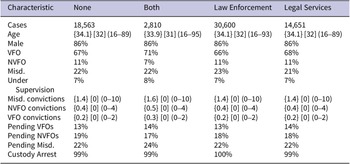
Tables 1 and 2 provide summary statistics on the two data sets by professional background.
Summary Statistics for the Detention Dataset

Values in are means, in [ ] are medians, and in () are ranges (min–max).
Abbreviations: Misd. = misdemeanor; NVFO = nonviolent felony; VFO = violent felony.
Summary Statistics for the Bail Dataset

Values in are means, in [ ] are medians, and in () are ranges (min–max).
Abbreviations: Misd. = misdemeanor; NVFO = nonviolent felony; VFO = violent felony.
While some judges have experience in other government agencies (e.g., Attorney General’s Office, local law departments), we classify these under “None” to maintain clear distinctions between our primary categories of interest: judges with prior experience in criminal law enforcement.
We exclude private defense attorneys and court-appointed counsel, including those who may have served on 18-B panels (New York State Unified Court System 2024a), from the legal services category. This decision reflects both data limitations and theoretical considerations. In terms of data, judicial biographies and public-facing profiles rarely specify whether a judge handled court-appointed indigent defense as a private practitioner, and former attorneys who later joined the bench often did not maintain public websites or have since taken them down. Even when prior private practice is noted, it is usually impossible to tell whether the judge accepted 18-B assignments or how much of their work involved criminal defense. Any attempt to reclassify such judges would therefore require speculative inference and introduce misclassification risk.
More substantively, the mechanisms we are testing center on both self-selection and institutional socialization. Judges who previously worked in public defender offices or other legal services organizations likely chose that path out of a preexisting orientation toward indigent representation. In addition to that self-selection effect, their work would have been shaped by the norms, training, and shared mission of institutional settings designed to serve low-income clients. Private practice and 18-B panel work lack that collective environment and are more likely to involve mixed client bases, including both indigent and fee-paying clients. As such, even if these judges performed defense work, they do not represent the same form of professional identity we are testing with the legal services category. Including them would dilute the conceptual clarity of the grouping and weaken its interpretive value.
We combine public defenders and other legal services attorneys into a single category for two reasons. First, both groups share the experience of representing indigent clients in a publicly funded legal services organization. Second, publicly available professional background data is limited. The biographical profiles we use, such as the Unified Court System’s online profiles, rarely indicate which unit or division a judge worked in – even for major organizations like the Legal Aid Society, which is New York City’s largest provider of indigent legal services. As a result, we are generally unable to distinguish whether a judge previously served as a criminal-court public defender, a family-court or housing public defender, or held another legal services role.
For the analysis of law enforcement tenure, we obtained data on the number of years each judge served in law enforcement roles from public sources, including those used to identify their prior professional backgrounds, as well as published interviews, LinkedIn profiles, and other media sources. When multiple law enforcement positions were listed, we summed the non-overlapping years of service across roles. For a small subset of judges, we were unable to verify total years of law enforcement experience; these judges were therefore excluded from the tenure analysis. Of the 84 judges in our detention analysis dataset with any law enforcement background, tenure information could not be confirmed for 7 (8.3%), accounting for 2,654 cases, or 8.3% of all cases handled by judges with law enforcement experience. Judges categorized as having “Both” law enforcement and defense backgrounds were also excluded from the tenure analysis.
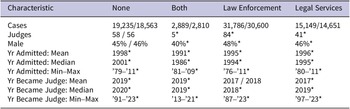
Table 3 provides summary statistics on the judges in our study. Due to data limitations, we are unable to include controls for judges’ race or exact age in our analysis.
Summary Statistics for Judges in Both Datasets (Detained/Cash Bail)

Star (*) indicates identical values for both datasets.
Where two numbers appear, format is Detention/Cash Bail.
Statistical modeling
We estimate judge-clustered linear probability models for two binary outcomes: (1) whether the judge ordered pretrial detention (bail set or remand versus release) and (2) the extensive-margin decision of whether any cash bail was imposed (yes/no). For the intensive margin, we restrict to positive cash bail cases and fit a judge-clustered OLS of log bail. Thus, the intensive margin estimate is conditional on bail being imposed and should be read as the difference among bail-set cases; it does not by itself describe the effect on expected bail across all arraignments. To ensure our findings are not model-specific, we replicate the analyses with alternative specifications, see Section 4 in the Online Appendix.
Our analyses employ four groups of explanatory variables: (a) defendant characteristics, (b) case-specific legal factors, (c) administrative controls, and (d) judge information. Defendant variables include demographic information, supervision status, prior convictions, and pending cases. Case factors encompass charge severity, offense category, and arrest type. Administrative controls account for county and time variation – including month and year of arraignment – to capture seasonal crime patterns, the onset of COVID-19 and related lockdowns, and reported increases in violent crime locally and nationally during the study period (McDowall, Loftin, and Pate Reference McDowall, Loftin and Pate2012; Andresen and Malleson Reference Andresen and Malleson2013; Grawert and Kim Reference Grawert and Kim2022; Watkins Reference Watkins2020). The fourth group, capturing information about the arraignment judge, comprises our primary explanatory variables and includes the judge’s professional background category, gender, and other judge-level attributes. The appendix includes more details about variable groups (a)-(c) and their relevance to the pretrial detention determination based on New York law; see Section 1 in the Online Appendix.
Because we attribute outcome differences to judge characteristics, we must show that case assignment is quasi-random. NYC’s rotating calendar does not use case- or defendant-specific information, producing quasi-random exposure within court-by-time schedules. Prior research has found New York City pretrial case assignments to be quasi-random, based on this rotating calendar system (Arnold, Dobbie, and Hull Reference Arnold, Dobbie and Hull2022; Kleinberg et al. Reference Kleinberg, Lakkaraju, Leskovec, Ludwig and Mullainathan2018). In our analysis, we verify that this assumption holds within our dataset, subject to the constraints of the public OCA/DCJS records (see section “Limitations”).
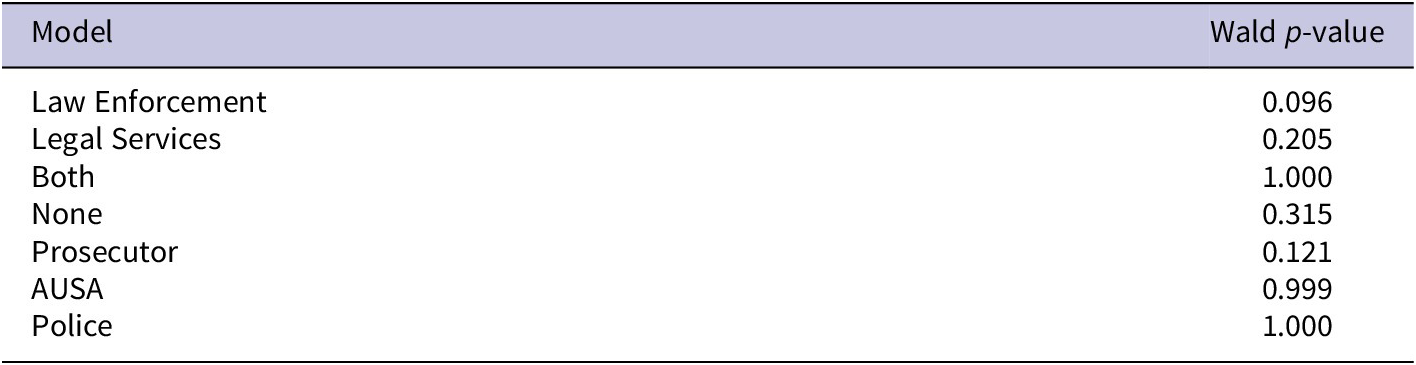
To assess the plausibility of quasi-random assignment of cases to judges, we test whether observable defendant and case characteristics predict the professional background of the assigned judge (Table 4). Specifically, we estimate separate linear probability models for each background category – law enforcement, legal services, both, neither, and the disaggregated AUSA, state prosecutor, and police indicators. Each model includes explanatory variables capturing defendant demographics, criminal history, and case characteristics. We absorb calendar and court structure using high-dimensional fixed effects for the interaction of county, arraignment date, and arrest type (a coarse proxy for arraignment shift). Standard errors are clustered at the judge level to account for the level of treatment assignment.
Random-Assignment Checks: Wald $ p $
-values by Judge Professional Background
$ p $
-values by Judge Professional Background

We find no evidence of systematic sorting: joint Wald tests for each background category fail to reject the null at conventional levels (all $ p>0.05 $
). In the smaller subgroups (judges categorized as “Both,” “AUSA,” or “Police”) the reported p-values of 0.999 and 1.000 stem from models with very few judge clusters (5, 3, and 2, respectively, in the detention dataset), for which cluster-robust Wald inference has limited reliability. These findings support the assumption that judges with different professional backgrounds are quasi-randomly assigned to cases, conditional on court-calendar structure.
$ p>0.05 $
). In the smaller subgroups (judges categorized as “Both,” “AUSA,” or “Police”) the reported p-values of 0.999 and 1.000 stem from models with very few judge clusters (5, 3, and 2, respectively, in the detention dataset), for which cluster-robust Wald inference has limited reliability. These findings support the assumption that judges with different professional backgrounds are quasi-randomly assigned to cases, conditional on court-calendar structure.
Certain determinations made after judge assignment – such as disposition at arraignment, statutory eligibility for detention, and the use of placeholder $1–$99 bail – create some potential for post-treatment selection bias. Section 2 in the Online Appendix reports tests showing no statistically significant relationship between professional background and exclusion from our main specification’s dataset. Further limitations are addressed in the section “Limitations”.
Results
We present our results in four parts. First, we report the main specification results on the effect of judicial background on pretrial decisions. Second, we quantify their practical implications. Third, we examine heterogeneity across law enforcement roles. Finally, we assess potential mechanisms for the effects we observe.
Main specification results
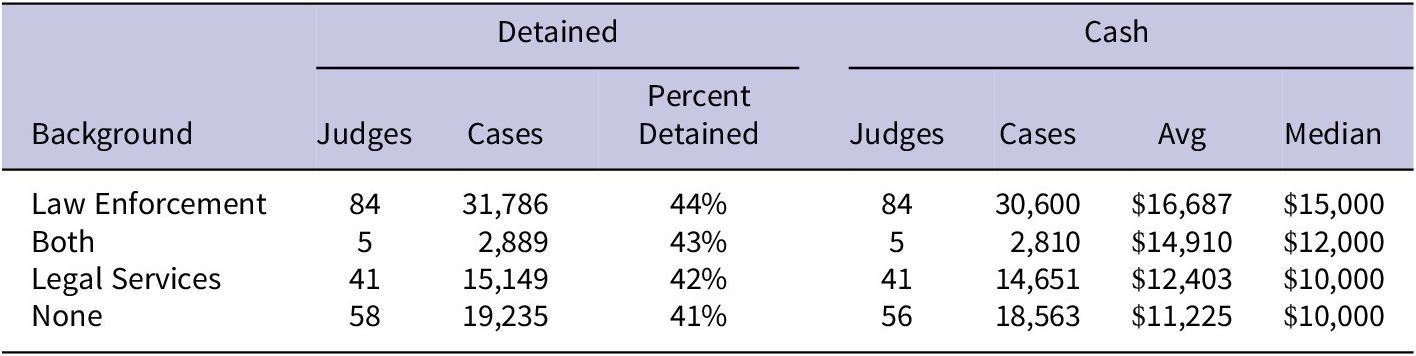
Initial examination of the raw data suggests systematic differences in pretrial decisions based on judges’ professional backgrounds (Table 5). Judges with no prior experience in legal services or law enforcement (“None” category) have the lowest detention rate (41%) and set the lowest average cash bail ($11,225). In contrast, judges with law enforcement backgrounds have the highest detention rate as well as the highest average and median cash bail amounts.
Summary Statistics: Pretrial Detention Rates and Cash Bail Amounts by Judge Professional Background

Average cash bail includes $0 cases (released).
Median cash bail excludes $0 cases; including them yields $0 for all backgrounds.
These differences in outcomes do not appear to stem from variations in case assignment or judge characteristics. Examining the distribution of case characteristics, we find consistent patterns across judicial backgrounds (see Tables 1 and 2). Similarly, judge-level characteristics (gender, year of bar admission, and year of elevation to the bench) show no substantial variation across professional background categories (see Table 3).
Given these preliminary indications that differences in pretrial outcomes may be attributable to judges’ professional backgrounds, we proceed with regression analysis to more rigorously test this relationship.
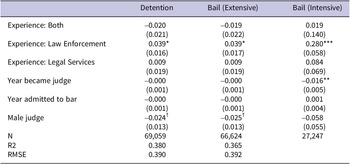
Our regression results appear in Table 6. Across all three models, former law enforcement judges impose more severe pretrial sanctions than their “None” peers. On average, they are 3.9 percentage points more likely both to order detention and to set cash bail, and – conditional on cash bail being imposed – they set amounts that are approximately 32 percent higher. Case- and defendant-level controls behave as expected: more serious charges and longer criminal histories are significantly associated with higher detention probabilities and larger bail amounts (Online Appendix, Table A.2). This alignment strengthens confidence that the models are properly specified. The results remain statistically significant, with only slightly smaller coefficients, when judges in the “Both” category are collapsed into the law enforcement category (Table A.3 in the Online Appendix). By contrast, judges whose background lies exclusively in legal services work do not significantly differ from the “None” group. The law-enforcement premium also holds in a post-bail-reform implementation window (2022–2023), with similar magnitudes (Table A.4 in the Online Appendix).
Judge Experience Effects Across Models

Standard errors clustered by judge in parentheses.
All models include defendant-, case-, and arraignment administration fixed effects.
Signif.: $ {}^{\dagger }p<0.10 $
,
$ {}^{\dagger }p<0.10 $
, $ {}^{\ast }p<0.05 $
,
$ {}^{\ast }p<0.05 $
, $ {}^{\ast \ast }p<0.01 $
,
$ {}^{\ast \ast }p<0.01 $
, $ {}^{\ast \ast \ast }p<0.001 $
.
$ {}^{\ast \ast \ast }p<0.001 $
.
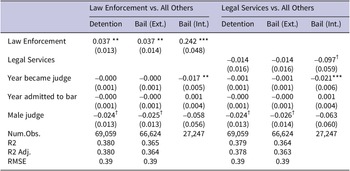
The effects observed above for the law enforcement and legal services cohorts are virtually identical when each background is compared with all other judges rather than only those in the “None” category (Table 7), confirming that our main specification findings are not driven by the composition of the reference group.
Professional Background Effects: Law Enforcement and Legal Services vs. All Other Judges

Standard errors clustered by judge in parentheses.
All models include defendant-, case-, and arraignment administration fixed effects.
Signif.: $ {}^{\dagger }p<0.10 $
,
$ {}^{\dagger }p<0.10 $
, $ {}^{\ast }p<0.05 $
,
$ {}^{\ast }p<0.05 $
, $ {}^{\ast \ast }p<0.01 $
,
$ {}^{\ast \ast }p<0.01 $
, $ {}^{\ast \ast \ast }p<0.001 $
.
$ {}^{\ast \ast \ast }p<0.001 $
.
Among judge-level covariates, only the judicial start year exhibits statistical significance at the 5% level (p < 0.05), and this result appears solely in the intensive-margin bail models. In these specifications, more recently appointed judges set modestly lower cash bail amounts. No other judge characteristic, including start year, is significant in either the detention or extensive-margin bail models. Thus, with the exception of this limited finding for bail amounts, judge-level attributes beyond professional background do not meaningfully influence pretrial decisions.
Estimating the impact of judicial background
To quantify the practical implications of our findings, we conduct a simple counterfactual analysis examining the potential impact of replacing a judge with law enforcement experience with one from the “None” category. We focus on a 10-year period to reflect the typical term length for judges appointed by the New York City Mayor to criminal courts ( N.Y. City Crim. Ct. Act), who constitute the majority of judges presiding over arraignments in New York City (New York State Unified Court System 2024b; NYC Mayor’s Advisory Committee on the Judiciary 2024).
To calculate the projected impact, we estimate the annual caseload of a typical former law enforcement judge. For each judge, we divide total cases by years served, then average those judge-level rates across all law enforcement judges in the dataset. This yields an average annual caseload of 166.4 in the detention dataset and 66.0 in the bail dataset. We then apply our regression-estimated differences in detention probability and cash bail amounts to this average annual caseload over a 10-year period.
To translate these percentages and dollar amounts into a rough estimate of concrete impacts, we use an average detention length of 97 days per detainee, calculated as a weighted mean from 2020 to 2021 data (Rempel Reference Rempel2022). We then multiply by the daily detention cost of $1,375, based on figures from the NYC Comptroller (New York City Comptroller 2021).Footnote 4
Replacing a single former law enforcement judge with a judge who has no legal services and law enforcement experience would result in roughly 65 fewer people detained over a ten-year term, about 17 person-years of jail time avoided, and approximately $8.7 million in reduced taxpayer expenditures. Conditional on cash bail being set, former law enforcement judges impose bail amounts that are 32% higher than those set by judges with no legal services and law enforcement experience, resulting in an average increase of approximately $9,200 per defendant. Because the typical law-enforcement-background judge in our sample sets bail in approximately 66 cases per year, this premium amounts to roughly $6 million in additional bail imposed over a ten-year term by a single judge.
Types of law enforcement
We further examine whether effects differ across law enforcement roles. We re-estimate models with separate indicators for the three former roles underlying our law enforcement category: State prosecutor, federal prosecutor (AUSA), and police experience (Table 8). However, these estimates are based on small subsamples. Only three judges have AUSA experience and two have police experience, limiting the precision of our estimates. Even so, they reinforce our main finding that law enforcement backgrounds – whether in prosecution or policing and in either the federal or state system – are associated with more severe pretrial decisions. At the same time, they offer little leverage to distinguish between selection and socialization as the mechanisms driving these effects.
Disaggregated Law Enforcement Background Effects on Judicial Outcomes

Standard errors clustered by judge in parentheses.
All models include defendant-, case-, and arraignment administration fixed effects.
Signif.: $ {}^{\dagger }p<0.10 $
,
$ {}^{\dagger }p<0.10 $
, $ {}^{\ast }p<0.05 $
,
$ {}^{\ast }p<0.05 $
, $ {}^{\ast \ast }p<0.01 $
,
$ {}^{\ast \ast }p<0.01 $
, $ {}^{\ast \ast \ast }p<0.001 $
.
$ {}^{\ast \ast \ast }p<0.001 $
.
Mechanisms for law enforcement severity
Building on our earlier discussion of selection and socialization, we examine what our data can reveal about the mechanisms underlying the association between law enforcement background and higher pretrial severity. We do so by analyzing patterns by tenure length and charge severity.
Years in law enforcement
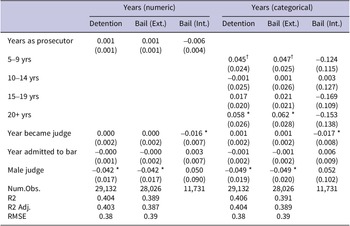
We test whether the total number of years served in law enforcement correlates with more severe outcomes in our sample (Table 9). Longer law enforcement tenure is generally not associated with more severe pretrial decisions. The only significant differences appear among judges with 20 or more years in such work, who are modestly more likely to detain and to set cash bail compared to those with 1–4 years of such experience. However, such tenure does not yield significant results for bail amounts set (intensive margin).
Years of Law Enforcement Experience and Pretrial Outcomes

Standard errors clustered by judge in parentheses.
All models include defendant-, case-, and arraignment administration fixed effects.
Signif.: $ {}^{\dagger }p<0.10 $
,
$ {}^{\dagger }p<0.10 $
, $ {}^{\ast }p<0.05 $
,
$ {}^{\ast }p<0.05 $
, $ {}^{\ast \ast }p<0.01 $
,
$ {}^{\ast \ast }p<0.01 $
, $ {}^{\ast \ast \ast }p<0.001 $
.
$ {}^{\ast \ast \ast }p<0.001 $
.
Only the categorical specification yields a small but statistically significant difference for judges with 20 or more years of law enforcement experience (relative to the 1–4 year reference group) on both detention and any-cash-bail decisions. We interpret this result as leaning toward a selection account: whether a judge ever served in law enforcement is more predictive of pretrial severity than is how long they served. The pattern is non-monotonic across categories, suggesting that tenure does not produce gradual socialization over time. At the same time, these results do not rule out a rapid early socialization effect – one in which attitudes formed within the first few years of service persist but do not intensify with longer tenure. Prior research has found that extended service in certain legal roles can shape judges’ sentencing decisions – see Harris and Sen (Reference Harris and Sen2025) on public-defender tenure – but we do not observe a comparable tenure gradient among law-enforcement judges.
Charge severity
To further explore potential explanatory mechanisms for law enforcement severity, we re-estimate our models separately for violent felonies and for nonviolent felonies and misdemeanors. We hypothesize that the effects of law enforcement background are not uniform, but emerge most clearly when two mechanisms are present.
First, the statutory discretion floor: New York’s 2020 bail reform law made release mandatory for nearly all misdemeanors and nonviolent felonies, sharply curtailing judges’ ability to order pretrial detention in these cases ( N.Y. C.P.L. § 510.10; Rempel and Rodriguez Reference Rempel and Rodriguez2019). For the vast majority of such arraignments, judges are legally required to release defendants and may impose bail or remand only in a narrow set of carve-out circumstances. As a result, judges who might otherwise prefer either greater leniency or greater severity have little to no opportunity to act on those preferences for most low-level cases. In contrast, violent felony cases remain fully within judicial discretion, allowing judges wide latitude both to detain and to set bail amounts as they see fit.
Second, reputational-risk asymmetry: Judges are acutely aware that releasing a defendant who later re-offends can draw intense media scrutiny, with some describing the possibility of such scrutiny as a “judicial nightmare” (Fellner Reference Fellner2010). We hypothesize that judges with law enforcement backgrounds are especially sensitive to maintaining a reputation for public safety and are more vigilant about the potential for public criticism. As a result, they may be less likely to be lenient when reputational stakes are highest, such as in decisions involving violent felony charges. While the literature emphasizes that such effects are often most salient as judges seek new terms, we hypothesize that this dynamic persists throughout a judge’s term, as high-profile stories of perceived leniency can be readily resurfaced near term’s end in the internet era.
By contrast, the institutional incentives for a judge to make a lenient detention decision are weak: a released defendant generates no headlines or reputational benefit, and media coverage can be hostile even when no re-offense occurs (Sedacca Reference Sedacca2025; New York Post 2025). As a result, even judges whose backgrounds might incline them toward greater leniency, such as those with legal services experience, face strong reputational pressures that can blunt observable leniency in their decisions.
Our findings are consistent with these hypotheses. In violent felony cases, judges with law enforcement backgrounds are significantly more likely to order detention, set bail, and impose higher bail amounts than their colleagues, with effect sizes similar to those in our full-sample models. Judges with legal services backgrounds are not significantly different from their colleagues in any model (Table 10).
Law Enforcement and Legal Services Background Effects: Violent Felonies Subset

Showing coefficients and standard errors clustered by judge in parentheses.
All models include defendant-, case-, and arraignment administration fixed effects.
Signif.: $ {}^{\dagger }p<0.10 $
,
$ {}^{\dagger }p<0.10 $
, $ {}^{\ast }p<0.05 $
,
$ {}^{\ast }p<0.05 $
, $ {}^{\ast \ast }p<0.01 $
,
$ {}^{\ast \ast }p<0.01 $
, $ {}^{\ast \ast \ast }p<0.001 $
.
$ {}^{\ast \ast \ast }p<0.001 $
.
In misdemeanor and nonviolent felony cases – the statutory carve-outs included in our estimation sample, where judges retain full discretion to detain or set bail – professional background has no significant effect on the likelihood of detention or the imposition of any bail, though when bail is set, judges with law enforcement experience impose higher amounts (Table 11).
Law Enforcement and Legal Services Background Effects: Nonviolent Felonies and Misdemeanors Subset

Showing coefficients and standard errors clustered by judge in parentheses.
All models include defendant-, case-, and arraignment administration fixed effects.
Signif.: $ {}^{\dagger }p<0.10 $
,
$ {}^{\dagger }p<0.10 $
, $ {}^{\ast }p<0.05 $
,
$ {}^{\ast }p<0.05 $
, $ {}^{\ast \ast }p<0.01 $
,
$ {}^{\ast \ast }p<0.01 $
, $ {}^{\ast \ast \ast }p<0.001 $
.
$ {}^{\ast \ast \ast }p<0.001 $
.
Overall, the split by charge type points to a conditional pattern: background-linked severity is most evident when judicial discretion is wide and reputational stakes are high, and muted when the law leaves little room to maneuver. This suggests that professional background does not operate as a constant, unfiltered preference, but is activated in contexts where reputational incentives make “tough” decisions both possible and advantageous. These patterns align with a broader dynamic in which judges seeking new terms are rewarded for signaling severity, and in which role-congruent judging can be reinforced even after a judge takes the bench.
Additional mechanisms and data constraints
Our results show that background-linked severity emerges when judicial discretion is wide and reputational stakes are high. These dynamics, however, may not fully account for the asymmetry between judges with law enforcement and legal services backgrounds. The absence of a tenure–severity link for law enforcement judges points toward self-selection, in contrast to Harris and Sen (Reference Harris and Sen2025), who find that longer public-defender tenure predicts increased leniency in federal sentencing. Two additional mechanisms may help explain this asymmetry.
First, the path to the state bench may be systematically different for former Legal Services candidates. Because selectors may fear they will emphasize liberty interests and collateral-consequence costs over public-safety risks, these candidates may feel pressure to project – or explicitly signal – moderation. By contrast, candidates with a law enforcement background likely face no such screening, as being “tough on crime” may be considered a qualification. If these dynamics characterize judicial selection in New York City, legal services attorneys who reach the bench may represent a centrist, prevetted subset, while prosecutors more closely reflect the full spectrum of their original cohort. This pattern may be especially pronounced in New York City, where many judges who oversee arraignments are screened through a confidential and, at times, insular process shaped by a moderate party establishment (New York City Bar 2018; Sterne Reference Sterne2023b). Moreover, unlike the life-tenured federal judges in Harris and Sen’s study, state court judges face periodic reappointment or reelection, which can heighten incentives to avoid perceptions of leniency and may help explain the absence of a tenure–leniency relationship. Unfortunately, systematic data on the vetting process or applicant profiles are not publicly available, so we cannot confirm or reject these hypotheses.
Second, our broad “Legal Services” category – which includes criminal public defenders, family defenders, housing attorneys, and other civil legal aid roles – may conceal important differences. If only certain subgroups, such as criminal defenders, are associated with greater leniency, grouping them with other legal services roles may mask the effect. Our data constraints required us to use this broader grouping, but more granular biographical data could allow future research to test whether distinctions within the category reveal distinct behavioral patterns.
Limitations
Our analysis is subject to several limitations arising from the structure of the public OCA/DCJS dataset. First, the data do not include the full range of court $ \times $
time fixed effects that have been used in previous quasi-random assignment studies. As a result, our ability to control for temporal variation in judge assignment is limited. While we approximate shift using the arrest type variable, nearly all cases in our analytic sample (approximately 99.5%) are custody arrests, meaning that we can only coarsely approximate arraignment shift beyond the month and year. Additionally, our study period postdates that of existing research establishing quasi-randomness in New York arraignments. It is possible that unobserved changes in policing or court scheduling, especially during the pandemic era, which falls within our study’s period, could have influenced the mix of cases handled in different court sessions. While our Wald test indicates no systematic sorting, future work with access to more granular variables could strengthen the identification of quasi-random assignment.
$ \times $
time fixed effects that have been used in previous quasi-random assignment studies. As a result, our ability to control for temporal variation in judge assignment is limited. While we approximate shift using the arrest type variable, nearly all cases in our analytic sample (approximately 99.5%) are custody arrests, meaning that we can only coarsely approximate arraignment shift beyond the month and year. Additionally, our study period postdates that of existing research establishing quasi-randomness in New York arraignments. It is possible that unobserved changes in policing or court scheduling, especially during the pandemic era, which falls within our study’s period, could have influenced the mix of cases handled in different court sessions. While our Wald test indicates no systematic sorting, future work with access to more granular variables could strengthen the identification of quasi-random assignment.
Second, the OCA/DCJS data lack certain defendant characteristics – such as failure to appear records, juvenile and youthful offender adjudication histories, and detailed case records – that might influence judicial decisions. Moreover, the data only provides the severity level of prior convictions, omitting crucial details about offense types and out-of-state records. The absence of data on prosecutors’ bail requests may also affect our results, as research indicates these requests are an influential factor in bail determinations (Phillips Reference Phillips2012).
A more specific data limitation is the absence of risk assessment scores from the New York City Criminal Justice Agency (CJA). These scores constitute the principal structured risk tool provided to judges at arraignment and are intended to inform assessments of flight risk. However, neither the scores nor most of the underlying inputs – such as detailed failure-to-appear history and measures of community ties – are included in our data. As a result, constructing a reliable proxy for the CJA score is not feasible. While this absence is a limitation, administrative data indicate that judges frequently override these recommendations (Peterson Reference Peterson2020; Rempel and Weill Reference Rempel and Weill2021), suggesting that the scores are not as decisive in arraignment outcomes as their formal role might imply.
As mentioned previously, our professional background categories are limited by the sparse biographical data available. We cannot distinguish former public defenders from those who represented indigent clients in civil, family, or housing matters, nor can we systematically identify judges who handled 18-B or other court-appointed defense work while in private practice.
Some potential for post-treatment bias remains. Certain determinations made after judge assignment – such as disposition at arraignment, statutory eligibility for detention, and the use of placeholder $1–$99 bail – lead to exclusion from the estimation sample, creating potential post-treatment selection bias. Section 2 in the Online Appendix discusses this issue in greater detail and reports tests showing no statistically significant relationship between professional background and exclusion. Two limitations remain. First, the intensive-margin (bail-amount) estimates are necessarily conditional on bail being set and cannot be estimated on the full universe of arraignments. Because judge background also affects the extensive margin (any bail set), the intensive sample is endogenous to treatment. If unobservables influence both the bail-setting decision and the amount, intensive-margin coefficients may be biased. We therefore interpret them as conditional differences within the “bail-set” subset and emphasize the extensive-margin results for statements about the full arraignment population. Second, two exclusion categories – placeholder bail and detention despite ineligibility – may be too small to detect very small differences across judges. These constraints are unlikely to affect the main findings but should be kept in mind when interpreting the results.
Conclusion
Our analysis shows that judicial professional background meaningfully shapes pretrial detention decisions in New York City criminal courts. Because nearly every defendant arrested on eligible charges – particularly violent felonies – faces potential detention, the state-court setting, which processes 99% of criminal cases nationwide (State Courts 2020; United States Courts 2020), affects far more people and carries broader influence than settings examined in prior work.
Our findings carry practical implications for shrinking the jail population and reducing fiscal strain. Replacing a single judge with law enforcement experience with one lacking law enforcement or legal service experience could, over a typical ten-year term, avert about 65 detentions, prevent 17 years of incarceration, and save an estimated $8.7 million in jail costs, along with roughly $6 million less in cash bail imposed. These data may also inform debates over algorithmic pretrial risk assessment, as such tools aim to formalize and potentially replace aspects of judicial decision-making that our results suggest are shaped by judges’ professional backgrounds.
Our results suggest that the link between law enforcement backgrounds and more severe pretrial decisions likely reflects self-selection rather than gradual socialization, as longer tenure shows no added effect. The charge-type split points to a reputational mechanism: law-enforcement judges are most punitive in violent felonies, where discretion is widest and backlash risk highest, but this pattern fades in low-discretion contexts where the law generally requires release. This pattern contrasts with federal sentencing evidence that former public defenders’ leniency grows with tenure, suggesting professional background may operate differently across procedural stages and contexts.
Future research should examine whether similar patterns hold in other jurisdictions and at other stages of the legal process. Longitudinal studies and detailed analyses of individual judges over time could help clarify whether the observed effects stem from preexisting dispositions, professional socialization, or a combination of both. A rigorous analysis of whether the effects of judicial background vary by defendant race is an important priority. Finally, linking judicial background to downstream defendant outcomes, such as recidivism, would be a valuable extension.
Supplementary material
The supplementary material for this article can be found at http://doi.org/10.1017/jlc.2025.10010.
Data availability statement
Replication materials for this article are available at the Journal of Law and Courts Dataverse at https://doi.org/10.7910/DVN/FUFK7O.
Author contribution
Conceptualization: CMT, OO; Methodology: CMT, OO; Software: CMT, OO; Validation: CMT, OO; Formal Analysis: CMT, OO; Investigation: CMT, OO; Data Curation: CMT, OO; Writing – Original Draft Preparation: CMT, OO; Writing – Review and Editing: CMT, OO; Visualization: OO
Financial support
No funding.
Competing interests
The authors declare no competing interests.
Ethical standard
Not applicable – this study relies solely on publicly available secondary data.





 Open access

