




Introduction
Conservation problems are characterized by complexity, diverse stakeholders and multiple, interdependent causes and consequences (Rittel & Webber Reference Rittel and Webber1973). Addressing these challenges, such as biodiversity loss and the conservation of species, requires the coordinated efforts of diverse actors, including governments, private landowners, developers, scientists, local communities, educators and advocacy organizations (Bodin et al. Reference Bodin, Mancilla García and Robins2020, Byers et al. Reference Byers, Copsey, Lees, Miller and Traylor-Holzer2022). No single entity – no matter how well-resourced or well-intentioned – can solve these large-scale challenges alone (Gavin et al. Reference Gavin, McCarter, Berkes, Mead, Sterling, Tang and Turner2018, Mason et al. Reference Mason, Ward, Watson, Venter and Runting2020). Despite the growing call for collaboration (Ernston Reference Ernston, Bodin and Prell2011, Bodin et al. Reference Bodin, Mancilla García and Robins2020, Maynard et al. Reference Maynard, Adams, Jacobson and Monroe2021, IUCN SSC 2023, Roznik et al. Reference Roznik, Buckanoff, Langston, Shupp and Smith2023), many conservation efforts are engaged in by organizations working in relative isolation and failing to leverage collective resources or knowledge, ultimately hindering progress towards shared conservation goals.
Zoos and aquariums (hereafter ‘zoos’) are uniquely positioned to address these collaboration gaps; they straddle the worlds of public education, scientific research and ex situ and in situ conservation, reaching millions of visitors annually who may not otherwise know about or engage with traditional conservation organizations (Association of Zoos and Aquariums 2024). The International Union for Conservation of Nature (IUCN) recognizes zoos as key actors in species conservation, not only through species and population management, but also through research, education, community engagement and access to nature-based experiences (IUCN SSC 2023). These organizations often serve as one of the first points of connection to nature for many individuals, and they are uniquely positioned to foster understanding of the intrinsic value of biodiversity and to motivate positive conservation practices (Moss et al. Reference Moss, Jensen and Gusset2015). Furthermore, research has shown that zoos can influence visitors’ conservation attitudes and strengthen motivations to adopt behaviours that align with broader environmental goals (MacDonald Reference MacDonald2015, Godinez & Fernandez Reference Godinez and Fernandez2019, Mann et al. Reference Mann, Ballantyne and Packer2020, Kleespies et al. Reference Kleespies, Powell and Brownlee2021, Routman et al. Reference Routman, Khalil, Schultz and Keith2022, Heimlich & Ardoin Reference Heimlich, Ardoin, Fraser, Heimlich and Riedinger2023).
Zoos engage visitors through a wide range of informal and non-formal learning experiences, such as public programmes, exhibits, animal talks and facilitated encounters. These efforts fall under the field of interpretation, an educational practice that emphasizes revealing meaning and relationships rather than simply delivering facts (Tilden Reference Tilden1957), as well as creating meaningful, relevant and inclusive experiences that inspire engagement with the world (National Association of Interpretation 2025). In zoos, interpretation can take the form of staff- and volunteer-led conversations and programmes, exhibit design and hands-on interactions that help visitors connect with animals and their habitats. Interpretation is typically designed to deepen understanding of wildlife, broaden perspectives on human–animal relationships and motivate pro-environmental behaviour (Weiler & Smith Reference Weiler and Smith2009, Moss & Esson Reference Moss and Esson2012, Nygren & Ojalammi Reference Nygren and Ojalammi2018). Increasingly, this interpretive effort also aims to influence the affective and emotional dimensions that shape how visitors connect with the natural world (Myers et al. Reference Myers, Saunders and Birjulin2004, Powell & Bullock Reference Powell and Bullock2014).
One promising approach emerging within this work is the use of empathy-based interpretive practices (Young et al. Reference Young, Khalil and Wharton2018, Akerman Reference Akerman2019). Empathy for animals, when cultivated through intentionally designed experiences and programmes, has been shown to motivate conservation behaviours and deepen emotional and moral engagement with wildlife (Zeppel Reference Zeppel2008, Skibins & Powell Reference Skibins and Powell2013, Ghasemi & Kyle Reference Ghasemi and Kyle2021). Research within zoos has also shown that empathy-based programmes have increased visitors’ intentions to support habitat restoration, species protection and other conservation-related behaviours (MacDonald Reference MacDonald2015, Godinez & Fernandez Reference Godinez and Fernandez2019, Ghasemi & Kyle Reference Ghasemi and Kyle2021, Heimlich & Ardoin Reference Heimlich, Ardoin, Fraser, Heimlich and Riedinger2023) by bridging the emotional and cognitive gaps between people and wildlife. Building on these findings, many organizations accredited by the Association of Zoos and Aquariums (AZA; https://www.aza.org/conservation) are incorporating empathy-based interpretive practices into exhibits and programmes to drive pro-conservation outcomes and build a culture of caring that extends beyond the zoo or aquarium setting (Skibins & Powell Reference Skibins and Powell2013, Fraser & Switzer Reference Fraser, Switzer, Fraser and Switzer2021).
Although many zoos are integrating empathy-based approaches, professionals working in this space may lack opportunities for cross-institutional learning, shared resource development and collaboration. Professional networks can play an important role in strengthening field-wide practice by connecting staff across institutions, supporting shared learning and facilitating the exchange of tools and ideas. Supporting collaboration among zoo professionals engaged in empathy-based interpretation is therefore an important area of practice development.
Recognizing the potential for sector-wide advancement of these approaches, Woodland Park Zoo in Seattle, Washington, launched the Advancing Conservation through Empathy for Wildlife™ (ACE for Wildlife™) Network in 2019 (https://www.aceforwildlife.org/about-us/). The ACE for Wildlife Network was developed to advance empathy-based conservation practice, which involves designing programmes and experiences that foster care, perspective-taking and emotional connection as pathways to conservation engagement. The Network creates structured opportunities for staff from AZA-accredited zoos and partner organizations to share effective practices, co-develop tools and increase capacity for delivering empathy-based programmes. As of September 2025, the Network included 27 formal partner institutions and a broader membership of over 800 professionals representing more than 110 organizations. Members include researchers, educators, zoo professionals and consultants. Woodland Park Zoo’s internal Advancing Empathy Team serves as the Network’s backbone – a formal, centralized coordinating role that designs and supports Network activities, facilitates communication channels and helps align participants around shared learning goals (Kania & Kramer Reference Kania and Kramer2011, DuBow et al. Reference DuBow, Hug, Serafini and Litzler2018).
The Network’s design stands in contrast to prior research suggesting that zoo collaborations often reflect competitive rather than cooperative dynamics. For example, Maynard et al. (Reference Maynard, Adams, Jacobson and Monroe2021) used public-facing data to conduct a social network analysis (SNA) of zoo partnerships and found limitations in meaningful collaboration. This study builds on that foundation, applying SNA to explore the ACE for Wildlife Network structure. By combining SNA with qualitative interviews, we explore how a deliberately structured and supported network can foster both information-sharing and collaboration among zoos.
This study’s three primary objectives were to: (1) describe how the ACE for Wildlife Network’s structure and facilitation influenced patterns of information-sharing and collaboration among participants and their affiliated organizations; (2) examine the relationship between information-sharing and collaborative action within the Network; and (3) identify perceived barriers and enablers of cross-institutional collaboration within a zoo and aquarium professional development network.
Through this analysis, we aim to offer insights into how intentionally structured professional networks can enhance shared learning, information exchange and collaborative capacity within the zoo sector, with implications for other mission-driven conservation settings.
Methods
To examine network dynamics and participant experiences, the research team employed an explanatory sequential mixed-methods case study approach, first conducting a quantitative SNA, followed by semi-structured interviews with study participants to provide additional context to the quantitative findings. This design allowed us to: (1) quantify and visualize network structure and connections; (2) identify key actors and relationship patterns; and (3) explore the underlying processes and outcomes of the collaborative conservation efforts. SNA provides insights into network efficiency, resilience and potential barriers to collaboration, helping to identify communication bottlenecks, redundancies or isolated groups. SNA can also track connection changes over time, showing how relationships evolve and how a network’s capacity for collective action transforms. This overall approach is particularly suited for understanding complex conservation networks in which both structural patterns and participants’ experiences within the network influence outcomes (Borgatti et al. Reference Borgatti, Everett and Johnson2018).
Network dimension data sources
This study examined multiple interaction dimensions, including those intentionally structured and facilitated by the ACE for Wildlife Network and those that were emergent. Data examining the intentional network dimensions were first gathered through archival records from monitored network events and communications, including discussion board participation data, event attendance records and committee participation records. These archival data were incorporated into the SNA as intentionally facilitated ties, which allowed us to identify connections formed through structured Network activities coordinated by the Advancing Empathy Team. Data on emergent network dimensions that were self-organizing and developed more naturally among participants were gathered through an online survey of ACE for Wildlife Network participants. Prior to deployment, researchers conducted preliminary cognitive interviews and pilot testing to ensure the clarity, reliability and validity of the survey questions (Fowler Reference Fowler2013). The online survey was deployed through Alchemer survey software between November 2023 and February 2024 to the 378 Network participants, using then-current membership records from September 2023, representing 110 unique organizations that worked in and around the zoo field. Although the ACE for Wildlife Network has continued to grow since that time, this study focuses on the Network as defined by the then-current membership roster used for data collection. The survey included demographic questions, closed and open-ended questions about Network processes and outcomes and four social network questions focusing on two relationship types: (1) information-sharing, defined as sharing information and ideas specifically related to empathy for wildlife either occasionally as needed or regularly in ongoing relationships; and (2) collaboration, defined as working together on projects directly related to fostering empathy for wildlife, either occasionally or regularly.
Information-sharing and collaboration were analysed as two distinct relationship types. Although information-sharing is a necessary part of collaboration, survey respondents were instructed to report information-sharing that occurred outside of collaboration when answering these survey questions. Using a comprehensive roster of Network participants and organizations, a respondent identified both the presence and frequency of each relationship type with each of the listed Network participants, with frequency operationalized as a binary measure of occasional or regular interaction patterns. To focus specifically on participant-generated relationships rather than interactions produced through structured, facilitated activities, the survey asked respondents to identify only information-sharing and collaboration connections that occurred outside of the ACE for Wildlife Network activities and events. This approach ensured that the SNA captured emergent, participant-generated connections rather than connections resulting from being present together at scheduled activities. Survey participants received a 25 USD Amazon gift card for their participation.
Qualitative interview data
After analysing the online survey results, researchers conducted 27 semi-structured interviews with Network participants using purposive criterion sampling to ensure diverse representation. Participants were selected based on connectivity level within the Network (low: <8 unique network connections; medium: 8–20 unique network connections; high: >20 unique network connections), organizational role, geographical location in the USA and time spent in the network (Patton Reference Patton2015, Creswell & Plano Clark Reference Creswell and Plano Clark2018). These online interviews lasted 30–60 min, exploring experiences within the Network, barriers and enablers to collaboration and outcomes resulting from Network participation. The interviews were recorded and transcribed using Sonix.ai. Each interview participant received a 50 USD Amazon gift card in appreciation.
Data analysis
Social network analysis
Archival data were incorporated into the SNA as intentionally facilitated ties, allowing researchers to identify connections formed through structured Network activities. These data complemented the survey-reported ties representing more emergent, participant-generated relationships. Although the analysis and the results of these intentionally facilitated ties are not presented here due to space limitations, they informed our interpretation of overall network connectivity and provided important context for understanding how relationships formed across the Network.
To explore the ties formed through participant-generated activities, our analysis was operationalized around the two relationship types: information-sharing and collaboration connections. In the application of the SNA, the ACE for Wildlife Network was analysed as a closed network (Wittek Reference Wittek1999), as network membership is required to be a participant. Analysis was conducted using Gephi v. 0.10, an open-source SNA software.
SNA terminology was utilized, focusing on network nodes and edges (Tabassum et al. Reference Tabassum, Pereira, Fernandes and Gama2018). In the SNA and subsequent visualizations, nodes represent individual network participants, shown as unique dots on network graphs, while edges capture reported connections between nodes, graphically depicted as lines connecting these dots (Yang & Xie Reference Yang and Xie2016). These edges were analysed as directed relationships, meaning that this study tracked both who initiated information-sharing or collaboration and who received it. Edges served as the primary unit of analysis, offering key insights into network patterns and dynamics (Borgatti et al. Reference Borgatti, Everett and Johnson2018). All geodesic measurements such as diameter and average path length reflect structural distance in the network map and do not correspond to measured physical or geographical distance.
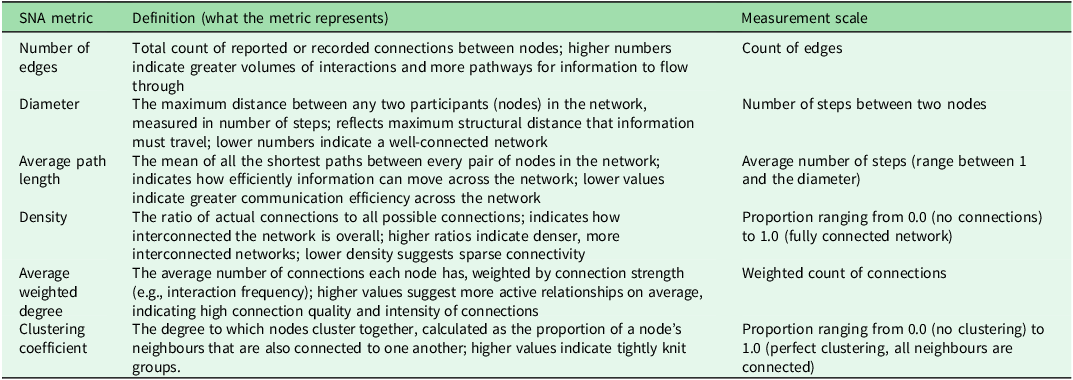
SNA produces descriptive statistics that aid in understanding the relationship structures and characteristics present in a network. Table 1 summarizes the SNA metrics utilized in this study and how they are measured (Cherven Reference Cherven2013). Additionally, we conducted a Spearman’s rank-order correlation analysis to examine the relationship between participants’ level of connectivity within the Network and the emergence of new collaborations.
Social network analysis (SNA) metrics, definitions and measurement scale.

Qualitative data analysis
Interview transcripts and open-ended survey responses were analysed using inductive thematic analysis (Saldaña Reference Saldaña2016). Researchers developed codes from the data without predetermined categories, allowing patterns and themes to emerge. Quantitative and qualitative findings were then integrated to identify areas of alignment and divergence in understanding network dynamics and their impacts on shared goals (Creswell & Plano Clark Reference Creswell and Plano Clark2018).
Results
SNA of archival data drawn from discussion board activity, event attendance and committee participation indicated that the ACE for Wildlife Network’s formally organized activities, facilitated through the Network’s centralized backbone coordination, were associated with the formation of connections among participants. Although these results are not displayed here due to reporting constraints, they provided important context for interpreting the overall Network and highlighted the role of structured activities in initiating early ties. Survey data showed, however, that connections extended well beyond these facilitated interactions.
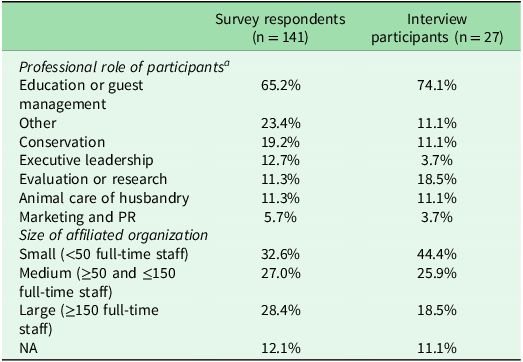
We received survey responses from 141 participants representing 47 organizations (37.2% individual response rate, 42.7% organizational response rate). Most respondents worked in education or guest engagement roles, with additional representation from conservation, executive leadership, animal care and evaluation positions (Table 2).
Study participants by professional role and organization size.
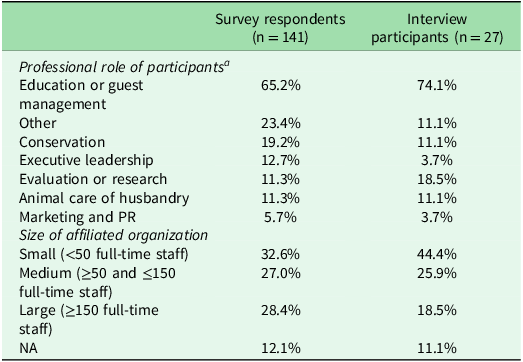
a Totals exceed 100% because respondents could select more than one professional role.
NA = not applicable; PR = public relations.
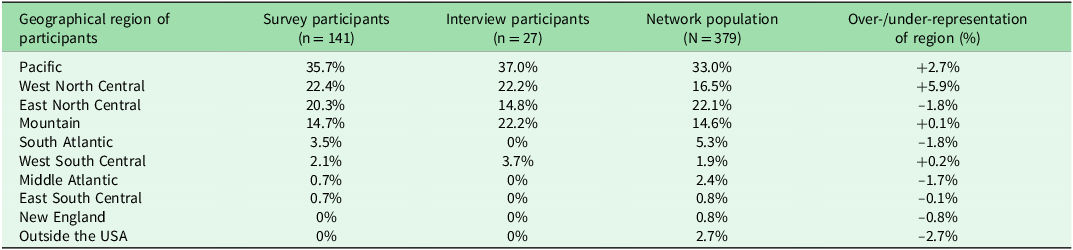
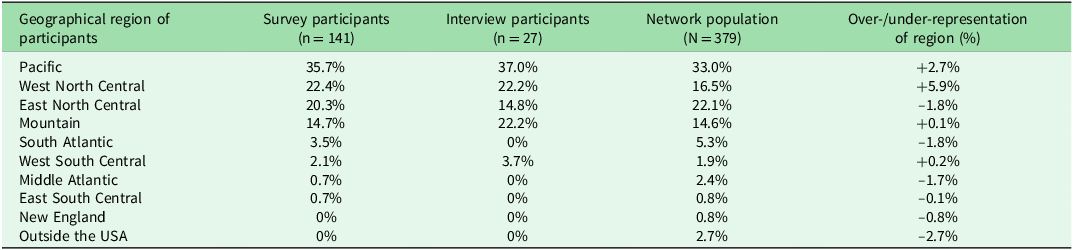
To contextualize the survey sample relative to the full ACE for Wildlife Network, we compared the geographical and organizational distribution of study participants to the Network population (Tables 2 & 3). Overall geographical patterns were largely consistent, with modest over- or under-representation across regions, although representation varied across organizations (Table 3). Larger organizations with multiple Network participants were slightly under-represented, whereas smaller organizations with only one Network participant were proportionately over-represented because a single response represented full organizational participation. These patterns are typical of social network surveys.
Geographical representation of study participants compared to network population.
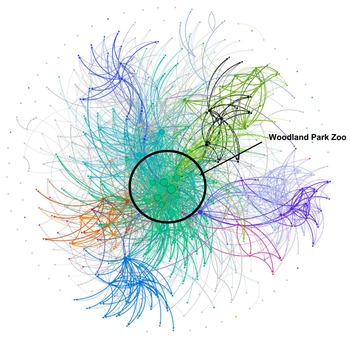
Consistent with the survey design, information-sharing connections and collaboration connections were analysed separately and are reported as distinct networks. Together, the two network visualizations (Figures 1 & 2) offer a structural view of how participants are connected through different types of relationships. By examining information-sharing and collaboration as separate but related networks, the analysis highlights differences in how ties form, cluster and extend across organizations.
Information-sharing network among Advancing Conservation through Empathy for Wildlife™ Network participants. Each dot represents a Network participant (node), and each line represents a participant-generated information-sharing connection (edge). Node colours correspond to organizational affiliation, whereas node size reflects each participant’s total degree (frequency and strength of information-sharing connections). Clusters indicate participants who share more connections with one another, and nodes on the periphery represent participants with fewer or no reported connections. More centrally positioned nodes, such as Woodland Park Zoo (circled), indicate higher levels of connectivity within the Network.

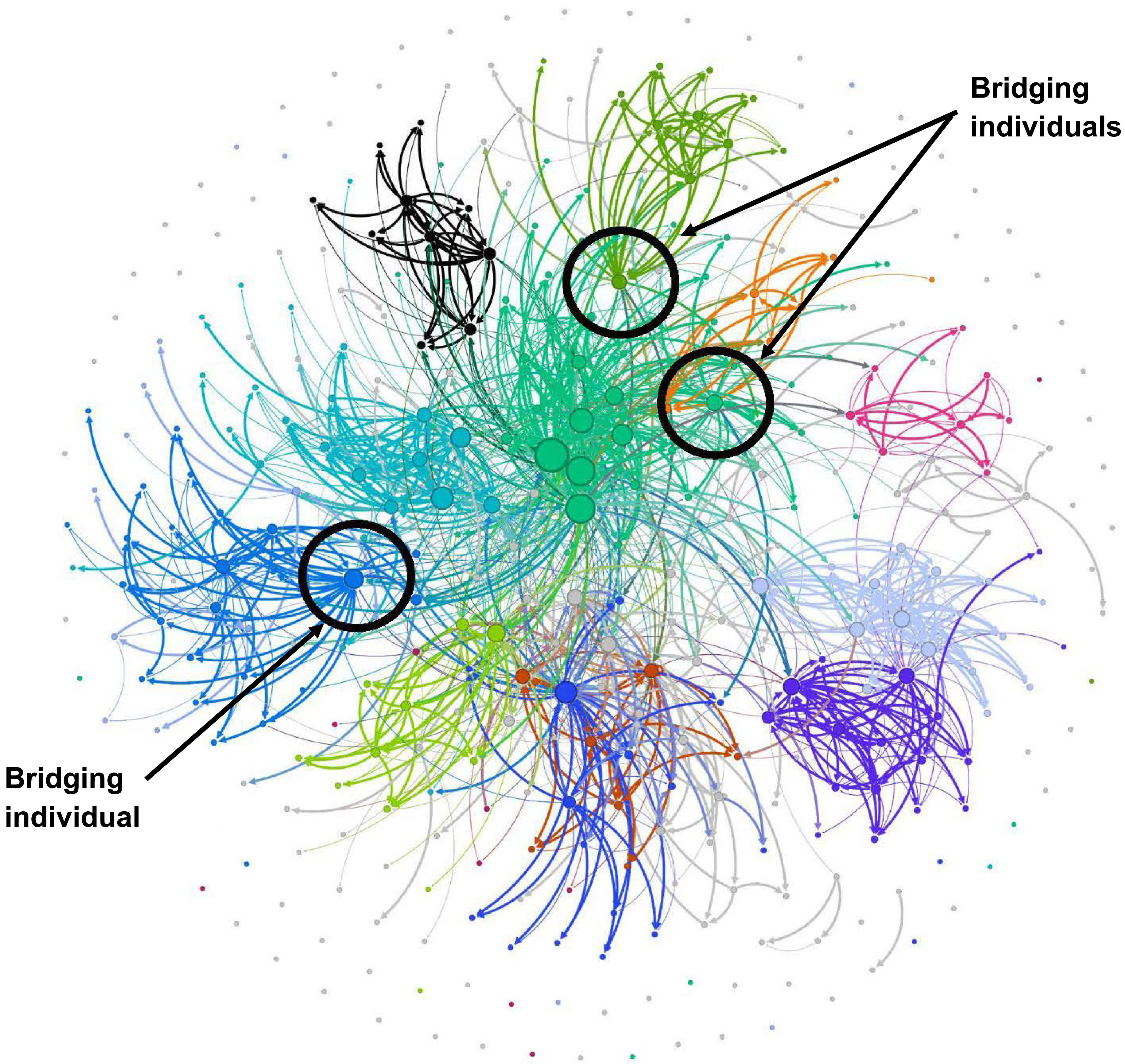
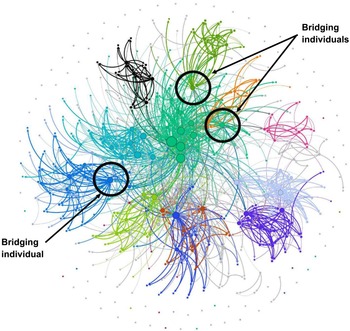
Collaboration network among Advancing Conservation through Empathy for Wildlife™ Network participants. Dots represent Network participants (nodes), and lines represent collaboration connections (edges), with thin lines indicating occasional collaboration and thick lines indicating regular collaboration. Colours indicate organizational affiliation, and larger dots reflect higher total degree (frequency and strength of collaboration connections). The three circled nodes highlight bridging individuals who connect otherwise-separate organizational clusters and enable cross-institutional collaboration.
Information-sharing network
The information-sharing network was characterized by robust connectivity with 1869 edges or connections, a diameter of 6, an average path length of 2.9, a density of 0.013, an average weighted degree of 6.6 and a clustering coefficient of 0.22 (Figure 1). A large majority of respondents (86.9%) reported information-sharing connections (82.8% occasional and 64.1% regular). Although the average weighted degree indicated that each respondent connected with approximately seven others, the relatively low density of 0.013 indicated that 1.3% of possible information-sharing connections were realized, suggesting that information flow might encounter bottlenecks. The clustering coefficient (0.22) indicated some organization-based grouping, potentially limiting cross-institutional information exchange without the presence of bridging actors, or those inter-organizational connectors who serve as conduits of information.
Woodland Park Zoo occupied the central position in the information-sharing network (Figure 1), reflecting its backbone function in facilitating knowledge exchange across the Network. The position also indicates Woodland Park Zoo’s role as a key connector within the mapped network.
Qualitative interviews revealed that participants shared a variety of information resources both within and across organizations, including research articles, engagement guides, evaluation tools, interpretive plans, lesson plans and training materials. Additionally, 70.2% of survey respondents (n = 99) reported that they implemented new or updated empathy-based practices into their work as a result of information exchange.
Collaboration network
The collaboration network exhibited fewer connections than the information-sharing network, with 1304 edges or connections, a diameter of 9, an average path length of 3.4, a density of 0.01, an average weighted degree of 5.2 and a clustering coefficient of 0.25. Although most respondents (82.1%) reported collaborative relationships (67.6% occasional and 76.6% regular), the lower density of 0.01 (1.0% of possible connections realized) indicated more selective collaboration patterns. The longer average path length and diameter suggested that collaborative relationships were less widespread than information-sharing relationships.
There were three notable patterns in how collaboration happened: (1) Woodland Park Zoo held a central position, reflecting the centralized coordinating role played by its internal Advancing Empathy Team; (2) there was a clustering of collaboration within organizations, and (3) there was evidence of inter-organizational collaboration, facilitated by the critical role of bridging individuals (Figure 2). In Figure 2, bridges appear as larger circles within an organization that are connected both to nodes within the same organization and to nodes in other organizations. This indicates the crucial role that bridging individuals played in fostering collaboration. They served as the conduits through which ideas, resources and support flowed, not only within but also between different organizations (Borgatti et al. Reference Borgatti, Everett and Johnson2018). Their strategic position and numerous connections made them vital to the health and cohesion of the entire Network.
Interview data, which provided additional explanation and context to the survey data, revealed three distinct pathways to participant collaboration: (1) independent internal collaboration – direct empathy-based work with colleagues within one’s own organization; (2) independent regional collaboration – direct outreach to geographical regional partners with similar roles or empathy-based projects; and (3) cross-institutional collaboration beyond region – primarily facilitated by the ACE for Wildlife Network through events, grant programmes and committees.
Although the survey captured the presence of collaboration ties, interviews provided context regarding how collaborations formed, the types of joint activities pursued and the perceived influence of the Network on these outcomes. These qualitative insights extended beyond what could be captured through the survey items and were used to interpret patterns in the Network.
Interviewees engaging in internal collaborations (n = 10) reported working with departmental colleagues, while one person mentioned cross-departmental interactions. Interviewees engaging in regional collaborations (n = 5) reported collaborating with people with similar roles or projects/programmes in their geographical area. Types of collaborations included regional projects, training development, grant and report writing, brainstorming about and exchanging resources and site visits.
Interviewees engaging in cross-institutional collaborations beyond their geographical regions (n = 13) primarily connected with others through the ACE for Wildlife Network. Types of collaborations included brainstorming about and exchanging resources, working on network committee tasks and collaborating on conference panel proposals.
Additionally, 51.8% of survey respondents affirmed that their Network participation had resulted in new collaborations. There was a significant positive correlation between the two variables (Spearman rs(131) = 0.45, p < 0.001), indicating that higher levels of connection were associated with new collaborations.
A progressive pathway from information-sharing to collaborative action was also evidenced: information-sharing and collaboration networks were positively correlated (Spearman rs(143) = 0.73, p < 0.001). Higher levels of reported information-sharing were associated with higher levels of reported collaboration.
Additional interview results
Interview participants reported both personal and professional growth as a result of their involvement in the Network. Nine interviewees, most of whom had medium to high levels of connection (n = 7), reported feeling ‘in community’ with other Network participants, connecting through their shared interests and the common challenges associated with implementing wildlife-focused projects.
Interviewees (n = 21) mentioned that their information-sharing or collaborations had resulted in tangible products, including signage, reports, professional development training and training manuals, guides, plans and learning programmes. Nine interviewees also described gaining validation for their work through research, evidence and examples of other institutions successfully implementing their practices, which in some cases helped build organizational buy-in for using empathy-based approaches.
Interviewees identified several barriers to collaboration, including limited time, competing priorities and varying levels of familiarity with empathy-based practices. They also highlighted key enablers, such as facilitated Network events, the accessibility of shared tools and the presence of bridging individuals who connected otherwise-separate organizational clusters. These themes provided context for understanding the network patterns observed in the SNA.
Discussion
As a descriptive case study, these findings offer analytic rather than statistical generalization (Yin Reference Yin2018), providing insights into how a deliberately structured network can support information-sharing and collaboration among zoo and aquarium professionals engaged in empathy-based conservation work. The results suggest that intentional design, coordinated support and relationship-centred facilitation can help a network navigate typical barriers to connection in a sector that has historically faced geographical, institutional and operational isolation. A central finding is that of the foundational role of information-sharing in enabling collaboration. Information-sharing within the ACE for Wildlife Network was both more prevalent and more widely distributed than collaboration, and the two were strongly correlated. Participants described the Network as a trusted space for asking questions, exchanging resources and sharing lessons learned, with these interactions often laying the groundwork for subsequent projects and collaboration. This pattern aligns with the broader network literature positioning information-sharing as a precursor to deeper forms of engagement.
The relationship between information-sharing and collaboration was also evident in the ways participants described their Network involvement. As participants connected through events or committees, these connections often progressed from information-sharing to project-related collaboration or co-created resources. Although correlation does not imply causation, the alignment between the Network’s SNA metrics and participants’ qualitative accounts suggests that structured opportunities for connection may help facilitate the development of new professional relationships.
The structure of the network maps further highlights the importance of bridging roles – individuals who connect otherwise-disconnected groups and facilitate information flow across organizational boundaries. These bridging individuals were important in supporting cross-institutional connection. Maintaining and strengthening these connections requires ongoing attention, and the Advancing Empathy Team has already begun implementing strategies to support these key roles. These findings echo prior work emphasizing the relational infrastructure necessary for sustaining collaborative efforts (Gillam et al. Reference Gillam, Counts, Garstka, Burns and Jones2018).
The results of these collaborative efforts extend beyond internal connectivity. The ACE for Wildlife Network’s collaborative framework also generated several tangible outputs, including new shared resources, training programmes and contributions to conferences and publications, all directed towards fostering empathy for wildlife and promoting conservation. Participants reported a stronger sense of professional community, and many noted an increased sense of legitimacy within their roles. These reports suggest that structured opportunities for shared learning and relationship-building may help enhance professional capacity and accelerate the creation and dissemination of tools and resources that support empathy-based conservation practice.
At the same time, both survey and interview data pointed to opportunities to deepen cross-organizational collaboration. In response to these findings, the Advancing Empathy Team has implemented new strategies, including a structured cross-site visit programme, to deepen institutional connections and strengthen the foundations for future collaboration.
Central to all of these dynamics is the backbone function played by Woodland Park Zoo’s Advancing Empathy Team. This organization’s central positioning in the information-sharing and collaboration maps is not incidental but reflects the team’s essential role in coordinating activities, maintaining communication and sustaining shared purpose across diverse participants (Kania & Kramer Reference Kania and Kramer2011). Over time, increasing distributed leadership and self-organizing collaboration may signal a maturing and more resilient network – a pattern that is consistent with the literature on network development and adaptive capacity (Plastrik et al. Reference Plastrik, Taylor and Cleveland2014).
Interpretation of these findings should be considered alongside several methodological limitations. Participation patterns reflected differential representation across organizations, with smaller organizations being more visible and larger organizations being somewhat under-represented. Such patterns are common in social network surveys but warrant caution when interpreting the distribution of ties. In addition, the length of the survey may have contributed to participant burden, and the 37% response rate introduces the possibility of missing ties that could affect network structure and centrality measures (Kossinets Reference Kossinets2006). Although these limitations do not undermine the analytic insights generated, they highlight the need for careful interpretation.
Taken together, these findings demonstrate how an intentionally structured and supported professional network can cultivate meaningful connections, foster a sense of community and contribute to professional and organizational learning. For practitioners, these findings offer several concrete insights. First, intentionally designing opportunities for staff to share information – whether through committees, regular convenings or informal forums – can lay essential groundwork for later collaboration. Second, identifying and supporting bridging individuals may help connect otherwise-isolated teams or institutions and expand the reach of shared learning. Third, dedicated backbone facilitation by a centralized coordinating team can be instrumental in sustaining momentum, coordinating joint efforts and maintaining communication. These lessons may guide other zoos seeking to strengthen empathy-based practice through collaborative professional development networks. As a case study, the ACE for Wildlife Network offers analytic insights into how structured facilitation and relationship-centred design may influence information-sharing and collaboration in interpretive or conservation education contexts and provides practical considerations for developing and strengthening similar networks.
Conclusion
This study illustrates how a structured professional network may support cross-institutional learning, information-sharing and collaboration among zoo and aquarium professionals. The ACE for Wildlife Network provides an example of how intentionally designed networks – supported by a dedicated backbone function that provides centralized coordination and facilitation, aligned around shared goals and centred on relationship-building – can advance both professional capacity and conservation outcomes.
The Network’s trajectory offers timely insights for conservation practitioners seeking to foster collaboration across organizations. Practitioners may draw upon these findings by designing intentional spaces for information-sharing, supporting individuals who play bridging roles across teams and institutions and ensuring dedicated backbone support to coordinate shared efforts. These elements can help zoos strengthen empathy-based practice and foster more collaborative conservation efforts. This study contributes to a growing body of evidence indicating that collaboration, when supported, can be a powerful force for conservation. Zoos, with their dual role in engagement and conservation action, are uniquely positioned to advance this work. By applying collective impact principles and investing in conditions that allow collaboration to thrive, they may help strengthen professional practice and support more connected approaches to conservation-related work.
Data availability statement
The data that support the findings of this study are not publicly available due to confidentiality considerations, as participating organizations are identified in the analysis. However, the full report is available to participants in the ACE for Wildlife Network via the Network’s website. Additional information or access to study materials may be made available from the authors upon reasonable request, subject to institutional approval.
Acknowledgements
The authors thank the members of the ACE for Wildlife Network who participated in this study and generously shared their time and perspectives. We also acknowledge the four-person Advancing Empathy Team at Woodland Park Zoo for their role in supporting the implementation of this study.
Financial support
This case study was funded by a grant from a private donor to the Advancing Empathy Initiative at Woodland Park Zoo.
Competing interests
DG, CW, EH and SS declare no competing interests. MJ, TB and EB are employed by the organization examined in this case study; however, this affiliation did not influence the study’s analysis or reporting of results.
Ethical standards
Not applicable.

 Open access

