





Conspiracy theories explain social and political events of public interest as the secret acts of typically powerful groups (Douglas and Sutton, Reference Douglas and Sutton2023; Douglas et al., Reference Douglas, Uscinski, Sutton, Cichocka, Nefes, Ang and Deravi2019). The correlates of conspiracy beliefs have been investigated extensively in recent years, and one important finding is that people with higher conspiracy beliefs tend to be more self-centered (Hornsey et al., Reference Hornsey, Chapman, Alvarez, Bentley, Salvador Casara, Crimston, Barlow, Fromm and Jetten2021; Imhoff and Lamberty, Reference Imhoff and Lamberty2020; Marinthe et al., Reference Marinthe, Brown, Delouvée and Jolley2020). However, there is a dearth of empirical studies investigating whether those with stronger conspiracy beliefs also tend to be less generous toward others in general. We conducted 3 studies to address this gap. Specifically, we examined how intentions to donate to charities on a politically non-controversial issue (childhood cancer) correlate with conspiracy beliefs (Study 1). We also investigated generosity toward random strangers (Study 2). Lastly, we tested whether conspiracy beliefs relate to generosity depends on whether it is direct or mediated through an intermediary (e.g., a charity; Study 3).
1. Conspiracy beliefs are associated with lack of trust
Research on the psychology of conspiracy theories has flourished in recent years, identifying a range of traits, situational factors, and motives that are associated with belief in conspiracy theories (see Hornsey et al., Reference Hornsey, Bierwiaczonek, Sassenberg and Douglas2023, for a review). One of the most important contributors to conspiracy beliefs appears to be distrust. Specifically, research has shown that higher levels of belief in conspiracy theories are closely related to social distrust (e.g., Abalakina-Paap et al., Reference Abalakina-Paap, Stephan, Craig and Gregory1999; Douglas and Sutton, Reference Douglas and Sutton2018; Goertzel, Reference Goertzel1994; van Prooijen and Acker, Reference van Prooijen and Acker2015; van Prooijen et al., Reference van Prooijen, Spadaro and Wang2022) and that people with higher conspiracy beliefs overestimate how dishonest other people would behave (Alper et al., Reference Alper, Toribio-Flórez, Capraro and Douglas2024). Other studies have shown that those with stronger conspiracy beliefs are more likely to perceive strangers’ faces as threatening (Frenken and Imhoff, Reference Frenken and Imhoff2023) and are less trusting of their counterparts (Meuer and Imhoff, Reference Meuer and Imhoff2021), even in the absence of cues suggesting threat. It has been theorized that distrust in other individuals, groups, and organizations is crucial in driving people toward conspiracy theories (van Mulukom et al., Reference van Mulukom, Pummerer, Alper, Bai, Čavojová, Farias, Kay, Lazarevic, Lobato, Marinthe, Pavela Banai, Šrol and Žeželj2022). It has further been suggested that mistrust triggers biased information processing (e.g., lower analytical thinking and scientific literacy), which eventually results in conspiracy beliefs (Pierre, Reference Pierre2020). Recently, lack of trust in media (Bruder and Kunert, Reference Bruder and Kunert2021; Lockyer et al., Reference Lockyer, Islam, Rahman, Dickerson, Pickett, Sheldon, Wright, McEachan and Sheard2021; Su et al., Reference Su, Lee, Xiao, Li and Shu2021), government and public health institutions (Bruder and Kunert, Reference Bruder and Kunert2021; De Coninck et al., Reference De Coninck, Frissen, Matthijs, d’Haenens, Lits, Champagne-Poirier, Carignan, David, Pignard-Cheynel, Salerno and Généreux2021; Kim and Kim, Reference Kim and Kim2021; Pummerer et al., Reference Pummerer, Böhm, Lilleholt, Winter, Zettler and Sassenberg2021), and science (Constantinou et al., Reference Constantinou, Kagialis and Karekla2020; Eberl et al., Reference Eberl, Huber and Greussing2021; Erceg et al., Reference Erceg, Ružojčić and Galić2020) have also been shown to play a key role in fostering conspiracy beliefs about the origins of COVID-19. A large-scale cross-country comparison showed that, in countries where people find fewer reasons to trust institutions (e.g., countries with high levels of corruption), there were significantly higher levels of COVID-19-related and general conspiracy beliefs (Alper, Reference Alper2023; Alper and Imhoff, Reference Alper and Imhoff2023) and lower trust in science and scientists (Alper et al., Reference Alper, Yelbuz, Akkurt and Yilmaz2024).
2. Conspiracy beliefs are associated with antisocial tendencies
Conspiracy beliefs are associated with antisocial attitudes toward others (Jolley et al., Reference Jolley, Marques and Cookson2022). For example, they appear to be more willing to take part in a sinister conspiracy if given the chance (Douglas and Sutton, Reference Douglas and Sutton2011) and to commit everyday crime (Jolley et al., Reference Jolley, Douglas, Leite and Schrader2019). Various studies have also shown that people with stronger conspiracy beliefs score higher on socially undesirable personality characteristics, such as the so-called ‘dark’ traits of narcissism, Machiavellianism, and psychopathy (Cichocka et al., Reference Cichocka, Marchlewska and De Zavala2016; Hughes and Machan, Reference Hughes and Machan2021; Kay, Reference Kay2021; March and Springer, Reference March and Springer2019). Callousness, which is a common factor among all dark traits (Jones and Figueredo, Reference Jones and Figueredo2013), is also related to conspiracy beliefs (Swami et al., Reference Swami, Weis, Lay, Barron and Furnham2016). The dark core of personality, which is characterized as aversive personality traits and accompanying beliefs regarding how distrustful others are (Moshagen et al., Reference Moshagen, Hilbig and Zettler2018, Reference Moshagen, Zettler and Hilbig2020), is strongly associated with conspiracy beliefs (Thielmann and Hilbig, Reference Thielmann and Hilbig2023). Similarly, in a recent study, conspiracy beliefs were found to positively correlate with lying in a monetary incentivized lying task (Alper et al., Reference Alper, Toribio-Flórez, Capraro and Douglas2024).
3. Are conspiracy beliefs negatively related to generosity?
Given these links between conspiracy beliefs, distrust, antisocial tendencies, and dark personality characteristics, it is unsurprising that those with stronger conspiracy beliefs tend to be more self-centered. Specifically, in the context of the COVID-19 pandemic, conspiracy belief has been consistently linked to a lower likelihood of taking preventive action, such as social distancing and following recommended hygiene practices (e.g., Allington et al., Reference Allington, Duffy, Wessely, Dhavan and Rubin2021; Erceg et al., Reference Erceg, Ružojčić and Galić2020; Marinthe et al., Reference Marinthe, Brown, Delouvée and Jolley2020; Pavlović et al., Reference Pavlović, Azevedo, De, Riaño-Moreno, Maglić, Gkinopoulos, Donnelly-Kehoe, Payán-Gómez, Huang, Kantorowicz, Birtel, Schönegger, Capraro, Santamaría-García, Yucel, Ibanez, Rathje, Wetter, Stanojevic and Van Bavel2022; Romer and Jamieson, Reference Romer and Jamieson2020), lower intentions to take a vaccine for the greater good (e.g., Hornsey et al., Reference Hornsey, Chapman, Alvarez, Bentley, Salvador Casara, Crimston, Barlow, Fromm and Jetten2021; Romer and Jamieson, Reference Romer and Jamieson2020; Salali and Uysal, Reference Salali and Uysal2021), and a greater likelihood of hoarding vital resources for oneself (Imhoff and Lamberty, Reference Imhoff and Lamberty2020). During this time, conspiracy believers have also tended to be more concerned about their own safety than the safety of others (Hornsey et al., Reference Hornsey, Chapman, Alvarez, Bentley, Salvador Casara, Crimston, Barlow, Fromm and Jetten2021; Marinthe et al., Reference Marinthe, Brown, Delouvée and Jolley2020).
If conspiracy beliefs positively relate to being more self-centered and antisocial, it is plausible that they may also be less inclined to display generous behavior, understood as incurring a cost to benefit others (Park et al., Reference Park, Kahnt, Dogan, Strang, Fehr and Tobler2017). Generosity can be broadly defined as the voluntary transfer of resources to benefit others, even at some cost to oneself (Engel, Reference Engel2011). Unlike cooperation or reciprocity, which involve mutual or conditional exchanges, generosity is fundamentally unilateral—but it is also inherently object-directed: it requires a beneficiary, and people’s willingness to give depends on who or what the recipient is, how deserving they are perceived to be, and whether the channel through which generosity is expressed is trusted (Brañas-Garza, Reference Brañas-Garza2006). This means that worldviews—including epistemic worldviews such as conspiracy beliefs—can systematically shape these perceptions.
However, empirical research on the association between conspiracy beliefs and generosity remains limited. Thus far, only 2 studies have examined this possibility. A study with participants recruited from Amazon Mechanical Turk found that exposure to conspiracy theories about climate change decreased intentions to donate to, and volunteer for, an unspecified charity (Van der Linden, Reference Van der Linden2015). This suggests that conspiracy beliefs may indeed be associated with lower levels of generosity specifically toward a charity. However, this was limited to a single study on an American crowdsourced sample. Moreover, it referred to a specific target of generosity: a charity; given that people higher in conspiracy beliefs are more likely to distrust institutions and organizations, it is possible that the aforementioned effect is driven by distrust, rather than generosity per se. In other research from 4 countries, COVID-19 conspiracy beliefs (i.e., believing that the official account of the COVID-19 hides the actual truth about its nature) were found to be related to lower intentions to help others during the pandemic (self-reported tendencies to donate money, offer support to neighbors, engage with volunteers, and use social media to promote social distancing; Moon and Travaglino, Reference Moon and Travaglino2021). However, because both the conspiracy-belief measure and the generosity-related outcomes were specific to the COVID-19 context, this association is not especially surprising and may partly reflect domain-specific coherence rather than a broader relationship between conspiracy beliefs and generosity.
4. Preliminary studies
During the conceptualization of the present research, we conducted 2 preliminary studies. The first was based on secondary analyses of data on hypothetical donations in the context of the COVID-19 pandemic from an open multinational dataset (Van Bavel et al., Reference Van Bavel, Cichocka, Capraro, Sjåstad, Nezlek, Pavlović, Alfano, Gelfand, Azevedo, Birtel, Cislak, Lockwood, Ross, Abts, Agadullina, Aruta, Besharati, Bor, Choma and Boggio2022). We observed that COVID-19 conspiracy beliefs were negatively related to donations to national charities working on COVID-19, while the association between conspiracy beliefs and donations to international charities was nonsignificant (see the Supplementary Material for details). These preliminary results may not be surprising. After all, why would an anti-vaxxer donate to a pro-vaccine organization? Reluctance to support an organization might not always indicate lower generosity. If one believes that a charity is working against the public interest, refusing to support that organization could actually reflect a prosocial attitude from that person’s perspective. In the case of conspiracy believers, refusing to donate to certain charities might similarly be interpreted as a prosocial, rather than antisocial, behavior.
In our second preliminary study, we performed secondary analyses on European Social Survey (ESS Round 10: European Social Survey Round 10 Data, 2020) data (29,904 participants from 20 European countries; see the Supplementary Material for details). We found that perceived importance of being prosocial was not correlated with any of the 3 conspiracy items (‘Small secret group of people responsible for making all major decisions in world politics’; ‘Groups of scientists manipulate, fabricate, or suppress evidence in order to deceive the public’; and ‘COVID-19 is a result of deliberate and concealed efforts of some government or organization’). However, this was a self-reported measure of being prosocial and did not directly tap into the concept of generosity, since prosociality is a broader concept that includes but is not limited to generosity.
Our first preliminary study, therefore, deviated from an ideal test of the relationship between conspiracy beliefs and a general tendency to behave generously, insofar as it introduced confounds (e.g., vaccine attitudes, political identity, and institutional trust) potentially affecting the perceived deservingness of the recipient. Our second preliminary study similarly suffered from limitations since it was a self-report, not behavioral, measure of prosociality, rather than generosity. In the present research, we focused on whether conspiracy beliefs are related to a general propensity for generosity, while methodologically minimizing or testing the influence of potential confounds.
5. Research overview
Building on our preliminary studies (see the Supplementary Material), which indicated a negative correlation between conspiracy beliefs and generosity but were subject to several limitations, we designed 3 studies to systematically examine how conspiracy beliefs relate to generosity across different contexts. In these 3 studies, we sought to address the limitations of the preliminary work by focusing on contexts in which participants were unlikely to hold strong political attitudes (unlike Preliminary Study 1) and by employing measures that directly assess generosity rather than broader prosociality (unlike Preliminary Study 2). Study 1 focused on generosity in the domain of a politically non-controversial cause (i.e., donations to charities helping children with cancer) to narrow variance in perceived deservingness, while also examining differences between national and international charities. In Study 2, we tested how conspiracy beliefs relate to generosity toward an anonymous stranger in a Dictator Game (Engel, Reference Engel2011). Finally, Study 3 addressed whether the relationship between conspiracy beliefs and generosity can be explained by institutional distrust by examining whether they differentially relate to direct donations to a person in need versus mediated donations through a charity.
Throughout the research, we employed generosity paradigms that capture people’s inclination to benefit others even at a personal cost. In contrast to prior work, we used not only measures of intended generosity (Study 3) but also behavioral measures with real monetary incentives in economic games (Studies 1 and 2). Importantly, because Studies 1 and 2 involved paradigms in which the generous act was carried out through an intermediary, such as a charity or the researchers themselves, we sought to test whether this influenced the results, since conspiracy beliefs often involve a deep distrust of institutions and institutional agents. This rationale guided Study 3, where we compared direct and mediated generosity.
All data, supplementary materials, and the codebook are available at https://osf.io/s762z/. Study 1 was preregistered at https://osf.io/b8dr9. Study 3 was preregistered at https://osf.io/naw9q.
6. Study 1
We preregistered our hypotheses that conspiracy beliefs would be associated with lower donations to national and international charities (https://osf.io/b8dr9/).Footnote 1 , Footnote 2
6.1. Participants
As preregistered, we aimed to recruit a sample size of 853 to be able to detect small correlations (r = 0.11; Funder and Ozer, Reference Funder and Ozer2019), with a statistical power of 0.90 and a two-tailed alpha of 0.05. Our sample size was restricted by both thresholds for practically meaningful effect sizes (Funder and Ozer, Reference Funder and Ozer2019) and our available resources. We collected a sample of 850 UK participants (419 male, 425 female, 5 non-binary/other, 1 rather not say; M age = 43.38, SD = 13.21) via Prolific (www.prolific.co).Footnote 3 They were paid for their participation and told that they could win a bonus payment depending on their choices during the study.
6.2. Measures and procedure
Participants were given the following instructions:
As a participant in this study, you are entitled to an additional allocation of £0.50. You will have the opportunity to distribute this sum among the following: (a) yourself; (b) the British non-governmental organization (NGO), Children with Cancer UK, dedicated to aiding children afflicted with cancer; and (c) the international NGO, Childhood Cancer International, which also endeavors to assist children battling cancer.
After reading the instruction, participants were asked to divide £0.50 in any way they liked. Next, participants completed the 15-item Generic Conspiracist Beliefs Scale (Brotherton et al., Reference Brotherton, French and Pickering2013; α = 0.939; measured on a 5-point scale ranging from definitely not true to definitely true) and 5-item Conspiracy Mentality Questionnaire (Bruder et al., Reference Bruder, Haffke, Neave, Nouripanah and Imhoff2013; α = 0.867; measured on an 11-point scale ranging from 0% certainly not to 100% Certain). We used 2 different measures of conspiracy beliefs to capture slightly different aspects of conspiracy beliefs: Generic Conspiracist Beliefs Scale includes several generic, well-known conspiracy theories (e.g., ‘Evidence of alien contact is being concealed from the public’.) while the Conspiracy Mentality Questionnaire taps into the deep suspicions of the political establishment (e.g., ‘I think that politicians usually do not tell us the true motives for their decisions’.). Lastly, participants completed a demographic form stating their age, gender, education status, and perceived income status on a 10-step ladder.
After the data collection was complete, we distributed the money from the donation task according to the participants’ decisions (i.e., added as bonus payments to the participants’ compensation and/or sent as donations to the respective NGOs).
6.3. Analytical procedure
We calculated bivariate correlations between conspiracy beliefs measures, and how much money participants kept to themselves and how much they donated to national and international charities working on childhood cancer. We also estimated multiple linear regressions to check whether the association held when adjusting for differences in demographic factors (age, gender, education, and income). Due to deviations from assumed normality and homoskedasticity, we report robust standard errors (HC1). As a robustness check, we further fit multinomial logistic regression models to capture the discrete and bounded nature of the outcome measure. Specifically, money allocations were categorized into 5 levels (i.e., allocating 0 – zero, 1 – more than zero, 2 – half, 3 – more than half, and 4 – all), allowing us to examine whether the results held across distinct levels of generosity.
6.4. Results
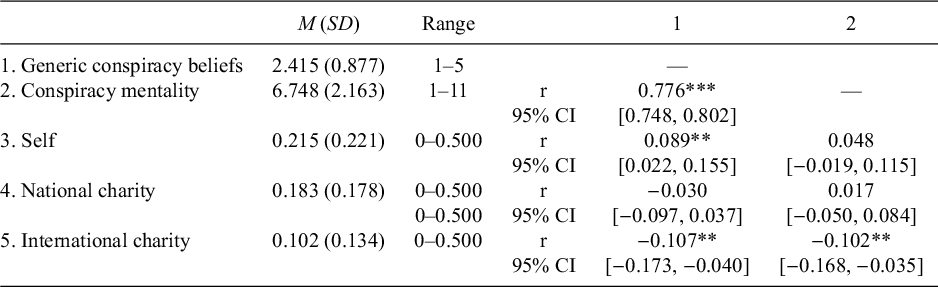
First, we examined how conspiracy beliefs related to how much participants allocated to themselves. The participants were considered as less generous overall if they kept more money to themselves. Generic conspiracy beliefs were positively correlated with keeping money to oneself, r = 0.089, p = 0.009, while conspiracy mentality was not associated, r = 0.048, p = 0.162 (see Figure 1 and Table 1). Results were similar in multiple linear regression models, after adjusting for demographics (age, gender, education, and income) and estimating robust standard errors. The multinomial regression model indicated that generic conspiracy beliefs were specifically related to the decision of keeping all (vs. zero) money to oneself (see the Supplementary Material for more detailed statistics).Footnote 4
Histograms depicting the distribution of responses in Study 1 (N = 850).

Generic conspiracy beliefs, r = −0.030, p = 0.384, and conspiracy mentality, r = 0.017, p = 0.615, were not associated with donations to a national charity. However, both generic conspiracy beliefs, r = −0.107, p = 0.002, and conspiracy mentality, r = −0.102, p = 0.003, were negatively associated with donating to an international charity. Adjusting for demographic variables in linear regression (age, gender, education status, and perceived income status) led to the same conclusions. The multinomial logistic regression indicated that the negative associations of generic conspiracy beliefs and conspiracy mentality with international charity donations were specifically significant regarding the decision of donating half (vs. zero). We also observed a negative association between generic conspiracy beliefs and donating half (vs. zero) to national charities (p = 0.045); however, we do not interpret this finding further (see the Supplementary Material).
Descriptive statistics and bivariate correlations between conspiracy beliefs and the amount of money allocated to self, a national charity, and an international charity on childhood cancer in Study 1

Note: ** p < 0.01, and *** p < 0.001. The intervals in brackets below the correlations are their 95% confidence intervals.
6.5. Discussion
In terms of overall generosity, Study 1 aligned with our expectations, although the evidence was not as strong as we expected. In line with our hypothesis, generic conspiracy beliefs were positively associated with keeping more money for the self, albeit with a small effect size (r = 0.089; Funder and Ozer, Reference Funder and Ozer2019). However, conspiracy mentality was not associated with lower generosity. These findings therefore partially supported our hypothesis that those with stronger conspiracy beliefs would act less generously. However, the results revealed inconsistencies between donations to national and international charities: Conspiracy beliefs and conspiracy mentality significantly and negatively predicted donations to international charities only. This finding was the opposite of what we observed in our preliminary study (Preliminary Study 1) on donations to charities working on COVID-19, in which we found that conspiracy beliefs were negatively related to donations to national charities but not to international ones (see the Supplementary Material).
Taken together with our preliminary study, Study 1 provided weak and inconsistent evidence for an association between conspiracy beliefs and generosity. However, Study 1 included measures of donations to charities. Considering that conspiracy beliefs are known to negatively correlate with institutional trust (van Prooijen et al., Reference van Prooijen, Spadaro and Wang2022), overall distrust in charities may be confounding the relationship between conspiracy beliefs and generosity. In Study 2, the recipient of generosity was an anonymous stranger, unlike Study 1.
7. Study 2
In Study 2, we aimed to investigate how conspiracy beliefs relate to generosity toward strangers. Due to the mixed results in our preliminary studies (see the Supplementary Material) and in Study 1, we did not preregister Study 2.
7.1. Participants
We collected a sample of 323 US participants (149 male, 156 female, 3 non-binary, 2 preferred not to say; M age = 37.84, SD = 11.97) from Prolific (www.prolific.co). They were paid for their participation and told that they could win a bonus payment depending on their choices during the study, similar to Study 1. The sample size was restricted by the available budget and it was sensitive to detect correlations as small as r = 0.18 with a statistical power of 0.90 and a two-tailed alpha of 0.05.
All participants in this study played as dictators and they were paid a bonus according to their choice. Receivers were selected from a list of Prolific IDs associated with participants in prior studies and were paid a bonus according to the dictator’s decision.
7.2. Materials and procedure
Participants were provided with $0.10 and informed that they could give any amount of it to a stranger, keeping the rest for themselves. They indicated their decision on an 11-point scale (1 = give $0.00 to the other participant, 11 = give $0.10 to the other participant). Participants then completed 2 comprehension check questions, in which they were asked which option maximized their own payoff (correct answer: ‘1 = give $0.00 to the other participant’) and which maximized the other person’s payoff (correct answer: ‘11 = give $0.10 to the other participant’).
Next, participants completed the 15-item Generic Conspiracist Beliefs Scale (Brotherton et al., Reference Brotherton, French and Pickering2013; α = 0.942) and the 5-item Conspiracy Mentality Questionnaire (Bruder et al., Reference Bruder, Haffke, Neave, Nouripanah and Imhoff2013; α = 0.860). In the Generic Conspiracist Beliefs Scale, there was an additional attention check item to ensure data quality.Footnote 5
7.3. Analytical procedure
We calculated bivariate correlations between participants’ economic allocations to an anonymous person and their conspiracy beliefs (generic conspiracy beliefs and conspiracy mentality).
7.4. Results
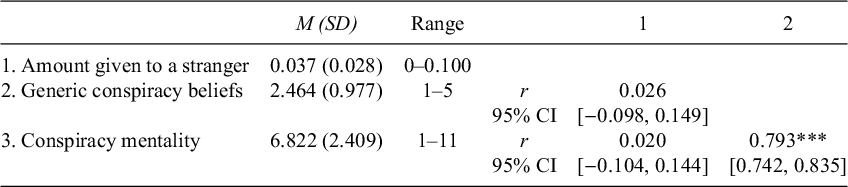
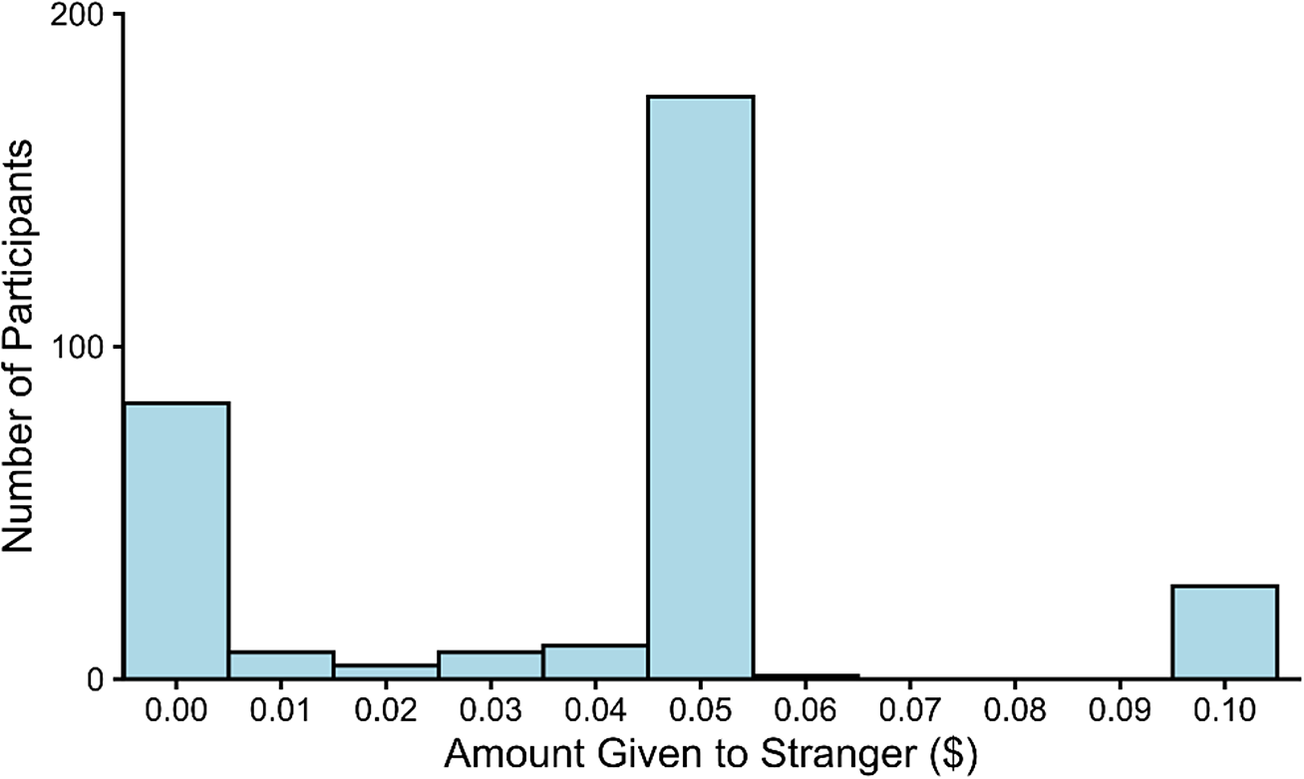
The amount given to the other person was not correlated with generic conspiracy beliefs, r = 0.023, p = 0.682, or conspiracy mentality, r = −0.009, p = 0.878. When participants who failed the comprehension questions and attention check were excludedFootnote 6 (N analysis = 251), correlations between amount given to the other person and generic conspiracy beliefs, r = 0.026, p = 0.681, and conspiracy mentality, r = 0.020, p = 0.754, remained nonsignificant (see Figure 2 and Table 2).
Descriptive statistics and bivariate correlations between conspiracy beliefs and the amount given to a stranger in Study 2 (N = 251)

Note: *** p < 0.001. The intervals in brackets below the correlations are their 95% confidence intervals.
Histogram depicting the distribution of responses in Study 2 (N = 251 after excluding inattentive participants).

7.5. Discussion
We did not find a correlation between conspiracy beliefs and generosity toward a stranger in a Dictator Game. It appears that conspiracy beliefs are not predictive of generosity in anonymous settings. A potential explanation for the null relationship between conspiracy beliefs and generosity may lie in participants’ attitudes toward the intermediary through which they expressed their generous behavior. As discussed above, individuals with strong conspiracy beliefs are known to distrust institutions (Alper, Reference Alper2023; Bruder and Kunert, Reference Bruder and Kunert2021; De Coninck et al., Reference De Coninck, Frissen, Matthijs, d’Haenens, Lits, Champagne-Poirier, Carignan, David, Pignard-Cheynel, Salerno and Généreux2021; Kim and Kim, Reference Kim and Kim2021; Pierre, Reference Pierre2020; Pummerer et al., Reference Pummerer, Böhm, Lilleholt, Winter, Zettler and Sassenberg2021; van Prooijen et al., Reference van Prooijen, Spadaro and Wang2022), and this distrust may extend to the intermediaries of prosocial acts (e.g., charities). In the setup of the present study, the researchers and the data collection platform function as intermediaries between the participants and the anonymous recipient, which may arguably elicit distrust about whether the generous behavior is genuinely carried out. In Study 3, we examine this potential limitation further by comparing participants’ willingness to donate directly to a person in need versus through a charity, in hypothetical scenarios. Specifically, Study 3 employs a hypothetical vignette, because (a) it is the only practically feasible way to assess how participants intend to behave toward another person without the mediation of an intermediary, including the researchers or the data collection platform and (b) there is no evidence to suggest that the use of hypothetical versus incentivized paradigms interacts with conspiracy beliefs in a way that would alter the direction of their association with generosity. In other words, although a main effect of incentivization may exist, there is no indication that it differentially affects individuals as a function of their level of conspiracy beliefs. Nevertheless, we acknowledge this as a potential limitation.
8. Study 3
In Study 3, we test 2 preregistered hypotheses: (H1) there would be a significant interaction between the level of conspiracy beliefs and donation type (direct vs. mediated) in predicting the intention to donate money to a person in need and (H2) the relationship between conspiracy beliefs and intention to donate would be negative when donation is mediated. We preregistered our hypotheses, study design, exclusion criteria, and analytical procedure before data collection (https://osf.io/naw9q).Footnote 7
8.1. Participants
We collected a sample of 830 US participants (251 male, 243 female, 4 non-binary, 332 preferred not to say; M age = 49.02, SD = 15.72) from Prolific (www.prolific.co).Footnote 8 They were paid for their participation. The sample size was sensitive to detect correlations as small as r = 0.11 with a statistical power of 0.90 and a two-tailed alpha of 0.05. Our target for the effect size comes from the finding that a typical small effect size in psychological research is 0.10 (Funder and Ozer, Reference Funder and Ozer2019) and we reasoned that anything below this threshold would not be consequential. For the analysis of our main model, we ran a sensitivity analysis for a linear multiple regression involving 3 predictors (conspiracy beliefs, the mode of donation [direct vs. mediated], and the interaction between them). The resulting N of 830 participants was sufficient to detect very small effect sizes (f 2 = 0.017) with a statistical power of 0.90, assuming a two-tailed alpha of 0.05 for detecting deviations of R 2 from zero.Footnote 9
8.2. Materials and procedure
Participants were randomly assigned to read either the direct (n = 414) or the mediated (in parenthesis) (n = 416) versions of a hypothetical vignette:
You are walking through a public area and notice a person sitting on the sidewalk holding a sign that says they are homeless and in need. The person appears to be asking passersby for money ( a table set up by a registered charity that supports homeless individuals. The charity is collecting small donations from the public. ). You have a one-dollar bill in your wallet.
In both conditions, participants were asked ‘How likely would you be to donate one dollar in this situation?’ and responded on a 7-point scale (1 = very unlikely, 7 = very likely).
Next, participants completed the 15-item Generic Conspiracist Beliefs Scale (Brotherton et al., Reference Brotherton, French and Pickering2013; α = 0.935) and the 5-item Conspiracy Mentality Questionnaire (Bruder et al., Reference Bruder, Haffke, Neave, Nouripanah and Imhoff2013; α = 0.853). There were 2 attention check questions to ensure data quality.
8.3. Analytical procedure
We calculated bivariate correlations between participants’ conspiracy beliefs and intention to donate in direct and mediated donation scenarios. We carried out a general linear model to examine the interaction between conspiracy beliefs and binary-coded donation condition (1 = direct, 2 = mediated). Similar to Study 1, we estimated robust standard errors (HC1) to counter any potential deviation from homoskedasticity.
8.4. Results
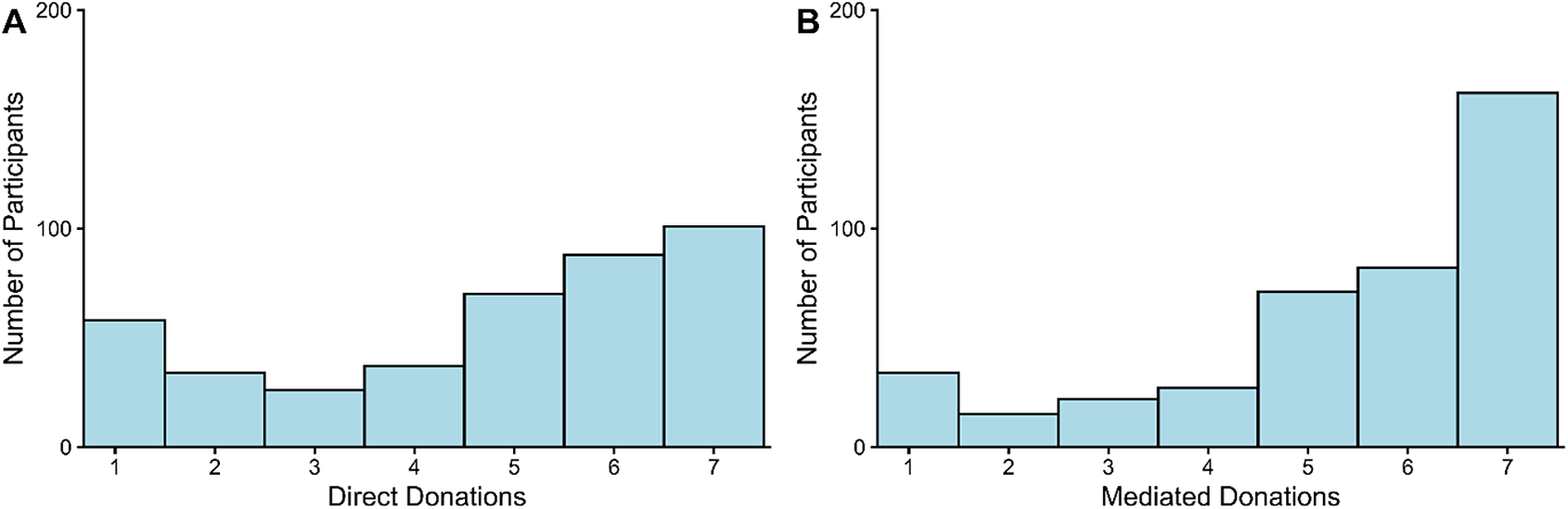
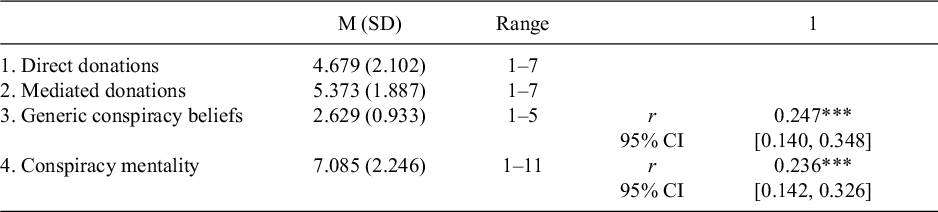
In general, mediated donations were significantly higher than direct donations, t(825) = −4.997, p < 0.001, d = −0.348. However, while conspiracy beliefs were not related to mediated donations, they were positively associated with direct ones (see Figure 3 and Table 3).
Bar plots depicting the distribution of responses in Study 3 (N direct = 414 and N mediated = 413).

Descriptive statistics and bivariate correlations between conspiracy beliefs and donations to direct and mediated donations in Study 3.

Note: *** p < 0.001. Since participants responded to either direct or mediated donation scenarios, the correlation between the two is not calculated. The intervals in brackets below the correlations are their 95% confidence intervals.
In our general linear model, participants with higher generic conspiracy beliefs, b = 0.591, SE = 0.140, 95% CI [0.343, 0.840], β = 0.120, t(638) = 4.239, p < 0.001, and those in the mediated donation condition, b = 2.535, SE = 0.509, 95% CI [1.595, 3.476], β = 0.402, t(638) = 4.979, p < 0.001, were more likely to donate. The interaction between generic conspiracy beliefs and donation condition was also significant, b = −0.645, SE = 0.184, 95% CI [−0.982, −0.308], β = −0.288, t(638) = −3.512, p < 0.001, indicating that while generic conspiracy beliefs predicted direct donations, it did not predict mediated donations, b = −0.054, SE = 0.119, 95% CI [−0.281, 0.174], β = −0.024, t(638) = −0.449, p = 0.653 (see Figure 4).
The associations between conspiracy beliefs and donation for different types of donation (direct vs. mediated) in Study 3. Shades represent 95% confidence interval.

We subsequently conducted the analysis with conspiracy mentality as a predictor, instead of generic conspiracy beliefs. People with higher conspiracy mentality, b = 0.229, SE = 0.048, 95% CI [0.140, 0.317], β = 0.144, t(807) = 4.742, p < 0.001, and those in the mediated donation condition, b = 2.116, SE = 0.476, 95% CI [1.211, 3.021], β = 0.355, t(807) = 4.448, p < 0.001, were more likely to donate. The interaction between conspiracy mentality and donation condition was also significant, b = −0.197, SE = 0.064, 95% CI [−0.318, −0.075], β = −0.217, t(807) = −3.067, p = 0.002, indicating that while conspiracy mentality did positively predict direct donations, it did not predict mediated donations, b = 0.032, SE = 0.042, 95% CI [−0.051, 0.116], β = 0.036, t(807) = 0.763, p = 0.446 (see Figure 4).
8.5. Discussion
In Study 3, we found that conspiracy beliefs were positively correlated with direct donations, but not with mediated donations. Analyses examining the interaction between conspiracy beliefs and donation type similarly showed that variations in conspiracy beliefs did not predict donations made through charities, but significantly and positively predicted donations made directly to a person in need. These results are consistent with our expectation that the association between conspiracy beliefs and generosity would depend on whether an institutional third party serves as an intermediary to the generosity. Importantly, the findings also suggest that those with stronger conspiracy beliefs are not less generous overall; in fact, they may be more generous but only when they are able to donate directly to the recipient.
9. General discussion
In 3 studies, using different methodologies and diverse samples, we have shed light on the relationship between conspiracy beliefs and generosity. We had initially hypothesized that those with higher conspiracy beliefs would be less generous, considering their tendency for self-centeredness (Hornsey et al., Reference Hornsey, Chapman, Alvarez, Bentley, Salvador Casara, Crimston, Barlow, Fromm and Jetten2021; Imhoff and Lamberty, Reference Imhoff and Lamberty2020; Marinthe et al., Reference Marinthe, Brown, Delouvée and Jolley2020), dishonesty (Alper et al., Reference Alper, Toribio-Flórez, Capraro and Douglas2024), antisocial attitudes (Jolley et al., Reference Jolley, Marques and Cookson2022), lower levels of trust (Abalakina-Paap et al., Reference Abalakina-Paap, Stephan, Craig and Gregory1999; Douglas and Sutton, Reference Douglas and Sutton2018; Goertzel, Reference Goertzel1994; Meuer and Imhoff, Reference Meuer and Imhoff2021; van Prooijen and Acker, Reference van Prooijen and Acker2015; van Prooijen et al., Reference van Prooijen, Spadaro and Wang2022), and higher levels of dark personality traits (Cichocka et al., Reference Cichocka, Marchlewska and De Zavala2016; Hughes and Machan, Reference Hughes and Machan2021; Kay, Reference Kay2021; March and Springer, Reference March and Springer2019; Thielmann and Hilbig, Reference Thielmann and Hilbig2023). However, our findings suggested that conspiracy beliefs are largely unrelated to generosity. The one exception was that, in Study 3, those with stronger conspiracy beliefs reported being more willing to give when institutional intermediaries were not involved, a finding that awaits replication.
In Study 1, we measured general conspiracy beliefs and examined actual donation behavior in the context of a politically neutral topic, childhood cancer. The results provided partial support for the original hypothesis: Generic conspiracy beliefs negatively correlated with overall generosity, albeit with a small effect size (r = 0.089). The association of conspiracy mentality, however, was not significant. Study 1 did not consider, however, that people who have higher conspiracy beliefs might distrust charities in general, regardless of their mission. It is likely that conspiracy beliefs are related to being suspicious of whether the money given to charities is used for the good of the public. We addressed this concern in Study 2 by focusing on alternative operationalizations of generosity. We found that conspiracy beliefs were not associated with generosity toward a stranger in a Dictator Game (Study 2). Together with weak and inconsistent effect sizes observed in Study 1, and the absence of relationships in Study 2, the overall findings suggest that conspiracy beliefs are not a major factor in predicting how generous people are.
Study 3 provided the most compelling evidence that conspiracy beliefs are not necessarily associated with lower generosity. In an experimental paradigm where we manipulated whether the act of donation was made directly to the recipient or mediated through a third party (i.e., a charity), we found that higher levels of conspiracy beliefs predicted a greater self-reported intention to donate when the donation was made directly to a person in need. However, when the donation was mediated, conspiracy beliefs did not predict generosity. Interestingly, although the general tendency across the sample was to donate more through charities, conspiracy beliefs were only (and positively) related to direct donations. This finding aligns with previous research suggesting that conspiracy beliefs are related to deep institutional distrust (Alper, Reference Alper2023; Hornsey et al., Reference Hornsey, Bierwiaczonek, Sassenberg and Douglas2023; van Prooijen et al., Reference van Prooijen, Spadaro and Wang2022). In our study, people with higher conspiracy beliefs tended to be generous, except when the donation was mediated by an institution.
Our set of studies focused primarily on generosity paradigms. Other dimensions of prosociality, such as cooperation and reciprocity, were not directly examined. Yet different social dilemma paradigms, such as the Trust Game (Berg et al., Reference Berg, Dickhaut and McCabe1995) and the Public Goods Game (Samuelson, Reference Samuelson1954), may evoke different motivations, and individuals may also differ in their motivations within the same dilemma (Bruins et al., Reference Bruins, Liebrand and Wilke1989; Thielmann et al., Reference Thielmann, Böhm and Hilbig2015). In this context, 2 motivations are especially relevant: greed and fear. Greed refers to the motivation to maximize one’s own payoff, whereas fear refers to the expectation that others will do so, leaving oneself as the sole cooperator and exposed to a ‘sucker’s payoff’ (Bruins et al., Reference Bruins, Liebrand and Wilke1989; Thielmann et al., Reference Thielmann, Böhm and Hilbig2015). Importantly, if conspiracy beliefs are linked to generalized distrust, as our findings and prior work suggest, this distrust may be expressed in social dilemmas primarily as fear, that is, as an expectation that others, especially institutional or anonymous others, may exploit one’s cooperation. Our initial hypothesis, grounded in prior work linking conspiracy beliefs to self-centeredness and antisocial tendencies, was that lower generosity would primarily reflect selfish motivations, namely greed. However, our findings, particularly in Study 3, point more strongly toward a fear-based account. This interpretation is also consistent with recent work by Thielmann and Hilbig (Reference Thielmann and Hilbig2023), who found that conspiracy beliefs are more closely tied to generalized dispositional distrust than to selfish motivations, and that conspiracy mentality was no longer associated with aversive personality traits once distrust-related beliefs were considered.
This distinction between greed and fear becomes crucial for interpreting our results. Individuals with stronger conspiracy beliefs are likely to be highly cynical (Papaioannou et al., Reference Papaioannou, Pantazi and van Prooijen2023) and prone to perceive themselves as victims of others’ exploitative intentions (Toribio-Flórez et al., Reference Toribio-Flórez, Altenmüller, Douglas, Gollwitzer, Adinugroho, Alfano, Apriliawati, Azevedo, Betsch, Bialobrzeska, Bret, Calero Valdez, Cologna, Czarnek, Delouvée, Doell, Dohle, Dubrov, Dziminska and Wojcik2025), displaying significant suspicion toward others. This aligns with findings that conspiracy beliefs are negatively correlated with generalized trust and that conspiracy believers overestimate others’ dishonesty (Alper et al., Reference Alper, Toribio-Flórez, Capraro and Douglas2024). Therefore, conspiracy believers may act out of fear rather than greed, especially fear of exploitation, particularly by intermediary institutions.
These results, overall, suggest that those with stronger conspiracy beliefs are not notably less generous. At the same time, the evidence from Study 3 raises the possibility that the channel through which generosity is expressed may matter, though this finding should be interpreted cautiously given the small effect sizes and the reliance on self-report. Moreover, these findings have potential implications that extend beyond the domain of generosity. Essentializing the socially destructive consequences of conspiracy theories (Jolley et al., Reference Jolley, Marques and Cookson2022), such as violence (Imhoff et al., Reference Imhoff, Dieterle and Lamberty2021; Jolley et al., Reference Jolley, Marques and Cookson2022), antisociality (Douglas and Sutton, Reference Douglas and Sutton2011; Jolley et al., Reference Douglas, Uscinski, Sutton, Cichocka, Nefes, Ang and Deravi2019), dishonesty (Alper et al., Reference Alper, Toribio-Flórez, Capraro and Douglas2024), and anti-science attitudes (Bierwiaczonek et al., Reference Bierwiaczonek, Gundersen and Kunst2022), as expressions of the inner characteristics of conspiracy believers may overlook important contextual factors. The current set of findings points to the possibility that conspiracy beliefs may be unrelated to antisociality or even positively associated with prosociality, provided the context does not involve institutional establishments that conspiracy believers deeply distrust.
Results were inconclusive regarding how conspiracy beliefs affect donations to national versus international charities. In our preliminary study (see the Supplementary Material), we observed that individuals with higher conspiracy beliefs donated less to both national and international charities focused on COVID-19, with a more pronounced negative association for national charities. This suggests that while those with stronger conspiracy beliefs were generally less inclined to donate, they showed a particular reluctance toward national charities compared to international ones. However, we reasoned that this might not be an appropriate test of generosity, since refusing to support COVID-19-related charities could be seen as prosocial if one believes that COVID-19 is a hoax. Study 1, which focused on a non-controversial issue (childhood cancer), revealed the opposite pattern: Higher conspiracy beliefs were significantly linked to reduced donations to an international charity addressing childhood cancer, but not to a national charity pursuing the same objective. This discrepancy might be attributed to the distinct missions of the charities. The contentious and politically charged nature of COVID-19 pandemic response (Kerr et al., Reference Kerr, Panagopoulos and Van Der Linden2021), which has spawned numerous conspiracy theories (Douglas, Reference Douglas2021; van Mulukom et al., Reference van Mulukom, Pummerer, Alper, Bai, Čavojová, Farias, Kay, Lazarevic, Lobato, Marinthe, Pavela Banai, Šrol and Žeželj2022), likely fueled distrust in national institutions perceived as political adversaries. This political divide may be less pronounced in the context of international organizations, possibly explaining the sharper decline in donations to national charities among those harboring conspiracy beliefs. In Study 1, the focus was on childhood cancer, a cause purposely chosen as a less polarizing cause within a country. Without internal polarization, conspiracy beliefs’ impact on attitudes toward outgroups might become more prominent, elucidating the stronger association with reduced donations to international charities. This would be consistent with past research showing that conspiracy beliefs are associated with perceiving one’s ingroup as superior to others (Golec de Zavala et al., Reference Golec de Zavala, Bierwiaczonek and Ciesielski2022; Golec de Zavala and Federico, Reference Golec de Zavala and Federico2018; Sternisko et al., Reference Sternisko, Cichocka, Cislak and Van Bavel2023).
9.1. Limitations and directions for future research
While our findings point to distrust as a key factor shaping how conspiracy beliefs relate to generosity, our paradigms do not allow us to directly identify the motivations underlying participants’ decisions. Monetary-incentivized tasks, such as the Dictator Game, can reflect a mixture of motives, including fairness concerns, altruism, or reputational considerations (Bruins et al., Reference Bruins, Liebrand and Wilke1989; Thielmann et al., Reference Thielmann, Böhm and Hilbig2015). As a result, it remains unclear which specific motivations drive the observed associations. Relatedly, our focus on generosity captures only one dimension of prosocial behavior. Other paradigms, such as the Ultimatum Game, involve qualitatively different forms of prosociality, including responses to fairness violations. In the Ultimatum Game, for example, responders may reject unfair offers either to enforce fairness norms (altruistic punishment) or due to spiteful or antisocial tendencies (Brañas-Garza et al., Reference Brañas-Garza, Espín, Exadaktylos and Herrmann2014). These distinct motivational pathways are not captured by unilateral allocation tasks. Future research should therefore (a) employ designs that better disentangle the motivations underlying prosocial decisions and (b) extend the scope beyond generosity by incorporating a broader range of incentivized paradigms that capture different forms of prosociality and their underlying motives.
It was evident from our exploratory analyses in Preliminary Study 2 that there was significant heterogeneity across countries in the correlation between conspiracy beliefs and generosity. In exploratory analyses reported in the Supplementary Material, we entertained the possibility that country-level corruption might be an important moderator (Alper, Reference Alper2023; Alper and Imhoff, Reference Alper and Imhoff2023) but failed to find consistent results. Future research should investigate the potential moderating effect of other societal and political differences, including, but not limited to, employment status (Freeman and Bentall, Reference Freeman and Bentall2017), minority group status (Freeman and Bentall, Reference Freeman and Bentall2017), and trust in government (Einstein and Glick, Reference Einstein and Glick2013). These are linked to conspiracy beliefs and might play an important role in this association. Future research could also control for other variables that are associated with generosity, such as perceived neediness of the recipient (Brañas-Garza, Reference Brañas-Garza2006; Engel, Reference Engel2011).
Another potential limitation is the problem of small incentives. In Study 2, participants were asked to divide $0.10, which could be argued to be too small to be influential on participants’ decision-making. However, past research has also found that small incentives might work very similarly to larger ones. The average donation in Dictator Game paradigms with incentives as small as $0.10 was quite similar to a larger meta-analysis of Dictator Game studies (Brañas-Garza et al., Reference Brañas-Garza, Capraro and Rascon-Ramirez2018; Engel, Reference Engel2011). In addition, incentives were uniformly small across conditions; therefore, even if they influenced the overall level of generosity, this would not bias our analysis because our focus is on the correlation between generosity and conspiracy beliefs, and there is no reason to expect the potential effect of incentives to vary systematically with conspiracy beliefs.
Finally, although more convenient and arguably more feasible, the use of a self-reported measure as the primary dependent variable in Study 3 constitutes a potential limitation. Participants’ reports of how generously they believe they would behave may not correspond to their actual behavior. Future research should therefore incorporate behavioral experiments to examine how both direct and mediated donation behaviors are associated with conspiracy beliefs.
10. Conclusion
Across 3 studies employing diverse methods and samples, we examined the complex and context-sensitive relationship between conspiracy beliefs and generosity. While previous literature often portrayed conspiracy believers as fundamentally antisocial and distrusting, our findings challenge this essentialist view. We observed that conspiracy beliefs are not uniformly associated with reduced prosociality; instead, their influence varies depending on the nature of the recipient, the presence of institutional intermediaries, and the sociopolitical context. Notably, one study found that people with higher conspiracy beliefs reported greater willingness to give directly to individuals rather than through institutional channels, raising the possibility that institutional distrust may shape how, rather than whether, conspiracy believers express generosity.
These findings call for a more nuanced understanding of the social consequences of conspiracy beliefs. Rather than viewing conspiracy believers as inherently antisocial, our research highlights the importance of situational cues and motivational dynamics in shaping their generosity. Future work should further explore these contingencies by integrating a wider variety of behavioral paradigms and examining cross-cultural moderators. A more balanced perspective on conspiracy beliefs, one that takes potential cross-cultural differences into account, may foster more productive discussion around some of the assumed sociopsychological correlates, such as social and institutional distrust, and the erosion of social cohesion and democratic values, more broadly.
Supplementary material
The supplementary material for this article can be found at https://doi.org/10.1017/jdm.2026.10036.
Data availability statement
Supplementary materials and data are available at https://osf.io/s762z/?view_only=07d3acf5831647e198bd293a4be75907.
Acknowledgements
We employed ChatGPT (chat.openai.com) exclusively for proofreading. Its function was restricted to refining the language of our texts when appropriate. ChatGPT did not contribute original content and did not author any part of the article.
Funding statement
The current research was funded by Yasar University, as a part of the project entitled as ‘Conspiracy Beliefs and Coopearation’ (Project No. BAP 138). We acknowledge the support of The Science Academy’s (Bilim Akademisi) BAGEP prize awarded to S.A. We acknowledge the support of the European Research Council Advanced Grant ‘CONSPIRACY_FX: Consequences of conspiracy theories’ (Grant No. 101018262). We acknowledge the support of the CHIST-ERA grant (Project No. 222N310; ‘Malicious actors profiling and detection in Online Social Networks through Artificial Intelligence’). This research was partly supported by the MUSA—Multilayered Urban Sustainability Action—project, funded by the European Union—NextGenerationEU, under the National Recovery and Resilience Plan (NRRP) Mission 4 Component 2 Investment Line 1.5: Strengthening of research structures and creation of R&D ‘innovation ecosystems’, set up of ‘territorial leaders in R&D’—project code: ECS 000037.
Competing interest
The authors declare that there are no competing interests.
Ethical standards
Ethical approval was granted by the Yasar University Institutional Review Board.



 Open access

