


1. Introduction
In the traditional craft industry, co-design between designers and artisans is crucial for maximising craft value and adapting craft products to meet social and market needs (Reference Malasan, Triharini and IhsanMalasan et al., 2023). Thus, craft co-design capability is essential for collaboration to be effective and sustainable (Reference Yun, Rahman, Ariffin and AliYun et al., 2022). Scholars have explored workshop-based co-design processes to bridge capability gaps, empower artisans, and ensure product quality (Reference TungTung, 2021). However, under rapid industrialisation and uneven regional development, business-oriented craft projects face additional constraints: products must be deliverable within time, cost, and quality requirements, while partners adapt to uneven resources, skills, and infrastructures (Reference Hu, Hur and ThomasHu et al., 2025). Yet most studies focus on short-term workshops and provide limited guidance on how everyday product development decisions under time/cost/quality constraints interact with partners’ evolving capabilities. Practitioners therefore lack a structured way to align craft value intentions with feasible product design strategies and collaboration modes in capability-asymmetric business projects.
Therefore, this research investigates designer–artisan collaboration in China’s business-oriented textile craft projects, distributed in unbalanced developing regions and offering diverse co-design practices (Reference Hu, Hur and ThomasHu et al., 2025), and addresses three research questions: (RQ1) What craft product feature directions do partners use to translate craft value for social innovation into market-oriented products? (RQ2) How do these feature directions correspond to partners’ expertise configurations and co-design relationship modes? (RQ3) What interaction strategies enable mutual adaptation and capability balancing when developing craft contents and techniques over iterative projects?
Based on 20 qualitative case studies, this study proposes a capability-based co-design model, aligning (a) craft value and product design directions, (b) partners’ capabilities and relationship modes, and (c) adaptive interactions to foster long-term sustainability. The model extends capability-based approaches into a step-by-step guidance for sustaining product quality and capability growth in capability-asymmetric partnerships. This study supports engineering design practice by applying structured design processes within craft-based collaborative settings, demonstrating how such integration can inform transferable approaches across different cultural contexts.
2. Theoretical background
2.1. Craft co-design, participatory design and social innovation
Traditional crafts are valued for their authenticity, reflected in material, form, and use, which supports the sustainability of craftspeople’s co-design capabilities, business growth, and regional development for social innovation (Reference Hu, Hur and ThomasHu et al., 2024). Social innovation, widely studied in craft revitalisation, is a co-creative process that integrates expertise across fields to generate economic and social value (Reference Hu, Hur and ThomasHu et al., 2024; Reference MuratovskiMuratovski, 2023). Co-design represents a specific form of co-creation, engaging professional designers and non-professionals to integrate diverse perspectives and empower communities through shared experiences (Reference MuratovskiMuratovski, 2023).
Recent craft co-design studies have explored how designers and artisans co-prototype and co-translate tacit craft knowledge into shared design decisions, and develop product innovations (Reference Hu, Hur and ThomasHu et al., 2024). Participatory design positions stakeholders as active partners across the craft design process, emphasising recruitment, timing and participatory techniques to enable more equitable outcomes (Reference Wacnik, Daly and VermaWacnik et al., 2025). Socially engaged design frames craft-related design as long-term collaboration for social innovation and capability building, requiring reflection on power relations and the infrastructures that sustain change (Reference MuratovskiMuratovski, 2023). Sustainable, business-oriented collaboration could empower artisans through increasing their participation in product development to cultivate their co-design capabilities, encompassing product development (knowledge transformation, material and technology understanding, creative thinking) and adaptive capability (communicating, networking, and aligning resources) to enhance creativity, and market opportunities to sustain livelihoods (Reference TungTung, 2021; Reference Yun, Rahman, Ariffin and AliYun et al., 2022). Yet in business-oriented settings, capability asymmetries, misaligned expectations and resources constraints complicate how product feature design decisions (e.g., what to keep traditional, what to develop, and what to technologise) and interaction modes evolve over time (Reference Hu, Hur and ThomasHu et al., 2025). Existing research offers limited guidance on linking such day-to-day design choices to partners’ evolving capability needs across projects, thus motivating this study.
2.2. Capability-based approach as a lens for capability-asymmetric collaboration
The capability-based approach, rooted in economics and philosophy, emphasises individuals’ freedom to achieve well-being through capabilities (real opportunities for individuals to achieve desired states) and functions (outcomes of what individuals choose to achieve, as shaped by social conditions) (Reference Sen, Nussbaum and SenSen, 1993). Integrating this approach into co-design could enhance empowerment and inclusivity by shifting attention from a one-off co-design workshop towards what partners are actually able to do, learn, and sustain over time (Reference Malasan, Triharini and IhsanMalasan et al., 2023). However, artisans, especially those in underdeveloped areas, lack the capability to collaborate equally (Reference Hu, Hur and ThomasHu et al., 2025). The unclear connections among partners’ capabilities, product development, and interaction methods continue to constrain the practicality and sustainability of daily business-oriented co-design projects. Thus, this study applies a capability-based approach as an engineering design strategy to link (a) craft value intentions, (b) product features, and (c) partners’ adaptive interactions. This connection is used to explain how partners can select feasible development pathways and collaboration modes under persistent capability gaps.
3. Methods
3.1. Research design and methods
Rather than estimating population parameters, this study aimed to explore business-oriented designer–artisan co-design under day-to-day product-development constraints, focusing on mechanisms linking partners’ capability feature decisions, and interaction strategies. As the units of analysis include situated interactions and capability adaptation processes that are difficult to operationalise reliably at scale without prior construction of the model, the qualitative, interpretivist–constructivist multiple-case study was used to capture the diversity and complexity of designer-artisan collaborations across a broad populations (Reference Paparini, Papoutsi, Murdoch, Green, Petticrew, Greenhalgh and ShawPaparini et al., 2021), enabling the exploration of flexible co-design strategies for social innovation.
3.2. Analysis framework
Grounded in the human-centred notion of empowerment and freedom within a capability-based approach (Reference Sen, Nussbaum and SenSen, 1993), this study expanded Reference Cao, Ma, Meng and SchreppCao et al.’s (2025) framework, originally focused on designers’ co-design capabilities, to encompass both designers’ and artisans’ capabilities essential for social innovation. In traditional craft co-design, partners are necessary to alternate roles to preserve and reinterpret techniques for cultural continuity and market growth (Reference TungTung, 2021).
As shown in Figure 1, the framework integrates three capability dimensions—interaction (communication, empathy, collaboration), systems thinking (holistic and adaptive understanding), and design expertise (creativity and aesthetic engagement for social innovation). Within this structure, two capability focuses were analysed: product development capability, reflecting the context of collaboration, and adaptive capability, representing partners’ flexibility during co-design. The capability-based approach provides a lens to examine how these capabilities evolve through product development processes.
The analysis framework used in this study (adopted from Reference Cao, Ma, Meng and SchreppCao et al., 2025)

3.3. Data collection
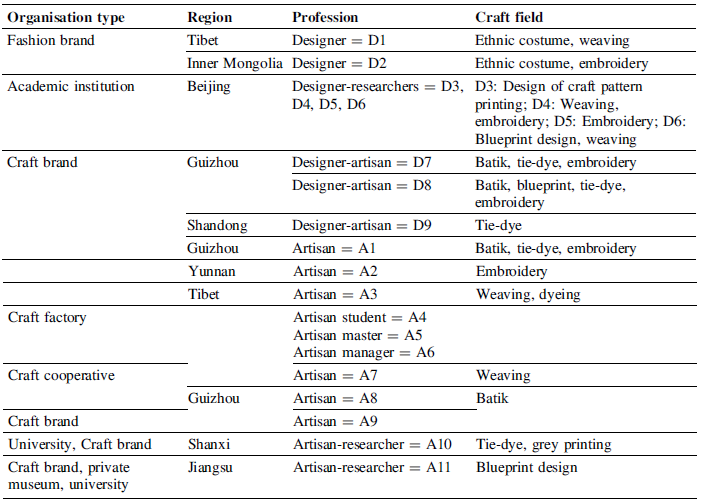
Data were triangulated from multiple sources to ensure validity (Reference Donkoh and MensahDonkoh & Mensah, 2023). Mixed purposive sampling (snowball plus criterion) enabled access to difficult-to-reach artisans and ensure high-quality participants across diverse traditional textile sectors, regions, organisations, co-design roles, and business-oriented co-design contexts (Reference Nyimbili and NyimbiliNyimbili & Nyimbili, 2024). Inclusion required official certification or demonstrable expertise and at least three years of co-design experience. Recruitment used conferences, training projects, and official referrals. Data collection continued until theoretical saturation was reached, yielding 20 cases from eight Chinese cities (11 craft experts and nine design experts, categorised by self-identified roles; Table 1) (Reference Sebele-MpofuSebele-Mpofu, 2020).
Selection also maximised variation in techniques/market contexts and in role configurations shaping capability asymmetry (e.g., separated roles versus hybrid ‘designer–artisan’ practitioners), as boundary-spanning roles often mediate knowledge transfer and standardisation across projects.
Profile of the study participants

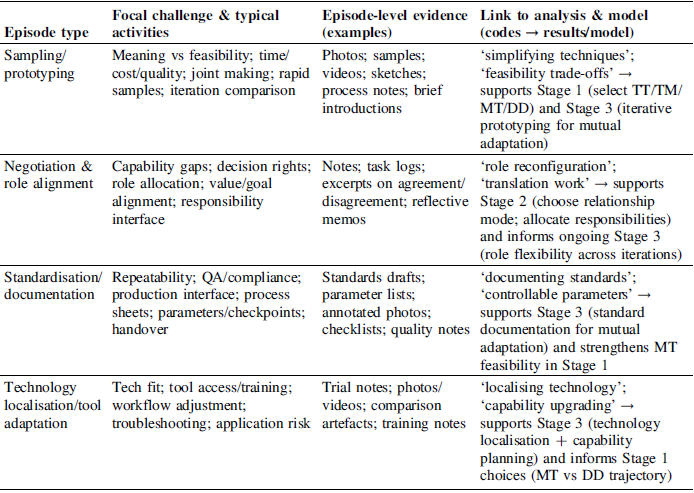
In addition to semi-structured interviews, primary data also included observations, and participatory sessions, allowing the researcher to co-design with participants for experiential insight. Informal interactions, field notes, photos, and recordings were supplemented by secondary sources involving online materials and public documents for contextualisation. Rather than lab directed workshop activities, the co-design sessions in this study were naturally occurring episodes embedded in ongoing everyday business projects. Each episode was recorded (participants/roles, focal challenge or decision point, key actions, and captured materials) and synthesised into four recurring episodes (Table 2) that provide traceability from situated practice, episode-level evidence to codes, themes and the emerging model: sampling/prototyping, negotiation and role alignment, standardisation/documentation, and technology localisation.
Overview of naturalistic co-design episodes

3.4. Data analysis and validation
The data were analysed in NVivo 12 using thematic analysis informed by the six Cs of grounded theory (causes, contexts, contingencies, consequences, covariances and, conditions) to derive patterns related to the research aim and link codes to mechanism and outcomes (Reference Ndame, Okoko, Tunison and WalkerNdame, 2023). Three coding phases were identified: (a) initial theme identification linked to research questions, (b) categorisation into main themes, and (c) iterative review against original transcripts to ensure consistency (Figure 2). Co-design sessions and observations were treated as situated interaction episodes and analysed alongside interview data to make explicit how capability gaps and feasible design decisions emerged in practice.
Three-phase coding and themes identified in this study

To build code–theme relationships, each salient code was elaborated using six-Cs (cause, context/conditions, contingencies, and consequences) and linked via covariances, defined as recurrent co-occurrences around shared decision points). We then formulated and iteratively checked context or constraint, co-design action, and consequence. These statements grouped interdependent codes into the three Results themes (craft values, craft features and expertise, and mutual adaptive interaction) and informed the relationships presented in the conceptual model (Figure 7).
Trustworthiness was strengthened through parallel data collection and analysis, iterative model refinement, and formative member checking. During fieldwork, participants reviewed brief summaries and draft representations of emerging constructs and relationships to confirm interpretive accuracy and practical usefulness under production constraints. This situated and iterative feedback helped reduce misinterpretation, clarify tacit craft knowledge, and keep the model grounded in participants’ lived constraints and decision-making. Revisions were documented through member checking, peer debriefing, and an audit trail. In addition, two-stage triangulation was conducted: (1) within each case, interview transcripts were compared with observation notes, co-design session artefacts, and secondary sources to identify converging/diverging interpretations and document discrepancies in a case dossier; convergences, divergences, and discrepancies were documented in a case dossier; and (2) cross-case synthesis then compared patterns to refine relationships between feature directions, expertise configurations, and interaction strategies in the model (Reference Donkoh and MensahDonkoh & Mensah, 2023). Ethical approval was granted by the University of Leeds, ensuring voluntary participation, anonymity, and data security.
4. Results
The data revealed three key themes for balancing partners’ co-design capabilities and product development: (a) the systematic feature directions of co-designed craft products, (b) correspondence between these directions and partners’ expertise, and (c) interactions for balancing different design expertise. Table 2 summarises recurring episode types and links episode-level evidence to the codes, themes, and model components reported below.
4.1. Understanding the craft value system for social innovation
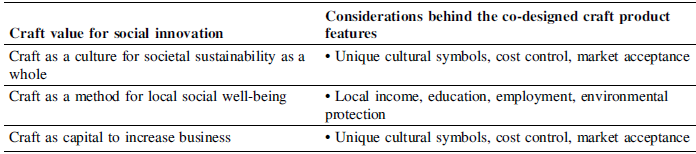
Partners co-created craft product features reflecting three levels of craft value for social innovation (Table 3).
Systems thinking in co-designed craft product features

At the first level, craft elements were viewed as business capital: partners often selected well-known traditional craft elements to highlight regional culture and enhance business appeal, while simplifying labour-intensive patterns to meet cost targets and fashion preferences: ‘… we used the traditional ones [motifs and techniques] …’ (A2); ‘… the human labour cost is too high … (so) we simplified the (original) patterns … young people like [simplified patterns]’ (D8).
At the second level, crafts are seen as methods for promoting local well-being (e.g., ‘artisans’ incomes’, ‘local GDP’, ‘local education’, ‘return migration rate’, and ‘environmental protection’ (D7)). Partners combined traditional skills with adapted technologies to meet local constraints, and organised training activities for residents and tourists to support employment and tourism: ‘We imported the machine to meet the emission criteria’ (A3); ‘We train the villagers before assigning them with tasks … the trainings for tourists are not free’ (A1).
At the third level, crafts were considered cultures emphasising societal sustainability. Partners focused on gradual development that connects traditional and modern elements rather than direct symbolisation. The resulting products ‘show new elements but are still in the shadow of traditional styles and spirit’ (D1), representing the ‘lively application’ of co-design ideas generated in daily life. This gradual approach fosters the ongoing development of co-design capabilities for long-term sustainability.
To realise the three-levels of craft value in co-design, the data revealed non-binary design directions reflecting the complementary designer–artisan capabilities. Participant D1 criticised a binary view of ‘traditional crafts’ versus ‘modern design’, emphasising their inner connections for sustainable value co-creation. Given current professional gaps, this research uses ‘traditional’ to represent artisans’ expertise in handmaking, patterns, and meanings, and ‘modern’ to represent designers’ expertise in technology and fashion trends—differences in expertise rather than the two fields’ strict separations.
In the mutual adaptation process, overlaps and gaps in expertise centred on contents (subjects, styles, patterns, colours) and techniques (tools, materials, skills, methods). These were combined to visualise abstract craft values and meet market needs through knowledge transformation and resource activation. In some crafts, content and technique were interdependent, while in others they acted separately. For example, Chaoshu embroidery was defined mainly by its stitching techniques, whereas Shu embroidery was distinguished by its pattern subjects (D4). Hence, co-designed craft feature directions are non-binary, forming a continuous four-quadrant model that integrates varying degrees of ‘traditional’, ‘developed’, and ‘modern’ techniques and content. Four representative directions popular in the current market were identified (Figure 3), along with the ideal direction for future social innovation.
Four representative craft product feature directions in current Chinese traditional textile co-designs

-
(1) Traditional Techniques + Traditional Contents (TT). In this feature direction of craft design, partners applied traditional handmaking techniques and content, directly incorporating semi-finished crafts into modern fashion products. For example, designers used participant A9’s semi-finished textiles on bag surfaces. This preserved the craft’s ‘origin’ but was often criticised as superficial patching rather than true integration.
-
(2) Modern Technology + Traditional Contents (MT). Here, artisans adapted modern technology to local contexts to re-present traditional content, imitate handmaking effects, and enable large-scale, low-cost production. Participant A3, for instance, developed locally suited dyeing equipment to produce textiles in regional colours for designers. This transformed handmaking experience into industrial standards, supporting adaptability, textile digitisation and archiving. Yet, weak regulation can raise ethical concerns if mass-production reduce local employment, further reducing artisans’ creative initiatives.
-
(3) Traditional Techniques + Modern Contents (TM). This direction used traditional techniques to express modern fashion trends. For instance, participant D8 and partners employed batik methods to depict contemporary patterns. This preserved traditional traits and promoted interactive iteration between designers and artisans, but risked prototype-focused work disconnected from local culture.
-
(4) Developed Traditional Techniques + Developed Traditional Contents (DD). Partners advanced traditional forms by flexibly merging established techniques with modern tools and trends while retaining the essence of Chinese textile interconnections. Designers acted as locally grounded collaborators, and artisans upgraded their technical proficiency to turn conceptual ideas into practical designs. As participant D1 noted, inspired by costume sleeves that as both sources of warmth and decoration, partners adapted handcrafting to merge traditional textile structures with modern scarves—preserving craft value while suiting contemporary use. This approach required deep understanding of authenticity and effective knowledge transfer.
-
(5) The ideal co-design directions in the future. The co-design goal of flexibly transforming craft value into diverse products to intellectualise both techniques and content by preserving craft interconnections rather than rigid forms. As D6 stated, practitioners needed continuously knowledge transformation and flexible intelligence control.
4.2. Linking craft features with partners’ expertise
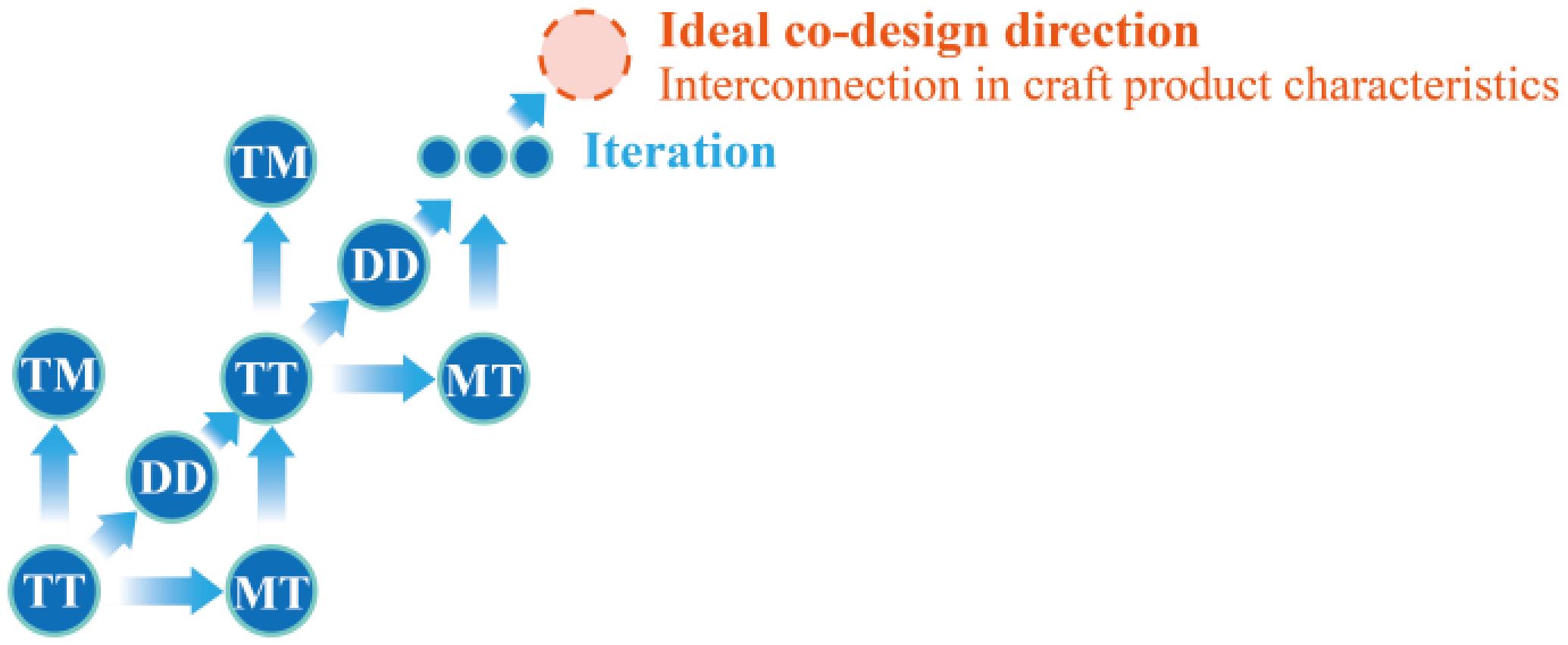
The data reveals interrelationships and developing process between these co-design directions (TT, TM. MT, DD) (Figure 4).
The developing process and relationships between craft co-design directions

Reflecting partners’ co-design capabilities, the TT direction required minimal knowledge or resource transformation, while MT and TM demanded development in either techniques or content, and DD required balanced advancement in both. Since partners rarely improved both simultaneously, TT typically evolved into MT, TM, and later DD. As capabilities balanced, MT and TM progressed into DD, strengthening interconnections among diverse craft elements.
Over time, familiarity with the DD direction turned it into a new starting point—an updated ‘TT’—for ongoing adaptation: ‘At first, I knew nothing about fabric materials … Now I can tell texture by touch, imagine designs, and connect styles instantly’ (D2) (Figure 5).
The iterative development of designer-artisan co-design intervention directions on craft product innovation and authenticity co-creation

The craft feature directions also shaped designer-artisan relationship modes by matching specific expertise. Except for a few with interdisciplinary skills, most partners still exhibited notable capability gaps (D4, A7, D8, D7). In such cases, they defaulted to collaboration modes aligned with their strengths, forming a continuum of expertise between ‘traditional’ and ‘modern’ influences (Figure 6).
Correspondence between co-design directions, actors’ expertise and relationship modes

All three co-design modes appeared in the TT direction. As TT retained tangible and cultural elements, artisans mainly worked within familiar territory. In the designer-directing mode, artisans reproduced traditional content chosen by designers; in the co-directing mode, designers offered broad briefs for artisans to interpret; and in the artisan-directing mode, artisans proposed concrete ideas while designers refined them for markets. In the DD direction (co-directing), partners extended beyond core expertise through mutual learning, maintaining balance between local traditions and external trends. In TM and MT, designers usually led due to their stronger grasp of design trends, adjusting outcomes to artisans’ contexts. Thus, designer-directing appeared across all directions, while artisan-directing was mostly limited to TT. As partners deepened familiarity with both ‘modern’ and ‘traditional’ fields, co-directing became increasingly common, corresponding to the evolution of their craft design directions.
4.3. Mutual adaptative interaction for sustainable collaboration
Designers and artisans leveraged their strengths to adapt to one another while developing techniques and contents. These mutual adaptations illustrate how designers supported artisans’ engagement under existing conditions. To advance craft design from TT, TM, and MT to DD, designers combined structured briefs with artisans’ improvisational outputs, aligning plans with market needs and artisans’ skills. Although designers proposed initial ideas and step-by-step plans, they left room for revisions, while artisans maintained flexible, emotion-driven processes oriented toward shared goals.
When developing craft contents, allowing artisans to work in familiar environments preserved craft authenticity by inspiring emotional engagement: ‘The loom is simple, but songs passed from mothers to daughters… weaving outdoors, they might recall a song or pattern—something no algorithm can compute’ (D1). However, artisans sometimes lacked confidence in storytelling: ‘I can weave randomly… but when I’m given a topic, I don’t know how to do it’ (D9). To address this, partners established open conceptual starting points from familiar fields, leaving creative space for mutual imagination. For example: ‘If designers wanted an outdoor picnic scene… artisans might suggest a tie-dyed tablecloth to match’ (D9). This approach aligned diverse experiences into cohesive concepts.
When developing craft techniques, artisans refined traditional methods within existing rules to meet design needs: ‘The serge belt’s wide spacing caused waste … we asked artisans to reduce it, saving material’ (D1). Beyond existing rules, however, three adaptation strategies emerged: (a) simplifying techniques to address inefficiency or environmental impact. As one participant said ‘It takes 2-3 days to embroider… we cut from three needles to two, simplifying without losing quality’ (D8) and ‘I can’t force an ideal effect—my ideal might not even be realistic’ (D6), (b) revising plans to turn technical limits into design strengths: ‘Chaoshu embroidery is fragile … yet it resembles a hard shell, providing support and doesn’t twist when worn on the chest. With this design, it can be machine-washable and practical for modern use’ (D4), and (c) adapting designs to artisans’ working methods for better results: ‘The new patterns suited artisans’ techniques—efficient and effective’ (D4).
Meanwhile, artisans responded by (a) documenting standards for consistency, (b) using flexible work sequences, and (c) localising modern technologies (A2, A3, D6). Through this reciprocal adaptation, partners co-developed diverse and sustainable craft products.
5. Discussion
This study examined designer–artisan co-design within China’s traditional craft sector and proposed a conceptual model linking partners’ co-design capabilities, processes, and craft product strategies for social innovation. Grounded in craft value for social innovation, the model introduces a three-stage co-design strategy that integrates designer–artisan capability development (Figure 7). It integrates the three results themes into a practice-facing workflow, with episode-level traceability from situated co-design work to the model summarised in Table 2.
The conceptual model of a capability-based designer-artisan co-design strategy for social innovation through craft product development

In the craft co-design field, recent studies have addressed designer–artisan capabilities and interaction patterns (Reference Malasan, Triharini and IhsanMalasan et al., 2023; Reference Yun, Rahman, Ariffin and AliYun et al., 2022), but few explicitly connect capability needs to evolving collaboration strategies. The proposed model links capabilities, product development directions, and interaction modes, showing how partners negotiate expertise, shift roles, and maintain active, balanced participation within asymmetric relationships while developing their co-design capabilities. Conceptually, it extends Reference Sen, Nussbaum and SenSen’s (1993) capability-based approach and Reference Cao, Ma, Meng and SchreppCao et al.’s (2025) design capability mapping into a practice-facing strategy for long-term collaboration. For design-for-social-innovation researchers, the model provides an analytical lens through which to interpret how local collaborations create economic and social value alongside capability growth. Craft and collaboration scholars can trace episode-level evidence (Table 2) to capability shifts and role reconfigurations across iterations, clarifying how design enables adaptive partnerships in business contexts. Scholars may use the model to conceptualise asymmetric partnerships as longitudinal processes of capability evolution and expertise negotiation, including efforts to empower different marginalised communities through heritage transformation.
From a practical standpoint, the model offers structured guidance for collaborating under capability asymmetry (Reference Malasan, Triharini and IhsanMalasan et al., 2023). It can be used as a repeatable workflow for project planning and review: (1) articulate a social innovation intent, identify corresponding craft values, and select a feasible feature direction by assessing which contents and techniques can be preserved, developed, or technologised under cost/time/quality constraints; (2) map partners’ expertise gaps to choose an initial relationship mode (designer-directing, co-directing, or artisan-directing) and allocate responsibilities; and (3) plan mutual-adaptation actions for content and technique development (e.g., iterative prototyping, standard documentation, and technology localisation), then reassess capability changes after each iteration to decide whether and how to move towards the DD direction. During member checking, participants reviewed the emerging relationships and terminology, helping refine the model’s wording and the step sequence for practice-oriented clarity.
Regarding engineering design implications and scalability in the MT direction, engineering constraints are most explicit when applying a process used in engineering design: scaling traditional content through modern technology requires translating tacit craft knowledge into controllable process parameters and documentation that interface with standard production systems (repeatability, quality assurance, and compliance). The cases show that technology localisation and standard documentation can increase feasibility; however, if scaling proceeds without parallel capability upgrading (training, tool access, and shared decision rights), mechanisation may reduce local initiative and weaken social innovation. Capability-based planning should therefore accompany technology adoption to align scalability with empowerment outcomes.
Although developed in China’s textile and fashion context, the model can be adapted to other craft-based or manufacturing settings by mapping ‘content’ to product meaning/identity requirements and ‘technique’ to process/material capabilities. For ceramics or wood-based products, the same three-stage logic can guide which heritage forms to preserve, which processes to standardise or automate, and how to distribute responsibilities across asymmetric partners. This mapping clarifies what should remain stable (capability dimensions and iterative strategy) versus what is context-specific (domain techniques, regulatory constraints, and market channels). Beyond crafts, the findings are relevant for cultural product design, design education, maker communities, civic culture management, and cultural tourism, supporting project leaders in fostering equitable collaboration among asymmetric participants. By translating capability theory into a step-by-step strategy, the model promotes socially responsible, context-sensitive co-design across diverse cultural and industrial settings, particularly those in developing regions.
6. Conclusion and future directions
This study developed a capability-based co-design model that links craft values, feature-direction, and partner interaction modes to support capability-based empowerment in crafts-related business contexts.
Focusing on China’s textile crafts sector, the insights explored may not fully generalise across regions. However, the diverse case and detailed analysis offer robust contextual evidence, enhancing the transferability of the research and providing practical guidance for stakeholders and scholars in other craft sectors and sustainable cultural industries. A dedicated post-hoc usability evaluation of the final framework with independent practitioners was beyond the scope of this study and will be addressed in future research. Future research should extend this research by: (a) examining developing regions like Southeast Asia and Africa, where resource imbalances influence capability building; and (b) exploring localised, long-term strategies that support artisans across diverse craft sectors using larger empirical datasets.







 Open access

