





Introduction
Cooperatives aspire to be truly democratic organizations, and their boards must reflect gender diversity. Yet women remain persistently underrepresented in cooperative governance, revealing a gap between cooperative ideals and empirical reality (International Cooperative Alliance, 2017).
Cooperatives are part of the civil society and nonprofit sector, often described as embodying some of the most democratic governance structures. According to the International Cooperative Alliance (2015), a cooperative is “an autonomous association of persons united voluntarily to meet their common economic, social, and cultural needs and aspirations through a jointly owned and democratically controlled enterprise” (p. 8). Cooperatives are based on the values of democracy, equality, equity and solidarity, as well as ethical values of honesty, openness, social responsibility, and caring for others (ICA, 2015). Thus, when women face barriers to leadership in such organizations, this contradicts their declared values and also suggests that similar or greater challenges are likely to persist across the wider field of voluntary and nonprofit organizations.
Within this framework, it is essential to distinguish between equality and equity. Equality refers to the same formal rights and opportunities, while equity requires differentiated measures to compensate for historical and systemic barriers, thereby ensuring substantive fairness (European Commission, 1998). International bodies emphasize that equality without equity risks perpetuating exclusion (UN Women, 2024). In organizational research, this conceptual progression is reflected in the evolution from Diversity and Inclusion (DI), which emphasized representation, to Diversity, Equity, and Inclusion (DEI), which addressed fairness, and more recently to Justice, Equity, Diversity, and Inclusion (JEDI), which places justice at the center of organizational change (Stivers et al., Reference Stivers, Pandey, DeHart-Davis, Hall, Newcomer, Portillo, Sabharwal, Strader and Wright2023). From this perspective, gender diversity on cooperative boards should not be reduced to quotas or compliance but seen as a structural matter of fairness and legitimacy.
Organizations that promote gender equity not only align with values of fairness, equal opportunity, and respect for diversity, but also enhance the legitimacy and effectiveness of decision-making processes (Cook & Glass, Reference Cook and Glass2014; Terjesen et al., Reference Terjesen, Sealy and Singh2009). Empirical studies further demonstrate that gender-diverse boards positively impact governance outcomes: the presence of women in decision-making bodies is associated with greater monitoring diligence and broader strategic perspectives (Post & Byron, Reference Post and Byron2015), and can contribute to enhanced transparency in nonprofits (Benito-Esteban et al., Reference Benito-Esteban, Elvira-Lorilla, Garcia-Rodriguez and Romero-Merino2024), improved accountability and self-evaluation (Ortega-Rodríguez et al., Reference Ortega-Rodríguez, López-Arceiz and Bellostas2023), and fairer executive compensation practices (Lee, Reference Lee2023). These benefits align with the United Nations Sustainable Development Goals, particularly SDG 5 on gender equality, SDG 10 on reducing inequalities, and SDG 16 on strong institutions. Yet progress remains slow, as UN Women (2024) warns that, at the current rate, gender parity in senior leadership will not be achieved before 2050.
Compounding these challenges, recent political shifts have fueled an anti-DEI agenda that weakens diversity programs across government, education, and corporate sectors (Ng et al., Reference Ng, Fitzsimmons, Kulkarni, Ozturk, April, Banerjee and Muhr2025). Against this backdrop, cooperatives, with dual economic and social missions, are well positioned to advance this agenda, as affirmed by the 2025 UN International Year of Cooperatives resolution (United Nations, 2024). Their capacity to mitigate inequalities and foster democratic participation positions cooperatives as a comparatively less examined setting for assessing inclusive governance, with relevant empirical insights dispersed across sectors and disciplines, while their hybrid nature frames them as ethical alternatives to investor-owned firms (Camargo Benavides & Ehrenhard, Reference Camargo Benavides and Ehrenhard2021).
Nevertheless, this potential contrasts sharply with current practice. Women constitute a substantial portion of cooperative membership globally, frequently the majority, yet remain underrepresented in governance and decision-making bodies (ICA, 2024; ILO, 2015). Despite the relevance of cooperatives to economic and social development worldwide, sex-disaggregated statistics on the composition of boards across cooperative sectors are still fragmented or unavailable. International organizations such as Committee for the Promotion and Advancement of Cooperatives (COPAC) emphasize that the lack of such governance data poses a barrier to monitoring gender equality progress in cooperatives (COPAC, 2025; ILO, 2025).
Where data are available, they reveal a persistent gap. In the global credit union sector, women represent approximately half of the membership base, with median values ranging from 48% to 54% depending on the region, according to World Council of Credit Unions (World Council of Credit Unions, 2025). However, female participation in governance remains significantly lower. In 2024, the median share of women on the boards of national credit union associations reached 33% in Europe and only 11% in Latin America, indicating a consistent pattern of underrepresentation in leadership (World Council of Credit Unions, 2025). This discrepancy is not unique to financial cooperatives. Similar gaps arise across other sectors whenever data are available. Although grounded in values of equity and democracy (ICA, 2015), cooperatives cannot be assumed to be inherently inclusive; empirical evidence indicates persistent gender gaps in governance (ICA, 2017; ILO, 2015). Moreover, despite the normative promise of cooperatives, existing scholarship on gender diversity has focused predominantly on traditional investor-owned firms (Adams & Ferreira, Reference Adams and Ferreira2009; Campbell & Mínguez-Vera, Reference Campbell and Mínguez-Vera2008; Post & Byron, Reference Post and Byron2015). As a result, the cooperative model remains comparatively less examined in mainstream organizational research (Camargo Benavides & Ehrenhard, Reference Camargo Benavides and Ehrenhard2021). Given the breadth of contexts and the heterogeneity of approaches used in this literature, a scoping review is well suited to map the existing evidence and identify gaps. Therefore, this scoping review addresses the following research question:
RQ. What personal, organizational, and environmental factors enable or hinder women’s participation on cooperative boards?
In this review, “participation” refers to women’s access to and inclusion in cooperative board positions, as reported in primary studies. Addressing this question requires a multilevel analytical perspective that considers how dynamics at the individual, organizational, and broader institutional context interact to shape inclusion in cooperative governance.
Theoretical foundation
Gender diversity and board governance
Gender diversity in governance has emerged as a critical issue in scientific literature on nonprofit and hybrid organizations, with two dominant approaches: quantitative and qualitative shaping the field.
From a quantitative perspective, gender diversity is primarily assessed in terms of the numerical representation of women and men in decision-making spaces. For instance, Hernández-Ortiz et al. (Reference Hernández-Ortiz, García Martí, Martínez Jiménez, Pedrosa Ortega and Ruiz Jiménez2020) emphasize that equitable gender balance on boards is a foundational element of inclusive governance. This approach has often focused on the implementation of mandatory quotas as a mechanism to accelerate parity. While some scholars (e.g., Labelle et al., Reference Labelle, Francoeur and Lakhal2015) caution that quotas may lead to formal compliance without substantive inclusion, others (Mensi-Klarbach & Seierstad, Reference Mensi-Klarbach and Seierstad2020) contend that such policies can drive long-term equality, especially in institutional contexts where informal resistance to inclusion persists.
Empirical cases underscore the potential of quotas to catalyze change. In Norway, a combination of voluntary and mandatory quotas significantly increased the presence of women on cooperative and corporate boards, from 17% in 2003 to 39% in 2009 (Brandth & Bjørkhaug, Reference Brandth and Bjørkhaug2015). This reform disrupted the traditionally male-dominated board culture and fostered new understandings of gender (Brandth & Bjørkhaug, Reference Brandth and Bjørkhaug2015), while broader evidence indicates that gender diversity can enhance decision making by diversifying perspectives (Adams & Ferreira, Reference Adams and Ferreira2009; Post & Byron, Reference Post and Byron2015). In nonprofit contexts, Lee (Reference Lee2023) found that greater female representation on boards was associated with more equitable CEO compensation, underscoring the broader governance implications of gender diversity for justice and fairness.
The qualitative approach, on the other hand, considers that gender diversity transcends the numerical to include the integration of diverse perspectives, values, and leadership styles. Hernández-Nicolás et al. (Reference Hernández-Nicolás, Martín-Ugedo and Mínguez-Vera2019) highlight that, to advance female representation in leadership spaces, it is essential to address structural barriers such as the “glass ceiling,” defined by the European Commission (1998) as “an invisible barrier generated by male-dominated organizational structures” (p. 37). Holgersson and Hvenmark (Reference Holgersson and Hvenmark2023) further challenge the treatment of gender as a static individual attribute and advocate for feminist organizational theory to analyze how gender is socially and structurally (re)produced in nonprofit settings. From this lens, gender is embedded in organizational routines and discourses that must be interrogated to reveal mechanisms of exclusion and control.
The presence of women on boards, according to Brandth and Bjørkhaug (Reference Brandth and Bjørkhaug2015), has improved the quality of decisions by incorporating different approaches and values, noting that gender diversity not only benefits the internal dynamics of organizations, but also strengthens their adaptability and effectiveness. Benito-Esteban et al. (Reference Benito-Esteban, Elvira-Lorilla, Garcia-Rodriguez and Romero-Merino2024) reinforce this by showing that gender diversity, in combination with other board characteristics such as size and expertise, can be part of the configurations that lead to higher levels of web transparency, a key indicator of accountability and ethical governance.
Cooperatives as hybrid and democratic organizations
Despite the growing number of studies on gender diversity on boards of directors, little attention remains devoted to the inclusion of women especially in the context of cooperatives. According to the International Cooperative Alliance, cooperatives are democratic organizations controlled by their members, who actively participate in setting their policies and making decisions. Men and women serving as elected representatives are accountable to the membership (ICA, 2015). This structure, in principle, offers a fertile ground for gender-inclusive governance, yet empirical research on whether this promise is being realized is scarce (Camargo Benavides & Ehrenhard, Reference Camargo Benavides and Ehrenhard2021).
The absence of such analysis limits the development of a robust theoretical framework that links gender diversity in cooperatives to broader principles of justice, inclusion, and accountability. Ortega-Rodríguez et al. (Reference Ortega-Rodríguez, López-Arceiz and Bellostas2023) reinforce this point by identifying board diversity as a governance mechanism that enhances stakeholder trust and strengthens internal control processes.
Unlike traditional firms, cooperatives provide a distinctive governance model that can shape female participation. They are also recognized for their wider social impact: according to the International Cooperative Alliance, cooperatives “provide jobs or work opportunities to 280 million people across the globe, in other words, 10% of the world’s employed population” and, as member-owned businesses, they “strengthen their social and human capital and develop their communities” (ICA, 2024). This impact takes special relevance considering the United Nations resolution designating 2025 as the International Year of Cooperatives, highlighting their role in achieving the 2030 agenda (United Nations, 2024). However, the specific factors that impact this dynamic have not yet been sufficiently explored in scientific literature.
In this context, critical scholars have emphasized the need for more nuanced and theoretically grounded approaches to studying gender in the third sector. Dodge et al. (Reference Dodge, Eikenberry and Coule2021) advocate for the use of critical and feminist methodologies to uncover the subtle, often invisible mechanisms of exclusion that positivist analyses frequently overlook. They contend that promoting ethical and meaningful organizational change entails more than increasing the numerical presence of women in leadership; it requires rethinking the deeper cultural norms, institutional logics, and power structures that sustain inequality. This call for a structural and intersectional perspective is particularly relevant in the case of cooperatives.
The Stone and Colella framework in the context of gender and cooperatives
To analyze these dynamics, this study adopts the theoretical model of Stone and Colella (Reference Stone and Colella1996). Although originally developed to examine disability inclusion, the model’s emphasis on stereotypes and the role of observers provides a valuable lens for analyzing gender in cooperative governance. Its multilevel structure was adapted here to classify enablers and barriers to women’s participation.
The Stone and Colella (Reference Stone and Colella1996) model’s core strength lies in its systematic examination of how stereotypes, perceptions, and observer characteristics influence inclusion and exclusion processes in organizational settings. This theoretical foundation is directly applicable to gender diversity research, as both disability and gender represent social categories that trigger stereotype-based judgments and differential treatment in organizational contexts (Heilman, Reference Heilman2012).
The model’s emphasis on the role of observers, those who make decisions about inclusion or exclusion, is particularly relevant for cooperative governance, where board composition decisions are often made by existing board members or cooperative assemblies. These decision makers act as “observers” whose perceptions and biases significantly influence women’s access to governance positions.
The framework developed by Stone and Colella identifies three main categories of factors that shape inclusion and exclusion in organizational contexts:
-
a) Personal factors refer both to the attributes of individuals subject to stereotypes and to the characteristics of those who evaluate them.
-
b) Organizational factors encompass the norms, values, policies, and reward systems that define opportunities within organizations.
-
c) Environmental and legal factors capture the influence of external regulations, legislation, and broader societal norms.
In this study, these dimensions are applied to the context of gender and cooperatives. Personal factors include women’s qualifications, experiences, and the perceptions of observers regarding their competence. Organizational factors refer to cooperative governance structures, internal cultures, and practices that either promote or constrain female participation. Environmental and legal factors encompass equality legislation, quota policies, and public initiatives designed to foster women’s access to boards of directors.
This adaptation allows the framework to serve as a comprehensive analytical tool for classifying both enablers and barriers to gender diversity in cooperative governance, highlighting how dynamics at different levels interact in shaping women’s opportunities for participation.
Method
This study was conducted as a scoping review to map the breadth and nature of evidence on factors that enable or hinder gender diversity on cooperative boards, identify research gaps, clarify key concepts, and lay the groundwork for future research and policy (Peters et al., Reference Peters, Godfrey, McInerney, Munn, Tricco, Khalil, Aromataris, Lockwood, Porritt, Pilla and Jordan2020). The choice of a scoping review reflects the need for an overarching overview of heterogeneous literature rather than a focused estimate of effect; unlike systematic reviews, which address narrowly defined questions and include formal critical appraisal and, where appropriate, quantitative synthesis, scoping reviews prioritize comprehensive mapping and conceptual clarification while still following systematic and transparent methods (Peters et al., Reference Peters, Godfrey, McInerney, Munn, Tricco, Khalil, Aromataris, Lockwood, Porritt, Pilla and Jordan2020; Tricco et al., Reference Tricco, Lillie, Zarin, O’Brien, Colquhoun, Levac, Moher, Peters, Horsley, Weeks, Hempel, Akl, Chang, McGowan, Stewart, Hartling, Aldcroft, Wilson, Garritty and Straus2018).
The review followed the PRISMA-ScR (Preferred Reporting Items for Systematic Reviews and Meta-Analyses extension for Scoping Reviews) to ensure transparency, replicability, and auditability of the search and selection process. PRISMA-ScR provides a standardized four-stage flow (identification, screening, eligibility, inclusion) that is increasingly adopted in management, social sciences, and nonprofit research for mapping heterogeneous evidence (Tricco et al., Reference Tricco, Lillie, Zarin, O’Brien, Colquhoun, Levac, Moher, Peters, Horsley, Weeks, Hempel, Akl, Chang, McGowan, Stewart, Hartling, Aldcroft, Wilson, Garritty and Straus2018). Recent bibliometric evidence confirms this expansion, revealing a 58% average annual growth in scoping reviews published in the social sciences between 2015 and 2021, including applied management domains (Logan et al., Reference Logan, Webb, Singh, Tanner, Barrett, Wall, Walsh and Ayala2024).
Searches were conducted systematically across the selected databases (see Table 2 for the search strategy). Titles and abstracts were screened, and the full texts of potentially relevant records were retrieved and, if meeting the inclusion criteria, analyzed in parallel and independently by two investigators; disagreements were resolved by discussion or by consulting a third reviewer. In the data extraction, the following elements were included: (a) authors, (b) year of publication, (c) article titles, (d) abstracts, (e) keywords, (f) theoretical framework, (g) type of cooperative analyzed, (h) methodological approach, (i) factors favoring gender diversity in cooperative boards, and (j) factors hindering gender diversity in cooperative boards. These elements are presented in Table 1. Because the included studies operationalized and reported participation in heterogeneous and often noncomparable ways, we did not extract participation rates (e.g., percentages) as a standardized variable across studies; instead, the synthesis maps the determinants reported as enabling or constraining women’s participation on cooperative boards.
Data extracted from selected articles

Table 1. Long description
This image was flagged as sensitive.
Search strategy and data sources
Searches were conducted in two bibliographic databases, Web of Science and Scopus. No date limits and no language restrictions were applied. To restrict retrieval to peer-reviewed empirical work, a document-type filter for Articles was applied in both databases. Iterative subject-area filters and other database limits were also used to reduce retrieval of records from unrelated fields, for example, medicine, psychology, engineering, and biology. Duplicate records were removed prior to title and abstract screening. Full search strategies are reported in Table 2.
Search strategy using PCC framework (Population–Concept–Context)

Table 2 Long description
The table has five columns labeled from left to right as PCC element, Operationalization in this review, Search terms (Boolean syntax), Search field, and Databases. The first row under Population lists ‘Board members in cooperative enterprises’ as operationalization, '(board asterisk or governance or board of directors)' as search terms, ‘Title, Abstract, Keywords’ as search field, and ‘Web of Science, Scopus’ as databases. The second row under Concept lists ‘Descriptors typically employed in empirical studies to address women’s presence on boards’ as operationalization, '(gender diversity or women or female asterisk)' as search terms, ‘Title, Abstract, Keywords’ as search field, and ‘Web of Science, Scopus’ as databases. The third row under Context lists ‘Cooperatives as democratic enterprises’ as operationalization, ‘cooperative asterisk’ as search terms, ‘Title, Abstract, Keywords’ as search field, and ‘Web of Science, Scopus’ as databases.
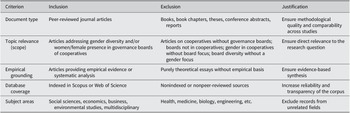
Study selection was guided by the PCC framework, which specifies the Population, Concept, and Context, following Peters et al. (Reference Peters, Godfrey, McInerney, Munn, Tricco, Khalil, Aromataris, Lockwood, Porritt, Pilla and Jordan2020). Population referred to the populations examined in the included studies: women and men serving as members of cooperative boards. Concept referred to descriptors used in the literature to address women’s presence on boards. Context encompassed cooperative enterprises across sectors and countries, understood as democratically controlled organizations in line with the International Cooperative Alliance definition (2015). Empirical studies reporting primary or secondary data, using quantitative, qualitative, or mixed methods, and published in peer-reviewed journals were eligible for inclusion. Table 3 shows the criteria of inclusion and exclusion, aligned with PCC framework and PRISMA-ScR.
Inclusion and exclusion criteria aligned with PCC framework and PRISMA-ScR
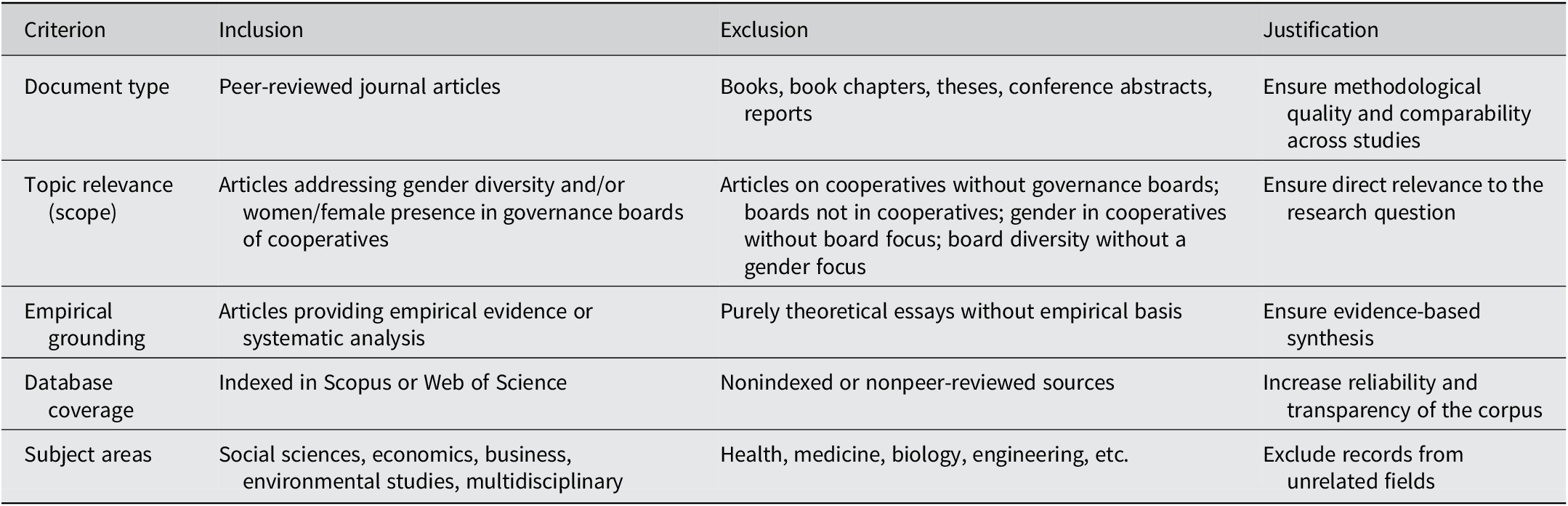
Table 3 Long description
The table has four columns labeled Criterion, Inclusion, Exclusion, and Justification. From top to bottom, the first row is Document type with Inclusion as Peer-reviewed journal articles, Exclusion as Books, book chapters, theses, conference abstracts, reports, and Justification as Ensure methodological quality and comparability across studies. The second row is Topic relevance (scope) with Inclusion as Articles addressing gender diversity and or women or female presence in governance boards of cooperatives, Exclusion as Articles on cooperatives without governance boards, boards not in cooperatives, gender in cooperatives without board focus, board diversity without a gender focus, and Justification as Ensure direct relevance to the research question. The third row is Empirical grounding with Inclusion as Articles providing empirical evidence or systematic analysis, Exclusion as Purely theoretical essays without empirical basis, and Justification as Ensure evidence-based synthesis. The fourth row is Database coverage with Inclusion as Indexed in Scopus or Web of Science, Exclusion as Nonindexed or nonpeer-reviewed sources, and Justification as Increase reliability and transparency of the corpus. The fifth row is Subject areas with Inclusion as Social sciences, economics, business, environmental studies, multidisciplinary, Exclusion as Health, medicine, biology, engineering, etc., and Justification as Exclude records from unrelated fields.
Search terms targeted three complementary dimensions: cooperatives, gender-related descriptors, and governance bodies. The final search strings used in each database were as follows:
-
Web of Science (Topic search): TS = (cooperative* AND (“gender diversity” OR women OR female*) AND (board* OR governance OR “board of directors”))
-
Scopus (Title/Abstract/Keywords): TITLE-ABS-KEY (cooperative* AND (“gender diversity” OR women OR female*) AND (board* OR governance OR “board of directors”))
The search strategy was developed iteratively through an exploratory identification of relevant descriptors, testing of Boolean combinations, and refinement of strings and filters in response to screening feedback. The overall approach was designed to be systematic and transparent, consistent with methodological guidance for scoping reviews (Peters et al., Reference Peters, Godfrey, McInerney, Munn, Tricco, Khalil, Aromataris, Lockwood, Porritt, Pilla and Jordan2020).
Results
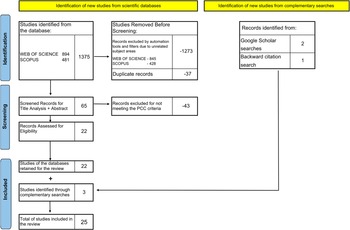
A total of 1375 records were identified through database searches: Web of Science (n = 894) and Scopus (n = 481). Prior to manual screening, automated subject-area filters excluded 1273 records (Web of Science n = 845; Scopus n = 428). For example, records indexed in Medicine/Health-related subject areas were excluded after a rapid inspection showed that “cooperative” was frequently used in clinical or behavioral meanings (e.g., patient cooperation) rather than to denote cooperative enterprises; subject-area restrictions were refined iteratively to reduce retrieval from clearly unrelated fields. Next, 37 duplicate records were removed, leaving 65 records for title and abstract screening. During title and abstract screening, 43 records were excluded for failing to meet the predefined PCC criteria. Common reasons for exclusion at this stage included: the term cooperative being used as a verb rather than to denote cooperative enterprises; studies addressing forms of diversity other than gender; articles that discussed gender but did not examine the Population of interest (i.e., current or prospective members of cooperative boards); and studies not focused on board composition or governance in cooperatives. Among these were papers that did not correspond exactly to scientific articles, such as conference abstracts, or that did not provide relevant information for the research. This resulted in 22 publications that met all eligibility criteria. In addition, complementary searches identified three additional eligible peer-reviewed journal articles not retrieved in the database search: Meira et al. (Reference Meira, Martinho and Castro2020) and Thapa (Reference Thapa2017), located through targeted Google Scholar searches, and Huang et al. (Reference Huang, Zazale, Othman, Aris and Ariff2015), identified through backward citation searching (cited by Meliá-Martí et al., Reference Meliá-Martí, Tormo-Carbó and Fernández-Guadaño2024). Cohen’s Kappa index (Cohen, Reference Cohen1960) reached a value of 0.935, indicating near-perfect agreement between reviewers. In total, 25 articles were included in the review: 22 retrieved directly from databases and 3 identified through complementary searches (Figure 1).
Prisma-ScR diagram.

Fig. 1. Long description
At the top, two yellow boxes indicate identification sources: scientific databases on the left and complementary searches on the right. Under scientific databases, a box lists studies identified: Web of Science 894, Scopus 481, total 1375. To the right, a box details studies removed before screening: 1273 excluded by automation tools and filters (Web of Science 845, Scopus 428), and 37 duplicate records. An arrow leads down to 65 screened records for title analysis and abstract. To the right, 43 records are excluded for not meeting the P C C criteria. Downward, 22 records are assessed for eligibility, all retained for review. At the bottom, a box shows 22 studies of the databases retained for review. To the right, complementary searches identify 2 from Google Scholar and 1 from backward citation search, totaling 3. These are added to the 22, resulting in 25 studies included in the review. The flowchart uses arrows to indicate the direction of screening, exclusion, and inclusion steps.
Descriptive results
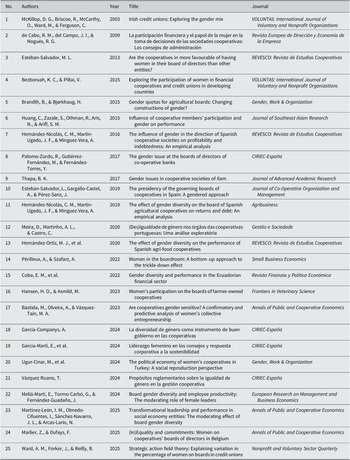
The selected articles are presented in Table 4.
Articles selected for the review
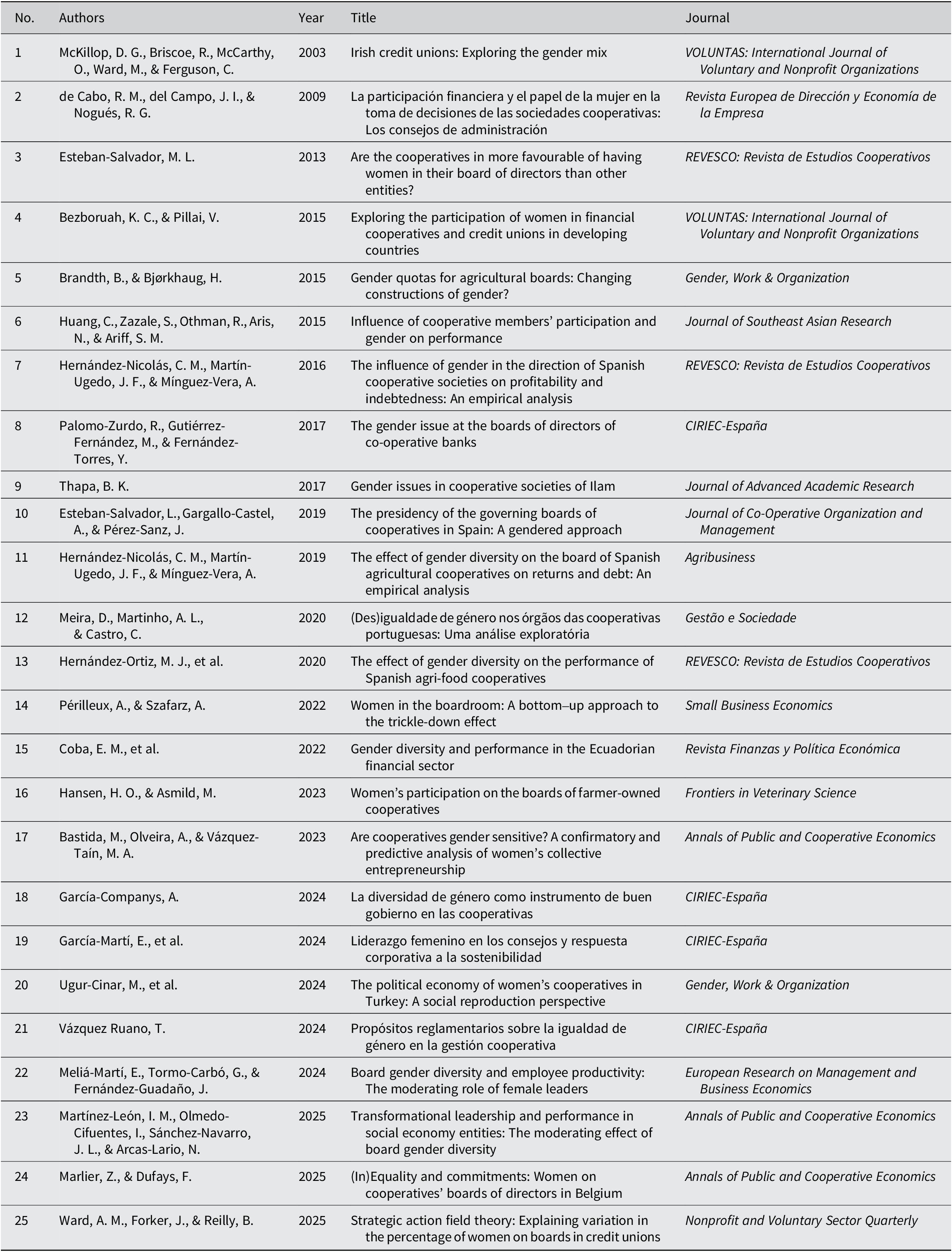
Table 4 Long description
This image was flagged as sensitive.
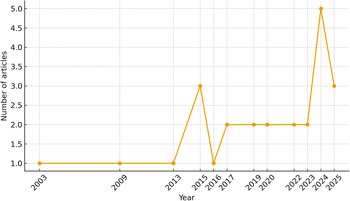
The annual distribution of the selected articles is presented in Figure 2, showing an increase in the years 2022 and 2025.
Articles per year.
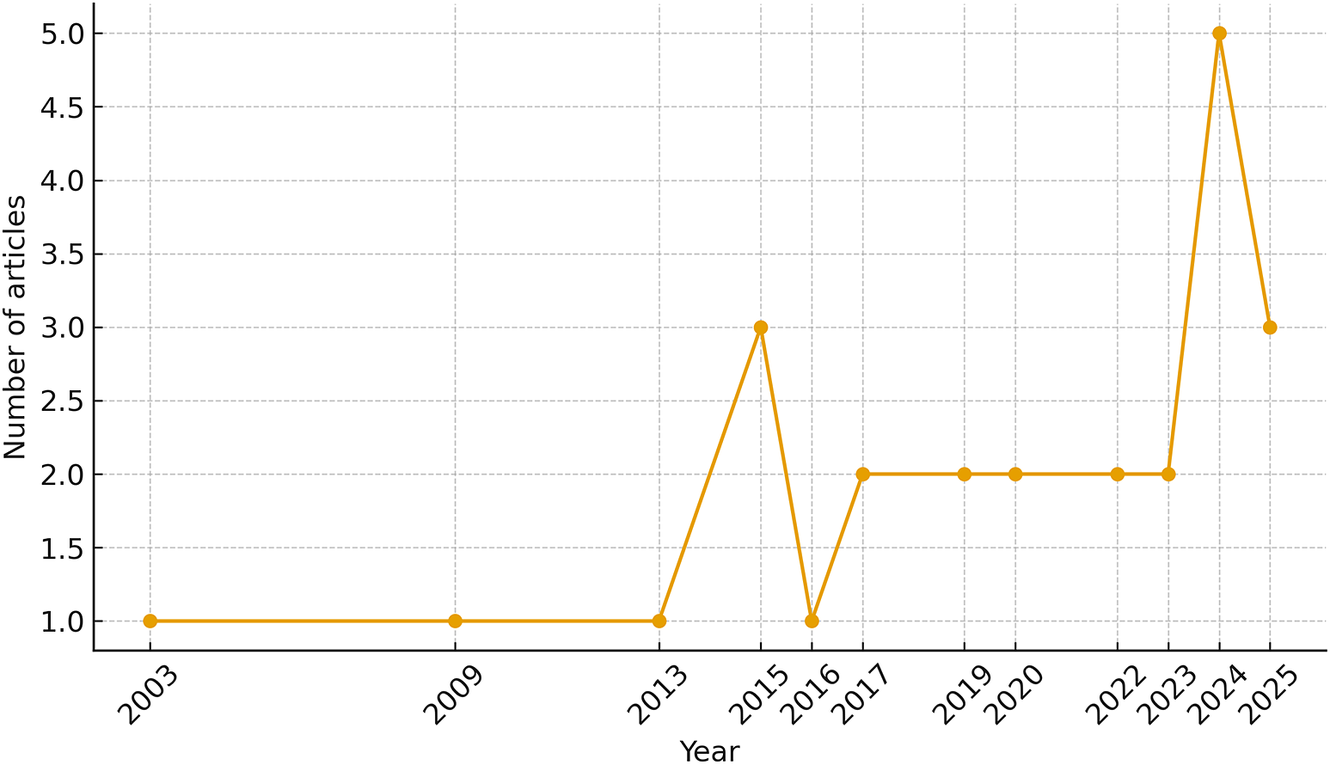
Fig. 2. Long description
The x-axis is labeled Year, ranging from 2003 to 2025. The y-axis is labeled Number of articles, ranging from 1 to 5. From 2003 to 2013, the count remains at 1. In 2015, the count jumps to 3, drops back to 1 in 2016, then rises to 2 in 2017 and stays at 2 through 2023. In 2024, the count spikes to 5, then falls to 3 in 2025. The line is orange with circular markers at each data point.
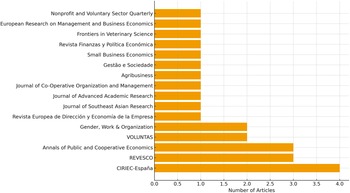
Figure 3 shows the journals with the highest number of publications, with CIRIEC-Spain having the most publications (n = 4, 16%), followed by Annals of Public and Cooperative Economics and REVESCO (n = 3, 12% each) and VOLUNTAS and Gender, Work & Organization (n = 2, 8% each).
Articles per journal.
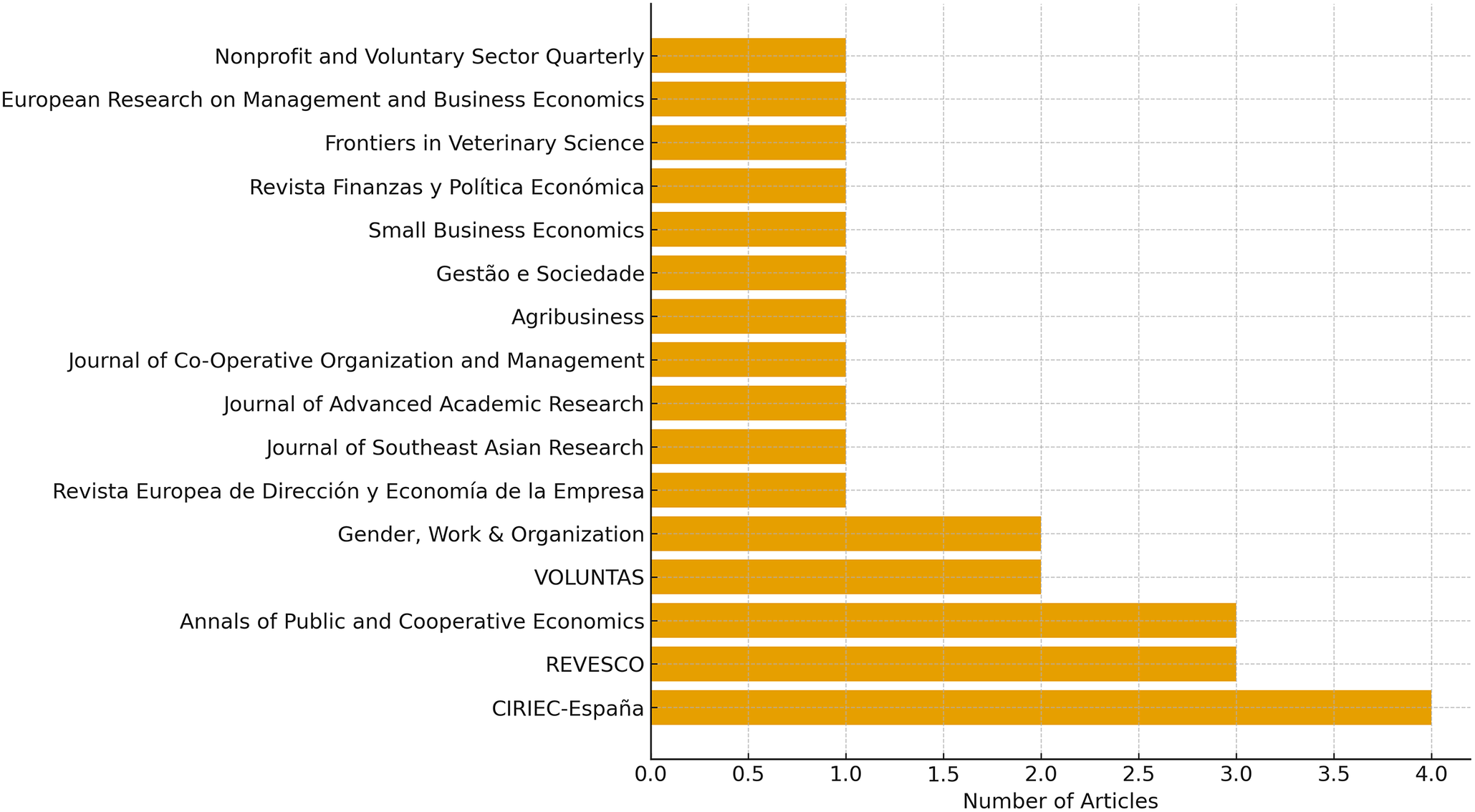
Fig. 3. Long description
The chart displays fifteen journals on the y-axis, ordered from top to bottom: Nonprofit and Voluntary Sector Quarterly, European Research on Management and Business Economics, Frontiers in Veterinary Science, Revista Finanzas y Política Económica, Small Business Economics, Gestão e Sociedade, Agribusiness, Journal of Co-Operative Organization and Management, Journal of Advanced Academic Research, Journal of Southeast Asian Research, Revista Europea de Dirección y Economía de la Empresa, Gender, Work & Organization, VOLUNTAS, Annals of Public and Cooperative Economics, REVESCO, and CIRIEC-España. The x-axis is labeled Number of Articles, ranging from 0.0 to 4.0. Most journals have bars extending to 1 or 2 articles. CIRIEC-España has the longest bar, reaching 4 articles. REVESCO and Annals of Public and Cooperative Economics each have 3 articles. VOLUNTAS and Gender, Work & Organization have 2 articles each. All other journals have 1 article. The bars are colored orange and aligned horizontally.
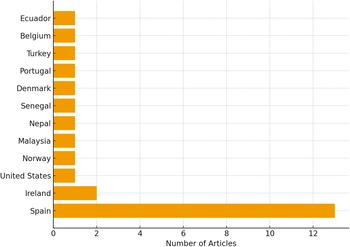
Figure 4 shows that Spain concentrates the majority of contributions (n = 13), followed by Ireland (n = 2). All other countries appear with a single published study each: United States, Norway, Malaysia, Nepal, Senegal, Denmark, Portugal, Turkey, Belgium, and Ecuador.
Articles per country.
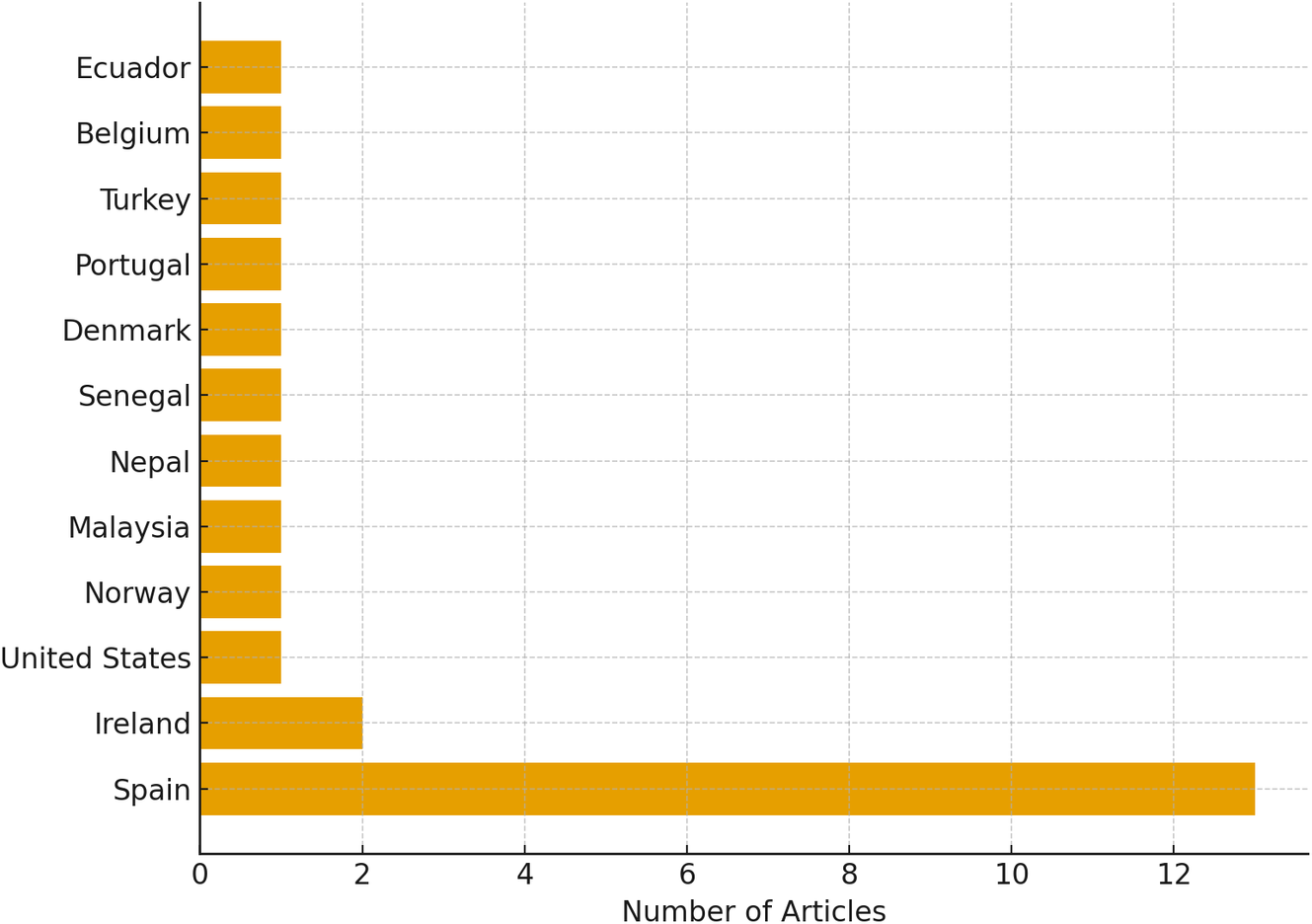
Fig. 4. Long description
The chart displays countries on the y-axis from top to bottom as follows: Ecuador, Belgium, Turkey, Portugal, Denmark, Senegal, Nepal, Malaysia, Norway, United States, Ireland, and Spain. The x-axis at the bottom is labeled Number of Articles and ranges from 0 to 14. Each country except Ireland and Spain has a bar extending to 1, indicating one article. Ireland's bar extends to 2. Spain's bar is the longest, extending to 13, indicating thirteen articles. The distribution shows a strong concentration in Spain, with all other countries contributing minimally.
As detailed in Table 1, the studies differ in cooperative type and methodological approach. Most focus on agricultural and agri-food cooperatives in Spain, while others examine credit unions and financial cooperatives, with fewer addressing multisectoral or service cooperatives. Methodologically, the sample includes quantitative designs such as econometric analyses of financial and governance indicators, qualitative studies including interviews, case studies, and document analysis, and a small number of mixed methods. This heterogeneity shows that research on gender diversity in cooperative boards remains fragmented, concentrated in certain sectors and regions, and underscores the need for broader comparative and cross-sectoral investigations.
Content analysis based on the Stone and Colella framework
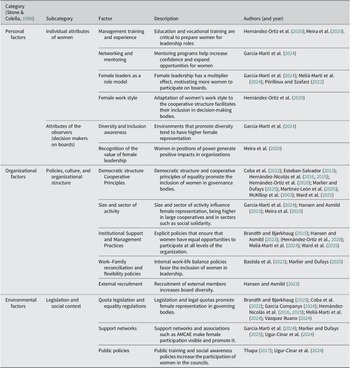
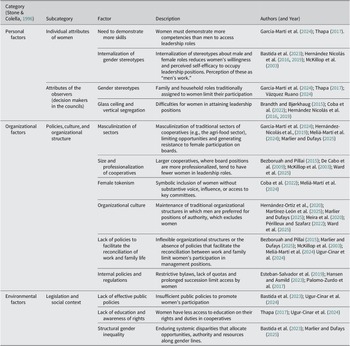
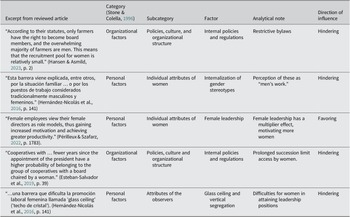
Building on Stone and Colella’s (Reference Stone and Colella1996) framework, the findings of the review were clustered into four thematic areas that mirror these multilevel influences. This analytical step allowed us to group the evidence in a way that reflects the interplay between personal, organizational, and environmental/legal factors, thereby providing a theoretically grounded rationale for the clustering (Tables 5 and 6). The evidence suggests that no single dimension accounts for women’s inclusion or exclusion; rather, mechanisms at multiple levels co-occur and reinforce one another. Illustrative excerpts from the reviewed articles, along with their respective coding, are provided in Table 7 to enhance transparency of the analytical procedure. These represent a selection of examples intended to illustrate the process, rather than an exhaustive account of all coded material.
Factors favoring gender diversity on cooperative boards of directors
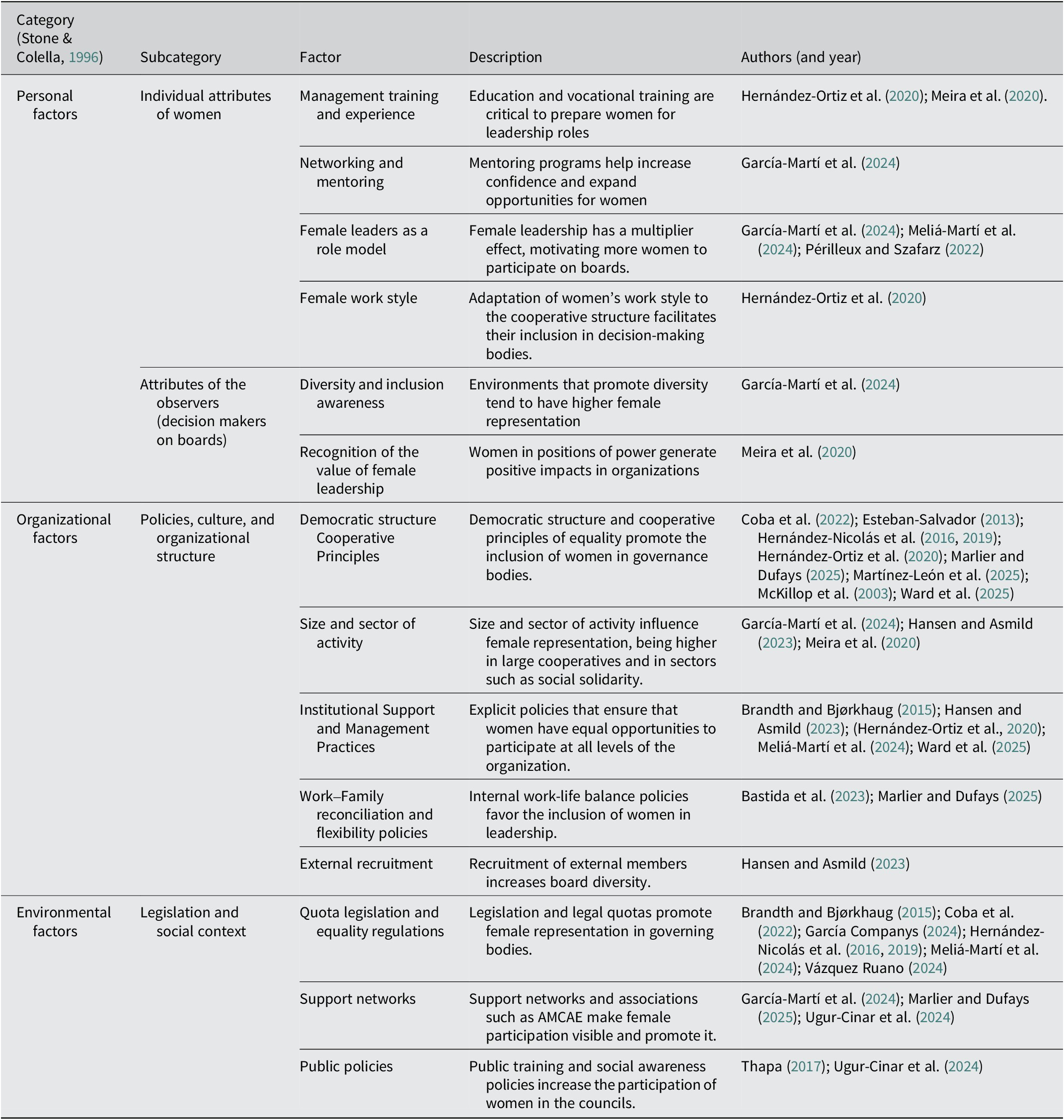
Table 5 Long description
From left to right, the table columns are: Category, Subcategory, Factor, Description, and Authors. The first main category is Personal factors, subdivided into individual attributes of women and attributes of observers. Under individual attributes, factors include management training and experience, networking and mentoring, female leaders as role models, and female work style, with descriptions such as the importance of education, mentoring programs, multiplier effects of female leadership, and adaptation of work style. Under attributes of observers, factors are diversity and inclusion awareness and recognition of the value of female leadership, described as environments promoting diversity and positive organizational impacts. The second main category is Organizational factors, with the subcategory policies, culture, and organizational structure. Factors listed are democratic structure and cooperative principles, size and sector of activity, institutional support and management practices, work–family reconciliation and flexibility policies, and external recruitment, with descriptions emphasizing equality, influence of size and sector, explicit equal opportunity policies, work-life balance, and increased diversity through external recruitment. The third main category is Environmental factors, with the subcategory legislation and social context. Factors are quota legislation and equality regulations, support networks, and public policies, described as legal quotas promoting representation, support networks making participation visible, and public training and awareness policies increasing participation. Each row includes specific author citations and publication years.
Factors hindering gender diversity on the cooperative boards of directors
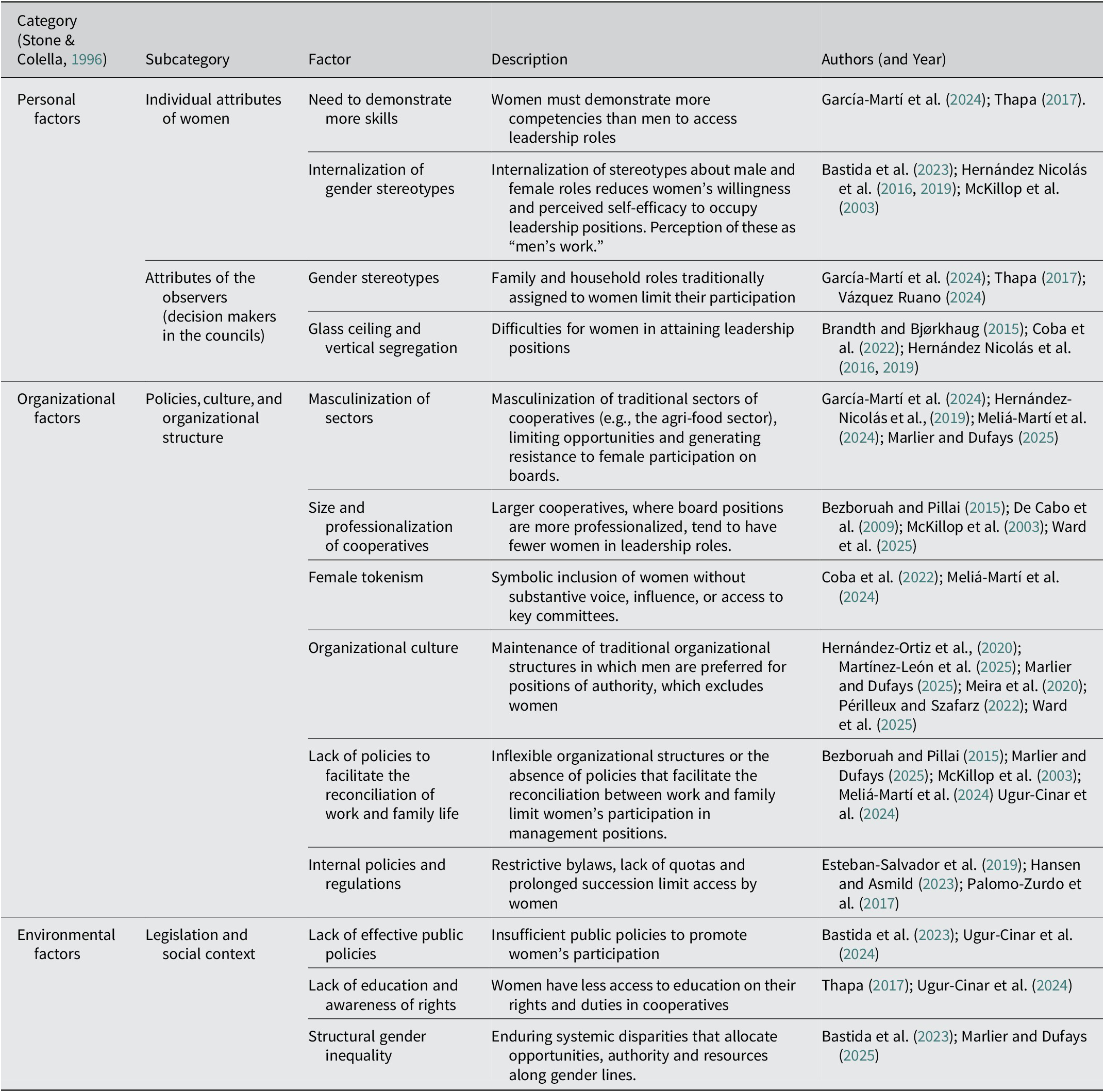
Table 6 Long description
From top to bottom, the table is divided into three main categories. The first section, Personal factors, includes two subcategories: Individual attributes of women and Attributes of the observers. Under Individual attributes, factors are ‘Need to demonstrate more skills’ with the description that women must show more competencies than men to access leadership roles, and ‘Internalization of gender stereotypes’ describing how internalized stereotypes reduce women's willingness and self-efficacy for leadership, with perceptions of these roles as men's work. Under Attributes of the observers, factors are ‘Gender stereotypes’ noting that traditional family and household roles assigned to women limit participation, and ‘Glass ceiling and vertical segregation’ describing difficulties for women in attaining leadership positions. The second section, Organizational factors, has one subcategory: Policies, culture, and organizational structure. Factors listed are ‘Masculinization of sectors’ (traditional sectors like agri-food limit opportunities and generate resistance to female participation), ‘Size and professionalization of cooperatives’ (larger, more professionalized cooperatives have fewer women leaders), ‘Female tokenism’ (symbolic inclusion without real influence), ‘Organizational culture’ (traditional structures favor men for authority), ‘Lack of policies to facilitate reconciliation of work and family life’ (inflexible structures or absence of supportive policies limit women's management participation), and ‘Internal policies and regulations’ (restrictive bylaws, lack of quotas, and prolonged succession limit women's access). The third section, Environmental factors, has the subcategory Legislation and social context. Factors are ‘Lack of effective public policies’ (insufficient policies to promote women's participation), ‘Lack of education and awareness of rights’ (women have less access to education about their rights and duties in cooperatives), and ‘Structural gender inequality’ (systemic disparities in opportunities, authority, and resources by gender). Each factor is accompanied by a detailed description and a list of cited authors and years.
Illustrative coding examples
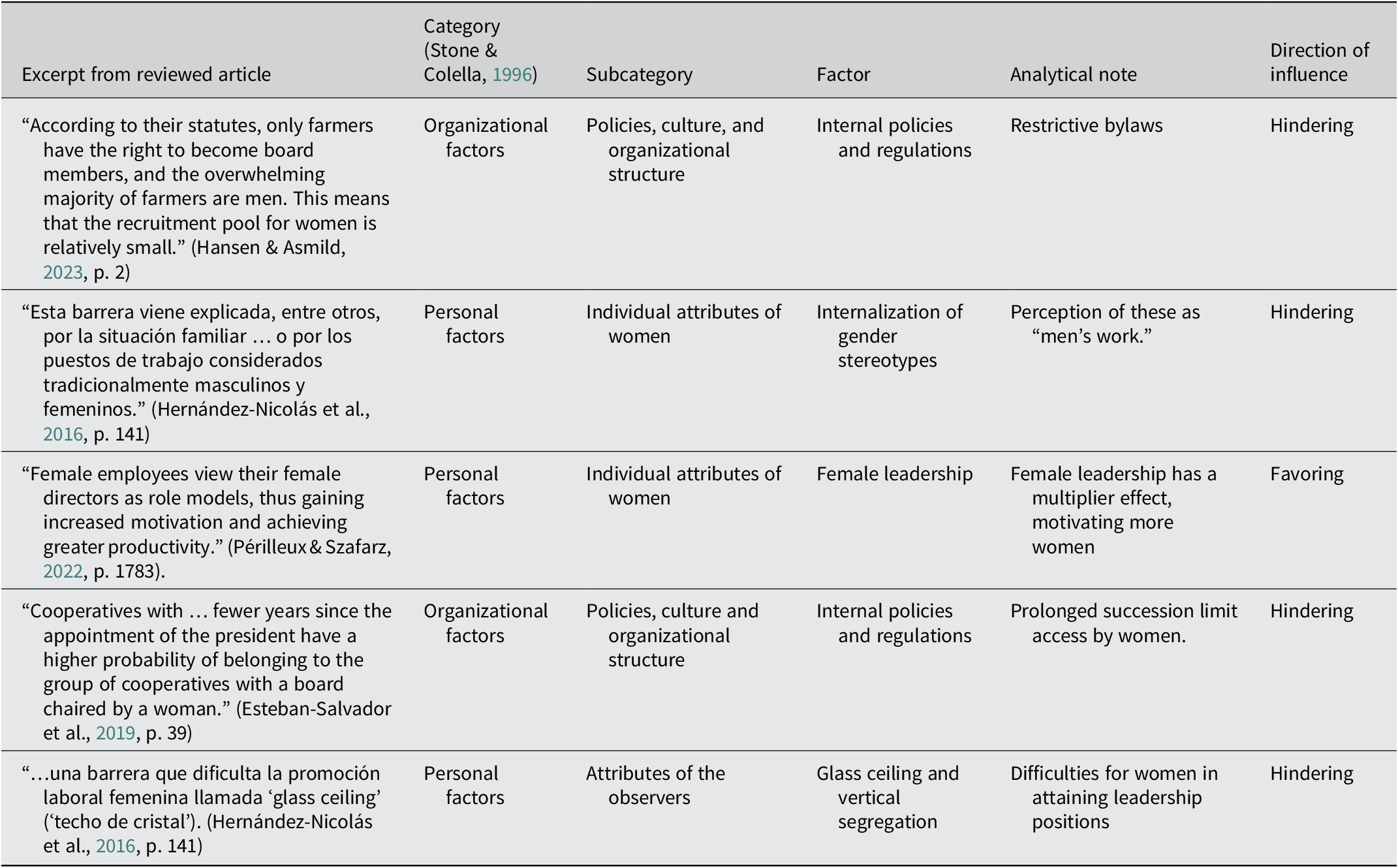
Table 7 Long description
The table has six columns: Excerpt from reviewed article, Category, Subcategory, Factor, Analytical note, and Direction of influence. Row 1: Excerpt discusses board membership limited to farmers, mostly men, restricting women's recruitment pool; Category is Organizational factors; Subcategory is Policies, culture, and organizational structure; Factor is Internal policies and regulations; Analytical note is Restrictive bylaws; Direction is Hindering. Row 2: Excerpt addresses barriers from family situation and gendered job roles; Category is Personal factors; Subcategory is Individual attributes of women; Factor is Internalization of gender stereotypes; Analytical note is Perception of these as ‘men’s work’; Direction is Hindering. Row 3: Excerpt notes female employees view female directors as role models, increasing motivation and productivity; Category is Personal factors; Subcategory is Individual attributes of women; Factor is Female leadership; Analytical note is Female leadership has a multiplier effect, motivating more women; Direction is Favoring. Row 4: Excerpt states cooperatives with fewer years since president appointment are likelier to have a woman chair; Category is Organizational factors; Subcategory is Policies, culture and organizational structure; Factor is Internal policies and regulations; Analytical note is Prolonged succession limits access by women; Direction is Hindering. Row 5: Excerpt refers to the ‘glass ceiling’ as a barrier to women's promotion; Category is Personal factors; Subcategory is Attributes of the observers; Factor is Glass ceiling and vertical segregation; Analytical note is Difficulties for women in attaining leadership positions; Direction is Hindering.
To illustrate, Hansen and Asmild (Reference Hansen and Asmild2023) describe how internal eligibility rules can restrict women’s entry into boards: “only farmers have the right to become board members, and the overwhelming majority of farmers are men,” resulting in a limited recruitment pool for women (p. 2). This excerpt was coded as an organizational factor (internal policies and regulations: restrictive bylaws) hindering women’s participation. In contrast, Périlleux and Szafarz (Reference Périlleux and Szafarz2022) highlight a multiplier effect of women’s leadership: “Female employees view their female directors as role models,” which can increase motivation and productivity (p. 1783). This excerpt was coded as a personal factor (individual attributes of women: female leadership) favoring women’s participation.
At the personal level, managerial training and experience (Hernández-Ortiz et al., Reference Hernández-Ortiz, García Martí, Martínez Jiménez, Pedrosa Ortega and Ruiz Jiménez2020; Meira et al., Reference Meira, Martinho and Castro2020), networking opportunities (García-Martí et al., Reference García-Martí, Hernández-Ortiz, Ruiz-Jiménez, Pedrosa-Ortega and Martínez-Jiménez2024) were frequently reported as enablers, while the need for women to demonstrate higher levels of competence than men (García-Martí et al., Reference García-Martí, Hernández-Ortiz, Ruiz-Jiménez, Pedrosa-Ortega and Martínez-Jiménez2024; Thapa, Reference Thapa2017) and the internalization of stereotypes (Hernández-Nicolás et al., Reference Hernández-Nicolás, Ugedo and Vera2016; McKillop et al., Reference McKillop, Briscoe, McCarthy, Ward and Ferguson2003) were recurrent barriers. These dual narratives illustrate how capacity-building initiatives coexist with persistent doubts about women’s legitimacy in leadership roles.
Among observers and decision makers, recognition of the value of women’s leadership (Meira et al., Reference Meira, Martinho and Castro2020) and awareness of diversity emerged as enablers (García-Martí et al., Reference García-Martí, Hernández-Ortiz, Ruiz-Jiménez, Pedrosa-Ortega and Martínez-Jiménez2024), whereas gendered expectations about family roles (García-Martí et al., Reference García-Martí, Hernández-Ortiz, Ruiz-Jiménez, Pedrosa-Ortega and Martínez-Jiménez2024; Thapa, Reference Thapa2017; Vázquez Ruano, Reference Vázquez Ruano2024), vertical segregation and the glass ceiling (Brandth & Bjørkhaug, Reference Brandth and Bjørkhaug2015; Coba et al., Reference Coba, Díaz- Córdova, Carrion-Gavilanes and Chango-Casanova2022; Hernández Nicolás et al., Reference Hernández-Nicolás, Ugedo and Vera2016) remained significant obstacles.
At the organizational level, democratic cooperative principles (Esteban-Salvador, Reference Esteban-Salvador2013; Hernández-Nicolás et al., Reference Hernández-Nicolás, Martín-Ugedo and Mínguez-Vera2019; McKillop et al., Reference McKillop, Briscoe, McCarthy, Ward and Ferguson2003; Ward et al., Reference Ward, Forker and Reilly2025), work–family reconciliation and flexibility policies (Bastida et al., Reference Bastida, Olveira and Vazquez Tain2023; Marlier & Dufays, Reference Marlier and Dufays2025) and recruitment practices shaping board composition (Hansen & Asmild, Reference Hansen and Asmild2023) were noted as facilitators. Barriers included the masculinization of certain sectors (García-Martí et al., Reference García-Martí, Hernández-Ortiz, Ruiz-Jiménez, Pedrosa-Ortega and Martínez-Jiménez2024; Meliá-Martí et al., Reference Meliá-Martí, Tormo-Carbó and Fernández-Guadaño2024), female tokenism—symbolic inclusion of women without substantive voice (Coba et al., Reference Coba, Díaz- Córdova, Carrion-Gavilanes and Chango-Casanova2022; Meliá-Martí et al., Reference Meliá-Martí, Tormo-Carbó and Fernández-Guadaño2024), restrictive bylaws, prolonged succession processes, and organizational cultures dominated by male norms (Esteban-Salvador et al., Reference Esteban-Salvador, Gargallo-Castel and Pérez-Sanz2019; Hansen & Asmild, Reference Hansen and Asmild2023; Palomo-Zurdo et al., Reference Palomo-Zurdo, Gutiérrez-Fernández and Fernández-Torres2017). Evidence regarding cooperative size and professionalization was contradictory: while some studies linked larger and more professionalized cooperatives with greater female representation (García-Martí et al., Reference García-Martí, Hernández-Ortiz, Ruiz-Jiménez, Pedrosa-Ortega and Martínez-Jiménez2024; Hansen & Asmild, Reference Hansen and Asmild2023; Meira et al., Reference Meira, Martinho and Castro2020), others found larger cooperatives associated with fewer women in governance (Bezboruah & Pillai, Reference Bezboruah and Pillai2015; De Cabo et al., Reference de Cabo, del Campo and Nogués2009; McKillop et al., Reference McKillop, Briscoe, McCarthy, Ward and Ferguson2003; Ward et al., Reference Ward, Forker and Reilly2025).
At the environmental/legal level, quota legislation (Brandth & Bjørkhaug, Reference Brandth and Bjørkhaug2015; Coba et al., Reference Coba, Díaz- Córdova, Carrion-Gavilanes and Chango-Casanova2022; García Companys, 2024; Vázquez Ruano, Reference Vázquez Ruano2024), support networks (García-Martí et al., Reference García-Martí, Hernández-Ortiz, Ruiz-Jiménez, Pedrosa-Ortega and Martínez-Jiménez2024; Marlier & Dufays, Reference Marlier and Dufays2025; Ugur-Cinar et al., Reference Ugur-Cinar, Cinar, Onculer-Yayalar and Akyuz2024), and public training initiatives (Thapa, Reference Thapa2017; Ugur-Cinar et al., Reference Ugur-Cinar, Cinar, Onculer-Yayalar and Akyuz2024) were seen as enablers. Conversely, the absence or weak enforcement of public policies (Bastida et al., Reference Bastida, Olveira and Vazquez Tain2023; Ugur-Cinar et al., Reference Ugur-Cinar, Cinar, Onculer-Yayalar and Akyuz2024), the limited awareness of women’s rights within cooperatives (Thapa, Reference Thapa2017; Ugur-Cinar et al., Reference Ugur-Cinar, Cinar, Onculer-Yayalar and Akyuz2024) and structural gender inequality (Bastida et al., Reference Bastida, Olveira and Vazquez Tain2023; Marlier & Dufays, Reference Marlier and Dufays2025) constrained participation.
These findings are further elaborated in the Discussion, where we consider how multilevel dynamics interact and how cooperatives compare with other organizational forms.
Discussion
This study categorized factors that favor or hinder gender diversity on cooperative boards, using Stone and Colella’s (Reference Stone and Colella1996) model as reference. The results not only expand existing knowledge by incorporating cooperative perspectives but also reveal a paradox. Although cooperatives are grounded in democracy and equity, women still face barriers to full participation. This ambiguity places cooperatives in an intermediate position within the nonprofit sector, expected to model inclusion yet often reproducing exclusion found elsewhere.
In terms of personal factors, management training, mentoring networks, and collaborative leadership style are determining aspects that favor female inclusion on boards of directors (García-Martí et al., Reference García-Martí, Hernández-Ortiz, Ruiz-Jiménez, Pedrosa-Ortega and Martínez-Jiménez2024; Hernández-Nicolás et al., Reference Hernández-Nicolás, Ugedo and Vera2016; Meira et al., Reference Meira, Martinho and Castro2020). Brandth and Bjørkhaug (Reference Brandth and Bjørkhaug2015) and García-Martí et al. (Reference García-Martí, Hernández-Ortiz, Ruiz-Jiménez, Pedrosa-Ortega and Martínez-Jiménez2024) also emphasize the importance of training and mentoring programs to strengthen women’s self-confidence and expand their opportunities for access to governance. However, critical scholarship warns against framing such initiatives as sufficient solutions. Ely and Meyerson (Reference Ely, Meyerson, Staw and Sutton2000) describe this orientation as the “fix-the-women” approach, in which organizational change efforts focus on adapting women to existing structures rather than transforming those structures. This perspective converges with Acker’s (Reference Acker1990) influential formulation that organizational structures are not gender neutral and that gender is an integral part of organizational processes. Together, these contributions caution against approaches that place the burden of change on women alone, instead of addressing the organizational practices and cultural norms that sustain inequality.
However, significant personal barriers persist related to women’s need to demonstrate superior skills to their male peers and the existence of self-stereotypes that limit their motivation (Hernández-Nicolás et al., Reference Hernández-Nicolás, Ugedo and Vera2016, Reference Hernández-Nicolás, Martín-Ugedo and Mínguez-Vera2019; McKillop et al., Reference McKillop, Briscoe, McCarthy, Ward and Ferguson2003). Along these lines, research by Koenig et al. (Reference Koenig, Eagly, Mitchell and Ristikari2011) argues that male leadership stereotypes prevail in corporate contexts and significantly limit female participation. As Piatak et al. (Reference Piatak, Miller and Holt2022) point out, female leaders in nonprofit and government sectors often face lower perceived legitimacy, especially in environments lacking clear institutional rules, highlighting the influence of implicit bias on organizational behavior. These findings show how patterns of perception affect access to decision making, creating organizational challenges for equity in recognition and promotion. They also raise questions about justice and fairness, as discussed by Greenwood (Reference Greenwood2002), who emphasizes that genuine stakeholder inclusion requires not only structural access but also meaningful voice and agency. In contexts where women must overperform to gain access to leadership, organizations risk violating the moral principle of procedural justice.
Regarding the attributes of observers, the study shows that awareness and explicit recognition of the value of female leadership are fundamental to increase diversity on boards (García-Martí et al., Reference García-Martí, Hernández-Ortiz, Ruiz-Jiménez, Pedrosa-Ortega and Martínez-Jiménez2024; Meira et al., Reference Meira, Martinho and Castro2020). This finding reinforces the argument put forward by Ridgeway (Reference Ridgeway2001), who points out how perceptions about gender in positions of authority are deeply rooted in social structures that must be transformed at the cognitive and affective levels to achieve effective change. García-Martí et al. (Reference García-Martí, Hernández-Ortiz, Ruiz-Jiménez, Pedrosa-Ortega and Martínez-Jiménez2024) and Vázquez Ruano (Reference Vázquez Ruano2024) suggest that cognitive biases, such as gender stereotypes, negatively condition selection and promotion decisions, thus limiting the potential for female inclusion in leadership positions. This dynamic illustrates what Schwartz (Reference Schwartz2005) defines as a moral silence within organizations, the failure to challenge structural norms that perpetuate inequality even when they conflict with the organization’s stated ethical values. Similar gatekeeping effects have been documented in corporate governance, yet cooperatives, due to their explicit democratic ethos, carry an added responsibility to counteract such biases (Camargo Benavides & Ehrenhard, Reference Camargo Benavides and Ehrenhard2021).
Regarding organizational factors, the democratic and participatory structure of cooperatives is highlighted as a facilitating mechanism, consistent with the research of Hernández-Ortiz et al. (Reference Hernández-Ortiz, García Martí, Martínez Jiménez, Pedrosa Ortega and Ruiz Jiménez2020), Marlier and Dufays (Reference Marlier and Dufays2025), Martínez-León et al. (Reference Martínez-León, Olmedo-Cifuentes, Sánchez-Navarro and Arcas-Lario2025) and Ward et al. (Reference Ward, Forker and Reilly2025). However, Holgersson and Hvenmark (Reference Holgersson and Hvenmark2023) emphasize that even participatory organizations often reproduce gendered power dynamics through informal norms and cultural expectations, calling for a deeper interrogation of how gender operates structurally in nonprofit governance. This research also identified the persistence of traditionally masculinized organizational practices, which hinder effective female inclusion (Hernández-Nicolás et al., Reference Hernández-Nicolás, Martín-Ugedo and Mínguez-Vera2019; Meliá-Martí et al., Reference Meliá-Martí, Tormo-Carbó and Fernández-Guadaño2024). This duality has also been observed in publicly traded companies, where organizational culture and management practices play a critical role in the representation of women in senior positions (Adams & Ferreira, Reference Adams and Ferreira2009; Campbell & Mínguez-Vera, Reference Campbell and Mínguez-Vera2008). Likewise, it was evidenced that work-life balance continues to be a significant organizational constraint (Bastida et al., Reference Bastida, Olveira and Vazquez Tain2023; Marlier & Dufays, Reference Marlier and Dufays2025), which is consistent with results obtained in corporate contexts (Mensi-Klarbach & Seierstad, Reference Mensi-Klarbach and Seierstad2020). Examples discussed in the literature include flexible meeting schedules, parental leave policies accessible to both men and women, and mechanisms for childcare support (Hansen & Asmild, Reference Hansen and Asmild2023). Yet these remain unevenly implemented, highlighting the gap between formal principles and actual practices. These results reinforce the importance of observing possible tensions between the formal governance structure and the informal dynamics that shape organizational culture. As Benito-Esteban et al. (Reference Benito-Esteban, Elvira-Lorilla, Garcia-Rodriguez and Romero-Merino2024) demonstrate, gender-diverse boards can contribute, alongside other governance factors, to configurations associated with higher levels of web transparency and accountability, suggesting that gender inclusion plays a role not only in internal dynamics but also in external perceptions of legitimacy.
Finally, in the environmental dimension, legislation and public policies such as gender quotas and specific regulations proved to be effective instruments to facilitate female representation on cooperative boards (Coba et al., Reference Coba, Díaz- Córdova, Carrion-Gavilanes and Chango-Casanova2022; García Companys, 2024; Meliá-Martí et al., Reference Meliá-Martí, Tormo-Carbó and Fernández-Guadaño2024; Vázquez Ruano, Reference Vázquez Ruano2024), a finding congruent with studies conducted in publicly traded companies (Labelle et al., Reference Labelle, Francoeur and Lakhal2015; Mensi-Klarbach & Seierstad, Reference Mensi-Klarbach and Seierstad2020). However, the effectiveness of these policies depends largely on the sociocultural context and institutional support provided through specialized networks and associations (García-Martí et al., Reference García-Martí, Hernández-Ortiz, Ruiz-Jiménez, Pedrosa-Ortega and Martínez-Jiménez2024; Ugur-Cinar et al., Reference Ugur-Cinar, Cinar, Onculer-Yayalar and Akyuz2024). This aspect reinforces the thesis of Inglehart and Norris (Reference Inglehart and Norris2003), who argue that gender equality in decision-making structures does not depend solely on legislative changes, but also on profound transformations in culture and social norms. Ortega-Rodríguez et al. (Reference Ortega-Rodríguez, López-Arceiz and Bellostas2023) add that board diversity, including gender, is positively correlated with stronger governance mechanisms and better alignment with stakeholder interests, reinforcing the ethical and instrumental value of inclusive leadership. Other studies also point to the lack of education and awareness of rights as a barrier to women’s participation in cooperatives, limiting their ability to claim leadership opportunities (Thapa, Reference Thapa2017; Ugur-Cinar et al., Reference Ugur-Cinar, Cinar, Onculer-Yayalar and Akyuz2024). Taken together, these findings resonate with critical contributions in organizational theory. Ely and Meyerson (Reference Ely, Meyerson, Staw and Sutton2000) caution against strategies that adapt women to existing structures rather than transforming them, while Acker (Reference Acker1990) demonstrates how organizational processes themselves are gendered and reproduce exclusion. More recently, Stivers et al. (Reference Stivers, Pandey, DeHart-Davis, Hall, Newcomer, Portillo, Sabharwal, Strader and Wright2023) have advanced the JEDI framework, highlighting the need to frame gender diversity not only as a question of representation or equity but as a broader matter of justice and legitimacy. These perspectives offer a critical lens to understanding persistent barriers in cooperative governance.
One limitation of this study is the absence of an intersectional analysis of gender diversity on cooperative boards. Although barriers and facilitators of female inclusion were examined, the lack of attention to race, class, age, disability, or sexual orientation is both methodological and ethical. Neglecting these dimensions risks reproducing a one-dimensional gender narrative that excludes the most vulnerable women in cooperative governance.
In the context of cooperatives, Camargo Benavides and Ehrenhard (Reference Camargo Benavides and Ehrenhard2021) argue that though these enterprises are often idealized as democratic and inclusive, research has given limited attention to how these ideals are implemented in practice. Their findings emphasize the need for further empirical investigation into governance dynamics and representation patterns within cooperative structures. Future research should compare cooperatives with other nonprofit or hybrid organizations, examine intersectional dimensions such as race, class, and age, and assess whether legal reforms create lasting cultural change or only short-term compliance. Another avenue is qualitative studies with women and men in cooperatives to capture perceptions of factors that facilitate or hinder gender inclusion in governance. As Stivers et al. (Reference Stivers, Pandey, DeHart-Davis, Hall, Newcomer, Portillo, Sabharwal, Strader and Wright2023) argue, nonprofit scholarships must also move beyond equity to explicitly address justice as a core dimension of diversity and inclusion. Positioning cooperatives within this JEDI framework underscores both their promise and their responsibility to deliver on the values they claim to embody.
Theoretical and practical implications
The results obtained in this research offer implications from both a theoretical and practical perspective, supported by previous studies that enrich its rationale. From a theoretical point of view, this study extends the model originally proposed by Stone and Colella (Reference Stone and Colella1996), applying it to the analysis of gender diversity in cooperative boards. The adaptation demonstrates how personal, observer, organizational, and environmental–legal factors jointly influence women’s opportunities for access and permanence in governance. By sitting these domains within cooperatives view, the study provides a contextualized reading of the framework. This theoretical contribution responds to calls in nonprofit scholarship to strengthen research on cooperatives, a field often overlooked despite its relevance as a hybrid organizational form (Camargo Benavides & Ehrenhard, Reference Camargo Benavides and Ehrenhard2021). Cooperative’s identity, grounded in equality, open membership, and members’ democratic control (ICA, 2015), create strong theoretical expectations: if any organizational form should provide equitable access to leadership for women, it is the cooperative model.
However, this scoping review shows empirical evidence that challenges this assumption. Although cooperatives explicitly commit to equality and democratic governance, empirical evidence shows that structural gender barriers persist, including limited access to decision making, invisibilization of care labor, and masculinized leadership norms (Genta, Reference Genta2021). If women face such constraints even within organizations designed to ensure democratic participation and equality, it is plausible that similar or more intense barriers operate in other organizational forms with weaker normative commitments to inclusion (Genta, Reference Genta2021). These findings contributes to theoretical refinement by exposing the limits of participatory governance as a guarantee of gender inclusion. Equitable civil society governance depends not only on values but also on systematic disruption of gendered norms embedded in organizational routines and collective expectations.
From a practical perspective, the findings suggest the need to implement specific measures to promote gender diversity in cooperatives. For example, mentoring programs, a proposal aligned with the results of García-Martí et al. (Reference García-Martí, Hernández-Ortiz, Ruiz-Jiménez, Pedrosa-Ortega and Martínez-Jiménez2024) and Terjesen et al. (Reference Terjesen, Sealy and Singh2009), and discussed by Brandth and Bjørkhaug (Reference Brandth and Bjørkhaug2015), could significantly reduce entry barriers and facilitate the development of women’s managerial skills. Likewise, training in female leadership is supported by studies by Adams and Ferreira (Reference Adams and Ferreira2009) and Eagly (Reference Eagly2007), who point out that the female collaborative style improves governance and contributes to better performance. At the same time, critical scholarship warns against relying exclusively on training or mentoring, since this can reproduce a “fix the women” logic. More durable change requires modifying organizational structures and routines (Acker, Reference Acker1990; Ely & Meyerson, Reference Ely, Meyerson, Staw and Sutton2000).
In terms of institutional design, internal policies must integrate inclusion criteria transversally, specifically throughout selection, promotion, and evaluation phases. Notable mechanisms include transparent nomination protocols, balanced shortlists, and practices for reconciling work and family life that bolster women’s access to senior positions. These measures may encompass meeting schedules compatible with family needs, remote work options, parental leave, and childcare support, as evidenced by comparative studies (Mensi-Klarbach & Seierstad, Reference Mensi-Klarbach and Seierstad2020). Finally, aiming for congruence between cooperative principles and organizational outcomes, it is imperative to institutionalize gender mainstreaming within statutes and governance routines via gender equality commissions, affirmative action mechanisms, and protocols prohibiting harassment (Genta, Reference Genta2021).
Likewise, awareness raising and training for observers (decision makers in cooperatives) regarding gender diversity is critical, considering that these actors determine internal policies and practices. This implication is consistent with Koenig et al. (Reference Koenig, Eagly, Mitchell and Ristikari2011) and Ridgeway (Reference Ridgeway2001), who highlight how stereotypes and cognitive biases embedded in organizational structures limit female participation in managerial roles. Evidence suggests that gender diversity, together with other board attributes, is part of the governance configurations associated with higher levels of web transparency within nonprofits (Benito-Esteban et al., Reference Benito-Esteban, Elvira-Lorilla, Garcia-Rodriguez and Romero-Merino2024), while broader governance mechanisms such as codes of ethics, oversight structures, and internal accountability practices play a key role in reinforcing organizational legitimacy (Ortega-Rodríguez et al., Reference Ortega-Rodríguez, López-Arceiz and Bellostas2023).
These actions can strengthen the coherence between the values declared by cooperatives and their practices. Promoting gender diversity can increase organizational legitimacy, strengthen member confidence, and improve the public perception of cooperatives. At the organizational level, it is essential to promote an inclusive culture and internal policies that facilitate work–family reconciliation. The effectiveness of these measures has been widely validated by studies in corporate contexts (Mensi-Klarbach & Seierstad, Reference Mensi-Klarbach and Seierstad2020).
Finally, in the environmental dimension, this research showed the relevance of public policies and legislative quotas as effective strategies to improve female representation in managerial spaces, corroborated by studies such as Labelle et al. (Reference Labelle, Francoeur and Lakhal2015) and Moxom et al. (Reference Moxom and Romenteaun.d.). Their effectiveness increases when combined with sectoral networks and awareness initiatives (García-Martí et al., Reference García-Martí, Hernández-Ortiz, Ruiz-Jiménez, Pedrosa-Ortega and Martínez-Jiménez2024; Inglehart & Norris, Reference Inglehart and Norris2003; Ugur-Cinar et al., Reference Ugur-Cinar, Cinar, Onculer-Yayalar and Akyuz2024). Taken together, organizational reforms, observer-level change, and enabling regulation are mutually reinforcing and more promising than isolated measures.
Conclusion
This study provides a comprehensive perspective on the factors influencing gender diversity on cooperative boards, identifying enablers and persistent obstacles. At the individual level, the relevance of women’s prior performance, leadership skills, and interpersonal style is highlighted, while at the organizational level, cooperative governance structures, inclusive hiring practices, flexible work arrangements, and mentoring programs emerge as key factors. However, environmental influences, such as gender quotas, entrenched stereotypes, and the masculinization of the sector, continue to significantly limit equity, evidencing the persistence of the “glass ceiling.” The factors identified interact across multiple levels rather than operating in isolation, influencing the trajectories of women’s access to and permanence in decision-making spaces.
Cooperatives, by virtue of their democratic and participatory nature, are often described as organizational forms uniquely positioned to advance more inclusive and equitable governance (ICA, 2015; ILO, 2015). At the same time, research highlights that this potential remains underexplored in nonprofit scholarship and requires more critical examination of how democratic principles translate into practice (Camargo Benavides & Ehrenhard, Reference Camargo Benavides and Ehrenhard2021). The findings of this article suggest that strategies such as inclusive recruitment, flexible practices, and mentoring programs can strengthen women’s participation and retention on board. These strategies can be coherently integrated with cooperative values and principles, advancing both effectiveness and equity goals. In addition, the inclusion of women in governance not only responds to ethical and legal principles, but also represents an essential tool to enhance transparency, sustainability, and organizational resilience, in line with the Sustainable Development Goals, particularly SDG 5 on gender equality, SDG 10 on reduced inequalities, and SDG 16 on strong institutions.
In this sense, gender diversity can be interpreted as a structural component of organizational legitimacy. Yet the evidence also highlights tensions between cooperative principles and actual practices, revealing that a democratic ethos does not automatically translate into gender parity. Without sustained structural and cultural change, cooperatives risk reproducing the same inequalities observed in traditional firms.
This study brings originality by integrating recent empirical data with Stone and Colella’s (Reference Stone and Colella1996) theoretical model, providing an enriched conceptual framework that encompasses the multiple dynamics affecting gender diversity in cooperative governance. It also contributes to filling a gap in nonprofit research, where cooperatives remain underexplored despite their democratic ethos (Camargo Benavides & Ehrenhard, Reference Camargo Benavides and Ehrenhard2021).
Ultimately, gender diversity on cooperative boards cannot be reduced to a numerical target or a matter of legal compliance. It must be examined as a structural issue of fairness and legitimacy, requiring sustained organizational and cultural change rather than reliance on individual remediation (Acker, Reference Acker1990; Ely & Meyerson, Reference Ely, Meyerson, Staw and Sutton2000). Positioning gender equity within justice, equity, diversity, and inclusion debates underscores both the promise of cooperatives and their responsibility to uphold the values they espouse (Stivers et al., Reference Stivers, Pandey, DeHart-Davis, Hall, Newcomer, Portillo, Sabharwal, Strader and Wright2023). Aligning governance practices with SDGs 5, 10, and 16 moves inclusion from principles to a concrete operational reality. In this sense, cooperatives can only fulfill their democratic mission by ensuring that women’s participation in governance is not symbolic, but substantive, sustained, and transformative.
Supplementary Material
The supplementary material for this article can be found at http://doi.org/10.1017/S0957876526000100.
Funding statement
The study was supported by the Coordination of Superior Level Staff Improvement (CAPES)—Brazil (PDSE—Institutional Doctoral Degree Program Abroad; Grant/Process No. 88881.934193/2024-01).
Competing interests
The authors declare no conflict of interest.
Ethical standard
This research project was approved by the Research Ethics Committee (Comitê de Ética em Pesquisa—CEP) of the Pontifical Catholic University of Paraná (PUCPR), under Approval Number 6.772.108 (CAAE: 78379924.2.0000.0020), on April 17, 2024.
Research involving human participants and/or animals
This research did not involve any studies with human participants or animals performed by any of the authors.
Informed consent
Not applicable, as this study is based on a systematic review of publicly available literature and does not involve human participants.
AI assistance disclosure
Generative AI (ChatGPT, OpenAI) was used for language editing and stylistic revisions only. No AI tools were used to generate data, perform analyses, or produce results. The authors take full responsibility for the content of the manuscript.




 Open access

