

Introduction
The importance of recovery-focused care planning in mental health care in Ireland has been outlined in a series of health policy documents published over the past 18 years by the Department of Health (2006, 2020), the Health Service Executive (2021) and the Mental Health Commission (2012, 2024). The recovery literature highlights the nurturing of hope, facilitation of a meaningful life, fostering self-determination and development of supportive relationships and individual flourishing as key components of recovery-focused services (Onken et al. Reference Onken, Craig, Ridgway, Ralph and Cook2007, Cullen & McDaid, Reference Cullen and McDaid2017, Ellison et al. Reference Ellison, Belanger, Niles, Evans and Bauer2018, Mental Health Engagement and Recovery Office, 2024, Swords & Houston, Reference Swords and Houston2024). Service users [SUs] should be actively supported in making personal choices, acknowledged as decision makers and respected in their ability to solve personal problems (Kartalova-O’Doherty & Tedstone Doherty, Reference Kartalova-O’Doherty and Tedstone Doherty2010; McCloughen et al. Reference McCloughen, Gilles and O’Brien2011, Dell et al. Reference Dell, Long and Mancini2021). It is imperative therefore, that the care planning process should harness the expertise of SUs and where appropriate, family members as well as of mental health professionals (MHPs) (Department of Health 2020). The Quality Framework published by the Mental Health Commission outlines explicit criteria against which the quality of recovery-focused care planning can be measured, and this is now mandatory in inpatient care settings (Farrelly et al. Reference Farrelly, Kiernan, Finnerty, Stepala, Costigan, Chrzanowska, Carney and Mahon2023). However, translating recovery principles into an effective model of practice in community mental health care remains challenging. This creates tension as community orientated services, in terms of location and philosophy, have been consistently advocated within modern mental health services both nationally and internationally (Department of Health 2020, World Health Organisation, 2021a). Moreover, conceptualisations of recovery focus on personal and social recovery which are sometimes at odds with services that are historically tied to a biomedical and paternalistic narrative (Norton & Swords, Reference Norton and Swords2021). A narrative review on this topic identified the main challenges as being the empowerment of the SU in the process, the integration of care provided by the multidisciplinary team (MDT) and the need for shared responsibility within the MDT for decision making and leadership (McHugh & Byrne, Reference McHugh and Byrne2014). Success in meeting these challenges requires a flexible, person-centred and collaborative care system that puts the SU fundamentally in charge of their care plan and prioritises their goals and aspirations (Department of Health 2020). To date, there has been no consensus as to a model of care that best meets these requirements in the community setting.
The Collaborative Care Pathway (CCP-9) is based on recovery principles and integrates care planning as a pivotal step in a complete pathway of care from referral through to discharge to primary care services. The nine [9] in the acronym refers to the nine steps involved in the CCP process and specific details are outlined in another paper (Gibbons et al., Reference Gibbons, Higgins, Doyle, Gelderen, Duggan, Jackson, Matthews, Daly and Keoghin press) and are not repeated here. In summary, it strives for collaborative engagement with SUs and their FMs, focusing on shared decision making, identification of personal needs and goals set against a detailed psychosocial assessment. This model of care has been in operation in one sector of the Health Services Executive for more than 10 years, initially piloted in one community mental health team (CMHT) and subsequently rolled out to 2 further CMHTs in the same sector service. This service serves a largely suburban population, currently standing at 85,000 people, and has low indices of social deprivation. While the CCP-9 has been in operation for over a decade with anecdotal support from SUs and MHPs, there was a keen desire to evaluate satisfaction more formally, introduce improvements where necessary and disseminate our experiences to other mental health services. Hence an evaluation was carried out by a team of independent researchers, which was supported by an advisory group that included SU and family representation as well as MHPs in clinical practice.
Aim
To evaluate the satisfaction of SUs’, FMs’ and MHPs with the operation of the CCP-9 in a community mental health service, with particular focus on the quality-of-service user and family engagement, and effective MDT involvement in the process.
Methodology
A survey methodology was adopted, with three separate questionnaires developed with input from the advisory group which asked SUs’, FMs and MHPs to indicate whether they agreed with a series of statements in relation to their experience of the CCP-9 process. The advisory group was made up of SUs, FMs, MHPs and academic staff. The development of the survey was an iterative process with multiple meetings held with the advisory group to decide on the questions. As the survey focused on satisfaction, key elements of the CCP-9 process were examined and questions constructed to capture satisfaction with the process. The questions were designed around the structure and process of the CCP-9 which questions tailored to be simple and clear to support easy completion by the participants (deVaus, Reference de Vaus2013). While we considered pre-validated instruments for assessing satisfaction we did not find they adequately captured the specific features of the CCP-9 pathway, and we focused on a co-designed approach that prioritised relevance and face validity over standardisation.
The surveys were anonymous and asked for minimal background demographic data and did not ask participants to give clinical information e.g. diagnosis. Each questionnaire offered participants an opportunity to add free text to elaborate on their responses. An anonymous online MHP survey was also developed in a similar fashion which included six questions asking MHPs about their familiarity with using the CCP-9, and their views on the importance of CCP-9 to each stakeholder group. It also included further questions about their confidence using the CCP-9 and their interest in further training which are not reported here.
The relevant questionnaires were posted to all SUs (n = 169) who had completed the CCP-9 with the three relevant CMHTs and to their nominated FMs (n = 105). Each questionnaire was accompanied by a participant information leaflet outlining the purpose of the research and clearly stating that participation was voluntary and anonymous. The questionnaires, along with a stamped addressed envelope, were posted from the CMHT office and returned to the researchers. Due to poor response rates, the questionnaires were re-sent to all recipients within 3 months of the initial circulation, following the same methodology as the original round. As this yielded only 3 further responses, both questionnaires were shortened and circulated to a new cohort of SUs who had completed the CCP-9 over a subsequent 6-month period and to their nominated FMs. In this case, the covering letter included an option to complete the questionnaires online, accessed through a QR code. There were 39 questions in the initial version of the SU questionnaire and 38 in the questionnaire for family/supporters. This was reduced by 14 questions in each case in the revised version i.e. to 25 and 24 questions respectively to maximise response rates and limit respondent fatigue. Only those questions which are common to both surveys are reported here.
A link to the online MHP questionnaire was circulated to all MHPs working with the three relevant CMHTs via e-mail by an administrator, which included an explanation of the research and confirmed that responses would be anonymous. The survey provided opportunities for participants to add explanatory comments in relation to the strengths and challenges that arise in CCP-9, and suggestions for improvement. Ethical approval for the study was received from the ethics committees at the researchers University. Survey data was inputted into an excel database and a descriptive analysis was conducted. A brief thematic analysis using a descriptive approach (Doyle et al. Reference Doyle, McCabe, Keogh, Brady and McCann2020) was conducted with the qualitative data where they were grouped into similar concepts and aligned with the survey questions to assist in their explanation. Findings are presented in percentages and interpretation of the survey findings assisted by review of participants’ comments in free text.
Results
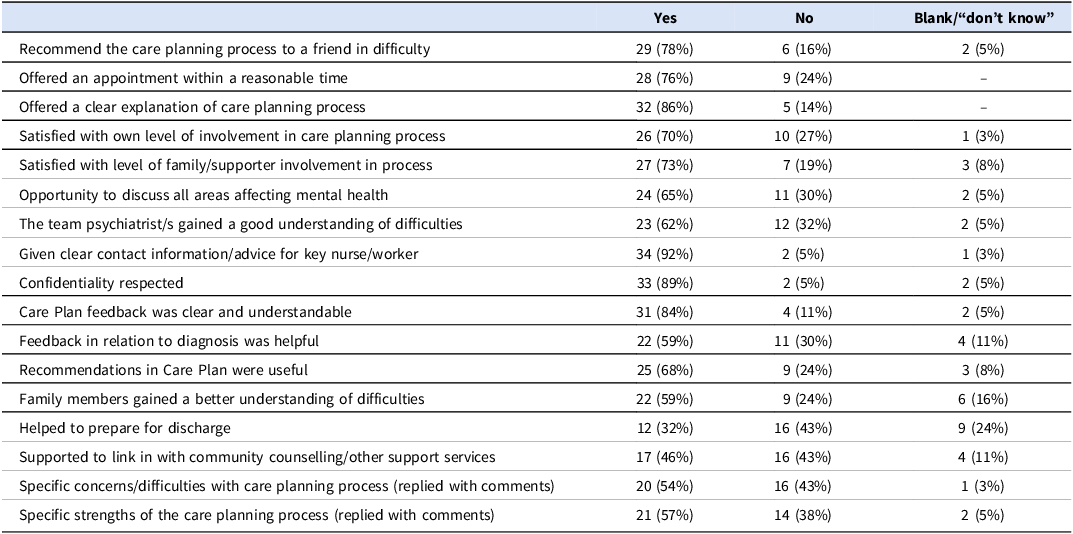
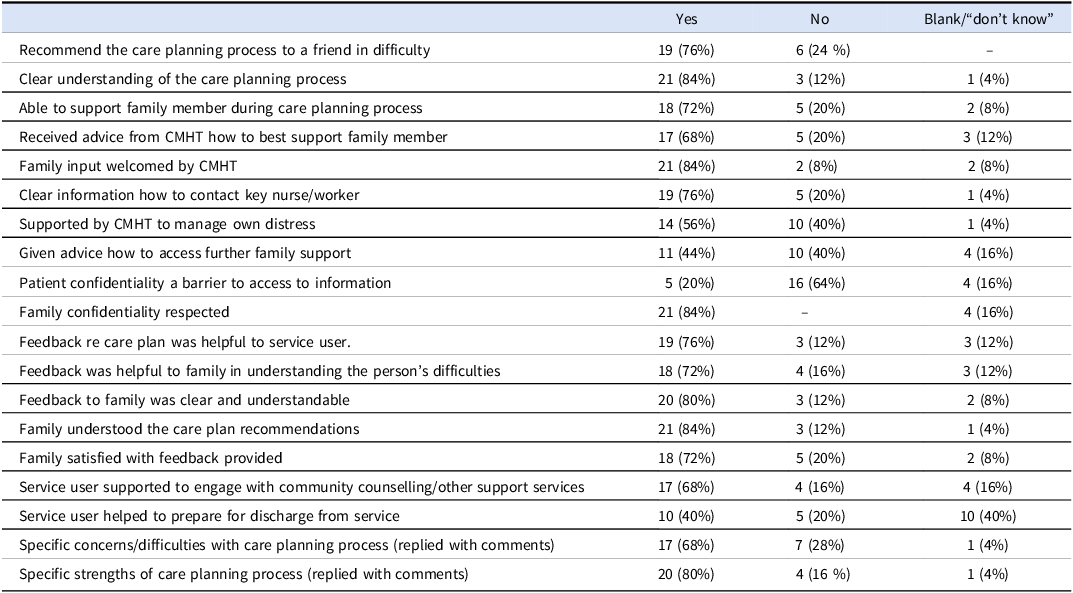
The initial version of the questionnaires was circulated on 2 consecutive occasions to 148 SUs and 87 FMs and yielded 27 SU and 14 FM responses. The re-circulation of the questionnaires yielded 1 additional SU and 2 FM responses. The shortened version of the questionnaire was circulated to a new cohort of 21 SUs who had completed the CCP-9 process over a subsequent six-month period and 18 FMs, which yielded an additional nine SU and nine FM responses, giving a total of 37 SU (overall n = 169, response rate = 21%) and 25 FM responses (overall n = 105, response rate = 24%). A total of four SU participants (11%) did not have family input throughout the care pathway, due to either SU or family preference. Of the 28 SU participants who provided relevant data, 18 (64%) had attended the mental health service for more than 6 months, indicating that most had been referred for longer-term therapeutic intervention with the CMHT after completing their care plan, and a minority sign-posted to community counselling/support services only. The MHP online survey was circulated to 33 CMHT clinicians, and 13 completed questionnaires were returned (response rate = 39%). Of these, 6 were from nursing staff and the remainder were psychiatrists, occupational therapists, social workers and psychologists. Participants had a median of ten years’ experience in clinical practice, and 70% had experience of working in other mental health services. The responses to the SUs and FMs surveys are summarised in Tables 1 and 2 respectively. Where percentages have been rounded to the nearest whole number, the total does not equal 100% in all cases.
Summary of Service Users Questionnaire responses (n = 37)

Summary of family member (FM) questionnaire responses (n = 25)

Overall, SUs and FMs endorsed the CCP-9, with over three-quarters in each group indicating that they would recommend CCP-9 to a friend with mental health difficulties. In entries in the survey comment boxes, several SUs highlighted the importance they attached to discussing their difficulties with an empathic listener. For example, one SU wrote: “The service gave me a listening ear… I was so glad to have someone to tell my ‘woes’ to.” Another SU commented: “there was always compassion and understanding from all the staff. I always felt safe and listened to.” Several FMs likewise highlighted the importance of their sense of being listened to and understood, and the expression of empathy and compassion by staff. One FM wrote: “I felt I was listened to, and my views were valued. The support was comprehensive and ongoing. I felt the diagnosis/treatment was not rushed.” Another FM observed: “(the nurse) was very attentive and understanding and included me in the process, as my (unwell relative) did not want to go through it alone.”
SUs were largely satisfied that they had been offered an initial appointment within a reasonable time following referral, with some highlighting this as a strength of the service. Both SUs and FMs reported having gained a good understanding of the assessment and care planning process. Approximately three-quarters of SUs expressed satisfaction with their own involvement: “I was consulted at every turn… my wishes were taken into account throughout.” Nine SUs commented on the length of assessment, with 8 of these (89%) feeling it was of appropriate length, which gave a sense that they were listened to, and their difficulties were taken seriously: “I was given time and listened to… I felt understood and heard.” Several SUs commented positively on the comprehensive nature of the assessment, with one noting: “The process covered all areas and was not rushed.” Another SU felt that the comprehensive assessment had given them perspective on their difficulties: “It was good to get an overall picture of my life and illness.” Approximately two-thirds of SUs felt that they had had a chance to discuss all areas impacting their mental health and that the attending psychiatrist had gained a good understanding of their mental health difficulties. However, one SU reported discomfort with the extent of exploration of childhood experiences: “I had to talk about my childhood all the time… it was too much for me…,” and several SUs perceived there to be an excessive focus on diagnosis, rather than a holistic understanding of their difficulties: “answering stupid questionnaires to try and fit me into a (diagnostic) ‘box’ was heartbreaking.”
SUs also reported satisfaction with their FMs’ level of involvement in the process and several SUs highlighted the positive impact of this, with one commenting: “I didn’t want other (family) involvement but realised the importance after the fact.” FMs felt strongly (84%) that their own input to the process was welcomed by the CMHT, but several commented that they wished for even greater involvement in the care pathway. Some expressed a lack of confidence in supporting their relative through the process. In addition, only half (56%) of FMs reported feeling supported by the CMHT in dealing with their own distress, with one commenting on this in relation to the length of assessment: “during that time (for assessment) as a parent I was left in limbo, not knowing what is happening….”
Most of the SUs (94%) reported being clear about how to contact their key worker/nurse in the event of difficulty, while FMs were somewhat less clear on this. Several SUs and especially FMs emphasised the importance and value of having access to key worker support, with one FM commenting: “(It was helpful) that I could contact the key nurse when I needed to discuss my concerns and get some feedback”, and another observing: “having a designated key individual was very beneficial, as my (unwell relative) bonded well with the nurse.” In total, 89% of SUs reported that their confidentiality had been respected throughout the process, with FMs reporting a similar experience in relation to family confidentiality. However, despite the emphasis in the CCP-9 model on involving families, some (20%) reported that their issues around SU confidentiality had been a barrier to FM involvement. An additional 11% of SUs indicated that they did not have any family involvement during the process although it was not clear why this involvement was lacking.
In relation to feedback of assessment outcomes, both SUs (84%) and FMs (80%) reported having a clear understanding of the conclusions reached and the basis for recommendations made by the CMHT. Most SUs (59%) reported finding the feedback helpful in understanding their difficulties. However, some SUs struggled with understanding the feedback, particularly in relation to diagnosis. One SU’s noted that “It’s not that I was unhappy with my diagnosis or dispute it, it’s just that it was hard to understand the terminology, the way it was explained”. FMs (72%) were satisfied with the feedback they had received and found this helpful in understanding their relative’s difficulties, and a similar proportion (76%) felt that the feedback had been helpful to their relative.
In terms of discharge and longer-term support, around half of the SUs (46%) reported receiving help in linking in with community support or counselling services, and a third (32%) felt that they had received adequate help to prepare for discharge. Several SUs commented on this e.g. “It’s the lack of support afterwards (discharge) that worries me.” Another contrasted the detailed nature of the assessment with the relative dearth of support services in the community after discharge: “the service cannot help unless there is a psychiatric illness… (they shouldn’t) start a lengthy process if there aren’t a range of services to help the variety of assessment outcomes.” In this context, others highlighted the relative scarcity of publicly funded community counselling and support services: “there was no help in gaining access to public sector services as I can’t afford private,” and another pointing out the “lack of (community) services… due to cuts”. FMs were more confident (68%) that their relative had been supported to engage with community support or counselling services, but almost half (40%) were unsure whether their relative had received sufficient support to prepare for discharge. FMs s also highlighted the difficulties experienced by their relative in accessing follow-up care and support in the community, with one noting a 9-month delay in getting an appointment with a community counselling service.
Over half of SUs and two-thirds of FMs described additional challenges arising in the CCP-9 process, with one SU highlighting the emotional challenge presented by engaging in the assessment, commenting: “I was vulnerable and ill when I needed help, so getting involved in the care/treatment was not easy.” Several SUs and FMs commented negatively on breaks that had occurred in the continuity of care, particularly in relation to the assigned key nurse and to the psychiatrists working with them. This reflected a lack of confidence that the clinician had sufficiently familiarised themselves with previous assessments e.g. by reviewing the case file, with one SU observing: “You really notice who knows your case before seeing you for follow-up,” and a FM noting: “… asking parents to repeat the history for each assessment… it’s soul destroying.” SUs highlighted the importance of peer support in their recovery and felt that they had not received sufficient help to link in with peer support groups. FMs also noted the importance of family peer support, with one commenting: “I wasn’t aware that support services for spouses are available. It’s great that the affected person is getting help, but mental health issues (also) have damaging effects on marriages.”
Twenty-two SUs (59%) and 19 FMs (76%) commented on specific strengths they had observed with the CCP-9 process. Of these, 12 SUs and nine FMs drew particular attention to the empathy, compassion and professionalism displayed by the clinicians who had worked with them as the main strength of the service. In addition, several SUs and FMs commented positively on the local nature of the service, with one SU observing: “Home visits must give a very good insight into the life of the client, (so) the local aspect of the clinic and treatment is good.” As previously noted, both SUs and FMs valued key worker support, and in addition respondents commented positively on the multidisciplinary nature of the assessment and care provided with several emphasising the importance of the access they had gained to social work, occupational therapy or psychology input in addition to nursing and medical care.
MHP survey
MHP respondents had a broad experience and confidence in delivering the CCP-9, with 92% [n = 12/13] having participated in MDT case review and drafting of care plan recommendations, 77% [n = 10/13] in providing feedback to SUs and families and 85% [n = 11/13] involved in helping SUs prepare for discharge and link in with community services. Approximately three-quarters of MHPs reported confidence in completing psychosocial assessment, using standardised assessment tools and interviewing FMs, while 92% [n = 12/13] were confident in contributing to MDT case review and formulation and in making care recommendations, and 85% [n = 11/13] were confident in providing individual and family feedback and helping SUs prepare for discharge.
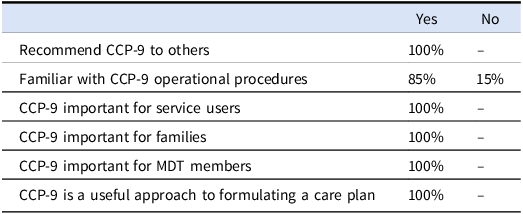
In relation to recommending CCP-9 to others, 9 out of 13 MHP participants (69%) added free text which elaborated on the importance of CCP-9 for each stakeholder group (Table 3). For SUs and their families, 4 MHPs described the process as collaborative and effective in engaging and supporting SUs and FMs, with one noting: “we are working from an agreed approach with clients that helps guide us in responding to the needs of our clients and their families and leads in many cases to a more structured approach to care rather than a ‘firefighting’’reaction,” and another commenting: “(CCP-9) offers a clear structure and support for clients and families during the process and offers a clear framework for staff to work in and guide interventions.” Seven MHP participants commented on the systematic, comprehensive and multidisciplinary nature of the process, with one noting: ‘The CCP process appears to be effective in helping the MDT to understand the person’s difficulties, and in identifying useful pathways to recovery,” and another observing: “(CCP-9 is) A multi-disciplinary approach which is stated in Vision for Change and other initiatives to promote a high-quality service.” Two MHPs commented on the sharing of risk across disciplines as a positive aspect of effective MDT working in the CCP-9. Six out of 13 MHP participants added comments in relation to challenges that can arise in CCP-9, 5 of whom highlighted the considerable investment of staff time involved in completing the process, and the implications of this for having time to dedicate to other duties, and for causing delays at times for SUs in accessing the CCP-9 service. One MHP expressed concern that the feedback process could be emotionally challenging for the SUs and therefore needed to be tailored to individual need.
Views of MHPs on the importance of CCP-9 for recovery (n = 13)

Discussion
The aim of this study was to assess the satisfaction of key stakeholders with the experience of the CCP-9 in a large mixed suburban/rural community mental health service in the Republic of Ireland. Overall response rates to the SU and FM questionnaires were poor but very similar to previous postal mental health consumer satisfaction surveys despite repeated attempts to increase the sample size (Gooden et al. Reference Gooden, Wright, Swinn and Sizmur2021). Despite the low response rates, the evaluation does add to an emerging body of research to an area that has not had much attention (Jones et al. Reference Jones, Hannigan, Coffey and Simpson2018). Both SUs and FMs indicated a generally positive experience of the CCP-9, with over three-quarters of each group recommending the process, while MHPs were almost unanimous in their positive view of CCP-9. The high levels of SU satisfaction with their own and their family involvement in CCP-9 compares favourably with a survey of consumer satisfaction with the Care Programme Approach (CPA) in Wales, where SUs reported lower satisfaction with their own and their families’ involvement in the CPA process by comparison (Health Inspectorate Wales, 2019). Similarly, in a previous Irish survey of 93 SUs attending 10 different CMHTs, only 42% reported that they were aware of their care plan, and only 62% felt that they had participated in decisions about their care (de Burca et al. Reference de Burca, Flood, Armstrong, McCurtain and Saunders2007).
Families likewise found that their input in CCP-9 was valued by the CMHT, compared to a minority of FMs expressing a similar view in the CPA study (Health Inspectorate Wales 2019). Doody et al. (Reference Doody, Butler, Lyons and Newman2017) in their review found that family involvement in care planning was not always positive with FMs describing uncoordinated approaches with their lived experience not always appreciated by MHPs. FMs negotiating mental health services can experience heightened emotions and it is imperative that they are both valued and listened to at this time (Olasoji et al. Reference Olasoji, Maude and McCauley2017). In the current study over half of the FMs found the process supportive in managing their own distress which suggests that they felt appreciated although clearly more work in this area is necessary.
Satisfaction with CCP-9 also compares favourably with findings from a study on the operation of inpatient care planning in Ireland (Nikkah et al. Reference Nikkhah, Callahan and McDonald2024) where only 41% of MHPs reported that the Individual Care Planning (ICP) process positively contributed to mental healthcare outcomes. In additional commentary, MHPs in the same study described ICP as time consuming, replicating the plan of care already documented in the case file and not contributing to the quality of care (Nikkah et al. Reference Nikkhah, Callahan and McDonald2024). These concerns are mirrored in reviews of the CPA framework in community mental health care in the U.K., where both MHPs and SUs reported that time dedicated to documenting the care plan is at the cost of direct therapeutic support (Simpson et al. Reference Simpson, Hannigan, Coffey, Jones, Barlow, Cohen, Vseteckova and Faulkner2016) and the call for an approach that is more flexible, person-centred and of higher quality (NHS England Position Statement 2022).
SUs consistently identify their relationship with the care coordinator/key worker as a vital clinical tool in recovery (Bee et al. Reference Bee, Price, Baker and Lovell2015, Simpson et al. Reference Simpson, Hannigan, Coffey, Jones, Barlow, Cohen, Vseteckova and Faulkner2016), and report that activities (e.g. care planning) which reduce access to this support are disempowering rather that helpful. In the current survey, SUs and FMs again highlight the importance to their recovery of MHPs’ role as a non-judgemental ‘listening ear’ and a source of empathy and compassion, and it is positive that the pathway has not diverted key workers from their emotional support role. In a similar vein, it is noteworthy that both SUs and FMs found the CCP-9 feedback clear and understandable and the MDT recommendations for treatment intervention to be useful to recovery, with no participant reporting that the CCP-9 process was tokenistic or a ‘paper exercise’.
Notwithstanding these positive comments almost a quarter of participants in both the SU and FM cohorts dissented from this positive view of the CCP-9, with some reporting a strongly negative experience e.g. finding the diagnostic aspect of the assessment alienating, or that the assessments were repetitive or intrusive (e.g. in overly focusing on childhood or trauma history). Some SUs, particularly those presenting with complex psychological difficulties, struggled to gain an understanding of the case formulation and found this feedback stigmatising. This may explain the MHP observation that some SUs find the feedback process ‘overwhelming’, suggesting that in such cases, the staging of individual feedback may need to be extended and enhanced. This may require additional training for MHPs with a focus on supporting the provision of feedback that is useful to SUs to help them to manage their mental health in their everyday lives (Brooks et al. Reference Brooks, Lovell, Bee, Sanders and Rogers2018).
The concern raised most frequently by both SUs and FMs primarily relates to the final step of the CCP-9, with SU and FMs feeling that there was not enough preparation for discharge. This dissatisfaction may be because the SUs felt that they were not adequately linked to community services at that point. As the CCP-9 is operated within the specialist mental health services, it is likely that many individuals do not reach the threshold for specialist treatment and are referred to primary care. This could be perceived as a negative experience and impact SU engagement with community services and further help seeking. This can be frustrating for FMs who are sometimes told that their relative is ‘not sick enough’ (Olasoji et al. Reference Olasoji, Maude and McCauley2017) to require specialist care. While SUs found the feedback clear and understandable, greater attention needs to be given to helping SUs understand the range of possible outcomes on introduction to the pathway. This process could be reframed as referral to ongoing community supports rather than discharge to enhance the relationship between primary and specialist mental health services, in line with the four-tier stepped care approach of service provision advocated by mental health policy (Department of Health, 2020).
The CCP-9 approach strives to embed recovery orientated principles within a process that has been traditionally mental health service driven. In practice, this means that there is increased emphasis on the relational aspect of the process which makes it longer to complete. It is estimated that it takes around 16-18 hours to complete the CCP-9 which is a limitation and a potential barrier to its wider implementation. While this is a very important consideration, it is essential that quantity is not valued over quality in this instance and that the underpinning philosophy of the CCP-9 is not lost. If services are to strive for person-centred approaches which focus on enabling and supporting recovery as outlined by mental health policy (Departmentt of Health, 2020) then additional time for engagement with SUs will need to the mainstream. For this to happen, more high-quality evidence to support wider adoption and implementation is required.
The processes associated with the CCP-9 and the underpinning philosophy map directly onto the National Quality Framework which drives how excellence can be achieved in modern mental health services (Farrelly et al., Reference Farrelly, Kiernan, Finnerty, Stepala, Costigan, Chrzanowska, Carney and Mahon2023). In addition, the conceptualisation of recovery within the process draws from both biomedical and clinical interpretations of mental distress in tandem with personal narratives within a strengths-based approach (World Health Organisation, 2021b). Moreover, the holistic nature of the assessment and the role of the MDT aligns with recovery as a concept that has multiple complementary perspectives that can be used in an elective way based on SU need (Winsper et al. Reference Winsper, Crawford-Docherty, Weich, Fenton and Singh2020). It could be argued that the use of case formulation and diagnosis creates a tension with recovery as a SU driven concept. However, within the CCP-9 the emphasis on collaboration, SU and family involvement, person-centred processes within a community orientated framework demonstrate that traditional conceptualisations of mental distress can exist in harmony. The challenge is to make sure that the SUs personal experiences, their narratives, their personal definition of recovery and what it means to them drives the delivery of the mental health services.
Conclusion
The survey results demonstrate solid support across the 3 stakeholder groups for the CCP-9 as a model that supports recovery and compares favourably with the CPA model in the UK and inpatient care planning in Ireland. Challenges arise for some SUs in understanding feedback around complex psychological issues and in accessing community support and counselling services. Families wish to be more involved in the process and to have greater access to support in managing their own distress. A unique strength of this study lies in its design, where stakeholder groups came together to design and carry out the research in collaboration with the researchers and the clinical staff. It is acknowledged that this is a small study which limits the generalisability of the findings (Bowling, Reference Bowling2005). In addition, the response rates were poor despite the surveys being circulated several times. However, it should be noted that no other evaluations of a similar community care planning approach could be located in the literature. The rich qualitative feedback and consistently positive responses also offer a meaningful insight into the acceptability and feasibility of the CCP-9 process. In addition, the innovative nature of the CCP-9 in Ireland may inform discussions around how community mental health services engage with guidance from governing bodies in relation to care planning. Moreover, future evaluations of the process could consider obtaining feedback from SUs and FMs on discharge as part of regular quality audits. While satisfaction is one element of the evaluative process, future research should look to longitudinal studies which seek to focus on the effectiveness of the CCP-9 process in terms of improving mental health and recovery outcomes over time. In addition, it would be useful to assess outcomes for those SUs who do not meet the threshold for treatment with specialised mental health services and are referred to community services for further care. Furthermore, the additional time and resources to complete the CCP-9 may be challenging to any further or wider implementation. However, this needs to be balanced with the desire for SU-focused initiatives over service-led priorities.
Acknowledgements
Our thanks are due to all participants in the surveys and to Gearoid Moynihan who assisted with drafting the Service User and Family Questionnaires and to Patricia Kenny, who assisted with administration of the surveys.
Author contributions
All authors listed meet the authorship criteria according to the latest guidelines of the International Committee of Medical Journal Editors, and all authors have contributed and are in agreement with the manuscript.
Funding Statement
This research received no specific grant from any funding agency, commercial or not-for-profit sectors.
Competing interests
The authors have no conflicts of interest to declare.
Ethical standards
The authors assert that all procedures contributing to this work comply with the ethical standards of the relevant national and institutional committee on human experimentation and with the Helsinki Declaration of 1975, as revised in 2008. The research was unfunded, and the authors declare no conflicts of interest.

 Open access

