

Who created Spanish imperial royal decrees for the New World, and how? These are the central questions which We, the King seeks to answer. Getting to the heart of this problem for the early modern period in general, and specifically for the sixteenth-century Spanish Empire’s dominions in the Indies, promises to reframe historians’ understandings of early modern and contemporary absolutist power, lawgiving, legal categories, racialization, and society. The Spanish Empire has attracted extensive scholarly attention, in considerable part due to its conquests, its logistical challenges, its monarchs’ penchant for issuing abundant decrees, its array of racial categories, and its subjects’ considerable ethnic and linguistic heterogeneity. Departing from exclusively top-down or “negotiated-authoritarian” approaches, this work argues that royal decrees did not originate in the chambers of rulers and ministers alone. It centers human and nonhuman action in creating decrees, exploring how humble, middling, and elite groups cocreated a system of lawmaking and shaped (and phrased) these documents. In the process, it also explores the rise of the sixteenth-century New World’s infamous legal categories of human difference (including so-called “caste” or “racial” categories).Footnote 1
Vassals’ petitions, I argue, were the origins of virtually all royal decrees. Ministers frequently even transplanted successful letters’ phraseologies directly into edicts, often verbatim. This explains in large part the origin of many novel New World legal categories of human difference, like mulato, mestizo, and others. Of course, in an empire characterized by enormous expanses of land and sea, linguistic and ethnic diversity, and uneven literacy, these petitions did not merely glide to the court. The petition-and-response system, while generally voluminous and inclusive of free Christian vassals regardless of their status, was a complex (if often inequitable) collective undertaking. Tracing petitions’ creations, their movement to the court, their fate under ministers’ scrutiny, and successful proposals’ transformation into royal decrees, this book also draws attention to the nitty-gritty details of early modern institutional and archival practices. All participants in this process worked to create a single, highly complex “communicative transaction,” sustained by the labor of many vassals both within and far beyond the formal domain of lawmaking.Footnote 2
This petition-and-response system involved hefty conceptual, symbolic, and written work. Some contributed muscle and sweat, as did countless Indigenous trail-sweepers, couriers, canoeists, Afro-descendant laborers (free and enslaved), sailors and port workers, doormen, and justice enforcers. Others’ assistance came in the form of long hours of writing, reading, annotating, and organizing: notaries, informal assistants, legal agents, secretaries’ wives, court reporters, nearly anonymous subalterns. Those involved also provided different pieces of symbolic work by cocreating the collective make-believe that all vassals had the ruler’s ear, a conversation not adulterated by the fraught creation, transport, and reading of these supplications. Those who attempted to subterfuge this real-and-fictional ruler–ruled dialogue, be they internal Indies saboteurs, sovereign Afro-descendant slaves, British pirates, Chiriguano combatants, or women in the council ministers’ social circles in the royal court, all profoundly transformed petition-and-response system – and risked consequences for tainting this communication.
The fiction of ruled–ruler exchange was a cornerstone of vassals’ trust in the monarchy. It was from this epistolary dialogue and trust-building that communication across the world emerged – and even flourished.Footnote 3 Indeed, this back-and-forth did not merely prompt many of its laws, it shaped Indies society profoundly and itself constituted a fundamental element of a collective imperial project.
Dialogue-Building and Overseas Empire
Scholars of early modern governance are increasingly rejecting “extremely state-centered” models of early modern state formation, and proposing that “popular claims and initiatives could force public authorities in Europe to develop new institutional structures.”Footnote 4 Some within this “empowering interactions” school have called for more bottom-up, actor-oriented models of subject–ruler dialogue, which acknowledge that such negotiations simultaneously centralized and reinforced reigning administrations while allowing a wide range of individuals and groups to design fundamental aspects of these polities.Footnote 5 In this view, states and state formation are not simply the products of coercive apparatuses which impose themselves upon passive communities, but “the outcome of communicative processes” that rendered “both parties … more powerful.”Footnote 6
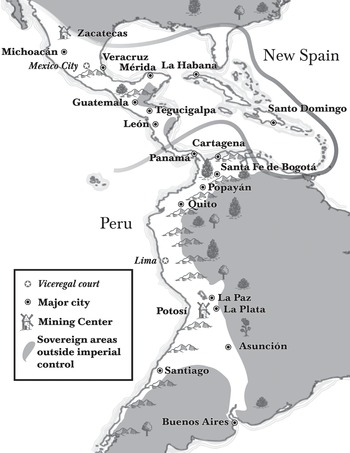
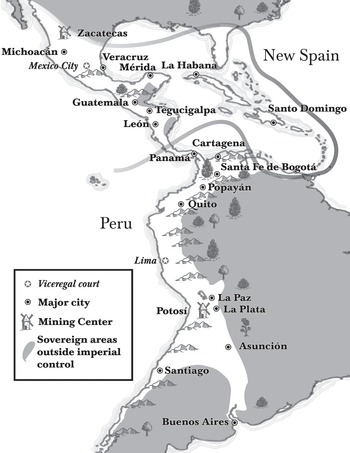
Subjects could shape their states through violence or threats, through formal parliamentary gatherings, or by appealing to the arbitration of higher authorities – and often pursued many approaches simultaneously.Footnote 7 Moreover, in many of these European polities, individuals and groups could petition authorities for specific pieces of legislation.Footnote 8 A considerable body of work which extends beyond early modern Europe to the wider world, and to global Antiquity, the Middle Ages, has increasingly begun to trace similar patterns – indeed, many of liberal modernity’s still-treasured myths of oriental despotisms and fatalistic peasantries may be in the process of crumbling thanks to these advances.Footnote 9 Historians have not rigorously extended this burgeoning subfield’s insights to one of the early modern era’s most crucial arenas of social change: the sixteenth century Spanish Empire, where Iberian warriors and their Indigenous allies toppled New World societies and sowed upheaval without precedent (see Figure 0.2). If subjects in Europe and elsewhere indelibly shaped their governments by petitioning for legislation, how might vassals in overseas territories undergoing profound social, legal, and conceptual upheaval and flexibility have used petitioning to shape emergent administrations’ institutions and laws?Footnote 10
A map of the Spanish Indies, ca. 1570
Petitioners and the Creation of Human Difference in the Indies
For many decades, researchers have expressed substantial interest in one set of social features which emerged in the sixteenth-century Spanish New World: the appearance of categories and institutions of human difference. Historian Juan Olaechea Labayen noted that the “discovery of America” unchained “a revolution … of the linguistic order.”Footnote 11 This transformation included new or transubstantiated words for individuals born of genealogical crosses to parents which vassals considered to be Spaniards, Indians, and Africans.Footnote 12 Many of these terms appeared in royal decrees and other documents, and it was partly from this legislation that they achieved great social significance. Scholars often call this array of endemic discriminatory social and legal categories the “caste system.”Footnote 13 Interest in these terms and the so-called “caste system” occupy a central place in the literature; as Stuart Schwarz notes, “There may be no topic in early Latin American history that has generated more interest and debate than the issue of race and racial identity – including that identity’s characteristics, terminology, effects, history, and hierarchies.”Footnote 14
I first stumbled upon Rengifo’s case, and the overall question of how decrees were made, during several years in the Archive of the Indies, while I had been attempting to explain the sixteenth-century legal origins of the term mestizo. This category of human difference gradually came to mean “part-Indian, part-Spaniard” and today occupies a central part of Latin American nationalism and scholarship. My archival findings linked thousands of vassals’ petitions to hundreds of royal decrees, including many featuring mestizo. Unfortunately, the existing literature could not accurately explain how this petitioning process worked, nor could it account for the emergence of the royal decrees which gave the mestizo category legal heft. Might the system of petitioning and monarchical response have something to add to this central topic of scholarly inquiry? Could many of these categories have been the by-products of these empire-wide empowering interactions?
Most scholars have explained the emergence of so-called “caste” categories as the top-down designs of powerful people or forces. Many attribute the rise of Indies caste categories to elites or rulers – the monarchy’s ruling circle or local Spaniards. Others single out socioeconomics and/or mechanistic cultural processes of colonial domination and exploitation as the culprits.Footnote 15 Yet none have proven a direct, absolute, causal connection between these phenomena and the rise of caste legislation. As Yanna Yannakakis notes, “The exact origins of the caste system remain shadowy.”Footnote 16 Moreover, these laws seem to lack a consistent structure across time and space. Recently, Joanne Rappaport has critiqued scholars’ “propensity to envision caste as part of a coherent ‘system’ that subsists across the entire colonial period.”Footnote 17 Karen Graubart has also described laws on mestizos, mulatos, and zambaigos (a term for African-Indian subjects) as “piecemeal.”Footnote 18 Rengifo’s case, and scholars’ doubts about the nature of colonial categories, make evident that current models of Indies “racial formation” are somehow awry.Footnote 19
The 1580s Peru debates about ordination show, on the one hand, that vassals played a direct part in defining what mestizo meant, and how the priesthood and convents were to operate. The council did not express a clear preference for the anti-mestizo Augustinians’ perspective, and perhaps allowed Pedro Rengifo to triumph because of the impressive dossier. Whatever their reasons, ministers here were passive, responsive, and hardly invested in engineering a system of human difference to facilitate imperial domination. Petitioners dominated their agenda, and the empire’s. Moreover, Pedro’s travels highlight the fragility of this dialogue, and the multiplicity of causal forces which could have either sped the case to completion or destroyed it. The regime of human difference in the New World that emerged in the sixteenth century was far from a consistent, systematic, top-down effort; instead, it was a complex, cocreated array of categories and policies riven with polyvalence, contradiction, and contingency.
Royal Decrees
This is a book about the creation of royal decrees – but what were they? Decrees – or cédulas reales – were brief documents, rarely longer than a page or two, bearing royal signatures. They included many themes, from privileges of individuals, families, and towns, to local, middling, and major policies. They were the Habsburgs’ preferred vehicle of policy-making, and shared an equal status with another key type of text: the longer, more complex, but far less-common ordinances.
We may never even know the exact number of individual edicts which the monarchs ratified, but they certainly ratified very many. Council of the Indies officials and subalterns periodically attempted to provide rough guesses as to this number. By the time of King Philip II’s 1598 death, the council had issued well over 110,000 pages of decrees on sweeping state policies, personal minutiae, and everything in between, copying them by hand into 300 to 500 massive hide-bound tomes.Footnote 20 In 1624, legal scholar don Rodrigo de Aguiar de Acuña counted some 300,000 individual decrees.Footnote 21 Five years later, his successor Antonio de León Pinelo increased the estimate to 600 books, 150,000 pages, and 400,000 individual rulings.Footnote 22
Most of these concerned minor privileges. Many others, however, had administrative consequences across a broad spectrum, from the minor to the general. They consisted of virtually all of the bedrock laws which applied to Indies-specific affairs. One rather rough list from the late 1560s included between 17,000 and 18,000 policies for matters big and small.Footnote 23 According to one official count, by 1618 these included many tens of thousands relating to privileges and minor administrative-executive orders, but also included 11,000 fundamental policy decrees; by 1635, the tally had risen to 12,000.Footnote 24 In 1681, the council published its first printed compilation, the Recopilación, which featured 6,385 laws, of which all but 0.51 percent dated before 1636.Footnote 25 The Recopilación did not replace the legal status of royal decrees, however; New World policies remained up for debate. In any case, this volume could not replace the status of royal decrees, for rulers never abandoned their claim that their will constituted lex animata – that is, the living law itself – and continued to imbue decrees with their legislative volition.Footnote 26
The Liberal Myth of Habsburg Totalitarianism
For many authors, royal decrees incarnate state-mandated racialization and authoritarianism. As with the scholarship on the top-down origins of racial categories, liberal writers have long depicted Spanish imperial lawmaking and administration as “absolutist, interventionist, centralist, statist, [and] bureaucratic.”Footnote 27 The Crown has appeared frequently in the literature as an effective regime of repression which constituted a highly evolved predecessor of twentieth-century horrors: it oversaw Gestapo-like informant networks who enforced ideological purity, sponsored programs of genocide and racial apartheid, erected the first concentration camps, and cultivated the world’s first cutthroat capitalist order.Footnote 28 In one author’s words, the Habsburgs’ (successful) quest for “absolute political control” would culminate in the horrors of the twentieth century.Footnote 29
An even more common view is that the monarchy was an ineffective authoritarian state whose aspirations of domination – embodied in their constant production of futile laws by motu propio – were frustrated by the creole cunning of Spanish and Indian pícaros. In contemporary Latin America, many observers argue, this vision of absolutist fiat thwarted by defiant local ingenuity characterized the region’s “cultures of transgression.”Footnote 30 Overall, such interpretations, by neglecting to consider the rich culture of vassal–ruler communication, have distorted not just scholars’ accounts of racial formation, but have snarled our overall model of Indies society and governance.
This misunderstanding has political roots. During the liberal era, various mythological genealogies have emerged to explain Latin America’s woes, especially focusing on the sixteenth century.Footnote 31 For many reformists, sixteenth-century Spanish imperial authoritarianism and the sui generis legal control of rulers over vassals primed Indies soil for its misshapen harvest. The Austrian dynasty crushed Castilian and Aragonese traditions of municipal democracy on the battlefield in the revolts of 1520–1521, sowed salt upon the budding democratic traditions of the New World, and crushed Indigenous traditions of egalitarianism.
In the liberal imagination, royal decrees in particular incarnated tyrannical government. Simón Bolívar declared these laws to be the “abysmal relics of all the despotisms, ancient and modern.”Footnote 32 In 1835, the President of Ecuador declared them the “sign of the monarchic regime, the most absurd and corrupt of all those which exist among modern peoples.”Footnote 33 One Panama jurist called them a “monstrous legislation … a labyrinth with no exit.”Footnote 34
Many of Latin America’s liberal reformers pointed to the sheer volume of decrees as a sure sign of this monarchical perversity. Bolivian president Andrés de Santa Cruz despaired in 1830 that Indies law had been “confused, indeterminate, contradictory, and dispersed across a thousand different volumes.”Footnote 35 President Braulio Carrillo of Costa Rica described these laws as an incoherent, contradictory, “deformed and heterogeneous mass.”Footnote 36 In 1831, Chile’s Chamber of Deputies complained about “thirty-six thousand compiled laws and millions dispersed, without beginning, without unity … they cannot be learned, nor can they be known.”Footnote 37 The issue of how and why so many decrees emerged in the sixteenth century, then, cuts directly through the field of politics: the long-vanished Habsburg myths of the dynasty’s own power, and the even more powerful and ongoing liberal-era narratives about monarchical authoritarianism.
Scholars today largely share this view of decrees and other legal texts as Habsburg instruments to control their distant realms – and to intrude into vassals’ every affair. The historiography of racial formation has frequently made this claim, but this perspective extends far beyond the so-called caste system. Carlos Fuentes does not mince words: “[I]n Spain an authoritarian order imposed itself on the movement toward a democratic order. An in the New World, the vertical structures of the Aztec and Inca empires were simply superseded by the vertical, authoritarian structure of the Hapsburgs.”Footnote 38
Felipe Fernández-Armesto has similarly stated that Spanish monarchs “aspired to regulate the most minute details of the lives of its subjects in Manila and Michoacán, down to the weight of the burdens that native labourers were allowed to carry and the identity of individuals allowed to wear swords in the street.”Footnote 39 In his words, the law was a “whip” – echoing José Luis de las Heras Santos’s metaphor of “absolutist” Habsburg justice as a “knife” which the Crown used to force subjects to do its bidding.Footnote 40 To avoid being lacerated by the state, vassals could only resort to foot-dragging and the invocation of the shrewd legal phrase “we obey, but do not comply.” For others, decrees cast a shadow to the present. Latin American corruption itself can be explained by these edicts, which broke from the venerable Anglo tradition of judge-dominated common law and thus enabled state kleptocracy, impunity, and, ultimately, social disorder and widespread poverty.Footnote 41
Not all scholarly depictions of this authoritarianism are quite so sanguine. To the contrary, a very large group of scholars now question whether law acted merely as “an ordering tool by the state.”Footnote 42 Many refer to the dynamic between monarchs and subjects in terms of “negotiation,” suggesting that vassals could skirt orders from Madrid or mute their effects through local resistance, forcing imperial compromise. Works on “racial passing,” for instance, tend to emphasize a coherent imperial legal order thwarted by local maneuvering. This tradition tacitly preserves the “command theory” of royal decrees, albeit without explicitly caricaturing Crown actions as either purely authoritarian or farcical. As the literature on racial formations shows, however, both this top-down, statist interpretation and its subtler variants remain powerful if sometimes latent currents in the historiography.
Legal Historians on the Creation of Royal Decrees
Legal studies – including those on human difference – constitute one of colonial Spanish history’s biggest subfields.Footnote 43 Experts working specifically within this discipline have tended to depict imperial normativity in far subtler terms. That being said, few have attempted to elucidate the exact origin of royal decrees. Twentieth- and twenty-first-century specialists have expressed astonishment (and not a little dismay) at the sheer number of the council’s “superabundant” legislative documents.Footnote 44 Alfonso García-Gallo described the Spanish Empire’s legal system as “without parallel” in the history of European colonialism, singling out the Crown’s “minutious … horde of concrete and casuistic dispositions,” as “one of the basic pillars, and the constitution and structure, of the Hispanic American peoples (pueblos).”Footnote 45 Similarly, Alfredo Jiménez Núñez has called these decrees and the “political apparatus” that produced them “one of the most interesting and controversial” elements in the Empire’s history.Footnote 46
Indeed, scholars regard these edicts, and the normative structures within which they operated, as central to this “Empire of Law.” Brian Owensby has noted that “perhaps no other conquest and colonization, certainly none in modern European history, made such a point of its laws and judicial institutions as did Spain in America during and after the sixteenth century.”Footnote 47 Whether or not one accepts that the Spanish Empire was truly unique in its adherence to legalism, surely its denizens’ investment in legal thinking was considerable, even endemic.Footnote 48
One might expect from this considerable scholarly attention to Spanish imperial law, and the importance and sheer volume of royal decrees, an extensive body of research which would explain how these and their categories emerged. Within the specialized subfield of Spanish colonial legal studies, or derecho indiano, there are three main approaches to explaining the creation of royal decrees, all of which fail to place their production within a concrete, flesh-and-blood universe extending far beyond the council and the narrow domain of the legal. The first derecho approach has been to assign them to the sole initiative of the Crown, in keeping with the contemporary mythologization of the Habsburgs. For example, Ismael Sánchez Bella declared that subjects could “not intervene in the government of the society they form[ed] a part of” and that laws were “elaborated without their intervention.”Footnote 49 A second tradition, arguably the most common, mentions these documents without explaining their origins at all.
An important third derecho approach, innovative if sometimes rather confused, has suggested that casuistry of “incredible” dimensions produced these “minutious and copious” documents.Footnote 50 In this vision, the king and his ministers were not tyrannical authoritarians but casuists, discovering laws through dialectics aimed at resolving matters of conscience; local Indies magistrates would then reapply these dialectics when choosing whether to enforce a given law. To make a long story short, however, the petition-and-response procedure through which Crown officials made decrees was very rarely casuistic in the strictest sense.Footnote 51 Nor was this decision-making process primarily structured by an overarching casuistic spirit or outcome (although the acquittal of the royal conscience, always the focus of casuistic reasoning, was always a major collective concern).
In the Habsburg era, jurists and theologians produced an abundant genre of legal writings which contemporaries generally called casos morales and which we now call “casuistry.” These works were collections of moral conundrums, each case followed by a resolution which would clarify the problem. A case might read something like “Peter is a friar but before taking vows he committed murder and subsequently escaped prison – if he leaves his Order, can authorities jail him? Or was Peter the Friar’s oath valid, and he therefore cannot be arrested due to having acquired ecclesiastical immunity?” The author would explain over several pages how one could untangle this knot. Methodologically, a theologian or jurist would reach a conclusion through specific tactics: scrutinizing a problem quite rigorously, reading many normative sources, considering counterarguments, and unraveling the solution. The author would do so dialectically, showing readers his train of thought by citing analogies, common sense, written and unwritten law, royal decrees, other legal literature, the Bible, scholastic authorities, and other sources. He would intellectual finally “crack” the case’s algebra and show future readers how he solved the moral conundrum.Footnote 52
Strictly speaking, the council’s methods for dealing with legislative-administrative gobierno petitions did not have the same textual format nor the same methodology as theologian-jurists did when computing the casos morales. Petitions did not necessarily take this paradox-dialectics-solution style, nor did decrees resemble the casos’ conclusions. A single petition might have 150 proposals, and decrees were almost always between 1 to 2 pages long (although some could be as long as 15 pages if they excerpted entire petitions or decrees). Ministers and monarchs were far too busy and uninformed to treat all or even most incoming petitions in such casuistic detail. The themes of petitions and casuistic works also frequently differed. Moral cases like that of Peter the Friar did not seek to solve a concrete, real situation, but to discover and illuminate a type of paradigmatic problem and the legal maxim within.Footnote 53 Gobierno paperwork, on the other hand, could feature far more varied topics. Many petitions and decrees involved specific people in specific cases. Others concerned major issues: Was Indigenous testimony valid throughout the Indies? Should all Indians speak Nahuatl in Mexico? Should merchants establish a consulate in Mexico City? Should there be a high court in Panama? Could officials marry local women? Should a fortress be built in Havana? Both petitioners and vassals were seeking solutions variously particular and general, big and small, local and diffuse, concrete and abstract, moral and practical – meaning many supplications and decrees did not often match cases like that of Peter. Most were insufficiently “maxim-oriented” to count even loosely as casuistic texts.Footnote 54
Suppose, however, that we depart from an understanding of casos morales in a narrow formal, methodological, and thematic sense, and ask whether gobierno paperwork and casuistry had some deeper resemblances. Some important scholars, including Tamar Herzog, view kings practicing casuistry, acting as jurists or theologians searching for pre-existing principles. Decrees would be mere judicial “discoveries,” applications of law to circumstance.Footnote 55 Did contemporaries accept that the prince’s authority fell on the side of mere legal discovery, and that the ruler had no ability to create law? Jurists sometimes squabbled about the fine print.Footnote 56 None truly accepted that rulers could issue purely creative laws, for after all God created all men and all law, while also giving kings ample power to shape society.
Nonetheless, contemporaries believed that, within the constraints of God’s creation, monarchs had the power to create human positive law. Learned scholars explicitly framed the king’s decree-making as an act of legislatio (legislation), described sovereigns’ making, giving, and changing of law, and often called decrees not just decretos but leyes or laws.Footnote 57 For instance, Friar Miguel Agia followed a centuries-long Iberian tradition when he wrote in the late 1500s that the king was “supreme Legislator and Monarch” and could “establish, declare, and abrogate laws.”Footnote 58 That the New World lacked adequate human positive law for countless issues only made the need for decree-making more acute.Footnote 59 This is likely why petitioners and ministers did not often use the term discovery, or a cognate, such as explicatio.Footnote 60 Of course, this was not a denial that God remained the only true architect of His creation; the ruler had to placate Him by engineering and maintaining a just social order in the terrestrial realm, in the inseparable roles of law-keeper and law-maker.
A final issue concerning casuistry is implementation – a topic which, due to reasons of space, I do not address in this book.Footnote 61 For scholars today, casuistry is not only a scholar’s search for maxims of justice via the consideration of concrete cases, but also the judge’s adjustment of law to social circumstances. For example, perhaps Peter the Friar was guilty of murder and jailbreaking, but he had killed in self-defense and escaped prison to save children from a natural disaster. In this case, a judge using a casuistic method might forgive Peter or moderate his punishment despite royal decrees to the contrary. Here, a judge deviates from a rule-governed system to flexibly meet the moral specifics of the case.
To be sure, decrees were reflections of the royal will, and were therefore not set in stone. A monarch could easily overturn his own decree, modify it, temporarily suspend it. He could also allow (via a gracia privilege) for a specific individual or corporation to ignore it. Moreover, Indies officials and vassals often claimed (not without controversy) that they could temporarily soften and appeal a monarch’s decree because it had not been the ruler’s intention to cause harm. We should not juxtapose case versus system, however, when considering kings’ own decree-ratification; the monarch’s ability to overturn his own determinations and to bend the field of legality via gracia renders that binary highly murky, and often irrelevant.Footnote 62 That local Indies magistrates could in a very loose sense use flexible, context-specific approach to reach decisions (especially in justicia litigation) is, however, quite accurate. So too is legal scholars’ common observation that decrees did not always constitute the final word. Regarding how decrees arose in the petition-and-response process, however, casuistry, either as a form of decision-making or as a spirit, is an obtuse and often outright incorrect conceptual tool. In most cases, the gobierno petition-and-response system was formally and often in spirit a distinct format and method during the sixteenth century, and its concerns lay not with hypothetical Peters but with the flesh-and-blood Pedro Rengifo and countless others, and with these petitioners’ concrete and abstract proposals. It is this petition-and-response system which I describe in the pages that follow.
Exploring the Gobierno Channel (the Vía de Gobierno)
The vast literature on the Spanish Indies’ legal culture has therefore largely not accounted for the actual process through which decrees arose. There are some works – including important recent articles by Felipe Ruan and Caroline Cunill – which give considerable attention to the specifics of how council officials assembled decrees.Footnote 63 Nevertheless, a work devoted to reflecting upon the holistic process of legislative decree-making has not yet been undertaken, leaving the overall picture of how these texts arose obscure.
At the root of much scholarly confusions lies authors’ tendency to indiscriminately blur three very different types of imperial paperwork: justicia, gracia, and gobierno.Footnote 64 Vassals’ litigation before judges, or negocios de justicia, constituted council ministers’ lowest priority (this route was also the most casuistic).Footnote 65 This remains the best-understood branch of royal justice, perhaps because it fits rather well with many liberal models of adjudication and because so many lawyers-cum-legal historians appreciate justicia’s familiar structure.Footnote 66 The second paperwork branch was gracia – decrees and petitions dealing with exceptions, such as concessions of aristocratic privileges, royal offices, patents, and pardons.Footnote 67 That our popular conception of kings associates their faculties with nobility and privilege-granting has predisposed scholars to explore this gracia dimension rather well.
The historiography has almost entirely ignored the workings of the third bureaucratic channel: gobierno.Footnote 68 This branch determined specific acts of government administration or laid out legal principles. These policies could concern miniscule, titanic, or middling issues. Unlike justicia, it featured no formal litigation between feuding parties before a judge. Unlike gracia, its decrees did not offer vassals privileges or rewards. And unlike both gracia and justicia, Indies vassals could submit gobierno petitions directly to the Crown without first passing through the gauntlet of local authorities.
All categories of council paperwork – especially gracia and gobierno – nonetheless overlapped in complex and often messy ways.Footnote 69 Both gracia and gobierno decrees were valid in perpetuity unless replaced by a more recent decree (unlike more casuistic and one-off justicia determinations or sentencias).Footnote 70 The council’s massive handwritten volumes of Indies legislation also indiscriminately mixed gracia and gobierno decrees. Moreover, both differed from justicia court cases, in which lawyers and others often agonistically invoked volleys of theory and scholarship. In the 1500s, ministers decided upon gracia and gobierno petitions without justicia’s more rigorous exegeses – the latter often looked to current and centuries-bygone normative literature, and to the classics of divine or natural law.Footnote 71
The derecho indiano historiography has acknowledged that gracia decrees arose from privilege-seekers’ petitions, but has not explicitly tied gobierno legislation to vassals’ petitions. This lack of specificity has created a muddle of these three council branches, such that experts cannot distinguish meaningfully between a court case’s outcome or a new piece of administrative policy, let alone identify specific actors involved. Without singling out gobierno as a distinct channel, and without acknowledging a wide range of vassals’ initiatives in prompting gobierno royal decrees, it is not possible to untangle how royal officials’ policy-making process functioned, nor can one look behind past and present myths of Spanish imperial rule and find its many actants at work.
Beyond Ruler and Ruled, Beyond the Closed Domain of the “Law”
Delineating the gobierno petition-and-response process’s functioning within the council is only one step toward a larger understanding of how actors created royal decrees. For some time, I was persuaded that the empowering interactions model was fully suited for the task, for it revealed subjects in action. Continual research persuaded me, however, that a model of vassal–ruler dialogue was too simple for explaining how and why the Spanish kings issued decrees. By adhering to the ruler–ruled dichotomy, ubiquitous in the historiography of empowering interactions, were we really pulling back the curtain on the sociological processes which created so many polities’ decrees? Or were we promising a demystification and exposing a new and almost as reductive fiction?
Exploring cases such as Rengifo’s, my files accumulated with more and more inane details about the world within and beyond the Council of the Indies. The twists and turns of this institution’s bureaucratic channels were becoming clearer with time, but from obscure corners of Seville’s General Archive of the Indies (AGI) and other repositories, an outside universe of historical actors began to interrupt the vassal–ruler conversation. Here, an enslaved black woman cleaning the council and bringing their ministers cinnamon tea. There, a petitioner’s ship delayed for months by a hurricane and pirates. A river which ran dry during rainy season isolating all of Paraguay from Peru. Secret gambling. Women influencing decision-making in the court in exchange for stunning Indigenous artworks. A legal agent secretly distorting a petition. A descendant of the Inca dynasty in Seville forging an edict (royal signature and all) with gruesome consequences. Eyebrow-raising as these outside elements were, this story would not be complete without attention to other rather gray but equally important humdrum rituals and tasks.Footnote 72 Paper, ink, marginal scribbles, a new shelf for secretaries to store royal decrees, a secretary in bed with facial paralysis. Was it even possible to write a book about sixteenth-century decree-production without incorporating as many as possible of these forces into a great causal chain?
The book whose spirit of inquiry struck me as most useful for harmonizing the council’s formal work and its greater social milieu was Bruno Latour’s 2002 The Making of the Law. The anthropologist’s ethnography of the twenty-first-century French Conseil d’État or Council of State sought to understand this body’s “passage of law” and relish the many twists and turns through which “humble practices of interaction metamorphose” into authoritative legal statements.Footnote 73 Latour called for a more humanized vision of how this council proceeded as an organic whole within society, critiquing scholarship’s mythologized vision of law as a “neoclassical temple hovering above an astounded citizenry.”Footnote 74 Law was little more than the process of lawmaking, and lawmaking was a gigantic series of procedural “winding paths” of collective, self-referential practices, including not only officials’ deliberations but a far greater universe of participants.Footnote 75 Instead of envisioning the law as “a sphere apart and self-maintained within society,” Latour underscored the contribution of many “extra-legal” actors, including litigants, lawyers, female secretaries, security guards, files, paper-clips, archives, furniture, “walls, corridors, frescoes, a body of members, texts, careers, publications, controversies.”Footnote 76 His analysis revealed some of lawmaking’s “materiality, its colours, its textures and its opulence, but also its fragility.”Footnote 77
The Making of the Law implicitly drew from decades of Latour’s work on Actor-Network Theory, which provides a useful methodology for tracing causal processes within decree-production, the creation of legal categories, and the role of nonelites in creating imperial policy, all at once. This methodology aimed to “rebuild social theory out of networks” and thus allow us to rethink pervasive sociological concepts like “institutions, organizations, states and nations” – or, one might add, constructs like “the law,” “science,” or “religion.”Footnote 78 This approach foregrounds the complexities of countless overlaid network chains instead of attempting to impose the universal upon the particular.Footnote 79 Following these networks’ operations up close also often reveals the artificiality of many sociological and conceptual binaries pervasive in research.Footnote 80 For example, dualities between human and nonhuman actors fade – Latour instead calls for exploring anything which influences the network as an actant.Footnote 81
By expanding the scope of analysis beyond the era’s own mythical accounts of vassal–Crown relations, one can better appreciate the roles of actants and vassals with less symbolic capital who nonetheless made the decree-making process possible. These contributors include humans elite – from kings to ministers to archbishops; humans middling – legal agents, postal workers, ship captains; and humans humble – Indigenous runners, Afro-descendant raftsmen, maids, and enslaved custodians (among many others). The petition-and-response process also was shaped by nonhuman flora and fauna, such as mules, horses, mosquitos, cloth, and rainforests, as well as nonliving actants like paper, ocean winds, archives, and Indigenous goldwork. Ideas played a crucial part: ruler–vassal reciprocity, legal representation-by-agent, the defeminization of officialdom, the legitimacy of conquest, and the binding power of the phrase “I, the King.” In fact, these spheres of ideas and materials, human and nonhuman, rulers and ruled, were not opposite at all, for they intrinsically merged and mutually shaped one another at every moment.Footnote 82 Countless actants formed part of a causal ecology far greater than the past mythologization of ruler–ruled dialogue and today’s predominant idea of the law would allow.
The Legal Fictions of Habsburgs and Liberals
Latour notes that strong networks do not simply surrender the myths of their own construction. Actors creating networks often symbolically and conceptually cordon them off from wider connections, so that artificial domains such as “law,” “science,” and “religion” appear as spheres discrete from other ones (at least in our imaginations). Latour notes that after a researcher has traced a network, and has revealed the actual causal unity of spheres many once held to be distinct, he or she must go further still, devoting attention to why its participants did not understand this network as a wider process but rather as a distinct domain.Footnote 83 Though he does not belabor the point, he suggests that actants sometimes create “cutting points” – artificial truncations of networks’ true organic extensions into the societies inside which ostensibly separate spheres actually operate.Footnote 84 I will refer to the outcomes of this “cutting” as mythologizations, for those thinking within them not only imagine certain interlinked networks as separate from one another, but implicitly model them as devoid of actors and their terrestrial constraints.
Scholarly writing on both law and legal history have tended to mythologize law, as Latour noted. Early modern actors were not so much concerned with re-enforcing a domain of “the legal” as they were with sustaining the image of a great vassal–ruler dialogue which was largely untrammeled by earthly challenges. The empire’s participants expressed a collective self-image of a consenting community. Their communications network could not have existed without legal fictions. Indeed, just as there “would be no game without belief in the game and without the wills, intentions, and aspirations which actuate the agents,” there could hardly be an empire built without vassals’ volition, on violence alone.Footnote 85
This widespread belief in dialogue required the constant cocreation of many vassals. One end result was an actant-created fiction of vassal–ruler contact.Footnote 86 This book relies particularly heavily on Karen Petroski’s definition of legal fiction, a domain of nonactual “collective consensual ‘pretending’” and disciplined role-play, with its own internally cohesive logic.Footnote 87 Petroski lists among legal fictions the “linguistic depictions of nonactual people” as individuals – for instance, today’s widespread tendency to legally identify corporations as human beings.Footnote 88 She also mentions lawyers’ and judges’ claims to understand the innermost emotions and intentions of specific actors, though they “do not have direct access to these states in others” – a fiction which legal norms often require for judges’ determinations. Role-play and make-believe are not aberrances in an otherwise sober legal discipline. They are endemic to normative systems, and are necessary for trust-building, sustaining community life, and enabling law to shape society.Footnote 89 It is only with these fictions that complex, imperfect processes can function – and, in the process, sustain society.Footnote 90
The overlapping views of liberals and specialist scholars have shared a tendency to mythologize Spanish monarchs’ lawmaking practices, in a sense echoing the legal fictions of the past. That is to say, these authors have approached lawmaking as an act aloof from its social and material context, and have depicted lawmakers as unmoored from their human limitations. The early modern Habsburgs might have been very flattered by twentieth- and twenty-first century scholars’ overestimation of their capabilities and designs. Certainly, the Austrian ruling family did not object when courtier-historians proclaimed their descent from supernaturally capable mythological and Biblical figures.Footnote 91 In this way, in today’s historiography, as well as in sixteenth-century thought, royal decree-making appears as a top-down process of Crown authorship divorced almost entirely from bottom-up contributions, and is sharply separated from a wider “extra-legal” society.Footnote 92
How sixteenth-century vassals and rulers imagined the petition-and-response system as involving a minimum of actors, with the king playing the predominant role, also required substantial effort from all parties. The Trastámaras and Habsburgs themselves did not invest their personal time in proclaiming the divine origin of their rule, nor did they explicitly proclaim that their decrees emerged sui generis. Most decrees bearing their signatures acknowledged that certain vassals had requested monarchical intervention in a particular or general matter. However, these rulers did jealously defend the divine origin of their lawgiving powers. Downplaying the process of decree-making, they framed their edicts as the expression of their royal volition. They and their vassals also framed their relationship as one of a dialogue of volitions. Some sociologists today have made an argument for societies as the products of voluntarism – the gathering of many actors’ “scattered wills [which] are recapitulated in the person of the sovereign.”Footnote 93 Sixteenth-century vassals would have intuitively agreed with, and its intellectuals strongly approved of, this vision.Footnote 94 Francisco Suárez’s masterful 1612 A Treatise on Laws and God the Lawgiver provided a recapitulation of scholastic works on the nature of lawmaking and, in the process, laid out many jurists’ mythology of how earthly rulers created law (or, more precisely, how they ratified princely decrees or positive human law).Footnote 95 In some ways, today’s historiography would agree with Suárez, who viewed law as a sui generis, top-down obligation, or a rope (ligation) with which a superior binds his inferiors.Footnote 96 Suárez’s myth insisted that this chain of command did not rest with the monarch, but with God, who by His volition, or voluntad, delegated earthly rulers with lawmaking authority or potestad. The Lord thus enabled monarchs to apply their divinely commissioned intent to concrete or general problems in the form of human positive law. In this way, written or spoken laws were merely an effect or sign of a king’s will.Footnote 97 The more recent the decree, the fresher and weightier the royal voluntad.
Vassals, too, constantly downplayed the coproduced nature of decrees, even as their writings and actions betrayed that they knew otherwise. Virtually all insisted on certain scholastic and monarchical fictions. They broadly agreed, for instance, that decrees constituted manifestations of the royal volition. As the Viceroy of Peru reported in 1596 after facing ambiguities executing certain land reforms, “all of the theologians and jurists’ recommendations seek to interpret the intention and volition of what your Majesty orders and sends through his royal decrees,” and his own approach was to favor Indigenous communities.Footnote 98 It was through this process of seeking to discern the royal intention that “we executed the will of your Majesty.”Footnote 99
However, subjects’ constant communications with the king and council also reveal certain different strains of myths from those embraced by scholastic jurists. According to petitioners, lawmakers may have derived their authority from God, but the rulers’ obligation to dialogue with and listen to subjects complemented the top-down flow of authority. Petitioners insisted constantly upon the essential role of dialogue. One Miguel de Villanueva reminded the monarch from Charcas that “if the words of council are good, they must be heeded without regarding who offers them.”Footnote 100 Many statements confirm vassals’ convictions that the king was obliged to attend to lowly petitions. Friar Pedro Suárez de Escobar reminded the council that “it is not too much that the mortal princes, though they have their high estate, allow themselves to be pleaded by the poor who bear the lowlier place.”Footnote 101 The Indians of Mexico City wrote that “we have understood that the clemency and justice abounds in Your royal breast,” particularly for “us, your vassals, the natives of New Spain and especially the City of Mexico.”Footnote 102 Similarly, Chongo Indian leaders wrote from Peru that the king’s duty was to “maintain us in Justice.”Footnote 103 The widow doña María de Aguilar boldly stated that she dared to write the king because he would not “permit, nor does he benefit from, that we widows be mistreated.”Footnote 104
But which force obliged the monarchs to heed these humble petitioners? This was the royal conscience (real conciencia) which impelled the king to hear the claims of all his flock, regardless of nation, ethnicity, age, or gender.Footnote 105 Indeed, the monarch was perpetually on trial before God, and his mandate depended on his careful attention to the republic’s most marginal vassals.Footnote 106 Petitioners invoked this principle extremely often. Around 1527 the procurators of the City of Mexico traveled to the court and demanded that the council provide them with a bishop, saying “we plea, and above that, we commend this to your conscience.”Footnote 107 Bishop Luis Zapata and President don Lope Diez de Armendariz wrote from New Granada, “we sustain ourselves and persevere with nothing but the hope that Your Majesty will solve [this issue] as suits the tranquility of your vassals and the acquittal (descargo) of your royal conscience.”Footnote 108 Others made similar arguments. Pedro de Ahumada wrote in 1559 that the state of affairs in Mexico put the royal conscience at risk, and that he must embrace certain reforms to “acquit your royal conscience well and [provide] the conservation of these Indians, your vassals.”Footnote 109
This principle was not a merely rhetorical ploy. Monarchs took the matter of divine judgment seriously. In their private correspondences, Spain’s rulers made this explicit. Emperor Charles V would instruct his son Prince Philip in 1548 to watch over his “conscience” with “great account and consideration” about the Indies’ most pressing crises.Footnote 110 As king, Philip took these concerns to his deathbed.Footnote 111
Denizens of the empire viewed communication itself as a safeguard not only of the monarch’s conscience but of their own. The prominent New Granada official Tomás López Medel stated in 1557 that he wrote the council because “I am obligated for the discharge of my conscience.”Footnote 112 Luis de Salazar wrote in 1573, “It seems to me, Your Majesty, that I would always accuse my conscience, saying ‘woe is me,’ for I fall silent and do not say the many things that I could” if he did not petition.Footnote 113 One conquistador wrote the king from Santa Fe de Bogotá in 1583 that “if the aggrieved of these parts of the Indies” did not have “the sea of clemency and justice that glistens in … your Catholic breast, it would cause us such desperation so as to lose not only our bodies, but our very souls.”Footnote 114 Communication was deliverance both personal and collective – and this stirred, as a secondary effect, the royal volition which created law. Dialogue was essential for the emergence of a more Christian society, a process through which all could achieve redemption.Footnote 115
Subjects almost always framed their petitions as personal communications with a king who would give careful attention to each one of their problems. In practice, subjects’ voluntad, not the will of the ruler alone, was also an essential ingredient here – despite scholastics’ insistence that volition flowed downward from heaven. But could a lifeless petition contain the voluntad of a human subject? The reality was that many vassals could not easily express problems on paper, due to challenges in accurately describing the Indies, illiteracy, language, and logistics. All petitioners had to surrender to the reality that their writings would need intermediaries of all sorts – and these middlemen had their own volitions which could adulterate dialogue. From beginning to end, voluntad coursed through social and logistical channels fraught with frictions of all sorts – from petition-making to ministers’ final decisions.Footnote 116
Vassals and royal officials thus constantly sought to reinforce various fictions of pure vassal–lord dialogue at weak points in the petition-and-response pipeline. A considerable part of We, the King explores how Crown officials and subjects created and patrolled the fiction of local intermediaries’ and royal ministers’ impartiality. Royal secretaries, the council, and its ministers acted similarly as intermediaries. Though it was the king’s volition (expressed via his signature) which created human positive law, petitions first had to pass before the prudent eyes of royal ministers and the hands of secretaries. Ministers, however, were all too human – each brought his own voluntad to the vassal–lord dialogue.Footnote 117 Furio Cerol’s 1559 El Consejo, y consejeros del Príncipe (“The Council, and Counselors of the Prince”) urged that while a good minister acted as a doctor to an ailing republic, a biased one endangered all.Footnote 118
There exists today a powerful if not completely dominant tendency among scholars to depict the Spanish royal administration as inept, corrupt, uniquely nonbureaucratic – or all three. Many historians have described the council’s operations as a pure patrimonial system, characterized by “mass domination by one individual” and his or her untrammeled family interests, clientelist obligations, or personal whims.Footnote 119 Others have even described the Spanish Empire as the “epicenter of corruption” in Europe – and, perhaps, the world.Footnote 120
And yet the system of petition-and-response was not entirely or even mostly dominated by acts which we, or they, would call corrupt or patrimonial. In sixteenth-century officials’ views, corrupt acts included “nepotism, traffic of influences, bribery, distortion of legislation, cash payments in quantities that range from ‘gifts’ with the finality of ‘accelerating paperwork,’ to the pay of sums that change the direction of affairs … confiscation of papers, false notarial certificates, extortive methods of all types, etc.”Footnote 121
Today’s understandings of the empire’s officialdom tend to emphasize venality and clientelist networks, underestimating the extent to which Habsburg monarchs attempted to shape ministers into diligent, prudent, disinterested, selfless servants who acted solely as vessels to channel rulers’ decision-making, not as agents with their own blind spots and personal interests.Footnote 122 Ministers’ good praxes, after all, were essential to ensure that vassals’ voluntad reached the king’s eyes and ears, for the validity of the ruler’s determinations was dependent on his having received morally pure recommendations from subjects and especially from ministers.Footnote 123 As Nicole Reinhardt has noted, many contemporaries believed that both “royal will as well as councilors’ competent counselling” were necessary to create not merely a policy but a just policy.Footnote 124 Erasmus of Rotterdam laid this out in his 1516 Education of a Christian to the young Prince Charles V. The ruler was to welcome the counsel of “wise men” as his “hands and eyes,” and to take great care in defending poor and middling subjects by listening to their pleas.Footnote 125
In the course of the sixteenth century, council officials and Crown administrators developed an anticorruption ethos, including substantial efforts to prevent powerful Indies vassals from usurping the petition-and-response system. And, as this book shows, the emerging ethos of dispassionate prudence arose in part through the intentional and inadvertent actions of women, and accrued increasingly gendered overtones due to widespread fears in the court that female subjects, pleasure, and emotion might corrupt ministers and jeopardize the vassal–lord exchange of voluntad. The resulting gendered supervision of all sorts of officials, both from top-down and bottom-up initiatives, played a crucial role in the Habsburg myth of an untainted vassal–ruler dialogue.
Centering the Labor of the Law
We, the King is a book about the labor of decree-production – more precisely, the many diverse work practices which actants contributed to the great chain of communicative transactions necessary for decree-making. As Latour noted, actants are nothing if not workers, and their networks nothing if not worknets.Footnote 126 Latour may not have stated this in uncertain terms in The Making of the Law, but lawmaking is labor, and all labor related to decree-production is part of the lawmaking process.
By viewing the petition-and-response system’s diverse labor types from a richly bottom-up perspective, and by considering its great and highly diverse chain of actants from laborers to hurricanes to kings, we collide with the concept of labor itself. On the one hand, global labor history has recently sought to rethink “labor” as a concept, but continues to limit its focus to traditional topics and agents – peasants, factory workers, unions, socialist political parties, and the like.Footnote 127 But sociologically speaking, why should kings, letter-writers, secretarial assistants, legal agents, mules, notaries, or whistle-blowing wives of ministers not count as participant workers within a great network of global toil?Footnote 128 Indeed, this artificial division of labor types is a major component of the mythologization of the phrase “I, the King,” and likely the root of many other sociological misunderstandings about where agency lies within countless societies’ production of normative orders.
Studies of the Council of the Indies have rarely considered the issue of labor head on.Footnote 129 Beyond a wealth of biographical and prosopographical works on its members, scholarship on the council is lacking in general.Footnote 130 For instance, few have studied its document-producing procedures.Footnote 131 The same is true for studies of documentary genres, which have nonetheless greatly downplayed the production process itself while focusing almost exclusively on describing decrees’ formal contents.Footnote 132
Expanding our focus from institutional guidelines to actual labor portrays lawmaking in a new light. The most visionary historian to date on labor within this institution has been Margarita Gómez Gómez, who has forcefully called for studying council subalterns – an important step toward recognizing the wide net of actants who participated in the decree-production process.Footnote 133 Guillaume Gaudin and Caroline Cunill also have pressed forward in this direction.Footnote 134
Scholars are also beginning to look beyond the confines of the council’s offices. Two recent books in particular point the way forward for a bottom-up, communication-centric rethinking of imperial administration rooted in the New World. Óscar Mazín’s Agents of Royal Justice delves deep into the social and bureaucratic worlds of Mexican cathedrals’ agents at the court.Footnote 135 José Carlos de la Puente Luna’s Andean Cosmopolitans provides an even more dramatic study, tracing how Peru’s Indigenous privilege and justice-seeking communities engaged with imperial justice systems in Lima and Madrid.Footnote 136 Puente Luna’s work shows the massive chains of hard communal labor, legal mediation, patronage and charity, royal bureaucracy, and ideas which enabled trans-Atlantic communities of advocacy to arise.
While none of the aforementioned works focus holistically on the petition-and-response system per se, they do testify to the windfalls which might come from studying petitioning and Crown praxes from a bottom-up perspective. Without incorporating these various labor forms into a single vision of a complex communication network, the lawmaking process will remain disconnected from human efforts, and our sociological models will remain divested of the capacity to appreciate who, beyond the myth of the king and the state, created royal decrees. If we insist on understanding “the state” as partly magical, bereft of real, limited, fallible actants, then Latour’s observation that we were never really modern holds.Footnote 137
“Polyphony” and Decree Phraseology
Tracing how petitions traveled to the court and worked their way through the sinews of council praxes sometimes reveals the extent to which vassals’ initiatives were mediated by their legal agents, by subaltern officials, by ministers, and by the king. However, petitioners seeking gobierno measures also often did exert a fairly direct influence on royal decrees – and not only by acting as the primary initiators of each edict. A careful analysis of the gobierno process reveals that ministers almost always transplanted successful petitions’ phraseologies – including vassals’ proposed legal categories – into the final decree. While ministers and their subalterns did not always include all of the petition in the final product, and sometimes tweaked or rearranged elements, the expository text within each decree was virtually always a reflection of the petition itself. It was generally that case that Council officials would only diverge from this phraseological approach if its subalterns could locate precedent in their archives, and these repositories were often difficult for officials to use before the 1570s.
Council officials’ practice of petition-to-decree phraseological transplantation greatly complicates the prevalent scholarly view of Crown authorship of its laws. Historians often find it impossible not to refer to royal decrees as documents which the king and the council created – and for good reason, since the sovereign certainly claimed authorship by signing “I, the King.” However, the very categories and phrases which constituted this enormous body of law originated from a ruler–ruled muddle at best, and generally sprung directly from the phrases of subjects. The Crown did not speak in one voice; royal decrees featured a “polyphony” of perspectives which ministers did not rigorously attempt to tame.Footnote 138 This insight echoes several findings from other Old World eras and polities, suggesting that this avenue of textual analysis may stand to transform our understanding of many other nonliberal regimes.Footnote 139 Indeed, the argument for an empowering interactions approach must not only increasingly attend to countless intermediary actants which made dialogue possible, but must push its analysis into the documents which these encounters themselves produced.
This insight turns many other historiographical assumptions on their heads. Was the Crown invested in creating “racial” categories by fiat, or did officials simply consent to using those terms proposed successfully by vassals in an almost entirely passive manner? If the latter is true, the literature’s near-universal postulate that racial categories originated within the state as a coordinated effort of the Crown cannot hold. Indeed, the very taxonomic and “epistemological master pattern” which postcolonialist scholars assert emerged from imperial administrations and resulted in the “colonization [of] the imagination of … Amerindians and Europeans” must be reformulated in the light of the existence of largely bottom-up creations of categories, meaning, and law.Footnote 140 Just as imperial agents often pressed royal and ecclesiastical frameworks of thinking upon subjects, so too did monarchs and officials often accept those of their vassals.
Archives and Communication: Rethinking Early Modern Knowledge and Power
So far, I have offered a bottom-up model for royal officials’ creation of decrees, in which vassals’ petitions prompted and phrased royal policies (albeit only after a fraught, multiactant dialogue). For monarchs the issue was not primarily a matter of “seeing like a state” but listening like a lord.Footnote 141 This invites a rebuttal: did the monarchs and their ministers simply assent to any incoming petitions which reached their desks? The historiography has often suggested precisely the opposite: the Crown had clear ideas about the Indies, and imposed their vision through a flurry of policies. On the other hand, Arndt Brendecke’s seminal exploration of knowledge production within the sixteenth-century Spanish court argues the opposite. He notes that while the postcolonial historiography has often asserted that colonial knowledge equals colonial power, this relationship is in reality far from clear. Brendecke argues that postcolonial methodologies simultaneously promise the “unmasking [of] imperialist power structures” and bestow early modern rule with a new mask, by greatly oversimplifying the relationship between rule and information.Footnote 142
Brendecke set out to challenge the knowledge-is-power postulate by tracing officials’ production of “knowledge at court in actu” – that is, by conceiving of council ministers, the king, and others as flesh-and-blood actors who operated within, not beyond, their society.Footnote 143 Moreover, he emphasized how the more the empire expanded, the less and less its lawgivers knew – royal officials’ rare efforts to collect systematic knowledge largely failed in the face of this titanic challenge. The council was therefore largely a passive institution, waiting for and inviting the petitions of vassals – which were always loaded with interests – in an attempt to maintain constant bottom-up communication and eke out a degree of post-facto control over Indies events.Footnote 144
Brendecke’s aim – to trouble the historiography’s understanding of knowledge – did not, however, engage with the specifics of the council’s decree-making process. As we shall see, his affirmation that the Crown “did not essentially collect information so that it could actively shape policy” is often true.Footnote 145 Nonetheless, by the final three decades of the sixteenth century royal decision-makers increasingly did manage to achieve some factual mastery over certain Indies affairs – particularly in limited issues of finance and war – thanks to new archival technologies and information-gathering practices. And despite Brendecke’s view that council ministers were almost entirely driven by social circumstances at the expense of efficient knowledge-gathering, royal officials also moved quite aggressively against ministers’ illicit social connections – a process rife with gendered overtones. Ministers did also assemble a massive and moderately well-organized archive of petitions and decrees which came to constitute their “legal truths.” We should not push too far the argument about the Crown as merely a bundle of social relations which collected information as a secondary concern.Footnote 146
This insight about the sixteenth-century council, in turn, helps clarify the relationship between early modern archives and power. Critical archival studies scholars have largely taken for granted that archives and power are intertwined, but they do not clarify how heaps of documents translate into concrete benefits for administrations.Footnote 147 This mystery becomes all the more pressing in the Spanish imperial case, as sixteenth-century Habsburgs simultaneously pioneered some of the world’s most centralized and sophisticated archival systems and the expansion of Europe’s largest overseas dominions.Footnote 148 Even if knowledge does not quite equal power unless actants can make information useful, by the 1580s royal officials’ decision-making process had managed to make something of its papers. Ministers were powerfully aided by archives of more consistent and orderly legal facts, as well as by new descriptive facts that helped ministers triumph over local interests and rationalize resources within the fields of finance and defense, affording the empire limited but significant breakthroughs.
The labor-intensive process through which the council developed these archival technologies transformed decision-making but paradoxically also diluted the agency of its ministers.Footnote 149 As paperwork technologies became increasingly central in decision-making, these “little paper tools” and reference books became actants in lawmaking in their own right.Footnote 150 So too did the custodians of these papers – primarily the powerful council secretaries, but also their wives and subaltern officials, whose influence over the now-powerful archives increasingly rendered them “gatekeepers” of great importance.Footnote 151 Officials’ growing knowledge regarding financial and military spheres, bolstered by the growing contributions of their archive-savvy subalterns, also weakened some petitioners’ ability to influence royal policies.
While the “gray power of files” never came close to doing away with the monarchs’ need for communication with vassals, by 1598, the year of King Philip II’s death, looming canyons of papers did constrain many of the flows of petitioning into channels increasingly favorable to the integrity of the empire and the interests of the Habsburgs.Footnote 152 By the early 1600s, the rise of archive-wielding secretaries, royal attorneys, and high-aristocratic prime ministers transformed this landscape once more, somewhat marginalizing council ministers and altering petitioners’ experiences; it is at this crucial juncture that my research ends and another chapter of the story of imperial lawmaking begins.Footnote 153
Violence and Entrapment
We, the King argues for understanding decree-production as a complex causal ecology comprised of many actants’ muscle, effort, and legal fictions. Yet, as this book also argues, this domain of legal make-believe was not merely labor-intensive: It was also collectively patrolled and guarded by the bearers of violence, who periodically lashed out against perpetrators who maliciously sought to appropriate these fictions’ properties without permission. The threat of grievous bodily injury lurked just beyond the high-minded domains of vassal–lord communication, as imperial subjects’ and officials efforts to suppress sovereign Indigenous, Afro-descendant, and European attacks against those transporting mail. Harm also might befall anyone who tampered with legal make-believe, by forging or distorting ritual elements of this dialogue.
Moreover, while this book also underscores that while the petition-and-response system allowed vassals to cocreate many imperial policies and categories, this dialogue also generated subtle forms of intellectual coercion. Even if the Crown did not always impose its categories, taxonomies, and epistemological frameworks as many have argued, the very act of vassals’ engagement within this communications channel enticed and obligated its participants to seek a (strongly Castilian, Catholic) common ground of statements and beliefs which was never neutral.Footnote 154 Petitioning was both a tool and a snare, trapping many subjects’ status and forms of argumentation within an eerie “papereality” of legal fictions – as Pedro’s clients knew all too well, as they reluctantly became mestizos and adopted the legal category they sought to contest.Footnote 155 This world of legal reasoning – which was far more than the ruling monarchical cabal but a nearly inescapable veritable meta-system of thought and communication – lured all into a web of legal fictions. And yet Pedro was not merely drawn into a snare of others’ making; he was cocreating the snare even as it entrapped him.
Sources, Silences, and Wrongdoing in Context
How can researchers working within the mythological frameworks of Habsburg and liberal-era narratives overcome intentional and unintentional camouflagings of the circumstances of decree-making? Archival work along the grain is one answer.Footnote 156 The lion’s share of this documentation on the lawmaking process was produced by the Council of the Indies. While the early modern Spanish Empire’s archival practices were generally superb for the era, the court’s constant movement before the 1560s dispersed and destroyed many petitions, decrees, and other documents.Footnote 157 Beginning in the 1580s, high-ranking officials and royal committees increasingly borrowed council writings for specific ends, never to return them.Footnote 158 In the 1600s, kings’ prime ministers (privados) also pillaged Madrid’s archives at will for their projects of imperial reform.Footnote 159
Many of these papers were reunited beginning in the final third of the 1700s in the Archive of the Indies (AGI), today the primary repository of the council’s paperwork.Footnote 160 Virtually all surviving petitions sit in the AGI’s massive Gobierno section, others in the Patronato papers; unfortunately, decrees and petitions are separate and can only be reunited through painstaking work.Footnote 161 Much of the present book is based on my attempt to reconstruct the gobierno petition-and-response system within the AGI. I consulted roughly 100,000 pages of royal decrees, as well as the lion’s share of petitions, for every Indies region from 1492 to around 1600. This included considerable work in the legendarily opaque “General Indifferent” section, where the majority of the council’s internal administrative information is haphazardly dispersed.
While Council of the Indies’ papers do occasionally provide rich information on the mechanical breakdowns of the petition-and-response system, their repositories have their silences as well. Ministers’ illicit behaviors and social ties to petitioners are virtually nowhere to be found. Tracing their crises of integrity and the council’s subsequent reforms requires consulting another sphere of paperwork: royal secretaries’ and investigators’ secret correspondences and audits. Some of these documents are found in the Royal Library of El Escorial.Footnote 162 Most others once belonged to a single collection, the Altamira dynasty’s archives, until the family went bankrupt and auctioned its papers. Those relating to the Indies are now in New York’s Hispanic Society of America, London’s British Library, and Madrid’s Instituto Valencia de don Juan and Biblioteca Francisco de Zabálburu. Read together, these archives reveal the rich if fragmentary social contexts of ministers’ wrongdoing and of the council’s major reforms. They include four council audits which royal officials conducted in 1541–1543, 1567–1571, 1586–1587, and 1587–1589, which offer glimpses into how this institution’s 1542 and 1571 gobierno, gracia, and justicia guidelines came about, as well as the labors of reform which royal insiders undertook to ensure the preservation of the vassal–monarch bond. These archives thus reveal a dense webs of actants operating beyond the official, formal, licit domain – from powerful women to part-Indian agents to pearl necklaces and Indigenous goldwork – which contributed to collective restructurings of the petition-and-response system.
Reading along the grain, we discover the council’s everyday inputs, decision-making praxes, and outputs. Reading against it, and through observers’ outside perspectives on the council, the hidden frictions of the petition-and-response system sometimes manifest themselves. These two reading strategies together not only make possible a study of the Crown’s failures or successes, but also often reveal the legal fictions which rescued the empire from a total breakdown of vassal–lord trust. It is from this back-and-forth that we experience surprise encounters with some of the contingent, intricate, and fragile objects, labor, ideas, and people which made up the great network of imperial lawmaking.Footnote 163
Chapter Overviews
Chapter 1 explores how Indies vassals created gobierno petitions. It traces how subjects transubstantiated their innermost volitions into material form, and made their thoughts into written words, through a series of legal fictions which enabled all involved to conceive of globe-spanning, paper-based vassal–ruler communication as a possible and legitimate substitute for face-to-face encounters. Vassals either directly wrote their proposals or did so through the labor of intermediaries such as procurators and translators. Official and unofficial middlemen were extremely numerous, assuaging authorities’ consciences that they had made efforts to give all subjects access to petitioning. However, transfers of voluntad onto paper were fraught with problems of authenticity, especially when Indigenous vassals formulated proposals. Many observers also complained about legal agents’ shortcomings and volition-contaminating undertakings. To project and fix vassals’ volitions to paper, subjects turned to several signs and rituals, including the rúbrica (signature), the poder (power of attorney), and translation (traducción). Despite numerous challenges, Crown officials’ and vassals’ dedication to enabling petitioners’ access to writing did yield concrete results, making gobierno supplications quite affordable and accessible to most, and creating the widespread belief in the possibility that ruler and ruled could indeed have an intimate dialogue of wills – even through cocreated papers which traveled thousands of leagues across time and space.
The troubled, often multiactor conversion of will into matter was only the first of the petition-and-response system’s many challenges in transmitting voluntad to the court. Logistical obstacles constituted the greatest challenge to the fiction of ruled–ruler dialogue; these are the subject of Chapter 2. The myth of globe-spanning paper encounters between subjects and monarchs was a powerful and necessary fiction, but in the context of the Indies this was even more strained than in Europe. To sustain the fiction of an empire of intimate communication, many types of labor, contributed by as many types of vassals, were necessary. The royal mailing system was extremely limited. The maintenance of most communications in the face of adverse weather and topography required sailors, informal couriers, relay-runners, free and enslaved mule drivers and raftsmen, Indigenous communities, and vigilant vassals and officials. Subjects were forced to rely on travelers, especially merchants, and backwater regions without vigorous trade often struggled to fulfill the basic obligation of communicating with the monarch. The deliberate actions of saboteurs, sovereign peoples’ resistance, and, especially, pirates also played a major role in interrupting the flow of petitions. Logistics were, no doubt, the empire’s weakest link; subjects and officials could only maintain the fiction and reality of communication through enormous amounts of labor and perseverance.
Chapter 3 asks: how could monarchs and upright ministers uphold a fiction of acting as instruments for vassals’ communication with the ruler, when they themselves had their own interests and biases? Crown officials’ difficulties in resolving this question stemmed from a major paradox within imperial governance: the simultaneously patrimonial and bureaucratic nature of royal administration. Both ruler and ruled understood the monarch’s duties within the patrimonial language of the family network.Footnote 164 However, when ministers imitated this lordly model, they usurped their masters’ patrimonial faculties, and thus adulterated vassal–ruler dialogue with their own designs and volitions. As busy monarchs became increasingly distant from vassals, and ministers’ power increased, problems concerning these officials’ biases came to a head.
During the Trastámara and early Habsburg dynasties, officials’ broad and informal influence over ruler–ruled dialogue had been common. The New World’s monarchs did not endorse this, but also did not explicitly forbid it. After a series of 1520s revolts in Castile against Charles V’s courtier-counselors, monarchs became increasingly irritated by ministers’ tendency to put the personal above the public good. Since the 1524 foundation of the Council of the Indies, Habsburg monarchs and their closest counselors repeatedly sought to ensure ministers’ legal and ethical distance from vassals – indeed, what we today would recognize as considerably “bureaucratic” stances.
Two milestones in ministers’ departure from pure patrimonial rule came in 1542 and 1571, when the council received foundational administrative guidelines forbidding them from involving family and friends in decision-making. These ordinances did not mechanistically emerge; these rules instead owed to the efforts of Indies vassals, and especially women at the court, to shape ministers’ decision-making. The might of conquistadors and the circulation of exotic Indies goods at the court initially gave female subjects new avenues to sway ministers. Subsequent crises of ministers’ integrity were in large part responsible for three royal audits of the council, in the early 1540s, late 1560s, and mid-to-late 1580s. The resulting reforms curbed patrimonialism and protected even the humblest vassal’s ability to receive Crown officials’ attention. Royal decision-making thus became almost exclusively male, and ministerial work heavily gendered, as ministers and other officials sought to exclude powerful interlopers, and especially women, from adulterating vassal–lord dialogue. These fundamental changes in the decree-making process, however, had been brought about by powerful female subjects.
Once petitions sat on council ministers’ desks, these officials needed not only to listen to vassals but also to discern which proposals should become decrees. They also had to discern what was beneficial and what was deleterious for the common good. Chapters 4 and 5 explore ministers’ decision-making processes, asking: what was the relationship between knowledge and power? Early on, ministers began to develop a series of decision-making technologies, largely seeking to acquit the royal conscience. Chapter 4 explores the peripatetic council’s meager decision-making technologies, especially its gradual accumulation of legal facts. Crown officials succeeded wildly at encouraging communication with vassals, but in their excessively passive stance created a substantial number of contradictory decrees which complicated the monarch’s promise of justice.
Chapter 5 explores how decision-making transformed substantially from 1561, when King Philip II fixed the seat of the court in Madrid. Ministers who now had permanent offices came to increasingly value and rely on compilations of legal facts, and developed ever-greater collections of descriptive facts as well. Ministers developed certain strategies to supplement information-poor petitions with additional perspectives and (limited) cross-referencing, and thus could sometimes detect interest-laden claims. By the 1570s and 1580s, council officials working in special juntas became much more assertive in three main fields: issues relating to Franciscans, military affairs, and financial matters. Part of this owed to officials’ improving archives, which paradoxically shifted the burdens of both labor and influence away from ministers and toward secretaries and bureaucratic subalterns. This meant council ministers lost some power, even as archives and their custodians – including workers and secretaries’ wives – began to exert subtle but important influence over decision-making.
Chapter 6 explores how ministers phrased decrees. Royal officials, having collectively satisficed the royal conscience through this series of decision-making technologies, now had to transform petitions into royal decrees. A close textual analysis of petitions and royal decrees reveals that ministers’ and their subalterns’ phraseology of decrees lifted entire phrases, often verbatim, from vassals’ petitions. Indeed, subjects of many backgrounds were thus able to propose policies, and could even introduce new institutions and legal categories. The king’s signature was the final fiction in the process of decree-making: a stroke of ink that concreted his authorship over the text and invested it with his law-creating volition. The birth of a royal decree was thus the culmination not only of a massive labor chain, but also of the merging of segments of subjects’ petitions with the royal will. This imbued the empire’s towering legislative output with a highly polyphonic character – and a highly inconsistent one at that.
Conclusion
This overall picture of the Council’s gobierno praxis reveals a great deal about our misunderstandings of the era. I would hazard that understanding this long labor chain through which petitions formed and (if successful) became decrees offers an opportunity to rethink the entire empire – suddenly not a society of serfs and officials subject to passively obey, negotiate, or thwart state directives, but a world permeated by a great communicative process in which legislation was not always a foreign or imposed element. Needless to say, this petition-and-response system was avowedly undemocratic and hierarchical, and was the origin of many decrees which featured categories of human difference. We must not tear down one mythology only to erect another.
Certainly, however, vassals achieved a profound influence over the empire both through direct petitions and in their shaping of petitioning more generally. After all, gobierno royal decrees were often definitive commands for issues of governance, finance, policing, taxation, the parameters of privilege, judicial procedures, military operations – a full list would be almost never-ending. The empire’s policies – some of them highly consequential and broad – often hung on the subtlest string of words in a decree, as Rengifo’s case shows. This recalls Arlette Farge’s comment that “lives are at stake in some phrases, and odds of success and failure hang upon a few words” – in the Indies, this reality played out on an imperial scale.Footnote 165 And these locutions were virtually always born in petitions which a single ocean wave or disease-carrying mosquito might have thwarted en route. A universe of discriminatory practices against mestizos and countless other groups hung on the most delicate semantic chains within cloth-and-ink petitions, chains in turn held together by tenuous institutional and logistical webs which an even greater universe of actants influenced with every repetition of the petition-and-response cycle. This system, so fundamental for maintaining the Indies within the Spanish monarchy, was simultaneously as evanescent as an idea, as frail as a sheet of paper, as fluid as a waterway, as defiantly enduring as a Caribbean fortress.