

Introduction
Interest in alternative dairy calf rearing systems, where cow and calf are not separated within the first hours post-partum and calves are not only reared with peers, is increasing dynamically. Recent indications are a significant body of published research (reviewed by Johnsen et al., Reference Johnsen, Zipp, Kälber, de Passillé, Knierim, Barth and Mejdell2016 and Meagher et al., Reference Meagher, Beaver, Weary and von Keyserlingk2019), increased expression of consumer concerns (Busch et al., Reference Busch, Weary, Spiller and von Keyserlingk2017) and growing numbers of farmers who practice different systems of dam or foster cow rearing of dairy calves (Kälber and Barth, Reference Kälber and Barth2014; Spengler et al., Reference Spengler Neff, Ivemeyer and Schneider2015). Pros and cons of the different rearing systems in terms of well-being, health and production are being broadly investigated and discussed, and most authors emphasize certain animal welfare advantages of cow-calf contact. However, the economic consequences have as yet received comparatively little scrutiny. Due to the multitude of possible variations of dairy cow-calf systems and of influencing factors on the economic outcome, whose effects depend on farm-level preconditions and interactions, this is no easy undertaking. Bickelhaupt and Verwer (Reference Bickelhaupt and Verwer2013) concluded from a SWOT-analysis that the lack of economic information is a weakness that aggravates decision making for farmers who consider conversion to an alternative rearing system. In an optimization approach using linear programming, Asheim et al. (Reference Asheim, Johnsen, Havreroll, Mejdell and Grøndahl2016) investigated how to maximize profit on Norwegian dual purpose dairy-beef farms, comparing no suckling, suckling for 3 d, for 7 weeks and for 13 weeks. Under the conditions investigated they showed that suckling for 7 weeks would be economically optimal. The goal of the current research reflection is to summarize and structure relevant socio-economic factors into a methodical framework that is suitable for the wide variation of cow calf rearing systems, farm, market and societal conditions. As a first step, we have applied a literature based systems theory approach in order to gather the factors that directly or indirectly affect the economic success of this production system and to structure them into subsystems (Wicklow, Reference Wicklow2016). The system-theoretical approach enables the systematic identification of system boundaries, relevant subsystems and functional-causal relationships of the considered real systems. A particular advantage is the ability to analyse across disciplines (animal welfare, economics). For part of the factors, monetary effects can be measured, calculated or estimated, but another part is either difficult to estimate (effect of welfare concerns on consumer demand and willingness to pay, for example), or has immaterial effects (e.g. improvement of work quality or animal welfare) and would need to be priced. For the time being we only used factors where monetary effects can be recorded on individual farms to build an economic model, but we also name non-monetary factors that play a role for decision-making on the farm and might be taken into account in an economic model in the future. The monetary factors were further scrutinized using a case study concerning two model farms for which we calculated enterprise budgets using full cost accounting (DLG, 2011). This allowed us to map all cost items relevant for decision-making and their interdependencies within the complex system, including non-salaried production factors (own work, capital, pasture and forage land). The main goal of this approach was to itemize factors that should be included in a socio-economic evaluation and to consider their possible effects, but also to highlight further research needs.
Framework concerning monetary factors
The two model farms for which we calculated enterprise budgets were assumed to produce organically. Although not restricted to organic farms, from an economic perspective the change from a calf rearing system without cow contact to one with cow contact is easier on organic farms, not least because the EU regulation of organic farming (EU, 2008a) requires one to feed calves at least 3 months of natural milk, preferably from their own dam. This renders the loss of saleable milk considerably smaller compared to rearing systems using milk replacers for feeding of the calves. Moreover, farmers may be more open and consumer expectations may be higher with regard to the application of ‘more natural practices’ in organic production. We anticipate that the majority of farms that are already practicing a dairy cow-calf rearing system are organic farms. Nevertheless, economic consequences of the different rearing systems follow the same mechanisms under conventional conditions. The two model farms differ in their calf rearing systems only, the one farm providing permanent mother cow-calf contact for 13 weeks, while on the other (traditional rearing) farm mother and calf are separated immediately after birth, calves are reared in groups after one week of life and receive on average 8 l of whole milk daily for 13 weeks. The influences considered are shown in Fig. 1 and are described in the next sections.

Fig. 1. Framework for the socio-economic evaluation of rearing systems of dairy calves with or without cow contact.
Income from milk
Machine gained milk yield decreases due to the combined effect of calves ingesting more milk and impaired alveolar milk ejection which, in addition, leads to a reduced milk fat content, which may be balanced to some extent by the possibility that the milk of suckled cows has increased protein content (overview in Johnsen et al., Reference Johnsen, Zipp, Kälber, de Passillé, Knierim, Barth and Mejdell2016). The actual difference between systems depends on the amount of milk fed to the calf by bucket or feeder, as well as the amount of daily and overall contact between cow and calf (Zipp, Reference Zipp2018). Moreover, differing results have been obtained for the whole lactation instead of the nursing period alone. Some investigations did not find a significant reduction (Johnsen et al., Reference Johnsen, Zipp, Kälber, de Passillé, Knierim, Barth and Mejdell2016; Zipp, Reference Zipp2018). In the current accounting, a substantial reduction of 1026 kg energy corrected milk (ECM)/cow was assumed which might be lower in many cases. Furthermore, possible long-term effects are not included. For instance, if calves grow faster due to increased milk intake and possibly further factors, the young stock may reach maturity earlier and have increased milk yields when lactating (Bar-Peled et al., Reference Bar-Peled, Robinzon, Maltz, Tagari, Folman, Bruckental, Voet, Gacitua and Lehrer1997; Meagher et al., Reference Meagher, Beaver, Weary and von Keyserlingk2019). However, evidence for this is inconsistent (see Zipp and Knierim, Reference Zipp and Knierim2020) and more research is needed on the long-term effects of dairy calf rearing with cow-calf contact. Another potential factor would be the milk price which can be higher if the label includes the aspect of rearing dairy calves with cow contact, although as yet there are only very few examples (Bickelhaupt and Verwer, Reference Bickelhaupt and Verwer2013). Currently in Germany two organic initiatives label organic products originating from cow-calf contact rearing, one of them with a certification (https://kuhpluskalb.de), but as yet there are a limited number of suppliers within these label initiatives (3 and 31 farms, respectively).
Income from calves
The most constant effect of dam rearing reported is a faster growth with higher calf weights at weaning (Asheim et al., Reference Asheim, Johnsen, Havreroll, Mejdell and Grøndahl2016; Johnsen et al., Reference Johnsen, Zipp, Kälber, de Passillé, Knierim, Barth and Mejdell2016) and later on (Wagenaar and Langhout, Reference Wagenaar and Langhout2007). Moreover, in the accounting it was assumed that calf losses are reduced (5.7% vs. 6.9%; Ehrlich, Reference Ehrlich2003), although results on calf health are variable (Wagenaar and Langhout, Reference Wagenaar and Langhout2007; Roth et al., Reference Roth, Barth, Gygax and Hillmann2009; Asheim et al., Reference Asheim, Johnsen, Havreroll, Mejdell and Grøndahl2016) and risks of accidents are possibly increased. Once again, long-term effects on herd health are difficult to estimate and should be monitored. Additional future influences could be the price paid for calves, veal or beef in the light of labelling initiatives, although already now it is reported that dam reared calves achieve higher prices (Bickelhaupt and Verwer, Reference Bickelhaupt and Verwer2013).
Other income and costs
No differences were expected regarding any other incomes, for example cull cows. However, for farms that sell breeding animals, problems with the correction of performance testing due to milk consumed by calves during the nursing period can decrease marketing potentials, if no satisfactory solution can be found (Bickelhaupt and Verwer, Reference Bickelhaupt and Verwer2013; Kälber and Barth, Reference Kälber and Barth2014).
On the side of costs, the highest influence is to be expected from building costs. In newly built or rebuilt farms, it can be an advantage that calf hutches or similar housing systems for calves until 13 weeks are not necessary. The keeping of calves with the cows in a cubicle system further reduces necessary litter provision (a direct cost). On the other hand, some rebuilding might be necessary in existing cow sheds in order to allow calves access to a creep area with separate provision of feed, water and protected lying places, and in order to fulfil legal requirements regarding the flooring (EU, 2008b: bedded area for calves under two weeks, certain requirements on slat and gap width in the implementing German regulation). In the accounting, it was assumed that the walking area in the cow shed has non-slatted floors and that a bedded creep area can be constructed by simple means. Thus, elated investments, depreciation and interest, as well as insurance are considerably lower than for the calf hutches.
Labour costs
The labour demand for the feeding of calves differs between systems (Bickelhaupt and Verwer, Reference Bickelhaupt and Verwer2013; Spengler Neff et al., Reference Spengler Neff, Ivemeyer and Schneider2015). The actual difference depends on the applied feeding system (bucket feeding vs. automatic feeder, for example), the suckling system (e.g. permanent or restricted cow-calf contact) and the amount of time the farmers spend with their calves in order to build a good human-animal relationship (Spengler Neff et al., Reference Spengler Neff, Ivemeyer and Schneider2015) and monitor calf behaviour and health. Following Asheim et al. (Reference Asheim, Johnsen, Havreroll, Mejdell and Grøndahl2016) a reduction of about 10 h/dam reared calf was assumed in the accounting. Despite lower amounts of machine gained milk, in line with Asheim et al. (Reference Asheim, Johnsen, Havreroll, Mejdell and Grøndahl2016) a reduced labour demand for milking was not expected due to the additional necessity to check for empty quarters.
Direct costs
These include costs for litter provision, calves' concentrate feeding and treatment costs that were assumed to be slightly reduced in dam rearing. In addition, a slightly better cow fertility was expected leading to lower feeding costs per kg milk ECM and insemination costs. However, both for calf health (see above) and cow fertility (Johnsen et al., Reference Johnsen, Zipp, Kälber, de Passillé, Knierim, Barth and Mejdell2016), mixed results are reported, in the latter case with predominantly no effect of rearing system. Regarding health, an increased risk of disease transmission between cow and calf (Bickelhaupt and Verwer, Reference Bickelhaupt and Verwer2013; Johnsen et al., Reference Johnsen, Zipp, Kälber, de Passillé, Knierim, Barth and Mejdell2016) might even lead to negative effects. However, these cost positions have a relatively small contribution to the overall balance.
Framework concerning non-monetary factors
The success of a production system does not only depend on monetary costs and incomes, but may be enhanced or constrained by non-monetary factors. Inputs on the level of the individual farm are, for instance, the attitude, motivation, knowledge and skill of the farmer whilst outputs of dam rearing may be an enhanced work quality due to the possibility to experience cow-calf interactions and a more pronounced play behaviour (Langhout, Reference Langhout2003; Grøndahl et al., Reference Grøndahl, Skancke, Mejdell and Høgset Jansen2007). In addition to positive animal welfare effects, the application of a more natural rearing system that is favoured by consumers (Busch et al., Reference Busch, Weary, Spiller and von Keyserlingk2017) may generate a better reputation and higher sustainability. On the other hand, negative outputs are also possible. For instance, if the weaning and separation process is associated with strong calling of cow and calf, it may impair labour quality on the farm, but also disturb the neighbourhood (Bickelhaupt and Verwer, Reference Bickelhaupt and Verwer2013; Johnsen et al., Reference Johnsen, Zipp, Kälber, de Passillé, Knierim, Barth and Mejdell2016). Neighbour's complaints may then in turn be a negative input factor. Whether this is a problem depends on the application of solutions including less abrupt, but stepwise weaning and separation (reviewed in Meagher et al., Reference Meagher, Beaver, Weary and von Keyserlingk2019). If dam reared calves are less used to human handling, this may increase work safety risks on the farm. Increased risks of transmitting diseases such as paratuberculosis via direct contact (Bickelhaupt and Verwer, Reference Bickelhaupt and Verwer2013) possibly also affect consumers, if the suspected relation to human gut diseases is true. However, according to conclusions in the review of Beaver et al. (Reference Beaver, Meagher, von Keyserlingk and Weary2019), it is still open whether cow-calf contact is a significant risk factor of paratuberculosis (Johne's disease).
Example of full cost accounting
Costs and incomes were calculated based on data from a German farm (for convenience) with permanent cow-calf contact system for 13 weeks (on average 44 cows, 4 lactations, 5063 kg ECM/cow and in addition data on feeding, milk contents, somatic cell counts, cow losses and income from slaughtered cows), complemented by standardized data (for labour demand and labour costs; KTBL, 2015), while weaning weight, milk consumption, calf losses, treatment costs etc. were literature based assumptions (Table 1). Data were compared between this and an equivalent model farm that was supposed to practice traditional, separated calf rearing.
Table 1. Outcomes of full cost accounting of two organic model farms, with permanent cow-calf contact during 13 weeks vs. separate calf rearing (immediate cow-calf separation and 13 weeks whole milk bucket feeding)
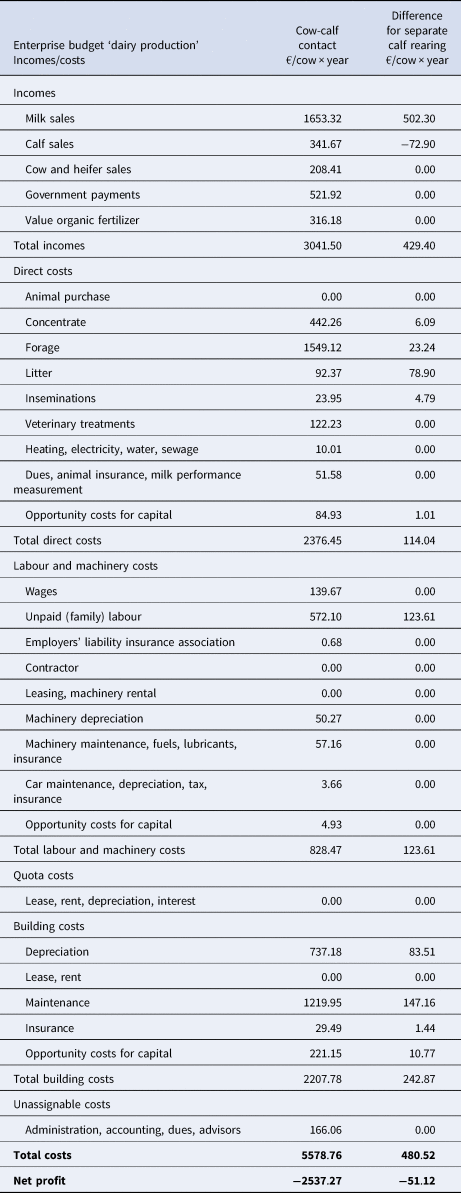
In this example, both systems show a negative imputed net profit of milk production which is realistic and widespread (without allowing conclusions to be drawn about total farm income). Here costs for a new barn building were assumed and feed costs valued at full costs. In addition, the own factors used on dairy farms are not always fully remunerated. Nevertheless, the case study shows that under certain conditions, an economic advantage of calf rearing with full cow contact might be achieved. However, depending on actual outcomes and prices, the overall balance can vary.
Conclusions
The variability in rearing systems is very high with a similarly high number of interacting factors. Therefore, it is not surprising that study results on distinct welfare and performance effects of rearing with or without cow-calf contact are mostly rather variable in extent, but partly also in direction. Consequently, directions and extents of monetary effects are often difficult to predict on a theoretical basis, despite some general findings such as reduced amounts of saleable milk with decreased fat content during the suckling period or increased growth rates of dam reared calves. This means that the outcome of the economic model we applied is not very robust. However, it was not the aim of the modelling to determine whether rearing with cow-calf contact is economically advantageous, but instead to itemize factors that should be considered in an economic evaluation. We propose that for the reasons given above it is necessary to gather a greater number of real farm data including different rearing systems for individual full cost accountings, and to identify input and output patterns on this basis. This will not only help to provide a robust basis for economic decision making, but also help to fill research gaps concerning long-term effects of calf rearing with cow contact. In addition, ways should be explored of how to take non-monetary effects into account.
Acknowledgements
We are grateful to COST Action FA1308 DairyCare, supported by COST (European Cooperation in Science and Technology, http://www.cost.eu). COST is a funding agency for research and innovation networks. COST Actions help connect research initiatives across Europe and enable scientists to grow their ideas by sharing them with their peers. This boosts their research, career and innovation. We especially thank Martin Haugstätter and Anja and Pius Frey for many fruitful discussions.


 Open access

