1 Introduction
When citizens across the world are surveyed about their attitude toward democracy, a great majority of them expresses highly positive views and endorses a democratic system of government (Pew Research Center Reference Center2017, 2024; World Values Survey 2017–2021). Bearing this in mind, one could assume that the world is precisely where more than thirty years ago some scholars and pundits triumphally predicted it would be – in a state where “democracy is the only game in town.” Unfortunately, the reality looks much different. Practices that are undermining the substance of democracy – such as attempts by incumbents to unlevel the playing field, a serious weakening or dismantling of checks and balances, and restrictions of political and civil liberties – have become an increasing reality in many countries worldwide. What makes this trend even more disturbing is the fact that it not only concerns flawed democracies that were pushed over the edge into (electoral) autocracies, but advanced ones as well.
Hence, instead of living in a democratic bonanza as predicted more than thirty years ago, we are experiencing an alleged “crisis of democracy” (Przeworski Reference Przeworski2019), and this in spite of the fact that democracy is still very much cherished by the ordinary people. Although the talk of a crisis of democracy seems to be somewhat exaggerated and too alarming – as many democracies still uphold their robustness and there are no clear indicators that tell us when precisely a democracy passes the crisis threshold (Merkel, Milacic and Schäfer Reference Merkel, Milacic and Schäfer2021; Levitsky and Way Reference Levitsky and Lucan2023) – we still need to explain and reconcile these two contradictory realities: one marked by citizens’ strong support for democratic principles and the other by practical erosion of these very same principles.
Why are countries across the world increasingly dealing with many forms of democratic malaise if the majority of citizens agree that democracy should be “the only game in town”? Thus far, the literature has mainly tried to explain the erosion of democracy with the rise of polarization (Svolik Reference Svolik2019; McCoy and Somer Reference Somer2019), authoritarian populism (Mudde Reference Mudde2007; Norris and Inglehart Reference Norris, Inglehart, Trump and Populism2019), economic crises leading to anxieties (Matkovski Reference Matkovski2021; Rhodes-Purdy, Navarre and Utych Reference Rhodes-Purdy, Navarre and Utych2023), and the weakening of external pro-democracy actors (Levitsky and Way Reference Levitsky and Lucan2023). All of these contributing factors are sound and have merit.
However, as pointed out by Vachudova, countries “that have suffered from democratic backsliding have tended to share one characteristic: the embrace by parties of intense if not extreme appeals to safeguard the interests of ‘the nation’” (Reference Vachudova, Dzankic, Keil and Kmezic2018, 81). Fish reached the same conclusion, emphasizing that “virtually everywhere that autocrats and would-be autocrats have gained the upper hand in the twenty-first century, they have recognized that politics is in part a contest to capture the flag, and they have invariably claimed superiority as patriots and protectors of the nation” (2024, 20). A global rise in nationalism and the decline of democracy appear to be closely related (Nodia Reference Nodia2017, 7; Tudor and Slater Reference Tudor and Slater2021, 706).
In spite of it, a theoretical and empirical systematization of the consequences of nationalism for democracy and the operationalization of their relationship are still very much lacking (vom Hau et al. Reference Hau, Helbling, Tudor, Wimmer and Halikiopoulou2023). This also applies to the current literature on democratic backsliding. Either it has not recognized nationalism as one of the main causes of the phenomenon, or it has integrated an exclusionary version of nationalism into the populist explanatory framework. In fact, when I entered the words “nationalism” and “democratic backsliding” in Google Scholar, the number of publications, in the first 100 displayed that contained these words in their title, including the word “nationalist,” was only 2. When I repeated this, but this time using the words “populism (populist)” and “democratic backsliding,” the number of publications was twenty-nine.
Contrary to this dominant trend in the literature, I argue that in cases where political actors heavily employed nationalist appeals as a justification to subvert democracy, nationalism should serve as a separate and complementary explanation of democratic backsliding. Hence, in cases where appeals to safeguard the nation were followed by democratic backsliding, nationalism should be an integral part of the explanatory framework. I thereby do not seek to offer a fully developed and highly robust alternative explanation. What I do seek to demonstrate is that nationalism was not simply an element of political actors’ political appeals, but was intrinsic to the logic of their authoritarian governance. Accordingly, the goal of my Element is to lay out a preliminary version of what a new and complementary theoretical argument might look like and provide sufficient empirical evidence for its plausibility. This is of paramount importance because correctly identifying the “illness” puts us in a much better position to develop a “cure.”
Accordingly, if we are indeed dealing with a complementary explanation of democratic backsliding based on nationalism, this is likely to have implications for our understanding of what matters in resisting attacks on democracy. I thus investigate the interactive nature of backsliding and resistance from the perspective of nationalism and address the following set of questions that so far have been largely unanswered: How the subversion of democracy in the name of the nation unfolds? Why do many voters acquiesce to the subversion of democracy by nationalist elites? What matters in resisting the subversion of democracy in the name of the nation? All of this, in turn, should justify the introduction of a new dimension of research that treats nationalism as an explanation of democracy-related phenomena (Tudor and Slater Reference Tudor and Slater2021).
My aim, therefore, is to make no more than a contribution to this agenda by highlighting the role of nationalism for both democratic backsliding and democratic resistance. Too often, we are surprised by the electoral outcomes and re-election of aspiring authoritarians (the most recent example being Donald Trump) who, among other things, employ heavily nationalist appeals. The fact that every emerging authoritarian leader wears the mantle of nationalism (Bhanu Mehta Reference Bhanu Mehta2024) tells us that this new explanatory path should be explored more thoroughly. In other words, we need new theoretical tools to better understand current challenges.
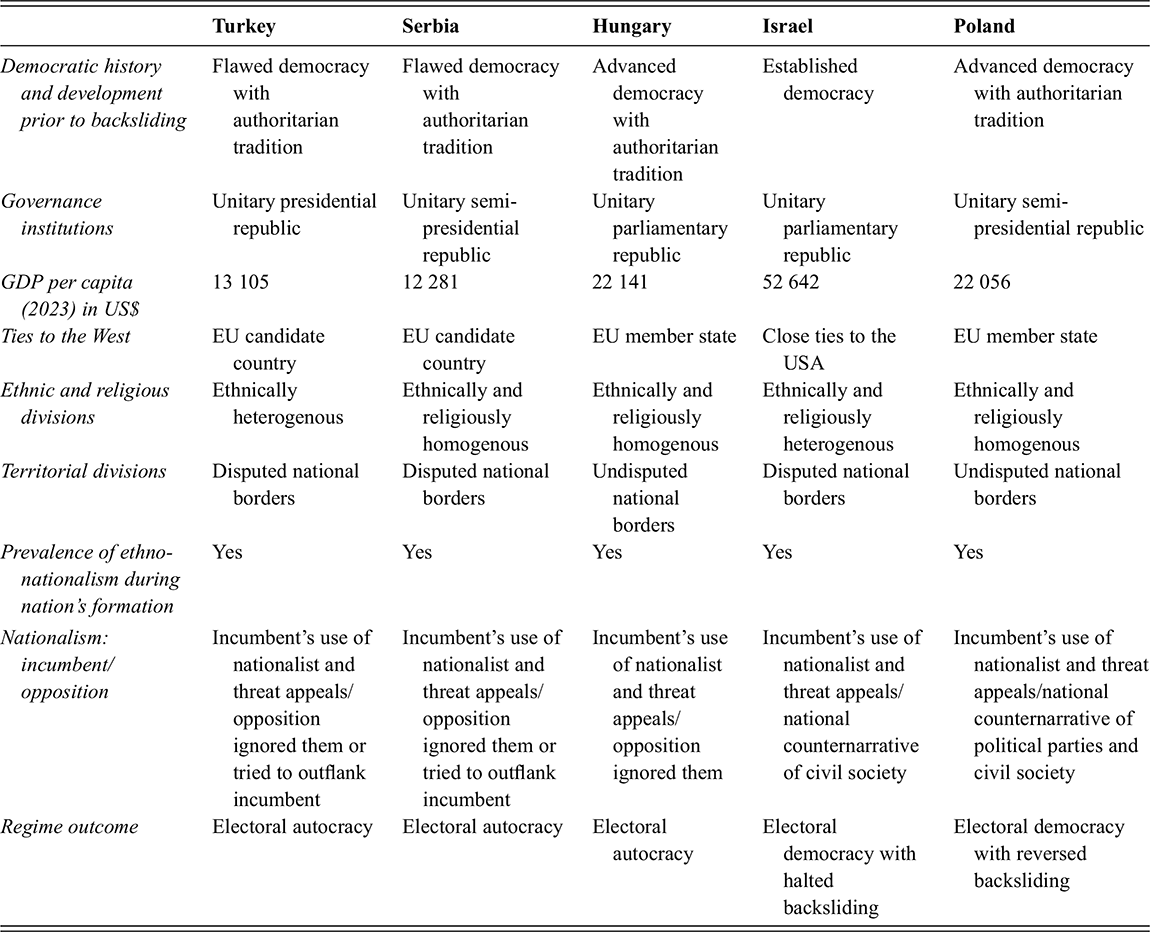
In line with this, this Element dives deep into the political dynamics of countries such as Hungary, Serbia, Turkey, Israel, and Poland that have experienced a significant deterioration of democracy (V-Dem 2024). Though different from each other in many ways (see Table 1) – different democratic histories and development, governance institutions, economic development, ties to and dependence on Western pro-democracy actors, and degree of ethnic, religious or territorial divisions (Somer Reference Somer2019; Milacic Reference Milacic2022; Talshir 2022; Enyedi and Mikola Reference Enyedi, Mikola, Riedl, Friesen, McCoy, Roberts and Somer2023; World Bank 2023; V-Dem 2024) – they share a common political dynamic in the form of a subversion of democracy by political actors, with protection of the allegedly threatened nation serving as a justification. I furthermore mainly attribute the resonance of nationalist claims to subvert democracy to specific historical and structural factors that favored the prevalence of ethno-nationalism during these nations’ formation.
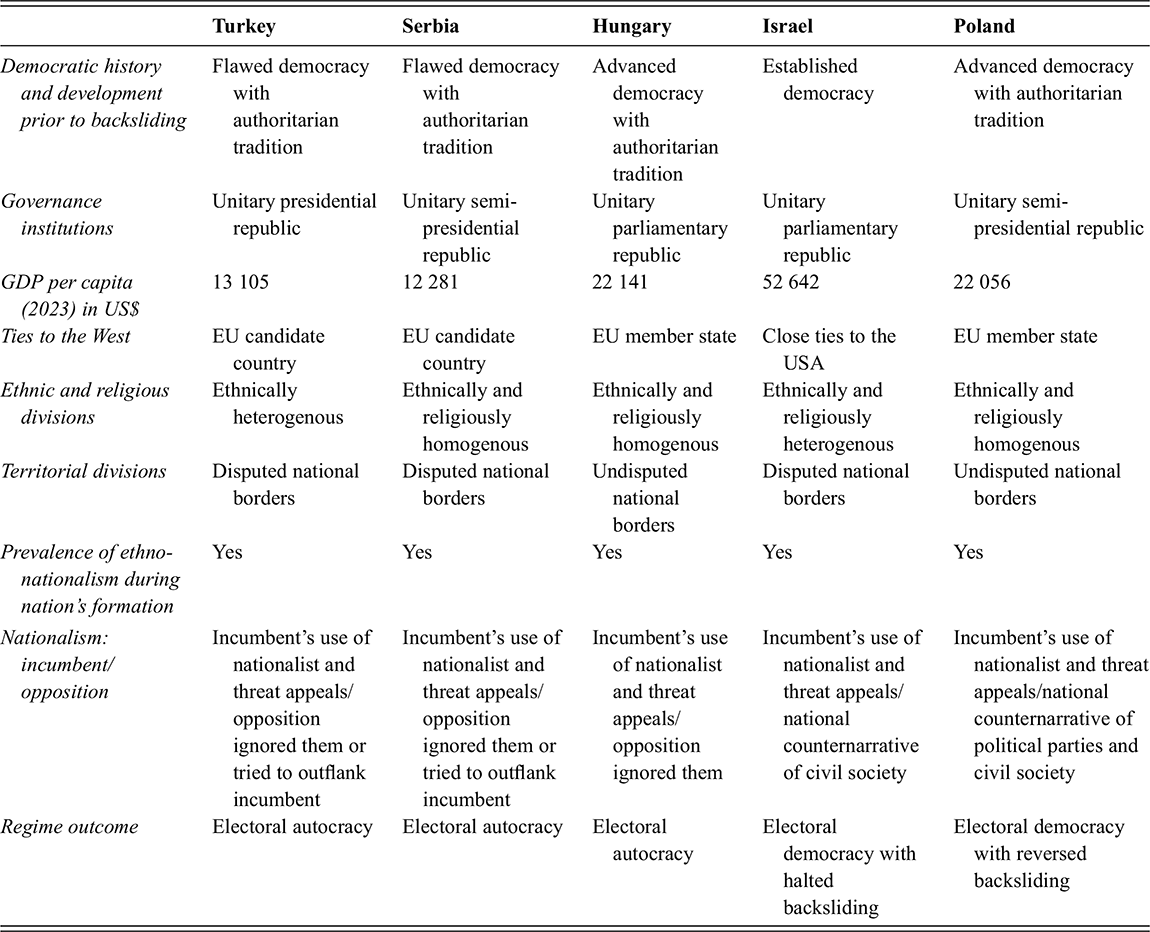
Table 1 Long description
This table illustrates the most promising option for pro-democracy actors when faced with an autocrat who uses the justification of protecting the allegedly threatened nation to subvert democracy: developing a nation-related counternarrative that integrates the cleavage between autocratic and democratic forces. The existence of independent media to disseminate the narrative is a prerequisite.
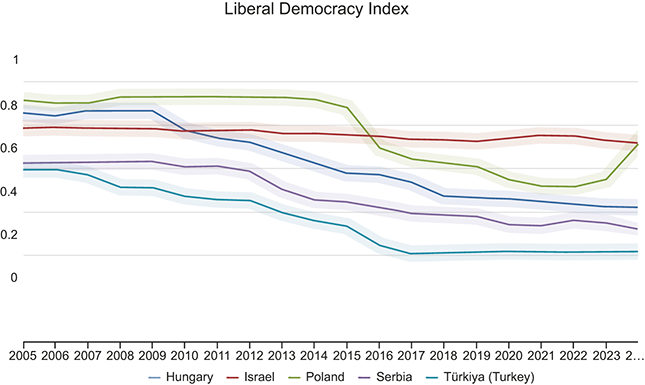
However, despite this structural similarity, some incumbents were less successful than others, demonstrating the important role of political agency. Indeed, despite the same strategy of political actors, in Serbia, Turkey, and Hungary democracy broke down as these countries now belong to the camp of electoral autocracies, whereas in Israel and Poland it “only” eroded to democracy of a lower quality, that is, to electoral democracy (V-Dem 2024). What is more, Poland even managed to reverse the trend by removing the PiS from power in the October 2023 parliamentary election. In this regard, I don’t only view the opposition’s success as defeating the incumbent at the ballot box. Opposition can also slow down and limit backsliding through its actions. This is precisely what happened in Israel, which is why I also consider Israel a partial success. Israeli civil society halted autocratization by mobilizing and stopping the government’s judiciary “reform,” which would have eliminated judicial independence.
I find these variations important because they allow us to explore the reasons for the more successful resistance of political elites and citizens in Poland and Israel, which in turn contributes to our knowledge about democratic resilience, an aspect that has received much less attention in the current literature. The aforementioned differences with respect to the strength of democratic institutions, governance institutions, and democratic histories, which are considered sources of democratic resilience (Beatty Riedl et al. Reference Riedl, Paul Friesen, McCoy and Roberts2024, 18), mean that the reasons for the different levels of success could be various. However, since I focus on what is common for all studied cases – the role of nationalist appeals and threat narrative as a discursive strategy in democratic backsliding – I examine the reaction of opposition forces in this regard. I found that the cases that were more successful in resisting the attacks on democracy in the name of the nation (Poland and Israel) were precisely those in which pro-democracy actors managed to develop an emotionally compelling nation-related counternarrative into which, furthermore, they integrated the regime cleavage between autocratic and democratic forces. These cases thus show that the success of incumbent’s subversion of democracy in the name of the nation is not dependent on the historical prevalence of ethno-nationalism. How the opposition reacts matter as well.
In line with the outlined argument, the Element is organized as follows: In Section 1, I review the dominant existing theoretical explanatory approaches of the phenomenon of democratic backsliding. While acknowledging their merits, I argue that they are insufficient to fully explain five selected cases. I further make a case for nationalism as a complementary contributing factor because the appeals used as a pretext to undermine democracy were related to the two key criteria of the nation’sFootnote 1 existence (De Cleen and Stavrakakis Reference De Cleen and Stavrakakis2017; Mylonas and Tudor Reference Tudor2023): appeals to protect limited community (its ethnic, religious, and cultural composition) and sovereignty (territorial integrity and security). Since nationalism has been integrated into the framework of populism, I also explain what distinguishes them. While the question of who are authentic members of the political community is inherent to nationalism, this is not the case with populism (Rooduijn Reference Rooduijn2014; Bonikowski Reference Bonikowski2017). In addition, unlike populists who see elites as a threatening “outside” (Brubaker Reference Brubaker2020), for nationalists the out-groups can be of various origins and natures: from elites and immigrants to sexual, religious, and ethnic minorities and foreign countries.
Although I have established the relationship between nationalism and democratic backsliding, we are in the dark regarding potential mechanisms linking the two. Therefore, my further approach aims at theory building (George Reference George and Gordon1979). The use of nationalist appeals to attack key tenets of democracy has proven effective. But does this then mean that political actors (entrepreneurs) only need to use “in the name of the nation argument” to be successful? How do we explain the acquiescence of democratically minded voters to the subversion of democracy in the name of the nation? Drawing on the findings from social psychology, I will further argue that in order to accept the subversion of democracy in the name of the nation, voters need to feel that their nation is under threat. Thus, if voters are convinced that their nation’s identity or sovereignty are threatened, this appears to make them more willing to accept the subversion of democracy that is done in the name of protecting the supposedly endangered national identity and sovereignty. That is why authoritarian incumbents have strategically developed narratives portraying national identity and sovereignty as threatened. Besides political agency (Bartels Reference Bartels2023), I identified the following factors as important in determining the resonance of threat narratives within the population: historical legacies (the loss of national territory or sovereignty), shrinking population as well as the existence of formative rifts, competing national narratives, and narratives of the victimized nation and its exceptionalism (Hiers, Soehl and Wimmer Reference Hiers, Soehl and Wimmer2017; Feinstein and Bonikowski Reference Feinstein and Bonikowski.2019; Somer and McCoy Reference Somer2019; Krastev Reference Krastev2020; Tudor and Slater Reference Tudor and Slater2021; Ding, Slater and Zengin Reference Ding, Slater and Zengin2021; Carter and Pop-Eleches Reference Carter and Pop-Eleches2024).
Hence, in Section 1 I posit that nationalist appeals work in combination with threat narrative and shed light on the underlying three-steps-mechanism, which is a central part of my theoretical argument related to democratic backsliding. If pro-democracy actors are faced with incumbent’s narrative on the protection of the allegedly threatened nation serving as a justification for attacks on democracy, I further conceptualize their strategic options: They can ignore the nationalist and threat narrative; outflank the authoritarian incumbent by being more nationalist; or develop a nation-related counternarrative, which links democracy and the nation, and that I regard as the most promising strategy. My typology sheds new light on how to fight back more successfully (Gamboa Reference Gamboa2023; Tomini, Gibril and Bochev Reference Tomini, Gibril and Bochev2023).
In other words, with my theoretical argument I will not only help us to better understand the role of political elites in undermining democracy, but also when their nationalist appeals are effective or when they resonate in a particular way with the population, thus emphasizing the important role of voters in this process. The same goes for democratic resistance. I will explore when it is possible for the opposition forces (political parties and civil society) to re-establish a coalition with voters that can defend democracy. In light of the scholarly debate on the role of elites (supply-side) and voters (demand-side) in democratic backsliding (Bermeo Reference Bermeo2016; Graham and Svolik Reference Graham and Svolik2020; Cleary and Öztürk Reference Cleary and Öztürk2022; Carothers and Press Reference Carothers and Press2022; Mazepus and Toshkov Reference Mazepus and Toshkov2022; Bartels Reference Bartels2023), I will thus claim that both democratic backsliding and resistance encompass top-down and bottom-up aspects. The role of political leadership in safeguarding or dismantling democratic institutions is essential. Nevertheless, we should not forget that in a democracy the voter has the last word. Therefore, as my co-authors and I have already argued, “a diagnosis of democratic vulnerabilities may start with politicians but it must end with voters” (Svolik et al. Reference Svolik, Avramovska, Lutz and Milacic2023, 16). Hence, I argue against the aforementioned dichotomy and will try to reconcile demand-side and supply-side findings by examining what elite cues can exacerbate this phenomenon and the types of cues that may counter it.
In line with an outlined theoretical argument, from Section 2, I start with an empirical analysis. I firstly depict how the alleged fight for the nation served political actors to justify and legitimize their attacks on key tenets of democracy: electoral fairness, civil liberties, and checks and balances. More concretely, political elites presented the attacks on democratic institutions and norms as necessary for the protection of national identity or as the protection of nation’s sovereignty from foreign powers and their domestic allies (pro-democracy actors) who undermine it. They furthermore often directly linked democratic institutions and norms to threats to national identity and framed attacks on democracy as advancing the interests of the collective identity structured in an exclusionary way. These nationalist appeals were also coupled with exclusionary majoritarian appeals. Accordingly, undemocratic reforms passed by the parliamentary majority were justified as the will of the nation because the parliamentary majority represents “true people” who alone decide what is best for the country.
To be clear, I am not linking all attempts to undermine democracy to nationalism. There have been important developments in this process that have nothing to do with nationalist appeals. For example, gerrymandering and a majoritarian electoral system in Hungary repeatedly translated Fidesz’s electoral result of less than 50% of the vote into a two-thirds parliamentary majority. This fact greatly facilitated Viktor Orban’s assaults on democracy, which furthermore tells us that a country’s institutional setup – in this case electoral legislation – influences the likelihood of success of nationalist appeals for electoral mobilization. Moreover, in several of selected countries the critical private media, branded as “enemies of the nation,” were also stifled by choking off their advertising revenues, initiating arbitrary tax investigations, and encouraging government-friendly businessmen to take them over. Clientelistic practices that made elections less competitive were not always linked to national identity politics either. Opposition parties were marginalized not only through delegitimization campaigns that portrayed them as “enemies of the nation,” but also by preventing their oversight role through accelerated legislative procedures. However, as Section 2 shows, the attacks on democratic norms and institutions were very often justified with nationalist appeals. This is why it is necessary to add nationalism to the explanatory framework.
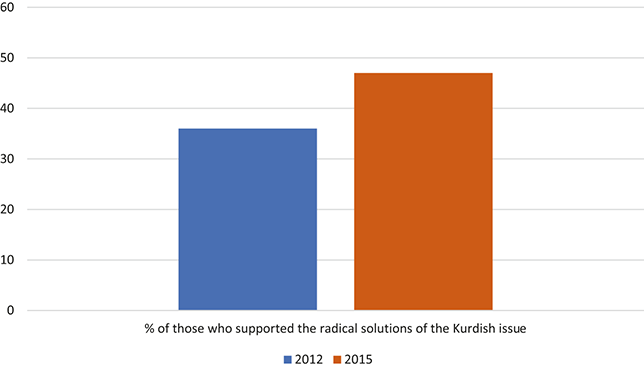
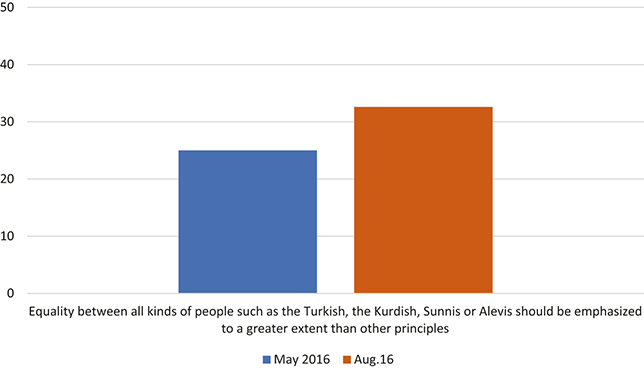
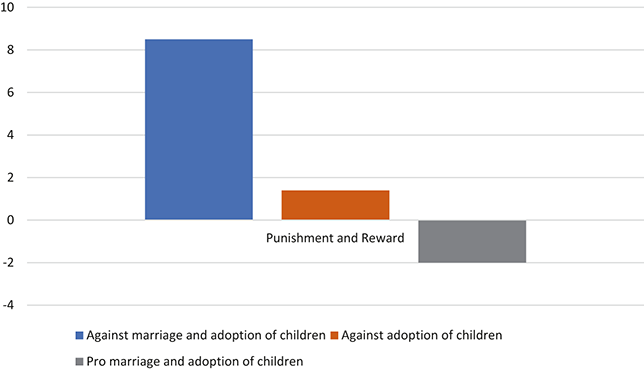
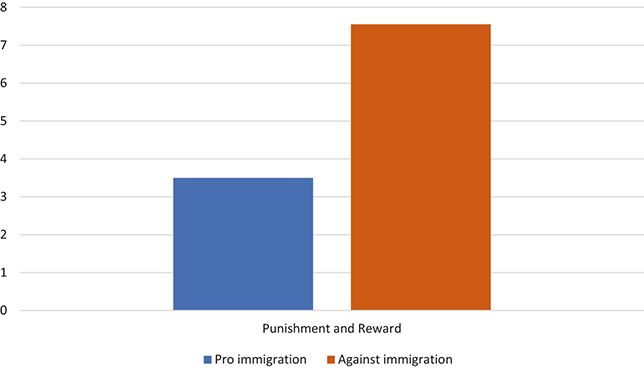
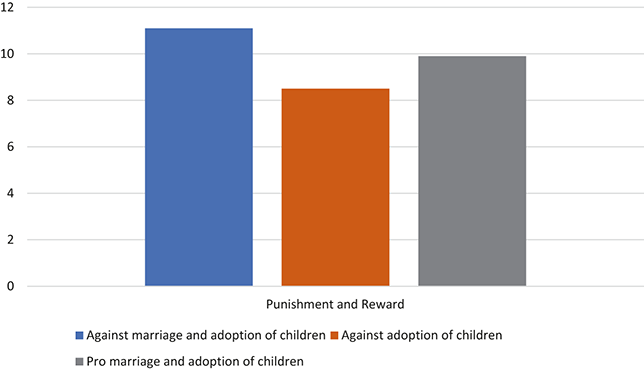
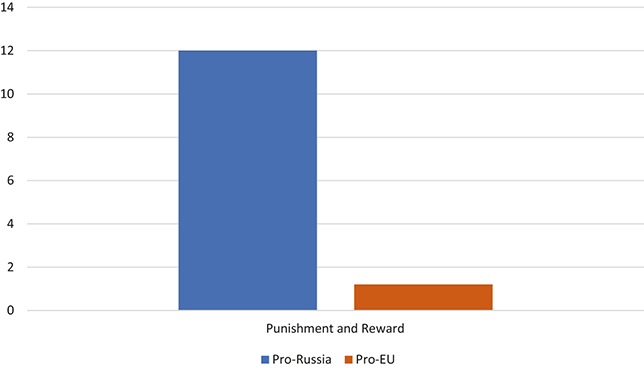
In Section 3, I continue with empirical analysis and present empirical evidence that should confirm plausibility of my threat-driven mechanism. Accordingly, political entrepreneurs in the five countries under investigation strategically portrayed the nation’s identity and sovereignty as being under threat from various actors: from domestic outsiders, such as secular elites and different communities that are seen as not belonging to the nation (LGBT, Kurds, and Israeli Arabs), to external actors, such as the West and immigrants from Muslim countries. The narratives resonated not only because of the skillfulness of the political actors, but also because of the available raw material stemming from the current context and historically rooted conflicts and experiences. I furthermore offer evidence that show that such a development increased the willingness of voters to tolerate undemocratic behavior of politicians because, as Section 2 shows, it was done in the name of safeguarding the allegedly endangered nation.
If the strategy of political entrepreneurs was to portray the nation as threatened, which in turn made many voters more willing to tolerate the subversion of democracy that is done in the name of protecting the nation, then to improve our understanding of democratic resilience it is necessary to analyze how pro-democracy actors in selected countries responded to such a strategy. Hence, in Section 4, I will argue that a compelling counternarrative, which integrated the regime cleavage between autocratic and democratic forces, proved to be an important factor in resistance. In Poland, the narrative centered on the defense of Poland’s EU membership as an integral part of Polish identity as a Western nation that is threatened by PiS’s authoritarian policies, while in Israel it centered on the defense of democratic values and institutions as an integral part of Israel’s founding narrative. Far from being solely responsible for the successful resistance, counternarrative was instrumental for mobilizing pro-democracy citizens both in the streets and at the ballot box. In the three remaining cases where the opposition forces ignored the threat narrative or tried to outflank the authoritarian incumbent by offering a more ethno-nationalist narrative, they were less successful. In addition, I will unpack the main factors that shape the pro-democracy actors’ decision on the resistance strategy in this regard.
In line with an outlined argument, with this Element I hope to contribute to both a pathway of democratic backsliding and strategies of resistance (Beatty Riedl et al. Reference Riedl, Paul Friesen, McCoy and Roberts2024): Firstly, by making the case for nationalism as a separate and complementary explanation of democratic backsliding, the Element refines the existing theoretical argument. More concretely, it depicts the exact manner in which key tenets of democracy are undermined: political elites employing appeals related to nation’s identity and sovereignty as a justification for attacks on democracy, accompanied by the narrative of a threatened nation that should increase citizens’ willingness to trade off democracy for the nation. In addition, the Element sheds new light on the strategies of resistance by also showcasing that a nation-related counternarrative matters for successfully resisting the subversion of democracy in the name of the nation. These lessons of my Element could be valuable not only for better understanding the existing empirical cases. They can be useful for cases beyond them as well.
In addition to open primary and secondary sources, these claims are backed by various exclusive data sources, such as the data from experimental cross-national surveys that I have conducted with several colleagues and data provided to me by other organizations. This exclusive category of sources also includes thirty-one semi-structured interviews with actors from politics and civil society in the countries under investigation who were directly involved in the processes I analyze.
In sum, my goal is to contribute to the conceptualization of the relationship between nationalism and democracy by providing sufficient evidence for the plausibility of the theoretical argument that political elites managed to subvert democracy with appeals on the protection of the nation’s identity or sovereignty because they were also able to convince voters that their nation’s identity or sovereignty are endangered. Developing a compelling nation-related counternarrative, which has the potential to secure the support of the majority of citizens, helps to successfully counter the subversion of democracy in the name of the nation. This tells us that there is no “some single thing called nationalism” (Gustavsson and Miller Reference Gustavsson, Miller, Gustavsson and Miller2020, 1) and that nationalism is not per se a pernicious force (Fish Reference Fish2024). It can also be a force for good.
2 People’s Simultaneous Support for Democracy and Those Who Subvert It: When Voters Abandon Democracy for the Nation
“The crisis here is not a crisis in democracy but a crisis in theory.”
In many countries around the world the majority of citizens find democracy the best form of government – yet, they vote for political actors who subvert it. Indeed, surveys show citizens’ solid commitment to democracy even in countries that serve as examples of democracy’s recent troubles, thereby including the countries that are the focus of this Element (Pew Research Center 2024). What is more, according to the surveysFootnote 2 I have conducted with several colleagues, democracy appears to be highly valued even among voters of the parties responsible for its erosion. For 78% of Hungarian Fidesz voters, 82% of Serbian SNS voters, and 92% of Polish PiS voters it is important to live in a country that is democratically governed, whereas 89% of Fidesz voters, 83% of SNS voters, and 93% of PiS voters strongly agree or agree that democracy is better than any other form of government.
Democracy has always been a contested concept (Collier, Hidalgo and Maciuceanu Reference Collier, Hidalgo and Maciuceanu2006), which is why both citizens and experts often have different understandings of what democracy is (Canache Reference Canache2012; Schedler and Sarsfield Reference Schedler and Sarsfield2007). Thus, when voters talk about democracy, they often do not mean the same as democracy does not necessarily mean the same thing in different cultural contexts (Schwertheim Reference Schwertheim2017). In addition, the term democracy and its various meanings have been intensely politicized by political actors in many countries (Torcal and Magalhães Reference Torcal and Magalhães2022). Indeed, in many autocratizing countries illiberal measures have been presented not as anti-democratic, but as means of enhancing democracy. This has practical implications because research has shown that many voters do take cues about the state of democracy from their favorite parties (Gidengil, Stolle and Bergeron-Boutin Reference Gidengil, Stolle and Bergeron-Boutin2021; van der Brug et al. Reference van der Brug, Popa, Hobolt and Schmitt2021).
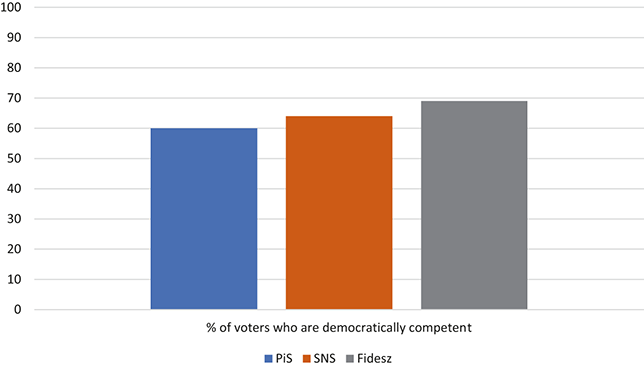
Could it then be that the voters of Fidesz, SNS, and PiS did not even see themselves as supporting something undemocratic in the first place? Perhaps they were not aware of Fidesz’s, SNS’s, and PiS’s undemocratic behavior because they do not perceive it as such amid their lack of understanding of what democracy is? To assess this, my colleagues and I evaluated the democratic competence of Polish, Hungarian, and Serbian citizens. Respondents were asked to evaluate a series of democratic and undemocratic practices so that we could establish whether they know what is democratic and what it is not. According to our results, not only the majority of Polish (78%), Hungarian (72%), and Serbian (76%) citizens are democratically competent, but this also holds for the majority of voters of PiS (60%), Fidesz (69%), and SNS (64%). Therefore, the majority of them are fully capable of recognizing undemocratic behavior (see Figure 1).
Democratic competence.
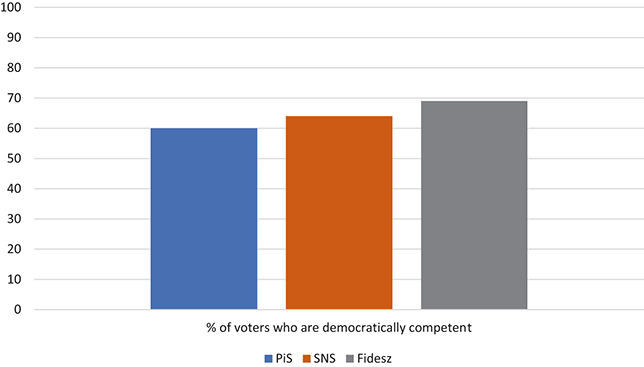
Notwithstanding the fact that in every electorate there is a fraction of voters who do vote for authoritarian-minded leaders because of their authoritarianism (Grossman et al. Reference Grossman, Kronick, Levendusky and Meredith2022), these data tell us that most voters have cast a ballot for authoritarian incumbents not because of their authoritarianism, but in spite of it. Thus, we are dealing with a majority of voters who value democracy and can distinguish between democratic and undemocratic behavior. Yet they continue to vote for politicians who undermine democracy. This phenomenon clearly demonstrates the limitations of conventional democratic thought. Indeed, these contradictory findings tell us that the theory on the role of democratically minded citizens in defending democracy and its principles (Diamond Reference Diamon1994; Weingast Reference Weingast1997) needs refinement.
2.1 Predominant Theoretical Explanations
This necessity has been recognized by many scholars. The erosion of democracy prompted them to try to explain people’s simultaneous support for both democracy and those who subvert it. According to the polarization theoretical argument, in a political system characterized by toxic polarization, voters are willing to trade off democratic principles for partisan interests so that their side can win (Svolik Reference Svolik2019; Graham and Svolik Reference Graham and Svolik2020; Simonovits, McCoy and Littvay Reference Simonovits, McCoy and Littvay2022). Hence, it is argued that in a polarized environment, voters are willing to overlook violations of democratic rules in order to advance their ideological agenda and advantage their favorite party as well (Gidengil, Stolle and Bergeron-Boutin Reference Gidengil, Stolle and Bergeron-Boutin2021). Voters namely tolerate or even encourage policies that erode democratic norms because the opponent is not regarded as a legitimate adversary, but as an enemy to be kept out of office at all costs (McCoy, Somer and Luke Reference McCoy, Somer and Luke2021).
The polarization of society in Hungary, Poland, and Serbia did indeed increase after Fidesz, PiS, and SNS came to power, but even before that, these countries were marked by serious societal polarization (V-Dem Index) that did not lead to a deterioration of their democracies. In fact, according to the V-Dem indexes on liberal democracy and societal polarization, Serbia, Poland, and Hungary were characterized by serious polarization of their respective societies while their democracies were performing the best. In Poland, democracy flourished even as the country also endured serious political polarization. The same holds true for Turkey, which also recorded the highest democratic development in times of serious political polarization. Similarly, according to V-Dem data, Israel has been marked by a serious societal polarization for many years, without, however, this fact reflecting on the quality of its democracy. These examples tell us that serious polarization per se may not be sufficient to trigger democratic backsliding as there must be an actor willing to exploit the situation. Hence, rather than being a principal cause of democratic backsliding, polarization’s role should be seen as an important facilitator of political actors’ efforts to subvert democracy – or as a byproduct of such efforts. The threat narrative that helped to subvert democracy in selected countries, and which was a clear form of divisive and polarizing discourse, seems to confirm this.
The existence of conditions that can trigger human suffering, such as an economic crisis, is regarded as another contributing factor to democratic backsliding (Matkovski Reference Matkovski2021). Turmoil, dysfunction, and injustice make people more susceptible to the political elites’ narrative justifying their authoritarian rule as necessary to successfully address these challenges (Matkovski Reference Matkovski2021). Resolving an acute crisis can transform an aspiring autocrat into a “savior of the people,” facilitating their assault on democracy (Weyland Reference Weyland2025, 8). In addition, economic crises also generate cultural discontent and in this why enflame conflicts over values and identities (Rhodes-Purdy, Navarre and Utych Reference Rhodes-Purdy, Navarre and Utych2023). Economic crises thus create anxieties that make citizens vulnerable to authoritarianism (Rhodes-Purdy, Navarre and Utych Reference Rhodes-Purdy, Navarre and Utych2023). Again, however, we cannot observe a clear pattern when we look at countries’ GDP growth prior to the onset of backsliding and during the most intense attacks on democracy. The Israeli and Polish economies were performing well, with stable and high growth, but so was the Turkish economy (World Bank 2024). Thus, it appears that economic crises help authoritarian actors gain power, as was indeed the case in Serbia and Hungary, but while they certainly contributed to the deterioration of democracy in selected cases, they cannot fully explain democratic backsliding (Carothers and Hartnett Reference Carothers and Hartnett2024).
2.2 Distinguishing Nationalism From Populism
Similar to the theoretical arguments presented in 2.1, populism alone cannot fully explain democratic backsliding. The populism argument also puts emphasis on the role of political actors and their narrative that arguably makes voters more receptive to undemocratic behavior. Accordingly, populists divide society into pure people and corrupt cosmopolitan elites who act against national interests that can be both cultural and economic (Mudde Reference Mudde2007; Enyedi Reference Enyedi2020; Vachudova Reference Vachudova2020). This anti-elitist narrative is then misused to target “the formal institutions of oversight and accountability in the name of bringing such institutions under popular control” as well as to eliminate opponents from political life by branding them illegitimate (Müller Reference Müller2017; Grzymala-Busse Reference Grzymala-Busse2019, 707). Hence, cosmopolitan elites as well, usually in the form of mainstream parties, must be prevented from gaining power at any cost as they act against the interests of the real people.
The authoritarian populism argument has many strengths as well, and in some of the cases under investigation one could clearly observe a malign influence of leaders’ populist rhetoric on democracy (Norris and Inglehart Reference Norris, Inglehart, Trump and Populism2019). Indeed, depicting cosmopolitan elites as enemies was an integral part of efforts to subvert democracy. However, these appeals often did not target elites as such (Bill Reference Bill2020), but rather because they allegedly endanger the nation’s identity (its ethnic and cultural composition). Yet despite their clear ethno-nationalist nature, these appeals have usually been attributed to populism because the radical right variety of populism defines people according to ascriptive and exclusionary ethno-cultural criteria (Mudde Reference Mudde2007; Milacic and Vukovic Reference Milacic and Vukovic2018; Brubaker Reference Brubaker2020). Although such features can in fact be found in this variety of populism, they are not inherent to populism (Rooduijn Reference Rooduijn2014; Bonikowski Reference Bonikowski2017; De Cleen and Stavrakakis Reference De Cleen and Stavrakakis2017). As already noted, the central feature of populism is the vilification of corrupt elites who act against people’s interests. And these elites can indeed be seen as illegitimate because they do not represent the ethno-cultural interests of the ordinary people or the majority, but rather of minorities (Caiani and della Porta Reference Caiani and della Porta2011; Bhanu Mehta Reference Bhanu Mehta2024). However, for populists, the interests of “the people” can also be political or ideological, invoking class struggle and economic antagonism, not just ethnic or cultural (Müller Reference Müller2021; De Cleen Reference De Cleen, Rovira Kaltwasser, Paul and Ostiguy2017).
Unlike populism, the question of who belongs to the nation is inherent to nationalism. Indeed, nationalism envisages the nation “as a limited and sovereign community” that “is constructed through an in/out opposition between the nation and its outgroups” (De Cleen and Stavrakakis Reference De Cleen and Stavrakakis2017, 9; Brubaker Reference Brubaker2020, 12). In its more inclusive form nationalism views the nation members’ shared civic values and their identification with the state as its main building blocks (Hobsbawm Reference Hobsbawm2012; Ignatieff Reference Ignatieff1993). In nationalism’s less inclusive or exclusionary form, however, in-group belonging derives from ethnic, linguistic, or religious ties (Smith Reference Smith1986), with religion being perceived as an especially important building block (Gorski Reference Gorski2003). This notion of nationalism furthermore often refers to the necessity of protecting the in-group and its homogeneity, which is threatened by “dangerous others” (the out-group) (Gellner Reference Gellner1983; Kohn 1944).
However, it is fair to say that populist discourse is also structured around an in-group and out-group differentiation. But there is an important difference between populism and nationalism in this regard. Unlike populists, who see elites as a threatening “outside” (Brubaker Reference Brubaker2020), the experience of cases under investigation confirms that for nationalists the out-groups can be of various origins: from domestic outsiders, such as secular elites or different communities that are seen as not belonging to the nation (LGBT, Kurds, and Israeli Arabs), to external actors, such as the West and immigrants from Muslim countries (more on this in Section 3). Moreover, they are perceived as out-groups precisely because they pose a threat to one of the two defining features of the nation: Firstly, they do not share the in-group’s ethnic, cultural or religious characteristics and values and thus do not belong to the “limited community”; secondly, they endanger the “community’s sovereignty” by infringing on its right to “self-rule over a distinct territory” (Mylonas and Tudor Reference Tudor2023, 23). This includes a monopoly on the legitimate use of force within its territory to ensure the nation’s territorial integrity and security (Taylor Reference Taylor1992; Weber Reference Weber1992).
Hence, populism and nationalism can be interconnected and combined, and very often they are. Nevertheless, we should not ignore their differences and conflate them. If political actors’ appeals are mainly rooted in the protection of nation’s identity (ethnic, religious, and cultural composition of the country) and sovereignty (territorial integrity and security), then nationalism is a more suitable analytical concept.
2.3 The Threat Narrative and the Subversion of Democracy
Democratic processes have often been shaped by nationalism. Fixed and permanent borders of a country, coupled with a sense of national unity, have been regarded as absolute prerequisites for democracy (Dahl Reference Dahl1989; Linz and Stepan Reference Linz and Stepan1996). In addition, democratic development was also affected by the decision on the concept of the national identity. The concept of civic citizenship is seen as favoring democracy for being inclusive, whereas the concept of ethnic citizenship is seen as opposing individual rights and being hostile to minorities (Nodia Reference Nodia2017). Indeed, in many countries exclusive, often religion-based, nationalism has legitimized the exclusion of minorities (Tudor and Slater Reference Tudor and Slater2021; Saiya Reference Saiya2023).
In recent years, we have furthermore witnessed political actors using nationalist appeals as a pretext and justification to attack key tenets of democracy, and this approach has proven effective. But does this then mean that political actors only need to use the “in the name of the nation” argument in order to succeed? That it can work everywhere and in all circumstances? I strongly disagree. It would be too easy to claim that in order to succeed, elites need only say we seek to curtail civil liberties because these liberties are not in sync with national identity or accumulate power in order to protect the nation’s sovereignty.
In other words, while previous work has found that appeals to safeguard the nation seem to have resulted in a minimized resistance of citizens to power grabs, it has not addressed the question of “why this approach works.” I argue that the threat narrative of political entrepreneurs is precisely the reason. Political actors often develop strategic narratives to achieve their political objectives (Miskimmon, O’Loughlin and Roselle Reference Miskimmon, O’Loughlin and Roselle2013). Creating a story is important because it helps citizens to understand the phenomena in question and to persuade them of why particular political actions are right or necessary (Antoniades, Miskimmon and O’Loughlin Reference Antoniades, Miskimmon and O’Loughlin2010). Accordingly, political actors in the studied countries developed threat narratives to convince voters that their nation’s identity or sovereignty are threatened because this seems to make them more willing to accept the subversion of democracy that is done in the name of protecting the supposedly endangered national identity and sovereignty. But why do we see such an effect?
2.3.1 Why Groups Matter
Social psychology tells us that the propensity for an “us” vs. “them” thinking (dichotomizing) is innate to all humans (Bargh Reference Bargh, Wyer and Srull1994; Sapolsky Reference Sapolsky2019). According to it, our brain distinguishes between in-group members and outsiders automatically and unconsciously, and “we feel positive associations with people who share the most meaningless traits with us” (Sapolsky Reference Sapolsky2017, 390). This “brain argument” is furthermore consistent with findings that individuals have a fundamental need to belong to groups (Baumeister and Leary Reference Baumeister and Leary1995), that is, that “group attachments are easily generated and profoundly felt” (Achen and Bartels Reference Achen and Bartels2016, 215) even when individual benefits are not at stake (Gagnon and Bourhis Reference Gagnon and Bourhis1996). Groups not only satisfy our need for categorization to understand the world (Tajfel et al. Reference Tajfel, Billig, Bundy and Flament1971; Mason Reference Mason2018) and feel certain about our place within it (Mullin and Hogg Reference Mullin and Hogg1998), but provide their members with positive self-esteem (Tajfel Reference Tajfel1970; Hogg Reference Hogg1992).
How, then, are these basic understandings about the importance of groups related to the processes of democracy subversion in the name of the nation? Identity issues foster in-group/out-group thinking. In fact, the essence of many identity issues is belonging to a group with those who share that identity with us. Put simply, identity issues are “collective in nature” (Deaux et al. Reference Deaux, Reid, Mizrahi and Ethier1995, 286). Therefore, when it comes to identity issues, it is much easier to form a group, that is, to categorize oneself and others, than when it comes to socio-economic ones. Hence, our propensity for tribalism is much easily triggered when we are dealing with identity issues. This particularly applies to the nation as beliefs about the nation’s meaning “are central to people’s sense of self and their connections to others around them” (Bonikowski Reference Bonikowski2017, 188).
2.3.2 The Role of Political Entrepreneurs
It is, however, common for us to be members of many different groups based on different social identities. Indeed, most people belong to several politically meaningful groups. Such multiple memberships, or cross-cutting politically relevant affiliations, serve as an obstacle to perceiving the world in simplistic social-categorical terms and allow for compromises (Lipset Reference Lipset1959; Almond and Verba Reference Almond and Verba1963). These role designations can furthermore be conflicting and, according to Stryker (Reference Stryker, Yardley and Honess1987), they are organized into salience hierarchies. So, how does one identity climb up on the salience hierarchy, and a certain role designation is called into play? How does a membership in one group become a priority for the individual so that she acts in accordance with that category, while other group memberships are downplayed? More concretely, why does a certain group, such as the nation, become politically consequential at a certain point in time?
I argue that this is to be attributed to political entrepreneurs. By claiming that the group is in danger and by highlighting a clear-cut enemy, they strengthen the identification with the group and heighten the salience of the particular identity associated with the group (Hogg Reference Hogg1992; Hogg Reference Hogg, Brewer and Hewstone2004, 209; Huddy Reference Huddy, Huddy, David, Jack and Levy2013). When it comes to the nation, identifying an out-group is especially important because national majority often has to be manufactured. As pointed out by Chandra (2024, 59), majoritarian nationalists are aware that a majority is not coherent, but rather a collection of minorities, which is why a common enemy is needed to serve as a glue.
Yet, as previously emphasized, we are all shaped by multiple dichotomies based on different identities, and they “can be invoked at any time” (Hirschfeld cited in Berreby Reference Berreby2005, 212). One “us vs. them” dichotomy, which at one point of time seems inevitable and crucial, can under different circumstances lose its importance (Sapolsky Reference Sapolsky2017, 410). To prevent such a shifting of priorities, which would make their political success less durable, political entrepreneurs embrace a permanent campaign and constant political mobilization (Bhanu Mehta Reference Bhanu Mehta2025). They namely portray themselves as the 24/7 champions of national interests and the sole protectors of the ethnic and cultural composition of the country, that is, according to them, constantly under siege. That is why the freedom of media is usually their first victim when they come the power. It is critical for them to capture the media, both public and private, as this in turn enables them to permanently campaign and transmit to the wider public their message about the threats to the nation.
2.3.3 Narrative Frames
The role of political entrepreneurs is, therefore, essential in developing intense social and political attachments to a group. Human nature makes the job of political entrepreneurs whole a lot easier as the experiments of Tajfel (Reference Tajfel1970) and his followers (Brewer Reference Brewer1979; Diehl Reference Diehl1990) confirm: They showed that the human capacity for joining groups and disliking other groups is easily mobilized – even under the most minimal and meaningless of conditions. But political entrepreneurs’ skillfulness alone is not sufficient as there are other factors that determine their success.
Indeed, their attempts to develop strategic threat narratives and establish salient identities are constrained by the historical and social contexts. As pointed out by Entman (Reference Entman1993), narratives are crafted not only out of discourses, but also out of frames. They must be anchored in something. Different endogenous factors serve thereby as frames, conditioning the resonance of a narrative that sees the ethnic and cultural composition of the nation and its sovereignty as threatened. Foremostly, the parameters of a country’s narrative are bounded by its historical legacy. Anxieties and grievances related to the nation’s history – such as tragic historical events involving foreign rule or military defeats that had led to the loss of national territory or sovereignty – make many citizens more susceptible to threats related to the nation’s sovereignty and ethnic composition (Hiers, Soehl and Wimmer Reference Hiers, Soehl and Wimmer2017; Carter and Pop-Eleches Reference Carter and Pop-Eleches2024). Such societies tend to suffer from a permanent insecurity regarding their national territory, making them vulnerable to political entrepreneurship based on the threats to sovereignty. In addition, the historically insecure existence of the state favored the development of a stronger attachment to the national community than to the state, resulting in ethnic elements (ethnicity and religion) being more salient than the civic ones (Hiers, Soehl and Wimmer Reference Hiers, Soehl and Wimmer2017).
These grievances are furthermore usually coupled with narratives of the victimized nation and its exceptionalism as well. Their existence is important not only because they shape the interpretation of present-day events, but also because there is a correlation between the existence of narratives of victimhood and exceptionalism and the perception of the nation in ethno-nationalist terms (Feinstein and Bonikowski Reference Feinstein and Bonikowski.2019). An exclusionary conception of national identity stems from past struggles for national survival, often involving colonial or imperial humiliation (Ding, Slater and Zengin Reference Ding, Slater and Zengin2021), which favored loyalty to the national community (Hiers, Soehl and Wimmer Reference Hiers, Soehl and Wimmer2017). The chosenness, which is often grounded in predecessors’ ability to preserve national autonomy (Ding, Slater and Zengin Reference Ding, Slater and Zengin2021), is used to justify the possession of the state at the expense of minorities (Feinstein and Bonikowski Reference Feinstein and Bonikowski.2019).
Moreover, nations are often marked by competing national narratives based on different visions of the criteria for belonging to the nation (Tudor and Slater Reference Tudor and Slater2021). The existence of this kind of struggle also matters for the success of the strategic threat narrative. It offers, namely, the possibility to tap into resentment across ethnic, religious, or cultural lines. The same holds true for a political environment marked by formative rifts (Somer and McCoy Reference Somer2019) or stateness problem (Milacic Reference Milacic2022). The ongoing disputes on national borders or on the status of ethnic/religious minorities provide a permanent source for constructing a threat narrative. In such an environment, political actors are much less affected by contingency and less dependent on exogenous factors that facilitate political entrepreneurship, such as, for example, immigration crisis triggered by the war. In addition, the societies plagued by ongoing or recurring territorial conflicts develop stronger ethnic forms of national identification (David and Bar-Tal Reference David and Bar-Tal2009; Hiers, Soehl and Wimmer Reference Hiers, Soehl and Wimmer2017).
Lastly, it appears that an increased level of emigration and population decline, as several Eastern European cases show, can lead to demographic anxieties and an erosion of a previously stable collective identity rooted in national belonging, which is another important facilitating factor of political entrepreneurs’ success (Krastev Reference Krastev2020). In sum, some societies are simply more prone to nation-related fears than others. Their collective memory and current social context provide raw material that political actors can exploit to develop an effective threat narrative.
2.3.4 Psychological Motivation for Tolerating Undemocratic Behavior
The depicted strategy of political entrepreneurs is successful because it has a particular psychological effect on voters. We already know that the groups to which we belong to influence our beliefs, preferences, and thus our political behavior (Stenner Reference Stenner2005; Sinclair Reference Sinclair2012). In fact, our group-related preferences and beliefs tend to be particularly strong when the group is based on our primary identity (Spry Reference Spry, Druckman and Green2021), which includes the nation, because primary identities are about “emotional attachments that transcend thinking” (Achen and Bartels Reference Achen and Bartels2016, 228). As a result, group loyalties based on identities often become drivers of our political behavior (Achen and Bartels Reference Achen and Bartels2016).
Such an influence of the group is even more consequential when the group and its interests are endangered. This triggers defensive reactions among many members of the group and strengthens the effects of in-group identification (Sherif Reference Sherif1967; Turner et al. Reference Turner, Hogg, Oakes, Reicher and Wetherell1987), in-group loyalty (Hogg Reference Hogg, Brewer and Hewstone2004), and the depersonalization of the self (Hogg Reference Hogg1992). Indeed, when the group is threatened, the individuals tend to conform to the group (Steiner Reference Steiner1954; Duckitt Reference Duckitt1989). This is particularly the case when the group in question has “great emotional significance” (Sides and Citrin Reference Sides and Citrin2007, 479) or confers a sense of identity as the individuals are motivated by the desire to maintain their social identity (Sinclair Reference Sinclair2012).
Moreover, the group members’ reasoning is thereby also affected. For group belonging, the individuals are, namely, willing to sacrifice sound reasoning and judgmental accuracy (Kahan et al. Reference Kahan, Peters, Dawson and Slovic2017). In fact, an environment marked by a threat to the group promotes the development of an in-group bias (Diehl Reference Diehl1990; Mullen, Brown and Smith Reference Mullen, Brown and Smith1992) and an out-group bias (Huddy Reference Huddy, Huddy, David, Jack and Levy2013). Subconsciously, individuals tend to evaluate information that supports their group’s interests more favorably and are more skeptical of information that challenges their beliefs and allegiances (Ditto et al. Reference Ditto, Liu and Clark2019).
In other words, affected group members tend to be characterized by bias and faulty decision-making (Turner et al. Reference Turner, Hogg, Oakes, Reicher and Wetherell1987; Monroe, Hankin and Bukovchik Van Vechten Reference Monroe, Hankin and Bukovchik Van Vechten2000). Their partisan goals (safeguarding the group and its interests) motivate affected individuals to apply their reasoning in defense of a prior, specific conclusions (Kruglanski and Webster Reference Kruglanski and Webster1996), what Lodge and Taber (Reference Lodge and Taber2013) called motivated reasoning. Hence, a sense of shared and linked fate and a commitment to a group that is allegedly under threat strongly affect many group members’ behavior and color their views (Stenner Reference Stenner2005; Achen and Bartels Reference Achen and Bartels2016).
2.3.5 Plausible Mechanism
If we apply these findings to the political terrain and the relationship between the nation and democracy, it means that when voters perceive their nation to be under threat, they also become more attached and committed to the nation. All of this, in turn, makes them more willing to tolerate undemocratic behavior of political actors that is done in the name of protecting the supposedly endangered nation. Authoritarian-minded leaders thus get a free pass because their subversion of democracy is ignored amid the existence of a threat to the nation or rationalized away as having the function of minimizing a threat. In sum, the established mechanism (see Figure 2) that explains voter acquiescence to elite’s subversion of democracy is essentially a three-step procedure.
Plausible mechanism.

2.4 Resistance Options
The three-step-mechanism outlined helps us to better understand democratic backsliding. What, however, we know much less about is what matters for resisting it. Simply because a successful resistance to backsliding incumbents is not the norm. Nevertheless, the works of several authors have identified important sources of resilience and possible paths of resistance (Ding and Slater Reference Ding and Slater2021; Welzel Reference Welzel2021; Treisman Reference Treisman2023; Beatty Riedl et al. Reference Riedl, Paul Friesen, McCoy and Roberts2024; Milacic Reference Milacic2025a). Various actors of resistance are thereby involved – state institutions, political parties, civil society organizations, trade unions, independent media, and ordinary citizens – and they can opt for various strategies as well: within institutions (courts, parliament, bureaucracies, electoral arena) or outside of institutions (street protests); and they can develop specific emotional narratives, which is the least investigated resistance strategy (Tomini, Gibril and Bochev Reference Tomini, Gibril and Bochev2023; Gamboa Reference Gamboa2023; Selvin Korkmaz Reference Selvin Korkmaz2023; Beatty Riedl et al. Reference Riedl, Paul Friesen, McCoy and Roberts2024).
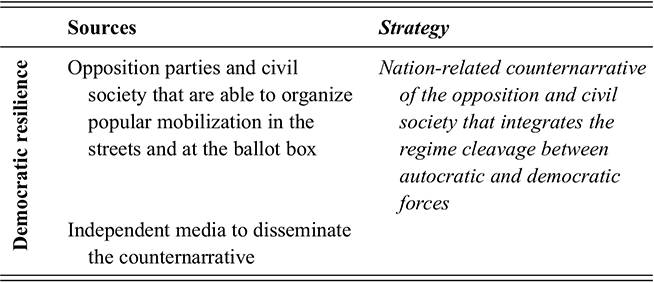
In this regard, it has been argued that “the characteristics of the political regime in which autocratization takes place have a major impact on the types of resistance actors involved and their strategies” (Tomini, Gibril and Bochev Reference Tomini, Gibril and Bochev2023, 123). The regime type influences the paths of resistance because, in some regimes, certain actors have been captured and certain arenas closed off, while this is not the case in others. I offer a complementary theoretical argument by claiming that the mode of democratic backsliding impacts the mode of resistance. When faced with an autocrat’s protection of the allegedly threatened nation serving as a justification for the subversion of democracy, pro-democracy actors have three options: ignore the threat narrative and the issue of the nation; outflank the autocrat by portraying themselves as more (ethno-) nationalist; or develop a nation-related counternarrative, into which they integrate the regime cleavage between autocratic and democratic forces. I argue that the counternarrative, which links the nation and democracy, is the most promising resisting strategy in this regard. It can help political parties and civil society to mobilize pro-democracy citizens to fight back, both in the streets and at the ballot box. I regard such a counternarrative as a necessary but not sufficient condition for successfully resisting this particular path of democratic backsliding (the subversion of democracy in the name of the nation). For a counternarrative to be effective, it has to be disseminated, which is why the existence of independent media is important for this strategy of resistance to succeed (see Table 2).
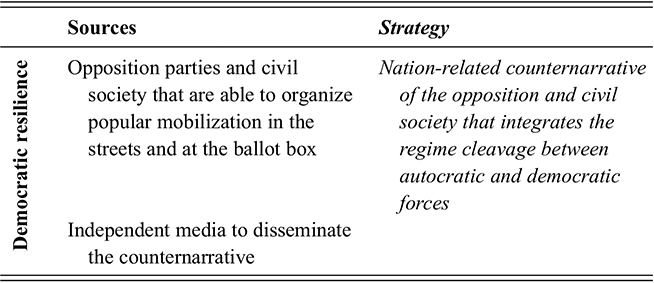
Table 2 Long description
This table illustrates the most promising option for pro-democracy actors when faced with an autocrat who uses the justification of protecting the allegedly threatened nation to subvert democracy: developing a nation-related counternarrative that integrates the cleavage between autocratic and democratic forces. The existence of independent media to disseminate the narrative is a prerequisite.
3 How Nationalist Elites Subvert Democracy
“He who saves his Country does not violate any Law.”
As the previous section showed, the electorates of the countries under investigation clearly value democracy. To succeed, therefore, the aspiring authoritarians had to justify their attacks on democracy. They found one of the most effective tools for this purpose in nationalism. As the following pages will show in more detail, nationalist appeals served as a pretext to attack all the key elements of democracy as defined by Dahl (Reference Dahl1971) and others (Linz and Stepan Reference Linz and Stepan1996): electoral fairness, civil liberties, and checks and balances. This is in line with the definition of democratic backsliding by Waldner and Lust (Reference Waldner and Lust2018) who define the phenomena as significant degradations with respect to elections, liberties, and accountability.
Playing the nationalist card has often been a part of political actors’ repertoire, thereby including the five countries under investigation. So why have authoritarian incumbents been successful in subverting democracy now, but not in the past? Because in the past, the instrumentalization of nation-related issues has mainly served as a potent mobilization strategy for the elections (Berman Reference Berman2019; de Vries and Hobolt Reference de Vries and Hobolt2020). What is new now is that nation-related political entrepreneurship is employed not only for advancing electoral chances, but also for more easily subverting democracy (Bartels Reference Bartels2023). Indeed, in all five countries under investigation, we are dealing here with a rather novel development marked by the skillful coupling of nationalist appeals and undemocratic actions.
In Serbia, the Kosovo issue has always played an important role in electoral mobilization, but it is Vucic who, for the first time, has systematically used it as a justification to attack democracy. In Turkey, Erdogan, in a similar way, misused the religious vs secular division and the Kurdish issue to attack all key elements of democracy. In Israel, the Palestinian issue has always been an important topic for electoral competition, but Netanyahu started using it as a pretext to attack democracy. In Hungary and Poland, the European refugee crisis was an exogenous issue that Orban and Kaczynski capitalized on. But again, it served not only for electoral mobilization, but also for the subversion of democracy. In other words, the experience of these countries tells us that national identity and sovereignty cannot only be politicized to gain more votes, but that they can also be weaponized against democracy itself.
Accordingly, at the heart of political actors’ nationalist appeals was the protection of the ethnic, religious, and cultural composition of the nation and the interests of the collective identity structured in an exclusionary way. Hence, in this particular case we are dealing with ethno-nationalist appeals and they were primarily employed. These appeals were furthermore accompanied by appeals to safeguard nation’s sovereignty, which were employed to a lesser extent. Hence, political elites presented attacks on democratic institutions and norms as necessary to protect national identity or nation’s sovereignty from foreign powers and their domestic allies (pro-democracy actors) who are undermining it; framed attacks on democracy as advancing the interests of the collective identity structured in an exclusionary way based on ethnic or religious belonging; and often directly linked democratic institutions and norms to threats to the nation.
Moreover, the nationalist appeals about the protection of the nation’s identity and sovereignty were combined with exclusionary majoritarian appeals. The authoritarian incumbents in selected countries did not merely describe their actions as “the will of the majority” derived from the electoral outcome. They went a step further by claiming that they were elected by the “real” people that they defined in ethnic and religious terms. Their majority is thus not just any majority. It is the majority composed of the “true” people, with “the people” being understood as “another name for the national community” (De Cleen and Stavrakakis Reference De Cleen and Stavrakakis2017, 10). It is, therefore, not the will of the majority that they exhibit, but the will of the nation. Subsequently, they claimed to have a mandate to unilaterally remodel the system (Bozoki Reference Bozóki, Magyar and Vásárhelyi2017; Somer Reference Somer2019, 55; Kremnitzer and Shany Reference Kremnitzer and Shany2020) and implement changes deemed necessary “for the good of the people” (Fomina Reference Fomina, Carothers and O’Donohue2019, 136). The aim was to strengthen the particularistic, exclusionary defined nature of the state, which ensures that authoritarian incumbents remain in power because, as Orban once said, “the homeland can’t be in opposition” (cited in Bozoki Reference Bozóki, Magyar and Vásárhelyi2017, 481).
3.1 Attacks on Liberal Components of Democracy
In order to successfully consolidate power, authoritarian incumbents must deal with those actors who might offer the strongest resistance to their autocratization. The goal is to weaken or eliminate them so that they cannot resist. In the five countries under investigation, this has been done by employing rhetorical attacks that delegitimized opponents; by adopting legislation that made it difficult or impossible for them to successfully act as a check on the government; by curtailing various civil liberties in practice; and by weakening or dismantling the system of checks and balances. In the name of the nation served thereby as a frequent justification.
3.1.1 Delegitimization of Opponents
When it comes to delegitimizing opponents, such as critical media, critical CSOs, and opposition parties, incumbents and their allies have typically vilified them as “traitors of the nation” and “enemies of the people” (Vladisavljevic Reference Vladisavljevic, Jovanovic and Vucicevic2020; Rogenhofer and Panievsky Reference Rogenhofer and Panievsky2020; Filc and Pardo Reference Filc and Pardo2021). In Serbia, government opponents were discredited as anti-Serbian and as spies paid for by foreigners (the West) “with only one goal – the destruction of our country and the granting of the independence to so-called Kosovo” (Vucic cited in B92 2023; CSO 2024, 205). The AKP and Erdogan portrayed their secular opponents as the enemies of the pious real people (Somer Reference Somer2019) and CSOs’ actions as a Western conspiracy (Somer Reference Somer2017) trying to halt the rise of the new Turkey (Tas Reference Taş2015, 784; Rogenhofer and Panievsky Reference Rogenhofer and Panievsky2020).
Following an identical pattern, the opponents of the PiS were denigrated as “Poles of the worse sort” (Kaczynski cited in Fomina and Kucharczyk Reference Fomina and Kucharczyk2016, 63) and traitors who conspire with the country’s foreign enemies in order to keep Poland subordinated (Grzymala-Busse Reference Grzymala-Busse2019). In Hungary as well, Orban vilified critical CSOs as “paid political activists … trying to help foreign interests” (cited in BTI Hungary 2016, 8), while the CSOs that helped immigrants were accused of treason (Köves Reference Köves, Kucharczyk and Mesežnikov2018). Netanyahu and his allies went even further in their delegitimization attempts. In addition to the “usual” accusations of being “enemies of the people” (Rogenhofer and Panievsky Reference Rogenhofer and Panievsky2020) and of colluding with foreign governments to harm Israel (Talshir Reference Talshir2018), the opposition, CSOs, and the critical media were also portrayed as “a treacherous group that endangers the existence of the state” (Levi and Agmon Reference Levi and Agmon2021) and even equated with Hezbollah leaders and Hamas terrorists (Panievsky Reference Panievsky2022, 820).
3.1.2 Targeting Legislation
In most of the selected cases, the attacks did not remain at the rhetorical level. In fact, they were a prelude to a targeting legislation (Kremnitzer and Shany Reference Kremnitzer and Shany2020) that affected the work of opposition actors, foremostly CSOs. Once again, this was justified as safeguarding the nation from foreign influences or as the protection of its identity.
The typical example in this regard was a so-called “Foreign Agent Law.” In 2016, the Knesset’s majority passed the law, which requires from the CSOs that receive more than half of their funding from foreign entities to declare it in their advertisements, letters, and reports, essentially labeling them as “foreign agents” (Lamarche Reference Lamarche2019). Orban and Fidesz tried to intimidate critical CSOs in a similar way. The so-called “Lex NGO” adopted in 2017 also forced CSOs that receive funding from abroad to label themselves as “foreign-funded organizations” in all their publications (Bárd Reference Bárd2020). In Turkey as well, legislation affecting civil society has become restrictive, notably by designating any CSO that accepts funding from abroad as a potential foreign agent (BTI Turkey 2014).
However, this was not a single piece of such legislation. The new legislation imposed special taxes on donations from foreign governments to Israeli organizations (Oren Reference Oren2023). Similarly, Hungarian organizations that carry out activities promoting immigration must pay a 25% surtax foreseen by the so-called “Stop Soros” law (Szabo Reference Szabó, Kucharczyk and Mesežnikov2018). Moreover, in Hungary and Poland the legislation was adopted that provides a legal basis for favoring pro-government CSOs with a Christian, conservative agenda in the distribution of public funds (BTI Hungary 2014; Kremnitzer and Shany Reference Kremnitzer and Shany2020; Pirro and Stanley Reference Pirro and Stanley2021, 96; Takacs, Fobear and Schmitsek 2022). In addition, as civil activist Ulas Tol told me in an interview, anti-terror legislation has silenced Turkish CSOs dealing with the protection of minorities’ rights, such as the rights of Kurds, because they can easily be banned for empowering terrorism.
3.1.3 Practical Curtailing of Various Liberties
In addition to delegitimizing opponents and justifying targeted legislation, nationalist appeals have been used as a cover to curtail various civil and political liberties. One of the first victims was the media freedom. Indeed, the transformation of the state – for which, as noted above, the authoritarian-minded incumbents claimed to have a full mandate as enforcers of the nation’s will – was used as a pretext to capture public broadcasters. Apart from Israel, pro-government reporting of public broadcasters was ensured by purging them and packing them with loyalists (Brouillette and van Beek Reference Brouillette and van Beek2015; Danas 2016; Fomina and Kucharczyk Reference Fomina and Kucharczyk2016; Kaya Reference Kaya2015; Sadurski Reference Sadurski2018), thus hampering an equal access to the public media (see ODIHR reports).
Moreover, in Poland and Hungary, some attacks on the private media were also framed as a fight for the nation. In Hungary, the concentration of more than 400 media outlets into a single conglomerate called the Central European Press and Media Foundation was declared by the government to be in the “national interest” (Enyedi and Mikola Reference Enyedi, Mikola, Riedl, Friesen, McCoy, Roberts and Somer2023) as the foundation’s mission is to promote activities that “strengthen Hungarian national identity in the print, radio television and online media platforms” (Polyak Reference Polyak2019). The PiS government called its own attempts a “repolonization” of the media. In practice, the aim was to silence critical private media by reducing foreign ownership and helping government allies to take control of them (Tilles Reference Tilles2020b; BTI Poland 2022; Sata and Karolewski Reference Sata and Karolewski2023). Unlike Serbia, Turkey, and Hungary, where authoritarian incumbents largely managed to capture diverse private media landscapes, the PiS failed in its attempt. The proposed law, which aimed to silence the US-owned news channel TVN by forbidding companies outside the European Economic Area to hold a controlling stake in Polish media outlets, was vetoed by President Duda amid strong pressure from the US (Koper and Plucinska Reference Koper and Plucinska2021).
Other liberties have also been curtailed in the name of the nation, such as the freedom of expression. The Fourth Amendment to the Hungarian Constitution stipulates that freedom of expression cannot be used to dishonor the Hungarian nation (Kremnitzer and Shany Reference Kremnitzer and Shany2020). In a similar vein, the Polish Law on the Institute of National Remembrance provides for civil sanctions for statements that harm the reputation of Poland or the Polish nation (Sadurski Reference Sadurski2018), while Israel’s so-called “Boycott Law” imposes economic sanctions on citizens and organizations that call for a boycott of Israel (Mordechay and Roznai Reference Mordechay and Roznai2017). However, the most serious attacks on the freedom of expression were observed in Turkey. Any critical coverage of the issues related to the national identity – such as the Kurdish issue, the Armenian issue or the issue of minority rights – was sanctioned by referring to the Turkish Penal Code that criminalizes “insults to Turkdom” (BTI Turkey 2014). Such sanctions were seen as protecting the identity and interests of the state (Somer Reference Somer2016). In addition, a new anti-terror law, mainly related to the Kurdish issue, was used to silence critics by imprisoning them for allegedly spreading propaganda of terrorist organizations (Esen and Gumuscu Reference Esen and Gumuscu2016; Oren and Waxman Reference Oren and Waxman2022/23). The anti-terror law continues to be used to restrict the freedom of expression, as illustrated by the example of Enver Cevik, international secretary of the Kurdish Dem Party, whom I interviewed. He was sentenced to two years and one month under the anti-terror law for a tweet criticizing the government.
In some of the countries under investigation, nationalist appeals were also used as a pretext to curtail freedom of assembly. The new Polish regulation on the right of assembly gave priority to assemblies dedicated to patriotic, religious, and historic events – usually organized by the PiS – and made counter-assemblies in the direct vicinity of these national identity-related assemblies illegal (Sadurski Reference Sadurski2018). In Serbia, the LGBT parade was not allowed because it allegedly conflicted with national interests regarding the Kosovo issue (Rujevic Reference Rujevic2022), while in Turkey the anti-government demonstrations were portrayed as tools of foreign powers (Carothers and Press Reference Carothers and Press2022), which was used as a pretext to deny freedom of assembly (BTI Turkey 2016).
Moreover, in Poland, Turkey, and Hungary in the name of protecting the nation a new regulation was adopted that enabled monitoring of the digital communication of citizens (Tas Reference Taş2015, 784; Rydzak Reference Rydzak2016; BTI Hungary 2018). An ethno-religious understanding of the people led furthermore to the discrimination against ethnic, religious, and sexual minorities who do not belong to “us,” such as Kurds in Turkey (Somer Reference Somer2019; Yabanci Reference Yabanci2022, 7) or LGBT community in Poland and Hungary (Korolczuk Reference Korolczuk2020; Takacs, Fobear and Schmitsek 2022; Sagi Reference Sagi2023; Ayoub and Stoeckl Reference Ayoub and Stoeckl2024, 62). In Israel, the Nation State Law from 2018 is the most prominent example of discrimination against minorities. In order to ensure Israel’s future as the nation-state of the Jews (Netanyahu cited in Waxman and Peleg Reference Waxman and Peleg2020, 187), the parliamentary majority passed the Nation State Law that formally elevated Jewish collective rights over individual political rights, thereby reducing the status of religious minorities in Israel to de facto second-class citizens (Gutwien Reference Gutwien, Handel, Allegra and Maggor2017, 30; Smooha Reference Smooha2019, 26; Rogenhofer and Panievsky Reference Rogenhofer and Panievsky2020).
3.1.4 Undermining Checks and Balances
The undermining of the system of checks and balances, leading to the executive aggrandizement (Bermeo Reference Bermeo2016), occurred in a similar manner. By portraying themselves as “the embodiment of the nation and the main custodian and definer of its interests” (O’Donnell Reference O’Donnell1994, 60) incumbents personalized power and exerted disproportionate influence over policy and outcomes. Indeed, Erdogan often portrayed himself as the embodiment of national interests (Tas Reference Taş2015) and the sole defender of the nation against its enemies (Somer Reference Somer2016). In a similar fashion, Vucic portrayed himself as the sole guardian of national interests and even as the embodiment of the grievances related to the Kosovo issue (Milacic Reference Milacic2022). Kaczynski, Netanyahu, and Orban also used similar appeals to cement their status as protectors of the endangered nation (Bozoki Reference Bozóki, Magyar and Vásárhelyi2017; Tilles Reference Tilles2020b) and as “the sole savior of the Jewish state” (Talshir Reference Talshir2018).
This special legitimacy and popularity, derived from their role as protectors of the nation’s identity and sovereignty, enabled power grabs. As head of the government, Orban was already the dominant figure. But his role as a tribal leader (Bozoki Reference Bozóki, Magyar and Vásárhelyi2017) also led to an informal concentration of power in his hands as important decisions were made by a close circle around him (BTI Hungary 2020). As prime minister, Erdogan depended on a parliamentary majority. However, the 2017 constitutional reforms gave him more legislative powers at the expense of the other two branchesFootnote 3 and made him independent of the parliamentary majority through his direct election. Constitutional amendments were necessary for “a great Turkey” and “a strong Turkey” (Erdogan citied in Kaya Reference Kaya2021), and according to the AKP such a strengthening of the bond between the Muslim-Turkish nation and its leader was the only effective response to existential threats and crises (Yabanci Reference Yabanci2022; Tas Reference Taş2015, 778).
In the cases of Vucic and Kaczynski, their actual power was much less in line with constitutional provisions. Vucic, as the president, was in a weaker position than the prime minister, which was even more evident in the case of Kaczynski who was “only” an MP and deputy prime minister. Hence, Serbian politics unfolded largely outside the formal rules (Vladisavljevic Reference Vladisavljevic2019), with real power residing in the inner circle of the “savior of the nation.” It was irrelevant whether Vucic held the position of a prime minister (2014–2017) or the president (since 2017), with prime ministers Ana Brnabic, Milos Vucevic, and Djuro Macut being handpicked by him. Similarly, and despite constitutional provisions, Kaczynski, who was routinely referred to by his subordinates as “Naczelnik” (leader) (Tworzecki Reference Tworzecki2019), enjoyed “a veto power over key decisions and policies in Poland” (BTI Poland 2022, 8) and controlled “both the president and the government” (Krzyzanowski Reference Krzyzanowski2018, 82).
Although many actors deferred to Erdogan, Vucic, Orban, and Kaczynski because of their popularity as champions of national interests, this alone cannot explain their ability to accumulate so much power in their hands. This was mainly possible because they also used their popularity and legitimacy as “protectors of the nation” to establish full control over their respective parties and thus dominance over the parliamentary majority (this was less relevant for Erdogan after the introduction of the presidential system). In this way, they institutionalized backsliding. Indeed, the existing total discipline within the parties (Bozoki Reference Bozóki, Magyar and Vásárhelyi2017) meant that an election result with an absolute majority of seats or a near-absolute majority (with smaller and weaker partners) also meant Erdogan’s, Vucic’s, Orban’s, and Kaczynski’s dominance over the parliament. It, namely, meant that the parliaments’ oversight role became formalistic, as they acted as a voting machine of the ruling party and were effectively turned into rubber-stamp parliaments (Sadurski Reference Sadurski2018; Bogaards Reference Bogaards2018; Somer Reference Somer2019; European Commission Serbia 2020, 11).Footnote 4
Such control over the parliamentary majority is the main difference between them and Netanyahu, who managed to secure dominance over his Likud (Haklai and O’Donohue Reference Haklai and O’Donohue2024), but not over the parliamentary majority that would become a vehicle for him to exercise power at the expense of other branches of government. Only recently have his interests and undemocratic agenda fully aligned with those of his new radical right coalition partners, with the attacks on the judiciary as a result. Indeed, the parliamentary majority proposed but (so far) failed to implement a judicial “reform” that would give the government control over the selection of judges and allow parliament to override Supreme Court rulings (Gidron Reference Gidron2023). Unsurprisingly, the attempt was justified by portraying the court as pro-Palestinian because it acted “as an obstacle to Jewish territorial expansion in the West Bank” (Makovsky Reference Makovsky2019; Gidron Reference Gidron2023, 42) and advanced universalist liberal principles that dilute Jewish identity and threaten “our [the Jewish people’s] ability to secure our existence” (Levi and Agmon Reference Levi and Agmon2021, 299).Footnote 5
Contrary to Israel, in other countries under investigation, the control of the legislative branch of the government then made it possible to neutralize or capture other state institutions and oversight mechanisms, particularly the judiciary. As already emphasized, these majoritarian “reforms” were presented as the nation’s will because, for authoritarian nationalists, democracy is the rule of the ethno-culturally defined electoral majority. By “reforming” the legal system because it is not only full of the nation’s traitors (Sadurski Reference Sadurski2018; Sata and Karolewski Reference Sata and Karolewski2020), but it also weakens the will of the true people (Somer Reference Somer2017), the autocrats claimed they were simply enacting the will of the nation. In some cases, like Serbia, they did not bother to purge it because it was simply not necessary. The judiciary deferred to the executive power amid its broad electoral appeal (Milacic Reference Milacic2025b).
3.2 Attacks on Electoral Component of Democracy
In the countries under investigation, the nationalist appeals were also used to unlevel the electoral playing field: foremostly by combining national identity politics and clientelism (widespread patronage networks and the provision of state jobs to loyalists) and by using nationalist justifications for changes in electoral legislation that favor the incumbent. However, electoral manipulation did not occur to the same extent in all five countries, meaning that there were significant differences in the extent to which this element of democracy was damaged.
National identity-based clientelism was most prevalent in Turkey and Serbia. Indeed, the misuse of state resources reached new levels under the AKP and Erdogan (Rogenhofer and Panievsky Reference Rogenhofer and Panievsky2020). Such widespread clientelism was made possible through Islamization of the bureaucracy (Somer Reference Somer2017) by purging state institutions of secularists (Esen and Gümüscü Reference Esen and Gumuscu2016). The captured state administration then implemented social assistance programs that privileged the “people” defined around conservative and religious values (Rogenhofer and Panievsky Reference Rogenhofer and Panievsky2020) who were AKP supporters (Aytaç Reference Aytaç2014). In addition, large-scale construction projects – such as the Third Bridge, a giant waterway connecting the Black Sea to the Marmara Sea, and a new Istanbul airport – not only projected “the self-confidence of the nation” (Yabanci Reference Yabanci2020, 11), but also served to maintain the party’s business counter-elite that in turn supported the AKP (Tas Reference Taş2015; Somer Reference Somer2016).
In Serbia, widespread clientelism and the misuse of state resources (European Commission Serbia 2020) were integrated into the narrative of a Serbia that was becoming stronger under Vucic’s leadership and could once again take care of its people (Milacic Reference Milacic2022). As in Turkey, major construction projects, such as the “Belgrade Waterfront,” which fed “into the nationalist claim of Serbia’s ‘awakening’ under his (Vucic’s) leadership,” served as a cover for the redistribution of public resources to businessmen close to the SNS (Günay and Dzihic Reference Günay and Džihic2016, 11), whereby patronage networks were maintained.
In the remaining three countries under investigation, there are also examples of the combination of nationalist appeals and clientelism. In Israel, the “welfare state” for Jewish settlers and certain Likud loyalists contrasts sharply with a “neoliberal state” for the rest of Israeli society (Gutwien Reference Gutwien, Handel, Allegra and Maggor2017; Rogenhofer and Panievsky Reference Rogenhofer and Panievsky2020, 1399). In Hungary and Poland, too, the misuse of state resources was frequently highlighted in ODIHR reports (Hungary 2018 and 2022; Poland 2019 and 2023) as one of the main reasons for the uneven playing field. This was enabled by a large-scale personnel exchange in the public administration and state-owned enterprises that were justified by the need to purge the state of the nation’s enemies (Sata and Karolewski Reference Sata and Karolewski2020).
Nationalist justifications have also been used to tilt the playing field further in favour of the incumbent by changing electoral legislation. In Israel, the ruling majority amended the “Knesset Law” and raised the threshold to 3.25%, which lowered the chances of parties representing the Arab population to enter parliament (Perliger and Pedahzur Reference Perliger, Pedahzur and Rydgren2018). In Hungary, Serbia, and Turkey, however, the most common practice in this regard concerned the voting rights of co-nationals living abroad who are considered members of the national community (Bozoki Reference Bozóki, Magyar and Vásárhelyi2017; BTI Turkey 2018; Danas 2023a). The motive behind this was not only to increase the vote share (BTI Hungary 2016; Wieder Reference Wieder2023), but also because the voting and counting process for these votes offered numerous opportunities for manipulation (Ilonszki and Varnagy Reference Ilonszki and Várnagy2014; CRTA 2023).
3.3 Comparison of the Degree of Erosion of Democracy
Although democracy has deteriorated in all of the countries under investigation, it has not deteriorated to the same extent. While Poland and Israel regressed to electoral democracies, democracy collapsed in Hungary, Serbia, and Turkey, and these countries are now classified as electoral autocracies (V-Dem 2024; see Figure 3). As the previous pages have shown, nationalism played an important role in this regard, as both electoral and liberal elements of democracy were attacked in the name of the nation. In some of the selected countries, the attacks were more frequent and serious than in others, contributing to different regime outcomes. Overall, more democratic spaces remained open in Poland and Israel: checks and balances were more severely dismantled in Hungary, Serbia, and Turkey; civil liberties were curtailed to a greater extent in them, particularly media freedom as authoritarian-minded leaders managed to capture almost all of the key media (BTI Turkey 2018; Stojanovic and Casal Bértoa Reference Stojanovic and Casal Bértoa2019; Sata and Karolewski Reference Sata and Karolewski2023); and the playing field was much less level amid widespread clientelism and electoral manipulations.
Democratic development.
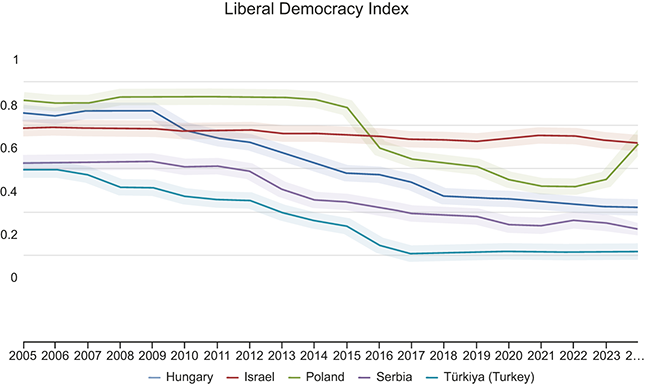
4 How Nationalist Elites Convince People to Abandon Democracy
“Nations have become mysterious symbols to whose protection we rally as savages to fetishes.”
The previous section established the role of elites’ nationalist appeals in the deterioration of democracy in the five countries under investigation. The struggle for the nation legitimized the assaults on democracy, and these findings build on the work of other authors who have also demonstrated an important role of such appeals in undermining democracy (Vachudova Reference Vachudova2020; Rogenhofer and Panievsky Reference Rogenhofer and Panievsky2020; Sata and Karolewski Reference Sata and Karolewski2020). However, the political actors’ subversion of democracy in the name of the nation is only one side of the democratic backsliding story. I further argue that in order to accept the subversion of democracy in the name of the nation, voters need to feel that their nation is under threat. Hence, if voters are convinced that their nation’s identity or sovereignty is threatened, this seems to make them more willing to accept the subversion of democracy that is done in the name of protecting the supposedly endangered national identity and sovereignty.
Let us now consider the specific mechanism outlined in Section 1. As already noted, my aim is to establish its plausibility by providing sufficient empirical evidence. My theory is built on the premise that in order for voters to accept the subversion of democracy in the name of the nation, they must perceive their nation as threatened. Accordingly, I, firstly, begin by tracing the emergence of the political entrepreneurs’ narrative of threatened nation’s identity and sovereignty, with a clearly identified out-group as the threat. I thereby rely on public statements, party programs, decisions by state institutions, and semi-structured interviews with various actors from politics and civil society. If the threat-driven narrative of the political entrepreneurs resonated with the population, we should, secondly, expect to see evidence of the existence of a sense of threat within the population (the out-group is indeed perceived as a threat), accompanied by the strengthening of the resentment against the out-group that is portrayed as a threat. In addition, we should also see evidence for the strengthening of in-group sentiment. The existence of such evidence should allow me to conclude that many voters see the nation, as defined by the political entrepreneurs, as endangered, and they show a stronger attachment to it. Thirdly, such a development should furthermore lead to a willingness on the part of voters to tolerate undemocratic behavior for the sake of the nation. Therefore, we should observe evidence of such voters’ willingness. To examine resonance and identify popular beliefs on the demand side, I draw on the data from the experimental cross-national survey I have conducted with several colleagues, as well as data from other surveys.
Having established a plausible mechanism that could explain voter acquiescence to elites’ subversion of democracy, I move on to provide empirical tests of the theoretical explanation and the validity of the mechanism. As already noted, I aim to show that shifts in voters’ perceptions of various objects correspond to the onset of the narrative that portrays these objects as threats, essentially showing how leaders manufacture public opinion as well as that partisans in particular are susceptible to cues from party leaders (Bartels Reference Bartels2023). But this top-down influence is not the only reason why the narrative resonated, resulting in a stronger willingness to tolerate undemocratic behavior. In line with my conceptualization of the narrative boundary, I will, firstly, depict the context that facilitated the resonance of the threat narrative.
4.1 Fertile Ground
As the next pages will show in more detail, in the five countries under investigation the elites’ narrative mainly revolved around the threats to national identity (ethnic and religious composition). Because adherence to the dominant religion (Judaism, Islam, or Christianity) was considered a key marker of national identity, Arab minority,Footnote 6 Turkish secular elites, and Muslim immigrants were seen as threats. However, in Poland and Hungary, the religion was also used to portray the LGBT community as a threat. By posing a danger to Catholic family values and traditions, the LGBT community threatens the fabric of the nation (Ayoub and Stoeckl Reference Ayoub and Stoeckl2024). Moreover, the threats also concerned national sovereignty: This was the case with the Kurds in Turkey amid their secessionist demands;Footnote 7 the West in Turkey for supporting the KurdsFootnote 8 and in Serbia for supporting the independence of Kosovo, the former Serbian province;Footnote 9 and Muslim immigrants in Poland and Hungary as well as Arabs in Israel for posing a security threat (Brubaker Reference Brubaker2017; Levi and Agmon Reference Levi and Agmon2021).Footnote 10
These societies are a fertile ground for the development of such narratives because many factors elaborated in Section 1, which strongly determine threat narrative’s resonance, are present in them: from the historical loss of national territory or sovereignty and demographic decline to the existence of formative rifts, competing national narratives, and the narratives of a victimized nation and its exceptionalism (Hiers, Soehl and Wimmer Reference Hiers, Soehl and Wimmer2017; Feinstein and Bonikowski Reference Feinstein and Bonikowski.2019; Somer and McCoy Reference Somer2019; Tudor and Slater Reference Tudor and Slater2021; Ding, Slater and Zengin Reference Ding, Slater and Zengin2021; Carter and Pop-Eleches Reference Carter and Pop-Eleches2024).
The history of the Holocaust makes Israel’s context particularly specific. This experience is furthermore an integral part of the victimhood narrative that Jews have always been persecuted (Feinstein and Bonikowski Reference Feinstein and Bonikowski.2019). The existence of the Jewish state is thus regarded as necessary to prevent persecution and a second Holocaust (Auron Reference Auron2010). In addition, the belief that Jews are the “chosen people” with supreme culture and mission in the world also occupies a central position in Jewish collective memory (Abulof Reference Abulof2015).
In both Turkey and Serbia, there is a strong belief about the historical mistreatment by the West. In Turkey, the victimization narrative has its roots in the collapse of the Ottoman Empire after the First World War and the ensuing loss of territory and military occupation by the victorious Allied powers, coupled with a more recent exclusion from EU membership (Ding, Slater and Zengin Reference Ding, Slater and Zengin2021). In Serbia, the West is blamed not only for being a midwife of Kosovo’s independence, but also for acting against Serbian interests during the break-up of the former Yugoslavia, thereby including the 1999 NATO bombing of Serbia (Milacic Reference Milacic2022). As Zorana Mihajlovic, a former Serbian deputy prime minister from the SNS, told me, “Serbia cannot forget the bombing and the West’s lack of support regarding the Kosovo issue. It is a fact that the West wronged Serbia.” Moreover, in both Turkey and Serbia, there is a parallel belief about the nation’s chosenness. Erdogan and the AKP portray Turkey as a “unique” nation leading a powerful Islamic civilization with roots in the Ottoman empire (Ding, Slater and Zengin Reference Ding, Slater and Zengin2021), while Vucic often refers to Serbia as a country that has defied great powers throughout its history and has always remained independent and free (cited in Nezavisne 2025).
Poland’s “123-year disappearance from the world map” following the partitions of the Polish-Lithuanian Commonwealth, the occupation by Nazi Germany in the Second World War, as well as a later loss of sovereignty to the Soviet Union, is an integral parts of Polish collective memory (Ding, Slater and Zengin Reference Ding, Slater and Zengin2021, 155; Hiers, Soehl and Wimmer Reference Hiers, Soehl and Wimmer2017). The insecure status of the state resulted in a stronger identification with ethnic identity markers, such as religion. As the 2019 PiS election program emphasizes, “it is impossible to accept that Polishness can exist without the heritage brought by the Catholic Church” (14). The depicted historical legacy also favoured the emergence of a narrative in the Polish public discourse that sees Polish history as undeserved victimhood (Sadurski Reference Sadurski2018) and the Polish people as heroic individuals who fought and suffered like no other nation, particularly in the twentieth century against Nazism and Communism (Jaskulowski and Majewski Reference Jaskułowski and Majewski2022).
Similarly to Poland, Hungary also suffered from historical occupation and a loss of territory. The domination by Austrians within the Habsburg monarchy and a loss of three quarters of its territory after the First World War were followed by the loss of sovereignty to the Soviet Union after the Second World War. Besides the notion of historical victimization, this historical legacy also strengthened an ethnic concept of the nation at the expense of a civic one (Hiers, Soehl and Wimmer Reference Hiers, Soehl and Wimmer2017). As Orban has said: “Hungary will be Christian, or it will cease to exist” (cited in Brubaker Reference Brubaker2017, 35). What is more, for Orban and his allies, religion has become a focal point of the narrative according to which Hungary is a chosen nation destined to defend Christian Europe from Muslim invaders (Boffey Reference Boffey2018). Polish collective memory is also marked by a similar belief amid the essential role of Poles in defending Vienna against Ottoman conquerors in the seventeenth century. In addition, the population of both Poland and Hungary has been steadily shrinking over the last few decades (World Bank 2023b), causing nation-related anxieties (Krastev Reference Krastev2020). The same is true for Serbia (World Bank 2023b).
Some of the countries under investigation are also characterized by a dispute over national borders or the definition of the nation and thus by competing national narratives. In Poland, “true Poles” are opposed by “Poles of the worse sort,” as Kaczynski put it, with the former incorporating traditional national and religious values (Fomina Reference Fomina, Carothers and O’Donohue2019, 128). In Hungary, Fidesz used its supermajority to enshrine in the Fundamental Law the criteria for belonging to the nation, which the opposition disputes: being a heterosexual Hungarian who belongs to the Hungarian ethnic nation and the Christian community (Majtenyi, Kopper and Susanszky Reference Majtényi, Kopper and Susánszky2018; Halmai Reference Halmai2018). In the AKP’s “new Turkey” (Tas Reference Taş2015), the majority is defined by conservativism, nativism, and Islamism and only considered as the people, while the “old” Turkey is dubbed secular and not in sync with Turkish traditions (Aytac and Elci Reference Aytaç, Elçi and Stockemer2019). The identity dispute is accompanied by contested borders amid Kurdish separatism. In Israel, the governing majority promotes an ethno-religious definition of national identity (Filc Reference Filc, Steiner and Önnerfors2018; Perliger and Pedahzur Reference Perliger, Pedahzur and Rydgren2018; Talshir 2022), which, in the words of Netanyahu, is opposed by a coalition of Arabs and leftists who have forgotten what it is to be a Jew (cited in Filc and Pardo Reference Filc and Pardo2021, 103). As in the Turkish case, the identity dispute is accompanied by unclear borders due to the occupation of Palestinian territories (Talshir 2022). Serbian borders are contested as well amid the Kosovo issue. Often referred to as the “Jerusalem of Serbia,” Kosovo is regarded not only as a territory, but also as a symbol of Serbia’s national consciousness, statehood, history, and mythology (Milacic Reference Milacic2017). It, therefore, does not come as a surprise that Serbia did not recognize Kosovo’s independence, which was unilaterally proclaimed in 2008. In fact, the Serbian constitution considers Kosovo a part of Serbia, and there is no relevant political party that recognizes its independence. A strong rejection of Kosovo’s independence is present in the Serbian population as well (Mladenovic Reference Mladenovic2021).
4.2 Nation Under Threat
The political entrepreneurs’ narrative of an endangered nation was the first step in the attack on democracy. A similar narrative was used in all selected countries, though the choice of threats varied and depended on the local context. In cases marked by formative rifts (Israel, Turkey, and Serbia), the threats revolved around this endogenous factor, whereas in Hungary and Poland, contingency and exogenous factors – such as the wars in Syria and Iraq, the closure of the Balkan immigration route, and COVID-19 pandemic – played a more important role.
In Poland, the threats to the Polish national identity and sovereignty were strategically fabricated. This was confirmed to me by the spokesperson of the Polish Foreign Ministry, Lukasz Jasina, in the last PiS-led government. He told me in an interview that the PiS used focus groups, professional analysts, and polls to identify issues that would fit the threat narrative, with Kaczynski himself ultimately deciding which issue to choose. Afterwards, according to Jasina, the threat narrative was disseminated in various forms and by various actors, including himself, who was involved in preparing and disseminating the anti-German narrative in 2023.
However, for the Polish political dynamic, the selection of the threat in 2015, Muslim immigrants, and later in 2019, sexual minorities, was more consequential. As the European refugee crisis intensified in 2015, Kaczynski and the PiS quickly recognized the political potency of the Muslim refugee issue and started tapping into it. While the 2014 PiS party program was silent on Islam and immigration (Meyer Resende and Hennig Reference Meyer Resende and Hennig2021), by mid-September 2015, an anti-Muslim immigration discourse began to dominate the PiS’s political agenda. Kaczynski and the PiS vehemently opposed the agreement between the Polish government and the European Commission on the resettlement of refugees, claiming it to be against Polish national interests. Although triggered by the influx of refugees from war-torn Syria and Iraq, Kaczynski and the PiS’s anti-immigrant discourse quickly encapsulated all immigrants from Muslim countries (Skowronska Reference Skowronska2021).
Indeed, the narrative was based on “the construction of a Muslim other” (Skowronska Reference Skowronska2021, 955) that poses an “existential threat” to Poland (Fomina and Kucharczyk Reference Fomina, Kucharczyk, Kucharczyk and Mesežnikov2018, 198) and was, furthermore, skillfully deployed in an orchestrated move (Krzyzanowski Reference Krzyzanowski2018). In this sense, Kaczynski claimed that Muslim immigrants would not respect Polish laws and rules, but only Sharia Law, and would attempt to impose their customs on the local population (cited in Kinowska-Mazaraki Reference Kinowska-Mazaraki2021, 8 and Krzyzanowski Reference Krzyzanowski2018, 86). The developed narrative depicted Poland as being “flooded” by Muslim immigrants, who openly oppose Polish culture and endanger Christianity (Krzyzanowski Reference Krzyzanowski2018, 89). In addition, Muslim immigrants were portrayed as “conquerors” and as a security threat, bringing terrorism and diseases (Fomina and Kucharczyk Reference Fomina, Kucharczyk, Kucharczyk and Mesežnikov2018, 188–190).
However, the lack of Muslim immigrants in Poland (less than 0.1% of the total population), as well as the closure of the Balkan route in 2016 and the ensuing reduction in the flow of immigrants to Western Europe, meant that the issue of Muslim immigration would eventually lose its great politicization potency. In the following years, therefore, the issue of LGBT rights became the most prominent feature of Kaczynski’s and his PiS allies’ narrative on the endangered Polish national identity. The politicization of LGBT rights in 2019 thus served to maintain the sense of threat among the population. Kaczynski warned that Poland must “defend children and normal families” from “imported LGBT” that “threatens our identity, our nation, its continued existence, and therefore the Polish state” (cited in Tilles Reference Tilles2020a). According to him, it is necessary to defend values and combat ideas hostile to Polish traditions so that Poland does not end up as a society “without any identity” or another Ireland – a “Catholic desert with LGBT ideology out of control” (cited in TVP 2020). Kaczynski’s narrative was supported by prominent party allies. During his re-election campaign in 2020, Polish President Andrzej Duda published a so-called “Family Charter” that included pledges to “ban the propagation of LGBT ideology in public institutions” and opposed the rights for same-sex couples to marry and adopt children (cited in Tilles Reference Tilles2020a). In line with this, other PiS officials described LGBT rights as threatening “the unity and homogeneity of the Polish people” (Yermakova Reference Yermakova2021, 16).
As Ayoub and Stoeckl (Reference Ayoub and Stoeckl2024) argue, in countries like Poland (and Hungary, as the following pages will show), the LGBT community is portrayed not only as a threat to the family, but also to the nation itself. The threat is twofold. By posing a danger to Polish Catholic family values and traditions (Korolczuk Reference Korolczuk2020), the LGBT community threatens the country’s cultural composition. Accordingly, the LGBT issue was not about the civil rights of a few, but about the character of the Polish national identity that concerns all Poles: “a choice between a white-and-red Poland and a rainbow Poland” (Patin Reference Patin2020). In addition, demographic anxieties were also invoked as the LGBT community poses an existential threat to the nation for not having children (Ayoub and Stoeckl Reference Ayoub and Stoeckl2024).
Hungarian Fidesz used a very similar approach. Deep dissatisfaction with a previous government, coupled with a lack of knowledge about the authoritarian playbook at the beginning of the last decade, left many Hungarians unaware of the magnitude of Orban’s undemocratic project. This allowed Orban to initially undermine democracy without fear of punishment by voters. If, however, Orban had counted on the eternal ignorance of the citizens, he wouldn’t have bothered to develop and spread effective threat narratives. As several interviewees from civil society and politicsFootnote 11 told me, polls and focus groups were used to select the issues around which a threat narrative was developed. The whole work was coordinated in the Prime Minister’s Office and, according to former opposition MP Zsuzsanna Szelenyi and media reports (Marantz Reference Marantz2022), was advised by the late consultant Arthur Finkelstein, who also helped Netanyahu in the same way. “The threat narratives reflected both a strategy and a Hungarian reality amid historical fears for its survival,” as Bence Bauer from the Fidesz-close Mathias Corvinus Collegium told me. However, Fidesz was initially unsuccessful. The narrative of protecting the Hungarian nation and Christian culture and values from the Roma minority and the homeless people did not resonate particularly well with the Hungarian population (Köves Reference Köves, Kucharczyk and Mesežnikov2018; Sagi Reference Sagi2023). The situation changed in Fidesz’s favor when it started to stir up fears about immigrants.
Already in 2014, Fidesz began to target Kosovars because the largest number of asylum applications came from this country (IOM 2024). However, in 2015, thanks to the migration crisis and the influx of refugees from the Middle East, the threat narrative became very effective. Fidesz and government officials, state media, as well as news portals and newspapers associated with the ruling party, portrayed immigration as the greatest threat to the nation and its Christian culture (Köves Reference Köves, Kucharczyk and Mesežnikov2018). In the words of Orban, the influx of immigrants is “an invasion” (Walker Reference Walker2018) and Hungary is the last bastion in the fight against the “Islamization” of Europe (Boffey Reference Boffey2018). However, as in Poland, the Muslim immigrants were not only not welcome because of their different cultural background, but also because they were labeled as a security threat and accused of importing terrorism (Köves Reference Köves, Kucharczyk and Mesežnikov2018). Moreover, with its activities, the government ensured that the topic of immigration remained salient even after the closure of the Balkan route in 2016 and the subsequent reduction in the influx of immigrants. In addition to the so-called national consultation on immigration in May 2015 (Szabo Reference Szabó, Kucharczyk and Mesežnikov2018), the government also launched billboard campaigns (first in May 2016, then in mid-June 2016), and proposed a referendum on the EU’s proposal for quotas for the distribution of refugees among its member states (Soltesz Reference Soltesz, Kucharczyk and Mesežnikov2018).
Although Fidesz and Orban, unlike their Polish counterparts, managed to prolong the salience of the immigration issue, the border closures due to the COVID-19 pandemic made the issue less opportune (Gera Reference Gera2023). Therefore, a new threat was fabricated to complement the immigration threat. As in Poland, the threat of Muslim immigration was followed by the narrative of the threat posed by the LGBT community. As stated by Orban, after trying to weaken Hungarian identity through mass immigration, the same forces want to impose their way of life on the majority of the population (cited in Gera Reference Gera2023, 122). This narrative was then echoed by other government and Fidesz officials. Indeed, as in Poland, allowing sexual identities outside of traditional norms was presented as a threat to the nation and its Christian identity (Ayoub and Stoeckl Reference Ayoub and Stoeckl2024). To prevent this, the Hungarian parliament passed the so-called “anti-gay-propaganda law” in 2021 that bans the distribution of information on sexual orientation and gender identity to minors. In addition, the same tools were again used to disseminate the narrative and ensure that the issue remained salient: national consultations with questions such as “Do you agree with the principle that a child has a right to a mother and a father?”; campaigns in media outlets and billboards; and an anti-LGBT referendum (Sagi Reference Sagi2023).
Unlike Orban and Kaczynski, whose strategies were very much shaped by contingency and different exogenous factors, the actions of Erdogan, Vucic and Netanyahu were much less affected by them. This is because Serbia, Israel, and Turkey are characterized by a dispute over national borders or the status of an ethnic/religious minority. These open issues were then strategically politicized for the development of threat narratives. Kosovo has always occupied a central spot in Serbia’s vision of its national identity (Cohen Reference Cohen2001). Unsurprisingly, Vucic and his SNS used the Kosovo issue as a tool to portray the West (the USA and the EU), a key supporter of Kosovo’s independence, as a threat to the Serbian national identity and sovereignty. Vucic has been constantly claiming that the country was under heavy pressure from the West to recognize Kosovo’s independence (cited in Novinar 2019; Borba Reference Borba2021), which was further intensified after the Russian 2022 aggression against Ukraine (cited in B92 2022). In line with this, the image of Serbia as a martyr nation, which has been persecuted by the West that wants Serbia to be weak and dependent, has been established. In the words of Vucic, “only a humiliated Serbia is a final solution for them” (cited in RTV 2020), adding “they all (the West) are doing it together because they have to support Kosovo and break Serbia” (cited in Danas 2023b). The anti-Western narrative was coupled with the portrayal of Vucic as a champion of national interests who will never recognize Kosovo’s independence even if, in his words, “they beat me on the head with the sticks” (cited in RTRS 2018). The new narrative was clearly reflected in an increase in anti-Western reporting of pro-government media outletsFootnote 12 (see Figure 4).
Anti-Western reporting.
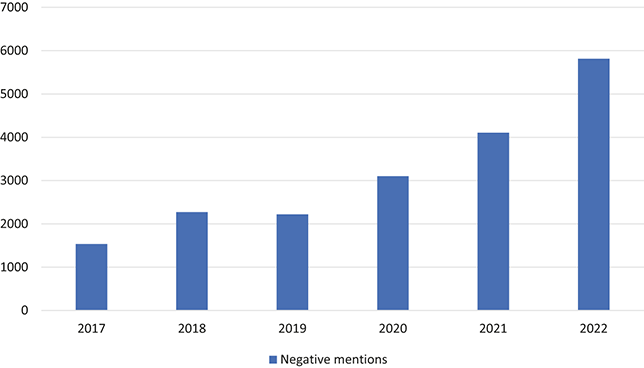
In order to maintain the salience of the Kosovo issue for the local political dynamic, the claims on Western pressure were accompanied by claims of an alleged imminent threat from Kosovo with the support of the West and of an endangerment of Kosovo Serbs (cited in RTRS 2018). For this reason, Vucic mobilized the Serbian army on several occasions (Aljazeera 2021) and encouraged violence and disobedience by Kosovo Serbs (Lukiv Reference Lukiv2023). In an interview with Jovana Radosavljevic, a prominent civil activist from northern Kosovo, where the majority of Serbs live, she confirmed to me that Belgrade has been telling Kosovo Serbs that “Kosovo’s independence is not a done deal” and therefore they should not integrate into Kosovo’s institutions. According to her, Kosovo Serbs’ dependence on Serbia to maintain the economy and institutions (pensions, jobs, and health care) also meant that Belgrade made the decisions in most cases and that Vucic could raise and lower tensions as he pleases.
However, for the Serbian opposition, the reality looks much different. MP and deputy leader of the oppositional Democratic Party (DS), Nebojsa Novakovic, told me in an interview that Vucic has not been under pressure from the West at all. “In fact, Vucic has been favored by the West and the West has been showing a lot of patience and understanding for him, thinking that he will resolve the Kosovo issue.” A German Foreign Ministry official responsible for the Balkans, who wished to remain anonymous, also told me in an interview that “Vucic is under no pressure to recognize Kosovo’s independence. The EU is only asking him to fulfill the points of the official agreements. Nothing more than that.” For MP Novakovic, “the whole theatricality about Kosovo has the purpose of Vucic presenting himself as the protector of the nation.” Zoran Lutovac, until recently one of the opposition’s leaders and head of the DS, agrees, stating during our interview that “Vucic, like Slobodan Milosevic (former Serbian strongman), is opportunistically using the Kosovo issue that is central to Serbian national identity.”
In Israel, there has always been a sense of threat in the society due to the unresolved Israeli-Palestinian conflict, as prominent civil society activist Raluca Ganea pointed out in our interview. What is new, however, is that Netanyahu and his allies have amplified the existing sense of threat within the Israeli Jewish population by regularly depicting Israel’s Arab citizens as “the enemy within” (Del Sarto Reference Del Sarto2022). Indeed, over the past decade, Netanyahu has made much greater use of Jewish ethno-religious appeals (Talshir 2022), which have been accompanied by an intensified narrative of the threat to the nation posed by Israeli Arabs. Accordingly, they pose a threat primarily because they are “non-native ‘other’” (Filc and Pardo Reference Filc and Pardo2021, 104), who do not belong to Israel’s rightful native group – the exclusively defined Jewish people (Perliger and Pedahzur Reference Perliger, Pedahzur and Rydgren2018).
Since 2015, however, in the statements made by Netanyahu, his ministers, and his Likud allies, the Arab population has also been branded as a supporter of terrorism and as disloyal to the state (Smooha Reference Smooha2019). Such attacks on Arab citizens have even intensified and become more severe since 2019 (Smooha Reference Smooha2019). In fact, Likud leaders have built most of their political discourse around the exclusion and marginalization of Israeli Arabs (Filc Reference Filc, Steiner and Önnerfors2018), publicly portraying them as a “Trojan horse,” and thus as a security threat to Israeli Jews (Rogenhofer and Panievsky Reference Rogenhofer and Panievsky2020), as well as a threat to the Jewish character of the country (Makovsky Reference Makovsky2019). In addition to using inflammatory rhetoric, Netanyahu and his allies stoked interethnic violence to increase the salience of the Palestinian threat (Akkoyunlu and Sarfati 2024).
Connecting Arab citizens with terrorism and radical Islamization, as well as their portrayal as a fifth column, was particularly visible during election campaigns. For example, during the 2015 election campaign, Netanyahu portrayed the voting of Israeli Arab citizens as a danger (Mordechay and Roznai Reference Mordechay and Roznai2017), warning that “anyone who is going to establish a Palestinian state today and evacuate lands is giving attack grounds to the radical Islam against the state of Israel” (cited in Rudoren Reference Rudoren2015). Four years later, Netanyahu publicly stated that “Israel is not a state of all its citizens,” and that “Israel is the nation-state of the Jewish people – and it alone” (cited in Alexander and Teibel Reference Alexander and Teibel2019). Unsurprisingly, such a narrative was accompanied by the narrative of Netanyahu defending Israel against those who seek to transform it into a “state of all its citizens” (Talshir 2022). According to an official of the opposition party Democrats, Uri Zaki, and civil activist Eran Schwartz, this playing of the nationalist threat card was strategic and served to advance the Likud’s and Netanyahu’s political agenda. Schwartz described it in our interview as “Netanyahu’s poison machine.”
In Turkey, too, the threat narrative was based on the country’s two formative rifts related to national identity and territory (Somer Reference Somer2019). With respect to the disputes over what it means to be a Turk, Erdogan and his AKP allies saw “the Kemalist secular elite” as a threat to the nation for imposing its foreign lifestyle and values on the pious majority consisting of ordinary “Muslim-Turkish people” (Dincsahin 2012; Somer Reference Somer2017; Aytac and Elci Reference Aytaç, Elçi and Stockemer2019). Interestingly, such a narrative “only” considered secular elites as a threat and was inclusive of minorities and their religious and cultural identity. In fact, the narrative emphasized the common religion (Islam) as the basis of unity, thus including the Kurdish and Alevi minorities, and it pitted this pious and devout people against the secular elites (Dincsahin 2012). Moreover, as MP of the Turkish main opposition party CHP, Yüksel Taskin, pointed out in our interview, Erdogan capitalized on the past anti-democratic behavior of secular elites, such as the military, which the CHP did not strongly condemn.
However, as the AKP increasingly captured the state, the strategy of vilification of state institutions, as symbols of Turkish secular identity, was no longer opportune (Somer Reference Somer2019). In addition, by 2015, the AKP was losing support among the Turkish electorate, culminating in the loss of its parliamentary majority. Such circumstances necessitated the development of a new threat narrative, and this time it was built around the second formative rift related to the community’s borders, namely the threat posed by the secessionist attempts of the Kurdish minority. To this end, military interventions against the Kurds were launched to bolster the government’s narrative of a renewed Kurdish threat, which strongly contributed to the dramatic outburst of ethnic violence (Akkoyunlu and Sarfati 2024).
Hence, the initial policy of inclusion toward the Kurds and other minorities was replaced by a narrative that saw the Kurdish population as “the enemy within,” with Sunni Islam and Turkish ethnicity now serving as the basis of national identity (Yabanci Reference Yabanci2020). In an interview, Enver Cevik, international secretary of the Kurdish Dem Party, told me that this change happened very quickly: “In April 2015, just before the election, there was one step left to conclude a peace agreement. But the Turkish government delegation did not show up for the negotiations. They suddenly changed their mind and we never found out why. We found out about the change of mind on television.” According to CHP MP Taskin, Erdogan and the AKP have escalated and instrumentalized the Kurdish issue for their political gains. He also sees pure political opportunism as the motivation for other threat narrative of Erdogan and the AKP related to the West. The non-Muslim West has been accused of promoting values, such as LGBT rights and pluralism, which are seen as an attack against Turkey’s national identity (Yabanci Reference Yabanci2021, 20). In addition, the West has been accused of “standing by Kurdish terrorists” (Erdogan cited in France 24) as well as of interfering in Turkish internal affairs in order to delay Turkey’s development (Yabanci Reference Yabanci2021) or, in Erdogan’s words, “enslave the Turkish nation” (cited in Al Jazeera 2018).
The depicted use of nationalist discourse in the countries under investigation has been captured by various measures. According to the data of Jenne, Hawkins and Castanho Silva (Reference Jenne, Hawkins and Castanho Silva2021), who measured the nationalist discourse of state leaders in thirty European and North American countries between 1998 and 2018, Erdogan is the most nationalist leader in the sample, Orban is the third most nationalist leader, and Kaczynski is among the ten most nationalist leaders. In Serbia, the period between 2017 and 2018 was marked by the highest degree of nationalist discourse in this century, which coincides with the increased use of the Kosovo-related discourse by Vucic and the SNS (Milacic Reference Milacic2022).
Moreover, the data from the Comparative Manifestos Project (CMP) (Volkens et al. Reference Volkens, Burst and Krause2021), which measures the positions of political parties, found an increased emphasis on “the national way of life” by Polish PiS for the 2015 election, which increased further in 2019, thus coinciding with the PiS’s decision to target immigrants and later the LGBT community; a strong increase in the Serbian SNS’s “the national way of life” discourse for the 2020 election, while such discourse was absent in the 2016 election, coincides with the party’s shift toward the nationalist (Kosovo-related) politics; in 2014, Hungarian Fidesz increased its emphasis on “the national way of life” sevenfold compared to the 2010 election, while for the 2018 election the emphasis was increased fivefold when compared to 2014, capturing the party’s increased targeting of immigrants and the LGBT community; for the 2015 election, the Turkish AKP increased its emphasis on “the national way of life” by 2.3 times compared to 2011, followed by a 1/3 decrease in 2018 – a development that coincides with the development and intensity of the narratives against secular elites and Kurds. According to the Chapel Hill Survey, which placed Israeli parties in relation to the Arab-Israeli conflict, the Likud, once a mainstream party, now takes “a far-right stand on the Israel-Palestine variable” (Zur and Bakker Reference Zur and Bakker2023, 9).Footnote 13
4.3 The Resonance of the Threat Narrative
The previous section provided evidence for the existence of a nationalist threat narrative in selected countries. It is not uncommon for political actors to play the nationalist card for personal gain. But has their narrative resonated with the population? In other words, is the out-group perceived as a threat and are both out-group resentment and in-group sentiment reinforced? In this section, I provide evidence that the narrative has resonated with the population. Specifically, I provide evidence for the presence of a sense of threat in the population and for the strengthening of in-group thinking and out-group resentment as well. This allows me to conclude that many voters perceive the nation, as defined by the political entrepreneurs, as endangered and that they show a stronger attachment to it. What is more, I demonstrate that these shifts in voters’ perceptions coincide with the emergence of the threat narrative, thereby illustrating the pivotal role of leaders in this development. I thus demonstrate the success of political entrepreneurs’ efforts.
The Muslim immigration was a marginal issue in Poland (Fomina and Kucharczyk Reference Fomina, Kucharczyk, Kucharczyk and Mesežnikov2018). However, after the PiS began employing threat appeals, it became a salient one for a significant number of Poles. According to the Pew Research Center surveys in 2016 and 2017, 73% and 60% of Poles saw Muslim refugees as a “major threat” to Poland, with PiS supporters more likely to see the issue as a threat (see Figure 5). Moreover, an Ipsos survey from 2019 shows that Kaczynski and the PiS have later succeeded with their second threat narrative as well. According to it, all Poles saw “gender ideology and the LGBT movement” as the second most important threat to the country, whereas 54% of PiS supporters saw this issue as the greatest threat to Poland, with concerns about Russia being far behind in the second place (26%) (see Figure 6) (Oko Press 2019).
Perception of Muslim immigrants (all Poles).
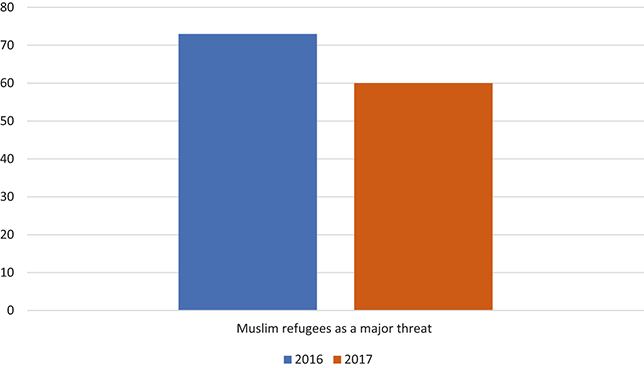
Perception of LGBT (PiS voters).
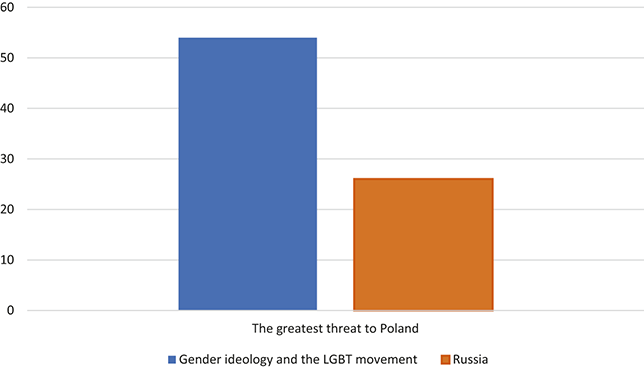
By fabricating threats to the Polish national identity, Kaczynski and his allies strengthened out-group resentment and in-group (ethnic Polish) sentiment as well. The percentage of Poles who opposed the entry of refugees from the Middle East and Africa rose from 48% in September 2015, when the narrative against Muslim immigrants began, to 64% in December 2015 and reached 71% in April 2016, with PiS supporters showing the strongest opposition among the Polish parties (CBOS 2016). The percentage of Poles who disagree that lesbian, gay, and bisexual people should have the same rights as heterosexual people (marriage, adoption, and parental rights) increased from 45% in 2019, when the anti-LGBT narrative began, to 54% in 2023 (Eurobarometer 2023). In addition, Polish ethnic identity has been reinforced, evidenced by the sharp increase in the number of Poles who would allow none or few immigrants of different race/ethnic group: from 41.5% in 2014 to 59.8% in 2016 and 63.9% in 2018 (ESS 2014, 2016, 2018) (see Figure 7).
In-group strengthening in Poland.
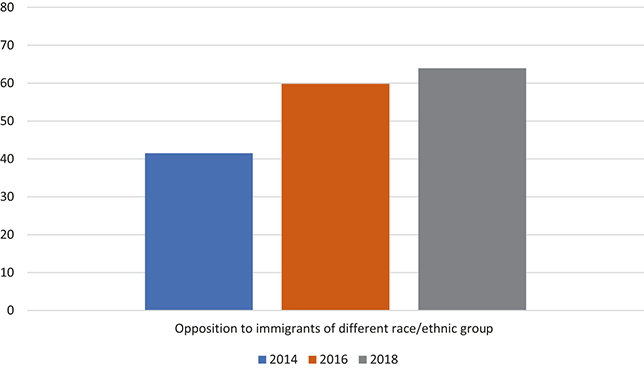
A very similar development can also be observed in Hungary. Orban’s threat narrative turned a marginal issue into a salient one for many Hungarians. According to the Pew Research Center surveys from 2016 and 2017, 69% and 66% of Hungarians, respectively, saw Muslim refugees as a “major threat” to Hungary (see Figure 8). This sense of threat has also been captured in other surveys. For example, in 2016, 60% of Hungarians worried “a lot both about the realistic and symbolic threat of migration related to Hungary,” with Fidesz supporters more likely to have such feelings (Tarki 2016, 63).
Perception of Muslim immigrants (all Hungarians).
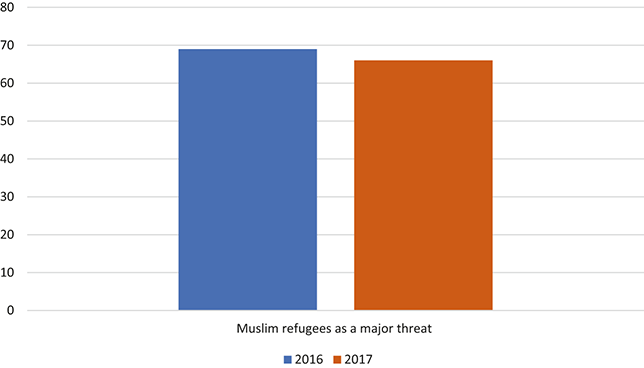
The strengthening of out-group resentment was visible as well. Between 2014 and 2015, when Orban and Fidesz began to portray Muslim immigrants as a threat, and 2016–2017, the rejection of refugees increased by 14% (Szabo Reference Szabó, Kucharczyk and Mesežnikov2018). In addition, the percentage of Hungarians who disagree that lesbian, gay, and bisexual people should have the same rights as heterosexual people (marriage, adoption, and parental rights) increased from 46% in 2019 to 51% in 2023 (Eurobarometer 2023) (see Figure 9). Thus, thanks to the anti-LGBT narrative that started in 2021, the majority of Hungarians, just like Poles, became opposed to LGBT rights. Moreover, and again similar to Poland, the ESS surveys also showed that ethnic Hungarian thinking was reinforced. The percentage of Hungarians who would allow none or few immigrants of different race/ethnic group increased from an already very high 80.8% in 2014 to 87% in 2016. However, if we count only those who would not allow any immigrants, the strengthening of in-group sentiment is even more visible as their share increased from 33.3% in 2014 to 48.4% in 2016 (see Figure 10).
Anti-LGBT resentment in Hungary.
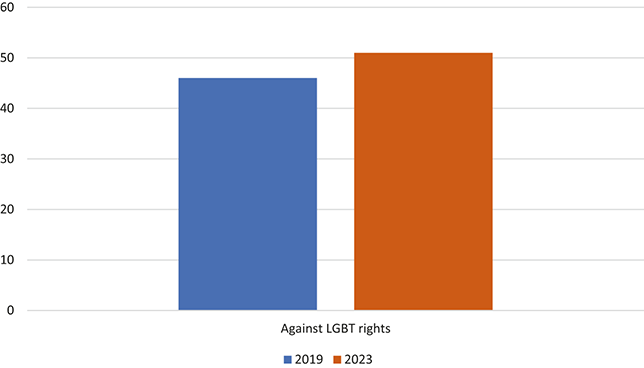
In-group strengthening in Hungary.
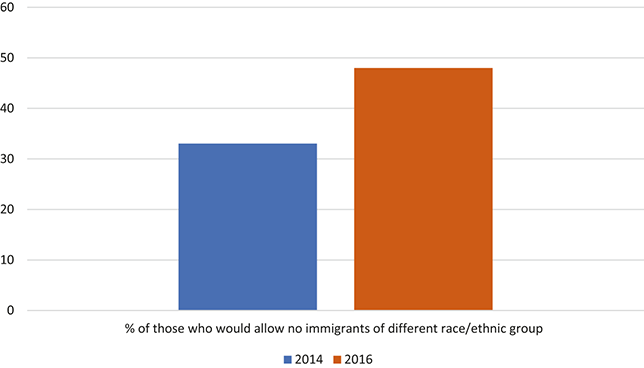
Since 2017, Vucic and his allies have increasingly promoted an anti-Western narrative in Serbia. Unsurprisingly, the USA, as the main representative of the West and the main supporter of Kosovo’s independence, is perceived as the main threat. Indeed, in both FES surveys conducted in 2018 and 2021, the USA is seen by Serbs as the main threat to the country. Such a perception of the West has been recorded in other surveys as well. For example, 70% of Serbs agree that the West is “working to destroy our national identity, traditional values, and way of life” (see NATO 2021). Moreover, that the out-group resentment against the West took deeper roots in the Serbian electorate after the onset of the threat narrative has also been confirmed by surveys (see Figure 11): In 2017, 52% of Serbs said the USA have a bad influence on Serbia, whereas in 2020 this percentage rose to 59%; in 2017, 23% said the same for Germany and 36% for the EU. In 2020, then, this percentage more than doubled in the case of Germany (55%), while it increased significantly (68%) in the case of the EU (BCSP 2017, 2020).
Anti-Western resentment in Serbia.
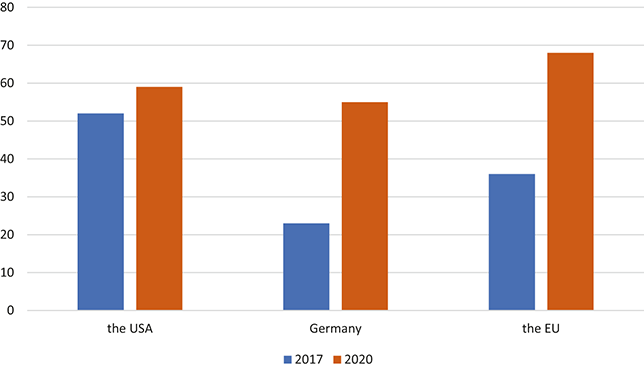
The threat narrative also strengthened in-group (ethnic Serb) sentiment, and this is most clearly visible in the shift in the priorities of Serbs. According to the FES survey from 2018, joining the EU was seen by Serbs as the country’s top foreign policy priority. The FES survey conducted three years later recorded a clear shift in priorities. The Serbs now see the country’s top foreign policy priorities in the protection of the territory (mainly related to the Kosovo issue) and the interests of all Serbs in the region.
As noted above, Erdogan and the AKP have used different objects to build their threat narrative around. Initially (until 2015), it was the secular elites whose lifestyle posed a threat to the “real” Turkey. It is, therefore, not surprising that the 2014a KONDA barometer concluded that “the respondents who perceive AKP opponents as distant from themselves believe that AKP opponents pose a threat at high rates” (23) and that the conflict between the AKP supporters and opponents “originates primarily from lifestyles” (24–25). Two years later, when the Kurdish threat narrative was dominant, the KONDA barometer from March 2016a (18) registered that for 67% of ethnic Turks, the Turkish-Kurdish dispute is the social tension that scares them the most. A later increase in the use of anti-Western appeals by Erdogan and his allies has also been captured by surveys: In 2017, 72% of Turks saw the USA as “a major threat,” 28% more than in 2013 (Pew Research Center Reference Center2017).
The resonance of the threat narrative is also visible when it comes to resentment toward Kurds as an out-group. In February 2016, the percentages of those who did not support the right of Kurds to receive education in Kurdish and those who supported this minority right were the same. However, when asked again in January 2019, when the narrative of the Kurdish threat was much less dominant in AKP’s discourse, the percentage of those who support the right of Kurds to receive education in their mother tongue was 8% higher than the percentage of those who deny it (KONDA 2019, 14). Even more striking, in 2012, 36% of AKP voters supported the radical solutions to the Kurdish question, such as deportation, eradication of the PKK (Kurdistan Workers’ Party), capital punishment, no compromise, war and slaughter, and so on, while in 2015, when the Kurdish threat narrative began to dominate the AKP’s discourse, their share rose to 47% (KONDA 2015, 42) (see Figure 12).
Anti-Kurdish resentment (AKP voters).
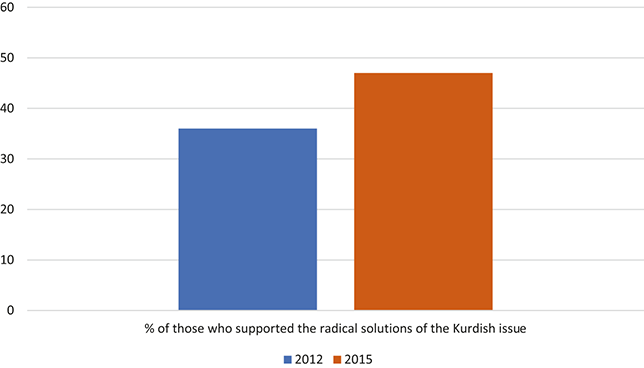
There is also evidence that the threat narrative has affected in-group (ethnic Turkish) sentiment. For example, the KONDA barometer registered that in May 2016, only 25% of Turks said that “the equality between all kinds of people such as the Turkish, the Kurdish, Sunnis or Alevis should be emphasized to a greater extent than other principles.” The fact that Turkey has been marked by an escalation of the Kurdish issue since July 2015 – including terrorist attacks, the declaration of a state of emergency in the eastern provinces, and military operations – has certainly contributed to a low regard for a more inclusive principle. However, only three months later, in August 2016, when the July coup attempt rather than the Kurdish issue dominated the agenda, their share increased to 32.6% (KONDA 2016b, 65), and thus a weakening of the in-group sentiment could be observed (see Figure 13).
In-group sentiment in Turkey.
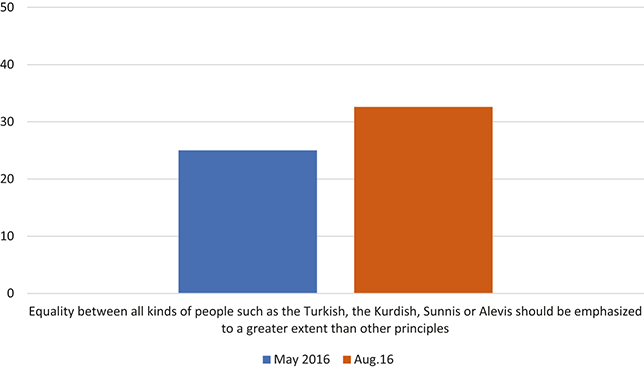
The ever-present Israeli-Palestinian tensions meant that the Israeli Jews’ perception of Israeli Arabs as a threat has always been high and fairly constant. Indeed, in the years between 2013 and 2019 a solid majority of Israeli Jews expressed “fear of Arab citizens endangering the state because of their struggle to change its Jewish character” and “because they may start a popular revolt” (Smooha Reference Smooha2019, 59): 59.4% and 60.6% respectively in 2013, 61.2% and 63.4% respectively in 2015 or 60.1% and 62.8% respectively in 2017 (Smooha Reference Smooha2019, 59). Therefore, the strong effect of the threat narrative by Netanyahu and his allies, which has been intensified since 2015, is mainly visible in the strengthening of the resentment against Israeli Arabs and in the strengthening of the in-group (Jewish) sentiment as well. And there is ample evidence of this.
The percentage of Israeli Jews who agree that “most Arab citizens of Israel want to integrate into Israeli society and be part of it” fell from 66% in 2018 to 40% in 2022 (Israeli Democracy Index 2022, 121). Moreover, the percentage of Israeli Jews who were “personally wishing/ready to let Arabs live in their Jewish neighborhoods” also dropped sharply from 54.1% in 2015 to 39.6% in 2019 (Smooha Reference Smooha2019, 35). The same trend can be observed among those who agree that “the state should allow Arab citizens to manage their own educational, religious and cultural affairs.” Their share fell from 55.8% in 2015 to 40.2% in 2019 (Smooha Reference Smooha2019, 122). It thus does not come as a surprise that the rejection scale, which measures Jews’ rejection of Arabs, also captured this negative development: it increased from 5.43 in 2015 to 5.99 in 2019, on a scale from 0 to 13 with 0 meaning total acceptance and 13 total rejection (Smooha Reference Smooha2019, 132). The increase in rejection is particularly visible among those for whom “Jewish people” is the most important affiliation: from 6.29 in 2015 to 7.5 in 2019 (Smooha Reference Smooha2019) (see Figure 14).
Jews’ rejection of Arabs on 0–13 scale.
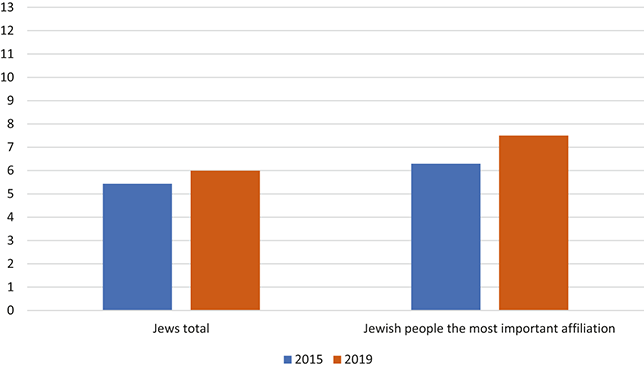
As already noted, Israel is defined as both a Jewish and a democratic state, and both components were considered important. However, there is evidence that the former, and thus the Jewish in-group identity, is becoming more salient for many Israeli Jews, corresponding to Netanyahu’s increased employment of a threat narrative. Comparing the years 2017 and 2022, we see that the share of Israeli Jews who said that the Jewish component should be the dominant one increased from 23% to 43%. Among those on the Right of the political spectrum, who are the main audience for the threat narrative, the increase is from 40.5% to 60% (Israeli Democracy Index 2022, 107) (see Figure 15).
In-group strengthening in Israel (the Jewish component should be the dominant).
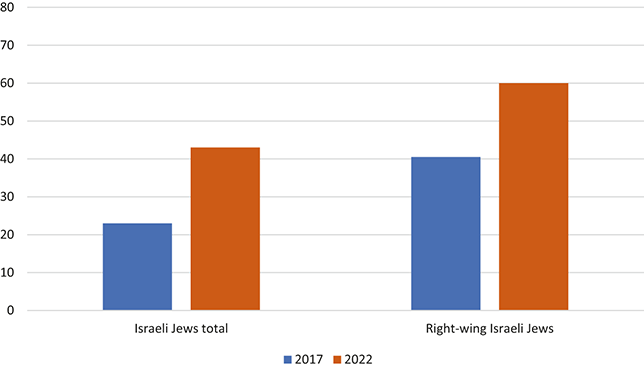
4.4 Nation First, Democracy Second
In the previous section, I provided evidence for the resonance of the threat narrative in the population. In all of the countries under investigation, we could observe the existence of a sense of threat, accompanied by the strengthening of the resentment against the out-group portrayed as a threat, as well as the strengthening of in-group sentiment. These shifts in voters’ perceptions correspond to the onset of the threat narrative of political entrepreneurs. Following my mechanism, if the threat narrative resonated, it should also have led to voters’ willingness to sacrifice democracy for the issues related to the nation. Therefore, my aim is to provide sufficient evidence for the plausibility of such a claim. Hence, in this section, I present empirical facts that should plausibly establish the existence of voters’ willingness to tolerate undemocratic behavior for the sake of the nation.
In the cases of Poland, Hungary, and Serbia, this is established with the data from the experimental surveys that my colleagues and I have conducted. The experimental survey in Poland, conducted in November 2021, showed that Poles would only sacrifice democracy for the LGBT issue. Indeed, they would reward an undemocratic candidate who advocates for their favorite policy on same-sex couples’ rights, and this candidate would win an electoral contest against the democratic one. Yet as Figure 16 shows, this does not apply to all Poles, but only to those Poles who would ban same-sex couples from marrying and/or adopting children. Only they would reward such a candidate with an 8.5% and 1.4% vote share increase, respectively. I argue that this is likely the effect of the narrative of the PiS and Kaczynski that Polish national identity is threatened by the LGBT community. Accordingly, those Poles who are receptive to this kind of message are willing to make such a trade-off, prioritizing national identity, which is allegedly endangered by the extension of LGBT rights, over democracy. As noted above, those Poles who support same-sex couples’ rights would not trade off democracy for this issue. For them, the stakes are not as high.
Change of vote share (%) of undemocratic candidate on LGBT issue (Poland).
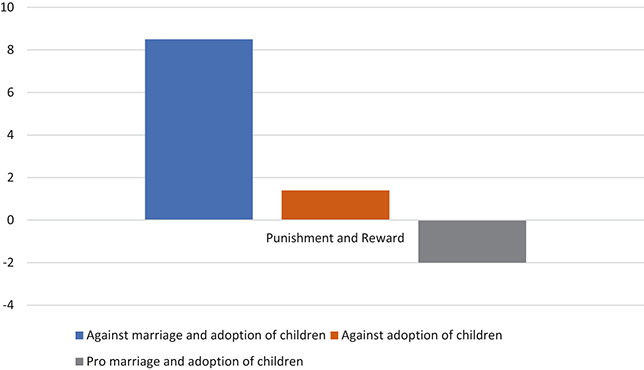
As already noted, Poles would not sacrifice democracy for other issues examined in the survey, such as the environment, education, national sovereignty vis-à-vis the EU, and immigration. If Muslim immigrants have also been portrayed as a threat by Kaczynski and the PiS, why are Poles not willing to trade off democratic principles for this issue as well? This finding clearly demonstrates the power of the political entrepreneurs’ narrative. As already emphasized in the section on the emergence of the threat narrative, immigration was the main focus of the Polish political entrepreneurs in the years between 2015 and 2018, after which it was replaced by the narrative that portrayed the LGBT community as the main threat to Poland’s identity. It appears that this shift also affected the mood of the Polish electorate.
The example of Hungary, where the same experimental survey was conducted in 2023, seems to provide further confirmation of the power of elite narrative. The Hungarians showed the greatest willingness to sacrifice democracy for two issues: LGBT and immigration (see Figures 17 and 18). Moreover, as both figures show, the willingness to reward an undemocratic candidate is stronger among those who oppose both LGBT rights and immigration, the very people we would expect to be susceptible to Orban’s and Fidesz’s threat narrative. Their greater willingness is likely the effect of the narrative according to which the LGBT community and the immigrants are a threat to Hungary. But why are Hungarians willing to trade off democracy for interests related to immigration, while Poles are not? As emphasized in the section on the emergence of the threat narrative, Orban and Fidesz, in contrast to Kaczynski and PiS, have continued to successfully portray immigrants as the major threat and have thus been able to prolong the salience of the immigration issue for local political dynamics. This seems to have had an impact on the attitudes of Hungarian voters.
Change of vote share (%) of undemocratic candidate on immigration issue.
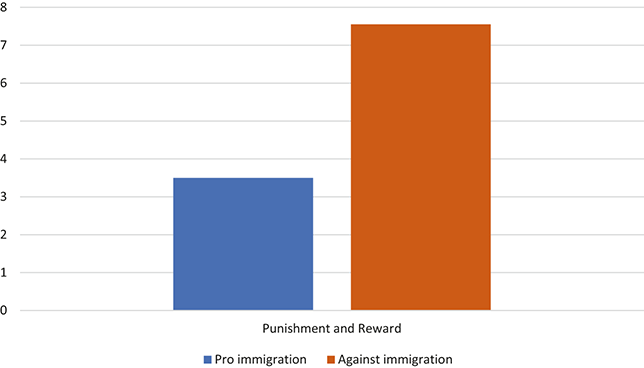
Change of vote share (%) of undemocratic candidate on LGBT issue (Hungary).
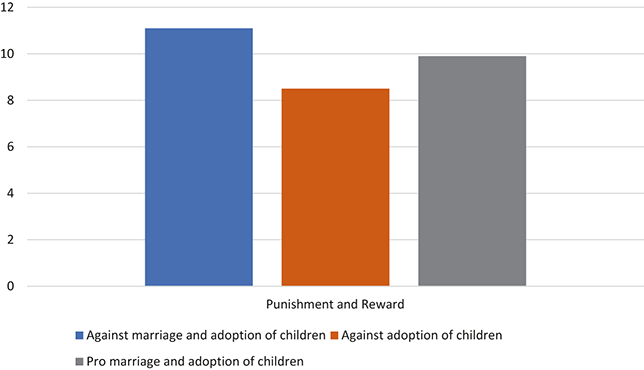
The case of Serbia, where we also conducted an experimental survey in 2021, appears to confirm the aforementioned assumption about an increased willingness to tolerate undemocratic behavior for matters of the nation. Given the salience of the issue for political competition, in Serbia we investigated the respondents’ willingness to sacrifice democracy for their favorite foreign policy: pro-EU vs. pro-Russia. According to our data, pro-Russian Serbs are ten times more willing to sacrifice democratic principles for their preferred policy on this issue than pro-EU Serbs. Indeed, as Figure 19 shows, an undemocratic pro-Russian candidate can increase her vote share by 12%, while an undemocratic pro-EU candidate by “only” 1.2%. I argue that this is likely the effect of the narrative of the SNS and Vucic that Serbia is threatened by the West. In the context of the alleged threat to the nation from the West, pro-Russian Serbs are more inclined to see democratic principles as a necessary sacrifice to protect the nation through closer relations with Russia. Contrary to it, the stakes are not as high for pro-EU Serbs because there is no established narrative that Serbia is threatened by Russia.
Change of vote share (%) of undemocratic candidate on EU vs. Russia issue.
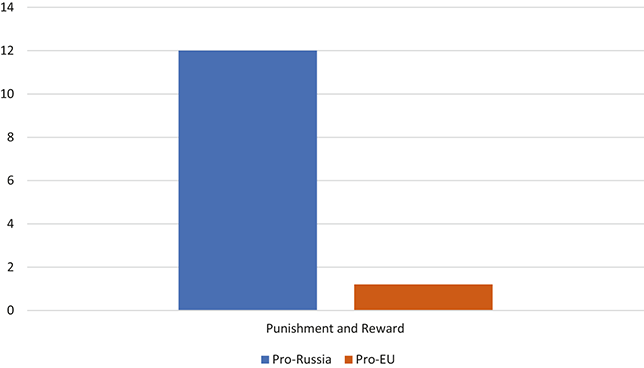
In the cases of Turkey and Israel, I do not rely on the experimental survey data to plausibly establish a willingness to trade off democracy for the nation. However, data from other surveys using direct questions seem to confirm that many voters are open to such trade-offs. What is more, the link between the willingness to trade off democracy and the threat narrative can be plausibly established as well.
According to the 2014b KONDA barometer (21), which was the period marked by Erdogan’s and the AKP’s portrayal of secular elites as a threat to Turkey and its identity, 40% of Turks agree that the “use of force may be necessary to preserve our traditional lifestyle,” with groups who are expected to be more receptive to the threat narrative, such as traditional and religious conservatives, anti-secularists, and AKP voters, showing more support for it. Moreover, according to the 2019 KONDA barometer (47), which was conducted after the renewal of the Kurdish threat, 56% of Turks agree that “State security comes before the rights of the people.” Their share is even higher among AKP voters (76%), the very people we would expect to be susceptible to Erdogan’s and the AKP’s threat narrative, while it is significantly lower among voters of the main opposition party, CHP (34%) (KONDA 2014b, 115).
However, the effect of the elite narrative on the population’s willingness to engage in trade-offs at the expense of democracy is perhaps best illustrated by analyzing the data on whether rights and liberties can be restricted in the fight against terror, which is mainly related to the Kurdish issue. The KONDA barometer of March 2016b (4) registered that 50% of Turks agreed with such a restriction of rights. Only five months later, when the Kurdish threat is no longer dominating Erdogan’s and the AKP’s discourse, but the failed coup attempt, their share has dropped to 30% (KONDA 2016b). This shift is particularly visible among AKP voters: from 62% in March to 38% in August (KONDA 2016b, 54) (see Figure 20).
Rights and liberties can be restricted in the fight against terror.
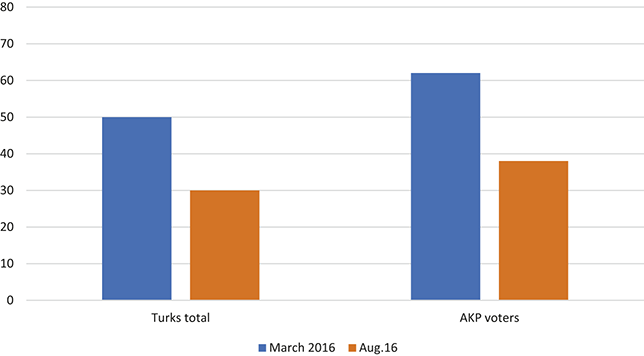
As mentioned above, the main debate in Israel concerns the country’s character: Is Israel predominantly Jewish or predominantly democratic (Shamir and Arian Reference Shamir and Arian1999; Talshir 2022)? Netanyahu’s and Likud’s narrative of the nation as endangered seems to have increased the willingness of many Israelis to choose Jewishness over democracy. In 2015, when the heightened threat narrative began, 25% of Israelis agreed that Jewish citizens of Israel should have more rights than non-Jewish citizens (Israeli Democracy Index 2022, 51). Seven years later, their share rose to 49% (Israeli Democracy Index 2022). Unsurprisingly, those who identify with the Right, and who are expected to be receptive to the narrative on endangered Jewishness, were much more likely to agree with this notion (62%) than those in the Center (around one-third) and on the Left (11%). Further evidence of the likely impact of the threat narrative on the willingness to compromise on democracy is visible when one compares the year 2022 with the multi-year average: “Whereas on the Left the two are virtually identical, in the Center current support for this position is eight percentage points higher than the multi-year average, and on the Right 14 percentage points, indicating growing endorsement of this undemocratic attitude in the latter two camps” (Israeli Democracy Index 2022) (see Figure 21).
Jewish citizens of Israel should have more rights than non-Jewish citizens.
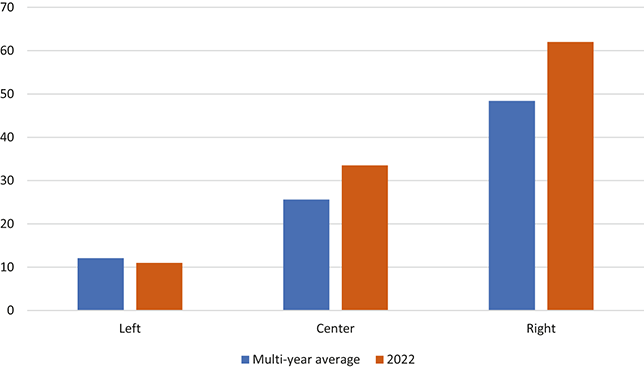
Other questions also registered an increased willingness among Israeli Jews to trade off democracy for the nation, particularly the question “In the event of a conflict between democratic principles and halacha (Jewish religious law), should priority be given to democratic principles or to the precepts of Jewish law?” While between 2003 and 2013 an average of 45% of respondents said that democratic principles should be prioritized, in 2022 only a third chose this response (Israeli Democracy Index 2022, 107).
5 Resisting the Subversion of Democracy in the Name of the Nation: The Role of Counternarrative
“I see a sea of red and white banners … we all share the view that our red-and-white homeland can be home to free people again.”
In the preceding parts of this Element, I identified a common mechanism that contributed to democratic backsliding in all five countries under investigation. Subversion of democracy through nationalist appeals appears to work when citizens are convinced that the nation is under threat. They seem to be more willing to acquiesce to the subversion of democracy for the sake of the allegedly endangered nation. The threat-driven mechanism of democratic backsliding thus worked at the micro level.
So why do we see different results at the macro level? Although democracy eroded in all five countries, it did not erode to the same extent. Indeed, despite the same strategy of political actors, democracy broke down in Serbia, Turkey, and Hungary, while in Israel and Poland it only eroded to a democracy of a lower quality, with Poland even managing to reverse the trend by ousting an authoritarian incumbent. Why were Kaczynski and Netanyahu unable to break democracy, that is, to convince enough people to abandon democracy for the nation?
In my attempt to shed light on this puzzle, I follow Beatty Riedl et al.’s (Reference Riedl, Paul Friesen, McCoy and Roberts2024) distinction between sources of democratic resilience and strategies of resistance. The already noted fact that five selected countries differ with respect to important institutional and structural sources of resilience (starting points) – such as the strength of democratic institutions, governance institutions, democratic histories, and ties to Western pro-democracy actors (Carothers and Press Reference Carothers and Press2022; Riedl et al. Reference Riedl, Paul Friesen, McCoy and Roberts2024, 18; Treisman Reference Treisman2023; Levitsky and Way Reference Levitsky and Lucan2023) – tells us that the reasons for a more successful resistance could be various. However, given a specific path of democratic backsliding, characterized by nationalist appeals and a threat narrative that served as a discursive strategy, I, accordingly, narrow my focus to the question of what matters in resisting the subversion of democracy in the name of the nation. I examine the response of opposition forces at the discursive level, focusing thus primarily on strategies of resistance.
Faced with the autocrat’s nationalist appeals and a threat narrative, pro-democracy actors have three options: ignore the threat narrative and the issue of the nation; outflank the autocrat by portraying themselves as more (ethno-)nationalist; or develop a counternarrative that links democracy and the nation. I found that the cases that were more successful in resisting the attacks on democracy in the name of the nation (Poland and Israel) were precisely those in which pro-democracy actors (opposition parties and civil society) managed to develop an emotionally compelling nation-related counternarrative, into which they were able to integrate the regime cleavage between autocratic and democratic forces. The counternarrative, in which the notion of a counter-threat featured heavily, helped them to mobilize pro-democracy citizens to fight back, both in the streets and at the ballot box.
5.1 The Power of Counternarrative
When the attacks on democracy began in 2015, Polish civil society was able to quickly organize popular protests (Fomina and Kucharczyk Reference Fomina and Kucharczyk2016). This was also possible due to the existing vibrant civil society and its developed infrastructure (CSO Sustainability Index 2024; interview with Kinga Lozinska, former deputy head of the Committee for the Defense of Democracy (KOD)). Popular mobilization helped to slow down the attacks on democracy, but not to halt them or reverse the trend. What the Polish opposition initially failed to develop was a counternarrative to the PiS’s threat narrative. This changed later. As both civil society and the then-opposition representatives told me in interviews, they deliberately began to use emotions and developed a counternarrative that revolved around Poland’s EU membership. Indeed, Jakub Kocjan from the prominent CSO Akcja Demokracja, and Bartosz Machalica, chief strategist of the party Lewica, told me that they began appealing to emotions by portraying the PiS as a threat to Poland because its authoritarian policies would lead to a so-called “PolExit,” meaning that the EU would kick Poland out because of the PiS’s policies.Footnote 14 Kinga Lozinska from the KOD and Krzysztof Izdebski from the Stefan Batory Foundation, another prominent CSO, also confirmed to me that they were deliberately appealing to emotions related to EU membership. KOD did not directly mention the role of the PiS in a possible “PolExit,” but rather how important the EU membership is for Poland and warned that it would be terrible for the country to leave the EU. The Stefan Batory Foundation’s message was based on the importance of the EU membership for Poland’s security.
This new “we are the guardians of Poland” approach was crowned with the campaign of Donald Tusk and his party PO for the 2023 parliamentary election. They reclaimed the narrative of patriotism, with the Million-Hearts-March, the highlight of the campaign, serving as the best example for it (Wojciechowski Reference Wojciechowski, Brändle and Szelewa-Kropiwnicka2023). The red-and-white hearts and the red-and-white Polish flag have become a symbol of the campaign (Walker Reference Walker2023), coupled with the change of the party symbols. Indeed, instead of the previous yellow smiley, the PO has chosen the heart in the national colors of Poland as its new party logo, reflecting its new patriotic message. Dorota Loboda, MP and spokesperson of PO’s parliamentary group, confirmed to me that such a counternarrative was deliberately developed. According to her, “national symbols, including the flag, were stolen by the PiS. For years we did nothing, and for years only PiS talked about community. For the 2023 election we decided to organize campaign based on emotions, to reclaim national symbols, and refill them with new content.” In her view, the party had to propose an alternative platform, and not just one that was anti-PiS, which is something that former PO spokesperson, Piotr Kolomycki, also pointed out in our interview. According to Loboda, they then settled on “a patriotic message based on the EU membership and an emphasis on building community around democratic values.” The counternarrative based on EU membership (keeping Poland anchored in the West) resonated with the Polish electorate because it is in line with both the authentic Polish identity, which sees Poland as belonging to the West, and with the pro-Western orientation of Polish society, as Loboda pointed out.
All interviewees agreed that the patriotic emotions were essential for the electoral mobilization that defeated the PiS in 2023. However, the precondition for this success was the existence of strong independent media. Indeed, the existence of private media such as TVN and Gazeta Wyborcza prevented the PiS from fully controlling the narrative. The representatives of the opposition and civil society told me that the role of these media was essential for their voice to be heard and for them to spread their counternarrative because the public broadcaster was only spreading the PiS narrative.
Poland thus serves as an example of successful mobilization at the ballot box, to which a compelling nation-related counternarrative contributed greatly. But this success is also due to the PiS’s mistake. The party, which is said to be “very good at recognizing Polish fears” (interview with Jakub Kocjan), miscalculated with its choice of a threat for the 2023 election. The narrative according to which Germany threatens Poland’s existence and Germans are Polish enemies (Romaniec Reference Romaniec2023), coupled with the official demands for reparations for the losses in the Second World War (Dettmer Reference Dettmer2023), did not resonate with the Polish population. According to the German-Polish barometer from 2023, as in previous years, the majority of Poles surveyed expressed a positive opinion of Germany, with only 15% expressing an aversion to it (Kucharczyk and Lada-Konefal Reference Kucharczyk and Lada-Konefal2023). What is more, there is no clear negative image of Germany among PiS voters, as the distribution of positive and negative statements is balanced (Kucharczyk and Lada-Konefal Reference Kucharczyk and Lada-Konefal2023).
However, the example of another success story, Israel, shows that the counternarrative is indeed important for mobilization and successful resistance. Israel, like Poland, has a vibrant civil society and independent media that gave civil society a voice. The government’s announcement of the judicial “reform” was followed by the longest and most massive protest in Israel’s history (Ziv Reference Ziv2023), initiated by a new organization called Mate Hama’avak (i.e., Resistance Headquarters). The counternarrative, which did not shy away from patriotism, but emphasized it, played an important role in this. The counternarrative was based on the role of democracy for Israel’s national identity and had its source and inspiration in the Israeli Declaration of Independence that envisioned Israel as a liberal democracy (Ariely Reference Ariely2023). Therefore, the protesters saw themselves as the true and authentic guardians of Israel because they were fighting “for a democratic and Jewish country that Israel was founded to be, while the government is trying to impose authoritarianism that is alien to Israel’s identity” (Beckerman Reference Beckerman2023). This was accompanied by the efforts to reclaim national symbols from the right and the far-right, most notably the national flag that eventually became the symbol of the protest. In fact, there has never been a protest movement so completely dominated by the Israeli flag (Ziv Reference Ziv2023), in stark contrast to previous similar protests where the use of the Israeli flag was exceptional (Stein and Strömbom Reference Stein and Strömbom2023). In addition to waving the flag in the name of democracy (Ziv Reference Ziv2023), the protests always began with the singing of the national anthem, as Yaniv Roznai, who was directly involved, told me.
That all this was no coincidence but a clear strategy was confirmed to me by the operation leader of Resistance Headquarters, Eran Schwartz. According to him, the challenge was not only to mobilize enough people, but also to make the protests last, and the nation-based counternarrative, which included reclaiming the national symbols that, in his words, “the ruling parties stole from us,” greatly helped. The protest organizers saw such a narrative as being in line with Israel’s tradition, that is, as building on the history of Israel as both a democratic and Jewish state. It was particularly helpful for mobilizing previously skeptical conservative voters and uncommitted citizens (Ziv Reference Ziv2023; interview with Raluca Ganea, whose organization was involved in the protest movement). In the words of Uri Zaki, an official of opposition party Democrats and former civil activist, “it made them immune to Netanyahu’s narrative that opposition is unpatriotic” as well as to the narrative that the protests were an Ashkenazi left-wing demonstration.Footnote 15 Eran Schwartz told me that their internal polling of protest participants confirmed to them that they were indeed able to reach voters across the political spectrum. Hence, with such an approach, they were able to unite many different subgroups – from those opposed to the occupation of Palestinian territory to veterans’ organizations, as civil activist Dan Sobovitz told me – but at the expense of Israeli Arabs who found it difficult to join in, as Ganea and Schwartz confirmed to me.
The success of such a popular mobilization organized by civil societyFootnote 16 was not only in raising the costs for the authoritarian government. According to all of my interlocutors, the massive popular mobilization encouraged the Supreme Court to react and not to defer to the executive branch. The protests provided the court with the support and legitimacy to strike down the judicial reform law (BBC 2024), as Roznai told me. They all agreed that without such strong public support, the court’s intervention would have been unlikely and the autocratization would not have been halted in its initial stage.
Contrary to Poland and Israel, pro-democracy actors in Hungary, Turkey, and Serbia failed to develop an effective nation-based counternarrative, that is, to frame the struggle for democracy as a struggle for the nation. In Serbia and Turkey, pro-democracy CSOs were too weak to fight back (CSO Sustainability Index 2024; BTI Turkey 2014, 2020), whereas independent media were quickly captured by the government (BTI Turkey 2014; ODIHR Turkey 2015; Milacic Reference Milacic2022). In addition, the opposition parties also struggled to find the right response to threat narratives. As civil activist Vukosava Crnjanski told me, Serbia has not confronted its past regarding the breakup of Yugoslavia, concretely the role of the ethno-nationalist “Greater Serbia” project in the Yugoslav wars. As a result, ethno-nationalism is still legitimate across the Serbian political spectrum. In fact, the stances of some of the Serbian opposition parties on the Kosovo issue are even more radical than Vucic’s, as another civil society activist, Igor Bandovic, pointed out to me. The Serbian far-right opposition, unlike Vucic’s SNS, officially opposes Serbia’s EU membership because, in their view, this would imply the recognition of Kosovo (Danas 2023c; Novi DSS party program). They also vehemently rejected the Franco-German plan on the normalization of the relationship between Serbia and Kosovo (Danas 2023d), and call for the return of the Serbian army to Kosovo (Novi DSS Reference Novi2024; Dveri party program).
While these opposition parties wanted to outflank Vucic and presented themselves as more nationalist than him and his SNS, the others decided to ignore the matter of the nation, including the concerns about Kosovo, as Zoran Lutovac, who was one of the leaders of the pro-European opposition between 2018 and 2024, told me. They are also against Kosovo’s independence, but they did not try to outflank Vucic because they also advocate for Serbia’s European integration. Normalizing relations with Kosovo is one of the key conditions for Serbia’s EU accession. Hence, such an ideologically heterogeneous Serbian opposition was unable to develop a compelling nation-related counternarrative that would also integrate the regime cleavage between autocratic and democratic visions of society. This in turn allowed Vucic and the SNS to successfully use the Kosovo issue and related nationalist appeals to subvert democracy.
In Turkey, for the far-right MHP, which was in the opposition until 2018, hostility to the Kurds was more fundamental than the ongoing autocratization under the AKP (Akkoyunlu and Sarfati 2024). Moreover, as Enver Cevik, international secretary of the Kurdish Dem Party, told me, when Erdogan initiated his anti-Kurdish narrative and started attacking Kurds, the main opposition party, CHP, also supported Erdogan and did not find his behavior problematic. This was in line with the party’s Kemalist nationalist politics that saw Kurdish rights as a danger to the national unity (BTI Turkey 2018; Somer Reference Somer2022). Accordingly, while some in the CHP tried to outflank Erdogan and the AKP with a more nationalist approach, the others were silent about the government’s nationalism, as civil activist Ulas Tol told me. Hence, the CHP’s traditional exclusionary nationalism was an obstacle to the development of a compelling counternarrative that would link nation-related appeals and democratic values.
There is, however, an important difference between Turkey and Serbia. In recent years, the CHP has transformed itself into a more inclusive social democratic party (Selvin Korkmaz Reference Selvin Korkmaz2023; Akkoyunlu and Sarfati 2024), which has made it more aware of Erdogan’s misuse of the Kurdish issue to undermine democracy. This was confirmed to me by its MP, Yüksel Taskin, who emphasized that a learning process took place within the CHP: “In the CHP, many learned later about Erdogan’s real intentions regarding the Kurdish issue.” He admitted that different visions on the Kurdish issue still exist in the CHP, but argued that the ethno-nationalist and anti-Kurdish discourse is not as strong as it used to be. As someone who has long been a critic of Turkish nationalism and was expelled from university for advocating Kurdish rights, he also pointed to himself as “a living example of the party’s shift.”
This shift, in turn, has made the party more open to a cross-ethnic democratic approach to the Kurdish question (Somer Reference Somer2022). MP Taskin told me that they realized that ethnic outbidding was not working, so “we started to focus on countering Erdogan’s nationalism with concrete social policies and how to solve problems and make the system work,” which manifested itself already in the 2019 local election campaign. Indeed, the CHP’s campaign was marked by inclusive and hopeful campaign slogans that focused on local politics (Selvin Korkmaz Reference Selvin Korkmaz2023). The same approach was used for the 2024 local election campaign as well. The CHP’s candidate for the mayor of Fatih municipality in Istanbul province, Mahir Polat, confirmed the change in strategy to me: “The Kurds are a part of Turkey and not a threat to it. We (CHP) now have a less abstract and a more solution-oriented approach that promises to solve the country’s problems. Our integrative strategy for the society is based on this.” It seems that this new approach strongly contributed to a surprising victory in the 2024 local election (Kirby and Kasapoglu Reference Kirby and Kasapoglu2024). However, it is questionable whether a counternarrative, which sees the output of the system and good governance as the basis of the nation’s identity, will resonate with voters in the campaign for the national election. Such a narrative does not seem to solve, but rather only ignores, a key identity dilemma emphasized by Somer (Reference Somer2022, 286): How to ensure that ethnic Turks are not concerned about their own identity, while also recognizing Kurdish identity?
Unlike the opposition in Turkey and Serbia, the Hungarian opposition (with the exception of the far-right Jobbik) was not supportive of ethno-nationalism. As Klara Dobrev, who was one of the opposition’s leaders, told me, “the failure to develop a counternarrative was not due to different principles as we were against ethno-nationalism,” which was confirmed to me by a senior official of the Hungarian Social-Democrats, Gabor Harangozo. The Hungarian opposition parties simply struggled to identify an issue around which to create a nation-related counternarrative, so they decided not to address the matter of the nation and to focus on other issues, Dobrev emphasized. Zsuzsanna Szelenyi, former opposition MP and co-founder of liberal party Together, told me a similar story. According to her, the opposition was “paralyzed” in 2015 when Orban started his threat narrative against immigrants and did not know how to react: “There were strategic discussions within the opposition about how to respond, but they were not fruitful, so it was decided not to talk about the issue,” allowing Fidesz to dominate the discourse, which has been the case ever since.
Hungarian civil society did not manage to find the right tone either. Civil society’s resistance was, in the words of Marta Pardavi, head of the Hungarian Helsinki Committee, “an elite affair” and not properly communicated to the general public. CSOs addressed individual deficiencies of democracy, and there was thematic cooperation between them, as I was told in the interviews, without the resistance being framed in a nation-related narrative or CSOs having a coordinated message, as seen in Poland and Israel. There was also no coordination on the narrative with the opposition parties, while some CSOs, such as the HCLU, deliberately kept a strict distance from the opposition parties (interview with its head, Dalma Dojcsak). According to Pardavi, it was only later that they realized that judicial reform, media reform, amendments to the Constitution, and attacks on LGBT, Roma, homeless people, and immigrants were not separate issues, but all integral parts of the larger project: “We are now more aware that this is a battle of narratives and we need our positive vision.” However, the current Hungarian context, described to me by Klara Dobrev as a “communication jail” amid the absence of an opposition’s voice in the media, makes it much harder for the opposition to develop an effective counternarrative.
5.2 Key Lessons for Building a New Electoral Coalition
As already noted, when faced with the subversion of democracy in the name of the nation, pro-democracy actors have three options. Although the five countries under investigation show that a nation-related counternarrative seems to be the most promising resistance strategy, their experience also tells us that the opposition’s response is conditioned by several factors:
Firstly, the existence of the formative rifts. In an environment lacking formative rifts, the counternarrative should be centered on a nation-related topic that is salient to the local political dynamic and not already owned by an authoritarian incumbent, as the Polish experience demonstrates. The opposition can draw inspiration from contemporary debates or available historical narrative sources.
On the other hand, where formative rifts exist, given their societal salience, they are likely to be misused by authoritarian incumbents for the development of a nationalist narrative, as Turkish, Serbian, and Israeli cases demonstrated. Hence, when nationalist and threat appeals revolve around formative rifts, it is difficult for pro-democracy actors to ignore them. In a context marked by the disputed national identity or borders, it is unlikely that a counternarrative, which solely focuses on democracy and ignores these open issues, can bring success. Israel, however, offers an exception here. Israeli pro-democracy actors were able to develop a counternarrative without addressing the Israeli-Palestinian issue thanks to the above-mentioned specific role of democracy in Israeli nation-state building.
This is, however, not to say that the formative rifts will always play a decisive role. If an open territorial issue turns into a frozen conflict, it may lose some of its salience to voters and thus its potency, as we could observe in Serbia and Turkey. This provides the opposition with a time-limited opportunity to craft a counternarrative that does not focus on the formative rift, which is important because the formative rift often poses an obstacle to building a broad democratic coalition. The political entrepreneurship of Vucic, Erdogan, and also Netanyahu had, therefore, a purpose of maintaining the salience of the Kosovo, Kurdish, and Palestinian issues, respectively. Moreover, we cannot exclude contingency as a factor, as demonstrated by the recent Serbian experience. Serbian students managed to mobilize hundreds of thousands of Serbs in the streets with an approach that included the use of the Serbian flag, the singing of the national anthem, and a patriotic counternarrative based on good governance rather than the Kosovo issue (Congradin Reference Congradin2025). This counternarrative, revolving around the rule of law, seemed to resonate because the protests were triggered by a tragic incident involving the deaths of sixteen people and the government’s reluctance to hold those responsible to account (Le Monde Reference Monde2025). However, the question remains whether such a narrative can be sustained in the long term.
Secondly, the country’s demographic situation. Pro-democracy actors in ethnically and religiously heterogeneous countries face a certain dilemma. The Turkish and Israeli experiences tell us that, as the opposition was building an electoral majority to defend democracy, they deliberated the extent to which their narrative should be inclusive toward Kurds and Israeli Arabs, respectively. The existence of many Kurdish voters was an incentive for the CHP to partially shift from trying to outflank Erdogan to developing a counternarrative that is more inclusive toward the Kurds. Although the size of the Israeli Arab population is similar to that of the Kurdish population in Turkey, the counternarrative of Israeli civil society largely ignored Israeli Arabs and was only more inclusive toward conservative Israeli Jews. Hence, the dilemma in heterogeneous societies seems to be whether to develop a counternarrative that is more appealing to minority voters or to moderate voters of the authoritarian incumbent. Against the backdrop of Turkish and Israeli experiences, this decision appears to depend heavily on the local context, that is, the intensity and scale of the conflict between the majority and minority. In cases where the conflict is ongoing or recurring and highly violent, with no cross-cutting links between the majority and minority, such as a shared religion, a more inclusive approach toward the minority appears less promising. However, the precondition for the aforementioned dilemma is that minorities are fully committed to democracy, which is not always the case. In many countries, they have sided with authoritarian nationalists who promised to protect their particularistic rights in exchange for turning a blind eye to violations of democratic rules (e.g., North Macedonia) – something that Erdogan is trying to achieve with his recent overture toward the Kurds.
Thirdly, ideological homogeneity of the opposition. In Serbia, the ideological heterogeneity of the opposition conditioned its response to the incumbent’s nationalist appeals. The ethno-nationalist opposition tried to outflank an incumbent, while the pro-European ignored the incumbent’s nationalist rhetoric. This prevented a joint response, from which the incumbent greatly profited. Ideological homogeneity of the opposition thus facilitates a more successful resistance.
Fourthly, the role of political agency. My interviews with political actors in Turkey, Hungary, and Serbia revealed that the absence of a counternarrative was also due to the opposition’s lack of skill and creativity. Although ideologically rather homogeneous, the Hungarian opposition was unable to identify a suitable topic for the counternarrative. As already noted, the Turkish opposition managed to learn from its mistakes and strike the right tone at the local level, but still not at the national level. In Serbia, the pro-European opposition ignored the incumbent’s nationalist appeals because they were neither able to develop a politically profitable counternarrative around the Kosovo issue, nor to identify another nation-related topic around which to build a counternarrative. Contrary to them, my interviews with actors from Poland and Israel revealed internal debates about strategy, readiness for reinvention, and the courage to try a specific counternarrative.
6 Conclusion
Recent developments around the world have taught us that we are not living in a democratic bonanza. In many parts of the world, authoritarian-minded leaders continue to be re-elected. Does this mean that ordinary citizens are fed up with democracy and that they are looking for something else? Overall, this Element argued that it is not that the majority of citizens in the five countries under investigation wanted authoritarianism. It is that political actors (entrepreneurs) exploited available opportunities and created conditions in which many citizens began to tolerate authoritarian behavior more or to find it more acceptable. More concretely, the Element identified the successful creation of a threat to the nation, which in turn justified the attacks on democracy in the name of safeguarding the nation, as another path of democratic backsliding. Therefore, in addition to the previous playing of the nationalist card for electoral mobilization, the five cases under investigation tell us that nationalist appeals can be weaponized against democracy as well.
Hence, the Element argued that authoritarian leaders cannot quietly undermine democracy forever without citizens noticing, as Guriev and Treisman (2022) suggest. It is only a matter of time before democratically minded citizens become aware of it. A cover or justification is thus needed, such as the one in the form of the threat narrative, because when voters feel threatened, they appear to ignore the subversion of democracy or rationalize it away as a way to minimize the threat. This threat-driven mechanism of democratic backsliding seems to work across different political landscapes. However, its success appears to be affected by a mix of factors identified in the Element, though other factors may also be at play. Available historical material (the loss of national territory or sovereignty), demographic decline, as well as the existence of competing national narratives, and narratives of the victimized nation and its exceptionalism, facilitate the resonance of the threat narrative. Nevertheless, the Element did not attribute the outcomes solely to the factor of path dependency. The role of agency, that is, the selection of threat objects by political actors, proved pivotal as well. By examining the threat objects that resonated and those that did not (Germans in Poland or Roma and homeless people in Hungary), I conclude that the objects that more directly, and much less abstractly, threaten hegemonic national identity (e.g., immigrants for being Muslims or LGBT for being against very strong Christian roots) or national sovereignty (e.g., Kurdish separatists or the West for endorsing Kosovo’s independence) are more promising as threat objects. In this case, the threat claims are more feasible.
Accordingly, political actors from countries marked by formative rifts have an easier job, as this seems to be another important structural factor. Thanks to the existing formative rifts, the threat selection of Erdogan, Vucic, and Netanyahu was less affected by contingency and exogenous factors. Contrary to them, Orban and Kaczynski could not profit from open national identity or territory issues that provide a steady source for political entrepreneurship. Hence, in such an environment, contingency and exogenous factors, as well as the skillfulness and creativity of political actors, matter much more. Orban and Fidesz, for example, managed to prolong the salience of the immigration issue with their actions despite unfavorable exogenous factors, such as the closure of the Balkan route for immigrants and the COVID-19 pandemic. Kaczynski and PiS, on the other hand, failed to do so. In other words, when formative rifts are present, the path of success for aspiring autocrats is in their politicization to ensure their salience for the local political dynamic; when formative rifts are absent, threats need to be repeatedly fabricated since shifts in voters’ perception (the existence of a sense of threat within the population) are not necessarily durable.
However, the experiences of the five countries under investigation teach us another lesson as well – that the success of aspiring authoritarians also depends on the agency of pro-democracy political actors. If pro-democracy forces want to increase their chances of defeating authoritarian incumbents, they should not ignore the issue of the nation, but rather develop a compelling counternarrative into which they should integrate the regime cleavage between autocratic and democratic forces. This proved to be a critical factor in the resistance in Poland and Israel: the defense of EU membership as an integral part of Poland’s identity as a Western and democratic nation, and the defense of democratic values and institutions as an integral part of Israel’s founding narrative. The counternarrative motivated Polish citizens to cast a vote for the opposition and reverse the trend, whereas Israeli citizens to take to the streets, which in turn encouraged the Supreme Court to react and halt the backsliding. This form of political agency, which also includes the reclaiming of national symbols in order to dissociate them from the ethno-nationalist vision of society, seems to be particularly important for convincing moderate voters of authoritarian incumbents to switch sides.
Therefore, by emphasizing the importance of counternarrative in democratic resistance, the Element builds on the work of Fish (Reference Fish2024), who has emphasized the need for inclusive counternarratives to challenge the exclusionary narrative of ethno-nationalists. Recent developments in Hungary and Poland seem to additionally confirm this. It may not be a mere coincidence that the first serious challenge to Orban comes from a political actor named Peter Magyar, who makes heavy use of national identity appeals (The Economist 2024) and has incorporated the national flag into party symbols, similar to the Polish PO. According to some polls, his Tisza party is ahead of Fidesz (Reuters 2025). Moreover, after successfully defeating the PiS with a counternarrative in 2023, the PO and its presidential candidate, Rafal Trzaskowski, decided to outflank the PiS and its candidate, Karol Nawrocki, by sharply turning to the right on issues such as immigration, Ukrainian refugees, and LGBT (Kuisz and Wigura Reference Kuisz and Wigura2025). This strategy was unsuccessful as Trzaskowski lost the 2025 election despite being the clear favorite.
These lessons could be valuable for other countries where authoritarian incumbents use nationalist appeals to subvert democracy, which is additionally confirmed by the Brazilian experience. One of the key reasons for successful resistance lies in President Lula’s ability to frame the fight for democracy as a fight for Brazil’s character and sovereignty. Lula portrayed himself as representing a pluralist and independent Brazil, while depicting his far-right opponents as authoritarians deferring to the interests of the USA (Pagliarini Reference Pagliarini2025). Moreover, the Polish and Israeli cases teach us another important lesson – that a pluralist narrative can prevail despite unfavorable conditions. National narratives can thus change, but not only for the better. Despite their dominant civic traditions, we could observe the rise of ethnic nationalism in Trump’s USA and Modi’s India. Trump’s portrayal of himself as a protector of the endangered American national identity and sovereignty, while simultaneously branding the Democrats as unpatriotic, is an important part of his electoral appeal and power grab efforts (The White House 2025). Nevertheless, the Democrats are still reluctant to fight Trump on this terrain by developing their own version of patriotism linked to democratic values. Similarly, Modi has used Hindu nationalist appeals as a pretext to curtail the civil liberties of the Muslim minority and attack the opposition (Tudor Reference Tudor2023). Yet unlike the Democrats, the Indian National Congress (INC) seems to have learned that national narratives must be constantly nurtured and reinvented, which contributed to a significant decrease in seats for Modi’s BJP in the last parliamentary election: from 303 to 240 (Fish Reference Fish2024).
But why are national narratives so politically relevant? Besides the fact that “the nation-state remains the primary context for democratic political representation” (De Cleen and Stavrakakis Reference De Cleen and Stavrakakis2017, 1), we need to finally accept that, as discussed in Section 1, humans have a fundamental need to be part of a collective identity. “Human life is group life” (Achen and Bartels Reference Achen and Bartels2016, 18), and the nation is still one of the most important groups. Indeed, the surveys tell us that vast majorities all over the world “across the educational and political spectrum” (Gustavsson and Miller Reference Gustavsson, Miller, Gustavsson and Miller2020, 10) value and cherish their membership in the nation. As such, they seek leaders who are committed to serving and protecting them (Tamir Reference Tamir2019a) and who “make them feel great about their country,” something that democracy’s defenders have often neglected and ignored (Fish Reference Fish2024, 32). This seems particularly true of societies that have suffered the loss of territory or sovereignty in their history, as well as societies marked by a contested national identity and borders. In these societies, the nation as a topic is particularly potent.
Yet the Polish and Israeli examples show us that this does not have to lead to nationalism based on ethnicity. Indeed, nationalism can live separately from ethnicity (Mylonas and Tudor Reference Tudor2023), and a compelling national narrative does not have to be based on ascriptive criteria. Conflating nationalism with ethno-nationalism seems to prevent us from seeing many of the merits of liberal nationalism (Tamir Reference Tamir2019b; Fish Reference Fish2024), including for combating democratic backsliding and strengthening our democracies. Progressives too often reject nationalism, unaware of how much voters’ concern for the nation shapes their political actions. Therefore, to counter the sense of uncertainty plaguing many societies and the fear-mongering of the far-right, pro-democracy actors must nurture a unifying political and cultural narrative. They should not wait for the election of an authoritarian incumbent, but should immediately engage in these efforts that could strengthen democracy’s resilience to threats and nationalist appeals employed by many actors – even in established democracies such as Great Britain, Germany or France.
However, developing such an emotional counternarrative could exacerbate polarization, and this is a major challenge for pro-democracy actors (Beatty Riedl et al. Reference Riedl, Paul Friesen, McCoy and Roberts2024). Moreover, the Element unpacked other important challenges that pro-democracy actors face when developing a compelling counternarrative and building a new electoral coalition: how to identify a promising nation-related topic and link it to democracy? Whether to develop a counternarrative that is more appealing to minority voters or to moderate right-wing voters? Or the challenges stemming from the ideological heterogeneity of the opposition, the existence of formative rifts, and endogenous factors. The Element offered some guidance in this regard.
The argument of the Element has its limits that I acknowledge, and that could serve as points of departure for subsequent investigations. My mechanism is based on plausibility, not causality, because my goal was to lay out a preliminary version of what a new and complementary theoretical argument might look like and to provide sufficient empirical evidence for its plausibility. In addition, the argument is applicable only to the cases in which the subversion of democracy was mainly justified with nationalist appeals. Moreover, while the Element identified historical and structural factors that facilitate the resonance of the threat narrative in society as a whole, it does not fully explain why the narrative resonated with some segments of society, making them more tolerant of undemocratic behavior, while failing to resonate with others: is it a top-down influence (the partisanship and elite cues)? Or a bottom-up effect related to the pre-existing ethnocentric attitudes? This is a burning question, and with this Element, I hope to inspire future research in this regard.
I also acknowledge that a threat-driven form is not the only expression of nationalism that serves the political ends of aspiring autocrats. Some of the actors I analyzed used a positive nationalism, or restorative nationalism that aims to restore the lost national greatness (Ding, Slater and Zengin Reference Ding, Slater and Zengin2021), thus claiming that “we are great again and that is why our enemies point to our alleged democratic deficits.” But the threat-driven version of nationalism was primarily used as a cover for attacks on democracy.
Overall, I believe the Element’s key insights contribute to a better understanding of democratic backsliding and resilience. These insights could be useful beyond the countries under investigation. They include the role of elite’s threat narrative and nationalist appeals in the subversion of democracy, the role of human nature in tolerating such attacks on democracy, and the importance of a national counternarrative for building a broad coalition in defense of democracy. And, no less important, these insights show that, as Tudor and Slater (Reference Tudor and Slater2021) emphasize, nationalism can help explain political outcomes, and not only be a phenomenon to be explained. I hope that my Element will encourage other scholars to further explore the relationship between nationalism and democratic backsliding and resilience, and to test the robustness of my findings.
Acknowledgment
Much of the data in this Element is drawn from the Friedrich-Ebert-Stiftung’s project “Identity, Partisanship, Polarization: How Democratically Elected Politicians Get Away with Autocratizing Their Country.” I have worked on the manuscript during my stays at the MacMillan Center at Yale University and the Institute for Human Sciences in Vienna. I am grateful to my editors, Rachel Beatty Riedl, Maya Tudor, and Ben Ross Schneider, for their support throughout the process. Many thanks go to Andreas Schedler, Dan Slater, Amar Hur, Jerik Cruz, Michael Coppedge, Max Brändle, Murat Somer, Ivan Krastev, Carlos Melendez, Balint Mikola, Yuko Sato, Zsofia Bocskay, Szabolcs Pogonyi, Zsolt Enyedi, Levente Littvay, and two reviewers for their excellent comments, criticisms, and suggestions. Special thanks go to my interview partners.
Einaudi Center for International Studies and Cornell University
Rachel Beatty Riedl is the Director and John S. Knight Professor of the Einaudi Center for International Studies and Professor in the Government Department and School of Public Policy at Cornell University. Riedl is the author of the award-winning Authoritarian Origins of Democratic Party Systems in Africa (2014) and co-author of From Pews to Politics: Religious Sermons and Political Participation in Africa (with Gwyneth McClendon, 2019). She studies democracy and institutions, governance, authoritarian regime legacies, and religion and politics in Africa. She serves on the Editorial Committee of World Politics and the Editorial Board of African Affairs, Comparative Political Studies, Journal of Democracy, and Africa Spectrum. She is co-host of the podcast Ufahamu Africa.
Massachusetts Institute of Technology
Ben Ross Schneider is Ford International Professor of Political Science at MIT and Director of the MIT-Brazil program. Prior to moving to MIT in 2008, he taught at Princeton University and Northwestern University. His books include Business Politics and the State in 20th Century Latin America (2004), Hierarchical Capitalism in Latin America (2013), Designing Industrial Policy in Latin America: Business-Government Relations and the New Developmentalism (2015), and New Order and Progress: Democracy and Development in Brazil (2016). He has also written on topics such as economic reform, democratization, education, labor markets, inequality, and business groups.
Oxford University
Maya Tudor is Professor of Politics and Public Policy, Blavatnik School of Government and Fellow, St. Hilda's College, at Oxford University. She researches democracy and nationalism in the developing world, with a focus on South Asia, and is the author of two books, Promise of Power and Varieties of Nationalism.
Advisory Board
Yuen Yuen Ang, University of Michigan
Catherine Boone, London School of Economics
Melani Cammett, Harvard University (former editor)
Stephan Haggard, University of California, San Diego
Prerna Singh, Brown University
Dan Slater, University of Michigan
About the Series
The Element series Politics of Development provides important contributions on both established and new topics on the politics and political economy of developing countries. A particular priority is to give increased visibility to a dynamic and growing body of social science research that examines the political and social determinants of economic development, as well as the effects of different development models on political and social outcomes.