


Introduction
The nonprofit sector has experienced significant growth in recent decades. However, in parallel to this expansion, the emergence of scandals within nonprofit organizations (NPOs) has threatened the reputation and legitimacy of all NPOs, undermining their role as reliable advocates for social causes and ultimately endangering the public trust and credibility of the entire sector (Hielscher et al., Reference Hielscher, Winkin, Crack and Pies2017). This crisis of confidence led to international efforts to promote accountability, increasing the demand for transparent reporting and strengthened corporate governance mechanisms (Gazzola et al., Reference Gazzola, Amelio, Papagiannis and Michaelides2021; Romero-Merino & Garcia-Rodriguez, Reference Romero-Merino, Garcia-Rodriguez, Jung, Phillips and Harrow2016). Specifically, NPOs need a governance model that adequately responds to the needs of a sector in a constantly changing environment, that enhances the representation of all stakeholders, and that promotes transparency and accountability as key elements for building credibility and legitimacy within civil society (Leardini et al., Reference Leardini, Moggi and Rossi2019).
Most common internal NPO governance mechanisms include the board of directors, codes of ethics, internal audit processes, and accountability (Plaisance, Reference Plaisance2021). Among these, the board is considered to be at the apex of NPO governance (Jensen, Reference Jensen1993) being responsible for the fulfillment of the mission and playing an important role in ensuring that NPOs are well governed and accountable to their constituent groups (Bellante et al., Reference Bellante, Berardi, Machold, Nissi and Rea2018). Thus, board composition is expected to affect both NPO performance and accountability, making it a particularly influential governance mechanism.
Regarding accountability, though hard to conceptualize, it has usually been related to the means by which organizations are externally accountable for their actions and take internal responsibility for continually reviewing their mission (Ebrahim, Reference Ebrahim2003). Accountability is therefore considered at the core of governance, with transparency being one of its basic dimensions (Sanzo-Pérez et al., Reference Sanzo-Pérez, Rey-Garcia and Álvarez-González2017; Zhou et al., Reference Zhou, Zhu and Zheng2021).
Here, the study of the relationship between board and accountability, as essential governance mechanisms in NPOs, becomes a very relevant topic to develop. Previous authors have analyzed this relationship focusing mainly on the influence of board size, independence, or activity (e.g., Oliveira Carvalho et al., Reference Oliveira Carvalho, Lima Rodrigues and Castelo Branco2017; Zhou et al., Reference Zhou, Zhu and Zheng2021) on NPOs accountability or transparency. However, the evolution of this line of research and of the society in which NPOs operated, introduced new accountability mechanisms, such as those web-based (e.g., Benito-Esteban et al., Reference Benito-Esteban, Garcia-Rodriguez and Romero-Merino2019; Martín & Martín, Reference Martín and Martín2017) and also progressively expanded the board dimensions under study, including features such as directors' expertise (Cody et al., Reference Cody, Lawrence, Prentice and Clerkin2022), board politicization (Xu & Niu, Reference Xue and Niu2019; Zhou et al., Reference Zhou, Zhu and Zheng2021), or gender diversity (Cody et al., Reference Cody, Lawrence, Prentice and Clerkin2022; Zhou et al., Reference Zhou, Zhu and Zheng2021). Results obtained from these studies, however, are so far inconclusive, with either positive, negative or nonsignificant relationships found for most of the variables analyzed.
Hence, our aim in this study is to continue this line of research to shed more light on the influence of board composition on transparency and, more specifically, on web transparency. To this end, our goal is threefold. First, this study proposes the use of a methodology, such as fuzzy set qualitative comparative analysis (fsQCA), which goes beyond the analysis of the influence of each board characteristic separately. In contrast, this methodology allows us to identify which board configurations (considering jointly their size, independence, expertise, and diversity) are more likely to lead to high web transparency. Second, we measure NPO’s accountability by using a very comprehensive index of web transparency (defined by Benito-Esteban et al., Reference Benito-Esteban, Garcia-Rodriguez and Romero-Merino2019) which addresses not only information transparency (ornamental, financial, governance, etc.) but also issues related to presentation, navigation and relational. The latter elements go a step beyond mere disclosure of information (sometimes made by legal imposition) and indicate that the NPO is concerned with facilitating stakeholders' access to and interaction with the organization. Finally, we build on recent research (Arshad et al., Reference Arshad, Bakar, Thani and Omar2013; Cody et al., Reference Cody, Lawrence, Prentice and Clerkin2022; Zhou et al., Reference Zhou, Zhu and Zheng2021) that analyzes the board by considering not only traditional variables (size and independence), but also other features incorporated in the most recent literature like gender diversity and specific expertise of directors (financial or in NPO). Previous studies that incorporated these last board characteristics did not use web transparency in any case, so our study is a pioneer in analyzing this relationship.
To achieve our threefold goal, we use the board composition (size, independence, gender diversity, and professional expertise) and web transparency of 67 Spanish non-governmental development organizations (NGDOs) and analyze their relationship with the fsQCA methodology. We find that several combinations of board characteristics can lead to a high level of transparency for both large and small NPOs, as well as for organizations with the legal form of association and foundation. Moreover, our results show that having board members with expertise in the nonprofit sector are needed to achieve a greater transparency in any case, recruiting female directors is favorable in most scenarios, while the impact of the rest of the board characteristics on transparency depends on the interactions with the remaining variables.
This study contributes to previous literature on nonprofit governance by providing better insight on the relationship between two governance mechanisms (board and transparency). To this end, we use a more holistic analysis—the fsQCA—which offers different board configurations leading to a high level of transparency, thus providing an answer to the inconclusive results obtained by previous literature. Furthermore, we use a detailed index of web transparency and some of the board characteristics introduced by the most recent literature, which allows us to find that the participation of some kinds of directors (e.g., NPO experts and women) is particularly valuable to increase web transparency defined on terms beyond information disclosure, also assessing the accessibility and the interrelation possibilities of the website.
The structure of this study is as follows: We begin with a review of the literature on nonprofit governance and, specifically, on board, accountability and transparency. We then explain the sample, variables and methodology used and show the results obtained. Finally, we present the main conclusions, limitations, and future lines of research.
Literature Review
In a context with information asymmetries, agency conflicts arise from the existence of a conflict of interest that results when separating resource providers from control of an organization (Fama & Jensen, Reference Fama and Jensen1983). This situation generates the possibility of opportunistic behavior by the managers (agents), who can have different interests from those of the principals (owners in corporations, grantors or donors in NPOs). To prevent this opportunistic behavior, the board of directors stands as the main responsible for ensuring that NPOs fulfill their mission (Andrés-Alonso et al., Reference Andrés-Alonso, Martín Cruz and Romero-Merino2006; Romero-Merino & Garcia-Rodriguez, Reference Romero-Merino, Garcia-Rodriguez, Jung, Phillips and Harrow2016).
However, direct application of this theory to the nonprofit sector has its limitations, especially when those understood as ‘principals’ do not obtain direct benefit from their donations—which reduces their incentive to monitor—(Balsam et al., Reference Balsam, Harris and Saxton2020) and also have limited sanctioning potential (Hielscher et al., Reference Hielscher, Winkin, Crack and Pies2017). To overcome these limitations, many authors propose the use of a theoretical framework proposing that there are other stakeholders who may be equally interested and able to monitor (e.g., beneficiaries, volunteers, or civil society in general) and that, therefore, they should also be included in the governance model. Hence, stakeholder theory becomes important in explaining the agency relationships that occur in NPOs. The stakeholder theory, originated in Freeman’s (Reference Freeman1994) studies, has as its central argument that there should be mutual cooperation and trust among the stakeholders. Based on this theoretical background, the board, in addition to monitoring the management, must also serve as a mechanism for representing the interests of the different stakeholders (Leardini et al., Reference Leardini, Moggi and Rossi2019) and becomes an instrument of NPO legitimization for stakeholders. Along these lines, accountability becomes a critical governance tool for the board, as it can serve as a mechanism for connecting with other stakeholders and also reduces information asymmetries by allowing other stakeholders to monitor the organization's functioning. Therefore, it is essential to understand how board members handle accountability.
Accountability and Transparency in NPOs
The topic of accountability in NPOs is a key issue that has been studied extensively in both past and present NPO governance (e.g., Bellante et al., Reference Bellante, Berardi, Machold, Nissi and Rea2018; Plaisance, Reference Plaisance2021). There is a wide range of definitions of accountability, from the narrowest, which consider it as a ‘constraint upon the powerful’ (Roberts, Reference Roberts2001: 1555) to much wider ones, which argue that accountability faced by organizations can be plural and change over time (Ebrahim, Reference Ebrahim2003; Sanzo-Pérez et al., Reference Sanzo-Pérez, Rey-Garcia and Álvarez-González2017). In any case, accountability seems to be more than accounting (or mere information disclosure), as it addresses the information needs of the stakeholders to which the NPO is intended to relate (Connolly & Hyndman, Reference Connolly and Hyndman2013). In this sense, accountability has become an essential instrument of good governance because it allows board directors, major donors, etc., to monitor and evaluate the good practice of the management (upward accountability) and furthermore, under a stakeholder approach, accountability has become a safeguard of the NPO's mission as it addresses demands and needs of a larger stakeholder environment, including beneficiaries (downward accountability) (Edwards & Hulme, Reference Edwards and Hulme1996; Hielscher et al., Reference Hielscher, Winkin, Crack and Pies2017).
Transparency, in turn, is one of the basic dimensions of accountability and refers mainly to collecting and disclosing information to the public (Weisband & Ebrahim, Reference Weisband and Ebrahim2007). Its role is critical in minimizing information asymmetries. The evolution of the transparency concept has been in line with that of accountability, starting with a focus on information disclosure regarding the management and governance practices (consistent with the monitoring arguments of agency theory), but in recent years it has focused on evidencing how NPOs accomplish their mission and on including aspects such as the accessibility to such disclosed information and the possibility of engaging in a dialog with stakeholders (following the arguments of the stakeholder approach) (Benito-Esteban et al., Reference Benito-Esteban, Garcia-Rodriguez and Romero-Merino2019; Sanzo-Pérez et al., Reference Sanzo-Pérez, Rey-Garcia and Álvarez-González2017).
Transparency has become particularly important since the digital transformation. The evolution of the Internet has created an environment that, on the one hand, has provided NPOs with a cost-effective and fast way to provide information and interact with their stakeholders and, on the other hand, has led to social pressure on NPOs to increase their transparency in order not to lose the trust and confidence of civil society. In this context, there are many factors that can drive an improvement in web transparency (e.g., financial readiness, perceived complexity, social pressure, etc.), but, among them, the board is defined as an internal pressure that can encourage an increase in the NPO's transparency (Lee & Blouin, Reference Lee and Blouin2019).
The Board of Directors and its Complex Relationship with Transparency in NPOs
The role of the board of directors depends on the approach under which governance is conceived. Thus, under agency theory arguments, its main function is to monitor management to prevent them from behaving opportunistically and expropriating the principals (who could be conceived of as the donors or grantors in an NPO). Board members are expected to be an effective control mechanism for the organization since, as they are located at the end of the responsibility chain, they are ultimately responsible for the control of all the actions carried out by the NPO (Rey, Reference Rey2009). However, while board involvement in oversight can prevent value destruction of the NPO (Bellante et al., Reference Bellante, Berardi, Machold, Nissi and Rea2018), stakeholder theory focuses more on how boards can help achieve its mission by engaging all stakeholders in decision-making. Stakeholder participation in boards and governance helps to generate a better outcome by linking organizational decisions to constituent needs. Nevertheless, meaningful participation requires that stakeholders have acknowledgment of the organization's activities (Leardini et al., Reference Leardini, Moggi and Rossi2019). Thus, accountability is critical for the board of directors to achieve effective stakeholder engagement.
Considering the importance of accountability for the board, we can expect that different board configurations may lead to different approaches to accountability (Oliveira Carvalho et al., Reference Oliveira Carvalho, Lima Rodrigues and Castelo Branco2017). In fact, the relationship between board and accountability (often measured in terms of transparency or web transparency) has been previously analyzed on several occasions.
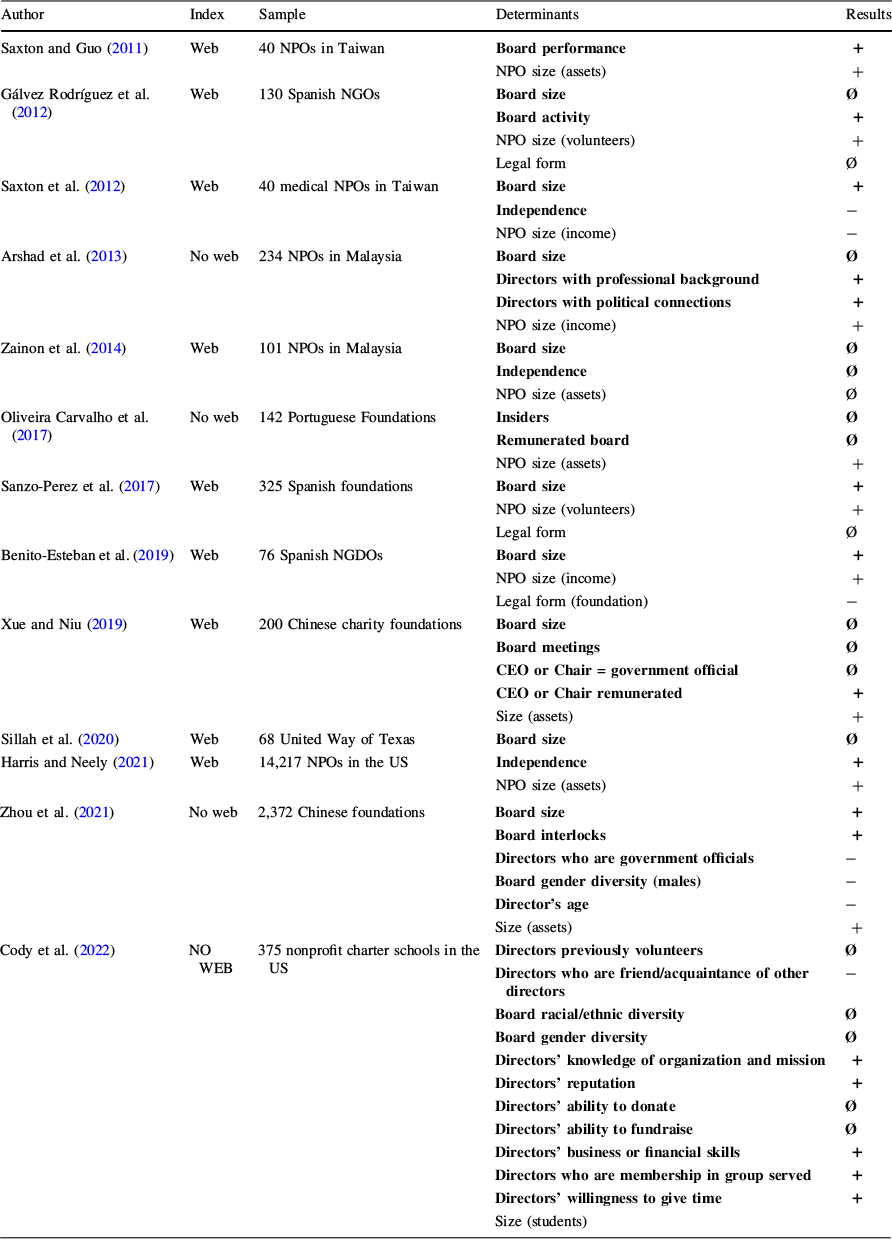
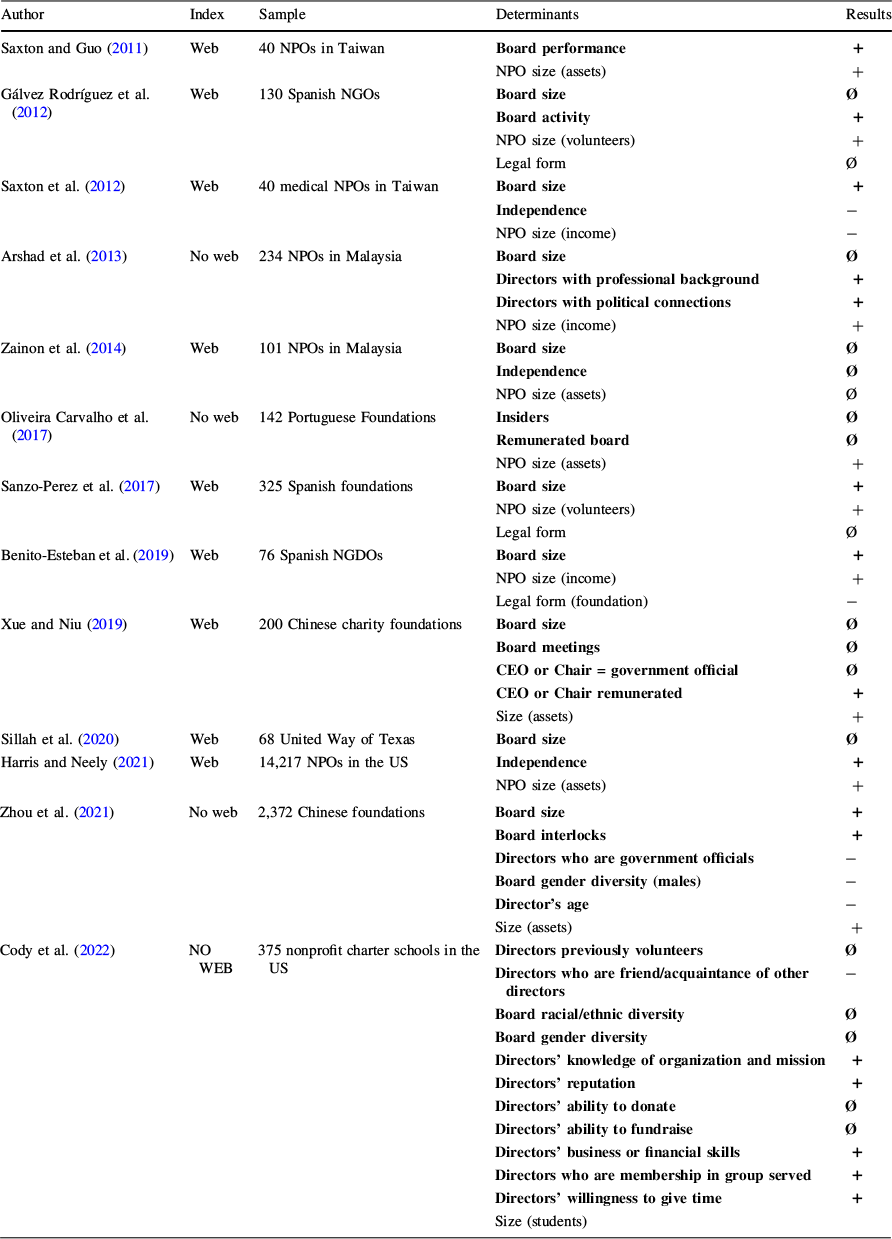
After conducting a systematic review of studies addressing this relationship, we found 13 studies (see Table A1 in Appendix) that began mainly focused on traditional issues such as size or independence (e.g., Gálvez Rodríguez et al., Reference Gálvez Rodríguez, Caba Pérez and López Godoy2012; Saxton et al., Reference Saxton, Kuo and Ho2012) but have gradually addressed more heterogeneous features such as political connections (e.g., Arshad et al., Reference Arshad, Bakar, Thani and Omar2013; Xue & Niu, Reference Xue and Niu2019), gender diversity (Cody et al., Reference Cody, Lawrence, Prentice and Clerkin2022; Zhou et al., Reference Zhou, Zhu and Zheng2021) or board directors' expertise (Arshad et al., Reference Arshad, Bakar, Thani and Omar2013; Cody et al., Reference Cody, Lawrence, Prentice and Clerkin2022). Also, along these studies, we find a wide range of accountability measures, although most are focused on web-based accountability measures (e.g., Saxton & Guo, Reference Saxton and Guo2011; Sillah et al., Reference Sillah, Nukpezah and Kamau2020).
However, despite all these analyses, the results are not conclusive and we consider it necessary to continue examining the effects that these board features may have on NPO’s transparency. In particular, we focus here on giving arguments for the influence of size, independence, gender diversity, and expertise (in NPOs or in finance).
Regarding board size, previous studies show that larger boards can pressure management to increase the amount of information to be disclosed to have more contact with the public (Saxton et al., Reference Saxton, Kuo and Ho2012), to facilitate a wider community representation (Zainon et al., Reference Zainon, Atan and Wah2014), and to safeguard their reputation (Gálvez Rodríguez et al., Reference Gálvez Rodríguez, Caba Pérez and López Godoy2012).
When referring to the board independence the arguments are not so conclusive. On the one hand, outsiders in the board are perceived as a tool for monitoring managerial team, and they want to validate their professional credibility as expert controllers by increasing accountability (Harris & Neely, Reference Harris and Neely2021; Zainon et al., Reference Zainon, Atan and Wah2014). On the other hand, insiders in the board may have incentives to increase accountability because they are bonded to the NPO and they want to preserve their jobs and reputation (Oliveira Carvalho et al., Reference Oliveira Carvalho, Lima Rodrigues and Castelo Branco2017).
Additionally, NPOs that consciously include female directors in their boards are expected to better fill their accountability role (Cody et al., Reference Cody, Lawrence, Prentice and Clerkin2022). Female directors are more stakeholder-oriented and ethical than male directors (Adams et al., Reference Adams, Licht and Sagiv2011), which minimizes the risk of organizational fraud (Kirsch, Reference Kirsch2018), leading them to not need to hide anything and to promote transparency. Recent literature has proved the key role of women in fostering stakeholder engagement and information disclosure (Cody et al., Reference Cody, Lawrence, Prentice and Clerkin2022; Saraite-Sariene et al., Reference Saraite-Sariene, Galán-Valdivieso, Alonso-Cañadas and García-Tabuyo2022).
Finally, since the directors’ ability to monitor or contribute to the organization's strategy will depend on their theoretical and practical knowledge (Garcia-Rodriguez et al., Reference Garcia-Rodriguez, Romero-Merino and Santamaria-Mariscal2021), the directors’ expertise or background is essential. Board members who have financial expertise and have the time and willingness to connect the nonprofit to resources are more likely to play the accountability role (Cody et al., Reference Cody, Lawrence, Prentice and Clerkin2022). Also, professional backgrounds, especially when having prior experience in the nonprofit sector, are able to implement strategic plans that can be seen to be accountable to a wide range of stakeholders (Arshad et al., Reference Arshad, Bakar, Thani and Omar2013).
However, the empirical evidence found so far is still inconclusive, as can be seen in Table A1. One possible explanation for this lack of solid results lies in the fact that transparency is a complex phenomenon that the consideration of individual board features may not be able explain (Cuadrado-Ballesteros et al., Reference Cuadrado-Ballesteros, Martínez-Ferrero and García-Sánchez2017). This kind of problem has increased the interest of scholars in applying complexity theory in the field of corporate governance (Dwekat et al., Reference Dwekat, Seguí-Mas, Tormo-Carbó and Carmona2020).
Definition of variables

Variable |
Definition |
|---|---|
Outcome |
|
Transparency (TRANSPARENCY) |
Transparency index used by Benito-Esteban et al. (Reference Benito-Esteban, Garcia-Rodriguez and Romero-Merino2019) composed of 119 items |
Independent variables |
|
Board size (SIZE) |
Number of directors on the board |
Board Independence (INSIDER) |
Percentage of insiders on the board. Board members are considered insiders if they have been employees in the NPO |
Gender Diversity (GENDER) |
Percentage of women on the board |
Expertise in the nonprofit sector (EXPERT_NPO) |
Dummy variable that takes the value 1 when at least one director has professional experience in the nonprofit sector and 0 otherwise |
Expertise in finance (EXPERT_FINANCE) |
Dummy variable that takes the value 1 when at least one director has professional experience in finance and 0 otherwise |
NGDO’s size (NGDO_SIZE) |
Total income of the NGDO |
Legal form (LEGAL_FORM) |
Dummy variable that takes the value 1 when the NPO is a foundation and 0 otherwise |
Complexity theory posits that relationships are more complex than cause-effect (Cuadrado-Ballesteros et al., Reference Cuadrado-Ballesteros, Martínez-Ferrero and García-Sánchez2017). When analyzing the conditions that influence an outcome, this theory focuses on four main tenets: equifinality (more than one optimal path can lead to the same outcome), asymmetry (a condition can lead to either high or low levels of the outcome), complexity (the effect of a particular antecedent on the outcome can be affected by other initial circumstances), and casual asymmetry (the combination of variables leading to a high-value outcome is not the 'mirror opposite' of the one leading to a low-value outcome) (Dwekat et al., Reference Dwekat, Seguí-Mas, Tormo-Carbó and Carmona2020; Ragin, Reference Ragin2008; Woodside, Reference Woodside2013).
The general goal of this research is to analyze which board configurations are associated with higher levels of transparency. More specifically, based on the equifinality and complexity tenets, we propose:
Proposition 1
NPOs can achieve high levels of transparency through different configurations of board characteristics (equifinality tenet).
Proposition 2
The effect of a particular board characteristic on a specific level of transparency depends on other initial board characteristics (complexity tenet).
Sample, Variables and Methodology
Sample
The sample of this study consists of 67 NGDOs belonging to the Spanish Platform of NGDOs (CONGDE) in 2015. Although CONGDE had 93 members NGDOs in 2015, due to the lack of data on the curricula vitae of several directors the final sample was reduced to 67 NGDOs. To compile the database, we collected manually information on the biographies of 793 board members, by consulting the websites of the NGDOs, as well as the annual reports. This information was completed with other sources (e.g., websites of for-profit entities, LinkedIn, etc.) in some cases. The organizations of this sample already have a minimums level of disclosed information, since CONGDE has a Code of Transparency and Good Governance. Therefore, as in Bellante et al. (Reference Bellante, Berardi, Machold, Nissi and Rea2018), this study is developed in a context of medium-to-high level of accountability.
Variables
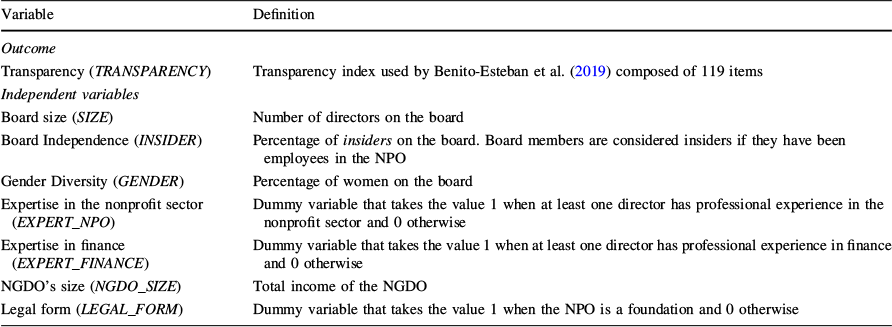
Table 1 shows the definitions of the variables utilized in this research. Regarding web transparency of NGDOs, we measure it with the comprehensive index built by Benito-Esteban et al. (Reference Benito-Esteban, Garcia-Rodriguez and Romero-Merino2019). The index is composed of 119 items constructed from previous studies by Gandía (Reference Gandía2011), Gálvez Rodríguez et al. (Reference Gálvez Rodríguez, Caba Pérez and López Godoy2012) and the CONGDE (2012)Footnote 1 and includes items related to ornamental transparency (22 items), financial and governance transparency (60 items), presentation and navigation transparency (25 items), and relational transparency (12 items). To measure the variables related to the board composition, we manually build a database with the CVs of directors (793 observations). Based on these data, as we can see in Table 1, we calculate the number of directors (SIZE), the percentage of inside directors (INSIDER), and female directors (GENDER), and we built dummy variables for expertise in the nonprofit sector (EXPERT_NPO) and finance (EXPERT_FINANCE). Beyond board characteristics, some corporate aspects may affect transparency as they might restrict the volume of resources that can be devoted to transparency (Cuadrado-Ballesteros et al., Reference Cuadrado-Ballesteros, Martínez-Ferrero and García-Sánchez2017). In particular, we have incorporated the size of the organization (measured in income) (NGDO_SIZE) since it has been found to affect the level of transparency in NPOs (e.g., Harris & Neely, Reference Harris and Neely2021; Saxton & Guo, Reference Saxton and Guo2011). We have also analyzed the legal form of the NPO (LEGAL_FORM) since it has been included in previous studies due to its influence on the governance of NPOs (e.g., Benito-Esteban et al., Reference Benito-Esteban, Garcia-Rodriguez and Romero-Merino2019; Gálvez et al., Reference Gálvez Rodríguez, Caba Pérez and López Godoy2012; Garcia-Rodriguez & Romero-Merino, Reference Garcia-Rodriguez and Romero-Merino2014; Sanzo-Perez et al., Reference Sanzo-Pérez, Rey-Garcia and Álvarez-González2017).
Methodology
Most previous literature uses regression analysis for this type of study (e.g., Arshad et al., Reference Arshad, Bakar, Thani and Omar2013; Gálvez Rodríguez et al., Reference Gálvez Rodríguez, Caba Pérez and López Godoy2012). However, that approach considers symmetrical relationships among variables and net impacts of independent variables on outcomes, while real-life relationships are mostly asymmetrical (Ragin, Reference Ragin2008), which could explain the contradictory and inconclusive results of previous literature (Dwekat et al., Reference Dwekat, Seguí-Mas, Tormo-Carbó and Carmona2020). fsQCA, which is based on complexity theory, overcomes this problem (Cuadrado-Ballesteros et al., Reference Cuadrado-Ballesteros, Martínez-Ferrero and García-Sánchez2017) because it combines qualitative and quantitative analysis and assumes that the effect of some variables on an outcome depend on how those variables are combined (Ragin, Reference Ragin2000).
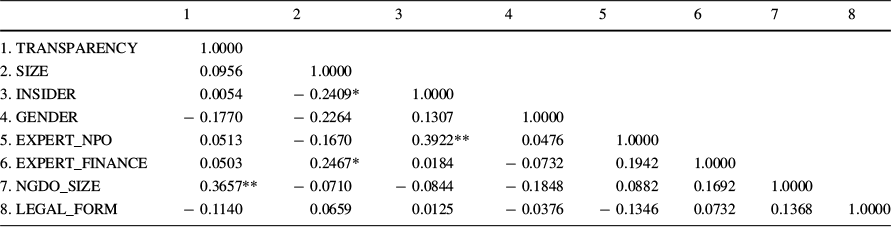
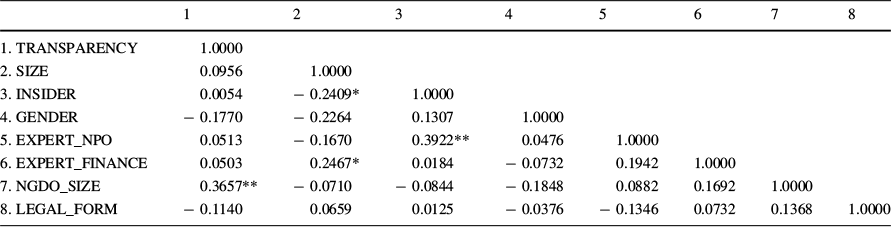
We performed a preliminary symmetrical test to analyze whether our data followed symmetrical patterns or, on the contrary, they were asymmetrical and the fsQCA was the most suitable approach. In line with Wu et al. (Reference Wu, Yeh and Woodside2014), we perform correlations and a contrarian cases analysis to examine the relationships between the variables used in this study. Table 2 shows the correlation coefficients among all variables. The coefficients of the outcome variable (TRANSPARENCY) and the rest of variables are below 0.70 suggesting asymmetrical relationships (Woodside, Reference Woodside2013).
Correlation matrix
1 |
2 |
3 |
4 |
5 |
6 |
7 |
8 |
|
|---|---|---|---|---|---|---|---|---|
1. TRANSPARENCY |
1.0000 |
|||||||
2. SIZE |
0.0956 |
1.0000 |
||||||
3. INSIDER |
0.0054 |
− 0.2409* |
1.0000 |
|||||
4. GENDER |
− 0.1770 |
− 0.2264 |
0.1307 |
1.0000 |
||||
5. EXPERT_NPO |
0.0513 |
− 0.1670 |
0.3922** |
0.0476 |
1.0000 |
|||
6. EXPERT_FINANCE |
0.0503 |
0.2467* |
0.0184 |
− 0.0732 |
0.1942 |
1.0000 |
||
7. NGDO_SIZE |
0.3657** |
− 0.0710 |
− 0.0844 |
− 0.1848 |
0.0882 |
0.1692 |
1.0000 |
|
8. LEGAL_FORM |
− 0.1140 |
0.0659 |
0.0125 |
− 0.0376 |
− 0.1346 |
0.0732 |
0.1368 |
1.0000 |
* and ** represent statistical significance at 95% and 99% confidence level, respectively
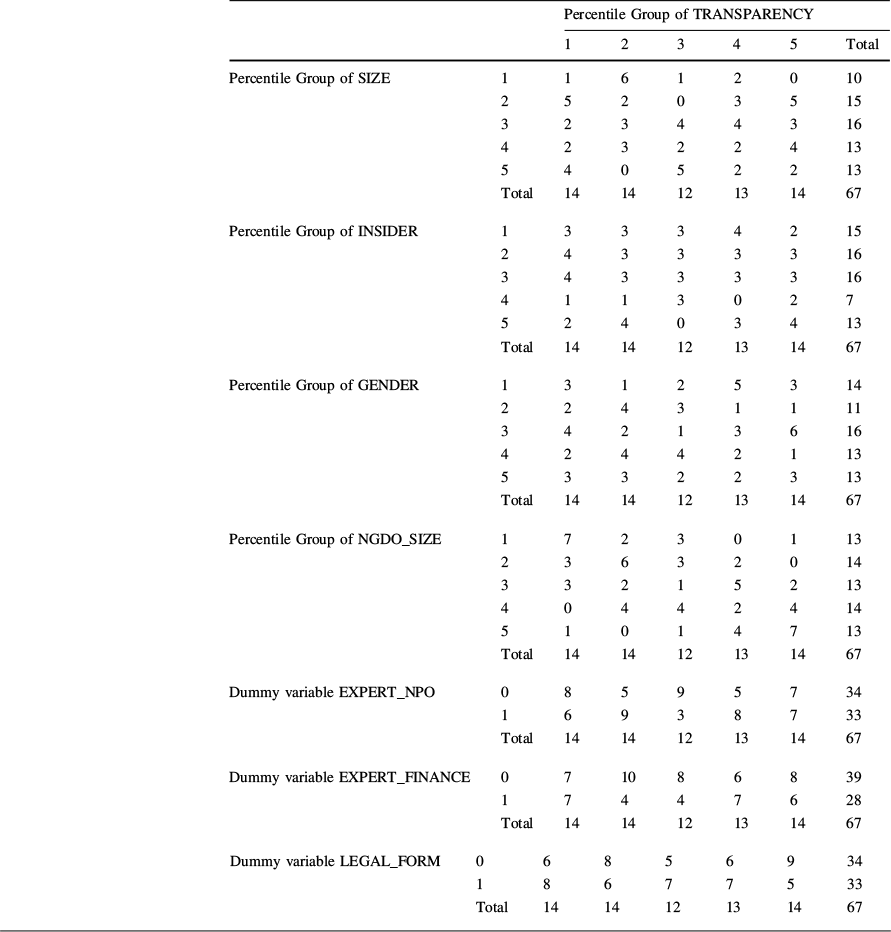
Table 3 shows contrarian cases between transparency and each of the board characteristics and size and legal form of the organizations. To create these contrarian cases, we performed cross-tabulations across the quintiles of all variables (except for dummy variables). We find contrarian cases in our sample; e.g., Table 3 shows that there are some observations with a small board (quintiles 1 and 2) and a high level of transparency (quintiles 4 and 5). The same happens with the rest of board characteristics and with the size and legal form of the NPO. These findings indicate that the relationships between the variables in our study are asymmetrical, and therefore, fsQCA is a suitable methodology (Pappas & Woodside, Reference Pappas and Woodside2021).
Contrarian cases analysis

Percentile Group of TRANSPARENCY |
|||||||
|---|---|---|---|---|---|---|---|
1 |
2 |
3 |
4 |
5 |
Total |
||
Percentile Group of SIZE |
1 |
1 |
6 |
1 |
2 |
0 |
10 |
2 |
5 |
2 |
0 |
3 |
5 |
15 |
|
3 |
2 |
3 |
4 |
4 |
3 |
16 |
|
4 |
2 |
3 |
2 |
2 |
4 |
13 |
|
5 |
4 |
0 |
5 |
2 |
2 |
13 |
|
Total |
14 |
14 |
12 |
13 |
14 |
67 |
|
Percentile Group of INSIDER |
1 |
3 |
3 |
3 |
4 |
2 |
15 |
2 |
4 |
3 |
3 |
3 |
3 |
16 |
|
3 |
4 |
3 |
3 |
3 |
3 |
16 |
|
4 |
1 |
1 |
3 |
0 |
2 |
7 |
|
5 |
2 |
4 |
0 |
3 |
4 |
13 |
|
Total |
14 |
14 |
12 |
13 |
14 |
67 |
|
Percentile Group of GENDER |
1 |
3 |
1 |
2 |
5 |
3 |
14 |
2 |
2 |
4 |
3 |
1 |
1 |
11 |
|
3 |
4 |
2 |
1 |
3 |
6 |
16 |
|
4 |
2 |
4 |
4 |
2 |
1 |
13 |
|
5 |
3 |
3 |
2 |
2 |
3 |
13 |
|
Total |
14 |
14 |
12 |
13 |
14 |
67 |
|
Percentile Group of NGDO_SIZE |
1 |
7 |
2 |
3 |
0 |
1 |
13 |
2 |
3 |
6 |
3 |
2 |
0 |
14 |
|
3 |
3 |
2 |
1 |
5 |
2 |
13 |
|
4 |
0 |
4 |
4 |
2 |
4 |
14 |
|
5 |
1 |
0 |
1 |
4 |
7 |
13 |
|
Total |
14 |
14 |
12 |
13 |
14 |
67 |
|
Dummy variable EXPERT_NPO |
0 |
8 |
5 |
9 |
5 |
7 |
34 |
1 |
6 |
9 |
3 |
8 |
7 |
33 |
|
Total |
14 |
14 |
12 |
13 |
14 |
67 |
|
Dummy variable EXPERT_FINANCE |
0 |
7 |
10 |
8 |
6 |
8 |
39 |
1 |
7 |
4 |
4 |
7 |
6 |
28 |
|
Total |
14 |
14 |
12 |
13 |
14 |
67 |
|
Dummy variable LEGAL_FORM |
0 |
6 |
8 |
5 |
6 |
9 |
34 |
1 |
8 |
6 |
7 |
7 |
5 |
33 |
|
Total |
14 |
14 |
12 |
13 |
14 |
67 |
|
The first step to conduct this analysis is the calibration of the variables, i.e., the transformation of the original data into membership scores (Ragin, Reference Ragin2008). Fuzzy-sets calibration uses three breakpoints: full membership (value of 1), full non-membership (value of 0) and the crossover point (value of 0.5) (Ragin, Reference Ragin2008; Woodside, Reference Woodside2013). We use the percentiles 0.20, 0.50, and 0.80 as the thresholds for full non-membership, crossover, and full membership points, respectively (Pappas & Woodside, Reference Pappas and Woodside2021). For dummy variables, value 1 indicates full membership and 0 represents full non-membership.
After coding, a ‘truth table’ displays all possible combinations of conditions along with their degree of consistency. Once the truth table is reduced by frequency and consistency (Pappas & Woodside, Reference Pappas and Woodside2021), the software computes three different solutions: complex, parsimonious, and intermediate. In line with Ragin (Reference Ragin2008), we discuss only the intermediate solution that represents a balance between the other two solutions and provides considerable benefits over them. Finally, to evaluate the strength of the different configurations and solutions fsQCA provides two useful metrics: consistency (degree to which a configuration or solution leads to an outcome) and coverage (amount of the outcome explained by each configuration or solution) (Ragin, Reference Ragin2008). According to prior literature, the fsQCA model is considered useful when the coverage is between 0.25 and 0.65 and consistency is over 0.80 (Woodside, Reference Woodside2013).
Results
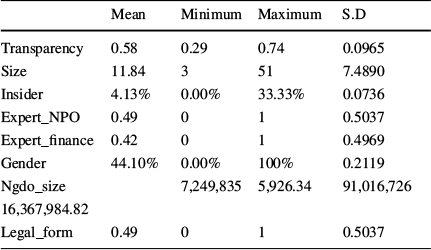
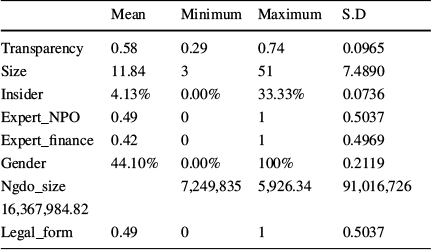
As we can see in Table 4, transparency index of NGDOs has an average of 0.58, with values ranging between 0.29 and 0.74. On average, the board of directors of Spanish NGDOs has 12 members, 4% are employees of the organization (insiders) and 44.10% are women. Board size and independence are similar to those reported in the study by García-Rodríguez and Romero-Merino (2014) for a similar sample in 2011. However, the presence of female board members has increased considerably (from 38.65%), placing it within the range recommended by the CONGDE (40–60%). Moreover, 49% of organizations have at least one board member with expertise in the nonprofit field, and 42% of NGDOs have at least one director with financial expertise. Finally, the average size of the organization (measured in total income) is above 7 million euros and 49% of the sample are foundations.
Descriptive statistics
Mean |
Minimum |
Maximum |
S.D |
|
|---|---|---|---|---|
Transparency |
0.58 |
0.29 |
0.74 |
0.0965 |
Size |
11.84 |
3 |
51 |
7.4890 |
Insider |
4.13% |
0.00% |
33.33% |
0.0736 |
Expert_NPO |
0.49 |
0 |
1 |
0.5037 |
Expert_finance |
0.42 |
0 |
1 |
0.4969 |
Gender |
44.10% |
0.00% |
100% |
0.2119 |
Ngdo_size |
7,249,835 |
5,926.34 |
91,016,726 |
16,367,984.82 |
Legal_form |
0.49 |
0 |
1 |
0.5037 |
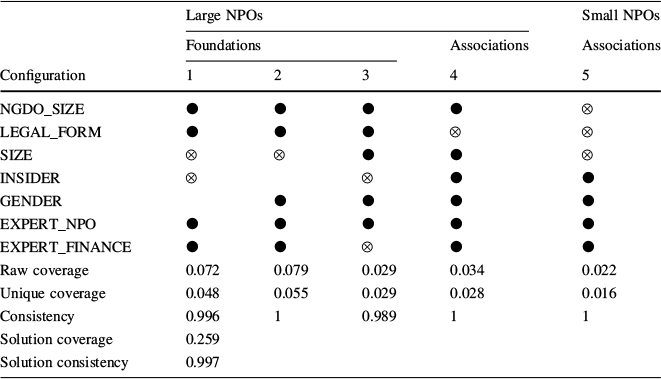
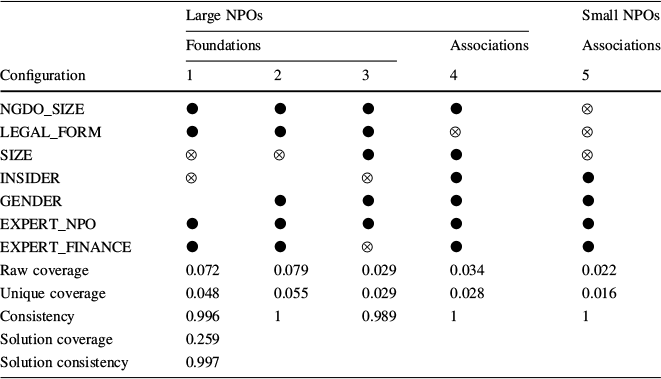
Table 5 shows the combinations of board characteristics as well as size and legal form of the organization (structural conditions that are given) that lead to a high level of transparency. The solution has a high consistency (0.997) and an adequate coverage (0.259), so the model is informative—consistency is over 0.8 and coverage is between 0.25 and 0.65. As we can see, both large and small NPOs can reach a high level of transparency through the combination of board characteristics. We also find different combinations of board features for foundations and associations.
Configurations of board characteristics, organizational size, and legal form predicting high level of transparency
Large NPOs |
Small NPOs |
||||
|---|---|---|---|---|---|
Foundations |
Associations |
Associations |
|||
Configuration |
1 |
2 |
3 |
4 |
5 |
NGDO_SIZE |
● |
● |
● |
● |
⨂ |
LEGAL_FORM |
● |
● |
● |
⨂ |
⨂ |
SIZE |
⨂ |
⨂ |
● |
● |
⨂ |
INSIDER |
⨂ |
⨂ |
● |
● |
|
GENDER |
● |
● |
● |
● |
|
EXPERT_NPO |
● |
● |
● |
● |
● |
EXPERT_FINANCE |
● |
● |
⨂ |
● |
● |
Raw coverage |
0.072 |
0.079 |
0.029 |
0.034 |
0.022 |
Unique coverage |
0.048 |
0.055 |
0.029 |
0.028 |
0.016 |
Consistency |
0.996 |
1 |
0.989 |
1 |
1 |
Solution coverage |
0.259 |
||||
Solution consistency |
0.997 |
||||
Following the presentation suggested by Ragin (Reference Ragin2008), black circles indicate that a condition must be present to reach the outcome, cross circles represent that the condition must be absent, and a blank space represents that the condition is not included in that configuration
On the one hand, three possible optimal board configurations improve the level of web transparency for large foundations (Configurations 1 to 3). According to Configuration 1, large foundations that have a small board and a low percentage of insiders, but have experts in the nonprofit sector and in finance, achieve a high level of transparency. Based on Configuration 2, large foundations with a small board, a high percentage of female trustees and experts in both the nonprofit sector and finance also lead to high levels of transparency. Finally, large foundations also achieve more transparency with a large board with few insiders, a high presence of female directors and experts in the nonprofit sector, but without financial experts (Configuration 3). We find no possible board composition that would lead to increased transparency for small foundations.
On the other hand, there are two optimal board configurations for associations to improve the level of transparency of the website depending on the size of the NGDO (Configurations 4 and 5). Thus, large associations can achieve a high level of transparency with a large board of directors, a high presence of both insiders and female trustees, and the presence of experts in both the nonprofit sector and finance (Configuration 4). And in the case of small associations, the appropriate board configuration is a small size, with more insiders, a high presence of female directors and members with expertise in both the nonprofit sector and finance.
Thus, as Table 5 shows, there is more than one combination of board characteristics, considering the organizational size and legal form, which can lead to a high level of transparency, supporting Proposition 1. Furthermore, the effect of the different board characteristics, organizational size, and legal form on transparency depends on other characteristics, supporting Proposition 2.
Discussion
The results presented above show that there are different combinations of board characteristics that can lead to a high level of transparency in NPOs and that some variables have different effects depending on other board features or organizational settings. However, we also found that there are some characteristics that seem to have always (or almost always) the same effect on transparency. In this sense, having at least one board member with expertise in the nonprofit sector appears in all configurations with a positive effect, which means that this board characteristic is a necessary condition for achieving a high level of transparency in the NGO. However, this feature of the board is not enough to achieve a high level of transparency, as it must be combined with other features to get it. Moreover, gender diversity appears in four out of five configurations helping to promote greater transparency, so including a high percentage of female trustees is generally beneficial to fostering transparency. This finding seems to contrast with the negative effect of gender diversity on NPOs’ accountability found in some previous studies (Saraite-Sariene et al., Reference Saraite-Sariene, Galán-Valdivieso, Alonso-Cañadas and García-Tabuyo2022). Finally, according to the results presented in Cody et al., (Reference Cody, Lawrence, Prentice and Clerkin2022), the presence of financial experts on the board seems to favor transparency in most cases (it is positive in four out of five configurations), although there is one configuration (i.e., large associations) in which it is better to exclude them.
The rest of the characteristics are not always positive or negative, nor are they present in all the optimal configurations. This may explain the mixed results found in previous studies with respect to these features. On the one hand, regarding board independence, the presence of insiders—who have a better knowledge of the organization—seems to promote greater transparency only in associations (Configurations 4 and 5), as evidenced also in some previous studies (Saxton et al., Reference Saxton, Kuo and Ho2012) while most configurations for foundations (Configurations 1 and 3) show that more independent directors lead to greater transparency, as shown in studies such as Harris and Neely (Reference Harris and Neely2021). In associations, due to their more participatory nature, having insiders could be more suitable, while in foundations the insight from independent members provides better monitoring.
On the other hand, relative to board size, small boards in small NPOs generate a high level of transparency (Configuration 5), as they may be more appropriate for the needs of these organizations. However, in large NPOs, a large (Configurations 3 and 4) or small (Configurations 1 and 2) board may generate a high level of transparency, so its influence on transparency depends on how it is combined with other board characteristics. This result may explain why many of the previous studies have found no significant effect of board size on transparency (e.g., Gálvez-Rodríguez et al., Reference Gálvez Rodríguez, Caba Pérez and López Godoy2012; Sillah et al., Reference Sillah, Nukpezah and Kamau2020).
Conclusions
In this study, we have focused on analyzing the relationship between the board and the web transparency of a sample of 67 Spanish NGDOs using fsQCA. Specifically, we analyzed how the different combinations of board characteristics (size, independence, gender diversity, expertise in the nonprofit sector and financial expertise) lead to a high level of web transparency of the NPO, also depending on the organizational size and legal form as structural conditions. Our results indicate that five different combinations of board characteristics lead to a high level of transparency. Therefore, there is more than one optimal path to achieve transparency, and the effect of each board characteristic depends on the others. Specifically, having expertise in the nonprofit sector on the board is a necessary condition to achieve transparency, while gender diversity appears in most configurations being an important factor to improve transparency. Board size and its independence as well as having financial experts show different effects on transparency depending on their combination with other board characteristics and the size and legal form of the organization.
This study has several contributions. First, our results indicate that board composition influences transparency. Although the characteristics analyzed are not significant individually considered, several combinations of board variables are associated with high transparency; that is, both large and small NPOs, and also foundations and associations, have several optimal combinations of board characteristics for achieving high transparency. However, these optimal board configurations to foster NPOs’ transparency are obtained by introducing not only traditional variables (size or independence), as did the first studies that analyzed this relationship (e.g., Saxton et al., Reference Saxton, Kuo and Ho2012; Zainon et al., Reference Zainon, Atan and Wah2014), but also, and especially, other dimensions such as diversity or expertise in the nonprofit sector or finance, which have been incorporated in later studies (e.g., Cody et al., Reference Cody, Lawrence, Prentice and Clerkin2022; Zhou et al., Reference Zhou, Zhu and Zheng2021). In fact, our results suggest that among the characteristics that always—or nearly always—positively influence transparency are background in NPOs and gender diversity. Second, the empirical evidence we provide is based on a dependent variable that is not only adapted to new technologies (web index), but is also built through a multi-item indicator that measures dimensions that go beyond pure information disclosure to incorporate issues related to accessibility and easy interaction with stakeholders. Finally, it provides a new methodological approach in the research of governance in the nonprofit sector by using fsQCA. This approach leads to results that are more robust and tackles the problem of the inconclusive results found by previous literature (Cuadrado-Ballesteros et al., Reference Cuadrado-Ballesteros, Martínez-Ferrero and García-Sánchez2017).
Practitioners’ implications arise from this research as well. First, since we have evidenced that board members with previous professional background in nonprofit sector are necessary to achieve a high level of transparency, NPOs should work on recruiting such directors to their boards. Moreover, even though, as we have evidenced in this research, the participation of women on the NPO boards is increasing, it is advisable to continue appointing women as trustees to boost NPO transparency. Finally, NPOs must be aware of their own particular characteristics (specifically, their size and legal form) to compose a board that favors transparency so as to take advantage of the benefits provided by this corporate governance mechanism. At this point, it is important to note that, although previous literature has noted how the larger organizational size positively influences transparency, small NPOs can also achieve high levels of transparency by configuring their boards appropriately.
This study also has several limitations, mainly the sample size and the rapid obsolescence of the transparency measure used. Undoubtedly, it is necessary that this type of studies continue to be replicated in the future given that online transparency is increasing very rapidly in recent years, as Benito-Esteban et al. (Reference Benito-Esteban, Garcia-Rodriguez and Romero-Merino2019) confirms in a scenario similar to this study. In line with these limitations, some possible lines of future research emerge such as the possibility of studying transparency longitudinally to analyze the effect of the board of directors on the increase in transparency using panel data or the possibility of performing transparency analyses that include several countries to be able to incorporate institutional variables in the research. Moreover, given the continuous update of the Internet, social media use might be included as an aspect of online transparency. Furthermore, to analyze the effect of good governance codes, it would be interesting to include in the sample NPOs that are not affected by such codes. Additionally, we suggest studying the effect of the board in other areas, such as fundraising, using the fsQ methodology, and including moderating or mediating effects in the proposed relationships. Finally, we should not forget that the concept of accountability goes beyond the web transparency and that factors outside the board of directors may affect it.
Funding
Open Access funding provided thanks to the CRUE-CSIC agreement with Springer Nature. This work was supported by UAM—Comunidad de Madrid Research Project for Young Researchers (SI3-PJI-2021-00276).
Declarations
Conflict of interest
The authors have no competing interests to declare that are relevant to the content of this article.
Appendix
See Table 6.
Results of previous studies on determinants of transparency
Author |
Index |
Sample |
Determinants |
Results |
|---|---|---|---|---|
Saxton and Guo (Reference Saxton and Guo2011) |
Web |
40 NPOs in Taiwan |
Board performance |
+ |
NPO size (assets) |
+ |
|||
Gálvez Rodríguez et al. (Reference Gálvez Rodríguez, Caba Pérez and López Godoy2012) |
Web |
130 Spanish NGOs |
Board size |
Ø |
Board activity |
+ |
|||
NPO size (volunteers) |
+ |
|||
Legal form |
Ø |
|||
Saxton et al. (Reference Saxton, Kuo and Ho2012) |
Web |
40 medical NPOs in Taiwan |
Board size |
+ |
Independence |
− |
|||
NPO size (income) |
− |
|||
Arshad et al. (Reference Arshad, Bakar, Thani and Omar2013) |
No web |
234 NPOs in Malaysia |
Board size |
Ø |
Directors with professional background |
+ |
|||
Directors with political connections |
+ |
|||
NPO size (income) |
+ |
|||
Zainon et al. (Reference Zainon, Atan and Wah2014) |
Web |
101 NPOs in Malaysia |
Board size |
Ø |
Independence |
Ø |
|||
NPO size (assets) |
Ø |
|||
Oliveira Carvalho et al. (Reference Oliveira Carvalho, Lima Rodrigues and Castelo Branco2017) |
No web |
142 Portuguese Foundations |
Insiders |
Ø |
Remunerated board |
Ø |
|||
NPO size (assets) |
+ |
|||
Sanzo-Perez et al. (Reference Sanzo-Pérez, Rey-Garcia and Álvarez-González2017) |
Web |
325 Spanish foundations |
Board size |
+ |
NPO size (volunteers) |
+ |
|||
Legal form |
Ø |
|||
Benito-Esteban et al. (Reference Benito-Esteban, Garcia-Rodriguez and Romero-Merino2019) |
Web |
76 Spanish NGDOs |
Board size |
+ |
NPO size (income) |
+ |
|||
Legal form (foundation) |
− |
|||
Xue and Niu (Reference Xue and Niu2019) |
Web |
200 Chinese charity foundations |
Board size |
Ø |
Board meetings |
Ø |
|||
CEO or Chair = government official |
Ø |
|||
CEO or Chair remunerated |
+ |
|||
Size (assets) |
+ |
|||
Sillah et al. (Reference Sillah, Nukpezah and Kamau2020) |
Web |
68 United Way of Texas |
Board size |
Ø |
Harris and Neely (Reference Harris and Neely2021) |
Web |
14,217 NPOs in the US |
Independence |
+ |
NPO size (assets) |
+ |
|||
Zhou et al. (Reference Zhou, Zhu and Zheng2021) |
No web |
2,372 Chinese foundations |
Board size |
+ |
Board interlocks |
+ |
|||
Directors who are government officials |
− |
|||
Board gender diversity (males) |
− |
|||
Director’s age |
− |
|||
Size (assets) |
+ |
|||
Cody et al. (Reference Cody, Lawrence, Prentice and Clerkin2022) |
NO WEB |
375 nonprofit charter schools in the US |
Directors previously volunteers |
Ø |
Directors who are friend/acquaintance of other directors |
− |
|||
Board racial/ethnic diversity |
Ø |
|||
Board gender diversity |
Ø |
|||
Directors’ knowledge of organization and mission |
+ |
|||
Directors’ reputation |
+ |
|||
Directors’ ability to donate |
Ø |
|||
Directors’ ability to fundraise |
Ø |
|||
Directors’ business or financial skills |
+ |
|||
Directors who are membership in group served |
+ |
|||
Directors’ willingness to give time |
+ |
|||
Size (students) |
We conducted a systematic literature review to search for those articles that studied the relationship between the board and transparency or accountability in NPOs. We searched the Web of Science and Scopus databases and included only peer-reviewed articles. We found 349 articles (202 in Web of Science and 147 in Scopus) and, after cleaning the duplicates, the sample was reduced to 254. After a title and abstract analysis, 48 articles were admitted to the next step and the full text assessment led to 11 studies. Finally, we conducted a hand search and included 2 more articles that hade board characteristics as control variables, and thus the final sample included 13 publications. The variables in bold are those related to the composition of the board

 Open access

