


Introduction
Over the course of past decades, most advanced democracies have gradually shifted from traditional industries to ‘knowledge economies’, where intellectual capabilities drive economic prosperity. The increasing importance of knowledge-based services has entrenched stark economic disparities across cities and regions. Widespread digital communication notwithstanding, successful companies in the knowledge economy depend on an entire local ecosystem to foster creativity and drive innovation (Iversen and Soskice, Reference Iversen and Soskice2019). As a result, highly skilled and highly specialized workers are drawn to spatially concentrated skill clusters, making location more important than ever (Moretti, Reference Moretti2013). The widening economic gap between places with strong knowledge-based economies and less dynamic places specializing in traditional industries reshapes the economic geography of advanced democracies. Economic growth and jobs are increasingly concentrated in a few successful areas where workers benefit from better economic opportunities, while less prosperous regions feel increasingly left behind by economic modernization.
Unequal levels of local economic opportunity transform the composition of the local population as knowledge workers cluster in urban agglomerations. Rising spatial inequality therefore has profound political implications. Political conflict between densely populated high-opportunity areas and more rural places with lower economic dynamism is now a core characteristic of many advanced democracies (see, for example, Cramer, Reference Cramer2016; Hobolt, Reference Hobolt2016; Jennings and Stoker, Reference Jennings and Stoker2016; Rodríguez-Pose Reference Rodríguez-Pose2018; Iversen and Soskice, Reference Iversen and Soskice2019; Maxwell, Reference Maxwell2020; Patana, Reference Patana2022; Huijsmans et al., Reference Huijsmans, Harteveld, van der Brug and Lancee2021; Rodríguez-Pose et al., Reference Rodríguez-Pose, Lee and Lipp2021; Haffert, Reference Haffert2022; Cremaschi et al., Reference Cremaschi, Rettl, Cappelluti and De Vries2024). These divides are generally perceived through a ‘lens of place’ but are largely sectoral and educational at their core, hence deeply rooted in the knowledge economy (Zollinger, Reference Zollinger2024).
Existing research has thus firmly established the contours of a new political geography in the knowledge economy. In this paper, we advance the literature with a more dynamic perspective. The increasing spatial concentration of economic opportunity in the knowledge economy is inherently a story of change, movement, and transformation. Due to clustering and network effects, places with strong knowledge-based economies attract workers and experience extraordinary growth in relative population and income (Glaeser and Gottlieb, Reference Glaeser and Gottlieb2009). We ask about the political implications of this strong structural pull into destinations that are typically more politically progressive than most places of origin. Does the rise of the knowledge economy result in a general political shift in the electorate because an ever-growing share of the population lives and works in or moves to politically more progressive opportunity areas?
We examine this question by studying the case of Germany, a country that has successfully transitioned to a knowledge-based economy in the digital era while maintaining an innovative and highly competitive manufacturing sector (Thelen, Reference Thelen2019; Mitsch et al., Reference Mitsch, Hassel and Soskice2024). Our analytical approach proceeds in two steps. In a purely descriptive effort, we first map the spatial divergence in opportunity across German regions. For this purpose, we gather a broad array of innovative indicators that encompass various dimensions of local dynamism. These indicators include economic and labor market related metrics, as well as broader urban amenities, which we combine into a granular, multidimensional measure of local opportunity at the NUTS-3 level.Footnote 1 This ‘opportunity map’ contains relevant descriptive information on the extent of spatial inequality in Germany but also provides the basis for assessing whether a given individual relocation of a voter can be seen as a ‘move to opportunity’ by comparing local economic opportunities between place of origin and place of destination.
In the second step, we combine our opportunity map with restricted-use data from the German Socio-Economic Panel (SOEP) for the years 2010 to 2020. This empirical set-up allows us to examine individual moving patterns in general and the political effects of moving to opportunity areas in particular. We are interested in both general levels of political participation and in the potential ideological assimilation of newly arrived entrants. The longitudinal dimension of the data is crucial to limit the impact of self-selection of movers, a key empirical obstacle to studying the political implications of different context conditions (Gallego et al., Reference Gallego, Buscha, Sturgis and Oberski2016).
Our approach is in many ways similar to related work examining the relative importance of self-selection and socialization in attitude formation by exploiting individual relocations (Gallego et al., Reference Gallego, Buscha, Sturgis and Oberski2016; Maxwell, Reference Maxwell2019,Reference Maxwell2020; Cantoni and Pons, Reference Cantoni and Pons2022; Lueders, Reference Lueders2024b), but it is important to highlight one key difference. We are not primarily interested in the political implications of changing location per se. Instead, in line with our motivation to understand the changing politics of the knowledge economy, we add relevant contextual information based on our local-level measure of economic opportunity. This indicator provides crucial context to an observed relocation and allows differentiation between ‘opportunity moves’ into destinations with stronger knowledge-based economies and any other type of move. This is an important distinction, as it has been shown that most relocations occur between similar localities along a broader rural–urban categorization, which limits the room for behavioral change when studying relocations without further contextualization (Lueders, Reference Lueders2024b). Our approach also goes beyond an examination of relocations into ‘big cities’ (see Maxwell, Reference Maxwell2019) because, as we will show, population size turns out to be an imprecise proxy of local opportunity.
The relevance of the differentiation between moving as such and moving into knowledge economy hubs is indeed supported by our empirical analysis. We find strong and consistent evidence that moving to opportunity fosters political integration and shifts political preferences to the left. In line with a mechanism of assimilation, relocating to higher-opportunity areas, which on average have higher turnout rates, higher vote shares for center-left parties, and much lower vote shares for radical-right parties, changes individual political participation and individual political preferences in the same direction. In contrast, we find very little evidence that relocation in general, regardless of changing opportunity, affects individual political behavior in a systematic way.
By bridging recent insights on spatial inequality with the literature on the emergence of the knowledge economy and political behavior, we contribute to the ongoing debate on how long-term structural transformations of the economy shape the contemporary political landscape in advanced capitalist democracies. While we do not claim that assimilation to context is the primary driver of the contemporary political geography, our results do highlight important long-term implications of the continuing pull of urban and progressive knowledge hubs. In line with other work showing the relevance of changing context (Cantoni and Pons, Reference Cantoni and Pons2022) and political assimilation (Gallego et al., Reference Gallego, Buscha, Sturgis and Oberski2016), our findings suggest that the ongoing intragenerational and intergenerational movement of populations from lower dynamism rural and (sub)urban regions to prosperous cities may come with a self-reinforcing political dynamic that can create a strong and lasting progressive potential in the mid- and long-term. However, there is a ‘dark side’ to this optimistic scenario centering around individuals who thrive in knowledge economy-driven urban centers: the outflow of people from areas with limited opportunities is likely to worsen existing grievances in those regions (see, for example, Cremaschi et al., Reference Cremaschi, Rettl, Cappelluti and De Vries2024; Dancygier et al., Reference Dancygier, Dehdari, Laitin, Marbach and Vernby2025). In summary, our study highlights how economically driven internal migration serves as a structural factor that contributes to political polarization.
Local Opportunity and Political Behavior
Although globalization has diminished the significance of distance between countries, geography is more important than ever within countries. Economic activities, including production and employment, are distributed unevenly, with some regions benefiting strongly from economic modernization and others losing out (Colantone and Stanig, Reference Colantone and Stanig2018; Rickard, Reference Rickard2020). Technological progress has facilitated a transition from a manufacturing-based to a more services-dominated economy, with an ever greater reliance on intellectual capabilities (Powell and Snellman, Reference Powell and Snellman2004). The rise of such ‘knowledge economies’ has gone hand in hand with rising population size and a geographical concentration of highly educated workers in (sub)urban agglomeration centers and cities (Dumais et al., Reference Dumais, Ellison and Glaeser2002; Florida, Reference Florida2005; Glaeser and Gottlieb, Reference Glaeser and Gottlieb2009; Moretti, Reference Moretti2013). In many advanced capitalist democracies, economic disparities between regions have been amplified, resulting in a situation of ‘diverging destinies’ in which a few central city regions benefit from successful agglomeration economies that arise when high-skilled workers and ‘superstar firms’ interact in close proximity (Iammarino et al., Reference Iammarino, Rodriguez-Pose and Storper2019). Governments may reinforce such dynamics through fiscal policies and institutional frameworks that exacerbate regional disparities (Rodden and Wibbels, Reference Rodden and Wibbels2010).
The knowledge economy is thus characterized by increasing spatial segregation (Berkes and Gaetani, Reference Berkes and Gaetani2023) and rising levels of inequality more generally (Hope and Martelli, Reference Hope and Martelli2019). The new geography of employment and incomes creates a divergent ‘new geography of opportunities’ (Storper, Reference Storper2018). As a result, regional economic divergence is increasingly seen as a threat not only to economic progress but also to social cohesion by contributing to political polarization (Iammarino et al., Reference Iammarino, Rodriguez-Pose and Storper2019). Indeed, economic segregation between regions has been shown to result in a bifurcation of politics between more cosmopolitan areas and ‘provincial backwaters’ (Jennings and Stoker, Reference Jennings and Stoker2016). Regional economic and industrial decline proves to be a central predictor of populist voting in Europe (Dijkstra et al., Reference Dijkstra, Poelman and Rodríguez-Pose2020; Rodríguez-Pose et al., Reference Rodríguez-Pose, Terrero-Dávila and Lee2023). The observed divergence in perceptions and political preferences is seen as a reflection of a reinforced spatial rural–urban cleavage that is accompanied by a strong educational divide (Iversen and Soskice, Reference Iversen and Soskice2019; Maxwell, Reference Maxwell2020; Huijsmans et al., Reference Huijsmans, Harteveld, van der Brug and Lancee2021; Attewell, Reference Attewell2022; Zollinger, Reference Zollinger2024). The existing literature offers a clear view of how the new economic geography of the knowledge economy shapes a political landscape where ‘territorial polarization’ (Rodríguez-Pose et al., Reference Rodríguez-Pose, Terrero-Dávila and Lee2023) and political polarization go hand in hand.
However, the profound dynamic patterns underlying this geographic realignment are less well understood. Urban economists strongly emphasize the dynamic nature of economic transformation by focusing on relative changes in population density, production, and employment over time. The standard spatial equilibrium assumption (see, for example, Glaeser, Reference Glaeser2000) implies that location-specific productivity effects will attract firms and workers (and drive up land prices), emphasizing the pivotal role of individual relocation. In addition, the influential recent body of work showing that economic opportunity and rates of social mobility vary significantly by geography also hints at the potential relevance of spatial relocation (Chetty et al., Reference Chetty, Hendren, Kline, Saez and Turner2014,Reference Chetty, Friedman, Hendren, Jones and Porter2018). The fact that childhood location has long-run effects on adult outcomes has become the basis of a thriving research agenda that centers around the idea that individuals may ‘move to opportunity’ (Chetty et al., Reference Chetty, Hendren and Katz2016; Bergman et al., Reference Bergman, Chetty, DeLuca, Hendren, Katz and Palmer2019; Derenoncourt, Reference Derenoncourt2022). The central conjecture, also prominently discussed in the sociological literature (see, for example, Savage, Reference Savage1988; Morris, Reference Morris2022; Hecht and McArthur, Reference Hecht and McArthur2023), is that people may need to be geographically mobile to achieve upward mobility and benefit from the advantages of the rising knowledge economy.
Strong incentives for relocation that result from spatially concentrated advantages in the knowledge economy may have important political implications with the potential to decisively shape the contours of advanced capitalist democracy. High-opportunity areas are the home ground for ‘aspirational voters’ who believe that they (or their children) benefit from the knowledge economy and thus support mainstream parties and policies that strengthen the current economic system (Iversen and Soskice, Reference Iversen and Soskice2019). This is much in contrast to the losers of economic modernization, who feel increasingly left behind and hence may be willing to support political forces that promise to upend the political status quo (see Rodríguez-Pose Reference Rodríguez-Pose2018; Broz et al., Reference Broz, Frieden and Weymouth2021; Rodríguez-Pose et al., Reference Rodríguez-Pose, Lee and Lipp2021; Kurer and van Staalduinen, Reference Kurer and van Staalduinen2022; Häusermann et al., Reference Häusermann, Kurer and Zollinger2023). As such, aspirational voters in thriving knowledge hubs are seen as a democratic bulwark against potential political disruption fueled by all those who see the promise of upward mobility unfulfilled.Footnote 2
We combine these insights with an explicitly dynamic perspective to examine whether the ongoing economic pull into knowledge hubs creates the structural underpinnings for a growing – and politically increasingly dominant – progressive coalition. Systematic relocation into higher-opportunity areas – contexts that are characterized not only by better economic prospects but also by higher levels of political participation and stronger support for progressive forces – is expected to result in some form of political reorientation and, ultimately, assimilation to the destination context. Specifically, we anticipate that relocation to higher-opportunity areas will lead to political mobilization and stronger support for center-left parties. Because relocation typically disrupts personal networks and knowledge of local politics, it is possible that the expected positive effects are limited to participation in national politics, whereas active participation in local politics (such as volunteering) might overall decrease as a result of personal uprooting (Lueders, Reference Lueders2024a).
Contextual theories of political behavior have long suggested that elements of the environment in which individuals are situated affect their political preferences (see, for example, Agnew, Reference Agnew1987). Contextual influence on political behavior has been theorized to work either through direct contact with other residents or via a perception of partisan dominance that results in assimilation (Burbank, Reference Burbank1997). Enos (Reference Enos2017) emphasizes that residential mobility exposes individuals to new social environments, which can influence political attitudes and increase alignment with prevailing local political norms. This effect is particularly pronounced in internally homogeneous opportunity hubs, where dominant political preferences are reinforced due to limited exposure to meaningful interactions with sizable outgroups offering alternative viewpoints. The concentration of politically like-minded individuals in such hubs amplifies the progressive potential in these areas, but it also exacerbates political polarization at a broader level. Chen and Rodden (Reference Chen and Rodden2013) underscore this dynamic by illustrating how the geographic sorting of voters along socio-economic and ideological lines contributes to entrenched political divides. This spatial clustering of political preferences further solidifies polarization, as regions increasingly diverge in their political orientations and priorities.
Empirically, it is not trivial to separate true context effects from non-random self-selection into destination area (see Gallego et al., Reference Gallego, Buscha, Sturgis and Oberski2016), and various scholars have argued that the relevance of contextual effects is limited (see, for example, King, Reference King1996; Maxwell, Reference Maxwell2020). However, the evidence is mixed and contextual approaches to political behavior have recently seen a revival (Patana, Reference Patana2020; Bolet, Reference Bolet2021). More specifically, related work studying individual relocations shows that context indeed does have a small (Gallego et al., Reference Gallego, Buscha, Sturgis and Oberski2016) or even sizable (Cantoni and Pons, Reference Cantoni and Pons2022) impact on political behavior. It is worth emphasizing again that here we are not interested in geographical mobility as such but in relocation into higher-opportunity destinations that differ systematically from the place of origin.
Mapping Opportunity Across Space
The German Knowledge Economy
Germany has successfully transitioned to a knowledge-based economy in the digital era while maintaining an innovative and highly competitive manufacturing sector (Thelen, Reference Thelen2019). Unlike other European countries, whose knowledge economies have fully shifted to high-tech and service industries, Germany has preserved a strong foundation in (advanced) manufacturing through initiatives like Industry 4.0, which emphasize the digitalization of traditional industrial sectors. Institutions and regional growth coalitions between firms, social partners, and regional governments have been key to facilitating this successful transformation (Mitsch et al., Reference Mitsch, Hassel and Soskice2024). The growing share of tertiary-educated workers in the production sector illustrates how higher education and advanced manufacturing are becoming increasingly interconnected. While overall employment in manufacturing has declined – although less so than in other advanced capitalist democracies – the demand for university graduates in this sector has significantly grown (Durazzi, Reference Durazzi2023).
Regional diversity has long been a hallmark of Germany’s political economy, but the shift to the knowledge economy has deepened and amplified these variations. Regional growth coalitions are especially prevalent in Southern Germany, where they foster an environment conducive to competition and innovation (Mitsch et al., Reference Mitsch, Hassel and Soskice2024). Unlike more centralized economies, where opportunity is concentrated in a few major cities, Germany’s decentralized structure spreads economic opportunities across both urban agglomerations and more rural areas. This spatial distribution lowers the cost of relocation by allowing individuals to move shorter distances while still improving their economic prospects.
Measuring Local Opportunity
In a first step, we create an empirical measure to map opportunity across Germany at the NUTS-3 level. We approach this multifaceted concept by combining a variety of relevant indicators capturing distinct aspects of the attractiveness and promise of a place of residence. An obvious point to start this exercise is the domain of local economic dynamism. Metrics such as the number and quality of available jobs reflect employment availability and workforce specialization, key drivers of regional economic growth and the creation of innovation hubs, as emphasized by Moretti (Reference Moretti2013) and others. Innovation capacity, often measured by patenting activity, facilitates future-oriented knowledge-intensive economic activity and is a key source of local prosperity (Feldman and Florida, Reference Feldman and Florida1994; Acs et al., Reference Acs, Anselin and Varga2002). Workplace centrality and population dynamics highlight the importance of agglomeration economies and migration trends (Glaeser, Reference Glaeser2012). Additional factors like broadband availability, real-estate affordability, and commuting distances address infrastructural aspects essential for sustaining economic opportunities (Glaeser and Kahn, Reference Glaeser, Kahn, Henderson and Thisse2004; McCoy et al., Reference McCoy, Lyons, Morgenroth, Palcic and Allen2018).
However, we explicitly want to go beyond the undoubtedly important labor market perspective. A place can offer ample prospects for employment but may still not be seen as a desirable enough location to be considered an ‘opportunity area’. Existing research has examined how cities and knowledge hubs can succeed in attracting skilled workers whose local availability is key to thrive in the knowledge economy. A central premise of this literature is that urban amenities, as well as consumption and leisure opportunities such as restaurants and nightlife but also school quality, play an important role as pull factors for attracting skilled workers and population growth in cities more generally (see, for example, Glaeser et al., Reference Glaeser, Kolko and Saiz2001; Carlino and Saiz, Reference Carlino and Saiz2019; Couture and Handbury, Reference Couture and Handbury2020). A related argument in the sociological literature emphasizes the importance of tolerant and vibrant places to attract the ‘creative class’ (Florida, Reference Florida2002; Florida, Reference Florida2005). Indeed, empirical research demonstrates how changes in amenities amplify inner-city sorting of knowledge workers (Berkes and Gaetani, Reference Berkes and Gaetani2023). Related evidence shows that local non-wage benefits are an important determinant of city choice, with respondents willing to forgo between 2 per cent and 8 per cent of their wage to live in a city with high-quality amenities (Arntz et al., Reference Arntz, Brüll and Lipowski2021).
Following the central insights of this literature, we conceptualize local opportunity in a multidimensional way in order to capture the ‘sweet spot’ of a dynamic labor market providing good employment prospects that is coupled with a high urban amenity quality and an attractive range of leisure and consumption activities.
We have gathered and standardized an extensive array of pertinent indicators from diverse sources to empirically encapsulate the multifaceted dimensions of local opportunity. Table 1 maps the different variables into the theoretically expected component of either labor market or amenity. Most indicators are collected from official administrative data, but we complement such publicly available data with more specific sources. To capture local job opportunities, we rely on proprietary job vacancy data from Textkernel. Based on the near-universe of posted jobs in Germany, we calculate precise local indicators of the number of jobs and the share of high-skilled jobs. We proxy the local presence of the creative class using detailed membership data from the Künstlersozialkasse, which provides social insurance to self-employed artists and publicists. In addition, we web-scraped the number of nightclubs, theaters, and playgrounds from OpenStreetMap. We integrate the real-estate purchase price–income ratio (Prognos 2019a, 2019b) to capture the trade-off between local living cost and opportunity. Finally, we include the (logged) number of inhabitants to capture genuine size effects, which have been shown to enable stronger assortative matching in large cities (Dauth et al., Reference Dauth, Findeisen, Moretti and Suedekum2022), but purge all other indicators of magnitude by relying on population shares rather than absolute numbers. This is to avoid our multidimensional opportunity index boiling down to a mere indicator of population size or urbanization.
Opportunity index: indicators

Note: See Table A.1 in the Supplementary Material for a detailed overview of the indicators and the sources.
Starting with this encompassing list of indicators, we create a more compact index by relying on principal component analysis (PCA). PCA is a well-established mathematical procedure that reduces the dimensionality of the data while retaining most of the variation in the data set (see, for example, Wold et al., Reference Wold, Esbensen and Geladi1987). PCA as applied here is an unsupervised machine learning approach that involves the set of our indicators and no given associated response. It is well suited for visualization and for the derivation of explanatory variables for use in subsequent supervised learning (James et al., Reference James, Witten, Hastie and Tibshirani2013). In comparison to a simple (‘supervised’) additive index, the suggested procedure involves fewer arbitrary decisions (which indicators to include, how to weight them, etc.), which is why we rely on the inductive logic of unsupervised PCA even though the meaning of the components in substantive terms is a priori undefined.
Figure 1 shows the distribution of all 401 NUTS-3 units projected onto the two first components, which jointly capture 50.5 per cent of the total variation from the seventeen different indicators in the data. The interpretation of the components is ‘inherently ad-hoc’ (James et al., Reference James, Witten, Hastie and Tibshirani2013, p. 384) and it is the researcher’s responsibility to make substantive sense of the underlying dimensions. Looking at the arrows, which represent the individual indicators’ contribution to each component, our intuition of a labor market dimension and an urban amenity dimension fits well with the empirical reality. The first and most influential component on the horizontal axis is dominated by indicators describing a local labor market (jobs, workplace centrality, broadband access, but also rental cost). However, importantly, there is also large variation within locations with similarly strong (or weak) labor market prospects, represented by the second component on the vertical axis. Indicators related to theaters, the presence of artists, the number of playgrounds, or school quality provide a second distinguishing dimension of local opportunity. Indeed, most of the indicators that, from a theoretical perspective, were placed into the right-hand side of Table 1 clearly load on this second dimension.
Two components of opportunity: labor market (PC1) and urban amenity (PC2).

An obvious concern is that this pattern is first and foremost about urbanity or population density, even though we carefully scale all absolute indicators by population size. Figures B.1 and B.2 in the Supplementary Material provide additional representations of the same distribution in which we group the shown NUTS-3 regions by population density terciles and population size bins. Of course, denser and larger locations tend to provide better labor market opportunities overall. Still, size does not seem to be the primary underlying factor determining the distribution within the two components, and PC2 on the vertical axis clearly cross-cuts population density. While exceptionally high levels of urban amenities are typically found in large cities (especially in Berlin, Hamburg, and Köln), there is a large variation in the availability of amenities, leisure facilities, and consumption opportunities across places with varying population size or density. This second component hence provides a valuable addition to the labor market aspect when capturing opportunity in a multidimensional way. Another concern is the robustness of the resulting components to alternative indicator selections. Since there is no objectively correct set of indicators, it is important to ensure that our measure does not depend heavily on a specific combination. Supplementary Material B.2 presents a sensitivity analysis using a bootstrapping approach to demonstrate the components’ robustness to the exclusion of one or more indicators.
Based on these encouraging exploratory analyses, we create an opportunity index that combines the first two principal component values (recoded so that higher values mean better opportunities). We weight each component by their relative explanatory power (37.0 per cent vs. 13.5 per cent), which means that the labor market component contributes about three times as much as the urban amenity component to the overall index. Finally, we normalize the resulting weighted sum to a 0–1 range.
Dealing with Commuting and Proximate Opportunity Zones
Looking at the opportunity of a given region as if it was an isolated entity certainly provides an incomplete perspective. Many regions that may provide limited opportunity within their borders benefit from proximity to more attractive nearby places. This is especially true in the surroundings of thriving urban areas, which may provide ample job opportunities within commuting distance or offer easy-to-reach cultural amenities, restaurants, and nightlife.
We address this issue in two different ways. Our preferred approach relies on an innovative method to re-weight our original index values, taking into account the role of commuting. We make use of detailed information on commuting flows between all NUTS-3 regions in Germany (‘Pendleratlas’, Federal Labour Office, 2023) to account for potential spillover effects in a systematic way. For every region, we first identify the destination with the highest commuting outflows. We then adjust the local opportunity value by adding the opportunity value of the top commuting destination weighted by the local population share that regularly makes its way to this one top commuting destination. An example will clarify this procedure: Offenbach am Main has a mid-range opportunity value of 0.44. But this value neglects its proximity to Frankfurt am Main, which is a region with one of the highest opportunity values (0.86). Indeed, 16 per cent of Offenbach’s population regularly commute to Frankfurt, which is a very high number considering that inhabitants could theoretically also commute to various other regions or just stay put in Offenbach. As a consequence, the opportunity value for Offenbach adjusted for proximity to Frankfurt increases to 0.58 (0.44 + 0.16*0.86). In contrast, regions with either little or spatially dispersed commuting patterns or regions that do not differ much in terms of opportunity from close-enough surrounding regions are almost unaffected by this adjustment (see Supplementary Material Figure C.1 for an illustration).
Still, in light of the likely presence of spatial spillovers, one might question whether NUTS-3 regions are the appropriate level of aggregation for this study. A less granular approach, focusing on larger labor market regions or commuting zones, could be considered. In our main analysis, we opted for the NUTS-3 level for substantive reasons: we are interested in the impact of local opportunity on political behavior both between and within broader regions. Moving from a low-opportunity NUTS-3 region to the regional capital within the same labor market region is a source of variation that would get lost when our analysis relied on a less granular spatial differentiation. However, importantly, we are able to demonstrate that our results do not hinge on this decision. Our findings are robust when we conduct the analysis at the level of German labor market regions, the German equivalent to US commuting zones (BBSR, 2024). Details and results of this additional analysis are provided in Supplementary Material D.8.
Descriptive Patterns
Opportunity Across Space
Figure 2 displays our opportunity map, that is, the distribution of local economic opportunity, conceptualized as described in the previous section, across German NUTS-3 regions (Kreise). Lighter colors represent better local economic opportunities. Yellow regions are close to the maximum value of 1 and are concentrated in the south, especially in the Munich area but also going up north-west and including some economic powerhouses like Stuttgart and Frankfurt am Main. Darker colors in more rural areas in the north-east and east represent regions with less economic opportunity.
Local opportunity index across German NUTS-3 regions.

Despite these – largely unsurprising – general trends, the map shows significant variation in opportunity within regions or federal states (‘Bundesländer’). In almost every part of Germany, individuals living in darker areas will find a relatively nearby location offering better prospects, making relocation to opportunity a feasible endeavor for many. While Germany’s knowledge hubs certainly include major cities like Berlin, Munich, Hamburg, and Frankfurt, many lesser-known areas and mid-sized cities also provide ample opportunities. This is particularly true for work-related prospects, whereas the availability of urban amenities tends to be more concentrated in densely populated areas (see Supplementary Material A.2 for component-specific maps). The widespread distribution of opportunity, even in less central locations, is linked to the presence of so-called hidden champions – a well-known driver of trade surpluses in German-speaking and Scandinavian countries. These small and mid-sized companies are highly competitive in export markets but often remain largely unknown, as their products are used in manufacturing processes and are invisible to consumers (Simon, Reference Simon2009). Such advanced manufacturing is critically supported by coalitions of firms, social partners, and local governments, which create institutional environments that promote innovation and competition (Mitsch et al., Reference Mitsch, Hassel and Soskice2024). This form of regionalized governance is particularly prominent in southern Germany, as reflected in our opportunity map.
To move beyond a purely visual inspection, Table 2 shows the ten regions with the highest and lowest levels of local opportunity. As already seen in the map, high-opportunity areas are dominated by urban areas. Going beyond the top ten, however, high-opportunity areas not only include cities with large labor markets but also smaller regions with specialized industries and/or very high quality of life in commuting distance to more urban areas (for example the suburbs, so-called ‘Speckgürtel’, in the metropolitan region of Munich). In line with a common perception, the ten lowest-opportunity areas are concentrated in rural areas in the east and north-east of Germany. Finally, we can also empirically confirm that opportunity areas are indeed characterized by significant population growth over the past decade (see Supplementary Material Figure B.3).
Highest and lowest values of local opportunity (adjusted for proximate opportunity zones)

Cross-Section: Opportunity and Local-Level Political Outcomes
In the introduction, we have discussed the well-established urban–rural gap in political behavior, which becomes increasingly pronounced in modern knowledge economies. Marked divergence in opportunity across space has contributed to a new political geography with a concentration of progressive values in densely populated areas and stronger anti-establishment sentiments in declining and lagging-behind areas (see, for example, Rodriguez-Pose Reference Rodríguez-Pose2018; Maxwell, Reference Maxwell2020). While this paper has a dynamic focus and primarily explores the political implications of relocation into thriving knowledge hubs, the static relationship between opportunity and political outcomes at the local level is a fundamental starting point.
Figure 3 shows simple Kreis-level correlations between our measure of local opportunity and three different political outcomes: turnout, voting for progressive center-left parties, and voting for traditionalist radical-right parties. Very much in line with the literature on the political geography in the German knowledge economy (Mau, Reference Mau2019; Haffert, Reference Haffert2022; Greve et al., Reference Greve, Fritsch and Wyrwich2023), we see a positive relationship between our opportunity measure and political participation and support for progressive parties, whereas radical-right anti-establishment parties gather little support in high-opportunity areas. Of course, this is not much more than a simple pre-condition for our ultimate goal to understand whether (and how) moving to opportunity areas affects individual political behavior. Still, the presented correlations not only confirm our priors about the cross-sectional relationship between opportunity and political outcomes but also lend credence to the validity and explanatory power of our novel opportunity measure.
Opportunity and political outcomes at the local level.

Data and Methods
For our main analysis, we merge the local opportunity index with individual-level panel data to explore the political implications of relocations to knowledge hubs. We rely on the restricted-use data from the German SOEP, a well-established longitudinal household survey conducted on a yearly basis since 1984 by the German Institute for Economic Research (SOEP, 2022). While the broadly accessible version of the SOEP only contains the federal state (NUTS-2) in which individuals live, the restricted-use data also provides information about people’s place of residence at the postcode level. These can be mapped to the the German Kreise (corresponding to the NUTS-3 regional level), the level at which we have constructed the opportunity index.
Sample selection. We restrict the sample to individuals living in private households and to those aged between eighteen and seventy years. In most of the analyses, we examine the period from 2010 to 2020.Footnote 3 We exclude earlier waves from the analysis because our opportunity index is time-invariant. The underlying assumption thus is that there were no major changes with respect to the included index components over time. This is reasonable as long as we restrict ourselves to a limited period of time, since most of our indicators capture slow-moving aspects of local opportunity.
Dependent variables. Our analysis builds on seven main survey questions that capture different dimensions of political integration and orientation. We analyze the effect of moving to opportunity on more participatory elements of political integration, namely the probability to (1) perform volunteering activities, (2) engage in local political activism, and (3) vote in federal elections. The first two variables are available for five years between 2010 and 2020 and the latter one is available for three years, namely in 2009, 2014, and 2019. Moreover, we include a measure based on a self-placement question that captures respondents’ self-reported (4) political orientation on a continuous scale ranging from 0 (very left) to 10 (very right). The latter question is asked every five years since 2009. Additionally, there are three questions on people’s party identification asked on a yearly basis that allow us to construct measures of (5) whether a person has a party leaning or not (dummy), (6) the intensity of the party leaning, ranging from 0 (no party leaning) to 5 (very strong party leaning), and (7) towards which party or parties they lean. We further code different party identification dummies to zoom in more closely on the electoral dynamics accompanying opportunity moves. The dummies for single parties account for combinations of party leaning if they are on the same side of the political spectrum, coding them as 0 for any other and no party identification.
Main independent variables. Our main independent variable of interest is the newly constructed multidimensional opportunity index at the Kreis-level (NUTS-3 regions). Residential moves across NUTS-3 borders are the only source of change in a person’s assigned opportunity index value. By definition, relocations within the same NUTS-3 region are not considered as they do not induce any change in the opportunity measure. In the main models, we include a continuous scaled opportunity index ranging between 0 and 1, which we adjust for opportunity levels in spatial proximity as described above (resulting in a variable ranging from 0 to 1.04). We further control for variables that vary within individuals across time and could confound the estimated effect of moving from a lower to a higher opportunity region on political integration and orientation: age group (18–29, 30–49, 50–70), education level based on the ISCED-classification (in school, low, medium, high), and type of household (single, couple without kids, couple with kids, single parent, other household type).
Panel Regression Estimations
We harness the panel character of the data and estimate a standard two-way fixed effect (TWFE) model. The model controls for potential unobserved confounders that are time-invariant and thus fixed at the individual level, and for broader trends across time using year fixed effects. We conducted a formal F-test for the inclusion of time-fixed effects. Performing the within-transformation to time- and entity-demean the variables in the model, we are estimating the following baseline regression:
 $$Y_{i,t}=\alpha _{i}+\lambda _{t}+\rho OI_{i,t}+X_{i,t}{\rm '}\beta +\varepsilon _{i,t}$$
where Y i, t is a political outcome variable, α i are the individual and λ t the year fixed effects, and X i, t represents a vector of observed time-varying confounders. ρ is the coefficient of interest for a one-unit change in the opportunity index, which result from an individual relocation across NUTS-3 regions.
For inference, we compute robust standard errors clustered at the level of the treatment assignment (Abadie et al., Reference Abadie, Athey, Imbens and Wooldridge2022), the 401 German Kreise. We estimate linear models with fixed effects. For most of the binary outcomes, linear probability models (LPMs) are reasonable as the distribution is not highly skewed so that conditional probabilities will lie within the boundaries of 0 and 1. For binary outcome variables with strong skewness, we also run a logistic fixed effects model as a robustness check.
We acknowledge the recent concerns regarding the identification of causal effects using standard TWFE models (see, for example, de Chaisemartin and D’Haultfoeuille Reference de Chaisemartin and D’Haultfoeuille2020), which arise from implicit weighting of average treatment effects within the models. The development of alternative Difference-in-Differences (DiD) estimators is a very active area of research (see, for example, Sun and Abraham, Reference Sun and Abraham2021; Goodman-Bacon, Reference Goodman-Bacon2021; Callaway et al., Reference Callaway, Goodman-Bacon, Sant’Anna and Sant’Anna2021; Imai et al., Reference Imai, Kim and Wang2023), and further empirical research is required to allow conclusions about which of these estimators will prove superior under what conditions (Huntington-Klein, Reference Huntington-Klein2022).
Our choice to rely on the TWFE estimator stems from several theoretical and practical challenges associated with alternative DiD approaches specific to our case. First, collapsing opportunity moves into a binary treatment classification, as required by the most prominent recent methodological implementations (see especially Callaway and Sant’Anna Reference Callaway and Sant’Anna2021), would lead to a substantial loss of meaningful variation, undermining a core purpose of our innovative multidimensional opportunity index. Second, limitations in the number of years certain variables are observed makes it impossible to thoroughly asses pre-treatment trends. Third, given the somewhat limited number of treated units (movers), we face sample size and, as a result, statistical power constraints in set-ups that rely on the separate estimation of group-time average treatment effects.
Some of the most recent review studies discussing a host of classical and alternative approaches highlight that, depending on the specific case, standard TWFE models can still be effective baseline models and concerns about negative weights may be less severe (Arkhangelsky and Imbens, Reference Arkhangelsky and Imbens2024). In the specific context of our study, the fact that a large number of people never move (that is, they belong to the never-treated group) limits biases arising from negative weights to a certain extent. This is because the large never-treated control group ensures that most variation stems from comparisons between movers and a stable reference group, reducing the influence of problematic comparisons across differently treated units.
To address further concerns revolving around treatment heterogeneity, we (1) conduct analyses separately for upward and downward movers (that is, we restrict our sample to those who never moved in the given time frame and either those who moved up or down at a time), (2) avoid bias from treatment reversal by excluding the small share of multiple movers, and (3) demonstrate stable results across German subregions (see robustness section). Nonetheless, we acknowledge the limitations of the TWFE approach, especially regarding its strong assumption of treatment homogeneity, which is unlikely to hold. We therefore interpret our findings with appropriate caution and do not claim to recover a strictly causal treatment effect.
Who Moves to Opportunity?
Before we analyze the effects of relocation on political integration and orientation, we descriptively examine the socio-demographic profile of movers and address the question of what individual characteristics predict ‘moving up’ (that is, from lower opportunity in the place of origin to higher opportunity in the place of destination). The underlying interest is in the extent to which moving to higher-opportunity areas is socially stratified. Because share and direction of relocations are fairly stable over time, we pool over eleven survey years (2010–20) for this descriptive exercise. This yields a total number of 5,722 moves, of which 2,921 are upward and 2,801 are downward moves.
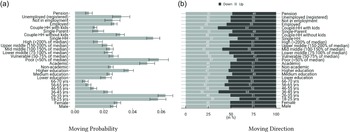
Panel (a) in Figure 4 displays the probability to move across NUTS-3 regions for selected groups and panel (b) shows the share of upward and downward moves with respect to local opportunities conditional on moving. Overall, the variation in the probability to move between different opportunity areas and – more importantly – to move up does not suggest that moving to opportunity is solely a means of the already advantaged.
Socio-demgraphic characteristics of movers Note: Kreis-level moves, pooled over years 2010–2020. Shares with 95 per cent confidence intervals. Source: SOEP v37, weighted.

Younger people aged eighteen to twenty-five and twenty-six to thirty-five years and single households have an above-average probability of around six per cent to relocate to a different county. These groups also move towards rather than away from opportunities once they decide to relocate. More than half of the mobile young adults aged between eighteen and twenty-five years move up. This reflects the residential mobility associated with studying and labor market entry in or close to knowledge economy hubs. As expected, education also plays an important role, with the higher educated being almost twice as likely to relocate compared to those with lower and medium education. Couple households with kids and those in the peak age of family formation (thirty-six to forty-five years) are substantially less mobile. Even if they move, around two thirds move away from rather than towards economic opportunities. Such moves are possibly transitions into less densely populated areas at the outskirts of metropolitan regions or into smaller towns or villages. Interestingly, single parents are significantly more likely to move towards opportunity.
Differentiating by income groups provides further nuance. Around six per cent of those with very low income (measured as equivalized disposable household income relative to the median) relocate across regions. The propensity to move is around three times higher at the very bottom as opposed to the very top of the income distribution.Footnote 4 More than half of the relocations among the economically disadvantaged (poor and vulnerable) are upward moves, and unemployed respondents are slightly more mobile compared to those who were in employment prior to moving. We interpret these findings as suggestive evidence that material hardship can be an important motivation to relocate and deliberately move into ‘better’ areas with higher job opportunities.
Do Opportunity Moves Shift Political Behavior?
In this section, we present the core of our analysis, the assessment of the impact of opportunity moves on political integration and orientation in the place of destination.Footnote 5 The first part of the findings is presented in Table 3, which shows results from eight separate TWFE models covering outcomes related to political participation and ideological leaning. These models are based on within-subject variation only and thus purged of the effects of all time-invariant respondent characteristics. Recall that the models also control for important time-varying covariates of relocations established in the previous section (age group, education, and household type). Since our explanatory variable is scaled from roughly 0 to 1, the presented coefficients correspond to a move from a bottom-ten to a top-ten region in terms of local opportunity.
Opportunity moves and political integration and orientation

***p < 0.01; **p < 0.05; *p < 0.1. All models include age group, education group, and household type as control variables; standard errors are clustered at the Kreis level. Source: SOEP v.37, 2009/10-2020.
Overall, we find that moving to opportunity significantly relates to different measures of political integration and orientation. Outcomes that require more personal involvement are negatively affected: activities in a local party organization or volunteer group are significantly lower after a move. This makes sense as moving from one region to another disrupts local roots and social networks within which people participated in such time-consuming activities, and these may take a while to be re-established after moving. In contrast, we find a positive relationship between upward moves and political integration measured as having an active party identification. This result holds for the general probability of having a party leaning and the intensity of the leaning. The association with political participation in the federal elections, what might be seen as a behavioral consequence of having a party identification, points in the same direction but is not precisely estimated. This variable is only available for three years over the selected time period, which results in a much smaller sample.
In addition, we find robust evidence for a significant reorientation of political leanings: Moving to higher opportunity areas is related to a leftward shift with respect to ideological self-placement. This pattern is mirrored in changes of movers’ identification with different party families. In general, we observe more support for any type of center-right or center-left mainstream party. However, the magnitude of increasing support is skewed: It is particularly pronounced for politically progressive parties where moving from a low to a high opportunity area increases the probability of identifying with parties on the center-left by about 0.04, approximately twice of what we find for the center-right. This measure increases our confidence in the finding on changes in political orientation as measured through left–right self-placement, as they are available for not just three but all eleven survey years, allowing a more precise estimation of the effects.
In summary, our analysis demonstrates a significant relationship between relocations to higher-opportunity areas and individual political behavior. Since our empirical approach substantially reduces concerns about self-selection based on unobserved time-invariant individual characteristics, we interpret these findings as suggestive evidence that relocation may result in adjustments in political attitudes and behavior. Moving from more disadvantaged areas of origin into places of destination characterized by higher opportunity and, typically, more progressive values results, at least to some degree, in political assimilation. Apart from the disruption of involvement in local political activism and volunteering activities, relocating to places with stronger local opportunities is related to a higher attachment to politics and a robust leftward shift in ideological self-placement.
Table 4 provides a closer look at ideological reorientations by showing the estimated effects on the probability of identifying with a specific party (coalition). A positive change in local opportunity is related to a higher probability of identifying with the Social Democratic Party (SPD) and significantly lower probability of identifying with the right-wing populist Alternative for Germany (AfD). All other potential changes in party leaning remain insignificant.
Opportunity moves and party identification

***p < 0.01; **p < 0.05; *p < 0.1. Party leanings include coalitions in the political direction of the respective party (including left coalitions for SPD, Gruene, and Linke; right coalitions for CDU/CSU, FDP, and AfD). All models include age group, education group, and household type as control variables; standard errors are clustered at the Kreis level. Source: SOEP v.37, 2010-2020.
Figure 5 below provides a graphical display of the main results. While the magnitude of the effects is relatively small, which is to be expected in light of the mostly slow-changing dependent variables, there is a consistent pattern of shifting leanings towards the left (and away from the radical right) of the political spectrum and party landscape.
Coefficient plot of main results.
Note: Point estimates with 95 per cent CIs; political orientation re-scaled to values between 0 and 1; all models include age group, education group, and household type as control variables; any move operationalized as cumulative count variable; standard errors are clustered at the Kreis level. Source: SOEP v.37, 2009/10-2020.

Robustness and Heterogeneity
In the Supplementary Material (SM) to this article, we present various additional analyses to demonstrate the robustness of our main results. Our main analysis assumes symmetric effects for upward and downward relocations, as opportunity is measured continuously from 0 to 1. Yet, the estimation of course also draws on within-individual variation from downward moves, that is, relocations away from rather than towards opportunity. To disentangle this, we restrict the sample to single-time movers and estimate effects separately. The results broadly confirm symmetry: upward moves correlate with increased left-leaning self-identification and decreased far-right support, while downward moves show the opposite (see SM Tables E.30–E.34). However, while downward moves reduce SPD support, upward moves do not significantly boost identification with center-left parties – if anything, the Left Party benefits. These findings underscore that relocation-induced attitudinal shifts do not automatically translate into electoral changes, requiring active political mobilization.
To further test the robustness of our findings, we include time-varying socio-economic controls, employment status (SM Tables D.1 and D.2), and income (SM Tables D.3 and D.4), finding no confounding effects. Excluding multiple movers yields consistent results (SM Tables D.5 and D.6). We also address potential biases from students moving to university towns, showing that restricting the sample to post-higher-education years does not alter the findings (SM Tables D.8 and D.9). Additional analyses (SM Sections D.4 and D.5) indicate that the effects are driven by substantial opportunity shifts, not moving distance. While younger individuals show slightly stronger political shifts, differences across age groups are minor.
Our results are robust to the inclusion of additional regional fixed effects. Given the legacy of the GDR, we include both fixed effects for different moving patterns between east and west (SM Tables D.15 and D.16) and also restrict our analysis to relocations within these two regions (SM Tables D.17–D.20). Our results hold with a few unsurprising exceptions regarding party vote choice: the decline in AfD voting is confined to opportunity movers in the west, whereas in the east, we find support for the left party. We further demonstrate robustness to the additional inclusion of fixed effects for northern, eastern, western, and southern regions of Germany (SM Tables D.25 and D.26).
Finally, the construction of local-level indices always requires decisions about the specific level of aggregation. We therefore test the robustness of our findings at the more aggregate level of German labor market regions (Arbeitsmarktregionen, similar to US commuting zones). We use this more aggregate index to re-run core parts of our analyses (including the behavioral implications of opportunity moves outlined in the subsequent section). We can replicate all main findings with the only difference that the leftward shift in ideological self-placement is more pronounced, translating into significantly higher support for the Greens (see SM Tables D.27 and D.28).
Mechanisms
Our primary analysis reveals the political implications of contextual changes in opportunities resulting from individual relocations. This section delves deeper into the mechanisms linking shifts in opportunity with political behavior. In the following, we examine mechanisms at the macro, meso, and micro level to enhance the interpretation of our earlier findings but also help us situate and reconcile our results with the existing literature.
Macro Level: Local Context Conditions
Our conceptual focus differs from otherwise similar studies by examining the directional impact of a changing environment in terms of local opportunity rather than the impact of a relocation per se. Hence, we want to illustrate that the behavioral consequences of an opportunity move, as opposed to a relocation as such, indeed matter. To that end, we contrast our previous results with estimations including any type of county-level relocation. Figure 5 provides strong evidence that our main findings are specific outcomes of opportunity moves rather than merely changes in residence. When re-running the exact same models with a dummy variable capturing any kind of Kreis-level relocation, instead of the change in local opportunity resulting from a move, the results almost completely break down. One association that persists is the reduced engagement in volunteering activities, which makes sense given our earlier argument that this type of political engagement is most strictly tied to local networks. This suggests that our findings do not just result from relocation as such but from specific changes in the local context that accompany relocation into an environment characterized by higher local opportunity. This insight helps reconcile our findings with related empirical assessments that provided much more limited evidence of contextual effects.
In order to gain more detailed insights about which specific aspects of changing context matter most, we re-run our analyses separately for the two index components (labor market and economy [PC1] and urban amenity [PC2]) (see Supplementary Material Section E.4). These analyses show that our findings are primarily – but not exclusively – driven by economic context conditions captured in the first component. Using the labor market and economy component, we can fully reproduce core insights from our analyses. While the predictive power of the urban amenity component is lower with regard to political preferences and behavior, we can show that an improvement in local amenities comes with a significantly higher probability of participating in cultural events such as classical concerts, theater, or exhibitions (see SM Table E.54). While opportunities related to the labor market likely represent the dominant channel, this finding shows how our multidimensional index provides important nuance to the interpretation of the findings. Improved cultural amenities in higher-opportunity areas may facilitate the encounter of and interaction with different people who share in the consumption of cultural goods, which may represent an important facet of individual political behavior.
Meso-Level: Social Networks and Intermediaries
The previously discussed evidence underlines that improved cultural amenities in higher-opportunity areas may facilitate encounters and interactions with different people who share in the consumption of cultural goods. Another highly influential environment shaping political preferences after relocation is the professional context, where many people spend a substantial amount of their time. One might ask whether our results stem more from changes in the work environment than from shifts in the local context, particularly when relocation coincides with major occupational transitions.
Interestingly, only twelve per cent of our movers switch between major occupational groups, making social interactions at the workplace a rather unlikely alternative explanation for changing political preferences. In order to test the predictive power of changing occupational networks, we re-ran our main models on the subset of what we call ‘occupational stayers’: movers who remain in similar occupational contexts. We can reproduce all our main insights (see Tables E.37 and E.38 in the Supplementary Material) when focusing on respondents who remain in comparable occupational environments. This suggests that our findings are unlikely to be driven by substantial changes in the occupational context workers are embedded in after an opportunity move.Footnote 6
Micro-Level: Individual Adaptation and Behavior
As a final step, we wish to illuminate behavioral implications of an opportunity move that help us understand potential individual-level channels explaining political mobilization and a shift in political preferences. A relocation implies an adjustment of the work-related environment but also a changing offer in terms of urban amenities and cultural life, both of which could affect the frequency and type of personal interactions, which in turn impinge on political attitudes. We hence examine whether and how personal socio-economic circumstances and cultural consumption change after moving to an area typically characterized by better labor markets and more vibrant cultural offerings.
Models 1 and 2 in Table 5 show that moving to regions with a knowledge-intensive economy is, on average, accompanied by higher labor earnings and higher occupational status (measured with the International Socio-Economic Index [ISEI]). An improvement in local opportunity hence typically goes hand in hand with objectively improving individual labor market outcomes, which is also reflected in lower subjective worries about job security (Model 3).Footnote 7
Opportunity moves: socio-economic and cultural outcomes

***p < 0.01; **p < 0.05; *p < 0.1.
Models with socio-economic outcomes include work experience, work experience squared, education group, and household type as control variables; models with cultural activities outcomes include age group, education group, and household type as control variables; standard errors are clustered at the Kreis level. Source: SOEP v.37, 2009–2020.
In addition, we are also interested in non-economic behavioral change following relocation. We find a strong positive association between opportunity moves and various cultural activities, such as taking part in cultural events and going to the cinema, attending concerts, or going to a club (Models 4 and 5). Again, these results are unique to our contextual approach to relocation, whereas any kind of relocation does not have comparable implications (see Table E.36 in the Supplementary Material). Interestingly, when examining upward and downward moves separately, the results reveal that the positive association with cultural activities is more strongly driven by lower cultural engagement of those moving away from higher opportunity areas (see SM Tables E.32 and E.35).
Overall, these additional analyses demonstrate the observable presence of expected behavioral implications of moving to opportunity areas, extending beyond the political realm. Non-political institutions and environments are essential for the development of politically relevant skills (Brady et al., Reference Brady, Verba and Schlozman1995) and preference formation more generally (see, for example, Kitschelt and Rehm, Reference Kitschelt and Rehm2014). These results thus provide an important additional layer to our understanding of so-called place effects (Cantoni and Pons, Reference Cantoni and Pons2022). The observed shift in political behavior after moving to opportunity areas is not merely contextual; it is not just that voters find themselves in different social and political environments that affect attitudes through signaling certain norms or normalities. Residential relocation also naturally impacts how individuals earn their living and how they spend their free time.
Discussion and Conclusion
Over recent decades, advanced democracies have transitioned from traditional industries to so-called knowledge economies. Successful companies in these economies depend on local ecosystems to foster innovation, drawing highly skilled workers to concentrated skill clusters, thus making location crucial. This shift increasingly concentrates opportunity in specific areas, which attracts in-migration and exacerbates spatial inequality. The economic geography of the knowledge economy has profound political implications, creating conflicts between high-opportunity urban and lower dynamism areas. This paper advances the existing literature with a dynamic perspective that explicitly asks about the political implications of a strong structural pull into destinations typically characterized by a more progressive political environment than most places of origin.
We examine the case of Germany and provide evidence that relocation to opportunity-rich areas is indeed accompanied by political assimilation at the individual level. Specifically, we observe increased political participation, reduced support for radical parties, and a robust leftward shift in ideological self-placement among citizens moving from lower- to higher-opportunity areas. While Germany’s economic structure – characterized by advanced manufacturing and regional growth clusters – differs from many other European economies, these particularities do not fundamentally challenge the generalizability of our results. Germany’s knowledge economy is more decentralized, with innovative small- and mid-sized manufacturing clusters, particularly in the south, offering opportunities beyond the capital and largest cities. This stronger decentralization may actually lower the cost of moving to opportunity. In contrast to countries like France or Britain, where opportunity is more strongly concentrated in capital cities and their immediate surroundings, relocations in Germany are more diverse and not primarily directed towards Berlin, Munich, or Hamburg. As a result, our findings for Germany could be considered lower-bound estimates compared to contexts where opportunity-driven moves involve greater costs and barriers due to larger distances and more pronounced differences between origin and destination. In more centralized contexts, opportunity moves may be less frequent but may have stronger effects on those who overcome the higher hurdles. We thus contribute to a broader understanding of how internal migration shapes contemporary political landscapes in advanced capitalist democracies.
One possible interpretation of our results is that the ongoing transition towards a knowledge-intensive economy creates a structurally sustained and politically mobilizable potential in support of (progressive) mainstream parties in the mid- and long-term. Internal migration to opportunity hubs could act as a stabilizing force for democratic systems. This interpretation could therefore offer an optimistic contrast to concerns about low political trust and anti-establishment sentiments in ‘left-behind’ regions.
However, there are at least three important caveats to such an optimistic interpretation of the political fallout of the transition to the knowledge economy. First, a progressive shift in attitudes does not automatically translate into electoral change; it requires a compelling party supply to mobilize and realize this potential. Our analysis shows that the Social Democrats struggle in this regard. Despite a leftward shift in attitudes, we find no consistent increase in left party support among those moving to opportunity areas. Meanwhile, voters leaving these areas often abandon support for the Social Democrats, underscoring the paradoxical possibility of electoral net losses despite a growing progressive potential. Second, the political consequences of forced out-migration and reinforced grievances in low-opportunity areas limit an overly optimistic interpretation of our results. Even if opportunity areas host a growing population of engaged and trusting citizens, the regions and people at the losing end of this political geography remain significant and politically influential (see, for example, Rodríguez-Pose et al., Reference Rodríguez-Pose, Terrero-Dávila and Lee2023). Moving to opportunity can be costly, and individual residential constraints may therefore hinder relocation. Patana (Reference Patana2022) shows that radical right support in France is strongest where citizens have limited means to respond to local conditions. Housing cost differentials between declining and more prosperous areas play a particularly important role in this dynamic. Contemporary patterns of realized or blocked internal migration thus likely reinforce political polarization between regions with differing levels of economic dynamism. Finally, a combination of human geography and electoral rules amplifies political polarization and the influence of left-behind regions. The strong concentration of progressive voters in opportunity hubs creates an inefficient spatial distribution of votes, producing urban supermajorities but limiting the effective translation of votes into parliamentary seats – a phenomenon Chen and Rodden (Reference Chen and Rodden2013) term ‘unintentional gerrymandering’.
To conclude, our study highlights how economically driven internal migration serves as a structural factor contributing to political polarization in a world where geographic and social mobility are increasingly intertwined. The shift towards knowledge economies and the resulting political dynamics highlight not only progressive potentials but also enduring grievances. The knowledge economy carries inherent political tension because it creates opportunity for many, perhaps including the decisive ‘aspirational’ voter, but the viability of such aspirations varies significantly due to increasing ‘territorial inequality’ (Rodríguez-Pose et al., Reference Rodríguez-Pose, Terrero-Dávila and Lee2023) and the spatial concentration of good jobs.
Supplementary material
The supplementary material for this article can be found at https://doi.org/10.1017/S0007123425100677.
Data availability statement
Replication data for this article can be found in Harvard Dataverse at: https://doi.org/10.7910/DVN/PF8CWD.
Acknowledgments
For helpful comments on earlier versions of this manuscript, we would like to thank Tom O’Grady, Italo Colantone, Sandra Morgenstern, and participants of seminars, workshops, and panels at the University of Milan, University of Duisburg, IAB Nürnberg, SPSR Conference in Basel, University of Konstanz, EPSA in Glasgow, University of Lausanne, the European University Institute in Florence, Bocconi University, and MZES Mannheim. We would also like to thank the Bertelsmann Stiftung and Prognos for their generous provision of data used for the Opportunity Index.
Author contributions
Valentina Consiglio and Thomas Kurer are listed alphabetically, reflecting equal contributions to the article.
Financial support
Valentina Consiglio and Thomas Kurer have received and gratefully acknowledge funding from the University of Zurich’s Research Priority Program (URPP) ‘Equality of Opportunity’ and from the Deutsche Forschungsgemeinschaft (DFG German Research Foundation) under Germany’s Excellence Strategy EXC-2035/1–390681379.
Competing interests
None.




 Open access

