


Introduction
The struggle between parties and organized interests is one of the basic features of democratic politics (Almond & Powell, Reference Almond and Bingham Powell1966; Schattschneider, Reference Schattschneider1942). While political parties seek public office and policy influence by contesting elections, interest groups attempt to influence public decision making from the outside, directly by lobbying decisionmakers or indirectly by means of media, protest or public opinion strategies (Beyers et al., Reference Beyers, Eising and Maloney2008, pp. 1119–1120; Bolleyer & Weiler, Reference Bolleyer and Weiler2018, p. 1629). As a result, parties and interest groups compete for public attention, resources and political influence (Kriesi et al., Reference Kriesi, Tresch and Jochum2007, pp. 53–54; Wilson, Reference Wilson1990, p. 156). At the same time, some parties and interest groups establish organizational relationships to collaborate and perhaps control each other (Heaney, Reference Heaney, Maisel and Berry2010, p. 568).
Whether they compete or establish relations is likely to depend on the institutional setting, like the generosity of the state's finance of parties, but will also vary within countries as not all groups and parties are interested in structured interaction with each other. Yet, even if these circumstances call for significant scholarly attention to understand policy decisions and outputs, the foundational literature and associated research trajectories are only somewhat helpful in reconciling the contradiction between collaboration and competition (Thomas, Reference Thomas2001). On the one the hand, we have the sociological studies of politics (Lipset & Rokkan, Reference Lipset, Rokkan, Lipset and Rokkan1967) or the economics approach of Downs (Reference Downs1957) with a focus on party‐voter interactions, on the other, we have those following Schattschneider's (Reference Schattschneider1935) emphasis on politics as a battle of interests fighting for their preferences. In brief, parties and interest group research evolved as separate fields (Heaney Reference Heaney, Maisel and Berry2010; Thomas, Reference Thomas2001; Witko, Reference Witko2009).
However, in recent years scholars have started to bridge this gap, and studies suggest that organizational ties – structured interaction – like regularized top‐leadership meetings between parties and interest groups, are commonplace in contemporary democracies (e.g., Allern et al., Reference Allern, Otjes, Poguntke, Hansen, Saurugger and Marshall2021; Gava et al., Reference Gava, Varone, Mach, Eichenberger, Christe and Chao‐Blanco2017; Koger et al., Reference Koger, Masket and Noel2009; Rasmussen & Lindeboom, Reference Rasmussen and Lindeboom2013). Moreover, we know that many possible pairs of parties and interest groups have no structured contact (Eichenberger & Mach, Reference Eichenberger and Mach2017; Rasmussen & Lindeboom, Reference Rasmussen and Lindeboom2013; Witko, Reference Witko2009). We therefore need to understand when and why organizational ties between parties and interest groups exist and what can explain the varying degrees of institutionalization. Party‐group ties may still secure a more stable support base for political parties (Martin et al., Reference Martin, De Lange and Van der Brug2020), and they may affect the political representation of interests by parties in different political systems. Organizational ties mean stable access to decisionmakers on both sides. Therefore party‐group ties can strengthen the representative capacity of parties due to efficient interest articulation but can also contribute to bias in the political system, just like unbalanced access to various administrative and legislative venues does at the institutional level (Weiler et al., Reference Weiler, Eichenberger, Mach and Varone2019), depending on whether the preferences of the party constituency and the group overlap or not in key issues (Giger & Klüver, Reference Giger and Klüver2016).
While regularized interaction might exist informally at the individual level, we focus on organizational‐level ties as these are the ones party‐group elites might directly establish or abolish. Their choice is wide but constrained by the strategic context in which parties and groups interact. For example, the pattern of party competition has been argued to affect party incentives (Berry, Reference Berry1997, p. 47; Thomas, Reference Thomas2001, pp. 275–276). Yet, in this paper the analytical focus is on actor characteristics. Historically, strong party‐group ties were rooted in shared ideological positions, like in the archetypal case of labour parties and labour unions. Once formed, however, organizational relationships did not go ‘on autopilot’ (Warner, Reference Warner2000, pp. 18, 23). Moreover, a group and a party that are ideologically aligned do not automatically develop organizational ties (Allern et al., Reference Allern, Otjes, Poguntke, Hansen, Saurugger and Marshall2021). Accordingly, the predominant explanation for why some still get involved in organized relationships emphasizes what the two sides offer each other in terms of tangible resources (McLean, Reference McLean1987, p. 70; Quinn, Reference Quinn2002, p. 44; Warner, Reference Warner2000, p. 29). By structuring – institutionalizing – their interaction parties and interest groups stabilize the exchange of resources between them (Quinn, Reference Quinn2002).
Existing empirical studies support the cost‐benefit resource exchange model: differences in specific resources, and thus usefulness, correspond systematically with the variations in strength of organizational ties, over time and today, even when controlling for historical origins (Allern & Bale, Reference Allern and Bale2017; Rasmussen & Lindeboom, Reference Rasmussen and Lindeboom2013). Likewise, it has been argued in studies of lobbying and political influence that providing tangible resources like campaign donations and electoral support motivate legislators and/or parties to grant access and listen to particular interest groups (Binderkrantz, Reference Binderkrantz, Martin, Saalfeld and Strøm2014; Bouwen, Reference Bouwen2002; Hansen, Reference Hansen1991; Heaney, Reference Heaney, Maisel and Berry2010; Powell & Grimmer, Reference Powell and Grimmer2016; Snyder, Reference Snyder1992). The provision of information has also been argued to explain how interest groups’ political goals are converted into tangible political outcomes (Ainsworth, Reference Ainsworth1993; Austen Smith, Reference Austen‐Smith1993); and, more recently, why the exchange rate for technical information in respect to political influence varies between business and public interests (Dür et al., Reference Dür, Marshall and Bernhagen2019). Groups, for their part, find powerful MPs from powerful parties particularly attractive (Marshall, Reference Marshall2015).
However, even if the resource exchange perspective is frequently mentioned, it is seldom fleshed‐out in the literature on either interest group lobbying or organizational ties. Most studies are limited to studying the correlation between having resources and getting access to institutional venues, parties or individual policymakers (e.g., Rasmussen & Lindeboom, Reference Rasmussen and Lindeboom2013, but see Hall & Deardorff, Reference Hall and Deardorff2006), and few studies span multiple types of parties, groups and countries (but see Allern & Bale, Reference Allern and Bale2017; Binderkrantz et al., Reference Binderkrantz, Christiansen and Pedersen2015; Otjes and Rasmussen, Reference Otjes and Rasmussen2017). Moreover, the literature on organizational ties and resource exchange does not address the conditions under which groups are interested in ties at all. Hence, there are still understudied aspects that prevent us from drawing general conclusions. In this paper, we contribute to filling four gaps in the literature on party‐group ties that is also of relevance for other research fields studying the role of resources and exchange in politics.
First, we argue that the resource exchange model itself is not equally well‐suited to explain the absence of ties as it is for explaining the strength of present ties. Second, addressing the strength of ties, we highlight that a resource exchange model depicts an equilibrium, suggesting that party‐interest group ‘pairs’ that mutually provide each other with significant resources are more likely to be characterized by stronger organizational ties than those with a less reciprocal resource provision. Third, we make the case for scrutinising the relative importance of different types of resources in terms of asset specificity or exclusivity. We suggest that in the same way that there is a ‘hierarchy of ties’ (in terms of institutionalization) there is a ‘hierarchy of resources’ (in terms of specificity and exclusivity) and hypothesize that resources that are specific for the transaction (not easy to redeploy and reuse) or rather exclusive (hard to share with others) are stronger predictors of highly institutional ties than other resources.
We test our hypotheses on data from a novel organizational survey of representative samples of interest groups and their ties to parties conducted simultaneously in seven mature Western democracies in 2017–2018. This allows us to look at party‐group dyads and control for the possible confounder of ideological kinship (i.e. policy proximity). We combine these data with several other data sources. By moving beyond the ‘usual suspects’ of long‐established party‐group relationships in politics, we draw more generalizable conclusions than previous cross‐national studies (Thomas, Reference Thomas2001; Warner, Reference Warner2000). The number of countries that are studied, limits the opportunities to directly examine the effects of political institutions, but we use country fixed effects to control for unobserved system‐level variation.
Note that our study was designed to address relations (ties) between parties and groups and not ties between groups or ties between parties. We focus on types of ties that can only exist between pairs of individual parties and interest groups. Empirically, we examine a sample of interest groups, not an entire population, in each country. Thus, the study does not include all possible party‐group relations. Therefore, our party‐group dyadic approach to ties has a different purpose and design than (bipartite) network analysis addressing whether party‐group ties are dependent on one another (Victor et al., Reference Victor, Montgomery, Lubell, Victor, Montgomery and Lubell2017; Ward et al., Reference Ward, Stovel and Sacks2011).
By and large, we find support for our hypotheses. We cannot preclude the possibility that ties to groups have previously affected parties’ and groups’ resource provisions, but we control for the possible third factor of particularly strong historical ties making resource provision, organizational ties, as well as policy proximity, more likely. The findings have important theoretical and normative implications that we elaborate on in the conclusion.
Theory: Resource exchange and organizational ties
Parties and interest groups do not face an either‐or choice when it comes to structured interaction with each other. There are multiple options between having no or only sporadic ad‐hoc contact on the one extreme to the formally integrated relationships we witnessed in the early days of party politics on the other (Rasmussen & Lindeboom, Reference Rasmussen and Lindeboom2013). The strength of organizational ties primarily reflects the extent to which contact is made formal or otherwise structured (Allern et al., Reference Allern, Otjes, Poguntke, Hansen, Saurugger and Marshall2021, p. 1257). Organizational‐level ties – like a collaboration agreement – constitute such structures but also purely informal contact might be structured if it is regular and normalized (Bellucci & Heath, Reference Bellucci and Heath2012). In this paper, we aim to explain both the general presence of and the strength of organizational‐level ties, between parties and interest groups, by innovating on classic resource exchange theory.
General assumptions
This standard approach is rooted in general resource dependence theory. Organizations will respond to and become dependent on those in its environment that control critical resources but may change their environments through political means or establish inter‐organizational relationships to control or reduce uncertainty (Pfeffer & Salancik, Reference Pfeffer and Salancik1978). Most importantly, the resource approach takes a rational choice perspective: it proposes that parties assess the costs and benefits of possible ties to interest groups for the pursuit of office (per se or to implement policy), while interest groups tend to assess ties to parties considering parties’ ability to enhance their chances to influence public policy. Political parties seek votes, monetary support and organizational assistance from groups, while interest groups seek access to government and legislation, and policy rewards from parties (McLean, Reference McLean1987, p. 70; Warner, Reference Warner2000).
In this potential exchange, there are some difficulties related to various transaction costs, as in economic exchange (see e.g., Williamson, Reference Williamson1979). First, there is imperfect information: groups do not know all about what parties do in parliament and government. Second, the ‘exchange’ is not simultaneous: groups support parties before and during a legislative term while policies are developed and ‘delivered’ at a later stage. However, through a well‐organized relationship with specific parties, interest groups may ‘pre‐programme’ politicians and hereby improve their own chances for policy rewards (Warner, Reference Warner2000, p. 98). It might also be useful for parties to establish credible compensation mechanisms in terms of ties with interest groups as these may anticipate the breaking of policy promises and the undersupply of resources, like financial support, or threaten to do so. Hence, the resource exchange model implies that parties and interest groups establish organizational ties to stabilize mutual resource provisions (Quinn, Reference Quinn2002).
We build on these basic assumptions, but before specifying the model, we need to ask: does it apply to all parties and interest groups, or must certain preconditions be in place for groups and parties to seek help from each other?
Existence of ties: Preconditions
The resource exchange model presupposes at least two things, and first of all, that parties and groups rely on each other to reach their goals. This is generally plausible, but there are also likely to be exceptions. To address the situation parties and groups face, one needs to specify their goal‐seeking behaviour. We assume parties seek access to office, but also maximization of policy, by the means of votes (Strøm, Reference Strøm1990).Footnote 1 Probably, most parties are willing to interact with interest groups in a structured manner to participate in government, either because access to office allows some of the party's policy preferences to be implemented as public policy, or because they value spoils per se. Interest groups may help them pursue both these goals, like resource dependency theory suggests. Some resources, like information, might be more valuable for individual policymakers due to more severe time and resource constraints, but these often act on behalf of parties and there are limits to the policy expertise and budgets of parties as collective units too.
Meanwhile, many interest groups have originally, or also, been set up as organizations for non‐political purposes (Bolleyer & Weiler, Reference Bolleyer and Weiler2018, pp. 1629–1630), and when they interact with the political realm, they are pure policy maximizers (Berry, Reference Berry1997; Quinn, Reference Quinn2002; Schlesinger, Reference Schlesinger1984); for instance, using political action to secure policy beneficial to their constituency. Thus, access to government via parties and politicians is generally of instrumental value to interest groups, even if organization elites might themselves enjoy being present in the corridors of power. However, the nature of their policy‐seeking varies. Some groups have a general orientation at the level of policy dimensions (like a trade union), even if they do not have an ideology per se, while others are narrower, perhaps very technically oriented, and ‘apolitical’ or ‘non‐ideological’ in the partisan sense (like a patient organization). Indeed, many interest groups focus on promoting and protecting narrow policy niches (Beyers et al., Reference Beyers, De Bruvcker and Baller2015; Gray & Lowery, Reference Gray and Lowery1996). While the former seeks to influence the aspects of public policy that parties address, the latter have policy goals that are perhaps outside of the orbit of regular party competition. Hence, they do not so much seek to influence party policy choices but rather rely on a small set of specialized legislators and bureaucrats, viewing high profile party alignments as riskier (Beyers et al., Reference Beyers, De Bruvcker and Baller2015). As a result, the basic motivation for having structured interaction with parties generally differ and we expect that the weaker the ideological orientation of the interest group in a relationship, the less likely that organizational ties will exist at all.
Second, it could be argued that resource exchange and maintaining organizational ties requires a minimum of organizational capacity even if weak ties are not that hard to maintain. If an actor has limited resources at hand (in terms of staff and budget) this can also affect their orientation towards other actors, as they need to have a certain surplus of resources once their core activities are accounted for, in order to engage and invest in relationships with others. While parties are usually able to compete in elections repeatedly and thus nearly by definition have a certain level of organizational capacity, many interest groups are smaller, based on voluntary work and cannot nurture organizational ties with parties even if they want to. Groups with limited organizational capacity, are less likely to have organizational ties with parties. Hence, we argue that the nature of interest groups’ policy goals and their organizational capacity are what primarily explain the presence or absence of ties, and hypothesize:
Precondition hypothesis (H1):
H1a: Organizational ties between a party and an interest group are less likely if the group is non‐ideological in its policy orientation.
H1b: Organizational ties between a party and an interest group are less likely if the group has limited capacity in terms of organizational resources (such as staff, budget and time).
Next, the question is what explains the strength of existing organizational ties. To this end, we elaborate the specific propositions of the ‘resource exchange model’ and their empirical implications.
Strength of ties: Specifications
Faced by a set of interest groups a party assesses the tangible benefits groups can offer, according to the resource exchange model: the potential in terms of votes, money and organizational resources but also their expertise on specific subjects. Interest groups are specialists in their domain and can offer highly valuable information to parties (Bernhagen, Reference Bernhagen2013; Bouwen, Reference Bouwen2004; Hall & Deardorff, Reference Hall and Deardorff2006).
Likewise, faced with a set of parties, the interest group assumingly evaluates the performance of a party concerning the given party's policy record and the party's power resources. Mapping the achievement of specific policy‐related goals is beyond the scope of this study, but powerful parties – in terms of regular access to government and seat share in parliament – are more likely to have influence on policy outcomes and are thus particularly attractive ‘partners’ for interest groups. In parliamentary systems, larger parties are likely to supply the formateur of a coalition (Bäck & Dumont, Reference Bäck and Dumont2008), who shapes the coalition agreement itself, as well as the prime minister, who exerts considerable control over policy making (Glasgow & Golder et al., Reference Glasgow, Golder and Golder2011). Statistically speaking, larger parties are also more likely to include the pivotal lawmakers than smaller parties. Finally, parliaments distribute resources (such as staff) in proportion to party size (Brauninger & Debus, Reference Brauninger and Debus2009). All these assets give large parties a high chance of influencing policy.
As a result, organizational ties between parties and interest groups can be envisaged as shaped by a mutual exchange of assets. Differences in the strength of organizational ties will reflect variations in the associated balance of costs and benefits. For parties, the potential costs – besides invested time and generally reduced freedom of action – include potential drawbacks like repelling other voter groups and limiting the party's coalition possibilities. Moreover, strong links with particular interest groups involve the risk of making policy promises that collide with their own policy preferences in specific issues. For interest groups, alienating members and the limited possibility for gaining access and ‘seeking out the highest bidder’ among all parties, are probable disadvantages, in addition to the costs of invested resources (Kirchheimer, Reference Kirchheimer, LaPalombara and Weiner1966, p. 193; McLean, Reference McLean1987, p. 70; Warner, Reference Warner2000, pp. 102, 165–166).
In a nutshell, the resource exchange model suggests that parties and interest groups that can offer each other a considerable level of measurable ‘goods’ – that is, cases where the costs of being (strongly) tied are unlikely to exceed the benefits – tend be interconnected by stronger organizational ties.Footnote 2 Parties and groups are primarily assumed to be willing to institutionalize their relationship if they provide each other with substantial resources. We propose that parties and groups trade off the utility of a given relationship (based on ties) with the potential utility of entering another relationship (based on ties). Thus, we expect that the differences in the strength of party‐interest group organizational ties will vary systematically according to resources offered by the interest group and the party. Furthermore, the standard exchange model predicts that when both sides of the resource exchange equation reach an equilibrium in the provision of key organizational or power resources, the establishment of strong ties is more likely. Hence, we expect that both sides of the resource equation explain more of the variation in organizational ties than one side does on its own. Our second hypothesis is thus:
Resource provision hypothesis (H2):
H2a: The organizational ties between a party and an interest group tend to be stronger in cases where the group offers the party significant resources (such as votes, financial resources, organizational support and information).
H2b: The more powerful the party is (i.e., in terms of regular access to government and position in the legislature), the stronger the organizational ties between a party and an interest group are likely to be.
H2c: Group resources and party resources explain more of the variation in strength of organizational ties together than they do alone.
Finally, the transaction costs theory underpinning the idea of ties as an instrument to stabilize resource exchange can be used to further specify the explanatory model in terms of types of resources. In ‘new institutional economics’, firms are seen as governance structures in which certain, frequent transactions are organized more efficiently (at lower cost) than in the market. Services provided at a lower cost internally will be produced by the demander itself (Williamson, Reference Williamson1979). More specifically, it is argued that if the goods and services which are traded cannot easily be used elsewhere if an agreed exchange is not fulfilled, these assets are specific, and the exchange is vulnerable to attempts to re‐negotiate contrasts. Therefore, exchange of such resources is more efficiently organized in firms through ‘vertical integration’. Likewise, the degree of ‘asset specificity’ of resources is likely to matter for party‐group ties: can the exchanged goods easily be used elsewhere or not? (Warner, Reference Warner2000, pp. 29–30).
Specifically, financial donations are emphasized since they cannot be redeployed once given and used by the party. Similarly, if group members are used to voting for a specific party, they can be hard to deprogram (Warner, Reference Warner2000, pp. 29–30). Meanwhile, a group may easily prevent a party from using its organizational facilities and the same goes for human capital, given that the groups are able to instruct or at least encourage their activists to stop working for the party in question. The resources also vary in terms of whether they are rather exclusive (like a donation or an endorsement) or can easily be provided to or shared by multiple actors (like information). The policy information of groups is something than can be shared with other parties. Seen from the party's point of view, the provision of stable access to government can easily be provided and denied. Specific policy benefits are more selective, but while hard to measure, they are seldom of exclusive value to a single group.
Like there is a hierarchy of ties, we propose that there is a hierarchy of resources. Exclusivity and not least asset specificity strengthens the incentives for stronger ties (to stabilize provision). Shareable and less exclusive resources, like information, are more relevant for the lower level of institutionalization, as are ties like regular invitations to congresses and hearings that can be established with multiple actors simultaneously. Hence, we finally hypothesize:
Resource exclusivity hypothesis (H3):
Resources that are specific for the relationship (not easy to redeploy and reuse) and/or rather exclusive (less easy to share with others) are stronger predictors of highly institutional ties than other resources.
Research design
When testing our hypotheses, we utilize data from a novel interest group survey conducted in Denmark, France, Germany, the Netherlands, Norway, the United Kingdom and the United States in 2017–2018.Footnote 3 Although this number of countries is too small to systematically examine country‐level variation, we seek to cover interest groups that operate under relatively similar conditions but in countries that vary in their institutional setting to secure more generalizable results; in terms of separation of powers, corporatism versus pluralism, state subventions and party finance regulations – all aspects that might weaken or strengthen the incentives for party‐group ties. We developed similar sampling frames across countries and, on basis of that, we generated one random sample and one purposive sample consisting of the 10 most important actors within a set of group categories active within different policy areas. In sum, this led to representative samples with some oversampling of the major interest group players to ensure responses from these groups (see the Supporting Information Appendix for details on sampling strategy).
The response rate was 29 per cent (857/2944) across countries. There is variation between countries in line with the results from other interest group surveys, and the countries with the lowest response rates are the large countries not usually included in existing (cross‐national) surveys: United States and France (Dür & Mateo, Reference Dür and Mateo2013; Marchetti, Reference Marchetti2015; Rasmussen & Lindeboom, Reference Rasmussen and Lindeboom2013). We take account of this by controlling for heterogeneity that could result in differential response rates across countries using country fixed effects. Removing the United States, where the response rate was only 10 per cent from the analysis, makes no difference to the results. There are, no major biases between group types (see Supporting Information Appendix for the response rate across countries and between group types and for the coding scheme for the group types).Footnote 4 The unit of analysis in this paper is dyads consisting of interest groups and parties in the different countries. This makes us able to analyse differences on the dyadic level, that is, group X has strong ties to party A but none to party B and weak ties to party C.
Operationalizations
The strength of organizational ties is our dependent variable and indicates the extent to which contact is made formal or otherwise structured (‘institutionalized’). We focus on the organizational‐level ties that connect decision‐making bodies, headquarters and/or the decisionmakers or staff.
Dependent variable: Index of organizational ties
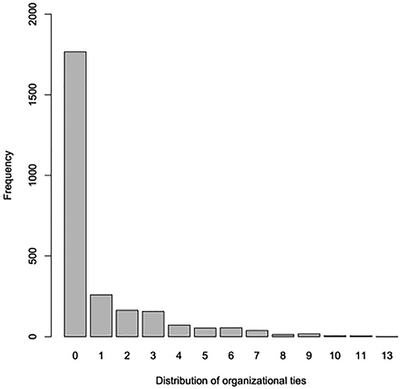
We construct an index from 0 to 13 counting the number of organizational‐level ties that a group has reported to have to a party over the last 5 years from the launch of the survey. In Table A2 in the Supporting Information Appendix, we show based on Mokken scaling – an item response modelling technique especially created for binary data – that this index scales well and that groups that have the strongest organizational ties also have the weaker ones. Joint party‐group arrangements – like a liaison committee – are the strongest example of inter‐organizational ties here. These are durable and mutual, whereas others, like arranged consultations or regularized congress invitations, are by nature one‐way and occasional as they are event‐related (see lower cells of Table A2). Such ties are easier to establish with multiple actors than the durable ties as they are less costly (time‐consuming). Hence, the aggregated tie score shows the number of organizational‐level ties and indicates the level of institutionalization as defined above. For more detailed information on the dependent variable see the Supporting Information Appendix. Figure 1 shows the distribution of ties across the party‐group dyads included in the analysis. When testing the Precondition hypothesis (H1) we zoom in on the zero values, while the test of the Resource provision hypothesis (H2) uses the variation from 1–13 (see below).
Dependent variable: Distribution of organizational ties

To test whether resources that are exclusive for the transaction are mainly predictors of highly institutional ties, we also run separate models for durable ties only. The measure Durable ties is an index (0–7) including the seven durable items in the upper cells in Table A2 in the Supporting Information Appendix but only for cases that have at least one occasional tie.
Our data show that among the limited number of groups with numerous durable ties, the majority has durable ties to only one or two parties. Thus, the question is what factors account for the choice of having stronger compared to weaker ties or none at all among party‐group dyads?
Independent variables
To be able to test the hypothesis on the presence of ties (Precondition hypothesis [H1a‐b]), we utilize three different variables: Non‐ideological profile, Group budget and Group staff size. Non‐ideological profile taps that some groups’ policy goals are ‘apolitical’ in the partisan sense (like a typical patient organization), while others have a general ideological orientation similar to parties at the level of policy dimensions (like many trade unions). To measure the nature of groups’ policy‐seeking in this sense, we utilize questions on six different policy dimensions, extracted from the Chapel Hill Expert Survey on party positions (Polk et al., Reference Polk, Rovny and Bakker2017), from the interest groups survey (see details below). We count the number of dimensions a group has not been able to place itself on (i.e., it has used the survey response option ‘No position/not applicable’). The variable is standardized between zero and one where the maximum value, in particular, indicates that a group is a non‐ideological group (with no positions across the six dimensions). Group budget and group staff size tap the group's capacity and are also based on survey items. In both cases we dichotomized the ordinal answer categories because we are interested in separating amateur organizations with weak capacity (that are unlikely to have ties) from professional ones with large capacity (that are likely to have ties) instead of seeing how the level of professionalization affects the number of ties. Both variables are one if the score is higher than the median and zero if it is not. Note that non‐ideological profile and group budget are also used as controls in the models testing the Resource exclusivity hypothesis (H3).
To test our Resource provision hypothesis (H2a‐c), we use the following substantial indicators, starting with the resources that groups offer to parties. In order to tap a group's resource provision (H2a), we first look at information provision. To measure this, we use the variable Group information constructed on the basis of the interest group survey. We use an ordinal item concerning the number of employees who monitor and comment on public policy for at least half of their working time (‘policy workers’). The variable is dichotomized. It is one for values higher than the median and zero for lower values. The assumption is that more full‐time policy workers equal more informational resources. The measure is not dyad‐specific but tells us about the capacity to provide high‐quality information.
Second, to capture the vote providing potential we primarily use the survey item Group endorsement. If the group has reported to have publicly endorsed the party in question before an election Group endorsement is one and zero if not. This item is taken from the interest group survey and covers the last 5 years (pre‐survey date). We also run a robustness test on a sub‐sample of membership organizations (see Supporting Information Appendix, Table A4). If the group has reported that their members are inclined to vote for the party, Group vote (for party) is coded as one, otherwise the value is zero.
Third, financial donations are captured by the variable Group donation. This variable indicates whether the group has donated money to the party directly in the last 5 years (before the survey). Money is the most tangible resource that an interest group can provide and it is also chracterized by asset specificity, not only exclusiveness. The reported direct contributions are cross‐checked with national authorities’ reports of donations from groups to parties and the survey data matches these reports. Hence, we consider the validity of this survey measure to be sufficiently good. Note, that donations are rare and need to be above a certain (country‐specific) threshold to be required to be reported to national authorities.
The Resource provision hypothesis also addresses what resources parties provide groups. Mapping the achievement of specific policy‐related goals is beyond the scope of this study, but groups are more likely to gain from powerful parties in terms of policy benefits. To capture the different aspects of power discussed above, we relied on the Parlgov database for data on both time in government and seat shares ten years back in time from when the survey was launched (Döring & Manow, Reference Döring and Manow2018).Footnote 5 We constructed an additive scale – Party power – combining the share of seats parties have and their time in government. Therefore, we can include both measures in the same model even though they are highly correlated. This variable is standardized so that all values fall between zero and one.
Control variables in models testing hypotheses 2 and 3
We control for policy distance as there might be good reasons for parties and interest groups to take basic political preferences into account when building relationships. Even if some interest groups focus on very narrow policy niches, it is reasonable to assume political cleavages can be observed among interest groups (Beyers et al., Reference Beyers, De Bruvcker and Baller2015). Accordingly, echoing studies of lobbying and issue‐based contacts (Berkhout et al., Reference Berkhout, Hanegraaff and Statsch2021), one must control for policy proximity. First, the likelihood of achieving specific policy priorities for groups increases with overlapping general policy positions, since the groups’ preferences will be less likely to collide with the party's own policy goals. Second, it implies particularly relevant information from groups seen from a party's point of view, in light of both its own policy‐seeking and vote‐seeking purposes. Third, general policy proximity is not only indirectly relevant as a way to estimate likely costs and benefits in the eyes of the actors, it is also a possible confounding factor: a variable influencing both the independent variable (provision of resources) and the dependent variable (strength of ties).
To take account of this we use data from the interest group survey measuring group positions on policy dimensions. Hence, we include the absolute distance between the group's self‐placement in the survey and the Chapel Hill Expert Survey coding of parties from 2014 on six different dimensions (Polk et al., Reference Polk, Rovny and Bakker2017). These six dimensions were all measured on a scale from 0 to 10 and concerned the environment, immigration, social lifestyle, government intervention in the economy, redistribution and the choice between lower taxation or better public services respectively. Thus, both conflicts concerning ‘old’ and ‘new’ politics are represented. We run six different models to control for the effect of policy distance between a group and a party and expect a negative relationship with the dependent variable, that is, the higher the distance, the lower the probability of ties. All six measures are standardized so that all values fall between zero and one. If a group was unable to locate itself on the dimension in question it is excluded in the specific model (hence the N varies across these models).
We control for various group characteristics that may affect the probability of organizational ties to parties. To tap into a history of strong ties as a possible confounding variable, we include the group's year of establishment and interest group type. Recently formed groups cannot have historical ties to parties. We thus include a binary variable Old group ( = one if established before 1980). This information is based on the survey. The variable Economic group is coded one if the group is a labour/trade union, employers’ organization/business group or occupational organization, and zero if not. This variable is constructed based on the group type variable that was coded in collaboration with the country teams for the entire sample of groups (see Supporting Information Appendix for coding scheme). It controls for whether a group has been among the most relevant for the traditional party competition along the economic left‐right axis. It also partly taps into the variation in historical ties between parties and interest groups. The most prominent examples of strong ties to parties were found within this group category (Duverger, Reference Duverger1954/1972).
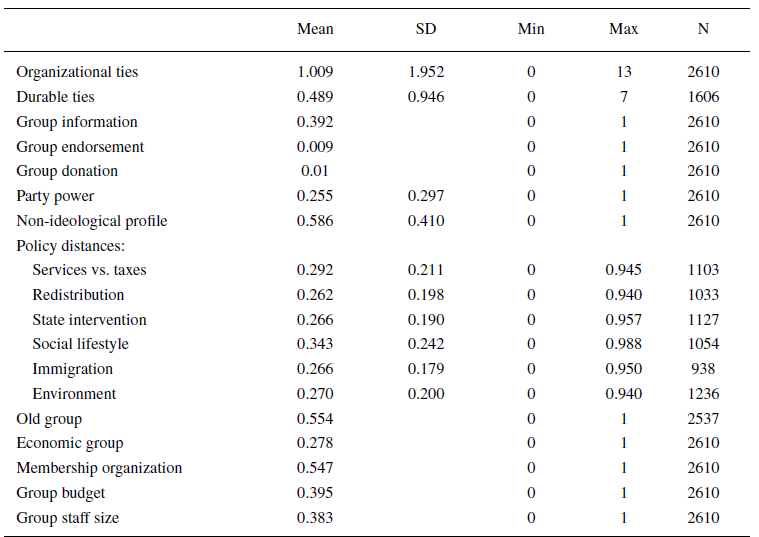
Finally, membership organization is a binary variable (taken from the survey) coded as one if the group has individual members or multiple membership types and as zero if the group has only other types of members (like organizations) or no formal members at all. Having individual members might be a plus for groups facing parties seeking electoral support and makes groups generally more attractive. Table 1 shows the descriptive statistics for the two dependent variables and the independent variables.
Descriptives

Note that missing values on Organizational ties (DV) are omitted from the descriptives for the independent variables
Method of analysis
Since the dependent variables Strength of organizational ties and Durable ties are count variables, we use count models. Due to overdispersion in the data (the observed variance exceeds the mean) we employ negative binomial models. To test the Precondition hypothesis (H1) and the Resource provision hypothesis (H2) we rely on a zero‐inflated model where its zero‐inflated part is relevant for H1 and the conditional part for H2. Here, the zeroes are modelled as a function of the variables preconditioning the existence of ties and the higher values as a function of the resource exchange variables. The data has a multi‐level structure with possible dependencies between the party‐group dyads within groups, political parties and countries. Since empty models show that most of the variance is at the group level (and not on the country level or party level), we account for the multilevel structure of the data by including groups as level 2 units and include group random effects in the ordinary negative binomial models.Footnote 6 We use country dummies to control for unobserved heterogeneity between the political systems. These dummies also account for variation between political systems in the size of groups and party populations and thus address the concern that some environments are generally more competitive than others. Note that we control for the variation in competition within different group types in Tables A13–14 in the Supporting Information Appendix.
Empirical analysis
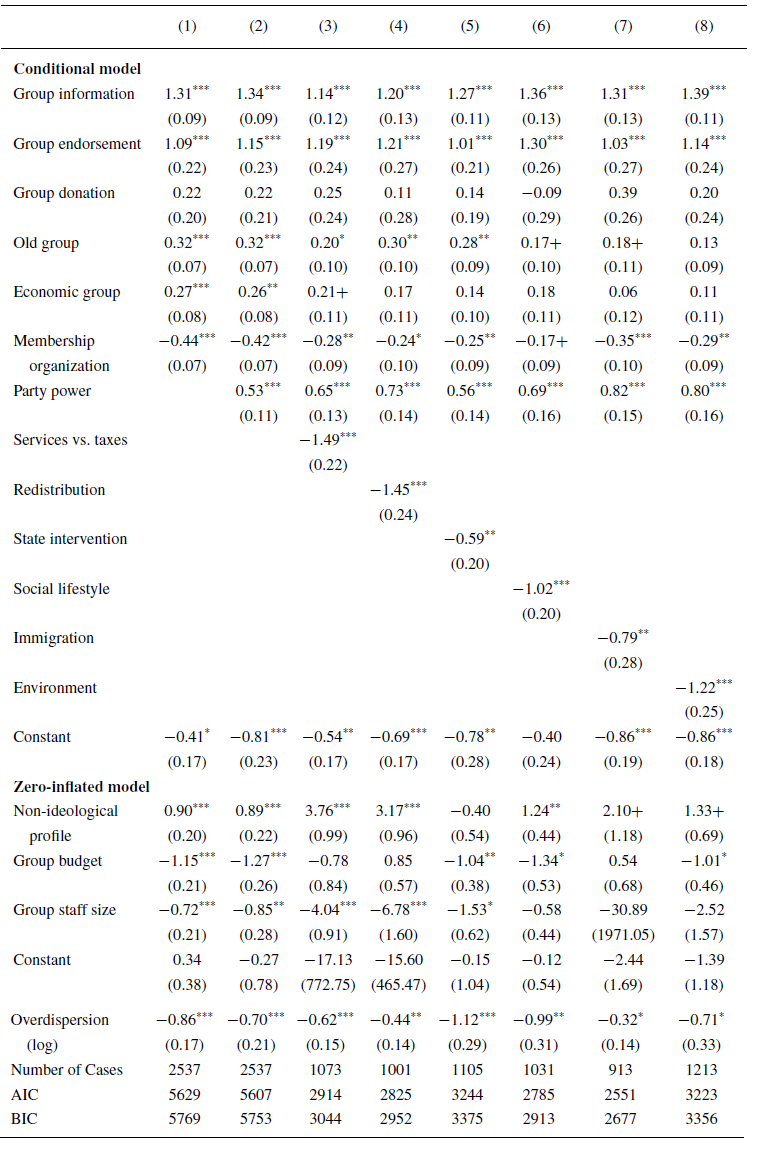
To test all three sets of hypotheses, we rely on results reported in two different tables. Table 2 tests the Precondition hypothesis (1a‐b) and Resource provision hypothesis (H2a‐c) while Table 3 tests the Resource exclusivity hypothesis (H3). In general, we find support for all three sets of hypotheses. The following will assess this support in detail.
Zero‐inflated and conditional negative binomial model. DV: All ties

All models include country fixed effects. + p<0.10,
* p< 0.05;
** p< 0.01;
*** p< 0.001.
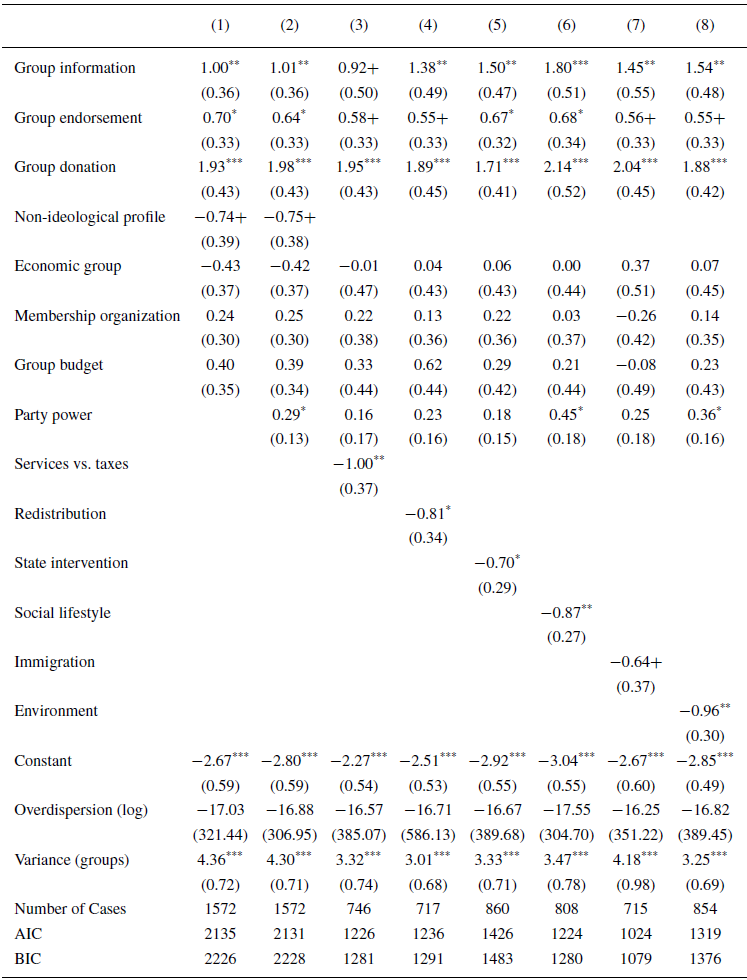
Negative binomial model with group level random effects. DV: Durable ties

Models 1–2 include country fixed effects. + p < 0.10.
* p< 0.05;
** p< 0.01;
*** p< 0.001.
In the zero‐inflated part of Table 2, we see that (degree of) Non‐ideological profile (H1a), and group organizational capacity (H1b) operationalized as Group staff size and Group budget significantly predict the absence of organizational ties between parties and groups as hypothesized. While groups that are less political in their orientation are positively associated with having zero ties, groups with more full‐time workers and larger budgets are negatively associated with having zero ties.
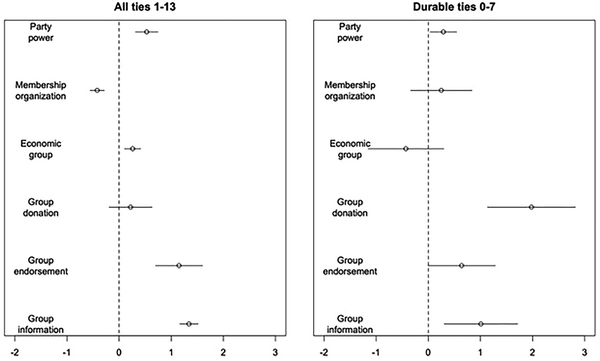
The conditional model in Table 2 zooms in on the resource exchange. We first look at one model including the group resources before adding party resources in model 2. The remaining models (3–8) control for the policy distances on the six different dimensions. The models show consistent results for the different resource variables. Regarding the Resource provision hypothesis (H2a‐c) we find that group resources (both information and vote potential (as measured by Endorsement [of party]) are associated with stronger organizational ties. This supports H2a.
We also find support for H2b. The more powerful the party is, the stronger the organizational ties between a party and an interest group tend to be. Both the group and the party resources results remain robust when including policy distances. This means that similar general policy positions between groups and parties do not wipe out the importance of resource provision for explaining the strength of organizational ties between parties and interest groups. But note that the least common group type resource, Group donation, does not have a significant association with the dependent variable when we look at all types of organizational ties. In Table 3, we investigate whether this can be explained by the need for higher level (durable) ties, in particular, for donations to materialize.
We also find support for H2c, group resources and party resources explain more of the variation in strength of organizational ties together than they do alone. This can be seen by comparing the AIC (Akaike Information Criterion) values between models 1 and 2 in Table 2. This estimator of prediction error decreases when including party resources as well in the model which again indicates that model 2 is a better fit than 1. Note that a comparison of only party resources to party and group resources together also shows that resources from both sides explain more than what party resources do alone.
The effects of the control variables in the conditional model are generally in line with expectations, but not completely. First, older groups and economic groups are more likely to hold organizational ties to parties than groups founded at later stages and non‐economic groups in most of the model specifications. Second, Membership organization is negatively associated with organizational ties. This is somewhat surprising, but it could be that the favourable traits of having members are picked up by other variables in the models (see Table A4 in the Supporting Information Appendix for an alternative specification of the association between members and ties).
Third, the negative effects of all the six policy distance measures indicate that the larger the policy distance between a group and a party, the weaker the ties between them. Hence, the stronger the degree of policy proximity between a party and an interest group the stronger the organizational‐level ties between them tend to be.
To test the Resource exclusivity hypothesis (H3), we include the same independent variables and all controls but use the number of durable ties as dependent variable in Table 3.
Here we investigate whether the effect of the non‐redeployable and more exclusive group resources (such as donations) are particularly associated with higher levels of institutionalization (compared to other resources).
When looking at the results here, we see that the association between the dependent variable and financial resources now is positive and significant. This association is also more robust than the effects of the other resource variables. This lends support for the H3 since this type of resource cannot be redeployed and is less easy to share than endorsements and information. Meanwhile, Party power – a resource which is not exclusive for a given relationship matters less for durable ties.
The uncertainty of the substantial effects from Table 2 (conditional model) and Table 3 are shown in Figure 2. While all resource variables (apart from Group donation) have a positive and significant effect on ties when we look at the results from the conditional model, the effect of group donation pops out and is the most robust one when looking at durable ties in particular. This is in line with our expectations (H3) since this type of resource is something that it is not possible to redeploy, reuse or share with others and are thus exclusive to the party‐group relationship as such.

This difference is also evident if we look at the predicted number of ties. The number of ties increases from around 1 to 7 when the DV is Durable ties and the group donated money to the party in comparison to when it did not (and all other variables in model 2 (Table 3) are kept at their mean).
Finally, multiple additional tests presented in the Supporting Information Appendix, show that our results are robust to a variety of different specifications and support the choices made in the analyses shown above (Supporting Information Table A3–A19).
Discussion and conclusion
Numerous groups have organizational ties to selected parties and vice versa in contemporary democracies, but most of the party‐group dyads examined in this paper are not connected by means of organizational ties. Analysing this variation, our paper adds to the growing literature on party‐interest group relationships in contemporary democracies, by innovating on classic resource exchange theory. We highlight that it is about an actual exchange of relevant goods, not just a correlation between interaction and resources broadly conceived. Specific hypotheses and indicators about exchange ensure that our theoretical argument is falsifiable. Also in contrast to much previous research, we have been able to control for the possible confounder of general policy proximity along multiple dimensions and find, by and large, support for our hypotheses.
First, the findings suggest that the lack of ties is driven by more inherent organizational qualities of interest groups, namely their policy‐seeking nature and organizational capacity. Numerous groups are not interested in influencing parties or able to establish ties at all. For some groups keeping distance to parties is perhaps key: if their ‘non‐ideological’ issue niche becomes ‘politicized’ this probably means more complex policy‐making processes and less control over policy outcomes (Beyers et al., Reference Beyers, De Bruvcker and Baller2015, p. 536). Thus, the resource exchange model seems not to be equally well‐suited to explaining the absence of ties as it is to explaining the strength of existing ties. This is a takeaway also for those using resource theory to study other aspects of party and interest group politics. Is the model applicable for the entire population or just a subset of groups? Moreover, the findings highlight the need to better understand the nature of interest group competition and policy‐seeking: do they position themselves along political cleavages or not?
Second, we see that for the strength of existing ties the size and types of resources on offer seem to matter. Ties are stronger if groups can deliver resources to parties, in terms of electoral support and (high‐quality) information. We also note that parties’ ability to provide access to political power are positively associated with having organizational ties to each other. Many groups cannot or do not want to endorse and support parties financially, but they still establish ties with parties, and the ties tend to be stronger if the party is regularly in government. Thus, our more focused but extensive empirical test provides support to the classic resource exchange model, if not uniformly across indicators. Hereby, we confirm the interest group literature's finding that ‘based on the relative value of possessed resources, patterns of access may be explained’ (Binderkrantz, Reference Binderkrantz, Martin, Saalfeld and Strøm2014, p. 533).
Third, however, the findings suggest that the exchange model merits specification in line with transaction costs theory (Warner, Reference Warner2000). Resources that are specific for the relationship (not easy to redeploy and reuse) and rather exclusive (less easy to share with others), like money, are particularly important for the ties at higher levels of institutionalization. This is an insight of interest for the study of access to and influence on decisionmakers more generally. Do different types of access rely on different types of resources? Our study also echoes the idea that group access is a product of the correspondence between the aims and resources of groups, and the gatekeepers’ specific need for resources (Binderkrantz et al., Reference Binderkrantz, Christiansen and Pedersen2015, p. 101).
Finally, we note that policy proximity plays a separate part. The association between ties and resources is not spurious, but shared policy goals matter. Stronger ties are more likely to occur if parties and groups are aligned. What the mechanism is, our study cannot tell, but parties may use general policy proximity to estimate likely costs and information relevance, while groups may predict policy gains based on parties’ policy profiles. This view is consistent with studies showing that interest groups prefer to subsidize likeminded legislators, with for example information, rather than changing the mind of legislators (Hall & Deardorff, Reference Hall and Deardorff2006; Hojnacki & Kimball, Reference Hojnacki and Kimball1998).
The question is what role policy proximity would play if we would be able to estimate actual policy benefits for individual groups. Future studies should therefore aim to better capture the role of policy positions. Moreover, our empirical analysis does not rule out that causality flows in both directions. For an interest group, long‐established ties probably make it less risky to invest resources in parties. Scholars should therefore also try to examine this possible reverse causality in more detail. Finally, future research should seek to address the dynamics of networks of organizational ties between parties and groups. With more data, one could, for example, examine whether actors with strong ties to one group/party type have disproportionally few ties to other groups/parties, and whether groups with shared party ‘partners’ are more likely to collaborate themselves (Leifeld and Schneider, Reference Leifeld and Schneider2012).
To conclude, our analysis throws light on what factors are decisive in whether civil society actors seek and get irregular, stable or guaranteed access to individual parties’ decisionmakers. Hereby, the findings have broader theoretical and normative implications too. Above all, we see that we may differentiate between a non‐ideological and/or amateur group world of zero ties to parties and the more ideological and/or professional group world with specific relationships. Hence, a possible take‐away is that party‐group ties do probably not contribute much to widening the party‐political space in the short‐term. The structured interaction clearly mirrors the political conflicts structuring the party competition for votes. However, we also see that resource provision nonetheless matters. The question arises as to how this, in turn, affects patterns of political influence and hereby political representation. Can resource provision, via ties, make parties listen to groups pursuing different policy goals, and if so, when?
Whatever the case might be, our study suggests that all those who are trying to understand decision‐making and policy outcomes in party‐based contemporary democracies should consider that, beneath the surface of issue‐based contacts, there are institutionalized patterns of group access to parties, seemingly driven by policy proximity but also resources of varying importance.
Acknowledgement
We would like to thank Eirik Hildal and Torill Stavenes, plus, above all, Lise Rødland and Maiken Røed, for excellent research assistance during the data collection process. We are also thankful to the rest of the PAIRDEM core research group, Tim Bale, Heike Klüver, Thomas Poguntke, Anne Rasmussen, Sabine Saurugger, Christopher Witko, and Paul Webb and the locally recruited research assistants, who helped when preparing and fielding the PAIRDEM interest group survey. We are grateful for feedback on paper drafts from participants at EPSA's Annual Conference in Belfast, at the ECPR's General Conference in Wroclaw and at APSA's Annual Meeting in Washington, DC, in 2019, and from participants in research seminars at the Institute for Social Research, Oslo, and Department of Political Science, UiO, in 2019–2020. We would in particular like to thank Adriana Bunea, Onna Malou van den Broek, Alex Garlick and the journal's anonymous reviewers for their helpful comments.
Conflict of Interest
The authors declare no conflict of interest.
Ethical Approval Statement
The interest group survey was cleared with the Data Protection Official of the host country ‐ Norway (NSD ‐ Norwegian Centre for Research Data (now a part of Sikt: Norwegian Agency for Shared Services in Education and Research).
Data Availability Statement
All data required to enable full replication is published as an online appendix together with the paper. See also: https://doi.org/10.18712/NSD‐NSD2978‐V3
Funding Statement
The research for this paper was generously supported by the Research Council of Norway and the University of Oslo (FRIPRO, YRT, grant no. 231755/F10).
Online Appendix
Additional supporting information may be found in the Online Appendix section at the end of the article:
Supplementary File: Online Appendix
Supp Data


 Open access

