

INTRODUCTION
One of the most iconic and unique objects of La Tène material culture of north-west Europe was the carnyx. Evoking ferocity and spirituality, the carnyx was a war horn, with specimens from Britain, Gaul, and the Balkans, and with records for its use dating from c 300 bc – c ad 300.Footnote 1 The carnyx is displayed as a long- or short-tubed trumpet, likely inspired by the Etruscan lituus as part of the broader incorporation of Mediterranean imagery and material culture in northern Europe.Footnote 2 The lituus image proved popular also in Rome, becoming the symbol of one of the priestly offices, and its shape would influence other forms of material culture found in Iron Age western Europe, such as the Braganzo brooch, the Gundestrup Cauldron and some Armorican (modern-day Brittany) coins.Footnote 3 However, the carnyx diverges from the lituus in that in almost all examples, and in most of its representations, the carnyx takes the form of a growling boar, with its bristles raised in anger.Footnote 4 The style of this instrument is unique to these people in ancient antiquity; there are no known similar objects before the whistling draco standard of the later Roman Empire.Footnote 5
Unsurprisingly, this bellowing creature had an imposing presence on the battlefield. Polybius was among the ancient classical historians who described the impact of the carnyx, while chronicling the battle of Telamon between the Romans and invading Gauls in 225 bc:
For there were among them such innumerable horns and trumpets, which were being blown at the same time from all parts of their army, and their cries were so loud and piercing, that the noise seemed to come not from human voices and trumpets, but from the whole countryside at once.Footnote 6
The influence of the carnyx not only impressed ancient listeners, but modern ones, as can be witnessed through the recent reconstructions produced by Fraser Hunter.Footnote 7 However, it is the ancient viewpoint that this paper focuses on. The role played by the carnyx in the Iron Age can be perceived not only among the inhabitants of Iron Age Britain and Gaul, but also among the Romans. This paper considers the attitudes of these separate cultural groups, by examining a medium for representations of the carnyx that they shared: coinage.
Previous studies of the carnyx have almost solely focused on a single culture’s point of view.Footnote 8 Despite being contemporary, Romans and the north-west Europeans form the focus of different disciplines, often in different scholarly departments. This separation has limited cross-cultural studies of the material. This is particularly troubling when one considers material culture encountered by both peoples. An object’s meaning changes as it travels, taking on different connotations when it enters a new cultural climate.Footnote 9 Examining a single culture’s view of an object thus limits modern understanding of how an object was perceived through its life course. This contribution builds upon scholarship seeking to overcome these divisions by analysing Roman and north-western European viewpoints of the carnyx simultaneously through coinage for the first time.Footnote 10
Despite social and political divisions, the north-west Europeans had a distinctive cultural background to the Romans. Both societies had Hellenistic influences, but they were structured differently. The Romans were an urbanised society of the Mediterranean, with an identity focused around a single city, and with a view of the barbarian influenced by their own interactions with aggressive northern tribes.Footnote 11 The north-west Europeans comprised a group of separate political entities, which on occasion came together to form larger groups with different customs, but with broadly similar cultural and artistic styles.Footnote 12 We are fortunate that the north-west Europeans and the Romans both chose to present the carnyx on coinage and that these representations are contemporary, with coins from these cultures displaying the carnyx being produced from the late second century bc to the late first century bc.
It is perhaps unsurprising that these different cultures should choose to use coinage as a medium of expression, since the medium is designed to connect and transcend cultural systems. Moreover, due to their large quantity, the number of individuals viewing the image on a coin would be far greater than for a single statue or relief. Although some scholars have previously regarded the design on Roman coins as having all the fascination of a modern-day postage stamp, it has been argued that since a coin was involved in multiple transactions, the coin’s image would have been regularly seen, influencing an individual on a subconscious level, even though the imagery itself may not have been actively studied.Footnote 13 Iron Age Gallic and British coin imagery may have been the centre of greater attention as, in addition to or instead of a monetary usage, the coinage may have served a role in gift-giving; a practice that would lead to the gifts – and their images – being examined by the recipients.Footnote 14 In the ancient world coinage served as an important medium of imagery and as a way of expressing cultural and personal attitudes.
ROMAN REPRESENTATIONS OF THE CARNYX
Roman attitudes towards choosing coin imagery are relatively straightforward to assess in contrast to those attitudes of the Gauls and Britons towards coinage (see Representations of the Carnyx in Iron Age Gaul and Britain, below). Roman coins primarily served a monetary role: for the exchange of goods and services, as well as for government payments;Footnote 15 but Roman coinage also gradually acquired a political and cultural role as well. Coinage in the Republic was the responsibility of Roman elites, who held the political office of moneyer.Footnote 16 The coins’ designs were often used to advertise the official himself and his family, perhaps in preparation for his future political career, as well as to highlight the prowess of Rome.Footnote 17 As a result, historical, and occasionally contemporary, events were often referred to in coin iconography.Footnote 18 Coins essentially acted as little monuments (monumenta), commemorating an event to maintain it in public memory, similar to an inscription on a large monumental building.Footnote 19 This conceptualisation of coinage had a significant role in how the carnyx was represented in Roman Republican culture.
Remarkably, the Romans were the first to represent the carnyx on coinage, in 206–200 bc, before the communities that actually created and used the object.Footnote 20 Perhaps it is not so surprising given that communities in Gaul tended to be conservative with the images on their coins. Most coinage in Gaul was originally inspired by Philip ii of Macedon’s coinage, which had Apollo’s laureate head on the obverse and a charioteer in a two-horse chariot (biga) on the reverse. This design was imitated in Gaul throughout the third to the first centuries bc.Footnote 21 It was not until the late second to early first century bc that a significant number of different images began to appear. Likewise, British communities only began producing coins a little before the first century bc, and a large variety of types only appeared after 50 bc. The first appearance of the carnyx on a coin thus likely results from the cultural circumstances of the Roman, Gallic and British coin production, rather than a particular Roman association with the carnyx.
Warfare was the primary context of the carnyx, and this is witnessed in Roman depictions.Footnote 22 The Romans used the carnyx as a sign of Roman military triumph. Coins depicting the carnyx among a military trophy (fig 1) can be dated to c 120, 119, 98, 97, 51 and 45 bc.Footnote 23 These images follow the Roman cultural model of presenting past and present events on their coinage, notably Marius’ defeat of the Cimbri in the early first century bc and Caesar’s Gallic wars in the late 50s bc.Footnote 24 The trope of a military trophy, with captured weapons and arms and possibly captives, and occasionally with the winged goddess Victory added, was a common representation of a military victory in the Roman world.Footnote 25 These victories against such a formidable enemy continued to be used after the event for the purpose of enhancing prestige. Caesar’s coinage in 44 bc, for example, continues to present the carnyx as part of trophies.Footnote 26 This was well after the Gallic War (58–50 bc), but it created a continual reminder of Caesar’s achievements as he attempted to increase his power in Rome. The use of the carnyx to enhance the prestige of the Roman general was clearly successful, as similar scenes depicting the carnyx in trophies can be seen in later Roman art, like Trajan’s column in the early second century ad.Footnote 27
(a) Obv: C.EGNATVLEI.C.F.Q, laureate head of Apollo (right) Border of dots. C. Egnatuleius, Quinarius, Rome, 97 bc, 1.76g. Photograph: Crawford Reference Crawford1974, 333/1. (b) Rev: Victory (left), inscribed shield attached to trophy, between Q, beside trophy, carnyx, Roma; in exergue. Photograph: American Numismatics Society 1010.1.30
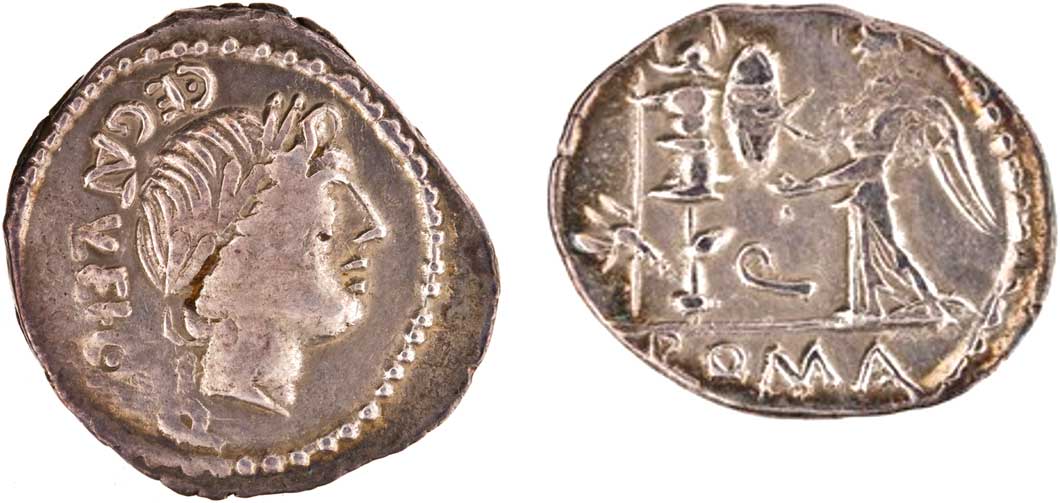
The carnyx in these scenes was more than just a background motif. Without knowledge of contemporary events, a viewer would be unaware of the specific context of these images, particularly if the coin continued to circulate long after the event.Footnote 28 Through incorporating a unique object such as the carnyx, the generic image is given a new, distinct meaning. This instrument was only used by northern European communities, so its presentation in a pile of non-descript weapons marks the opponents as northern European invaders; that is, the Cimbri or the Gauls. The carnyx’s specific associations thus added much-needed context to a formulaic scene.
The Roman colonia (colony) of Transalpine Gaul, Narbo Martius, used a similar strategy, but for a different purpose. Coins were struck for the colony in 118 bc, a year after the colonia’s founding.Footnote 29 These coins (fig 2) display a chariot, drawing upon the formulaic image of Jupiter’s chariot frequently found on Roman coins at this time, but exchange Jupiter’s chariot for a naked Gaul, armed with shield, spear and carnyx. While nudity and chariots were aspects of Gallic warfare, both tropes can also be found in Roman artistic models, with the triumphal chariots and naked divine forms in Roman material culture.Footnote 30 This playful mixing of ‘Gallic’ and ‘Roman’ can be found in other aspects of the coin scene: the shield, for example, looks distinctly classical, being round like a Greek hoplon (ὅπλον) shield, rather than the oblong and square shields that the Gauls and Britons tended to use.Footnote 31 The figure is not even moustachioed, a common classical trope for identifying Gauls both in ancient literature and Hellenistic art.Footnote 32 On this coin, the carnyx is the sole indicator that the warrior is a Gaul.
(a) Obv: L.PORCI LICI, helmeted head of Roma (right) wearing Attic helmet; (around) inscription; (behind) denominational mark. L. Porcius Licinius, Denarius Serratus, Narbo Martius, 118 bc, 3.77g, 20.1mm. Border of dots. Photograph: Crawford Reference Crawford1974, 282/5. (b) Rev: Naked Gallic warrior in biga (right), holding shield, carnyx and reins in left hand and hurling spear with right hand; (below) L.LIC.CN.DOM; in exergue. Border of dots. Photograph: American Numismatics Society, 1944.100.567
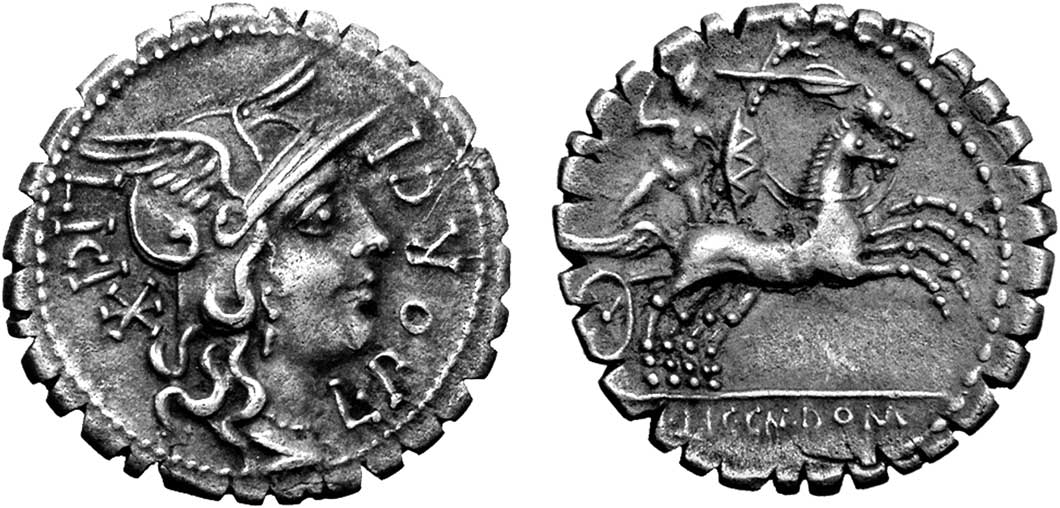
The appearance of a Gaul on this coin issue has been connected to the victory of Domitius Ahenobarbus against the Gauls, an achievement commemorated in 119 bc.Footnote 33 But this representation differs significantly from other Roman coin images commemorating victories over the northern barbarians: the images related to the Cimbri invasion and the Gallic wars display a trophy scene with a defeated opponent, whereas the Narbo Martius chariot scene depicts a heroic Gaul free from captivity.Footnote 34 The location of Narbo Martius within Gaul indicates a different context for this image. Later coloniae that produced coinage incorporated local imagery into their designs, such as can be seen by the use of the Pegasus on Corinth’s colonia coinage, when it was re-founded under Caesar.Footnote 35 In this way, the colonia coins, similar to more modern colonial currencies, transformed local customs and imagery that surrounded the new settlers into something ‘Roman’ through placing local imagery on a Roman coin denomination. These coins in turn contributed to the creation of an identity for the new settlement. The Narbo coins show a distinctly warlike scene, but this has little to do with Narbo Martius’ apparent character, which is that of a major commercial hub, home to merchants rather than soldiers.Footnote 36 Rather, the Gallic warrior was the image of Gaul favoured by the Romans; this was how the Romans saw these peoples. It was thus this particular image, which also fitted well with Rome’s own material culture, that was appropriated for use on the colonia’s coinage, and not another image.
At times, the representation of military trophies with carnyces on coinage is accompanied by an image of Victory (see fig 1). One such representation (fig 3) is unusual in that it shows the carnyx beneath Victory in a biga.Footnote 37 This is similar to the first coin depicting the carnyx and which, produced during the Second Punic War (281–201 bc), placed the motif beneath the Dioscuri.Footnote 38 The earliest coin could be related to the use of Gallic mercenaries by Hannibal in the Second Punic War, but its similar position to the later coin suggests a different cause.Footnote 39 Indeed, the coin presenting the carnyx beneath Victory was produced in 91 bc, when there is no recorded conflict against the northern barbarians, so it is difficult to attribute the scene to a contemporary military victory. This 91 bc coin is part of a series of other coins that show Victory in a biga, but without the carnyx below.Footnote 40 It seems likely that it is acting as a control mark, as a variety of symbols were often used for this purpose in Republican coinage.Footnote 41 The unusual shape of the horn and its novelty was distinctive, making it ideal as a distinguishing mark for this purpose.
(a) Obv: mask of bearded Silenus right; (below) plough. D. Iunius Silanus, Denarius, Rome, 91 bc, 3.78g. Photograph: Crawford Reference Crawford1974, 337/1a. (b) Rev: D·SILANVS·L·F, Victory in biga (right), holding palm-branch and reins in left hand and whip in right hand; (below) carnyx. Border of dots. Photograph: American Numismatics Society, 1944.100.800

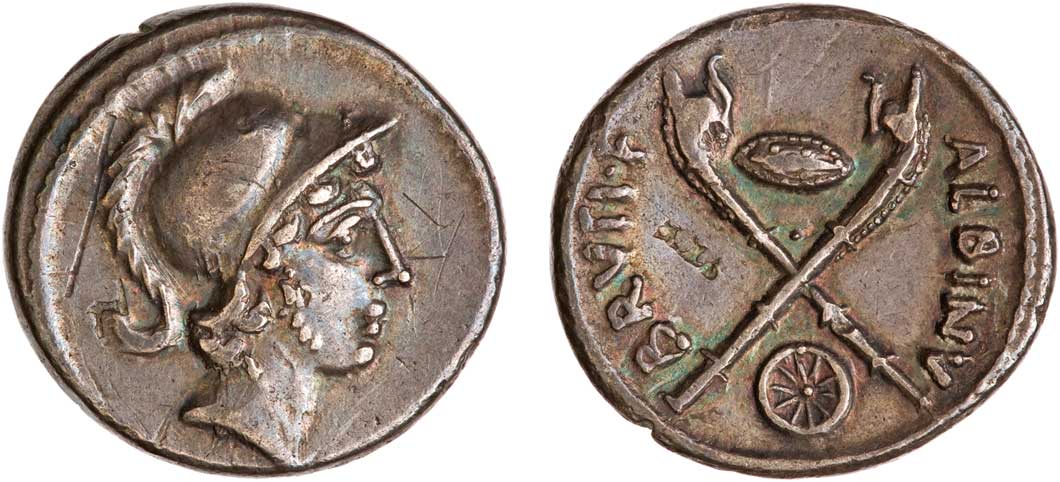
Numismatic representations of the carnyx in the late first century bc are affected by the more varied iconographic styles of the period, and the increased authority of particular individuals. The 48 bc denarius of Brutus Albinus (fig 4) displays two crossed carnyces on its reverse.Footnote 42 Once again, the carnyces are used as a symbol of ‘otherness’ to refer to the Gauls, but, unlike previous examples, they are presented prominently, with no Roman images (such as the chariot or Victory) present. This becomes more apparent when one notices the wheel (associated with the Gallic chariot, as well as an important part of Gallic religious iconography) and the oblong Gallic shield present between the carnyces.Footnote 43 This scene is best viewed within the context of the coinage of 48 bc, in which other prominently Gallic images were utilised at the Roman mint, including one type displaying an unprecedented male Gallic head on the obverse.Footnote 44 In this year, another Republican coin type was struck depicting the carnyx next to a female head, and this too can be seen within the context of the broader Gallic emphasis of Roman coinage in this year.Footnote 45 The imagery of these coins seems to be designed to work together to return the Gauls to public memory, most likely to ensure that Caesar’s victory in Gaul remained in public discourse.Footnote 46 This association between the objects of a non-Roman culture and Caesar presaged the approach of a single ruler of the Romans: a single great conquest allowed the appropriation of all images of the conquered people to a single conqueror. Nevertheless, despite the unusual nature of the type, the same Roman method of using the carnyx as a symbol of defeated enemies is utilised.
(a) Obv: helmeted head of Mars (right). Border of dots. Brutus Albinus, Denarius. 450/1b, Rome, 48 bc, 3.87g. Photograph: Crawford Reference Crawford1974. (b) Rev: two carnyces in saltire; (above) oval shield; (below) round shield; ALBINV (on right), BRVTI.F (on left). Border of dots. Photograph: American Numismatics Society, 1944.100.3288
REPRESENTATIONS OF THE CARNYX IN IRON AGE GAUL AND BRITAIN
It remains unclear exactly how British and Gallic communities used coinage. Gold, silver and bronze denominations are found in both Britain and Gaul, utilising similar metals to the Romans, but some areas favoured one metal over another, and it is unclear how they functioned together. As mentioned above, there have been suggestions that British and Gallic gold coins potentially served a gift-giving or votive role rather than being used in a monetary economy.Footnote 47 The later silver and bronze coinage of these peoples are often found in settlement sites, which suggests the possibility of a developing market economy, and thus silver and bronze coins possibly had monetary usage in at least some areas of Gaul and Britain.Footnote 48 It is difficult to gauge who specifically the users of these coins were, although one would imagine that the elites would have been the owners of a significant number of them.
There is little to no evidence of a Gallic or British desire to commemorate events on their coinage, although some scholars have put forward such conclusions.Footnote 49 The Iron Age Gauls and Britons produced no literature (although legends on coins were coming into existence), preventing any knowledge of their political history that would justify assigning specific events to particular coin imagery. Unlike the Romans, Gallic and British presentations of the carnyx bear no traceable reference to historical events. This does not rule out a political purpose for the images, but it is difficult to know the political situation these images would be attempting to influence or commemorate.Footnote 50
In Roman images the carnyx’s user was presented as a generic barbarian, but in the Gallic and British Iron Age the horn gave the player supernatural connotations. Carnyces deposited at Deskford (in Scotland), Kappel (in Switzerland), Mandeure (in France) and Sặluştan (in Romania) had been ritually dismantled before burial, suggesting a common pan-European attitude to the ritual involved in a carnyx’s deposition.Footnote 51 The breaking of objects such as swords, tools and statues in sacred springs, temple sites and other religious contexts has been identified as a Gallic and British religious phenomenon, but in reality the practice can be witnessed in other societies.Footnote 52 Among the Pueblo native Americans, for example, ritual drums were broken prior to deposition, owing to the fact that they were believed to have contained a spirit.Footnote 53 Breaking these spirit holders seems to have been a method of releasing the spirit, and the same reason may be behind the carnyces’ dismantling. The few forms of Gallic and British art in which the carnyx is represented often show it within scenes with religious connotations, such as in the Gundestrup Cauldron, where the carnyx players stand behind a parade of spear-armed soldiers approaching a vat in which one of them is being dunked.Footnote 54 Additionally, a Gallic statue from Pauvrelay (in central France) carries a carnyx, and is depicted with six fingers on one of his hands.Footnote 55 It has been suggested that this represented a real-life player with an abnormality.Footnote 56 However, the over-emphasis of natural features could be an indicator of a supernatural element, perhaps indicating that this musician was a god or a supernaturally gifted mortal.
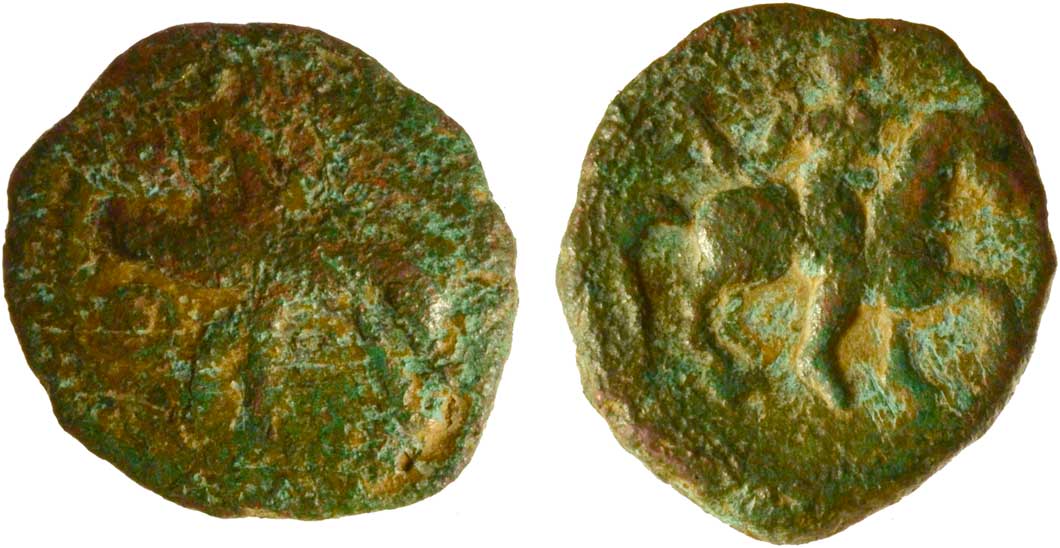
The divine’s association with the carnyx can be witnessed on British coins. The coinage of the British king Dubnovellaunus, reigning in Kent (and perhaps Essex) towards the end of the first century bc, shows one such example (fig 5).Footnote 57 The reverse appears to depict a naked woman riding a horse while holding a carnyx. Female figures, aside from Victory, are rarely represented on British coins, and when they do appear they seem to be representing goddesses, such as Ariadne or Demeter.Footnote 58 This coin likely follows this pattern, which would mean a divine figure is associated with the carnyx. The figure’s identity is unknown, but she has been associated with the naked female horse rider present on Armorican (modern-day Brittany) coins, produced possibly a century earlier.Footnote 59 The Armorican rider is armed, promoting warlike connotations, similar to Dubnovellaunus’ coin with the war horn. Additionally, female deities are often associated with the earth in many cultures, and the first part of Dubnovellaunus’ name, Dubno, has a meaning possibly related to the Underworld.Footnote 60 The deity may, therefore, be a canting image, representing the name of the coin’s authority, similar to the dogs that appear on a number of coins of Cunobelin (a later king ruling a territory approximating Essex and Kent), as the former part of his name, Cuno, means ‘hound’.Footnote 61 While a certain identification of the figure remains impossible, a divine association is likely.
(a) Obv: [DVBNO] boar (left), pellet in ring (below head), legend above now missing. Dubnovellaunus, Bronze, c 20 bc– c ad 10, Britain, 2.23g, 17.51 mm. Photograph: Rudd Reference Rudd2010, 348. (b) Rev: horsewoman (right) holding carnyx. Photograph: Courtesy of the Portable Antiquities Scheme, SF-9F65E6, https://finds.org.uk/database/artefacts/record/id/827155 (accessed 28 June 2018)
Gallic and British coinage differs from Roman coins in that women, albeit divine women, are presented as holding the carnyx. Similarly, a post-Caesarean conquest example from the Loire region (in France) shows Victory carrying a curved object that has been identified as a carnyx.Footnote 62 This is the only example of any coin – Gallic, British or Roman – that depicts Victory handling the instrument. The association between the carnyx and war may be the reason for their association. It is possible that Victory was a symbol of general success and prestige among the Gauls and Britons, so the coin may point to the high status and, owing to her role as a deity, possibly supernatural nature of the carnyx player.Footnote 63 In an inverse manner to the Narbo Martius coin, this post-conquest coin represents a Gallic appropriation of Roman imagery. Rather than the carnyx being the sign of a foreign other, it instead provides a Gallic point of reference to a foreign deity, allowing Gauls to identify the figure as a war goddess due to her association with a Gallic instrument of war.
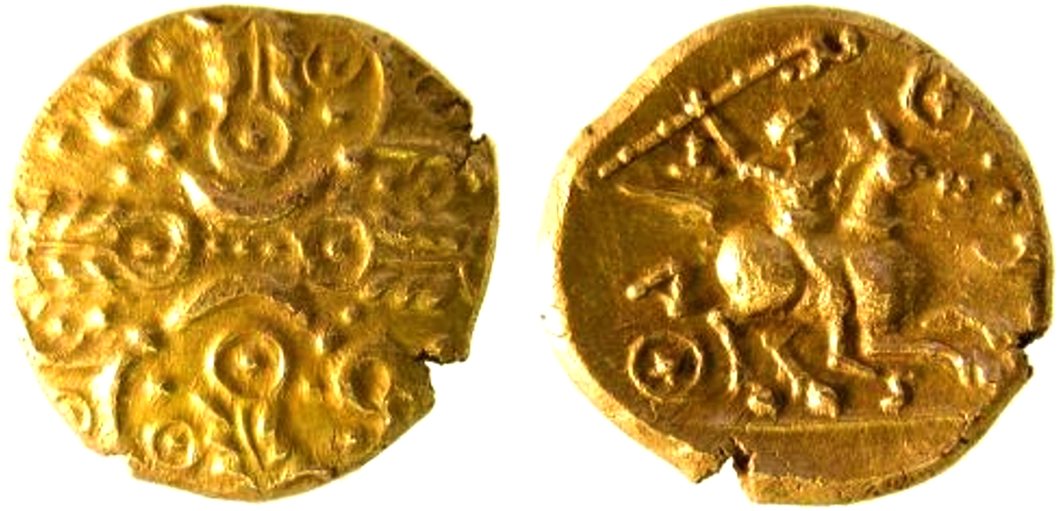
In a similar manner to the Roman images, most Gallic and British representations of the carnyx have warlike connotations. In Britain, the most common depictions of the carnyx on coins have the instrument carried by a cavalryman (fig 6), often armoured in chainmail; in Gaul, various representations featured the carnyx being carried by a charioteer and a foot solider holding a human head.Footnote 64 All represented the elite of the British and Gallic world. Chainmail was only available to the wealthiest of warriors, and the same was true of horses and chariots.Footnote 65 Indeed, there seems to have been some special status given to horsemen and charioteers as, according to Caesar during his first invasion of Britain, it was the cavalry and charioteers of the British who engaged his forces first.Footnote 66 As the first to enter battle, they would be the first to gain glory, so the cavalry and charioteer element of the British and Gallic army would be the most prestigious. The carrying of a human head on the Gallic coin may relate to the Gallic practice of head hunting, in which acquiring the head of an enemy gave a warrior respect.Footnote 67 The images associated with the carnyx relate to the Gallic and British military elite, in contrast to the Roman depictions of a defeated opponent. This in turn may be designed to represent the prestige of the authority behind the coin’s manufacture.
(a) Obv: central back-to-back crescents with dot in ring motifs and crossed wreaths. Tasciovanus, gold, Britain, 25 bc– ad 10, 5.65g, 17.5mm. Photograph: Rudd Reference Rudd2010, 2562. (b) Rev: helmeted warrior carrying carnyx on horse r. T above inverted, A behind, S below and C in front. 4-spoked wheel below l and above, r. Photograph: Courtesy of the Portable Antiquities Scheme, SF-4C72C3, https://finds.org.uk/database/artefacts/record/id/215360 (accessed 28 June 2018)
CONCLUSION
Despite both incorporating the carnyx into their coin imagery, north-western Europeans and Roman artists had their own conception of what the instrument represented. To the Romans, it was the war horn of the barbarians of northern Europe, and the appropriation of its image on Roman coins marked the superiority and power of Rome. For the Gallic and British communities, the carnyx was given additional relevance beyond war: it had supernatural associations, perhaps itself being a spiritual object, in addition to the user at times being notably connected to the divine. Despite these different conceptions, the same context of the carnyx’s use was expressed: war. Both sides accepted the carnyx’s role as a war horn, the musician being either a defeated enemy or a proud warrior of their own culture. While some ideas translate well across a geographical and cultural divide, others become altered to suit a society’s own narrative. At times, certain images appear to bridge the divide, such as the Narbo Martius coin incorporating Gallic imagery, but the same cultural stereotypes are manifested on the coin to suit the producing culture’s need.
This paper has considered the reaction of Roman and Gallic societies’ presentation of the carnyx separately. Despite some of the later Gallic coins featuring the carnyx being produced at a time when Roman coinage was entering Gaul in large numbers after the conquest, the imagery chosen by one culture rarely imitates the imagery of the other. There is, therefore, a justification in believing that each society viewed the carnyx considerably differently, to the extent that they were uninfluenced by the instrument’s ‘foreign’ representations.Footnote 68 This could suggest there would have been a considerable impact when one of these images crossed over these cultural lines. At the time of writing, the Portable Antiquities Scheme contained twenty-seven examples of Roman coins depicting the carnyx in Britain.Footnote 69 Despite their manufacture pre-dating the Claudian invasion, it is highly likely that most, if not all, of the Roman coins in Britain arrived after the invasion.Footnote 70 Nevertheless, for many of the British provincial inhabitants who might have seen these images, one can only imagine how they might have perceived these unusual depictions of one of their prized objects, particularly since many of the indigenous coins displaying the carnyx were likely in circulation just prior to the invasion. The representations of the carnyx suited each culture’s own tastes, so examining these differing representations would have shaken or re-conditioned the concepts previously explored in their own images.
ACKNOWLEDGEMENTS
I would like to thank my anonymous referees, who provided excellent feedback on the earlier draft of this paper, as well as my supervisor, Clare Rowan, for her guidance and helpful suggestions.



