


Introduction
Over the past decade, rights for lesbian, gay, bisexual, transgender, queer, questioning, intersex, asexual, and more (LGBTQ+) have undergone major changes around the world. In 2011, only 8 European countries allowed homosexuals to marry legally, but by 2020 marriage equality had been legalized in 19 European countries. Diverse LGBTQ+ rights have been actively discussed not only for gay or lesbian couples but also for other types of sexual minorities. What explains the variation in the adoption of LGBTQ+ rights policies across countries? This paper investigates factors affecting LGBTQ+ rights by examining 27 European countries from 2013 to 2020.
Previous literature on the legalization of LGBTQ+ rights, particularly same-sex marriage, suggests domestic factors (Abou-Chadi and Finnigan Reference Abou-Chadi and Finnigan2019; Lax and Phillips Reference Lax and Phillips2009; Reynolds Reference Reynolds2013; Siegel, Turnbull-Dugarte and Olinger Reference Siegel, Turnbull-Dugarte and Olinger2022) and international influences (Ayoub Reference Ayoub2015; Paternotte and Kollman Reference Paternotte and Kollman2013). This paper emphasizes the role of public demand, the interplay between public opinion (or social construction) and issue salience, in shaping LGBTQ+ rights. Public demand is considered the most direct and influential factor in shaping policy outputs in democracies. Studies on responsiveness mechanisms in democracies suggest that politicians react to public opinion but often prioritize issues that receive more attention, known as issue salience (Dahl Reference Dahl1971; Schaffer, Oehl and Bernauer Reference Schaffer, Oehl and Bernauer2022; Schneider and Ingram Reference Schneider and Ingram1993). I challenge this assumption by focusing on LGBTQ+ politics – a domain often affecting minorities rather than the general public and frequently subject to controversy.
At the same time, recent political developments call for greater attention to the phenomenon of backlash. In several European countries such as Austria, France, Germany, and Italy, rising electoral support for populist and extreme-right parties has raised serious concerns about growing resistance to LGBTQ+ rights. While this study does not directly examine supply-side mechanisms, it seeks to clarify the demand-side conditions under which democratic responsiveness to marginalized groups is either enabled or constrained. Specifically, I explore under what circumstances issue salience facilitates or hinders the translation of favorable public attitudes into inclusive LGBTQ+ policies.
Scholars generally agree with the positive relationship between positive public opinion on LGBTQ+ and the legalization of LGBTQ+ rights (Abou-Chadi and Finnigan Reference Abou-Chadi and Finnigan2019; Lax and Phillips Reference Lax and Phillips2009; Siegel, Turnbull-Dugarte and Olinger Reference Siegel, Turnbull-Dugarte and Olinger2022). In addition, regarding issue salience on LGBTQ+ issues, Lax and Phillips (Reference Lax and Phillips2009) argue that U.S. states with more public interests in LGBTQ+ issues tend to have more inclusive LGBTQ+ policy outputs. However, I argue that while positive social constructions of LGBTQ+ populations are a necessary condition for the advances of LGBTQ+ rights, issue salience can facilitate LGBTQ+ rights only if public opinion on LGBTQ+ is positive. In addition, I provide an institutional condition for the responsiveness mechanism concerning LGBTQ+ rights. I investigate how electoral systems condition the relationship between social constructions and LGBTQ+ rights.
I examine the theory using a time-series cross-sectional dataset of 27 European countries with democratic regimes from 2013 to 2020. European countries provide variance in social constructions of LGBTQ+ and legalizations of LGBTQ+ rights (e.g., Ayoub and Paternotte (Reference Ayoub and Paternotte2014), Siegel, Turnbull-Dugarte and Olinger (Reference Siegel, Turnbull-Dugarte and Olinger2022)). I find that positive constructions are correlated with more inclusive LGBTQ+ rights across countries, and the positive impacts of issue salience on LGBTQ+ rights could be observed if a country has positive social constructions. In addition, the influence of electoral systems implies that positive social constructions’ impacts are more salient in countries with more proportional systems.
Public demand
In representative democracies, policy outputs are a function of policymakers’ responsiveness (Dahl Reference Dahl1971). Although there are different theories explaining why some policies receive more attention than others (e.g., rational choice theory, interest group theory, elite theory), the general assumption of policy decision-making theories is that politicians consider their reelection motivations when they face different policy demands from various parts of society under limited resources. Public demand refers to “the aggregate of what individuals in a given society prefer or want” (Oehl et al., Reference Oehl, Schaffer and Bernauer2017, 173) and consists of public opinion and issue salience regarding the relevant issues (Schaffer, Oehl and Bernauer Reference Schaffer, Oehl and Bernauer2022). In other words, politicians’ policy advocacy is influenced by how people perceive a relevant issue (public opinion) and the level of importance attached to that issue by the public (issue salience).
In the context of minority group representation, where the mechanisms of responsiveness may differ from those applying to general issues, differentiating between public opinion and issue salience is particularly important. While issue salience has been widely theorized to enhance responsiveness, this assumption may not hold when the targeted groups are stigmatized or politically contested. In such cases, salience alone may trigger resistance or backlash. By unpacking how public perception must accompany salience to enable inclusive policy change, this framework offers a more nuanced theory of how public demand affects minority policies.
However, this paper, which examines LGBTQ+ rights, regards public demand as consisting of a combination of social constructions and issue salience, not public opinion and issue salience. LGBTQ+ exists not as an issue but as a group of minorities, so using the concept of “social construction” rather than public opinion to study people’s general perceptions about LGBTQ+ rights would provide a broader understanding. According to Schneider and Ingram (Reference Schneider and Ingram1993), the social construction of target populations is defined as “the cultural characterizations or popular images of the persons or groups whose behavior and well-being are affected by public policy” (Schneider and Ingram Reference Schneider and Ingram1993, 334).
To clarify, social construction is (1) related to a group of people rather than an issue, (2) a social or cultural construct made by the general public rather than a subset of people, and (3) therefore more stable and resistant to change (though changeable in the long term). Issue salience is (1) related to an issue, (2) the level of importance attached by the public, and (3) therefore varies over time based on people’s interests.
Social constructions
Schneider and Ingram (Reference Schneider and Ingram1993) provide four types of target populations depending on social constructions and political power: advantaged (powerful groups with positive images), dependents (powerless groups with positive images), contenders (powerful groups with negative images), and deviants (powerless groups with negative images). Based on this typology, they argue that social constructions of target populations have a powerful effect on public officials and shape the policy agenda and the actual design of policy since politicians and bureaucrats are more sensitive to issues for which people are positively perceived (Arnold Reference Arnold1990; Kelman and Wilson Reference Kelman and Wilson1987; Quade and Carter Reference Quade and Carter1989; Schneider and Ingram Reference Schneider and Ingram1993).
Specifically, in Schneider and Ingram (Reference Schneider and Ingram1993)’s theory, advantaged and dependent groups share positive social constructions. Advantaged groups, such as the elderly, businesses, veterans, and scientists, have relatively stronger political power than dependent groups, such as children, mothers, and the disabled. On the other hand, contenders and deviants share negative social constructions. The rich, big unions, minorities, cultural elites, and the moral majority were cited as examples of contenders with negative social constructions and strong political power, while criminals, drug addicts, communists, flag burners, and gangs were cited as examples of deviants with negative social constructions and weak political power (Schneider and Ingram Reference Schneider and Ingram1993).
This study modifies Schneider and Ingram (Reference Schneider and Ingram1993)’s social construction theory by considering the overtime changes in people’s perception of the target populations. They assumes that social constructions are constants, although they provide a possibility of change. They regard social constructions as an “ideal type” in their article and do not examine the dynamics of social constructions. However, social constructions of LGBTQ populations have changed over time. Previous studies show positive changes in people’s attitudes toward LGBTQ+ populations (e.g., Abou-Chadi and Finnigan (Reference Abou-Chadi and Finnigan2019); Ayoub (Reference Ayoub2016); Brewer (Reference Brewer2003); Magni and Reynolds (Reference Magni and Reynolds2021)). LGBTQ+ groups are not examined by Schneider and Ingram (Reference Schneider and Ingram1993), and minorities are positioned in the strong & negative group. However, LGBTQ+ populations have never had a political influence as powerful as that of the rich or big unions in any society. Thus, I argue that the social constructions of LGBTQ+ populations are moving away from “Deviants” toward “Dependent” in many countries.
I argue that the positive change of social construction on LGBTQ+ populations is a necessary condition for more inclusive policies for LGBTQ+ rights. First, the positive social constructions of LGBTQ+ populations play a crucial role in shaping policy outputs for their rights when compared to other minority groups such as women or racial/ethnic minorities for these reasons: (1) they remain a demographically small group in most national contexts, though visibility has increased in recent years, (2) their sexual identities are often not readily apparent externally, and (3) their very limited descriptive representation in politics (Reynolds Reference Reynolds2013). Thus, in order to set LGBTQ+ populations’ agendas in politics and obtain their policy goals, they should decrease backlash against them and get more support from outsider groups.
In fact, social construction on LGBTQ+ populationsFootnote 1 have been positively changing over time, not only among advanced democracies (Abou-Chadi and Finnigan Reference Abou-Chadi and Finnigan2019; Andersen and Fetner Reference Andersen and Fetner2008; Ayoub Reference Ayoub2016) but also developing countries (Ayoub and Garretson Reference Ayoub and Garretson2017). Particularly, secular (not religious) (Goren and Chapp Reference Goren and Chapp2017), educated (Abou-Chadi and Finnigan Reference Abou-Chadi and Finnigan2019; Dejowski Reference Dejowski1992; Herek Reference Herek2002),female (Herek Reference Herek2002; Twenge and Blake Reference Twenge and Blake2020), single or divorced (Abou-Chadi and Finnigan Reference Abou-Chadi and Finnigan2019; Dejowski Reference Dejowski1992; Swain Reference Swain1995), young citizens (Sani and Quaranta Reference Sani and Quaranta2020), nativists who are hostile to immigration of sexually conservative ethnic out-groups (Turnbull-Dugarte and López Ortega Reference Turnbull-Dugarte and López Ortega2023) are more tolerant for LGBTQ+ populations.
Second, LGBTQ+ populations are socially marginalized, but they are not necessarily economically marginalized. As a minority group, their policy goals are mostly related to regulative policies (e.g., discrimination, family law, hate crime, or legal gender recognition). Consequently, their policy goals are not often involved in the zero-sum game of the budget, such as distributive policies or redistributive policies, as outlined in Lowi’s policy typology (Lowi Reference Lowi1972). Therefore, once non-LGBTQ+ people agree with LGBTQ+ groups’ policy demands, they are more likely to be supportive of LGBTQ+ rights than of other minority issues that require government budgets and could potentially reduce non-minority people’s benefits from the government.
H1: If social constructions for LGBTQ+ populations are more positive in a country, policy outputs for LGBTQ+ populations will be more inclusive.
However, social construction theory is criticized for ignoring other key variables affecting policy outputs (e.g., policy outcome’s time horizon, direct mobilization or powerful advocates, and groups’ specific characteristics) (Donovan Reference Donovan2001). I therefore consider another factor that constitutes public demand and discuss how two factors interact for LGBTQ+ rights.
Issue salience
Issue salience refers to “the importance and visibility to the public at large, and prominence in public discourse” (Lax and Phillips Reference Lax and Phillips2009, 370). Generally, politicians tend to prioritize the more salient issues to be reelected by focusing on the issues that voters care about (e.g., Jones and Baumgartner (Reference Jones and Baumgartner2005)). Electoral systems also shape which issues become politically salient. Proportional representation amplifies niche issues, while majoritarian systems often suppress them by promoting broad policy convergence (Norris Reference Norris2004). With regard to LGBTQ+ politics, Lax and Phillips (Reference Lax and Phillips2009) examine how issue salience influences the adoption of policies related to gays’ and lesbians’ rights in state politics in the US. They argue that more attention to the issues brings about greater responsiveness of politicians. Building on this foundation, I modify the existing theory by introducing a conditional mechanism.
I argue that issue salience alone is not sufficient to explain the adoption of inclusive LGBTQ+ policies. Rather, its effectiveness depends on the presence of positive social constructions of LGBTQ+ populations. Accordingly, I theorize an interactive effect between social constructions and issue salience on LGBTQ+ policy outputs. Due to their controversial nature, LGBTQ+ rights do not always benefit from high issue salience. When such issues receive increased public attention, they may provoke backlash, particularly in societies where negative social constructions of LGBTQ+ individuals are dominant. In contrast, in more supportive societies, heightened attention can help advance inclusive policies.
I expect that more public attention to LGBTQ+ rights could contribute to generating more inclusive LGBTQ+ policies only if a society shares positive constructions of the group (Strong Demand in Table 1). On the other hand, when LGBTQ+ issues become salient in a society sharing negative constructions of sexual minorities, it would be more challenging to achieve policy outputs that benefit the target population, as the controversy can intensify the backlash against them (Backlash in Table 1). Table 1 summarizes the theoretical expectation on the interactive effect of social construction and issue salience on LGBTQ+ rights.
Expected interactive effects

H2: In countries where social constructions for LGBTQ+ populations are more positive, the salience of LGBTQ+ issues leads to more inclusive policy outputs.
Interaction with electoral systems
Building on the theoretical framework of public demand for LGBTQ+ rights, it is essential to explore how the demand side of LGBTQ+ politics interacts with the supply side of politics. I focus on electoral institutions because they provide the institutional foundation that enables public demand to be translated into legislative policy outputs. Electoral systems determine the composition of representative bodies and, consequently, the potential for political responsiveness to public attitudes. While cabinet partisanship may have a more immediate impact on policy decisions, electoral systems shape the conditions under which such partisan dynamics unfold – including which parties enter government and how representative bodies are composed. I therefore conceptualize electoral systems as critical mediating institutions that either facilitate or constrain the political translation of social constructions.
I focus on the relationship between social constructions – a necessary condition for inclusive LGBTQ+ rights – and electoral systems, while recognizing that different types of electoral systems can shape the diversity of issues that are articulated during electoral competition (Norris Reference Norris2004). I assert that electoral systems mediate the translation of social constructions of LGBTQ+ populations into policy outputs. This is because electoral systems influence (1) the entry of parties into the legislature to actively address LGBTQ+ issues (e.g., green parties and social democratic parties) and (2) the likelihood of LGBTQ+ candidates running and winning.
First, the electoral system’s proportionality will affect the likelihood of the entry of LGBTQ+-friendly parties into the legislature. If a country’s electoral system exhibits greater proportionality (i.e., proportional representation rather than single-member districts or a mixed system, a lower electoral threshold, and a larger average district magnitude), it is more likely to foster a multi-party system rather than a two-party system. Multi-party systems enable small parties to secure seats in the legislature. Additionally, an analysis of party manifesto projects (Appendix A.1) suggests that small parties often prioritize the concerns of underprivileged minority groups more than large parties do.
Specifically, electoral proportionality could be decided by its basic rules (i.e., proportional representations, single-member districts, or mixed systems), electoral thresholds, and district magnitude. First, proportional representation systems are more likely to be associated with multi-party systems according to Duverger’s theory (Duverger Reference Duverger1959). Second, electoral thresholds could affect the entry of small parties into the legislature (Lijphart Reference Lijphart1994). With the lower electoral threshold, parties dealing with LGBTQ+ issues would be more likely to have seats in the legislature. Third, small parties are more likely to win seats in a large district magnitude than in a small district magnitude (Cox Reference Cox1997). I expect that small parties dealing with LGBTQ+ issues would be more likely to win seats with a larger district magnitude than with a small district magnitude.
Second, party-centered electoral systems are more likely to allow LGBTQ+ candidates to be elected than candidate-centered systems. In particular, the electability of LGBTQ+ candidates concerns ballot types. A closed party list could be favorable for LGBTQ+ candidates’ running and winning because voters tend to penalize LGBTQ+ candidates (Magni and Reynolds Reference Magni and Reynolds2021). Thus, party-centered systems (i.e., closed PR list) would benefit LGBTQ+ candidates since parties could take lesser risks to nominate LGBTQ+ candidates in PR systems. On the other hand, in candidate-centered systems (i.e., SMD, STV, open PR list), the impact of social constructions of LGBTQ+ populations on LGBTQ+ policies is restricted because candidate-centered systems are less likely to allow those LGBTQ+-friendly actors to be elected.
Moreover, while the link between descriptive and substantive representation is debated, there is empirical evidence supporting this connection in the context of LGBTQ+ rights. Reynolds (Reference Reynolds2013) finds that the presence of even a small number of openly LGBTQ+ legislators is significantly associated with the future adoption of inclusive LGBTQ+ rights, even after controlling for social values, regime type, and party ideology. This suggests that electing LGBTQ+ candidates does not only increase descriptive representation, but also substantively improves the policy environment for LGBTQ+ populations through a “familiarity through presence” effect within legislatures.
H3a: The impact of positive social constructions on LGBTQ+ rights is more salient in countries with more proportional electoral systems compared to those with less proportional electoral systems.
H3b: The impact of positive social constructions on LGBTQ+ rights is more salient in countries with party-centered electoral systems compared to those with candidate-centered electoral systems.
Data and empirical design
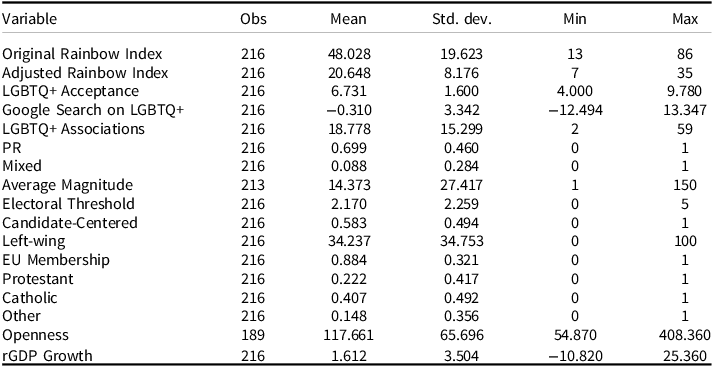
To analyze how social construction and issue salience influence LGBTQ+ rights, I conduct a country-level study using a time-series cross-sectional dataset covering 27 European democracies from 2013 to 2020Footnote 2 . European countries exhibit substantial variation in the social construction of LGBTQ+ people, LGBTQ+ rights policies (as measured by the Rainbow Index), the presence of LGBTQ+ associations, and electoral rules, making them well-suited for this study (see Table 2 for an overview of descriptive statistics).
Descriptive statistic
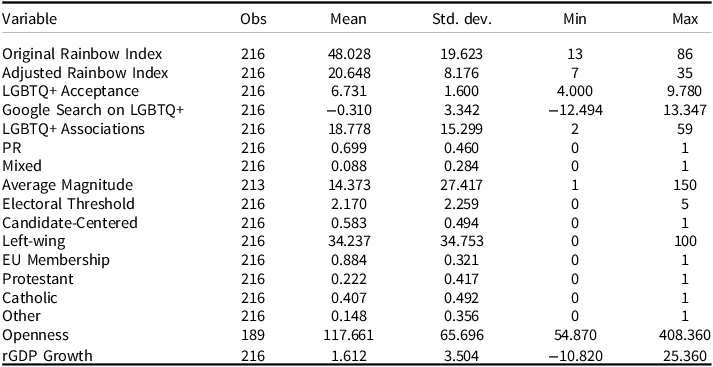
To identify democratic regimes, I use the dataset compiled by Bjørnskov and Rode (Reference Bjørnskov and Rode2020), which adopts Cheibub et al. (Reference Cheibub, Gandhi and Vreeland2010) binary democracy indicator based on a minimalist definition. A country is classified as democratic if it (1) holds elections, (2) ensures free and fair electoral processes, and (3) experiences a peaceful transition of legislative and executive power. I adopt this minimalist definition because it aligns with the theoretical focus on democracy’s responsiveness mechanism. The most relevant aspect of democracy in terms of responsiveness is electoral competition.
Policy outputs for LGBTQ+ rights
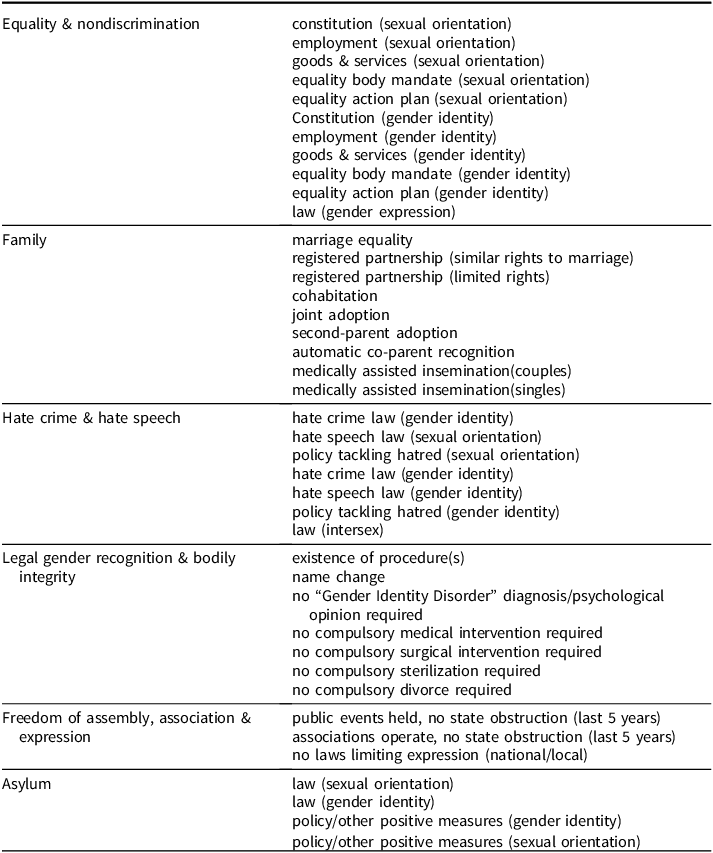
The dependent variable is policy outputs for LGBTQ+ rights, which I measure using the Rainbow Index from ILGA (International Lesbian, Gay, Bisexual, Trans and Intersex Association) Europe (ILGA-Europe 2023). The Rainbow Index evaluates all 49 European nations based on laws and policies that have a direct impact on LGBTQ+ people’s human rights. This index comprises six major categories:
-
1. Equality and Nondiscrimination
-
2. Family
-
3. Hate Crime and Hate Speech
-
4. 4. Legal Gender Recognition and Bodily IntegrityFootnote 3
-
5. Civil Society Space
-
6. Asylum
While most categories within the Rainbow Index assess the formal adoption of LGBTQ+ rights protections through legislative action, some components, such as holding public LGBTQ+ events without state obstruction, reflect executive policies and administrative enforcement. However, the index remains a measure of policy output rather than policy outcomes, as it captures the existence of legal protections rather than their enforcement or real-world effects.
This study uses the Rainbow Index to capture the multidimensional nature of LGBTQ+ rights protections, while previous literature on LGBTQ+ policies has mainly focused on the legalization of same-sex marriage and partnerships – one of the most politically salient and contested issues in LGBTQ+ rights (Abou-Chadi and Finnigan Reference Abou-Chadi and Finnigan2019; Reynolds Reference Reynolds2013). Relying on a single policy dimension, such as marriage equality, provides only a partial view of how LGBTQ+ rights are institutionalized across different legal domains. The Rainbow Index offers a more comprehensive framework by incorporating policies related to anti-discrimination, family rights, hate crime legislation, legal gender recognition, and asylum protections.
Prior research has also employed broader measures to assess LGBTQ+ rights. For instance, Ayoub and Paternotte (Reference Ayoub and Paternotte2014) develops an index that classifies LGBTQ+ legislation into five categories: anti-discrimination protections (employment, goods, and services, constitution), criminal law (incitement to hatred prohibition), partnership recognition (cohabitation, registered partnerships, and marriage equality), parenting rights (joint and second-parent adoption), and equal sexual offense provisions (age of consent and legality of same-sex relations). Building on this approach, the Rainbow Index extends this classification by specifying and distinguishing additional policy areas.
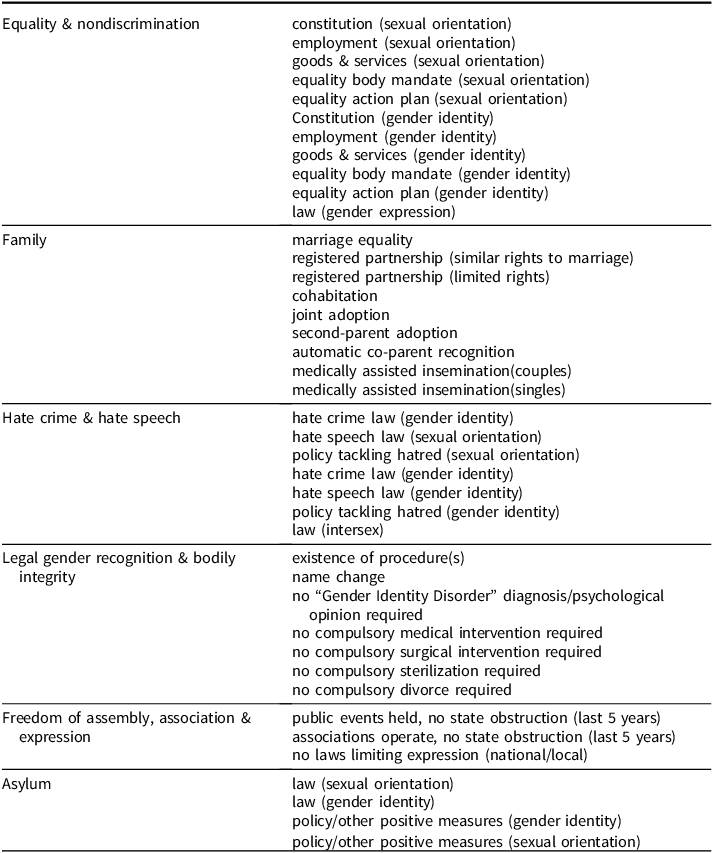
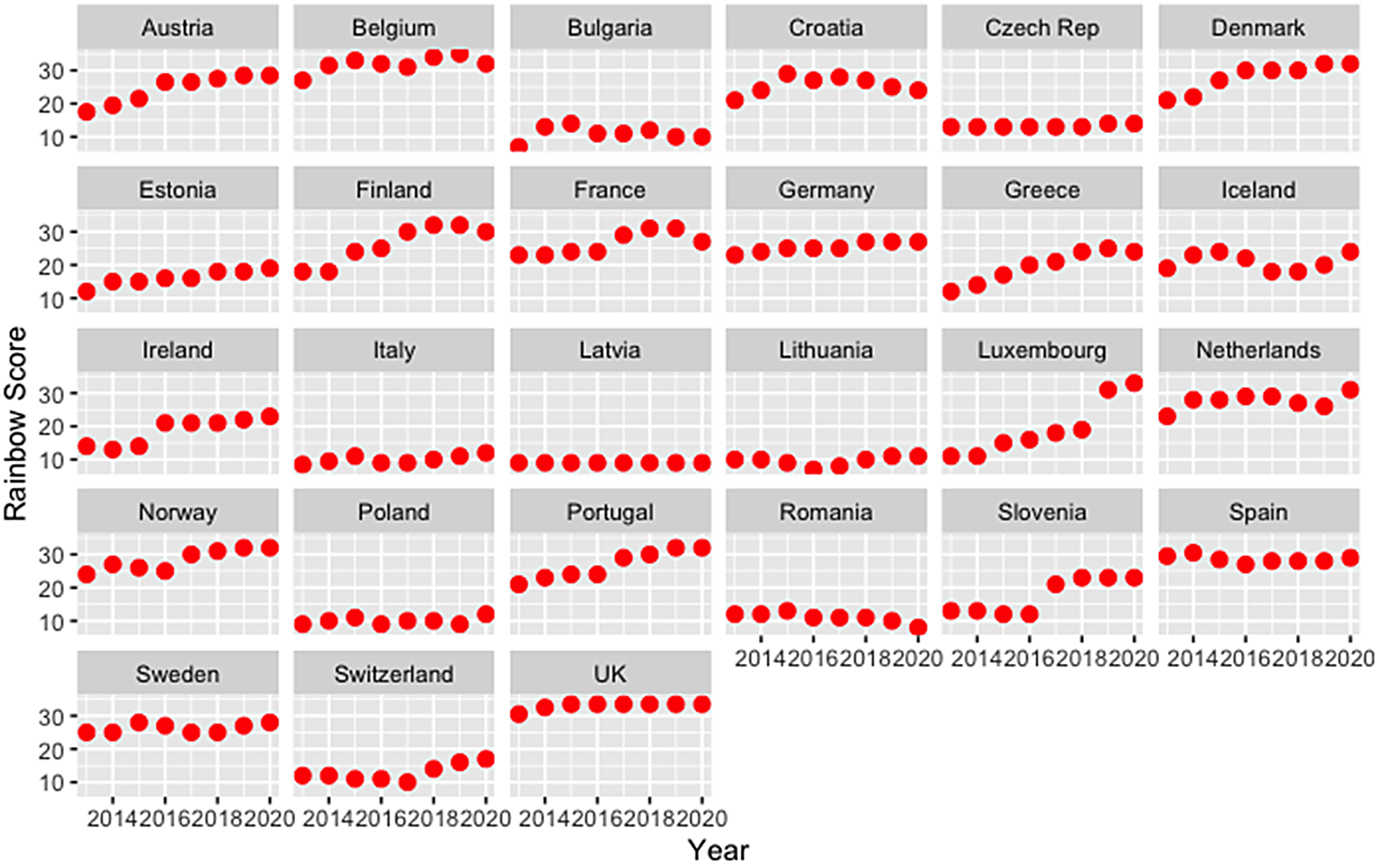
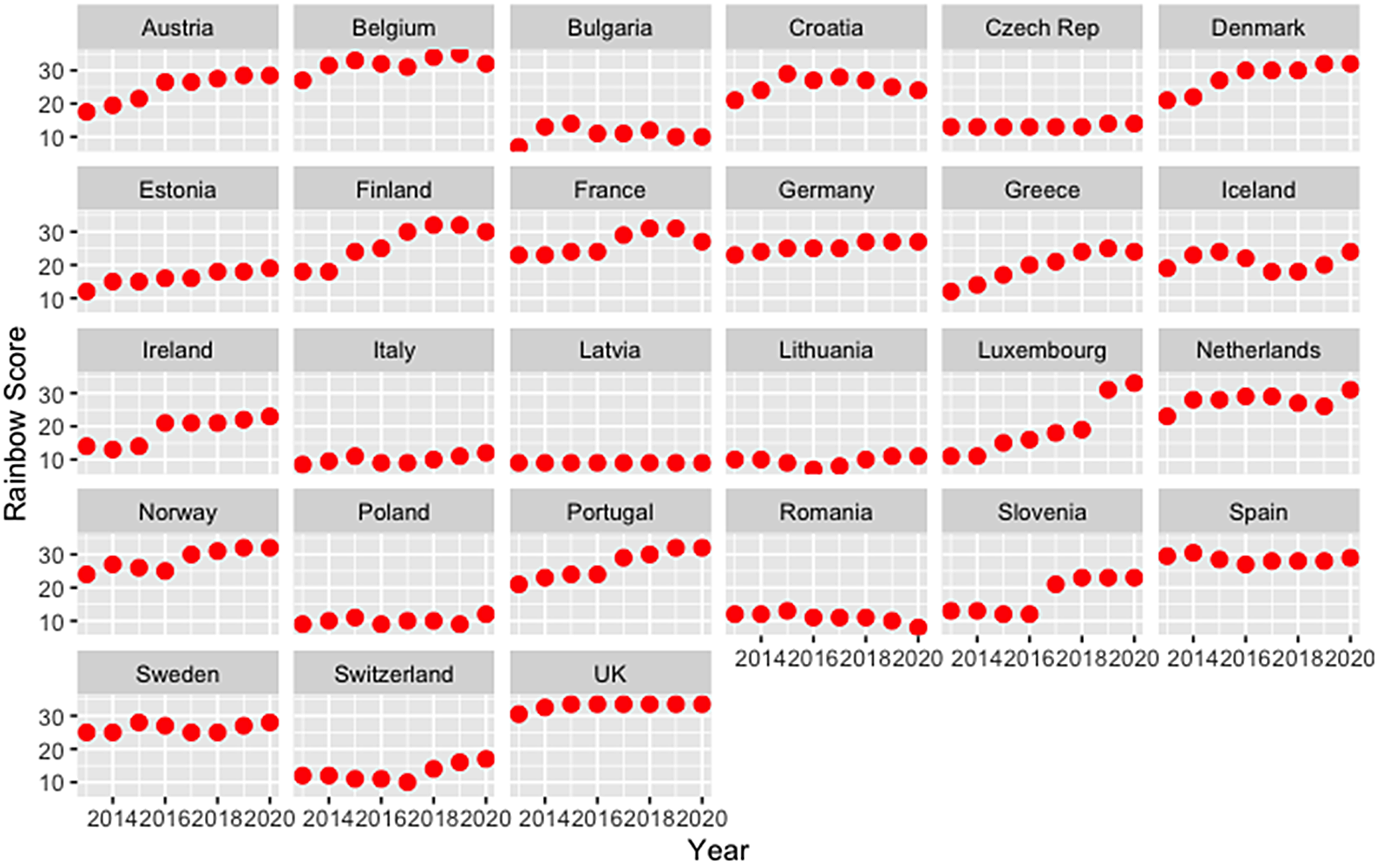
However, because the Rainbow Index categories have varied over time, I construct an adjusted measure that retains only those dimensions consistently present in the dataset from 2013 to 2020, ensuring comparability across years and minimizing the impact of category changes. The list of consistently included dimensions is presented in Table 3. In the model, I use both (1) the original Rainbow Index, which reflects relative scores assigned based on evaluation criteria at the time, and (2) the adjusted Rainbow Index, which maintains a stable set of categories to better track policy changes over time. Among the countries in Figure 1, Belgium in 2017 has the highest score (35), while Bulgaria (2013) and Lithuania (2016) received the lowest score (7).
Rainbow index with consistently existing dimensions (2013–2020)
Rainbow index with consistently existing dimensions (2013–2020).
Independent variables
My main independent variables are (1) social construction, (2) the interaction term of social construction and issue salience, and (3) the other interaction term of social construction and electoral systems.
Social construction
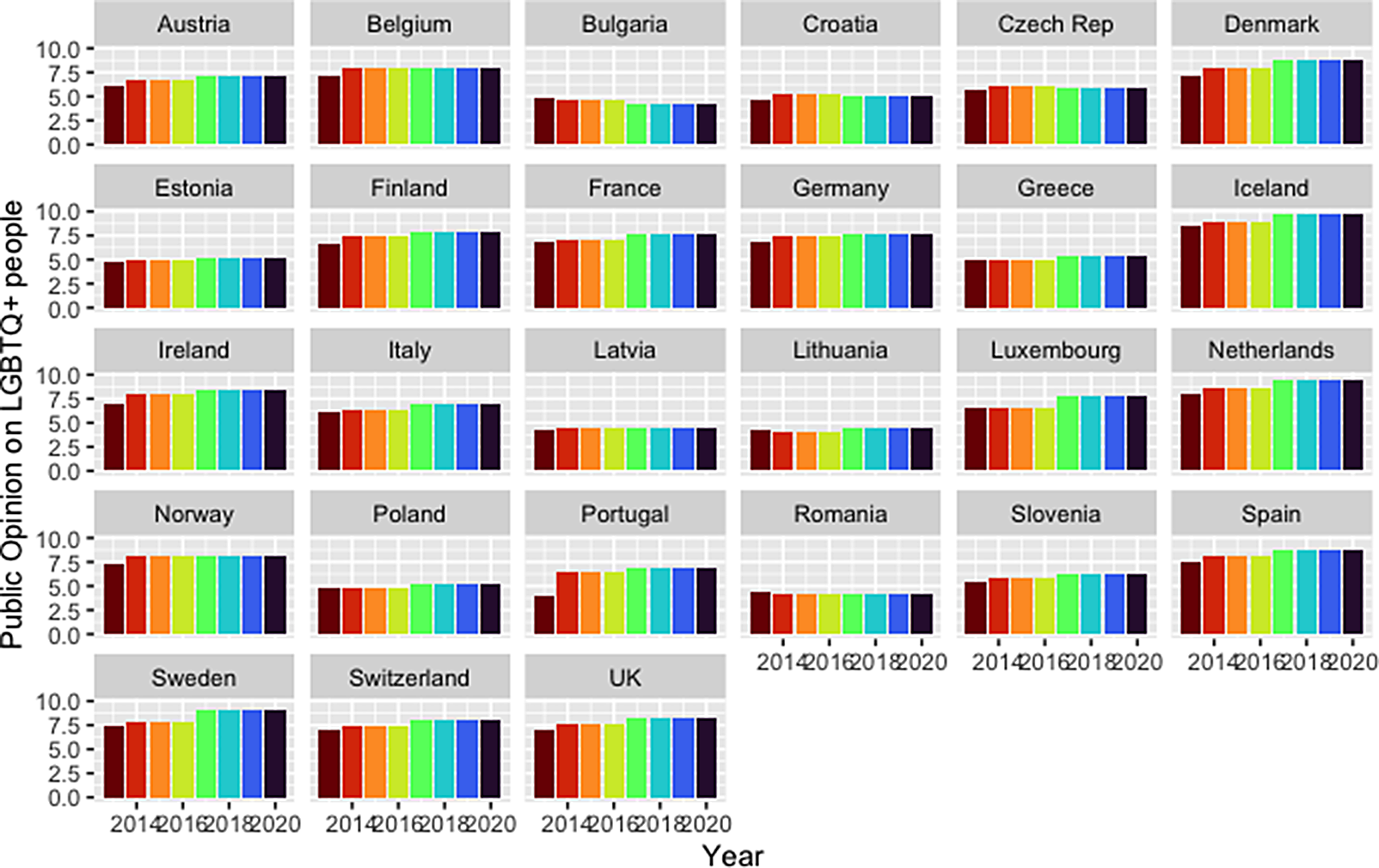
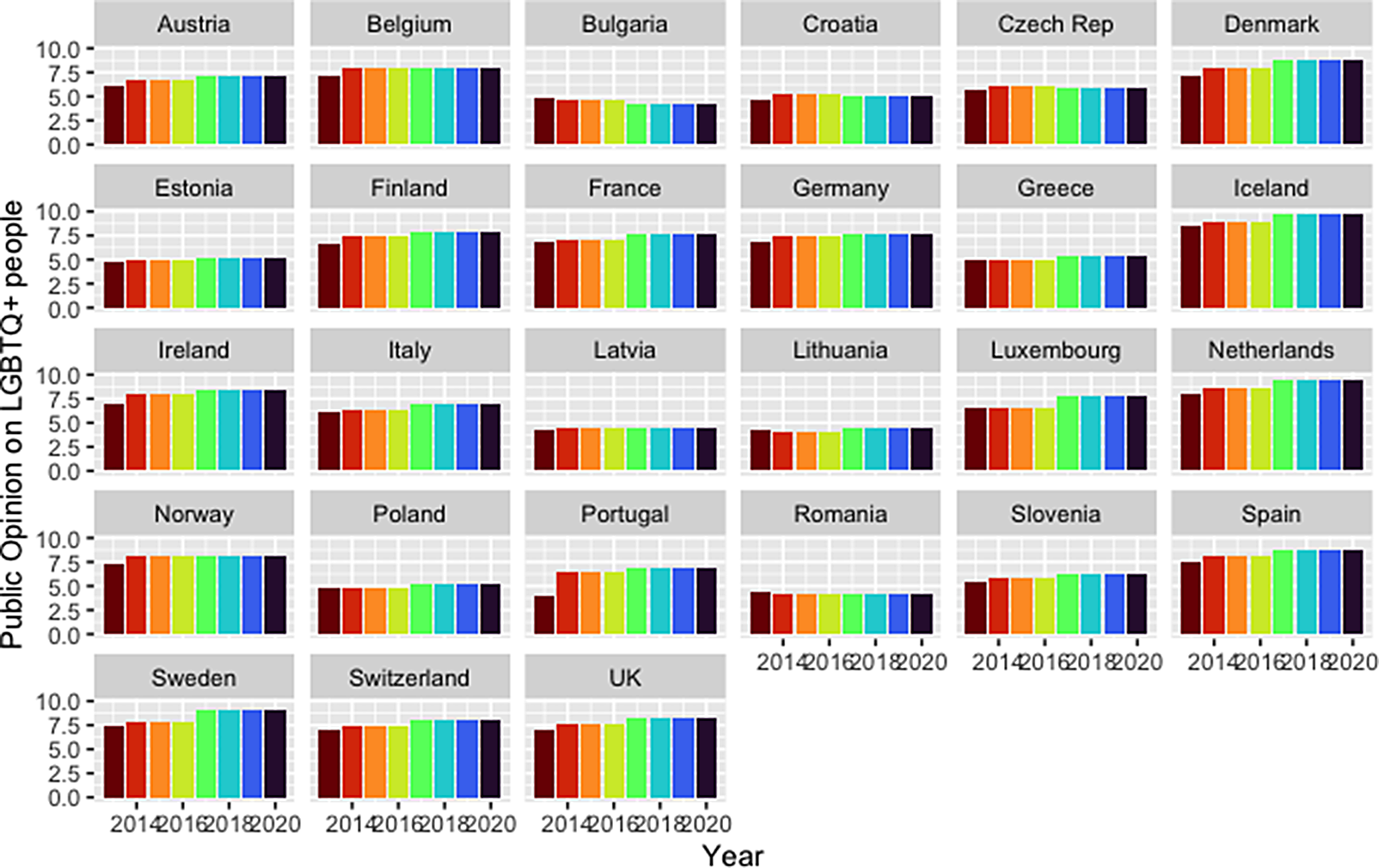
Social constructions of LGBTQ+ populations are measured using the LGBTQ+ Global Acceptance Index (GAI) (Flores Reference Flores2019). The GAI captures societal perceptions of LGBTQ+ individuals by aggregating responses from multiple public opinion surveys on attitudes and beliefs about LGBTQ+ people and their rights. The index incorporates data from Eurobarometer, the European Values Survey, Gallup World Poll, the International Social Survey Programme, Ipsos, and the World Values Survey to generate a single acceptance scoreFootnote 4 . Higher scores indicate more positive societal attitudes toward LGBTQ+ people and issues. Figure 2 presents the GAI scores by countryFootnote 5 . Among the countries in my dataset, Iceland has the highest average score (9.278), while Romania has the lowest (4.125).
Social construction on LGBTQ+ (2013–2020).
Issue salience
I use Google TrendsFootnote 6 to measure issue salience. A wide range of fields including social science utilize Google data to measure information-seeking behavior and the concerns of the public (Jun et al., Reference Jun, Yoo and Choi2018). Mellon (Reference Mellon2014) shows Google Trends data could be a proxy of issue salience by comparing Google search with survey data. In addition, according to Oehl et al. (Reference Oehl, Schaffer and Bernauer2017), Google Trends data are closely correlated with media salience measures.
I use the topic search in Google Trends, which captures a group of related search terms that share the same concept across different languages and expressions, while a “search term” only includes data for the exact word or phrase in the selected language. I chose the topic search specifically because it enables a more comprehensive and cross – linguistic capture of public interest in LGBTQ+ issues, ensuring greater comparability across countries. Google Trends provides the relative values of people’s searches – specifically, the number of searches for the selected topic divided by the total number of Google searches within a defined population and time period – for each country over time. Notably, the values are not the absolute values but the relative values either by time or by country. Based on this data structure, I construct a weighted-normalized value to represent each country’s yearly salience measure.
 $${x_{it}} = {x_i} \times {{{{x_t} - \overline {{x_t}} }}\over{{max\left( {{x_t}} \right) - min\left( {{x_t}} \right)}}}$$ ${x_i}$
presents a relative value of a country’s search for LGBTQ+ by comparing with other sample countries while
${x_i}$
presents a relative value of a country’s search for LGBTQ+ by comparing with other sample countries while ${x_t}$
shows a relative value of a country’s search for the keyword by comparing with other periods within the country. This index adjusts each country’s yearly salience relative to its own baseline and simultaneously considers its standing compared to other countries in the sample, providing a more consistent and interpretable measure of LGBTQ+ issue salience over time and space.
${x_t}$
shows a relative value of a country’s search for the keyword by comparing with other periods within the country. This index adjusts each country’s yearly salience relative to its own baseline and simultaneously considers its standing compared to other countries in the sample, providing a more consistent and interpretable measure of LGBTQ+ issue salience over time and space.
Electoral systems
To measure the proportionality of electoral systems (H3a), I consider different traits of the electoral system: (1) the basic type of electoral system used in the elections (PR, Mixed, and SMD), (2) average magnitude, and (3) electoral threshold. I use the Democratic Electoral Systems (DES) dataset (Bormann and Golder Reference Bormann and Golder2013). In the case of a bicameral legislature, I focus on the lower chamber.
First, to code the basic type of electoral system used in the elections, I include two different electoral systems, PR and Mixed systems, as dummy variables (SMD is the reference category). These variables are used not only as a variable to test the proportionality effect in Models 1 and 2 in Table 5 but also as a control variable in main models in Table 4.
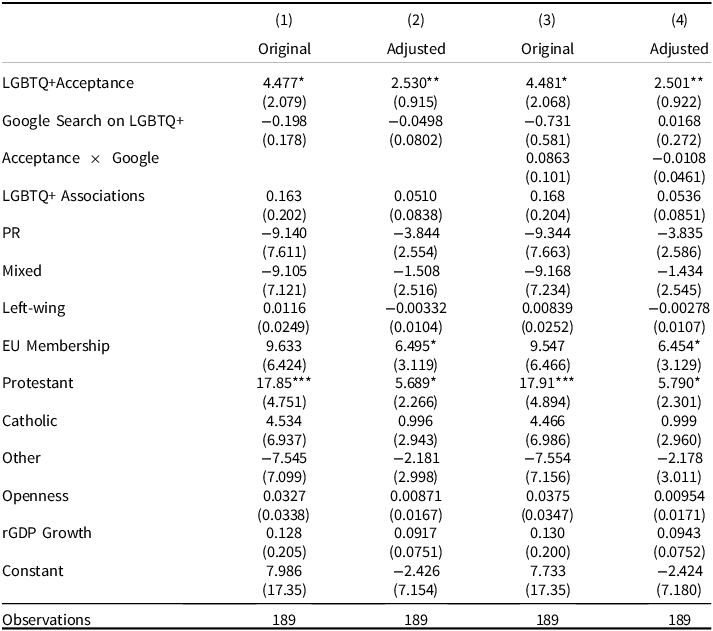
Social constructions, issue salience, and their interactive effect
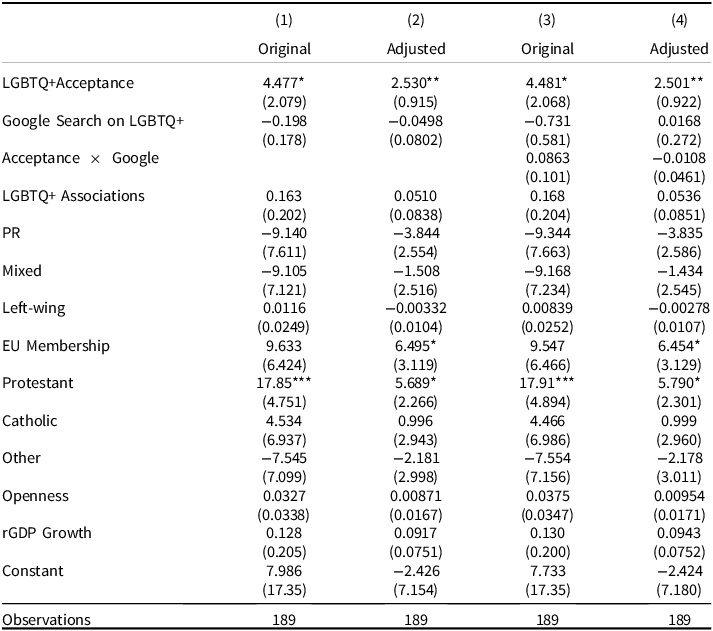
Standard errors in parentheses.
* $p & \lt 0.05$
, **
$p & \lt 0.05$
, ** $p & \lt 0.01$
, ***
$p & \lt 0.01$
, *** $p & \lt 0.001.$
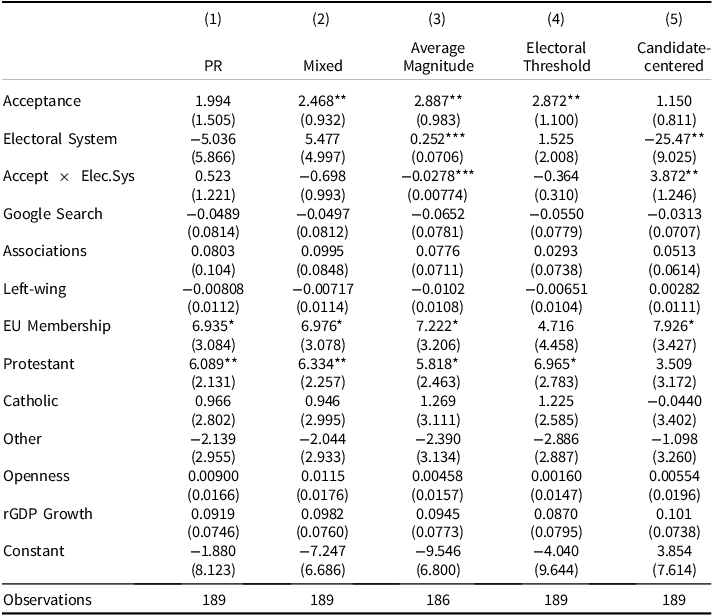
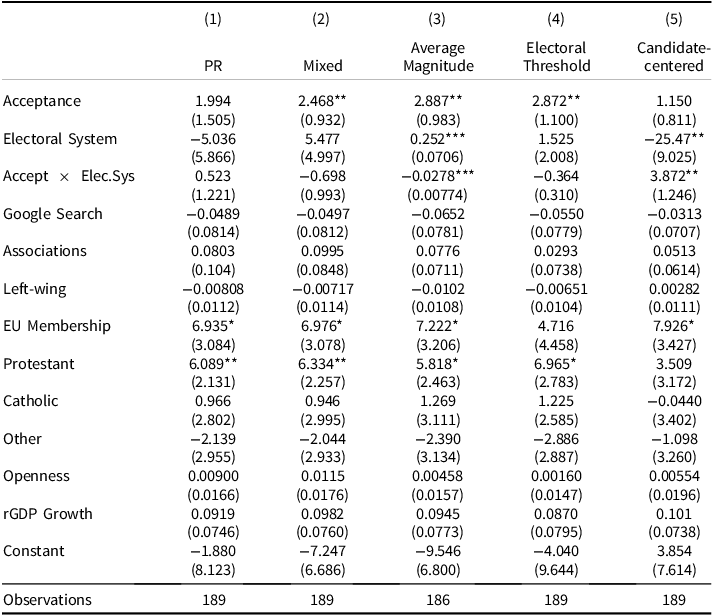
Interactive effects between social constructions and electoral systems (adjusted rainbow index)
Standard errors in parentheses.
* $p < 0.05$
, **
$p < 0.05$
, ** $p < 0.01$
, ***
$p < 0.01$
, *** $p < 0.001$
.
$p < 0.001$
.
Electoral magnitude refers to the number of seats allocated in a district or electoral area for representation. The same dataset is used to measure the average district magnitude. A higher average electoral magnitude usually indicates a system more inclined toward proportional representation, where more parties are likely to gain representation, whereas a lower average suggests a system that may favor larger parties and possibly result in less proportional outcomes.
The electoral threshold in political science refers to the minimum share of the vote that a party must achieve to gain any representation in a legislative body. Minor parties have benefits when the electoral threshold is low. The electoral threshold data is collected from the Comprehensive European Parliament Electoral Data (COMEPELDA) Däubler, Chiru and Hermansen (Reference Däubler, Chiru and Hermansen2022).
To determine whether a country employs either a candidate-centered or a party-centered system (H3b), I examine the country’s ballot type. Countries with a closed-list PR system are coded as having a party-centered system. Conversely, countries with open-list PR, SMD, or STV systems are coded as having a candidate-centered system. Appendix A.2 has specific information on each country’s electoral system.
Control variables
Control variables are LGBTQ+ associations, left-wing government, religions, EU membership, Economic Openness, and real GDP (Gross domestic product) growth rate. The influence of interest groups does matter in policy outputs (e.g., Burstein (Reference Burstein2003)). The number of LGBTQ+ associations by country is counted from the information of LGBTQ+ groups which are enlisted in ILGA-Europe’s website, and that is included in the models (Ayoub and Kollman Reference Ayoub and Kollman2021; Proctor Reference Proctor2020). Given the challenge of measuring this variable annually, it exhibits only cross-country varianceFootnote 7 .
I control for government partisanship by focusing on whether it is left-wing government or not based on the dataset of Armingeon et al. (Reference Armingeon, Wenger, Wiedemeier, Isler, Knöpfel, Weisstanner and Engler2019). Although it is disputable whether left-wing parties are the only advocates for LGBTQ+ issues, previous literature suggests that left-wing parties are more likely to support LGBTQ+ issues (e.g., Reynolds (Reference Reynolds2013), Schulenberg (Reference Schulenberg2012)). Additionally, religiosity is a relevant factor in LGBTQ+ politics and is likely to have a negative impact on the legalization of LGBTQ+ rights (Andersen and Fetner Reference Andersen and Fetner2008; Goren and Chapp Reference Goren and Chapp2017; Turnbull-Dugarte and López Ortega Reference Turnbull-Dugarte and López Ortega2023). To measure religiosity, four categories of the dominant state religion – Mixed Christian, Protestant, Catholic, and Other – are included in the models (Andersen and Fetner Reference Andersen and Fetner2008). Among the four categories, “Mixed Protestant” serves as the reference category. EU membership is another significant factor in explaining LGBTQ+ policy adoption (Ayoub Reference Ayoub2015). Furthermore, economic openness and real GDP growth are included in the models as control variables to examine the impact of economic modernization on LGBTQ+ rights.
Results
I employ a fixed-effect model for the TSCS data with country-specific robust standard errors. The equation below presents the main model (Model 3 in Table 4) for Hypothesis 2:
 $${Y_{it}} = \alpha + {\beta _1}{X_{1,it - 1}} + {\beta _2}{Z_{it - 1}} + {\beta _3}{X_{1,it - 1}}{Z_{it - 1}} + {{\bf{W}}_{{\bf{it}} - 1}}\gamma + {\alpha _i} + {v_i} + {u_{it}}$$
For each state $i$
and year
$i$
and year $t$
,
$t$
, ${Y_{it}}$
means the Rainbow index (LGBTQ+ Rights). LGBTQ+ acceptance (Social Constructions) and its coefficient are
${Y_{it}}$
means the Rainbow index (LGBTQ+ Rights). LGBTQ+ acceptance (Social Constructions) and its coefficient are ${\beta _1}{X_{1,it - 1}}$
. Google Search on LGBTQ+ (Issue salience) and its coefficient are
${\beta _1}{X_{1,it - 1}}$
. Google Search on LGBTQ+ (Issue salience) and its coefficient are ${\beta _2}{Z_{it - 1}}$
. The interaction effect between two independent variables is captured by the term of
${\beta _2}{Z_{it - 1}}$
. The interaction effect between two independent variables is captured by the term of ${\beta _3}{X_{it - 1}}{Z_{it - 1}}$
. The matrix of remaining control variables(
${\beta _3}{X_{it - 1}}{Z_{it - 1}}$
. The matrix of remaining control variables( ${{\bf{W}}_{{\bf{it}} - 1}}\gamma $
), their coefficient and state-specific fixed effects(
${{\bf{W}}_{{\bf{it}} - 1}}\gamma $
), their coefficient and state-specific fixed effects( ${\alpha _i}$
), and the error term(
${\alpha _i}$
), and the error term( ${v_i}$
and
${v_i}$
and ${u_{it}}$
) are also provided. If I include a lagged dependent variable in the model, it can cause a nickel bias due to the data structure involving a short time period with numerous countries (Nickell Reference Nickell1981). Thus, I do not include the lagged dependent variable.
${u_{it}}$
) are also provided. If I include a lagged dependent variable in the model, it can cause a nickel bias due to the data structure involving a short time period with numerous countries (Nickell Reference Nickell1981). Thus, I do not include the lagged dependent variable.
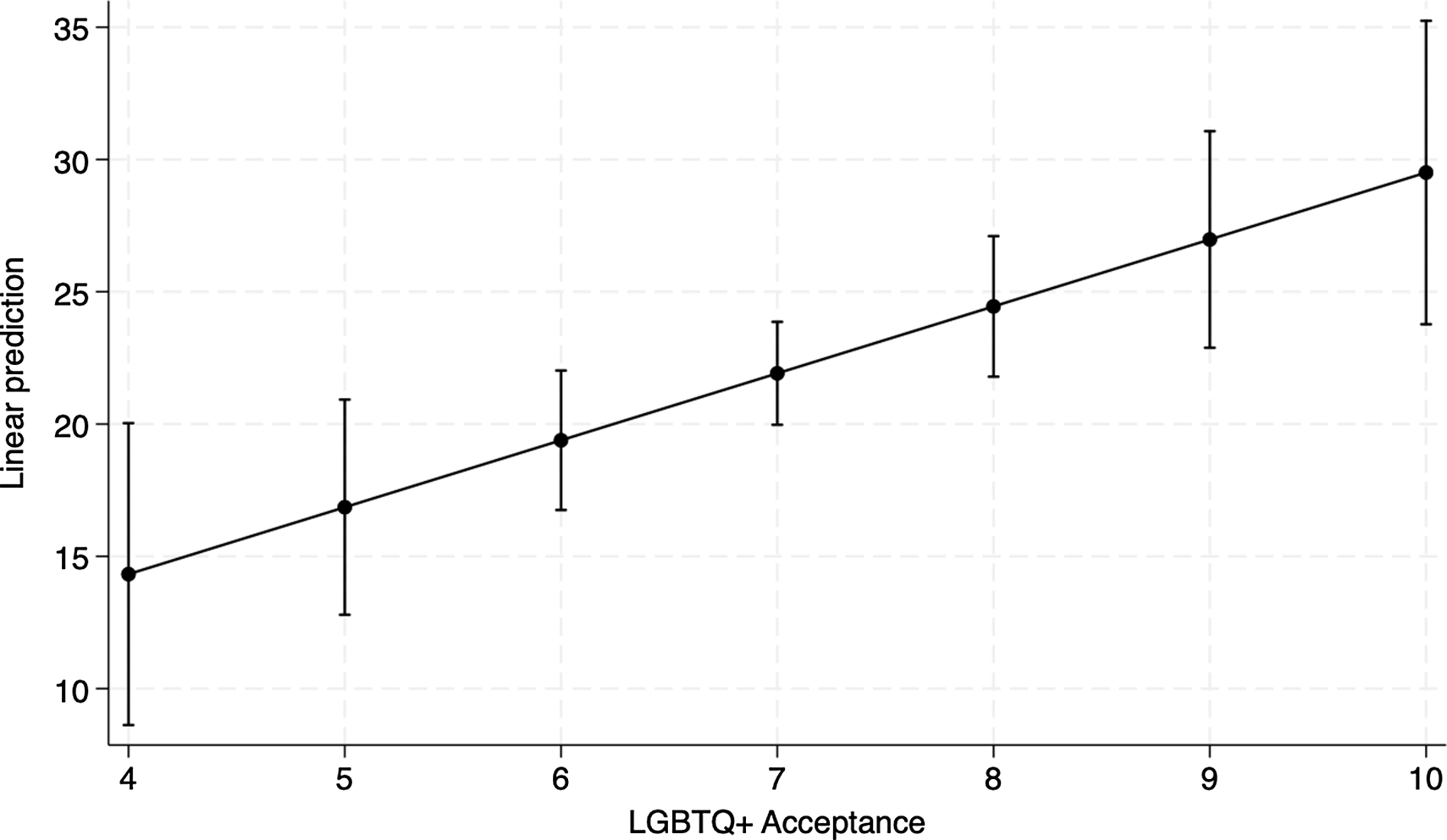
In Table 4, while Models 1 and 2 have no interaction term, Models 3 and 4 are the main models for Hypotheses 1 and 2. Models 1 and 3 use the original Rainbow index, and Models 2 and 4 use the adjusted Rainbow index. Figure 3 shows a country is more likely to have more inclusive LGBTQ+ policies as people have more accepting attitudes toward LGBTQ+ populations. Thus, the result supports Hypothesis 1 that policy outputs for LGBTQ+ populations will be more inclusive if social constructions for LGBTQ+ populations are more positive in a country.
Average marginal effects of LGBTQ+ acceptance (Social Constructions) with 95% CIs (Based on table 4 model 2).
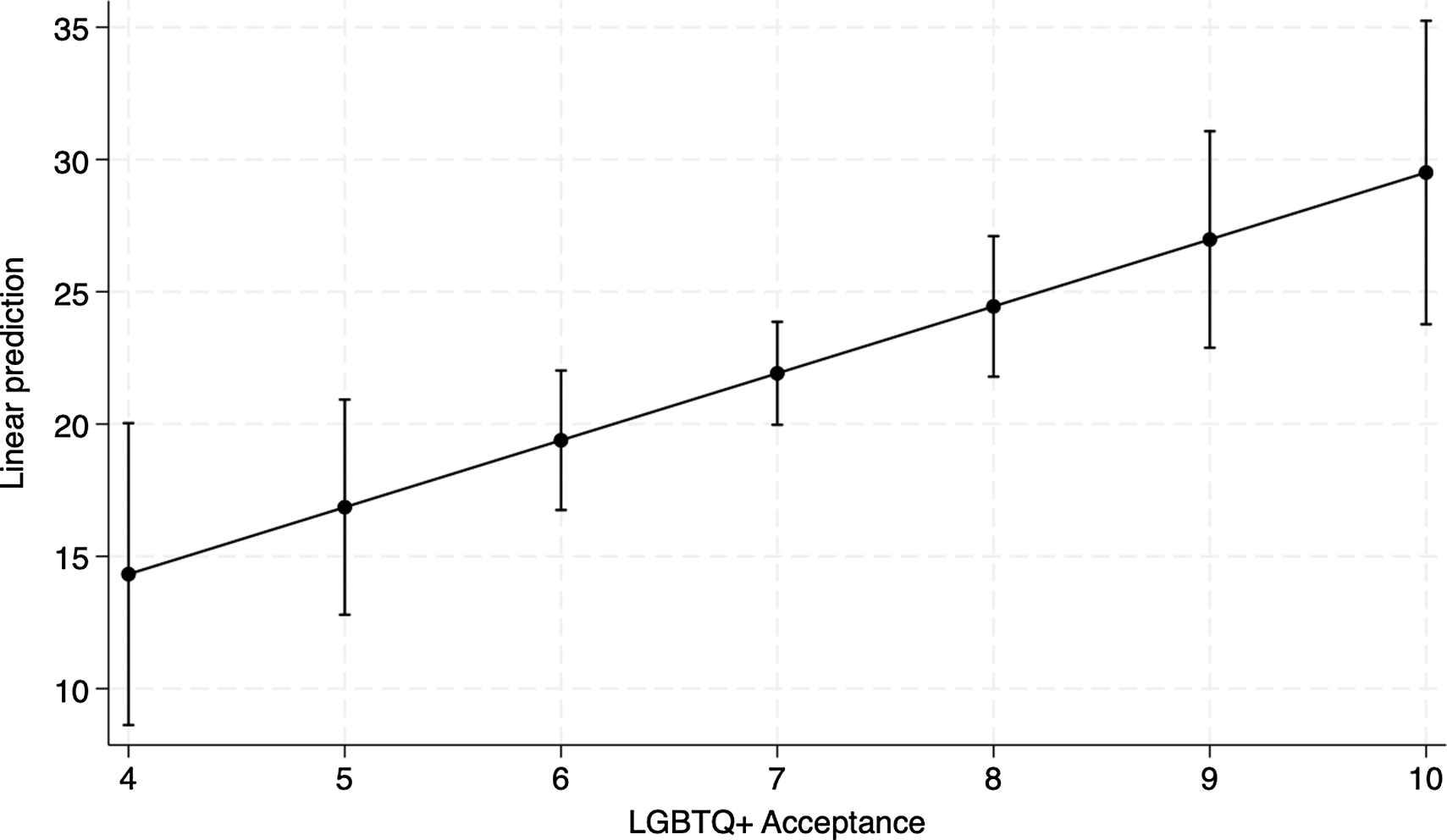
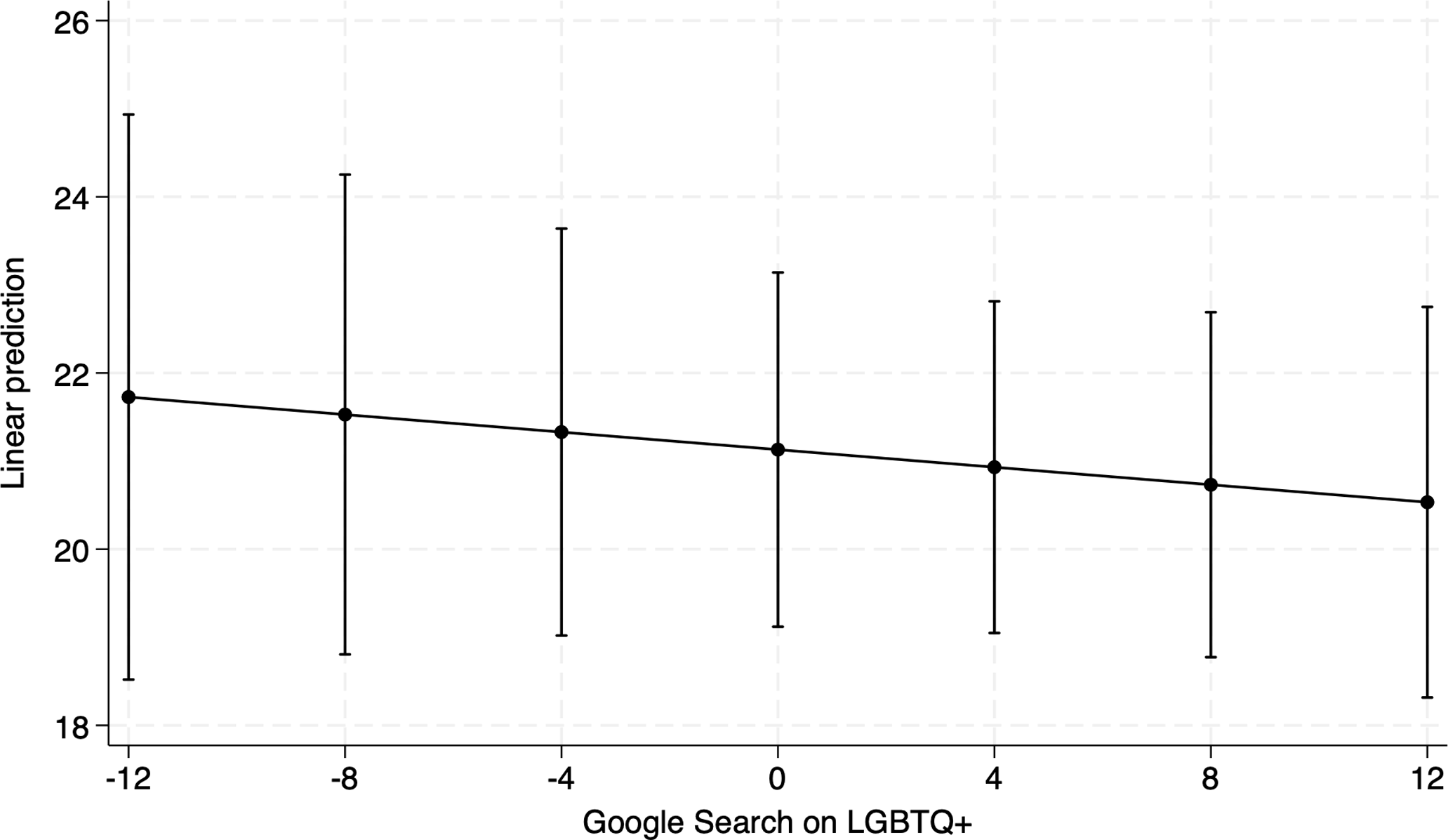
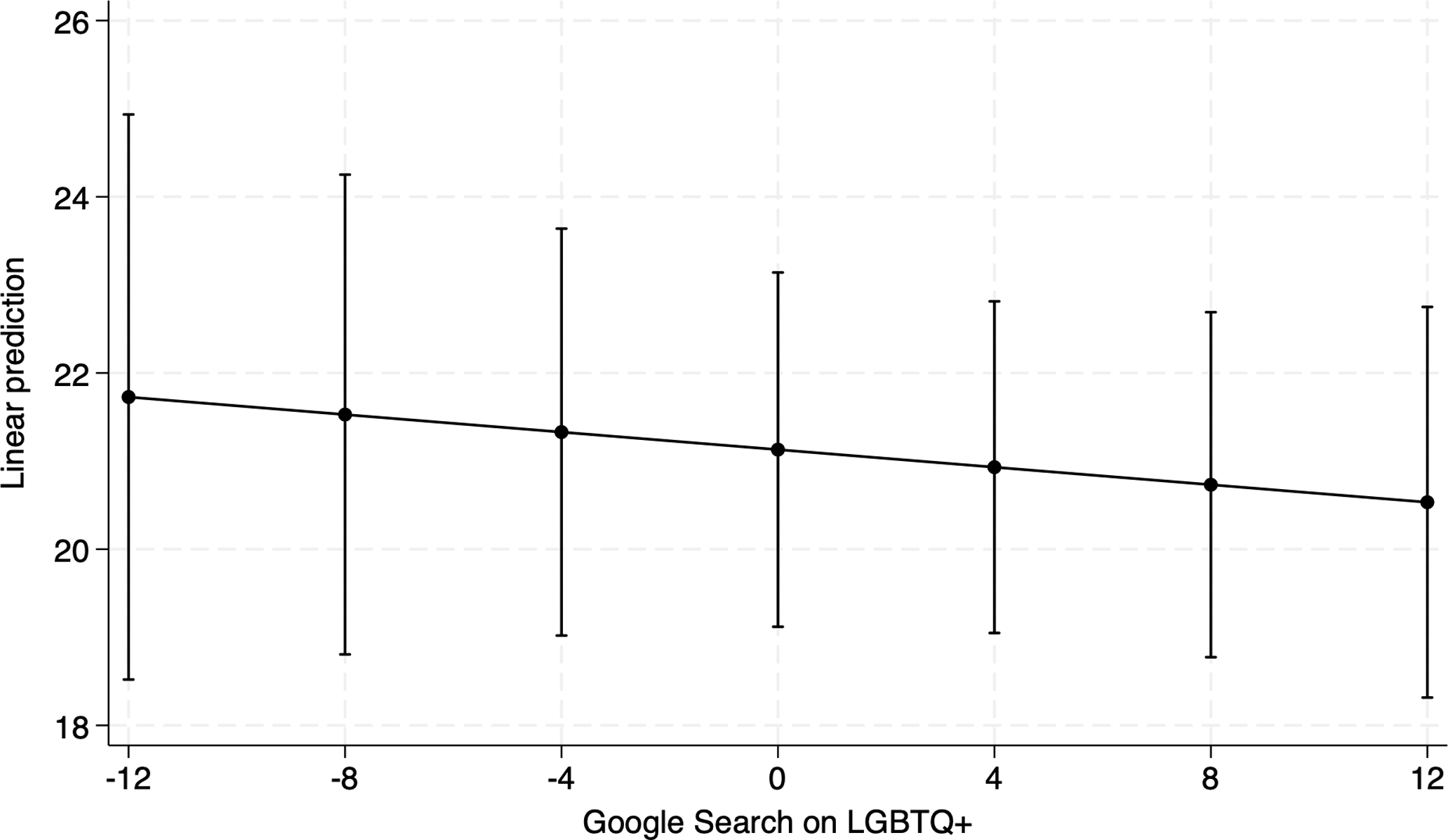
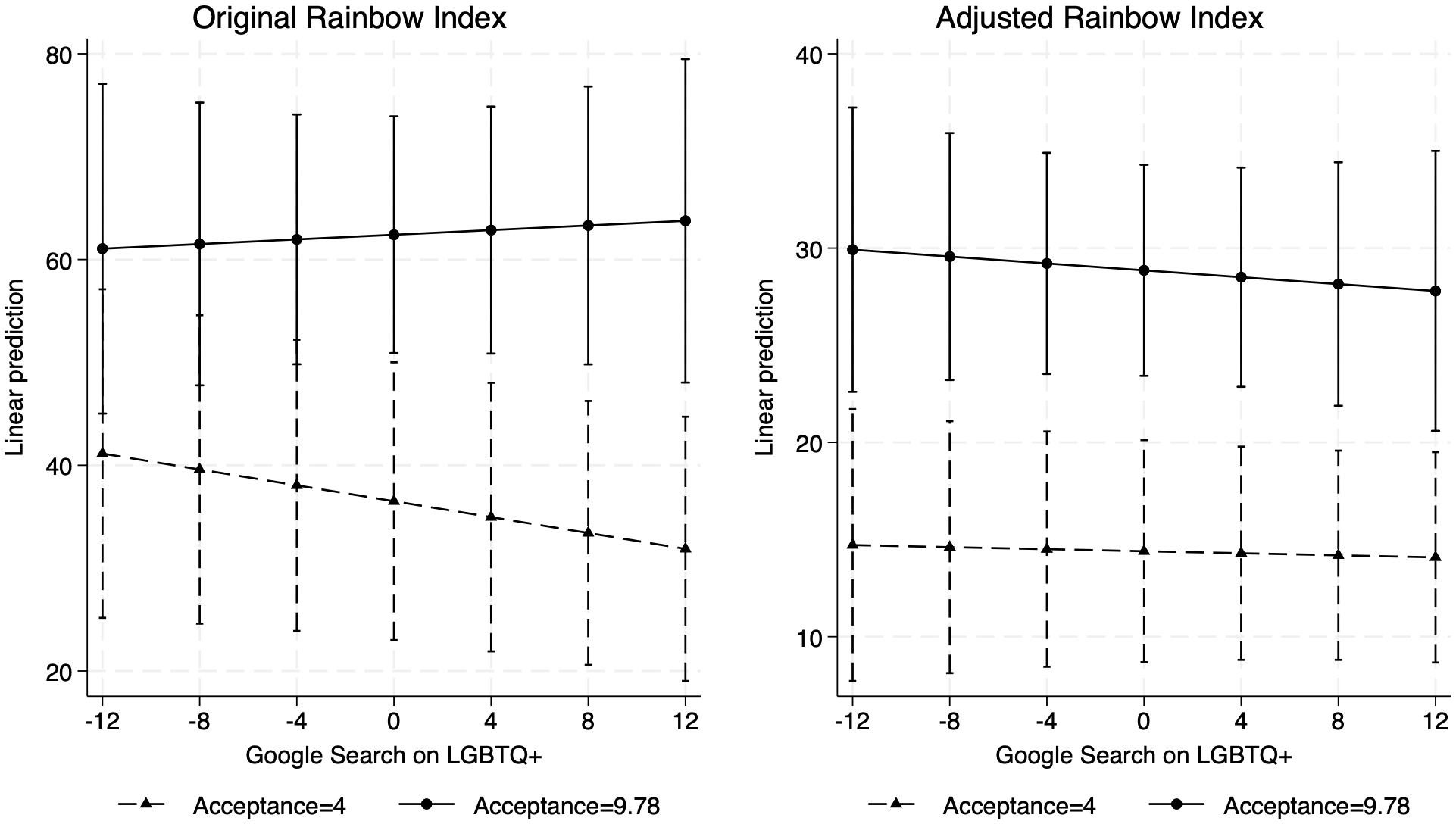
Figure 4 shows a negative but statistically insignificant relationship between issue salience and LGBTQ+ rights, suggesting that greater public attention to LGBTQ+ issues does not automatically lead to more inclusive policy outcomes. Table 4 also reveals inconsistencies between Model 3 and Model 4, particularly with respect to the interaction between salience and social constructions. To further explore this conditional relationship, Figure 5 presents predicted values based on two scenarios: one with low levels of LGBTQ+ acceptance (value = 4) and one with high acceptance (value = 9.78). In the high-acceptance context, the predicted level of LGBTQ+ rights increases as issue salience rises, while in the low-acceptance context, there is little to no change or a slightly negative slope. These patterns are qualitatively consistent with Hypothesis 2, which posits that issue salience fosters inclusive policy change only when supported by positive social constructions. However, given that the interaction term is not statistically significant in the regression results, this evidence should be interpreted with caution. Although the patterns observed align with the theoretical expectations, the results are not statistically conclusive.
Average marginal effects of Google search on LGBTQ+ (issue salience) with 95% CIs (Based on table 4 model 2).
Interactive effects between social constructions and issue salience with 95% CIs.
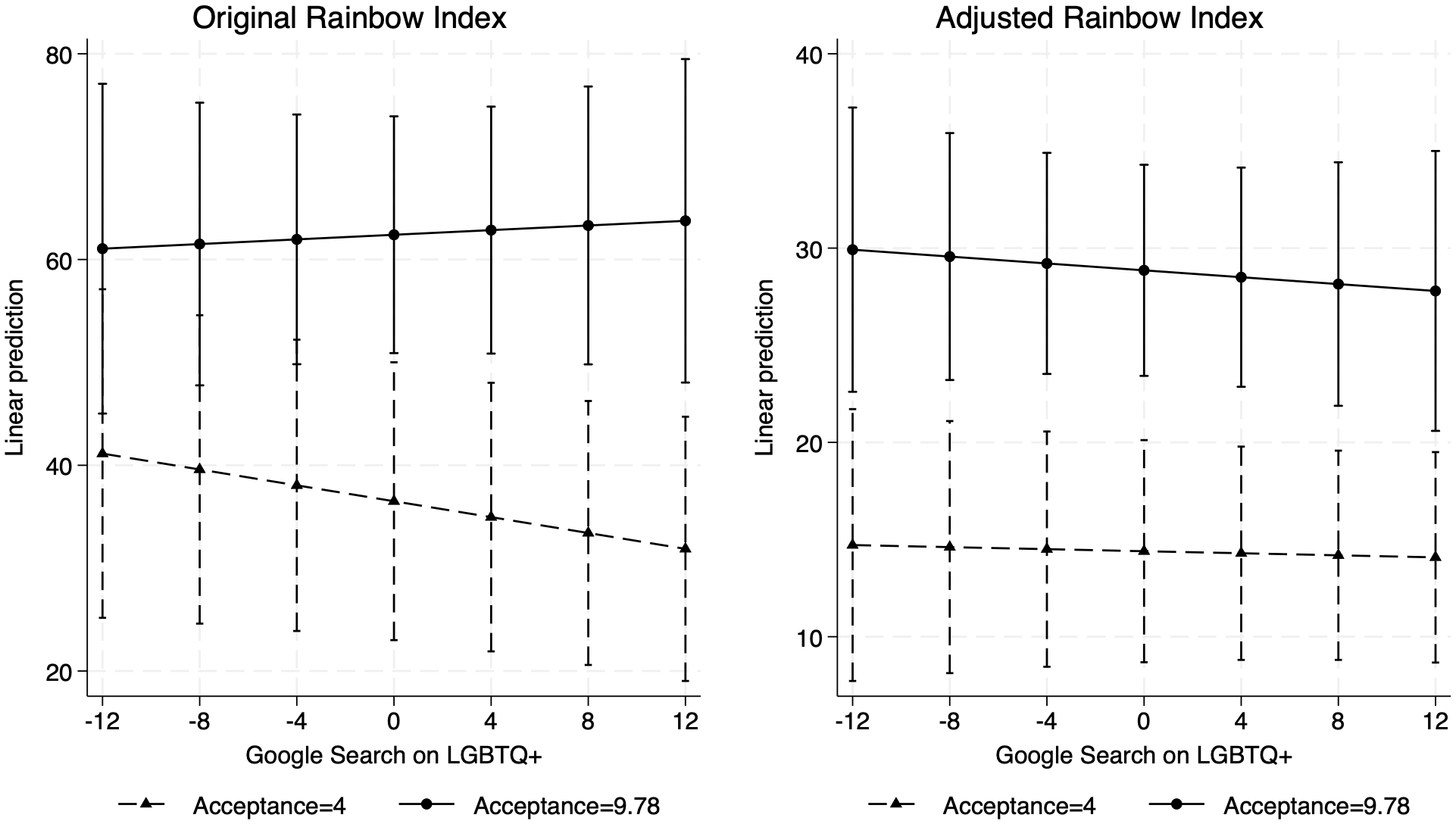
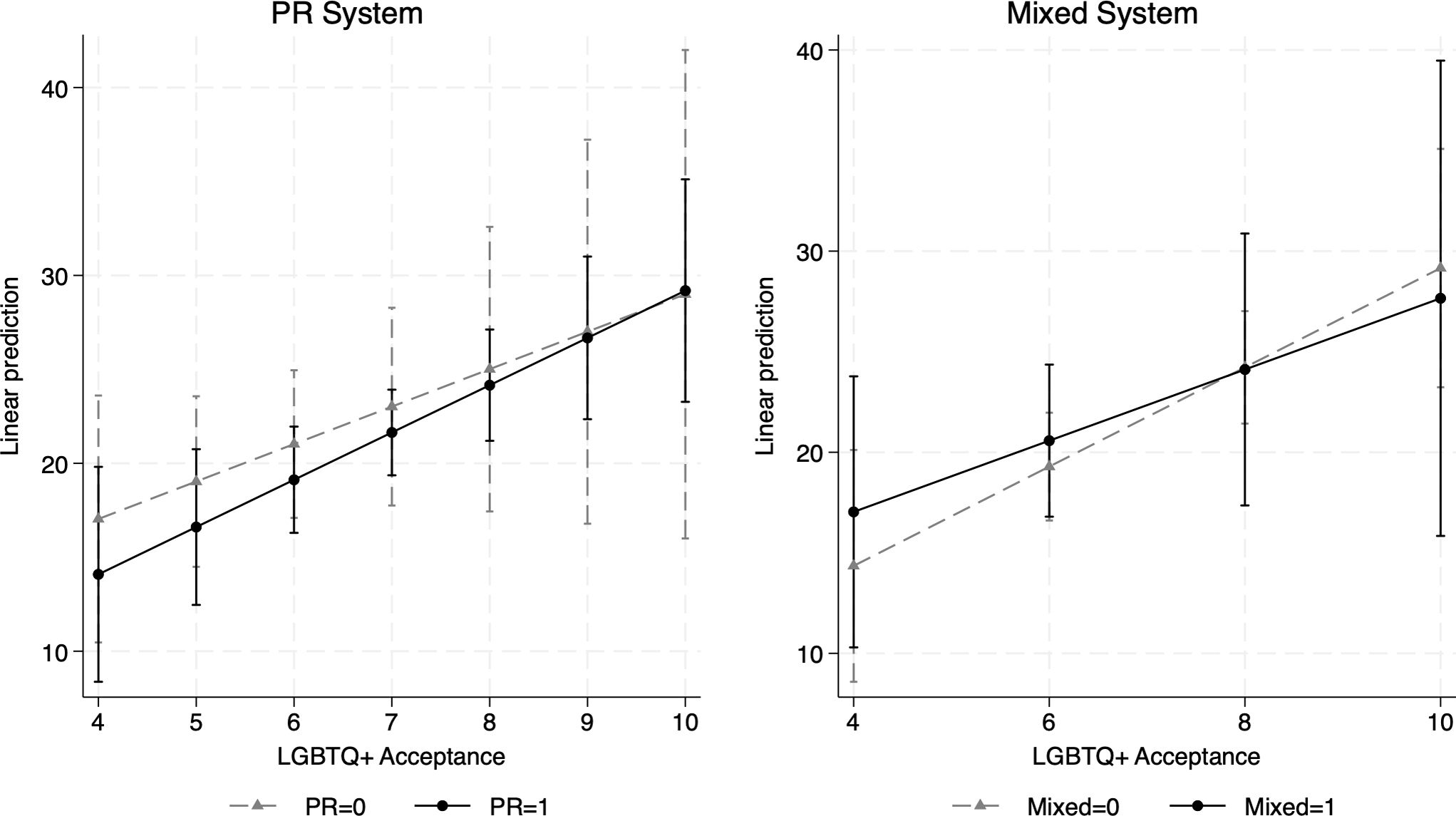
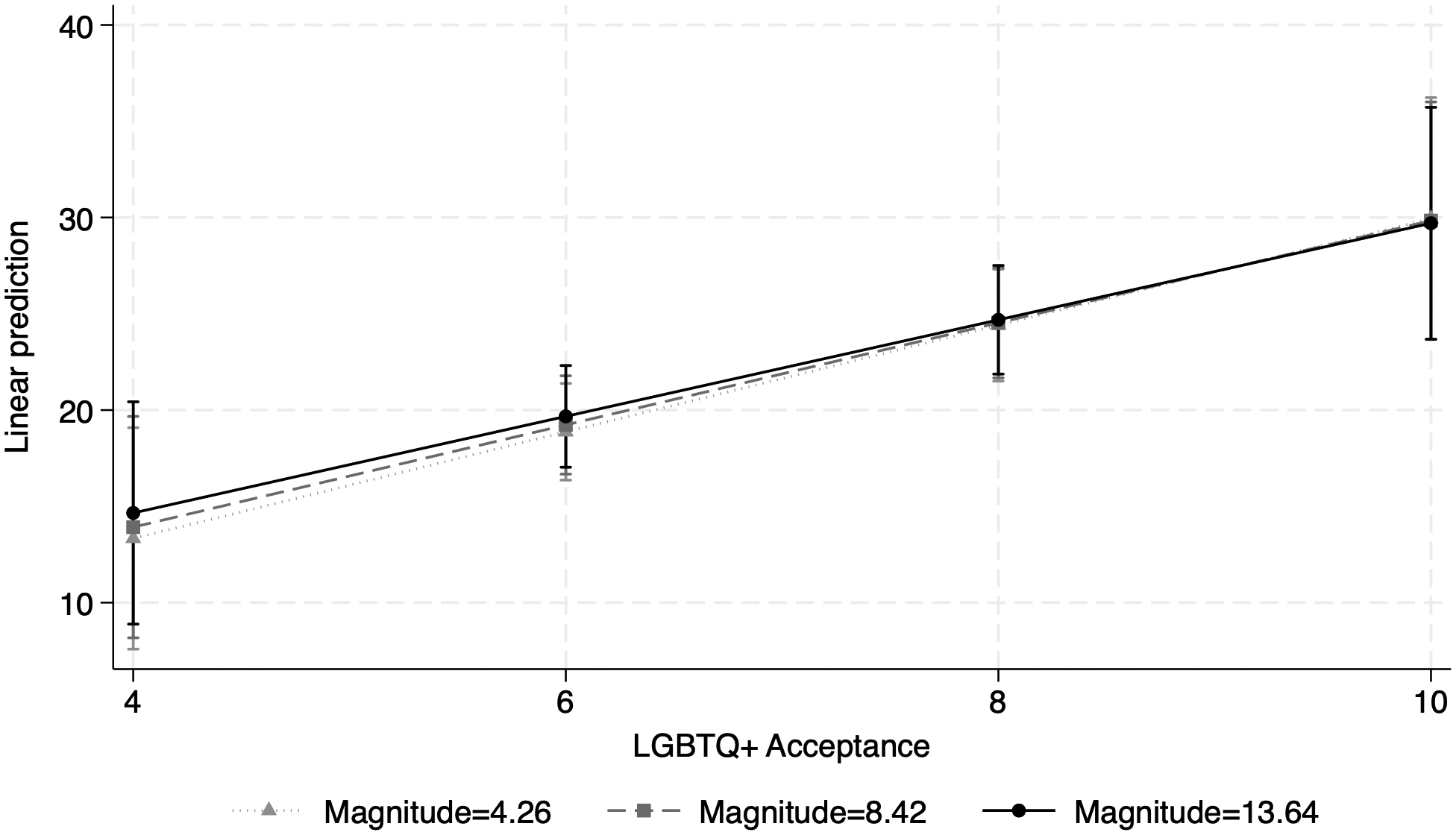
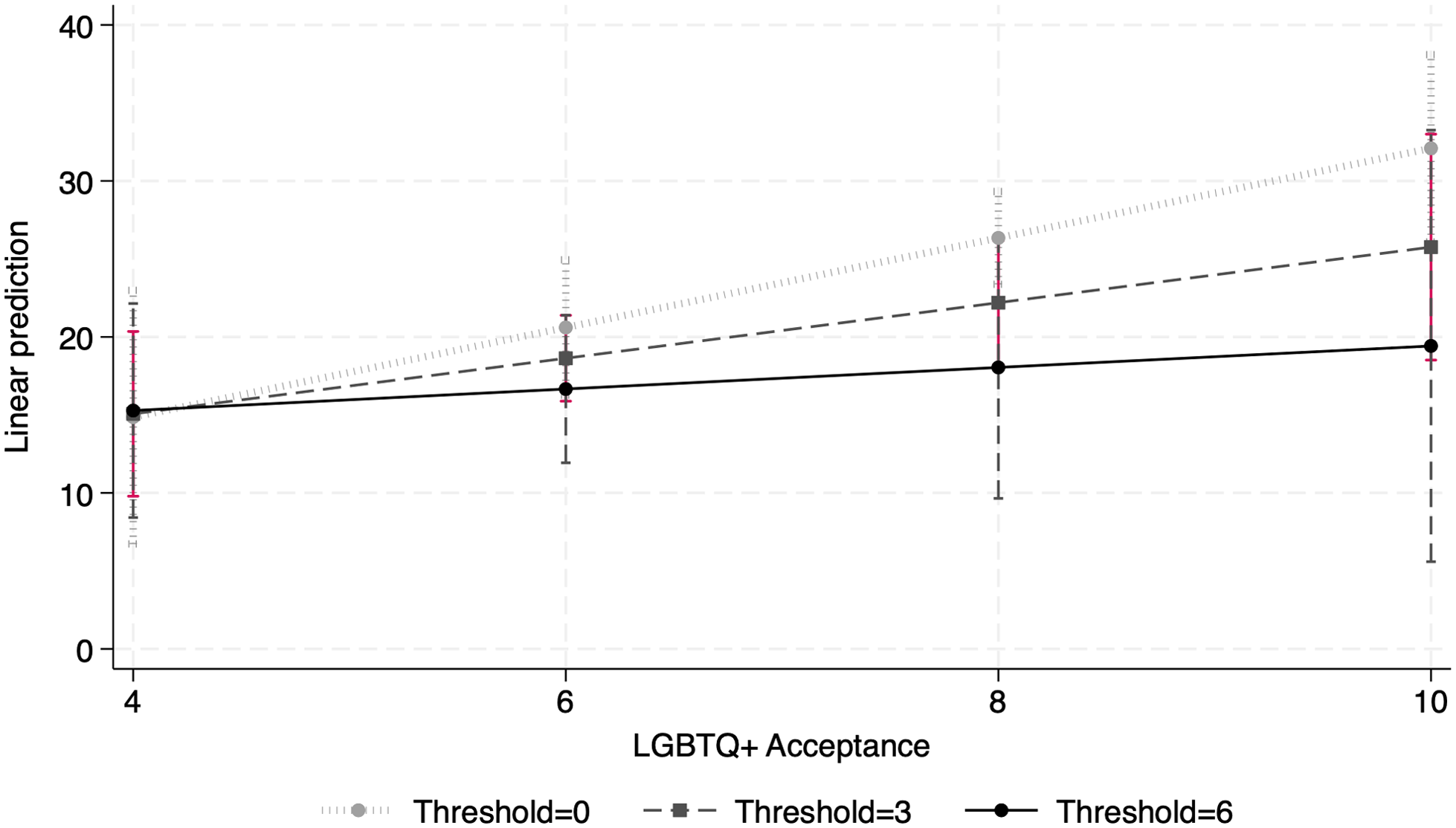
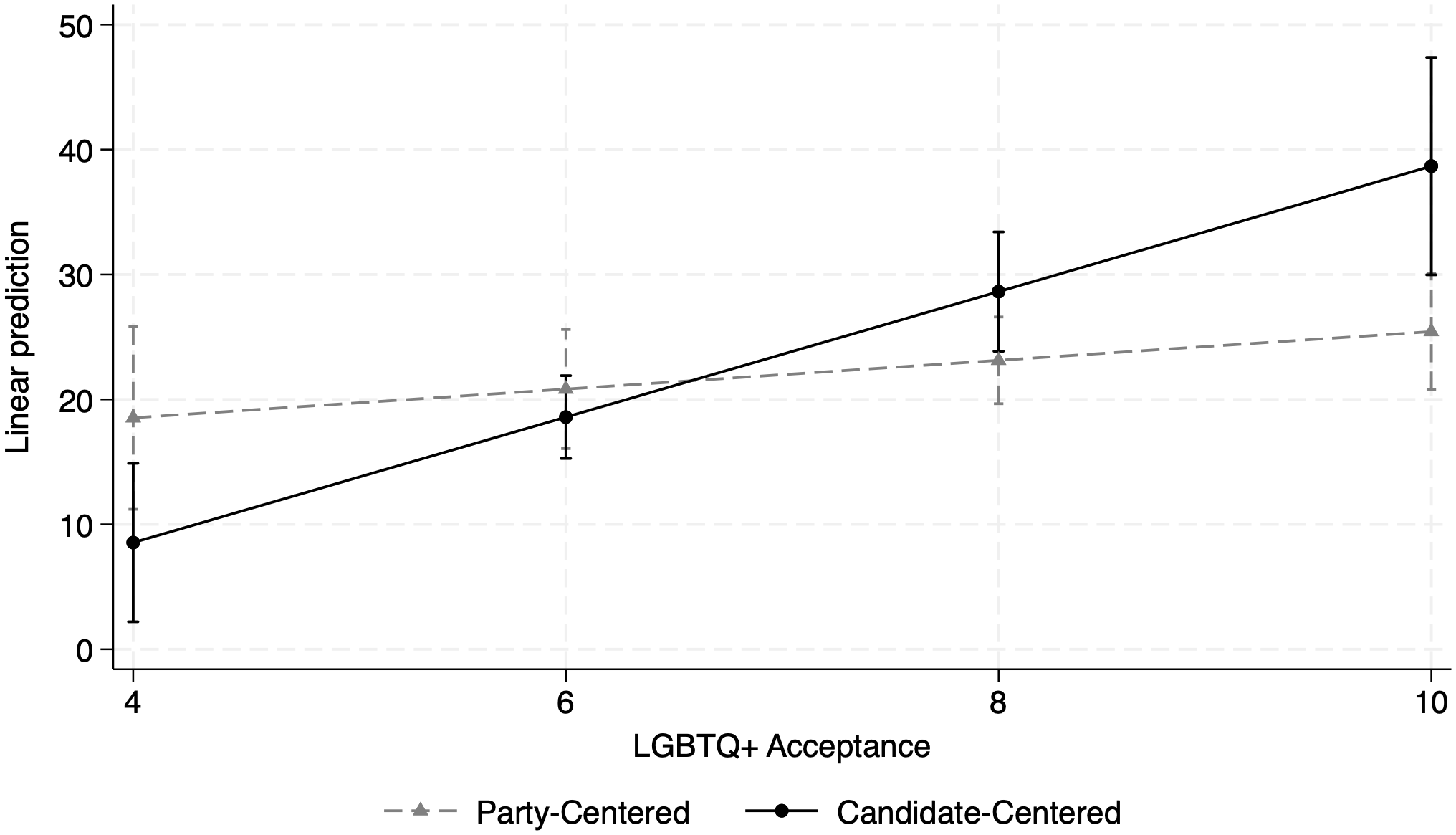
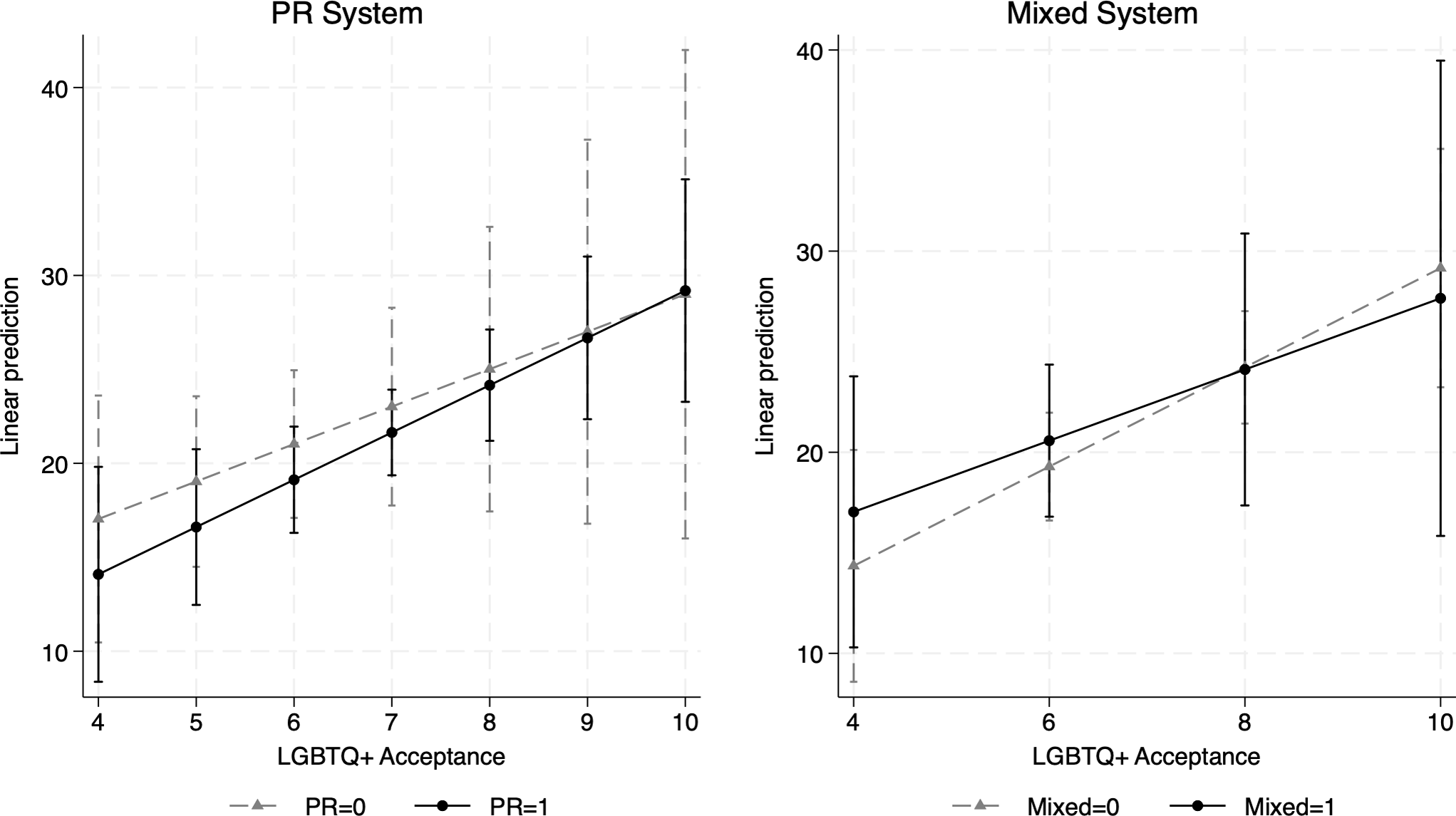
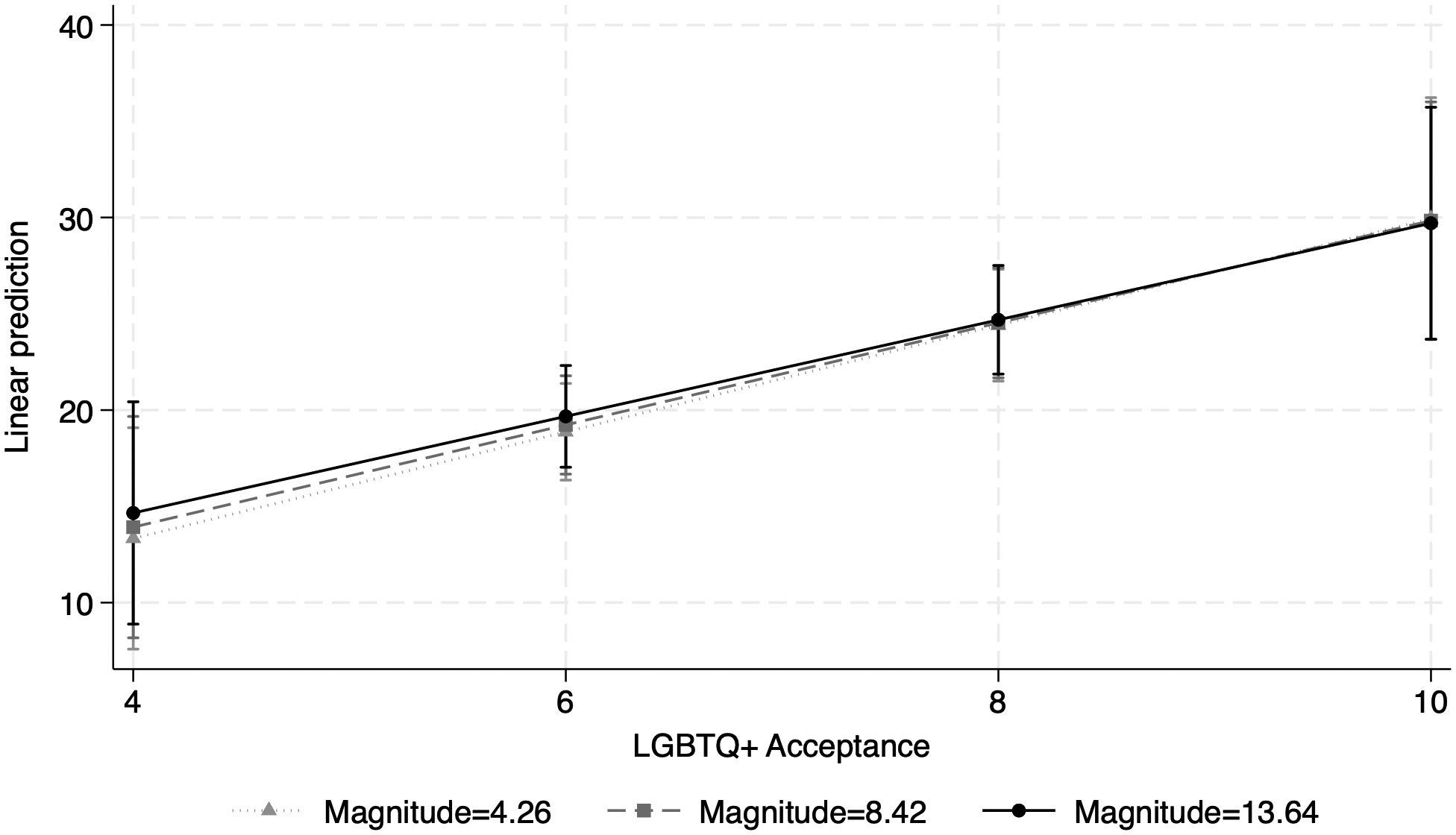
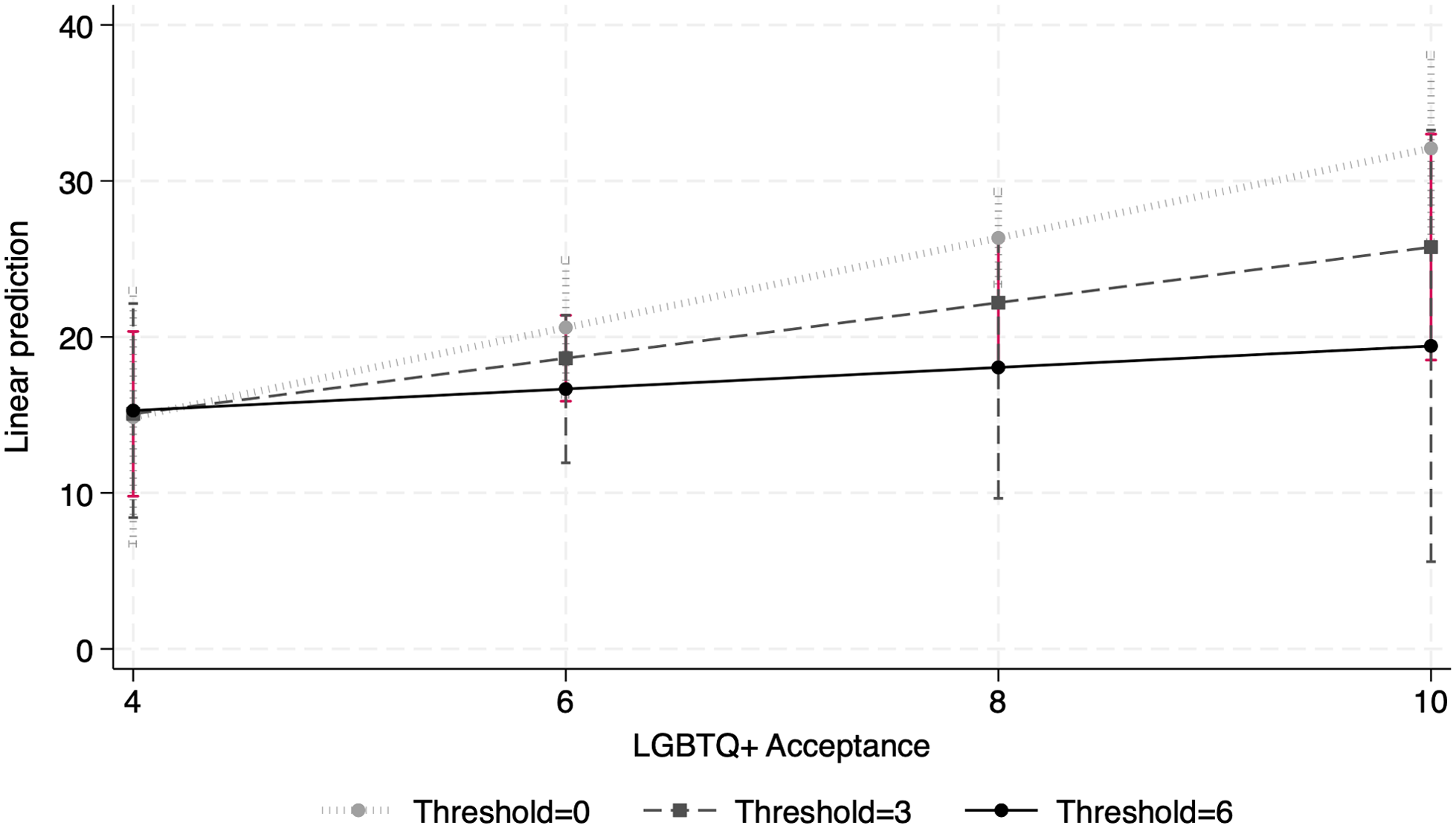
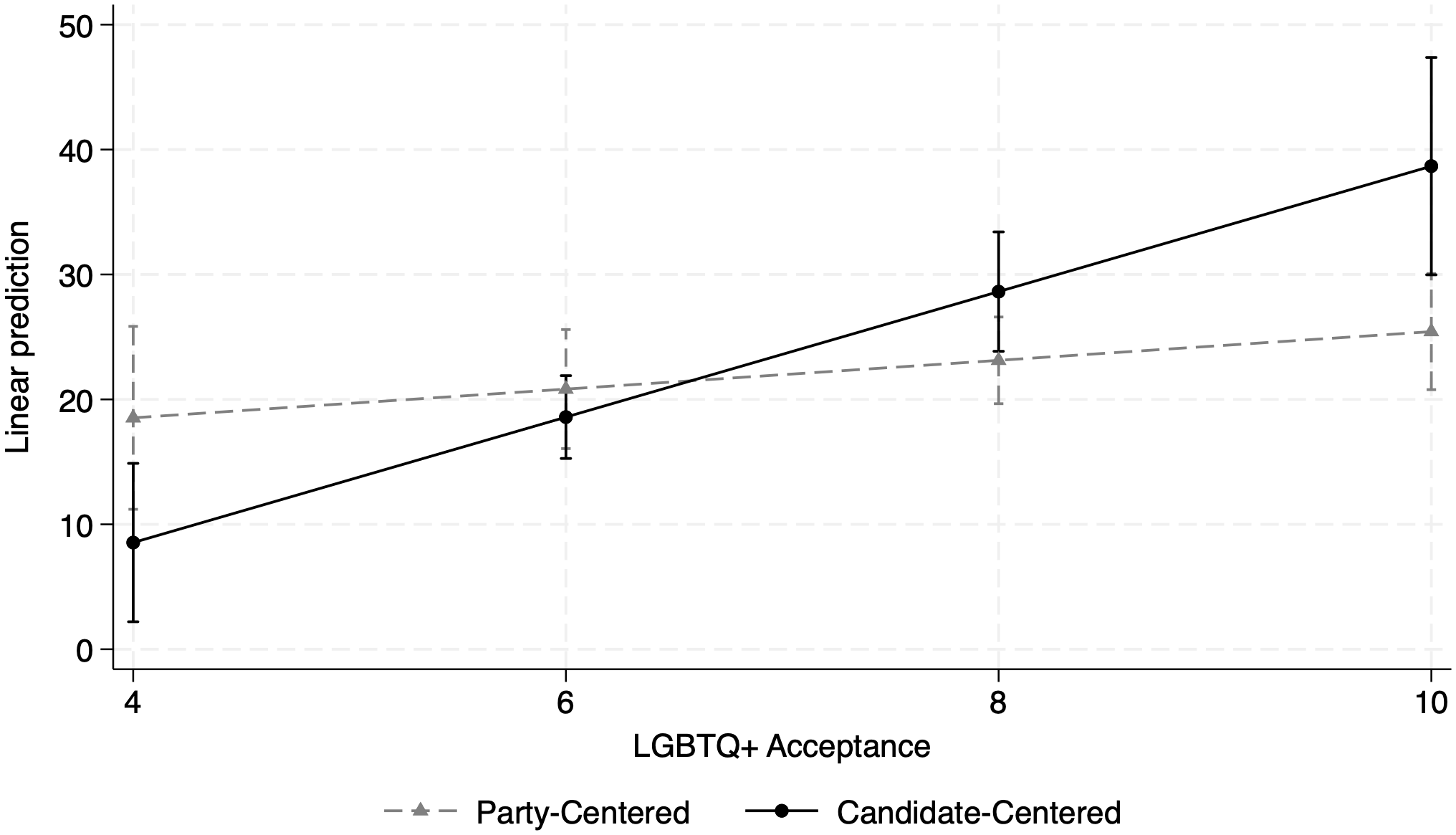
Table 5, which uses the adjusted Rainbow Index,Footnote 8 reports the results related to electoral systems. The first and second models (Figure 6) are not statistically significant. Contrary to Hypothesis H1a, the third model, which uses average district magnitude as an institutional variable, and Figure 7 suggests that the more proportional the system, the weaker the positive impact of social constructions. The fourth model, which employs electoral threshold as the institutional variable, indicates that the marginal effect of LGBTQ+ acceptance on the Rainbow Index is larger in more proportional systems (i.e., when the electoral threshold is lower), as illustrated in Figure 8. However, this interaction effect is not statistically significant and should therefore be interpreted with caution. Finally, as shown in Figure 9, although party-centered systems are generally associated with higher overall levels of LGBTQ+ rights, the moderating effect of social constructions is stronger in candidate-centered systems, contrary to Hypothesis H3b.
Interactive effects between social constructions and PR/Mixed with 95% CIs.
Interactive effects between social constructions and average magnitude with 95% CIs.
Interactive Effects between social constructions and electoral threshold with 95% CIs.
Interactive effects between social constructions and party/candidate-centered system with 95% CIs.
In addition, to assess whether the partisan composition of the cabinet moderates the relationship between public perceptions and LGBTQ+ rights, I conducted an additional analysis including an interaction term between social construction and partisan composition (Refer to Appendix A.4). The interaction effect is statistically insignificant and substantively small across predictive margins. These findings suggest that, in this context, partisan alignment does not meaningfully condition the effect of public attitudes on policy outputs.
Conclusion
This study contributes to the literature by developing a conditional theory of LGBTQ+ rights in terms of public demand being shaped by both public opinion (or social constructions) and issue salience. While the study uses existing datasets (e.g., Rainbow Index, GAI, and Google Trends), it offers a novel integration of these measures and applies them to construct and test a theory. The findings show that positive social constructions are correlated with more inclusive LGBTQ+ rights across countries, and the positive impact of issue salience on LGBTQ+ rights is observed only in countries with positive social constructions. Furthermore, the moderating role of electoral institutions is mixed: lower electoral thresholds may enhance the impact of public support, but the effect of proportionality is less consistent.
However, when explaining policy changes via social constructions, the concept of “social construction” – (1) related to a group of people rather than an issue, (2) a social or cultural construct made by the general public rather than a subset of people, and (3) therefore more stable and resistant to change (though changeable in the long term) – faces criticism due to its inherent traits. The concept may overlook dynamics of sub-groups in society and changes in relatively short-run, such as backlash from conservative groups. As LGBTQ+ rights have become more advocated in many societies, the backlash against LGBTQ+ individuals or policies has also become more prevalent in many countries.
This concern is especially timely in light of recent political developments. In several European countries such as France (RN), Germany (AfD), Austria (FPÖ), the Netherlands (PVV), and Italy (FdI), electoral gains by radical right populist parties have coincided with policy proposals aimed at restricting LGBTQ+ rights. Although this manuscript does not investigate the subset of society and supply-side mechanisms, these could be future projects. Previous literature has found no evidence of a negative reaction to marriage equality from the general population, individuals inclined to harbor negative views toward gays and lesbians, or those with psychological characteristics that might predispose them to react negatively (Bishin et al. Reference Bishin, Hayes, Incantalupo and Anthony Smith2016). However, the findings on issue salience suggest the possibility of backlash against LGBTQ+ individuals in response to policy developments, as well as shifts in public support for LGBTQ+ populations or related policies.
This study also contributes to broader debates on responsiveness and the substantive representation of marginalized groups. When politicians focus on a salient issue, it is considered not only effective and efficient for their reelection motivations, but also democratic in terms of responsiveness. However, as this study shows, issue salience is not always conducive to the substantive representation of marginalized groups. In some contexts, issue “silence” rather than issue salience could provide an opportunity for socially marginalized groups to advance their controversial policy goals. Concerning the substantive representation of socially marginalized groups, the relationship between responsiveness and representation may be more contentious than with other groups.
Moreover, while this study focuses on LGBTQ+ politics, the theoretical framework may be extended to other marginalized groups that share similar structural and symbolic characteristics – such as relatively small population size, a history of negative social constructions, increasing public visibility, and variable issue salience. For example, individuals with mental health conditions may exhibit similar dynamics in how social attitudes evolve and how policy responsiveness unfolds in different institutional contexts. However, this generalizability is conditional. Scope conditions such as group size, internal cohesion, and clarity of group identity are likely to shape how effectively public perceptions are translated into policy outputs. These reflections contribute to broader discussions on the substantive representation of marginalized groups and the role of intersectionality in shaping how group identities are recognized and institutionalized in policymaking processes.
However, this study has several limitations in its theory and empirical test. First, while this study emphasizes the effect of public attitudes – measured through social constructions and issue salience – on policy outputs, I acknowledge that the causal relationship may also operate in the reverse direction. A growing body of research suggests that inclusive policies may influence public support for LGBTQ+ populations by increasing their visibility, legitimacy, and perceived social acceptance (Abou-Chadi and Finnigan Reference Abou-Chadi and Finnigan2019; Flores and Barclay Reference Flores and Barclay2016). This study does not establish a causal direction and should therefore be interpreted as correlational. Nevertheless, recognizing this bidirectionality adds nuance to the theoretical framework and underscores the complex dynamics between democratic responsiveness and the substantive representation of marginalized groups.
Second, there are measurement issues with the key independent variables. For social constructions of LGBTQ+, I use the GAI acceptance index (Flores Reference Flores2019), which is generated by merging different sets of survey data questioning people’s attitudes toward LGBTQ+ populations. However, it would be great if we can distinguish people’s attitudes toward subsets of LGBTQ+ groups and analyze different attitudes and different policy outputs since people tend to be more hostile toward transgender individuals than gays and lesbians (Magni and Reynolds Reference Magni and Reynolds2021). Concerning issue salience, I relied on Google Trends data, which does not provide the original search frequency values but instead offers a relative value within the sample. Consequently, it may be biased due to this measurement issue.
Additionally, the external validity of the study may be a concern. Although this study focuses on European countries, it may have the potential to be applied in other contexts, such as democracies in different continents, given that its logic relies on democratic responsiveness. However, I expect that the visibility of LGBTQ+ populations in those regions could be lower compared to European countries, possibly due to cultural or religious reasons. Consequently, it might be challenging for these countries to bring up LGBTQ+ issues in their legislatures as an agenda.
Supplementary material
The supplementary material for this article can be found at https://doi.org/10.1017/S0143814X2510072X
Data availability statement
Replication materials are available in the Journal of Public Policy Dataverse at https://doi.org/10.7910/DVN/WQHAJI
Acknowledgements
I would like to thank my dissertation advisor for her invaluable support and guidance throughout this project. I am also grateful to my dissertation committee and to the participants at the Women in Legislative Studies Annual Conference (October 2023) and the APSA (American Political Science Association) Annual Meeting in Philadelphia (September 2024) for their thoughtful feedback. I further thank the anonymous reviewers for their helpful suggestions.
Funding statement
There is no funding source to report for this manuscript.
Competing interests
There is no conflict of interest to report for this manuscript.



 Open access

