


Despite ample evidence for the efficacy of antidepressant medications and structured forms of psychotherapy, a series of international studies have documented the modest rates of recognition and effective treatment attained in primary care for people suffering from depression (Reference Thornicroft and SartoriusThornicroft & Sartorius, 1993; Reference Lepine, Gastpar and MendlewiczLepine et al, 1997; Reference Simon, Goldberg and TiemensSimon et al, 1999). A manifest implication of these findings is that depression contributes heavily to estimates of national and global burden of disease (Reference Vos and MathersVos & Mathers, 2000). However, assessment of the economic consequences of depression via cost-of-illness studies at the population level (Reference Kind and SorensenKind & Sorensen, 1993; Reference Rice and MillerRice & Miller, 1995) or clinical trials at the individual level (Reference Lave, Schulberg and KamletLave et al, 1998; Reference Simon, Von Korff and BarlowSimon et al, 1995; Reference Simpson, Corney and FitzgeraldSimpson et al, 2000) have been restricted largely to industrialised countries to date. Thus, there remains a paucity of information on the economic consequences of depression in an international context, including patterns of resource consumption, its effect on labour participation and the impact of comorbidity on work loss or health care needs.
METHOD
The overall aim of the Longitudinal Investigation of Depression Outcomes (LIDO) study was to assess associations between quality of life and economic and depression outcomes, based on a multi-national national observational study with a prospective cohort of primary care patients with depression (Reference Herrman, Patrick and DiehrHerrman et al, 2002). The specific objectives of the economic dimension of the LIDO study were: to develop a research method for collection of individual service utilisation and costs data, and site-level socio-demographic and service profiles; to describe and compare service utilisation and cost differences within and between sites; and to explore site-specific and cross-cultural relationships between service costs, depression symptoms, quality of life and functioning. Further description of the methods used and examination of the longitudinal relationship between costs, depression and treatment are reported elsewhere (Reference Chisholm, Amir and FleckChisholm et al, 2001a ). The focus of the present paper is a cross-sectional baseline analysis of costs, depression status and comorbidity. This takes advantage of the larger sample of subjects who met the initial eligibility criteria (depressive symptoms at baseline assessment) but who did not form part of the longitudinal investigation of cases meeting the full DSM–IV (American Psychiatric Association, 1994) criteria for major depressive disorder (see Reference Simon, Chisholm and KnappSimon et al, 2002).
Sampling strategy
Patients attending primary care clinics in six participating sites (Be'er Sheva, Israel; Barcelona, Spain; Porto Alegre, Brazil; Melbourne, Australia; St Petersburg, Russia; Seattle, WA, USA) were approached systematically in person by the primary care physician, clinic or research staff and invited to complete a screening assessment package, which was scored for initial eligibility (a score of 16 or greater on the Center for Epidemiologic Studies – Depression rating scale, CES–D; Reference RadloffRadloff, 1977). In order to undertake subgroup analyses of gender differences, booster sampling of men was carried out in each site (a target quota of one-third of recruited subjects). Written informed consent was obtained from participating subjects following a description of the study. For patients meeting the initial eligibility criteria, a baseline assessment was conducted that included administration of a depression diagnostic instrument (Composite International Diagnostic Interview, version 2.1, CIDI; Reference Weiller, Lecrubier and MaierWeiller et al, 1994) and other measures of socio-demographic status and service contact. Patients with a chronic medical or psychiatric comorbid condition were eligible, but those with a known organic or major psychiatric disorder (dementia, psychosis, bipolar disorder) were excluded. A concurrent conditions checklist was used to identify subjects with one or more out of 12 major chronic medical conditions (Reference Wells, Rogers and BurnamWells et al, 1991), comorbid anxiety was assessed via the Hopkins Symptom Checklist (SCL–90, with a cut-off score of 1.7; Reference Derogatis, Rickels and RockDerogatis et al, 1976) and high alcohol use was defined as at least 21 units/week for men, 14 units/week for women or at least six drinks on a single occasion in the previous month. Functional status was assessed using the 12-item Short Form Health Survey (SF–12) physical component score (Reference Ware, Kosinski and KellerWare et al, 1995). Patients receiving treatment for depression currently or in the previous 3 months were excluded from the study, so that the reference population for the analysis is that of currently untreated cases of depression seen in primary care.
Principles and processes of service costing
Measurement of resource use was carried out via the administration of a service receipt schedule adapted specifically for use in this project from the Client Service Receipt Inventory (CSRI; Reference Chisholm, Knapp and KnudsenChisholm et al, 2001b ). A range of primary care, psychiatric, social and general medical services was identified that gave a comprehensive profile of potential service receipt for the patient population in the six sites (Reference Chisholm, Amir and FleckChisholm et al, 2001a ). The three main categories of service contact were: primary care and out-patient services, which covered the frequency and average duration of contacts with primary care or mental health care professionals; day care services, provided to several patients at a time and usually offering a combination of treatment for problems related to mental illness; and in-patient hospital services services, incorporating both psychiatric and general medical admissions.
A set of unit-cost templates was developed for computing the cost of services provided by both individual professionals and facilities. Site-specific unit costs for each service are listed in Table 1. Site-specific service costs were then converted into a common currency via purchasing-power parities (World Bank, 2000), which enables direct comparison of costs using the same metric (international dollars). In this paper, we primarily report cost results in national currency units because the focus is more on site-specific rather than pooled relationships.
Site-specific unit costs of services

| Service category | Measurement unit | Site-specific unit costs (local currencies) | |||||
|---|---|---|---|---|---|---|---|
| Barcelona (peseta) PPP=129.5 | Be'er Sheva (shekel) PPP=3.6 | Melbourne (Australian $) PPP=1.4 | Porto Alegre (real) PPP=0.8 | Seattle (US $) PPP=1.0 | St Petersburg (rouble) PPP=2.8 | ||
| Primary care provider (GP, family doctor) | 10 min of direct contact | 830 | 53 | 25 | 15 | 28 | 2 |
| Other primary health care worker (nurse) | 10 min of direct contact | 680 | 13 | 9 | 9 | 10 | 1 |
| Psychiatrist | 10 min of direct contact | 860 | 29 | 33 | 15 | 22 | 2 |
| Psychologist/therapist | 10 min of direct contact | 840 | 16 | 82 | 8 | 13 | NA |
| Other mental health worker (e.g. MH nurse) | 10 min of direct contact | 670 | 13 | 8 | 9 | 11 | NA |
| Other specialist physician/consultant | 10 min of direct contact | 830 | 160/visit | 32.50 | 15 | 30 | 2 |
| Day hospital (physical health) | Day's attendance | 22 132 | 771 | 119 | 70 | 125/h | 46.5 |
| Day hospital (mental health) | Day's attendance | 17 605 | 165 | NA | 70 | 248 | 31.5 |
| Day care (community mental health) | Day's attendance | 5636 | 140 | 81 | 70 | 152 | NA |
| Psychiatric hospital ward | In-patient day | 12 636 | 363 | NA | NA | 432 | 57 |
| Psychiatric ward of general hospital | In-patient day | 21 879 | 1033 | 297 | 95 | 584 | 42 |
| Medical ward of general hospital | In-patient day | 28 559 | 1389 | 583 | 208 | 824 | 21 |
| Emergency ward (non-psychiatric) | Attendance | 14 257 | 436 | 100 | 29 | 150 | 31 |
Lost opportunities for employment were assessed via self-reported days absent from work. The costs of lost employment were estimated by multiplying days absent from work by the local wage rate for the occupational category of the patient. Other indirect costs, such as reduced productivity while at work or informal care support, were not collected in this study because of expected measurement difficulties at the international level.
Analysis
The sampled population in each site was split into four groups: (A) subclinical depression (CES–D score > 16) but no medical comorbidity; (B) subclinical depression (CES–D score > 16) with medical comorbidity; (C) clinical depression (CIDI positive) but no medical comorbidity; (D) clinical depression (CIDI positive) with medical comorbidity. This enabled us to test four hypotheses: that individuals with clinical depression consume more resources and have greater absence from work than those with subclinical depression, either discrete/non-comorbid (C > A) or comorbid (D > B); and that medical comorbidity has a cost-raising influence on health care use or work loss, for both subclinical depression (B > A) and clinical depression (D >C).
Total health care costs were made up of three categories: mental health out-patient costs (contact with a psychiatrist, psychologist or other mental health worker, and attendance at a day care programme); general medical out-patient visits (primary care doctor, non-mental health specialist physician or other health care worker such as a nurse practitioner, plus day hospital attendance for physical health problems); and general medical in-patient care (psychiatric admission in the 3 months prior to baseline would have excluded the subject from the study). Costs of out-patient services were adjusted for the average duration of visits.
Analyses of variance (with the Scheffé test for pairwise comparisons) and chi-squared test statistics were used for testing bivariate mean and proportional differences between the four analytical groups A–D, respectively. Owing to the skewed distribution of cost data, confidence intervals for means were derived using bootstrapping, a non-parametric approach that avoids strong distributional assumptions by employing large numbers of re-sampling computations (Reference Efron and TibshiraniEfron & Tibshirani, 1993). In order to adjust for key socio-demographic and clinical characteristics, total costs of health care were subsequently entered into a linear regression analysis in each site (using age, gender, marital status, education and employment as covariates alongside CIDI depression status, and dummy variables for comorbid anxiety and high alcohol use as well as chronic medical illness). A variety of different model specifications were fitted, including ordinary least squares (OLS), with both an untransformed and log-transformed dependent variable, and also generalised linear modelling with a gamma error distribution and a log-link function. Our chosen model specification was an OLS regression with the log of total service cost (+1, to avoid zero values for cost), which satisfied distributional assumptions (as well as homoscedasticity and independence), provided slightly improved explanatory power and allowed simplified inter-site comparison in terms of proportionate effects of specified variables on service costs (Reference Diehr, Yanez and AshDiehr et al, 1999; Reference Knapp, Chisholm and LeeseKnapp et al, 2002).
RESULTS
Clinical characteristics of the sampled population
Across the six participating sites, a total of 18 489 screens were carried out among primary care attendees, of whom 4662 (25%) met the study eligibility criteria (CES–D > 16, and not treated in the previous 3 months). Out of the 13 827 non-eligible screened subjects, 63% had a CES–D score < 16, 10% were already being treated for depression and 2% expected to be moving away within the next year. Half of the eligible population agreed to participate in the study, giving a baseline study sample of 2359 primary care patients with untreated depression. Administration of the CIDI diagnostic interview revealed that 1193 subjects met the full DSM–IV diagnostic criteria for major depressive disorder (here-after referred to as ‘clinical depression’), whereas 166 subjects did not meet these criteria but nevertheless had depressive symptoms (‘subclinical depression’). The mean CES–D scores for the two groups were 29.9 (s.d.=10.8) and 17.1 (s.d.=8.7), respectively, which is a clinically and statistically significant difference (t=31.6; P < 0.001). Further splitting of the depression sample according to medical comorbidity status revealed that the largest proportion of cases belonged to the category of comorbid clinical depression (group D; an inter-site range of 21–43%), followed by comorbid subclinical depression (group B; 21–35%), non-comorbid subclinical depression (group A; 12–28%) and non-comorbid clinical depression (group C; 11–25%).
Socio-demographic characteristics of the sampled population
Comparison of the socio-demographic characteristics of the sampled populations who met the eligibility criteria for the study in each site is given in Table 2. The mean age of subjects was close to 40 years in each site except for St Petersburg, where the mean was 47 years (s.d.=16.2). Subjects with comorbid depression were appreciably older than those with non-comorbid depression, as were those with subclinical as opposed to clinical depression. The average number of years of schooling for the total sample in each site ranged from 9.3 (s.d.=3.4) in Porto Alegre to 13.7 (s.d.=2.9) in St Petersburg; in all six sites, subjects with comorbid clinical depression had fewer years of schooling. The striking similarity with respect to the gender of the sampled populations – in each of the six sites, women constituted two-thirds to three-quarters of the sample – is an artefact of the booster sampling of male attenders. The proportion of subjects who were married ranged from one-quarter in Melbourne to two-thirds in Be'er Sheva, but in all but the latter site, the subjects with clinical depression were more likely to be unmarried. The proportion of study subjects in employment ranged from approximately 50% in Porto Alegre and St Petersburg to 67% in Seattle, with rates consistently lower among the comorbid groups.
Socio-demographic characteristics of sampled populations

| Variable | Be'er Sheva | Barcelona | Melbourne | Porto Alegre | Seattle | St Petersburg | ||||||
|---|---|---|---|---|---|---|---|---|---|---|---|---|
| n | Mean (s.d.) | n | Mean (s.d.) | n | Mean (s.d.) | n | Mean (s.d.) | n | Mean (s.d.) | n | Mean (s.d.) | |
| Age | ||||||||||||
| A. Subclinical depression, discrete | 104 | 37.9 (12.4) | 134 | 35.7 (12.8) | 85 | 35.0 (10.9) | 101 | 36.4 (13.0) | 66 | 36.1 (11.9) | 36 | 38.4 (16.3) |
| B. Subclinical depression, comorbid | 95 | 46.9 (15.7) | 124 | 51.0 (14.5) | 107 | 46.1 (16.3) | 82 | 46.1 (12.4) | 125 | 48.2 (15.8) | 107 | 50.9 (14.0) |
| C. Clinical depression, discrete | 75 | 34.5 (11.0) | 116 | 32.8 (10.4) | 87 | 32.1 (10.3) | 90 | 34.4 (11.5) | 68 | 33.5 (10.8) | 33 | 37.4 (14.1) |
| D. Clinical depression, comorbid | 109 | 44.6 (14.0) | 98 | 47.8 (14.2) | 158 | 41.2 (13.9) | 118 | 42.9 (14.1) | 107 | 43.1 (14.5) | 134 | 48.6 (16.6) |
| Total | 383 | 41.4 (14.3) | 472 | 41.5 (15.2) | 437 | 39.4 (14.3) | 391 | 39.9 (13.6) | 366 | 41.8 (15.0) | 310 | 47.0 (16.2) |
| F | 16.116* | 55.960* | 21.391* | 16.490* | 20.855* | 10.735* | ||||||
| Years of education | ||||||||||||
| A. Subclinical depression, discrete | 104 | 12.6 (2.3) | 134 | 11.1 (3.3) | 85 | 13.7 (3.1) | 101 | 9.7 (3.2) | 66 | 13.4 (2.1) | 36 | 14.4 (2.1) |
| B. Subclinical depression, comorbid | 95 | 12.0 (3.0) | 124 | 9.9 (3.9) | 107 | 11.6 (4.0) | 82 | 9.2 (3.6) | 125 | 13.5 (2.6) | 107 | 14.1 (2.8) |
| C. Clinical depression, discrete | 75 | 11.8 (2.4) | 116 | 10.7 (3.1) | 87 | 13.4 (3.8) | 90 | 9.5 (3.4) | 68 | 13.4 (1.9) | 33 | 14.0 (2.0) |
| D. Clinical depression, comorbid | 109 | 11.3 (2.8) | 98 | 9.6 (3.8) | 158 | 11.8 (12.4) | 118 | 8.9 (3.2) | 107 | 13.0 (2.2) | 134 | 13.0 (3.2) |
| Total | 383 | 11.9 (2.7) | 472 | 10.4 (3.6) | 437 | 12.4 (3.8) | 391 | 9.3 (3.4) | 366 | 13.3 (2.3) | 310 | 13.7 (2.9) |
| F | 4.679* | 4.860* | 8.833* | 1.207 | 1.077 | 4.091* | ||||||
| Female gender | ||||||||||||
| A. Subclinical depression, discrete | 104 | 60.6% | 134 | 71.6% | 85 | 69.4% | 101 | 78.2% | 66 | 63.6% | 36 | 58.3% |
| B. Subclinical depression, comorbid | 95 | 55.8% | 124 | 66.9% | 107 | 61.7% | 82 | 72.0% | 125 | 64.0% | 107 | 70.1% |
| C. Clinical depression, discrete | 75 | 69.3% | 118 | 77.6% | 87 | 63.2% | 90 | 78.9% | 68 | 66.2% | 33 | 66.7% |
| D. Clinical depression, comorbid | 109 | 63.3% | 98 | 67.3% | 158 | 65.8% | 118 | 72.0% | 107 | 72.9% | 134 | 79.1% |
| Total | 383 | 61.9% | 472 | 71.0% | 437 | 65.0% | 391 | 75.2% | 366 | 66.9% | 310 | 72.3% |
| ϰ2 | 3.429 | 4.098 | 1.413 | 2.248 | 2.547 | 7.380† | ||||||
| Married | ||||||||||||
| A. Sub-clinical depression, discrete | 104 | 71.2% | 134 | 48.5% | 85 | 31.8% | 101 | 42.6% | 66 | 56.1% | 36 | 50.0% |
| B. Subclinical depression, comorbid | 95 | 60.0% | 124 | 70.2% | 107 | 29.9% | 82 | 68.3% | 125 | 50.4% | 107 | 47.7% |
| C. Clinical depression, discrete | 75 | 62.7% | 116 | 45.7% | 87 | 19.5% | 90 | 48.9% | 68 | 47.1% | 33 | 39.4% |
| D. Clinical depression, comorbid | 109 | 71.6% | 98 | 61.2% | 158 | 24.7% | 118 | 53.4% | 107 | 42.1% | 134 | 43.3% |
| Total | 383 | 68.8% | 472 | 56.1% | 437 | 26.3% | 391 | 52.7% | 366 | 48.4% | 310 | 45.2% |
| ϰ2 | 4.563 | 19.245* | 4.290 | 12.699* | 3.524 | 1.245 | ||||||
| Employed | ||||||||||||
| A. Subclinical depression, discrete | 104 | 70.2% | 134 | 71.6% | 85 | 69.4% | 101 | 54.5% | 66 | 78.8% | 36 | 69.4% |
| B. Subclinical depression, comorbid | 95 | 52.6% | 124 | 41.1% | 107 | 57.0% | 82 | 40.2% | 125 | 59.2% | 107 | 47.7% |
| C. Clinical depression, discrete | 75 | 61.3% | 116 | 81.0% | 87 | 67.8% | 90 | 52.2% | 68 | 76.5% | 33 | 69.7% |
| D. Clinical depression, comorbid | 109 | 43.1% | 98 | 46.9% | 158 | 56.3% | 118 | 48.3% | 107 | 64.5% | 134 | 47.8% |
| Total | 383 | 56.4% | 472 | 60.8% | 437 | 61.3% | 391 | 49.1% | 366 | 67.5% | 310 | 52.6% |
| ϰ2 | 17.154* | 54.571* | 6.392† | 4.113 | 10.694* | 10.270* | ||||||
Rates and costs of resource utilisation
Table 3 provides a breakdown of the (unadjusted) rates of contact and costs of resource use across the six sites. Rates of contact between sites were 5–14% for mental health out-patient visits, 94–100% for general medical/primary care visits and 5–18% for in-patient admissions. Across the six sites, mean utilisation for the six sampled populations in the 3 months preceding baseline was 0.2–0.7 for mental health out-patient visits, 1.5–8.0 for medical out-patient or primary care attendances and 0.1–0.2 for in-patient days (not tabulated). Both the rate (%) and amount of contact were typically highest among subjects with clinical depression who had a medical and/or psychiatric comorbidity. The mean costs of this resource utilisation (for the sampled populations as a whole, not just service users) are reported in Table 3 (costs are expressed in national currencies, but can be converted into US dollars or other monetary units using the set of purchasing-power-parity conversion factors provided in Table 1). Focusing on total health care costs – similar findings are obtained for the three subcategories of resource cost – we find the following.
Rates and costs of resource utilisation (national currencies)

| Be'er Sheva (shekel) | Barcelona (peseta) | Melbourne (Australian $) | Porto Alegre (real) | Seattle (US $) | St Petersburg (rouble) | |||||||||||||
|---|---|---|---|---|---|---|---|---|---|---|---|---|---|---|---|---|---|---|
| n | Rate of contact | Mean cost (95% CI) | n | Rate of contact | Mean cost (95% CI) | n | Rate of contact | Mean cost (95% CI) | n | Rate of contact | Mean cost (95% CI) | n | Rate of contact | Mean cost (95% CI) | n | Rate of contact | Mean cost (95% CI) | |
| Mental health out-patient care visits | ||||||||||||||||||
| A. Subclinical depression, discrete | 104 | 3.8% | 25.7 | 134 | 6.7% | 594.7 | 85 | 17.6% | 54.4 | 101 | 8.9% | 25.3 | 66 | 4.5% | 19.5 | 36 | 5.6% | 3.7 |
| (0.9−74.2) | (190.6−1276) | (24.2−101.1) | (5.8−55.1) | (0.0−59.9) | (0.0−12.4) | |||||||||||||
| B. Subclinical depression, comorbid | 95 | 4.2% | 90.8 | 124 | 3.2% | 8716 | 107 | 7.5% | 36.5 | 82 | 3.7% | 8.5 | 125 | 4.8% | 82.1 | 107 | 3.7% | 0.2 |
| (0.2−309.7) | (41.0−31 860) | (4.7−103.9) | (0.0−23.1) | (3.0−228.1) | (0.0−0.5) | |||||||||||||
| C. Clinical depression, discrete | 75 | 8.0% | 14.7 | 116 | 5.2% | 206.1 | 87 | 14.9% | 39.4 | 90 | 12.2% | 43.3 | 68 | 14.7% | 56.5 | 33 | 6.1% | 23.3 |
| (2.2−39.6) | (47.9−468.8) | (10.9−95.9) | (10.7−99.2) | (12.4−152.1) | (0.0−88.7) | |||||||||||||
| D. Clinical depression, comorbid | 109 | 8.3% | 19.7 | 98 | 5.1% | 468.1 | 158 | 16.5% | 91.6 | 118 | 11.0% | 72.2 | 107 | 11.2% | 50.0 | 134 | 6.0% | 1.9 |
| (5.6−43.1) | (47.4−1455) | (43.6−161.9) | (29.0−142.3) | (21.9−86.6) | (0.3−5.4) | |||||||||||||
| Total | 383 | 6.0% | 38.0 | 472 | 5.1% | 2607 | 437 | 14.2% | 60.5 | 391 | 9.2% | 40.1 | 366 | 8.5% | 56.7 | 310 | 5.2% | 3.8 |
| (9.5−110.0) | (236.1−9261) | (36.2−90.7) | (22.8−65.4) | (26.2−108.8) | (0.7−10.3) | |||||||||||||
| F 1 | 0.591 | 0.884 | 1.047 | 1.756 | 0.402 | 2.639* (D<C)† | ||||||||||||
| General medical out-patient/primary care visits | ||||||||||||||||||
| A. Subclinical depression, discrete | 104 | 91.3% | 363.4 | 134 | 98.5% | 4107 | 85 | 100% | 201.1 | 101 | 96.0% | 136.8 | 66 | 100% | 319.6 | 36 | 94.4% | 22.4 |
| (278.2−480.6) | (3288−5325) | (147.5−292.5) | (102.3−184.6) | (250.5−395.5) | (15.0−33.5) | |||||||||||||
| B. Subclinical depression, comorbid | 95 | 97.9% | 934.2 | 124 | 96.8% | 10 006 | 107 | 100% | 349.8 | 82 | 95.1% | 151.0 | 125 | 99.2% | 569.5 | 107 | 92.5% | 26.6 |
| (543.5−1747.8) | (5071−20 449) | (281.9−434.2) | (105.4−227.3) | (447.8−720.8) | (21.6−32.8) | |||||||||||||
| C. Clinical depression, discrete | 75 | 90.7% | 727.7 | 116 | 99.1% | 14 788 | 87 | 98.9% | 209.6 | 90 | 95.6% | 150.7 | 68 | 100% | 356.5 | 33 | 90.9% | 33.7 |
| (485.0−1079) | (27 151−47 769) | (163.0−276.4) | (118.2−191.4) | (276.1−458.4) | (14.6−63.2) | |||||||||||||
| D. Clinical depression, comorbid | 109 | 96.3% | 939.3 | 98 | 99.0% | 14 385 | 158 | 100% | 297.5 | 118 | 94.9% | 229.9 | 107 | 99.1% | 600.7 | 134 | 97.8% | 44.5 |
| (725.9−1191) | (7479−29 753) | (254.9−351.2) | (181.5−289.6) | (470.3−760.3) | (27.3−70.2) | |||||||||||||
| Total | 383 | 94.3% | 740.2 | 472 | 98.3% | 10 416 | 437 | 99.8% | 274.0 | 391 | 95.4% | 171.1 | 366 | 99.5% | 494.0 | 310 | 94.8% | 34.6 |
| (595.7−956.8) | (5792−18 649) | (245.3−305.1) | (149.6−198.9) | (428.4−567.0) | (26.9−47.2) | |||||||||||||
| F 1 | 2.455† | 0.620 | 4.777*(B>A)* | 3.249* | 4.176*(B>A)† | 1.146 | ||||||||||||
| General medical in-patient care days | ||||||||||||||||||
| A. Subclinical depression, discrete | 104 | 8.7% | 676.2 | 134 | 3.7% | 1597 | 85 | 10.6% | 72.3 | 101 | 2.0% | 8.2 | 66 | 1.5% | 27.2 | 36 | 22.2% | 94.5 |
| (212.4−1336) | (212.8−4416.9) | (14.1−175.8) | (0.0−27.1) | (0.0−105.8) | (33.8−173.9) | |||||||||||||
| B. Subclinical depression, comorbid | 95 | 14.7% | 2079.0 | 124 | 5.6% | 6909 | 107 | 9.3% | 282.4 | 82 | 7.3% | 165.2 | 125 | 8.0% | 170.7 | 107 | 17.8% | 44.3 |
| (710.4−4632) | (1744−16 855) | (120.1−499.2) | (35.1−369.0) | (61.6−347.0) | (23.0−71.1) | |||||||||||||
| C. Clinical depression, discrete | 75 | 10.7% | 721.2 | 116 | 5.2% | 6278 | 87 | 6.9% | 83.9 | 90 | 4.4% | 50.8 | 68 | 0% | 0.0 | 33 | 12.1% | 22.6 |
| (254.9−1345) | (799−17 219) | (16.9−180.0) | (35.1−369.0) | (0.0−0.0) | (0.0−60.2) | |||||||||||||
| D. Clinical depression, comorbid | 109 | 9.2% | 928.8 | 98 | 15.3% | 17 192 | 158 | 15.8% | 328.8 | 118 | 6.8% | 41.5 | 107 | 11.2% | 242.1 | 134 | 18.7% | 55.3 |
| (315.3−1833) | (7878−31 286) | (130.4−667.5) | (11.6−82.6) | (96.2−452.9) | (33.2−86.8) | |||||||||||||
| Total | 383 | 10.7% | 1104.8 | 472 | 7.0% | 7381 | 437 | 11.4% | 218.8 | 391 | 5.1% | 61.0 | 366 | 6.3% | 134.0 | 310 | 18.1% | 52.6 |
| (646.9−1796) | (4229−11 718) | (133.1−340.2) | (27.2−107.8) | (72.6−219.1) | (37.6−70.2) | |||||||||||||
| F 1 | 1.369 | 2.755* | 1.519 | 2.537†(B>A)† | 2.504† | 1.526 | ||||||||||||
| Total health care | ||||||||||||||||||
| A. Subclinical depression, discrete | 104 | 92.3% | 1065 (605-1767) | 134 | 98.5% | 6299 (4465-9576) | 85 | 100% | 327.8 (237.8-453.7) | 101 | 97.0% | 170.3 (125.6-228.3) | 66 | 100% | 366.4 (277.5-486.6) | 36 | 94.4% | 120.6 (56.4-203.1) |
| B. Subclinical depression, comorbid | 95 | 97.9% | 3104 (1520-5991) | 124 | 96.8% | 25 631 (11 238-48 905) | 107 | 100% | 668.7 (474.8-919.7) | 82 | 95.1% | 324.7 (165.2-551.5) | 125 | 99.2% | 822.3 (601.1-1078) | 107 | 92.5% | 71.1 (50.0-10 1.3) |
| C. Clinical depression, discrete | 75 | 90.7% | 1464 (842-2275) | 116 | 99.1% | 21 272 (5104-57 331) | 87 | 98.9% | 332.9 (240.5-451.6) | 90 | 95.6% | 245.9 (169.1-371.6) | 68 | 100% | 421.6 (320.0-546.0) | 33 | 90.9% | 79.5 (36.1-142.8) |
| D. Clinical depression, comorbid | 109 | 96.3% | 1888 (1218-2865) | 98 | 99.0% | 32 046 (18 489-49 983) | 158 | 100% | 736.7 (511.6-1089) | 118 | 95.8% | 343.6 (271.3-429.8) | 107 | 99.1% | 892.8 (678.9-1193) | 134 | 97.8% | 106.1 (72.0-152.5) |
| Total | 383 | 94.5% | 1883 (1373-2584) | 472 | 98.3% | 20 403 (13 166-30 704) | 437 | 99.8% | 560.1 (454.3-704.2) | 391 | 95.9% | 272.4 (225.7-337.5) | 366 | 99.5% | 686.2 (580.0-811.6) | 310 | 94.8% | 92.9 (73.0-117.3) |
| F 1 | 2.093† | 1.593 | 3.066* | 2.277† | 4.990* | 0.959 | ||||||||||||
| Total for all cases (US $, PPP) | 523 | 158 | 400 | 340 | 686 | 33 | ||||||||||||
| Average per capita expenditure2 | 149% | 52% | 100% | 318% | 74% | 53% | ||||||||||||
-
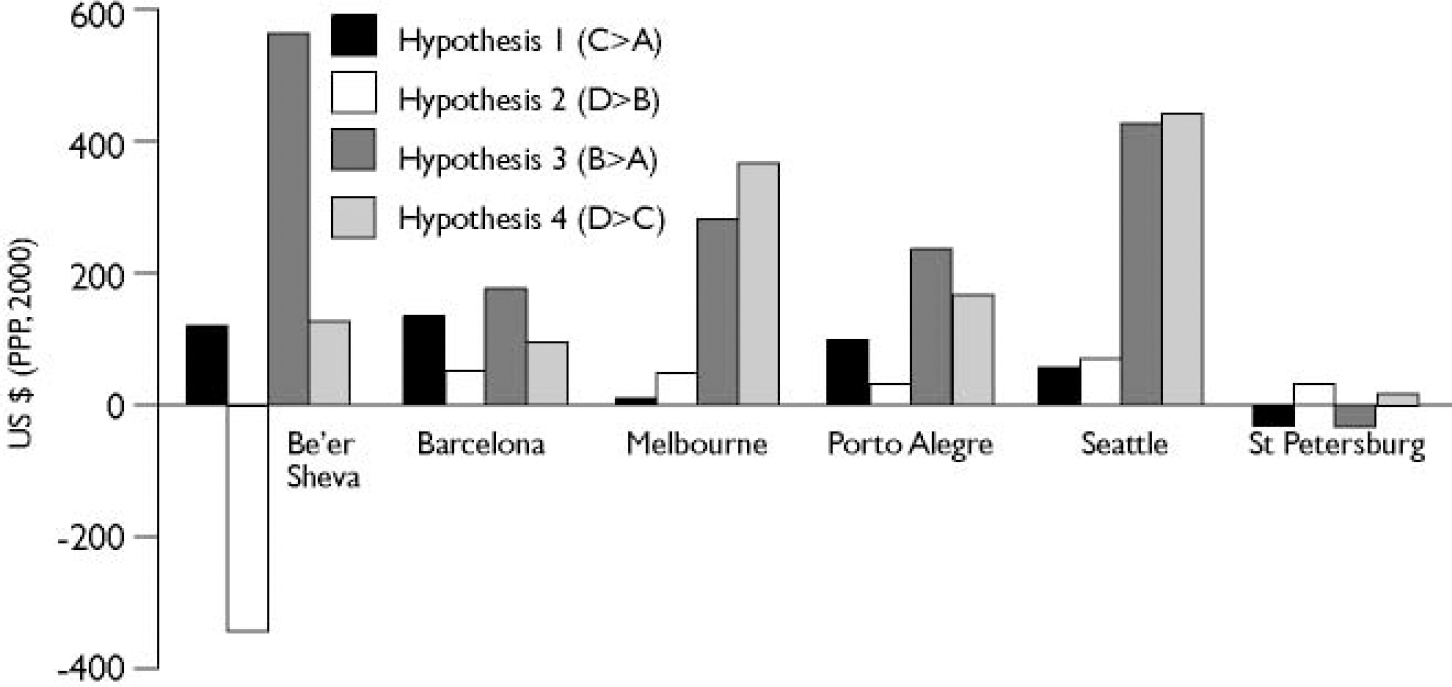
(a) Hypothesis 1 (C > A): Clinical depression is more costly than subclinical depression (no medical comorbidity). In all sites except St Petersburg costs are higher, most notably in Be'er Sheva and Porto Alegre (40% higher) and Barcelona (300%). However, none of these differences is statistically significant at the 5% level.
-
(b) Hypothesis 2 (D > B): Clinical depression is more costly than subclinical depression in comorbid cases. Costs are higher in five of the six sites (10–50%); in Be'er Sheva, costs are 40% lower. Again, these differences do not reach statistical significance.
-
(c) Hypothesis 3 (B > A): Comorbidity increases the costs of subclinical depression. In all sites except St Petersburg costs are appreciably higher: by a factor of 2 in Melbourne, Porto Alegre and Seattle, a factor of 3 in Be'er Sheva and a factor of 4 in Barcelona. Using the Scheffé test for pairwise comparisons, the difference or total health care costs reached statistical significance only in Seattle (and also in Melbourne for general medical out-patient costs).
-
(d) Hypothesis 4 (D > C): Comorbidity increases costs in clinical depression. Costs are considerably higher in all sites (over 100% higher in Melbourne and Seattle; 20–50% higher elsewhere). Again, the difference reached statistical significance only in Seattle.
An overview of the cost differences for each hypothesis and site is given in Fig. 1.
Differences in health care costs for the 3 months prior to baseline assessment (US $, purchasing power parity (PPP), 2000): (A) subclinical depression, discrete; (B) subclinical depression, comorbid; (C) clinical depression, discrete; (D) clinical depression, comorbid.
Rates and costs of work disability
Incidence of self-reported days absent from work ranged from 20% of cases in Porto Alegre to 55% in Seattle, whereas the average number of days taken off work in the previous 3 months ranged from 1.4 days (s.d.=5.6) in Porto Alegre to 7.6 days (s.d.=15.3) in St Petersburg (Table 4). By attaching site- and occupation-specific daily wage rates to work absences, an estimate (in human capital) of the costs of lost productivity can be obtained. This approach reveals that the monetary value accorded to these lost work days constitutes an appreciable element of the overall economic costs of depression. In five of the six study sites the cost of lost work days was some-what less than the total cost of health care, but nevertheless represented 15–40% of the total combined costs of health care and work loss. In the sixth site (Barcelona), lost work day costs were 75% greater than total health care costs.
Rates and costs of days absent from work

| Be'er Sheva (shekel) | Barcelona (peseta) | Melbourne (Australian $) | Porto Alegre (real) | Seattle (US $) | St Petersburg (rouble) | |||||||||||||
|---|---|---|---|---|---|---|---|---|---|---|---|---|---|---|---|---|---|---|
| % | Mean days (s.d.) | Mean cost (95% CI) | % | Mean days (s.d.) | Mean cost (95% CI) | % | Mean days (s.d.) | Mean cost (95% CI) | % | Mean days (s.d.) | Mean cost (95% CI) | % | Mean days (s.d.) | Mean cost (95% CI) | % | Mean days (s.d.) | Mean cost (95% CI) | |
| A. Subclinical depression, discrete | 33.7% | 3.2 | 951 | 32.1% | 2.5 | 34 305 | 35.3% | 2.7 | 372 | 23.8% | 1.0 | 36 | 54.5% | 4.2 | 487 | 33.3% | 6.9 | 0.0 |
| (8.1) | (516-1582) | (6.7) | (20 390-55 136) | (9.3) | (126-829) | (2.7) | (16-65) | (8.5) | (256-951) | (15.4) | (0.0-0.0) | |||||||
| B. Subclinical depression, comorbid | 34.7% | 3.2 | 733 | 13.7% | 1.3 | 19 715 | 21.5% | 1.0 | 117 | 13.4% | 1.5 | 47 | 49.6% | 5.6 | 641 | 28.0% | 7.7 | 19 |
| (9.5) | (295-1629) | (4.8) | (8987-36 70 1) | (2.5) | (60-201) | (7.3) | (9-123) | (13.5) | (386-1047) | (16.1) | (0.0-51) | |||||||
| C. Clinical depression, discrete | 45.3% | 7.8 | 1897 | 30.2% | 2.5 | 32 977 | 55.2% | 5.8 | 861 | 18.9% | 1.0 | 35 | 64.7% | 4.6 | 457 | 30.3% | 6.6 | 39 |
| (14.5) | (1171-2860) | (7.8) | (19 049-54 304) | (12.9) | (474-1396) | (2.8) | (15-63) | (8.2) | (283-699) | (14.1) | (0.0-156) | |||||||
| D. Clinical depression, comorbid | 26.6% | 2.9 | 679 | 27.6% | 3.6 | 48 904 | 24.1% | 2.8 | 316 | 21.2% | 2.0 | 67 | 54.2% | 5.0 | 420 | 37.3% | 7.9 | 36 |
| (8.1) | (365-1145) | (9.7) | (23 852-85 479) | (9.8) | (149-588) | (7.4) | (29-129) | (10.5) | (270-609) | (15.1) | (14-70) | |||||||
| Total | 34.2% | 4.0 | 1005 | 25.8% | 2.4 | 33 177 | 31.8% | 2.9 | 387 | 19.7% | 1.4 | 47 | 54.6% | 5.0 | 515 | 32.9% | 7.6 | 26 |
| (10.1) | (750-1351) | (7.3) | (24 765-43 912) | (9.4) | (259-534) | (5.6) | (30-71) | (10.9) | (389-658) | (15.3) | (11-46) | |||||||
| F 1 | 4.440* | 2.983* | 1.910 | 1.381 | 4.334* | 4.356* | 0.841 | 0.603 | 0.272 | 0.601 | 0.100 | 0.728 | ||||||
| (D<C)* | (D>C)† | (D>B)* | (D<C)† | (D<C)† | ||||||||||||||
With respect to the four subgroups, we found weak support for the hypothesised excess costs associated with clinical depression status: costs in the non-comorbid groups (Hypothesis 1: C > A) were similar in three of the sites but at least doubled in Be'er Sheva and Melbourne (difference not significant at the 5% level) and St Petersburg, whereas the costs in the comorbid groups (Hypothesis 2: D > B) were higher by a factor of 3 in Barcelona (Scheffé test: P < 0.05), Melbourne and St Petersburg but actually lower in Be'er Sheva and Seattle. The hypothesised increase in the number and cost of lost work days among those with comorbid depression was not supported by these data (Hypotheses 3 and 4: B > A; D > C). In Be'er Sheva and Melbourne, costs were in fact significantly lower in the comorbid groups (Scheffé test: P < 0.05).
Multivariate analysis
Six site-specific regression models were developed in order to assess the contribution of depression status and medical comorbidity towards excess costs of health care (Table 5). Using the natural logarithm of total health service cost as the dependent variable and controlling for key socio-demographic and clinical variables, we found a significant proportionate increase in cost attributable to being clinically depressed (as ascertained by the CIDI) in Porto Alegre (52%), a modest increase in Barcelona, Seattle and St Petersburg (4–18%) and a decrease in Be'er Sheva and Melbourne (4–16% less). With respect to medical comorbidity, there was a significant effect in Barcelona, Be'er Sheva, Melbourne and Seattle (costs increase by 24–46%) and a lesser effect in Porto Alegre (17% increase). In St Petersburg, costs were 15% lower in medically comorbid cases.
Multivariate regression models (dependent variable=log of total service cost)

| Constant term | Be'er Sheva | Barcelona | Melbourne | Porto Alegre | Seattle | St Petersburg | |
|---|---|---|---|---|---|---|---|
| 8.166 (6.497 to 9.834) | 10.566 (9.187 to 11.946) | 6.603 (5.557 to 7.649) | 5.578 (4.152 to 7.004) | 7.394 (6.241 to 8.547) | 5.994 (4.293 to 7.696) | ||
| Socio-demographic variables | |||||||
| Age | β | 0.003 (−0.014 to 0.021) | −0.0085 (−0.024 to 0.007) | −0.0049 (−0.015 to 0.005) | −0.008 (−0.021 to 0.005) | −0.011* (0.022 to −0.001) | −0.0057 (−0.019 to 0.008) |
| Exp (β) | 1.003 (0.986 to 1.021) | 0.992 (0.976 to 1.007) | 0.995 (0.985 to 1.005) | 0.992 (0.979 to 1.005) | 0.989 (0.978 to 0.999) | 0.994 (0.981 to 1.008) | |
| Years of education | β | 0.042 (−0.043 to 0.126) | 0.0182 (−0.031 to 0.068) | −0.00002 (−0.038 to 0.038) | 0.008 (−0.039 to 0.056) | −0.012 (−0.071 to 0.047) | 0.0005 (−0.063 to 0.064) |
| Exp (β) | 1.043 (0.958 to 1.134) | 1.018 (0.969 to 1.070) | 1.0 (0.963 to 1.039) | 1.008 (0.961 to 1.058) | 0.988 (0.931 to 1.048) | 1.001 (0.939 to 1.066) | |
| Gender | β | 0.006 (−0.433 to 0.445) | −0.492* (−0.870 to −0.114) | 0.225 (−0.062 to 0.511) | 0.531* (0.142 to 0.921) | −0.232 (−0.524 to 0.060) | −0.06 (−0.461 to 0.339) |
| (0=female; 1=male) | Exp (β) | 1.006 (0.648 to 1.561) | 0.611 (0.419 to 0.892) | 1.252 (0.940 to 1.668) | 1.701 (1.153 to 2.511) | 0.793 (0.592 to 1.062) | 0.941 (0.630 to 1.403) |
| Marital status (0=single; 1=married/other) | β | 0.158 (−0.330 to 0.646) | −0.109 (−0.473 to 0.255) | −0.0068 (−0.309 to 0.296) | 0.123 (−0.193 to 0.440) | 0.066 (−0.205 to 0.336) | 0.257 (−0.102 to 0.615) |
| Exp (β) | 1.171 (0.719 to 1.907) | 0.897 (0.623 to 1.290) | 0.993 (0.734 to 1.344) | 1.131 (0.824 to 1.553) | 1.068 (0.815 to 1.399) | 1.293 (0.903 to 1.850) | |
| Employment | β | −0.475† (−0.956 to 0.006) | −0.0021 (−0.394 to 0.390) | 0.053 (−0.229 to 0.334) | 0.296† (−0.043 to 0.635) | −0.152 (−0.464 to 0.159) | 0.428* (0.007 to 0.850) |
| (0=employed; 1=other) | Exp (β) | 0.622 (0.384 to 1.006) | 0.998 (0.674 to 1.477) | 1.054 (0.796 to 1.397) | 1.345 (0.958 to 1.887) | 0.859 (0.629 to 1.173) | 1.535 (1.007 to 2.340) |
| Clinical variables | |||||||
| CES to D | β | −0.0008 (−0.025 to 0.023) | 0.0036 (−0.016 to 0.023) | 0.007 (−0.008 to 0.022) | 0.0009 (−0.017 to 0.018) | −0.0017 (−0.017 to 0.014) | −0.007 (−0.028 to 0.013) |
| Exp (β) | 0.999 (0.976 to 1.023) | 1.004 (0.984 to 1.024) | 1.007 (0.992 to 1.023) | 1.004 (0.984 to 1.019) | 0.998 (0.983 to 1.014) | 0.993 (0.973 to 1.013) | |
| CIDI status | β | −0.0394 (−0.545 to 0.467) | 0.144 (−0.270 to 0.558) | −0.168 (−0.476 to 0.140) | 0.418* (0.042 to 0.795) | 0.037 (−0.294 to 0.367) | 0.163 (−0.224 to 0.551) |
| Exp (β) | 0.961 (0.580 to 1.594) | 1.155 (0.763 to 1.747) | 0.845 (0.621 to 1.151) | 1.519 (1.043 to 2.214) | 1.037 (0.745 to 1.444) | 1.177 (0.551 to 1.735) | |
| Comorbid anxiety | β | −0.331 (−1.050 to 0.388) | −0.088 (−0.676 to 0.500) | 0.085 (−0.274 to 0.444) | −0.056 (−0.514 to 0.402) | 0.390† (−0.008 to 0.789) | 0.231 (−0.293 to 0.755) |
| Exp (β) | 0.718 (0.350 to 1.474) | 0.916 (0.509 to 1.648) | 1.089 (0.760 to 1.559) | 0.946 (0.598 to 1.495) | 1.477 (0.992 to 2.200) | 1.260 (0.746 to 2.127) | |
| Comorbid alcohol | β | 0.342 (−1.383 to 2.066) | 0.117 (−0.620 to 0.853) | −0.087 (−0.390 to 0.216) | −0.273 (−0.717 to 0.172) | −0.429* (−0.853 to −0.006) | −0.179 (−1.004 to 0.647) |
| Exp (β) | 1.407 (0.251 to 7.891) | 1.124 (0.538 to 2.348) | 0.917 (0.677 to 1.242) | 0.761 (0.488 to 1.188) | 0.651 (0.426 to 0.994) | 0.836 (0.366 to 1.909) | |
| Comorbid chronic medical illness | β | 0.335 (−0.130 to 0.799) | 0.378† (−0.008 to 0.764) | 0.210† (−0.097 to 0.517) | 0.159 (−0.186 to 0.504) | 0.345* (0.039 to 0.652) | −0.161 (−0.612 to 0.290) |
| Exp (β) | 1.397 (0.878 to 2.222) | 1.459 (0.992 to 2.147) | 1.234 (0.907 to 1.677) | 1.172 (0.830 to 1.656) | 1.412 (0.652 to 1.919) | 0.851 (0.542 to 1.336) | |
| SF to 12 physical score | β | −0.0693* (−0.089 to −0.050) | −0.051* (−0.067 to −0.035) | −0.034* (−0.046 to −0.022) | −0.036* (−0.055 to −0.017) | −0.025* (−0.038 to −0.013) | −0.07* (−0.093 to −0.048) |
| Exp (β) | 0.933 (0.915 to 0.952) | 0.950 (0.936 to 0.965) | 0.967 (0.955 to 0.978) | 0.965 (0.947 to 0.983) | 0.975 (0.963 to 0.987) | 0.932 (0.911 to 0.953) | |
| R 2 | 0.210 | 0.127 | 0.120 | 0.107 | 0.119 | 0.133 | |
| Adjusted R 2 | 0.182 | 0.106 | 0.095 | 0.080 | 0.090 | 0.101 | |
| F | 7.736* | 5.906* | 4.894* | 3.949* | 4.154* | 4.170* |
A range of other factors had an impact on costs but the only consistent finding was for the physical component score of the SF–12, which showed a statistically significant negative relationship in all sites, reflecting a lowering of costs as the score decreases towards no physical illness. Psychiatric comorbidity had a discernible effect in Seattle – anxiety increased costs by nearly 50%, whereas high alcohol use reduced costs by 35% – but elsewhere had no significant or consistent influence. Overall, the multivariate models had quite low explanatory power (adjusted R2 values were 8–18%) and provided no consistent cost relationships across all sites other than the medical comorbidity and physical illness score.
DISCUSSION
Depression status, medical comorbidity and resource costs
In view of previous international studies indicating the high prevalence, enduring disability and undertreatment of depression in primary care (Reference Thornicroft and SartoriusThornicroft & Sartorius, 1993; Reference Lepine, Gastpar and MendlewiczLepine et al, 1997; Reference Simon, Goldberg and TiemensSimon et al, 1999), the LIDO study was undertaken to explore the cross-sectional and longitudinal relationship between depression symptoms, quality of life and economic outcomes in a number of diverse cultural settings. Using the baseline assessments of all subjects with depression who met the initial eligibility criteria, this paper addressed the question of whether depression severity or medical comorbidity are associated with higher health care costs and absence from work. By excluding those not currently treated for depression, we focused on the use of general medical services rather than the costs of depression treatment. Our primary finding is that, across the six international study sites, unadjusted levels and associated costs of resource utilisation and work disability show a clear (but often statistically non-significant) tendency to be higher in clinical v. subclinical depression and in medically comorbid v. discrete depression. Controlling for the effect of key socio-demographic and relevant clinical characteristics via site-specific regression analyses confirmed that medical comorbidity was associated with a 17–46% increase in health care costs in five of the six sites. However, such a clear positive association was not observed in relation to costs and clinical depression status. A potential explanation for the latter finding is that study subjects may not have met the full diagnostic criteria for major depressive disorder for the whole 3-month retrospective cost period, whereas by definition the presence of a chronic medical illness is less subject to fluctuation over time. In addition, the large amount of unexplained variance reduces our ability to detect differences associated with depression or medical comorbidity.
Our findings are consistent with earlier studies that showed a strong association between depression and medical or physical comorbidity. For example, an earlier analysis of health care costs among primary care patients with recognised depression in one of the study sites (Seattle) found that on a multiplicative (logarithmic) scale depression was associated with a 50–75% increase in health service costs at all levels of medical comorbidity (Reference Simon, Von Korff and BarlowSimon et al, 1995). A number of studies have also demonstrated the influence of psychiatric comorbidity on the service utilisation rates of people with depression, including an analysis of the US National Co-morbidity Survey, which showed that having a comorbid (alcohol or non-alcohol) disorder was associated with an increased likelihood of service utilisation (Reference Wu, Kouzis and LeafWu et al, 1999). In the sampled populations that made up the LIDO study, however, we did not find a consistent trend in terms of the impact of psychiatric comorbidity on costs. This may be attributable in part to the limited measurement of these comorbidities in the present study.
Economic burden of untreated depression in primary care
An important outcome of this research has been the generation of detailed resource utilisation and costs data in a number of culturally diverse primary care settings, based on a common methodology and accompanying protocol. Such data are not only valuable within the national contexts of participating study sites, but are also potentially informative at an international level of comparison. Using purchasing-power parities to convert total health care consumption per subject into US dollars, for example, reveals that the economic burden of currently untreated depression in primary care either approaches or exceeds average per capita health care expenditures (World Health Organization, 2001) in four of the six study sites. This economic burden is substantially increased if the cost of lost work days is also included; 3.7 work days on average (inter-site range: 1.5–8.0) were lost for the total baseline sample in the 3-month period prior to baseline assessment, at a converted cost of $225 per subject. In addition to these whole days of lost work, but not measured here, so-called ‘cut-back days’ are a further important source of lost productivity in the working population (Reference Kessler and FrankKessler & Frank, 1997). These estimates may diverge from that estimated for a population of treated primary care attenders; however, the follow-up of these subjects at 9 months suggests that costs remain quite similar overall (additional depression-specific treatment costs are offset by reduced work days lost and health care consultations), in part because only a modest proportion of subjects received treatment (Reference Simon, Chisholm and KnappSimon et al, 2002).
Health system disparities and the challenges of cross-cultural health services research
In spite of the consistent methodology used, we see a marked disparity in terms of resource costs associated with health care utilisation and lost work days, most notably in St Petersburg, where a forbidding combination of societal stigma, health system reform, low health professional salaries and financial barriers to access at the user level means that our estimated health care costs are not just relatively but also absolutely low. Such fundamental differences in health system characteristics present a major challenge to multicultural studies that seek to measure the costs or cost-effectiveness of mental health care. In the LIDO study, a deliberate attempt was made to collect data relating to modes of health care financing and provision as well as perceived barriers to access (Reference Chisholm, Amir and FleckChisholm et al, 2001a ). However, the resulting site-level disparity required us to focus more on site-specific rather than pooled analyses, in order to determine whether there were similar cost trends – such as a proportionate increase associated with medical comorbidity – across the six diverse primary care settings. One drawback of such a site-specific analytical strategy is the loss of analytical power that would be available for pooled analyses. Even with samples of more than 300 subjects per site, and despite the magnitude of certain cost differences between the four subgroups, results did not generally reach statistical significance at the 10% level. Such non-significant findings are in part attributable to the fact that all subjects at baseline assessment had depressive symptoms (CES–D > 16), but are also determined by the skewed distribution of resource utilisation rates and costs, which is a common feature of these types of data (Reference Sturm, Unutzer and KatonSturm et al, 1999).
Cross-sectional analyses such as these have inherent restrictions, notably the absence of follow-up assessment that allow the examination of longitudinal relationships among resource costs, work absences and depression outcomes. Examination of these prospective associations was a further objective of the LIDO study and the results are reported elsewhere (Reference Simon, Chisholm and KnappSimon et al, 2002). Our hope is that the economic investigations undertaken as part of this observational study collectively lead to improved understanding, over time and across cultures, of the complex interaction among depression symptoms (alone and in combination with other morbidity), economic costs and treatment outcomes. Such insights into the current, largely untreated burden of depression will, we hope, stimulate greater efforts to develop cost-effective, primary-care-based interventions for depressive disorders and their associated comorbidities.
Clinical Implications and Limitations
CLINICAL IMPLICATIONS
-
▪ The economic consequences of currently untreated depression in primary care are considerable, both in terms of health care consumption and work days lost.
-
▪ Marked disparities in costs were apparent across primary care settings, stemming from differences in health system characteristics including access to and financing of care.
-
▪ Medical comorbidity has at least as much influence as symptom severity on the costs of depression.
LIMITATIONS
-
▪ The marked health system and cost differences found between participating sites made data pooling inadvisable (with consequent effects on study power).
-
▪ Multivariate models of the interrelationship between health care costs, depression status and comorbidity were only able to explain a modest amount of observed cost variation.
-
▪ Reported costs relate only to currently untreated depression and therefore may diverge from estimates for treated depression.
Acknowledgements
The Longitudinal Investigation of Depression Outcomes (LIDO) study is a cross-national observational study of major depression and its correlates. It has been carried out in six field study centres involved in the development of the WHOQOL measure (Australia, Brazil, Israel, Spain, USA and the Russian Federation). Development and conduct of the study was a collaborative effort between the research team, a panel of study advisors and the site investigators in each of the six field centres. Eli Lilly and Company, Indianapolis, IN, USA, provided the overall project sponsorship, and Health Research Associates, Inc. (HRA) served as the International Coordinating Agency for the study. The LIDO Group consists of the following.
The research team: Donald Patrick (University of Washington, Seattle, WA, USA); Don Buesching, Carol Andrejasich & Michael Treglia (Eli Lilly and Company, Indianapolis, IN, USA); Mona Martin & Don Bushnell (HRA Inc., Seattle, WA, USA); Diane Jones-Palm (HRA, European Office, Frankfurt, Germany); Stephen McKenna (Galen Research, Manchester, UK); and John Orley & Rex Billington (World Health Organization, Mental Health Division, Geneva, Switzerland).
Study advisors: Greg Simon (Group Health Cooperative of Puget Sound, Seattle, WA, USA); Daniel Chisholm & Martin Knapp (Institute of Psychiatry, London, UK); Diane Whalley (Galen Research, Manchester, UK); Paula Diehr (University of Washington, Seattle, WA, USA).
Site investigators: Helen Herrman (University of Melbourne, Australia); Marcelo Fleck (Federal University of the State of Rio Grande do Sul, Brazil); Marianne Amir (Ben-Gurion University, Be'er Sheva, Israel); Ramona Lucas (Barcelona, Spain); Aleksandr Lomachenkov (Bekhterev Psychoneurological Research Institute, St Petersburg, Russia); and Donald Patrick (University of Washington, Seattle, WA, USA).
We thank the following local site economists, who provided valuable assistance in the collation of health system and cost data: Ismail Budhiarso (Seattle), Dan Greenberg (Be'er Sheva), Igor Krasilnikov (St Petersburg), Julia Monserrat (Barcelona), Jeff Richardson (Melbourne) and Roger dos Santos Rosa (Porto Alegre). We also thank Ismail Budhiarso and Don Bushnell (HRA, Seattle) for data management and analysis support.




eLetters
No eLetters have been published for this article.