





Management Implications
It is not clear whether any management efforts to control or extirpate Zornia latifolia in Florida is warranted or would be useful.
Introduction
The broad-leaved Zornia, Zornia latifolia Sm. (Fabaceae), is a perennial herb with a native range from Argentina to south Texas and some West Indian islands and naturalized populations in Africa, Australia, and Hawaii (POWO 2025). There is disagreement on the status of Z. latifolia in Florida; it is variously classified as native (e.g., POWO 2025), not native (e.g., Wunderlin et al. Reference Wunderlin, Hansen, Franck and Essig2025), or as a “waif” (e.g., Weakley et al. Reference Weakley2025). Nesom (Reference Nesom2000: 191) defined botanical waifs as: “Plants of non-native species growing outside of cultivation but not maintaining a viable population for more than one or a few seasons.” In recent plant surveys, I found Z. latifolia to be common in and adjacent to mowed areas at many sites in St Lucie County. I therefore set out to document the distribution of this species in Florida and evaluate its status in the state.
Zornia latifolia is of ethnographic and pharmaceutical interest. Schultes (Reference Schultes1984: 288) wrote: “The leaves of Zornia latifolia, known in Brazil as maconha brava (‘wild marijuana’), are dried and smoked as an hallucinogenic substitute for Cannabis.” Zornia latifolia products (e.g., for smoking, vaping, ingesting, or brewing as tea) are widely marketed for their reported psychoactive properties, often mixed with other plant products and sold as “Spice” (Cornara et al. Reference Cornara, Fortuna-Perez, Bruni, Salis, Damonte, Borghesi and Clericuzio2018; Surugiu and Mincă Reference Surugiu and Mincă2012). Cornara et al. (Reference Cornara, Fortuna-Perez, Bruni, Salis, Damonte, Borghesi and Clericuzio2018: 1321) reported “that Z. latifolia contains large amounts of flavonoid di-glycosides derived from luteolin, apigenin, and genistein … It is likely that the spasmolytic and anxiolytic properties of Z. latifolia, as reported in traditional medicine, derive from its contents in apigenin and/or genistein.” Alloisio et al. (Reference Alloisio, Clericuzio, Nobile, Salis, Damonte, Canali, Fortuna-Perez, Cornara and Burlando2022: 929) exposed “cultured networks of rat cortical neurons” to Z. latifolia extracts and found that “Z. latifolia has a strong effect on neuronal functionality” that “was even more potent than that observed with a high-THC hashish drug. This could possibly account for the similar psychoactive effects for the two herbal drugs, even though in vivo studies on animal models or clinical trials would be needed to obtain confirmation.”
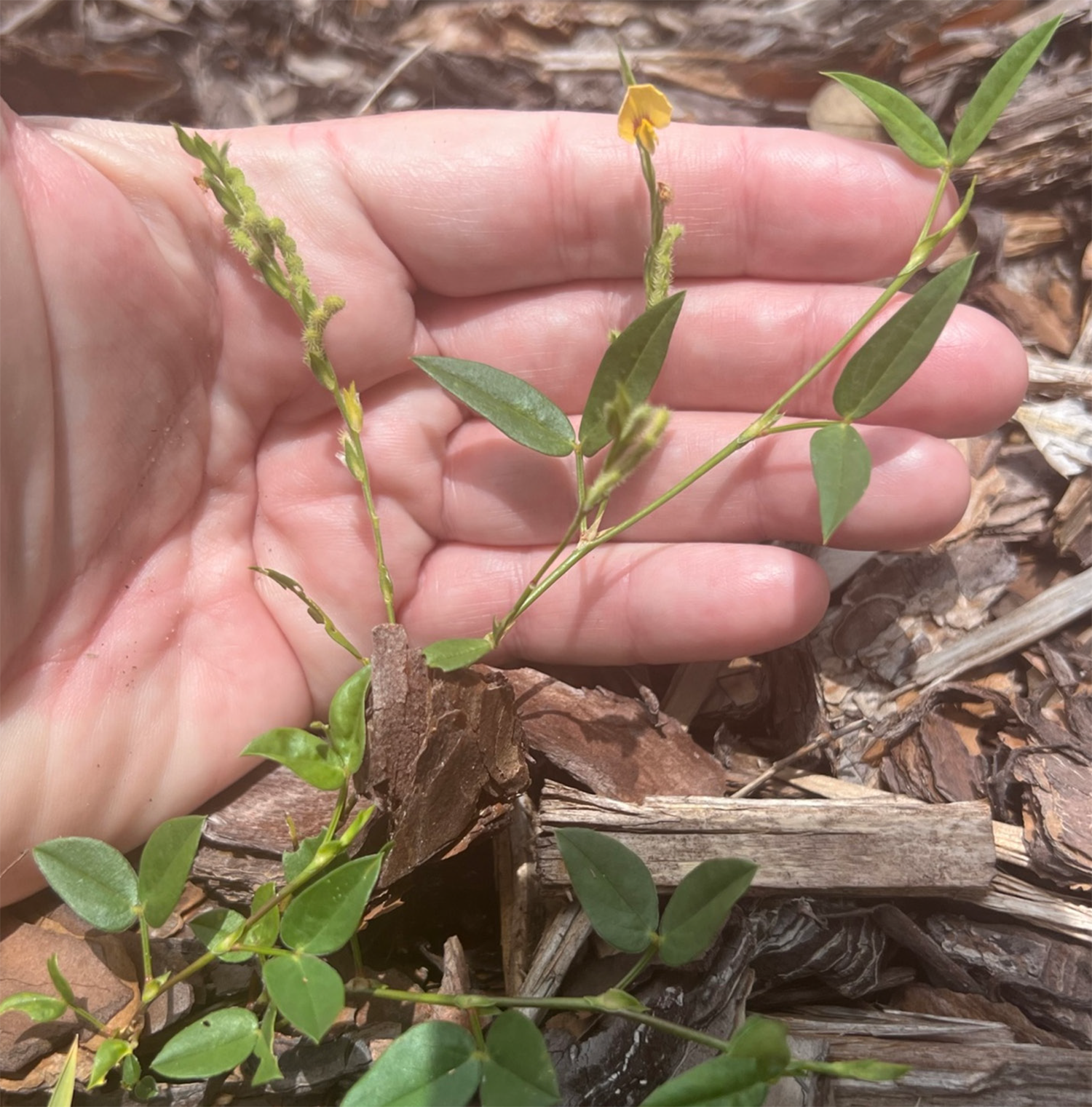
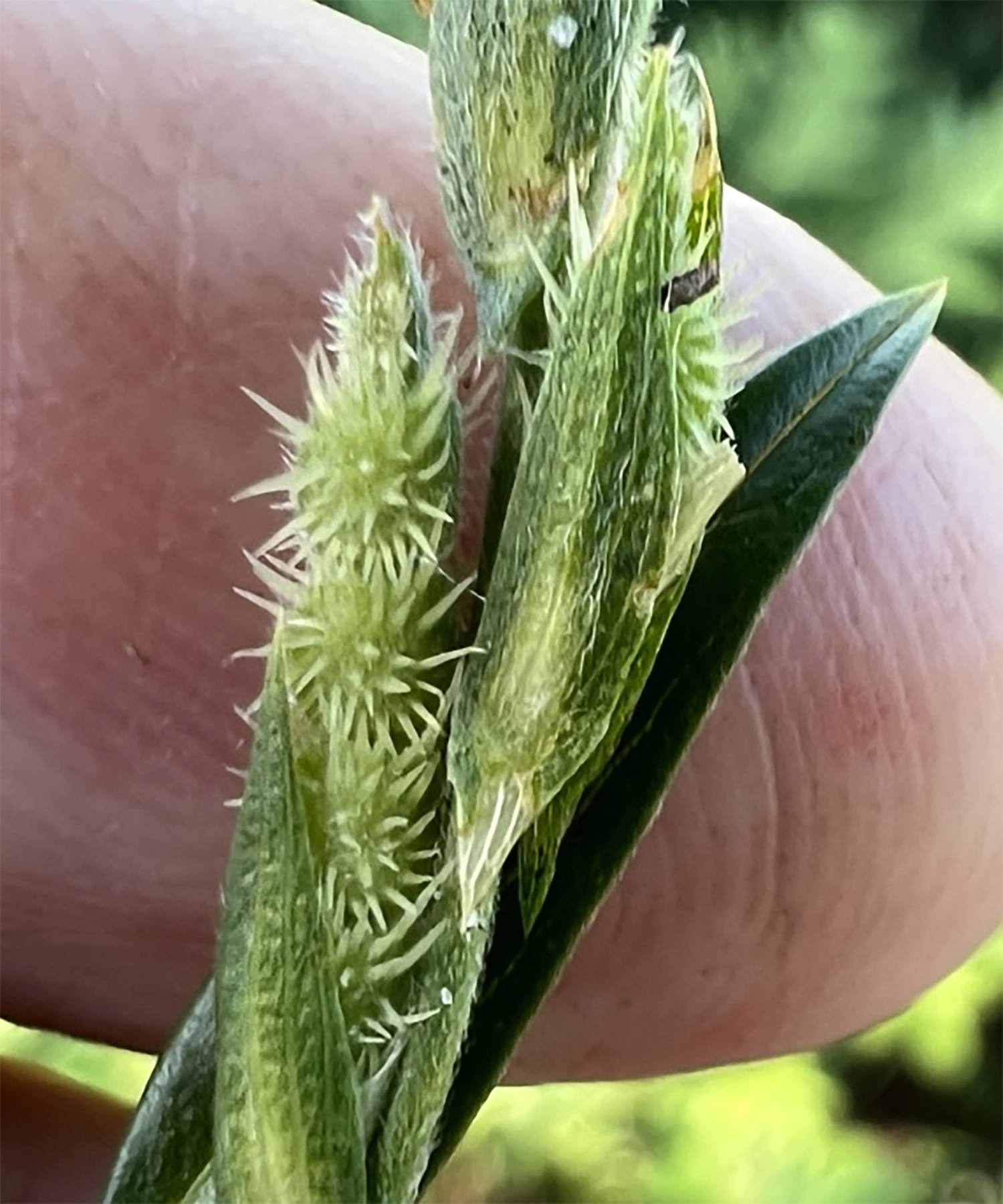
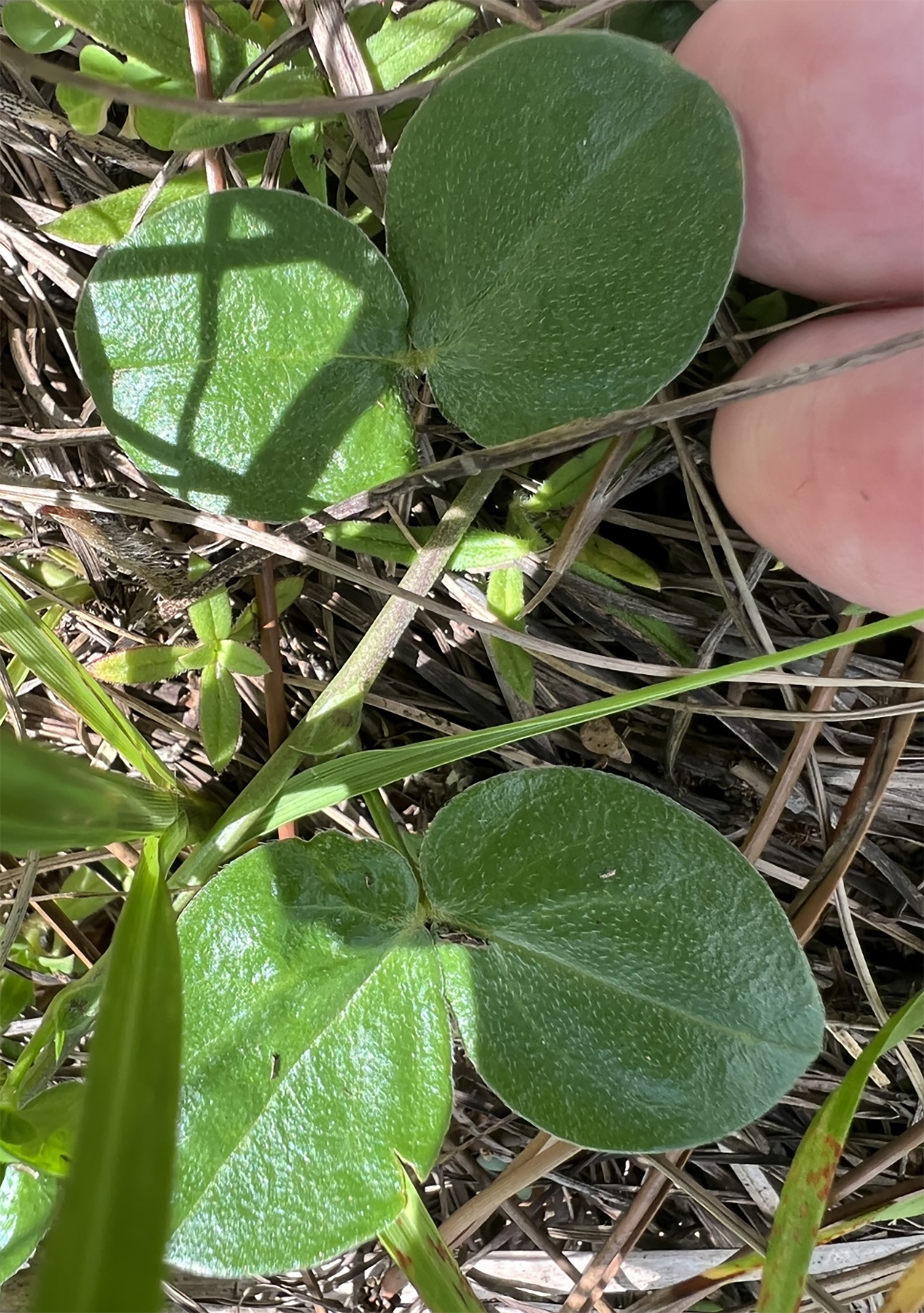
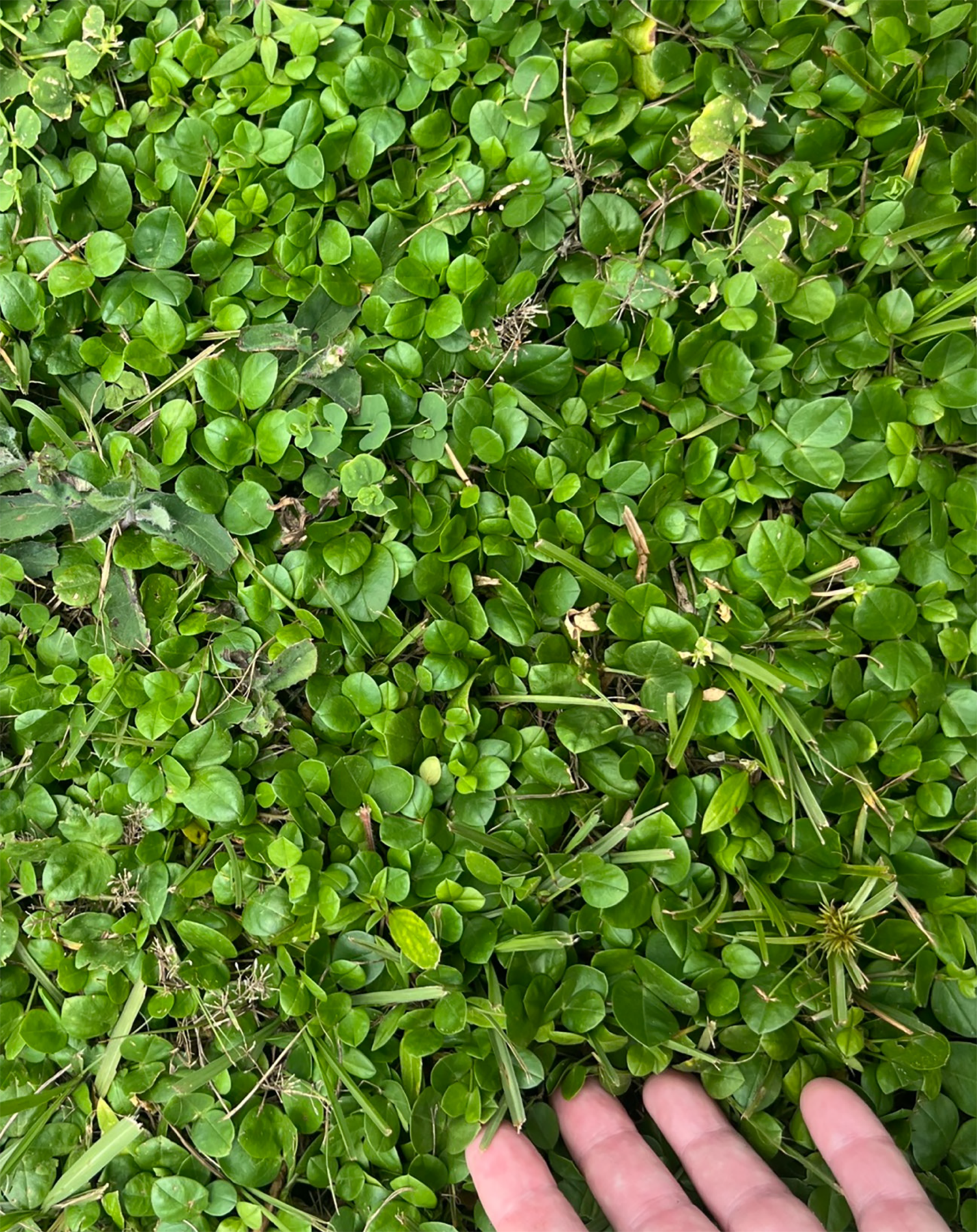
Gmelin (Reference Gmelin1792) named the genus Zornia, apparently to honor Johannes Zorn (1739–1799), a German botanist and pharmacist who studied medicinal plants and illustrated them in a series of published volumes. Smith (Reference Smith and Rees1818) described Z. latifolia, giving it the common name “broad-leaved Zornia” to match its Latin name (latifolia means “broad leaf” in Latin). Zornia spp. are commonly called “caterpillar beans” because of the appearance of their seed pods (Figures 1 and 2). The pods are loments, that is, they have single-seed segments able to break apart when mature. Zornia pods are covered with hooked hairs (Figures 1 and 2), adaptations for attaching to animal fur and feathers for dispersal (Mori and Brown Reference Mori and Brown1998). In Z. latifolia, lower leaflets are ovate to lance-ovate, while upper leaflets are lanceolate to linear-lanceolate (Mohlenbrock Reference Mohlenbrock1961; e.g., see Figures 1–4). Zornia latifolia is most common in tropical savannas and open fields (Rodrigues and Flores Reference Rodrigues and Flores2021). In Florida, there are only two reported Zornia species (Wunderlin et al. Reference Wunderlin, Hansen, Franck and Essig2025), which are simple to distinguish. The widespread native viperina, Zornia bracteata Walter ex J.F. Gmel., has leaves with four leaflets, while Z. latifolia has leaves with two leaflets (Figures 1–4). According to Cook et al. (Reference Cook, Pengelly, Schultze-Kraft, Taylor, Burkart, Cardoso Arango, González Guzmán, Cox, Jones and Peters2020), “In cooler climates, it [Z. latifolia] usually dies back to the rootstock during winter, producing new stems and leaves in spring and summer, and flowers and fruit in autumn.”
Zornia latifolia in Gotha, Orange County, FL (21 June 2025; J.K. Wetterer; 28.528°N, 81.511°W; inaturalist.org/observations/291605134).

Zornia latifolia on a trail in Indrio Savannahs Preserve, St Lucie County (16 November 2024; J.K. Wetterer; 27.530°N, 80.366°W; inaturalist.org/observations/251932842).

New leaves on Zornia latifolia in Jupiter, Palm Beach County, FL (7 June 2025; J.K. Wetterer; 26.903°N, 80.121°W; inaturalist.org/observations/287631090).

New growth of Zornia latifolia next to a sidewalk in North Jupiter, Martin County, FL (23 June 2025; J.K. Wetterer; 26.964°N, 80.148°W; inaturalist.org/observations/292163658).

In the only published record of Z. latifolia in Florida growing outside cultivation, Carter and Mears (Reference Carter and Mears2017: 1) reported Z. latifolia (as Zornia gemella Vogel, a junior synonym of Z. latifolia; see Fortuna-Perez and de Azevedo Tozzi Reference Fortuna-Perez and de Azevedo Tozzi2011) growing in an “infrequently mowed weedy border between athletic fields” at Alderman Ford Park in Hillsborough County (27.86974°N, 82.13712°W). Carter and Mears (Reference Carter and Mears2017; 1), however, wrote: “Additional populations are expected at other ruderal sites in central and southern peninsular Florida.”
There are earlier published records of Z. latifolia being cultivated in Florida to test its potential usefulness in agriculture, for instance, as forage for livestock. For example, in 1979 to 1983, Kretschmer et al. (Reference Kretschmer, Boman, Wilson and Snyder1992) studied the persistence of numerous legume species at the Agricultural Research Center, Fort Pierce (ARC-FP; 27.427°N, 80.408°W; now the Indian River Research and Education Center) in St Lucie County, FL. Kretschmer et al. (Reference Kretschmer, Boman, Wilson and Snyder1992) assessed Z. latifolia as having “moderate” persistence and “excellent” drought tolerance. The University of Florida Herbarium (FLAS) has voucher specimens of Z. latifolia imported from Brazil in the 1970s to ARC-FP (A Franck, personal communication). Pitman et al. (Reference Pitman, Chambliss and Kretschmer1988) similarly studied the persistence of legume species at the Agricultural Research Center near Ona, Hardee County, FL (27.398°N, 81.940°W; now the Range Cattle Research and Education Center), but found no surviving Z. latifolia in the year after planting.
Materials and Methods
I first encountered Z. latifolia in Martin County in October 2023. Then, in November 2024, I found high densities of this species at several sites in St Lucie County and one site in Palm Beach County. Over the next year, I set about looking for more populations and to map their local distribution.
In June 2025, I went through all Florida observations of Fabaceae species posted to iNaturalist, identifying photos of Z. latifolia. In the field, I searched for Z. latifolia, particularly in areas near and between sites where there were earlier observations of this species, photographing the plants and posting geo-referenced observations to iNaturalist. On June 21, 2025, I went to two sites in Orange County where others had posted observations of Z. latifolia to iNaturalist.
In May and June 2025, I deposited Z. latifolia vouchers from St Lucie, Martin, Palm Beach, and Orange counties at the University of Florida Herbarium (FLAS). Alan Franck confirmed identification of the specimens. One voucher has been posted online: U.S.A. FLORIDA. St Lucie Co.: Fort Pierce; Johnson Road, 27.4774°N, 80.4251°W, 9 Nov 2024, James K. Wetterer, FLAS 294993).
Results and Discussion
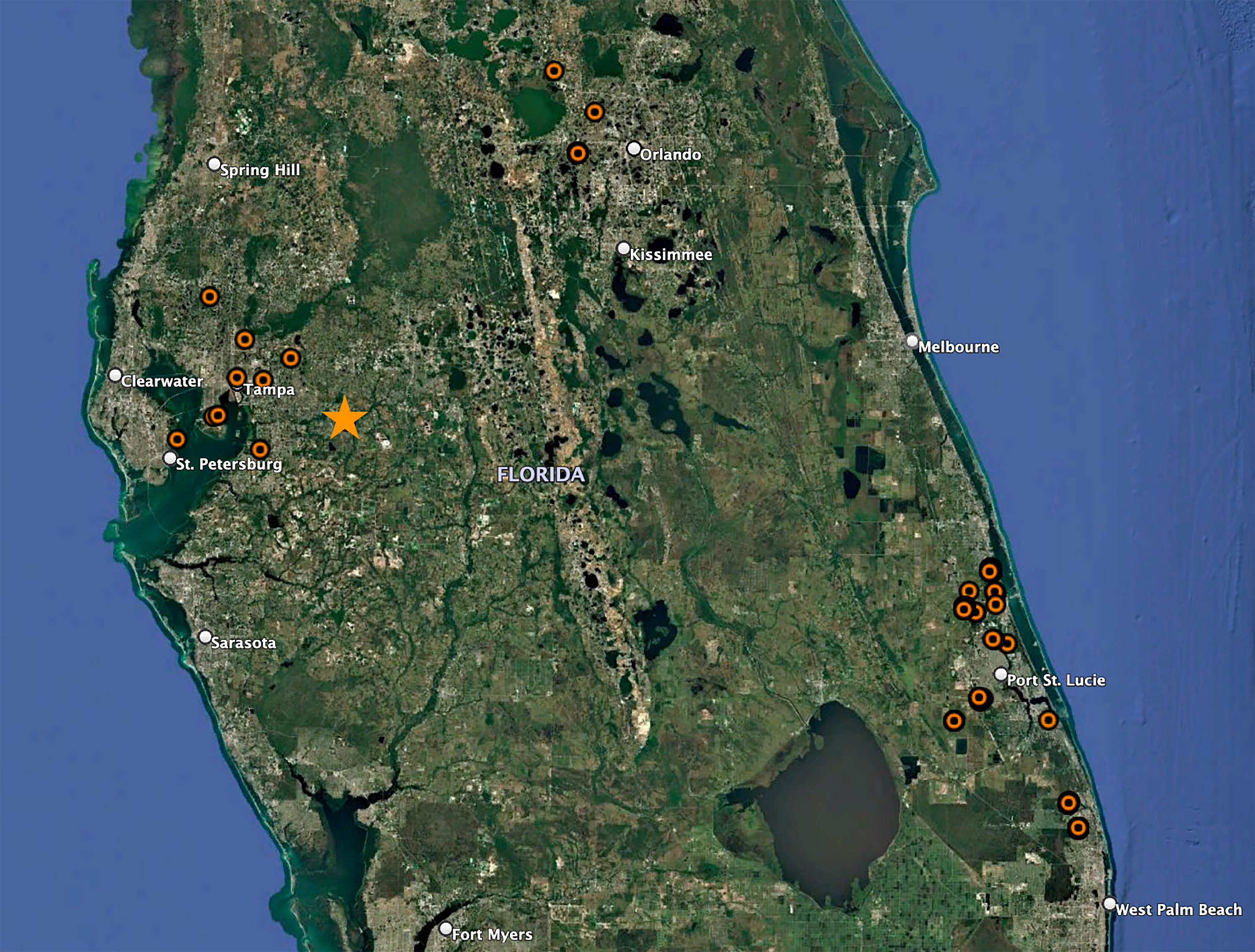
In June 2025, I mapped a total of 102 observations in Florida of Z. latifolia, 87 by me and 15 by others (Figure 5). All observations of Z. latifolia in Florida, except the first (in Carter and Mears Reference Carter and Mears2017), are documented on iNaturalist. Observations of Z. latifolia come from three widely separated areas of peninsular Florida: Hillsborough County in the west; St Lucie, Martin, and Palm Beach counties in the east; and Orange County in central Florida (Figure 5).
Zornia latifolia iNaturalist observations in Florida and Carter and Mears’ (Reference Carter and Mears2017) Hillsborough County voucher site (star).

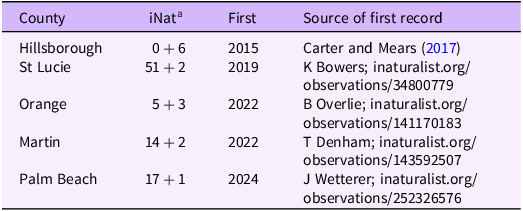
In addition to the record in Carter and Mears (Reference Carter and Mears2017), there are five iNaturalist observations of Z. latifolia in Hillsborough County (Figure 5; Table 1). Most Z. latifolia observations in St Lucie and Martin counties come from mowed areas next to canals, retention ponds, hiking paths, or roads. In Palm Beach County, all Z. latifolia observations are from a 400-m-long section of a large open field with winding gullies that serves as a water retention basin after heavy rains.
Records of Zornia latifolia growing outside cultivating in Florida counties.

a iNat = iNaturalist observations (mine + others).
There were three observations of Z. latifolia from two sites in Orange County posted to iNaturalist. Two observations were on the property on Gotha Middle School. The third had “hidden” geo-coordinates mapped as a random point within a 400-km2 area. I contacted the observer, who gave me the correct coordinates of the observation in Zellwood (the northernmost record in Figure 5). I found that the two Gotha observations were in an inaccessible area, fenced off on school property, but I observed abundant populations of Z. latifolia in surrounding areas. The Zellwood site was also inaccessible, and I did not find any Z. latifolia along the sides of Ponkan Road adjacent to the observation site.
In April 2025, I found Z. latifolia had dropped most of their leaves, leaving largely defoliated, crisscrossing mats of stolons. In June 2025, there were great numbers of plants with new, wide leaves but few flowers. The flush of new leaves sometimes resulted in an almost continuous blanket of vegetation too close to the ground to be cut by a lawn mower (Figure 4). As they started to flower and fruit, the plants grew more erect and had narrower leaves (Figures 1 and 2).
Zornia latifolia has extensive, established, persistent populations in five counties of peninsular Florida: Hillsborough, St Lucie, Martin, Palm Beach, and Orange counties. Several lines of evidence indicate that Z. latifolia is not native to Florida: (1) the first record of it growing outside cultivation is very recent (2015; Carter and Mears Reference Carter and Mears2017); (2) it appears to have only recently spread through areas discontinuous with its known native Neotropical populations; and (3) it has been found almost exclusively in highly disturbed environments.
The populations of Z. latifolia in Florida may all descend from stock imported to Florida for agricultural research. However, Z. latifolia might have been introduced to Florida through other avenues as well. Zornia latifolia products are widely advertised for purchase online, though not all the products are actually made with this plant. Cornara et al. (Reference Cornara, Fortuna-Perez, Bruni, Salis, Damonte, Borghesi and Clericuzio2018) purchased dried leaves advertised as Zornia latifolia or maconha brava from three websites, and all samples turned out to be the stylo, Stylosanthes guianensis (Aubl.) Sw. In 2010, the company World Seed Supply listed “dried foliage” and “viable seeds” of Z. latifolia for sale, and announced in 2013: “We are proud to now be offering live zornia latifolia plants” (shroomery.org/forums/showflat.php/Number/13551119 and 18941974). World Seed Supply currently lists Z. latifolia plants for sale, noting “These plants ship from our grower in FL” (worldseedsupply.com/product/zornia-latifolia-maconha-brava-1-live-plant). The plant photos on this webpage, however, do not depict bifoliate Z. latifolia, but instead trifoliate seedlings of what appear to be a Stylosanthes sp., perhaps S. guianensis.
Zornia latifolia seed pods may spread in Florida not only through attaching to fur and feathers of animals, but also on human clothing. After being in areas with Z. latifolia, I often found Z. latifolia pods adhering to my shoes and pants. There is little information on possible negative impacts of Z. latifolia. Concerning grass lawns in Brazil, Freitas et al. (Reference Freitas, Ferreira, Silva, Barbosa, Miranda and Machado2003: 159) wrote: “Zornia latifolia, when left uncontrolled, can reach infestation levels.” However, even at very high densities, Z. latifolia remains fairly inconspicuous (see Figure 4), blending in with the many other common weedy Fabaceae that have invaded Florida, such as creeping beggarweed (Desmodium incanum DC.), trailing indigo (Indigofera spicata Forssk.), black medick (Medicago lupulina L.), white clover, (Trifolium repens L.), and creeping tick trefoil [Grona triflora (L.) H. Ohashi & K. Ohashi]. It is unclear whether Z. latifolia will become a widespread invasive weed in Florida, or simply join the ranks of the many naturalized herbaceous plants that thrive in the weedy lawns, fields, and trails of Florida.
Data availability
All observation data are available on the iNaturalist website: https://www.inaturalist.org/observations?place_id=21&taxon_id=83975.
Acknowledgments
I thank A. Franck and M. Wetterer for comments on this manuscript; A. Franck, J. Horn, and other botanists for their taxonomic expertise that have made my plant studies possible.
Funding statement
This research was funded by Wilkes Honors College, Florida Atlantic University.
Competing interests
The author has no competing interests.

 Open access

