

Introduction
Gwageo, the civil service examination, during Korea’s Joseon Dynasty selected government officials through a competitive process rooted in Confucian scholarship. The examinations tested candidates on their knowledge of Confucian philosophy, literature, and classical Chinese texts. The civil service examination system was also implemented in China, where it originated, and in Vietnam (Lee Reference Lee2010). Of these societies, Joseon Korea presents a particularly instructive case, as the civil examination became inseparable from the very definition of the ruling elite. The yangban were the dominant status group of Joseon (Miyajima Reference Miyajima2014). Passing gwageo was the principal means of securing elite yangban status. Families that failed to produce examination passers over several generations were eventually demoted to the commoner class, known as sangmin. Thus, gwageo examinations remained the crucial gateway for intergenerational status mobility and status maintenance during the Joseon Dynasty.
An important question not fully addressed in prior research is how family socioeconomic backgrounds were associated with the chances of passing the civil service examinations. This gap stems partly from limited historical data availability, as records documenting both examination takers and passers were scarce. A closely related but underexplored question is whether variations in evaluation structures and examination types within the gwageo system enabled privileged families to gain disproportionate advantages. This study addresses the second question by examining how the institutional distinction between regular and special examinations shaped the family backgrounds of those who passed.
The gwageo examination system was not monolithic; rather, the Joseon Dynasty had two types of civil service examinations: siknyeonsi, the regular examination, and byeolsi, the special examination. The literal meaning of siknyeonsi is “regular” (sik) “year” (nyeon) “exam” (si), reflecting their regular triennial schedule. Byeolsi, meaning “special” (byeol) “exam” (si), had various names that reflected when, how, and why each exam was scheduled.Footnote 1 From the inception of gwageo in 1393 to its abolition in 1894 in the Joseon Dynasty, the regular examination was mostly held every three years, while special examinations were held as needed to meet governmental demands (Han et al. Reference Han, Chung and Kim2006). On average, the special examinations were conducted nearly three times as often as the regular examinations, and the frequency of special examinations increased over time. The two types of examinations differed not only in frequency but also in main test criteria, exam structure, and preparation period (Park Reference Park2022).
The sociology of education provides theoretical grounds for understanding that the composition of students who pass regular examinations may differ from that of those who pass special examinations. Exploring the contemporary college admission in the United States, Alon (Reference Alon2009) suggested that changes in evaluation structures are associated with privileged families gaining advantages before other families adjust to these changes, an adaptation mechanism, and/or the exclusion of the underprivileged from the exam, an exclusion mechanism. Numerous studies have assessed this theory and found supporting evidence. These include international research (Chmielewski Reference Chmielewski2019; Dynarski et al. Reference Dynarski, Nurshatayeva, Page, Scott-Clayton, Eric, Machin and Woessmann2023; Jerrim et al. Reference Jerrim, Chmielewski and Parker2015) and studies from Korea (Kim and Shin Reference Kim and Shin2020; Moon and Choi Reference Moon and Choi2019). Given that there was greater flexibility and variation in special examinations than in regular examinations, we hypothesize that (1) those from privileged families are likely to account for the larger proportion in the special examinations than in the regular examinations and (2) as the privileged change historically, those who benefited from special examinations changed accordingly.
This study contributes to the literature in multiple ways. First, to our knowledge, this is the first study to examine how the family backgrounds of civil service examination passers differed across examination types using representative data from Joseon Korea. Prior studies of Joseon Korea have been limited to analyses of a small number of families (e.g., Lee and Park Reference Lee and Park2019) or the influence of family backgrounds on career mobility among examination passers rather than how family background shaped differential outcomes across examination types (e.g., Hong et al. Reference Hong, Lee and Yoo2024; Lee and Park Reference Lee and Park2019, Reference Lee and Hee Park2023; Paik et al. Reference Paik, Hong and Yun2022). Related work addressing similar questions has instead relied on Chinese historical data (e.g., Chen et al. Reference Chen, Kung and Ma2020; Jiang and Kung Reference Jiang and Kai-sing Kung2021; Shiue Reference Shiue2025; Song et al. Reference Song, Campbell and Lee2015; Wen et al. Reference Wen, Wang and Hout2024).Footnote 2 Second, this study demonstrates that sociological theories of adaptation and exclusion mechanisms, which explain the advantages that privileged families have in contemporary college admissions processes, can be applied to the exam-based stratification system of a premodern society. Overall, this study advances our understanding of both the meritocratic nature of the civil service examination system and its limitations, showing how sociological theories developed for contemporary contexts can illuminate premodern stratification systems and suggesting that the tension between meritocratic ideals and social reproduction has deep historical roots in East Asian educational traditions.
Historical background and literature review
Structure of the gwageo system
The gwageo system encompassed three distinct examination categories: mungwa, the literary examination; mugwa, the military examination; and japgwa, the miscellaneous examination. The mungwa selected civil officials and constituted the most prestigious pathway to government service. The military examination recruited military officers, while the miscellaneous examination filled specialized positions in technical fields, including medicine, astronomy, and calendrical sciences. Among these, the literary examination served as the primary gateway to political power and elite yangban status.
The term for elite status, yangban, literally means “two” (yang) and “class” (ban), referring to two groups: the munban, the civil official class whose members passed the literary examination, and the muban, the military official class whose members passed the military examination. While both groups technically constituted the yangban elite, the civil official class held substantially greater prestige and political influence. This hierarchy was so pronounced that many military exam passers later sat for literary exams to achieve civil office status, recognizing that civil office provided the most direct route to political power and social advancement. Given this hierarchy, scholarly analyses of the Joseon examination system, including this study, primarily concentrate on the literary examination and its passers.
This emphasis on the literary examination highlights the complex interplay between merit and inheritance in the yangban system. Indeed, yangban status was not purely meritocratic; rather, it was semi-official, as no explicit laws defined yangban status or its privileges, yet in practice, yangban families received preferential treatment in accessing the gwageo examinations and participating in local governance. Furthermore, yangban families were exempt from mandatory military service. This semi-official status was also partly inherited, because yangban children had greater opportunities to sit for examinations and to inherit wealth and property from their ancestors. This semi-inherited nature meant that yangban status required continuous validation through successful examination outcomes. Families that failed to produce examination passers over multiple generations were demoted to commoner status. Consequently, yangban families often had little choice but to cultivate targeted strategies to ensure continued success in the gwageo examinations.
In this context, the reproduction of yangban status depended not only on continued success in the civil service examinations but also on families’ ability to demonstrate and sustain claims to elite standing across generations. One way this was achieved was through the use of jokbo, Korean genealogical registers that recorded family lineages and, in many cases, documented ancestors’ examination success and official careers. Although records of examination passers exist throughout the Joseon Dynasty, they were not systematically compiled in a way that could serve as an authoritative marker of status. In the absence of a formally codified legal marker of yangban status, genealogical registers could support families’ claims to longstanding ties to the examination system and state service (Cha Reference Cha2010; Lee and Park Reference Lee and Park2008). The effectiveness of such genealogical records as status markers rested not on genealogy per se but on the presence of demonstrable examination success within the family lineage. As a result, yangban families faced strong incentives to secure examination success for some of their descendants.
Regular versus special examinations
The Joseon Dynasty implemented two types of literary examinations: regular and special. The first regular examination was administered in 1393, and the first special examination was administered in 1401, eight years later. Over the more than five centuries of the Joseon Dynasty, around 14,600 candidates passed the literary examinations. Of these successful candidates, approximately three-fifths passed through the special examinations, while the remaining two-fifths succeeded via the regular examinations. In the later years of the Joseon Dynasty, the number of special examinations increased substantially, and the share of successful candidates passing through special examinations exceeded that of those passing through regular examinations. The Joseon Dynasty did not record who sat for the examinations but did record all examination passers and the type of examination they passed; these records are utilized in the current study.
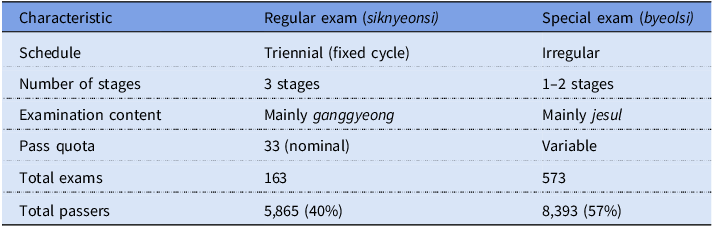
Table 1 summarizes the key structural differences between these two examination types. The two examinations evolved differently, not only in terms of scheduling but also in their structure and content (Park Reference Park2022). Beginning with the regular examinations, these occurred in specific years determined by the sexagenary cycle.Footnote 3 Throughout the Joseon Dynasty, a total of 163 regular examinations were administered (Lee and Kim Reference Lee and Kim2007). The path to passing the literary examination was a long and multi-tiered process. In the regular examination, candidates first had to pass the lower examination (sogwa). Passing the lower examination conferred a title and qualified candidates to enter the Sungkyunkwan, the National Confucian Academy, and, most importantly, to sit for the higher examination (daegwa), which constituted the final gateway to becoming a government official.
Comparison of regular and special civil service examinations in Joseon Korea
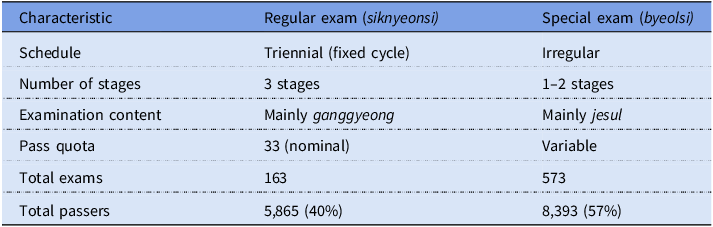
Including both lower and higher examinations, the regular triennial examination consisted of three distinct stages. The first stage (chosi) was a qualifying examination held in both Seoul and the provinces. Candidates who passed the qualifying examination then gathered in Seoul for the second stage (boksi). This stage was administered by the Ministry of Rites and was fiercely competitive. It selected a nominally fixed number of 33 successful candidates, though this quota was not always strictly observed. According to the limited available records, the number of applicants in 1617 was around 2,000, suggesting a pass rate of less than 2 percent (Park Reference Park2022). The final stage (jeonsi) was conducted in the presence of the king. The final stage did not eliminate candidates but determined their final ranking, which was crucial for their initial government appointment (Kim Reference Kim2017). Those who placed in the top three were appointed to higher positions than those who passed with lower ranks (Lee and Park Reference Lee and Hee Park2023).
Special examinations were not conducted on a fixed cycle. They were organized on special occasions such as royal celebrations, national emergencies, or at the king’s command. Special examinations were even held during natural disasters as a way to recruit talent for recovery efforts (Lee and Kim Reference Lee and Kim2007). The preparation time for special examinations varied, with their implementation occurring shortly after their announcement. For example, commemorative examinations (jeunggwangsi), which were held to commemorate events such as a king’s accession to the throne or other national celebrations, were typically implemented one or two months after their announcement, while royal-audience examinations (alseongsi), another type of special examinations, were implemented two to four weeks after their announcement. In extreme cases, the examination was conducted without any prior announcement, sometimes on the same day. Unlike regular examinations, for which the first stage was conducted locally, special examinations had only one or two stages held in Seoul (Cha Reference Cha1999), though some special examinations were occasionally administered outside Seoul (Song Reference Song2018). Passing the lower examination was not a prerequisite for taking special examinations. Thus, not only the students of the National Confucian Academy, who had qualified through the lower examination and resided in Seoul, but also candidates from privileged and wealthy families, who could devote themselves to exam preparation despite not having passed the lower examination yet, enjoyed significant advantages in special examinations over candidates lacking such institutional connections and coming from less-privileged backgrounds. The short notice and irregularity of special examinations may have functioned as an exclusion mechanism.
The reduced number of examination stages for special examinations increased the unpredictability of their outcomes. Furthermore, examination content also evolved differently between regular and special examinations, despite their similarity in the early years of the Joseon Dynasty. Regular examinations tested memorization and interpretation of core Confucian texts,Footnote 4 whereas special examinations assessed candidates’ ability to write complex ideas with elegance (Park Reference Park2022). At times, questions in special examinations drew on recently published Chinese books or addressed pressing governmental concerns of the period. Thus, those with access to relevant books and inside knowledge of pending issues enjoyed distinct advantages.
During the Joseon Dynasty, there were debates over whether to expand special examinations. The traditional yangban families denounced regular examinations as inferior, arguing that they simply required memorizing textual content, and demanded the expansion of special examinations (Han et al. Reference Han, Chung and Kim2006; Park Reference Park2022). In contrast, critics in these debates argued that candidates who focused on special examinations did not adequately study the core Chinese texts, which were not included in the examination questions.
The irregularity, flexibility, and diversity of special examinations with their variable quotas, reduced number of stages, and emphasis on literary composition likely provided privileged families with better opportunities to adapt their strategies and achieve success than those offered by the more standardized regular examinations. By contrast, those from less-privileged families were better able to adapt to the fixed, predictable format of regular examinations, which rewarded long-term preparation and familiarity with established testing routines. This study examines how privileged groups exploited differences between regular and special examinations to maintain their advantages throughout Joseon history.
Social mobility and status reproduction in the gwageo system
Much research on civil service examinations has emphasized their role in promoting social mobility. Ho (Reference Ho1962) argued that China’s civil service examination system fostered significant upward mobility by enabling new families to join the scholarly elite, even as established lineages experienced decline, thereby indicating notable social fluidity. Korean scholars have likewise debated whether the gwageo examination system enhanced social fluidity or reinforced existing social hierarchies (Wagner Reference Wagner1974; Lee Reference Lee1984; Han Reference Han1985; Chung Reference Chung2000). Such discussions frequently revolve around whether these examinations served as an effective “ladder of success” facilitating intergenerational advancement. However, subsequent scholarship on China challenged this optimistic assessment. Hymes (Reference Hymes1986) demonstrated that elite families in Fu-chou maintained their local prominence through marriage alliances, landholding, and social networks, even when they failed to produce examination passers across generations. Rather than serving as a simple ladder of success, the examination system coexisted with locally rooted strategies of status preservation. Elman (Reference Elman1991) further argued that the civil service examinations functioned as a mechanism of political, social, and cultural reproduction, contending that the cultural and linguistic resources required for examination success were so unevenly distributed that the system effectively reproduced existing elite dominance under the guise of meritocratic selection. These critiques shifted the scholarly focus from measuring rates of mobility among examination graduates to understanding the structural conditions under which elite families sustained their advantages within a formally open system.
Analyses of Chinese civil service exam records show that lineages were strong predictors of descendants’ success (Lee and Park Reference Lee and Park2019; Song et al. Reference Song, Campbell and Lee2015; Song and Campbell Reference Song and Campbell2017; Wen et al. Reference Wen, Wang and Hout2024; Wei et al. Reference Wei, Campbell and Xue2026), although the strength of this influence varies by exam type (Campbell et al. Reference Campbell, Xue and Wei2025). Recent studies of Korea using digitized historical data similarly challenge overly optimistic views of mobility by revealing how family backgrounds persistently influenced socioeconomic outcomes, while not rejecting the meritocratic nature of the civil service examination system. For instance, even after controlling for exam scores (Lee and Park Reference Lee and Hee Park2023), family backgrounds are associated with the likelihood of career upward mobility. This evidence suggests that while the system allowed some degree of fluidity, it did not fully eliminate the advantage associated with family background, but rather partially reproduced elite dominance through the intergenerational transmission of advantages, thereby setting the stage for understanding families’ proactive strategies. A question that previous studies have not addressed concerns the mechanisms through which such privilege was reproduced under a meritocratic examination system.
If the civil service examination were purely meritocratic, the association between family background and the successful passage of the examination would be null. Indeed, the association does not differ from zero when the influence of family background is measured for all children (Lee and Park Reference Lee and Park2019). However, to maintain their elite yangban status, families developed various strategies. One such strategy involved differential family investment. Families invested more heavily in children who showed potential to pass the exam and acquire high-ranking government positions. This approach differed from equal investment strategies aimed at maximizing the success of all children. By analyzing family genealogical records, Lee and Park (Reference Lee and Park2019) demonstrated that the positive association between ancestors and offspring could be found only when examining the chance of having at least one successful child, rather than the likelihood of success for all children. This strategy resembles primogeniture in early modern England, whereby concentrating inheritance on a single heir, typically the eldest son, served to preserve family wealth and status across generations (Stone Reference Stone1979). These strategies highlight how elites adapted to the system’s demands, a theme that resonates with modern sociological theories of educational inequality.
Adaptation and exclusion in the civil service examination system
In developing a theoretical framework on the evolution of class inequality in access to higher education, Alon (Reference Alon2009, Reference Alon2014) analyzed college admissions in the United States. We argue that Alon’s theory also helps explain how privileged families strategically exploited the distinction between regular and special gwageo examinations to their advantage, thereby highlighting the limitations of the ostensibly meritocratic civil service examination system.
Alon (Reference Alon2009, Reference Alon2014) argued that when competition for college admission is low, class inequality in access to selective institutions tends to decrease. In contrast, during periods of intense competition, class inequality tends to expand. She identified two mechanisms through which privileged classes gain an advantage: exclusion and adaptation. Exclusion refers to barriers that limit access for lower-class students, such as high tuition or reliance on standardized test scores. Adaptation describes how privileged groups respond to increased competition by investing in resources like tutoring or test preparation, enabling their children to meet new or more demanding selection criteria. When admission criteria change, privileged groups are more likely to adapt effectively. Alon (Reference Alon2009) further concluded that adaptation is a more potent mechanism than exclusion in maintaining class advantages. Her theory was applied in other countries such as Denmark (Thomsen Reference Thomsen2015), Israel (Alon Reference Alon2015), and Korea (Kim and Shin Reference Kim and Shin2020).
The availability of comprehensive historical records of gwageo passers allows us to examine whether privileged groups benefited disproportionately from the flexibility of special examinations. We hypothesize that privileged groups constituted a higher proportion of special examination passers than of regular examination passers, because the exclusion and adaptation mechanisms that generate advantage were more likely to operate in special examinations. In making this argument, we do not deny the meritocratic character of the civil service examination system itself; rather, we contend that meritocratic selection coexisted with institutional features that allowed advantages associated with privilege to persist.
Changes in privileged groups during the Joseon Dynasty
Our main argument is that among passers, privileged groups – those with ancestors who passed examinations – are more heavily represented in special examinations than in regular examinations because the irregularity, flexibility, and short notice of special examinations provided privileged families with greater opportunities to adapt, whereas the fixed format of regular examinations rewarded long-term preparation accessible to less-privileged candidates. Our first hypothesis is, thus, that passers of special examinations had more ancestors who passed examinations, thereby securing yangban status for their families, than passers of regular examinations.
Hypothesis 1: Controlling for demographic covariates, passers of special examination have a higher number of ancestors who passed the gwageo exam than passers of regular examinations.
Examining the proportion of the privileged among examination passers and its historical change can shed light on how open the Joseon Dynasty was. Research in the sociology of education has long shown that the expansion of educational opportunities tends to benefit privileged groups first, before less-privileged groups begin to gain access (Lucas Reference Lucas2001; Raftery and Hout Reference Raftery and Hout1993). Given that special examinations expanded more rapidly than regular examinations over time and tested qualitatively different content from regular examinations, we can hypothesize that privileged groups maintained educational inequality by concentrating their efforts on special examinations.
Although examining changes in the proportion of the privileged among examination passers is informative, a critical issue in testing our argument formally is the inability to control for applicants’ self-selection into examination types. Since the yangban class increasingly favored special examinations during the later Joseon period, it is expected that, on average, special examination passers were more likely to come from higher-status family backgrounds than regular examination passers. Partly due to this data limitation, previous studies using these data, such as Lee and Park (Reference Lee and Park2019) and Paik et al. (Reference Paik, Hong and Yun2022), have focused on the career trajectories of examination passers rather than on analyzing who passed the examination. Because the historical records document the outcomes of passers but not the full pool of applicants, directly estimating the probability of passing by status background is not feasible; instead, we compare the socioeconomic backgrounds of passers across examination types, which allows us to assess whether privileged groups were disproportionately represented in special examinations relative to regular examinations.
We address the self-selection problem by exploiting historical variation in the power of privileged groups over time: if privileged groups were indeed better positioned to leverage special examinations, their representation among special examination passers should have been greater during periods when their power was stronger. Drawing on research in history on changes in the power of privileged groups over time, the current study introduces a new methodological approach to analyzing the composition of examination passers using these records. It examines how the institutional distinction between regular and special gwageo examinations created opportunities for advantaged families to secure favorable outcomes, particularly in special examinations, revealing the constraints of the examination system’s nominal commitment to meritocracy.
There is a broad consensus in Korean historiography that there were two major historical changes in the power of privileged families during the Joseon Dynasty. One concerns the rise and decline of the social power and reputation of the yangban class, and the other concerns the emergence of powerful family clans in the later period of the Joseon Dynasty. We first examine changes in the yangban class. The founding of the Joseon Dynasty in 1392 did not represent a sharp break in the composition of the ruling elite. As Duncan (Reference Duncan2000) has shown, the central officialdom exhibited substantial continuity across the dynastic transition, with prominent families of the previous dynasty continuing to occupy positions of power under the new dynasty. The examination system was likewise carried over with only incremental modifications. Thus, in the early Joseon period, the elite reproduction structure remained largely intact from the preceding dynasty.
Over the course of the fifteenth and sixteenth centuries, the Joseon state progressively consolidated a Confucian sociopolitical order in which ritual practices, patrilineal kinship norms, and the civil service examinations became increasingly central to the definition and maintenance of yangban status (Deuchler Reference Deuchler1992). By the mid-seventeenth century, this transformation had matured: strict descent rules were firmly established, the family genealogical record compilation flourished, and private Confucian academies proliferated across the country. Whether this qualitative shift was precipitated by the external shocks of the Japanese Invasions (1592–1598) and the Qing invasion (1636–1637), or instead represented the completion of a longer arc of Confucian transformation, remains debated. What is clear is that the wars gravely undermined social stability and state capacity. In response, yangban elites tightened their reliance on Confucian norms and local institutional networks to reconstitute their privileged standing (Deuchler Reference Deuchler1992; Miyajima Reference Miyajima2014). During this period, particularly in the seventeenth century, those from yangban family backgrounds accounted for the highest proportion of examination passers and were disproportionately promoted to important positions (Han Reference Han2013). At the same time, Na and Cha (Reference Na and Cha2021) documented increasing downward mobility among some established yangban families in the late seventeenth century, suggesting that the consolidation of examination-based reproduction might coexist with both the reinforcement of elite power and selective elite decline.
From the eighteenth century onward, this internal differentiation within the elite deepened. At one end, provincial yangban and families of more recent yangban standing were progressively marginalized, often relegated to the status of local yangban (hyangban) or impoverished yangban (janban). The number of families claiming yangban status through examination success continued to increase (Han Reference Han2013), but the social distinction it conferred diminished accordingly. At the other end, a small number of powerful family clans known as sedoga consolidated political authority. Literally meaning “families that wield power,” the term sedoga refers to elite lineages whose political dominance rested less on examination success or bureaucratic merit than on sustained access to royal authority, kinship ties, and control over key state offices (Oh Reference Oh1991). These families wielded immense influence by holding key government positions across multiple generations, often through strategic marriage alliances with the royal family. As a result, political authority became increasingly concentrated within a narrow circle of families, thereby weakening the ideal of merit-based recruitment that had formally underpinned the civil service examination system. Nevertheless, they could not afford to disregard the civil service examinations, which remained an essential source of symbolic legitimacy for justifying and sustaining their authority.
Based on these historical changes and drawing explicitly on Alon’s (Reference Alon2009) adaptation mechanism, we hypothesize that privileged groups account for a higher proportion of passers in special examinations during periods when their political power was greatest, as these groups were better able to adapt their strategies to the irregular and less standardized features of special examinations. Conversely, if the distribution of power were unrelated to the institutional features of the examination system, we would expect any differences in the representation of privileged groups between regular and special examinations to remain stable over time, showing no systematic historical change. Our approach synthesizes historical changes in elite power with the available examination records, enabling us to assess the limitations of meritocracy in the civil service examination system without relying on information about who sat for the examinations or explicitly modeling selection into different examination types, thereby broadening the analytical use of historical data that document only examination passers. Building on this framework, we empirically test whether the advantages of privileged groups in special examinations varied in tandem with shifts in their political power, as specified in the following hypotheses:
Hypothesis 2: The number of ancestors who passed the gwageo examination is higher among special examination passers than among regular examination passers, and this difference is particularly pronounced in the seventeenth century.
Hypothesis 3: In the nineteenth century, passers of special examinations exhibited a higher proportion of powerful family clans than passers of regular examinations.
Although there is a broad consensus on the timing of the rise and fall of privileged groups’ political power, the precise periods remain debatable. We do not claim that testing differences across centuries, as proposed in our hypotheses, is the only approach or inherently more desirable than more finely grained temporal frameworks. Our approach offers a convenient way to test these differences using formal statistical methods; nevertheless, to assess the sensitivity of our results to temporal framing, we also estimate differences between regular and special examinations using shorter time intervals.
Methods
Data
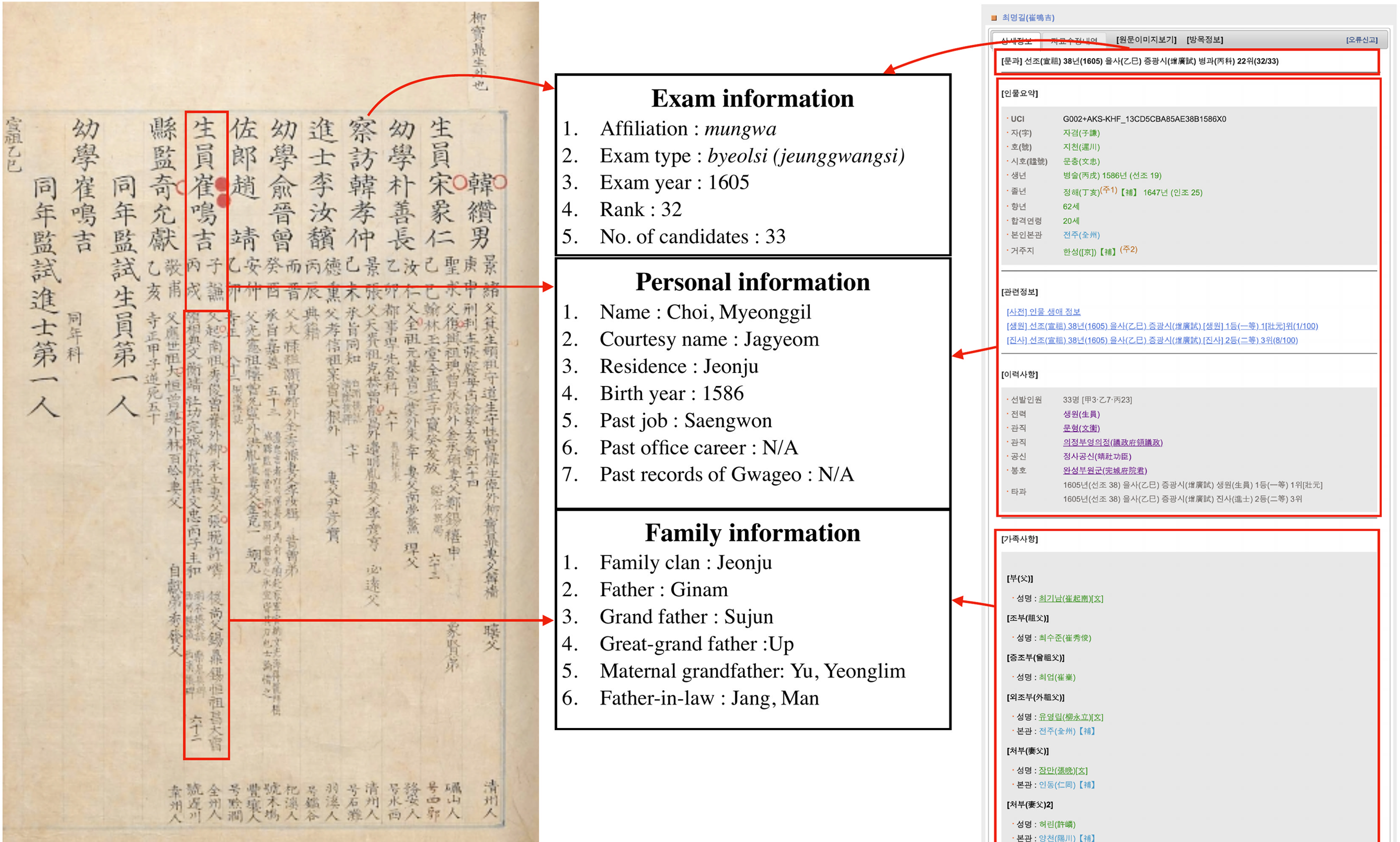
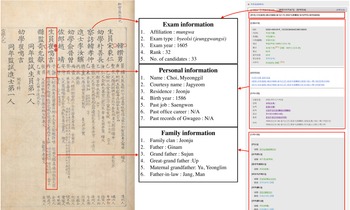
During the Joseon Dynasty, civil service examination records, known as Bangmok, were produced separately for each examination and preserved both in state repositories and in the private archives of individual families and were never consolidated into a central archive (Won Reference Won2010). These dispersed historical examination rosters have been compiled and digitized through scholarly efforts of Wagner and Song (Reference Wagner and Song2001) and of the Academy of Korean Studies (AKS 2025). Using multiple genealogical records, the AKS research team manually verified matches between examination passers and their ancestral lineages. We use this linkage as provided without further modification. The resulting datasets provide detailed information on successful examinees, including their names and bongwan (family clan, the hereditary lineage group to which a family belongs), residential areas, and family backgrounds – such as the names of fathers, paternal grandfathers, maternal grandfathers, and fathers-in-law – as well as details about examination type, year, rank, and the number of passers. Additional personal information includes courtesy names, birth years, and prior examination records. For this study, we use the publicly accessible and institutionally maintained dataset provided by the Academy of Korean Studies. The compiled data, as shown in Figure 1, cover all 14,638 individuals who passed the literary examinations. The Academy of Korean Studies expanded the ancestor records by linking the compiled examination rosters to the family genealogical records. This linkage enables a more comprehensive analysis of intergenerational dynamics. As it provides the names of their ancestors, we can determine whether those ancestors had also passed the literary examination in the past. For our analysis, we exclude a small number of passers from the senior preferential examination and the provincial special examination reserved for those residing outside Seoul. Our final sample is 14,258.
An example of the historical record of the examination rosters, Mungwa Bangmok.
Building on this, we link the compiled examination rosters to the Annals of the Joseon Dynasty. This linkage was initially compiled by the National Institute of Korean History (NIKH). The NIKH identified 7,740 unique individuals in the Annals, of whom 4,266 were matched to the 8,506 unique examination passers in our dataset. We supplemented the NIKH linkage with the following matching procedure. First, individuals whose names appeared only once in both the compiled examination rosters and the Annals were matched directly. Second, when multiple individuals shared the same name, we used birth year for exact matching. Third, when birth year was unavailable, we compared the gwageo pass year with the median year of the individual’s career records in the Annals; if the gap exceeded 60 years, we treated them as different persons. The remaining ambiguous cases were resolved through manual verification.
The Joseon Dynasty did not maintain official records containing complete career trajectories for all bureaucrats. However, the Annals provide an alternative avenue for tracking career success by recording bureaucrats’ names and positions when they participated in policy decisions, ceremonial events, or administrative matters deemed worthy of royal attention. This creates a systematically biased but informative sample, skewed toward more influential officials. While this limits our ability to measure overall career advancement, it allows us to identify examination passers who achieved sufficient prominence to warrant inclusion in the official historical record.Footnote 5 Using these data, we conduct a supplementary analysis to investigate whether the yangban and powerful family clans were more heavily represented among high-ranking officeholders during periods of greater political dominance, and whether their representation among high-ranking officeholders in a given period predicted their overrepresentation among special examination passers in the subsequent period.
Analytic methods
In this study, we examine the net average differences in privileged backgrounds between passers of regular and special examinations. In this approach, privileged status serves as the dependent variable in our regression models, and the type of exam passed is the independent variable. Because the historical records do not include information on the full pool of applicants, we cannot directly estimate whether the privileged were more likely to pass special examinations than regular examinations; instead, we quantify average differences in privileged status between special and regular examination passers, net of covariates. Accordingly, our estimates are purely descriptive, and there are no causal implications. Hypotheses 2 and 3 test whether individuals who passed special examinations tended to show privileged backgrounds during periods when their groups held power, compared to periods when their groups were less influential. Equation (1) shows our ordinary least square (OLS) or linear probability model (LPM), depending on the dependent variable: ${y_i} = \alpha + \beta S + \;\sum {\gamma _t}{C_t} + \sum {\delta _t}(S{ \times C_t}) + {\rm{{\rm X}'\Lambda }} + {\varepsilon _i}$
where y i refers to privileged status. y i is measured in two ways: first, the number of literary examination-passed ancestors, ranging from 0 to 6, which quantifies the strength of the family yangban status, and second, a dummy indicating whether the passer came from one of the powerful family clans (1) or not (0). Which family clans constituted the powerful family clans remains debatable. In this study, we define them as family clans that produced at least one queen consort or queen dowager since the reign of King Sunjo (1790–1834), who ascended the throne in 1800. Six family clans – Andong Kim, Bannam Park, Pungyang Cho, Yeoheung Min, Gyeongju Kim, and Namyang Hong – meet this criterion. There is no information about the proportion of these families in the entire population. Among exam passers, around 10 percent came from these families.Footnote 6 The primary independent variable, S, refers to whether individuals passed a special examination (1) or not (0), and C t is a set of century dummies with the fifteenth century or earlier serving as the reference point.
Thus, the interaction coefficient, δ t , quantifies whether the difference in privileged status between regular and special examination passers varies in the sixteenth, seventeenth, eighteenth, and nineteenth centuries compared to the fifteenth century or earlier. The interaction coefficients are of primary interest in this study. Hypothesis 2 predicts that when the number of examination-passed ancestors is the dependent variable, δ t would be statistically significantly positive in the seventeenth century as yangban families accounted for the highest share of examination passers and officeholders then. Likewise, Hypothesis 3 predicts that when a dummy for membership in one of the six powerful family clans is the dependent variable, δ t would be statistically significantly positive in the nineteenth century, which was the period of dominance of powerful family clans. Control variables include passers’ age, an indicator for missing age, residential region, an indicator for missing region, the number of passers in each exam, and the number of examinations offered within a six-year period. Standard errors are clustered at the exam level.
Empirical findings
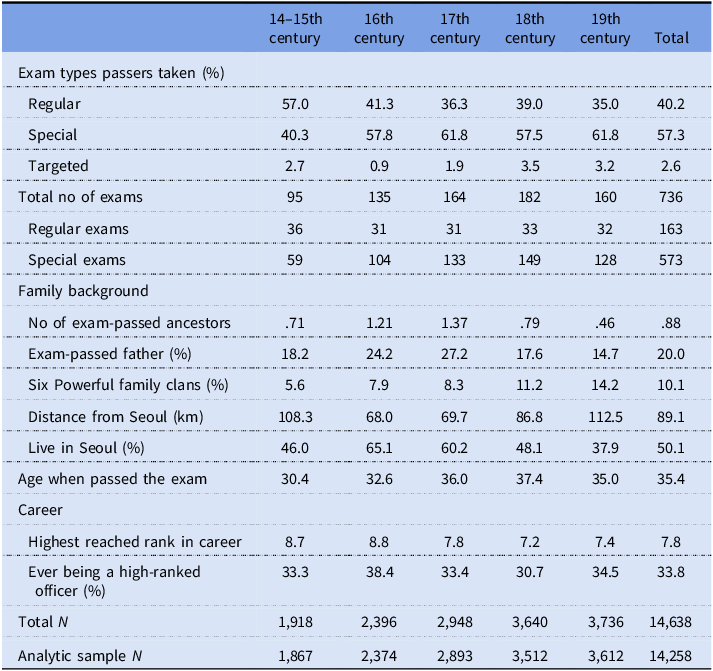
Table 2 shows the descriptive statistics. Throughout the Joseon Dynasty, a total of 163 regular examinations and 573 special examinations, including targeted ones, were offered. Among exam passers, 40 percent passed regular examinations, 57 percent passed special examinations, and 3 percent passed targeted examinations. The average age at which applicants passed the examination was 35.4, an inflated figure due to the inclusion of the targeted examinations for seniors. The average passing age for regular examinations was 28.1, and for special examinations, excluding targeted examinations, it was 31.2. Around one-third of the literary examination passers had reached a high-ranking position, which is defined as a senior third rank or above.
Descriptive statistics of literary civil examination passers, Joseon Korea, 1393–1894
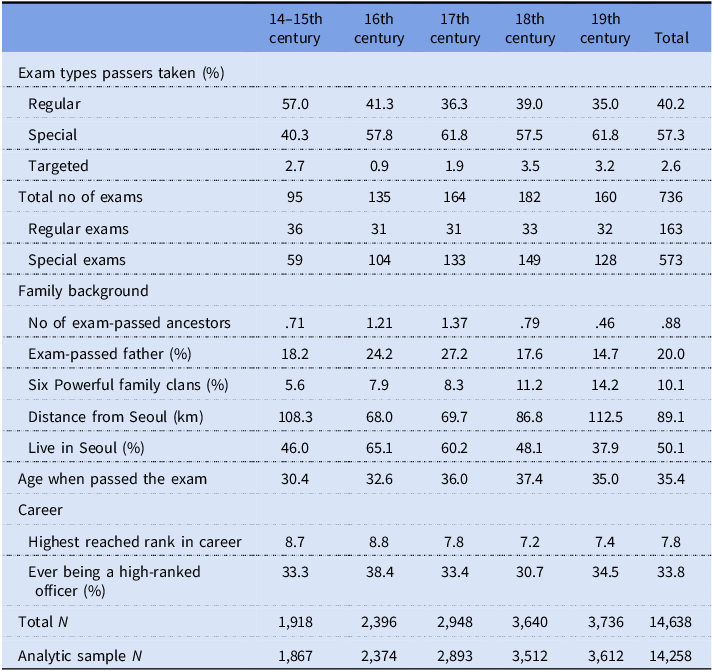
Note: The source of data is the compiled examination roster linked to the family genealogical records. Analytic samples exclude targeted exams. Except for exam type, all estimations are based on analytic samples. The officer rank ranges from 1 (lowest) to 18 (highest). High-ranked officers are those who reached 14 or higher-ranked position (dangsanggwan).
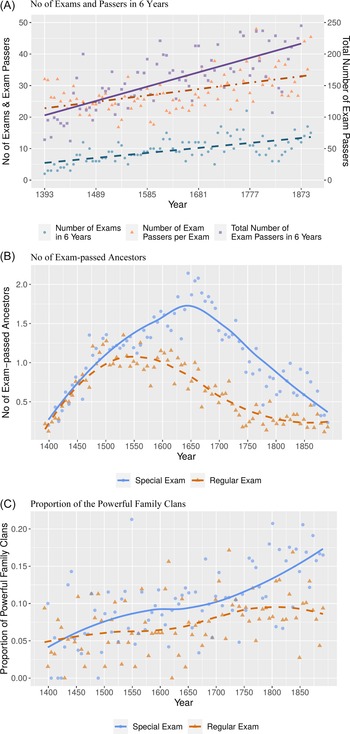
As shown in Figure 2A, the number of examinations offered in six-year periods, which correspond to the interval in which regular examinations were offered twice, increased steadily during the Joseon Dynasty. The average number of passers per examination also rose. As a result, the total number of examination passers in each six-year period grew steadily. Because the number of passers in regular examinations was mostly fixed at 33, the increase was primarily driven by special examinations.
Changes in the number of passers and examinations in a six-year interval and changes in the characteristics of passers by examination types, Joseon Korea, 1393–1894.
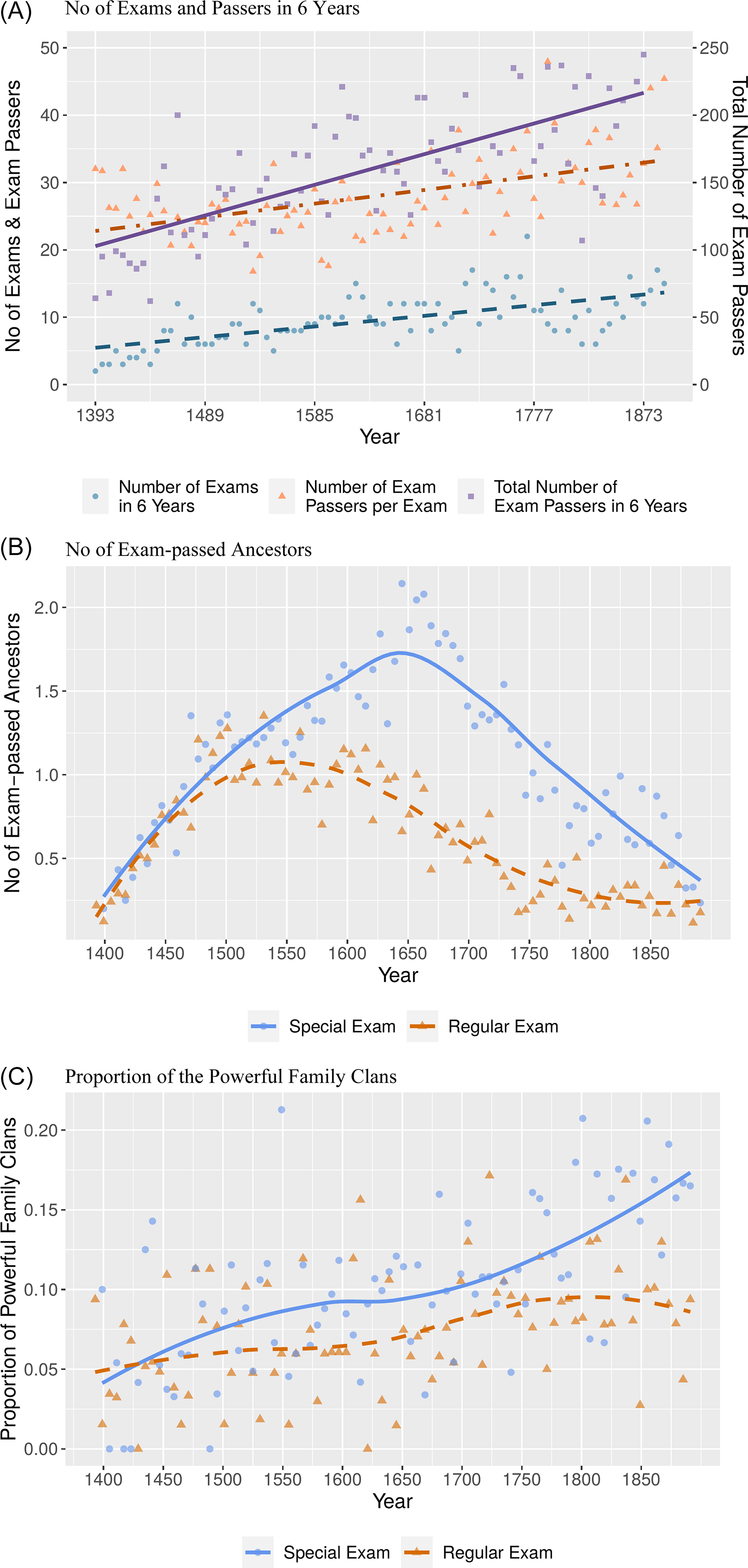
As for family backgrounds, around 20 percent of passers had fathers who also passed the examination. The proportion of passers whose fathers passed the examination was highest in the seventeenth century, when yangban families were most prominent among examination passers, and lowest in the nineteenth century. In the fourteenth to fifteenth centuries, the proportion from powerful family clans was a mere 5.6 percent, but it grew to 14.2 percent in the nineteenth century. Around half of the passers resided in Seoul, with this proportion highest in the sixteenth century and lowest in the nineteenth century. Our main question is whether these family backgrounds differ between regular and special examination passers and whether the patterns of these differences vary over time.
Differences in family backgrounds between regular and special examination passers
Figure 2B demonstrates the changes in the average number of literary examination-passed ancestors during the Joseon Dynasty. It shows an inverted U-shaped pattern. In the early Joseon period, the number of examination-passed ancestors was small. This number increased until the middle of the Dynasty, peaked in the seventeenth century, and then declined in the later period. Importantly, there was no difference in the average number between regular and special examination passers up until the fifteenth century, but a noticeable difference began to emerge from the sixteenth century. The average number of examination-passed ancestors was higher for special examinations than for regular examinations. In the seventeenth century, the average number for special examinations was 1.69, whereas for regular examinations, it was 0.82, a 0.87-point difference. The gap narrowed to 0.67 in the eighteenth century and 0.31 in the nineteenth century.
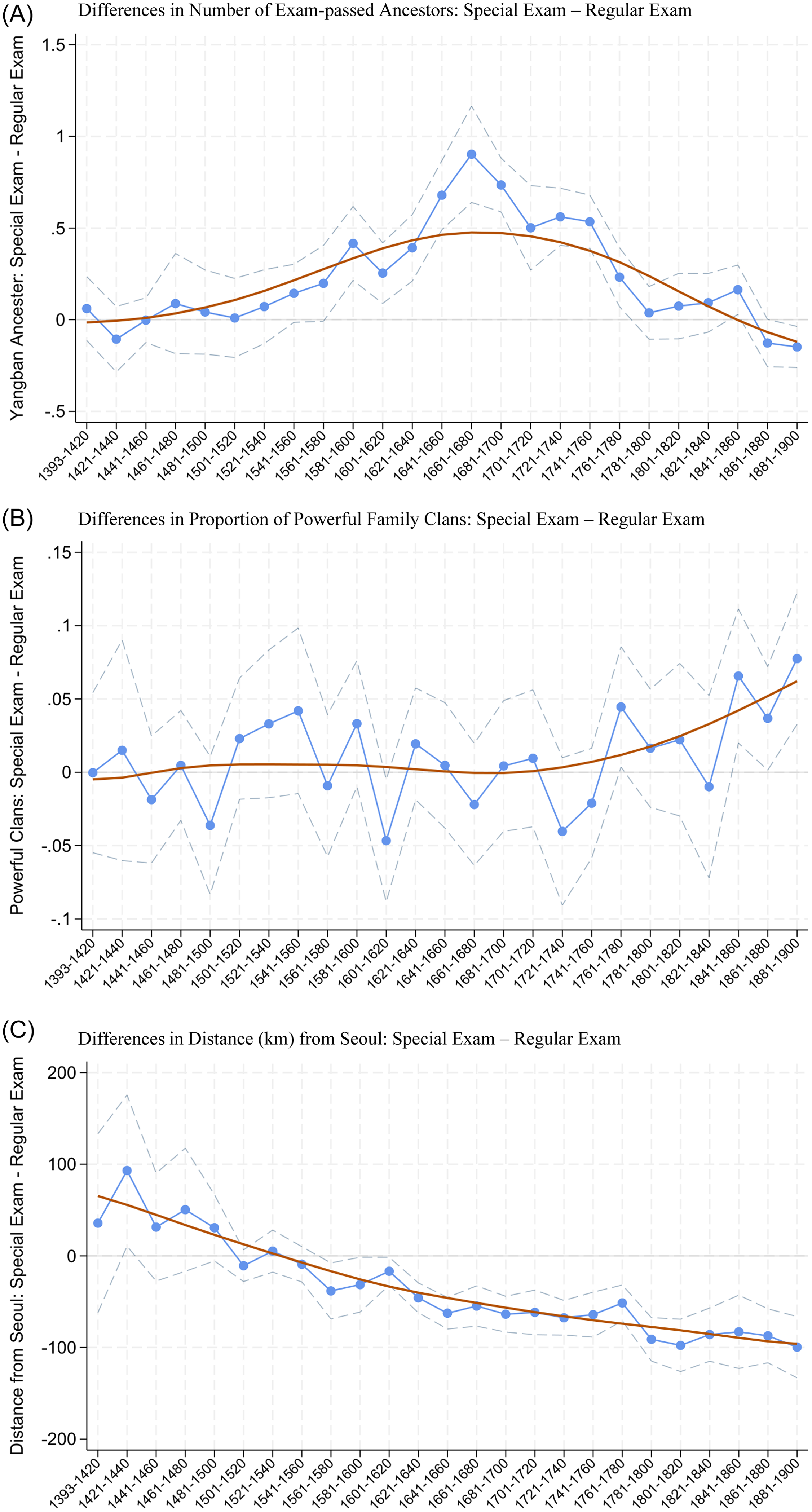
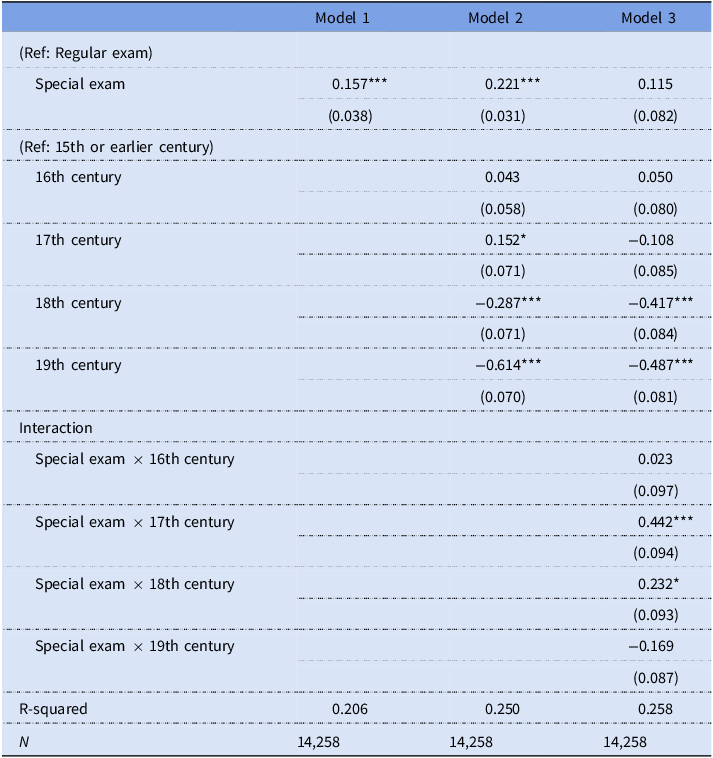
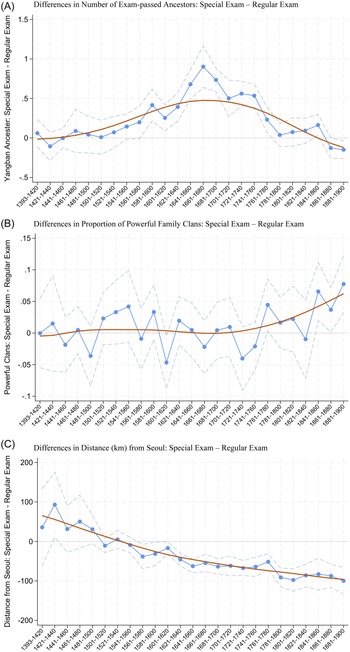
Table 3 presents the OLS estimates of examination type on the number of examination-passed ancestors. Controlling for demographic and examination-specific covariates, the average number of ancestors is 0.16 higher among passers of special examinations compared to regular examinations in Model 1 and 0.22 higher in Model 2, which includes century fixed effects. These results support Hypothesis 1. When interactions between century and examination type are introduced in Model 3, the main effect of the special exam becomes statistically insignificant, suggesting no significant difference in the number of examination-passed ancestors before the sixteenth century. However, the interaction terms are significant for the seventeenth and eighteenth centuries. Specifically, in the seventeenth century, individuals who passed special examinations had, on average, 0.44 more examination-passed ancestors than those who passed regular examinations. Considering that the average number of examination-passed ancestors is 0.88, a gap of 0.44 is substantial. At certain points in time, this gap reaches approximately 0.90, indicating that the average number of ancestors is roughly twice as high in special examinations as in regular examinations (see Figure 3).
OLS regression of the number of ancestors who passed the literary civil examination on exam type and century, Joseon Korea, 1393–1894
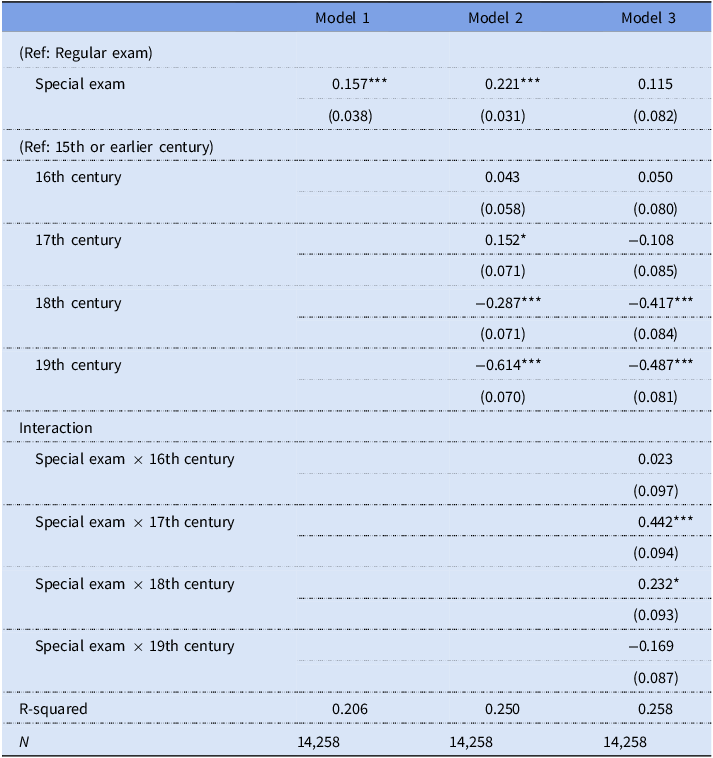
Note: The source of data is the compiled examination roster linked to the family genealogical records. Control variables include passers’ age, age variable missing, residential regions, region variable missing, the number of passers in each exam, and the number of exams offered in six years. Numbers within parentheses are standard errors.
*p < .05, **p < .01, ***p < .001 (two-tailed tests).
To assess the sensitivity of our results to the types of exam-passed ancestors, we re-estimate the models using several alternative measures: whether only the father passed the examination (excluding other ancestors); whether both the father and paternal grandfather passed; the number of examination-passed ancestors recorded in the compiled examination rosters only, excluding the record from the family genealogies; and the number of examination-passed ancestors including those who passed the lower-stage examination. The results remain robust across all specifications. Hypothesis 2 is supported.
Before proceeding to the next analysis, a noteworthy finding from Table 3 is that the main coefficients for the century dummies in Model 2 are negative for the eighteenth and nineteenth centuries. This suggests that, on average, examination passers in these later periods came from relatively less-privileged family backgrounds compared to those in the early Joseon period. The coefficient for the seventeenth century is positive in Model 2 but turns negative in Model 3, which indicates that examination passers had more examination-passed ancestors in the seventeenth century than in the fifteenth century, but this trend is driven primarily by those who passed special examinations. For regular examination passers, the number of examination-passed ancestors in the seventeenth century is lower than in early periods, although the difference is not statistically significant at the conventional alpha levels. In the nineteenth century, when the number of special examinations reached its peak, the difference between regular and special examination passers became negligible.
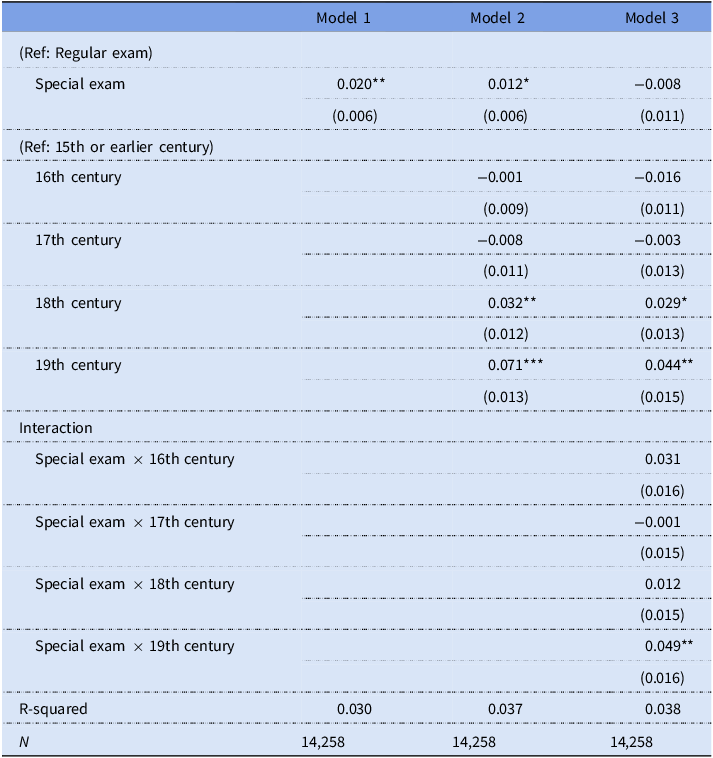
The late eighteenth century marked significant social transformations in Joseon society. The power and prestige of the traditional yangban class declined amid broader social and economic changes. At the same time, the late Joseon Dynasty came to be characterized by the dominance of a few influential family clans that monopolized high-ranking government positions and shaped national policies. That is, the privileged group shifted from the yangban to powerful family clans. If privileged groups indeed held an advantage in special examinations, we would expect that members of these powerful clans began to constitute a larger proportion of special examination passers compared to regular examination passers in the nineteenth century. To test this possibility, we estimate LPMs with membership in the six powerful family clans as the dependent variable. The primary focus, once again, is the interaction between examination type and century. While it is possible that powerful family clans rose to prominence because more of their members passed the examinations over time, our interest lies not in the overall increase in their representation among examination passers but in whether they were disproportionately represented in special examinations compared to regular examinations during periods when their power rose. Table 4 presents the results.
OLS regression of powerful family clan background on exam type and century, Joseon Korea, 1393–1894
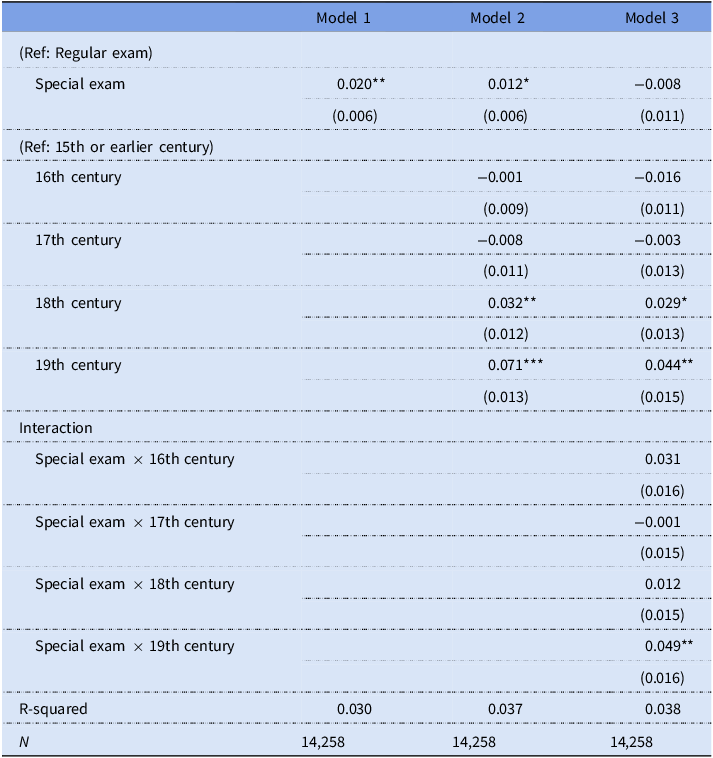
Note: The source of data is the compiled examination roster linked to the family genealogical records. Control variables include passers’ age, age variable missing, residential regions, region variable missing, the number of passers in each exam, and the number of exams offered in six years. Numbers within parentheses are standard errors.
*p < .05, **p < .01, ***p < .001 (two-tailed tests).
In the passer list of the compiled examination roster, a total of 751 family clans were recorded. Among them, approximately 10 percent of all examination passers came from the six family clans. Among regular examination passers, they accounted for 7.7 percent, while their share was notably higher, at 11.7 percent, among special examination passers. Figure 2C depicts how these shares evolve over time. As expected, the share of the powerful six family clans became higher in the late Joseon, particularly in special examinations. As shown in Model 2 of Table 4, in the eighteenth and nineteenth centuries, a greater proportion of examination passers came from the six clans compared to earlier periods. Regarding their representation in regular and special examinations, no significant difference is evident before the nineteenth century. The share of these clans increased during the eighteenth century, but the rise occurred similarly in both examination types. However, in the nineteenth century, when these families became dominant political forces, their representation grew more significantly in special examinations than in regular examinations. Given that the proportion of powerful family clans increased by 4.4 percentage points in the nineteenth century, the additional 4.9 percentage-point increase observed among special examination passers indicates roughly a twofold greater growth. These results are consistent with Hypothesis 3.
In this study, we use six family clans as an operational definition of powerful family clans. To assess the robustness of our results to alternative definitions of powerful family clans, we re-estimate the analyses using both a narrower set of four clans and an expanded set of 10 clans and find that the results are substantively unchanged.
Robustness checks
Our primary analyses use centuries as the unit of time to capture broad historical shifts. While existing scholarship commonly associates the seventeenth century with the culmination of the yangban’s political power and the nineteenth century with the dominance of powerful family clans, the boundaries of these transformations are inherently fluid and not sharply defined. To evaluate whether our findings depend on this coarse temporal aggregation, we conduct a robustness check by re-estimating Equation (1) using 20-year intervals and examining how the interaction coefficients evolve under finer temporal resolution.
Because estimating models with 20-year intervals generates a large number of interaction coefficients, we present the results more efficiently by plotting differences in marginal effects between regular and special examinations in Figure 3. The advantage associated with having examination-passed ancestors in special examinations is evident from the late sixteenth through the eighteenth century, peaking in the seventeenth century. Powerful family clans exhibit a distinct advantage in special examinations only from the mid-nineteenth century onward. Thus, estimates based on finer temporal resolution reinforce our central argument: advantages in special examinations emerge when privileged groups possess the social and political capacity to adapt strategically to the institutional features of the examination system.
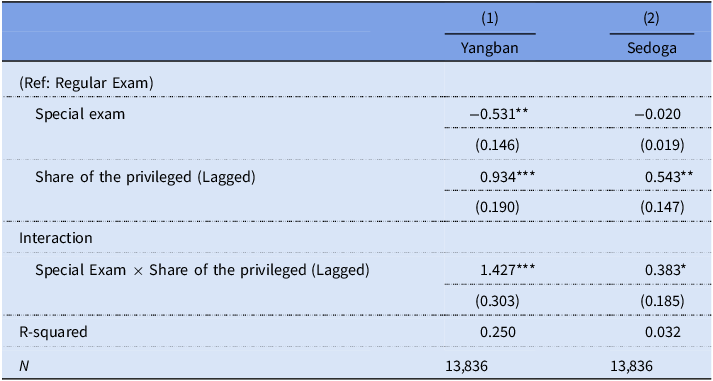
In this study, historical changes in the power and status of the privileged are primarily inferred from historical literature. As an additional robustness check, we operationalize the power of the privileged as the proportion of individuals who attained high-ranking office among gwageo passers from privileged backgrounds.Footnote 7 The interaction between this proportion, lagged by one 20-year period, and the special examination indicator is significantly positive (Table 5). That is, a stronger representation of the privileged among high-ranking officeholders in the preceding 20-year period was followed by significantly greater overrepresentation of the privileged in special examinations among passers in the subsequent 20-year period. This pattern points to intergenerational transmission of advantages, reflected in the growing advantage of the privileged in special examination outcomes.
OLS regression of Yangban Background on exam type and share of privileged among past passers who attained high-ranking office, Joseon Korea, 1393–1894
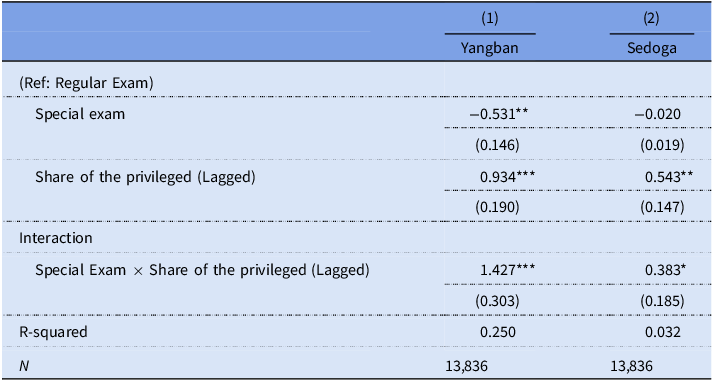
Note: The source of data is the compiled examination roster linked to the family genealogical records and the Annals of the Joseon Dynasty. The share of the privileged among high-ranking officers is calculated, within each 20-year period, as the proportion of individuals with a privileged background among high-ranking officers, conditional on past examination passing (= the number of exam passers from privileged backgrounds who were promoted to high-ranking offices/the total number of exam passers who were promoted to high-ranking offices). Depending on the model, a privileged background is defined as either a yangban background or membership in a powerful family clan. All independent variables are lagged by one 20-year period. Control variables include passers’ age, age variable missing, the number of passers in each exam, and the number of examinations offered in six years. Numbers within parentheses are standard errors. Standard errors are clustered by 20-year period because the key independent variable is the share of privileged families among high-ranking officers, which is measured at the 20-year period level.
*p < .05, **p < .01, ***p < .001 (two-tailed tests).
An additional piece of family background information from our dataset is the residential location. As a supplementary analysis, we estimate the distance between examination passers’ residential areas and Seoul. Because special examinations were often announced on short notice, proximity to Seoul conferred a systematic advantage in such examinations. Unlike the historical rise and fall of privileged groups, there were no comparable historical changes in the advantage of proximity to Seoul. However, Alon’s (Reference Alon2014) theory predicts that less-privileged groups can catch up to privileged groups if the structure of the examination remains the same over an extended period. As the structure and contents of regular examinations were relatively consistent over time, those who lived far from Seoul might have been more likely to adapt to regular examinations, and thus, the disadvantage of living far from Seoul could be diminished in regular examinations over time. As shown in the online appendix in Supplementary material, the results are consistent with this expectation. Over time, the special examination passers are increasingly coming from locations closer to Seoul, while the regular examination passers are increasingly coming from locations farther away from Seoul. These results provide additional evidence that the privileged were overrepresented among passers of examinations with new and varying rules.
Discussion and conclusions
Using the digitized examination roster data, this study examines how privileged groups leveraged institutional differences between regular and special literary examinations to sustain their advantages. Unlike many other elite systems, yangban status, the ruling class of the Joseon Dynasty, was maintained mainly by passing the literary examination. Families who failed to pass the examination over multiple generations lost their status. Whereas prior studies have focused on the meritocratic qualities of examination passers in career mobility (e.g., Lee and Park Reference Lee and Park2019; Paik et al. Reference Paik, Hong and Yun2022), this study focuses on the meritocracy of examination passing itself. Although the compiled examination roster data include only successful candidates, we address this limitation by synthesizing Alon’s (Reference Alon2014) theory of educational exclusion and adaptation with historical changes in elite power and applying this framework to differences between regular and special examinations. Special examinations, which were more flexible in terms of scheduling, stages, and content, may have given privileged groups greater opportunities to adapt and benefit before less-privileged groups could catch up. The short notice of their schedules may also have functioned as an exclusion mechanism against less-privileged groups. By focusing on this distinction, we shed light on how institutional differences between regular and special examinations generated systematic differences in the family backgrounds of those who passed, even within a system strongly based on merit.
Our analysis reveals that the proportion of privileged groups was higher in special examinations than in regular examinations and that this difference was most pronounced during periods when these groups held political power. These patterns persist after controlling for demographic and examination-related variables. The average number of examination-passed ancestors was higher among special examination passers, particularly during the consolidation of the Confucian sociopolitical order and yangban prominence in officeholding in the seventeenth century. Similarly, in the nineteenth century, when powerful family clans emerged as dominant political forces, their representation in special examinations exceeded that in regular examinations. Analysis of passers’ residential distance from Seoul provides indirect evidence that both adaptation and exclusion mechanisms operated within the civil service examination system.
Since the seminal work of Blau and Duncan (Reference Blau and Duncan1967), it has become well-established in sociology that family background shapes children’s socioeconomic achievements, largely through education in modern societies. The Joseon Dynasty was, if not the only one, one of the few premodern societies in which education served as the primary mechanism for the reproduction of the ruling class. Privileged groups in Joseon therefore had strong incentives to exploit every possible means to increase their offspring’s likelihood of passing the gwageo examination. This study demonstrates that privileged groups in Joseon held an advantage in special examinations, which featured more flexible formats than regular examinations. As privileged groups shifted over time, groups that benefited most in special examinations also changed accordingly. These results indicate that even under conditions of strong ideological and institutional commitments to meritocracy, privileged groups were better positioned to take advantage of institutional flexibility, which is similar to modern college entrance processes (Alon Reference Alon2009; Kim and Shin Reference Kim and Shin2020; Warikoo Reference Warikoo2022). In this sense, the civil service examination system in Joseon functioned not only as a meritocratic sorting mechanism but also as a site in which adaptation to institutional variation shaped the reproduction of elite advantage.
With respect to the historical changes in the meritocratic character of the civil service examinations, our results show that differences in family background between regular and special examinations were relatively small during both the early and late periods of the Joseon Dynasty. In the early Joseon period, Confucian principles gained prominence as a guiding framework for governance and institutional reform. Confucian education expanded, and the gwageo examination system was regarded as an important mechanism for selecting capable government officials. Some scholars have argued that the early Joseon period was more meritocratic than later periods (Han Reference Han1985). While our findings do not directly confirm this claim, they are consistent with it. The weakening influence of family background in the nineteenth century is consistent with previous findings that intergenerational mobility in the early nineteenth century in Korea was relatively high (Kye and Park Reference Kye and Park2019). Although powerful family clans continued to exploit their advantages in special examinations, an increasing number of examination passers came from families whose ancestors did not pass the exam. This pattern may reflect the growing porosity of status boundaries in late Joseon, as families outside the traditional elite increasingly gained access to the examination system.
Before concluding, we emphasize that we do not rule out the possibility that differences between regular and special examinations may also have been shaped by historical and institutional changes not directly captured in our models. These include major disruptions such as the Japanese and Manchu invasions, shifts in state priorities (e.g., changes in Joseon’s relationship with Qing China), and broader transformations in educational and political institutions. For these reasons, our analysis is descriptive rather than causal, and the observed associations should be interpreted as historically contingent patterns. This study has several other limitations. While this study leverages the institutional distinction between regular and special examinations, it does not directly measure the substantive differences between the two. Integrating data on examination questions and answers with the current dataset would allow future research to directly assess how these differences shaped patterns of examination success. In particular, which features of special examinations were associated with the advantages of privileged groups remains unexplored, as does how the skills emphasized in both special and regular examinations evolved over time. Moreover, because selection into examination types cannot be fully accounted for, it is not possible to determine whether the higher proportion of privileged groups in special examinations reflects a higher likelihood of passing these examinations, privileged groups’ greater access to them, or shifts in the relative valuation of different skills. Future research would also benefit from explicitly modeling how large-scale historical disruptions and institutional reconfigurations conditioned the relationship between examination systems and elite reproduction over time. Despite these limitations, in line with Song and Campbell’s (Reference Song and Campbell2017) argument, this study demonstrates that the use of historical and genealogical microdata is both fruitful and important for the study of stratification.
Supplementary material
The supplementary material for this article can be found at https://doi.org/10.1017/ssh.2026.10135.
Acknowledgments
An earlier version of this paper was presented at the Korea Inequality Research Network 2025 Annual Symposium. We are grateful to the editor and anonymous reviewers for their constructive comments, and to Cameron Campbell, Hao Dong, Bongoh Kye, Hyunjoon Park, and Xi Song for their helpful comments and suggestions. ChangHwan Kim received financial support from the Ministry of Education of the Republic of Korea and the National Research Foundation of Korea (NRF 2020S1A3A2A03096777). Direct correspondence to ChangHwan Kim, Department of Sociology, University of Kansas, at chkim@ku.edu.
Competing interests
The author declares none.


 Open access

