



1. Introduction
Plant and agronomical sciences are at a crossroads. The present polycrisis, where multiple interconnected crises, such as climate change, biodiversity collapse, economic inequality, food insecurity and geopolitical tensions, intensify each other’s impact, has created a state of urgency and uncertainty (Lawrence et al., Reference Lawrence, Homer-Dixon, Janzwood, Rockstöm, Renn and Donges2024). This situation is increasingly prompting plant scientists not only to provide solutions but also to reflect on their role in society.
For instance, while the decline of cultivated biodiversity appears to be a major source of vulnerability for agri-food systems, current socio-ecological challenges also present new opportunities for plant research to develop improved crops for tomorrow’s agriculture. In the context of plant breeding, creating new drought-resistant varieties could be seen as a positive endeavour by some (McMillen et al., Reference McMillen, Mahama, Sibiya, Lübberstedt and Suza2022), while others would rather view the generation of improved crops as an incentive to maintain the monoculture ideology and its many shortcomings for agriculture and society (Balogh, Reference Balogh2021). Similarly, enhancing the ability of plants to store carbon in their roots could be seen by some as an efficient way to mitigate the climate crisis (Kaplan, Reference Kaplan2021), while others would rather view this strategy as a way to avoid questioning the root cause of our CO2 emission, thus legitimizing a runaway trajectory (Honeycutt, Reference Honeycutt2021). Lastly, increasing the agronomical yield of crops may be viewed by some as a way to reduce deforestation, in the footsteps of Norman Borlaug’s land-sparing theory (Singh et al., Reference Singh, Low, Ooi and Martienssen2013), while others would rather see an emerging rebound effect, where more productive plants will generate new needs, and thus increase deforestation, instead (as seen for oil palm for instance; Hamant, Reference Hamant2020).
In the field of plant sciences, especially agronomy, participatory research emerges as a response to these polarizing ideas (Ceccarelli & Grando, Reference Ceccarelli and Grando2020). Based on citizen participation in the production of knowledge and applicable results and strategies, this approach aligns with the concept of agroecology, which advocates for a holistic transformation of food systems that encompasses not only technical practices but also social, political and economic dimensions (Table 1). Because such approaches are more situated, they are more heterogeneous. With such new challenges, these participatory approaches call for state-of-the-art quantitative approaches, offering a unique opportunity to bridge quantitative plant biology with social sciences.
Thirteen principles of agroecology according to HLPE (adapted from Dorottya Poor, (FAO & HLPE, 2019)).

Participatory research approaches are leading to the emergence of reflections from the social sciences on the stance of research and the place given to scientific methods. Scientists are increasingly re-evaluating their approach to research, to make it more consistent with current issues. This bridges with the concept of ‘post-normal science’, which provides a theoretical framework to guide scientific strategies and the links between science, politics and society in an uncertain world. In this article, we begin by analysing the role of scientific research in an uncertain world, examining the stance of researchers in society, introducing the concept of ‘post-normal science’ and giving a definition of participatory research aligned with post-normal science. In the second part of the article, we illustrate these theoretical considerations with a practical example of a participatory approach in agronomy: participatory plant breeding. This approach involves various stakeholders collaborating with scientists throughout the entire process of developing new crop varieties .
2. Scientific research in an uncertain world
2.1. Science is not neutral
The notion of the researcher’s neutrality, especially in the experimental sciences, remains widespread. This perspective assumes that scientists are external to their object of study. Their role is to produce ‘knowledge’ by ‘extracting data from the field’ (de Sardan, Reference Olivier de Sardan1995), which exists independently of the ‘knower’ (Popper & Rosat, Reference Popper and Rosat1998). This idea of neutrality is rooted in the positivism paradigm, a philosophical approach that considers scientific knowledge, derived from empirical studies, as the only form of legitimate knowledge (Park et al., Reference Park, Konge and Artino2020). In the social sciences, the researcher’s stance has been the subject of many epistemological debates over the past few decades. Neutrality, defended at the beginning of the 20th century by sociologists such as Max Weber (Weber, Reference Weber1919), is today ‘no longer a notion that can be used to define the researcher’s methodological stance’ (Beauguitte, Reference Beauguitte2022).
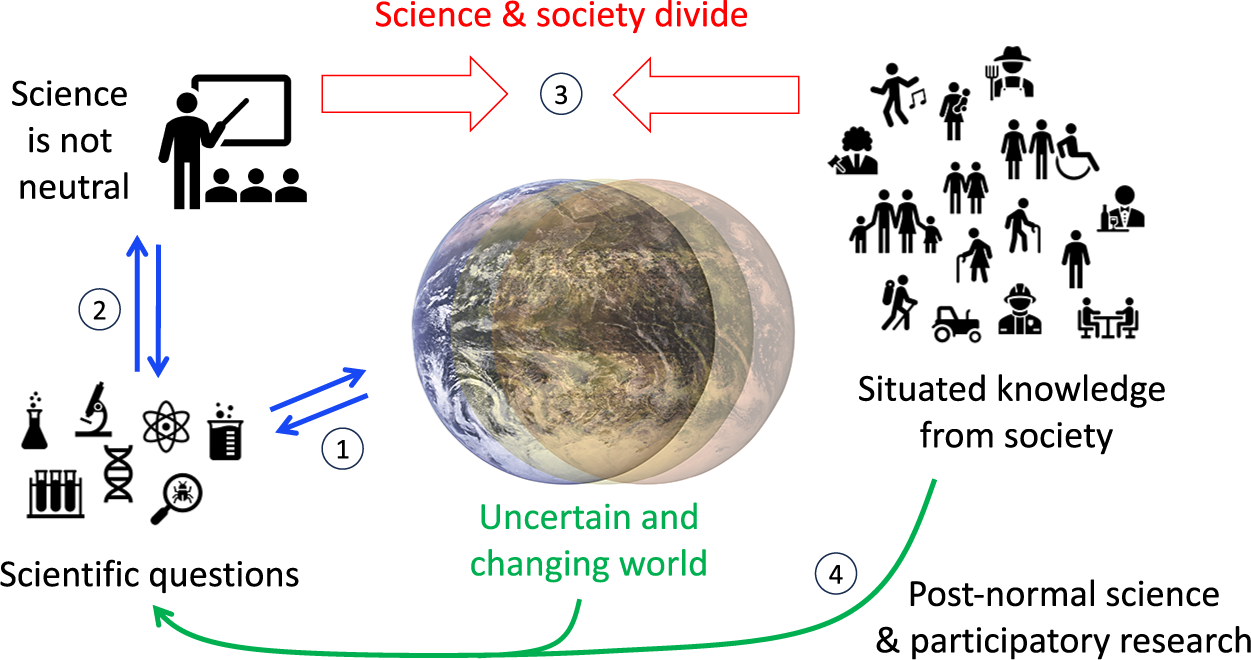
Indeed, as highlighted by several authors (e.g., see Latour et al., Reference Latour, Woolgar and Latour2013), even in the experimental sciences, a researcher is never truly neutral. Every scientific endeavour is influenced by ‘the system of representations and values that shapes their [the scientists] relationship to the world and to the social problems of their time’ (Kuhn, Reference Kuhn2008). Thus, ‘the questions we ask ourselves at a given moment in a given discipline are in part a reflection of the societies in which we live’ (Beauguitte, Reference Beauguitte2022). The scientist’s commitment, often unconscious, is apparent from the very outset of their work, beginning with the choice of research topic and the formulation of the research question (Figure 1).
Main stages of a research programme influenced by the scientist’s environment and value system. The four main stages are shown centrally, with examples of potential decisions for each stage depicted to the right, based on a fictitious research topic. For the final stage, ‘implementation of results’, a single application example is provided. On the left, a set of questions is suggested to encourage reflexivity throughout the research process.

Acknowledging the scientist’s commitment requires an alternative paradigm to positivism. Some researchers propose the ‘interpretativist’ paradigm, in which the scientists are aware of their non-neutrality and seek to distance themselves as much as possible from the object of study (Brasseur, Reference Brasseur2012).
However, an increasing number of authors are situating research within a ‘constructivist’ conceptual framework (Kuhn, Reference Kuhn2008; Thiollent, Reference Thiollent2011). This paradigm is based on the idea that reality does not exist as such but is ‘constructed by the act of knowing’ (Le Moigne, Reference Le Moigne2012). It acknowledges that scientists bring their intentions into their work, making them inseparable from the research process itself, and can thus be described as ‘researcher–actors’ (Brasseur, Reference Brasseur2012).
Beyond the researcher’s stance, constructivism questions the supposed objectivity of scientific knowledge. According to this paradigm, the ‘object’ of knowledge is co-constructed through interactions between the researcher and the field (Allard-Poesi & Perret, Reference Allard-Poesi and Perret2014). As a result, knowledge is viewed as subjective and contextual (Brasseur, Reference Brasseur2012).
This line of reasoning also applies to the experimental sciences, even though they are often perceived as highly objective. Indeed, philosopher Isabelle Stengers points out that experimentation relies on specific conditions (e.g., specific staging) designed to enable only one interpretation of the resulting observations. This guarantees the high reliability of results and constitutes the ‘strength of the laboratory’ (Stengers, Reference Stengers2000). However, without discrediting this strength of the experimental sciences, Stengers highlights the singularity of the discourse specific to these sciences, demonstrating that they are as socially constructed and situated as other forms of knowledge (Stengers, Reference Stengers2000).
2.2. The relationship between science and democracy
Recognizing that complete researcher neutrality is an illusion and that scientific knowledge is never entirely objective, one needs to reconsider the place of science in society. This reflection is particularly important in the context of the current polycrisis. Authors such as Bruno Latour and Isabelle Stengers call researchers to greater awareness of their responsibility for the impact of their work on society (Latour, Reference Latour2008; Stengers, Reference Stengers2000). Indeed, Latour (Reference Latour2008) and Stengers (Reference Stengers2000) assert that science and politics are inseparable and that researchers have a political responsibility through their work, whether they know it or not. As Latour pointed it out in a famous, and heavily debated, catch-phrase, ‘science is politics by other means’ (Seguin & Vinck, Reference Seguin and Vinck2023). To be clear, this does not mean that the goal of science is to follow a political agenda but rather that research cannot be fully objective, and thus it reflects, to some extent, the current political context. In this respect, the current funding of many plant science projects with a link to the climate crisis is exemplary.
Science, particularly experimental sciences, often wields an implacable power over lay knowledge and other scientific disciplines due to their alleged validity, objectivity and certainty (Stengers, Reference Stengers2000). However, in the context of public debate and social controversy, the issues at hand often extend beyond the scope of experimental science. While these sciences can analyse specific dimensions of societal problems and provide valuable information for public debate, they are insufficient to resolve them in their entirety. To fully grasp social controversies, it is essential to include contributions from other disciplines as well as from non-scientific citizens (Stengers, Reference Stengers2000).
The case of genetically modified organisms (GMOs) in Europe serves as a clear illustration of this point. Political arguments in favour of GMO authorization focused mainly on health and environmental aspects, which can be at least partially understood by the experimental sciences (Stengers, Reference Stengers2000). However, they often neglected the economic and social dimensions, related to other scientific disciplines, as well as the value systems held by the society as a whole. For instance, many scientists assert that it is possible to live with GMOs and reject citizen opposition based on irrational fears or resistance to change. Yet, a ‘common future’ with GMOs should be decided with all concerned citizens, considering not only expert knowledge but also lay knowledge and ethical arguments (Stengers, Reference Stengers2000).
Lastly, reflection on the relationship between science and society can also be applied upstream of research, by asking the question of who defines research orientations, and through what processes. In the end, the links between science, society and politics question the way in which the research process is conducted.
2.3. Reconciling commitment and methodological rigour
Admitting that research projects are committed also raises the question of how to ensure methodological rigour in the scientific process. Social sciences can contribute to participatory science on a methodological level by sharing, for example, tools that help develop reflexivity about research processes.
For example, in his chapter on reconciling rigour and commitment in geography research, Laurent Beauguitte stresses the importance of making explicit one’s [political] positioning as a researcher, as well as the theoretical choices that flow from it (Beauguitte, Reference Beauguitte2022). The author stresses the need to ‘make your methodological choices as explicit as possible, and base your work on solid, documented empirical data’. This transparency, which allows us to understand where we are coming from and the scientific approach we have adopted, helps to limit bias and, above all, to make it easily identifiable.
Another essential feature of methodological rigour, which is prevalent in qualitative social science approaches, is that of ongoing reflexivity. This invites researchers to constantly question their roles, presuppositions, methods and influence in the research process (Godrie et al., Reference Godrie, Boucher, Bissonnette and Bandini2020; Jodelet, Reference Jodelet, Moscovici and Buschini2003). Researchers are also urged to be open to debate and criticism, including from non-scientific citizens (Stengers, Reference Stengers2000).
In their article on participatory science, Houllier and Merilhou-Goudard (Reference Houllier and Merilhou-Goudard2016) propose nine recommendations aimed at guaranteeing the quality and rigour of participatory approaches, some of which can be transposed more broadly to any scientific approach. In particular, the authors emphasize the importance of ensuring ‘clarity of research objectives’, ‘quality and transparency of protocol’, ‘reliability and reproducibility of data’, ‘respect for scientific ethics’ and ‘openness and sharing of data and results’. So, despite the research’s assumed commitment, the rigour of the scientific approach can be ensured by respect for principles such as transparency and reflexivity.
2.4. Post-normal science
Awareness of the commitment involved in research, and acceptance of our responsibilities as researchers, requires us to move away from a positivist vision of scientific research. The concept of post-normal science, developed by Funtowicz and Ravetz (Reference Funtowicz and Ravetz2003) at the end of the 20th century, could be helpful. Post-normal science proposes a problem-solving approach that aims to produce usable knowledge for political decision-making and action, in contexts where the stakes are high, complex and uncertain (Figure 2).
Post-normal science, compared to more traditional approaches to problem-solving: applied science and professional consultancy. Post-normal science is particularly relevant in contexts of high uncertainty, where major issues hinge on political decisions. It is then essential to consider the values and concerns of all stakeholders. Adapted from the diagram by Funtowicz and Ravetz (Reference Funtowicz and Ravetz2003).

This strategy stands in opposition to ‘normality’. ‘Normality’ concerns both a type of scientific approach and the links between political decisions and scientific knowledge (Funtowicz & Ravetz, Reference Funtowicz and Ravetz2003). The ‘normal’ scientific approach is based on the resolution of successive problems within a paradigm accepted by all (Kuhn, Reference Kuhn1996). In terms of the relationship between science and policy, ‘normality’ assumes that science provides policy-makers with sufficient and appropriate knowledge (Funtowicz & Ravetz, Reference Funtowicz and Ravetz2003). Normality thus refers to the scientific approach and the positioning of science within a positivist paradigm.
However, the assumption of ‘normality’ is no longer valid today, especially in the face of uncertainty and the multiple crises facing societies (Funtowicz & Ravetz, Reference Funtowicz and Ravetz2003). In the footsteps of Günther Anders (Anders & Anders, Reference Anders and Anders2002) and the inability of humans to represent their actions, ‘all too often, we have to make major political decisions with only irremediably uncertain scientific information’ (Ravetz, Reference Ravetz1999). Post-normal science proposes an alternative to this observation. It recognizes that scientific knowledge is both uncertain and rooted in a system of values. It also recognizes that political decisions cannot be based solely on scientific facts, but must also consider the values, interests and concerns of the various involved parties.
Thus, post-normal science emphasizes the participation of all stakeholders, including non-scientific citizens and non-political professionals, in the production and use of scientific knowledge. This makes the research process much more complex. It raises the question of how, and by whom, the framework for knowledge production is defined, proposing a more inclusive and democratic vision. Finally, post-normal science places as much importance on the process of knowledge production as on its results (Funtowicz & Ravetz, Reference Funtowicz and Ravetz2003; Ravetz, Reference Ravetz1999).
In short, post-normal science proposes an approach to science based on solving concrete problems, usually on a local scale, by involving and considering the interests and values of a wide range of stakeholders.
2.5. Research according to post-normal science
Two major criteria characterize research aligned with post-normal science: the purpose and quality of the research process. Indeed, post-normal science refers to a scientific approach with objectives, clearly defined and shared by all stakeholders, that aim to contribute to the resolution of societal problems (Funtowicz & Ravetz, Reference Funtowicz and Ravetz2003).
In this context, the aim of such research is not to produce universal knowledge but rather to generate knowledge that can be mobilized to solve these problems and work towards a common goal of social transformation. The knowledge generated by these research approaches is characterized by ‘a high level of contextual validity’ (Godrie et al., Reference Godrie, Boucher, Bissonnette and Bandini2020). They are also ‘socially robust [because] validity is no longer determined solely by narrowly circumscribed scientific communities, but by much broader communities of engagement’ (Godrie et al., Reference Godrie, Boucher, Bissonnette and Bandini2020).
Furthermore, post-normal science places great importance on research processes (Funtowicz & Ravetz, Reference Funtowicz and Ravetz2003). It aims to foster ‘cognitive justice’, by transforming research spaces into places of ‘co-learning’, where scientists and non-scientific professionals are all ‘co-researchers’ (Godrie et al., Reference Godrie, Boucher, Bissonnette and Bandini2020). One can also evoke the term ‘deliberative democracy’ leading to ‘individual and collective emancipation’ (Morrissette, Reference Morrissette2013). This quality of processes can be assessed by the degree to which the scientific process is appropriated by lay actors (Gélineau et al., Reference Gélineau, Dufour and Bélisle2012). Stengers’ reflection on democracy within research processes is particularly relevant in this context (Stengers, Reference Stengers2000). Indeed, she cites two principles for fostering inclusiveness and democracy in scientific processes: recognition of the equal legitimacy of different types of knowledge and vigilance to avoid any hierarchy in the distribution of power between stakeholders.
Thus, research according to post-normal science is characterized by its two major objectives: generating scientific knowledge to answer societal questions and problems and setting up inclusive processes that can foster democracy on a broader scale. Through these two objectives, research contributes to social transformation. One type of research that meets the principles of post-normal science is participatory research.
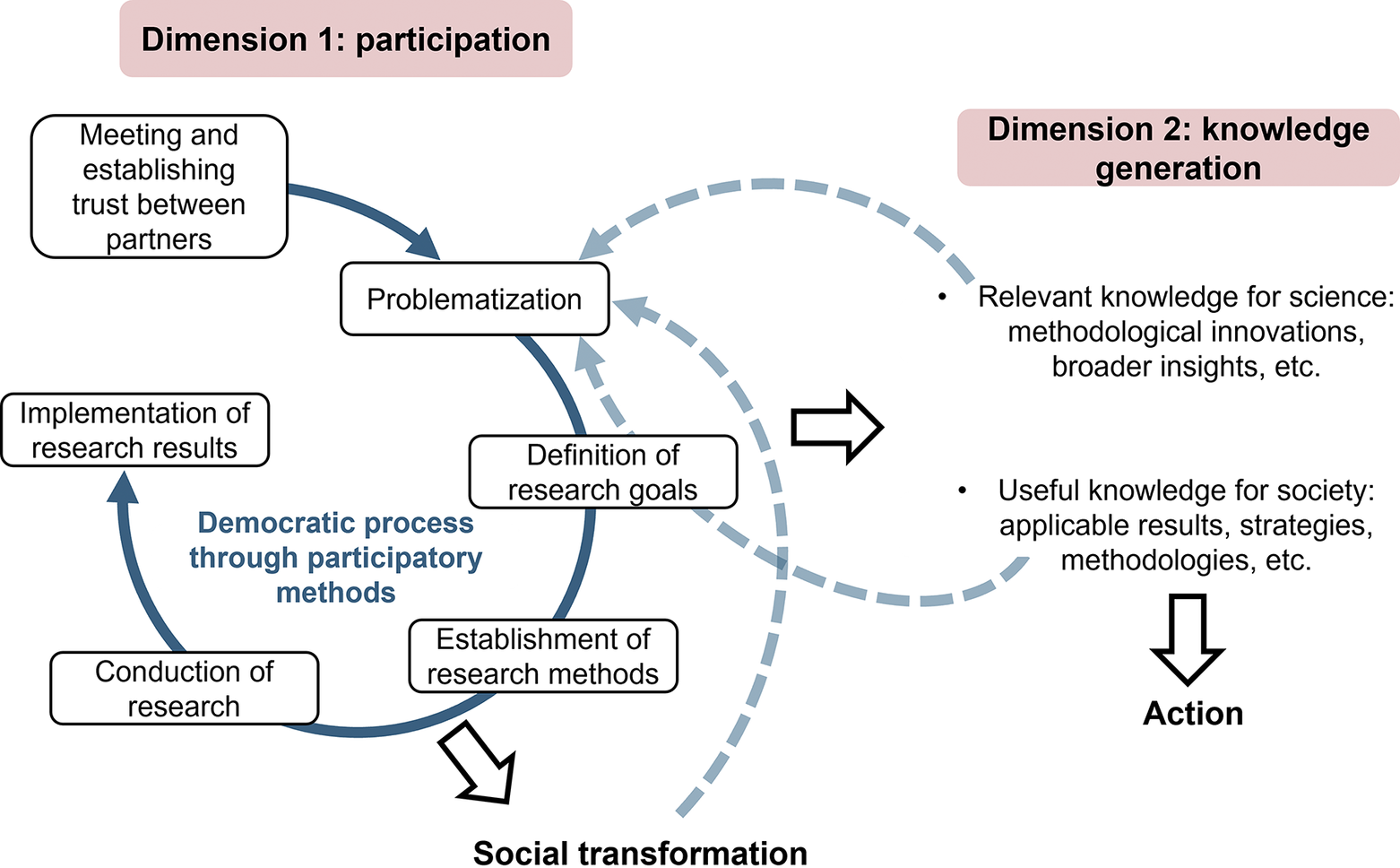
Defining participatory research. Short large arrows represent the direct outcomes of a participatory research process, while the dotted arrows indicate potential reinforcement effects, also for future projects. Participatory research is characterized by two inseparable dimensions: participation and knowledge generation. Effective management of the participatory process, which involves engaging all partners in every critical stage of the research (especially the problematization stage), is essential for generating knowledge that is both relevant for science and useful for society. Beyond knowledge generation, the participatory dimension often fosters social transformation, while the generation of useful knowledge for society leads to action. Moreover, in most cases, participatory research focuses on local issues and takes vernacular knowledge into account.
2.6. Participatory research
Participation is defined as ‘the competence of citizens or groups to be directly concerned by a problem and mobilized by their desire to learn more about phenomena that concern them, or to act on their own conditions or on their near or distant environments’ (Houllier & Merilhou-Goudard, Reference Houllier and Merilhou-Goudard2016). Participatory research has its roots in the reflections of various thinkers, including Paolo Freire, John Dewey and Kurt Lewin, from the 1940s onwards. The latter advocates a science that listens to people and is closely linked to action and social change (Macaulay, Reference Macaulay2016; Storup et al., Reference Storup, Millot and Neubauer2013).
Several definitions of participatory research exist in the literature. The term can be seen as an ‘umbrella’ word encompassing a diversity of approaches (Macaulay, Reference Macaulay2016). Nevertheless, most authors characterize participatory research by the involvement of research beneficiaries throughout the research process and by the production of relevant and coherent results for these non-academic stakeholders. It is a set of approaches that ‘establish links between research and action, between theory and practice, between the logic of the researcher and that of the practitioners’ (Anadon & Couture, Reference Anadon and Couture2007) (Figure 3).
Participatory research is characterized by full collaboration between researchers and the community, right from the problematization of research themes, by concrete objectives aimed at contributing to the resolution of societal challenges, and by the production of knowledge that can lead to innovation or social transformation (Houllier & Merilhou-Goudard, Reference Houllier and Merilhou-Goudard2016; Receveur et al., Reference Receveur, Poulet, Dalmas, Gonçalves and Vernay2022). Furthermore, participatory research approaches target ‘local priorities and perspectives’ (Cornwall & Jewkes, Reference Cornwall and Jewkes1995). Altogether, this also involves balanced power relations between researchers and other stakeholders, and the consideration of vernacular knowledge in the research process.
Here we will draw on the definition proposed by the ‘Sciences Citoyennes’ association, which describes participatory research as ‘a type of citizen participation in research, where members of a civil society organization join forces with academic researchers to build and carry out a research project together. The aim of this type of partnership is to produce knowledge that is both of genuine scientific interest to the researcher, and also meets the needs of the associative partner’ (Sciences Citoyennes, 2020). According to this definition, participatory research meets the post-normal science criteria. On the one hand, it seeks to respond to a question or problem raised by society. On the other hand, it attaches importance to the process, ensuring that non-academic stakeholders are involved right from the initial phases of the research.
In short, participatory research can be characterized by its two dimensions: research and participation. With regard to research, the aim is to produce knowledge of interest to both researchers and non-academic partners. In terms of participation, the aim is to involve the community through democratic processes, particularly in the early stages of the process (Receveur et al., Reference Receveur, Poulet, Dalmas, Gonçalves and Vernay2022) (see Figure 4a). These two dimensions can also serve as a basis for evaluating participatory research processes.
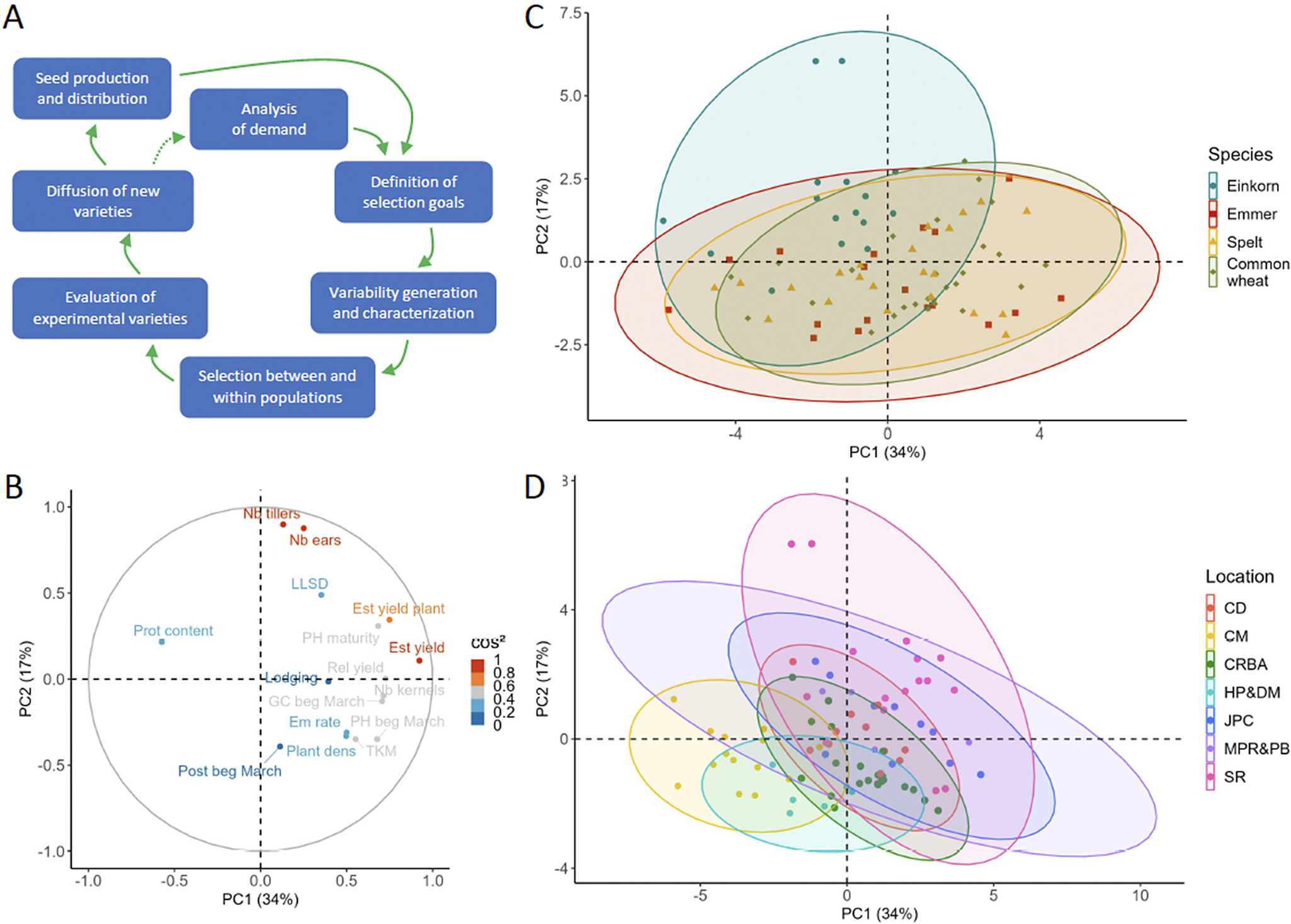
Breeding programme: approach and quantitative analysis. (a) Main stages of a breeding programme. Modified from Ceccarelli and Grando (Reference Ceccarelli and Grando2020). (b–d) An example of evaluation of experimental varieties of hulled wheats during an ongoing plant participatory breeding programme in the Lyon region, with a PCA on agronomic parameters. (b) Plot of variables. Colours indicate the quality of representation (cos2) of each variable. Dens: density, Em: emergence, Est yield: estimated yield, Est yield plant: estimated yield per plant, GC: ground cover, Nb tillers: number of tillers per plant, Nb ears: number of ears per plant, Nb kernels: number of kernels per ear, PH: plant height, Post: posture, Prot: protein. (c, d) Plots of individuals, according to the species (c) and the location (different farm names) (d) with 95% confidence ellipses of the mean point for each species (c) or location (d).
Finally, it is important to note that the boundaries between participatory research and other approaches that align with post-normal science are blurred. In particular, the distinction between action research and participatory action research is difficult to make. Two differences stand out in the literature: the way action is approached and the objective of knowledge production. In the case of participatory research, action is not an objective in itself but is often a consequence of the research process. On the other hand, knowledge production can be an end in itself. In action research and participatory action research, action is at the heart of the research process and knowledge production is only a means to an end.
3. An example of participatory plant breeding
3.1. The issue of cultivated biodiversity decline
The industrialization of agri-food systems, which began at the end of the 19th century and intensified after the Second World War (during the ‘great acceleration’), represents a major turning point for cultivated biodiversity. In Europe, in a post-war context, the re-launch of agriculture was of prime importance. The logic was to rationalize production to increase and secure yields, particularly of cereals. A Fordist vision was adopted in agriculture, based on mass production and consumption, standardization of processes and supply, and scale economies (Bonneuil et al., Reference Bonneuil, Thomas and Petitjean2012).
In this context, plant breeding, historically conducted by peasants, was restructured into a professional activity (Bonneuil et al., Reference Bonneuil, Thomas and Petitjean2012). The aim was to produce standardized crop varieties suited to the industrial agricultural model using knowledge of genetics. Yet, plant breeding professionals focused on a limited number of commercially valuable species, neglecting many other species that were often of great importance on a more local scale. Additionally, selection criteria became standardized, exchanges between producers declined and genetically heterogeneous varieties were replaced by homogeneous ones. Overall, such a revolution in plant breeding led to a massive decline in cultivated biodiversity (FAO, 2019; Khoury et al., Reference Khoury, Brush, Costich and Thormann2022).
The research community has gradually been concerned by the decline in cultivated biodiversity and the risks it represents for food security and the health of populations. In particular, research projects on neglected and underutilized species have multiplied in recent years (Chivenge et al., Reference Chivenge, Mabhaudhi, Modi and Mafongoya2015; Kaczmarek et al., Reference Kaczmarek, Causse, Abdul and Billot2023; Mugiyo et al., Reference Mugiyo, Chimonyo, Sibanda and Mabhaudhi2021). In the early 2000s, the UN led two international projects to promote neglected and underutilized species (Padulosi et al., Reference Padulosi, Bala Ravi, Rojas and Mal2013). These were characterized by a collaborative approach, bringing together a wide range of stakeholders. Among the main conclusions of these projects was the need to fundamentally rethink research and development strategies in order to restore or promote neglected and underutilized species culture. Such an aim implies reorienting project objectives, giving them an importance other than purely economic. Implementing inclusive approaches, bringing together different stakeholders, also appeared essential. Bridging the issue of crop biodiversity decline and participatory research leads to participatory plant breeding.
3.2. Participatory plant breeding
As far as breeding and varietal selection are concerned, new practices have also emerged in recent decades. In particular, the so-called ‘participatory plant breeding’ projects have developed over the last 40 years. Participatory plant breeding can be defined as a type of participatory research applied to the breeding and/or selection of cultivated plants (Ceccarelli & Grando, Reference Ceccarelli and Grando2020). It is characterized by the ‘involvement of customers (mainly, but not exclusively, farmers) in all major decisions during all stages of a breeding programme’ (Ceccarelli & Grando, Reference Ceccarelli and Grando2020). Seven stages are mentioned by the authors: identification of needs and demand, definition of programme objectives, generation or identification of variants, population selection, variety evaluation, release of new varieties and seed production and distribution (Figure 4). Participatory varietal evaluation, where non-academic actors are only involved from the variety evaluation stage onwards, can be differentiated from participatory plant breeding (Ceccarelli & Grando, Reference Ceccarelli and Grando2020).
Importantly, participatory breeding heavily relies on quantitative methods and data like an agronomical evaluation from multilocation on-farm trials or genetic diversity assessment by genotyping. In particular, heterogeneity being amplified by the diversity of users, growth conditions and agronomical practices, participatory breeding generates other complex quantitative issues than modern breeding. Thus, while participatory breeding embeds qualitative cultural or social factors, it does not avoid quantitative plant science. Quite the contrary, in fact. In particular, faced with often small sample sizes in localized territories with heterogeneous practices, the work plan and the associated statistical analyses must be carefully refined to provide significant outputs (Figure 4b–d).
According to several authors, participatory plant breeding has demonstrated its ability to create more robust varieties (Ceccarelli & Grando, Reference Ceccarelli and Grando2020; Goldringer et al., Reference Goldringer, van Frank, Bouvier d’Yvoire and Rivière2019), with a higher rate of adoption by farmers than varieties from the formal seed sector (Galluzzi et al., Reference Galluzzi, Estrada, Apaza and Jäger2015). These projects generally focus on heterogeneous and dynamic populations, and have a positive impact on increasing genetic diversity (Ceccarelli & Grando, Reference Ceccarelli and Grando2020; Joshi et al., Reference Joshi, Subedi, Rana, Kadayat and Sthapit1997). Furthermore, the participatory plant breeding process has been described as socially inclusive (Ceccarelli & Grando, Reference Ceccarelli and Grando2020). It fosters the empowerment of farmers, freeing them from a dependence on a distant technocracy (varietal breeding through the formal seed system), and can contribute to gender equity. In addition, participatory plant breeding is a means of creating varieties adapted to organic agriculture (Chable & Berthellot, Reference Chable and Berthellot2006) and can improve household food security locally (Joshi et al., Reference Joshi, Devkota, Harris and Witcombe2012). However, despite their agronomic and socio-economic advantages, participatory breeding approaches remain largely uninstitutionalized (Ceccarelli & Grando, Reference Ceccarelli and Grando2020).
3.3. A case study: Participatory plant breeding for common wheat in France
In France, the first participatory breeding experiments on various plant species were launched in the 2000s. Among these, a participatory selection programme for common wheat, involving the Réseau Semences Paysannes (RSP) and the Diversité, Evolution et Adaptation des Populations (DEAP) research team at INRAE’s Unité Mixte de Recherche Génétique Quantitative et Évolution-Le Moulon, emerged in the early 2000s. It was the brainchild of Jean-François Berthellot, a farmer and baker who grew many peasant and historical varieties on microplots. In 2006, he decided to carry out cross-breeding, in order to combine the interests of different varieties (Dawson et al., Reference Dawson, Rivière, Berthellot and Goldringer2011; Rivière, Reference Rivière2013). To this end, he asked for the help of the DEAP team and 90 crosses were made. The RSP wheat group and other scientists from various disciplines soon joined the project, which became ‘collective’ (Demeulenaere & Goldringer, Reference Demeulenaere and Goldringer2017). It was immediately agreed that all project tasks (experimental design, protocol development, data management and analysis) would be discussed and decided collectively. In addition, the research approach (selection methodology and collective organization) could be modified at any time following a collective decision (Rivière, Reference Rivière2013).
In 2008, the F3 generation of Jean-François Berthellot’s crosses was distributed to other farmers. Since then, an annual evaluation of different varieties has been carried out on the farms. For this, a methodology covering technical and organizational aspects was co-constructed (Rivière, Reference Rivière2013). It involved designing experimental set-ups enabling farmers to evaluate a maximum number of varieties on their farms (limiting intra-farm repetitions) and researchers to analyse the data using statistical methods. It was also necessary to set up a collective organization and develop a statistical method based on the Bayesian approach to analyse the data, as well as a relational database Seeds History and Network Management System (SHiNeMas) (Rivière, Reference Rivière2013). The researchers involved in the project have identified several types of innovation resulting from the project. ‘Genetic’ innovation refers to the varieties created and is one of the results of the programme. ‘Technical’ innovations (tools developed) and ‘organizational’ innovations (teamwork) are part of the ‘methodological’ innovations required to run the project (Demeulenaere & Goldringer, Reference Demeulenaere and Goldringer2017; Rivière, Reference Rivière2013).
Selection within this programme is both decentralized and participatory (Rivière, Reference Rivière2013). Decentralized, because it takes place on the farms of the different farmers involved, thus valorizing the interactions between genotype and environment. Participatory, because the end-user is involved in the selection process. Indeed, farmers are involved in all the selection stages illustrated in Figure 4a.
Regarding the methodological approach, the researchers involved in this selection project mention the time required for the co-construction process (Demeulenaere & Goldringer, Reference Demeulenaere and Goldringer2017). The development of the statistical method and the formalization of the collective organization can be the subject of a thesis (Rivière, Reference Rivière2014). In the case of this project, the farmer is free to choose the varieties to be evaluated and to manage the experimental plots on his farm. Nevertheless, networking is essential for the exchange of varieties, for the creation of variability (notably through the diversity of cultivation practices), for statistical evaluation, etc. This requires a ‘balance between dependence and independence of the farmer on the network’ (Rivière, Reference Rivière2013).
By 2013, a total of 650 ‘germplasm’ (i.e., genetic material), 165 of which were created from crosses within the project, had been evaluated (Rivière, Reference Rivière2013). Beyond this result on the genetic diversity circulating in the network, one can highlight the reappropriation of breeding by farmers, as well as an evolution in the practices of farmers (for example, an increase in seed exchanges within the network) and of research (Rivière, Reference Rivière2013).
4. Conclusion
The ‘process [can be] just as important as the results’ (Bellot & Rivard, Reference Bellot and Rivard2013). This assertion has a particular significance in the context of participatory research approaches, where the approach and the way in which the research is conducted are as crucial as the final conclusions.
There are several ways to reconcile quantitative plant science and current global challenges in an era of increasing divide between science and society. One of them is to set up research approaches involving non-scientific professional citizens. This means that the project should have meaning for the citizens of the local territory. Participatory approach is a powerful way to achieving these goals of meaning and social transformation. In fact, their transformative potential often exceeds that of more conventional top-down approaches (Kerrigan et al., Reference Kerrigan, Park, Ross and Davies2023).
As mentioned in this text, participatory plant research is not opposed to quantitative plant biology. Not only does it build on quantitative approaches to be able to disentangle the increased complexity raised by the transdisciplinary angle but it also departs from a simplistic view of the world (monocultures, food chain distribution and so forth), to embrace a systemic view from knowledge production to societal implications. We hope that this introduction to participatory research will incite more plant scientists to get involved.
Funding statement
This work was funded by the European Research Council (ERC-2021-AdG-101019515 “Musix”) and by the Agence Nationale de la Recherche in the frame of “Programme d’Investissements d’Avenir” (ANR-17-CONV-0004, “Agronomy-Nutrition-Health” research studio of Ecole Urbaine de Lyon).
Competing interest
The authors declare no competing interest.
Author contributions
Sofía Correa wrote the initial draft. All authors reviewed and finalized the manuscript.


 Open access


Comments
Dear Richard,
Here is our opinion article (perspective) on participatory research. This article is not intended to be a comprehensive review on the subject, but rather should serve as a trigger / mindset changer on science and society divide and ways to repair it. This is also an opportunity to set the stage for quantitative approaches to help in this endeavour. We end the article with a focus on participatory plant breeding (wheat in France), as an illustration, aligned with the scope of the journal. Daphné Autran, with her science & society angle, would be a great editor for this article for instance.
Best wishes,
Olivier