




INTRODUCTION AND BACKGROUND
Arslantepe is located in the fertile Malatya plain, in southeastern Turkey a few kilometers west of the Euphrates River (Figure 1). The site shows an uninterrupted occupation sequence covering the whole 2nd and through the first part of the 1st millennium BC. The beginning of the Iron Age at Arslantepe is marked by archaeological and historical continuity with the previous Late Bronze Age phases, in a period that, on the contrary, has been labelled for a long time as a “Dark Age” (Frangipane and Liverani Reference Frangipane and Liverani2013). The 12th century BC in Anatolia is marked by the dissolution of the Hittite empire and the subsequent development of a new set of independent regional entities, called the “Neo-Hittite” kingdoms (Bryce Reference Bryce2012). The formation and relationships of these polities have been widely debated by scholars. Recently, the synergy between archaeological, textual and scientific data has allowed comprehensive understanding of their chronological development, as well as their integration into the wider set of events that changed the Eastern Mediterranean world at the end of the 2nd millennium BC (Knapp and Manning Reference Knapp and Manning2016).
Map of the Syro-Anatolian region with the sites mentioned in the text (map courtesy of Maps for Free, compiled by the authors).

The Iron Age chronology of Arslantepe has been discussed from many perspectives in recent decades. Nonetheless, an overall reconstruction that takes into consideration archaeological and textual sources together with a reliable range of radiometric measurements has never been achieved. The first explorations at the site, carried out by a French expedition during the 1930s, brought to light an impressive set of sculptured stone reliefs (Delaporte Reference Delaporte1940). These artworks, together with some rock monuments distributed in the western portion of the Malatya plain, bear Luwian hieroglyphic inscriptions that undoubtedly date paleographically and philologically to the 12th and 11th century BC (Hawkins Reference Hawkins2000: 282–329; Dinçol et al. Reference Dinçol, Dinçol, Hawkins, Marchetti, Peker and Marchetti2014). These texts attest to the existence of an important polity in Iron Age I named Malizi (referring to both the city and its region) with its capital at Arslantepe and its domain stretching along the valleys to the west. Analysis of the inscriptions has also allowed synchronization with the dynasties ruling at nearby Karkemiš (also referring to both the city and its polity), an important Hittite vice-regal seat that inherited the power of the capital-city Ḫattuša after its decay (Hawkins and Weeden Reference Hawkins and Weeden2016).
Archaeological investigations have been able to support this historical scenario. The Italian Archaeological Expedition in Eastern Anatolian (MAIAO) from Sapienza University of Rome has excavated at Arslantepe since 1961 (Frangipane Reference Frangipane2019). Despite the fact that the investigations into the Iron Age levels have been conducted intermittently at the site, they were the focus of the first round of excavations performed by the Italian expedition. They allowed the unearthing of a long and continuous sequence that covers the whole Iron Age as well as the remains of a monumental Late Bronze Age gate-system and associated fortification wall (Pecorella Reference Pecorella1975). The 14C analysis of two charcoal samples collected from the destruction level of the Late Bronze Age gateway was carried out in 1966 (R-214 and R-214β, Alessio et al. Reference Alessio, Bachechi, Bella and Cortesi1966). Measurements were obtained by using proportional gas-counters with CO2 at 3 atm and by pretreating different amounts of charred material with an acid-base-acid (ABA) protocol (Alessio et al. Reference Alessio, Bella and Cortesi1964). The samples respectively dated this architectural level to 2835 ± 70 or 1207–837 cal BC (2σ) and to 2795 ± 60 or 1111–824 cal BC (2σ) (see Manuelli Reference Manuelli2013: 347–353). Associated material shows strong affinities with the Hittite imperial repertoire of the 14th and 13th century BC from central Anatolian sites (Pecorella Reference Pecorella1975: 31–33). Synchronization of these pieces of information suggested a dating for the destruction of the gate-system in the final Late Bronze Age, i.e., to the end of the 13th century BC (Manuelli Reference Manuelli2013: 399–409).
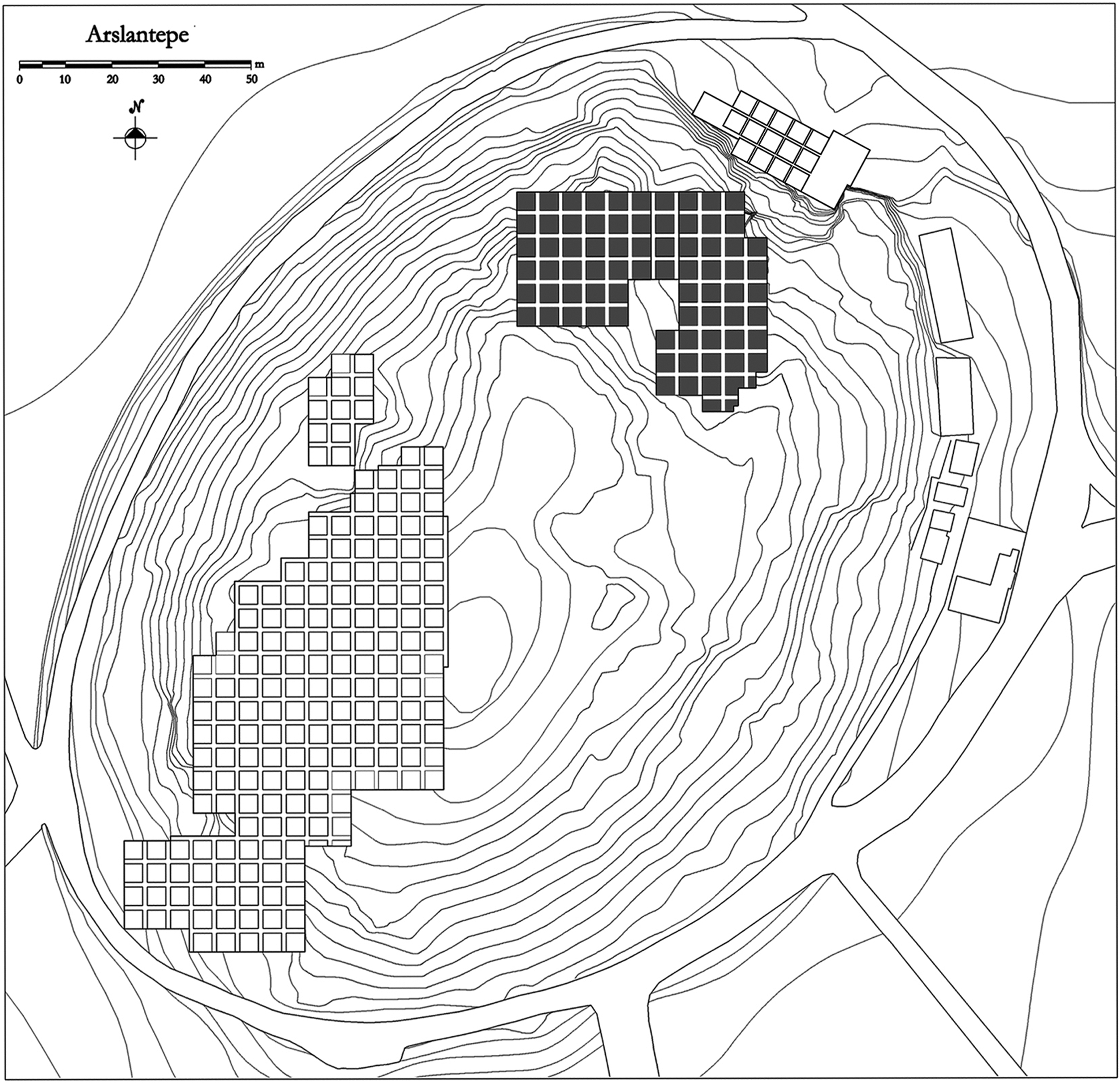
Following a long interruption, investigations on the Late Bronze and Iron Age levels at Arslantepe restarted in 2008 (Figures 2 and 3). A new targeted project began with the aim of providing answers to specific unresolved questions about the development of the site during the 2nd and 1st millennia BC (Liverani Reference Liverani, Galil, Gilboa, Maeir and Kahn2012). An uninterrupted sequence of monumental structures, covering the entire Iron Age occupation at the site for a period that approximatively spans the 12th to the 7th century BC has been brought to light (Manuelli Reference Manuelli2019: 163–168; Frangipane et al. Reference Frangipane, Balossi Restelli, Manuelli, Mori, Di Nocera, Erdal, Steadman and McMahon2019: 27–30). The Iron Age I (Arslantepe Period IIIA) and the following Iron Age II (Arslantepe Period IIIB) have been dated, based on a good amount of diagnostic material discovered either in situ or in sealed and well-preserved contexts, to the 12th and 11th centuries and to the 10th and 9th century BC respectively (Manuelli Reference Manuelli2018; Manuelli Reference Manuelli and Sonne2020: 113–118).
Topographic map of Arslantepe. Gray indicates the Iron Age areas investigated by the Italian expedition from 2008 to 2019 (©MAIAO).
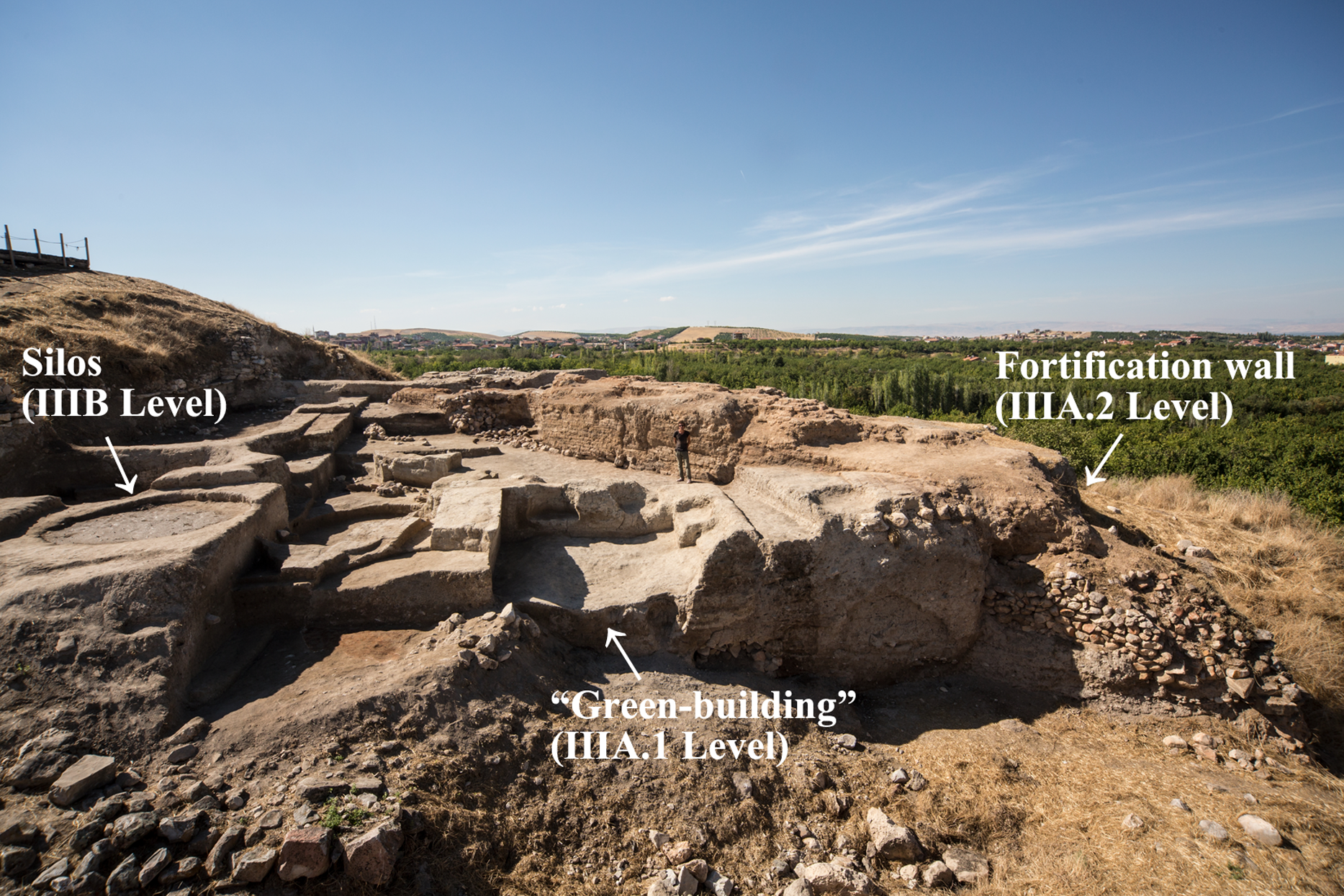
Arslantepe, the excavated sequence from the final Late Bronze Age to the Iron Age II levels.

Three main architectural levels have been identified (Figure 4). The earliest Iron Age I level (Arslantepe IIIA.1) directly overlays the final destruction of the Hittite imperial gate-system (Arslantepe IV), marking the existence of an unbroken sequence of construction that starts from the final Late Bronze Age and does not show any stratigraphic or architectural hiatus. Two large rooms, whose thick walls were made of green colored mudbricks have been unearthed (Figure 5). Although there is no specific evidence at the moment that the two rooms were part of the same structure, it is also clear that they both belong to a coherent and coeval architectural plan hence named the “green-building.” Several phases of construction and use were identified. Interestingly no traces of a final destruction by fire have been recognized, and the rooms were intentionally filled probably following their collapse and abandonment (Frangipane et al. Reference Frangipane, Manuelli, Vignola, Steadman and McMahon2017: 84–89).
Arslantepe, the new excavated Iron Age monumental sequence (photo: R. Ceccacci, ©MAIAO).
Arslantepe, the IIIA.1 “green-building” level. On the right the two rooms and on the left some only partially excavated structures belonging to this level (realized and elaborated by G. Liberotti, ©MAIAO).

Traces of a fortification, lying underneath the rooms, have been discovered and only partially excavated. This consists at least of a round structure filled with mud and mud-brick pieces, probably representing a substructure or a tower. Despite the fact that the exact relationship between these structures is still not completely clear at the moment, the fact that the tower was built with green colored mudbricks and does not show any burnt traces allows us to assume the existence of one “green level” only, characterized by several phases of construction.
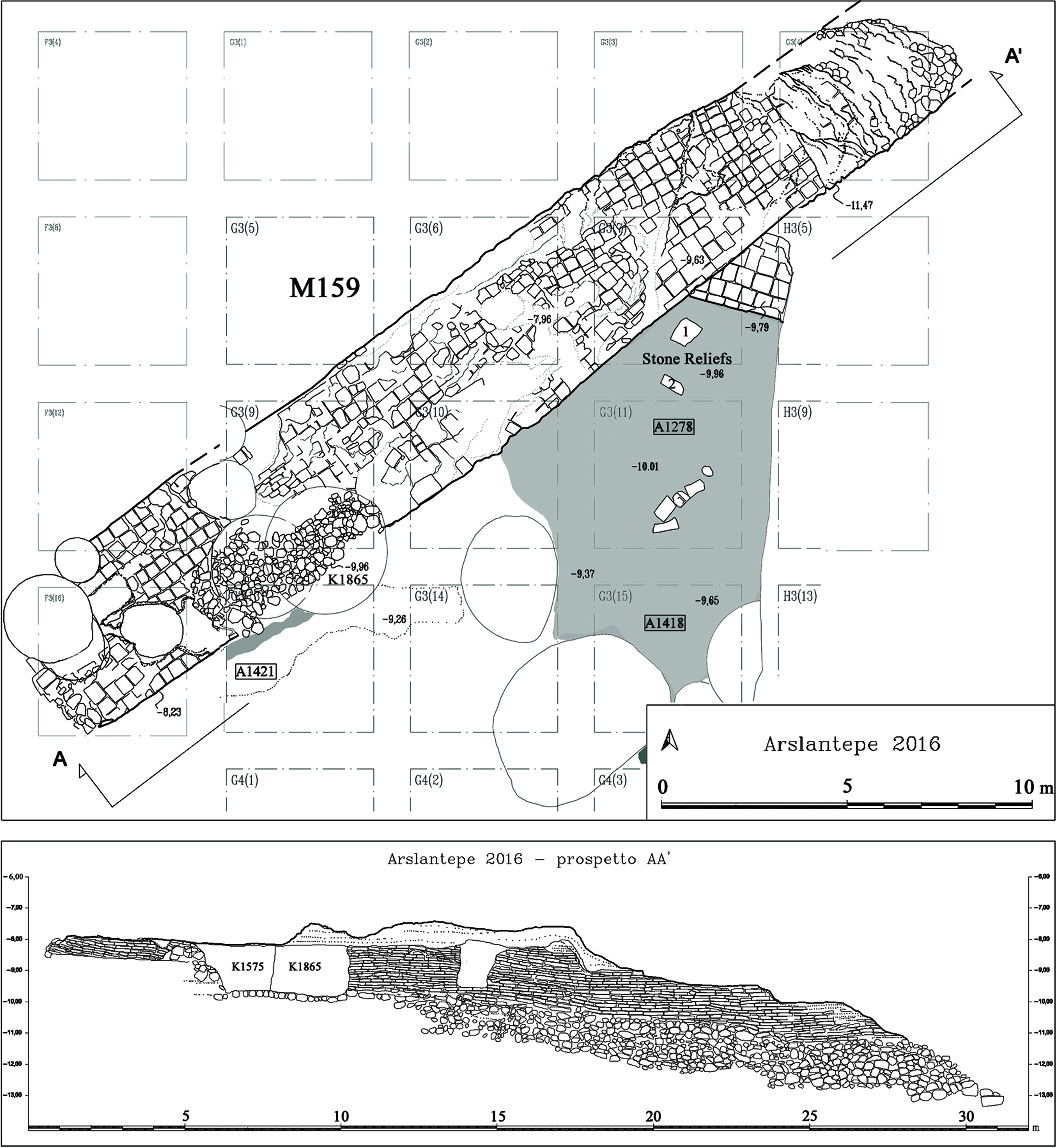
The two rooms have been found sealed underneath a thin mud-plastered floor associated with a massive fortification wall of mudbricks on a stone foundation (Figure 6). This later Iron Age I level (Arslantepe IIIA.2) was destroyed by a violent fire, as a thick layer of heavily burnt debris stemming from the wall collapse has been found over a large area. The excavation of the stone foundation revealed that the wall was built on several terraces with different elevations, following the ancient contours of the mound (Manuelli and Mori Reference Manuelli and Mori2016: 216–222). Interestingly, one archaeomagnetic date obtained from the burnt mudbricks dated the wall fire to 1050 ± 150 BC (Ertepinar et al. Reference Ertepinar, Langereis, Biggin, Frangipane, Matney, Ökse and Engin2012).
Arslantepe, the IIIA.2 fortification wall level: plan and profile (realized and elaborated by G. Liberotti, ©MAIAO).
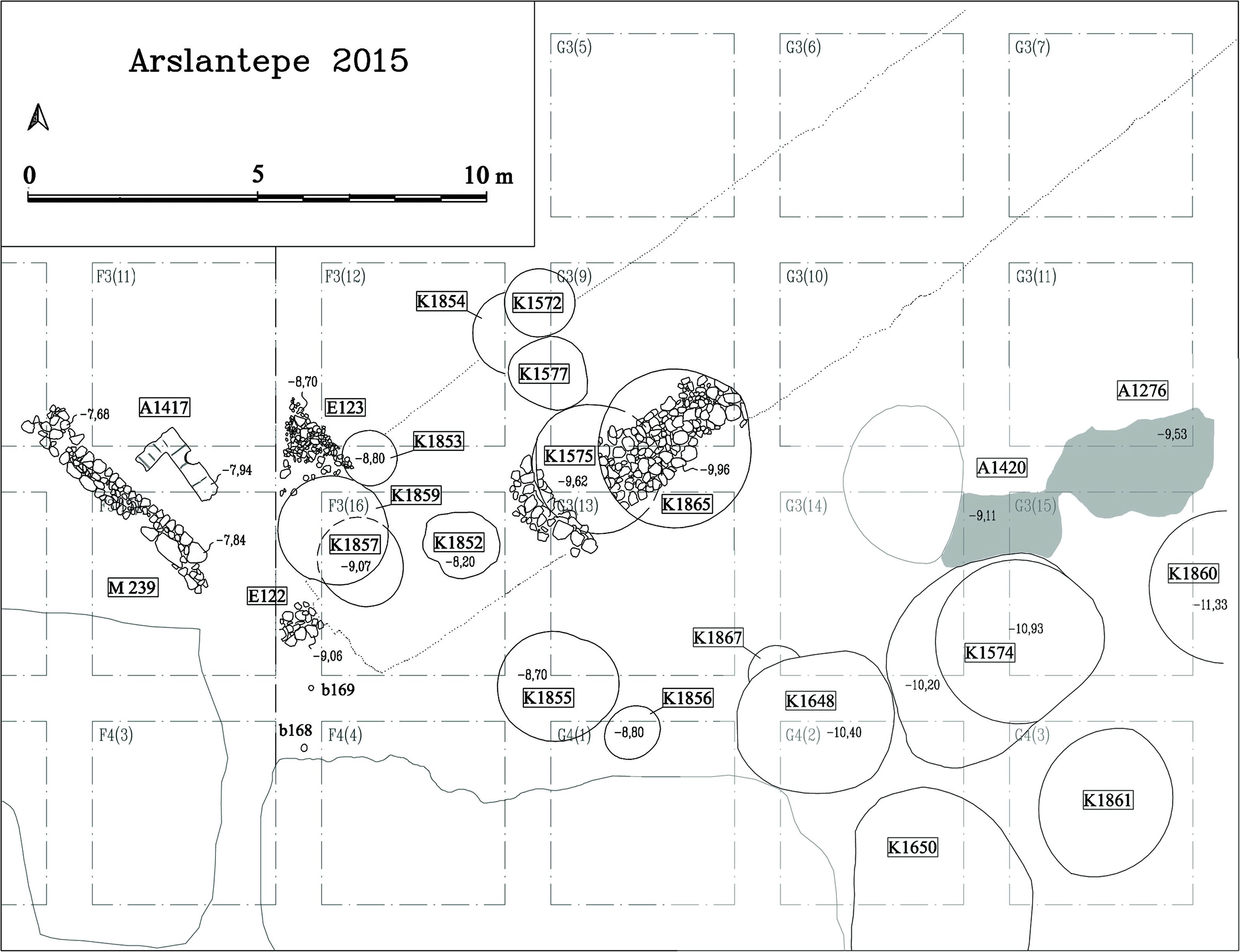
The destruction of the fortification wall marks an interesting change in the occupation pattern of the northern part of the site (Figure 7). Despite a reuse of some of the earlier structures, the following Iron Age II levels (Arslantepe IIIB) are represented by a series of large silos and pits, indicating that the area was specifically devoted to storage activities (Manuelli Reference Manuelli and Sonne2020: 113–118). Some of the pits are certainly coeval with the silos but others cut through them, showing the existence of two different phases. It should be also noted that both silos and pits have been found filled with earth and debris, i.e., reused as dump. If the original use for storing activities is certain for the silos, considering the presence of internal partitions and installations as well as of chaff plaster, the original role of the pits is actually not always easy to determine.
Arslantepe, the III.B silos and pits level (realized and elaborated by G. Liberotti, ©MAIAO).
The examination of a well-contextualized collection of material coming from levels IIIA.1 and IIIA.2 shows both aspects of continuity with previous traditions at the site, as well as the introduction of new cultural features. A set of new pottery shapes, e.g., trefoil jugs, handled jars, small squat body cooking-pots and neckless pithoi, as well as clay spool-shaped loom weights reflects remarkable connections with material dated from the end of the Late Bronze Age to the Iron Age I in northern Syria and the Levantine region (Manuelli Reference Manuelli2018: 146–155). Unlike other southern sites that are closer to the coast, Aegean or Aegean-inspired pottery is completely missing in these levels at Arslantepe. Connections with the Levant increases during Period IIIB, as is especially shown by the slow introduction and following spread of red-slip ware (Manuelli Reference Manuelli2019: 165–166).
In sum, the sequence of the beginning of the Iron Age at Arslantepe has been well established based on a wide set of reliable archaeological records and within a consistent historical framework. It is clear how the integration of new 14C dates together with stratigraphic reconstruction is essential to better define the site’s development as well as to create a 14C-based sequence that allows the establishment of a more solid local chronology. The chronological analysis is also essential for the wider and more consistent reconstruction of the history of the site, considering that the sequence of Arslantepe has been mostly built on a large set of 14C dates assembled over several decades (Alessio et al. Reference Alessio, Bachechi, Bella and Cortesi1966, Reference Alessio, Bella, Belluomini, Calderoni, Cortesi, Improta and Turi1976, Reference Alessio, Allegri, Azzi, Bella, Calderoni, Cortesi, Improta and Petrone1983; Calderoni et al. Reference Calderoni, Caneva, Cazzella, Frangipane and Petrone1994; Di Nocera Reference Di Nocera2000; Vignola et al. Reference Vignola, Marzaioli, Balossi Restelli, Di Nocera, Frangipane, Masi, Passariello, Sadori and Terrasi2019). Moreover, the recent correlation of high precision 14C dating by accelerator mass spectrometry (AMS), archaeobotanical analysis, and stratigraphic data has demonstrated how the analytical methods can impact the construction of the archaeological chronologies (Vignola et al. Reference Vignola, Marzaioli, Balossi Restelli, Di Nocera, Frangipane, Masi, Passariello, Sadori and Terrasi2019: fig. 4–5).
MATERIALS AND METHODS
The preservation of building levels at Arslantepe has already been shown to be suitable for dating the continuous sequence of occupation phases by a thorough selection of biological remains from undisturbed sealed contexts (i.e., Late Chalcolithic and Bronze Ages, Vignola et al. Reference Vignola, Marzaioli, Balossi Restelli, Di Nocera, Frangipane, Masi, Passariello, Sadori and Terrasi2019). In order to assess the construction sequence of the Iron Age I and determine how long the “green-building” and the fortification wall were in use respectively, different samples were recovered during excavation. From the IIIA.1 level (Figure 5), two samples were collected among the collapsed mudbricks of the round tower (27/2016, 30/2016) and one sample was collected from inside a circular stone structure of room A1426 probably made to support a large vessel (142/2015). They represent the construction and primary use of the “green-building”. Moreover, seven samples were taken from the following fill layers in the outer area that mark the end use of the IIIA.1 structures (48/2015, 18/2016, 19/2016, 20/2016, 22/2016, 26/2016, 323/2016). The IIIA.2 samples were all collected from various locations in the massive wall area (Figure 6). One sample was taken from the still standing mudbricks of the lower part of the wall (99/2015), probably relating to its construction phase. Another five samples were recovered from the burnt debris of the wall collapse that was stratigraphically separated (219/2010, 235/2010, 238/2010, 42/2015, 43/2015).
In order to assay when the occupation pattern changed and how long this site area was devoted to the storage during the Iron Age II, the IIIB samples were collected from the fill of silo K1574 (331/2009, 346/2009), and pit K1859 (137/2015) cutting the silo (Figure 7).
All samples consisted of charred wood material (charcoal); the identification was carried out at the Laboratory of Paleobotany and Palynology of the Sapienza University of Rome, Italy. In selecting charcoals for dating short-lived and fast-growing species were preferred, such as the rose family (Rosaceae) and poplar (Populus). Nonetheless, most of the charcoals were of deciduous oaks (deciduous Quercus) that are long-lived trees. In order to avoid the “old-wood” effect (Kim et al. Reference Kim, Wright, Hwang, Kim and Oh2019) and to obtain dates as close as possible to the occupational phases displayed by the archaeological evidence, we selected young branches or the last extant rings of heartwood or sapwood lacking any evidence of this boundary on the wood fragments. The aim was to date the growth period of the tree as close as possible to its use in the contexts: woods from IIIA.1 and IIIA.2 levels refer to timber remains, with the exception of the fragment from room A1426 that may have been part of some domestic installation. The IIIB charcoals are probably residual in dump layers of the silo/pit, even if their use in relation to these structures cannot be excluded (i.e., wooden roof or partitions).
From the samples, 15 were analyzed at CIRCE (Centre for Isotopic Research on the Cultural and Environmental heritage) lab of the University of Campania “Luigi Vanvitelli” in Caserta, Italy and the remaining 4 at CEDAD (CEnter for DAting and Diagnostics) lab of the University of Salento in Lecce, Italy (Table 1).
Radiocarbon dates and calibrated ages from the Iron Age levels of Arslantepe.

* Square–Stratigraphic unit (layer/room/wall/pit)–Cut–Area.
Taphonomic processes strongly impacted the preservation state of the samples and chemical pretreatment was required. Non-structural materials were removed by an Acid-Alkali-Acid (AAA) treatment (D’Elia et al. Reference D’Elia, Calcagnile, Quarta, Rizzo, Sanapo, Laudisa, Toma and Rizzo2004; Passariello et al. Reference Passariello, Marzaioli, Lubritto, Rubino, D’Onofrio, de Cesare, Borriello, Casa, Palmieri, Rogalla, Sabbarese and Terrasi2007). At CIRCE lab, each sample was kept in hot-sealed teflon envelope in order to prevent the loss of charred material. Nevertheless, sample 323/2016 completely dissolved during the alkaline step. As a result, only 18 of the originally 19 submitted samples were dated.
All 14C dates were determined by AMS (Terrasi et al. Reference Terrasi, De Cesare, D’Onofrio, Lubritto, Marzaioli, Passariello, Rogalla, Sabbarese, Borriello, Casa and Palmieri2008; Calcagnile et al. Reference Calcagnile, Maruccio, Scrimieri, delle Side, Braione, D’Elia and Quarta2019). After the chemical pretreatment, the samples were graphitized according to lab procedures (D’Elia et al. Reference D’Elia, Calcagnile, Quarta, Rizzo, Sanapo, Laudisa, Toma and Rizzo2004; Marzaioli et al. Reference Marzaioli, Borriello, Passariello, Lubritto, de Cesare, D’Onofrio and Terrasi2008). Radiocarbon ages were estimated according to Stuiver and Polach (Reference Stuiver and Polach1977) by applying the online isotope fractionation correction. The dates were calibrated using the IntCal 20 calibration curve using the OxCal 4.4 software (Bronk Ramsey and Lee Reference Bronk Ramsey and Lee2013; Reimer et al. Reference Reimer, Austin, Bard, Bayliss, Blackwell, Bronk Ramsey, Butzin, Cheng, Edwards, Friedrich, Grootes and Guilderson2020).
To refine the chronological assessment the Bayesian chronological modeling was employed using the OxCal 4.4 software including outlier analysis (Bronk Ramsey Reference Bronk Ramsey2009a, b; Bronk Ramsey and Lee Reference Bronk Ramsey and Lee2013). Specifically, the Charcoal outlier model was applied in order to overcome the possibility of in-built age caused by a heartwood dating. The estimate of ca. 10–20 years of sapwood from Anatolian oak trees cannot be ruled out in the absence of such evidence (Griggs et al. Reference Griggs, Kuniholm, Newton, Watkins, Manning, Manning and Bruce2009). The Arslantepe sequence for the Iron Age levels was constructed based on the observed stratigraphic relationships as reported in Figure 3.
RESULTS
The results of 14C dating are reported in Table 1. All dates are coherent with the stratigraphic expectations. The IIIA.1 samples are on the average older than the IIIA.2 ones, and the IIIB samples are the youngest with the exception of the sample from pit K1859. Nonetheless, the date ranges within each archaeological phase do not overlap significantly.
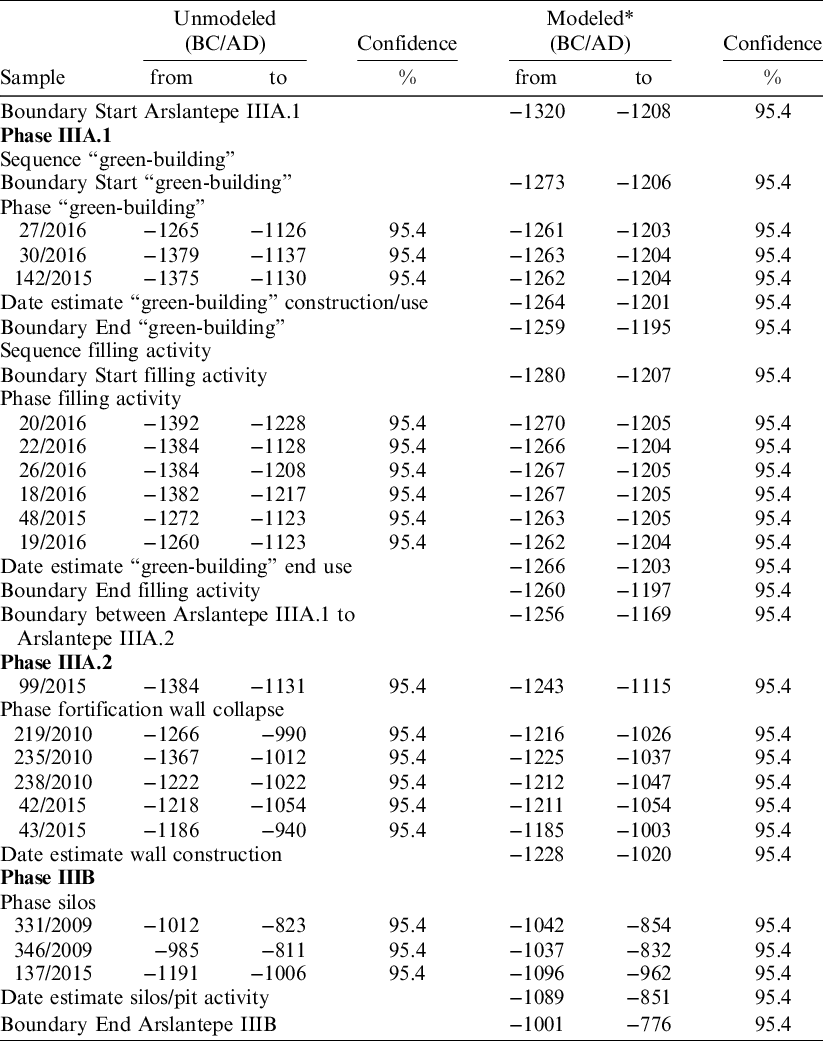
The results of Bayesian modeling are presented in Table 2 and Figure 8 as calibrated date ranges at 95.4% probability. The model provides a potential calibrated age of 1320–1208 cal BC for the beginning of the IIIA.1 phase. The transition between phases IIIA.1 and IIIA.2 is modeled at 1256–1169 cal BC, while the end to the IIIB phase spans from 1001 to 776 cal BC.
Bayesian modeling of radiocarbon dates from the Iron Age levels of Arslantepe. The Charcoal outlier model of the OxCal 4.4 software was applied.
Multiplot of phases and sub-phases from the Iron Age levels of Arslantepe. Bayesian modeling with the Charcoal outlier model was applied (Indices: Amodel 89.1, Aoverall 87.5).
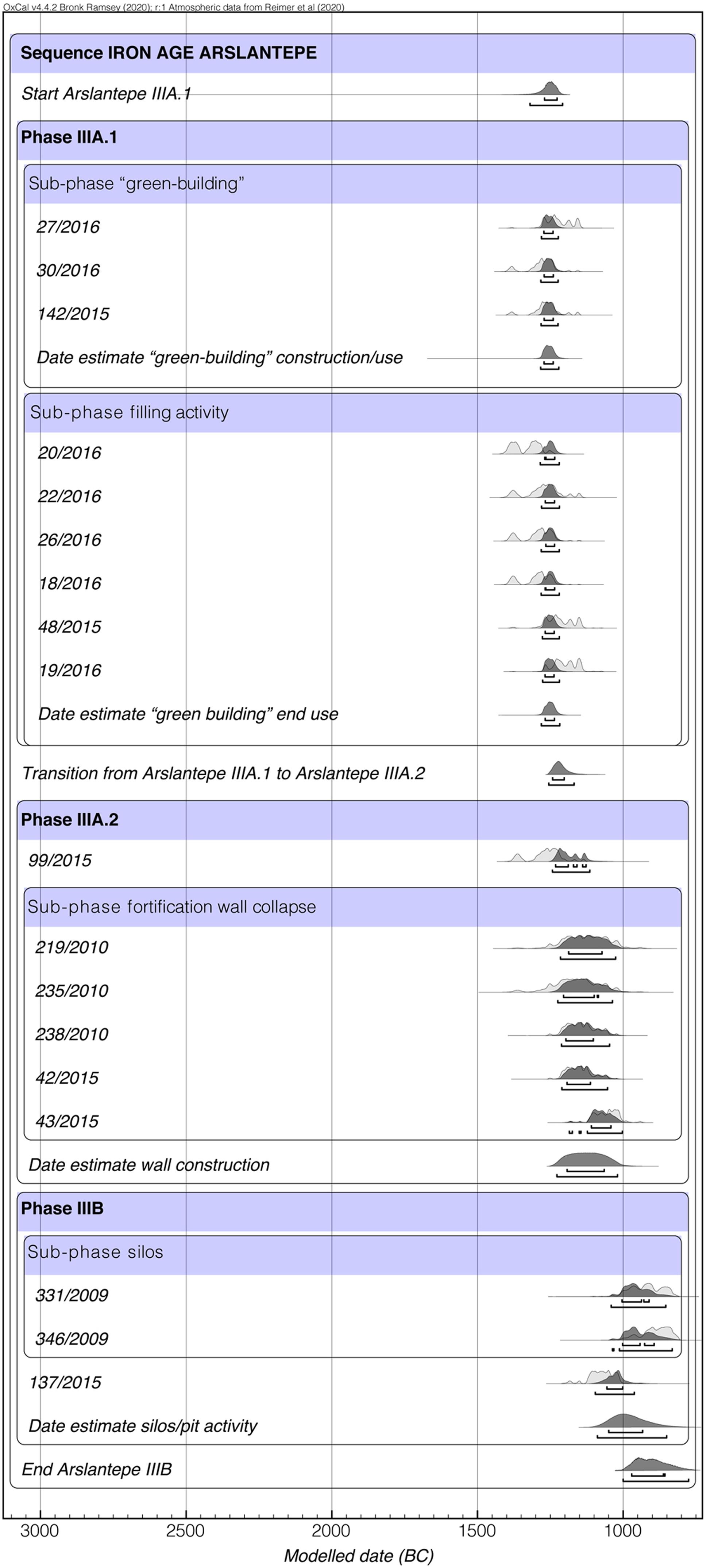
All of the dates from the IIIA.1 sub-phases are clustered and the modeled date ranges overlap. This indicates that the “green-building” was certainly used during the 13th century BC. Specifically, the date of construction is estimated at 1264–1201 cal BC whereas the last (secondary) use is modeled at 1266–1203 cal BC. It is clear that the dates from the filling sub-phase refer to the intentional deposition of residual materials from the building itself, even if two separate processes might have been involved. In fact, a later deposition seems to be represented by the last two dates (Figure 8). Nevertheless, the floor associated with IIIA.2 fortification wall definitively sealed the “green-building.” The time-span occurring from the construction and use up to the abandonment of the “green-building” is estimated in 136 years at the latest (95.4% probability by applying the Interval query).
The results from the IIIA.2 samples suggest that the massive fortification wall was used from the end of the 13th century BC to the second half of the 11th century BC. In accordance with the model, the wall construction is dated at 1228–1020 cal BC. Looking in detail, the dates from the sub-phase of wall collapse are later than sample 99/2015 and occur over a long timeframe (spanning from 1216 to 1003 cal BC). Since the separation into two sub-phases is stratigraphically realistic despite the absence of direct evidence (Figure 3), we argue that two different processes were involved and that samples from wall debris might refer to later building activities (restoration?). The possibility of in-built age for sample 43/2015, which is quite later than the others, cannot be ruled out; however, its intrusive nature is completely excluded by stratigraphical reasons (Figure 8).
Finally, the IIIB samples date the activities in the northern area of the site from the early 11th to the mid-9th century BC. There is no chronological evidence that the burning of the imposing wall caused this site area to be abandoned: in fact, the estimated age for the use of the silos/pits is 1089–851 cal BC even if the secondary depositional process must be taken into account. In this respect, the dates from the silos sub-phase are coherent with the stratigraphy (Figure 3) and fall in the same time frame after the fortification wall collapse (1042–854/1037–832 cal BC). They most likely refer to the IIIB use (primary or secondary) of the silo. On the contrary, the modeled date from pit K1859 is earlier (1096–962 cal BC) even if the pit cut the silo (Figure 3). For this reason, we consider the sample as residual (i.e., earlier) wood remains and not related to the context (Figure 8).
DISCUSSION
The results of the analysis here described have important implications for the chronology of the site and in general for the Syro-Anatolian world during the last centuries of the 2nd millennium BC. Despite the fact that this is not the place to discuss the topic in detail, some archaeological and historical considerations are necessary.
It should be first of all noted that the results of the 14C analysis proposed here provide dating that is slightly higher than expected, when considering the contexts of the samples even with a sapwood estimation. At the same time, the material coming from the examined contexts are not incompatible with the higher-than-expected dating.
The most interesting and at the same time controversial aspect of the analysis rises from the fact that what has been so far considered the earliest Iron Age level at Arslantepe (IIIA.1) actually represents, according to 14C dating, the end of the Late Bronze Age. The chronology of Anatolia during the 2nd millennium BC has been constructed on complex interpretations and correlations of written Hittite sources and archaeological data (Genz and Mielke Reference Genz, Mielke, Genz and Mielke2011: 14–17). Geochemistry, and especially the radiocarbon application, have been integrated into this framework over a number of years, allowing improvement in the quality and precision of our knowledge about the history of the Hittite capital-city Ḫattuša and other sites (Schoop and Seeher Reference Schoop and Seeher2006; Seeher Reference Seeher2018: 149–150). The end of the Hittite civilization and the following dawn of the Iron Age era have been the focus of many discussions amongst scholars (de Martino Reference De Martino2018). The unique blend of negative political, social, ideological, economic, demographic, and climatic issues is seen nowadays as the combined stress factor that induced the abrupt collapse of the empire (Schachner Reference Schachner2020: 392–393). In any case, the final abandonment and following destruction of Ḫattuša is firmly fixed at the very beginning of the 12th century BC, as also confirmed by correlated external sources (Knapp and Manning Reference Knapp and Manning2016: 126–127).
The establishment of the 2nd millennium BC chronology at Arslantepe cannot leave aside these premises. The end of the Late Bronze Age at the site has been always associated with the destruction of the so-called Hittite imperial gate. In light of the already mentioned 14C samples analyzed in 1966, this correlation has been mostly based on the fact that this is the last architectural level at the site that contains proper Hittite central Anatolian material (Manuelli Reference Manuelli2013: 399–409). The new chronology of Arslantepe IIIA.1 here proposed necessarily pushes back the final Late Bronze Age destruction, which was a uniform, widespread, and intense episode, to the first half of the 13th century BC. Indeed, material coming from the destruction level, although influenced, as said, by the Hittite imperial culture does not show any of those elements that have been recognized as typical of the 13th century BC at Ḫattuša (Schoop Reference Schoop2003; Manuelli Reference Manuelli2013: 383–386). As a consequence, a high dating of the Late Bronze Age gateway destruction between the 14th and the beginning of the 13th century BC is plausible.
Material coming from both levels IIIA.1 and IIIA.2 at Arslantepe shows instead interesting changes. Indeed, next to the continuation of some aspects of the Hittite pottery production, the appearance of new forms, mostly found and spread in northern Syria has been stressed (Manuelli Reference Manuelli2018). It is nonetheless essential to emphasize that in many Levantine sites these forms are already attested during the Late Bronze Age, as is shown for instance at Tell Afis (Venturi Reference Venturi2013), Alalakh (Montesanto and Pucci Reference Montesanto and Pucci2019) and Tell Kazel (Badre et al. Reference Badre, Capet and Vitale2018). The first spread of clay spools as well is nowadays set, with a certain margin of confidence, to the 13th century BC, according to material from the Aegean and the Levantine regions (Mazar Reference Mazar2019: 121–122).
The dating of Arslantepe IIIA.1 to the mid-13th century BC shows that a new set of cultural influences as well as gradual disappearance of the central Anatolian material occurred at the site before the collapse of the Hittite empire took place. The historical implications related with these events will be the focus of future contributions. At the current state of the research, it can be assumed that the renowned political and cultural influence exerted by Karkemiš on Arslantepe at the beginning of the Iron Age has its origin already during the 13th century BC. The destruction of the Late Bronze Age gate system at Arslantepe can no longer be taken to represent the end of this era but, rather, it marks crucial changes in the history of the site that lead to new contacts and relationships.
To sum up, Arslantepe IIIA.1 represents an “intermediate” level that links two periods of the history of the site. Following the 14C chronology, this is the last Late Bronze Age excavated level at Arslantepe. Nonetheless, culturally, this finds strict and solid connections with the following Iron Age levels. In this respect, it is also important to stress that the end of the Late Bronze age at Arslantepe is no longer to be seen as marked by a destruction, but rather by an abandonment. Indeed, the IIIA.1 structures are not damaged by fire and only a little material has been found in situ: the rooms have been probably used, cleaned up and abandoned within a period of maximum 136 years. Moreover, it also seems that the structures have been intentionally filled. The remains of the round tower, although sporadic, still represent further elements of continuity within the sequence, showing that the citadel was fortified during the whole advanced Late Bronze Age.
The fortification wall of Arslantepe IIIA.2 represents thus the first proper Iron Age structure of the sequence. Its construction and use are now consistently dated between the late-13th and the late-11th century BC. The destruction of the fortification wall and the following IIIB levels, characterized by the presence of the plastered silos of the Iron Age II, fluctuate according to the 14C chronology between the late 11th and the 9th century BC. The previous archaeomagnetic date of the wall conflagration agrees well with this time interval despite its wide range. Pottery coming from the filling of the silos supports a low dating for the abandonment of these structures. Indeed, according to comparisons with sites from the northern Levant and the Middle Euphrates valley, the appearance of the well-known red-slip ware and grooved ware pottery can hardly date the end of level IIIB before 900 BC (Pucci and Soldi Reference Pucci and Soldi2019; Blaylock Reference Blaylock2016: 14–20). This is anyhow confirmed by the lower chronological boundary of the sequence if we exclude the dating of charcoal from pit K1859. As stated above, the latter cuts stratigraphically the silos level.
CONCLUSIONS
This analysis provides important insights into the complexity of matching absolute chronologies with archaeological and historical sources. The results here proposed also bring new food for thought on the cultural dynamics that characterized the formation of the Iron Age kingdoms of the Syro-Anatolian region. The problem of dealing with the 12th century BC, combining material culture and historical data has been already well emphasized with specific focus on the Aegean world, especially in the absence of wide set of synchronized analyses and dating (Manning Reference Manning2006–2007). As a matter of fact, the study and time setting of the agents that led to the collapse of the Late Bronze Age system and the subsequent regeneration of the independent Iron Age societies still need in-depth regional and local analyses and improvement in order to concretely pursue comprehensive reconstructions and synchronizations. Moreover, the assessment of regional variations in 14C levels has to be taken into account (Manning et al. Reference Manning, Kromer, Cremaschi, Dee, Friedrich, Griggs and Hadden2020). The offset episodes (growing season related) between the calibration datasets in the whole Mediterranean can change the calendar time ranges at high precision. Specifically, the time interval around the end of the Late Bronze Age and during the earlier Iron Age in the Aegean and Anatolian areas might be affected by up to several decades (Manning et al. Reference Manning, Griggs, Lorentzen, Bronk Ramsey, Chivall, Jull and Lange2018, Reference Manning, Kromer, Cremaschi, Dee, Friedrich, Griggs and Hadden2020). In this respect, the revision here proposed of the 12th century BC levels at Arslantepe may be crucial to setting a high chronology and to synchronizing 14C data with historical evidence.
ACKNOWLEDGMENTS
The present study was possible due to the research projects awarded by the Fritz Thyssen Stiftung (2014, project # Az.20.13.0.200) and the Deutsche Forschungsgemeinschaft (2017–2020, project #127370) conducted at the Freie Universität Berlin. The authors are deeply grateful to Marcella Frangipane, for her constant support and for having allowed the study of the material from Arslantepe presented here and to Laura Sadori, who leads the Laboratory of Palaeobotany and Palynology of Rome. Research carried out at Arslantepe has been made possible by the financial support of the Sapienza University of Rome and the Italian Ministry of Foreign Affairs. A special thanks is due to the National Geographic Society for the grant provided in 2016 to carry out research on the Iron Age levels. Finally, we are thankful to the anonymous reviewers for their excellent advice and suggestions for improvement. Federico Manuelli wrote the introduction and the discussion, Cristiano Vignola and Fabio Marzaioli the methods and the results; the three authors contributed together to write the conclusions. Isabella Passariello carried out the analyses at CIRCE lab, whose former director is Filippo Terrasi. Unless specified, images from Arslantepe belong to the project’s archive (Missione Archeologica Italiana in Anatolia Orientale – ©MAIAO).


 Open access

