

Oversight of the use of executive power is a vital concern for democratic accountability (e.g. Diamond and Morlino Reference Diamond and Morlino2005; Laver and Shepsle Reference Laver, Shepsle, Przeworski, Stokes and Manin1999). It is particularly important for addressing issues such as a government’s potential misuse of power and different types of malpractice (e.g. Damgaard Reference Damgaard and Wiberg1994; Wiberg Reference Wiberg and Wiberg1994). However, it is difficult to address this type of challenge in parliamentary systems, since the relationship between the executive and parliament is not defined by traditional power theory but by the delegation of power from parliament to the government. The role of political parties means that powers are fused, not separated. Nevertheless, considering the delegation of power theoretically, parliaments are obligated to oversee the government’s use of this delegated power (Strøm Reference Strøm, Strøm, Müller and Bergman2003). This means that the political actors in parliament face an institutional obligation in this respect: parliamentary oversight is one of parliament’s core tasks (Kreppel Reference Kreppel, Martin, Saalfeld and Strøm2014).
These parliamentary actors are also political party representatives pursuing partisan goals, the goals of votes, policy objectives and the desire to hold office (Strøm Reference Strøm1990), and are hence motivated by partisan purposes that might not always go hand in hand with their duty of parliamentary oversight. The partisan logic implies that political party representatives engage in oversight if it serves their partisan purposes. Thus, the political actors in parliament must constantly make trade-off decisions between their institutional obligation and their partisan role when considering issues of parliamentary oversight. In other words, they frequently need to decide between diverse ‘modes’ of executive–legislative relations, primarily between those of an opposition party or a ‘non-party’ (Andeweg and Nijzink Reference Andeweg, Nijzink and Döring1995; King Reference King1976). This article focuses on these two competing logics in parliamentary oversight activity but argues that institutional settings also have an effect on how this plays out in practice. The stronger the institutional setting in terms of detailed rules and procedures for the performance of oversight tasks, the stronger the expectation that political party representatives adhere to institutional expectations at the expense of their partisan logic. This is operationalized as presenting more unity across government and opposition party distinctions relative to partisan divides or initiatives.
Oversight options are defined as mechanisms for monitoring activity (Kiewiet and McCubbins Reference Kiewiet and McCubbins1991; Lupia and Mccubbins Reference Lupia and Mccubbins1994; Lupia and McCubbins Reference Lupia and McCubbins2000; Strøm Reference Strøm, Strøm, Müller and Bergman2003). In parliamentary systems, these options are linked to various institutional settings, but only partially to parliamentary committees. This article argues that the standing committee system is a stronger institutional context than the assembly and that it is in the oversight committees that partisan and institutional expectations are confronted the most.
The article’s institutional argument is tested by investigating cases of oversight while varying the overall institutional setting, the assembly versus committee setting, and settings between various types of committee. The investigation measures the degree of institutional unity relative to partisan divides in these cases. The Danish, Norwegian and Swedish parliaments treat oversight in different types of committee setting (West Reference West2024a). Therefore, by using these three parliamentary cases, it is possible to develop a research design for multiple comparisons while varying the institutional variable, from smaller to larger institutional differences. Also, importantly, these three parliaments are known for their strong political parties and thereby strong partisan behavioural logics. This makes them well suited for the article’s investigation, which focuses on behavioural logics at the political party level. The investigation is based on a collection of 324 cases of parliamentary oversight and some background interviews carried out in April and May 2022 with political party representatives.
Overall, the findings show a high degree of unity in the outcomes of oversight cases, regardless of case type, type of committee or parliament. At the same time, the results show different degrees of unity when varying the institutional setting in the direction of greater unity/institutional logic, and less of a partisan logic in stronger/more controlled institutional settings compared to weaker/less controlled ones. Moreover, the findings show a clear difference when comparing assembly-driven oversight initiatives to the conclusions of cases carried out by committee.
The article proceeds first by addressing the concept of parliamentary oversight and presenting a detailed understanding of the two behavioural logics, partisan and institutional, before focusing on committee settings and parliamentary oversight in this context. Next, the article develops the research design for the comparisons and presents the findings. Finally, it concludes with a discussion of the results.
Understanding parliamentary oversight
In parliamentary systems, power is delegated by parliament to government. Considering this through a principal-agent theoretical perspective, this implies a risk in terms of agency loss, since the agents might not behave in accordance with what the principal intends. Therefore, actors (the principal) need options to modify this risk by being able to oversee their agent’s activity and holding them to account in cases of deviation. In general, holding an agent to account is an ex-post activity (e.g. Fearon Reference Fearon, Przeworski, Stokes and Manin1999; Kiewiet and McCubbins Reference Kiewiet and McCubbins1991; Lupia Reference Lupia, Strøm, Müller and Bergman2003; Lupia and Mccubbins Reference Lupia and Mccubbins1994; Strøm Reference Strøm, Strøm, Müller and Bergman2003). In addition to monitoring options, the literature often includes a focus on parliament’s powers to select/deselect government (Cheibub et al. Reference Cheibub, Martin and Rasch2015; Laver and Shepsle Reference Laver, Shepsle, Przeworski, Stokes and Manin1999: 285); however, this article’s sole focus is on parliamentary oversight related to government activity while in office and it does not address the selection or deselection of government. Thus, oversight of a government’s use of delegated powers is defined as an ex-post activity conducted by the political actors in parliament after the insertion of government, and focuses on the government’s actions related to its already defined discretion and legislative goals passed by parliament. The focus in oversight activity is to detect possible violations related to the defined legislative policy goals and procedural issues. This includes maladministration, legal breaches, lack of policy implementation according to parliament’s intent, impact assessments, and lack of efficiency in policy and public spending, but also more broadly government–clientele relations and the misuse of power, as well as potential corruption challenges (e.g. Bawn Reference Bawn1997; McCubbins and Schwartz Reference McCubbins and Schwartz1984; West Reference West2024a; Wiberg Reference Wiberg and Wiberg1994).
In this article, parliamentary oversight is defined as being different from another type of parliamentary control activity, namely, scrutiny of the government’s legislative proposals. While these are both examples of parliamentary control, they are defined as two distinct types. Empirically, there might be some overlap between them, especially with regards to post-legislative scrutiny, but this depends on the specific institutional design of the oversight options and whether post-legislative scrutiny forms part of the policy formulation process or is regarded as a distinct oversight activity. Concerning post-legislative scrutiny, Franklin De Vrieze and Philip Norton (2020) distinguish between post-legislative scrutiny as an evaluative function and post-legislative oversight as a legal and formalistic issue. The definition of oversight in this article encompasses both these dimensions of post-legislative scrutiny. Moreover, it is important to stress that this article’s understanding of oversight moves beyond the focus on monitoring activity to prevent loss of agency in relation to policy agreements. It is important to include procedural issues as well, considering the crucial link between parliamentary oversight/accountability and democratic systems: a core element of the concept of democracy is adherence to procedural requirements.
Parliamentary oversight and the complex role of political parties
The political actors expected to carry out parliamentary oversight activity are the political party representatives in parliament. It is political parties that make the single chain of delegation in parliamentary systems work in practice and which solve the different types of collective action challenges (Andeweg and Nijzink Reference Andeweg, Nijzink and Döring1995; Müller Reference Müller2000; Saalfeld Reference Saalfeld2000; Strøm Reference Strøm, Strøm, Müller and Bergman2003). Nevertheless, political parties are less constructive when it comes to their oversight of political parties’ use of delegated powers, and even, in some cases, counterproductive.
The institutionally driven task of parliamentary oversight represents a challenge for the collective good. Even though it is easy to agree on the importance of the task, no one actor will be eager to bear the costs (Mayhew Reference Mayhew1974; Olson Reference Olson1965). Oversight is a time-consuming activity and hence costly for the actors. However, in the case of there being partisan gains, the actors will consider their oversight activity to be worth the effort to a higher degree. In multiparty systems, which are typical for parliamentary systems, political parties’ incentives vary, creating complex and diverse incentive structures. This challenge resembles the ‘multiple principal problem’ (e.g. Voorn et al. Reference Voorn, van Genugten and van Thiel2019). In political systems where the electoral process is more firmly centred on individual candidates, there are additional dynamics of intra-party oversight driven by backbenchers (Saalfeld Reference Saalfeld2000).
In this article, the focus is on the incentives related to inter-party oversight, and the strongest party-level incentives can be found for parties positioned as an opposition party. Opposition party representatives have an interest in using oversight activity to damage the governing party’s reputation, inflict costs, and present themselves as a better governing alternative by highlighting the government’s mistakes. Governing party representatives have the opposite interest, to refrain from any type of activity that will attract blame (e.g. Maor Reference Maor1999; Saalfeld Reference Saalfeld2005; Weaver Reference Weaver1986; West Reference West2018) or, if necessary, to defend the government against the opposition’s blame games. For multiparty systems with coalition governments, there is an additional incentive for coalition parties to use oversight options to keep tabs on their fellow coalition partners in order to prevent loss of agency in relation to policy goals (Martin and Vanberg Reference Martin and Vanberg2011; Müller and Meyer Reference Müller and Meyer2010; Strøm et al. Reference Strøm, Müller and Smith2010). Thus, the dominant motivations for oversight are partisan.
However, as stated, these same political actors with primarily partisan motivations have a formal institutional obligation when it comes to oversight, which includes representatives of the government as well. Thus, it is possible to nuance our understanding of the incentive structures, since political actors can realize that the prestige of parliament as an institution depends on maintaining institutional probity, and that this requires government actors to respect the limitations and degree of discretion defined by parliament. According to this line of argumentation, there should be room for some oversight activity on the political party representatives’ list of priorities beyond their focus on diverse types of activity motivated by partisan incentives. Supporting this argument, Amie Kreppel (Reference Kreppel, Martin, Saalfeld and Strøm2014) lists control/oversight as one of the core functions which is important for parliament’s status as an influential institution, and David Mayhew (Reference Mayhew1974) similarly refers to the importance of institutional maintenance. This offers a basis for understanding an additional institutional behavioural logic in the activity of parliamentary oversight. However, this article argues that the way the competition between these two logics plays out in the oversight activity, especially with regards to the governing party’s representatives, depends on the specific parliamentary institutional setting.
In general, institutions create expectations for a certain kind of behaviour (Scharpf Reference Scharpf1997), but as stated, there is a competition between various types of behaviour. On the other hand, political parties typically control the goals of their party representatives (Sieberer Reference Sieberer2006; Strøm Reference Strøm, Blomgren and Rozenberg2012), making the partisan logic the stronger one (West Reference West2018). The general institutionalist argument is that institutional arrangements solve incentive challenges by structuring interactions and reducing uncertainty about the corresponding behaviour of others, thereby allowing ‘gains from exchange’ (Hall and Taylor Reference Hall and Taylor1996). However, when it comes to oversight, the argument is that instead of sharing the ‘gains’, the political parties agree on sharing ‘costs’. This means that actors realize the importance of this type of parliamentary activity and agree to share the oversight obligation, but to what extent depends on the institutional solution/design.
In line with this argument, Bjørn Erik Rasch (Reference Rasch and Wiberg1994: 258) argues that oversight needs to be routinized in a way that deprives legislators of a real choice, especially if the individual contribution to legislative oversight is costly. Indeed, previous research shows that highly institutionalized processes of auditing oversight dampen the partisan motives and strengthen an institutional oversight logic (Korff Reference Korff, Stapenhurst and Larson2018; Pelizzo Reference Pelizzo2011; Pelizzo and Stapenhurst Reference Pelizzo, Stapenhurst, Stapenhurst, Pelizzo, Olson and von Trapp2008; Wehner Reference Wehner2003; West Reference West2021). Research also shows that differences in institutional rules affect what types of oversight questions are asked (Akbik and Migliorati Reference Akbik and Migliorati2024). Thus, it is worth considering the specific institutional oversight settings when considering their possible effects. This article argues that a stronger institutional setting with clearly defined options for oversight tasks followed by clear procedures for the activity are more successful in depriving party representatives of a choice by strengthening the expectation that political party representatives take their institutional oversight obligation seriously and act accordingly.
It might also be in the interest of political parties to create this type of controlled institutional setting for another reason. Institutionally controlled settings reduce the risk of fierce blame games related to political and administrative cases of scandal and its oversight, thereby potentially limit the ensuing costs due to damaging outcomes. Therefore, institutionally controlled settings like central oversight committees and specialized oversight committees offer a suitable setting for political parties to collaborate on handling these types of cases across party political divides as either government or opposition parties. However, opposing political parties need to be jointly interested in creating this type of institutional support setting for the conduct of oversight activity. This implies an endogeneity challenge, since those political actors who have an incentive to carry out the oversight are the self-same actors who will decide on establishing the institutional setting to perform this task. To what extent political parties have in fact agreed on this type of institutional solution might vary depending on the parliament and the degree of established oversight options in the controlled setting (West Reference West2024a). Also, previous research shows that parliaments experience various trade-offs between ex-ante controls and ex-post controls (Sieberer Reference Sieberer2011). Summing up, this article argues that settings with more control/stronger oversight have an effect on how the competition plays out between the two behavioural logics and that institutional support strengthens the institutional relative to the partisan logic. From this follows the research hypothesis:
Hypothesis 1: The more controlled/stronger the institutional oversight setting, the stronger the parliamentary institutional logic relative to the partisan logic in parliamentary oversight activity.
The difference between the partisan and institutional logic in the oversight activity is operationalized as the difference in the degree of division or unity exhibited by the oversight activity when carried out across the party political divide between parties positioned either in government or opposition. The following section focuses on the variation in degree of institutional strength/controlled setting.
Oversight options and parliamentary committee design
For the performance of parliamentary oversight the literature frequently refers to the use of parliamentary questions as the relevant tool (e.g. Wiberg Reference Wiberg and Wiberg1994). Clearly parliamentary questioning is an important type of activity, considering its increased level of use. However, this type of activity to a high degree is dominated by opposition parties, which indicates a solely partisan-motivated activity. Additionally, research shows that its use goes far beyond the purpose of oversight (e.g. Bailer Reference Bailer2011; Eissler et al. Reference Eissler, Green-Pedersen, Loftis, Mortensen and Russell2023; Green-Pedersen Reference Green-Pedersen2010; Martin Reference Martin2011). Also, parliamentary questioning is to a high degree an assembly activity, and this type of setting is considered less controlled compared to parliamentary committee settings.
In general, committees are stronger institutional settings, where specific rules and procedures are followed for performing activity. Also, committees have a smaller number of seats compared to the assembly. However, the principal literature disagrees on the extent to which committee settings influence political behaviour. Gary Cox and Matthew McCubbins (Reference Cox and McCubbins1993) outline the significant role of political parties within committees and, therefore, the expected partisan logic in their outcomes,Footnote 1 but Keith Krehbiel (Reference Krehbiel1991) argues in favour of an informational effect of the committee setting, since committees are a parliamentary tool through which members access information (Martin Reference Martin, Martin, Saalfeld and Strøm2014; Norton Reference Norton2019). This article’s focus on a partisan and an institutional logic means that both perspectives are relevant for understanding oversight activity in parliamentary committees, because it is the competition between these two logics which is of interest. However, parliamentary committee systems consist of various types of committee that vary greatly in relation to their oversight strength.
In relation to parliamentary systems, research on committees has mainly focused on policy committees and the previously mentioned legislative scrutiny activity, and has only considered oversight tasks to a limited extent (e.g. Mattson and Strøm Reference Mattson, Strøm and Döring1995; Siefken and Rommetvedt Reference Rommetvedt, Siefken and Rommetvedt2021). In the literature on congressional committees, in contrast, there is generally a greater focus on ex-post oversight activity (e.g. Aberbach Reference Aberbach1990, Reference Aberbach2002). Here, however, due to the absence of a direct electoral connection to this type of activity, the focus is more specifically on oversight committees for carrying out this task (Mayhew Reference Mayhew1974: 145–150).
There has already been some work done on oversight committees in parliamentary systems, looking both at investigative committees (Müller and Strøm Reference Müller and Strøm2004) and at the select committees in the British House of Commons (Fernandes et al. Reference Fernandes, Saalfeld and Schwemmer2021; Norton Reference Norton2019). Scrutiny of post-legislative activity is also frequently linked to the work of committees, but it varies in terms of which particular committee carries it out (De Vrieze and Norton Reference De Vrieze and Norton2020; West Reference West2024a). Oversight of the government’s actions in relation to the European Union is typically the responsibility of specific European Affairs Committees (e.g. Blom-Hansen and Olsen Reference Blom-Hansen and Olsen2015; Raunio Reference Raunio2011; Winzen Reference Winzen2013). For Westminister parliamentary systems and Nordic parliaments, audit oversight (public accounts and expenditure) is typically the purview of specific Public Accounts Committees (PACs). Finally, the committee systems in parliamentary settings frequently have a central committee that deviates from the standing policy committees by not corresponding to a specific portfolio area and by having some type of case-related oversight and investigative options (West Reference West2024a). However, this type of committee also has tasks and agenda-setting options related to the supervision of parliamentary activity in general, and is also sometimes referred to as a ‘coordination committee’ (Frech and Sieberer Reference Frech and Sieberer2023). Central or coordination committees may therefore have responsibility for both tasks: to coordinate parliamentary work and to oversee government.
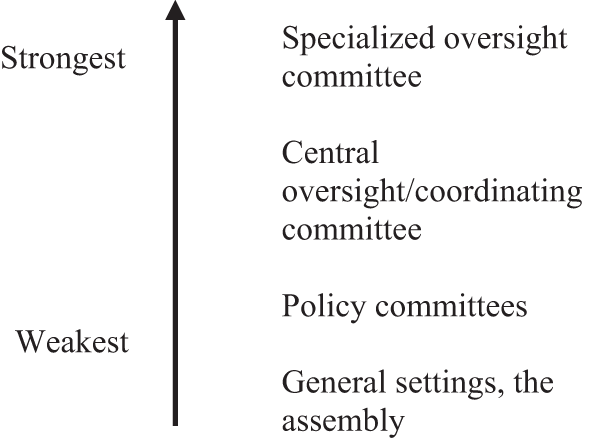
Concerning parliamentary oversight, this article considers that these different settings will vary in their relative institutional strength. Overall, the institutional committee setting is considered stronger compared to that of the assembly, but the policy-oriented committees are considered weaker than the oversight/coordinating committee without a defined policy portfolio. Concerning the variation in types of oversight committee, the article makes a distinction between specialized oversight committees such as PACs and general oversight committees, considering the former to be stronger than the latter. For an overview of the ranking of institutional settings, from weakest to strongest, see Figure 1.
Types of Setting and Assessment of Relative Institutional Strength

This article’s investigation focuses on committee-related oversight in the Danish Folketing, the Swedish Riksdag and the Norwegian Storting. The Storting has a central oversight committee (Kontroll- og konstitusjonskomiteen) designed for handling all types of oversight cases. The Riksdag has a central committee (Konstitutionsutskottet) with some but not all of the oversight options. This committee has an oversight option where case initiatives are controlled by the assembly, while the committee decides on the case outcomes. Hence, this option combines assembly settings with committee settings for the oversight option. For the Folketing, oversight options are carried out by multiple committees. All the Folketing committees – the central coordinating committee (Udvalget for Forretningsordenen) and the policy committees – can initiate and deal with oversight cases. Additionally, the Folketing has a specialised PAC for audit oversight. These committee-related oversight options in the Danish, Norwegian and Swedish parliaments are selected due to the differences in their design and exploited to create various ways for testing this article’s institutional argument.
Research design and data
The article tests the institutional argument by investigating committee-related oversight activity and comparing the behavioural logic while varying the institutional setting. The research design exploits the institutional variation of the selected cases to test the argument by comparing oversight activity in various institutional settings, including the assembly and various committee settings.
The three Scandinavian parliaments are unicameral and ‘working’ parliaments, in which the committees are vital institutions. Moreover, the country cases have similar electoral systems using proportional representation and multi-party systems that frequently use coalition governments, often minority governments (Bergman and Strøm Reference Bergman, Strøm, Bergman and Strøm2011; Esaiasson and Heidar Reference Esaiasson and Heidar2000). Importantly, the country cases are known for their strong political parties, which means that it is possible to investigate behavioural logics at the political party level and thereby focus on inter-party competitive logics. First-past-the-post systems, such as that which operates within the United Kingdom’s political system, have a greater degree of incentives related to oversight by individual candidates and thereby additional intra-party dynamics (Saalfeld Reference Saalfeld2000), which is not the focus of this article. Another pragmatic criterion is that the three Scandinavian parliaments selected have accessible formal documentation for oversight cases, which makes the investigation possible.
The investigation focuses on a number of oversight committees and policy committees, one PAC, and one committee-related oversight option involving the assembly. This means that the cases cover all the institutional variations presented in Figure 1. The oversight committees vary in their size and number of seats, but in general they share the characteristic of a high degree of proportionality in the selection of seats on the committee. Not all of the small parties receive seats in this type of committee, but the overall distribution favours smaller parties. Moreover, differences in seat allocation between the opposition and government on these oversight committees produce no discernible effect (West Reference West2024b).
For the Danish Folketing, the investigation uses the oversight case type beretning used by the policy committees and the central coordinating committee. Committee members initiate these cases. In addition, the investigation includes audit cases initiated by the Folketing’s PAC. For the Norwegian Storting, the same oversight committee treats all cases of oversight, including audit cases. The investigation uses the committee’s general innstillinger, which is the committee’s conclusion/recommendation for all the diverse types of oversight case. The investigation also looks specifically at audit cases. For the Swedish Riksdag, the investigation uses the anmälningar cases where members of parliament (MPs) outside the committee initiate oversight cases which are then carried out by the central committee. Although it is formally individual MPs who use this complaint option, in practice the political parties control its use (Interview 3), which means that it is possible to consider such case initiatives as a reflection of party political behaviour.
The investigation uses different types of comparison as the investigative tool. The comparisons focus on committee case outcomes in terms of behavioural logics. For one of the comparisons, the focus is on the difference between behavioural logics in the case initiation phase compared to the case outcome. The comparisons are designed so that the institutional settings vary but at the same time the cases compared are as similar as possible to leave out alternative explanations. The first comparison is an overall comparison of all the selected oversight cases across the three parliaments. The second comparison is between the policy committees and the central committees in the Folketing for the same case type beretninger. The third comparison is between the Folketing PAC audit cases and the Storting oversight committee audit cases. The fourth comparison is between the Riksdag assembly-driven anmälningar initiatives and the central committee’s conclusion for the same cases. For an overview of the different comparisons, see Table 1.
Overview of the Comparisons across and within Parliaments

For the case outcomes in studies 1, 2 and 3, the investigation assesses the degree of unity in the conclusions of the selected cases for each respective committee and parliament. For the assessment of committee unity, a distinction is made between cases where opposition and government party representatives agree on the conclusion and cases where they are divided. The investigation applies a ratio to calculate the degree of committee unity in the treatment of the selected oversight cases; that is, the number of cases of committee unity in relation to the total number of selected committee oversight cases. However, there are some cases where parties are divided on the outcome but where the divide does not resemble an opposition/government party divide, such as when a minority party makes a reservation to the committee conclusions. While these cases are not considered as expressions of a government/opposition divide, the numbers for this type of outcome are reported together with the overall results for division and unity between parties. With regards to the committee divides and political parties’ position in government or opposition, parties which formally support the government are considered as government parties.
The committee reports are used for the assessment of committee conclusions for each case. These documents provide information about possible reservations made by political party representatives and this information is used to assess the outcome value for each case and to calculate the unity ratios. The number of cases showing a divide is subtracted from the total number of cases, which is used to calculate the ratio. Ratio values lie between 0 and 1, where the value 0 means a perfect partisan logic and the value 1 means a perfect institutional logic. There are no guidelines to borrow from the literature as to which values distinguish a partisan or an institutional logic between the values of 0 and 1. However, for the Norwegian case, an overview of general committee unity in the Storting shows a level of 0.28 for the 2005–2013 time-period.Footnote 2 For the current investigation, to be assessed as showing a high degree of unity, the value needs to be 0.5 or above.
For case study 4 looking at the initiation phase in the Swedish Riksdag, the investigation counts the number of times opposition and government parties initiate the cases, reporting both the number (count) and percentage. Since 2010, the Swedish political system has consisted of eight political parties, and during the case selection period all governments have been minority coalitions with formal support party agreements (Bäck and Hellstrøm Reference Bäck, Hellstrøm, Field and Martin2022).Footnote 3
For the case selection, the strategy was to avoid the influence of specific government-opposition relations, but also to avoid selecting cases on the basis of outcome values. Cases were selected over four parliamentary years in each country, covering diverse government coalition periods within an overall timeframe of 10 years. The parliamentary year criterion produces a random selection of cases, while the selection of years from different elections and coalition time-periods reduces the effects of time-specific executive-legislative relations.
The cases were collected according to searches on the parliamentary webpages. The Riksdag anmälningar cases were collected according to the year they were initiated for the selected parliamentary years: 2011/12, 2014/15, 2018/19 and 2020/21. The oversight committee’s conclusions were published the following year in its annual reports. The Storting oversight committee recommendations (innstillinger) are for the parliamentary years 2010/11, 2014/15, 2018/19 and 2020/21; and the Folketing beretninger for the parliamentary years 2011/12, 2014/15, 2019/20 and 2020/21. With regard to the Folketing beretninger, however, the number for the central committee was too low across these years, for which reason the full population of cases for the whole 10-year period from 2011/12 to 2021/22 was collected for this committee. For the Epidemics Committee during the COVID-19 crisis, the cases showed a very different pattern compared to the other policy committees and other parliamentary years. Therefore, these cases are treated separately. For an overview of the number of cases for each parliamentary year, see Table A1 in the appendix. In addition, for the Danish case, information has also been collected from the 26 cases initiated by the PAC in the calendar years 2012, 2015, 2016, 2019, 2020 and 2021.
The data for the investigation are primarily data collected from parliamentary observational documents accessed via the parliamentary webpages for the respective parliaments. In addition, background interviews were carried out with three MPs and one party representative for the three parliamentary cases. The interviewees are all experienced in performing parliamentary oversight. An overview of the interviews is provided at the end of the article. For the full data overview, see Table 2.
Data Overview

As stated, the design uses time-period criteria for the case selection to avoid the influence of specific executive-legislative relations on the general assessments made about behavioural logics in oversight activity. However, given that the investigation registers the results for each parliamentary year, it is possible to check for differences and assess whether these link to specific executive-legislative relations in accordance with the theoretical framework. This strategy increases the validity of the results. In addition, the investigation uses data triangulation by adding information from interviews to the documentary parliamentary data.
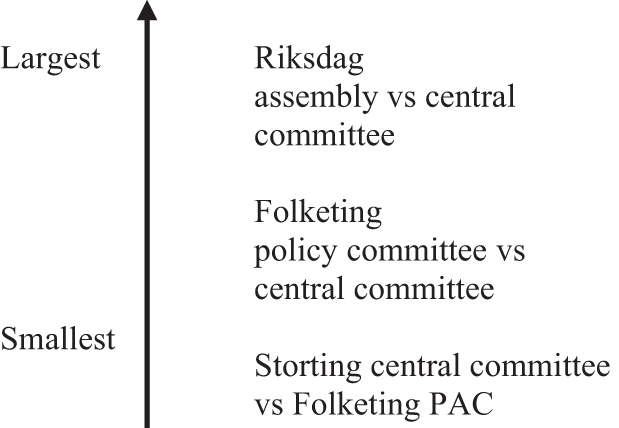
The research design developed in this article demonstrates ways of handling the endogeneity challenges that are often associated with parliamentary oversight, since the same political actors that initiate the oversight tasks are also responsible for deciding on the institutional setting for carrying out this type of task. Also, the investigation focuses on oversight activity that has actually been conducted in already established committee settings. Additionally, in order to test the institutional argument, the design of the comparisons incorporates robustness checks, since the comparisons include both larger and smaller differences for the institutional variable/condition. It is harder to test the argument when there is only a small difference. Figure 2 provides an overview of the degree of difference in the institutional variable for the three specific comparisons.
Difference in the Institutional Variable for Each Comparison

Finally, this article refrains from making conclusions based on the number of cases in each scenario because of the challenges of ‘anticipated effects’ and ‘observational equivalence’ (Lupia and McCubbins Reference Lupia and McCubbins2000: 301; Pollack Reference Pollack2002; Weingast and Moran Reference Weingast and Moran1983). It is possible that oversight committees primarily select cases that they expect to be able to agree on, even though this does not apply for the Riksdag scenario, where MPs outside the committee initiate the cases. However, it is not possible to investigate the outcomes in non-existing cases. Consequently, any investigation of the outcome of oversight cases must necessarily focus on existing cases.
Findings
The investigation focuses on the behavioural logics at play in cases of committee oversight by comparing examples of oversight cases in varying institutional settings. The partisan and institutional logics are operationalized to show either division or unity among committee members across the political parties’ positions in either government or opposition. The investigation starts out with a first overall comparison of oversight case outcomes for ‘anmälningar’, ‘innstillinger’ and ‘beretninger’ in the Riksdag, the Storting and the Folketing, respectively, and then continues to the specific comparisons. The second comparison is between the outcomes for ‘beretninger’ in the policy committees and the central coordinating committee of the Folketing. The third comparison focuses on the outcomes in audit cases in the Storting general oversight committee and the Folketing specialized PAC. Finally, the investigation compares the behavioural logic in the assembly-initiated ‘anmälningar’ to the outcomes treated in the constitutional committee of the Riksdag.
As explained, the outcome measure is given as a ratio from 0 to 1, where 0 means a total divide (partisan logic) and 1 means no divide (institutional logic). The ratio thus expresses the proportion of cases representing committee unity. Additionally, the investigation counts the number of minority political party reservations presented to the conclusions of the main committee, although this is without importance for the overall committee outcome (for more details on this see the relevant section in the research design).
Overall comparison
Overall, there is a high degree of unity in the oversight case outcomes. This applies for all the cases regardless of type and parliament. Yet to some extent, the results vary. Compared to the average ratio of 0.76, the value for the Riksdag (0.89) is higher, while it is lower for the Storting (0.66) and Folketing (0.67). For all the results and the calculated ratios, see Table 3.
Committee Divides and Minority Party Reservations for Oversight Cases (N) for the Folketing, Riksdag and Storting

Notes: Calculated ratios lie between 0 and 1, where 0 represents a perfect partisan logic (complete divide) and 1 represents a perfect institutional logic (complete unity) between the government and opposition parties.
For the Riksdag, the divided case outcomes occurred in the earlier part of the study (parliamentary years 2011/12 and 2014/15), whereas there were no divides in the later period (parliamentary years 2018/19 and 2020/21). According to the Riksdag parliamentary administration, this difference can be explained by an informal change which was implemented during this time period. The committee decided to aim for unity in its conclusions, but without changing any rules, meaning that it is still possible for committee members to make formal reservations concerning the committee’s conclusions.Footnote 4 This means there is an increase in committee institutionalization, since the expectation for an institutional behavioural logic is increased. For the Storting case, the within-case findings showed divides for all the selected years, but especially for the selected years after the 2017 election. The divides for the Folketing are similar in number for all years selected.Footnote 5 Interestingly, for the Storting, the time period showing less unity relates to especially challenging conditions for the governing coalition (Strøm Reference Strøm, Field and Martin2022), which could explain the increase in division. However, the 2018 Riksdag election was also challenging and resulted in the formation of a ‘grand coalition’ (Bäck and Hellstrøm Reference Bäck, Hellstrøm, Field and Martin2022), yet according to the findings, the degree of unity for the Riksdag central committee’s decisions in oversight cases remains intact.
Additionally, there are no examples of minority party reservations for the Riksdag committee, compared to reservations made to the Storting (20) and the Folketing (12) committees. A previous study has found that while political party representatives clearly support oversight institutions and processes in principle, they still add in their partisan vote or policy-seeking preferences when performing oversight activity (West Reference West2021). Both the Storting and the Folketing seem to display this combination of institutional and partisan behaviour in oversight activity to a higher degree than the Riksdag, where the ‘anmälningar’ outcomes reflect a stricter institutional logic.
Related to this overall comparison, the four interviews with political party representatives experienced in conducting parliamentary oversight provide some additional background information. In general, the interviewees stated that MPs face strong expectations about collaboration and approach oversight cases with a serious attitude, but there are some nuances to this, nevertheless. The Norwegian MP (interview 4) stressed the collaboration between opposition and government representatives in the oversight committee, but mentioned differences in terms of style. For example, while opposition MPs use harsher words in their criticism, government MPs are more restrained. This explains the combination of behavioural logics in the process, where party representatives act as ‘parliamentarians’ but at the same time add their partisan preferences. The Swedish MP (interview 3) stated that collaboration takes place but to varying degrees, since government often tries to neutralize critique and opposition MPs try ‘to find something on government ministers’, which is the basic ingredient for the partisan logic in this type of activity. This MP also stated that MPs do not think that much about control or accountability per se but focus on whether ‘things are working’. If not, there are scandals and heavy discussions, and when this occurs, every MP awakens and acts in opposition to the government.
The two Danish interviewees similarly highlighted differences depending on the seriousness of the case, the type of oversight option, and the policy implications of the case. Nevertheless, the former Speaker of the Danish Folketing (interview 1) stated there was a strong parliamentary institutional expectation, claiming that parliamentary oversight is in every MP’s ‘DNA’. At the same time, according to this interviewee, Danish MPs do not only focus on personal responsibility but also on correcting system errors. Additionally, he emphasized that the effects of institutions depend on status, and that status depends on parliamentary unity, and on political parties taking responsibility for cases of oversight. Moreover, the Folketing Speaker stated that the stronger the questions of legality related to the case, the less partisan the behaviour of MPs. Interestingly, the Riksdag oversight committee with the strongest level of unity has a very precise description of the work around oversight as being strictly legal.Footnote 6
Policy committees versus the central committee
The investigation now moves to focus on the case outcomes while varying the specific institutional committee setting. The option for Folketing policy committees to produce formal conclusions on cases, beretninger, makes it possible to compare the outcome for policy committees (less controlled/weaker) to the outcome for the central coordinating committee (more controlled/stronger). The results of the comparison are presented in Table 4.
Committee Divides for Oversight Cases (N and %) and Calculated Ratios (0–1) in the Folketing

The table for the Folketing committees shows a higher number of divided cases for the policy committees compared to the central committee (14 compared to 7), and a lower unity ratio (0.61 compared to 0.75). Although the correlation tests are not significant, it would only require one less divide for the central committee and one more for the policy committees for the test to become significant, and if the previously mentioned collection of 23 cases for the Epidemics Committee (see the research design section, Note 5) were included, the correlation coefficient would not only have turned out clearly significant but also stronger.
The findings for the Epidemics Committee show a regular conflict zone between government and opposition parties and reflect a perfect partisan logic, since 22 of the 23 cases are examples of an opposition/government divide. The activity in the Epidemics Committee relates to the COVID-19 crisis and fits the pattern described for the COVID epidemic’s ‘second wave’ of parliamentary behaviour. While the first wave resembled ‘a rally around the flag’, the second wave produced a more negative attitude, or simply a return to the previous competitive strategies (e.g. Louwerse et al. Reference Louwerse, Sieberer, Tuttnauer, Andeweg, Louwerse, Sieberer, Tuttnauer and Andeweg2021). Furthermore, the Epidemics Committee’s degree of government/opposition competitive logic is much fiercer compared to that of the policy committees in general. A previous study of the Danish parliamentary case related to the COVID-19 crisis highlights a move towards stronger control mechanisms in exchange for loss of legislative influence (Pedersen and Borghetto Reference Pedersen and Borghetto2021). Hence, in times of crisis those policy committees which are less controlled might be more exposed to partisan rivalry.
Oversight committee versus the public accounts committee
The third comparison focuses on the outcomes in audit cases in the Storting and Folketing and compares oversight in a general oversight committee to that of a specialized oversight committee. As mentioned, the Storting oversight committee deals with a wide variety of oversight cases, including audit cases, whereas the Folketing PAC only deals with audit cases.
For the Storting oversight committee, 58 of the 110 selected cases are audit cases. In 21 of these cases, the committee conclusions reflect an opposition/government divide, giving a unity ratio of 0.64, which is below the average committee ratio presented in the first comparison (see Table 3). In comparison, the sample of Danish PAC audit initiative cases reveals no opposition/government divides and not one minority party reservation. Moreover, the Folketing parliamentary administration confirms this as the overall pattern for the Danish PAC. There is only one instance of a divide, which occurred in 2009Footnote 7 and therefore is not presented in Table 5.
Committee Divides for PAC Cases (N and %) and Calculated Ratios (0–1) for the Storting Oversight Committee and the Folketing PAC

This clear difference in the degree of unity between the Storting oversight committee and the Folketing PAC indicates that specialized committee oversight settings increase the degree of committee unity, which means that specialized oversight committees have a stronger institutional logic compared to general oversight committees, with less room for partisan behaviour.Footnote 8
For audit cases, the former Danish Audit Committee Chair (interview 2) states that the Folketing parliamentary audits take the task very seriously. They do not let go of a case before it is fully resolved, even if it takes years, and the Danish government’s ministerial departments know that these audits will be carried out. Interestingly, the very strong degree of unity for the Danish PAC in its outcomes disguises a more partisan approach to the initiation of cases. According to the PAC Chair, it only requires two proposers to initiate a case, and there can be intense political battles during the initial selection process. In his view, about half of the cases initiated by members of the audit committee themselves are partisan-motivated. However, the strong PAC setting removes the partisan logic in the treatment of cases, as indicated by the strong degree of unity in the case outcomes.
Assembly versus committee
The final comparison focuses on the Riksdag anmälningar option. As seen earlier regarding the overall comparison between case types and settings (Table 3), there is a high degree of unity in the outcomes for anmälningar cases. Now, however, the focus turns to the initiation phase, where political party representatives within the assembly and outside the committee ‘turn in’ the cases for the committee to treat. Thus, the setting for the outcome is more controlled/stronger compared to that of the initiation phase. For this final comparison, therefore, while distinguishing between the respective political party’s position as either in government or in opposition, the investigation focuses on which political party representatives initiated the oversight cases and which behavioural logic the pattern reflects.
The findings reveal a different pattern for the case initiation phase compared to the case outcome pattern. A clear majority of these 101 cases – that is, 86 (85%) – were initiated by MPs from opposition parties. If we compare the analysis of the previous investigation concerning the outcome of these same cases, the ratio value is 0.89, showing a very high degree of unity. Thus, there clearly is a different logic at play in the initiation phase compared to the case outcomes. The findings can be seen in Table 6.
Oversight Initiatives (Anmälningar) for the Riksdag Constitutional Committee Divided on Party Position

Most of the 15 (16%) government-initiated cases were initiated by government support party MPs, and 13 of them were initiated in the 2020/21 parliamentary period following the previously mentioned challenging 2018 election, which resulted in a ‘grand coalition’ with the inclusion of left-wing as well as liberal support parties (Strøm Reference Strøm, Field and Martin2022; Strøm et al. Reference Strøm, Müller and Smith2010). Interestingly, as mentioned, this challenging coalition condition had no effect on the degree of committee divides or the number of minority party reservations to outcomes, and thereby did not challenge the unity of the constitutional committee’s decisions. Once again, this supports the claim that stronger institutional settings constrain partisan-motivated behavioural logics to a higher degree when it comes to oversight activity.
Discussion and conclusion
The implementation of parliamentary oversight depends on the available institutional options for oversight as well as the incentives of political actors to engage with and make use of these options. In general, parliamentary oversight is a contested activity, especially in parliamentary systems known for their weaker monitoring options and complex incentive structures. Political parties produce multiple principal challenges. Nevertheless, as explained, previous research has shown that different oversight options operating within different parliamentary systems vary in terms of their design and strength. The current article moves beyond this focus by investigating the use of such options while arguing that the institutional settings themselves have an effect on the behavioural logics at work in this type of parliamentary activity.
The investigation distinguishes between a partisan logic, defined as behaviour depending on the political party’s position in opposition or government, and an institutional logic uniting political party representatives in parliamentary oversight activity despite their varying positions. The article argues that more controlled/stronger institutional settings provide support and strengthen the parliamentary institutional logic in this type of activity relative to the partisan behavioural logic. The three Scandinavian parliaments – the Folketing, the Riksdag and the Storting – share the characteristic of having strong political parties, making it possible to focus on the behavioural logics at the party level. Moreover, these political party systems have managed to agree on establishing parliamentary oversight options in controlled settings but in different ways. This combination of similar actor but varying oversight settings makes the cases well-suited for a test of the institutional argument. The investigation is conducted by combining a general comparison of outcomes in oversight cases across the three parliaments with three controlled comparisons changing only the specific institutional setting, such as the assembly or various committee settings. For the specific comparisons, the degree of difference in the institutional settings being compared is also varied in order to increase the validity of the results.
Overall, the results show similarly high degrees of committee unity in oversight cases regardless of case type and parliament, but the degree of unity varies depending on the specific institutional setting. The findings show higher degrees of unity for central oversight/coordinating committees compared to policy-oriented committees but also higher for specialized oversight committees (PACs) compared to general oversight committees. The greatest difference is observed when varying the institutional setting the most by comparing the assembly-based oversight initiation phase to the case outcomes within a central oversight committee setting. The less controlled initiation phase shows a strong partisan logic, while the findings for the more controlled constitutional committee show a very strong institutional logic. Thus, all the comparisons demonstrated specific effects, but these were stronger when the institutional settings varied the most.
Even though this investigation has been conducted in the Scandinavian parliamentary committee settings, the design of the investigation focuses on differences in specific institutional settings, allowing for the results to travel beyond these parliaments. The investigation is relevant for a general understanding of oversight incentives at the political party level as well as the importance of institutional settings. Specifically, it identifies that the extent to which oversight options operate effectively in controlled institutional settings depends on the specific empirical setting. Moreover, it shows that the extent to which the political parties themselves have a strong role, or whether there are additional strong intra-party oversight incentives to consider, depends on the election system and whether other institutional scope conditions need to be taken into account. Nevertheless, more research is needed to more fully understand the interplay between inter-party and intra-party oversight incentives as well as possible differences between types of political parties. Additionally, more research is needed to clarify empirically when and to what extent political parties actually do come to an agreement on establishing oversight options in weaker or stronger institutional contexts, and also which factors influence these decisions about institutional design.
Overall, the results of this article indicate that more controlled/stronger institutional settings and specific formulated expectations in fact seem to dampen the partisan logic in this type of activity and strengthen the parliamentary institutional logic. However, it is important to stress that parliamentary oversight is not a question of either partisan or institutionally motivated oversight activity. Partisan incentives are drivers for this type of activity and thereby important for the activity level, but as this investigation demonstrates, the institutional setting – whether less or more controlled – has an effect on the treatment and outcome of oversight cases. The higher degree of unity across opposition and government party distinctions in more controlled settings indicates a less biased and more balanced treatment of oversight cases. This information might be useful with regard to trade-offs in decision-making when it comes to considering the institutional design of parliamentary oversight options.
Data and ethical statement
The data are primarily parliamentary observational data collected from the public webpages for the three parliaments: the Swedish Riksdag, the Norwegian Storting and the Danish Folketing. Additionally, the manuscript refers to four background interviews conducted by the author. Three of the interviewees have consented to being referenced by name, while one of the interviewees requested anonymity.
Acknowledgements
I gratefully acknowledge helpful comments and suggestions from the following: Flemming Juul Christiansen, Associate Professor in Roskilde School of Governance, Department of Political Science and Management at the University of Agder, and from the anonymous reviewers.
Financial support
This work was supported by the Danish Carlsberg Foundation (Special Research Project CF19-0618).
Disclosure statement
The author reports that there are no competing interests to declare.
Interviews
Interview 1 (6 April 6 2022): Folketing Speaker, Henrik Dam Kristensen and Folketing General Secretary, Torben Jensen.
Interview 2 (13 May 2022): Folketing Audit Committee Chair, Klaus Frandsen.
Interview 3 (12 May 2022): Riksdag MP, Jan Erickson.
Interview 4 (12 May 2022): Storting MP, Anonymous.
APPENDIX
Case Selection Overview





 Open access

