


Introduction
Worry or concern relating to physical health is referred to as health anxiety. Some construe health anxiety as being located on a continuum and, hence, what differentiates adaptive levels of concern from clinical levels of anxiety is quantitative rather than qualitative (Salkovskis, Rimes, Warwick and Clark, Reference Salkovskis, Rimes, Warwick and Clark2002; Salkovskis and Warwick, Reference Salkovskis and Warwick1986; Warwick and Salkovskis, Reference Warwick and Salkovskis1989). Conditions such as DSM-5 somatic symptom disorder and illness anxiety disorder (APA, 2013) are likely to be forms of severe or persistent health anxiety, although most references in the literature are to DSM-IV conditions, in particular hypochondriasis (Hart and Bjorgvinsson, Reference Hart and Bjorgvinsson2010; Salkovskis, Warwick and Deale, Reference Salkovskis, Warwick and Deale2003; Wattar et al., Reference Wattar, Sorensen, Buenmann, Birket-Smith, Salkovskis and Albertsen2005). Hypochondriasis involves preoccupation with having a disease or illness based on misinterpretations of bodily symptoms and affects from 1% to 5% of the population (APA, 2000). Health anxiety also captures conditions featuring health worry that do not necessarily meet DSM-IV criteria, for example milder forms of hypochondriasis. It also encompasses DSM-IV illness phobia involving excessive fear of contracting a specific illness in the future rather than fear of having one presently (Hart and Bjorgvinsson, Reference Hart and Bjorgvinsson2010).
According to Salkovskis and Warwick (Reference Salkovskis and Warwick1986), health anxiety involves an ongoing tendency to interpret physical symptoms, physical variations (“noise”), and health-related information in a catastrophic way. Aetiological factors may include childhood experiences such as having a serious illness, or having a parent with health anxiety. These experiences contribute to the development of dysfunctional beliefs, and these beliefs give rise to misinterpretations triggered by external factors (e.g. news about a new influenza strain), or by internal factors (e.g. noticing an unusual sensation or falling ill), which then leads to anxiety. The anxiety is maintained by various factors including selective attention to illness-confirming information, focusing on symptoms (leading to amplification of symptoms), and a range of safety behaviours including checking, reassurance seeking, or avoidance of situations that trigger health worry.
Salkovskis and Warwick's (Reference Salkovskis and Warwick1986) model has led to the development of efficacious cognitive behavioural treatments (Salkovskis et al., Reference Salkovskis, Warwick and Deale2003; Wattar et al., Reference Wattar, Sorensen, Buenmann, Birket-Smith, Salkovskis and Albertsen2005), and assessment tools including the Health Anxiety Inventory (HAI). The HAI demonstrates good psychometric properties, and is sensitive to treatment. Importantly, it can discriminate those with severe health anxiety from those who are physically ill, but who are not overly anxious about their health, as well as from those with other anxiety disorders featuring health anxiety including panic disorder (Salkovskis et al., Reference Salkovskis, Rimes, Warwick and Clark2002). The abbreviated HAI, called the Short Health Anxiety Inventory (SHAI), also has good psychometric properties; for instance, it correlates with other measures of health anxiety (Salkovskis et al., Reference Salkovskis, Rimes, Warwick and Clark2002), state anxiety (Wheaton, Abramowitz, Berman, Fabricant and Olatunji, Reference Wheaton, Abramowitz, Berman, Fabricant and Olatunji2011) and trait worry (Abramowitz, Olatunji and Deacon, Reference Abramowitz, Olatunji and Deacon2007).
Salkovskis and Warwick's (Reference Salkovskis and Warwick1986) model of health anxiety has generated empirical support. For instance, there is evidence to suggest that health anxiety exists on a continuum (Ferguson, Reference Ferguson2009; Longley et al., Reference Longley, Broman-Fulks, Calamari, Noyes, Wade and Orlando2010), and that severe health anxiety is associated with dysfunctional beliefs (Barsky, Coeytaux, Sarnie and Cleary, Reference Barsky, Coeytaux, Sarnie and Cleary1993; Fulton, Marcus and Merkey, Reference Fulton, Marcus and Merkey2011), and safety behaviours (Olatunji, Etzel, Tomarken, Ciesielski and Deacon, Reference Olatunji, Etzel, Tomarken, Ciesielski and Deacon2011). However, Rachman (Reference Rachman2012), in his review of the research, concludes that, while most of the evidence is consistent with the model, it is largely indirect and direct tests are needed.
In Salkovskis and Warwick's (Reference Salkovskis and Warwick1986) model of health anxiety, the worry pertains to physical health or functioning. Yet, individuals can worry about their mental health also. Indeed, this worry can be present in a number of DSM-IV disorders such as panic disorder, OCD, and depersonalization disorder (APA, 2000). For instance, the “fear of losing control or going crazy” is listed as a possible symptom of panic attacks in panic disorder (APA, 2000, p. 432). Individuals with depersonalization disorder may worry that experiences of depersonalization indicate that they are “crazy” (APA, 2000). Similarly, people with OCD worry that having intrusive thoughts signifies they might be “bad” or “mad” (Rachman and De Silva, Reference Rachman and Silva1978; Salkovskis and Harrison, Reference Salkovskis and Harrison1984). However, in these disorders, the mental health worry is considered to be a possible symptom or associated feature rather than the primary issue.
In recent conceptualizations of health anxiety, it has been suggested that individuals can experience extreme or enduring worry about their mental health in similar ways to how people worry about their physical health (Anderson, Saulsman and Nathan, Reference Anderson, Saulsman and Nathan2011; Rachman, Reference Rachman2012). Rachman (Reference Rachman2012) states that, in addition to cancer, heart attack, AIDS and strokes, fear of mental illness is common. He says that perceived threats to one's mental health may be as distressing and disabling as threats to one's physical health, and asserts that the concept of health anxiety should include fear of mental illness. Similarly, Anderson and colleagues recently extended their definition of health anxiety to include fear of mental illness (Anderson et al., Reference Anderson, Saulsman and Nathan2011).
Rachman (Reference Rachman2012) provides clinical examples of mental health anxiety including fear of becoming mentally ill, fear of losing control of one's mind, and fear of being institutionalized. He also discusses aspects of mental health anxiety that appear to be compatible with components of Salkovskis and Warwick's (Reference Salkovskis and Warwick1986) model, namely those relating to aetiology, dysfunctional beliefs, triggers and maintenance. For instance, being forced as a child to visit a seriously ill relative confined in a psychiatric hospital is an example of an aetiological factor. The idea that “mental illness might be contagious” is an example of a dysfunctional belief (p. 504). Hearing information about mental illness, and proximity to mentally unwell people are examples of triggers. Avoidance of mentally unwell people or places where mentally unwell people reside, are examples of maintenance factors. Rachman suggests that research is needed to establish the prevalence of this form of anxiety and recommends that current health anxiety instruments be modified to include items regarding worry about mental health.
Anxiety about personal mental health has not been explored in the literature as a primary clinical issue. However, several studies contain findings that appear to be compatible with Salkovskis and Warwick's (Reference Salkovskis and Warwick1986) model of health anxiety and are discussed next.
In an early study, Morrison and Teta (Reference Morrison and Teta1980) found that students endorsing the medical (or “disease”) model of mental illness reported greater fears of contracting mental illness or “going crazy”. However, these fears decreased after exposure to a 2-hour seminar designed to challenge the medical model, changes that were sustained at 14 weeks. This finding appears to fit Salkovskis and Warwick's (Reference Salkovskis and Warwick1986) model of health anxiety, as it demonstrates the relationship between beliefs about illness and fears of developing illness, and how such fears can be reduced through modifying associated beliefs. Similarly, Hardy and Calhoun (Reference Hardy and Calhoun1997) found that students’ fears about contracting mental illness had decreased after completing a course in abnormal psychology, which they proposed was due to the course having a normalizing effect on the students’ self-perception.
In a more recent study, Bassett, Sperlinger and Freeman (Reference Bassett, Sperlinger and Freeman2009) examined fear of “madness” in psychotic individuals, and found that greater fears, as assessed using their newly developed Worries About Mental Health (WAMH) questionnaire, were associated with higher levels of delusional distress. This scale includes items such as “I worry my mind is falling apart” and “I worry that feeling I have special powers means I am mentally unbalanced”. Bassett et al. concluded that fear of madness might contribute to delusional distress, and suggested this fear be treated to help reduce symptom severity. This study is important because their suggestion that fear of “madness” might exacerbate symptom distress is similar to Salkovskis and Warwick's (Reference Salkovskis and Warwick1986) proposal that focusing on symptoms can lead to symptom amplification. This study is also the first to feature a comprehensive scale assessing mental health worry, and while it was developed for individuals with psychosis, the authors suggest that it could be useful for trialling on other clinical populations, for instance, depression and panic disorder. It is unfortunate however that the scale has not undergone further validation.
Given suggestions that people can experience high levels of mental health anxiety (Anderson et al., Reference Anderson, Saulsman and Nathan2011; Rachman, Reference Rachman2012), and the paucity of research, investigation is needed to establish if such worry might constitute a mental health issue warranting clinical intervention. The aim of the current study was to begin exploring this form of anxiety in an adult community sample through preliminary validation of the Mental Health Anxiety Inventory (MHAI), a modified version of the Short Health Anxiety Questionnaire (Salkovskis et al., Reference Salkovskis, Rimes, Warwick and Clark2002). Validation entailed determination of the MHAI's internal consistency, test-retest reliability, and construct (convergent) validity. In relation to validity, it was expected that MHAI scores would correlate most strongly with frequency of mental health worry assessed using a single 6-point item. Convergent validity was also assessed against state anxiety using the Depression, Anxiety and Stress Scales (DASS-21; Lovibond and Lovibond, Reference Lovibond and Lovibond1995), trait worry via the Penn State Worry Questionnaire (PSWQ; Meyer, Miller, Metzger and Borkovec, Reference Myer, Miller, Metzger and Borkevec1990), and health anxiety using the Short Health Anxiety Inventory (SHAI; Salkovskis et al., Reference Salkovskis, Rimes, Warwick and Clark2002). Based on previous findings of significant correlations between SHAI and DASS-21 (anxiety), and SHAI and PSWQ scores of .47 and .51 respectively (Abramowitz et al., Reference Abramowitz, Olatunji and Deacon2007; Wheaton et al., Reference Wheaton, Abramowitz, Berman, Fabricant and Olatunji2011), significant correlations were expected between MHAI and DASS-21 (anxiety), and MHAI and PSWQ scores. Additionally, based on suggestions that mental health worry is a form of health anxiety, significant correlations were expected between MHAI and SHAI scores.
Finally, data collected as part of the MHAI validation process were examined in an attempt to address two key questions:
-
1. Do adults in the sample report worrying about their mental health and how does the level of mental health worry compare to physical health worry?
-
2. What proportion of adults surveyed report potentially problematic levels of anxiety about their mental health?
Method
Participants
Participants were recruited from the general community and a university setting via convenience and snowball sampling. The sample comprised 104 adults, with a mean age of 39.6 (SD = 12.2) ranging from 18 to 69 years. The mean ages for females (n = 71) and males (n = 33) were 38.1 (SD = 12.4) and 42.7 (SD = 11.5) respectively, and were not significantly different. Participants were excluded if they were under 18 years, were experiencing thoughts about self-harm, or believed that they would suffer undue distress as a result of participation. The self-harm and undue distress exclusion criteria were required by the ethics committee to avoid the possibility that participation might exacerbate suicidal ideation if this were present. The test-retest sample comprised 22 participants (18 females and 4 males) with a mean age of 42.1 (SD = 13.5).
Measures
Short Health Anxiety Inventory (SHAI; Salkovskis et al., Reference Salkovskis, Rimes, Warwick and Clark2002)
The SHAI is an 18-item assessment of health anxiety in which respondents rate their feelings about their health over the past 6 months. Scores range from 0 to 54 and higher scores indicate greater worry. Olatunji et al. (Reference Olatunji, Etzel, Tomarken, Ciesielski and Deacon2011) reported a test-retest coefficient of .87. Alberts, Hadjistavropoulos, Jones and Sharpe (Reference Alberts, Hadjistavropoulos, Jones and Sharpe2012) conducted a meta-analysis and reported internal consistency coefficients ranging from .74 to .96, and three pooled means of: 12.41 (SD = 6.81) for non-clinical samples; 32.53 (SD = 9.57) for hypochondriasis samples; and, 22.94 (SD = 10.98) across clinical samples (hypochondriasis, OCD, panic disorder). They also suggested a cut-off score of 27 to identify problematic health anxiety.
Mental Health Anxiety Inventory (MHAI)
The MHAI (Appendix) is a modified version of the SHAI (Salkovskis et al., Reference Salkovskis, Rimes, Warwick and Clark2002) in which respondents rate their feelings about their mental health over the past 6 months. Scores range from 0 to 54 and higher scores indicate greater worry about personal mental health. Questions were modified by replacing terms relating to physical health with terms specifying mental health. For instance, the SHAI item “Resisting thoughts of illness is never a problem”, was replaced with “Resisting thoughts of mental illness is never a problem”. The modifications were done with the permission and assistance of the principal SHAI author (P. Salkovskis, personal communication, 5 October 2012). To identify scores indicating potentially problematic levels of mental health anxiety, a cut-off score of 27 was chosen, the same as that suggested by Alberts et al. (Reference Alberts, Hadjistavropoulos, Jones and Sharpe2012) for health anxiety. This was deemed an appropriate starting point since preliminary analysis revealed that mean SHAI and MHAI scores were similar.
Penn State Worry Questionnaire (PSWQ; Meyer et al., Reference Myer, Miller, Metzger and Borkevec1990)
The PSWQ is a 16-item assessment of the tendency to worry where higher scores indicate greater trait worry and scores range from 16 to 80. Meyer et al. (Reference Myer, Miller, Metzger and Borkevec1990) report internal consistency and test-retest coefficients of .93 and .92 respectively, and means of 48.8 (SD = 13.8) for undergraduate students, and 64.1 (SD = 8.6) for students meeting Generalized Anxiety Disorder (GAD) criteria. Startup and Erikson (Reference Startup, Erikson and Davey2005) suggested a cut-off of 67.2 to identify persons with GAD.
Depression, Anxiety and Stress Scales-21 (DASS-21; Lovibond and Lovibond, Reference Lovibond and Lovibond1995)
The DASS-21 is a 21-item scale assessing depression, anxiety and stress experienced over the past week. Higher scores indicate higher levels of negative affect and scale scores range from 0 to 42. Henry and Crawford (Reference Henry and Crawford2005) report internal consistency coefficients of .88, .82 and .90 for the depression, anxiety and stress scales respectively, and non-clinical means of 5.66, 3.76 and 9.46. Depression, anxiety and stress means of 14.33, 11.34 and 22.36 respectively have been reported for a GAD sample (Brown, Chorpita, Korotitsch and Barlow Reference Brown, Chorpita, Korotitsch and Barlow1997).
Frequency of Mental Health Worry (FMHW)
The 6-point FMHW question was included as the key assessment of convergent validity. This item asked respondents to rate how often they worried about their mental health (over the past 6 months) and ranged from “never” to “daily”. In addition to the FMHW, optional questions were included asking participants if their mental health worry related to a current mental health issue, or an issue they thought they could have (or get in the future), and if they had sought help for this worry. Participants were given the opportunity to expand on their responses.
Frequency of Health Worry (FHW)
A 6-point question was also added asking respondents to rate how often they worried about their physical health (over the past 6 months) that ranged from “never” to “daily”. This item was included so that frequency of health worry and mental health worry could be compared.
Procedure
After providing consent, participants completed an online survey containing all instruments. The survey was anonymous unless participants elected to retake the survey as part of the test-retest analysis of the MHAI. In this case, participants were asked to provide their contact details and were contacted 2 weeks later with an invitation to complete an abbreviated form of the survey.
Analysis and results
All analysis was conducted using the Statistical Package for Social Sciences (SPSS) Version 22 (IBM, 2013).
Descriptive statistics
Descriptive statistics were produced for all variables including the means and standard deviations and are summarized in Table 1.
Descriptive statistics for self-report measures (N = 104)

Notes: FMHW = Frequency Mental Health Worry; FHW = Frequency Health Worry; MHAI = Mental Health Anxiety Inventory; SHAI = Short Health Anxiety Inventory; PSWQ = Penn State Worry Questionnaire; DASS–D = Depression Anxiety Stress Scales–Depression; DASS–A = Depression Anxiety Stress Scales–Anxiety; DASS–S = Depression Anxiety Stress Scales–Stress. * Data for the health worry variable were only collected for 93 participants as this question was added later.
MHAI reliability
Tests of internal consistency using Cronbach's alpha for the MHAI, SHAI, PSWQ and DASS-A produced coefficients of .92, .88, .95, and .86 respectively. Test-retest reliability was examined using data from 22 participants. While participants were asked to retake the survey at 2 weeks, this did not always happen and hence retest periods ranged from 12 to 20 days (M = 14.7 days). The MHAI and SHAI produced Pearson's r test-retest coefficients of .77 (p < .001) and .81 (p < .001) respectively.
MHAI validity
The key assessment of convergent validity entailed computing correlations between the MHAI and FMHW that resulted in a Pearson's r of .68 (p < .001). MHAI scores were also correlated against PSWQ, DASS-A and SHAI scores and resulted in large correlation coefficients (above .5). Correlations coefficients among all variables are presented in Table 2.
Inter-correlations among self-report measures
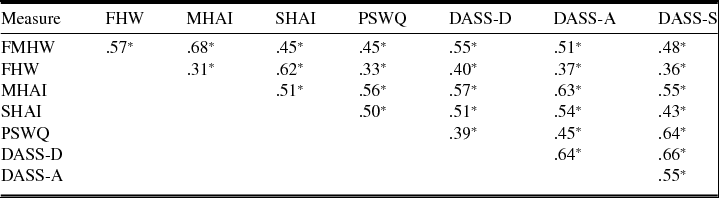
Notes: FMHW = Frequency Mental Health Worry; FHW = Frequency Health Worry; MHAI = Mental Health Anxiety Inventory; SHAI = Short Health Anxiety Inventory; PSWQ = Penn State Worry Questionnaire; DASS–D = Depression Anxiety Stress Scales–Depression; DASS–A = Depression Anxiety Stress Scales–Anxiety; DASS–S = Depression Anxiety Stress Scale–Stress. *p < .01.
Analyses addressing key exploratory questions
To compare levels of mental health worry with levels of health worry, a paired-samples t-test was conducted on SHAI and MHAI scores (N = 104), and also on FHW and FMHW (n = 93) scores. This test revealed no significant difference between the SHAI and MHAI mean scores t(103) = −4.80, p = .63. However, FHW scores were significantly higher t(92) = 2.02, p < .05 than FMHW scores.
The proportion of participants experiencing potentially severe or problematic mental health anxiety (MHAI scores of 27 or above) was 8.65% (nine adults). In comparison, 6.73% (seven adults) had SHAI scores above cut-off (27 or above). In relation to the above MHAI cut-off group, four people also had SHAI scores above cut-off, while five people had SHAI scores below cut-off. In addition, independent sample t-tests were conducted and demonstrated that participants with MHAI scores above cut-off had significantly higher scores on all variables except for FHW. The same tests were run for SHAI. Table 3 summarizes the results for both variables.
Means and standard deviations for self-report measures for MHAI and SHAI (below and above cut-off)

Notes: FMHW = Frequency Mental Health Worry; FHW = Frequency Health Worry; MHAI = Mental Health Anxiety Inventory; SHAI = Short Health Anxiety Inventory; PSWQ = Penn State Worry Questionnaire; DASS–D = Depression Anxiety Stress Scales–Depression; DASS–A = Depression Anxiety Stress Scales–Anxiety; DASS–S = Depression Anxiety Stress Scales–Stress; Samples size for below and above MHAI cut-off, below and above SHAI cut-off respectively were 95, 9, 97 and 7 respectively.*p < .05, **p < .01, ***p < .001.
Discussion
Validation results
The preliminary reliability results for the MHAI are promising. The MHAI demonstrated excellent internal consistency with an alpha coefficient of .92. This coefficient falls into the range .74 to .96 that was reported in a review of the 18-item SHAI (Alberts et al., Reference Alberts, Hadjistavropoulos, Jones and Sharpe2012). The MHAI has acceptable test-retest reliability with a Pearson's r correlation of .77, although it should be emphasized that the retest sample size was small (n = 22) and the retest period varied considerably. In future, a larger sample size and efforts to ensure re-administration at 2 weeks may be needed to better assess test-retest reliability.
Results pertaining to construct validity are also encouraging. Convergent validity was demonstrated when the MHAI, as predicted, correlated most strongly (.68) with average frequency of mental health worry. This result should be viewed cautiously, however, given that the FMHW measure comprises a single item measuring frequency only. Future studies using the FMHW could assess convergent validity more reliably by adding items that measure severity and duration of worry.
Convergent validity was also demonstrated when MHAI scores correlated with PSWQ (.56) and DASS-A (.63) scores, suggesting that mental health anxiety is a construct theoretically similar to trait worry and state anxiety. The correlation between MHAI and SHAI (.51) also supports recent suggestions (Anderson et al., Reference Anderson, Saulsman and Nathan2011; Rachman, Reference Rachman2012) that worry about mental health is a form of health anxiety. It is important to note, however, that mental health worry may be distinct to some extent from physical health worry since some participants with high MHAI scores had much lower SHAI scores.
It should also be noted that the correlations between mental health anxiety and non-anxiety variables (i.e. DASS depression and stress) were also strong (.57 and .55). One possible explanation for this is that worrying about one's mental health is particularly distressing and, hence, contributes to feelings of stress and depression. Given the large correlations that MHAI had with many variables, future studies could employ hierarchical multiple regression techniques to determine the unique contributions of each variable to the criterion variable.
Key research questions
A key aim of this study was to determine if adults in the community worry about their mental health. The results suggest that adults do worry about their mental health, and just as much as they do their physical health, as no significant differences were found between MHAI and SHAI scores. This result is somewhat undermined by the finding that FHW scores were significantly higher than FMHW scores. However, the FHW and FMHW measures consist of a single item only and, hence, are not likely to be as reliable as the SHAI and MHAI comprising more items. It is also noteworthy that the average MHAI and SHAI scores of 13.73 and 14.11 respectively were similar to the SHAI pooled mean of 12.41 reported by Alberts et al. (Reference Alberts, Hadjistavropoulos, Jones and Sharpe2012). These results, while promising, require verification through future research, preferably in larger scale studies.
Another key aim of this study was to determine the proportion of adults in the sample with MHAI scores potentially reflecting severe or problematic worry about mental health. Analysis revealed that 8.65% of the sample (nine adults) had scores that reached cut-off, while 6.73% (seven adults) had SHAI scores meeting cut-off. In relation to the characteristics of the MHAI above cut-off group, these participants had significantly higher trait worry, health anxiety, state depression, anxiety and stress than did those below cut-off. A similar pattern of results was found for the above SHAI cut-off group. This is further evidence that mental health and health anxiety may be similar constructs.
The finding that 8.65% of participants had MHAI scores meeting cut-off must be viewed cautiously. For instance, the cut-off of 27 cannot be considered robust as it was based on loose criteria only. A more crucial limitation, however, was that not enough data were gathered to be able to determine how best to interpret the high levels of mental health anxiety experienced by these participants. For instance, full DSM-IV diagnostic assessments including differential diagnosis were not included in this study. Also, while additional questions had been included in an attempt to gather more information about the anxiety, many participants declined to respond fully or at all. From the additional data that were gathered from these participants, six said their worry was in relation to a current mental health issue, one was worried about having received a wrong diagnosis, while the remaining two reported worrying about a mental health issue that they might have or get in the future, but had not sought assistance for. Hence, while it is possible that the participants in this group were experiencing unreasonably high levels of worry about mental health, such as that characteristic of extreme health anxiety, other explanations are possible and are discussed next.
Regarding the two participants who were anxious about a mental health issue that they might have or get in the future, their worry levels could have been justified if they were experiencing distressing symptoms but had not consulted a mental health professional who could have relieved their worry. Regarding the six participants who reported having a mental health issue, this issue may have been one in which worry about mental health was an associated feature or possible symptom. For instance, some of these participants may have had GAD, which is possible since four of them had PSWQ scores beyond 67.2, the cut-off suggested by Startup and Erikson (Reference Startup, Erikson and Davey2005). If this were the case, their mental health worry could simply have been one of many equally distressing worries. In summary, because in-depth data including diagnostic information were not collected, the possibility that the high levels of mental health anxiety experienced by these participants was the result of other conditions or factors could not be ruled out.
Future research
Future research using the MHAI could attempt to replicate and extend the findings of the current study, while addressing the limitations identified above. The most critical limitation was that the study was unable to determine whether the high levels of reported anxiety reflected the type of worry under investigation, that is, anxiety about mental health that, similar to health anxiety, is disproportionate to risk and persists despite reassurance. Future research could attempt to clarify this by collecting detailed information about the anxiety, including history and impact on functioning, as well as information on existing mental health issues. Using adapted DSM-IV (hypochondriasis) or DSM-5 (somatic symptom disorder, illness anxiety disorder) criteria to assess symptoms while ruling out conditions such as OCD, panic disorder, depersonalization disorder, or generalized anxiety disorder that could better account for the mental health worry might also be helpful.
Validation research should also include efforts to examine the extent to which mental health anxiety and health anxiety are alike. While the significant relationship between mental health and health anxiety scores suggests that these constructs share similar characteristics, more research is required. Qualitative research would be useful for this endeavour and the health anxiety model could help inform what information is gathered, for instance that pertaining to early experiences, beliefs about mental illness, triggers to worry, misinterpretations, and responses including safety behaviours. Future validation research using the MHAI could also include a factor analysis, consider adding more items, include a trial of the WAMH scale, and assess the degree to which mental health anxiety is a continuous variable.
The ultimate aim would be to have the MHAI reliably discriminate those people with problematic mental health anxiety from those who have a mental health issue but who are not unduly anxious about it, as well as from those with a mental health issue in which worry about mental health can be an associated feature, such as panic disorder. Accordingly, future research would need to develop reliable MHAI cut-off scores to enable clinicians to identify clients requiring treatment for this form of anxiety.
If future research did confirm that mental health anxiety is a form of health anxiety, then traditional conceptualizations of health anxiety and descriptions of DSM-5 illness anxiety disorder and somatic symptom disorder may need to be reviewed. Efficacious treatments would also need to be developed, or adapted from current health anxiety cognitive behavioural treatments to assist affected individuals.
Acknowledgements
The principal author thanks Professor P. Salkovskis for his assistance with modifying the HAI, Dr J. Rachman for his words of support and encouragement, and Dr P. Masterman and D. Ryder for their valuable feedback on the Masters version of this research.
Conflict of interest: The authors have no conflicts of interest with respect to this publication.
Appendix
Mental Health Anxiety Inventory (Salkovskis and Commons, 2012)
This questionnaire is a modified version of Salkovskis’ Health Anxiety Inventory (Short version). The amendments were made with his permission and assistance in 2012.
Each question in this section consists of a group of four statements. Please read each group of statements carefully and then select the one which best describes your feelings about your mental well being over the past 6 months. Identify the statement by ringing the letter next to it, i.e. if you think that statement (a) is correct, ring statement (a); it may be that more than one statement applies, in which case, please ring any that are applicable. PLEASE ANSWER ALL QUESTIONS.
Please be aware that for the purpose of this survey the terms “mental” and “psychological” mean the same thing.
-
1.
-
(a) I do not worry about my mental health.
-
(b) I occasionally worry about my mental health.
-
(c) I spend much of my time worrying about my mental health.
-
(d) I spend most of my time worrying about my mental health.
-
-
2.
-
(a) I notice unusual changes in my mental state less than most other people (of my age).
-
(b) I notice unusual changes in my mental state as much as most other people (of my age).
-
(c) I notice unusual changes in my mental state more than most other people (of my age).
-
(d) I am aware of unusual changes in my mental state all the time.
-
-
3.
-
(a) As a rule I am not aware of unusual things happening in my mind.
-
(b) Sometimes I am aware of unusual things happening in my mind.
-
(c) I am often aware of unusual things happening in my mind.
-
(d) I am constantly aware of unusual things happening in my mind.
-
-
4.
-
(a) Resisting thoughts of mental illness is never a problem.
-
(b) Most of the time I can resist thoughts of mental illness.
-
(c) I try to resist thoughts of mental illness but am often unable to do so.
-
(d) Thoughts of mental illness are so strong that I no longer even try to resist them.
-
-
5.
-
(a) As a rule I am not afraid that I have a serious mental illness.
-
(b) I am sometimes afraid that I have a serious mental illness.
-
(c) I am often afraid that I have a serious mental illness.
-
(d) I am always afraid that I have a serious mental illness.
-
-
6.
-
(a) I do not have images (mental pictures) of myself being mentally ill.
-
(b) I occasionally have images of myself being mentally ill.
-
(c) I frequently have images of myself being mentally ill.
-
(d) I constantly have images of myself being mentally ill.
-
-
7.
-
(a) I do not have any difficulty taking my mind off thoughts about my mental health.
-
(b) I sometimes have difficulty taking my mind off thoughts about my mental health.
-
(c) I often have difficulty in taking my mind off thoughts about my mental health.
-
(d) Nothing can take my mind off thoughts about my mental health.
-
-
8.
-
(a) I am lastingly relieved if my doctor or mental health professional tells me there is nothing wrong.
-
(b) I am initially relieved but the worries sometimes return later.
-
(c) I am initially relieved but the worries always return later.
-
(d) I am not relieved if my doctor or mental health professional tells me there is nothing wrong.
-
-
9.
-
(a) If I hear about a mental illness I never think I have it myself.
-
(b) If I hear about a mental illness I sometimes think I have it myself.
-
(c) If I hear about a mental illness I often think I have it myself.
-
(d) If I hear about a mental illness I always think I have it myself.
-
-
10.
-
(a) If I experience an unexpected mental event I rarely wonder what it means.
-
(b) If I experience an unexpected mental event I often wonder what it means.
-
(c) If I experience an unexpected mental event I always wonder what it means.
-
(d) If I experience an unexpected mental event I must know what it means.
-
-
11.
-
(a) I usually feel at very low risk for developing a serious mental illness.
-
(b) I usually feel at fairly low risk for developing a serious mental illness.
-
(c) I usually feel at moderate risk for developing a serious mental illness.
-
(d) I usually feel at high risk for developing a serious mental illness.
-
-
12.
-
(a) I never think I have a serious mental illness.
-
(b) I sometimes think I have a serious mental illness.
-
(c) I often think I have a serious mental illness.
-
(d) I usually think that I am seriously mentally ill.
-
-
13.
-
(a) If I notice an unexplained psychological sensation I don't find it difficult to think about other things.
-
(b) If I notice an unexplained psychological sensation I sometimes find it difficult to think about other things.
-
(c) If I notice an unexplained psychological sensation I often find it difficult to think about other things.
-
(d) If I notice an unexplained psychological sensation I always find it difficult to think about other things.
-
-
14.
-
(a) My family and friends would say I do not worry enough about my mental health.
-
(b) My family and friends would say I have a normal attitude to my mental health.
-
(c) My family and friends would say I worry too much about my mental health.
-
(d) My family and friends would say I am a hypochondriac.
-
For the following questions, please think about what it might be like if you had a serious mental illness of a type which particularly concerns you (for e.g. schizophrenia, bi-polar, and so on). Obviously you cannot know for definite what it would be like; please give your best estimate of what you think might happen, basing your estimate on what you know about yourself and serious mental illness in general.
-
15.
-
(a) If I had a serious mental illness I would still be able to enjoy things in my life quite a lot.
-
(b) If I had a serious mental illness I would still be able to enjoy things in my life a little.
-
(c) If I had a serious mental illness I would be almost completely unable to enjoy things in my life.
-
(d) If I had a serious mental illness I would be completely unable to enjoy life at all.
-
-
16.
-
(a) If I developed a serious mental illness there is a good chance that modern medicine would be able to cure me.
-
(b) If I developed a serious mental illness there is a moderate chance that modern medicine would be able to cure me.
-
(c) If I developed a serious mental illness there is a very small chance that modern medicine would be able to cure me.
-
(d) If I developed a serious mental illness there is no chance that modern medicine would be able to cure me.
-
-
17.
-
(a) A serious mental illness would ruin some aspects of my life.
-
(b) A serious mental illness would ruin many aspects of my life.
-
(c) A serious mental illness would ruin almost every aspect of my life.
-
(d) A serious mental illness would ruin every aspect of my life.
-
-
18.
-
(a) If I had a serious mental illness I would not feel that I had lost my dignity.
-
(b) If I had a serious mental illness I would feel that I had lost a little of my dignity.
-
(c) If I had a serious mental illness I would feel that I had lost quite a lot of my dignity.
-
(d) If I had a serious mental illness I would feel that I had totally lost my dignity.
-


 Open access


Comments
No Comments have been published for this article.