


Introduction
This paper is concerned with research on service user organizations in the mental health area. A wide variety of organizations operate within this field, from small informal grassroots organizations focused on peer support and larger service user-run organizations with paid staff, to national-level umbrella organizations (Baumann Reference Baumann2014; Brown et al. Reference Brown, Shepherd, Wituk and Meissen2008b). The role of and challenges facing mental health service user organizations (MHSUOs) as understood in research literature are analyzed in this paper. Specifically, current research is mapped and analyzed from the perspective of how these organizations move through different ‘participatory spaces’ (Cornwall Reference Cornwall, Hickey and Mohan2004).
The concept of participatory spaces, introduced by Cornwall (Reference Cornwall, Hickey and Mohan2004), is especially relevant to the analysis of research literature on MHSUOs since issues concerning participation have been central to MHSUOs from the outset. Service users and their organizations have struggled for social and political participation by challenging discriminatory and exclusionary practices of psychiatry and wider society (Beresford and Branfield Reference Beresford and Branfield2006; Janzen et al. Reference Janzen, Nelson, Hausfather and Ochocka2007). The growth of MHSUOs gained pace during the 1960s, when patient organizations focusing on advocacy and civil rights emerged throughout the Western world (Crossley Reference Crossley2006; Tomes Reference Tomes2006). These organizations were active in the deinstitutionalization movement, focused on shifting the location of mental health services from enclosed institutions to support integrated in the community (Parr Reference Parr2008; Rosenberg Reference Rosenberg2009; Truc Huynh Reference Truc Huynh2014).
MHSUOs have also struggled for service user participation by advocating for the integration of service user knowledge and perspectives in mental health service systems (Ostrow and Adams Reference Ostrow and Adams2012). These efforts not only relate to MHSUOs gaining access to spaces of policy making, but also to service users challenging the hegemonic discourses of these spaces by articulating alternative perspectives. MHSUO demands for service user participation have to some extent been heeded in the current post-deinstitutional era, with spaces for services user involvement integrated in service systems (Beresford and Branfield Reference Beresford and Branfield2006; Eriksson Reference Eriksson2015; Markström and Lindqvist Reference Markström and Lindqvist2015; Rose, Fleischmann, Tonkiss, Campbell, and Wykes Reference Rose, Fleischmann, Tonkiss, Campbell and Wykes2003). The present situation is further marked by a diversification of MHSUOs, with a visible growth in family organizations and condition-specific groups. This diversification is also reflected in the positions of MHSUOs, where many organizations have shifted their focus toward a more collaborative approach to mental health services (Crossley Reference Crossley2006; Karlsson and Markström Reference Karlsson and Markström2012; Tomes Reference Tomes2006).
Furthermore, neoliberal restructurings of the mental health area have contributed to new understandings of service user participation. Health and support systems have been influenced by market systems such as New Public Management, with a shift toward plural service providers. These changes are related to the development of hybrid MHSUOs, which are engaged in advocacy activities combined with service provision (Karlsson and Markström Reference Karlsson and Markström2012; Markström and Karlsson Reference Markström and Karlsson2013). As a result of this, service users and their organizations are invited to participate both as consumers and providers of mental health services. These dual roles contribute to changed positions within the psychiatric landscape.
The above-described transformations of mental health geographies in the post-deinstitutional era, both with regard to the position of MHSUOs and developments of mental health service systems, motivate us to map and analyze current formulations of MHSUO participation. Guided by the concept of participatory spaces, the aim of this study is to analyze the role of and challenges facing MHSUOs in the post-deinstitutional era, as they are depicted in research. The analysis is conducted on research literature published between 2006 and 2016.
Theoretical Framework
In the following section, we consider how service user participation constitutes a central concern in the post-deinstitutional era. We then describe the concept of participatory spaces (Cornwall Reference Cornwall, Hickey and Mohan2004) that will guide our analysis of how the current role of and challenges facing MHSUOs are understood in research.
Social and Political Participation in the Post-deinstitutional Era
Developments of the mental health field have a strong geographical dimension. Discourses of psychiatry have structured spaces such as the mental hospital, where both social and spatial distance has marginalized people with psychiatric disabilities. The first phase of deinstitutionalization challenged these exclusionary arrangements and focused on transferring mental health services and supports from the ‘total institution’ of the mental hospital to services such as day centers and sheltered housing which were integrated in the community. In the second phase, the current post-deinstitutional era, these services have been criticized for still constituting institution-like care settings (Markström Reference Markström, Brunt and Hansson2005; Markström and Lindqvist Reference Markström and Lindqvist2015; Rosenberg Reference Rosenberg2009). Even though the walls of psychiatric hospitals have been dismantled and care provision is now located elsewhere, patients have still been ‘walled-in’ and grouped together in community clinics and programmes (Rosenberg Reference Rosenberg2009). Rosenberg (Reference Rosenberg2009) argues that this geography has changed in the post-deinstitutional era. Instead of the psychiatric hospital, it is now community inclusion that constitutes the central point of reference. The focus has shifted from sheltered supports to exploring alternative mental health locations in the open community (Rosenberg Reference Rosenberg2009).
The post-deinstitutional era is further characterized by increased integration of service user participation in mental health service systems (Burns Reference Burns2014; Markström and Lindqvist Reference Markström and Lindqvist2015; Rosenberg Reference Rosenberg2009). Cornwall and Gaventa (Reference Cornwall and Gaventa2000) argue that new arenas and more direct ways for citizens to influence government are currently being explored and have broadened the definition of service user participation. The concept of participation is in this paper extended beyond processes initiated by authorities, to include autonomous arenas created for service user group engagements. The frame of ‘citizen participation’ proposed by Gaventa and Valderrama (Reference Gaventa and Valderrama1999) is applied, bridging definitions of social and political participation (Cornwall Reference Cornwall2002). The current involvement of MHSUOs in social activities, policy processes and provisioning has interlinked social and political participation, where both participatory forms potentially contribute to strengthening the social citizenship of service users.
Spaces for Participation
We will apply the concept of participatory spaces to analyze views in research literature on the role of and challenges facing MHSUOs in the current post-deinstitutional era, in which issues of participation are at the forefront (Cornwall Reference Cornwall, Hickey and Mohan2004; Rosenberg Reference Rosenberg2009). Through analyzing how participatory practices are enacted in different kinds of spaces, this theoretical perspective furthers our understanding of the dynamic between institutionalized spaces for participation constituted by authorities and more organic participatory spaces, autonomously created and shaped by service users (Cornwall Reference Cornwall2002). Developing the conceptualization of Cornwall (Reference Cornwall, Hickey and Mohan2004) and Gaventa (Reference Gaventa, Hickey and Mohan2004) we analyze the participatory spaces in which MHSUOs operate as ‘invited,’ ‘claimed’ or ‘popular.’ These different participatory spaces are made available for MHSUOs, alternatively occupied or created by them, to achieve social and political change (Cornwall Reference Cornwall, Hickey and Mohan2004). Participation in a given space relates not only to service users being represented or having ‘a seat at the table,’ but also to the possibility of affecting the discourse by articulating different perspectives, modes of knowledge and authority (Cornwall Reference Cornwall, Hickey and Mohan2004). The examination of participatory spaces can furthermore decouple the analysis from the institutional arrangements of organizations, to provide a more flexible and situational analysis of the processes in which MHSUOs are involved.
With the stated strategy to strengthen democracy, invited spaces are created to reduce the gap between the state and its citizens. In such spaces, authorities invite MHSUO representatives in the capacity of consultants, to sit in on committees and contribute to policy development. Invited spaces offer MHSUOs connections to traditional mental health service systems. However, these spaces have been criticized for having no effect on established power relations and for rearticulating hegemonic perspectives (de Freitas and Martin Reference de Freitas and Martin2015). Regardless of the core ambition, invited spaces are created, arranged and controlled by authorities (Cornwall Reference Cornwall, Hickey and Mohan2004, Reference Cornwall2008). Furthermore, these spaces are characterized by vast differences in status as well as heterogeneity with regard to the perspectives of the actors involved (Cornwall Reference Cornwall, Hickey and Mohan2004).
Claimed spaces represent arenas which previously had no service user representation but have now been occupied by service user groups. Participation is not only enacted through claiming the right to be represented in spaces for policy making, but MHSUOs occupying spaces for service provisioning also have potential to create platforms for the articulation of rights (Cornwall and Gaventa Reference Cornwall and Gaventa2000). Just like invited spaces, we define claimed spaces as relational to authorities but these spaces are chosen by service user groups themselves and created through the struggle of social movement organizations to participate (Cornwall Reference Cornwall, Hickey and Mohan2004; Gaventa Reference Gaventa, Hickey and Mohan2004). Different actors can have contrasting definitions of participatory spaces. Intermediate spaces between government and civil society can, for instance, be defined by the government as invited spaces, but can for MHSUOs represent claimed spaces (Cornwall and Shankland Reference Cornwall and Shankland2013).
As with claimed spaces, popular spaces originate in grassroots activity but represent spaces created independently of authorities for the purposes of activism, self-help initiatives or social activities. These more autonomous arenas unite service users around a commonality of identifications or perspectives, creating vital spaces for participation (Cornwall Reference Cornwall2002, Reference Cornwall, Hickey and Mohan2004, Reference Cornwall2008; de Freitas and Martin Reference de Freitas and Martin2015; Gaventa Reference Gaventa, Hickey and Mohan2004). In the absence of authorities, popular spaces can constitute sites for service users to develop their confidence and skills through solidarity and support (Cornwall Reference Cornwall2008). They can also make space for constructing alternative narratives of experience and negotiating new forms of knowledge (Cornwall Reference Cornwall, Hickey and Mohan2004; de Freitas and Martin Reference de Freitas and Martin2015).
Social and political participation can thus be enacted in the different forms of participatory spaces (Cornwall Reference Cornwall2002). Being relational to authorities, invited and claimed spaces have a focus on institutional politics but involvement in these spaces also supports the social participation of service user groups. Popular spaces are rather focused on social participation but also create space for political participation, by constituting sites for political activism and for service user groups to formulate and unite around political demands (Cornwall and Schattan Coelho Reference Cornwall, Schattan Coelho, Cornwall and Schattan Coelho2007).
Methods
Informed by the concept of participatory spaces, this study employs narrative review methodology in order to analyze research literature from the past decade focused on MHSUOs. The method is a suitable approach for our ambition to interconnect and reconceptualize studies on related subjects that use different methodologies (Baumeister and Leary Reference Baumeister and Leary1997; Werkmeister Rozas and Klein Reference Werkmeister Rozas and Klein2010). Rather than a focus on testing hypothesis, the narrative review can apply prior conceptualizations to offer new understandings of research literature (Baumeister and Leary Reference Baumeister and Leary1997). Our ambition is thereby to illustrate wider patterns in formulations of the role of and challenges facing MHSUOs, than what can be shown by single empirical reports (Baumeister and Leary Reference Baumeister and Leary1997).
Literature Search Strategies
To retrieve relevant literature, we conducted electronic bibliographic searches in EBSCOFootnote 1 and Scopus. A broader search stringFootnote 2 was initially used, but the unmanageable number of matches (EBSCO: n = 61,276, Scopus: n = 2655) led us to further refine our search, guided by our interest in third sector organizations. The main searches were performed on May 15, 2016, using search termsFootnote 3 selected in consultation with an information specialist and also informed by the search terms used in a previous review on a related subject (Karlsson and Markström Reference Karlsson and Markström2012). Prior knowledge of important publications in book format led us to include both peer-reviewed articles and book chapters. The database searches were set to include matches in English from 2006 to 2017.
The main search yielded 2133 matches in total (Scopus: n = 726, EBSCO: n = 1407). Initially, the authors discussed a selection of texts to decide on the inclusion criteria as well as defining the characteristics of the organizations to include. We have included a wide spectrum of organizations, from those that are small and focused on peer support to those that are policy-oriented and operating at national level. With regard to the target group of organizations, we have applied a broad definition of mental health, but excluded organizations where people with dementia, addiction problems and intellectual disabilities constitute the main target groups. After deciding on these common principles for inclusion, we screened the abstracts to ascertain whether they were relevant. Our selection was based on the inclusion criteria: (1) a focus on service user organization(s) and (2) falling within the field of mental health. The first author was mainly responsible for the selection, but borderline matches were continuously discussed in the research group. A large number of the matches did not meet the inclusion criteria but focused on topics such as survivors of disasters/cancer, aspects of voluntary community care, NPOs that were not MHSUOs or peer support/service user participation in the public sector without reference to MHSUOs. The vast majority of the matches failed to meet the first criteria. Matches with less than five references were also excluded, leaving 52 texts from the initial search after the selection.
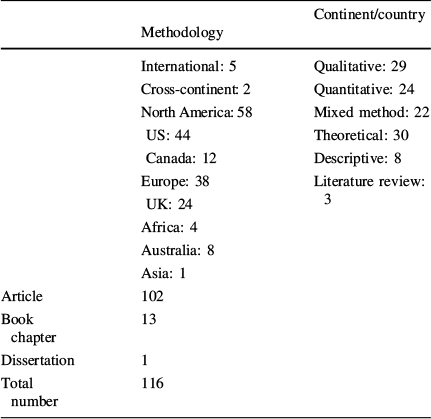
As an additional strategy, we scanned the references of the identified texts and performed hand searches to capture additional literature. A higher frequency of book chapters (n = 13) was included for this second step, where 64 texts in English or Swedish were added. These texts were compared to the initial broader search, which identified a large number of these texts (n = 49). A total of 116 texts were included; see Table 1. The fact that the main database search yielded fewer than half of the included texts could be seen as a weakness in the calibration of the search terms. However, these texts have been checked for central search terms excluded from our search string, and no such recurring terms were identified. The virtue of multiple search strategies that are most likely to transcend searches based solely on keywords is that they provide a more comprehensive overview of the research field.
Final selection of texts, according to continent/country of analytical focus and methodology

Continent/country |
Methodology |
|
|---|---|---|
International: 5 |
Qualitative: 29 |
|
Cross-continent: 2 |
Quantitative: 24 |
|
North America: 58 |
Mixed method: 22 |
|
US: 44 |
Theoretical: 30 |
|
Canada: 12 |
Descriptive: 8 |
|
Europe: 38 |
Literature review: 3 |
|
UK: 24 |
||
Africa: 4 |
||
Australia: 8 |
||
Asia: 1 |
||
Article |
102 |
|
Book chapter |
13 |
|
Dissertation |
1 |
|
Total number |
116 |
Categorization and the Synthesizing Process
Included texts (n = 116) were read through and categorized according to country of analytical focus and methodological orientation; see Table 1 for an overview. The selection showed a relatively even distribution over the ten-year period, indicating that research has not intensified to address the emerging questions concerning the role of MHSUOs in the post-deinstitutional era. As for the country of analytical focus, i.e., the geographical context of the MHSUOs described/analyzed, North America (n = 58) and Europe (n = 38) are dominant in the selection. In Table 1, we have singled out research which has a USA (n = 44) and UK (n = 24) context to highlight the high frequency of such texts. The dominance of research produced in Anglophone countries is visible in many research fields, and the pattern of US dominance within this field of research has been described in a previous study (Karlsson and Markström Reference Karlsson and Markström2012). The high frequency of texts produced in the UK possibly mirrors the national endorsement of service user research (Patterson et al. Reference Patterson, Trite and Weaver2014; Rose Reference Rose2015).
A large number of the included texts are focused on MHSUOs in the Global North, and the analysis is therefore bound to reflect issues of participation most relevant to these contexts. Our focus on mapping research literature from a particular theoretical perspective means that this study lacks information on the shifting, specific and local conditions of MHSUOs. The susceptibility of organizations to current developments varies, and national and local contexts are highly relevant to the circumstances of specific MHSUOs. Such variations are, however, largely beyond the scope of this article. Our lens of research literature furthermore entails a focus on the role of and challenges facing MHSUOs that are attended to in research. This study should thus be understood as an analysis of central issues of MHSUO participation discussed in research literature rather than an empirical description of the field of MHSUOs.
Included texts originate in many different disciplines, reflecting a lack of disciplinary dominance over this field of research. However, a number of authors are represented in several texts, which is especially noteworthy with regard to Nelson who is the co-author of six texts (Janzen et al. Reference Janzen, Nelson, Hausfather and Ochocka2007; Nelson et al. Reference Nelson, Ochocka, Janzen and Trainor2006a, Reference Nelson, Ochocka, Janzen and Trainorb, Reference Nelson, Ochocka, Janzen, Trainor, Goering and Lomotey2007, Reference Nelson, Janzen, Trainor and Ochocka2008; Nelson and Lomotey Reference Nelson and Lomotey2006) and Brown who is represented as author or co-author of eight texts (Brown Reference Brown2009a, Reference Brownb; Brown et al. Reference Brown, Shepherd, Wituk and Meissen2007a, Reference Brown, Shepherd, Wituk and Meissenb, Reference Brown, Shepherd, Merkle, Wituk and Meissen2008a, Reference Brown, Shepherd, Wituk and Meissenb, Reference Brown, Wituk and Meissen2010; Brown and Townley Reference Brown and Townley2015). The frequent representation of US authors from community psychiatry studies potentially creates bias to issues central within that context and field. Research focused on MHSUOs is a relatively limited field of research, making it particularly important to be aware of risks for weighted inclusion of literature.
A number of texts were the result of collaborations between service users and researchers (Gillard et al. Reference Gillard, Foster and Turner2016; Gupta and Roberts Reference Gupta and Roberts2014). The diversity of research focused on MHSUOs is also reflected in methodological orientation, with a relatively even distribution of qualitative (n = 29), quantitative (n = 24), mixed method (n = 22) and theoretical (n = 30) approaches. Texts categorized as descriptive (n = 8) focused on describing specific organizations (Barrett et al. Reference Barrett, Benson, Foster and Leader2014; Holland Reference Holland2010; Swarbrick Reference Swarbrick2007) or cooperation between organizations (Abdulmalik et al. Reference Abdulmalik, Fadahunsi, Kola, Nwefoh, Minas, Eaton and Gureje2014; Dziadkowiec et al. Reference Dziadkowiec, Reinhart, Vu, Shagott, Keele-Lien, Banta, Meissen, Brown and Wituk2010; Rogers Reference Rogers, Brown and Wituk2010). These texts provided empirical information without specific information about methodology.
The included texts were read through and clustered according to main focus. This grouping of texts provided an overview of included literature and enabled further analysis to be grounded in data by being used as a strategy to elicit a well-adapted theoretical framework (Best et al. Reference Best, Manktelow and Taylor2014). The texts were then re-read with a focus on mapping the role of and challenges facing MHSUOs informed by the perspective of the organizations’ presence in invited, claimed and popular spaces for participation. The presentation of our analysis is structured by the activities, organizational form, enactment of service user knowledge and relationships of MHSUOs, dimensions that are central to how MHSUOs involvement in participatory processes are understood in research.
Analysis
Developments in the field of mental health and in MHSUOs have meant these organizations are present in new arenas and engaging in novel activities. The challenges and value conflicts arising from developments in the role of MHSUOs are frequently described in the included texts (Boyce et al. Reference Boyce, Munn-Giddings, Smith and Campbell2010; Gillard et al. Reference Gillard, Foster and Turner2016; Nelson et al. Reference Nelson, Janzen, Trainor and Ochocka2008; Ostrow and Adams Reference Ostrow and Adams2012). We argue that these challenges are related to how MHSUOs in the post-deinstitutional era simultaneously participate in social processes related to popular, claimed or invited spaces.
Hybridization of Activities
By claiming spaces for service provision, MHSUOs now offer alternatives to traditional mental health system services. This development is especially evident in the USA, where peer-provided services by far outnumber traditional services (Goldstrom et al. Reference Goldstrom, Campbell, Rogers, Lambert, Blacklow, Henderson and Manderscheid2006). The service-providing role of MHSUOs is the main focus of many of the included texts, especially within texts focused on the North American context (Brown et al. Reference Brown, Shepherd, Merkle, Wituk and Meissen2008a, Reference Brown, Wituk and Meissen2010; Fleury et al. Reference Fleury, Grenier, Bamvita, Wallot and Perreault2012; Goering et al. Reference Goering, Durbin, Sheldon, Ochocka, Nelson and Krupa2006; Hardiman Reference Hardiman2007; Yates et al. Reference Yates, Mannix, Freed, Campbell, Johnsen, Jones and Blyler2011). However, these organizations are often involved in both service provision and advocacy activities (Goldstrom et al. Reference Goldstrom, Campbell, Rogers, Lambert, Blacklow, Henderson and Manderscheid2006; Janzen et al. Reference Janzen, Nelson, Trainor and Ochocka2006; Tanenbaum Reference Tanenbaum2012). Just like the ‘social movement service organizations’ conceptualized by Meyer (Reference Meyer and Hasenfeld2010), many organizations are hybrid in activity. In these organizations, service provision and advocacy are intimately linked core activities where advocacy is seen as related to personal gain and service provisioning as empowering and political (Brown et al. Reference Brown, Shepherd, Wituk and Meissen2007b; Stylianos and Kehyayan Reference Stylianos and Kehyayan2012; Tanenbaum Reference Tanenbaum2011).
Gee et al. (Reference Gee, McGarty and Banfield2015) as well as Janzen et al. (Reference Janzen, Nelson, Trainor and Ochocka2006) describe how MHSUO representatives are frequently invited to participate in policy development and community planning which currently constitute the core activities of many organizations. Practices like peer support and experiential knowledge have gained status and to some extent been incorporated into the traditional service system (Gillard et al. Reference Gillard, Foster and Turner2016). These developments in MHSUO activities have contributed to restructurings of the mental health field. By claiming discursive and material spaces, MHSUOs are now present in arenas where they used to be denied access. Practices developed in popular spaces are being transferred to traditional services and policy-making processes.
Conflicting perspectives on how to understand the current focus on service provision are evident in the material. Some argue that this could be seen as a radical development, where MHSUOs have claimed participatory spaces by creating alternatives to traditional mental health services based on service users’ needs and knowledge. Others describe the associated dangers of professionalization, cooptation and less focus on political advocacy (Andersen and Svensson Reference Andersen and Svensson2013; Ostrow and Adams Reference Ostrow and Adams2012; Seebohm et al. Reference Seebohm, Munn-Giddings and Brewer2010). These developments can furthermore cause role conflicts as MHSUOs straddle dual identities as partners with and opponents to traditional service systems (Crossley Reference Crossley2006).
Processes of Organizational Professionalization
MHSUOs aim to be different from traditional mental health services, often understood to be bureaucratic and oppressive (Nelson et al. Reference Nelson, Ochocka, Janzen and Trainor2006a). Alternative organizational forms have been developed in MHSUOs, involving high levels of volunteers, processes for democratic decision making and service user-exclusive groups (Boyce et al. Reference Boyce, Munn-Giddings, Smith and Campbell2010; Kleintjes et al. Reference Kleintjes, Lund and Swartz2013b; Tanenbaum Reference Tanenbaum2012). These aspects are described as unique features of MHSUOs and can be analyzed as constituting a counter-discourse that challenges the values and assumptions of hegemonic organizational models (Boyce et al. Reference Boyce, Munn-Giddings, Smith and Campbell2010; Brown et al. Reference Brown, Shepherd, Merkle, Wituk and Meissen2008a; Brown and Townley Reference Brown and Townley2015; Kleintjes et al. Reference Kleintjes, Lund and Swartz2013b; Nelson et al. Reference Nelson, Ochocka, Janzen and Trainor2006a). Grassroots activity in popular spaces, independent of traditional mental health service systems, is an important part of MHSUOs and vital for the development of alternative organizational models (Baumann Reference Baumann2014; Brown et al. Reference Brown, Shepherd, Wituk and Meissen2007a).
However, the organizational forms of MHSUOs have been affected by their greater presence in invited and claimed spaces. Influenced as they are by traditional organizational forms, MHSUOs are increasingly dependent on receiving government funding, employing staff and becoming more like structured nonprofits (Brown et al. Reference Brown, Shepherd, Wituk and Meissen2007a; Hodges and Hardiman Reference Hodges and Hardiman2006; Ostrow and Hayes Reference Ostrow and Hayes2015; Salem et al. Reference Salem, Reischl and Randall2008, Reference Salem, Reischl, Randall, Brown and Wituk2010). Many organizations grapple with issues related to organizational structure in the current situation. MHSUOs are often part professional, part grassroots associations, operating in an organizational gray zone (Brown et al. Reference Brown, Shepherd, Wituk and Meissen2007a). They may thus experience pressures from funders to professionalize and formalize, as well as opposing internal pressures to remain true to the core values of the service user movement (Boyce et al. Reference Boyce, Munn-Giddings, Smith and Campbell2010; Gillard et al. Reference Gillard, Foster and Turner2016; Meyer Reference Meyer and Hasenfeld2010).
Hodges and Hardiman (Reference Hodges and Hardiman2006) describe how intersectoral cooperation in invited and claimed spaces potentially provides MHSUOs with a stronger voice, but also how it means that these organizations risk becoming increasingly similar to their public/private counterparts. Karlsson and Markström (Reference Karlsson and Markström2012) discuss this trend as a Faustian pact whereby organizations gain influence and resources by receiving public grants and contracts in return for delivering services. However, these very opportunities risk changing the key values of organizations (Karlsson and Markström Reference Karlsson and Markström2012; Ostrow and Adams Reference Ostrow and Adams2012). While professional partnerships can contribute to greater organizational capacity, they can also result in decreased service user control and a more formal and hierarchical organization (Salem et al. Reference Salem, Reischl and Randall2008, Reference Salem, Reischl, Randall, Brown and Wituk2010).
Several studies focus on the ability of MHSUOs to accept invitations and claim new territory without sacrificing their unique organizational characteristics (e.g., Brown et al. Reference Brown, Shepherd, Wituk and Meissen2007a; Hodges and Hardiman Reference Hodges and Hardiman2006). Brown et al. (Reference Brown, Shepherd, Wituk and Meissen2007a) explore goal tracking as a method of providing accountability to funders while maintaining service user control. Salem et al. (Reference Salem, Reischl, Randall, Brown and Wituk2010) recommend that MHSUOs clarify their values and roles and develop buffers for unwanted structural change before entering professional partnerships (Salem et al. Reference Salem, Reischl, Randall, Brown and Wituk2010). Further examination is required to explore the opportunities for MHSUOs to operate in invited and claimed spaces while retaining their key organizational features.
The Integration of Service User Knowledge
The construction of recovery narratives and the sharing and revalorization of experiential knowledge are key characteristics of MHSUOs. Several studies describe the potential of MHSUOs to become arenas for experiential knowledge through providing space for sharing alternative narratives of self and recovery (Adame and Knudson Reference Adame and Knudson2007; Adame and Leitner Reference Adame and Leitner2008; Beresford and Branfield Reference Beresford and Branfield2006; Chassot and Mendes Reference Chassot and Mendes2015; Hoy Reference Hoy2014; Noorani Reference Noorani2013; Sapouna Reference Sapouna2012; Woods Reference Woods2013). Participation in countercultural communities in popular spaces, free from the involvement of the dominant system, is important in creating dialogical space for such alternative understandings of experience (Adame and Knudson Reference Adame and Knudson2007; Adame and Leitner Reference Adame and Leitner2008).
Gillard et al. (Reference Gillard, Foster and Turner2016) and Janzen et al. (Reference Janzen, Nelson, Trainor and Ochocka2006) describe how concepts and perspectives, such as recovery, experiential knowledge and empowerment, are currently being adapted in traditional mental health service systems. The included texts reflect this increased integration of service user perspectives where, for instance, empowerment and recovery scales are frequently applied to measure the outcomes of services provided by MHSUOs (Brown et al. Reference Brown, Shepherd, Merkle, Wituk and Meissen2008a; Corrigan Reference Corrigan2006; Kaplan et al. Reference Kaplan, Salzer and Brusilovskiy2012; Rogers et al. Reference Rogers, Teague, Lichenstein, Campbell, Lyass, Chen and Banks2007). Rabeharisoa et al. (Reference Rabeharisoa, Moreira and Akrich2014) discuss how service user groups can achieve change through constructing new political and scientific understandings of their experience. Knowledge production has enabled the service user movement to claim discursive space and thereby contribute to renegotiation of the hegemonic discourse.
However, several texts raise questions of whether concepts and perspectives such as empowerment and recovery could become coopted when incorporated into the professional system (Adame and Leitner Reference Adame and Leitner2008; Ostrow and Adams Reference Ostrow and Adams2012). Adame and Leitner (Reference Adame and Leitner2008), for example, discuss how empowerment has changed so as to mean individual choice over treatment rather than the redistribution of power resources. Beresford (Reference Beresford, Wallcraft, Schrank and Amering2009) also discusses risks for cooptation of service user perspectives in relation to MHSUOs engaging in research activities in partnership. He argues that service user-controlled research in popular spaces holds greater potential for challenging hegemonic discourses and developing new forms of knowledge (Beresford Reference Beresford, Wallcraft, Schrank and Amering2009). The introduction of education programmes to develop expert patients is also critically discussed in the included texts and is related to risks of creating an increasingly stratified service user movement and rearticulating the hierarchies of psychiatry (Hopton Reference Hopton2006; Lakeman et al. Reference Lakeman, Cook, McGowan and Walsh2007).
Intensified Relationships with Traditional Mental Health Service Systems
MHSUOs have claimed a seat at the policy table as a result of policy failures, system restructurings and political struggles (Bernstein Reference Bernstein2006; Campbell Reference Campbell, Stickley and Basset2008; Tomes Reference Tomes2006). This has resulted in evolved relationships with professionals and policy makers. Texts focused on MHSUO participation in policy processes examine service user participation in terms of the forms (Campbell Reference Campbell, Stickley and Basset2008; Janzen et al. Reference Janzen, Nelson, Hausfather and Ochocka2007; Stewart et al. Reference Stewart, Watson, Montague and Stevenson2008; Tse et al. Reference Tse, Cheung, Kan, Ng and Yau2012), barriers (Kleintjes et al. Reference Kleintjes, Lund and Swartz2013a) and contributions (Battams and Johnson Reference Battams and Johnson2009; Borkmann and Munn-Giddings Reference Borkmann, Munn-Giddings, Chambré and Goldner2008; Vaughan and Arsneault Reference Vaughan and Arsneault2008).
The growth in relationships between MHSUOs and traditional mental health service systems has created more invited spaces. The risks associated with these spaces are frequently discussed within texts focused on the context of Northern Europe (Beresford and Branfield Reference Beresford and Branfield2006; Campbell Reference Campbell, Stickley and Basset2008; de Freitas and Martin Reference de Freitas and Martin2015; Markström and Karlsson Reference Markström and Karlsson2013; Rose et al. Reference Rose, MacDonald, Wilson, Crawford, Barnes and Omeni2016; Van de Bovenkamp and Trappenburg Reference Van de Bovenkamp and Trappenburg2011). Adame and Leitner (Reference Adame and Leitner2008) and Rose et al. (Reference Rose, MacDonald, Wilson, Crawford, Barnes and Omeni2016) contend that such collaborations must have an awareness of the risk of coopting service user groups into the mainstream discourse. MHSUOs have to a great extent adopted a collaborative approach, but Campbell (Reference Campbell, Stickley and Basset2008) questions whether sitting at the same table and being tied to the same agenda is the best course of action given the differences in perspective and status. Invitations from authorities, made on the assumption that the organizations are equal partners, can in fact restrict the freedom of MHSUOs (Markström and Karlsson Reference Markström and Karlsson2013). Furthermore, high demands for MHSUO involvement in policy processes potentially compete with resources for popular initiatives outside mental health service systems (de Freitas and Martin Reference de Freitas and Martin2015; Van de Bovenkamp and Trappenburg Reference Van de Bovenkamp and Trappenburg2011).
Service user participation has come to be formulated through a consumerist discourse, framed in market terms and focused on treatment choice within mental health service systems. This focus excludes from the agenda broader social issues that affect the lives of service users (Battams and Johnson Reference Battams and Johnson2009; Beresford Reference Beresford, Wallcraft, Schrank and Amering2009; Campbell Reference Campbell, Stickley and Basset2008). Several texts discuss a shallow acceptance of service user participation in invited spaces and question whether participation in such spaces has led to any significant change (Beresford and Branfield Reference Beresford and Branfield2006; Bernstein Reference Bernstein2006; Campbell Reference Campbell, Stickley and Basset2008; Stewart et al. Reference Stewart, Watson, Montague and Stevenson2008; Tomes Reference Tomes2006). Battams and Johnson (Reference Battams and Johnson2009) analyze service user participation as being largely an end in itself rather than a means to exercising real service user influence. Campbell (Reference Campbell, Stickley and Basset2008) argues that the novelty of sitting at the table should have worn off by now, with a shift in focus to the changes actually made. Mechanisms that require accountability on behalf of authority could potentially be helpful in dealing with issues of tokenism in invited spaces (Battams and Johnson Reference Battams and Johnson2009).
Concluding Discussion
MHSUOs parallel presence in popular, invited and claimed participatory spaces is central to the discussion in current research on the role of and challenges facing MHSUOs in the post-deinstitutional era. MHSUOs move through popular spaces, where alternative organizational structures, practices and forms of knowledge can be developed. MHSUOs have also occupied claimed spaces, where the core practices of the service user movement are becoming increasingly integrated into the professional service system and alternative services are being provided. Furthermore, MHSUOs have been invited by authorities into new territories by participating, for instance, in provisioning and policy formulation. How to make the most of their presence in new arenas, resist cooptation into hegemonic models and remain arenas for developing alternative practices are central questions that MHSUOs face in the current situation.
Balancing the Political Opportunities of Participatory Spaces
Participatory spaces are shaped by different discourses, institutional logics and power relations and therefore hold different political potential (Cornwall Reference Cornwall, Hickey and Mohan2004). Balancing the political opportunities as well as the risks of different participatory spaces constitutes central challenges facing MHSUOs in the post-deinstitutional era. Even though popular spaces can be analyzed as being more radical, invited and claimed spaces also hold the potential to be transformed by the marginalized (Hickey and Mohan Reference Hickey, Mohan, Hickey and Mohan2004). By offering connections to authorities, participation in claimed and invited spaces gives MHSUOs political opportunities to exercise their voice in relation to traditional mental health service systems. However, the political opportunities of these spaces do risk being undermined by tokenism, professionalization and the cooptation of service user perspectives. In reaction to this, the current situation is characterized by a shift in focus from gaining access to spaces controlled by authorities to a critical examination of the political opportunities available. The previous struggle of MHSUOs to be consulted is currently shifting toward demanding accountability and transparency on the part of authorities (cf. Cornwall and Gaventa Reference Cornwall and Gaventa2000).
Even though claimed and invited spaces hold political potential, it is important to retain popular spaces in which the traditional mental health service system has no involvement. Such spaces are valuable resources for the mobilization of alternative perspectives and oppositional identities (Haug Reference Haug2013) and are a requisite for citizen engagement moving beyond legitimization of the current system (Habermas Reference Habermas1996). Popular spaces might be perceived as ‘laboratories of self-interest,’ where service user groups can unite around political positions and demands before communicating these in other participatory domains (Cornwall and Schattan Coelho Reference Cornwall, Schattan Coelho, Cornwall and Schattan Coelho2007, p. 18). de Freitas and Martin (Reference de Freitas and Martin2015) discuss the need to create arenas where marginalized groups and authorities can meet without these spaces becoming entrenched in bureaucracy and hegemonic discourses. We likewise understand the invitation of authorities to participate in spaces controlled by MHSUOs to hold the potential of offering the organizations connections to the state while avoiding state control (de Freitas and Martin Reference de Freitas and Martin2015).
Participation Beyond Psychiatry-Specific Spaces
MHSUOs are active in a range of participatory spaces that provide opportunities for social and political participation at both individual and systemic levels. Included texts focus especially on the increased presence of MHSUOs in claimed and invited spaces, where participation is defined in relation to traditional mental health service systems. Tanenbaum (Reference Tanenbaum2012) describes how MHSUOs have the potential to become civic organizations by providing space for members to build social citizenship and develop community ties. Participation beyond ‘psychiatry-specific’ spaces is central to develop this potential of MHSUOs (Parr Reference Parr2008; Rosenberg Reference Rosenberg2009). Such spaces could, for instance, be explored by evolved relationships with other civil society organizations. However, state incentives, whereby organizations are encouraged to engage in service provision or act as representatives in relation to traditional mental health service systems, mean that this civic potential of MHSUOs is often not fully explored (Tanenbaum Reference Tanenbaum2011).
Exploring participation beyond psychiatry could also lead to a reformulated agenda that challenges consumerist discourses on participation. Participation can be defined as an extension of democracy and citizenship, but it is also associated with state retrenchment whereby the market is constructed as a ‘surrogate arena for citizenship’ (Cornwall and Schattan Coelho Reference Cornwall, Schattan Coelho, Cornwall and Schattan Coelho2007, p. 5). The latter definition of participation involves service users being defined as both providers and consumers of services, and this needs to be distinct from participation focused on the redistribution of power (Cornwall and Gaventa Reference Cornwall and Gaventa2000; Cornwall and Schattan Coelho Reference Cornwall, Schattan Coelho, Cornwall and Schattan Coelho2007). MHSUOs exploring participation in issues that are not psychiatry-specific, such as housing policy and social insurance, could potentially allow for a shift from consumerist discourses focused on individual choice within the service system. A broadened participatory horizon could bring about an agenda that targets social and economic inequalities affecting the lives of service users.
To further the understanding of the current situation for MHSUOs, future studies will need to examine the strategies used by these organizations to manage professional partnerships, as well as MHSUO community ties and participation in spaces and issues that are not psychiatry-specific. The fact that it is an increasingly important social and political arena means that we also need to develop an understanding of the political opportunities offered through online spaces for service user mobilization.
Acknowledgements
This article constitutes a part of the research project ‘Mental health service user movements post deinstitutionalization—forms of organization and attitudes to services,’ funded by the Swedish Research Council for Health, Working Life and Welfare (Grant No. 2015-00414).
Funding
This study was funded by the Swedish Research Council for Health, Working Life and Welfare (Grant No. 2015-00414).
Compliance with ethical standards
Conflict of interest
The authors declare that they have no conflict of interest.

 Open access

