

BACKGROUND
From ad 865 to 879 a Viking army wreaked havoc on the Anglo-Saxon kingdoms, leading to political conquest, settlement on a substantial scale and extensive Scandinavian cultural and linguistic influence in eastern and northern England. This critical period for English history was followed by revolutionary changes in land ownership, society and economy, including the growth of towns and industry, while transformations in power politics would ultimately see the rise of Wessex as the pre-eminent kingdom of Anglo-Saxon England. Yet despite the pivotal role of the so-called Great Army (micel here) in these events, little is known of it; documentary sources provide few insights into its activities and intentions, and archaeological evidence has largely remained elusive. The size of the army and the scale of subsequent settlement have been disputed, but the debate about the impact of Scandinavian raiders and settlers is typically informed by evidence that has widely differing levels of chronological resolution and relates to diverse social, economic and political contexts; scholars have long struggled to integrate this evidence effectively.Footnote 1
This paper provides a fresh perspective on the Viking Great Army and its impact on Anglo-Saxon England, based on new tightly dated and contextualised evidence from Torksey. The Anglo-Saxon Chronicle tells us that in late ad 872 ‘the army went into Northumbria, and it took up winter quarters at Torksey, in Lindsey; and then the Mercians made peace with the army’.Footnote 2 While it has long been assumed that this occurred in the vicinity of the present-day village of Torksey, on the River Trent c 14km north west of Lincoln, only now has the site of the Viking winter camp been precisely located and its extent established. Torksey offers a unique research opportunity as both the camp and the adjacent urban settlement that developed in the wake of the overwintering are unencumbered by later development. Hence from 2011 to 2015 we undertook an archaeological evaluation at Torksey as part of a wider research agenda to examine the impact of ninth-century Viking armies, to illuminate their scale, complexity and intentions, and to provide new insights into the relationship between raiding, political conquest and settlement.
THE VIKING GREAT ARMY
The Anglo-Saxon Chronicle records that the Great Army landed in East Anglia in 865.Footnote 3 This was evidently larger than any previous Viking force and it became a constant threat, as it stayed in England through the winter. Over the following years it engaged in battle across eastern and northern England, leading each of the Anglo-Saxon kingdoms to ‘make peace’, as the Chronicle puts it. This is doubtless how the Army acquired many of the resources and allies it needed for a sustained campaign that marked a change in tactics from previous intermittent raids.Footnote 4 Viking armies had overwintered before – on the Isle of Thanet, in the mouth of the Thames, in 850 and on the Isle of Sheppey, in Kent, in 855 – but these were apparently isolated episodes on coastal sites.Footnote 5 The new force appears to have embarked on a phase of political conquest in which it exploited internecine warfare and played a role in appointing new kings from among its newly acquired allies drawn from the local elite.Footnote 6 The decade or so from 865 witnessed the transformation of the Great Army from raiders to settlers, hastening the demise of the separate kingdoms of Mercia, East Anglia and Northumbria. In 876, one force ‘shared out the land of the Northumbrians, and they proceeded to plough and support themselves’, and another force settled in Mercia in 877.Footnote 7 The remainder of the Great Army, led by Guthrum, was defeated in 878 by the West Saxons under Alfred at Edington, in Wiltshire. As part of the ensuing peace negotiations, Guthrum and thirty of his warriors were baptised; then, in 880, the Army went to East Anglia ‘and settled there and shared out the land’.Footnote 8 Subsequently, Guthrum and Alfred famously engaged in the making of a treaty, dividing out their areas of jurisdiction, and making arrangements for relations between their followers concerning legal disputes, trade and the movement of people. Coins were minted in Guthrum’s realm, on some of which he used his baptismal name of Æthelstan. These initiatives were part of the process by which Guthrum became a king in a western European guise.Footnote 9
Yet despite the importance of this pivotal period in Anglo-Saxon history, the army that precipitated these changes is poorly understood. The size of Viking armies has been much debated, especially following Peter Sawyer’s attempts some fifty years ago to challenge previous assumptions about the large scale of the Viking onslaught. Sawyer argued that translating the term here as ‘army’ was misleading; it was used in the early seventh-century laws of King Ine to mean any group numbering more than thirty-five men: ‘If a here could be three dozen men, it would be as well not to call it an “army”’. He maintained that the Chronicle exaggerated the numbers of ships involved in Viking raids, and argued that the difficulty of keeping a large army in the field precluded Viking armies comprising more than a few hundred men.Footnote 10
Sawyer also attempted to mobilise archaeological evidence. However, he relied on antiquarian speculation about possible Viking encampments in his argument for the small size of the armies; since the sites concerned were undated, they did not readily support his case without some circularity of argument. For example, in the 1920s Sir Cyril Fox had dismissed the notion that the earthwork known as Gannock’s Castle was the site of the Viking winter camp of 917 recorded at Tempsford (Bedfordshire), because at c 120×84ft (c 37×26m) it would only have accommodated around 270 men. However, Sawyer argued that there was ‘no reason to think that the here mentioned by the Chronicle was much larger than this’. In contrast, in 1903, Isaac Chalkley Gould had identified an earthwork some 500 yards (457m) long as the fortress built by a Viking army in 893 at Shoebury (Essex), and Sawyer explained the larger size by describing it as a place ‘intended to shelter the women, ships and property of the raiders during campaigns and … the men and horses as well’.Footnote 11
Nicholas Brooks subsequently demonstrated the flaw in Sawyer’s insistence that the Anglo-Saxon Chronicle is an unreliable witness to the numbers of ships that Viking raids comprised. He showed that the Chronicle is, in fact, notably restrained in its assessments of the scale of most of the raids and, moreover, that the estimates of the numbers of ships – sometimes 300 or more – are corroborated by Frankish, Irish and Spanish Muslim sources: ‘the Chronicle’s figures for Viking fleets are neither random nor wild; they avoid the obvious exaggerations of less well-placed or more colourful continental sources, and they mostly fit a consistent pattern of Viking activity that is credible and circumstantial’.Footnote 12 Brooks also argued that the Great Army was more successful than contemporary Viking armies raiding on the continent, because it was demonstrably larger than those armies. It was this that led to the ‘shattering effect which they achieved’ on Anglo-Saxon kingdoms and the Church.Footnote 13 While there was still no reliable archaeological evidence concerning the encampments of Viking armies, Brooks drew attention to the documentary evidence suggesting that the Great Army typically based itself at the royal and administrative centres of the Anglo-Saxon kingdoms, chosen ‘precisely because they already had defences’, some of them substantial Roman fortifications.Footnote 14 He concluded that the size of the places the army chose as their winter bases ‘would be inexplicable unless the “large” Danish armies were numbered in thousands rather than hundreds’.Footnote 15
The places at which the Great Army spent each winter between 865 and the mid-870s, when permanent settlement commenced, are critical to our understanding of the Viking impact, including scale, composition and the range of activities in which the Army was engaged. Yet although the Chronicle records the overwintering sites, this has proven only partially helpful for locating and exploring Viking encampments; in some cases it is unhelpfully vague (eg ‘East Anglia’ in 865–6), and even where a precise location is named, modern development has rendered the sites archaeologically inaccessible (eg York in 866–7 and 868–9, Nottingham in 867–8, Thetford in 869–70, Reading in 870–1 and London in 871–2).Footnote 16 There are, however, two exceptions: Torksey (872–3) and Repton (873–4).
Excavations and geophysical survey by Martin Biddle and Birthe Kjølbye-Biddle at Repton (1974–93) identified a substantial ditch, some 4m deep, which formed a relatively small D-shaped enclosure, c 0.4ha in size.Footnote 17 This did nothing to challenge the view that Viking armies can only have been numbered in the hundreds.Footnote 18 Four furnished graves were associated with the recorded overwintering, while excavation of a former mausoleum recovered the disarticulated remains of at least 264 individuals, among which 82 per cent of the sexed bones were male and described as ‘robust’. Radiocarbon dating suggested that these remains dated to no later than the late ninth century, and the deposit was interpreted as at least partly comprising members of the Great Army. Other than some indication of damage inflicted on the church, investigations at Repton revealed little more of the activities of the Great Army, but this can now be seen as a reflection of the lack of metal detector and landscape survey.Footnote 19 Nonetheless, for a generation Repton has served as the prototype for Viking encampments.Footnote 20 At Torksey our project now offers a different perspective. We have securely identified the precise location of the overwintering of 872–3 through a programme of archaeological evaluation and the plotting of an exceptional concentration of metalwork, including ingots, hack-metal and coinage (fig 1). Our work has also revealed that the camp was c 55ha in extent, considerably larger than that identified at Repton, and characterised by a wider range of activities. Important as the excavations at Repton remain, the scale and character of this new evidence from Torksey forces a radical reappraisal of the Viking Great Army.
A selection of metal-detected finds from the Viking winter camp at Torksey. Photograph: © Fitzwilliam Museum, Cambridge

The new insights from Torksey are timely given recent work on comparable sites in both England and Ireland. Metal-detecting, excavation and landscape survey have revealed the location of another, as yet unpublished, winter camp at Aldwark, north of York.Footnote 21 This is not a documented winter camp, but on the basis of the date of the metalwork, it has been associated with the movement of part of the Great Army back to Northumbria in 874–5.Footnote 22 Evidence for the operation of a bullion economy, metal-working and trade has been recovered. The site extended over an area of c 31ha, surrounded by a sub-rectangular ditched enclosure, possibly of early medieval date. Limited landscape analysis has revealed that the site was on higher ground above the flood plain of the River Ouse and that windblown deposits may have obscured any archaeological features.Footnote 23
The Annals of Ulster record the locations at which Viking armies in Ireland were based, sometimes describing them as longphuirt (plural for ‘ship-place’ or ‘ship-harbour’), with the earliest recorded being at Lough Neagh (Northern Ireland) in 840 and Dublin in 841. Whether the longphort should be regarded as a specific monument type has been extensively debated, but recent work has begun to identify their locations through excavation, survey and recognition of a suite of morphological and locational characteristics.Footnote 24 Fieldwork at Annagassan (Co. Louth) has illuminated the longphort constructed at Linn Duachaill in 841. Geophysical survey and excavation has identified a rampart, comprising a bank and ditch, of c 245m running from the River Glyde to the sea, and cutting off a 1.18km-long section of the peninsula. The geophysical survey also identified areas of burning and occupation ‘consistent with industrial activity and settlement’, and excavation revealed debris from metal-working, ship roves and rivets, hack-silver, a lead weight, a fishing weight, an iron knife and what has been interpreted as a weighing scale beam.Footnote 25 Finally, the recent publication of the excavations at Woodstown (Co. Waterford) has presented evidence for a Viking encampment. It is not specifically recorded as a longphort, although this part of Ireland is poorly represented in surviving documentary sources, and excavation suggests that it was occupied for a longer period of time than other sites discussed in this paper, from the mid-ninth century until the early to mid-tenth century. Two adjacent D-shaped enclosures encompass c 2.91ha, and evidence for iron-working, silver-working, glass-working, ship repair and trade has been identified. A burial containing weaponry has also been excavated.Footnote 26
AIMS AND METHODS
Over the last twenty years, several thousand pieces of early medieval metalwork and coins have been recovered by metal detector users from six fields to the north of the modern village of Torksey.Footnote 27 These finds first came to scholarly attention in the 1990s, and in his overview of Anglo-Saxon Lincolnshire they were interpreted by Sawyer as evidence for a market or fair of eighth- and ninth-century date, albeit that he accepted that ‘some of the ninth-century coins were probably brought by Vikings’.Footnote 28 Torksey was described by Katharina Ulmschneider in 2000 as a ‘very productive’ site. At that time, so-called ‘productive’ sites, characterised by unusual concentrations of coins and other metalwork of the Middle Anglo-Saxon period, were increasingly being discovered in eastern England by metal-detecting.Footnote 29 However, in a paper published two years later, Mark Blackburn highlighted the concentration of ninth-century coins, which implied ‘a period of exceptional activity at Torksey’, and he linked the finds, which then included eleven Arabic dirhams as well as hack-metal, ingots and copper-alloy weights, with the Viking overwintering of 872–3, although the precise locations in the parish from which the material was coming were unknown to him.Footnote 30 An updated list of finds was published in 2011, by which time it was apparent that most of the eighth-century coins were not from the site of the winter camp, now identified as ‘several ploughed fields adjoining the Trent’.Footnote 31 Blackburn estimated that the finds were coming from an area of c 26ha, but our fieldwork indicates that the size of the camp was, in fact, nearer to 55ha (fig 2).Footnote 32
Location plan showing the study area and the approximate outlines of the Viking winter camp and the Anglo-Scandinavian borough. Illustration: base map of this and subsequent figures derived from 2m LiDAR data, Environment Agency © 2014, all rights reserved; field boundaries from Ordnance Survey Mastermap © Crown Copyright/database right 2014, an Ordnance Survey/EDINA supplied service; general map of GB derived from Ordnance Survey MiniScale map

In order to set this exceptional metal-detected assemblage in context, we have undertaken a five-year programme of archaeological investigation employing a variety of techniques, including geophysical survey, fieldwalking, environmental analysis and small-scale excavation. By overlaying the various forms of evidence, it is possible to make sense of the different categories of data. Our aims have been to define the location and scale of the camp, its physical nature and organisation, the activities undertaken there and its legacy. We have asked why the Viking army chose the site, and examined its relationship to any pre-existing settlement, and we have assessed the role played by this overwintering in the subsequent emergence of the borough of Torksey to the south.Footnote 33 Earlier excavations within the area of the borough, evidently once much larger than the current village of Torksey, had identified at least four cemeteries and fifteen pottery kilns of ninth- to eleventh-century date.Footnote 34 However, the spatial and chronological relationship between the borough and the winter camp was previously unclear. Our project has major implications for the wider understanding of Viking armies, their strategies and composition, and their interaction with local populations as well as the subsequent revolutionary changes in Late Saxon pottery industries and the development of Anglo-Saxon towns.
The project aims have been addressed via eight specific objectives, employing a multidisciplinary team of archaeologists, geomorphologists, numismatists and historians, and by using a range of techniques:
-
1. Geoarchaeological investigation of the winter camp and its environs, employing auguring, test pitting, optically stimulated luminescence (OSL) dating and pollen analysis, to understand the nature and development of the landscape, and allow us to visualise its likely appearance on the eve of the arrival of the Viking Great Army.
-
2. Geophysical survey of the winter camp to identify archaeological features associated with the Viking camp and with other phases of activity.
-
3. Fieldwalking and geo-referenced metal-detector survey within the Viking camp to identify and date activity foci.
-
4. Trial and test-pit excavations to assess the visibility and depth of buried archaeological features within the winter camp.
-
5. Concordance and cataloguing of the metal-detected finds known to be from the Viking camp (with a cut-off date of August 2015) to integrate a range of disparate sources.
-
6. Fieldwalking and geophysical survey of Castle Field, within the Anglo-Saxon borough, to investigate the Torksey pottery industry.
-
7. Petrological thin-section study of the pottery and its clay sources to help understand the industry and inform broader issues of its relationship to the winter camp and borough.
-
8. Assessment and radiocarbon dating of the excavated cemeteries in Torksey to understand their relationship to the winter camp and borough.
The focus of this paper is on the winter camp itself (objectives 1–5), as our study of the Torksey pottery industry is being published separately,Footnote 35 although reference is made to the key outcomes of the other objectives (6–8) where they illuminate the camp and its impact. A searchable and illustrated database of all early medieval finds, and reports covering all objectives, are included in the digital archive, curated by the Archaeology Data Service; together with the current paper, they offer a full and up-to-date catalogue of all the metal-detected finds.Footnote 36 A selection of these finds have been discussed in previous publications,Footnote 37 but our project has collated published sources, current Portable Antiquities Scheme (PAS) records and museum accessions along with newly recovered finds. By integrating these strands of information with the results of targeted fieldwork and dating, we are able to demonstrate the value of metal-detected evidence through a contextualised approach on a scale not hitherto seen.Footnote 38
THE LANDSCAPE OF THE VIKING WINTER CAMP
The winter camp was located east of the River Trent, between the modern villages of Torksey and Marton, and straddling the parishes of Torksey and Brampton (OS grid reference SK 835805). This was a strategically important nodal point in the regional transport network, just south of a crossing point over the river, from which the Roman road now known as Till Bridge Lane ran south east to join Ermine Street just north of Lincoln.Footnote 39 In the medieval period (and probably earlier), Torksey was on a key transport route from the south to York, as travellers transferred from road to river at this point; according to Domesday Book, its inhabitants had the special responsibility of accompanying royal messengers to York ‘with their ships and their means of navigation’.Footnote 40 The position of Torksey within reach, should the need arise, of Northumbria and the heart of Mercia is striking. The Trent would have provided access to the Midlands and, downstream, to the Humber estuary and thence to York or the North Sea.Footnote 41 This facilitated movement of the army between the kingdoms, but also allowed control over other travellers into and out of Mercia. It is also possible that waterborne access into Lindsey was controlled from Torksey, as it is located adjacent to the Foss Dyke, a canal of probable Roman construction, which connects the Trent to Lincoln. Although we cannot be certain that it was navigable in the ninth century, the transportation of pottery produced at Torksey to Lincoln in the following century suggests that it was open by then.Footnote 42
The current channel of the Trent does not necessarily correspond with its early medieval course. It is likely, however, that climatic deterioration from the fourth to the tenth centuries led to the formation of an unstable, multi-channelled fluvial system with semi-permanent wetlands across the wider valley floor, interspersed with areas of raised ground formed by the Mercia Mudstone and sand and gravel islands. Our programme of coring and radiocarbon dating of peat sequences to the east of the winter camp has revealed that there had been a palaeochannel of the Trent up until the Bronze Age, when upstream siltation cut it off from the river, and peat deposits began to form.Footnote 43 Without an active channel, and with water levels averaging 1–2m higher than they are today, the low ground east of the camp would have remained a wetland, allowing peat to accumulate into the early medieval period (fig 3 [2]). Sediment mapping to the north and south of the site revealed not peat but silt (fig 3 [1 and 4]), suggesting that these areas remained open to the Trent, which would have provided naturally occurring seasonal tidal ports, with gently sloping sandbanks leading up to the higher ground of the winter camp. The area to the north of the site would have flooded regularly with the tidal influx of the Trent, as it continues to do to the present day when the Trent is in flood (fig 3 [4]). Indeed, the place name ‘Marton’ comes from the Old English mere-tūn, meaning ‘pool farm’, arguably derived from its position on the Trent flood plain.Footnote 44 Modern land management, including the digging of drainage channels and the installation of a pump-house at Marton in the nineteenth century, has had a significant impact, and geoarchaeological analysis was essential in determining the landscape setting of the winter camp.Footnote 45
The ninth-century landscape of the winter camp

In the winter of 872–3, bounded to the west by the Trent and surrounded by wet and marshy ground, the site of the Viking camp was effectively an island. A prominent bluff, 5–10m in height, overlooked the floodplain, gradually becoming less pronounced towards its northern end, the land sloping gently down to the east and north east (figs 2, 3 [3] and 4). Although the highest point is only c 10m higher than the modern village, this is a significant difference in the context of the surrounding landscape. The vantage point offered by the elevated location, combined with access to the Trent, must have made it particularly attractive to the Great Army. Viking armies are frequently recorded as occupying islands, including Thanet (Kent) in 850, Sheppey (Kent) in 855, an unnamed island in the River Colne (Hertfordshire) in 893 and an island called Mersea out in the sea off the Essex coast in 894.Footnote 46 On the continent Viking armies are also known to have based themselves on islands in major rivers, and the advantages that this offered are suggested in a late ninth-century account by Adrevaldus, a monk from Fleury Abbey (France), of a Viking army on an island in the Loire where they ‘held crowds of prisoners in chains and … rested themselves after their toil so that they might be ready for warfare. From that place they undertook unexpected raids, sometimes in ships, sometimes on horseback, and they destroyed all the province’.Footnote 47 The island character of Torksey is supported by its place name, which incorporates the Old English element ēg (‘an island; dry ground in fen, raised land in a wet area’) alongside a personal name of debated etymology, but probably Old English Turoc.Footnote 48 Alternatively, the ‘island’ element may have referred not to the site of the camp, but to the raised ground on which the present village stands, bounded by the Foss Dyke and the Trent, and a band of low-lying wetland to the east, where thirteenth-century sources record ‘Brampton Marsh’ and ‘Torksey Marsh’.Footnote 49
A twenty-first-century view looking east across the River Trent to the prominent bluff and the winter camp

A magnetic gradiometer survey was conducted over 26.9ha within the site.Footnote 50 This initially took the form of two 60m-wide transects, which traversed the site north–south and west–east, although the survey area was expanded where there was the clearest evidence for archaeological features (fig 5). The most striking anomalies were found in the centre of the transect, where the data indicate a post-medieval rabbit warren and a complex of rectilinear enclosures located towards the northern end of the ridge of high ground that forms the ʻislandʼ on which the winter camp was based. These enclosures are characteristic of a Romano-British settlement, incorporating rectilinear ditched enclosures, possible droveways and discrete pits; they are interpreted as a farmstead or similar (fig 6). This interpretation is reinforced by concentrations of Roman pottery found across this area during fieldwalking, as well as by the distribution of Roman metalwork recovered by the detector survey (see fig 12). The location provides a 360-degree view of the surroundings, including Lincoln, Marton, the Trent and Till Bridge Lane, which led to a crossing over the river opposite the former Roman town at Littleborough (Nottinghamshire), c 3.5km further north.Footnote 51 There is little indication of any Roman activity within the area of the later village of Torksey,Footnote 52 although pottery kilns of the second and third centuries have been excavated south of the Foss Dyke.Footnote 53
The area of the winter camp, overlaid with the results of the magnetometer survey

Geophysics interpretation of the central area showing the Roman farmstead (centre) and rabbit warren to the west

Our geoarchaeological survey demonstrated that considerable build-ups of windblown sand, a part of the Lincolnshire Coversands deposit, blanket the winter camp, up to 3–4m in depth.Footnote 54 The coring programme identified the location of former sand dunes, many of which were probably flattened by the first century AD. Analysis of pollen from peat deposits east of the winter camp suggests that woodland clearance accelerated in the Romano-British period, probably associated with the establishment of the farmstead identified by the magnetometer survey. By the time the Vikings arrived in 872–3, most of the former dunes probably appeared as wide mounds of sandy ground interspersed with the terrace gravels and clay mudstone.Footnote 55 It is suspected that the deposits of windblown sand, which have continued to build up and move since the Viking Age, have obscured detection of archaeology that, even under ideal conditions, can be expected to demonstrate comparatively weak magnetic contrasts with the surrounding soil. Such deposits may, however, have positive implications, ensuring the survival of the archaeology intact beneath the reach of the plough. Indeed, one of our test excavations, intended to assess a line of magnetic anomalies identified in the gradiometer survey (fig 7), revealed that silty sand extended to a depth of 1.98m below the modern ground surface (fig 8), with a gaming piece, fishing weight and buckle found at a depth of more than 0.5m.Footnote 56 OSL dating demonstrated that this deposit had begun to form in the second century AD, and continued to build up in subsequent centuries. The gradiometer survey found no evidence of a defensive ditch, such as that detected with excavation and geophysical techniques at Repton.Footnote 57 It is, of course, conceivable that any such ditch at Torksey was masked by windblown sand, but such a defensive measure may have been unnecessary when one considers the naturally defensible location of the site.
Geophysics interpretation of part of the southern area showing possible anomalies and the location of the TORK13 test trench (green rectangle)

The TORK13 test trench looking east

THE METALWORK ASSEMBLAGE
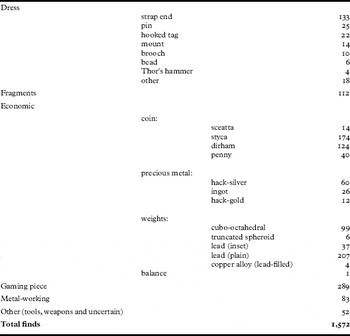
The windblown sand contains one of the richest assemblages of early medieval finds known from the British Isles. It is estimated that over the last twenty years some seventy metal-detector users have been working the site of the winter camp. The majority of finds are in private collections, although some have been sold online. Many have been logged by the PAS and, given the wide area from which the detectorists have been drawn to Torksey, objects have been reported to a number of finds liaison officers, including those in Sheffield, Derby, Lincoln, Scunthorpe and York. A major task of the assessment has been to update the catalogue of finds provided by Blackburn and to develop a database of all 1,572 known finds recovered before August 2015 (table 1).Footnote 58 The largest proportion (36 per cent) has been logged by the PAS; 18 per cent are in the Fitzwilliam Museum, Cambridge; 24 per cent are in a variety of other locations, including Lincoln Museum and private collections; and a growing number (currently 22 per cent) are from our own metal-detector survey. The site of the winter camp continues to be subject to modern agricultural practices, including deep ploughing, which regularly brings fresh objects to the surface. Nonetheless, the current landowners are in favour of controlling the detecting and access is now limited to a small number of detectorists, who have been logging the location of their finds with hand-held GPS. Since 2011 all new finds have been plotted. Although there is a scatter of Roman and medieval finds (as is common in most areas of Lincolnshire), the majority of objects (58 per cent) are early medieval (fig 9). Around 38 per cent of these finds are copper alloy, with 37 per cent lead, 20 per cent silver and very small proportions of gold and iron (fig 10). Apart from the under-representation of iron, which is not generally collected by the detectorists, the sample appears to be broadly representative of the metalwork present on the camp, particularly as the proportions are consistent between different detectorists.
Finds by period

Early medieval finds by material

Early medieval finds recovered by metal detector from the winter camp at Torksey (to August 2015)
The distribution of early medieval finds plotted during our detector survey (fig 11) shows widespread activity across each of the six fields identified as comprising the Viking camp. While the second southernmost field appears to have fewer finds, the survey here has so far been constrained by the cropping regime. Similarly, although distributions of finds by type so far indicate undifferentiated activities, the overall number of geo-referenced finds is still relatively small. Nonetheless, the area of the Roman farmstead, as revealed through geophysics, is certainly confirmed by the distribution of Roman finds (fig 12). The only possible indication of zoning of activities during the overwintering comes from the distribution of lead gaming pieces (fig 13), which cluster towards the northern part of the site and may provide the best indication of domestic areas, although we can map the find-spots of only twenty of more than 280 pieces recovered.
Distribution of the early medieval finds

Distribution of the Roman finds

Distribution of the lead gaming pieces

DATING THE CAMP
It is the metalwork and, specifically, the coinage, that allows the assemblage to be dated so precisely and which confirms this as the site of the Viking winter camp of 872–3. More than 350 early medieval coins have been recovered, including forty English silver pennies, with a notable concentration from the 860s and early 870s (fig 14), which is striking given that coin finds of the early ninth century are generally more prolific than those of the middle and later parts of the century.Footnote 59 Remarkably, there are also more than 170 Northumbrian copper-alloy stycas, which did not circulate widely outside Northumbria and are generally only recovered in Lincolnshire as single finds.Footnote 60 Most of these were struck in the 840s, particularly during the reign of Aethelred ii (840–4, 844–8) of Northumbria. There are also eleven late stycas of Osberht (died 867), probably dating towards the end of Anglian Northumbria. The concentration of stycas at Torksey suggests that they had remained in circulation and had been brought there directly from Northumbria, from where the Great Army had retired to Torksey.Footnote 61 Indeed, stycas are increasingly being identified in Scandinavian contexts in Britain, including settlements, hoards and burials, and ninety stycas have been recovered from Aldwark.Footnote 62
The age structure of the Anglo-Saxon coins, excluding stycas, found at Torksey

There are also 124 dirhams from Torksey, the largest concentration on any insular site (fig 15). These had all been cut into smaller fractions, indicating that they had been retained for their silver content rather than their monetary value.Footnote 63 These dirhams had clearly been brought to England from the Middle East via Scandinavia, and similar concentrations of dirhams have been found at Scandinavian trading centres such as Birka (Sweden) and Kaupang (Norway).Footnote 64 Indeed, there is growing evidence for large amounts of Arabic silver flowing into the Baltic in the 860s and 870s, and the date profile of the dirhams is similar to that from Torksey, although the sudden break in the late 860s at Torksey is not reflected at the Scandinavian trading sites, which continued to receive dirhams into the mid-tenth century.Footnote 65 A similar span of dates to that at Torksey, comprising both relatively recent and considerably older coins, occurs when dirhams – admittedly in much smaller numbers – are found in hoards in England.Footnote 66
Some of the Islamic dirhams found at Torksey. Photograph: © Fitzwilliam Museum, Cambridge

The latest dirhams from Torksey have a terminus post quem in the late 860s, post-dating the arrival of the Great Army in England, which indicates continued contact with Scandinavia during the years of campaigning. The English silver coins have an end-date in the early 870s, and they are likely to have been lost close to their date of production, as there is no evidence for pecking to test for quality. Archibald has argued that the most likely context for the introduction of pecking, first demonstrated in hoards dated to after c 890, was the reform of coinage in the mid-870s, when the silver content of new issues was increased, yet earlier issues continued to circulate.Footnote 67 Allowing for the time it would have taken for the dirhams to reach England, they appear to have an end-date remarkably similar to that of the English silver coins in the early 870s (fig 16). In summary, it is clear that the early medieval coins can only have been brought to the site by the Great Army, given the combination of silver coins of the 860s and early 870s, dirhams used as bullion and the exceptional concentration of stycas outside Northumbria.
The age structure of the dirhams found at Torksey

A handful of Middle Anglo-Saxon finds and a few late tenth-century dress accessories have been recovered from the same fields, but in insufficient amounts to suggest significant, if any, earlier or later settlement. Fourteen late seventh- to early eighth-century sceattas have been found, but this is a far smaller assemblage than is generally associated with Middle Anglo-Saxon trading sites. The character of the vast majority of the other metal artefacts is consistent, as we shall see, with them having been brought to the site, or produced there, by the Great Army. We are confident, therefore, that the exceptional assemblage of finds from Torksey largely represents a single year of activity, which may be linked exactly to the overwintering of 872–3 recorded in the Anglo-Saxon Chronicle.
ACTIVITIES IN THE CAMP
At first sight the amount of metalwork recovered from the camp seems remarkable as the reflection of a single overwintering, yet it is clear that in certain circumstances single events can lead to massive accumulations of material; the detritus left by more recent armies – or even on modern music festival campsites – reminds us how easy it is to mislay items in muddy and trampled fields. The fact that even gold and silver objects were not recovered at the time indicates the sheer quantity of portable wealth that must have been collected by the Army. The assemblage is invaluable in contributing to our understanding of what a Viking army did while it was overwintering, including trade and exchange, coin production and metal processing, as well as leisure activities.
Trade and exchange
That Viking armies were accompanied by individuals involved in trade is suggested by the finds from Torksey. This should not be a surprise, as it is revealed in continental texts. For example, the Annals of St-Bertin record that in 873 a Viking army besieged by Frankish forces at Angers was permitted to hold a market on an island in the Loire before departing in February. That armies were associated with trading is reinforced by the entry in the Annals for 876, which describes the ‘traders and shield-sellers’ that followed the army of Charles the Bald.Footnote 68
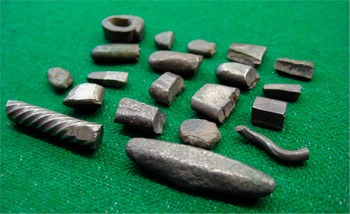
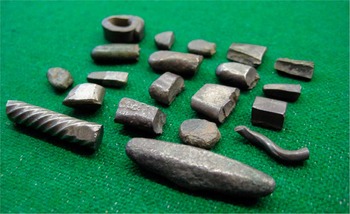
It is apparent that there were multiple economies operating alongside one another at Torksey. There was evidently an important role for bullion, as is clear from the fragmented state of the dirhams, the presence of sixty pieces of hack-silver (fig 17), and the mixed profile of the coins – from three Anglo-Saxon kingdoms, the continent and the Arabic world. In this context, Anglo-Saxon, Irish and Scandinavian fragmentary decorative silver jewellery can also be interpreted as having been used for monetary exchange.Footnote 69 Taken together, this evidence reinforces the impression of the operation of a bullion-based economy that emerges from the many Viking silver hoards of the late ninth and early tenth centuries. Most of these are a generation later than the finds from Torksey, but an exception is the hoard from Croydon (Surrey), consisting of hack-silver, ingots and c 250 coins from Mercia, Wessex and the continent, plus three dirhams. This has been dated to c 872 and associated with the movement of the Great Army to London in the winter of 871–2.Footnote 70 More recently, a hoard from Watlington (Oxfordshire), comprising 186 coins, seven items of jewellery and fifteen ingots, has been dated to the late 870s following the defeat of the Viking army at Edington.Footnote 71 Hack-silver, silver ingots and imported coins have also been found at Woodstown and Aldwark, suggesting that a bullion economy also characterised these Viking camps.Footnote 72 Recent analysis of a rural settlement at Cottam (Yorkshire) has revealed late ninth-century use of bullion, indicating Scandinavian settlement, which endured at the site into the tenth century.Footnote 73
Some of the silver ingots and hack-silver found at Torksey. Photograph: © Fitzwilliam Museum, Cambridge
Twelve pieces of hack-gold have been recovered at Torksey, which are very unusual finds (fig 18). Several pieces had been chisel-cut from gold ingots, although one twisted piece may have been cut from an arm- or neck-ring. Two cut gold solidi – one Frisian, the other Carolingian – may also have been bullion. This is an important insight into Viking activity because, unlike hack-silver and silver ingots, gold in any form rarely occurs in Viking Age hoards in Britain, and it has been suggested that this is in part because of its greater rarity and in part because it may have played more of a role in status display than in economic transactions.Footnote 74 However, the remarkable concentration of gold finds from Torksey does seem to suggest the use of gold in such transactions. This may even help to explain the unique discovery of fake hack-gold from the site, in the form of gold-plated copper alloy, including a fragment of an ingot and two sections cut from square rods.Footnote 75
Some of the hack-gold from Torksey. Photograph: © Fitzwilliam Museum, Cambridge

It is possible that copper-alloy artefacts were also being used as a form of low-value bullion. Indeed, there are twelve copper-alloy ingots from Torksey (fig 19), one of which has the transverse hammering often visible on silver ingots, and this may hint at a system of value where copper was of some importance in exchange.Footnote 76 Such a practice is not reflected in Viking Age hoards in England, but copper-alloy ingots from eastern England are increasingly being identified, some with the distinctive transverse hammering.Footnote 77 There is also some evidence for this economic use of copper alloy more broadly across the Viking world, with ingots found in several hoards (such as one from Spillings on Gotland, which has a terminus post quem of ad 874) and stycas found at trading sites in Scandinavia.Footnote 78
A group of cut copper-alloy ingots (hack-copper) from Torksey. Photograph: © Fitzwilliam Museum, Cambridge

A bullion economy required the weighing of the metal, and more than 350 weights have been recorded from Torksey (fig 20).Footnote 79 Nearly one hundred of these are copper-alloy cubo-octahedral weights, and there are also six truncated spheroid copper-alloy weights. Both arguably reflect the design and weight standards of Arabic copper-alloy weights, and similar examples appear in considerable numbers on Scandinavian sites from the 860s and 870s, while there is some evidence, from Birka and Gotland, that they were being manufactured there.Footnote 80 They are increasingly being recognised from sites in Britain and Ireland: Aldwark has produced twenty-four cubo-octahedral weights, and there is also one from Woodstown, although neither has produced a spheroid weight.Footnote 81 Those at Torksey must represent parts of multiple sets of weights. Our analysis has not identified any consistent weight standards, although the composite nature of the Great Army might account for a diversity of practice. Nearly 250 lead weights have been recovered, thirty-seven of which are inset with decorative metalwork, largely of insular origin. Similar inset lead weights have been found at numerous sites: Aldwark; Woodstown; the settlement at Llanbedrgoch on Anglesey; and in Viking burials at Islandbridge, near Dublin, and at Kiloran Bay, in the Inner Hebrides. Inset lead weights are also found in low numbers in Scandinavia itself, where they are thought to represent the transfer of an insular Viking tradition.Footnote 82 These inset weights seem, therefore, to reflect innovation in the operation of the metal-weight economy, and the production of these weights provides another example of manufacturing during the earliest phases of Scandinavian settlement.
A sample of weights from Torksey, including examples of cubo-octahedral, truncated spheroid and lead inset types. Photograph: © Fitzwilliam Museum, Cambridge

The sheer scale of the precious and base metalwork from Torksey does not, of itself, demonstrate the nature or extent of economic transactions undertaken there, but these are likely to have been diverse. The distribution of precious metals was undoubtedly one of the means by which Viking leaders enhanced their prestige and secured the loyalty of their followers. While the imported dirhams show extensive fragmentation, this is not true of the Anglo-Saxon coins, which may reflect their use within a monetary economy, not simply as bullion. The use of bullion alongside a managed currency has been dubbed the ‘dual economy’ of the Danelaw, and has been assigned to the period when coins began to be minted for Scandinavian rulers from the 880s/890s until the 920s, but it now appears that it existed from the very outset of Viking settlement in the west.Footnote 83 The picture that emerges from Torksey is, however, not so much of a ‘dual economy’ as of multiple metal economies operating simultaneously, with gold, silver and copper alloy all used in both coined and bullion form.Footnote 84
It is unlikely that the Great Army accrued the wealth that is reflected in the finds from Torksey solely through raiding and plunder. The Great Army is repeatedly recorded as having concluded peace treaties during its overwintering, and tribute-taking may have been an element in this process; leases of land by ecclesiastics are known to have occurred in the late ninth century as a means of raising tribute to pay Viking armies.Footnote 85 Slave trading may have been a factor in acquiring wealth, and may ultimately be the origins of the dirhams from the Middle East that Viking armies brought with them. Irish and continental sources record the capture and sale of slaves by Viking armies, and while this is not directly documented in contemporary sources in England, it must have occurred; indeed, the peace treaty between Alfred and Guthrum from the 880s contains a clause in which the rulers agreed not to harbour the runaway slaves from the other’s realm.Footnote 86 Slaves may also have been used for labour or to provide sexual services within the camp. The ransoming of hostages may have been another means of acquiring wealth, and hostages were also politically useful. Following the arrival of the Great Army at Repton, the new ruler of Mercia, Ceolwulf, gave hostages and swore oaths that he would be ready ‘at the enemy’s service’ whenever required. The details of the peace made between the Army and the Mercians at Torksey are not provided in the Anglo-Saxon Chronicle, but it may have included similar arrangements.Footnote 87
Coin production
There is some tentative evidence that the Great Army was minting coins during its campaigns. A strip of lead from Torksey bearing the impression of the die for an imitative gold solidus of Louis the Pious (814–40) supports the long-held belief that imitative gold solidi were being minted in England, since a number have been found in eastern England, albeit not from these actual dies.Footnote 88 They seem intended to have served as coins, not pendants, since there is no evidence for suspension loops. A lead impression of a lunette coin of Burgred of Mercia from Torksey (fig 21) also suggests minting; it appears to bear a blundered inscription, as do 23 per cent of the stycas, which may be an indication that these were Viking imitations.Footnote 89 A plated copper-alloy lunette was evidently a forgery, and one of the dirhams (finds catalogue CM.601–2010) appears to have a green patina, again suggesting a contemporary forgery, of which a similar example of the early tenth century has been found in York.Footnote 90
Evidence of coin and metal production at Torksey. Top left: lead bearing the impression of lunette type A coin of Burgred of Mercia; top right: a lead trial piece for triangular punches; bottom: a lead striking from dies of a lunette type A coin. Photograph: © Fitzwilliam Museum, Cambridge

Once they had seized control of the Anglo-Saxon kingdoms, Viking rulers, such as Guthrum, began to mint coins,Footnote 91 which is usually regarded as requiring ‘an administrative infrastructure to issue them and regulate their use’.Footnote 92 However, the lead impressions of dies and blundered stycas from Torksey suggest that the minting of coinage emerged during the overwintering phase, even before the Viking leaders had adopted the administrative apparatus of Anglo-Saxon kingship. Nonetheless, the boundaries between the use of precious metals in a bullion, monetary and a status-based or ‘display’ economy can be fluid, and precious metals could easily be melted down and transformed into other forms, whether ingots, coins or display items, such as the silver arm-rings of which fragments have been found at Torksey, along with some evidence for their manufacture.Footnote 93 The decision to mint coins is an ideological one, and often an expression of authority on the part of a ruler.Footnote 94 To a Viking army, coins were not necessarily more logical than bullion, but minting of imitations suggests that they understood something of the political as well as the economic value of coinage. The Great Army may have been engaged in minting coins for a variety of reasons: to use coinage in economic exchange locally to buy supplies; to display the aspirations of its leaders in an attempt to establish Viking authority within the Anglo-Saxon kingdoms; and as a response to competition between leaders within the Great Army.
Metal-working and other activities
Metal was also used in various forms of processing and production. While not capable of being closely dated, melts of gold and silver indicate metal-working, and silver-casting waste has also been recovered from Aldwark and Woodstown, while a high proportion of the cupels and crucibles recovered from Woodstown were used for silver-working.Footnote 95 At Torksey the recovery of three strips of lead on which decorative punches had been tested suggests the production of Scandinavian silver jewellery, such as arm-rings. A fragment of a lead Pressblech die could have been used to impress decoration onto gold foil which was to be applied to other objects.Footnote 96 That base metal-working was also undertaken is supported by the recovery of a lead casting for a strap end (fig 22), copper-alloy and lead melts, and more than 200 fragmentary copper-alloy artefacts (fig 23), which were deliberately cut, suggesting they were to be melted down.Footnote 97 Some of the fragmentary items may, alternatively, have been intended as insets for the lead weights or other form of display, since a significant minority have been pierced and some have intact rivets.Footnote 98
A lead casting for a strap end. Photograph: © Fitzwilliam Museum, Cambridge

A sample of fragmentary copper-alloy decorative metalwork from Torksey. Photograph: © Fitzwilliam Museum, Cambridge

Although no examples of clench nails have yet been recovered from Torksey, it is very likely that ships were drawn up onto the flood plain below the camp for repair over winter. Indeed, a hoard of iron woodworking tools is believed to have been recovered from the winter camp.Footnote 99 The tools (fig 24), which include four axeheads, an axe hammer, an adze and a two-edged blade, can be dated broadly on typological grounds to the eighth to tenth centuries. If they were used during the overwintering it is notable that they have an Anglo-Saxon form, lacking the distinctive pointed lugs of Scandinavian types, and may reveal the use of Anglo-Saxon material culture, if not labour.Footnote 100 Hoards of iron tools have sometimes been interpreted as ritual deposits; in a Scandinavian context, these are typically found in riverine and marshy environments.Footnote 101 However, a ritual interpretation seems unlikely for the Torksey hoard as the tools are not a complete set for any particular type of woodworking, unlike broadly contemporary iron hoards from Scandinavia.Footnote 102 The worn and damaged tools were accompanied by some fifteen fragments of iron vessel – mainly bowls, and two tripod stands – suggesting that this was scrap iron ready for reworking; the hoard may therefore provide evidence for both woodworking and iron-working on the site. The general paucity of iron artefacts from Torksey must to a large degree be connected to the under-representation of iron among the reported finds. It is, in contrast, notable that excavation and metal-detecting for iron at Woodstown recovered hundreds of ferrous items, many seemingly associated with ship repair.Footnote 103
A selection of artefacts from the hoard of woodworkers’ tools, including a cauldron, an adze, an axehead and several hammer heads. Photograph: © Lincoln Museum

A range of other artefacts also seem likely to derive from overwintering activities. The presence of spindle whorls, needles, punches and awls suggest textile-working, presumably including the repair of sails, tents and clothing (fig 25). Meanwhile, 289 lead gaming pieces serve as a reminder that the Army may have had leisure time on its hands (fig 26). This all suggests that the study of the impact of Viking raids in the late ninth century needs to broaden its focus beyond the purely military. Indeed, few items related to military activity have been recovered – merely two iron spearheads, an iron sword hilt and an arrowhead.
Some iron tools from Torksey, including awls and spoon bits. Photograph: © Fitzwilliam Museum, Cambridge

Examples of lead gaming pieces from Torksey. Photograph: © Fitzwilliam Museum, Cambridge

THE COMPOSITION AND SIZE OF THE VIKING GREAT ARMY
The winter camp at Torksey was evidently occupied not only by warriors, but also by merchants and craftworkers. Women and children may also have been present, as they are certainly recorded as accompanying Viking armies in contemporary continental sources and in the Chronicle entries for 893 and 895.Footnote 104 While no oval brooches typical of female Scandinavian dress have been recovered, and the other items of jewellery and dress accessories found cannot be confidently assigned to a specific gender, the textile-working equipment from Torksey may reflect a female presence. Elsewhere, textile-working spindle whorls, needles and needle cases, linen smoothers and shears, are overwhelmingly found in the graves of females.Footnote 105 Moreover, there are females among the individuals buried at the Great Army’s cemetery at Heath Wood (Derbyshire) and among the mass burial at Repton, including one for whom stable isotope analysis has suggested a childhood spent in mid-continental or Baltic Europe.Footnote 106
Documentary and archaeological evidence reveals that the Great Army was not a single unified force, but, rather, comprised multiple warbands drawn from different parts of Scandinavia. In the unusually detailed account of the Great Army’s battles with the West Saxon forces in 871, it is apparent that it was led by at least two kings – Halfdan and Bagsecg – and a number of jarls, with the army dividing into two at various stages. Moreover, it was reinforced in this year by what the Chronicle describes as a ‘great summer army’.Footnote 107 The differing burial strategies adopted subsequently at Repton and Heath Wood – inhumation and cremation, respectively – have similarly been interpreted as indications of the differing factions within the Great Army, which divided in two after the overwintering at Repton.Footnote 108 Stable isotope analysis of three males buried in furnished graves at Repton reveal that they were from diverse regions within Scandinavia.Footnote 109
In this context, it is striking that evidence for two areas of burial has been found within the winter camp at Torksey. The fieldwalking programme recovered seventy fragments of definite or possible human remains (fig 27); two samples were radiocarbon-dated to the late ninth century.Footnote 110 Excavation revealed that modern ploughing had disturbed the site down to the underlying clay derived from the Mercia Mudstone; therefore, it was not possible to confirm the presence of graves, although further fragments of human remains were recovered.Footnote 111 Nonetheless, the excavations were useful in revealing that the geology is different here, with badly draining natural clay lying beneath the ploughsoil, rather than the free-draining sandy soils to the east; this may help to explain the choice of this site for burial, on the ridge overlooking the Trent, as in the case of Heath Wood. Unfortunately, the human remains were so fragmentary that a minimum number of only two adults, both probably male, could be confidently identified, aged 18–25 and 25–35 years, respectively. A fragment of occipital, consistent with the human cranium, shows evidence of two separate blows from a sharp implement, providing compelling evidence for a violent, and probably fatal, encounter.Footnote 112 A further human cranial fragment was recovered c 200m to the north east, which may indicate a second burial area within the camp, possibly reflecting another warband within the Army.
Plan showing the location of TORK12 test trench (red) and find-spots of hand-collected human bone (black triangles)

It is possible that the presence of Anglo-Saxon slaves and hostages, and perhaps even allies acquired during their campaigns, explains some of the Anglo-Saxon dress accessories and jewellery recovered from Torksey. These were almost exclusively Anglo-Saxon in origin, and include 133 copper-alloy strap ends, the majority decorated in the late ninth-century Anglo-Saxon Trewhiddle style (fig 28), as well as hooked tags (fig 29). However, it is also possible that Anglo-Saxon material culture was being acquired and used by Scandinavians even before permanent settlement. Indeed, a disc brooch of the flat Anglo-Saxon form decorated in the Scandinavian Borre style may suggest the presence of local metalworkers producing dress accessories to meet the tastes of the raiders.Footnote 113 Furthermore, the presence of metalwork from Ireland and Frankia may reveal something of the diverse places to which members of the Great Army had travelled, and the people, cultures and economic systems they had encountered.
Examples of Anglo-Saxon strap ends from Torksey. Photograph: © Fitzwilliam Museum, Cambridge

Examples of Anglo-Saxon hooked tags from Torksey. Photograph: © Fitzwilliam Museum, Cambridge

The evidence from Torksey also has considerable implications for our understanding of the size of the Viking Great Army. Although not all of the 55ha is likely to have been as densely occupied as a later town – and it may have comprised separate zones for the distinct groups that made up the Army, for industrial and trading activities and for living space and burial – the clear implication is that the population of the camp numbered in the thousands, not the hundreds. The Repton camp now seems rather small at 0.4ha to have accommodated an army and its accompanying camp followers, and it appears implausibly small in the context of the camp at Torksey. The Torksey camp is also considerably larger than Woodstown at 2.91ha and is more comparable with the winter camp at Aldwark, which is estimated to extend over 31ha; although smaller, this may reflect the fact that Aldwark dates to a few years later, after the Great Army had divided in two.Footnote 114 The scale of Torksey is striking given that it has been estimated that the four major urban places in Scandinavia – Birka at c 6ha; Kaupang at c 5.4ha; Ribe (Denmark) at c 12ha; and Hedeby (Germany) at c 24ha – were all considerably smaller, even at their maximum extent in the tenth century.Footnote 115
Without doubt, given the size of the camp, the Great Army and its followers, probably including women and children as well as traders and craftworkers, comprised thousands of people. We can never know exact numbers, but if a fleet comprised 50–100 longships, and each ship had a crew of thirty to fifty warriors, then an army within the range 1,500–5,000 is not implausible, and could easily have been accommodated on the island at Torksey. The Anglo-Saxon Chronicle references to fleets of several hundred ships may not have been exaggerations after all.
WHY TORKSEY?
The choice of Torksey was doubtless partly determined by its easily defendable position at a junction of river and road routes. However, it was not the only option facing the Great Army, as there are other suitable locations along this stretch of the Trent, including a similar ‘island’ 4km south at Kettlethorpe.Footnote 116 It is difficult to assess the specific appeal of Torksey, given that we have no written record pre-dating the Chronicle entry and little archaeological evidence that is reliably earlier. David Stocker has proposed that there was an Anglo-Saxon ‘beach market’ associated with St Margaret’s Church at Marton just to the north of the camp. However, the basis for this argument is Sawyer’s suggestion that the metalwork from what is now known to be the site of the winter camp derived from a market of eighth- and ninth-century date, and the presence of multiple stone sculptures of the second quarter of the tenth century at St Margaret’s.Footnote 117 There is nothing to indicate significant activity prior to 872–3, even following our fieldwalking on the site of the winter camp and in the fields to the south of the village. Only a single sherd of handmade early Anglo-Saxon pottery has been recovered during excavation in the village, while sherds of two sixth-century vessels recorded by J N L Myres are from unknown find-spots within the parish.Footnote 118 Two sixth-century brooches have been recovered by metal detectorists east of the village.Footnote 119 Excavation in the 1960s of one of the pottery kilns to the south of the village – which has since been dated to the late ninth century – revealed traces of an earlier building comprising stone foundations laid in clay, but nothing else is known of the building.Footnote 120
The early history of Torksey is obscure. It was held by Queen Edith in 1066, but we cannot discern how long it had been a royal landholding.Footnote 121 There is some intriguing evidence that the parish churches of St Peter and St Mary were part of an early ecclesiastical complex, principally in the form of their juxtaposition, and the pairing of their dedications, which has been found at early monastic complexes. However, they have produced no early structural evidence and our radiocarbon dating of cist graves associated with the church of St Mary has produced only eleventh-century dates. Within and around the modern village of Torksey, three further cemeteries have been excavated that date broadly to the later Anglo-Saxon centuries (fig 30), but neither radiocarbon dating nor stratigraphic evidence dates these any earlier than the tenth century.Footnote 122
Map of Torksey showing the location of the Torksey ware pottery kilns (red dots) and the Anglo-Saxon cemeteries (black lozenge)

The Great Army repeatedly spent the winter adjacent to major centres, such as Repton where there was an important Mercian ecclesiastical site and royal shrine.Footnote 123 It has recently been argued that longphuirt in Ireland were typically located at the boundaries between kingdoms, where Viking armies can be found intervening in internecine rivalries.Footnote 124 However, there is little to confirm whether similar factors were relevant to the choice of Torksey as a place to overwinter. Nonetheless, there are several major churches in the vicinity. Stow, just 4km north east, was an episcopal possession in the eleventh century. Given the interest shown in it by the archbishops of York and the bishops of Dorchester, it has been suggested that the church was an endowment of the revived bishopric of Lindsey from the 950s. The cruciform church has a large central tower built in the mid-eleventh century under archiepiscopal patronage.Footnote 125 The part of the winter camp that was in the parish of Brampton was held by the Bishop of Lincoln in the thirteenth century, and may have been the subject of a grant to Stow in the 1050s by Earl Leofric of Mercia and his wife Godgifu, but the association with Stow cannot confidently be traced back any further.Footnote 126 Across the Trent from Torksey is another church with early origins at South Leverton (Nottinghamshire), from where fragments of late eighth- or early ninth-century sculpture have recently been recovered.Footnote 127 The strategic potential of the camp, in the vicinity of at least two major churches, may, therefore, partially account for the choice of Torksey as a base for the Great Army.
The Great Army would also have needed to provision itself, and the potential of accessing the food renders owed to major churches may have been another key factor in choosing where to overwinter. Food and other resources may have been offered as part of the peace settlements made when the Army overwintered, such as those recorded in Frankia in the 860s.Footnote 128 The Army was also able to exploit natural resources, as demonstrated by the recovery of fishing weights.Footnote 129 It would have required access to a variety of raw materials, including timber and canvas for the construction of temporary winter accommodation, as well as for fuel and ship repair, and clay for the manufacture of moulds and hearths necessary for metal-casting and smithying. These resources may have been acquired by a combination of foraging, of the type Asser says occurred during the overwintering at Reading on the Thames in 870–1, and purchase, which is what some of the coinage and bullion may have facilitated.Footnote 130 Indeed, one of the largest assemblages of stycas outside Northumbria, other than Torksey itself, comes from Littleborough. The date profile of the twenty-five stycas is almost identical to that of the Torksey assemblage, and may indicate contemporaneous activity.Footnote 131 Clearly, the army must have reached some form of accommodation with the local population, albeit enforced. The winter camps, like the towns that succeeded them, must have had hinterlands that extended for several kilometres. Indeed, the association between the camp at Repton with the Viking cemetery at Heath Wood, some 4km to the south east, underlines the need to consider the camps at a landscape level, not as single sites.Footnote 132 No doubt the sudden arrival of a settlement the size of a small town had a major impact on the locality.Footnote 133
What happened next?
The Great Army did not merely spend a few months in a locale and then move on; its leaders often attempted to maintain some level of control. Sometimes, they appointed a ruler from the local elite, as demonstrated at Repton where they replaced Burgred with Ceolwulf ii, while the Anglo-Saxon successors of Edmund of East Anglia (d. 869) minted coins that, in the words of Blackburn, displayed ‘all the hallmarks of a Viking coinage’, suggesting they were ‘puppet kings’.Footnote 134 Beyond the fact that the Anglo-Saxon Chronicle notes that the Great Army made peace with the Mercians at Torksey, their ensuing local interactions are unrecorded. However, Torksey is well known for its wheel-thrown pottery industry, which developed in the wake of the overwintering. Torksey ware has not been recovered from excavated contexts reliably pre-dating the end of the ninth century in York or Lincoln, and none was recovered from the winter camp during our fieldwalking. Torksey was at the forefront of a revolution in ceramic production, which witnessed the reintroduction of the fast potter’s wheel for the first time since the Roman period, and the use of updraft kilns producing high-fired sand-tempered vessels on a near industrial scale. The involvement of Carolingian potters has long been suspected, given that the fast wheel had remained in use on the continent.Footnote 135
Torksey ware has been found widely in eastern and northern England. It has previously been suggested that ‘Torksey-type’ ware was also produced in York, following the presumed foundation of a ‘daughter industry’ of Torksey, but fabric analysis conducted as part of the present project has revealed that this pottery was, in fact, produced in Torksey and transported north.Footnote 136 The arrival of Carolingian potters was part of the legacy of the overwintering of the Great Army, and our project has revealed the pottery industry at Torksey was of regional significance, and must have been crucial to the emergence of a thriving urban settlement with 213 burgesses by 1066.Footnote 137 By the turn of the eleventh century Torksey possessed a mint, and by the twelfth century a court.Footnote 138 It has accordingly been suggested that Torksey was one of the ‘seven boroughs’ referred to within the Anglo-Saxon Chronicle entry for 1015, thought to have included the ‘five boroughs’ of Derby, Lincoln, Nottingham, Stamford and Leicester named in the Chronicle entry for 942, along with two others.Footnote 139 There were at least three parish churches and two monasteries in Torksey by the twelfth century, serving as another marker of its urban growth in the centuries following the Viking overwintering.Footnote 140
CONCLUSIONS
In summary, our research at Torksey has revealed not only the location of the Viking winter camp, but something of its character as well. The sheer quantity and value of the metalwork assemblage forces a radical reappraisal of the scale of wealth amassed by the Viking Great Army. Plunder was being processed on a massive scale. There was intensive trade and exchange in goods and probably in slaves. The evidence from Torksey suggests a hybrid economy with monetary as well as bullion transactions and the minting of coins, reflecting something of the complexity of the multiple economic systems that co-existed during the Viking Age.Footnote 141
Torksey also forces us to reassess our interpretation of the size of the winter camps, and of the Great Army that occupied them. Hitherto, our picture of Viking encampments has largely been derived from the excavations at Repton, but it is now clear that even if the D-shaped enclosure was, indeed, the work of the Great Army it can only reflect a small part of the Viking encampment. It is apparent that much antiquarian, and even some modern, speculation about the potential locations of Viking winter camps is misguided; researchers have been seeking sites that are far too small and have been lured into an unnecessary search for D-shaped enclosures.Footnote 142 The unusual concentration of people in such camps has been revealed by our work at Torksey, and they may have given many of the members of the Viking armies their first taste for urban living.Footnote 143 Other urban features included a range of industries, comprising the processing of precious metals and other metal-working, smithying and textile-working. Although pottery manufacture was not undertaken on the camp, the development of the Torksey ware industry followed soon after the Army departed, and was a direct result of its overwintering, following the arrival of Carolingian potters who introduced the technology.Footnote 144
Our research at Torksey has demonstrated the huge importance of the winter camp and its legacy as well as its role for our understanding of the Viking Great Army and the development of urban life in ninth-century England. Indeed, there is already more evidence for ninth-century activity from Torksey than from the ‘five boroughs’ combined. Future fieldwork may well reveal more about the nature of camp life, including temporary living structures, industrial hearths and faunal assemblages, and the processes by which the town of Torksey developed.
Acknowledgements
The Anglo-Saxon and Viking Torksey project is a collaboration between the Universities of Sheffield and York, with the additional participation of staff of the Portable Antiquities Scheme and York Museums Trust. Dawn Hadley and Julian Richards would like to thank Gareth Williams (British Museum), Helen Goodchild, Andrew Marriott, Virginia Pichler (University of York), Lily Carhart, Elizabeth Craig-Atkins, Samantha Stein, Diana Mahoney-Swales, Gareth Perry (University of Sheffield), Andrew Woods (York Museums Trust), Adam Daubney, Rachel Atherton (PAS), Hannah Brown (freelance geophysicist) and Jane Young (freelance pottery specialist), as well as all the metal-detector users who have worked with us, notably Dave and Pete Stanley and Neil Parker.
We are also grateful to the landowners, Rodger Brownlow, Derrick Small and Dick Denby, for allowing us access and to Ben Robinson of Historic England for the Section 42 licence to undertake geophysical survey in the Castle Field, Scheduled Ancient Monument 1004991.
Funding was provided by the British Academy and the Society of Antiquaries of London, with additional support from the Quaternary Research Association, the Medieval Settlement Research Group, the Robert Kiln Trust and the Universities of Sheffield and York.
A number of colleagues kindly commented on earlier drafts of this paper, including James Graham-Campbell, Caroline Jackson and John Moreland, and we would also like to thank the Journal’s two anonymous referees. Our greatest debt, however, is to the late Mark Blackburn, who first brought the site to our attention and encouraged this archaeological investigation.




 Open access

