This book began as a conversation between friends and colleagues who love the arts. In our conversations about the latest exhibition we had seen across town, the museum we had visited on our last trip, or the books we were reading, we discussed not only beautiful artworks but also their power to afford us moments of joy and awe. We gravitated most toward discussing the times when art challenged, confused, and provoked us. Art’s significance was not confined to what we admired with our eyes but also encompassed the role it played in our lives and how it resonated with us on a deep, personal level.
Sasha’s fascination with the arts has been woven into the fabric of her life for as long as she can remember. One of Sasha’s earliest memories is of her mother guiding her through the Metropolitan Museum of Art in New York City, teaching her how to discern the brushstrokes and light that distinguished the works of Renoir, Monet, and Degas. Sasha can still vividly picture the joy that lit up her mother’s face – the crinkle in her eye, the knowing smirk, and the way she seemed to slip into another world – as she spoke about the soft, glowing cheeks in Renoir’s Girl with a Watering Can. It was more than “just art” for her mother; it was a language of its own, a source of delight and wonder, a reveling in the expertise it took for an artist to communicate a story using subtle visual cues, as well as in her mother’s own expertise in recovering and understanding that story. As Sasha delved into the study of Impressionism and Post-impressionism during an art history course in early high school, the relationship she had formed with these artists that her mother loved took on a new layer of complexity, deepening her childhood awe and personal connection with a richer historical understanding.
Clair’s love for the arts also comes from her family. One of Clair’s formative memories is staying up late poring over a cherished copy of Edith Hamilton’s Mythology that her dad had kept from his school days. The stories were bizarre, but familiar; they were jam-packed with symbols she recognized but did not fully understand, and the characters’ actions and motivations were often even more mysterious. She spent many nights trying to understand tales like that of Prometheus on the side of a mountain with his guts exposed, liver being picked at by an eagle, and would toss out takes in the cafeteria or at the dinner table when things got boring. The stories felt like a gift from, and a special connection with, both her dad and everyone else who had read and cared about them.
We are certainly not alone in feeling this connection with the arts. From ancient rituals to contemporary galleries, the arts are a fundamental part of human life that foster connection, understanding, and community across time and space (Dissanayake, Reference Dissanayake1990). Art is what we seek out when we want to experience intense emotions and connect to our inner selves; when we want to feel connected to each other and to our shared cultural histories; when we want to learn something new and interesting; and when we want to challenge ourselves and our views. As Jeannette Winterson (Reference Winterson1997) writes:
Even those from whom art has been stolen away by tyranny, by poverty, begin to make it again. If the arts did not exist, at every moment, someone would begin to create them, in song, out of dust and mud, and although the artifacts might be destroyed, the energy that creates them is not destroyed.
Despite the physical and social isolation during the COVID-19 pandemic, people could not help but create and share art. It was a social lifeline, a friend to many of us, and a means of connecting across and beyond our confined spaces. Neighbors hosted concerts for one another from their front doors, visual art installations appeared on people’s windows, and museums exploded with arts challenges like inviting people to recreate their favorite art pieces. It is very telling that creating and appreciating the arts was so central to people’s lives at a time of global crisis. The pandemic exposed how indelibly linked the arts are to who we are and to our shared humanity (Chan et al., Reference Chan, Ignacio, Rebello and Cupchik2022). That moment showed us how much art feels – and is – indispensable.
Kinds of Mattering
The title of our book states our central thesis: The arts matter. They are not a mere luxury for our leisure time, nor are they mere decoration or ornamentation on the things that really count in life. Instead, they are an important part of what makes us human, and they enrich our individual lives and our society in profound ways. Our question, then, is not whether the arts matter, but how the arts matter to human life. To take up this question, we find it useful to begin by clarifying what it means to say that something matters in the first place.
In Book II of the Republic, Plato makes a distinction between intrinsic value and instrumental value (Cooper, Reference Cooper1997). Things with intrinsic value are good for their own sakes, or good in themselves. They are worth choosing or pursuing just for what they are. A classic example of something with intrinsic value is joy. Joy is just good. You do not need a further reason to want joy beyond “it’s joy.” Things with instrumental value, in contrast, are good for or because of their consequences. They are valuable because of what we can use them to do. The standard example of something that is instrumentally valuable is money. We want money because of what we can do with it; wanting money for itself only makes sense for coin collectors. Using this distinction, Plato argues that valuable things fall into one of three kinds. They can be only intrinsically valuable, only instrumentally valuable, or both intrinsically and instrumentally valuable. Some things are valuable in both ways, and a central aim of the Republic is to argue that justice is among those things that are both. In this book, we will show that art is another of those things that are both intrinsically and instrumentally valuable.
That these categories are not mutually exclusive may strike some as counterintuitive. We often associate something being “useful” with being merely utilitarian and therefore not valuable in its own right. But something can be both good for its own sake and be good because of what we can do with it. For example, many people believe physical exercise is only instrumentally valuable; they exercise because it helps them stay fit and healthy. However, other people find exercise to be intrinsically valuable. Whatever exercise you engage in – walking, running, wheelchair basketball, stretching, dancing – can be worth engaging in for no other reason than that it is fun, or that it challenges your body to do something different than it usually does, or that it involves moving in particular ways. Exercise can be valuable both in itself and for its consequences.
We can see the “mutually exclusive” way of thinking in how the “fine arts” came to be defined as separate from craft and other skilled labor. Neither Ancient Greek culture nor Ancient Roman culture had a concept of fine arts in our current sense. The Greek word techne, and Latin ars, were used far more generally to mean any human skill of making or performing for a purpose. This encompassed painting, pottery, and sculpture, but also cobbling, shipbuilding, medicine, and “horse breaking” among many other pursuits, including theater, poetry, and music (Shiner, Reference Shiner2003, p. 19). The opposite of “art” in this sense was not “science” or “craft,” but “nature.” The concept of fine arts as we currently understand it was not formed until the seventeenth and eighteenth centuries. Moreover, during the same period, the arts became formally institutionalized in things like museums, secular concerts, and literary criticism (Shiner, Reference Shiner2003, p. 88). These institutions entrenched a growing distinction between the fine arts and “craft,” in which the fine arts were experienced, discussed, and physically and temporally located apart from their traditional functions, and craft was thus associated with utility and social use. One can still see remnants of this in museum spaces, concert halls, and libraries, where quiet, internal contemplation is thought to be the “right way” to engage with artworks “for their own sake,” and “useful” objects like quilts, ceramics, or furniture are either not included or set apart as their own exhibitions.
Despite this history, we believe that the arts are both instrumentally and intrinsically valuable. There is no shortage of studies and arguments that aim to show that the arts can be instrumentally valuable. Research on the relationship between math competence and music training, for example, suggests that children with more music training excel at math relative to their nonmusically trained peers. These kinds of arguments are often presented in the media as concluding that children should “learn music so that they will get a good SAT score.” Even while asserting that the arts are instrumentally valuable, we are sympathetic with artists and art lovers who are suspicious of this kind of argument. Reporting on results in this way positions the arts as only instrumentally valuable, and it conflates instrumental value with economic value. Economic value is just one way for things to be instrumentally valuable. That music is also good for one’s health or wellbeing is also a way for it to be instrumentally valuable, and in our mind, more importantly so. Moreover, being useful, or good for the sake of one’s consequences, does not diminish something’s intrinsic value. Whether musical training is good for math competence says nothing about whether musical training is good for its own sake.
Instrumental value is complex. It does not just refer to something being useful for economic reasons, but also to something being useful and good for yourself: for developing key capacities, ways of thinking, and ways of being that are important to living a good life. In this book, we do exactly that. We argue that the arts are instrumentally valuable for living well, that is, that the arts are good for us. They contribute to our health and wellbeing, including our sense of self and sense of others, and they help us to develop cognitive skills like observation, attention, emotional intelligence, and open-mindedness.
Defining “the Arts”
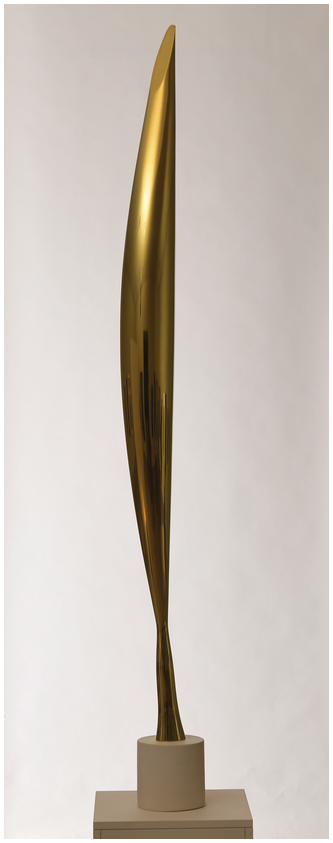
In a series of sculptures from the early twentieth century, Constantin Brâncuși explored the essential qualities of birds. In one version of Bird in Space, a slender, elongated piece of polished bronze tapers upward in a smooth, streamlined curve. The sculpture’s center of gravity is quite high, with a narrow bottom tapering into a bulbous “body” and tapering again into a thinner “head.” The piece is intentionally abstracted rather than a literal bird; it is a study in capturing the essence of “birdness.” What Brâncuși arrives at is a work that, he argues, captures the essence of flight and upward movement (Figure I.1).
Constantin Brâncuși, Bird in Space (1931). Norton Simon Museum of Art, Pasadena, CA, USA.
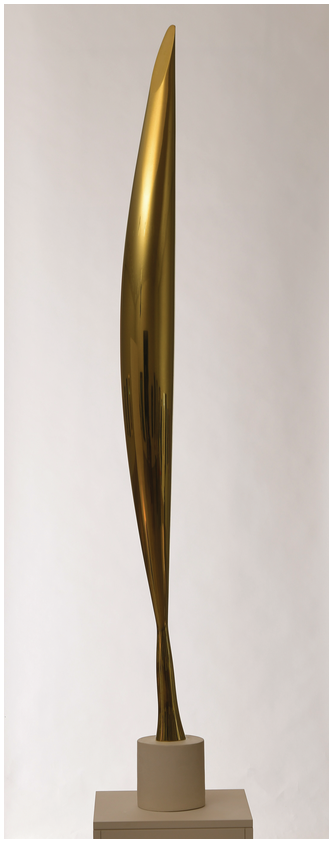
In 1926, Brâncuși was set to show Bird in Space at a gallery in New York. When the sculpture arrived in New York from Paris, US Customs officials refused to recognize it as art, arguing that it did not conform to the traditional definition of sculpture as a realistic imitation of nature. Instead, they classified it as a utilitarian object (a piece of manufactured metal that was essentially a kitchen item) and imposed a tariff on it. Brâncuși challenged the classification in court, and in the 1928 case Brâncuși v. United States, the judge ruled in his favor, suggesting that modern art could communicate ideas and aesthetic value without mimetic representation. The case marked a turning point in cultural history and underscored that the nature of “art” is not static, but shaped by evolving social, legal, and aesthetic values and artistic practices (Fincham, Reference Fincham2014; Heinich, Reference Heinich1996).
Throughout the history of philosophy, there have been many and varied attempts to define “art” which aim to identify the necessary and sufficient conditions for being an artwork. In doing so, philosophers argue that a specific property or set of properties is essential to something being an artwork. These attempts are motivated by a concern to unify varied arts practices, and to identify them all as of a single, coherent kind. For example, Charles Batteux argued that art aims to represent and imitate the beauty of nature, whereas Leo Tolstoy suggested that art communicates (and literally transmits) the artist’s emotion to the beholder. Others suggest that art can be identified and understood based on the specific way we engage with it – and the aesthetic experiences that we have with it, usually feelings of awe or responses to beauty. A different set of approaches defines art institutionally and historically. Some philosophers contend that institutions and practices that make up the “art world” get to say what art is and is not, or they suggest that artworks are things that have a special set of historical and causal relationships to other artworks.Footnote 1
One common problem with these kinds of definitions is that they tend to conflate something’s being an artwork with it being a good artwork. After all, someone could aim to express and evoke a specific emotion in a painting but fail to actually do so for all kinds of reasons (e.g., they lack relevant skill, or it was just an unsuccessful attempt). Definitions of the kinds above may not allow art like this – “bad art,” so to speak – to be categorized as art at all. Additionally, these kinds of definitions are often overly inclusive or overly exclusive, or sometimes both, at the same time. Take, for example, the “aesthetic experience” definition, in which artworks are defined by a characteristic feeling or response to them. These kinds of definitions often do not deal well with negative responses to artworks such as disgust, dislike, or aversion, nor with cases in which someone is confused by a piece, or otherwise does not recognize it as art. The Bird in Space example illustrates this: If artworks are defined as things that give rise to aesthetic experiences, then the initial response by customs officers to Brâncuși’s piece would call into question its status as an artwork. However, what their response really did was call into question the inadequacy of fixed definitions of art. The fact that Bird in Space is widely heralded as an influential masterpiece of modern art confirms its status as an artwork and exposes the flaws of these kinds of definitions. Moreover, this same kind of problem can be found across nearly all attempts to give a definition; for each, we can find ready counterexamples that undermine their claim to universality.
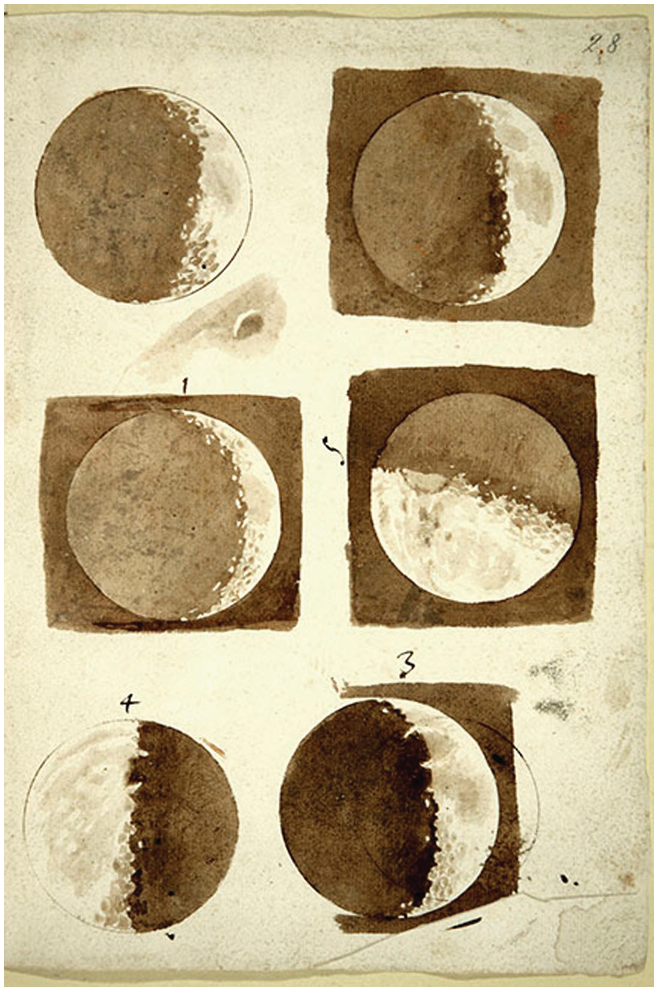
Galileo Galilei, who is sometimes referred to as the “father of the scientific method,” was trained in artistic techniques, including linear perspective. Galileo lived during the Renaissance, a period when art and science were not seen as separate domains but were intertwined as part of a broader humanistic worldview. We can see the intermixing of these two domains in the depictions of the moon that he created as part of his scientific investigation of the heavens. In 1609, he produced a series of six watercolors representing the moon in its different phases, based on his observations through a telescope. They are described as the first realistic depictions of the moon in history (Figure I.2; Edgerton, Reference Edgerton2009; Roche et al., Reference Roche, Commins and Farina2018).
Galileo Galilei (1609). Watercolors of the moon in different phases. Biblioteca Nazionale Centrale, Florence, Italy.
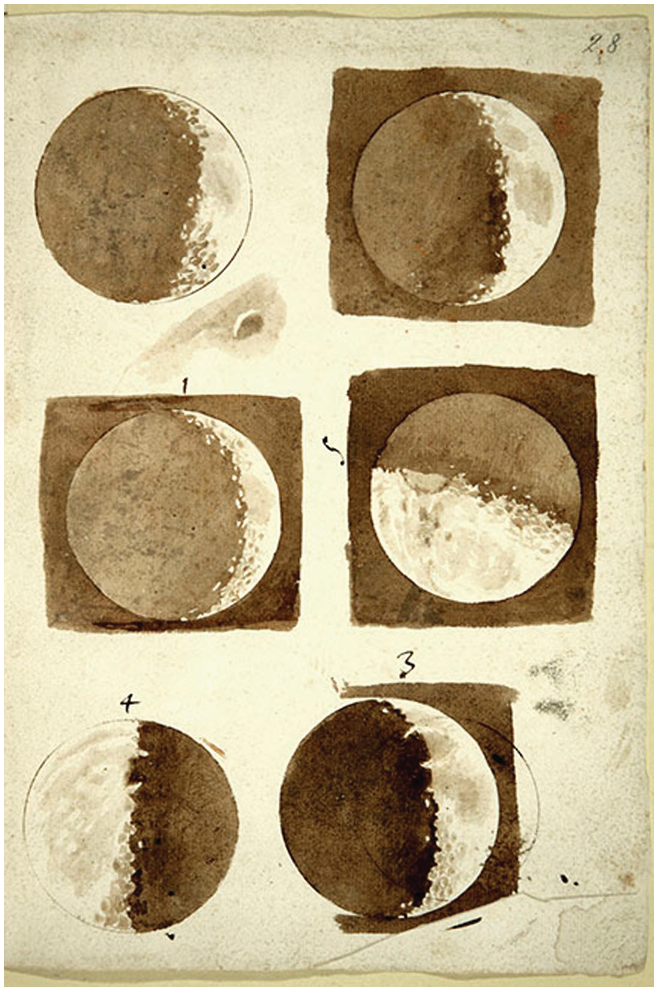
Figure I.2 Long description
The sketches are arranged in 3 rows, with 2 drawings each and show the following features using the dramatic play of light and shadow. The line between the light and dark sides is bumpy and uneven instead of a smooth curve. There are tiny dots of light in the shadowed area, representing mountain peaks high enough to catch the sunlight while the ground below is still in the dark. Dark circles with bright edges to show craters. There are also large, smooth, gray patches representing the seas, which he shows as flatter and darker than the rough, cratered highlands.
Does it matter whether these watercolors are characterized as artworks? If we set out to observe and appreciate them, would such a characterization help us better to understand them, their importance, their role in our understanding of the world, or our responses to them? It is not clear that it would. Moreover, approaching them in this way runs the risk of erasing their connection to Galileo’s scientific work. Of course, the paintings can be appreciated aesthetically and independently of any contextual information. However, what is particularly interesting about them – we suggest – is that they are part and parcel of Galileo’s scientific investigations, understanding, and communication of ideas and insights to others. The artistic practice Galileo engaged in to create these paintings helped him to make sense of his observations of the moon’s surface; more specifically, his artistic training helped him accurately record his scientific discoveries in a visual medium and communicate them to others.
Classifying Galileo’s watercolors as either “art” or as “not art” misses the point. If we instead shift our attention to considering the role that the arts played in Galileo’s life, and more generally, in human life, a whole host of interesting questions arise. Understanding the role of the arts helps us to focus on their social and cultural significance, including how participation in art creation and appreciation helps us to develop important skills and competencies for understanding ourselves, others, and the world. While we recognize the appeal of having a definition of art (in no small part because that would be very useful for our investigation!), we are not going to provide or subscribe to a particular definition here, and we remain agnostic about whether an adequate one exists. Even if there is a correct definition of “art,” we believe that the best way to understand the value of the arts is not to focus on giving necessary and sufficient conditions for something being an artwork, but instead to understand how the practices that people care about and recognize as “the arts” are embedded in our lives (Lopes, Reference Lopes2008).
This perspective rests on an important premise that the arts are social practices.Footnote 2 They are activities we engage in as communities. They are:
coherent and complex form[s] of socially established cooperative human activity through which goods internal to that form of activity are realized in the course of trying to achieve those standards of excellence which are appropriate to, and partially definitive of, that form of activity, with the result that human powers to achieve excellence, and human conceptions of the ends and goods involved, are systematically extended.
In this view, the arts are not a collection of objects or pieces we create and admire; they are ongoing, collaborative activities through which people come together, share methods, materials, and meanings, and continually shape both their individual skills and the collective understanding of what the practices, themselves, can be. Similarly, Winterson writes that the artifact, or the art object, is not the most important thing for appreciation or art-making; more important is what she calls the “energy,” or the creative process and practice itself (Winterson, Reference Winterson1997). Tolstoy also argued for such a view: “In order to correctly define art, it is necessary, first of all, to cease to consider it as a means to pleasure, and to consider it as one of the conditions of human life” (Tolstoy, Reference Tolstoy2021).
We will understand the arts as active pursuits, as things that we do. We use “arts engagement” throughout the book as an umbrella term for a host of different “doings” encompassing both arts appreciation – experiencing visual artworks, songs, and the like – and arts creation – making artworks for yourself and others to appreciate. Arts engagement is not just a one-off experience or moment; appreciation and creation are things that we learn how to do and that we continue to develop our ability to do well over time. Importantly, they are shared with others. They are done in the context of other people who are also engaging in them, and with whom we can both learn and mutually engage (Dissanayake, Reference Dissanayake1990).
Although we emphasize the social nature and importance of arts practices, we would be remiss not to point out that our society often sidelines the arts as mere curiosities, as expendable leisure activities, as secondary or tertiary areas of study to more important disciplines like math or science, or as a mere collection of objects of beauty to be contemplated and judged as such, but ignored when there are more important things to do. Arts programs, including those from the visual arts, music, and performing arts, are often the first to get cut during economic hardships and budget cuts. Dominic McIver Lopes points out that a common scholarly response to this sidelining is to insist on “the great cultural significance of the fine arts” (Lopes, Reference Lopes2018, p. 216). The danger of this response, according to Lopes, is that over-attending to the importance of the fine arts risks belittling or ignoring the importance of other kinds of arts practices and aesthetic experiences in our lives, many of which are often the most important to who we are. For instance, “crafting” practices like knitting or quilting are passed down through families and often cultivated in the context of local communities. We follow Lopes in thinking that a better reaction is to “embrace all aesthetic activity” as important. To this end, throughout the book, we take a broad stance, focusing on a host of different kinds of arts practices, all of which we mark as equally relevant.
The Argument and Structure of the Book
The overarching framework of this book is rooted in the idea that the arts are a vital set of social practices that are tied deeply to who we are, to what we know and how we know, and to how we interact with the world around us. The arts offer us unique opportunities for personal identity, growth, and development. Here, we argue that the arts cultivate a specific set of skills that enable us to better connect with the world. The arts help us to sharpen our capacity for observation, to foster our emotional intelligence, and to encourage and enable our open-mindedness and flexible thinking. Moreover, they provide an avenue for self-reflection, expression, and belief revision. Ultimately, we suggest, the cognitive and affective processes that are engaged through art not only enhance our relationship with art itself but also contribute to a richer life, helping us to navigate challenges and to find greater meaning in our everyday experiences.
Chapter 1 discusses the question of what it could mean for the arts to be a source of knowledge. We survey how philosophers have argued for and against the claim that we can gain knowledge through engaging with the arts. We suggest that the arts can make us epistemically better off, not by teaching us new facts per se, but by helping us to grasp the underlying meanings and relationships amongst aspects of our world. Moreover, we argue that “know-how,” or skill-based knowledge, can be gained from arts engagement, which serves as a jumping-off point for Chapters 2–4.
Chapters 2–4 each highlight a socio-cognitive skill developed through arts engagement: attention and observation (Chapter 2), emotional intelligence (Chapter 3), and open-minded, flexible thinking (Chapter 4). We describe and define these as cognitive skills that are teachable and malleable even in adulthood, we provide theoretical and empirical evidence for the arts as a venue for cultivating these skills, and we speculate about how the arts may contribute to making people more open and more creative observers of the world, even outside of arts contexts. Although we distinguish and discuss these skills in separate chapters, we also recognize that they build on one another, inform one another, and may not be fully distinct from one another. These discussions draw deeply from existing empirical research and endeavor to provide a fair and comprehensive representation of the relevant literature, although our goal is not to conduct a systematic review or meta-analysis of any particular body of data.
In Chapter 5, we turn our attention to identity and connection. The skills discussed in the earlier chapters are relevant to our sense of self and our connection to other people. By exposing us to a diverse array of perspectives, helping us see things and people anew, and fostering social connection and meaning generation, the arts become indelibly linked to our senses of self, to our identities, to who we think we are, and to how we identify in relation to others and the world. In giving this argument, we pay special attention to personal accounts and both philosophical and empirical investigations into the role the arts can play in the transformation of ourselves and our communities.
In Chapter 6, we take up the connection between the arts and wellbeing. We discuss the relationship between arts engagement and subjective wellbeing (SWB), as well as the relationship between arts and health. We pay special attention to the ways that the arts have been used in therapeutic settings to help patients manage and treat a host of mental and physical disorders, including Parkinson’s disease, acute and chronic pain, and anxiety and depression. We conclude by discussing how to understand the argument of our book as an argument for how the arts contribute to our objective wellbeing.
In the Conclusion, we bring our argument together by taking a more practical approach. We suggest several broad habits of mind that can be found throughout the book that we can embrace more fully as appreciators and makers of the arts: slowing down, embracing uncertainty, and making meaning individually and collectively.
Throughout, we approach our investigation in an intentionally interdisciplinary way by using the tools of philosophy, cognitive science, and empirical psychology. Rather than treat disciplinary tools as discrete and separate, we use them together to advance arguments and to understand the questions we are trying to answer. Our goal is to contribute a model for how different ways of thinking about central research questions can mutually inform and support one another, and to contribute to building the common language that is emerging across our fields. The empirical voice is not meant to be the authoritative voice, nor the voice needed to show that art matters; instead, it is one among many that can enrich and complicate our understanding of the value of the arts. The conceptual or theoretical considerations are also not taken to be the final word, nor are they simply a hypothesis to empirically verify (or not). Theory is a method for thinking that is in conversation with the empirical, so that each can inform and be informed by the other.
Like the figures in M. C. Escher’s The Bonds of Union found on the cover, the separate disciplinary positions from which we began our conversation have become enmeshed and deeply intertwined; yet the distinct influences and positions remain. It may not be clear where the psychology begins and the philosophy ends, where the philosophy begins and the psychology ends, but the presence of both ways of thinking is manifest throughout. In this way, the work is not transdisciplinary (merely covering multiple disciplines), but interdisciplinary, integrating different literatures and ways of thinking and arguing into a single contribution.