


Introduction
During the last few decades, consumers in the United States have become increasingly interested in alternative food systems, and local food chains are a key component. Authors such as Wendell Berry (Reference Berry1977) blame the modernization of agriculture for disintegrating farming culture and destroying rural communities. These authors advocate for a move toward reestablishing local cultures with communal memories and care through local and regional agricultural supply chains (DeLind Reference DeLind2011). Partially in response to this heightened consumer interest in “localness,” local foods marketing has significantly expanded. For example, between 2007 and 2012, farmers participating in direct-to-consumer marketing outlets increased by 5.5 percent. By 2015, the amount sold by these farmers totaled $8.7 billion (Thilmany and Woods Reference Thilmany and Woods2018). Alongside market expansion, academic interest in local foods has extensively increased during the last decade, with an emphasis on consumer perceptions and willingness to pay (Feldmann and Hamm Reference Feldmann and Hamm2015).
The overall objective of this article is to explore the interaction between local food identity and agricultural production. “Local food identity” has been described as the shared food habits formed by people within a defined geographical region, which include regularly used cooking techniques, ingredients, and dishes (Murcott, Belasco, and Jackson Reference Murcott, Belasco and Jackson2013). The idea of a geographical cuisine is a tangible feature in a consumer's social identity, making it a key contender in the construction of cultural identity, which requires adopting common community beliefs and practices (Jensen, Arnett, and McKenzie Reference Jensen, Arnett, McKenzie, Schwartz, Luydckx and Vignoles2011). By extension, residents in each state are likely to consider different food products to be most associated with the state in which they reside, creating important variation in the way consumers are likely to value any local food product.
While prior articles have considered the intersections between food and political identity (Chuck, Fernandes, and Hyers Reference Chuck, Fernandes and Hyers2016; Malone and Norwood Reference Malone and Norwood2019), motherhood (Johnson et al. Reference Johnson, Sharkey, Dean, McIntosh and Kubena2011), authenticity (Giorda Reference Giorda2018), and even African-American pastors (Harmon et al. Reference Harmon, Blake, Armstead and Hébert2013), fewer studies have considered the interplay between local food production, identity, and consumer demand. One exception is O'Kane (Reference O'Kane2016), which analyzes local food networks participants’ food cultures, finding that their relationship with food was connected to a consumer's relationships with people, place, and time. Food habits perform an important role in the transmission of cultural identity, so it is no surprise that social groups perceive food choices as important for community cohesion (Quintero-Angel, Mendoza, and Quintero-Angel Reference Quintero-Angel, Mendoza and Quintero-Angel2019). This local food identity is exemplified on products such as Wisconsin artisanal cheese and New England oysters (Master et al. Reference Master, LaChance, Bowen and MacNell2019).
This paper contributes to the literature on local food in three ways. First, we fill a gap in the research in demand for local foods, which generally overlooks the geographic and social connectedness between the studied product and the consumer. Second, we explore the degree of correspondence between a state's collective “local food identity” and the state's local agricultural production. Finally, we use a discrete choice experiment to compare additional premiums in willingness to pay for products connected to a local food identity.
Previous research on local food demand has focused on motivations to purchase as well as the ability of demographics and psychological scales in predicting willingness to pay (Low et al. Reference Low, Adalja, Beaulieu, Key, Martinez, Melton, Perez, Ralston, Stewart, Suttles and Jablonski2015). Researchers have identified freshness, taste, healthy attitudes, concern about food safety, wish to support local economy, and social desirability as main drivers for local food demand (Low et al. Reference Low, Adalja, Beaulieu, Key, Martinez, Melton, Perez, Ralston, Stewart, Suttles and Jablonski2015). Despite these key findings, these articles rarely address their sample's association with local food identity. Our findings suggest that a relationship exists between food identity and agricultural production. Furthermore, we find that consumers place a premium on the locally grown foods that they perceive as part of their collective food identity.
The remainder of this article is organized as follows. In the next section, we offer background on the notions and research on food identity and local foods. The third section presents our framework along with our hypotheses. The fourth section explains the data we used. Section five then describes our experiment. Section six presents and interprets our results. The final section concludes with suggestions for further research.
Background
Toward the end of the twentieth century, some consumers became concerned about the drastic changes in the traditional agricultural value chain (DeLind Reference DeLind2011). These criticisms raised concerns about long global food chains, increasing worries about untraceable contamination and labor exploitation. According to Laudan (Reference Laudan2013, pp. 350), “agrarian and romantic criticisms of modern food processing and mechanized farming” gave birth to the emergence of alternative cuisines. Some consumers came to believe common middle-class cuisines were unhealthful and unethical, leading to public voices calling for a return to home cooking, using of unprocessed and natural foods, support of small farmers, and shorter food chains (Laudan Reference Laudan2013). Within these “counter-cuisines,” “localness” became a valuable attribute (Schnell and Reese Reference Schnell and Reese2003).
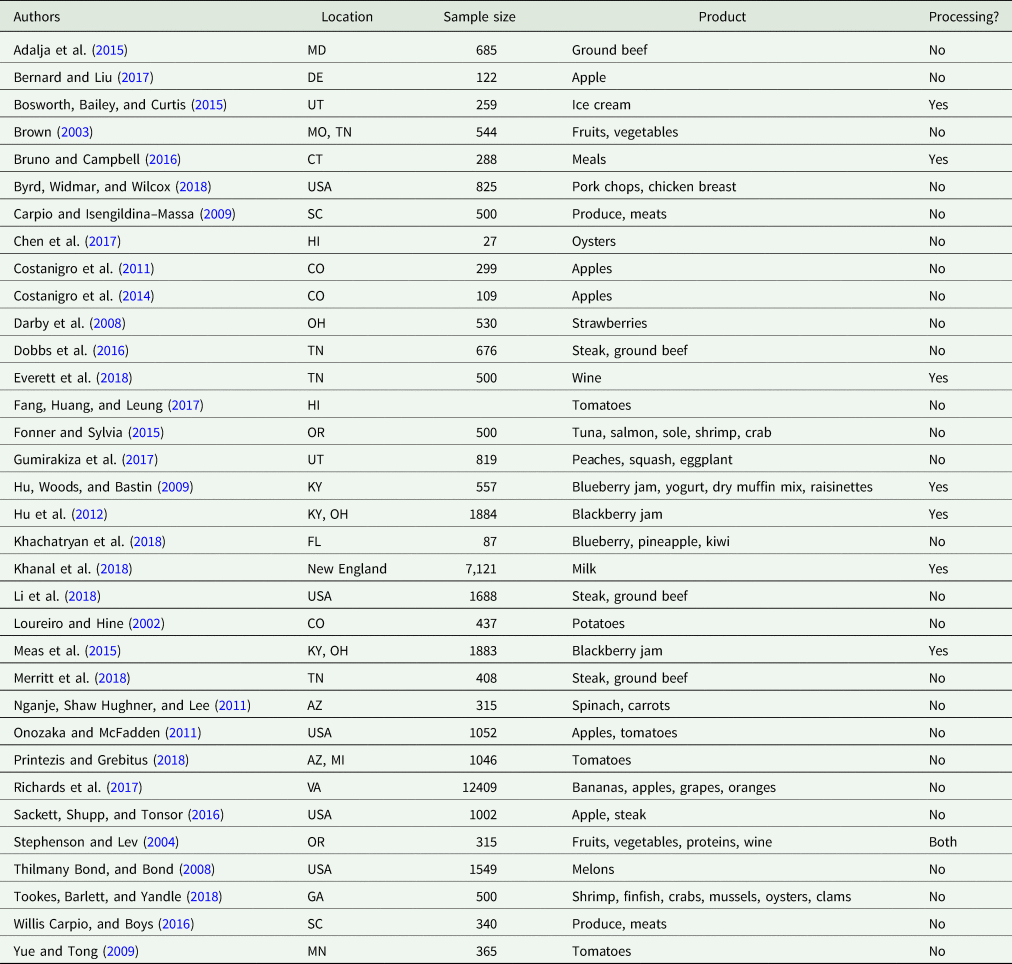
Academic research on local food demands has increased alongside growth in consumer interest. Of primary interest for us is the relationship between collective food identity and willingness-to-pay estimates for local food. Prior to conducting this analysis, we reviewed the local food literature as it relates to U.S. consumers (see Appendix). Almost 80 percent of these articles focused on unprocessed food items grown at varying levels across different geographic regions. Within this group, fruits and vegetables were the primary category, with a heavy emphasis on apples and tomatoes, followed by steaks and ground beef. Furthermore, there is concern regarding publication bias inflating willingness-to-pay (WTP) estimates (Printezis, Grebitus, and Hirsch Reference Printezis, Grebitus and Hirsch2019). As such, this proliferation of articles suggesting large premiums for local foods could be wrongly interpreted as a positive impact for all types of products in all geographies.
Even more important are the methods with which many researchers measure the notion of localness. Darby et al. (Reference Darby, Batte, Ernst and Roe2008) find that consumers assign the same value to different definitions of “local” and that willingness-to-pay for a local attribute is independent from other features. Often, studies focus on geographic boundaries or distance (Printezis, Grebitus, and Hirsch Reference Printezis, Grebitus and Hirsch2019), but the phrase “local foods” can also refer to the connection between a community and its food tradition as well as its farming characteristics (Bazzani & Canavari, Reference Bazzani and Canavari2017). Thus, collective food identity is entwined with the development of localness as a valuable attribute. In parallel form, the value of localness is likely to be higher when the considered food is associated with a place's values and cultural heritage, leading to feelings of cultural belonging (Schmitt, Dominique, and Six Reference Schmitt, Dominique and Six2018). As such, a region's food identity is likely to include local foods, and a local food item associated with a region's cultural background is perceived as an authentic part of the region's food identity.
As Printezis, Grebitus, and Hirsch (Reference Printezis, Grebitus and Hirsch2019) note, findings within this growing research area are mixed and ambiguous. This is perhaps unsurprising, as the research on local food demand covers topics that include consumer perceptions, motivations to purchase, and willingness to pay (Feldmann and Hamm Reference Feldmann and Hamm2015). Rather than a genuine preference for them, local food premiums can be conditioned on distrust of governmental food agencies and polarization against conventional products (Costanigro et al. Reference Costanigro, Kroll, Thilmany and Bunning2014). Meas et al. (Reference Meas, Hu, Batte, Woods and Ernst2015), exploring distinct organic and local definitions, found evidence that organic and local attributes are perceived as substitutes and that a food's origin from a small farm is a substitute for local and organic attributes, supporting the beliefs that local demand is motivated by associated values rather than geographic proximity itself. Notwithstanding the growing research in local foods, we were not able to find an article addressing the role of food identity in willingness-to-pay. In the context of understanding localness as a more complex notion than distance, the absence of an empirical approach to the role of food identity on local food demand is a gap worth exploring.
Theoretical Framework
Each alternative within a food choice scenario generates distinct levels of satisfaction (or utility), according to their attributes, the individual's characteristics, and the choice context (Hensher, Rose, and Greene Reference Hensher, Rose and Greene2015). We follow the discrete choice model from McFadden (Reference McFadden and Zarembka1973) where an individual (n th decision maker), in a food choice situation (s th choice situation), perceives a utility level for a food item (j th alternative), which we state mathematically as:

where X is a vector of attributes that change with the choice situation and the decision maker, β j is a vector of parameters that change with the alternative, and a nsj contains all the unobserved variables that impact on the utility level generated by the considered alternative. In this case, β j,local can be interpreted as the marginal impact on utility of “local.”
The value of a local food item is likely to be higher when the considered food is associated with a place's values and cultural heritage (e.g., local food identity). In other words, ceteris paribus, we expect consumers to choose a local food item that belongs to their food identity over one that is simply local. Residents of each geographic region are likely to have a unique consortium of foods that are representative of their collective food identity. Accordingly, respondents within the same state are likely to share similar opinions when asked about foods that are a part of their collective food identity. This relationship is likely to be connected to that state's agricultural production (Bazzani and Canavari Reference Bazzani and Canavari2017).
The relationships identified by the prior literature lead us to three testable hypotheses. First, we hypothesize that consumers place a larger premium on locally grown foods that they perceive as a part of their collective food identity. Therefore, we expect to observe that the marginal utility of localness is higher for a choice alternative that is part of the respondent's collective food identity. Second, we hypothesize that the heterogeneity of consumer preferences is likely to influence willingness-to-pay estimates. As such, we expect that estimating a unique “local” attribute for each product in the choice set is likely to fit the discrete choice data better than estimating a homogenous “local” attribute. Finally, we hypothesize that production volume is likely to influence a consumer's utility associated with their local food identity. That is, commodities that are grown more in a state are also likely to capture a higher willingness-to-pay for localness.
Data and Methods
Data were collected in two steps to address our hypotheses. To identify what foods are a part of each state's collective food identity, we first gathered primary data in collaboration with the Food Demand Survey (e.g., the FooDS [Lusk, Reference Lusk2017]). The FooDS was an online survey conducted by the Department of Agricultural Economics of Oklahoma State University and delivered monthly from 2013 to 2017 to samples of over 1,000 U.S. consumers. Its primary purpose was to track consumer preferences and sentiments on the safety, quality, and price of food consumed at home and away from home, as well as consumer awareness of food-related issues and events. Over nine months of the survey in 2016–2017, we asked 9,329 U.S. food consumers about foods that they consider a part of their state's local food identity. Using an open-ended question format, we asked:
Many people believe their state is associated with a particular type of food. In the space below, please list one or more foods that you believe is most associated with the state in which you currently reside.
One might presume that there is a strong relationship between a state's food identity and what they produce the most of. To test this, we compared the cleaned, ordered, and grouped FooDS responses to each state's top three answers to each state's top three crops in terms of cash receipts reported in the Farm Income and Wealth Statistics of the USDA-Economic Research Service (2018). After merging survey responses and agricultural production, we compared the top three participant responses for their state's food identity and the top three state's agricultural commodities (Table 1).
Food Identity Responses Main Agricultural Products According to Cash Receipts by State
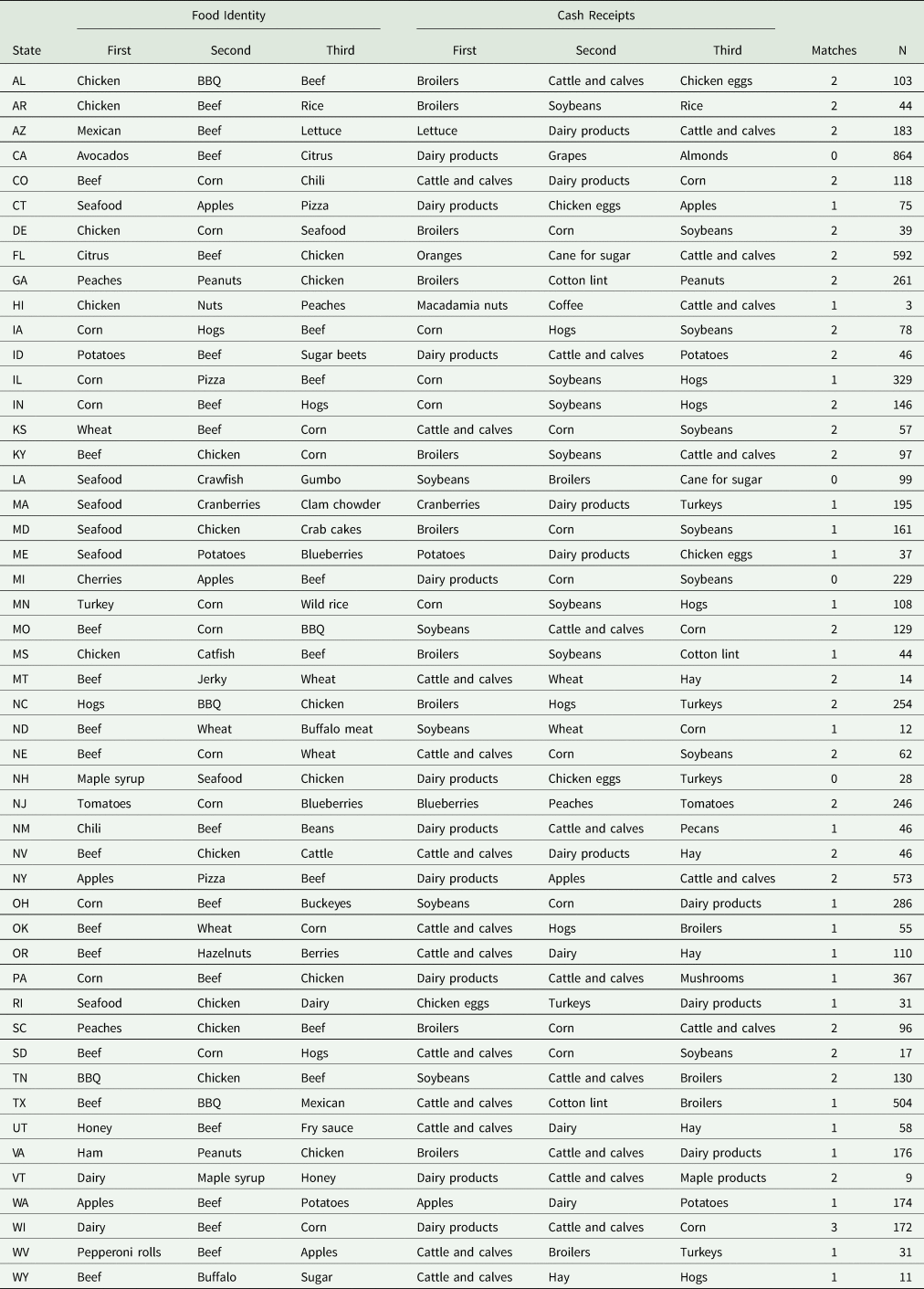
Note: Food identity responses are based on answers to the question, “Many people believe their state is associated with a particular type of food. In the space below, please list one or more foods that you believe is most associated with the state in which you currently reside.” Data were collected in collaboration with the Oklahoma State University Food Demand Survey (Lusk Reference Lusk2017).
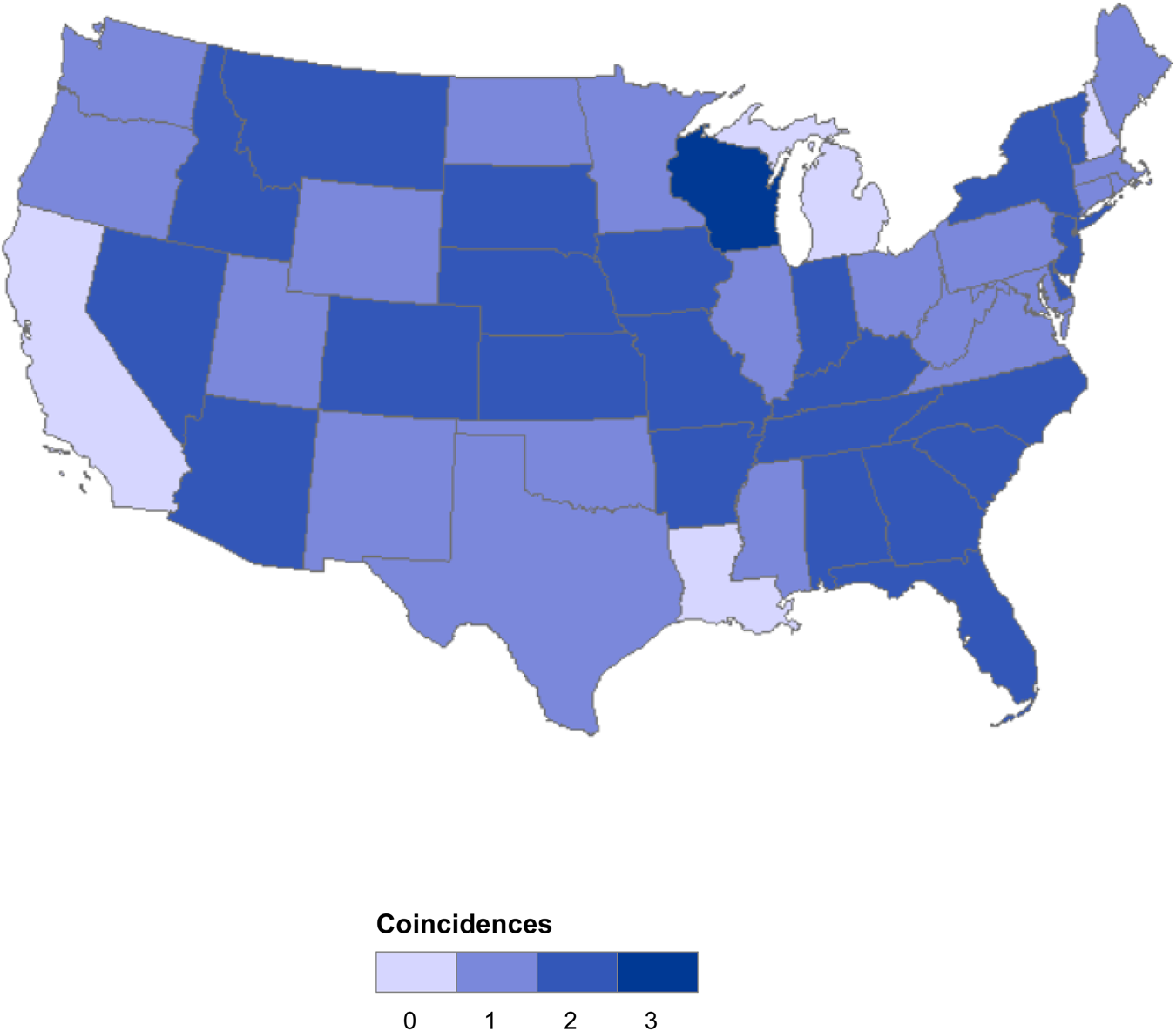
Almost 90 percent of the states in the sample exhibit a relationship between their indicated food identity and the top three agricultural commodities produced within the state, though that relationship varies significantly. For example, the foods that Californians identified as representative of their home state differ entirely. By contrast, the three foods identified by participants from Wisconsin coincided perfectly with the top three most produced agricultural commodities in Wisconsin. Despite being among the main agricultural products for 21 states, dairy is only mentioned as a main item in the top-three food identity foods for Wisconsin, Rhode Island, and Vermont. Similarly, food of an international origin (e.g., Mexican and Italian) was identified as part of the collective food identities of nine states. As an example, in New Mexico chilies, beef, and Mexican food are within the top foods in the survey, whereas dairy, beef cattle, and pecans are the main agricultural products.
Comparison of Collective Food Identity and Local Agricultural Production
Note: Coincidences signify the overlap between the three main answers in the Food Demand Survey and three main local agricultural products measured by USDA cash receipts.
There is generally a weaker relationship between production in states with significant specialty crop production and food identity. For example, the five food products most identified by Michiganders as most representative of their home state were cherries, apples, beef, corn, and dairy, while the five agricultural commodities most produced by Michiganders were dairy products, corn, soybeans, cattle and calves, and hogs.
Experimental Design
We utilize a discrete choice experiment to test if consumers place a premium on foods that are part of their collective food identity. Similar to Lusk (Reference Lusk2017), we ask participants to choose between substitutable products at varying prices that are readily available at a grocery store. We selected Michigan, as the state is capable of growing many specialty crops commercially. Our experimental design follows a 2 × 2 format where we focus on the interaction between local food identity and local agricultural production (Table 2).
Experimental Design to Identify the Effects of Local Production and Collective Food Identity
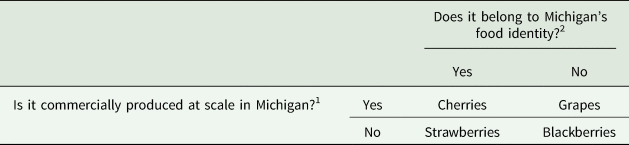
1 Defined as being one of the top 20 cash receipts defined by the USDA.
2 Defined as being one of the top 5 collective food identity by Michigan survey participants.
Based on USDA cash receipts data, we chose cherries, as it is both a key agricultural product in Michigan ($67,069,000 in 2015 cash receipts) and a part of Michigan's collective food identity (1st most frequent answer in FooDS for Michigan). We then chose strawberries, which is also part of Michigan's collective food identity (8th most frequent answer in FooDS for Michigan), but producers do not grow a large volume of them ($4,375,000 in 2015 cash receipts). We then identified grapes as a commodity produced in Michigan but not listed as part of Michigan's collective food identity ($25,734,000 in 2015 cash receipts). Finally, we included blackberries, as it is a substitutable product that is not significantly grown in Michigan nor is it a part of Michigan's food identity. Both grapes and blackberries were not mentioned at all as part of Michigan's collective food identity by the respondents of the FooDS.
Survey Design
Survey data were collected via Amazon's crowdsourcing platform Mechanical Turk (MTurk) where researchers submit surveys to individuals who are compensated a menial fee upon completion. The use of MTurk participants is increasingly popular for academic work (Dupuis, Endicott-Poposky, and Crossler Reference Dupuis, Endicott-Popovsky and Crossler2013), with thousands of studies having been conducted via MTurk data (Hitlin Reference Hitlin2016). The platform provides easy access to a large, stable, and diverse subject pool (Mason & Suri, Reference Mason and Suri2012). Prior research suggests that MTurk samples are often preferred to alternative sampling methods (Berinsky, Huber, and Lenz Reference Berinsky, Huber and Lenz2012) in part because MTurk participants respond to surveys more attentively than alternative panels (Hauser and Schwarz Reference Hauser and Schwarz2016).
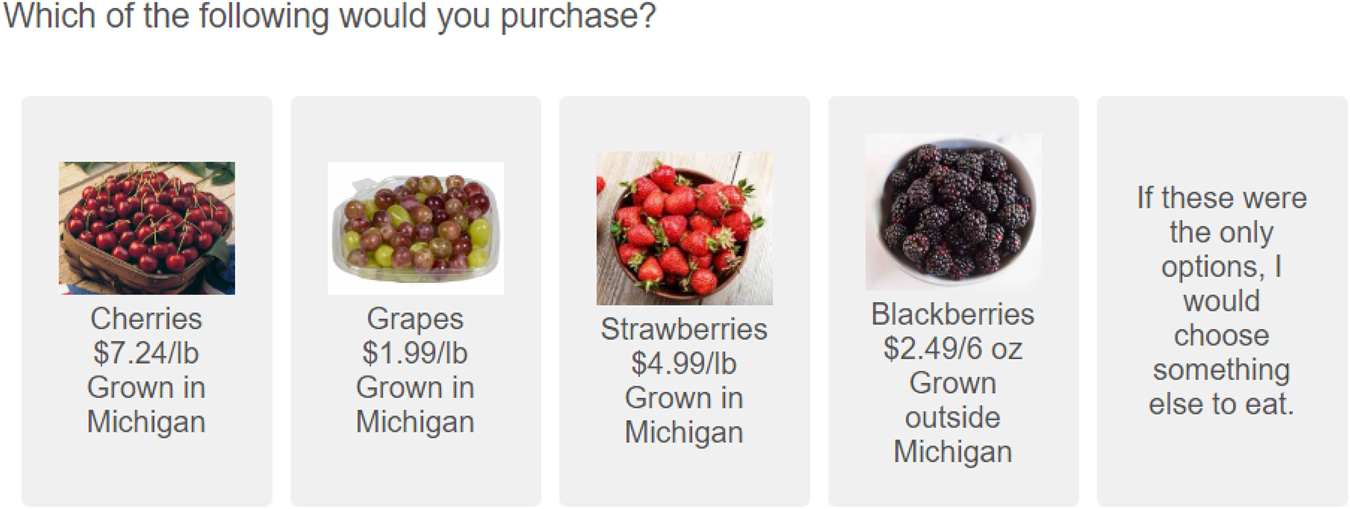
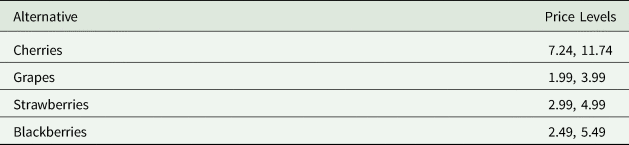
The Qualtrics® survey was organized into two parts. First, we conducted the discrete choice experiment based on an orthogonal fractional factorial design that was developed via SAS®, generating 16 individual choice scenarios. The attributes considered in the design were price and “localness,” with each price level being set based on observed grocery store prices.Footnote 1 Participants were randomly assigned 8 out of the 16 scenarios so each respondent was exposed to eight choice situations where the alternatives had two price levels and a local/not local label. Figure 2 presents an example of the discrete choice questions presented to participants.
Example of the Discrete Choice Questions Presented to Participants
The second portion of the survey focused on demographics, including gender, age, and income levels. This portion of the survey also asked for information about food behavior. As a check on the collective food identity items from the FooDS, we also included the same open-ended collective food identity question.
Results
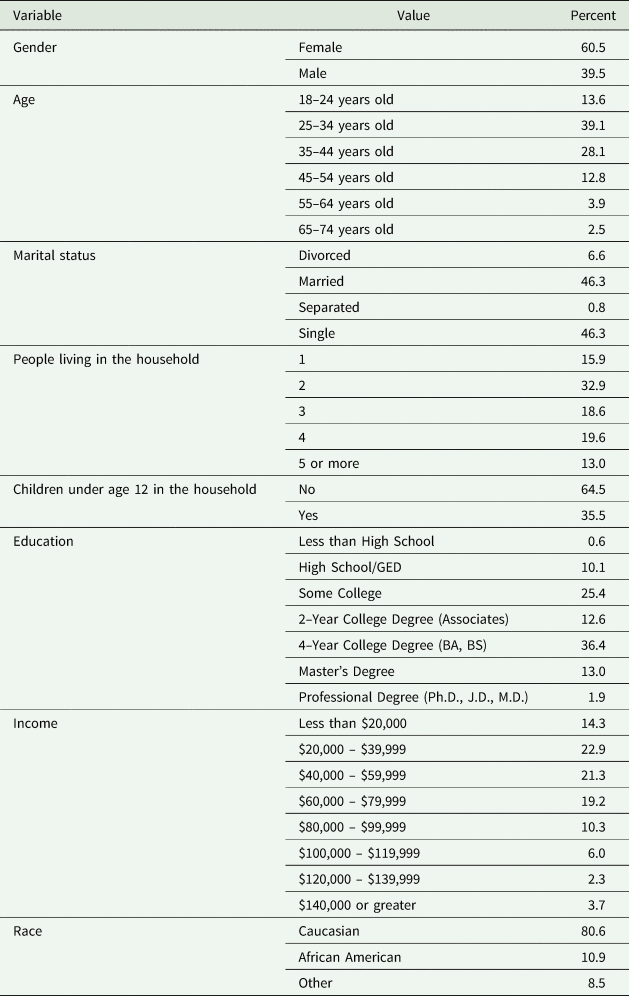
Discrete choice data were collected in the summer of 2019. We obtained 508 responses, from which 484 were completed. Similar to the prior survey, participants identified cherries (33 percent) and strawberries (4 percent) as a part of their collective food identity. Participant demographic information is summarized in Table 3. Sixty-one percent of respondents identified as female, while females comprise 51 percent of the Michigan population (U.S. Census Bureau 2019). Almost 67 percent of the respondents were between 25 and 44 years old, whereas this same age group represents 24 percent of the Michigan population (U.S. Census Bureau 2019). The sample was equally divided between single and married participants, while 48 percent of Michiganders are married (U.S. Census Bureau 2019). The sample is also overeducated, as 36 percent of the sample have earned a four-year college degree, whereas only 17 percent of Michiganders have attained a bachelor's degree (U.S. Census Bureau, 2019). In addition, 37.2 percent and 58.5 percent of our sample earned an annual income below $40,000 and $60,000, respectively, while the median individual income for a person 25 years and over is $36,396 in Michigan (U.S. Census Bureau 2019).
Summary of Demographics in the Discrete Choice Experiment
Since each of the 484 participants responded to eight discrete choices, we conduct our analysis with 3,872 unique choices. Most respondents chose grapes and strawberries (31 percent and 35 percent, respectively). We fit random parameter logit models in the NLOGIT® software with “no choice” as the base alternative. The first model considers a homogenous “local” parameter for all the alternatives, while the second model assumes a heterogeneous “local” parameter for each alternative. Using these estimates, we make two important comparisons. First, we test whether heterogeneous “local” attributes fit the data better than a single “local” parameter. This finding would signal that the value of “localness” varies across products. Second, we test whether the utility associated with local is higher for products that are a part of Michigan's collective food identity.
Table 4 shows the results from the random parameter logit models. The price coefficient is negative and statistically significant, indicating that utility decreases when prices increase. The alternative-specific constants for cherries, grapes, strawberries, and blackberries are positive and statistically significant, indicating that these alternatives are preferred to choosing nothing at all. Strawberries are the most preferred alternative, followed by grapes. We find that a model with heterogeneous “local” parameters fits the data better than a single “local” parameter since the McFadden Pseudo R-squared of the former is higher.
Random Parameter Logit Model Estimates
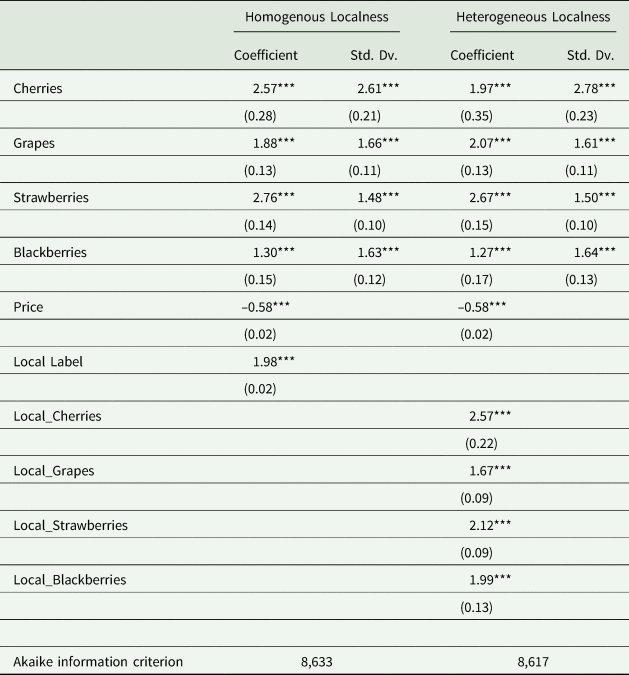
484 participants completed the survey, generating 3,872 unique choice observations.
Parameters can be interpreted as the relative change in happiness derived from choosing a product with the specified attribute.
Numbers in parentheses are standard errors.
***, **, and * indicate significance at 1 percent, 5 percent, 10 percent levels.
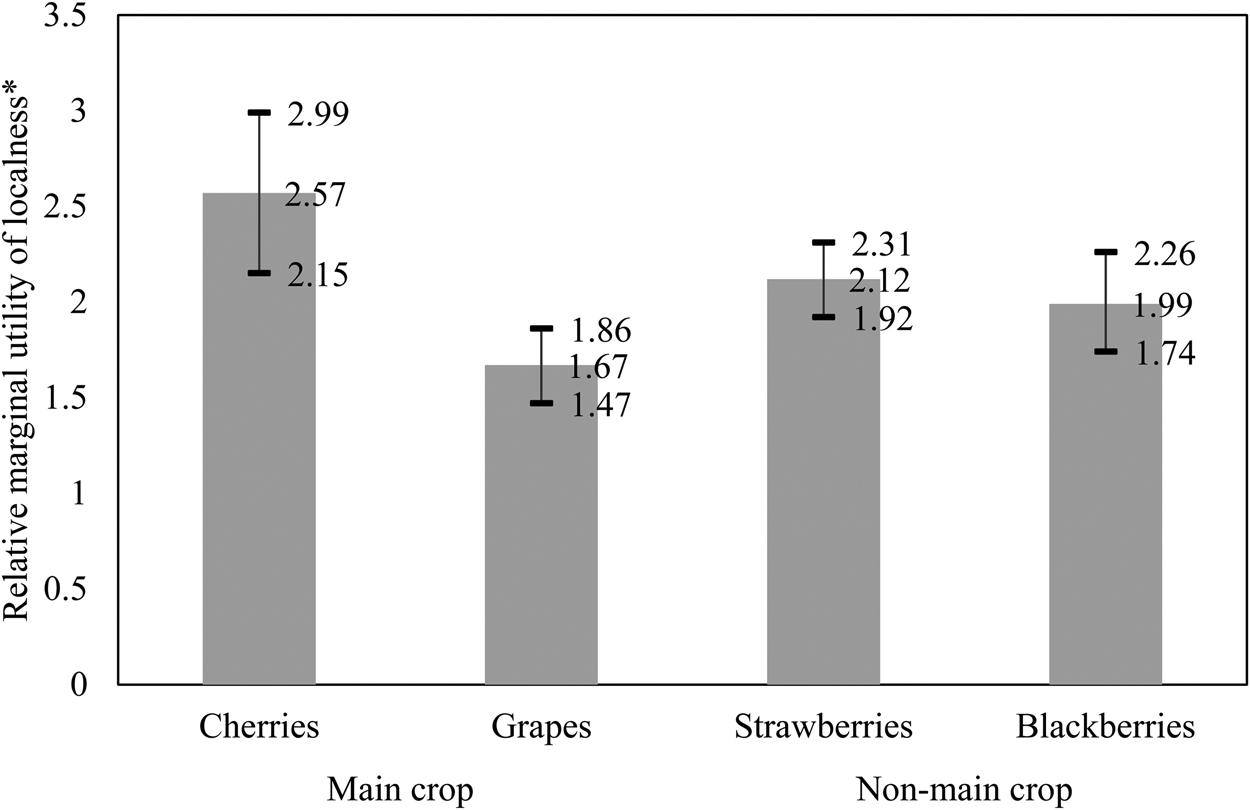
When we consider the 95 percent confidence intervals of our estimates of the RPL model, a higher marginal utility by localness for a product identified as part of Michigan food identity is only observed within products that are largely produced within the state (Figure 3). In this last group, the 95 percent confidence intervals for the local attribute for cherries and grapes do not overlap ([2.15, 2.99] and [1.47, 1.86]), while in the group that are not main agricultural products these intervals for strawberries and blackberries do overlap ([1.92, 2.31] and [1.74, 2.26]).
Mean Parameter Estimates for the Value of “Localness” for Each Alternative
Notes: Marginal utility of local attribute with respect to the alternative of not choosing nothing at all. Can be interpreted as an empirical value of localness for each product.
From the parameter estimates for localness, we estimate willingness-to-pay for local (WTPL) by dividing them by the negative of the price coefficient estimate. Following the previous results, WTPL is higher for the product that is identified as part of Michigan's collective food identity both within the group of highly locally produced items and those that are not. In the case of highly produced agricultural products, cherries (part of Michigan's food identity) have a higher WTPL than grapes ($4.43 and $2.88, respectively). Moreover, the local attribute represents a 56.6 percent price premium for fresh cherries and 44.7 percent for grapes. In the case of products that are not main agricultural products, strawberries (part of Michigan's food identity) have a higher WTPL than blackberries ($3.66 and $3.43, respectively).
These results are consistent with the notion that valuation for foods perceived as part of collective food identity is likely to be interconnected with local agricultural production. Laudan (Reference Laudan2013) and Bazzani and Canavari (Reference Bazzani and Canavari2017) stressed that an item belonging to a community's local food identity has strong link to the community's food and agricultural production. Therefore, an item that is both part of the collective food identity and is largely locally produced could be valued more than an item that does not have those two features. This could explain why localness premium is significantly higher for a product that is part of Michigan's food identity only within products that are largely produced within the state. Cherries (part of Michigan's food identity) and grapes are largely produced within the state and we found that cherries have a significant higher premium for localness than grapes. In contrast, strawberries (part of Michigan's food identity) and blackberries are not largely produced within the state, and their respective premiums were statistically similar. Thus, the results of our discrete choice experiment provide support for the notion that, at least for Michigan, consumers are likely to place a higher premium on the locally grown foods that they perceive as part of their collective food identity.
Conclusion
American consumers have recently paid more attention to “localness” as an important food product attribute than they used to. Despite the growing literature, researchers have not yet thoroughly addressed the relationship between local foods and local food identity. This study explored that interaction by evaluating the degree of correspondence between a state's collective “local food identity” and the state's local agricultural production as well as the role of belonging to local food identity in willingness to pay for localness. Using primary data from Michigan consumers, we found a positive relationship between collective food identity, agricultural production, and consumer preferences for localness. We found that consumers place varying premiums on different types of locally grown foods. More importantly, this article supports the notion that consumers place a premium on the locally grown foods that they perceive as part of their collective food identity. However, this premium occurs only within products that are largely locally produced. These results begin to fill a gap in the local food literature, as they suggest that collective food identity is an important attribute worth considering in future studies.
Since our data was gathered in an online survey that overrepresented certain population groups, future studies might utilize secondary data or non-hypothetical experimental data. It could also be that respondents were willing to pay more for local cherries because they are perceived to simply be of higher quality. If respondents believed Michigan provides a unique environment for producing tastier cherries, the higher value they assign to it might be somewhat confounded. There is no clear reason why consumers would have the agronomic knowledge necessary for understanding which growing conditions are best for cherries relative to grapes, strawberries, and blackberries. However, if there is a general belief that local cherries have higher quality due to other reasons like marketing campaigns, further research would have to control for quality to consistently estimate the value of being part of the collective food identity. This is particularly problematic, as perceptions of fruit quality are not always vertically defined but are often use-specific. For example, Balaton cherries are generally considered more preferred to Montmorency for fresh consumption, though there is no obvious reason why all consumers would follow this preference ordering.
Previous studies have shown that a premium for localness could be confounded with other important variables such as perceived freshness or organic preferences (Low et al. Reference Low, Adalja, Beaulieu, Key, Martinez, Melton, Perez, Ralston, Stewart, Suttles and Jablonski2015; Donaher and Lynes Reference Donaher and Lynes2017). Thus, any willingness-to-pay estimates for localness are likely to have some bias. Because this study compared the estimates of willingness-to-pay for localness of products that are part of Michigan's local food identity with products that are not, we believe we have largely side-stepped this potential bias. That is, the potential confound between localness and other attributes should happen for all products we are considering. Nonetheless, this article supports our hypothesis that an important relationship exists between collective food identity and utility associated with localness.
These findings have value for public policy and food marketing decisions. Policymakers have invested over $1 billion dollars in local foods promotion over the past few years, yet many local food systems continue to struggle (Thilmany and Woods Reference Thilmany and Woods2018). Given these massive investments, awareness of the variables that increase the value assigned by consumers could be used to improve targeting and finding efficient ways to invest those funds. In this case, local food dollars might be more appropriately used to promote a community's preexisting local food culture as it relates to consumers’ collective food identities. Similarly, food marketers might benefit by expanding their efforts to distinguish and promote their local labels as they link with each region's food identity. For example, the Michigan tart cherry industry hosts an annual National Cherry Festival each year in Northern Michigan, highlighting the industry's linkages to the state's collective identity. Events that emphasize, or raise, the degree of identification with foods could then imply a higher willingness to pay when grown locally.
Appendix
Local Foods Willingness to Pay
Price Levels for Discrete Choice Experiment Alternatives


 Open access

