





Bilinguals often perform below monolinguals on tasks that require lexical access (Gollan et al., Reference Gollan, Montoya and Werner2002), as well as on tasks that examine vocabulary knowledge (Bialystok et al., Reference Bialystok, Craik and Luk2008). However, it is yet unclear whether these effects reflect a critical period for language acquisition, after which one cannot reach native-like proficiency (e.g., Granena & Long, Reference Granena and Long2013; Hartshorne et al., Reference Hartshorne, Tenenbaum and Pinker2018), or the duration of overall exposure to the second language. Bilingualism may incur a linguistic cost (Bialystok, Reference Bialystok2009; Sandoval et al., Reference Sandoval, Gollan, Ferreira and Salmon2010), because bilinguals use each of their languages less frequently than do monolinguals (Ivanova & Costa, Reference Ivanova and Costa2008). Another possibility is that when bilinguals acquire their first and second language sequentially, rather than simultaneously, the duration of their overall exposure to the second language is shorter than that of native speakers. Thus, bilingualism itself might not be costly, but its effect on the extent of language exposure and use might determine linguistic knowledge. The current study explores the associations between age of acquisition, the duration of exposure to a second language, as well as age at testing on the one hand and receptive vocabulary on the other hand in adult Russian–Hebrew bilinguals.
Numerous studies have examined performance on tests of word production by comparing bilinguals’ word production to that of age-matched monolinguals. For instance, Gollan et al. (Reference Gollan, Montoya and Werner2002) compared verbal fluency scores in Spanish–English bilinguals (mean age 20) and in age-matched English-speaking monolinguals and demonstrated a bilingual disadvantage even when bilinguals could generate words in both of their languages. Ivanova and Costa (Reference Ivanova and Costa2008) found that Spanish–Catalan younger adult bilinguals, whose first-acquired and dominant language was Spanish, named pictures in Spanish more slowly than did monolingual Spanish speakers. Furthermore, Giguere and Hoff (Reference Giguere and Hoff2020) found that participants (mean age 19.5) who were exposed to both English and Spanish before the age of 5 and spoke both languages on a weekly basis at the time of testing named pictures more slowly than did monolingual English speakers. In a study of Spanish–English bilingual participants between age 50 and age 84, Rosselli et al. (Reference Rosselli, Ardila, Araujo, Weekes, Caracciolo, Padilla and Ostrosky-Solí2000) found that bilinguals generated fewer words on a semantic fluency task than did either English or Spanish speaking age-matched monolinguals. Similarly, older bilingual adults (mean age 74.7), who spoke English and another language, were less successful than were age-matched monolingual English speakers on verbal fluency tasks conducted in English (Anderson et al., Reference Anderson, Saleemi and Bialystok2017). In a study of older (≥60 years) bilinguals, who spoke Welsh and English for all or most of their lives, as well as monolingual English speakers, Clare et al. (Reference Clare, Whitaker, Martyr, Martin-Forbes, Bastable, Pye, Quinn, Thomas, Gathercole and Hindle2016) revealed a bilingual disadvantage on a 15-item naming test performed in English. These studies suggest that bilingualism incurs an inherent cost in word production and that bilinguals demonstrate a cost in their dominant language, even when they acquire their two languages from birth.
Research on vocabulary knowledge has also compared bilinguals and age-matched monolinguals (e.g., Bialystok & Luk, Reference Bialystok and Luk2012). Assessing expressive vocabulary in English, Hoff and Ribot (Reference Hoff and Ribot2017) reported that Spanish–English bilingual children (aged 30–60 months) lagged six months to one year behind monolingual English-speaking children. Bialystok et al. (Reference Bialystok, Luk, Peets and Sujin2010) analyzed the performance of 1738 children aged 3–10 on a test in which participants selected a picture to match a given word. The sample included bilingual children who spoke a non-English language at home and went to an English-speaking school, as well as monolingual English speakers. Across all ages, bilingual children performed below monolingual children. Segal and Gollan (Reference Segal and Gollan2018) found that Spanish–English bilingual students, whose exposure to English began at age 3.8 on average, had a smaller receptive vocabulary and recognized fewer metaphoric expressions in English than did monolingual students. In addition, Bialystok et al. (Reference Bialystok, Craik and Luk2008) showed that younger (mean age 19.7) and older (mean age 68.3) bilinguals had lower vocabulary scores than did monolinguals of similar ages. These studies suggest that bilinguals know fewer words than do monolinguals, and that this vocabulary disadvantage is quite robust and apparent across the entire lifespan.
It is yet unclear why bilinguals perform below monolinguals on linguistic tasks. According to one hypothesis, when bilinguals use one language, they activate their other language as well, and translation equivalents compete for selection (Blumenfeld & Marian, Reference Blumenfeld and Marian2013; Green, Reference Green1998). This dual activation interferes with lexical access in any of the two languages, causing retrieval difficulties. According to another theory, the Weaker Link Hypothesis (Gollan et al., Reference Gollan, Montoya, Cera and Sandoval2008), bilinguals develop weaker word representations due to more limited usage of each language. Since bilinguals can only speak one language at a time, they speak each language less frequently than do monolinguals, and thus they form weaker word representations in each of their languages compared to monolinguals. Weaker links between mental representations lead to greater retrieval difficulties. These accounts attribute retrieval difficulties to the nature of bilingualism itself. That is, the competition that bilinguals experience between translation equivalents, as well as the weaker representations that they form due to their lower frequency of usage, limit their ability to attain age-matched native-like scores.
Other authors argue that bilingualism itself may not impede native-like attainment, but rather that the age of initial exposure to a second language determines the ultimate strength of lexical representations (e.g., Lenneberg, Reference Lenneberg1967). According to this approach, after a certain critical age, one may be unable to reach native-like proficiency in a second language. Indeed, Sebastián-Gallés et al. (Reference Sebastián-Gallés, Echeverría and Bosch2005) found that early sequential Spanish–Catalan bilinguals could not detect mispronounced words in Catalan, in spite of extensive exposure to this language from a very young age. Dollmann et al. (Reference Dollmann, Kogan and Weißmann2020) showed that bilinguals who arrived in Germany after age 10 had a stronger foreign accent than those who moved at an earlier age. These studies support the argument that the time window for learning phonology closes early in life. Similar arguments emerged for grammatical knowledge. For instance, Hartshorne et al. (Reference Hartshorne, Tenenbaum and Pinker2018) recruited 669,498 bilinguals and monolinguals between ages 7 and 89 and examined their ability to judge syntactic structures. Only individuals who acquired English as their second language prior to age 12 demonstrated native-like grammaticality judgment (see also Abrahamsson & Hyltenstam, Reference Abrahamsson and Hyltenstam2009). Granena and Long (Reference Granena and Long2013) studied 65 Chinese learners of Spanish, who were long-term residents of Spain, and 12 native Spanish speakers. They found that no participant who acquired Spanish after age 12 reached native-like performance on tasks of lexical knowledge (e.g., completion of compound words and correction of multi-word units). According to these studies, there is a critical age for attaining native-like proficiency, in phonology, in grammar, and in lexical abilities.
If bilingualism itself is costly (Ivanova & Costa, Reference Ivanova and Costa2008; Rosselli et al., Reference Rosselli, Ardila, Araujo, Weekes, Caracciolo, Padilla and Ostrosky-Solí2000), even simultaneous bilinguals, who acquire both languages from birth, should lag behind monolinguals. In contrast, if a later age of second language acquisition results in the observed linguistic gap, simultaneous bilinguals should resemble monolinguals and differ from sequential bilinguals who acquire one language before the other. In a recent meta-analysis of 478 comparisons of bilinguals and monolinguals that appeared in 130 articles on lexical access (e.g., picture naming, verbal fluency, and synonym and antonym production), Bylund et al. (Reference Bylund, Antfolk, Abrahamsson, Olstad, Norrman and Lehtonen2023) found that simultaneous bilinguals, who performed the tasks in both their languages, and sequential bilinguals, who performed the tasks in their dominant languages, reached the level of monolinguals. However, simultaneous bilinguals had higher scores than did sequential bilinguals who performed the tasks in the language that they had acquired later. Furthermore, Kaushanskaya et al. (Reference Kaushanskaya, Blumenfeld and Marian2011) found that Spanish–English bilinguals who acquired both languages simultaneously, as well as native English speakers who acquired Spanish at an average age of 7.5, demonstrated similar levels of English vocabulary knowledge as did monolingual English speakers. These studies imply that bilingualism itself does not prevent the formation of intact lexical representations, but that early age of acquisition or the overall duration of exposure may promote native-like proficiency on both retrieval and vocabulary tasks.
As in other linguistic domains, research on vocabulary knowledge in bilingualism has primarily focused on bilingual and monolingual speakers who matched for age at testing (e.g., Bialystok et al., Reference Bialystok, Craik and Luk2008; Bialystok & Luk, Reference Bialystok and Luk2012; Segal & Gollan, Reference Segal and Gollan2018). Such research designs make it difficult to disentangle the demographic factors that might contribute to a difference between bilinguals and monolinguals, limiting the investigation of the effects of chronological age on vocabulary acquisition. In monolingual speakers, vocabulary knowledge improves from early adulthood until the sixth or seventh decade of life (Hartshorne & Germine, Reference Hartshorne and Germine2015; Kavé et al., Reference Kavé, Sapir-Yogev, Zamsh and Waintraub2022), and older adults outperform younger adults on tests of vocabulary knowledge (Bowles & Salthouse, Reference Bowles and Salthouse2008; Kavé & Yafé, Reference Kavé and Yafé2014; Kemper & Sumner, Reference Kemper and Sumner2001; Verhaeghen, Reference Verhaeghen2003). These findings emerge in studies of speakers of many different languages, such as American English (e.g., Salthouse, Reference Salthouse2019), British English (Rabbitt et al., Reference Rabbitt, Diggle, Holland and McInnes2004), Dutch (Keuleers et al., Reference Keuleers, Stevens, Mandera and Brysbaert2015), German (Lövdén et al., Reference Lövdén, Ghisletta and Lindenberger2004), Hebrew (Kavé & Halamish, Reference Kavé and Halamish2015), and Swedish (de Frias et al., Reference de Frias, Lövdén, Lindenberger and Nilsson2007). A mega-study that included 221,268 people, and altogether 61,800 English words, demonstrated that between ages 20 and age 60, the average person learns 6,000 additional words (Brysbaert et al., Reference Brysbaert, Stevens, Mandera and Keuleers2016). In addition, native speakers rarely forget existing vocabulary (Keuleers et al., Reference Keuleers, Stevens, Mandera and Brysbaert2015).
The increase in vocabulary knowledge in typical aging most likely reflects continuous exposure to language through education, reading, or life experience (Kavé, Reference Kavé2024), rather than age-related changes in brain functioning or in cognitive processes. Indeed, education attainment accounts for a substantial portion of the variance in vocabulary scores across different cohorts (Alwin & McCammon, Reference Alwin and McCammon2001; Keuleers et al., Reference Keuleers, Stevens, Mandera and Brysbaert2015; Uttl & Van Alstine, Reference Uttl and Van Alstine2003; Verhaeghen, Reference Verhaeghen2003). Moreover, vocabulary knowledge associates with reading across the lifespan (Uttl, Reference Uttl2002), and these associations emerge in younger, middle age, and older adults, with very similar intercepts and slopes. Thus, exposure duration as well as education and reading seem to propel vocabulary expansion, and this expansion continues across adulthood. A lengthier exposure may ultimately result in better word knowledge not only among monolinguals but also among bilinguals.
In sequential bilinguals, age of immigration or age of second language acquisition as well as the duration of exposure may be more relevant to the level of receptive vocabulary than age at testing. However, these variables depend on each other, as the consequence of immigration at a younger age is a longer exposure to the second language. Similarly, given an equal age of immigration or age of language acquisition, exposure duration will increase with aging. Therefore, most previous studies chose to focus on one or two of these variables rather than on all variables together (Stevens, Reference Stevens2006). For example, Granena and Long (Reference Granena and Long2013) divided their sample into three groups according to the age of first exposure to the second language and examined the association between length of residence (reflecting exposure duration) and language skills within each group, ignoring the effect of chronological age. It is nevertheless important to examine all variables and to address their interactions as well. If bilingualism itself prevents native-like proficiency, bilinguals will never reach a level of vocabulary that equals the level of age-matched native speakers, regardless of their age of immigration or the duration of exposure. In contrast, if factors such as age of immigration or duration of exposure determine language proficiency, bilinguals who immigrate early enough or those whose exposure to the second language is long enough may acquire vocabulary knowledge that matches that of native speakers. In addition, if exposure duration determines vocabulary knowledge, bilinguals’ vocabulary scores may resemble scores of younger native speakers with similar exposure duration. For example, a 40-year-old bilingual who immigrated at age 20 may attain similar vocabulary scores to those of a 20-year-old native speaker.
In the current study, we investigate a unique cohort of individuals who immigrated to Israel from one of the former USSR countries. Since these individuals had practically no exposure to Hebrew prior to immigration, it is possible to pinpoint the contribution of age of second language acquisition and exposure duration to the prediction of vocabulary knowledge, while considering age at testing.
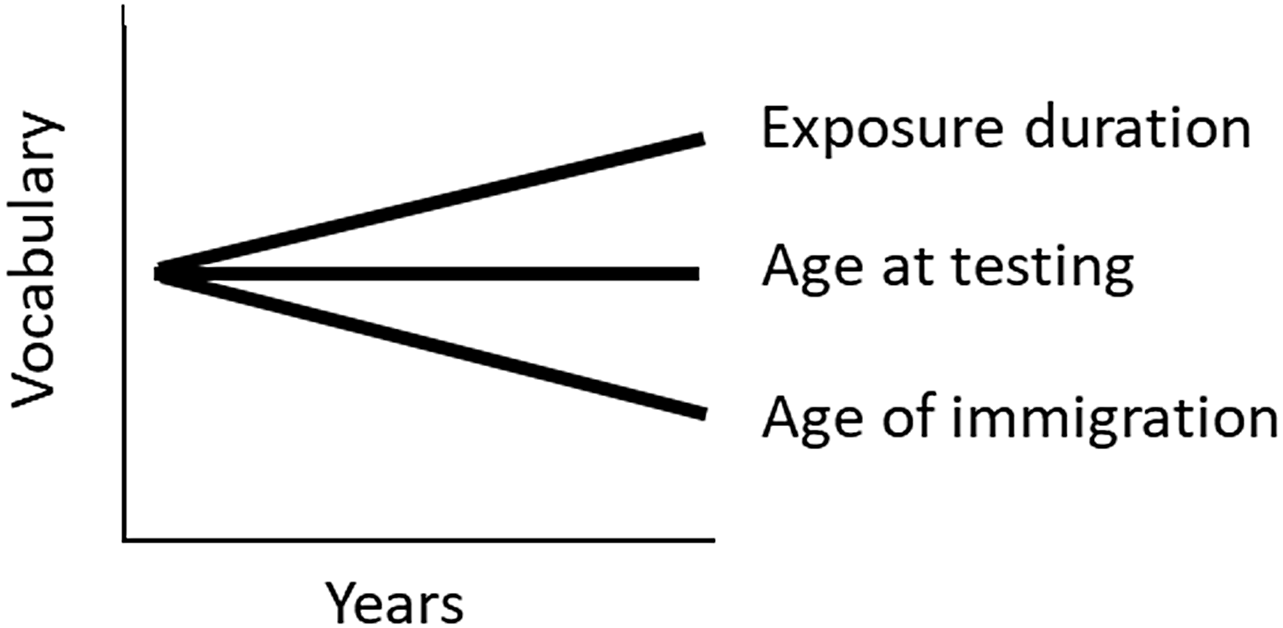
First, we examine the extent to which sequential bilinguals develop advanced vocabulary knowledge in their second language. Since vocabulary acquisition depends on exposure duration, we expect bilinguals’ vocabulary to lag behind the vocabulary of age-matched native speakers and to match native levels that reflect similar exposure duration. Second, we assess whether exposure duration contributes to vocabulary knowledge beyond the contribution of age of immigration. Age of immigration leads to shorter exposure to the second language, and thus we expect to find a negative association between age of immigration and vocabulary knowledge. In addition, we expect exposure duration to have a positive association with vocabulary size, beyond the effect of age of immigration. If age of immigration and exposure duration determine the level of vocabulary knowledge in the second language that bilinguals speak, age at testing will likely show no correlation with vocabulary scores in these speakers. Figure 1 presents a schematic depiction of these hypotheses.
Schematic depiction of the predicted association between age of immigration, exposure duration, and age at testing on the one hand and vocabulary scores on the other hand.

Methods
Participants
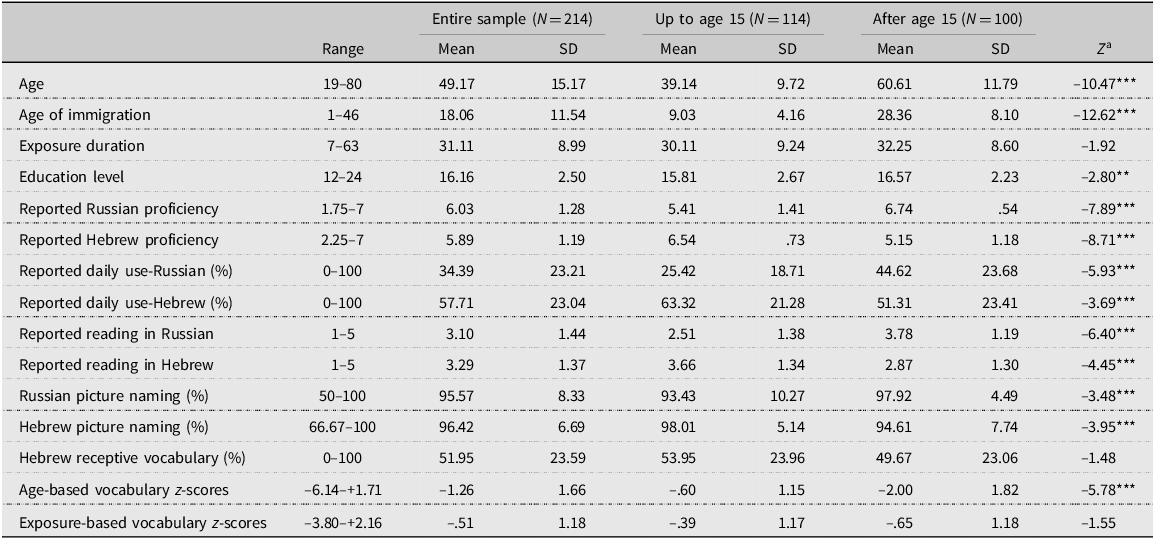
Data collection involved both snowball sampling of volunteers and recruitment through a survey company (see Segal & Kavé, Reference Segal and Kavé2024). We recruited 298 Russian–Hebrew bilinguals and excluded 84 of them because they did not complete the vocabulary task or did not meet all inclusion criteria. The final sample (N=214) included only individuals who reported having no present or past psychiatric or neurological diseases, and no attention-deficit disorder or learning disorders. Participants were 19–80 years old, and 143 (66.8%) of them were female (see full demographic details in Table 1). All participants immigrated to Israel from one of the countries of the former Soviet Union at ages 1–46 and could read in both Russian and Hebrew. To determine exposure duration, we subtracted age of immigration from chronological age. The study complied with American Psychological Association ethical standards and received an Institutional Review Board ethics approval from The Open University of Israel (approval #3400).
Demographic and language variables for the entire group and by age of immigration

a Based on Mann–Whitney U. **p < .01, ***p < .001
Tools
Research materials are available at https://osf.io/8fgp2/.
Reported proficiency
Participants reported their Russian and Hebrew proficiency on a scale of 1 (not at all) to 7 (perfect), referring to comprehension, production, reading, and writing. The proficiency score is the mean rating of the four domains.
Reported daily language use
Participants reported the percentage of using Russian, Hebrew, or another language each day on a scale of 0 (not at all) to 100 (all day). The percent of daily use reflects participants’ self-reported estimation of Russian and Hebrew use.
Reported reading in each language
Participants reported the frequency of reading Russian and Hebrew books on a scale of 1 (not at all) to 5 (the last three books that I read were in Russian/Hebrew).
Picture naming
We used an online naming task in which participants saw 12 pictures of familiar objects, with each picture presented on the screen separately until response (as in Segal et al., Reference Segal, Kavé, Goral, Gollan, Montanari and Quay2019). We asked participants to type the name of the item in the picture with Russian or English keys for Russian words and Hebrew keys for Hebrew words. We considered all responses that matched the sound of the target word as correct responses, regardless of their spelling, and calculated the percent of correct responses for each person.
Receptive vocabulary in Hebrew
We selected the only vocabulary test in Hebrew that has norms for Israeli-born adults (Kavé et al., Reference Kavé, Sapir-Yogev, Zamsh and Waintraub2022). This test consists of 12 multiple-choice items with infrequent words as both targets and distractors (see Kavé et al., Reference Kavé, Sapir-Yogev, Zamsh and Waintraub2022, for a description of test construction). Each target word appeared within the phrase “What is the meaning of…?” after which there were four alternative responses. Participants selected the meaning of the target word, and we calculated the percent of correct responses for each person. The order of the questions and response options in the test was fixed for all participants to maintain consistency with the original format.
Procedure
We used the Qualtrics platform to administer the tasks, and participants completed them online, on a computer, by themselves, in one session that lasted approximately 30 minutes. We made it technically impossible to complete the study on a smartphone. Participants provided general demographic information, completed several reading tasks in both Russian and Hebrew (reported in Segal & Kavé, Reference Segal and Kavé2024), and performed the naming task. They then filled the self-report proficiency and daily use questionnaires. The order of languages was counterbalanced across participants. Half of the participants started with tasks in Russian, answered questions regarding their proficiency and use in Russian, and then completed the same tasks in Hebrew. The other half followed the opposite order. Finally, participants completed the Hebrew vocabulary task.
Results
Data and analysis code are available at: https://osf.io/8fgp2/.
Table 1 presents raw data for all demographic and language variables, as well as z-scores on the vocabulary test according to norms for Israeli-born participants (Kavé et al., Reference Kavé, Sapir-Yogev, Zamsh and Waintraub2022). We calculated z-scores first by chronological age and then by exposure duration. That is, we first compared each score to the mean score of the person’s chronological age group in the Kavé et al. (Reference Kavé, Sapir-Yogev, Zamsh and Waintraub2022) study and divided the resulting number by the standard deviation of that age group in the norm study. We then used exposure duration as the relevant age group. For example, we compared a person with 30 years of exposure to norms for Israeli-born 30-year-old participants. Since norms were available only for age 17 onward, seven individuals with 7–15 years of exposure had no score on this measure.
Table 1 shows several important characteristics of the sample. First, there was considerable variance in age of immigration and in exposure duration. Second, on average participants reported being quite proficient in both Russian and Hebrew, using Russian for about a third of the day and Hebrew more than half the day. Their naming scores corroborated these subjective reports and were close to ceiling in both languages. Third, on the Hebrew vocabulary test, the average performance was close to 50%, with substantial variance. Note that since each word had four alternative responses, chance level was 25% rather than 50%, and scores were well above chance. Importantly, bilinguals’ vocabulary scores were below age-matched norms, but comparable to scores of native speakers matched for exposure duration.
To examine the effect of age of immigration on vocabulary scores, we divided the sample into two groups based on the median age of immigration, which was 15. We used the median (rather than the mean) because we wanted to create two groups with similar exposure duration. This median age of immigration could also serve to examine whether previous evidence of a critical period for lexical abilities around puberty (Granena & Long, Reference Granena and Long2013) is relevant in our sample. We compared the two groups on all measures, using Mann–Whitney U analyses for independent-samples test (see Table 1).
As seen in Table 1, the groups did not differ significantly in raw vocabulary scores. Furthermore, the two groups were comparable in exposure-based z-scores, which were within one standard deviation below the mean in both groups. These findings suggest that when exposure duration is equal, age of immigration does not determine vocabulary scores. However, age-based vocabulary z-scores differed significantly between the two groups, with normal scores in individuals who immigrated up to age 15 (mean z = –.60) and below-normal scores in those who immigrated after that age (mean z = –2.00). This difference reflects the fact that individuals who immigrated up to age 15 were younger at the time of testing than were individuals who immigrated after that age. The younger comparison group of Israeli-born speakers had lower vocabulary scores than did the older Israeli-born speakers, and hence the difference in age-based z-scores.
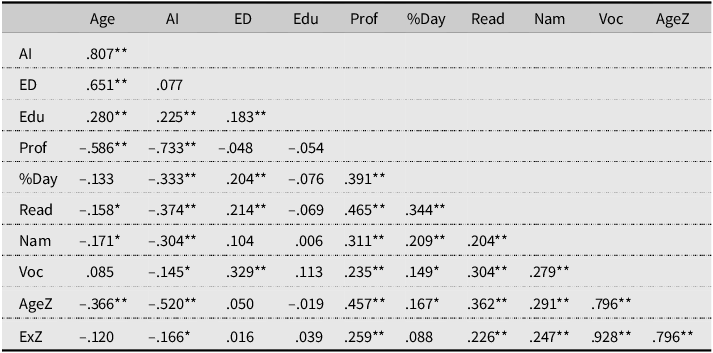
Our next set of analyses aimed to identify the best predictors of vocabulary scores. First, we calculated the full correlation matrix among all variables (see Table 2). We used this analysis not only to reveal the best predictors but also to examine relevant collinearity between variables and determine which variables to include in the regression analysis.
Correlations between demographic and language variables

Note: AI = age of immigration; ED = exposure duration; Edu = education level; Prof = reported Hebrew proficiency; %Day = reported daily use of Hebrew; Read = reported reading in Hebrew; Nam = Hebrew picture naming; Voc = raw Hebrew receptive vocabulary; AgeZ = age-based vocabulary z-scores; ExZ = exposure-based vocabulary z-scores. *p < .05; **p < .01.
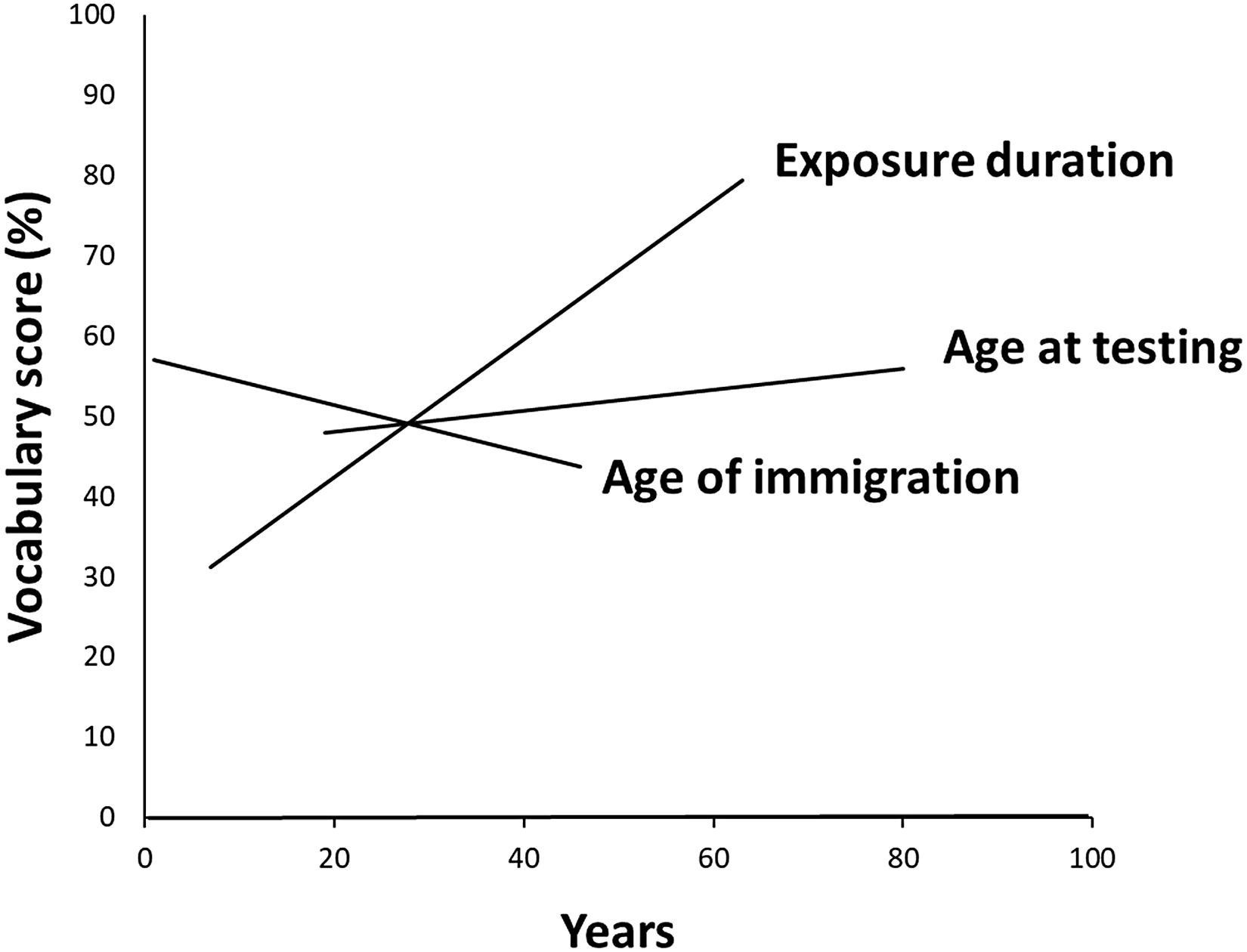
Table 2 shows that chronological age and education did not correlate with vocabulary scores, unlike common findings in samples of native speakers. As expected, reported Hebrew proficiency declined with increased age of immigration and improved with increased exposure duration. Age of immigration and exposure duration increased with increased age at testing. In addition, reported percent of daily Hebrew use and reported frequency of reading in Hebrew decreased with the increase in age of immigration and increased with the increase in exposure duration. Naming and vocabulary scores also declined with increased age of immigration and improved with increased exposure duration. Most importantly, age of immigration as well as exposure duration correlated with raw vocabulary scores, whereas age at testing did not correlate with these scores. Figure 2 presents age of immigration, exposure duration, and age at testing as predictors of raw vocabulary scores, using the percent of correct responses for each person as the dependent variable.
Age of immigration, exposure duration, and age at testing as predictors (regression lines) of raw vocabulary scores (percent of correct responses).

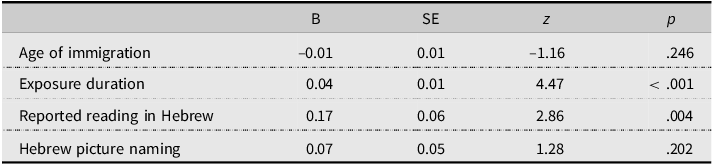
Next, to examine the contributions of age of immigration and exposure duration together, we conducted a multilevel analysis, using the R packages lme4 and lmerTest (Bates et al., Reference Bates, Maechler, Bolker and Walker2014; Kuznetsova et al., Reference Kuznetsova, Brockhoff and Christensen2017). The model included fixed effects for age of immigration, exposure duration, reported reading in Hebrew, and the picture naming score in Hebrew. We did not include age at testing as a fixed effect because it was strongly associated with the other measures (see Table 2). Reported book reading served as a measure of incremental vocabulary acquisition, and the naming score served as a measure of objective Hebrew proficiency. We used a binomial regression, with either 1 (correct) or 0 (incorrect) scores for each item on the vocabulary test, and analyzed random effects for intercepts by participants and by stimuli (items in the vocabulary task).
The regression analysis showed that age of immigration did not predict vocabulary performance, whereas exposure duration was a significant predictor (see Table 3). Reported reading in Hebrew was a significant predictor, but the Hebrew picture naming score was not. These findings indicate that when looking at age of immigration together with exposure duration, only the latter is a significant determinant of vocabulary knowledge.
Linear mixed Effects model to predict receptive vocabulary scores

Discussion
In this study, we analyzed vocabulary knowledge in a unique sample of sequential bilinguals who spoke the same two languages, but varied in their age of second language acquisition, in the duration of exposure to that language, and in chronological age. The findings show that bilinguals’ vocabulary scores fell below age-matched norms for native speakers but were similar to scores of native speakers with comparable exposure duration. Moreover, the results provide evidence that exposure duration is the best predictor of vocabulary knowledge in sequential adult bilinguals.
As expected, we found that bilinguals tested in the language that they acquired second knew fewer words relative to age-matched native speakers. These findings align with previous reports of a difference between sequential bilinguals’ vocabulary in their second language and monolinguals’ vocabulary in that language (Bialystok et al., Reference Bialystok, Craik and Luk2008; Segal & Gollan, Reference Segal and Gollan2018), which is often most noticeable in low-frequency words (Łuniewska et al., Reference Łuniewska, Wójcik, Kołak, Mieszkowska, Wodniecka and Haman2022). In addition, our findings are in line with research that found better lexical access in simultaneous than in sequential bilinguals (Bylund et al., Reference Bylund, Antfolk, Abrahamsson, Olstad, Norrman and Lehtonen2023). Since bilinguals split their time between their two languages and use each language less often than do monolinguals (Gollan et al., Reference Gollan, Montoya, Cera and Sandoval2008), bilingualism can incur an inherent cost on vocabulary acquisition. However, both simultaneous and sequential bilinguals split their time between languages, and yet simultaneous bilinguals reach better proficiency (Bylund et al., Reference Bylund, Antfolk, Abrahamsson, Olstad, Norrman and Lehtonen2023; Kaushanskaya et al. Reference Kaushanskaya, Blumenfeld and Marian2011). The difference between these two groups of bilinguals shows that it is not bilingualism itself that prevents native-like proficiency, but rather that sequential bilinguals experience an initial lack of exposure (i.e., prior to second language acquisition) that restricts their proficiency.
Indeed, while the comparison of bilinguals to age-matched native speakers demonstrated a difference, the comparison to exposure-matched Israeli-born speakers showed similar scores. These findings suggest that with enough time, sequential bilinguals can reach native-like vocabulary levels, and that there is no critical period for vocabulary acquisition. Reaching a satisfactory level of vocabulary does not depend on being monolingual, on early initial exposure to the language, or on acquisition mechanisms that are more efficient in childhood. It simply takes time. This conclusion fits well with the aging literature that has repeatedly shown that vocabulary knowledge expands with increased age (Bowles & Salthouse, Reference Bowles and Salthouse2008; Kavé et al., Reference Kavé, Sapir-Yogev, Zamsh and Waintraub2022; Verhaeghen, Reference Verhaeghen2003). It also follows suggestions in the literature that comparisons between bilinguals and age-matched monolinguals should be approached with caution (Rothman et al., Reference Rothman, Bayram, DeLuca, Di Pisa, Dunabeitia, Gharibi, Hao, Kolb, Kubota, Kupisch, Laméris, Luque, van Osch, Pereira Soares, Prystauka, Tat, Tomić, Voits and Wulff2023).
Our argument that there is no critical period for vocabulary acquisition receives further support from the finding that the bilinguals in our study immigrated to Israel and acquired their second language at an average age of 18. This age is older than the age previously associated with a critical period for the acquisition of phonology (e.g., Dollmann et al., Reference Dollmann, Kogan and Weißmann2020; Iverson et al., Reference Iverson, Kuhl, Akahane-Yamada, Diesch, Kettermann and Siebert2003; Sebastián-Gallés et al., Reference Sebastián-Gallés, Echeverría and Bosch2005), grammar (e.g., Hartshorne et al., Reference Hartshorne, Tenenbaum and Pinker2018; Johnson & Newport, Reference Johnson and Newport1989), or lexical abilities (Granena & Long, Reference Granena and Long2013). Had there been a critical age for vocabulary acquisition during childhood, bilinguals who had immigrated as children would have acquired more words than those who had immigrated as adults. However, there was no difference in vocabulary scores between early bilinguals, who immigrated up to age 15 and whose average age of immigration was below 10, and late bilinguals, who immigrated after age 15 and whose average age of immigration was 28. In fact, as these two groups were comparable in their duration of exposure to Hebrew, they differed neither in raw vocabulary scores nor in exposure-based scores, corroborating the conclusion that bilinguals can learn new words regardless of the age in which they first acquire their second language.
Looking at correlations between variables, we found that age of immigration inversely associated with vocabulary scores so that those who immigrated at a younger age had higher vocabulary scores, as seen before in other language domains (Granena & Long, Reference Granena and Long2013; Johnson & Newport, Reference Johnson and Newport1989). Yet, the regression analysis that examined age of immigration together with exposure duration showed that exposure duration was a much stronger determinant of vocabulary scores, making the contribution of age of immigration non-significant. This finding supports our conclusion that age of immigration is less important to vocabulary acquisition than is exposure duration, unlike previous conclusions (Granena & Long, Reference Granena and Long2013; Johnson & Newport, Reference Johnson and Newport1989). Note, though, that these previous conclusions emerged from studies of much smaller and younger samples whose exposure duration was shorter, and these studies did not examine vocabulary as we did. Our results demonstrate that while initial age of language acquisition obviously affects language proficiency, it determines vocabulary knowledge because it affects exposure duration. Hence, even late bilinguals can reach high levels of vocabulary, as long as they have a similar amount of language exposure.
In addition to exposure duration, the frequency of reading in Hebrew also predicted vocabulary size. The association between reading and vocabulary scores is not surprising, since individuals expand their word knowledge through reading (Uttl, Reference Uttl2002; Uttl & Van Alstine, Reference Uttl and Van Alstine2003), especially with regard to infrequent words. Yet, in the current study, we found no association between education level and vocabulary, as found before (Keuleers et al., Reference Keuleers, Stevens, Mandera and Brysbaert2015; Verhaeghen, Reference Verhaeghen2003), possibly because many individuals received their education in Russian prior to their immigration, and therefore they did not acquire new infrequent Hebrew words while in university. Furthermore, higher education did not lead to greater reading in Hebrew and did not result in further vocabulary acquisition. Interestingly, in our sample, chronological age did not associate with raw vocabulary scores, but it did inversely associate with age-matched vocabulary score. These results suggest that the aging-related increase in vocabulary knowledge seen in native speakers (Kavé, Reference Kavé2024) is equivalent to the exposure-related increase in vocabulary that we observed in bilinguals and that the overlap between aging and exposure duration makes aging redundant in our analyses. Consequently, the gap between bilinguals and native speakers increases with chronological age due to the differences in exposure duration.
We acknowledge that our study has some limitations. First, the vocabulary test that we used included highly infrequent words and was rather challenging for our participants. Had we used frequent words or words that native speakers usually acquire in childhood, we could have found different results. Nevertheless, a test of frequent words might have had a ceiling effect, thus precluding individual differences. Second, we focused on a limited set of words, unlike mega-studies (e.g., Brysbaert et al., Reference Brysbaert, Stevens, Mandera and Keuleers2016) that attempted to examine all the words in English (but see Clare et al., Reference Clare, Whitaker, Martyr, Martin-Forbes, Bastable, Pye, Quinn, Thomas, Gathercole and Hindle2016). While this narrow focus is a valid limitation of our study, it allowed us to compare performance of the current sample to age-matched norms for native speakers and thus to draw more general conclusions. Third, we suggest that bilinguals whose exposure duration is long enough can reach native-like proficiency, but we cannot determine which duration is long enough or whether there is an acquisition plateau at some point. Longer exposure duration will probably increase performance, but this conclusion requires further research. Last, we examined the effects of age of immigration, exposure duration, and age at testing on Hebrew vocabulary only. Testing other aspects of the bilingual experience, such as the proportion of language use within different communicative contexts (Gullifer et al., Reference Gullifer, Kousaie, Gilbert, Grant, Giroud, Coulter, Klein, Baum, Phillips and Titone2021) or the frequency of code-switching, as well as examining their effects on the native language vocabulary, could have provided a more comprehensive view of bilinguals’ vocabulary development. However, these other aspects of language use were beyond the scope of the current study and will have to await future research.
To conclude, it is difficult to differentiate between the associations of age of immigration, exposure duration, as well as age at testing and vocabulary knowledge, as these variables are inter-dependent (Stevens, Reference Stevens2006), and yet we show that exposure duration is the strongest determinant of vocabulary acquisition. Bilingualism itself or age of initial acquisition of a second language do not pose a barrier to vocabulary growth. In addition, the importance of exposure duration explains why vocabulary continues to accumulate across the lifespan, in bilinguals and monolinguals alike.
Replication package
Replication data and materials for this article can be found at https://osf.io/8fgp2/.
Acknowledgments
We thank Sofi Bonch, Rachel Epstein, Yael Ghitza, Olga Halperin, Tova Kukulansky, Tal Moran, Victor Shmuel, and Eitan Veng for their valuable help. The study received funding from The Open University of Israel (grant number 102381/31061).
Competing interests
The authors declare none.

 Open access

