


Introduction
For half a century, European policymakers have attempted to position the region as a technological powerhouse, especially in relation to global competitors threatening to relegate Europe to the margins of the increasingly technology-driven global economy. Especially when European technology companies faced the rise of the Japanese and American high-tech industries amid the stagnation of the 1970s and post-industrial shift toward a service economy in the 1980s, the European Economic Community’s (EEC) executive Commission did not deploy regional protectionism or engage in trade wars to support European high tech. Instead, it built a new architecture for organized business by cultivating advisory relationships with groups of business leaders.Footnote 1 We find these “business forums,” groups of business elites brought together by policymakers to advise legislation and offer firm-level information about the economy to inform policymaking, are distinct from both the “business interest associations” formed by business actors to organize firms in particular industries, sectors, or national contexts for the purposes of lobbying policymakers and likewise from the “private advocacy groups” developed in the second half of the twentieth century to exert greater influence over the global economy and eroded by the redundancy of their own multiplication.Footnote 2 Building on a growing body of historical scholarship on early European industrial policy and drawing on archival evidence from the Cabinet of European Commissioner for Industry Étienne Davignon,Footnote 3 we examine how the US Business Roundtable inspired him to recruit European business leaders to take part in “consultative forums” in several sectors, including the so-called “Big 12 Roundtable” on high tech, which developed the industrial policy innovation,Footnote 4 the European Strategic Program on Research in Information Technology (ESPRIT), to strengthen European competitiveness in high tech and remake the European economy in the late twentieth century.Footnote 5 By uncovering the activities of the Big 12 and the funding mechanism of ESPRIT, we narrate the creation of new forms of organized business and offer a fresh perspective on the development of European industrial policy.
Consequently, this article makes two primary contributions to scholarship on historical European political economy. First, by narrating the creation of the Big 12 Roundtable in the 1970s, it identifies “business forums” as a new type of business-government relations and traces their historical evolution in the context of other forms of organized business. Second, it contributes to scholarship on European industrial policy by uncovering how the ESPRIT program, born out of a desire to remake the European economy in the late twentieth century and achieve “global competitiveness,” was an industrial policy innovation and laid the foundation for the European research policies still driving research and development in the region in the twenty-first century, as historians Daniela Felsini and Paolo Paesani have shown.Footnote 6 Our narrative demonstrates how regional policymakers imagined the future of the EEC, its Single Market, and its firms in the global economy of the 1970s and 1980s and explains how the lack of “European champions” in high tech, the limitations on state aid in the Single Market, and the structure of policymaking in the EEC motivated closer business-government relations and an innovative approach to industrial policy.
By narrating the development of regional business forums in the context of European integration, we expand the genealogy of business organizations and the distinct characteristics of business forums (Section I). We then situate the Big 12 Roundtable in this genealogy and examine the scale and scope of the Commission’s efforts to respond to the “shock of the global” and Europe’s lag in IT industries through the ESPRIT program (Section II).Footnote 7 In Section III, we examine the legacy of the Big 12 and of the use of technology and later research policy as new forms of European industrial policy. Our Conclusions examine the outcomes of these efforts to support European high tech.
The Genealogy of Business Organizations: From Interest Associations to Forums
Business leaders formed many business interest associations (BIAs) in the late nineteenth and early twentieth centuries, especially with the aims of sharing information and coordinating their positions to lobby local and national governments.Footnote 8 After World War I, the League of Nations tasked the International Chamber of Commerce (ICC), a transnational business association, with arbitration in the new international order.Footnote 9 BIAs and the ICC worked to maintain international trade amid interwar economic nationalism and World War II.Footnote 10 As international organizations proliferated in the postwar period, transnational “peak associations” formed to lobby the new institutions of international governance.Footnote 11 One such organization, the Union of Industrial and Employers’ Confederations of Europe (UNICE)—now BusinessEurope—was formed by business actors in response to the European Coal and Steel Community’s creation in 1952.Footnote 12 UNICE’s rise to prominence as the premier European BIA was a gradual and non-linear process of adaptation to institutional changes in the EEC. Another regional organization, the European League of Economic Cooperation (ELEC), formed in 1946 with explicit goals of promoting European federalism, demonstrated an early interest in monetary integration among European business and provided a space for economists to debate and gradually form coherent visions of what such a development could look like.Footnote 13 Two further types of business organizations formed in Europe between 1946 and 1958: employers’ organizations speaking on behalf of business, on the one hand, and business clubs made up of individuals on the other, both of which broadly supported regional economic integration in Europe.Footnote 14 By bringing together networks of like-minded business leaders and firms, they provided spaces in which policy positions could be evaluated, debated, proposed, and adopted, enabling the entry of business into a regional public sphere.Footnote 15 These organizations were particularly effective in the realm that political scientist Pepper Culpepper describes as “quiet politics,” insulated from salient public debate.Footnote 16
Similarly, the Comité européen pour le progrès économique et sociale (CEPES), which was founded in 1952 and operated as “an exclusive think-tank” for European Coal and Steel Community (ECSC) firms, offered regional networking opportunities for business leaders in the first Community of supranational economic governance in Western Europe. Inspired by an American counterpart, top European business executives drew on CEPES,Footnote 17 formulating “unionist” and “neo-liberal” positions that could often be contrasted with ELEC’s more “federalist” vision.Footnote 18 Likewise, the Groupe des présidents des grandes entreprises européennes (GdP), composed of top executives from big business across the EEC, began meeting in 1967. Initially convened by a senior EURATOM official, the GdP gathered business leaders with varying views on European integration, but demonstrably a clear interest in the increasing relevance of the supranational institutions based in Brussels.Footnote 19
Enthusiasm for European integration and its opportunities for influence was not uniformly shared in business circles. Challenging recent emphasis on the role of business in driving European integration, Alexis Drach has shown that French and British banks showed little interest in—and even skepticism of—EEC banking policy.Footnote 20 His scholarship on banking clubs also suggests that banks preferred a private, cooperative European integration among each other rather than institutional integration, meaning the Commission’s growing trust among business leaders was not universal across sectors.Footnote 21 By the 1970s, identified as a transformative decade in the growing political role of business in Europe, it was not necessarily that regional organizations had successfully and systematically organized to influence EEC policy, but rather the Commission that could tap into an existing ecosystem of market-minded industrialists.Footnote 22
As Laurent Warlouzet has argued, EEC member states did not respond uniformly to the crises of the 1970s. Instead, EEC policy represented an evolving compromise between socially oriented neomercantilism and market-oriented ordoliberalism.Footnote 23 Neoliberalism and its alternatives equally prioritized protecting economic growth amid the crises by soliciting policy input from the private sector. In the 1970s, we find that the Commission began convening and creating business forums, sector by sector.
Other historians have shown that consultations of this type were not purely a response to the energy crises beginning in 1973, but that sectoral forums had been formed in response to the challenges of globalization. Founded in 1970 by Commissioners François-Xavier Ortoli and Altiero Spinelli in response to growing trade deficits in cars with Japan, the X group was composed of the technical directors of automakers, and its successor, the Committee of Common Market Automobile Constructors (CCMC), gathered chief executives of Europe’s largest car companies to develop common European norms and standards.Footnote 24 Exchanges between the CCMC and the Commission cultivated convergences between industry preferences and European policy objectives both before and in reaction to the 1973 oil crisis. And despite limited concrete achievements, the relationship between carmakers and the Commission tightened further once Davignon took over the reins of the industry portfolio in 1977.Footnote 25
That sectoral forums became indispensable to business-Commission consultations is clearest in the case of European commerce. While Brussels-based trade associations representing commerce had existed since the early 1960s, it was not until the 1970s that a common organization, the Comités des organisations commerciales des pays de la Communauté économique européenne (COCCEE), could act as “a single voice for commerce and distribution.” Once it disintegrated due to internal divisions, a frustrated Commission, lacking a single counterpart to consult in the areas of commerce and distribution, itself conferred recognition to four separate organizations as the appropriate representatives out of necessity.Footnote 26 The Commission ultimately created the Committee on Commerce and Distribution (CCD) in 1981 to facilitate dialogue with the commerce sector. While seminal narratives on the political power of transnational business groups have criticized these as exerting undue influence on policy, this striking example of the Commission stepping in to organize business into representative groups shows that policymakers in Brussels found these forums necessary and useful to develop solutions to Europe’s economic woes.
The Commission’s creation of pan-European spaces for business consultations beyond the confines of the individual member states shows that the EEC’s later success with furthering political and economic integration beginning in the mid-1980s was preceded by spaces for trust-building and expertise-sharing begun in the preceding decade. The European Round Table of Industrialists (ERT), which began convening in 1983 and became a focal point for seminal studies on business influence on European integration due to its influence on the Single Market Program, was created in the context of these many predecessor European business roundtables initially formed for individual sectors. Whether credited with convincing EEC member states to pledge support for the Single Market or criticized as business capture of and undue influence on the Commission, it was not the first business forum to advise European policymaking.Footnote 27 But as we demonstrate in the following sections, the key breakthrough for the ERT’s launch, characterized by far more intimate business-Commission relations from the top to the bureaucrat level at the Directorate-Generals, was the colloquially named “Big 12 Roundtable” and its decisive role in creating the ESPRIT program.Footnote 28
The “Big 12 Roundtable,” JEPE-IT, and ESPRIT
Not only did Europe suffer the industrial crises of the 1970s, but the EEC and its member states also had to contend with losing market share in one of the greatest success stories of the decade. The telematics industries—a contemporary term for information and communications technology (ICT)—rapidly grew elsewhere throughout the decade, with the world market for semiconductors (the essential, underlying hardware) trebling in size between 1970 and 1978.Footnote 29 The major winners from this industry’s impressive growth were largely Japanese and American producers, leading to a growing European fear throughout the decade that failure to adapt to “the economies of tomorrow” would not only lead to economic dependence but its very “economic survival.”Footnote 30 Other than a few limited “niches,” the Commission argued that Europe was outcompeted in the ICT sector by the early 1980s, with eight out of ten computers sold in Europe imported from the US, nine out of ten videotape recorders imported from Japan, and its share of global chip production down to just 13%—around half of which was produced in the US by European subsidiaries.Footnote 31 With decades-old economic models existentially challenged and the technology gap widening, Western Europe fell behind its economic competitors in what Jean-Jacques Servan-Schreiber called the “Global Challenge.”Footnote 32
Unsurprisingly, despite earlier cooperation between and among European states in tech research and development, national governments initially responded to difficulties in the computer and semiconductor industries with industrial policy efforts to prop up national champions capable of eating into the market shares of leading global competitors like IBM.Footnote 33 Nor was the European Commission a passive observer of the EEC’s relative decline in market shares. Discussions about an EEC-wide technology program began as early as 1974,Footnote 34 and an eventual program focused on technological standardization, procurement rules, and inter-firm collaboration to reduce the fragmentation of the Community market was proposed in 1976.Footnote 35 While the EEC remained a modest actor, its policy interventions “mushroomed” in this and various other policy fields in the 1970s, allowing it to lay a foundation for its future role in research policy by providing a European alternative to national programs.Footnote 36
But the Commission’s proposal was controversial and faced two main criticisms. First, key member states Germany and France launched a “major attack” in light of the Community proposal’s potential competition with their national programs.Footnote 37 Member states could veto funding toward technologies in which they had competitive advantages and opt into programs jointly funding technologies in which they were lagging behind, thus preventing Schumpeterian creative destruction and genuine innovative disruption.Footnote 38 The French government under President Valéry Giscard d’Estaing (1974–1981), for example, perceived its technology companies to be more advanced than their EEC competitors.Footnote 39 Intergovernmental debates about a common industrial policy reflected stark differences at the national level. As Fernand Braun from the Directorate General for Industry (DG III) noted in 1982, French policy prioritized vertical integration, while the German preference for propping up national champions reflected horizontal integration. Such differences hampered the development of programs for cooperative research and development.Footnote 40 Second, while acknowledging the need for an ambitious European program to close the gap in these industries, the European Parliament scrutinized the Commission’s proposals. Three separate committees pointed to an obvious lack of consultation with BIAs such as the European Computer Manufacturers Association (ECMA) and the European Association of Business Machines and Data Processing Equipment (EUROBIT), suggesting that a program focused more on coordinating the efforts of IT firms should have been the primary focus.Footnote 41 Ultimately, a program with “severely reduced funding” was only approved by the Council after long delays, leaving technology programs in the exclusive domain of national governments throughout the 1970s.Footnote 42
Initially, without collective efforts to support European high tech, the Industry Commissioner turned to industry itself, especially to the “champions” so jealously guarded by national governments. Perhaps the foremost national champion was Germany’s largest high-tech producer Siemens, which received the majority of total government R&D subsidies in the late 1970s.Footnote 43 In 1978, Siemens began sharing various policy proposals with the Commission, such as “buy European” and common technical standards,Footnote 44 and by the next year, Davignon was soliciting advice on a new EEC telematics program directly from the company’s chief executive, Bernhard Plettner.Footnote 45 The exchanges reveal an information gap in the Commission that the Parliament thought only industry could fill—for instance, Siemens officials committed to providing the Commission with data on US industrial aid.Footnote 46 Notably, leading European technology companies lobbied national governments as well, expressing their interest in collective solutions.
Plettner, just like the chief executives from ICT firms such as Olivetti, Philips, the French Compagnie générale d’électricité (CGE), the British General Electric Company (GEC), and the American heavyweight IBM’s European subsidiary, was all consulted by Davignon beginning in early 1979 and asked to participate in a “systematic reflection” in “the face of economic crisis.”Footnote 47 On one side, some companies eagerly seized on the opportunity to share their visions of an EEC technology program. CII-Honeywell Bull’s chief executive, Jean-Pierre Brulé, had readily offered to do his part to ensure the “future independence of European states” in May 1979,Footnote 48 producing a wish list for “the creation of a European market” through standardization in the months following.Footnote 49 On the other hand, Davignon solicited input from the executives for setting an EEC goal for how large a share of the world semiconductor market should be European,Footnote 50 and for what a “formula” for regularized exchanges between industrialists and the commission might look like.Footnote 51 Jacques Maisonrouge, President of IBM Europe in 1979, suggested the US Business Roundtable as a potential “model.”Footnote 52 Maisonrouge, who had once called “the world’s political structures […] completely obsolete,” referring to the obstacle “the independence of nation-states” posed to the “global optimization of resources,”Footnote 53 lauded the flexible character of a roundtable which would incentivize participation of high-level industrial executives by letting them take the initiative themselves.Footnote 54 Despite Davignon’s continued consultations with Maisonrouge over the following years, IBM Europe was excluded from the Big 12 Roundtable,Footnote 55 whose members all vehemently opposed the US multinational’s dominance.Footnote 56 In fact, as historian Arthe van Laer shows, the increasingly tight linkages between the Commission and the Big 12 “lilliputians” (in the European computer market, IBM was ten times bigger than its closest competitor) were used not only to exclude IBM, but to lobby for more favorable antitrust action against the “giant.”Footnote 57 By early 1980, the chief executives of the EEC’s twelve largest high-tech firms began regularly meeting as a group chaired by Davignon, earning them the name: “Big 12 Roundtable.”
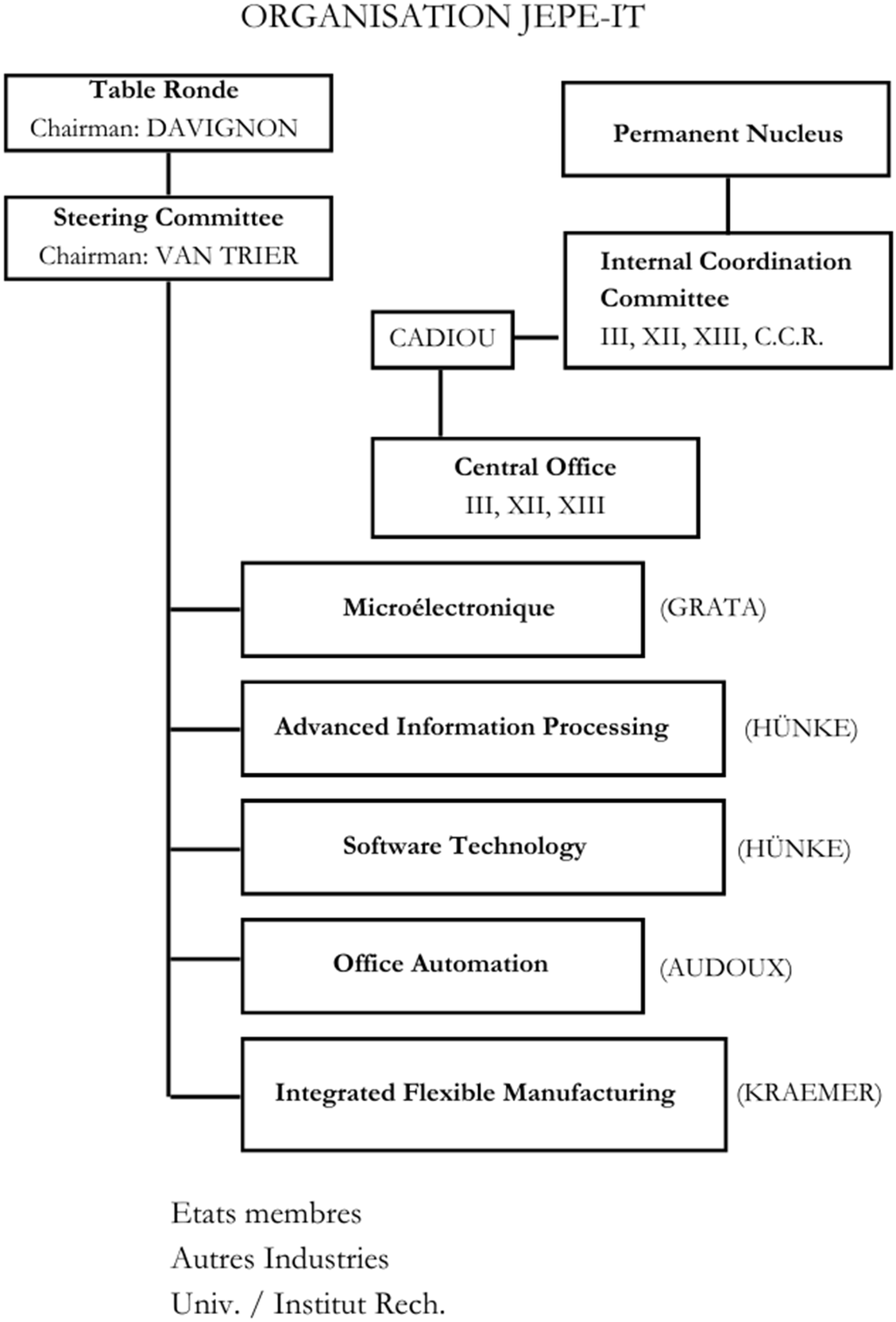
In early 1981, less than a year into the Big 12 Roundtable’s discussions, the forum created the Joint European Planning Exercise in Information Technology (JEPE-IT), a plan to collectively fund European research and development in high tech.Footnote 58 The Commission promised to fund 50% of the program’s collaborative R&D projects, with participating firms providing the other half, provided that the research was “precompetitive” to maintain the perception that the program was a Community technology program rather than a transfer of industrial policy authority to Brussels.Footnote 59 Commissioners participating in JEPE-IT came chiefly from Directorates-General III (Internal Market and Industrial Affairs), XII (Science, Research and Development), and XIII (Information Market and Innovation). By dividing the organization into five task forces or panels, each specializing in one technology area, the JEPE-IT mobilized the most important resource the Big 12 companies could offer the Commission — the expertise of engineers from Big 12 firms, something it had lacked in the 1970s.
A 1991 Burson Marsteller report quoted a Commissioner who had lamented the “terribly understaffed and overstressed” administration of the EEC’s executive branch, comparing the burden of nine Commission staff to 600 employees in the US federal government.Footnote 60 Representing 70% of the European ICT industry’s annual revenue, the companies could match this privileged access to the Commission with their “industrial hard core,” able to mobilize R&D resources at scale in a way smaller companies could not.Footnote 61 Beyond the US Business Roundtable, the Commission looked to Japan’s successful experience with industrial policy in semiconductors and microelectronics.Footnote 62 A 1983 internal memorandum entitled “ESPRIT: HOW MITI WOULD DO IT!” [sic] touted “proven Japanese procedures and methods of organizing” a publicly funded industrial collaboration program, stressing in particular the need for clear and unambiguous property rights protecting the research results achieved through interfirm collaboration from foreign competitors.Footnote 64 JEPE-IT’s primary objective was to create a program to support and fund the development of European high tech.
JEPE-IT task forces were supervised by a steering committee of R&D directors, akin to the “X-group” of carmakers in the early 1970s and led by Ton van Trier, recommended to Davignon by a Philips executive and Dutch Minister of Science.Footnote 65 The steering committee, in turn, reported to the Davignon-chaired roundtable consisting of chief executives.Footnote 66 That Olivetti offered to “advise the Commission/Steering Group on how to approach” the Italian research and technology minister further demonstrates the Big 12 companies’ connections with national governments and their willingness to use them. JEPE-IT initially focused its energies on “selling” the idea of a technology policy program to its “customers,” i.e., the member states crucial for financing the program, by circulating internal guidelines among the task force rapporteurs on how best to convince national government officials to provide program funds.Footnote 67 In 1983, Davignon achieved what historians David Irion and Darina Volf call “hidden integration” by building the coalition required to fund and launch a technology policy funding program, the European Strategic Program on Research in Information Technology (ESPRIT).Footnote 68
ESPRIT’s initial goals were to help European tech firms create a “long-term strategy” with the aim of placing them “in a position of technological equality with their competitors” and help European ICT claim a “world market share comparable to the relative size of the European IT market itself, e.g., 30% of the world market.”Footnote 69 The Commission set an ambitious deadline of one decade by which to achieve these goals, for which it articulated the necessity of focusing on “pre-competitive technology,” remaining aligned with national efforts, and being of a “substantial scale” to catch up with Japan and the USA.Footnote 70 With a forum like the Big 12 Roundtable in place and program funding like ESPRIT, the EEC aimed to achieve global competitiveness in high tech in the 1980s.
Unlike the earlier technology policy proposals, which had suffered from weak business participation, the proposal for ESPRIT was built on in-house expertise and the lessons Davignon’s cabinet learned in the 1970s.Footnote 71 Of course, disagreement was still a feature of the Commission-Industry relationship and the relationships between participating firms in the “social group” of the forum.Footnote 72 Ahead of the Commission’s proposal of ESPRIT in 1983, the allocation of program funding became internally controversial. On the one hand, Big 12 firms increasingly spoke to Davignon and the Commission with one voice, lobbied heavily for greater shares of program funding, and worried that an open tender would undermine their support for JEPE-IT’s technical proposals. On the other hand, Davignon insisted the projects had to be assessed “on technical merit.”Footnote 73 Big 12 firms maintained structural advantages over SME participants in ESPRIT; however, Big 12 firms submitted twenty-seven proposals to the open tender, all but six of which made the shortlist, accounting for more than 70% of the program’s budget.Footnote 74 Defending what they argued was their rightful share of program funding, members of the roundtable argued that only they had the scale to “carry out research and train technologists” and dismissed SMEs as “poachers.”Footnote 75 A small role for SMEs was perhaps an inevitable consequence of an R&D-heavy industrial policy program, but their relative neglect has been suggested as a cause of ESPRIT’s limited number of concrete achievements.Footnote 76 Moreover, Robb Wilmot, the managing director of the Big 12 British technology firm ICL, reported his suspicions that about half the firms participating in the Roundtable were motivated only by receiving program funding and had no real intention to cooperate.Footnote 77
Internal documents from the ESPRIT planning process reveal an awareness of the privileged position of Big 12 firms. When meeting with Commission officials involved in JEPE-IT, Davignon “emphasized that [the Commission’s] relationship with industry [the 12] cannot be to the exclusion of the institutes, universities and other industry,”Footnote 78 whose representation as a minority voice on the ESPRIT “industrial advisory board” (which had been set-up to give the Big 12 firms a permanent, formal role in the program) was later secured.Footnote 79 His awareness of the controversy of business consultations is also apparent: “What has to be avoided is to appear to take industry’s view of the plans of their governments. […] What we are doing with industry is to identify, without judgement, those areas where there appears to be a valid objective and reason for support.”Footnote 80 This self-capacity to problematize the influence given to a few key firms whose input was solicited and resources pooled to set up ESPRIT shows that convening and institutionalizing the roundtable was a calculated Commission decision.
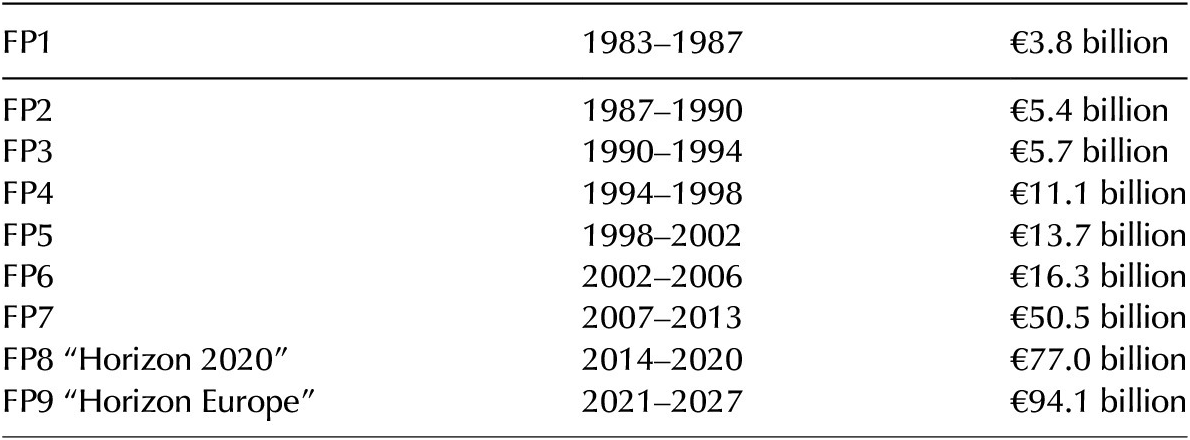
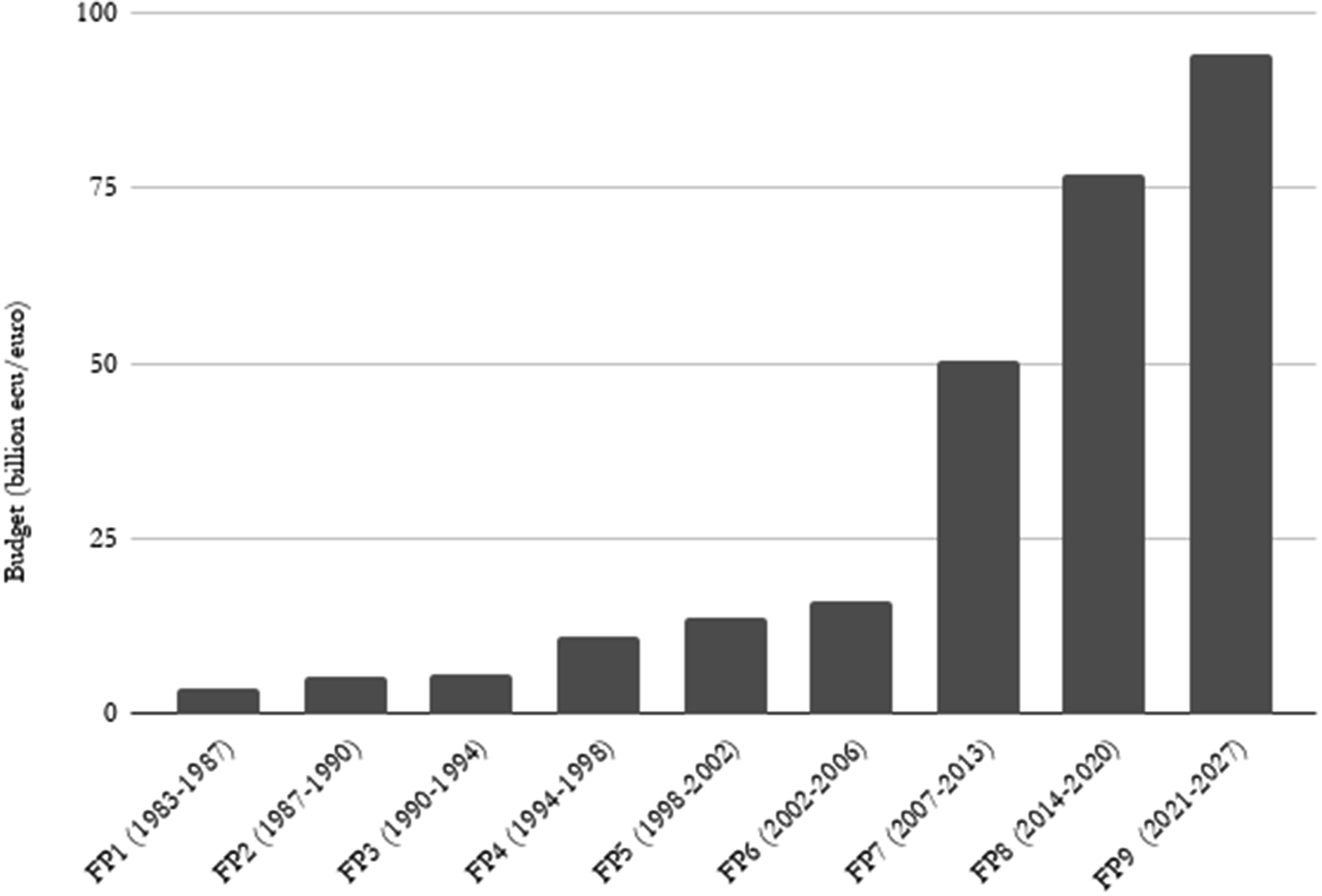
Formally launched in 1984, ESPRIT was the single largest industry-specific program in the first multi-year funding Framework Program (FP) designed to support common research and development in technology, the eighth successor of which is today’s ambitious Horizon Europe (see Figure 2 and Table 1 below).Footnote 81 Not only did ESPRIT help consolidate EEC research policy into the FPs—becoming the third largest common budget item—but it was also inextricably linked to the launch of the Single Market Program. Veera Mitzner points to an “emerging consensus” for a larger role of the EEC in additional policy fields established already by the time Jacques Delors took the reins of the European Commission, and by no coincidence, the Single European Act stressed an urgent need for Commission responsibilities in R&D.Footnote 84 As a technology policy program, ESPRIT laid the foundations for common European research policy, the next generation of industrial policy innovation in compliance with the Treaty framework and as a reflection of the global service economy. As a policy innovation and consequence of political compromise, ESPRIT further demonstrates the powerful potential of networks to bypass the EEC’s lack of legal competence in industrial policy through less controversial research policy, as shown by our archival evidence of collaboration centered on the “Big 12 Roundtable.”
Framework Program Budgets, 1983–2027

Table 1. Long description
Starting at the top, FP1 covers 1983–1987 with a budget of €3.8 billion. FP2 spans 1987–1990 at €5.4 billion. FP3, 1990–1994, is €5.7 billion. FP4, 1994–1998, is €11.1 billion. FP5, 1998–2002, is €13.7 billion. FP6, 2002–2006, is €16.3 billion. FP7, 2007–2013, is €50.5 billion. FP8, labeled Horizon 2020, covers 2014–2020 at €77.0 billion. FP9, labeled Horizon Europe, spans 2021–2027 with €94.1 billion. The note at the bottom states that earlier programs used ECUs, later converted to euros at parity.
Note: Earlier programs preceding the introduction of the euro budgeted in ECUs, later converted to euro at parity.Footnote 83
More importantly, ESPRIT reflects the piecemeal structure of EEC policymaking and the result of intergovernmental compromise. Portfolio division across the Commission’s Directorates General meant policymaking was neither comprehensive nor cohesive but was instead divided between Directorates General responsible for industry and the internal market (DG III), competition policy (DG IV), scientific research and technological development (DG XII), and telecommunications and informatics (DG XIII). Consequently, as Figure 1 shows, Davignon excluded DG IV, which might have opposed the creation of a horizontal mechanism to support the technology industry, from the JEPE-IT.Footnote 85 While Davignon had curbed the power of competition policymaking in the 1970s, he understood the success of a high-tech industrial policy program would depend on “effective collaboration with DG IV.”Footnote 86 Moreover, ESPRIT’s intentionally modest scope reflected its architects’ efforts to create a program most member state governments would support—including Margaret Thatcher in Britain who favored its targeted, provisional, and precompetitive focus—and seemingly posed no threat to national programs like France’s own national Eureka program, designed in 1985 to promote European cooperation between companies in research and development outside of the cooperative Community framework and to undercut the American invitation to include European firms in the US’ Cold War-era Strategic Defense Initiative.Footnote 87 Still, ESPRIT’s challenge to Eureka limited France’s support for the Community program, leaving companies unsure of how to navigate the business environment of competing national and transnational programs.Footnote 88
Organigram of the JEPE-IT.Footnote 63

Figure 1. Long description
At the top, Table Ronde chaired by Davignon is leftmost, Permanent Nucleus is rightmost. Below Table Ronde is the Steering Committee chaired by Van Trier, which connects downward to Cadiou and then to the Central Office labeled I I I, X I I, X I I I. The Permanent Nucleus connects to the Internal Coordination Committee labeled I I I, X I I, X I I I, C C R, which also connects to Cadiou. The Central Office branches downward to five technical divisions: Microélectronique (Grata), Advanced Information Processing (Hünke), Software Technology (Hünke), Office Automation (Audoux), and Integrated Flexible Manufacturing (Kraemer), listed vertically. At the bottom, three categories are listed: Etats membres, Autres Industries, Univ. forward slash Institut Rech.
Framework Program Budgets, 1983–2027.Footnote 82
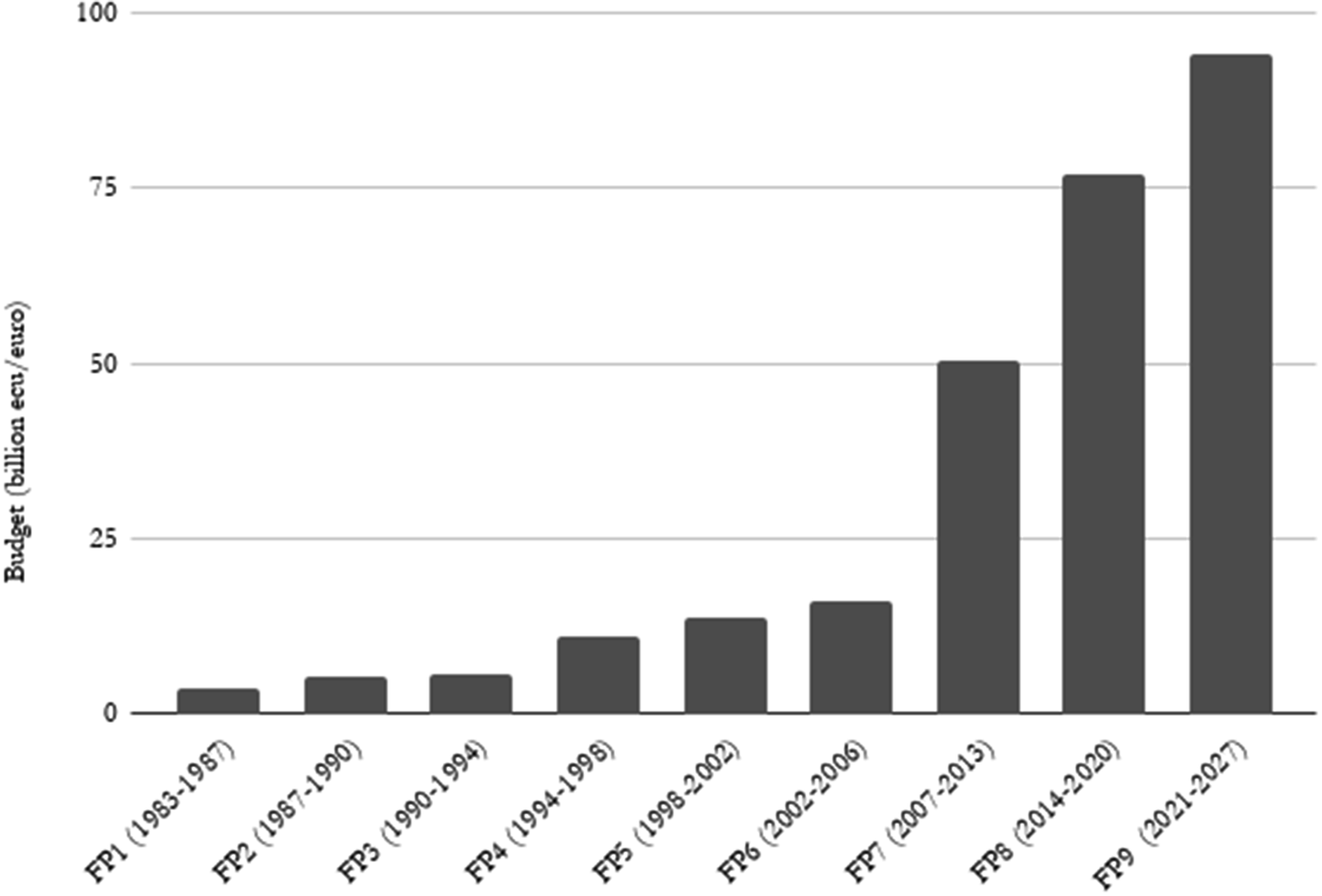
Figure 2. Long description
The x-axis lists FP1 1983 to 1987, FP2 1987 to 1990, FP3 1990 to 1994, FP4 1994 to 1998, FP5 1998 to 2002, FP6 2002 to 2006, FP7 2007 to 2013, FP8 2014 to 2020, and FP9 2021 to 2027. The y-axis is labeled Budget in billion ecu/euro, ranging from 0 to 100 in increments of 25. Bar heights increase gradually from FP1 through FP6, then rise sharply at FP7, FP8, and FP9. FP1 through FP4 are below 10 billion, FP5 and FP6 are between 10 and 25 billion, FP7 is at 50 billion, FP8 at 75 billion, and FP9 reaches nearly 100 billion.
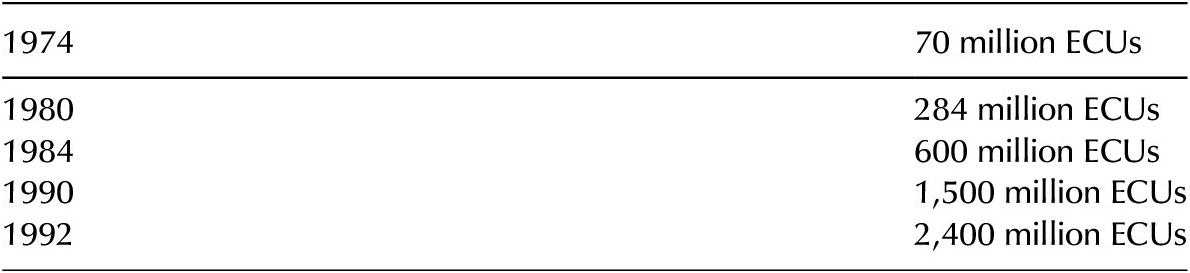
These framework budgets reflect a new kind of common industrial policy. Article 107 of the 1957 Treaty of Rome introduced state aid prohibitions, enforced only when the 1986 Single European Act (SEA) prioritized competition policy over state intervention, which limited the ability of member state governments to do industrial policy by strategically transferring state resources to particular sectors, industries, and firms.Footnote 89 The development of technology policy, however, allowed the EEC to fund research in a wide array of fields with commercial applications. As Table 2 shows, the EEC increased common spending on technological R&D by 22% per year on average between 1974 and 1992 (Table 2). R&D spending in the 1970s prioritized energy and natural resources in response to the 1974 oil crisis, but by the 1980s, industrial research spending on the “high-tech sector” became the priority, especially with the launch of ESPRIT.Footnote 91 And by 1992, Articles 173, 179, and 190 of the Treaty on the Functioning of the European Union (TFEU) officially tasked the EU and its supranational institutions with “boost[ing] the global competitiveness of EU industry.”Footnote 92
EEC R&D spending, 1974–1992Footnote 90
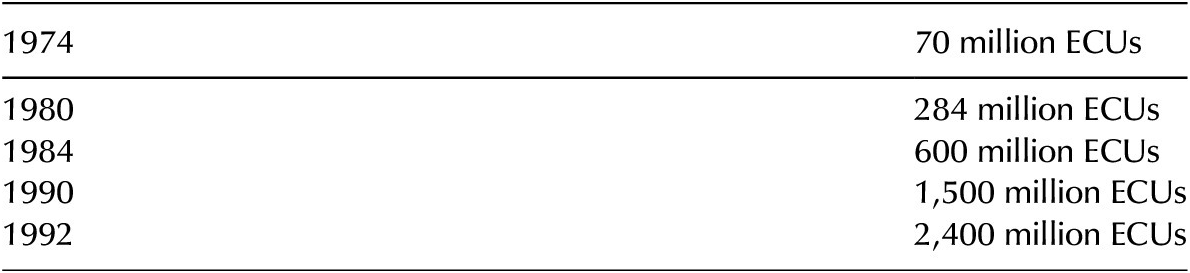
Table 2. Long description
The table lists years in the left column and corresponding E E C R and D spending in millions of E C U in the right column. From top to bottom: 1974, 70 million E C U; 1980, 284 million E C U; 1984, 600 million E C U; 1990, 1,500 million E C U; 1992, 2,400 million E C U. Spending rises steadily across the period. E C U refers to European Currency Units, a weighted basket of E E C member state currencies used until 1999.
Note: ECUs: European Currency Units (weighted basket of EEC member state currencies used as a unit of account until it was replaced by the Euro in 1999).
The concrete achievements and wider legacy for European research policy of ESPRIT, however, have faced criticisms. Political scientists Margaret Sharp and John Peterson argue the program quickly outlived its usefulness, having prioritized subsidies for “lazy” national champions over “seedcorn funding for new enterprises” and fed into a European “proclivity for thinking that laboratory breakthroughs can substitute for efficient manufacturing or aggressive marketing.”Footnote 93 And as historian David Irion argues, treaty recognition for European research policy came with in-built flaws, laying the groundwork for a budget spread across a fragmented landscape of priorities that even qualified majority voting could not rectify.Footnote 94 Criticisms notwithstanding, member states renewed ESPRIT three times, with the program continuing to match funding for European interfirm collaboration and with a gradually increasing focus on consumer experience.Footnote 95 By the 1990s, the rhetoric of technological superiority over counterparts had waned, but the FPs had become a core component of common technology policy and laid the foundation for research policy.Footnote 96
Toward a New Competitiveness Paradigm and the Legacies of ESPRIT
By early 1982, the roundtable approach to policy design had demonstrated its practicality to the Commission, so much so that one Directorate-General III official wrote internally that “a cooperation of the ‘roundtable’ type should be started in other sectors.”Footnote 97 Rapid progress by the JEPE-IT was also synchronous with “several” 1982 meetings between Davignon and Pehr Gyllenhammar, the Volvo CEO who would prove instrumental in the ERT’s founding in the following year.Footnote 98 The ERT was thus born into an existing ecosystem of business forums with chief executives and policymakers readily participating, and in emulating the US Business Roundtable, was another US innovation imported to the EEC like managerial practices and business school training.Footnote 99 Davignon’s leadership in convening the Big 12 Roundtable and his involvement in discussions of an ERT-type roundtable years earlier reveal the entrepreneurial role of the Commission in establishing these new business forums. In this sense, the “new rapprochement” resulting in the ERT, for which van Apeldoorn gives Davignon credit, had been many years in the making.Footnote 100 The business forums established by the Commission in the 1970s-1980s reveal its industrial policy approach to economic governance, reflecting not only protectionist interests in the ERT’s membership but also legacies of industrial policy both at national levels, and at the European level through ESPRIT.Footnote 101 Yet, in its White Paper on European “Growth, Competitiveness, and Employment” in 1993, the Commission addressed the ongoing economic recession—despite the very recent “completion” of the Single Market, establishment of the political European Union, and launch of economic and monetary union—by advocating for increased attention on European ICT and high tech as “the heart of the development model for the 21st century” and “a crucial aspect in the survival or decline of Europe.”Footnote 102 To support the development of a European “information society,” the Commission proposed the creation of a “Task Force on European Information Infrastructures […] with a direct mandate from the European Council.”Footnote 103
In 1994, only a decade after the EEC launched ESPRIT and following the dissolution of the Big 12 Roundtable, the Task Force presented a starkly different vision for how the European ICT industry should be supported in a report requested by the Council.Footnote 104 Commissioner Martin Bangemann, responsible for the industrial affairs as well as the telecommunications and information society portfolios, convened business representatives, including Gyllenhammar, six representatives of the original Big 12 Roundtable, and Davignon (then as chairman of the Société générale de Belgique) to create the Task Force, often referred to as the “Bangemann Group.” This new forum, yet another example of the redundant multiplication of peak organized business, urged the Council to “put its faith in market mechanisms as the motive power to carry [Europe] into the information age” and to “improve the competitiveness of all industry [for] the satisfaction of societal needs for a better quality of life.”Footnote 105 In a rebuke of the previous decade’s approach of state-led efforts to strengthen homegrown IT industries, and reflecting economic debates between institutionalists and technologists, the “Bangemann Group” encouraged fostering an “entrepreneurial mentality” and continuing the work of standardization with a “common regulatory approach.” Most provocatively, this new approach did “NOT mean more public money, financial assistance, subsidies, dirigisme, or protectionism.”Footnote 106 But it did claim legitimacy by resting on the “scientific and conceptual basis” of previous framework programs.Footnote 107 ESPRIT II had aimed to “strengthen the economic and social cohesion of the Community and the promotion of its overall harmonious development,” especially by supporting the program participation of small and medium-sized enterprises, further implemented in ESPRIT III.Footnote 108 Most importantly, although policymakers recognized ESPRIT as the foundation for subsequent common research and development programs in high tech, the fourth FP “move[d] away from the ‘technology push’ policies of previous framework programs” and introduced new approaches for technology policy “implementation and technical content.”Footnote 109 The evolution of ESPRIT laid the foundation for further innovations on common industrial policy in the twenty-first century.Footnote 110
The “Bangemann Group” vision of a high-tech Europe reflected the post-Maastricht era’s neoliberal bent, emphasizing the “competitiveness paradigm” and deregulation. In the 1980s, the Commission justified protectionism and “non-market means” with the goal of European “competitiveness.”Footnote 111 But in response to the new economic challenges, a changing constellation of voices on already institutionalized business forums, coupled with economic thought emphasizing market and trade liberalization, and the benefits of dynamism from the mobilization of private capital, accelerated the transition toward a new, more neoliberal and less neo-mercantilist vision for European economic policy.Footnote 112 The contrast between the conclusions of the Big 12 Roundtable and those of the Bangemann Group a decade later challenges assumptions about the homogeneity of business interests across firms and sectors over time, since executives from some of the same firms that had championed industrial policy in the 1980s embraced new policy solutions to Europe’s problems in the ICT sector.
By the 1990s, industry executives had proven not only reliable partners, but enthusiastic participants in the Commission’s many business forums to provide policy input. Business forums like the Big 12 Roundtable and Bangemann Group are also emblematic of the increasingly “revolving door” between the Commission and executive positions at the same European firms given privileged access to these forums. After losing the race for Commission President to Jacques Delors, Davignon landed board memberships at several major companies and served as President of the Société générale Belgique until 2001,Footnote 113 with Bangemann later joining the ranks of former Delors Commission members entering the corporate world with a position at Spanish Telecom giant Telefónica, another member of this 1994 group.Footnote 114 The Commission-business networking pioneered by Ortoli and finding its footing under Davignon began offering benefits not only to the Commission’s policymaking process, but also offered new exit options to the Commissioners themselves. Institutionally, Brussels was slow to cope with the conflicts of interest arising from increasingly intertwined corporate and policymaker worlds. Only in 1999—after mass resignations in light of corruption scandals—did the European Commission adopt a Code of Conduct,Footnote 115 and only by 2007 did amendments to the Treaty on the Functioning (TFEU) of the European Union explicitly insist on the “[economic] independence of Commissioners.”Footnote 116
Conclusions
This history of the EEC’s creation of business forums like the Big 12 Roundtable and the development of a regional technology policy program like ESPRIT reveals how the competitive pressures Europe faced in the 1970s and policy constraints of multilevel governance motivated a new form of business-government relations as well as industrial policy innovation.Footnote 117 We have shown how the Commission solicited policy advice for the competitiveness of European firms by creating business forums like the Big 12 Roundtable focused on high tech, a model repeated across sectors, and then broadened in the creation of the ERT, underscoring the redundant multiplication of business forums. Furthermore, this history demonstrates how the role of a forum (the Big 12) in creating a plan (the JEPE-IT) to establish a funding program (ESPRIT) designed to directly support select large firms obfuscated both business influence and policy favoritism. This structure reflects the ways Commissioners like Étienne Davignon innovated around the constraints of fragmented policymaking and the challenges of intergovernmental compromise to develop a modest and unthreatening program to support the development of a regional high-tech industry.
We have also shown how the Commission implemented industry input by providing funding for research and development through the ESPRIT program and the genealogy of Framework Programs that succeeded it. As the case of the Big 12 Roundtable shows, and as was echoed in the ERT and reflected in efforts to reform ESPRIT to support small and medium-sized enterprises, the Commission traded equitable economic policymaking for the expertise and input of a select few large European tech “champions.” Consequently, we argue, the Commission’s approach to supporting the competitiveness of the high-tech industry in the late twentieth century laid the foundation for ever-closer business-government relations through business forums and the ability to do industrial policy by reframing it first as technology and later as research policy. Despite these innovations of creating business forums and a new policy instrument to fund common technological research and development on a large scale, however, the European Union has continued to discuss new approaches to achieving global competitiveness in high tech in the twenty-first century.Footnote 118
Acknowledgments
We thank the participants of the Council for European Studies research network sessions on Business in Politics and Society in Lyon in 2024, Kiran Klaus Patel, Philipp Ther, Laurent Warlouzet, and participants of a workshop on “Industrial Policies since the 1970s in European and Global Comparison” at the KFG on Universalism and Particularism in Contemporary European History at LMU Munich in 2025, and James Stafford, Madeleine Dungy and participants of a panel on “The Politics of Trade Wars” at the American Historical Association conference in Chicago in 2026 for their helpful comments and questions on earlier drafts of this article. We also thank Dimitri Zurstrassen for his collaboration, David Irion for insightful comments, and Andrew Popp and two anonymous referees for their incisive feedback.

 Open access

