


Globalization has placed immense demands on parties, especially those that traditionally favored free markets and deregulation, to adapt to a political landscape where voters increasingly expect protection from the economic risks posed by global integration. The previous chapter concludes that, in response, many center-right parties have moderated their ideological positions on the main socioeconomic left–right dimension, making promises that are more centrist. However, this strategy creates a dilemma for center-right parties: How can they address voters’ economic anxieties without alienating their traditional support base that favors limited government? Moving too far to the left risks losing the support of their core supporters, who continue to prefer open markets and limited government intervention. We argue that in response to these competing pressures, mainstream center-right parties have increasingly turned to populist rhetoric in their promises – particularly on issues like national identity, immigration, and cultural values – as a means of broadening their electoral appeal without entirely abandoning their economically liberal principles.
This strategic pivot toward cultural populism is a direct consequence of globalization’s effects on voters’ expectations. The chapter examines how center-right parties have responded to these pressures by adopting exclusionary populist rhetoric and focusing on noneconomic issues, such as national sovereignty and immigration. These parties have increasingly embraced a narrative that pits “the people” against “elites,” both at the national and international levels, positioning themselves as the defenders of traditional values against the forces of globalization. While the populist rhetoric of the far right has often been seen as a fringe phenomenon, our findings suggest that mainstream parties are also increasingly using these strategies.
The argument that mainstream center-right parties’ use of populist rhetoric is a direct response to the globalization dilemma differs from most accounts of mainstream party populism. Existing accounts have focused on the imitation hypothesis, according to which mainstream party leaders feel compelled to respond to the success of smaller populist parties by imitating them. This may be part of the story in some countries. However, it is at most indirectly related to the main concern of this study: how globalization directly affects mainstream parties’ electoral appeals. Although we do not discount the imitation hypothesis entirely, we do not find strong evidence that mainstream parties are more populist when populist parties are more successful.
To explore the effects of globalization on populist rhetoric in mainstream parties, we analyze a dataset of mainstream political parties from thirty-one established democracies over five decades, focusing on their ideological positions and use of populist rhetoric. Our findings indicate that globalization has played a significant role in reshaping the ideological landscape, pushing especially right-leaning parties toward populism as they seek to balance economic liberalism with citizens’ demands for greater state protection from economic risks.
Mainstream Parties’ Strategic Dilemmas
The socioeconomic left–right dimension has been the main dimension of party competition in a broad range of established democracies for many decades.Footnote 1 Chapter 7 shows that many mainstream political parties, particularly those on the right, have moderated their traditional market-friendly stances as their countries have become more deeply integrated into the international economy. These ideological shifts respond partly to voters’ concerns about the economic insecurity associated with globalization. Such adaptations are at least partly attempts to remain electorally competitive by building broader coalitions of support (Butler Reference Butler2014; Gibson Reference Gibson1996; Ziblatt Reference Ziblatt2017).
The dilemma for center-right parties is that they must strike a balance between pleasing their traditional constituents, who continue to favor more open economies and deregulation, and middle-class voters, who are less willing to support parties that do not have plans to correct the distributional effects of economic integration. Consequently, while center-right parties have moderated their ideological stances, they have generally not gone as far as to promote serious government regulation and redistribution. Comparative research shows that governments have done little to offset the trends in rising inequality; on the contrary, many government policies appear to have become less redistributive over time, especially in more unequal societies (Iversen and Soskice Reference Iversen and Soskice2009; Lindert Reference Lindert2004; Lupu and Pontusson Reference Lupu and Pontusson2023).Footnote 2
Economic risks associated with globalization, combined with government policies that have failed to adequately address these challenges, have generated a pervasive sense of status anxiety among many citizens. This anxiety is particularly acute among middle- and lower-income voters who fear a decline in their social and economic standing. Growing social and economic insecurity in these groups has contributed to deepening social divisions in many societies (Cramer Reference Cramer2016; Iversen and Soskice Reference Iversen and Soskice2019; Judis Reference Judis2016, Reference Judis2018) and rising feelings of injustice and resentment are increasingly reflected in voting behavior (Noury and Roland Reference Noury and Roland2020). Many voters feel left behind by the combination of rising inequality and the neoliberal economic policies pursued by mainstream parties (Appel and Orenstein Reference Appel and Orenstein2018; Huber and Stephens Reference Huber and Stephens2001). A widespread perception has emerged that mainstream parties no longer offer meaningful alternatives on socioeconomic issues; a perception that is supported by comparative research (Grzymala-Busse Reference Grzymala-Busse2019; Spoon and Klüver Reference Spoon and Klüver2019). As a result, many citizens direct blame toward the wealthy or various outgroups, both domestic and foreign, and express growing resentment toward professional elites and minorities within their own countries (Bonikowski Reference Bonikowski2017). Economic anxiety has also fueled a broader cultural and racial backlash, particularly among citizens who feel threatened or alienated by immigration, the spread of liberal cosmopolitan values, and the growing empowerment of minority groups (Gidron and Hall Reference Gidron and Hall2017; Haughton and Deegan-Krause Reference Haughton and Deegan-Krause2020; Norris and Inglehart Reference Norris and Inglehart2019; Pop-Eleches and Tucker Reference Pop-Eleches and Tucker2017). In this context, the continued support by mainstream parties for immigration, neoliberal economic policies, and international integration is increasingly out of step with the preferences of many voters, particularly those who are less affluent and less educated, and instead appeals only to richer and more educated constituencies (Berman Reference Berman2019).
Widespread resentment among citizens toward economic elites has also targeted international actors, including entire countries. For example, economically disadvantaged citizens in the developed world often blame China for their problems (Milanović Reference Milanović2018). Resentment is also directed toward international institutions, which are seen as elitist, undemocratic, and unaccountable. Institutions, such as the European Union, have been blamed for increased immigration, unemployment, and rising inequality (De Vries Reference De Vries2018; Whitefield and Rohrschneider Reference Whitefield and Rohrschneider2015). Many citizens feel their governments have given up their national autonomy to pursue policies that protect the economically privileged. While scholars continue to debate the extent to which the European Union is democratically accountable (Crombez Reference Crombez2003; Dahl Reference Dahl, Shapiro and Hacker-Cordon1999; Follesdal and Hix Reference Follesdal and Hix2006; Hix Reference Hix2008; Karp, Banducci, and Bowler Reference Karp, Banducci and Bowler2003; Meyer Reference Meyer1999; Moravcsik Reference Moravcsik2002, Reference Moravcsik2008; Nye Reference Nye2001; Olsen, Sbragia, and Scharpf Reference Olsen, Sbragia and Scharpf2002; Rohrschneider Reference Rohrschneider2002; Rohrschneider and Loveless Reference Rohrschneider and Loveless2010; Sánchez-Cuenca Reference Sánchez-Cuenca2017; Scharpf Reference Scharpf1992; Schmidt Reference Schmidt2006, Reference Schmidt2020; Schneider Reference Schneider2019), European integration – for good or bad – has reduced policy autonomy at the national level, particularly in the economic sphere (Meyerrose Reference Meyerrose2020, Reference Meyerrose2024; Nanou and Dorussen Reference Nanou and Dorussen2013; Scicluna and Auer Reference Scicluna and Auer2019). Extensive economic integration of this kind has negative effects on democratic accountability and representation at the national level (Ezrow and Hellwig Reference Ezrow and Hellwig2014; Hafner-Burton and Schneider Reference Hafner-Burton and Schneider2023; Hellwig Reference Hellwig2015; Hellwig and Samuels Reference Hellwig and Samuels2007; Kelemen Reference Kelemen2017, Reference Kelemen2020; Meyerrose Reference Meyerrose2020, Reference Meyerrose2024).
The consequences of these developments have included a hollowing out of mainstream political parties particularly on both the right and left (Greskovits Reference Greskovits2015; Hooghe and Marks Reference Hooghe and Marks2018; Mair Reference Mair2013). Center-right parties have ceded their traditional commitments to free markets, while at the same time failing to formulate policies that would really protect lower- and middle-income citizens from the economic risks associated with globalization. Leftist parties, while often maintaining their long-standing commitments to government intervention, have often failed to deliver on these socioeconomically progressive policies when in government, as Chapter 4 of this book demonstrates. These tensions have set the scene for an increase in support for populist antielite parties in many established democracies. This has entailed a shift in party competition toward identity and cultural values, as distinct from socioeconomic policies. The remainder of this section describes the rise in populist parties and populist sentiment in many established democracies, before explaining why many mainstream parties also use populist rhetoric as a response to the strategic dilemmas posed by globalization.
The Rise of Populist Challenger Parties and the Imitation Hypothesis
Populist parties have gained ground in response to citizens’ growing dissatisfaction with mainstream, established political institutions that appear unwilling or unable to respond to their grievances and demands (Bakker, Jolly, and Polk Reference Bakker, Jolly, Polk, Hobolt and Rodon i Casarramona2021; Berman Reference Berman2016, Reference Berman2017; Broz, Frieden, and Weymouth Reference Broz, Frieden and Weymouth2021; Foa et al. Reference Foa, Klassen, Slade and Rand2020). Support for populist parties is in many ways driven by their promise to end the source of rising inequality: globalization (Pastor and Veronesi Reference Pastor and Veronesi2018, Wiesehomeier, Dupont, and Ruth-Lovell Reference Wiesehomeier, Dupont and Ruth-Lovell2024). Working class citizens have been especially likely to respond to populist appeals (Berman Reference Berman2019; Stanley Reference Stanley, Kaltwasser, Taggart, Espejo and Ostiguy2017). The financial crisis of 2008 alone triggered a wave of populist sentiments across established democracies (Eichengreen Reference Eichengreen2018; Funke, Schularick, and Trebesch Reference Funke, Schularick and Trebesch2016; Rodrik Reference Rodrik2012; Schäfer Reference Schäfer2013).
Populist parties frame political discourse around a stark division between the “corrupt elites” and the “ordinary people” (Mudde Reference Mudde2007; Taggart Reference Taggart2000). By doing so, they portray the political establishment as an elite group that prioritized their own economic and political interests, often at the expense of the wider population. This antielite narrative has resonated deeply with voters who feel abandoned or disenfranchised by the traditional parties that they once trusted to protect their interests. Populists promise to reverse this dynamic, presenting themselves as the true defenders of the people against the entrenched elites, both within the country and in international institutions.
Populist parties have also positioned themselves as more responsive to the issues that mainstream parties had neglected or inadequately addressed. For example, concerns about immigration, globalization, and economic insecurity were frequently dismissed or downplayed by the traditional parties, especially in the face of pressures to maintain proglobalization stances. Mainstream parties often respond to such concerns with technocratic solutions or frame issues in ways that do not resonate with many citizens (De Vries and Hobolt Reference De Vries and Hobolt2020). In contrast, populist parties politicize these concerns directly, addressing them with a sense of urgency and in ways that align more closely with voters’ preferences. On such topics as immigration, populists frequently capitalize on anxieties about national identity, economic competition, and cultural change, offering simple (and often extreme) solutions that draw stark lines between insiders and outsiders (Hobolt and Tilley Reference Hobolt and Tilley2014).
Populists also readily tap into the antiglobalization sentiment, appealing to voters who see globalization as a threat to their economic security and national sovereignty. This gives populists a significant advantage over mainstream parties, which often hesitate to take strong stances against international economic integration. By foregrounding antiglobalization and nationalist rhetoric, populist parties effectively build a political identity that contrasts starkly with the establishment’s perceived complicity in the negative effects of globalization, such as job losses, wage stagnation, and economic inequality (Mudde and Rovira Kaltwasser Reference Mudde and Kaltwasser2018; Norris and Inglehart Reference Norris and Inglehart2019). Politicizing globalization and immigration as causes of citizens’ struggles has allowed populist parties to build a broad base of support, while mainstream parties have struggled to adapt their platforms in ways that effectively address these growing anxieties.
There are noteworthy differences between leftist and rightist populist parties. Both types of populists are antiestablishment parties that claim to be championing the interests of the people against elites. However, leftist populists tend to focus more narrowly on economic issues than the nationalist and xenophobic rhetoric that characterizes right-wing populism (Rydgren Reference Rydgren2014). For example, while parties like Syriza in Greece have campaigned on antiausterity platforms and railed against international financial institutions, they have not embraced the anti-immigration rhetoric that has been central to right-wing populist movements (Kitschelt Reference Kitschelt1996; Mudde and Rovira Kaltwasser Reference Mudde and Kaltwasser2018). Like other populist parties that succeeded in entering government, Syriza found it impossible to fulfill many of its radical promises; having campaigned on a platform of rejecting austerity, it was forced to accept an austere bailout package from the European Union (Ruiz-Rufino Reference Ruiz-Rufino2025; Stavrakakis and Katsambekis Reference Stavrakakis and Katsambekis2014). In contrast, right-wing populist parties combine economic grievances with cultural resentment (Mutz Reference Mutz2018). This offers a more emotionally resonant narrative to voters who fear the erosion of traditional values due to immigration and globalization (Kriesi et al. Reference Kriesi, Grande, Lachat, Dolezal, Bornschier and Frey2008; Mudde Reference Mudde2007). Right-wing populist parties – such as the National Rally (formerly National Front) in France or the Alternative for Germany (AfD) – have capitalized on voters’ frustrations with globalization by adopting exclusionary, nationalist rhetoric.
Mainstream parties have had to consider how best to respond to the growing support for populist parties (Rooduijn Reference Rooduijn2014), and they have adopted various strategies, including dismissive, adversarial, and accommodating stances (Meguid Reference Meguid2005, Reference Meguid2008). The imitation hypothesis posits that the most common response by mainstream parties to the rise of populist parties has been one of imitation.Footnote 3 Simply put, leaders of mainstream parties see the success of populist parties and decide to use similar rhetoric and positions in response to this electoral threat. De Vries and Hobolt (Reference De Vries and Hobolt2020) argue that mainstream parties have adjusted to the political climate created by populist entrepreneurs by tapping into antielite sentiment and populists’ demands for national sovereignty and protectionism. Akkerman, Lange, and Rooduijn (Reference Akkerman, de Lange and Rooduijn2016) demonstrate that the rise of populist radical-right parties pushes mainstream parties to engage with populist themes such as nationalism, anti-immigration sentiments, and skepticism toward globalization. This strategic adaptation is evident across a range of established democracies, where mainstream parties, particularly those on the center-right, have shifted their policy positions and rhetorical strategies to appeal to voters drawn to populist alternatives (Meguid Reference Meguid2005). Van Spanje and Van der Brug (Reference Van Spanje and Van Der Brug2009) further explain that mainstream parties adopt populist stances to neutralize populist parties’ success, especially by co-opting their messages on issues like immigration and national identity (see also Abou-Chadi and Krause Reference Abou-Chadi and Krause2020; Hobolt and Tilley Reference Hobolt and Tilley2014). By framing national identity in more exclusive terms and positioning themselves as defenders of traditional values against the perceived threats of globalization, center-right parties have sought to retain voters who might otherwise be drawn to more extreme populist alternatives (Canovan Reference Canovan1999; Mudde and Rovira Kaltwasser Reference Mudde and Kaltwasser2013).
There are many examples that fit the imitation hypothesis. For instance, in France, the mainstream conservative Republicans adopted tougher stances on immigration to counter the rise of the populist National Rally, emphasizing French identity and national sovereignty. Similarly, in the Netherlands, the mainstream conservative People’s Party for Freedom and Democracy moved toward more restrictive immigration policies in response to the populist Party for Freedom. In both cases, mainstream right-wing parties used populist rhetoric to retain electoral support without fully embracing the extreme economic and nationalist positions of their populist rivals.
Populism as a Mainstream Center-Right Party Response
While mainstream parties may indeed imitate the rhetoric of successful populist parties, this does not capture the full story about how globalization affects center-right parties’ electoral strategies. The kernel of the problem lies in the dilemma faced by center-right parties that we described earlier. Center-right parties respond to citizens’ rising expectations of their governments by moderating their stances on socioeconomic policies. However, they cannot fully embrace the policies that would make a discernible difference in terms of reducing economic risks without alienating their core supporters, who favor free markets and deregulation. Instead, these parties have chosen to address voter concerns by emphasizing cultural issues – such as stricter immigration controls, law and order, and national identity – while maintaining their economically liberal stances. By doing so, they respond to the socioeconomic anxieties of globalization while making only marginal adjustments to their traditional commitments to free-market principles (Häusermann, Picot, and Geering Reference Häusermann, Picot and Geering2013).
This approach allows center-right parties to compete in an increasingly uncertain political landscape. Rather than shifting dramatically leftward on economic issues, they offer selective economic adjustments – such as tax incentives or limited welfare programs – while pivoting to cultural populism to address voters’ concerns. Hays (Reference Hays2009) argues that while globalization has heightened citizens’ demands for social protections, center-right parties have navigated these pressures by offering targeted benefits and emphasizing national sovereignty and cultural conservatism. This strategy, which combines piecemeal measures and avoidance, has enabled them to retain electoral support, particularly among the middle class, which seeks security from globalization’s economic and cultural disruptions without fully embracing left-wing policies. Although this strategy avoids real remedies for the economic risks to which citizens are exposed, shifting the attention toward cultural and identity-based appeals is to an extent responding to voters’ real concerns too. Issues such as immigration, national sovereignty, and cultural liberalization have become central concerns for voters affected by the socioeconomic changes brought about by globalization (De Vries Reference De Vries2018; Polk et al. Reference Polk, Rovny, Bakker, Edwards, Hooghe and Jolly2017).
Our argument is not incompatible with the imitation hypothesis. Center-right parties may have learned to use the populist toolbox by observing populist parties in national and foreign contexts.Footnote 4 However, our argument that mainstream parties’ use of populist rhetoric is a direct response to the globalization dilemma does provide an alternative explanation that is independent of the existence of populist opposition parties at the national level at any particular time. The United States provides an obvious example of a conservative party that has become consumed by populist rhetoric in the absence of a significant populist party. The US electoral system effectively prevents any third party from emerging even if there was underlying social support for one. Since the mid 2010s the Republican Party under Donald Trump exemplified this dynamic. Trump’s three presidential campaigns, in 2016, 2020, and 2024, heavily emphasized themes of national sovereignty, protectionism, and anti-immigration sentiment, tapping into the anxieties of voters who felt economically and culturally marginalized by globalization. While the Republican Party previously focused more clearly on economic conservatism, the party has pivoted toward identity politics, promising to “Make America Great Again” by restoring traditional values and rolling back the influence of globalism. This shift toward cultural populism allowed the Republican Party to maintain its core economic principles while capturing the support of voters who have become disillusioned by both economic and cultural globalization (Brubaker Reference Brubaker2017; Pirro and Van Kessel Reference Pirro and Van Kessel2017; Vachudova Reference Vachudova2020).
Center-right parties have historically used religious and national issues to sustain broad coalitions of support (Riker Reference Riker1986; Shepsle and Bonchek Reference Shepsle and Bonchek1997). After World War II, the expansion of suffrage exposed these parties to a wider array of voters’ concerns, many of which focused on issues like immigration, national identity, and the perceived erosion of traditional values. Many center-right parties had to adapt to broaden their appeal beyond narrow sections of economic elites. This flexibility has given them an advantage in adapting to changing demands, particularly in response to the negative cultural consequences of globalization. While center-right parties may struggle to offer meaningful economic solutions to low- and middle-income voters who are most affected by globalization, they have learned that emphasizing cultural or value-based issues can allow them to attract voters increasingly concerned about these societal changes (Tavits and Potter Reference Tavits and Potter2015).
By contrast, left-wing parties have been notably less likely to embrace full-fledged populist rhetoric in response to globalization. The question here is whether center-left parties respond to globalization by adopting populist rhetoric and policies, not whether they adopt less populist rhetoric and policies than center-right parties. We argue that center-left parties generally do not respond to globalization by adopting populist rhetoric and policies. One key reason for this is that in response to citizens’ rising expectations of their governments, leftist parties have mainly doubled down on a class-based dimension, pledging to implement policies that protect and improve the lives of the working class, the poor, and those who feel disenfranchised by the global economic system (Hobolt and Tilley Reference Hobolt and Tilley2014; Roberts Reference Roberts2019). These policies, often centered around welfare programs, labor protections, and economic redistribution, resonate with the economic concerns of voters who feel left behind by globalization. As a result, left-wing parties are better positioned to address these grievances without needing to dramatically alter their ideological frameworks. Moreover, leftist parties’ progressive social values have made them less likely to fully embrace populist rhetoric in response to globalization. The problem for leftist parties is not that they do not have appealing policies to reduce the economic risks associated with globalization. Rather, as demonstrated in Chapter 4, the problem is that globalization often constrains them from implementing those policies when they are in government. However, populist rhetoric appears less successful at avoiding retrospective sanctioning.
In sum, we argue that globalization has not only pressured center-right parties to shift to the center of the socioeconomic left–right spectrum but also to adopt populist rhetoric and policy promises in an effort to address the dilemma caused by this ideological adjustment. Center-right parties’ use of populist rhetoric allows them to make relatively modest adjustments to their economically liberal positions, while at the same time appealing to a sufficiently large electoral base to sustain themselves through elections.
Data and Variables
The theoretical argument stated herein suggests that as economic globalization deepens, mainstream center-right parties have incentives to use populist rhetoric as a strategy to minimize electoral losses. Using comparative data on the extent to which parties adopt populist rhetoric, we find that this is indeed the case.
Dependent Variable: Mainstream Parties’ Use of Populist Rhetoric
We examine data on the levels of populist rhetoric in the electoral appeals of mainstream political parties across thirty countries between 1970 and 2019.Footnote 5 Mainstream parties are parties that are classified as socialist or left, social democratic, liberal, Christian democratic, or conservative using the Manifesto Project’s classification of parties into families (Lehmann et al. Reference Lehmann, Franzmann, Al-Gaddooa, Burst, Ivanusch and Regel2024). We exclude parties that are classified as ecological, nationalist, agrarian, ethnic, or otherwise special issue parties. We also exclude populist parties such as the AfD in Germany or UK Independence Party in the United Kingdom. Populist parties do enter our analysis, but as an explanatory variable, when we control for the electoral strength of those parties to test the imitation hypothesis. The unit of analysis is the political party–election year.
To measure Political Party Populism, we use the populist index by V-Party (Lindberg et al. Reference Lindberg, Düpont, Higashijima, Kavasoglu, Marquardt and Bernhard2022), which is an expert-coded dataset on political parties worldwide and part of the V-Dem Project (Coppedge et al. Reference Coppedge, Gerring, Glynn, Knutsen, Lindberg and Pemstein2020; Lindberg et al. Reference Lindberg, Düpont, Higashijima, Kavasoglu, Marquardt and Bernhard2022). The index captures the extent to which parties rely on populist rhetoric with a focus on the extent to which parties glorify ordinary people and identify themselves as part of them (people-centrism) and the salience of antielite rhetoric. This approach equates populist rhetoric with support for antielitism, people centrism, and a moralized Manichean worldview. Populists tend to depict the elite as self-serving, unresponsive and corrupt, while the people tend to be glorified as morally superior (Mudde and Rovira Kaltwasser Reference Mudde and Kaltwasser2018).
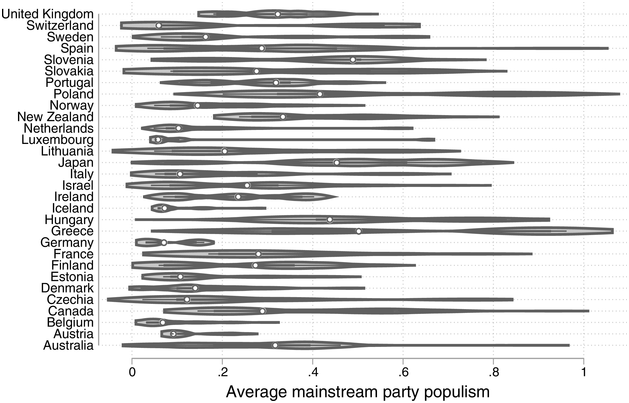
Figure 8.1 shows that there is significant variation in the use of populist rhetoric by mainstream parties across different liberal democracies, underscoring how this strategy is more prevalent in some countries than others. The sample includes only mainstream parties and excludes extremist or fringe parties. In some countries, such as Belgium, Luxembourg, and Iceland, mainstream political parties have used populist rhetoric sparingly. These countries tend to have stable political environments and high levels of trust in government institutions, allowing mainstream parties to maintain relatively inclusive, technocratic, and consensus-driven approaches.
Populist rhetoric of mainstream political parties, 1970–2019
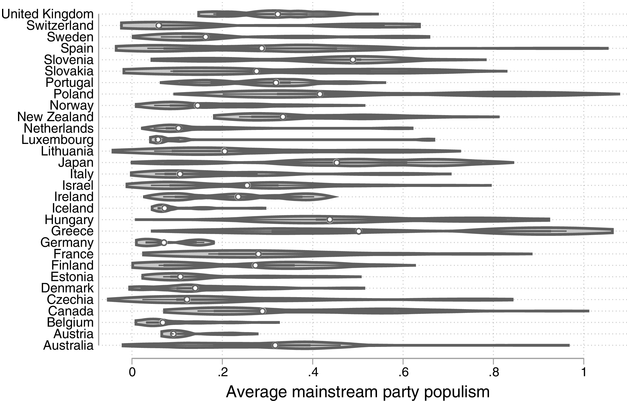
Figure 8.1 Long description
The 30 countries plotted are United Kingdom, Switzerland, Sweden, Spain, Slovenia, Slovakia, Portugal, Poland, Norway, New Zealand, Netherlands, Luxembourg, Lithuania, Japan, Italy, Israel, Ireland, Iceland, Hungary, Greece, Germany, France, Finland, Estonia, Denmark, Czechia, Canada, Belgium, Austria, and Australia.
In contrast, in countries like the United Kingdom, Poland, and Australia, many mainstream parties have high levels of populist rhetoric in recent years. In the United Kingdom, for example, the Conservative Party’s use of populist themes became especially pronounced during and after the Brexit referendum. The party adopted strong antielitist and nationalist rhetoric, framing the European Union as an oppressive foreign power and positioning Brexit as a way to “take back control.” This populist messaging resonated with voters who felt left behind by globalization and distant from political elites in Brussels. The Conservatives emphasized national sovereignty and British exceptionalism, using populist rhetoric to win over voters concerned with immigration, national identity, and economic independence.
Similarly, in Poland, the Law and Justice Party (PiS) effectively leveraged populist rhetoric to consolidate power during its years in government. While in office from 2015 to 2023, PiS consistently framed the political elite, judiciary, and media as detached from ordinary Poles, portraying itself as the defender of traditional Polish values and national sovereignty, especially in opposition to perceived interference from the European Union. The party embraced a nationalist and socially conservative platform, opposing liberal immigration policies and resisting progressive cultural changes. This turn toward populist messaging enabled PiS to maintain mainstream appeal while mobilizing voters anxious about the social and economic consequences of globalization, including job insecurity and cultural displacement.
In Australia, the Liberal Party increasingly adopted populist rhetoric, particularly around issues of immigration and national security. In response to growing concerns over globalization’s effects on the Australian economy and cultural identity, the party adopted tough stances on border protection and immigration control, often framing these issues in populist, nationalist terms. The Liberal Party’s rhetoric around “stopping the boats” and tightening immigration policies resonated with voters who were anxious about the economic and social impacts of globalization.
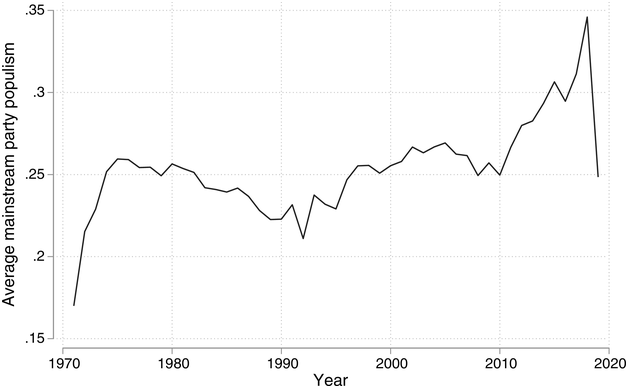
These examples suggest that populist rhetoric is not confined to fringe movements but is increasingly being incorporated into the platforms of mainstream parties as a strategic response to the pressures and uncertainties posed by globalization. Figure 8.2 further indicates that the trend of populism among political parties is increasing. Whereas mainstream parties in Western liberal democracies used populist rhetoric only sparingly in the 1970s (with an average value of 0.2), the use of populist rhetoric increased to an average of 0.25 in the 1980s and 2000s and then increased more significantly to an average of over 0.3 in 2019.
Average mainstream party populism, 1970–2020
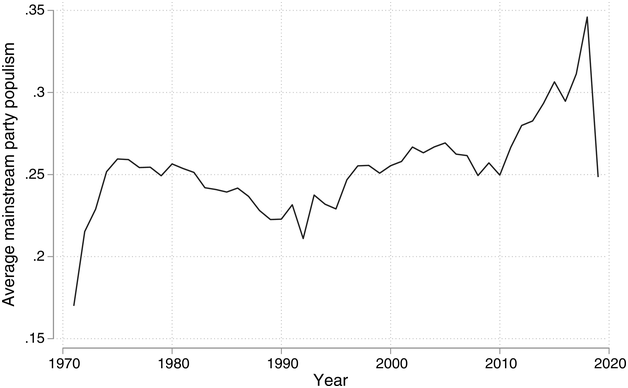
The trend of increasing populism among political parties, as indicated by Figure 8.2, is driven by a combination of long-term structural changes and more recent sociopolitical dynamics that mirror the increasing but varying constraints of globalization. In the early years of the 1970s, mainstream parties in many Western liberal democracies were operating at the tail end of the postwar consensus associated with sustained economic growth. The largest parties generally took centrist positions, and the use of populist rhetoric during this period was relatively rare, as populism was largely associated with fringe movements that capitalized on dissatisfaction with the political establishment. However, several key factors began to shift the political landscape, leading to a gradual rise in the use of populist rhetoric by mainstream parties. First, the economic stagnation of the 1970s and the neoliberal turn of the 1980s – marked by deregulation, privatization, and the weakening of the welfare state – created growing inequality and economic insecurity, particularly among lower- and middle-income voters. This fueled a sense of alienation from the political establishment, which populism could effectively tap into by blaming elites for failing to address these economic grievances. The rise of globalization in the 1990s further intensified this trend, as many citizens felt economically marginalized by the growing integration of global markets, job displacement, and increased competition from foreign labor.
By the 2000s, the populist narrative had found fertile ground in the landscape of increasing concerns over immigration, multiculturalism, and national sovereignty. Mainstream parties, especially on the center-right, began to adopt populist rhetoric to appeal to voters who were anxious about these developments. The 2008 global financial crisis exacerbated these anxieties, leading to widespread disillusionment with the political establishment’s ability to manage the economy and provide security. As a result, the use of populist language surged, with parties across the political spectrum, including center-left parties, increasingly incorporating populist themes such as antielitism, nationalism, and skepticism of international institutions into their platforms.
The marked increase in populist rhetoric by 2019 reflects the culmination of these long-standing trends. In addition to economic and cultural concerns, the growing polarization of political discourse and the rise of social media have contributed to the amplification of populist messaging. Populist rhetoric, which often simplifies complex issues into “us versus them” narratives, is particularly effective in the fast-paced, emotionally charged environment of digital media. Mainstream parties, feeling the pressure of populist challengers and the shifting demands of their electorates, have increasingly resorted to populist rhetoric to remain electorally competitive in a political climate shaped by economic uncertainty, cultural backlash, and distrust of traditional institutions.
Principal Explanatory Variables
As in the previous chapters, the data include cases where parties and governments were exposed to very different levels of globalization, which is our key explanatory variable. As in previous (KOF) chapters, we use the authoritative Konjunkturforschungsstelle Economic Globalization Index, which is an annual weighted aggregation of information on de facto and de jure trade and financial globalization:
Globalization is the extent to which a country is integrated into the international economy, including information on trade in goods and services, trade regulations, tariffs and agreements, foreign direct investment, investment restrictions, and capital account openness. Data are from Dreher (Reference Dreher2006).
Control Variables
To address omitted variable bias, we include several control variables at the levels of countries, election years, and party programs that have been used in previous research. At the level of election years, we control for:
Populist Party Vote Share measures the absolute vote share of populist parties in the country (excluding the vote share of the party under consideration if that party is a populist party). Data are from V-Party. Crucially, this variable allows us to test the imitation hypothesis, as well as to test our main alternative globalization hypothesis while controlling for the effects of populist party vote share.
Organizational Strength measures how strongly a political party is rooted in society. Data are from V-Party.
Intraparty Concentration captures the extent to which power rests in the hand of one leader or a small leadership elite. Data are from V-Party.
Left–Right Position measures partisan ideology on the left–right axis from the Comparative Manifesto Project. We use the so-called Right–Left Scale scores, which are also derived from parties’ election manifestos or platforms. Data are from Volkens et al. (Reference Volkens, Krause, Lehmann, Matthieß, Merz, Tegel and Wessels2019). By modeling an interaction between the variables Globalization and Left–Right Position, we can test our main theoretical expectation that it is parties of the center-right that increase their use of populist rhetoric in response to globalization.
Distinct Party Platform measures the ideological convergence and the existence of a space for contenders to exploit the perceived crisis of representation. Data are from V-Party.
Corruption captures public sector corruption, or the extent to which public sector employees engage in corrupt activities. Data are from V-Party.
Economic Growth measures the average growth rate of the country over the lifetime of the government. Data are from the World Bank Development Indicators, compiled by the Princeton Niehaus Center for Globalization and Governance World Economics and Politics Dataverse.
Per Capita Gross Domestic Product measures the level of economic development. Data are from V-Party.
Incumbency captures whether the party holds executive office or not at the time of their use of populist rhetoric. Data are from country specialists in the Comparative Pledges Project and supplemented with data from the European Journal of Political Research Data Yearbooks.
Government Experience takes the value 1 if the political party has had any experience in executive government and 0 otherwise. Data are from V-Party.
Descriptive statistics for all variables are presented in the online Supplementary Material. We standardized all continuous explanatory variables to a mean of 0 and a standard deviation of 1.
Globalization Increases Mainstream Parties’ Use of Populist Rhetoric
Since the dependent variable varies between 0 and 1, statistical analysis assuming a normal error structure can produce biased and incorrect estimates when data are doubly bounded. We estimate beta regression models with a logit link function, which use an error structure appropriate for our data (Papke and Wooldridge Reference Papke and Wooldridge1996). All estimations include standard errors that are clustered at the country-year level and a time trend. The inclusion of country fixed effects allows us to control for any unobserved factors that are constant within countries over time and further isolate the relationship between Globalization and Political Party Populism.
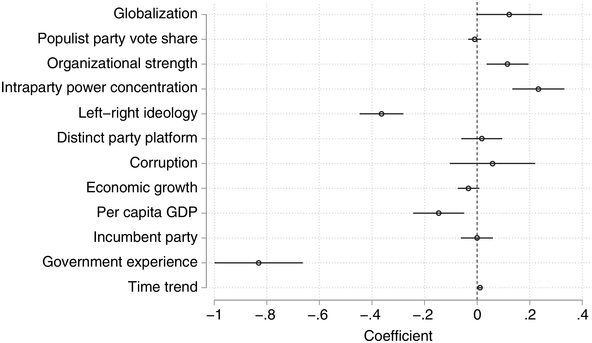
The coefficients from the model depicted in Figure 8.3 summarize the effects of a range of explanatory variables that have been examined in previous studies of populism (full numerical results in tabular format are presented in the online Supplementary Material). The independent variables are arrayed along the vertical axis, with the reference value omitted. The marginal effects are plotted on the horizontal axis. The estimated coefficients are denoted by a dark-gray circle, and their 95 percent confidence intervals are marked by bars of the same color. The dashed vertical line represents a coefficient of 0.
Globalization and political party populism
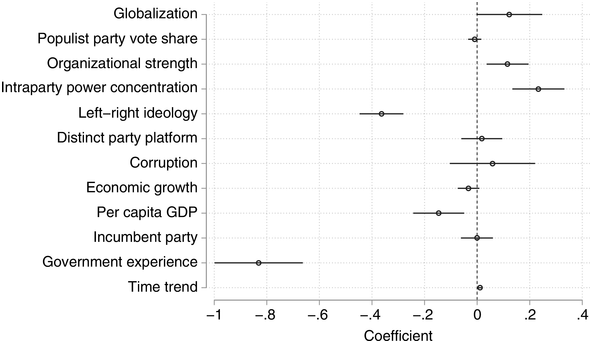
Figure 8.3 Long description
The 12 variables are globalization, populist party vote share, organizational strength, intraparty power concentration, left right ideology, distinct party platform, corruption, economic growth, per capita G D P, incumbent party, government experience, and time trend. The variable Government Experience stands out with the lowest coefficient while the rest remain relatively near x = 0.
In line with our theoretical expectations, the findings indicate a positive and significant association between globalization and mainstream party populism. Mainstream parties’ use of more extensive populist rhetoric increases by 0.12 (on a scale of 0 to 1) when their country’s integration into the global economy increases by 1 standard deviation. The effect is significant at p<0.055. It is remarkable that this strong positive effect of globalization is evident even in a model that controls for a host of other factors, including the populist parties’ total vote share. In contrast to the positive effect of globalization on populist rhetoric, the size of populist parties’ vote share has little to no effect, contrary to what we would expect based on the imitation hypothesis.Footnote 6
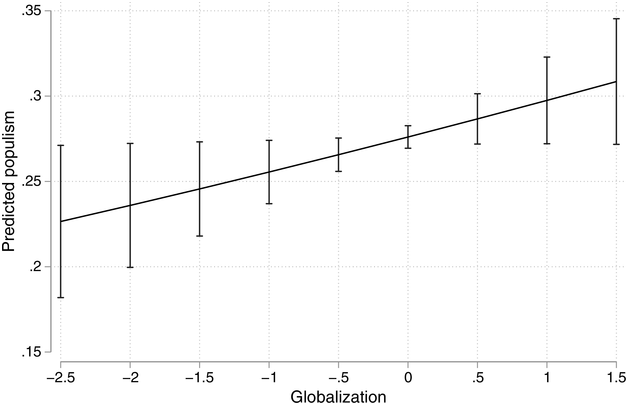
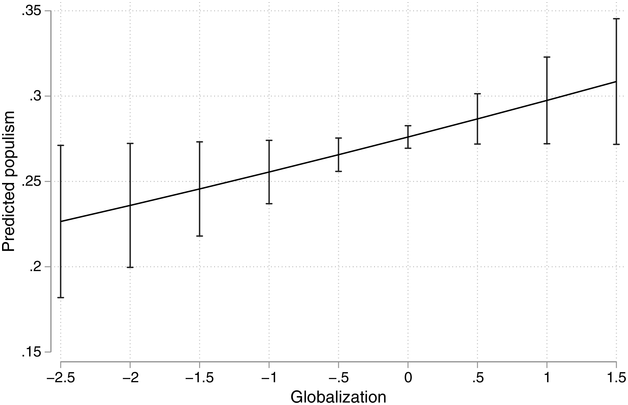
Figure 8.4 plots the predicted levels of populist rhetoric used by mainstream parties for different levels of international economic integration. The clear rising slope suggests that the effect is substantively important. Whereas mainstream parties tend to use little populist rhetoric (0.22 on a 0–1 scale) when they are 2 standard deviations below the average level of economic integration, countries that are deeply integrated into the international economy use significantly higher levels of populist rhetoric (0.30). Nonetheless, considering that the scale of populist rhetoric ranges from 0 to 1, mainstream parties are generally still at the lower end of it.Footnote 7
Predicted levels of populist rhetoric at different levels of globalization
The results for the control variables are largely in line with the existing literature. Political parties become more populist the more strongly the party is rooted in society and the greater the intraparty power concentration or the internal cohesion of the party elites. The main effect of parties’ left–right positioning is negative. This means that controlling for a host of other variables (including globalization), parties further to the right use less populist rhetoric. While this is relevant to note, our main concern is with how parties respond to globalization, and whether leftist and rightist parties respond differently, the main issue to which we turn next. The negative effect of per capita gross domestic product indicates that populism is also more widespread among mainstream parties in lower-income countries.
Right-Wing Parties and the Lure of Populism
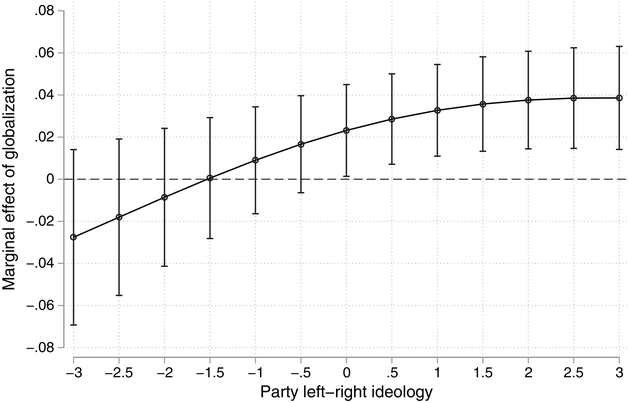
So far, the results indicate that globalization is significantly and positively associated with mainstream parties’ use of populist rhetoric. However, our argument indicates that the pressures to use more populist rhetoric are particularly strong for political parties on the right of the ideological spectrum. While leftist parties have few incentives to change their socioeconomic left–right ideological positions in response to globalization, center-right parties are under pressure to move to the center (see the results in Chapter 7). Center-right parties are, however, limited in the extent to which they can support policies that would alleviate the economic risks associated with globalization. Populist rhetoric is a strategy for center-right parties to deflect attention from this, as well as to respond directly to some voters’ concerns relating to cultural and nationalist issues. To explore this possibility, we estimated the main model with an interaction between Party Left–Right Ideology and Globalization. Figure 8.5 depicts the effect of globalization on the use of populist rhetoric for political parties at different points on the left–right ideological dimension (full tabular results in the online Supplementary Material).
Effect of globalization on populist rhetoric for different party ideologies
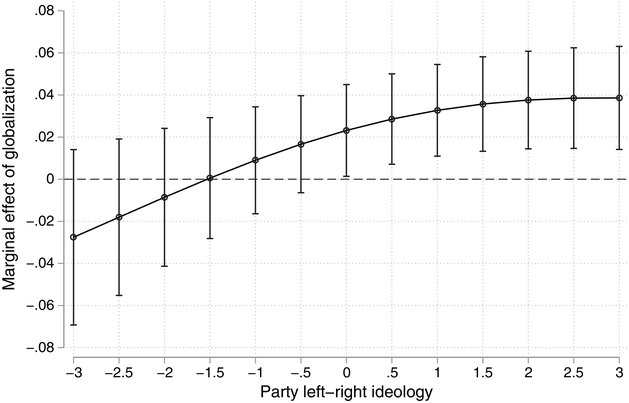
The findings support our argument. Mainstream center-right parties use higher levels of populist rhetoric when their countries are more exposed to economic globalization. The size of the effect of economic globalization on the use of populist rhetoric does not appear to differ markedly between centrist and rightist mainstream parties; both respond significantly to economic globalization by using more populist rhetoric. By contrast, leftist parties do not generally appear to respond to economic globalization by adopting more populist rhetoric. This does not, however, preclude leftist parties from addressing some of the same themes, such as immigration and national traditions, that are addressed by parties using populist rhetoric, a point we touch upon in Chapter 7 and to which we return in the concluding chapter.
Discussion
This chapter establishes that mainstream center-right parties use more populist rhetoric as their countries become more exposed to economic globalization. Based on the findings from Chapter 7, we observe that the growing economic risks and uncertainties brought about by global integration have compelled many center-right parties to moderate their ideological positions, as voters increasingly demand protection from the disruptive forces of globalization. This moderation risks alienating their core supporters, who favor economic openness and deregulation. In response, many center-right parties have turned to populist rhetoric, emphasizing cultural and identity-based issues to maintain their electoral competitiveness. Center-right parties’ strategic pivot toward populism is an attempt to cater to voters’ anxieties without abandoning their traditional economic policies entirely. We also observed that while center-right parties have adopted populist rhetoric to a greater extent, left-wing parties have been more consistent in their ideological positions. Left parties, whose traditional platforms already address the economic risks of globalization, have not faced the same pressures to shift their economic promises. However, the persistent constraints imposed by globalization mean that all mainstream parties – whether on the left or right – are navigating a more complex political landscape when deciding over the types of promises they make, one shaped by the shifting demands of voters.
The findings of this and previous chapters provide a range of insights into the challenges that political parties face in a globalized world. Not only are parties increasingly struggling to fulfill their promises, but they are also acutely aware of the electoral consequences of breaking those promises. Voters, particularly in highly globalized contexts, are more likely to punish parties for failing to deliver on their commitments. This dynamic is particularly challenging for left-wing parties, whose platforms often involve promises that are difficult to uphold in an open world. At the same time, right-wing parties face a distinct dilemma: they cannot move too far leftward to promise policies that would genuinely alleviate the economic risks faced by citizens due to globalization, as doing so would alienate key constituencies. Employing populist rhetoric is one of the strategies used by center-right parties to resolve this dilemma.
This brings us to the central question to be addressed in the next chapters of the book: How do parties, both left and right, seek to avoid electoral sanctioning failing to make promises that address voters’ concerns that are caused by globalization or failing to deliver on promises that do? The answer that we explore in the next part of the book lies in the use of ambiguous language in parties’ electoral appeals. Both left and right parties have strong incentives to make their appeals less specific albeit for different reasons. Leftist parties are constrained by their inability to deliver on redistribution and protectionism, while rightist parties fear losing their electoral base by shifting too much toward the center or even too far to the right on issues relating to culture, nationality, and law and order, typical populist themes. Ambiguity is a response to these electoral and ideological challenges, allowing parties to avoid making promises they cannot keep while maintaining electoral appeal. This shift toward more ambiguous language in response to globalization constraints marks a critical change in the relationship between political parties and voters, one that puts further pressure on the idea of effective promissory representation.

 Open access