

1. Introduction
Descriptive representation—the extent to which elected representatives reflect the experiences and outward manifestations of belonging to a particular group (Pitkin, Reference Pitkin1967; Mansbridge, Reference Mansbridge1999)—impacts citizens’ views of the policymaking process (see, e.g., Bobo and Gilliam, Reference Bobo and Gilliam1990; Gay, Reference Gay2002; Barnes and Saxton, Reference Barnes and Saxton2019). People appreciate seeing aspects of themselves mirrored in their elected officials. Recent survey-experimental research uncovers causal relationships between descriptive representation and citizens’ views of democratic decision-making (e.g., Hayes and Hibbing, Reference Hayes and Hibbing2017; Arnesen and Peters, Reference Arnesen and Peters2018; Clayton et al., Reference Clayton, O’Brien and Piscopo2019; Kao et al., Reference Kao, Lust, Shalaby and Weiss2022; Agerberg and Wängnerud, Reference Agerberg and Wängnerud2025). However, we argue that the existing literature does not address the impact of descriptive representation on citizens’ views of the policy process in two important and increasingly common scenarios: (1) when politicians decide on issues that both disproportionately affect and divide a marginalized group, and (2) in instances in which the marginalized group is over-represented in the decision-making process, a situation that, while still rare, is increasingly common.
Using a well-powered, pre-registered survey experiment on committee decision-making in the UK with over 10,000 respondents, we demonstrate that descriptive representation impacts citizens’ attitudes toward decision-making processes differently on more divisive issues, compared with the non-divisive issues that have been studied in existing work.Footnote 1 The impact depends on the level of representation of a marginalized group in the decision-making process. Women’s over-representation can breed discontent if citizens feel that decision-makers are driven by the material interests of a marginalized group. However, on issues where citizens do not see the material interests of the marginalized group at stake, citizens may view over-representation as fair and justified. In short, how citizens’ perceptions of decision-making in contexts of over- and under-representation of a marginalized group depend on the nature of the issue under debate.
We explore how different levels of women’s representation, including over-representation, impact voters’ procedural and substantive perceptions of policymaking for three divisive issues: (1) the introduction of additional sick leave for women on their period, (2) state support for early years childcare, and (3) the introduction of a mandatory waiting period before seeking an abortion. These three policies disproportionately impact women, a marginalized group in politics and particularly in legislatures (Paxton et al., Reference Paxton, Kunovich and Hughes2007, Reference Paxton, Hughes and Painter2010; Tripp and Kang, Reference Tripp and Kang2008; Krook, Reference Krook2010; Krook and O’Brien, Reference Krook and O’Brien2010; Barnes and Córdova, Reference Barnes and Córdova2016; Weeks, Reference Weeks2022), and are divisive among both men and women. This distinguishes them from policies used in related previous studies (e.g., Hayes and Hibbing, Reference Hayes and Hibbing2017; Clayton et al., Reference Clayton, O’Brien and Piscopo2019; Kao et al., Reference Kao, Lust, Shalaby and Weiss2022; Agerberg and Wängnerud, Reference Agerberg and Wängnerud2025), such as stricter penalties for sexual harassment, which receive wide public support.
Respondents perceive committee decisions as fairer when women and men are equally represented in the committee regardless of the type of policy being decided. However, the perception of policy outcomes differs strongly when women are over-represented, depending on the type of issue. With respect to the introduction of an abortion waiting period—a salient issue which is seen as deeply moral and does not impose monetary benefits or costs—the outcome of the decision-making process is generally perceived as fairer when more women are involved. In the case of paid menstrual leave, which respondents perceive as offering a targeted benefit to women, over-representation can drastically reduce perceptions of fairness, especially among those who do not support the benefit. The same is true for childcare, albeit to a lesser extent. Women’s representation in decision-making can impact respondents’ substantive agreement with a policy, but the impact is smaller.
In other words, pushing descriptive representation of women past parity, to the point where it reduces men’s representation relative to their share of the population, has differing effects on attitudes toward the decision-making process depending on the policy under consideration.Footnote 2 Moreover, these differences are not driven by gender. Theoretically, we might expect that women, who are personally affected by the policies and whose opinions on these issues are typically more firmly established, may be less susceptible to cues of women’s descriptive representation and, therefore, less likely to infer from them that decisions are “appropriate” (Mansbridge, Reference Mansbridge1999). Likewise, we might expect men to view decision-making bodies that under-represent them as systematically less fair. However, we do not find evidence for either expectation. Once controlling for initial attitudes toward the policy issues under discussion, men and women react similarly to increasing levels of women’s representation.
Our findings have important normative and substantive implications for how legislatures and other decision-making bodies design the descriptive composition of committees in charge of important decisions, particularly with respect to gender. Although women and other marginalized groups remain underrepresented in legislatures and decision-making bodies across the world, this is slowly changing. In Finland, recent governments led by both left- and right-wing parties have had more women than men. In Portugal, the parliamentary subcommittee on equality and nondiscrimination, which reports on issues of gender equality, comprises mostly women. Committees that deliberate on issues of racial equality have also had a higher proportion of minority members. The City of San Francisco African American Reparations Advisory Committee, for example, is composed almost entirely of African Americans. As historically marginalized groups become more prevalent, and even sometimes a majority, in governments and other decision-making committees, it is important to understand how their presence impacts citizens’ attitudes toward decision-making.
Our findings suggest that for decision-making bodies, such as governments or legislatures, that make law across a wide variety of issues, gender equality likely leads to outcomes that citizens view as fair and with which they are satisfied, all else equal. However, for committees charged with making policy recommendations or law on specific, controversial issues, it might be wise to consider how the likely outcome of the decision-making process interacts with the composition of the decision-making body to affect how citizens view the policy process. Given the increasing relevance of gender-related issues on the political agendas of both the left and the right, the legitimizing, but also fairness-reducing, effects of women’s over-representation become increasingly important.
2. Descriptive representation and the signaling of substance and fairness
Survey experimental research has shown that voters’ perceptions of democratic decision-making can vary depending on who makes the decisions, potentially softening perceived policy loss (Arnesen and Peters, Reference Arnesen and Peters2018; Agerberg and Wängnerud, Reference Agerberg and Wängnerud2025) or legitimizing potentially harmful decisions (Clayton et al., Reference Clayton, O’Brien and Piscopo2019). Descriptive representation—the representation of women in our case—can impact two distinct types of considerations that citizens make when they observe a decision-making process: (1) substantive and (2) procedural (Hayes and Hibbing, Reference Hayes and Hibbing2017; Clayton et al., Reference Clayton, O’Brien and Piscopo2019; Kao et al., Reference Kao, Lust, Shalaby and Weiss2022). Citizens first ask themselves whether a policy output is congruent with their individual policy preferences. And second, citizens assess whether the decision-making procedures were fair and proper, potentially affecting their satisfaction with democratic institutions (Easton, Reference Easton1965; Lind and Tyler, Reference Lind and Tyler1988; Bobo and Gilliam, Reference Bobo and Gilliam1990; Gay, Reference Gay2002; Lawless, Reference Lawless2004; Overby et al., Reference Overby, Brown, Bruce, Smith and Winkle2005; Scherer and Curry, Reference Scherer and Curry2010; Esaiasson et al., Reference Esaiasson, Gilljam and Persson2012; Tate, Reference Tate2018; Barnes and Saxton, Reference Barnes and Saxton2019; Krewson and Schroedel, Reference Krewson and Schroedel2023). Precisely, how descriptive representation impacts these considerations can vary, and the exact nature of the impact may depend on whether an individual belongs to the underrepresented group, whether the individual is personally impacted by the policy, the nature of the issue, and the nature of the policy outcome.
First, the presence of a marginalized group in a decision-making assembly can signal that group’s policy preferences are represented.Footnote 3 Such signals may be especially important to individuals who are unsure of a group’s substantive position, their own position, or how to evaluate a policy outcome. These lesser-informed individuals may take cues regarding the policies that serve the interests of a marginalized group from the composition of the decision-making body and outcome of the decision-making process. They assume, for example, that if a committee composed mostly of women makes a decision, that decision must be according to the preferences of women. Such reasoning may be more common among men, who are either less directly affected by policies on women’s issues or affected in different ways, and, therefore, more likely to rely on the cue of women’s descriptive representation. Mansbridge (Reference Mansbridge1999) has famously argued that descriptive representation of marginalized and historically underrepresented groups both signals substantive representation to a historically underrepresented group’s members and crystallizes the group’s preferences in the eyes of the historically dominant group. As such, representation could potentially change one’s substantive position on an issue.
Second, representation of a marginalized group informs individuals’ views of the fairness of the decision-making process. Representation signals to both marginalized and dominant groups that members of a marginalized group were able to contribute to the decision. Regardless of the decision reached, the inclusion of the marginalized group in the decision-making process could provide the process with greater democratic legitimacy and lead individuals to view the outcome as more just (Esaiasson et al., Reference Esaiasson, Gilljam and Persson2012)—especially in contexts where women’s substantive preferences remain underrepresented (Reher, Reference Reher2018; Mathisen, Reference Mathisen2024).
Finally, perceptions of procedural fairness can be influenced by the alignment between individuals’ substantive policy views and the outcome of the decision-making process, making it essential to disentangle the two. People tend to perceive an outcome as fairer when it aligns with what they believe should happen or what they desire to happen (De Fine Licht et al., Reference De Fine Licht, Daniel, Esaiasson and Gilljam2014; Esaiasson et al., Reference Esaiasson, Persson, Gilljam and Lindholm2019). Agerberg and Wängnerud (Reference Agerberg and Wängnerud2025) demonstrate that individuals’ substantive predispositions toward a policy are the primary determinant of how they evaluate both fairness and substance. By measuring respondents’ issue positions prior to treatment, the authors are able to identify the independent effects of substantive agreement and descriptive representation.Footnote 4
However, existing studies do not fully consider the ideological and policy divisions that can exist within marginalized groups, or how these divisions shape the impact of descriptive representation. Instead, researchers have chosen issues where pre-treatment positions (especially among the marginalized group) are reasonably clear and can be assumed (Hayes and Hibbing, Reference Hayes and Hibbing2017; Clayton et al., Reference Clayton, O’Brien and Piscopo2019). Indeed, in some cases, it is reasonable to assume that there are “women’s interests,” “Black interests,” or “Latino interests” (see, e.g., Whitby, Reference Whitby2000; Swers, Reference Swers2002; Childs, Reference Childs2004; Hutchings et al., Reference Hutchings, McClerking and Charles2004; Minta, Reference Minta2009), and people are able to ascertain the positions of social groups (Elder and O’Brian, Reference Elder and O’Brian2022). However, the existence of such group interests, who can claim to represent them, and how they are represented in the political system are also topics of considerable scholarship in their own right (e.g., Montanaro, Reference Montanaro2012; Celis et al., Reference Celis, Childs, Kantola and Krook2014; Dingler et al., Reference Dingler, Kroeber and Fortin-Rittberger2019).
Issues for which a “best interest” of a marginalized group can be determined, almost by definition, are unlikely to divide respondents, particularly those in the marginalized group. They tend to be “valence” in nature. In Clayton et al.’s (Reference Clayton, O’Brien and Piscopo2019) CCES (Cooperative Congressional Election Study) sample, for example, over 75% of all respondents and over 80% of female respondents either agreed with a committee decision that increased penalties for sexual harassment or disagreed with a decision that decreased penalties. Agerberg and Wängnerud (Reference Agerberg and Wängnerud2025) use the same policy in their study with similarly high approval rates when measured pre-treatment, both in the US and Sweden. The nature of the issues is such that all respondents receive a strong cue regarding what members of the affected, marginalized group are likely to prefer with respect to the policy outcome.
But what if it is difficult for people to infer a person’s policy position from their descriptive group membership? Many issues that disproportionately impact particular groups also divide those groups. Given the internal diversity of marginalized groups in terms of class, religion, ideology, or ethnic background—among other factors—they often disagree on a wide range of issues (Huddy et al., Reference Huddy, Cassese and Lizotte2008; Yildirim, Reference Yildirim2022). Opinion about access to abortion, for example, is similarly divided across men and women, despite being an issue that disproportionately affects women. Black Americans hold diverse and diverging views on punitive criminal justice policy and other similar policies (Jefferson, Reference Jefferson2023). When members of marginalized groups make decisions on valence issues, deciding against the group’s perceived interests may run counter to respondents’ expectations about what those group members should support. In contrast, for divisive issues where the group’s policy stance is less clear (Mansbridge, Reference Mansbridge1999), such expectations are less likely to arise. Existing studies of descriptive representation cannot speak to these instances in which the cue from descriptive representation regarding substantive positions is less strong because marginalized groups are also divided.
Similarly, issues that disproportionately impact marginalized groups vary in nature, potentially influencing how descriptive representation affects decision-making on them. In many cases, these issues center on whether or not to provide marginalized communities with benefits that offer relief or support. For example, funding for a community school—such as the policy examined in Hayes and Hibbing (Reference Hayes and Hibbing2017)—offers a benefit directed toward a specific community. However, another category of policies disproportionately affecting marginalized communities is not primarily concerned with material benefits but rather with moral or ethical considerations. Policies such as tough-on-crime measures or local dress code laws, as discussed by Jefferson (Reference Jefferson2023), disproportionately impact marginalized groups, focus primarily on moral judgments, and often affect the bodily autonomy of those they target. The public may also perceive them through this moral lens. Prior research has not explored how the effect of descriptive representation may vary across different policy domains.
When a decision-making body composed largely of marginalized group members enacts policies that provide material benefits to that group, the expected positive effect of their presence may be reversed (Mansbridge, Reference Mansbridge1999; Clayton et al., Reference Clayton, O’Brien and Piscopo2019; Jardina, Reference Jardina2019; Breyer, Reference Breyer2024; Reidinger, Reference Reidinger2025). While marginalized groups in decision-making roles can signal that they are incorporating substantive considerations based on their lived experiences, this may also create the impression that this group controls the agenda to their benefit. Perceptions that a group is granting itself material benefits can negatively affect how citizens view the decision-making process, particularly in terms of perceived fairness. However, this dynamic may differ for policies that are moral in nature rather than focused on distributing targeted benefits. In these cases, marginalized groups may be seen as especially qualified to make decisions, given their lived experiences.
We present a design in which respondents view and assess vignettes about policy issues on which members of a marginalized group may take different positions that we measure prior to the experimental treatment. Our policies also vary with respect to whether they offer a targeted benefit to the marginalized group (or are at least perceived as doing so) and the extent to which people view them as touching on issues of “right and wrong”—in other words, the extent to which they are a moral issue. Across these different types of policies, we examine whether citizens use the cues provided by descriptive representation to evaluate outcomes and assess procedural fairness of these policies, even after we measure substantive agreement with them. If they do, the effect of descriptive representation on substantive and procedural considerations travels far beyond certain types of valence issues and is larger than previously assumed. It implies that changes in descriptive representation can change people’s minds about policy and policymaking.
3. Theoretical expectations
We formulate expectations regarding the impact of descriptive representation on respondents’ perceptions of fairness in decision-making processes and their agreement with the resulting decisions.Footnote 5 In stating our expectations, we clearly distinguish between pre-treatment substantive policy position and post-treatment agreement with a policy decision. Similar to Agerberg and Wängnerud (Reference Agerberg and Wängnerud2025), we expect that one’s initial substantive policy stance matters a great deal when assessing the fairness of, and agreement with, a decision. Respondents are more likely to perceive decisions that match their stated policy preference as fair and those that do not match as less fair. They are also, of course, more likely to report agreement with these decisions that are in line with their own policy position (Esaiasson et al., Reference Esaiasson, Persson, Gilljam and Lindholm2019).
Hypothesis 1 Respondents find procedures are (a) fairer, and (b) they are more likely to agree with a policy decision when the outcome of the policy process is in line with their substantive policy position.
Levels of descriptive representation, though, can also clearly impact views of fairness and acceptance of a policy outcome. Descriptive representation signals that institutions are working properly and should positively impact views of fairness and agreement with a policy decision, even after controlling for respondents’ policy positions. If not, it would imply that alignment on policy substance trumps descriptive representation when evaluating decision-making.
Hypothesis 2 Descriptive representation has a positive effect on (a) procedural fairness and (b) agreement with a policy decision.
Descriptive representation’s positive effect on procedural fairness and one’s agreement with the outcome of a decision-making process can vary with the policy outcome that a decision-making process produces. The positive effect of descriptive representation should be stronger when a committee decides against the presumed preference of the marginalized group. Individuals may reason that a committee composed primarily of marginalized group members must take a decision that is in line with (or at least accounts for) the group’s preferences, and the decision is, therefore, fair. We test descriptive representations’ effect for more divisive issues, where the marginalized groups’ preferences may be harder to infer. However, presumptions may still be made about the preferences of the marginalized group.
Hypothesis 3 Descriptive representation’s positive effect is strongest when the committee decides against the presumed preference of the marginalized group.
We also posit that the impact of descriptive representation varies across groups. Men and women, and those directly affected and unaffected by policies, may view decision-making differently, and they may be differently impacted by descriptive representation. For example, we expect that any support we find for H3 will be driven primarily by men, while the impact of descriptive representation on views of fairness for unaffected women may lie between those of men and directly impacted women.
Finally, we expect that there are differences across policies. Some respondents view policies as providing a marginalized group with a material benefit, while others might view a policy as impacting—or benefiting—all of society. Additionally, respondents may view some policies as having a greater moral component than others. Rather than impacting redistribution or giving a group access to a material benefit, these policies may be more about “right” or “wrong” (e.g., Mooney and Schuldt, Reference Mooney and Schuldt2008; Clifford and Kennedy, Reference Clifford and Kennedy2023). Depending on the outcome of the policy process, the impact of descriptive representation, in particular, the over-representation of a marginalized group, could differ on issues associated with offering a marginalized group material benefits compared with issues that are moral in nature. If respondents view a policy as offering a targeted benefit to marginalized group at the expense of others, increased descriptive representation could backfire, especially among those who disagree with the policy. On the other hand, individuals who view an issue as relating to moral concerns will view policy processes involving more marginalized members favorably, regardless of the decision.
Hypothesis 4 The relationship between descriptive representation, fairness, and agreement is different across policies.
4. Data and methods
We test our hypotheses by collecting original survey data in the UK.Footnote 6 Our survey was fielded with Qualtrics between May 22 and June 26, 2023, and used quota sampling on gender, region, and age to obtain a sample of over 10,000 respondents.Footnote 7
4.1. Choice of issues
We chose three issues—the provision of sick leave to women on their period, state-subsidized childcare, and access to abortion—because they relate to gender and social politics in different ways.Footnote 8 All three disproportionately impact women, but they vary significantly across a range of dimensions: the extent to which respondents have given them thought (how crystallized preferences are in people’s minds); the extent to which they solely impact women; the extent to which respondents view them as touching on an issue of morality; and the extent to which they may provide women with a tangible material benefit that is potentially costly for men.
The issues vary in the degree to which they are salient to the public. The abortion policy, as well as the childcare policy, has been part of the political debate for quite some time now. The public is more likely to know what these issues are about and have likely heard of arguments for and against the policies. Parents of young children, in particular, have almost certainly given some serious thought to the cost of childcare. Although this childcare policy affects both men and women, research on domestic labor suggests that mothers are more likely to be impacted by expansions in childcare, as they continue to bear a greater share of the mental workload associated with family well-being (Helgøy and Weeks, Reference Helgøy and Weeks2025; Weeks and Ruppanner, Reference Weeks and Ruppanner2025) and take more leave under parental care models (Morgan, Reference Morgan2025). Meanwhile, menstrual leave is an issue that members of the public have thought much less about. Men are particularly unlikely to have thought about sick leave for women on their period and may not notice if occasionally a colleague was out of work for an additional day or two. However, they may also perceive material costs associated with the policy if they feel that they are expected to pick up the slack for a colleague off work.
We choose particular issues that have not been introduced in the UK previously, and we remind respondents of the fact that these policies would alter the status quo. However, the nature of the debate surrounding the issue might crucially affect how salient respondents perceive it. With regard to the abortion issue, the proposed policy would rekindle a previously dormant debate. In Great Britain, the 1967 Abortion Act was the last extensive change to abortion law. Since then, abortions have been provided free of charge by the National Health Service. With the approval of two doctors, a woman is allowed to terminate her pregnancy within the first 24 weeks. Under the current law, women who want to have an abortion or are deciding on having one are not required to take a session with a pregnancy counselor and are not subject to a waiting period.
Since 1967, the Abortion Act has been partly amended and several proposals have been made, including an attempt in 2008 to reduce the 24-week period during which an abortion can be obtained, something which sparked significant debate. Since then, proposals for changing the law have not been made in England, Scotland, or Wales, but politicians have periodically called for a renewed debate on the issue.Footnote 9 Apart from these calls from individual MPs, parties in the UK are not polarized and do not compete on the issue of abortion. However, in Northern Ireland, abortion was decriminalized in 2019. Recent developments, such as the change of law in NI, the referendum in Ireland, and the overturning of Roe vs. Wade in the US, may have had a spillover effect on issue salience in the rest of the UK.
There is currently no law in the UK that grants a right to menstrual leave. Individuals who suffer from menstrual pain fall back on their regular sick leave. Furthermore, politicians have not picked up on this issue, perhaps because there has been a general lack of debate surrounding women’s health and specifically menstruation. However, outside the UK, this issue has received attention. In 2023, Spain became the first European country to introduce such a policy. As this is debated elsewhere, the attention that policy receives in the UK might eventually increase.
Finally, while some childcare support is currently provided, our proposed policy suggests significant expansion. Currently, parents of 2-year-olds in England receive 15 hours of free childcare per week, but only if they meet strict income qualifications. Middle-income families do not qualify. Parents of 3- and 4-year-olds receive 15 hours of free childcare regardless of income, and qualified low-income parents can receive 30 hours. In Scotland, parents of 3- and 4-year-olds receive 30 hours per week regardless of income, and low-income parents of 2-year-olds also receive 30 free hours. Our policy proposes to “substantially increase” the amount of covered support. This could be interpreted to mean support for children under 2 or an increase in hours above the current 15- or 30-hour limit.
4.2. Experimental design
The general survey flow and question wordings are presented in Figure 1. After responding to some basic demographic (age, gender, and education levels) and political (party support, left–right ideology, and culturally conservative–progressive ideology) questions, the survey captures whether the respondent is a parent or not, whether they have children living at home with them, and whether they plan to have children (to determine how they would be affected by the childcare scheme). The survey then captures pre-treatment positions with respect to our three policy areas on 10-point agree–disagree scales. For each policy area, we also ask whether the respondent has thought about the policy before, whether the issue is important to them, and whether they consider this to be an issue of “morality.”Footnote 10 For the childcare and sick leave policies, we also ask whether the respondent views it as a policy that benefits only a few or all of society. This is meant to capture whether the issue is seen as a targeted benefit toward women. We do not ask this question for the abortion issue, because it would be controversial to frame a waiting period as a benefit.Footnote 11 The treatment describes a hypothetical (and admittedly unrealistic) scenario in which a parliamentary committee gets to decide policy on all three policy issues. We inform respondents that whatever the committee recommends will become law. This is meant to signal that the decision of the committee will have an impact. Despite the scenario’s unrealistic nature, responses to an open-ended question suggest that participants took the task seriously, treated it as plausible, and may have even found the committee-based scenario easier to understand.Footnote 12
The left column gives the general survey flow, while the right column provides the language for some of our treatments and measures. The full texts are found in Appendix 2, pages 4 and 5 in the SI.

We manipulate the level of descriptive representation on the committee across four dimensions: (a) gender, (b) age, (c) parental status (parents vs. childless), and (d) educational background (university degree vs. no university degree). Each of these dimensions is varied across multiple levels, including scenarios in which women are overrepresented.Footnote 13 We selected several dimensions to avoid priming respondents to focus solely on gender. Additionally, this approach places the effects of women’s descriptive representation under a harder test. Information about the committee’s composition was presented both in text and visually using icons (emojis). By using icons, we avoid potential bias arising from respondents’ reactions to facial expressions or attractiveness, which can occur when using pictures of real or AI-generated politicians. At the same time, emojis provide a neutral yet familiar way to convey information about committee composition to respondents. Figure 1 provides the basic vignette text, and Figure A1 in Appendix 2 (page 4 in the SI) displays a screenshot of the information screen about the committee with all information as the respondents saw it.
After providing the information about the committee and its composition, respondents are informed about the decision of the committee for each of the three policies separately. We randomly vary whether the committee adopts or fails to adopt the policy. By comparing the pre-treatment policy position of the respondent with the randomly generated committee decision, we measure the respondents’ pre-treatment policy agreement with the committee. The order in which the respondents see the issues is randomized. Before each policy, the respondent is reminded of the composition of the committee. We include an example of how the decision was shown to respondents in Figure A2 in Appendix 2, page 5 in the SI.
Following each policy decision, respondents answer our three outcome measures. The first asks if the process by which the decision was made was fair. The second asks to what extent the respondent agrees with the decision that the committee made. And the third asks the respondent, having seen the committee decision, to please think again about whether they agree with the statement that they saw at the start of the survey. All three outcome measures are captured on the same 10-point scale used for the pre-treatment measures. We use scales without a midpoint so that we can easily match respondents to agree with the binary decision of the committee. Finally, after recording these outcome measures, we present respondents with some manipulation checks in which we ask them to recall information about the composition of the committee.
5. Results
We begin our analysis by demonstrating that our proposed policies are more divisive than those examined in prior studies, with substantial shares of respondents—both women and men—expressing both agreement and disagreement with each policy pre-treatment. Additionally, we show that the abortion policy is seen as the most morally charged issue, while menstrual leave is most likely to be perceived as a targeted benefit. These findings align with our expectations regarding the nature of the three policies. Regarding H1, we find that respondents perceive procedures as fairer and are more likely to agree with policy decisions when those decisions align with their predispositions. A detailed test of this hypothesis is presented in Appendix 5.1 of the SI.Footnote 14 Finally, we present evidence related to H2, H3, and H4.
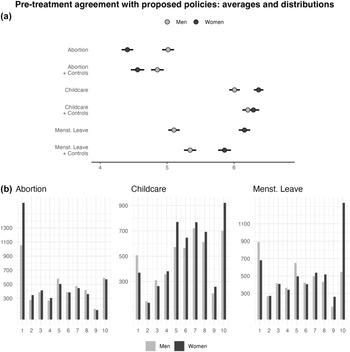
To show the divisive character of our policies, we illustrate average agreement by gender in Figure 2a and distributions of the agreement by gender in Figure 2b. We add estimates of women’s and men’s positions on the policies controlling for respondents’ education, age, region of residence, and general and cultural ideological position (+ controls in Figure 2a).Footnote 15 On our 10-point scales, values 5 and below indicate disagreement with the policy, while 6 and above show agreement. Men and women differ slightly on our proposed policies, with women reporting higher average agreement with the introduction of childcare (men: 6.0; women: 6.4) and paid menstrual leave (men: 5.1; women: 6.2) and stronger disagreement with the restriction of abortion (women: 4.4; men: 5.0). However, we also demonstrate that female as well as male respondents are torn on these issues, with considerable numbers of men and women agreeing and disagreeing with the policies. Many women hold positions that go against women’s presumed preferences. In the case of the introduction of paid menstrual leave, where women and men show the most substantial divide, we still find 42.3% of women expressing disagreement with the policy. When we propose limitations for access to abortion, 37% of female respondents agree, reporting a level of agreement of 6 or more, and 36.8% of women and 40% of men disagree with the introduction of childcare. Furthermore, when we control for demographics and ideology, the differences between men and women are reduced, suggesting that these factors partly explain the gender differences. In the case of the childcare policy, the differences between men and women are no longer statistically significant once we include controls. For the menstrual leave and abortion policy, the differences between men and women decrease but remain significant. Overall, these descriptive statistics of respondents’ positions show that our policies are more divisive than those used in previous studies.
Overall support for the three policies proposed, measured pre-treatment. (a) Mean agreement for men, women, and all respondents for each policy as well as men’s and women’s position on the policies controlling for demographics (education, age, region) and ideology (general and cultural left–right). (b) Distribution of support for all three policies by gender on our 10-point scales.

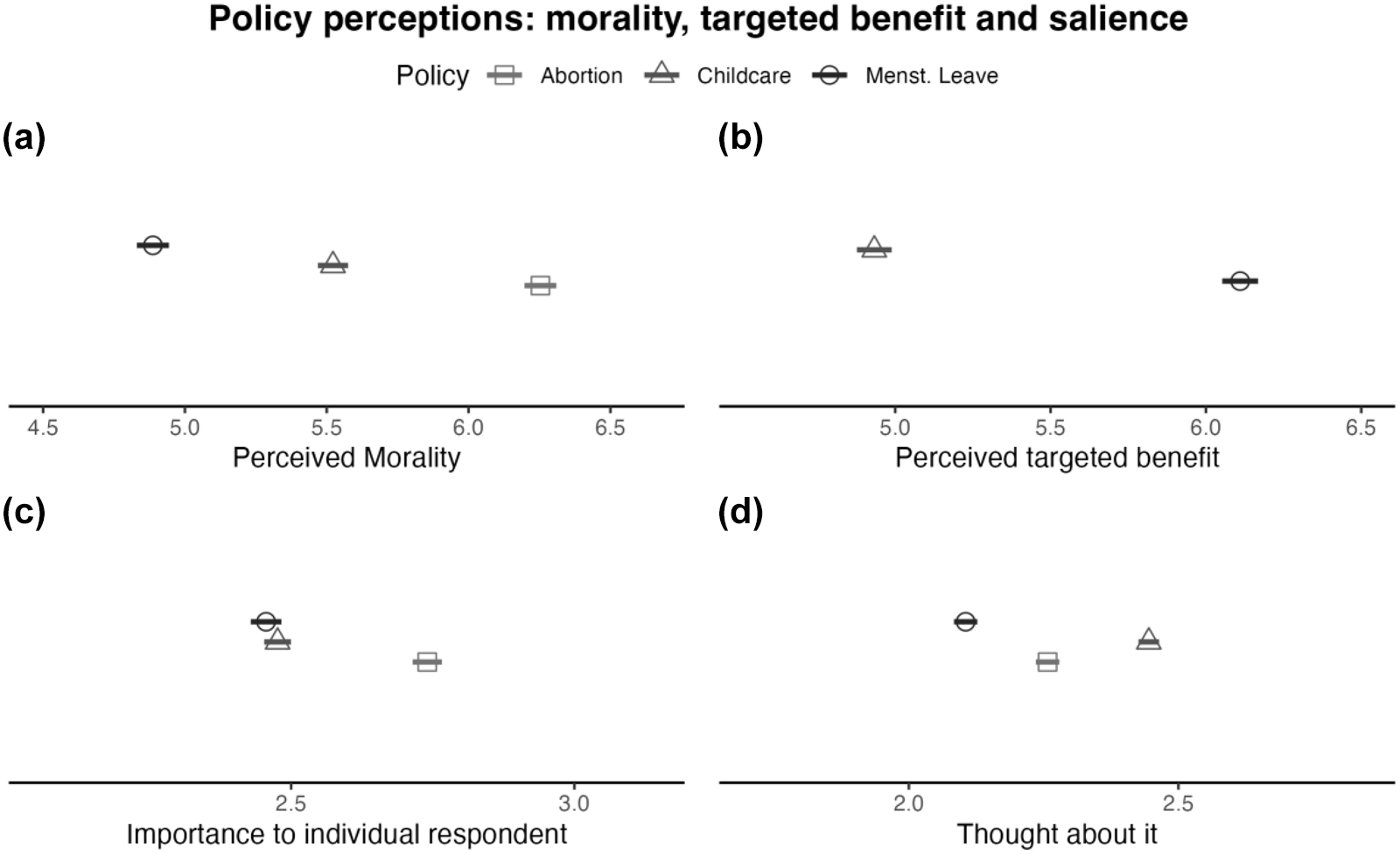
Furthermore, respondents perceive the nature of our proposed policies differently. Figure 3 shows average perceptions of the proposed policies being issues of morality, targeted benefits, and salient. Morality and targeted benefits are measured on 10-point scales and averages are shown in Figure 3a and b. We measure salience by asking respondents how important they consider the issue on a 5-point scale and thoughts spent on the issue on a 4-point scale with averages shown in Figure 3c and d.Footnote 16 We show that abortion is viewed as a highly moral issue with an average of 6.3 on our measure, followed by childcare with an average of 5.5.Footnote 17 Clearly, the menstrual leave policy is most likely to be viewed as a targeted benefit (mean: 6.1) and least likely to be viewed as a moral issue (mean: 4.9). Our two measures of salience (importance and thought) also show what we would expect based on the current debates going on in the UK. The menstrual leave policy is clearly the least salient, while the abortion and childcare policy have received more attention.
Means of perception as moral issue (a), targeted benefit (b), importance (c), and to what extent respondents thought about the policy (d).

5.1. Fairness perceptions of decision outcome
Figure 4 illustrates the effects of women’s representation on perceptions of fairness of the three proposed policies by decision outcome.Footnote 18 The committee’s decisions are either progressive or conservative.Footnote 19 With regard to the moral, salient, and divisive issue of abortion, the presence of women has a positive effect on fairness perceptions. When the committee adopts a progressive stance—opposing restrictions on abortion—perceived fairness increases by 0.85 points under equal representation compared to women’s under-representation and by 0.81 points when increasing from under- to over-representation. Similarly, fairness perceptions improve by 1.08 points when a gender-balanced committee decides to introduce abortion restrictions compared to when a male supermajority makes this decision. We see a comparable increase (1.02 points) when the committee comprises more women than men. Thus, committees with equal and over-representation of women are viewed as equally fair, and far fairer than committees on which women are under-represented. This finding supports H2 that higher levels of women’s representation enhance fairness perceptions for divisive issues.
Effect of three levels of women’s representation on fairness perceptions of the three proposed policies by decision-making outcome.

However, we observe different effects of women’s representation regarding decisions on childcare and menstrual leave. Gender-balanced committees are perceived as fairer both when introducing additional childcare (+0.38 points) and when rejecting its introduction (+0.65 points). The effect of equal representation, though, is stronger when the policy outcome is more conservative, providing evidence for H3. Furthermore, women’s over-representation only improves fairness perceptions when the committee decides against introducing additional childcare. When a committee with a supermajority of women chooses to introduce additional childcare, fairness perceptions remain unchanged compared to a scenario where a male supermajority makes the same decision.
Finally, we observe further differences in the impact of women’s representation when comparing decisions on the menstrual leave policy—a policy most clearly perceived as a targeted benefit—to those on abortion. Approving a menstrual leave policy—a more progressive decision—is perceived as fairer when the committee is gender-balanced compared with male-dominated, resulting in a 0.55-point increase in fairness perceptions. This effect of a gender-balanced committee is even more pronounced when the committee decides against introducing paid menstrual leave, with fairness perceptions increasing by 1.16 points, further supporting H3.Footnote 20 However, the effect of women’s over-representation varies depending on the decision outcome. When the committee introduces paid menstrual leave, the decision is perceived as less fair under a female super majority than under a male super majority (0.41-point decrease). Conversely, when the committee rejects the introduction of paid leave, women’s over-representation enhances fairness perceptions, leading to a 1.25-point increase compared to men’s over-representation.
Our findings demonstrate that equal representation consistently enhances perceptions of fairness in decision-making across all three divisive issues. However, the effects of descriptive representation depend on the specific policy, the decision outcome, and the level of representation, supporting H4. This is most strikingly illustrated by the fact that women’s over-representation negatively impacts views of fairness when the committee introduces paid menstrual leave but consistently improves perceptions of the abortion policy, no matter the committee’s decision. Furthermore, while we find that the impact of women’s representation is stronger when decisions on childcare and menstrual leave go against women’s preferences—providing support for H3—this pattern does not hold for abortion policy.Footnote 21
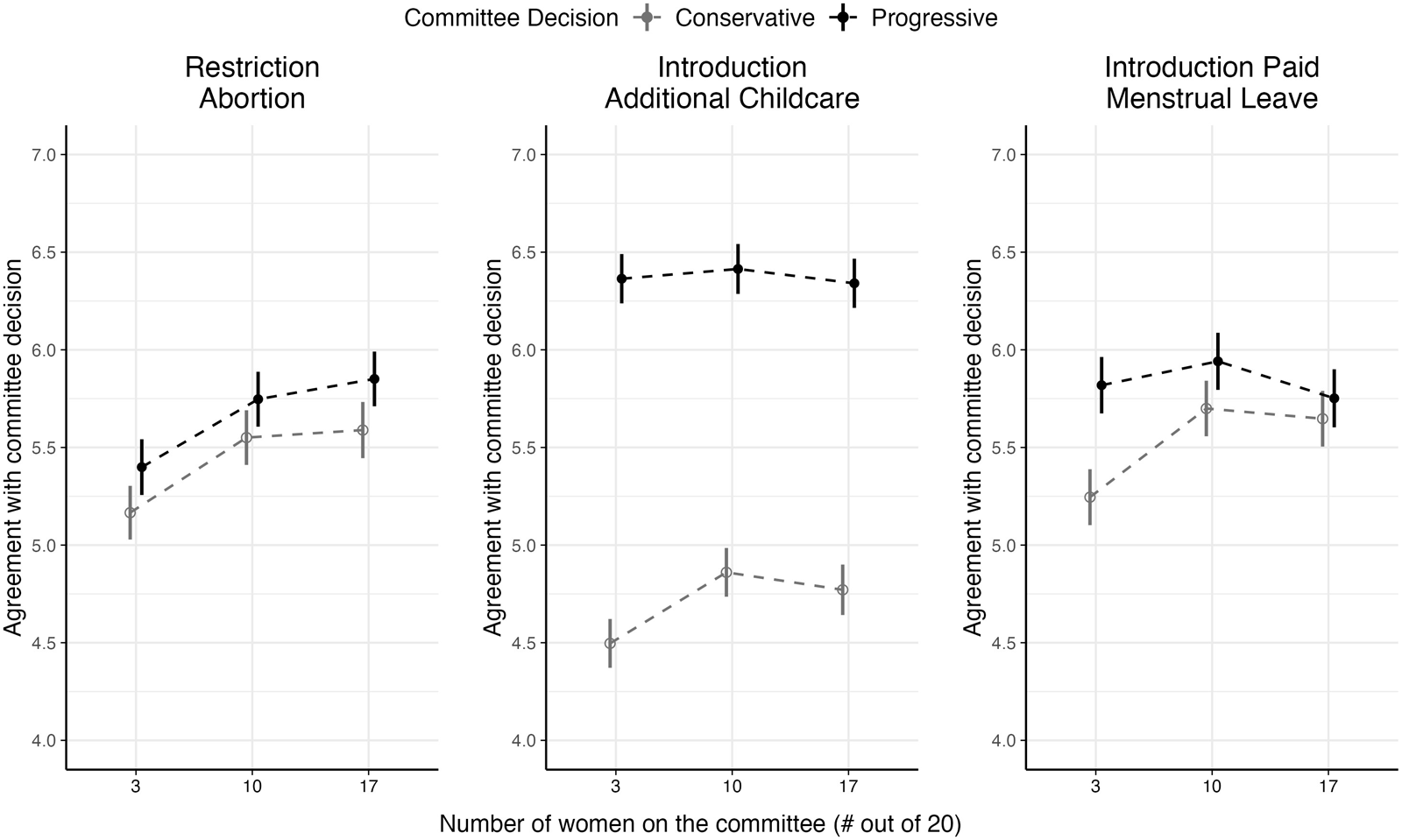
We now show the relationship between descriptive representation and fairness for subgroups of respondents with different ideological predispositions. Figure 5 presents the effects of varying levels of women’s representation across committee decisions separately for conservative and progressive respondents. Respondents are categorized as progressive or conservative based on their pre-treatment agreement with the three policies. Consistent with H1a, we find that, in general (with the exception of conservative respondents in the childcare policy case), those favoring a progressive policy outcome tend to view a progressive decision as fairer, while those favoring a conservative outcome perceive a conservative decision as fairer.Footnote 22
Effect of three levels of women’s representation on fairness perceptions of the three proposed policies by decision-making outcome, separately for subgroups of respondents with different ideological predispositions.

The most notable difference in shifts of fairness perceptions associated with descriptive representation occurs in the menstrual leave policy. Conservative opponents of the policy report a modest improvement in fairness when a gender-balanced committee approves menstrual leave (0.34 points), whereas progressive supporters report a larger increase in fairness (0.58 points).Footnote 23 However, among conservatives, fairness perceptions are lower when women are over-represented, with a −0.94-point difference compared to under-representation. For respondents who support the policy, over-representation has a slightly negative but statistically insignificant effect compared to under-representation. Nevertheless, relative to a gender-balanced committee, progressive respondents perceive over-representation as less fair. Overall, much of the negative association between a mostly women committee and fairness perceptions when approving menstrual leave stems from respondents who were already opposed to the policy change.
At the same time, both groups respond more similarly to increases in women’s representation when the menstrual leave proposal is rejected. Progressive respondents view the committee’s rejection as 1.02 points fairer when the decision-making body is gender-balanced. This effect is even stronger among conservative respondents who support the outcome, with a perceived increase in fairness of 1.40 points. Women’s over-representation is associated with an increase in fairness perceptions of 1.29 points among progressives and 1.33 points among conservatives. When subsidized childcare is rejected, descriptive representation is also associated with a statistically significant, but smaller, increase in fairness perceptions for both groups of respondents.Footnote 24
The abortion policy reveals a different story. Here, women’s over-representation is associated with higher fairness perceptions when gender-balanced and women-dominated committees make the decision, regardless of respondents’ pre-treatment position. Among progressive respondents, fairness perceptions improve by 0.91 points when a gender-balanced committee approves a mandatory counseling session compared to a committee that underrepresents women.Footnote 25 The increase is even greater among conservative supporters of the decision, with a 1.17-point increase. A committee with 17 women also produces a significant and positive effect for both groups. When the committee makes the progressive decision, the increase in fairness perceptions is slightly weaker for conservatives (0.60 points) than for progressive proponents (1.10 points). However, in both cases, over-representation of women is perceived similarly to equal representation and considered significantly fairer than under-representation. Overall, the contrasting effects of over-representation on fairness perceptions for the abortion and menstrual leave policies provide support for H4. Finally, among conservative respondents, women’s equal representation is viewed as fairer when decisions go against women’s presumed preferences across all three policies, providing further support for H3. In contrast, for progressive respondents, this effect is only stronger in the case of the menstrual leave policy.
We further test whether the positive effects of descriptive representation on the rejection of a progressive, feminist agenda are driven by men. Here we find no consistent pattern. We may expect a stronger effect of descriptive representation for men than for women in the case of menstrual leave, the policy with the strongest redistributive character. However, we again fail to uncover a significant interaction effect of gender with respect to the rejection of this policy. We provide all models which test for an interaction effect between descriptive representation and gender in Appendix 5.2 (page 14f in the SI).
5.2. Substantive perceptions of decision outcome
Figure 6 depicts the effects of descriptive representation on respondents’ post-treatment substantive agreement with the committee’s decisions. The regression models on which these graphs are based control for pre-treatment substantive position toward the policy.Footnote 26 We find positive and significant effects of descriptive representation with regard to the abortion policy. Descriptive representation increases agreement with the committee decision by 0.35 (gender-balanced committee) and 0.45 points (overrepresentation of women) when the committee makes a progressive decision, rejecting the abortion restriction. We observe similar effects when the committee decides to implement the abortion restriction. While we don’t find an effect of descriptive representation on agreement with the committee decision when additional childcare and menstrual leave are implemented, we do find that increases in women’s representation improve agreement with the rejection of the two policies (childcare: 0.36/0.27; menstrual leave: 0.45/0.40). Overall, these results provide support for H2b that descriptive representation improves agreement with decision outcomes. Furthermore, in support of H1b, we find that respondents who agree with the policy pre-treatment express higher agreement with the committee’s decision when the policy is approved and less agreement if it is rejected.Footnote 27 When we directly compare pre- and post-treatment substantive positions by looking at changes in position on the same 10-point scale, we do not find that respondents change their positions as a result of descriptive representation in combination with the decision that was reached.Footnote 28 Finally, we find almost no evidence that these effects are driven by gender; men and women respond similarly.Footnote 29
Effects of three levels of women’s representation on substantive perceptions of three proposed policies by decision-making outcome. We are controlling for respondents’ pre-treatment substantive agreement.

In sum, our results suggest an overall positive effect of women’s descriptive representation. When deciding contentious policies that impact women—especially abortion, an issue viewed as highly moral—the presence of female decision-makers improves perceptions of decision-making no matter the outcome of the decision and the substantive predisposition of the respondent. Respondents are more accepting of the granting, but also the deprivation, of material benefits, such as those associated with the menstrual leave policy, when women are equally represented in the decision-making body. However, respondents’ acceptance diminishes and can turn negative when a majority of women grant these benefits in comparison to when a (super)majority of men grant them. To a considerable extent, this negative effect of over-representation is driven by respondents who express disagreement with the direction that the decision takes.
6. Conclusion
In politics, we observe that decision-making bodies, such as cabinets, parliaments, and parliamentary committees, can evoke different reactions depending upon their composition and the decisions that they make. Increasingly, we see decision-making bodies that are either gender-balanced or with more women than men. Our research shows experimentally that reactions to the decisions of such committees are, indeed, a function of descriptive representation and the nature of the issue being decided. We find significant differences in the effect of descriptive representation depending on the policy, the outcome of the decision, and the substantive predisposition of individuals. While respondents found decisions taken by gender-balanced committees fairer, regardless of the issue, these positive effects are reduced and turn negative when a large majority of women decide in favor of a policy that grants material benefits to women (e.g., days off work in the case of paid menstrual leave). Meanwhile, fairness perceptions consistently improve with descriptive representation when abortion—a moral issue that does not involve significant material transfers—is addressed or when the same material benefits are rejected.
Moreover, we show that the effect of descriptive representation depends upon respondents’ substantive agreement with the policy in the first place. The large drop in perceived fairness that occurs when a group of women grants benefits to other women is driven by respondents who oppose the policy. However, the positive effect of descriptive representation on the acceptance of the deprivation of a benefit is consistent across all respondents. In other words, a decision made mostly by marginalized group members, which could potentially grant members of the same group benefits, enhances disappointment among opponents when these benefits are granted but legitimizes their deprivation when they are not. We further find that the presence of more women legitimizes both limiting women’s access to abortion and preserving a pro-choice status quo. Finally, our results suggest that individual policy perceptions are much more significant for the effect of descriptive representation than belonging to a particular group (e.g., being a woman) as suggested by earlier studies (Clayton et al., Reference Clayton, O’Brien and Piscopo2019). We find very limited evidence that gender differences drive our results. Instead, what matters are people’s beliefs about the policy before observing the committee’s decision-making.
Overall, we have provided strong evidence that descriptive representation is crucial for the perceptions of institutions and their decision-making. Foundational work on the descriptive representation of women and other underrepresented populations has shaped much of what we know about how representation influences perceptions of decision-making (Hayes and Hibbing, Reference Hayes and Hibbing2017; Arnesen and Peters, Reference Arnesen and Peters2018; Clayton et al., Reference Clayton, O’Brien and Piscopo2019; Kao et al., Reference Kao, Lust, Shalaby and Weiss2022). However, because these studies focus on a single policy, they do not reveal the full range of nuance in how voters perceive representation and fairness. To understand how citizens normatively evaluate who should make democratic decisions, we must understand the nature of the decision itself—both the nature of the policy under consideration and the outcome of the process. If we wish to select the composition of decision-making bodies to ensure that voters view the outcome as fair, our results suggest that it is the composition in interaction with the policy and the decision that matters. They further suggest that it is best to aim for levels of representation that match the population in order not to lead to an illegitimate process in the eyes of the general electorate. Members of decision-making bodies, and those who decide on their composition, should consider the legitimizing but also de-legitimizing consequences of their actions.
Future research may expand on how the nature of issues interacts with decision-making and descriptive representation to shape perceptions of processes. Researchers could test the perception of a range of issues along different dimensions, such as morality, the extent to which a policy offers material benefits to a particular group, or whether the policy intrudes in the daily lives of members of marginalized groups (e.g., affecting their physical health). By examining more issues that cover a range of dimensions, we could better say how specific characteristics of issues interact with descriptive representation on decision-making bodies to impact perceptions of policy decisions.
Supplementary material
The supplementary material for this article can be found at https://doi.org/10.1017/psrm.2026.10103. To obtain replication material for this article, please visit https://doi.org/10.7910/DVN/BCYWJK.
Acknowledgements
We would like to thank Kiran Auerbach, Filip Kostelka, Michele Fenzl, Stefanie Reher, Jessica Smith, Ana Weeks, Fabienne Eisenring, Dominik Duell, Massimo Troncone, Miguel Pereira, and Laurence Brandenberger for detailed comments, as well as seminar participants at the University of Zurich and conference attendants at Swiss Political Science Association Conference, European Political Science Association Annual Conference, ECPR Standing Group on Parliaments Conference, and ECPR Joint Sessions Workshops. Special thanks to Jenny Roberts, Aurora Palanza, and Julia Künzler for impeccable research assistance.





 Open access

