

Introduction
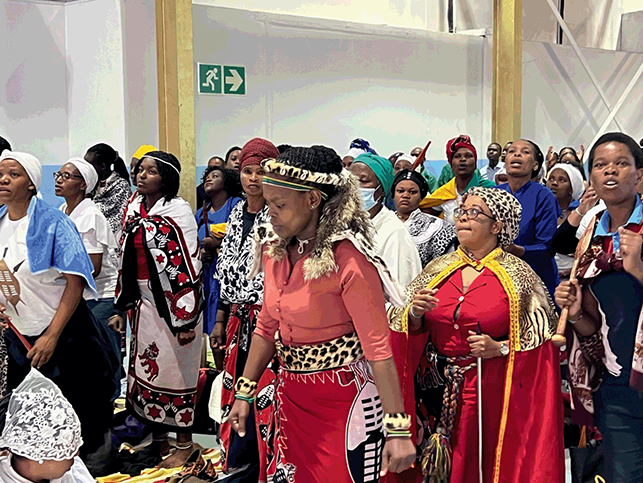
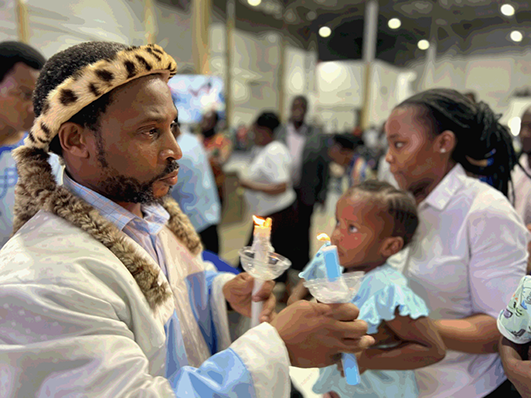
The first time we saw an event of The Revelation Spiritual Home (TRSH) was in Johannesburg, South Africa, on January 15, 2023. A group of girls dressed in blue quasi-military uniforms marched into a hall packed to capacity, where thousands awaited, and started singing spiritual songs. The audience cheered and danced. Some were shaking and crying. As we had some familiarity with both Pentecostalism and the so-called African Initiated Churches (AICs), we could have at first believed that this was vintage, colorful African Christianity in one of its innumerable new incarnations.
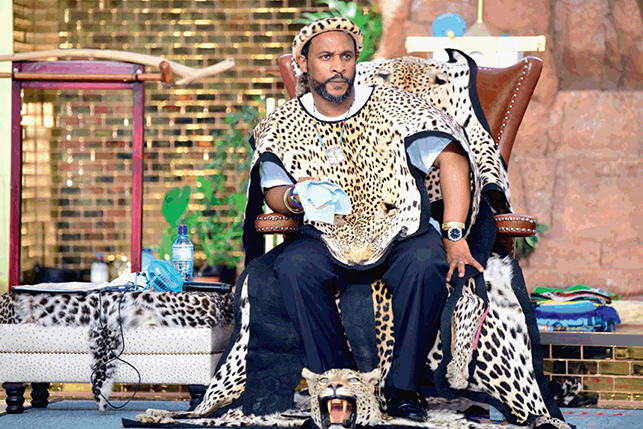
Then, however, the leader and founder of TRSH appeared on stage. He was, admittedly, impressive. He sat on a throne covered with a leopard skin. Another large leopard skin was under his feet (see Figure 1). Around his head was wrapped a headgear, also of leopard skin. Rather than as a Pentecostal preacher, he looked like a latter-day Shaka (1787–1828), the legendary Zulu king.
IMboni uZwi-Lezwe Radebe (a.k.a. Samuel Radebe) on his throne.
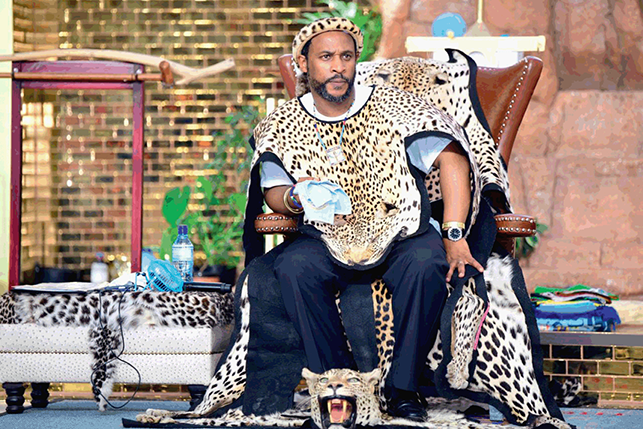
He is known to his followers as IMboni uZwi-Lezwe Radebe, and commonly referred to as “IMboni,” a word used in several different African languages to indicate a high-level spiritual guide. When Radebe started speaking, it became immediately clear that his was a different message from leaders of the AICs and Christian prophets. In a nutshell, he proclaimed that African Indigenous Spirituality, the oldest on the planet, had been consciously and maliciously eradicated throughout the centuries by Christianity and Islam through missionaries, colonial armies, and economic domination. What remains often survives in a confused form, part of a bastardized syncretism with Christianity. The only solution is to trace back centuries of colonial submission to foreign religions to restore the authentic African Indigenous Spirituality (AIS).
Powerfully stated by a charismatic speaker, it was a clear message and one that the crowd obviously liked. As we soon learned, it was also deceptively simple. AIS and the message of TRSH are more complicated than they may seem at first sight.
This Element is an ethnography of TRSH, incorporating travelogue-style field notes, based on fieldwork in South Africa and other African countries. The Element begins by discussing the (admittedly controversial) notion of AIS and then turns to a single case study – The Revelation Spiritual Home and its leader, Samuel Radebe. The focus on TRSH explains why the Element covers phenomena primarily occurring in Southern Africa, although there are comparative excursions to other parts of the continent.
We review different approaches, by scholars and practitioners, to AIS, noting the existence of gray areas and ambiguous phenomena. This ambiguity is reflected in most of the figures TRSH and other contemporary AIS groups regard as part of their history, from Kimpa Vita to Mantsopa Anna Makhetha, Isaiah Shembe, and Simon Kimbangu, who are considered by others as founders of AICs. We will examine these figures, as well as leaders and institutions other than TRSH that have propagated forms of AIS, including the Zulu group around Maphithini Thusi in Durban, and Credo Mutwa and his followers in Soweto and beyond.
The second, third, and fourth sections examine TRSH’s history and spirituality and its organization, which includes cultural institutes and a network of business enterprises. The fifth section discusses the existence of a growing anticult movement in several African countries and how its presence has also affected TRSH.
We surveyed the most relevant literature on the subject and the few books published by TRSH. However, the primary sources of this work have been our participant observation and interviews with TRSH leaders and members, including Radebe himself. We have also interviewed traditional diviners-healers in South Africa, Zimbabwe, Mozambique, and Senegal, as well as descendants of both Maphithini Thusi and Credo Mutwa. Religious liberty activists, scholars, and members of different branches claiming Isaiah Shembe’s legacy also supplied relevant information. A discussion of the Sufi brotherhood of the Layennes, which includes significant AIS elements, is based on interviews at its holy places in Senegal. We also interviewed followers of Kimbangu in France, Belgium, and Italy.
When referring to TRSH, we follow the transliteration of words from African languages used in the group’s literature in English. For an easier reading, we also use “we” when reporting the interviews and visits conducted by only one of the authors. We want to thank those who patiently answered our questions, even when they found them provocative, or perhaps arising from European misunderstandings about what AIS is all about.
1 In Search of African Indigenous Spirituality
The year 1967 was a momentous one for the study of religion and spirituality in Africa. The Journal of Religion in Africa, which still exists today, was launched by the Dutch academic publisher Brill. The first issue opened with a seminal article by Harold W. Turner (1911–2002), “A Typology for African Religious Movements” (Turner Reference Turner1967a). A Presbyterian pastor and the author of monumental works and bibliographies on new religious movements in primal societies (Turner Reference Turner1967b, 1977–1992), he regarded typologies as both “dangerous,” since they risk imposing on African spiritual developments “a Western framework,” and necessary (Turner Reference Turner1967a: 1–2). While previous scholars had mainly classified Christian organizations into different categories, Turner also considered what he called “neo-pagan religious movements”:
We say “neo-pagan” because we are not concerned with African traditional or pagan religions as such, but only with those new forms that have appeared as part of the reaction to the great changes occurring in African life in our period. Those who have felt the disturbing effects of contact with Western culture and religion, and have seen their own sanctions and unity being undermined, have sometimes sought to develop new forms of the old religions.
Having proposed such a definition, Turner confessed that scholars still had “insufficient” information on these groups, and some of those they had studied “might be better classed as syncretistic,” although “none could be called Christian” (Turner Reference Turner1967a: 8). He offered among his examples the Déïma churches in Ivory Coast, originating from the prophetic mission of Marie Lalou (1915–1951), and the Bwiti spiritual system, later recognized as one of the official religions of Gabon (Turner Reference Turner1967a: 7–8). Both the Déïma churches (Girard Reference Girard1974; Fath Reference Fath2018) and some of the branches of Bwiti (but not all: Havelka Reference Havelka2022) appropriated Christian elements, although African indigenous roots remain prevalent.
Lalou was influenced by the AIC founded by William Wade Harris (ca. 1860–1929), but shortly thereafter she started her prophetic mission, and “turned the legacy of Harris towards [indigenous] cosmogonic entities” (Dozon Reference Dozon2001: 375). In turn, echoes of Lalou resonated in the teachings of prophet Gbahié Koudou Jeannot (ca. 1930–2022), who denounced Christianity, Islam, organized religion, and the economic domination of the whites, and preached a return to African spirituality, although scholars perceived at least indirect Christian influences in his thought too (Dozon Reference Dozon1995a, Reference Dozon1995b; Petrarca Reference Petrarca2000).
Studied in the 1960s by American anthropologist James W. Fernandez, Bwiti is a network of groups, active primarily in Gabon. They were started between World War I and II as a reaction to the attempt by French colonial authorities and Christian missionaries to prohibit the ancient initiation ceremonies based on the use of the root of the iboga plant, which has psychedelic effects. Ceremonies based on psychoactive plants have a centuries-old tradition in Africa, although some contemporary practitioners we interviewed warn that their historical role in AIS should not be exaggerated. Fernandez also found that some groups in the network had once again incorporated Christian elements derived from French missionary Catholicism into their rituals (Fernandez Reference Fernandez1982).
In 1978, Fernandez reexamined Turner’s 1967 typology, noting that:
The centrality of the pagan-Christian dimension is characteristic of most mission-oriented and theologically concerned scholars. It is a dimension whose subtlety of discrimination and possible element of invidiousness discourage anthropologists. Also, while theological debates are characteristic features of Western religion, they are rarely so preoccupying elsewhere.
Ultimately, Fernandez disputed the very usefulness of typologies, often the product of scholarly enterprises “where the materials of African religious movements are used simply to fuel Eurocentric dialogues and disputes” (Fernandez Reference Fernandez1978: 230).
Few today would use the inherently discriminatory category of “paganism” to designate non-Christian and non-Islamic forms of African spirituality. Nevertheless, the question of distinguishing AIS-based institutions from the thousands of predominantly Christian African new religious movements has not lost its pertinence. In 2019, Kizito Chinedu Nweke and Ikenna Paschal Okpaleke, both theologians specializing in African issues and Roman Catholic priests, published an important article on “The Re-emergence of African Spiritualities.” They acknowledged that “the discussion over the differences between religion and spirituality is ongoing.” However, they argued that the “specific form of mundane-transcendent relationship of African origin” is better defined as spirituality rather than religion. AIS, they added, is characterized by its existence “outside Christianity or Islam” (Nweke and Okpaleke Reference Nweke and Okpaleke2019: 248).
Up to this point, they noted that their etic view was consistent with the emic approach of those involved in the current revival of AIS. However, Nweke and Okpaleke acknowledged that many of the latter would insist that African spirituality is one, while they deny that a “single systematicity” exists in “a whole continent” and prefer to use the plural form “African spiritualities” (Nweke and Okpaleke Reference Nweke and Okpaleke2019: 249). On the other hand, they do not deny that these “spiritualities” have important elements of “commonality in thought and observances” (Nweke and Okpaleke Reference Nweke and Okpaleke2019: 248). TRSH rejects the plural form “spiritualities” and insists that the plurality of symbols and rituals reflects a diversity of cultural expressions rather than a spiritual disunity.
In a subsequent article, Nweke criticized those AIS proponents who convert it into an “ideological front against religion” (Nweke Reference Nweke2022: 273). He argued that it all depends on how one interprets the word “religion,” for which competing definitions exist. However, he acknowledged that the whole question was obfuscated by the fact that
African spiritualities have experienced adulteration, bastardization, and proliferation due to rash and erroneous assumptions … Academic studies in African spiritualities were mostly conducted by Europeans and Americans who were extremely biased.
Nweke and Okpaleke also suggested several reasons why African spirituality was gaining momentum in several countries of the continent. They included an “Afrocentric trend” following the collapse of colonialism, the search for solutions to the loss of traditional moral values, a skepticism toward the coldness of Western medicine and a preference for holistic alternatives, a desire to affirm an African identity, and the persuasion that, unlike religions, African spirituality offers “imminent and feasible solutions to individual problems” (Nweke and Okpaleke Reference Nweke and Okpaleke2019: 253–6). They saw a “spiritual renaissance” of Africa, averting the risk that, as Nigerian scholar Jacob K. Olupona said in an interview, by losing African spirituality, Africans
would lose a worldview that has collectively sustained, enriched, and given meaning to a continent and numerous other societies for centuries through its epistemology, metaphysics, history, and practices.
The Mountain of the Gods
The temperature in northwestern Botswana was 42 degrees Celsius. Although we had left early in the morning, exploring on foot the Tsodilo Hills, “the mountain of the Gods” in December 2024, summer in Southern Africa made for a demanding journey. Yet, this was a crucial place for understanding AIS and its practitioners’ claim that it has existed from time immemorial. A UNESCO World Heritage Site, Tsodilo Hills feature over 4,500 rock paintings, many depicting animals and some clearly representing rituals. No less impressive than the paintings are the rocks themselves, dating back at least two million years, according to geologists. Visitors stand in awe of these ancient rocks before they spot their first paintings.
We also knew that by making Tsodilo a part of our exploration of AIS, we risked entering a controversy we did not feel was our own. Archaeologists, a tribe we are not part of, fiercely debate the dates of the rock paintings. Carbon dating does not seem to offer conclusive evidence because of the techniques used to carve images on the rocks. It does not help that different populations repainted them at different times in history. In 2006, Sheila Coulson from the University of Oslo suggested that the older paintings date back 70,000 years and may well be the oldest evidence of spiritual rituals on Earth. Her claim was popularized internationally by non-scholarly media. The pioneering investigators of the archeological area from Michigan State University and the National Museum of Botswana countered that they had dated the early signs of human activities at Tsodilo to some 15,000 years ago and the paintings depicting rituals probably to circa 600 CE (Robbins et al. Reference Robbins, Campbell, Brook and Murphy2007). But nobody knows for sure.
Local scholars have speculated that part of the rock art was painted or carved by shamans in a state of trance (Sheller and Diviney Reference Sheller and Diviney2018: 9 and 24). One cycle of paintings depicts the initiation of young women and men, the latter so easily distinguishable from the former that the site has been nicknamed by the locals the “Valley of the Dancing Penises.” Then there is the rock made famous by popular South African travel writer Sir Laurens van der Post (1906–1996), who was a close friend of Carl Gustav Jung (1875–1961) and managed to interest him in African spirituality. It was van der Post who first introduced Tsodilo Hills to a broader international audience with his 1958 book The Lost World of the Kalahari. The writer reported that by shooting wildlife for food, he offended the ancestral spirits of the Hills and met with a series of misfortunes, including being assaulted by swarms of bees. His movie camera suddenly stopped working for no apparent reason. To make things return to normal, he had to write a letter of apology to the spirits and bury it in a crack in the ledge next to some of the most spectacular animal paintings (van der Post Reference van der Post1958: 199).
Even more interesting than van der Post’s insatiable appetite for the picturesque were our conversations with the local villagers, including a young man wearing a shirt of London’s Arsenal soccer team. Those locals who claimed they resented tourism as a mixed blessing at best – tourists bring money, but take something away from the sacredness of the place – had nothing to complain about on that very hot morning. We and our community-authorized local guide were the only visitors. Even for locals, the heat was just too oppressive. But did they go to the hills, we inquired. They answered that they did, and not only out of curiosity. Even the young Arsenal fan confessed he went there to quietly communicate with ancient spirits. “We are Christians in Botswana,” he said, “but here we talk with the ancestors and the gods, we feel something, we hear ancient stories, we find solutions to our problems.” Most rituals have disappeared, locals said, blaming the tourists for that, but women and men from the villages still come as pilgrims, not merely as onlookers.
One can learn several things about AIS from the attitude of Botswanans toward Tsodilo Hills. AIS is present in caves, rocks, and water, and in seeking with awe and respect traces of a remote past rather than in books or places of worship. It communicates with ancestors and gods. It is experience rather than doctrine, mythos rather than logos.
In the stories of Tsodilo Hills and among the villagers from nearby Chukumuchu who help with the local museum, we found a passion and commitment to what they regard not only as a tourist attraction but as a living and meaningful spiritual center. On the other hand, we also perceived frustration among the locals that such an obviously powerful center has not generated a spiritual revival and is now threatened by modernization and tourism. The answer to those risks by some AIS practitioners has been the attempt to create stable and effective institutions.
African Indigenous Spirituality: An Elusive Category
Most attempts at defining AIS came from Christian theologians and missiologists, some of them suspicious of a possible resurgence of “paganism” and others sympathetic. Nevertheless, some of these scholars achieved significant results by looking at AIS through Christian lenses. Nweke and Okpaleke refer approvingly to a list of features of African spirituality compiled in 2016 by American Pentecostal theologian and bishop Jonathan E. Alvarado:
1. Belief in one almighty creator and usage of a medium through deities, persons, or objects.
2. It is not as logocentric as Christianity or Islam, that is, transmitted through written texts. It is rather a spirituality that is orally transmitted in the hearts and minds of people.
3. It provides a spiritual and emotional alternative framework to the Western scientific and rationalistic framework.
4. It frees the spirit and the self from the religious dictates of other religions.
5. It strengthens community structure and appreciates the continuity of the sacred-secular relationship. (Alvarado Reference Alvarado, Synan and Alvarez2016: 337–50)
The Romanian-French ethnologist Dominique Zahan (1915–1991) regarded three elements as essential in African spirituality: the idea of a Creator God, who coexists with a rich pantheon of other deities; a relationship with the ancestors; and the mediation of practitioners such as healers and spiritual guides. Zahan also emphasized two irreducible differences between African spirituality and Christianity: the absence in the former of a notion of original sin in need of redemption, and the presence of a cyclical rather than a linear notion of time (Zahan Reference Zahan1970, Reference Zahan and Olupona2000).
In discussing AIS with its practitioners in Africa, we often told them half-jokingly that they seemed more concerned with emphasizing what it is not than what it is. Eventually, we understood how this “via negativa” was crucial for them and a necessary part of any definition.
First, they insist that AIS is not a religion. AIS institutions such as TRSH try to “dismantle the notion of Africa as a continent with religion in the conventional sense” (African Hidden Voices 2024: 3). Some scholars share this approach, but with nuances.
A school of academics, mostly Nigerian, has tried to “decolonize” the study of AIS, which had been previously conducted primarily by Euro-American theologians. Olupona, for example, wrote that as applied to Africa, “the use of the term ‘religion’ is problematic” (Olupona Reference Olupona2014: 1). It presupposes a distinction between “religion” and other spheres of life that does not exist in the continent. However, the Harvard University professor believes that scholars can still speak of an “African religion,” while cautioning that the expression does not have the same meaning in Africa as in Europe or North America (Olupona Reference Olupona2000, Reference Olupona2014: 1). Another Nigerian academic who has taught in Germany, Scotland, and the United States, Afe Adogame, concurs, believing that the strength of a long tradition of academic use of the expression “African religion” cannot be overcome, but its meaning should be continuously renegotiated (Adogame Reference Adogame2021).
AIS practitioners also deny that they are part of “new religious movements.” They not only claim that their spiritual path is not “religious,” they also challenge the use of the word “movement” as an “external, foreign understanding” imposed on typically African institutions. These are also not “new,” they assert, because they “restore” rather than “innovate” (African Hidden Voices 2024: 104–5). TRSH members designate it as an “institution,” claiming Radebe’s spiritual guides commanded him to establish “an African indigenous institution.” Using “institution” for a spiritual organization may sound awkward in American English, but it is relatively common in British English spoken in South Africa.
Practitioners also claim that by not being a religion, AIS does not fit into John Mbiti’s (1931–2019) category of “African Traditional Religion” (ATR: Mbiti Reference Mbiti1991) either. TRSH claims that while Mbiti “has significantly contributed to the understanding of African spirituality, his characterization of African Traditional Religion can be seen as reductive” (African Hidden Voices 2024: 140).
The risk, we were told, is to make AIS into a mere species of a broader genus of religion, while it is a system “distinct” from religion and also different from “tradition.” Tradition is the transmission of knowledge and rituals from one generation to the next. As such, it is not deprived of value but “depends on spirituality to exist … spirituality breathes life into tradition, not the other way around” (African Hidden Voices 2024: 141–2). Without a continuing living experience of spirituality, tradition as transmission has nothing to transmit.
From the emic point of view of TRSH, ATR is an artificial construction by scholars conflating two different realities: tradition and religion. Distinguishing what practitioners call AIS from what several scholars prefer to designate as ATR remains challenging. However, we believe that referring to AIS as a distinct category offers some heuristic advantages and may be conceptually necessary. While acknowledging that the distinction is not clear-cut, in the terminology we use, ATR includes the “old forms” of African spirituality. AIS refers to institutions that, while claiming a millennia-old heritage, rely on ongoing spiritual revelations and today operate as modern institutions, proselytizing through state-of-the-art tools.
AIS institutions also insist they are not part of the African Initiated Churches (AICs), a notion intrinsically connected with Christianity, notwithstanding the attempt of some scholars to extend its scope. However, the question of the relationship between AIS and AICs is more complicated than it seems. We will first examine it through the paradigmatic cases of Isaiah Shembe and Simon Kimbangu.
AIS and AICs: Isaiah Shembe
On April 27, 1994, South Africa held its first post-apartheid democratic elections. Nelson Mandela (1918–2013) decided to cast his vote at a polling station in Ohlange High School in Inanda, KwaZulu-Natal. The school had been founded in 1901 by John Langalibalele Dube (1871–1946) as the first educational institution in South Africa created by a black person. After voting, an emotional Mandela visited Dube’s grave near the school. Surrounded by reporters, he loudly said: “Mr. President, I have come to report to you that South Africa is free today” (Inanda Ohlange Museum 2024: 4). Mandela called Dube “Mr. President” as he had been in 1912 the cofounder and first president of the South African Native National Congress. It was renamed the African National Congress, Mandela’s party, in 1923.
In a much quieter way, and certainly without reporters, we also paid homage to Dube’s grave in Inanda in December 2024 and visited the small museum celebrating his life and achievements. Apart from his notable involvement in politics, Dube interested us because he is credited with having coined the expression “African Independent Churches” (Dube Reference Dube1936), which was later replaced by “African Initiated Churches.” Some had objected that “independent” falsely implied that the other Christian organizations in Africa were all “dependent” on white missionaries.
Due to a momentous coincidence, three important figures for the religious and political history of South Africa (and beyond) lived within an area of a few square miles around Inanda shortly before World War I: Dube at the Ohlange School; Isaiah Shembe (1865–1935), since 1911, at his holy city of Ekuphakameni; and Mohandas K. Gandhi (1869–1948), the future Mahatma, at the ashram-like settlement of Phoenix he had founded in 1904. Gandhi had moved to South Africa in 1893 and left to return to India in 1914. Phoenix is also now a museum. We were surprised to notice the prominence of references to Dube and Shembe, celebrated through several panels and life-size silhouettes.
While panels both in the Ohlange School and in Gandhi’s nearby Phoenix settlement depict the three men – who knew each other – almost as friends, historians describe a less rosy reality. Dube shared the anti-Indian feelings of several of his political associates (Jarvis Reference Jarvis2024: 88). Shembe didn’t, however. He welcomed Indians at his worship services, and cooperation with Hindus has been continued by his followers to this day, sometimes in unpredictable forms. When we visited the largest branch of Shembe devotees at Ebuhleni, we were surprised to find a large portrait of Swami Sivananda (1887–1963) in the richly decorated baptismal pool. We were told that Sivananda’s Divine Life Society (DLS) financially helped build the pool. The DLS explains that
water from the Ganga has the recursive property that any water mixed with even the minutest quantity of Ganga water becomes Ganga water, and inherits its healing properties.
Thus, for the DLS, the baptismal pool, which brought water from the Ganges, has become the “Ebuhleni Ganga Baptismal Centre,” while remaining the baptismal pool of election for the local followers of Shembe.
As a Reformed Christian minister and the son of one of the first Zulu Christian pastors, Reverend James Dube (d. 1887), John Dube looked with interest at Shembe and his ideas. Eventually, he edited his first biography (Dube Reference Dube1936). However, Dube resented that some left his congregation to join Shembe’s Nazaretha. He accused Shembe of liberally milking his devotees for money (Dube Reference Dube1936: 90–2). In turn, followers of Shembe claimed that Dube, a married man, had a child with one of the young girls studying at his school. Shembe’s disciples also reported that Dube came to Shembe at night asking to be baptized secretly. According to their account, Shembe refused, stating he only baptized people openly and in daytime (Jarvis Reference Jarvis2024: 90).
The significance of these controversies goes beyond mere gossip. It shows that the label African Independent Churches was born under a cloud. Dube’s motivations in creating it were not exactly complimentary, although subsequent scholars used it more neutrally. Dube was also suspicious of Shembe’s whole enterprise. The latter claimed that at age forty, he heard the voice of God calling him to leave his three wives and work as an itinerant evangelist, initially for a Baptist church. In 1911, capitalizing on his success as a preacher, he founded his holy city at Ekuphakameni, where in 1913 the Ibandla lamaNazaretha was established.
Some of Shembe’s teachings were idiosyncratic, as he eliminated Christmas and Easter, introduced new dietary laws, and prayers and blessings for fertility that were not part of the previous Christian tradition. When we visited Ekuphakameni, we interviewed an old man who introduced himself as one of the “miracle children,” conceived by his mother (widely regarded as sterile) in her old age after receiving a blessing from Shembe. Dube had little patience for these remnants of African non-Christian spirituality, of which he found many traces in Shembe’s ideas and practices. As somebody who was also a novelist, Dube regarded AIS as a thing of the past, a fit subject matter for historical novels.
What exactly Shembe’s Nazaretha organization is has remained a matter of considerable controversy. It has been studied as the quintessential AIC by church historians such as Bengt Sundkler (1908–1995), who was both an encyclopedic scholar of such churches and a Lutheran bishop; Gerhardus Cornelis Oosthuizen (1922–2010), an Afrikaner theologian and minister of the Dutch Reformed Church; Hans-Jürgen Becken (1926–2013), a German Lutheran missionary; and Irving Hexham, an English-Canadian Anglican academic (see Cabrita Reference Cabrita2014 for a bibliography of their works). While evolving toward an increasing sympathy for the AICs and actively cooperating with Shembe’s descendants in collecting documents and oral histories, this Christian scholarly tradition started from a concern that Shembe had offered a “radical distortion” of Christianity, where the role of Christ was “superseded” and “usurped” by Shembe himself (Sundkler Reference Sundkler1948: 323).
A prolific contemporary scholar of Shembe, Joel Cabrita, argues that the original Nazaretha had “deep roots in evangelical Protestantism,” but these were “almost completely suppressed” in later times. Some of the branches into which the movement divided following leadership and succession disputes within the Shembe family insist that, if anything, their institution is closer to Judaism than to Christianity, with others emphasizing the prominent role of traditional Zulu culture (Cabrita Reference Cabrita2014: 343–4).
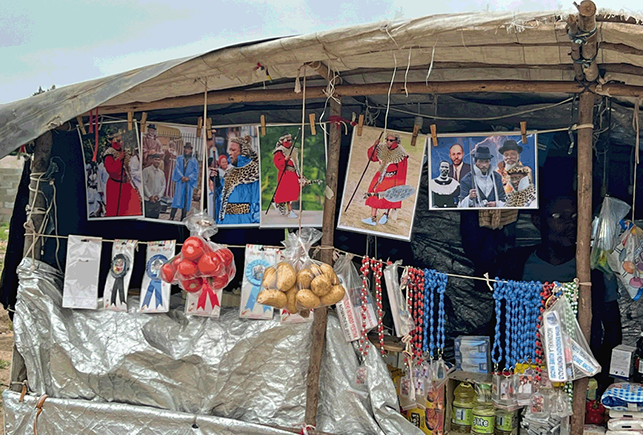
Mapping the schisms that have divided Shembe’s heirs into seven main rival branches (Kumalo and Mujinga Reference Kumalo and Mujinga2017) goes beyond the purposes of this Element. We saw a struggling, declining community when we visited Ekuphakameni, where Shembe is buried. By contrast, we found in nearby Ebuhleni a vibrant and prosperous institution, with grand projects of national and international expansion (see Figure 2). Ebuhleni is the home of a faction founded by one of Isaiah Shembe’s sons, Amos Khula (1907–1996), after he separated from Londa Shembe (1944–1989). The latter, the son of another child of Isaiah Shembe, remained in control of Ekuphakameni. However, Ebuhleni’s prosperity is in turn threatened by internecine succession feuds between the descendants of Amos Khula, which South African courts of law are still trying to settle.
Shembe paraphernalia on sale at Ebuhleni.
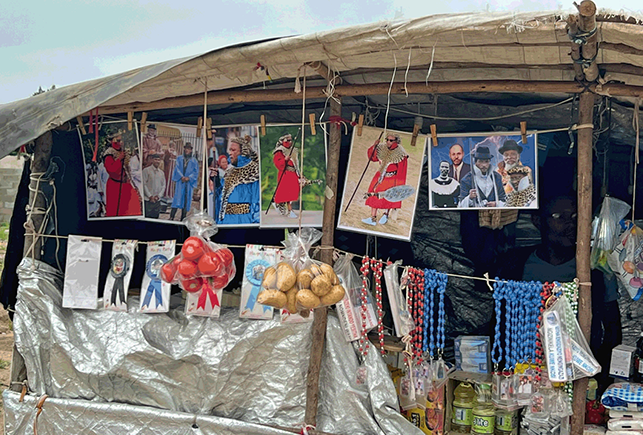
AIS institutions generally view Isaiah Shembe favorably. Maphithini Thusi’s daughter told us that her father met Shembe. He saw, she said, the revelations and the missions entrusted to him and Shembe as parallel and complementary. TRSH claims that “Shembe’s work was focused on restoring African spiritual practices, but his legacy has been co-opted by churches that do not fully represent the indigenous spirituality he sought to revive” (African Hidden Voices 2024: 135). This interpretation is at the opposite end of the one proposed by scholars such as Cabrita. While Cabrita regards Shembe’s institution as originally Christian and de-Christianized by his successors, TRSH emphasizes Shembe’s “separation from Christian organizations” and considers him a genuine exponent of AIS whose message was Christianized after his death.
Simon Kimbangu and AIS
TRSH offers a similar interpretation of the mission of Simon Kimbangu (1887–1951). Guided by a mysterious “Voice,” he started his prophetic and healing activities in Belgian Congo in 1921. They were quickly banned by the colonial authorities, who arrested Kimbangu and sentenced him to death, commuted to life imprisonment. For six months of prophetic activity, Kimbangu had to serve thirty years in various prisons until he died in 1951. Some 6,000 Kimbanguists were also arrested and sentenced to jail penalties of varying lengths. Yet, persecution proved ineffective, as Kimbanguism continued to grow under the leadership of Kimbangu’s wife, Marie Muilu Kiawanga Nzitani (1880–1959), and his sons. A few months after Marie’s death, the Belgian authorities finally recognized the Church of Jesus Christ on Earth through the Prophet Simon Kimbangu as an authorized religion in Congo (Asch Reference Asch1983; Ngudiankama Reference Ngudiankama2023).
A significant development followed: the lengthy negotiations that led to the church’s admission in 1969 to the World Council of Churches (Simon Reference Simon and Ngudiankama2023). A decisive role in the negotiations was played by Swiss theologian Marie-Louise Martin (1912–1990), who had emerged as the leading European scholar of Kimbangu (Martin Reference Martin1971). She ended up moving to Congo and becoming the director of the Kimbanguist School of Theology. Under her leadership, Kimbanguist theology was reworked. Kimbangu – identified as a divine incarnation as late as the 1960s – was rather seen as a “witness” of Christ or the special “support” of the Africans in their journey toward Jesus. Christian scholars like Becken and Oosthuizen, who befriended Shembe’s descendants, believed that “patronizing preaching would be counterproductive,” although occasionally did not resist the temptation of calling Nazaretha congregations to acknowledge “the centrality of Christ” (Cabrita Reference Cabrita2014: 43). Martin went one step further and rewrote Kimbanguist theology to make it acceptable to European Christians.
In 1983, sociologist Susan Asch noted, however, that Martin’s changes affected only the more educated segment and the official publications of the church. At the grassroots there remained, distinct from “official Kimbanguism,” what Asch called the “Kimbanguism of the Kimbanguists,” where ancient beliefs identifying Simon Kimbangu with God continued to persist, unchanged (Asch Reference Asch1983). Ultimately, it became obvious that popular Kimbanguism could not be suppressed. It even influenced the leaders, including Kimbangu’s son Salomon Dialungana Kiangani (1916–2001), who claimed to be a divine incarnation and the returned Jesus Christ. Unavoidably, this led to schisms and the exclusion of the Kimbanguists from the World Council of Churches in 2021 (B. Simon Reference Simon and Ngudiankama2023, Reference Simon2024).
According to Kimbanguist theologian Nduku-Fessau Badze, the ambiguity and the presence of two Kimbangus, the Christian leader and the African divine incarnation, have always been there:
We can see that Kimbanguists, from the spiritual leaders down to the simple faithful, have always maintained a double discourse, which contributes to the ambiguity of Kimbanguism. They understand that the official discourse is intended for the outside world, specifically for whites, so that they recognize that we are Christians. Simultaneously, these same leaders have a different discourse within limited circles. There is a discourse reserved for those at home (“Bana ya ndako”) and a discourse for those outside (“Batu ya libanda”).
It is difficult to reconstruct Kimbangu’s self-perception, as others organized the Kimbanguist church while he was in jail. The “official” Kimbanguism and Martin’s “reformed” narratives (Religioscope 2004) belong to the world of the AICs, of which Kimbanguism with its millions of followers may well be the largest. It claims the undoubtedly exaggerated figure of 32 million members worldwide, including ten percent of Congo’s population (AFP 2017). However, the “Kimbangu of the Kimbanguists” – the one who mysteriously appeared to followers from jail and continues to manifest himself after his death – today is often explicitly presented, including by Kimbanguist pastors, as both Martin’s “witness of Jesus Christ” and “a supernatural force … a spirit worshipped and manifested as God” (Z. N. Simon Reference Simon2024: 12 and 105).
Muslim Brotherhoods and AIS: The Layennes
The study of the relationship between AIS and AICs has rarely offered comparative approaches with how African spirituality might have interacted with Muslim Sufi brotherhoods in regions of Africa where the majority religion is Islam. The academic study of the AICs was started by Christian theologians and missionaries, who understandably focused on groups with Christian connections. However, there are parallels within Islam that are, in some cases, more impressive than in others. Scholars have noted that cases of “amalgam of Traditionalist [i.e., ATR or AIS] and Islamic forms of faith” have been condemned as heresy by modern “Islamic militancy” and marginalized, resulting in “less scholarly examination than they deserve” (Ryan Reference Ryan and Olupona2000: 300–1).
We visited the holy sites of the Layenne brotherhood in Yoff, Ndingala, and Cambérène, all three parts of Senegal’s Dakar metropolitan area. Founded by Limamou Laye (1843–1909) among the Lebu fishing communities, it has remained a comparatively small brotherhood, with some 50,000 members in Senegal, Cape Verde, and among the Senegalese and Cape Verdeans international diaspora.
While other African Sufi brotherhoods reveal the presence of some “Islamized” AIS features, among the Layennes there is something more. At the age of forty, after the death of his mother, Limamou entered a state of muteness, from which he emerged dressed in a white robe, presenting himself as an envoy of God. To escape opposition, he moved from Yoff to Ndingala. On our visit there, we were shown a well that prodigiously flowed from a spring discovered in an arid area, an episode during which Limamou proclaimed himself the last of the prophets and saw spirits coming to him from a nearby forest. The well is still popular, and even non-Layennes come there attracted by the water’s miraculous reputation. All these stories of spirits and sacred waters coexist with references to mainline religions. We were told that Limamou was the reincarnation of Muhammad (ca. 570–632), and his son Seydina Issa Laye (1876–1949) was the second coming of Jesus.
Clearly, this is not Orthodox Islam, and members of the largest brotherhood in Senegal, the Tijaniyyah, dispute the claim that Layennes are Muslims. We were told as much and saw anti-Layenne brochures on sale at the headquarters of the two main Tijani branches in Senegal, in Tivaouane and Kaolack.
French political scientist Cécile Laborde concluded her 1995 study of the Layennes by arguing that the tension between an ancient Lebu spirituality and Muslim theology ended up with “the victory of Islam, although a strongly ‘Africanized’ Islam” (Laborde Reference Laborde1995: 115). However, a comparison with AICs in sub-Saharan Africa would perhaps be fruitful. The double appropriation of Islam by leaders still inhabiting an African spiritual world and of African elements by an institution that wants to be recognized as a Muslim brotherhood shows processes that cannot be reduced to mere “syncretism” (Laborde Reference Laborde1995: 104) but rather demonstrates that AIS may emerge in unexpected locations.
Camouflage and Appropriation: Kimpa Vita
Without exhausting the subject, two sociological concepts may help explore the tangled web of AIS and AICs (and perhaps some African Muslim brotherhoods, too): appropriation, which we just mentioned, and camouflage. Scholars from African Hidden Voices, the academic branch of TRSH, describe camouflage as a “necessity for survival” of AIS in the face of colonization and persecution. African AIS leaders such as Shembe and Kimbangu, they claim, were “forced to hide their spirituality beyond symbols from the dominant religions, particularly Christianity” (African Hidden Voices 2024: 125).
Italian sociologists Andrea Mubi Brighenti and Alessandro Castelli note that camouflage “tends to produce such contradictory situations often leading to that dead end where deception ends up in self-deception” (Mubi Brighenti and Castelli Reference Mubi Brighenti and Castelli2016: 244). At the end of the process, the question of sincerity becomes, more than irrelevant, unsolvable. There were African spiritual leaders with roots in AIS for whom “the habit of believing” and “the habit of pretending to believe” (Mubi Brighenti and Castelli Reference Mubi Brighenti and Castelli2016: 244) in Christianity became indistinguishable.
We can also ask whether these were camouflage or appropriation cases. Historians of religion have defined “appropriation” as the process through which a spiritual tradition or institution incorporates elements from a different tradition, adapting them to its needs without renouncing its distinctiveness. The Theosophical Society has been described as systematically appropriating elements from disparate sources, including Jewish Kabbalah and Asian religions. Like camouflage, appropriation is a two-way process. The appropriated elements are transformed, but so is the institution appropriating them (Chajes and Huss Reference Chajes and Huss2016).
Among the cases mentioned by contemporary proponents of AIS, including TRSH, the oldest is the saga of Beatriz Kimpa Vita (1684–1706) in the Kingdom of Kongo, which was torn by civil wars during her time. Born in present-day Angola from an aristocratic family and baptized as a Roman Catholic, she emerged at age twenty, following an illness she claimed was of supernatural origin, as a messianic figure preaching the unification of Kongo under one king and the expulsion of the Portuguese. She announced that she possessed “kindaki (ability of operating with the assistance of the Other World)” (Hendrickx Reference Hendrickx2021: 3). She also claimed that she died and was reborn as the incarnation of a superior spirit, whom she identified as Saint Anthony (hence the name “Antonianism” for her group), while maintaining that the Catholic saint was himself a divine incarnation.
Her appropriation of Catholic themes was selective. For instance, she rejected the sacraments and the use of crosses, destroying many of them. She also claimed that Jesus, Mary, and Joseph had all been born in Kongo. While able to gather thousands of followers and raise an army, she was eventually perceived as a rival rather than an ally by King Pedro IV (1666–1718) and as a heretic and a witch by the Capuchin friars who dominated local Catholicism. Eventually, she was arrested, sentenced to death, and burned at the stake in 1706 (Thornton Reference Thornton1998). She inspired several subsequent female prophets in Congo up to the twentieth century (Covington-Ward Reference Covington-Ward2014), and some Kimbanguists claim she reincarnated as Simon Kimbangu (Lumbu Reference Lumbu2005).
Mantsopa Anna Makhetha
In December 2024, we stood at the grave of Mantsopa Anna Makhetha (1793 or 1797–1908) in Modderpoort, on the South African side of the border with Lesotho. The years of birth and death we indicate are not an error: according to tradition, she died at age 111 or even 115, although when exactly she was born remains unclear. Her grave is part of the cemetery of the Anglican missionary Brotherhood of St. Augustine of Hippo, and the area includes a cave known as the Rose Chapel, where, according to local traditions, Mantsopa might have lived or at least spent long hours in prayer. However, according to African Studies specialist Stephanie Cawood,
there is no evidence to suggest that Mantsopa ever lived in the cave herself or used it in her ministration, although she may have attended services and prayed in the chapel with the Anglican Brothers. In spite of the tenuous historical connection between Mantsopa and the Rose Chapel, Mantsopa is connected to the Rose Chapel through mythical oral narratives recounted by the Mantsopa pilgrims who believe that the cave is infused with the spirit of Mantsopa, and they continue to venerate the space for that reason.
Several other caves in the area are associated with Mantsopa by oral traditions and local historians, a fact of some relevance for TRSH, as we will see in Section 2. Mantsopa’s cave in Modderpoort is part of a Christian mission, yet as the South African scholar Dalifa Ngobese has argued, pilgrims mostly go there seeking “indigenous knowledge and ancestral veneration” (Ngobese Reference Ngobese2024: 247). An informant told Ngobese about the various Mantsopa caves that:
People coming here are sent by their ancestors, be it Apostles, traditional healers and cave dwellers and sick peoples. They are coming from places around South Africa and Lesotho. To them, Mantsopa cave is believed by everyone who came here as a holy place, and they attest that they are communicating personally with Nkgono Mantsopa when they are inside the cave.
Mantsopa’s mission did not start as Christian. Of royal blood, she was a spiritual guide and healer, and an advisor to the first king of Lesotho, Moshoeshoe I (ca. 1786–1870), who was her cousin (or brother, according to other versions). She predicted accurately the outcome of several battles in which Moshoeshoe was involved. The king, resentful of her popularity, exiled her from his kingdom. She took refuge with the Anglican brothers in Modderpoort and was baptized by them in 1870, although a French missionary claimed to have performed her baptism two years before, in 1868. However, as the South African anthropologist Gosiame Amy Goitsemodimo noted, even after baptism Mantsopa continued working with herbs, divining, and visions of African spirits (Goitsemodimo Reference Goitsemodimo2019).
One may interpret Mantsopa’s attitude as a needed camouflage to avoid persecution by the king. On the other hand, appropriation, as usual, went in both directions. The missionaries appropriated her persona and, after her death, tried to convert her memory into a place of Christian pilgrimage. Nevertheless, most pilgrims continue to visit Mantsopa’s most famous cave and her grave and appropriate the structures created by the missionaries to seek communication with the ancestors within a context owing more to African spirituality than Christianity (Ngobese Reference Ngobese2024).
Confirmation may be seen in the fact that Mantsopa’s legacy seems to be at work more among AIS practitioners than Christians. A case in point is the “extraordinary” story – to borrow the title of the only scholarly study devoted to him – of Khotso Sethuntsa (1898–1972), a Lesotho-born South African healer and herbalist who became internationally renowned. He had among his clients the rich and the famous, including the Afrikaner apartheid elite. The popular media indulged in counting both his wives (twenty-three, at one stage) and his luxury cars, including the only Cadillac in the Eastern Cape area where he lived (Wood and Lewis Reference Wood and Lewis2007: 201).
Khotso was not a Christian, although he told the unconfirmed story that Shembe and other AIC leaders had been helped by his herbs and charms in their rise to prominence (Wood and Lewis Reference Wood and Lewis2007: 107). He claimed to be a divine incarnation (Wood and Lewis Reference Wood and Lewis2007: 135) and to derive his powers from high spirits and his continuous relationship with a u-Ma-Mlambo, a deity living in rivers and lakes and appearing in the shape of a serpent or a mermaid. Khotso described his relationship with her in unmistakably erotic and, at the same time, romantic terms (Wood Reference Wood2008). That he loved only the u-Ma-Mlambo, he insisted, was in the best interest of his wives. The deity was jealous and would kill the wives to whom Khotso would demonstrate a romantic affection (Wood and Lewis Reference Wood and Lewis2007: 112–13).
Yet, Khotso also claimed that he met Mantsopa when he was a young boy and that either he stole or received from her a stone that was the secret of the old lady’s power. When Mantsopa died, Khotso was ten years old. That he met her is not impossible, although Khotso liked to embellish his life story. “By letting it be known that some of Mantsopa’s knowledge and powers might somehow have been passed on to him, Khotso could intimate that he was, in a sense, Mantsopa’s heir” (Wood and Lewis Reference Wood and Lewis2007: 28). By the time Khotso allegedly met her, Mantsopa had been baptized and was living with the Modderpoort Anglicans. However, Khotso reported that, rather than about Christianity, she instructed him about spirits and sacred stones.
AIS and Political Tragedies: Nongqawuse
One important aspect of African spirituality is that its leaders authoritatively advised the chiefs and rulers. In precolonial Africa, there was no clear distinction between spirituality and politics. Tragedies occurred when political programs rooted in spirituality clashed with different colonial or postcolonial projects.
From April 1856 to February 1857, the Xhosa in what is today Eastern Cape, South Africa, killed some 400,000 of their cattle. In the aftermath of this incident, 40,000 Xhosa died of starvation, 150,000 were displaced, and more than 600,000 acres of land they owned were occupied by white settlers (Peires Reference Peires1989: 319). The cattle-killing frenzy was triggered by the vision of a fifteen-year-old girl, Nongqawuse (1841–1898), who in April 1856 reported to her uncle Mhlakaza – who played a key role in spreading her prophecy – that she and a girlfriend had met the spirits of two ancestors. The spirits, she said, told Nongqawuse that if the Xhosa would kill their cattle and stop cultivating grain, their dead would arise and the Europeans would be expelled from the region (Peires Reference Peires1989: 79).
Observers and historians have interpreted the tragedy differently. Colonial authorities reported to London that what had happened was a conspiracy of local war-mongering tribal chiefs to incite an uprising against the British. Conversely, most Xhosa believed that the devious Governor of the Cape Colony, Sir William Grey (1812–1898), had manipulated the events to take their land.
The American historian Andrew Offenburger has divided the historiography of the Nongqawuse incident into three periods (Offenburger Reference Offenburger2009). In the first period, accounts depended on the reports of colonial administrators. They mentioned the conspiracy of the chiefs, but read the incident through colonial lenses deprecating the “superstition” and “fanaticism” inherent in African non-Christian spirituality. After World War II, as an alternative anti-colonial and anti-apartheid historiography developed in South Africa, the conspiracy of the chiefs was reversed into a British conspiracy, with Governor Grey as the main villain. The exiled anti-apartheid historian and economist Hosea Jaffe (1921–2014) wrote, for example, that “Grey knew enough of tribal lore to use [Nongqawuse] to achieve his diabolical purpose” (Mnguni Reference Mnguni and Jaffe1952: 89).
A third period was inaugurated in 1989 by the book-length treatment of the cattle-killing incident by South African historian Jeffrey Brian Peires, The Dead Will Arise. While acknowledging that Grey took advantage of the events, thus exacerbating their tragic consequences, Peires dismissed both conspiracies, tribal and British, as the root causes of the cattle-killing. He insisted on its spiritual dimension, but also noted that
the Cattle-Killing was a logical and rational response, perhaps even an inevitable response, by a nation driven to desperation by pressures that people today can barely imagine.
Without excluding other causes, Peires focused on the epizootic of lungsickness, or contagious bovine pleuropneumonia, which affected the Xhosa chiefdoms in the Cape in the 1850s (see Andreas Reference Andreas2005). Nongqawuse commanded the killing of cattle that would die anyway. This interpretation had been hinted at by Xhosa journalist William Wellington Gqoba (1840–1888) as early as 1888, noting that the epizootic was widely attributed to maliciously spread “poison.” However, Gqoba wrote in Xhosa rather than in English, and the influence of his articles was limited (Bradford and Qotole Reference Bradford and Qotole2008).
While acknowledging that Peires had meticulously reconstructed the events, not everybody agreed with his interpretation. Some insisted that the epizootic was one of the causes leading to the cattle-killing, but no less important motivations were punishing the pro-British chiefs who owned the animals (Stapleton Reference Stapleton1991), and trying to avoid rather than cause war by removing the cattle that were the very object of European greed (Bradford Reference Bradford2000). Some also argued that destroying grain was no less lethal than killing cattle and might have served the same purpose (Bradford Reference Bradford1996).
The early interpretations that reduced the incident to a manifestation of backwardness, proving the “superstitious” nature of Nongqawuse’s brand of African spirituality, seem to have been definitively discarded. But making sense of the cattle-killing and the “anti-heroine” Nongqawuse (Bradford Reference Bradford and Gasa2006) remains a “historian’s nightmare” (Ashfort Reference Ashforth1991: 581).
Enoch Mgijima and the Bulhoek Massacre
Another political tragedy is connected with Enoch Mgijima (1863–1928), a Methodist preacher who in 1907 experienced a vision where God asked him to be worshipped “according to your old traditions.” Mgijima first ignored the vision and continued in the Methodist Church, then interpreted it as a call to return to the Old Testament, joining in 1912 the American Church of God and Saints of Christ. Founded by William Sanders Crowdy (1847–1908) it was not, despite its name, a Christian denomination, although it acknowledged Jesus as a prophet, but the original branch of the Black Hebrew Israelite movement, which teaches that some Africans and most African Americans descend from the lost tribes of Israel (Miller Reference Miller2024).
It was one of the cases in which connections with American movements played a crucial role in the history of Southern African religion. The comparatively small Christian Catholic Apostolic Church, which originated from the ministry of John Alexander Dowie (1847–1907), who founded Zion City in Illinois, sent missionaries to South Africa since 1904. From their activities, the largest Southern African religious movement, the Zionist churches, eventually emerged (Cabrita Reference Cabrita2018).
In the case of Mgijima, he increasingly emphasized AIS features after 1912, which led to a break with Crowdy’s church in 1919. Mgijima’s disciples were then referred to simply as “the Israelites” (Mandew Reference Mandew1997). Mgijima also introduced millenarian elements and called his followers to wait for the end of the world (Edgar Reference Edgar2018). Some 3,000 gathered in Ntabelanga, in the Cape’s Bulhoek Valley, on land the colonial authorities claimed they had occupied illegally. On May 24, 1921, the British police tried to evict them, armed with machine guns. The Israelites resisted, but they had only spears and clubs. At the end of the tragic day, 163 Israelites were dead, 129 wounded, and 95 arrested, including Mgijima, who remained in jail until 1924. He died in 1928. What became known as the Bulhoek Massacre did not destroy the Israelites: in fact, an organization with this name still exists today. In post-apartheid South Africa, Mgijima was honored as a victim of colonial repression and violence, and a municipality in the Eastern Cape was named after him.
In one of his key visions, which predated World War I, Mgijima saw two rams fighting in the presence of a male baboon, which
became angry, came closer and grabbed them by their necks and broke both their necks and continued on his way. This means that there will be a world war, where the heathens will be fighting against each other. The heathens are the white people. They fight again the second time but in the end the black person will intervene and bring an end to this and then come to power.
This was Mgijima’s well-known prediction of World War I, and perhaps of a second world war too. Not surprisingly, when the anti-apartheid movement lionized Mgijima as a fighter against colonialism, the “black person” in the prophecy was identified with Mandela (Mandew Reference Mandew1997: 157). Others, however, may see in the “black person” a future spiritual leader. The prophecy has a clear anti-white tune – “the heathens are the white people” – and confirms that interpreting Mgijima simply as the founder of a peculiar AIC or a path leading Africans to Judaism rather than Christianity risks downplaying the elements of African spirituality present in his message.
Alice Lenshina and Alice Lakwena
A different and deadlier confrontation known as the Lumpa Uprising happened more recently, in 1964, on the eve of Zambia’s independence. Followers of Alice Lenshina (1920–1978) clashed with armed militants of the United National Independence Party (UNIP) of future Zambian President Kenneth Kaunda (1924–2021) and the British colonial Northern Rhodesia Regiment. Some 700 members of Lenshina’s Lumpa Church died.
In 1953, Alice Lenshina went through what she later described as four experiences of death followed by resurrections. In what would today be called near-death experiences, Alice received revelations encouraging her to establish a spiritual organization. Local missionaries tried initially to keep Lenshina’s group within the Church of Scotland (where Kaunda’s father was a pastor) until AIS elements emerged and made coexistence impossible. Alice established her own Lumpa Church in 1955. It was phenomenally successful, with membership in the Chinsali District representing half of the population (35,000) and perhaps a global following of 150,000. Although initially friendly with Kaunda, Alice was later perceived as a rival by the politician, particularly after her followers gathered in heavily stockaded settlements in preparation for independence. The 1964 conflict degenerated into a ruthless war, with accusations of torture and atrocities by both sides (Hudson Reference Hudson1999).
The uprising ended with the victory of the better-armed UNIP. Kaunda, aiming at national reconciliation and conscious of the crimes his men had perpetrated, offered the new Zambian government’s pardon to the Lumpa members who surrendered. Among those who surrendered was Lenshina herself, who spent her remaining years between detention and house arrest until she died in 1978. Many of her followers escaped to the present-day Democratic Republic of Congo (DRC) and never returned to Zambia. The Lumpa Church still exists in Zambia, the DRC, and other countries, divided into separate branches due to subsequent schisms.
Lenshina’s is yet another case often interpreted by scholars as a protest within Christianity. For example, Father Hugo Hinfelaar, a Catholic priest who emerged as a leading scholar of Lenshina, claims that a key to interpreting the Zambian spiritual leader is her grievance against churches and missionaries who regarded women as second-class devotees (Hinfelaar Reference Hinfelaar1991). Some who write from an emic AIS perspective disagree. They see in these accounts a prevalence of a “colonial narrative.” For them, it was ultimately “African Deities who led such people as Lenshina to break away from Eurocentric churches and form movements that were purely African in nature” (African Hidden Voices 2024: 102).
In our conversations with TRSH-connected scholars, we encountered no references to the tragic saga of Alice Auma (1956–2007), better known as Alice Lakwena after the name of her spirit guide, a dead military officer. Lakwena’s story is mainly known to Western scholars through the works of German anthropologist Heike Behrend. Like the other Alice, Lakwena raised an armed militia, the Holy Spirit Mobile Forces (HSMF), which fought against the government of Ugandan President Yoweri Museveni in 1986–1987. After some spectacular victories, the HSMF were finally defeated by Museveni’s army in 1987 (Behrend Reference Behrend2000). Lakwena escaped to Kenya, where she lived in a refugee camp until she died in 2007.
Perhaps her bold claims, misguided trust in potions that were alleged to protect from bullets, and her role in the tangled web of Ugandan politics explain the reluctance of AIS groups to include Lakwena in their gallery of predecessors. Yet, readers of Behrend’s Reference Behrend2000 book find that Lakwena’s AIS roots were as strong as those of the other figures we mentioned, with Christianity often operating just as a tiny veil.
We do not argue that a conscious process of masking or an intention to deceive followers was at work here. Christianity and non-Christian African beliefs were used as resources based on the contexts in which these spiritual leaders operated. We are also aware that the definition and boundaries of the AICs are controversial among scholars. Some include within the AICs only organizations that incorporate traditional African elements, thus excluding African Pentecostal churches, which more often reject and demonize anything coming from non-Christian spirituality. These more restrictive definitions make the boundaries between the AICs and AIS porous. Since we apply the label AIS only to modern, institutional, and proselyting institutions defined by their rejection of Christianity, their difference with AICs is their conscious effort to exclude Christian references. The events we have discussed so far confirm, however, that distinctions are not easy.
The last two cases in this section refer to spiritual leaders whose approach to AIS was more clearly separated from Christian trappings: Maphithini Thusi and Credo Mutwa.
Maphithini Thusi
“My older sister lived seven days under the sea’s water, then came home accompanied by a sea snake.” This highly symbolic story was told to us by the younger daughter of Maphithini Thusi (1888–1964), the founder of a Zulu AIS institution in Durban. She and her brother, unlike the older sister, are still alive.
The leading scholar who has studied Maphithini, the South African anthropologist Brian M. du Toit, reports that he was a Zulu villager with some training by two traditional healers (sangomas), the Dlamini brothers, and that until middle age he worked for a cabinet maker in Durban. According to du Toit, in 1937, Maphithini saw in a dream King Shaka, Shembe, and Gandhi, who told him he should devote all his time to work for his people. He then established an organization called emaKhehleni in Malukazi, near Durban. It was locally successful, although du Toit also reports several schisms (du Toit Reference du Toit and du Toit1970: 44), including one that led to the establishment of a somewhat Christianized version of emaKhehleni called Makhehleni Bantu Memorial Apostolic Church of South Africa. As for Maphithini, he did quote the Bible occasionally, but the AIS elements were always prevalent (du Toit Reference du Toit and de Jager1971: 91).
As told to us in 2024 inside the main building at Malukazi by two of Maphithini’s children, a daughter and a son, the story of how emaKhehleni started was slightly different. Maphithini was born on June 22, 1888, and according to his children, he had a first revelation not in 1937 but in 1910. He was led to a lonely spot on the shore of the sea where he stayed until the late evening. There he met an Indian man – who might have been Gandhi – who asked him where he would sleep that night. The Indian directed him to a nearby village where he encountered an African, whom he later realized was Shembe, slept in a hut, and was asked in a dream to establish a “school” teaching the old Zulu ways that would eventually become an institution. The sick should come there and stay for at least three days to be healed.
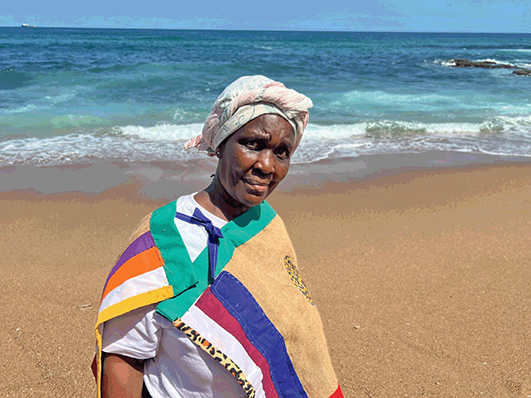
His first daughter, we were told, was born in 1917. She was the one who disappeared into the sea. Maphithini was not worried, since he knew she needed to spend a week underwater to be initiated by her deceased great-grandfather. It might have been ten days: her sister no longer remembers the exact time (see Figure 3). When she re-emerged from the water with a sea snake, the animal was in fact the ancestor. The family slaughtered a cow, and the initiation of the girl was completed. After this incident, Maphithini’s fame grew, and he had to build a larger hall to accommodate his growing number of followers. He healed and blessed them with salt, maize, charcoal, candles, and milk. Although the older sister left emaKhehleni after Maphithini died on June 12, 1964, the two children we met continued the organization.
Maphithini Thusi’s daughter, in 2024, at the spot where her sister disappeared into the sea, and her father used to meditate.
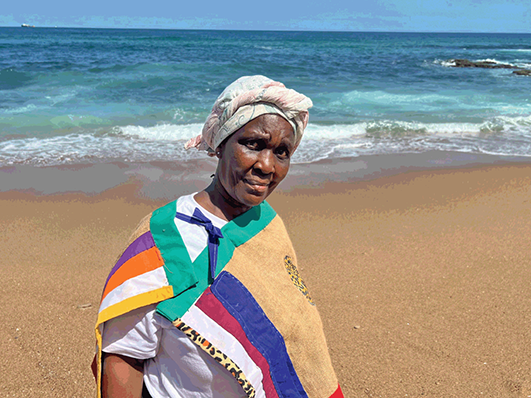
It seems to have remained a local group and changed very little from when du Toit observed it in the late 1960s. He sketched a map of the compound (du Toit Reference du Toit and de Jager1971: 92–3) that we could have used in 2024. The only difference is that du Toit was welcomed by Maphithini’s widow, who is now buried near her husband. The procession we witnessed, where participants go from the entrance to the compound to Maphithini’s mausoleum and then to the central gathering place, was also remarkably similar to the one described by du Toit, although perhaps smaller in scale. Like du Toit, we also noticed the main “membership insignia, a small Zulu shield made from real cow hide and approximately two inches in length” (du Toit Reference du Toit and de Jager1971: 90).
When du Toit studied emaKhehleni after Maphithini’s death, its membership was in the hundreds and probably never reached the thousands (du Toit Reference du Toit and du Toit1970). Maphithini did succeed in building an organization, as his dream had told him, but it was a local group rather than one with national or international ambitions.
It was an AIS organization, however. References to the Bible were not totally absent during Maphithini’s lifetime, or so du Toit reported, acknowledging, however, that “the tenets of the cult are drawn from the traditional [Zulu] cosmology and value system rather than from the Christian teachings and the Bible” (du Toit Reference du Toit and du Toit1970: 51–2; anthropologists used the word “cult” in the 1970s without the present derogatory meaning).
Maphithini also introduced rituals on August 1 every year honoring Nomkhubulwane, the Zulu goddess of rain and fertility, and “one of the most important achievements that members of emaKhehleni pride themselves on is the ability to cause barren women to conceive” (du Toit Reference du Toit and du Toit1970: 55). In fact, du Toit noted that those who had joined emaKhehleni and belonged to mainline Christian or “Separatist” (i.e., AIC) churches ended up abandoning them. He defined emaKhehleni as
a revivalistic cult. It originated and developed with reference to the ancestors and especially Shaka. It emphasizes traditional behavioural patterns, forms of native dress, native beer, polygamous unions, and traditional Zulu rituals. It operates through sacrifice, divination, dream interpretation, and communication with the shades.
Whatever one may think of the “revivalistic” label applied to such a group, this looks like the description of a typical AIS institution, if of a small one.
Credo Mutwa
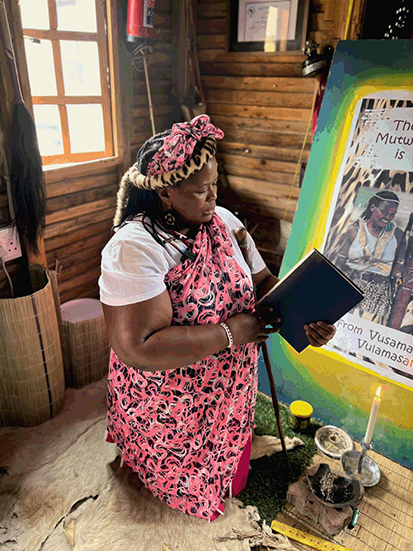
One of our most moving experiences in interviewing AIS-related figures came when Makhosi Vulamasango Isis Nozipho Mutwa, the daughter of Credo Mutwa (1921–2020), told us how “students” in 1976 attacked the house in Soweto we were now visiting when her father was not home (see Figure 4). They killed her brother, and raped her mother compelling her, a young girl at the time, to watch. Recently, she sought out those “students” she could still identify and invited them for a reconciliation ceremony. They slaughtered a goat, ate its meat, and cried profusely. A township war had, in a way, ended.
Makhosi Vulamasango Isis Nozipho Mutwa, the daughter of Credo Mutwa.
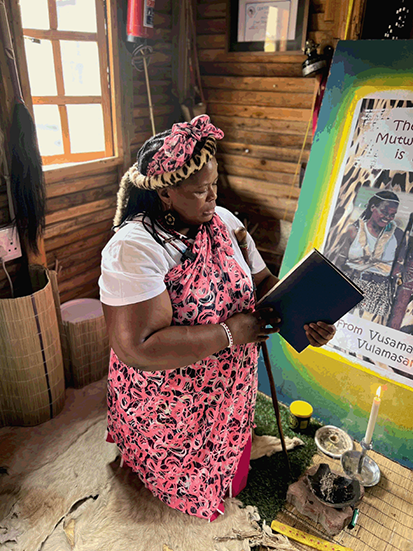
We were aware we were treading on slippery ground. The “students” who attacked Credo’s family during the Soweto riots of 1976, which started as protests against the introduction of the Afrikaans language in black schools, were anti-apartheid militants. Credo had been accused of being “an opportunist who consorted with the enemy” for his “unashamed unpoliticised conscience,” as a local journalist put it (Friedman Reference Friedman1997). He had refused to condemn apartheid and had denounced the Marxism of some black militants as not less dangerous than white rule, which he was willing to accept as long as Africans would be “free to preserve their distinctive tribal customs and their traditional way of life” (Chidester Reference Chidester2002: 70). His daughter told us that this image of Mutwa should be nuanced. While he was not engaged in politics and received visitors of all persuasions seeking his help, he went through the motions of supporting the government, she claimed, while secretly helping relatives who fought apartheid, including some of his own children.
On the other hand, he was controversial for different reasons, too. Many Westerners are familiar with theories that malignant shape-shifting Reptilians from outer space operate in our world and, after they interbred with human beings, their offspring became political leaders, kings, and even US presidents. They know these stories primarily derive from David V. Icke, a former British professional football player and later sports broadcaster-turned-conspiracy theorist. What is less known is that Icke might have derived his theory of Reptilians from Credo Mutwa. Icke gave due credit to Mutwa, although he said he found in the latter’s theories confirmation of ideas he had already developed by himself, or received as revelations from a spirit before (Chidester Reference Chidester2002: 78). Mutwa also reported personal encounters with aliens, which were studied with interest by the Harvard psychologist John Mack (1929–2004) in one of his books on the subject (Mack Reference Mack1999: 198–218).
Mutwa was a master of appropriation, which made him a popular lecturer in the international New Age circuit, from Australia to Japan and Peru. He was ready to answer those who called him a “New Age Zulu” (Steyn Reference Steyn, Carton, Laband and Sithole2009), pointing out that stories of encounters with beings from the stars, benign or malignant, are as old as Africa.
Mutwa was born in Natal in 1921. His father was a Roman Catholic who named him “Credo” after the profession of faith in the Sunday Mass. The father separated from Credo’s mother, who was a staunch proponent of African spirituality, and, together with his new wife, embraced Christian Science. Although he despised both the religion and his stepmother, Credo was perhaps influenced by the Christian Science idea that illnesses come from belief. As a child, he was sick himself. It was one of the mysterious sicknesses that in Africa signal a spiritual call; to understand this, however, the boy had to leave his paternal home and live with his mother and her parents (Mutwa Reference Mutwa and Larsen2003a: 1–13). There he started a process where he was cured of his illness, became conscious of his special spiritual gifts, and eventually concluded that Christianity was “a giant with feet of clay,” “a forgery,” and “a false religion” (Keeney Reference Keeney2001: 62). In a vision, King Shaka gave him the name “Vusamazulu” (Awakener of the Zulus) (Mutwa Reference Mutwa and Larsen2003a: 11). He understood that his mission was to become a spiritual guide of the Zulu people, preserving and restoring their old ways.
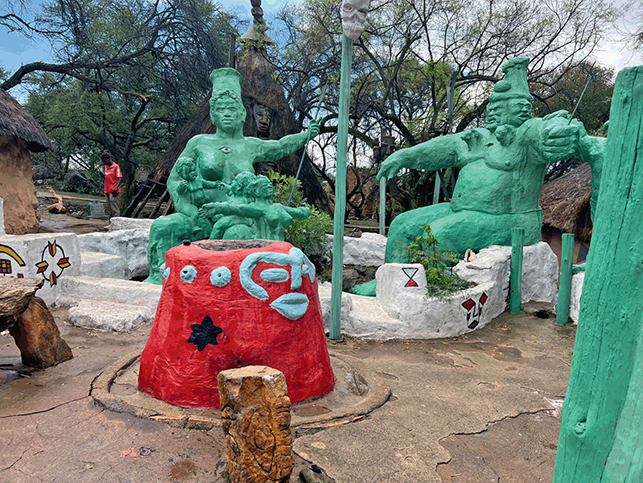
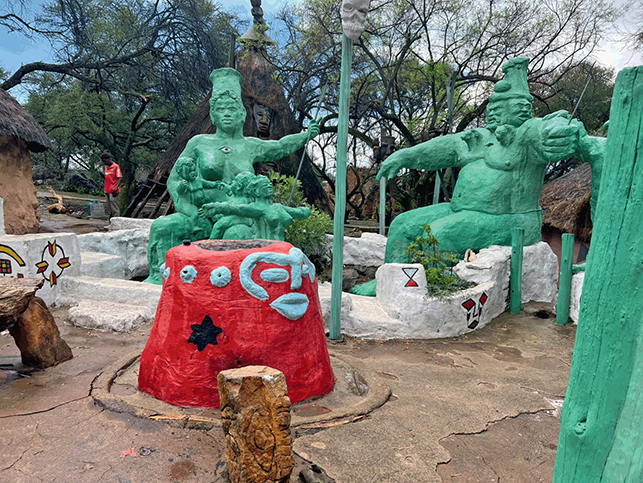
He tried to do this by becoming a “gifted and imaginative storyteller” (Chidester Reference Chidester2002: 68), starting from the book Indaba My Children (Mutwa Reference Mutwa1964), whose first edition was shown to us in Soweto by his daughter and her followers with great reverence, as if it were a sacred artifact. He also produced paintings, sculptures, and comics. Mutwa’s most fantastic creations were the small theme parks he created in Soweto – destroyed during the 1976 riots but since reconstructed (see Figure 5) – at Lotlamoreng Dam, in the North West province, and near the Shamwari Game Reserve, in the Eastern Cape. When we visited the one in Soweto, we were confronted with a phantasmagorical and in some ways bewildering array of statues and paintings depicting symbolic creatures, real and mythological animals, and aliens. The grave of Alida Moyeng (1949–1976), Credo’s loyal student killed during the 1976 riots, was there to remind us that the phantasmagoria once turned into tragedy.
Credo Mutwa’s theme park in Soweto.
Anthropologists and others note that none of Credo’s literary or artistic tales depict Zulu legends as they can be studied in older sources. Credo did not disagree, as he always claimed he was weaving African legends with visions, fiction, and figments of his creativity.
Credo had openly rejected Christianity and saw promoting AIS as his lifelong mission. While he and his Western translators and editors used the word “sangoma,” or traditional healer, which was becoming more familiar to non-African readers, he preferred to be designated as “Sanusi,” a higher intermediary with the spirit world in the Zulu language. His daughter told us that the real sangoma in the family was her mother, who in turn initiated her. Credo, she said, was a spiritual guide, a messenger of the deities. Credo himself anticipated that nobody in his family could continue in his role as a spiritual guide, although his daughter preserves some of his rituals. His son Innocent (1946–1976) was qualified to inherit the mantle, but he was murdered in the riots. So, Credo said, “I have no one to pass my knowledge on to” (Mutwa Reference Mutwa and Hund2003b: 166). In his idiosyncratic way, he did much to promote AIS but did not create a long-lasting AIS institution.
Both Maphitini and Mutwa conceived the idea of AIS as a way of revitalizing local traditions through some form of organization and promotional activities. Their plans, however, remained in their embryonic stages. While honoring Mutwa and Maphitini, Samuel Radebe will go beyond their localistic and tribal approach and build a national (or international) and viable AIS institution, TRSH.
2 The Making of The Revelation Spiritual Home
In 2013, the African Centre for Migration and Society at the University of Witwatersrand teamed with the Johannesburg newspaper Mail & Guardian to research aspects of the South African metropolis often bypassed in both media and academic discourse. The stage of the research was a city with more than five million residents and a growing number of problems, including a housing crisis, “extreme inequality, high rates of joblessness [and] the largest [number] of asylum seekers in the world” (Wilhelm-Solomon Reference Wilhelm-Solomon, Budesta Batanda, Kihato and Wilhelm-Solomon2013: 44).
Although either invisible to the mainstream media or misunderstood by them, many sought the solution to their problems in spirituality. In the context of this research, South African academic Matthew Wilhelm-Solomon was led to a place that, some ten years after him, we visited repeatedly: what was once the greatest Jewish synagogue in Johannesburg had become something else.
The story of the Great Synagogue in Johannesburg’s Wolmarans Street is visually told at the South African Jewish Museum in Cape Town. In the nineteenth century, some 40,000 Jews emigrated to South Africa from Lithuania (then part of the Russian Empire). Most were poor, but some became millionaires, and the opening of the Byzantine-style synagogue in 1914, designed by the famous Swiss architect Theophile Schaerer (1874–1948), testified to their newly acquired affluence. Eighty years later, in 1994, the dwindling number of Jews in Johannesburg and the rising crime rate in the area persuaded many Jews to leave. The synagogue became a venue for fashion shows and other events, until 2009, when it was rented by the institution then called The Revelation Church of God – and now, The Revelation Spiritual Home.
Wilhelm-Solomon in 2013 praised the institution for having kept and restored the main features of the synagogue with respect, something we also immediately noticed in 2023:
The interior of the synagogue is still well preserved. It has a large sky-blue dome, echoing with the voices of the congregants and reflecting light through stained-glass windows. The Star of David adorns many of the walls. The menorah, the seven-branched candelabrum, remains on the old bimah (pulpit), its candles burning against the backdrop of a video screen.
In 2023, we observed that TRSH had done the same when it purchased another beautiful synagogue in disrepair; it now hosts the Empandeni spiritual center of the institution. Even more impressive was the fact that both ex-synagogues were packed. In front of what was once the Great Synagogue, a former Jewish school was adapted as an overflow place of worship. More participants were accommodated in a nearby courtyard, protected from the sun by brightly colored umbrellas.
This was already true in 2016, when Wilhelm-Solomon revisited the former Great Synagogue with his colleague Bettina Malcomess, also from the University of Witwatersrand. They found outside the crowded building a “waiting congregation extending almost two entire blocks” (Malcomess and Wilhelm-Solomon Reference Malcomess, Wilhelm-Solomon, Wilhelm-Solomon, Núñez, Bukasa and Malcomess2016: 54).
A Young Man with a Vision
The institution’s success was mainly due to its charismatic leader, Samuel Radebe. He was born Samuel Mbiza on November 8, 1977, and grew up in Gugulethu, Western Cape, near Cape Town. He came from the Radebe clan, which had given his AmaHlubi ethnic group several spiritual guides.
The emic story of African spiritual leaders often starts with what appears to relatives as a mysterious illness until a spiritual seer reveals it to be a divine call. The experience may affect either a child or an adult (du Toit Reference du Toit and de Jager1971: 89). The fact that the emic story recurs in several similar cases does not mean that it is not factually true. Eyewitnesses often attest to it. Its interpretation creates a sacred context.
According to TRSH sources, Radebe’s signs started manifesting when he was only four months old. At the age of four, these signs intensified. At that time, he began experiencing visions and other spiritual phenomena. He “would see multi-colored lit izibane (candles) on the ground and … he did not understand what was happening.” The visions terrified him, and he feared to step on the ground (Radebe Reference Radebe2022: 12). Although Radebe was otherwise a normal child, loving music and soccer (Radebe Reference Radebe2022: 8–11), these visions continued. They left him scared and with problems in moving and speaking until he was six. Then, an elderly woman known for her spiritual gifts visited the family and explained that the boy was not sick but
had a spiritual calling. She further explained that young [Radebe]’s experiences were due to the activation of his spiritual guides (Izithunywa) who were signaling that they wanted young [Radebe] to assume his role of being a Spiritual Guider.
After the woman performed a ritual of placing a block of camphor and lighting a white candle (izibane) to appease the Izithunywa, Samuel was able to talk, move, and go back to school. But the visions continued.
Radebe lost his father when he was a toddler, and his mother later, as a teenager. After his mother’s death, the young man moved to Johannesburg. In 1993, at sixteen, he joined a Brazilian Pentecostal denomination called the Universal Church of the Kingdom of God (UCKG), which had considerable success in South Africa. This was an important passage in Radebe’s life, but one that was somewhat paradoxical and needed an explanation.
A church with several million members and a global reach, the UCKG was founded in 1977 in Rio de Janeiro by evangelist (later Bishop) Edir Macedo. Both opponents and scholars have accused the church of subtly promoting anti-African sentiments while officially condemning racism (Beecheno Reference Beecheno2022). The UCKG is also controversial for teaching, as do other Pentecostal churches, that demons control other forms of religion and spirituality. They include both Roman Catholicism (which the UCKG also attacks as “demonic” in South Africa: van Wyk Reference van Wyk2018) and AIS.
Indeed, the UCKG claims that Africa is “the heart of evil,” and its preachers “turn ancestors into perpetrators of evil.” Worse, since African spirituality is believed to be controlled by demons, the UCKG teaches that Africans deserve their misfortunes. “The UCKG uses the Bible to justify colonialism and slavery, and hence the suffering of African nations” (Vasconcelos de Castro Moreira Reference 78Vasconcelos de Castro Moreira2024: 9–10). Yet, the UCKG has experienced an “unlikely” success among black South Africans, with hundreds of congregations in the country. Many see its exorcisms as effective remedies against witchcraft (van Wyk Reference van Wyk2014) and fail to immediately discern its racist features.
TRSH’s account of Radebe’s experience in the UCKG is that it was spiritually predetermined by his spiritual guides to prepare his mission of reviving the spirituality of the African people. To do so, he had first to understand the reason behind the demise of AIS. The UCKG offered an excellent example of how a church trying to demonize and eradicate AIS operated.
Yet, Radebe enjoyed considerable success at the Johannesburg UCKG as a boy healer. The young man had a special healing gift, as people who attended his services at that time confirmed to us. His success notwithstanding, Radebe quickly noted the mistreatment of and discrimination against African pastors and evangelists by the white ones. Radebe asked himself, he told us, “why are black people until this day victims of segregation and brutal treatment even after democracy.” Soon, he felt out of place at the UCKG.
In 2006, while reflecting on his problems at the UCKG, Radebe was led by what he perceived as the voice of his spiritual guides to the Vaal River, near Johannesburg. Suddenly, he saw a golden lampstand emerging from beneath the waters. He insists this was not a vision but a live experience. This lampstand was very much real, as confirmed by Lucky Mpaphuthi, who is now a TRSH member and was an eyewitness to the event. It had seven lit candles in different colors (white, two shades of baby blue, green, red, yellow, and royal blue). At the Vaal River, Radebe also saw beings with abnormally large heads, “with the colors red, blue, and green flickering on them” (Radebe Reference Radebe2022: 22). Some of them had a third eye. It was there that he received his call. He was told by his spiritual guides that the time had come for him to establish an African indigenous institution.
The Blood River
In late 2024, we visited the Voortrekker Monument in Pretoria, as many South Africans do every year. The well-known city landmark is a celebration of Afrikaner and Christian South Africa, although its architect, Gerard Moerdijk (1890–1958), had esoteric interests and was an admirer of ancient Egyptian spirituality, the symbols of which he utilized throughout the building. Thus, paradoxically, an apology for white South Africa also hides references to what its architect regarded as the Egyptian origin of “Africanness” and its glory (Marschall Reference Marschall2001), a theme TRSH would easily agree with.
This is not to deny that the monument includes racist features, “with specific rights and privileges attributed to whites on the basis of being civil and thus superior” (Steenkamp Reference Steenkamp2015: 33). We were puzzled by the enthusiasm of our African tour guide for the bas-reliefs depicting the bravery of the Afrikaner trekkers, who had left the Cape Colony in 1836 seeking to escape British control, when they confronted on December 16, 1838, a preponderant force of Zulu warriors on the banks of the Ncome River, called since by the whites “Blood River.” Some 400 Afrikaners “miraculously” defeated 25,000 or more Zulus. While the Afrikaners’ firearms were a crucial factor in the battle, the Pretoria bas-reliefs insist on the Covenant, a vow made by the Voortrekkers before the battle that they would build a church if they emerged from the confrontation with the Zulus safe and victorious. Eventually, the Church of the Vow was built in Pietermaritzburg, Natal. Our Christian guide, a Zulu man, insisted on showing us a picture from his cell phone proving that he had been there and visited the church. For him, the Covenant at the Blood River symbolized a Christianization he felt part of.
December 16, the day of the battle, was celebrated in South Africa as a public holiday, “the Day of the Vow,” until 1994. Wisely, if not without controversy (Sithole Reference Sithole, Carton, Laband and Sithole2009: 322–30), Mandela kept the public holiday, but renamed it the “Day of Reconciliation” after the end of apartheid.
It was to the location of the Ncome River battle that Radebe, when he was leaving the UCKG, went as a pilgrim or, as he reported, was instructed by the Izithunywa to go, on December 5, 2008.
It was at that mountain where the causes of the African people’s misery and suffering under the command and altar of other nations were revealed to [him]. Together with that, he was also given instructions on how to remove the curse that had befallen the African people.
What happened was a reversal of the Afrikaner Covenant, which had established the primacy of the whites and their religion on South African soil. In the same place, Radebe started removing what he saw not as a blessing but as a “curse” and concluded a new Covenant with his spiritual guides, vowing to restore AIS in its pristine splendor. TRSH members told us that Radebe went to the Ncome River to “dissolve the Covenant that had been formed to oppress African people” and “establish a new liberating Covenant.” Later, Radebe told his followers that the symbol of the Covenant is an uphawu lesivumelwano, that is, beads of different colors (baby blue, red, white, royal blue, gold, and green) worn on the right hand.
According to TRSH, in 2021, a man from Greytown, KwaZulu-Natal, received a revelation that, since 1902, a sacred spear crafted by a descendant of the family whose ancestor forged lances for King Shaka had been kept in the Ncome River area, waiting to be given to Radebe. TRSH’s founder now possesses the sacred artifact (African Hidden Voices 2024: 182).
The Revelation Church of God
At the address 14, Plein Street, Johannesburg, there is an office building with an underground garage. Descending to its lowest floor, we found a space once used as a rudimentary place of worship. These were the beginnings of what is called today The Revelation Spiritual Home. Several devotees, who had been attending the UCKG services not so much for the Brazilian group’s theology but for Radebe’s healing skills, left with him and started gathering in the Plein Street garage. The first service was held there on March 22, 2009. The success was immediate. In a few weeks, the garage became too small to welcome those who wanted to hear Radebe. This led to the move to the former Great Synagogue on May 10, 2009.
But even the ex-synagogue eventually became too small. TRSH is now completing the construction of a large building in the Marshalltown district of Johannesburg, which is already in use and where it can seat some 5,000 participants at its gatherings. It also plans to build a large spiritual facility in the Johannesburg neighborhood of Yeoville, where it purchased land and won a long legal battle to evict the squatters who had occupied it.
However, no single building can hold all those who want to attend TRSH Sunday and Tuesday services. In 2013, Malcomess and Wilhelm-Solomon reported that the institution “packed the Johannesburg stadium to capacity with over 30,000 people.” The two scholars believe that what accounted for the rapid success were reports of healings – “stories of Radebe’s healing powers attract[ed] diverse congregations from across national and ethnic divides in the city [Johannesburg].” They also noted the presence of a robust contingent of Zimbabwean immigrants (Malcomess and Wilhelm-Solomon Reference Malcomess, Wilhelm-Solomon, Wilhelm-Solomon, Núñez, Bukasa and Malcomess2016: 53). An unemployed Zimbabwean immigrant with a heart condition told the scholars he had been discriminated against at Johannesburg Hospital. He said he felt
regarded as an outsider there. “If you are a foreigner, they don’t take you as if you are a patient, but as if you are foreigner. I don’t feel good at the hospital.”
In contrast, the man felt welcome at TRSH (then called The Revelation Church of God, TRCG). He hoped to be healed, but he also found a sense of belonging and the sense that TRCG was his “second home” (Wilhelm-Solomon, Zulu, and Worby Reference Wilhelm-Solomon, Zulu, Worby, Wilhelm-Solomon, Núñez, Bukasa and Malcomess2016: 266–7).
Malcomess and Wilhelm-Solomon noted that Radebe capitalized on what he had seen in the UCKG and used “many of the same methods as the UCKG including televised and online media, [and] the selling of newspapers” (Malcomess and Wilhelm-Solomon Reference Malcomess, Wilhelm-Solomon, Wilhelm-Solomon, Núñez, Bukasa and Malcomess2016: 53). Although the strategic tools used by Radebe might have been similar to the UCKG’s, the content was radically different (Malcomess and Wilhelm-Solomon Reference Malcomess, Wilhelm-Solomon, Wilhelm-Solomon, Núñez, Bukasa and Malcomess2016: 53; Wilhelm-Solomon, Zulu, and Worby Reference Wilhelm-Solomon, Zulu, Worby, Wilhelm-Solomon, Núñez, Bukasa and Malcomess2016: 264). While the purpose of the UCKG was to demonize and exorcize away AIS, Radebe wanted to restore and promote it.
From the beginning of TRCG, the exclusivism and vitriolic criticism of other spiritual forms typical of the UCKG was foreign to Radebe. On the one hand, it criticized religions alien to Africa and imposed by colonialism to destroy AIS; on the other, TRCG welcomed people of all faiths to its gatherings. Visiting scholars “witnessed members of Zionist congregations, in their dress, in attendance” (Wilhelm-Solomon, Zulu, and Worby Reference Wilhelm-Solomon, Zulu, Worby, Wilhelm-Solomon, Núñez, Bukasa and Malcomess2016: 264).
Finally, the scholars who observed TRCG in the 2010s noticed the absence of features that had plagued other African spiritual institutions – namely, tribalism and nationalism. Wilhelm-Solomon and his colleagues noted in 2016 that Radebe
has a transnational and cross-class membership. He directly speaks to the formation of a new moral community that is not rooted in nationalism. The overt cross-ethnic, cross-national stance makes the church quite politically radical in some sense.
In 2023 and 2024, we visited several TRSH branches in South Africa and Zimbabwe, all crowded and needing overflow spaces, including a huge white tent in the large Soweto branch. There are more than seventy branches of the group in South Africa, Eswatini, Botswana, Lesotho, Malawi, Zimbabwe, and Mozambique, with an overseas branch in Newbridge, County Kildare, Ireland, and one that opened in the United States in Atlanta, Georgia, in 2025. We were told that the foreign branches typically have not been founded by traveling missionaries but by locals who went to South Africa as immigrants or students, met TRSH there, then returned to their home countries. In the branches we visited, the services conducted in the Marshalltown headquarters were shown on large screens via streaming.
When we visited TRSH’s Bulawayo spiritual center in Zimbabwe, we noticed in the courtyard leading to the entrance of the main building an old and worn banner announcing “The Revelation Church of God” still on display. The period of TRCG is acknowledged as part of the organization’s history. Although the first institution bore Christian influence when it was founded in 2009, and in 2015 proclaimed its mission to restore AIS, it was only in 2020 with the change of name from The Revelation Church of God to The Revelation Spiritual Home, that Radebe “moved from the religious confines of Christianity to the full practice of his spiritual calling – one rooted in AIS” (African Hidden Voices 2024: 110–11). The Revelation Church of God had “churches” and “bishops.” The Revelation Spiritual Home has “spiritual centers” and local “leaders.” The terminology change attests to an emphasis on the difference between African spirituality and Christianity.
The Christian journey of Radebe is not denied but is appropriated as a step on his spiritual path – one that his followers believe his spiritual guides had devised to make him understand more clearly what happened to Africa’s soul and what remedies were needed.
The Mountain of Answers
We had traveled for almost five hours from Johannesburg and were now close to the border between South Africa and Lesotho, on the slopes of a scenic mountain near the town of Clocolan. The city was officially renamed to its original name, Hlohlolwane, in 2015, but is still often referred to by the colonial name, Clocolan. The mountain is known to TRSH members as Ekuphumuleni, the “Place of Rest,” and Intaba Ephendulayo, the “Mountain of Answers.” Hlohlolwane means in the Basotho language “Stand Up and Fight,” a name of spiritual significance for TRSH, as it is significant that the area was once populated by amaHlubi, Radebe’s ethnic group. The mountain is sacred to TRSH as the location Radebe entered in 2014, finding there the “resting place” of the Covenant he had enacted at the Ncome River.
As TRSH tells the story, in 2014, during a visit to his ancestral family home, Emahlubini, Radebe received an ithongo, a spiritual dream. His grandfather appeared to him, dressed in white, holding buckets of water as if offering them to Radebe. The latter connected the dream with his unexpected meeting with a Greek man who had something to sell to him. The Greek owned a large piece of land in Clocolan that included most of Ekuphumuleni mountain and its caves. Radebe received a revelation that this was one of the mountains in whose caves Mantsopa used to meditate. It is not far from Modderpoort, where Mantsopa lived out her final years and is buried.
Radebe bought the land and journeyed there on December 5, 2014. He established at the site the “Covenant of Restoration” (Isivumelwano Sembuyiselo), which TRSH sees as a pivotal moment, steering what had been The Revelation Church of God into the path of the restoration of an AIS freed from Christian contamination. This was not a second Covenant but a reaffirmation of the Covenant at the Ncome River.
Before 2014, TRSH members went as pilgrims to the Ncome River to celebrate Radebe’s Covenant there. From 2015, the pilgrimages were relocated to the mountain now called Ekuphumuleni, where Radebe goes every year on December 5 to renew the Covenant of Restoration. In 2015, Radebe recognized a cave on the Ekuphumuleni mountain as home to Ishtunywa Esikhulu, the “Principal Messenger.” Thus, Ekuphumuleni was designated the “Supreme Spiritual Altar” (Indawo Ephakeme).
The place also affirms the spiritual connection between Radebe and Mantsopa. In 2016, a group of TRSH members – who call themselves “Amasosha,” or part of “the Blue Nation” – got lost during their journey to Ekuphumuleni, which is indeed not easy to find. They met a local man called Timothy Tleru, who happened to be an amateur historian and a collector of old stories concerning Mantsopa. He confirmed that Mantsopa spent time on the mountain Radebe had bought. He also told the Amasosha that Mantsopa once uttered
a spiritual revelation about a Hlubi man who would inherit her mountain in the Free State. Mr. Timothy said that “Mme [Mantsopa] had prophesied that a male from the Hlubi tribe would one day inherit one of her mountains; she said that this male would come wearing a blue garment and would heal using water just as she did.”
These were all features of Radebe – a Hlubi man wearing a ceremonial blue garment and healing with water.
The reference is important for TRSH, as “the arrival of [an] Afrikan Indigenous Spiritual Guider must have been predicted by Afrikan Indigenous Spiritual Guiders before him … or her” (African Hidden Voices 2023: 83). TRSH finds similar revelations that can point to Radebe in the words of Simon Kimbangu (African Hidden Voices 2023: 82). As for Credo Mutwa, the group reports that in 2014 a group of Amasosha visited him when he was living in Northern Cape. Mutwa told them he knew Radebe “spiritually,” although he had never met him, and enquired whether he was still alive. Radebe and Mutwa met for the first time in 2015. Mutwa honored Radebe as “umkhulumi wamaqiniso, uVezindaba” – “Speaker of truth and revealer of spiritual matters” (African Hidden Voices 2023: 85). The circumstance was confirmed to us by Mutwa’s daughter when we visited her in Soweto in 2024.
Another spiritual connection with Mantsopa emerged more recently. In Ekuphumuleni, we interviewed Ngono Pulane Mateboho Khomonala, a woman from Lesotho who was initiated in 1998 as a traditional healer, although she was also a member of a branch of the largest Southern African AIC, Zion Christian Church. She saw Mantsopa in a dream and was told to ask her mentor (the woman who had initiated her) for permission to cross the border to South Africa and go to Mantsopa’s sacred mountains, where she would eventually meet a spiritual leader. Her mentor refused, and she went back to Zion Christian Church.
However, the woman continued having dreams, associating water and the spiritual leader she was called to meet at a place connected with Mantsopa. She also saw him in her dreams wearing a leopard skin. She developed her gifts as a healer and started wearing a yellow garment, symbolizing her spiritual call to heal through water. In 2022, another dream told her she should no longer attend Zion Christian Church. In 2024, when she was returning home from Lesotho’s capital city of Maseru, where she had gone to sell corn, she heard people singing songs she liked. Curious, she entered the building and discovered this was the Maseru branch of TRSH. She saw pictures of Radebe and finally realized he was the man Mantsopa had told her in 1998 that she would meet, and the one she had repeatedly seen in her dreams. Now, she told us, she has become a member of TRSH and has stopped gathering personal followers. She tells those who go to her as a healer to join TRSH.
Ekuphumuleni is not the only mountain with caves associated with Radebe. In a remote part of Zimbabwe, we visited an area with a sacred cave where, as in other parts of Africa, “rocks talk.” In Bulawayo, we met a former Zion Christian Church devotee who, after a passage in the Apostolic Church of South Africa, in 2010 joined TRSH through a cousin who was a member. She has visited the cave several times since 2014, and the talking rocks, she said, confirmed Radebe’s mission to her. The rocks also talked to Radebe himself when he went there.
The Sea of Revelations
On the Durban coastline, the beaches of the Golden Mile give way to wilder areas where rocks descend into the Indian Ocean. Although a paradise for surfers, the area is shark-infested and tests the effectiveness of the shark nets devised by the KwaZulu-Natal Sharks Board Maritime Centre of Excellence.
It is to one of its rocky coastal spots, later called Esibonakalisweni (Sea of Revelations), that his dreams and revelations led Radebe and his followers on December 31, 2011. A ritual was performed there from midnight on New Year’s Eve until the morning. After one month, the specific area revealed to Radebe in a vision was identified. It became a favorite spot for prophetic revelations. To Radebe, the water tells stories about the future. He goes there accompanied by followers, who record and videotape his words immediately after his visions.
In 2019, he received a revelation on immigration and the attacks against Zimbabwean immigrants in Durban. He took the opportunity to condemn xenophobia and the violence perpetrated by Africans against other Africans. He revealed that “one day South Africans will want to migrate to other countries, and they will be mistreated and killed too.” Radebe said this will be a sequence of spiritual rather than purely political incidents. The spirits protecting the Zimbabwean immigrants “will want to avenge these unwarranted killings of their children” (African Hidden Voices 2023: 96).
On February 26, 2020, Radebe perceived in the raging sea waves the anger of the national deities connected with water. When, in subsequent years, KwaZulu-Natal was hit by catastrophic floods, TRSH interpreted this vision as a prophecy of the deadly inundations (African Hidden Voices 2023: 100–1). We also watched a video dated January 1, 2022, where Radebe reported seeing the word “chaos.” TRSH members explained that shortly thereafter, riots instigated by the anti-migrant group Operation Dudula erupted in KwaZulu-Natal, together with an environmental crisis and new floods, conveying what was indeed a sense of impending chaos.
On January 26, 2020, Radebe saw something coming from the northeast, which he later identified as China and Wuhan, hitting a large S and A, meaning South Africa. This was interpreted as a prophecy of COVID-19 and the lockdowns in South Africa, which were also alluded to in other revelations received in the same place (African Hidden Voices 2023: 102).
TRSH members find an apparent confirmation of Radebe’s spiritual revelations in his description of a vision recorded on October 8, 2023. He saw the four letters S-A-B-C appearing before him “boldly” and announcing “something that will happen.” Four days thereafter, on October 12, South African national media reported a fire at the headquarters of SABC, which is the acronym of South African Broadcasting Corporation, in Auckland Park, Johannesburg. The fire was confirmed by SABC itself (SABC 2023). The short time lapse between Radebe’s vision and the fire was perceived as distinctly significant.
Just as the Ekuphumuleni mountain connects Radebe with Mantsopa, the scenic spot in Durban establishes a relation between the founder of TRSH and Maphithini Thusi. Radebe claims he was led there by visions. Only later did he discover this was where Maphithini was taken by his spirit guides when his mission began and where his elder daughter had her mysterious underwater experience. However, AIS is a world of dreams, and Maphithini’s daughter herself told us that she had seen Radebe in a dream where her father also appeared, directing her to visit a spiritual center of TRSH. Radebe also performs annual rituals on August 1 at the same place where Maphithini held his yearly celebrations of the goddess Nomkhubulwane.
Radebe’s visions and covenants at the Vaal River, Blood River, Hlohlolwane, and Esibonakalisweni are foundational events for TRSH. Over the years, their content and message have guided TRSH toward creating a narrative about human history and the universe, and a system of rituals.
3 Knowledge and Ritual in TRSH
“But have you been to the Cradle of Humankind?” TRSH members asked us, claiming that visiting the UNESCO World Heritage Site, some fifty kilometers from Johannesburg, would enlighten us about the connection between Africa and the oldest spirituality that appeared on Earth. So, there we were, listening religiously to the guide explaining the marvels of the world’s largest concentration of early hominid fossils. The guide was a cautious man. He systematically insisted, at the risk of becoming repetitious, that much of what he was telling us was scholarly speculation. We do not know precisely whether the early hominids found there, of the genus Australopithecus, lived two and a half or three million years before us. We do not know who or what precisely was the Homo naledi, whose remains were found only there and who is believed to have lived between 235,000 and 335,000 years ago, and was somewhat in the middle between the Australopithecus and our own species, Homo sapiens.
Armed only with the most basic schoolbook information on paleoanthropology, we did not have opinions on these contested issues. Other visitors marveled at the fact that bone scans conclusively proved that human ancestors had malignant tumors more than one million years ago, making cancer a very ancient rather than a modern disease. We were even more impressed with the fact that Homo naledi, and perhaps his predecessors too, already cared to bury their dead in specially designated chambers in the local caves, which indicated some form of ritual or spirituality. This was why our TRSH acquaintances recommended we go to the Cradle of Humankind. With the guide’s caution, it reinforces the theory that the oldest forms of spirituality originated in Africa. Perhaps it offers a better argument than the claim we discussed earlier, that Tsodilo Hills in Botswana host the oldest depiction of a ritual on Earth.
It is not our purpose to assess the validity of TRSH claims. We simply intend to present them. TRSH is not alone in believing that “spirituality is universal, although its origins can be traced back to the mother continent, Afrika.” Traces of early appearances of spirituality elsewhere are explained through “human migration from Afrika to other parts of the world” (African Hidden Voices 2023: 12).
These claims – which may well be true – are part of a discursive strategy aimed at reinforcing a sense of, and pride in, African identity. TRSH has undoubtedly been successful. It claims a global membership in the hundreds of thousands, although statistics for new spiritual institutions are always both difficult and contentious. What do these crowds detect in TRSH that they find so attractive?
The answer, we believe, is a combination of discourse and ritual, of a narrative of identity and practical benefits. The narrative is based on two pillars. As outside observers, we would call the first a form of historiosophy, a look at history using spirituality as an interpretive tool. The second pillar is a cosmology, which includes the all-important notion of spiritual hierarchy.
TRSH’s Historiosophy
The first narrative members find in TRSH is a history of Africa and, by extension, humanity. Spirituality, they are told, is as old as humans and originated in Africa, as paleoanthropological discoveries continue to confirm. In time, Africa also developed the first spiritual institutions, among the Egyptians: the “mystery schools, such as those found in ancient Kemet (Egypt)” (African Hidden Voices 2024: 147).
TRSH members show they are not reluctant to practice appropriation, as Credo Mutwa did before them. They read Egypt through the lenses of Egyptology but also of what – rather than Egyptomania, a derogatory if humorous label – should be preferably called Egyptosophy (Day Reference Day and van den Bercken2024: 30), that is, the gaze Western esotericism directed at the ancient Egyptian spirituality. Although they insist that “some of the more extreme theories … can hardly be taken seriously,” several academic Egyptologists today acknowledge that the borders between their discipline and Egyptosophy have always been porous, and that “alternative theories inspire ‘mainstream’ scholars to reexamine their previous assumptions” (van Haarlem Reference van Haarlem and van den Bercken2024: 181).
Some of TRSH’s theories about ancient Egypt derive from Egyptosophy, such as the connection with Atlantis and its destruction, and the existence of literature about “Universal Laws” and “humanity’s cosmic origins” once preserved in the Great Library of Alexandria (African Hidden Voices 2024: 169–71). African Hidden Voices, the scholarly branch of TRSH, even mentions theories about Egypt coming from Lisa Renee, an American author who has since 1999 spread revelations received via telepathic and other contacts – which she distinguishes from channeling – with beings from other planets and dimensions (Renee Reference Renee2019). The Egyptian themes in Renee are not original, as they find parallels in various esoteric and New Age texts. What interests TRSH in Renee’s teachings is the theory that Egypt’s mystery school was attacked by “Luciferian” forces that wanted to replace its original spiritual teachings with evil distortions, ultimately generating the falsehoods of religious monotheisms (Renee Reference Renee2019). This is a key point for TRSH’s historiosophy. TRSH assumes that spirituality is both older and qualitatively superior to religion. Its demise and substitution with religion, TRSH believes, was not a spontaneous process but was instigated by evil forces.
TRSH acknowledges the contribution to the study of AIS by scholars we have mentioned, such as John Mbiti. However, it sees their work as risking perpetuating “a narrative that diminishes the complexity of AIS, reducing it to a mere subset of religious practices rather than recognizing it as a distinct and authoritative spiritual system” (African Hidden Voices 2024: 141).
Here, historiosophy leads TRSH to a criticism of religion, which it describes as not only different from but as opposed to spirituality. While the distinction between spirituality and religion is a debated theme among scholars, with some even doubting that the two can be clearly distinguished, according to TRSH’s emic view, spirituality is about knowledge, while religion is about belief. It insists it is thus inappropriate to look for a set of AIS’ “beliefs,” just as ultimately “religion has no spirituality,” despite its claim to the contrary (African Hidden Voices 2023: 17).
Those who practice spirituality have arrived at a state of knowing, which means that no one can alter their truth or move them from it. Unlike spirituality, religions have a religious book, a founder, and an inception or birth date. According to [Radebe] religion is an academic belief written by scholars, thus it speaks to the mind and heart but not to the spirit; it is based on human ideologies – the ideas of humans about spiritual matters, it is the expression of how people view spiritual things like The Creator, Spirit Guides, and the afterlife in a manner that is clearly circumstantial. However, when we speak about spirituality, we speak about the state of knowing, we speak about a personal spiritual experience, in the form of spiritual dreams, spiritual revelations from a spirit source that is superior.
Additionally, for Radebe, “religion is not a neutral, descriptive term but has strong overtones of a political nature,” with the consequence that it immediately evokes an “external” rather than an “internal” experience. Conversely, Africans “are a people who know, not a people who believe. Their knowing is spiritually experienced, they have experienced the unseen and heard the unheard” (African Hidden Voices 2023: 18).
Africa went through its own “Dark Ages,” TRSH maintains, “when AIS was systematically undermined and suppressed by foreign religious ideologies.” It was “spiritual dislocation – an erasure of the sacred link between Africans and their spiritual identity” (African Hidden Voices 2024: 93). A central tenet of TRSH’s historiosophy is that this process was deliberate. Apart from ancient conflicts in Egypt, the first wave of suppression of AIS and its substitution with religion came with the spread of Christianity in Northern and Eastern Africa since the first century CE. The early church theologians and those who brought Christianity to Egypt and Ethiopia already denounced AIS as demonic.
The second wave of eradication of AIS came with Islam, which also “introduced a form of religious governance that further distanced Africans from their indigenous spiritual practices” (African Hidden Voices 2024: 96). Worse was to come with the third wave, colonization and the coming of the missionaries. While they built institutions such as schools and hospitals, TRSH claims this was part of their effort aimed at indoctrinating Africans out of AIS and into missionary Christianity (African Hidden Voices 2024: 96–7).
TRSH’s historiosophy includes a detailed discussion of African Initiated Churches (AICs). It is needed because many who join TRSH come from the AICs (Wilhelm-Solomon, Zulu, and Worby Reference Wilhelm-Solomon, Zulu, Worby, Wilhelm-Solomon, Núñez, Bukasa and Malcomess2016: 264), and some, including women we interviewed, continue for a while to attend both TRSH and AIC gatherings.
TRSH acknowledges as genuine AIS spiritual leaders some others describe as founders of AICs, such as Kimpa Vita, Shembe, Kimbangu, and even Simeo Ondeto (between 1910 and 1926–1991), who is at the origin of Kenya’s Legio Maria Church. Additional figures include the Xhosa prophet Ntsikana (1780–1821); Zimbabwe’s Mai Chaza (1914–1960), who founded the Guta raJehovah (City of God); and South Africa’s Christina Nku (1894–1980) of St. John’s Apostolic Faith Mission (African Hidden Voices 2023: 42–5). While mainline historiography sees these figures as typical founders of AICs (Schwartz Reference Schwartz1985, Reference Schwartz1989; Hodgson Reference Hodgson1985; Dube Reference Dube2008; Kgatle Reference Kgatle2019), TRSH regards the AIS features in their spiritual careers as more important than their Christian references.
For TRSH, some of these leaders, certainly including Kimpa Vita, Shembe, and Kimbangu, whom they recognize as IIMboni (plural of IMboni), tried to use camouflage to escape persecution, with varying success, although many of their followers misunderstood their true message. TRSH also dismisses speculations attributed to Kimpa Vita and others that make Jesus Christ, Mary, and Joseph black and African. It prefers to mention theories that Jesus was a “mythical figure” and never existed historically. TRSH goes further, and believes that “these key Christian figures were, in fact, stolen concepts” based on AIS, “hence their familiar resonance in the African spiritual consciousness” (African Hidden Voices 2024: 114).
As for the AICs in themselves, TRSH’s judgment is negative. That they were a reaction against colonialism aimed at affirming and preserving genuine African spiritual elements is regarded as “a misconception.” The AICs for TRSH “were not the result of a genuine African spiritual revival but rather a colonial project designed to deepen religious bondage under the pretense of spiritual independence.” Rather than preserving Africanness, “they were initiated to maintain colonial control over African spirituality, thereby ensuring that Africans remained tethered to the religious frameworks introduced by missionaries” (African Hidden Voices 2024: 131).
TRSH is aware that scholars who have studied the AICs have come to more charitable conclusions. It responds that this happened because most AIC scholars were themselves Christian missiologists, while in other cases, features that some found admirable in leaders like Shembe derived from AIS rather than from Christianity.
Although Radebe maintains friendly relations with several Christian leaders, his position that Africans should return to African Indigenous Spirituality is uncompromising. Christianity, even in its “Africanized” forms, is regarded as a religion imposed on Africans by white people and the colonial powers, which should be repudiated in its entirety. As we have seen, Radebe goes one step further. He distances himself not only from Christianity but from religion. Radebe denounces religion and believes that serious problems were created when religion tried to replace spirituality in Africa. To understand the depth of these problems, we should introduce a crucial concept for TRSH, the spiritual hierarchy.
TRSH’s Cosmology: The Spiritual Hierarchy
The cosmology (our term) of TRSH includes both the invisible and the visible realms, which are not separated. In expressing this cosmology, TRSH often uses the words “masculine” and “feminine.” However, these words indicate energies, both necessary for balance, rather than gender. They manifest as gender at the lower but not at the higher levels. Deities (Izithunywa) are referred to with masculine pronouns because they possess “masculine energy.” However, it is inappropriate to regard them as males, as at their level gender does not exist (African Hidden Voices 2024: 18–9).
TRSH’s spiritual hierarchy is represented by a dual movement, depicted through two triangles (see Figure 6) positioned upward and downward, the first with the vertex at the top and the second with the vertex at the bottom. Planet Earth is in the middle. At the top of the upward triangle, although not part of the upward or downward dimensions and transcending both, is the Creator, an arcane being whose name, according to TRSH, is UMfihlakalo, “the Mystery.” The Creator is referred to as “He” because of his association with masculine authority, which again is different from masculine gender, as he “transcends both masculine and feminine energies” (African Hidden Voices 2024: 17). In fact, UMfihlakalo guarantees their balance and equilibrium. We saw in TRSH the frequent presence of the ancient Egyptian symbol of life, Ankh, which is said to represent the balance of masculine and feminine forces and to proclaim that both are essential.
The spiritual hierarchy of TRSH depicted by upward and downward directed triangles.
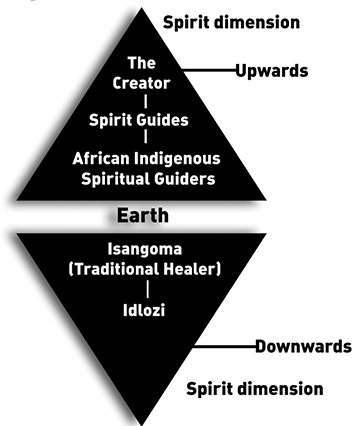
Figure 6 Long description
One triangle goes upwards towards the Spirit dimension, moving from African Indigenous Spiritual Guides to Spirit Guides to the Creator. The second triangle goes downwards, also towards the spirit dimension, moving from Isangoma, or a traditional healer, to Idlozi.
Spiritual hierarchy is also often expressed through numerology, which is ubiquitous in TRSH, although it may sometimes confuse outsiders. TRSH suggests that a perfect balance in life leads to a harmonious existence. The hierarchy is symbolized as follows:
−1 represents negative aspects in life, such as problems and suffering. These negative elements are a needed part of existence. They facilitate the emergence of positive energy and help maintain balance. +1 represents life’s positive aspects. The number 2 represents the synergy of the two forces. It signifies balance and spiritual completeness. Zero also signifies completeness or balance, just like 2. The equation can thus be simplified in the form
since both numbers, 2 and 0, represent the same elements, completeness and spiritual balance.
TRSH disagrees with theories that see monotheism in AIS because the Creator is one. TRSH believes that AIS is polytheistic since UMfihlakalo operates through a plurality of deities. “Scholars who attempt to impose a monotheistic lens on African spirituality often mistake the reverence of the Creator for monotheism,” according to African Hidden Voices. “AIS recognizes the Creator as the ultimate source but operates within a complex polytheistic system where Deities are vital intermediaries” (African Hidden Voices 2024: 8). Such polytheistic gods are not an object of belief, which is typical of religions, but of knowledge and direct experience. Africans “did not have to believe but they knew” (African Hidden Voices 2024: 6).
“The distinction between polytheism and monotheism in this context is not just numerical (i.e., many Deities versus one God); it is foundational” (African Hidden Voices 2024: 6). These multiple deities are the Izithunywa, a name we already encountered for the spirit guides of Radebe. They should not be confused with the spirits of the ancestors. Unlike the latter, the Izithunywa, each with a function in the spiritual hierarchy, were never human beings.
There is no direct communication between UMfihlakalo and humans. The Creator God communicates through the Izithunywa. They speak in dreams and revelation to the IIMboni, who act as “Spiritual Guiders” and “Physical Spiritual Central Beings.”
TRSH insists that there is a difference between a prophet and an IMboni. South African media often refer to its leader as “Prophet Radebe,” but TRSH rejects the designation as inaccurate. A prophet is an inspired preacher and speaks for the gods, but an IMboni is much more than that. An IMboni is a spiritual guide with immaculate spiritual foresight and indigenous spiritual wisdom. An IMboni’s spiritual revelations are primarily of national importance. He or she comes from a lineage of IIMboni and has been designated by the Creator God as the spiritual guide of a whole nation. An IMboni is born as such, not taught or elected by a group. In addition to the powers of prophecy and spiritual guidance, he has the power to heal both spiritually and physically.
Not all IIMboni, however, are created equal. Those who manage to establish “spiritual nations” are called “Spirit Kings” or “Spiritual Kings.” Kimbangu and Shembe, our interlocutors told us, were genuine IIMboni, but their message got mixed with religion. Other IIMboni did not establish institutions or only local ones, such as Credo Mutwa and Maphithini Thusi. Mutwa and Maphithini are revered figures in TRSH but, unlike Radebe, they are not regarded as Spirit Kings.
The symbolism of the downward triangle indicates that “working spirits” and ancestors who, unlike the Izithunywa, were once human beings and lived on Earth, are near the lower vertex. These are the idlozi, who can be good or bad depending on what they did in life. An IMboni can discern what kinds of idlozi are at work in a specific situation. This is possible because living IIMboni have a higher position in the spiritual hierarchy, thanks to their contact with the Izithunywa, than do the deceased working spirits and ancestors. The latter communicate with the abathandazeli – also often called, but again incorrectly, “prophets” – who can mediate between human beings and their spirit guides and heal through natural elements such as water. The idlozi also communicate, at a lower level than the abathandazeli, with the izangoma, whose name has been anglicized as “sangomas” (traditional healers), with the amagedla (herbalists), and with the amatola (war doctors who assisted the African rulers during conflicts).
The Role of the Sangomas
The role of the sangomas in the AIS, as interpreted by TRSH, is a rather complicated matter. We were told, for example, that the woman from Lesotho whom Mantsopa directed to Radebe through dreams is one of the abathandazeli rather than a sangoma. In addition, we saw hundreds of sangomas at TRSH services, in their colorful dresses and in corners reserved for them. Some join TRSH. Others don’t, but they participate in the African Association for Indigenous Spirituality (AAFIS), which Radebe inaugurated in 2023.
We interviewed some notable sangomas who enjoy a good relationship with TRSH. Mkhulu (David M.) Ngwenya is nationally famous in Zimbabwe and also receives foreign clients, some coming to Bulawayo to visit him from Canada, Mexico, or India (see Figure 7). He is not a member of TRSH but has joined AAFIS. His story is typical of many sangomas and includes a mysterious sickness (ukuthwasa) he experienced as a child that was, in fact, a call from the ancestral spirits.
Mkhulu (David M.) Ngwenya.
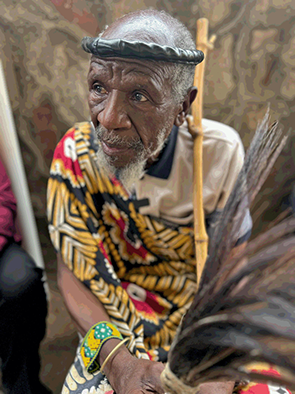
Born in 1936, he had an initially “normal” life. He went to study in South Africa and worked for the railways as a locomotive driver for twenty-one years. During this time, however, he kept collecting herbs and visiting sangomas. He insisted that one becomes a sangoma not out of a personal decision but because the spirits of the ancestors call the candidate. However, candidates should also apprentice with older sangomas and pass an exam, correctly identifying the appropriate animal to be sacrificed in an initiation ceremony. Ngwenya introduced us to his apprentices, including a recently married couple and a young man specializing in treating psychiatric patients by exorcizing the evil spirits often causing their problems.
Ngwenya does not see himself as a competitor with medical doctors. He says he cooperates with them and organizes meetings between sangomas and physicians, the first in 2001 at the Sheraton Hotel in Zimbabwe’s capital, Harare. This is part of the activities of what is now called the International Traditional Healers Association, which Ngwenya founded in 1992 (International Traditional Healers Association n.d.).
At that time, the Rhodesian Suppression of Witchcraft Act of 1899 was still in force in Zimbabwe. In South Africa, the Witchcraft Suppression Act 3 of 1957 was the heir of the British Witchcraft Suppression Act of 1895 of the Cape Colony. These acts, which had parallels in other African countries (while others are now discussing introducing legislation that would outlaw “malefic witchcraft”), were based on the “Western enforcement of a world-view that aim to deny and suppress African spiritual beliefs,” according to John Hund, a sociologist, legal scholar, and expert in witchcraft repression in South Africa (Hund Reference Hund and Hund2003: 35). The laws, he believes, both resulted from and caused confusion between two different African concepts: witch and sangoma. The problem was not with legislators only. “Academic writers are among the worst perpetrators of confusion,” Hund wrote, particularly through the use of the incorrect label “witch doctor” (Hund Reference Hund and Hund2003: 12–13), which ended up being adopted by some sangomas themselves.
For Ngwenya, the distinction is simple: sangomas heal and help, but witches harm and damage. He is not against laws punishing witches, as well as those who falsely accuse sangomas and others of witchcraft, which may result in serious violence. However, there are grey areas: love spells to attract women and men, for example, are an ambiguous matter. Credo Mutwa wrote that sangomas can cure the harmful effects of witchcraft because they can “understand and to some extent control the same occult forces as does the witch” (Mutwa Reference Mutwa1996: xxiv). Radebe believes that the word “witch” has been abused by the colonizers to slander legitimate and benevolent practitioners of African spirituality. However, he teaches that malevolent witchcraft also exists. We were shown, for example, a video on how an attack against the Marshalltown TRSH spiritual center by its opponents through witchcraft was detected and stopped.
The Suppression of Witchcraft Act of 1899 was replaced in Zimbabwe in 2006 by Part VI of the Criminal Law Code, which still punishes the use of spells to “cause harm or induce fears,” but allows the activities of traditional healers, including communication with the ancestors and divination. With minor amendments, the Witchcraft Suppression Act 3 is still in force in South Africa, but the Traditional Health Practitioners’ Act 35 of 2004 (Flint and Parle Reference Flint, Parle, Carton, Laband and Sithole2009: 312), followed by Act 22 of 2007, to which the “Traditional Health Professional Regulations, 2024” were added, allows the activities of traditional healers as long as they are registered with a government-supervised council.
Throughout Africa, there is competition between different associations of sangomas and between governmental attempts to regulate their activities and the practitioners’ fears of excessive government control. Ngwenya’s association in Zimbabwe has some 3,000 members between the sangoma’s home country and Zambia, with a sister association in South Africa. Typically, it aims to offer sangomas an organization controlled by themselves rather than the Zimbabwean government, which supervises the larger Zimbabwe National Traditional Healers’ Association (ZINATHA: Chavunduka Reference Chavunduka, Last and Chavunduka1986).
When Ngwenya introduced us into the inner sanctum of his healing activities, we noticed not only what was there – an enormous and disorganized pile of bottles with various powders and herbs, and animal skins – but also what was not there. There were no Christian symbols, images, or books, something we saw when visiting other sangomas. In Kaolack, Senegal, we met a sangoma who, while offering love spells involving the sacrifice of a goat, displayed pictures of mosques and Sufi brotherhood leaders. Ngwenya agrees with Radebe and TRSH that AIS should not be mixed with Christianity. He was repeatedly denounced as a witch by Christian pastors, he said – except that some of the same pastors would visit him at night and seek his help. On the other hand, in the difficult political situation of Zimbabwe, he praised what he sees as the sincere efforts by some Christian priests and pastors for peace and reconciliation.
We found a similar situation in Mozambique when we interviewed a female sangoma who had joined TRSH. She also experienced an ancestral calling (ukuthwasa) through an illness with spiritual causes Western medicine cannot diagnose or understand (Bührmann Reference Bührmann1982). She was eventually initiated by a sangoma but encountered considerable opposition from her Christian family. In 2013, she was told that there was a “church” in South Africa accepting sangomas. This was then The Revelation Church of God. She went to Johannesburg, met Radebe, and eventually joined TRCG’s branch of Mashava, Mozambique.
She described the double persecution that sangomas experienced in Mozambique, a former colony of Portugal. The official language, Portuguese, made it easier for Brazilian Christian megachurches such as the UCKG – firmly opposed to AIS and regarding traditional healers as demonic – to make inroads there. Mozambique also went through a long civil war (1977–1992) whose eventual winner, the Marxist FRELIMO (Mozambique Liberation Front), which is still in power, initially regarded AIS and sangomas as part of a system of “ignorance and obscurantism” that should be eradicated (Acçolini and Teixeira de Sá Reference Acçolini and Teixeira de Sá2016: 49).
After the war ended in 1992, the FRELIMO realized that sangomas were extremely popular and, rather than suppressing them, it tried to put them under governmental control by creating the AMETRAMO (Mozambican Association of Traditional Doctors). The association presides over 75,000 traditional healers and routinely mobilizes support for the ruling party in national and local elections (see e.g., Club of Mozambique 2024). For all practical purposes, joining AMETRAMO is mandatory to be able to work as a sangoma in Mozambique. The sangoma from TRSH whom we interviewed reluctantly joined the organization. However, she claims AMETRAMO is remarkably ineffective in protecting traditional healers from Christian attacks. Recent political developments, she said, resulted in a government more friendly to Christian churches and their anti-sangoma policies, but paying lip-service at the same time to the importance of “traditional doctors.”
This woman’s reluctance to engage with AMETRAMO may also be attributed to her uneasiness, as a TRSH member, when it comes to cooperating with sangomas who use Christian symbols in addition to those deriving from AIS. For Radebe, this is a serious problem. TRSH sees the use of Christian symbols by traditional healers, at least when it started, as rarely sincere and more often as camouflage aimed at protecting themselves against persecution and potentially fatal accusations of witchcraft (African Hidden Voices 2024: 125).
According to TRSH, problems extend beyond the death of these traditional healers. They “now appear in the dreams of their descendants wearing garments with crosses or other religious insignias,” thus perpetuating the confusion (African Hidden Voices 2024: 126). Every year, Radebe conducts “powerful spiritual rituals focused on the cleansing of ancestors.” They “purify ancestral lineages of any spiritual distortions caused by the mixing of religious symbols with spiritual practices.” This process, known as ukugezwa kwezithakazelo (the cleansing of clan names), is regarded by TRSH as “essential for restoring the spiritual integrity of African lineages” (African Hidden Voices 2024: 130).
Critics can see here an attempt to deny that these ancestors might have freely chosen Christian doctrines and practices. Radebe believes he is offering them liberation from the constraints of the colonial era.
IIntsebenzo (Rituals)
Radebe can perform these and other rituals because, as an IMboni and “Physical Spiritual Central Being,” he has authority over the working spirits and the ancestors. At the same time, the hierarchy in the spiritual world is replicated in the physical world. Radebe as IMboni is the head of a spiritual nation, just as in the physical dimension African nations used to be governed by kings and queens. They are still present, including in South Africa, but have limited roles since a democratically elected government and president rule the country.
Historically, African kings did not rule by themselves. TRSH emphasizes that they were assisted by IIMboni conveying to them messages from the Izithunywa. The connection between the spiritual and the physical world was thus guaranteed. Colonialism, TRSH teaches, understood that to destroy the independence of African monarchs, it first had to separate them from the IIMboni, attacking and persecuting the latter, and from the spiritual source of their authority, AIS. It managed to substitute AIS with religion and IIMboni with religious advisers and missionaries who taught kings to cooperate with the colonial powers.
Today, TRSH insists that Radebe’s revelations are of national significance. He is recognized as the Spiritual Guider of Langalibalele II, the reigning king of Radebe’s nation, the AmaHlubi (African Hidden Voices 2023: 90). When we attended in 2023 a function about religious freedom in Cape Town presided over by Radebe, we as well as the media noted the presence of a delegation from the Zulu royal family. Today, in several African countries, the traditional kings play a complicated game with spirituality. They know that AIS places IIMboni on equal, if not higher, footing with them. On the other hand, AIS also recognizes the kings’ roles and prerogatives, which are no longer taken for granted in modern African societies.
AIS remains the custodian of the quintessentially African idea that, as noted by scholars like Olupona, spirituality
informs every aspect of life – including birthing and death, marriage, family dynamics, diet, dress and grooming, health care (including mental health), the spending and saving of money, interaction with one’s friends and neighbors, and of course, governance.
In what is, so far, the central and largest home of TRSH, in Johannesburg’s Marshalltown, we saw a woman shaking and speaking in the voice of her deceased grandmother (see Figure 8). We were told the ancestral spirit had no hostile intentions. Discernment was needed, and Radebe was the appropriate and authorized person to perform it. It was revealed that the grandmother just wanted to be remembered and honored. Through IMboni, well-intentioned ancestors may be embraced and pacified. In contrast, relations with ancestors who led a bad life and continue to disturb their descendants from the spiritual world may be severed.
A woman speaks in the voice of her deceased grandmother during a TRSH service.
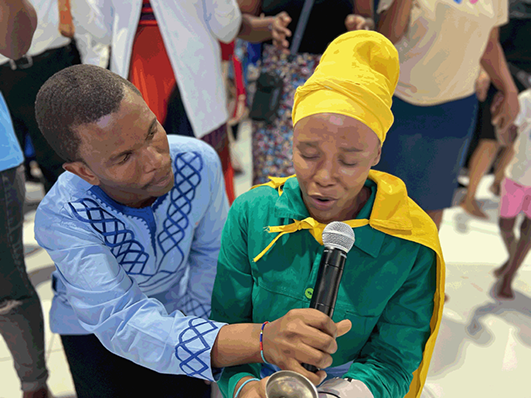
While this was a Tuesday Service of Enlightenment (intsebenzo yenkanyiso), Sunday services at TRSH are primarily devoted to teaching and reporting about the progress of the institution in South Africa and internationally, although music also plays an important role. Tuesday services are much more impressive (see Figure 9). A variety of IIntsebenzo (rituals) are performed there. These rituals have been revealed to Radebe and are specific to TRSH. Many use sanctified water, which symbolizes life and protection in African spirituality, and izibane, the spiritual lamps or candles of different colors that appeared to IMboni on the golden lampstand at Vaal River in 2006.
The corner of the traditional healers during a TRSH Service of Enlightenment.
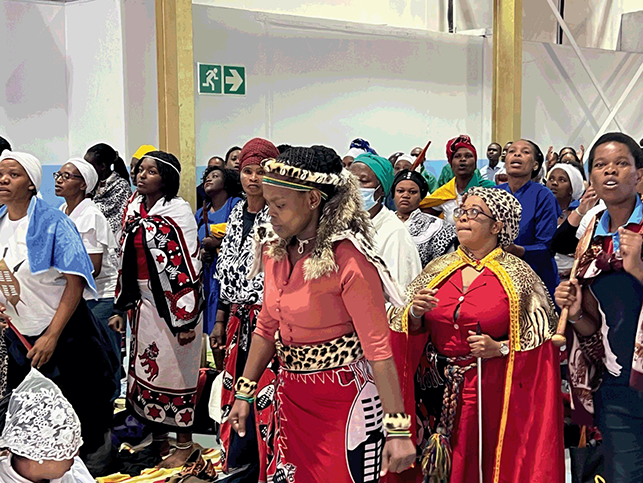
The seven colors of the izibane are important, as they represent different Izithunywa. The two baby blue candles represent the presiding Izithunywa. The royal blue lamp refers to the Izithunywa of hope. The red candle stands for the Izithunywa of war. The yellow one represents the spirit guide of balance and harmony. The green candle corresponds to the Izithunywa who bring greener pastures; it also represents the female Izithunywa. The white lamp stands for the Izithunywa of light. It is also used to summon the Izithunywa who preside over the family.
During the Tuesday services, Radebe walks with garments spiritually revealed to him and of spiritual significance. These include a leopard skin, which also appears on his ceremonial throne as a symbol of power, lineage, and the claim that the founder of TRSH has the role of Spirit King. His main garment (ingubo yesambulo) is white and blue, representing both the dominant deity Isthunywa Esikhulu, and the dominant position of Radebe as a Spiritual Guider. The white ingubo yamakhosi is used when Radebe administers rituals to kings and other authorities. There is also a red-yellow ingubo yokubamba, worn also by branch leaders for warding off evil spirits, and a different combination of white and blue, ingubo yamanzi, used for spiritual rituals based on water (Radebe and Hloele Reference Radebe and Hloele2022: 12–3).
Based on our observation, in a typical Tuesday Service of Enlightenment participants are organized in lines waiting for a short contact with Radebe and a blessing with water or the izibane. Some have symbolic small wooden spears in their hands. Women carry in their arms their children, whom Radebe blesses (see Figure 10). Some display pictures or copies of identification documents of relatives in need. When Radebe comes, some participants fall on the ground or start shaking or speaking with voices not their own. These are manifestations from the ancestral spirits, which need discernment.
Samuel Radebe blessing a child.
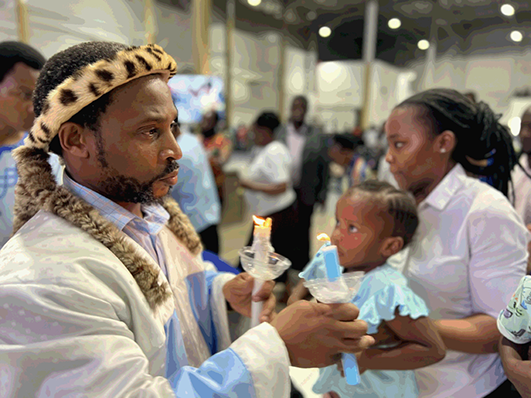
Most followers of TRSH come to the institution in search of spiritual or physical healing, protection from evil (including hostile ancestral spirits and witchcraft), and good fortune. This is the function of the rituals, which use several material elements as tools – primarily water, whose role in AIS is crucial, but also eggs, milk, incense, and salt.
Water is believed to be capable of “taking in the information on any illness and transform it into an antidote that would cure the specific illness” (Radebe and Hloele Reference Radebe and Hloele2022: 5). It is at the center of various rituals. It is splattered on the whole body of participants in the weekly intsebenzo yokuchelwa ngamanzi. On the first Tuesday of each month, participants bring two-liter bottles of water to the spiritual home and leave them there for three days so that the Izithunywa may bless them in the ibhafu ritual. Originally, every Thursday (now changed by Radebe to every Wednesday), participants go through the ritual called intsebenzo yenkomishi. They drink water from small white cups, which is sometimes followed by uncontrollable reactions such as vomiting or a sudden need to urinate, manifesting the expulsion of illnesses or evil spirits. Sea water is used in the monthly intsebenzo yamanzi rituals where participants come with two-liter plastic bottles for three days. They receive sanctified sea water they can bathe in or steam to produce beneficial vapors to inhale.
At the New Year, sanctified water is placed into a bull’s horn and rubbed on the feet and forehead (ukuqiniswa komntu). Also at the end of the year, participants receive sanctified salt to insert at the four corners of their homes, thus protecting them from hostile spirits and witchcraft (ukuqiniswa kwe khaya).
The intsebenzo yeqanda ritual is based on the idea that eggs can absorb negative energies. They are used to cleanse participants of the effects of the attacks by hostile ancestral spirits, curses, and the effects of past transgressions. Milk represents abundance and in the ritual intsebenzo yoBisi is poured on participants, invoking good fortune. There are also emergency rituals, others for specific categories of people, and a monthly inhalation of incense to ward off evil spirits (intsebenzo yeMphepho: Radebe and Hloele Reference Radebe and Hloele2022: 5–7). At both the Sunday and the Tuesday services, participants hear testimonies of the rituals’ success and are expected to express their joy by singing, dancing, and shouting.
A TRSH gathering is always a jubilant affair. However, participants do not only dance and sing. They are also informed about the progress of the multiple cultural and business activities associated with TRSH.
4 TRSH’s Business and Cultural Network
During a TRSH gathering, we shared a soft drink with a young woman who was very proud of her singing activities in one of the institution’s choirs. Singing, however, was not her profession. With the help of TRSH, she had set up a distributorship of cosmetic products, also manufactured by a TRSH-connected company. She has been trained by a TRSH educational organization to become more effective in her business. She has a son who plays soccer in a TRSH club. When her grandmother died, she took advantage of a TRSH-related burial scheme her family had subscribed to, solving what for many South African families is a serious problem, as costs for an honorable burial may go beyond their financial capabilities. She keeps herself fit at a TRSH gym and has holidays in other South African provinces using a TRSH-related travel agency.
Her experience is not uncommon and identifies TRSH as something similar to what, in a different context, scholars called a “pillar” of society. Belgian and Dutch sociologists and legal scholars such as Karel Dobbelaere (1933–2024) and Harry Post offered the example of the Catholic Church, which operated as a “total institution” in competition with other “pillars,” such as the secular-socialist anticlerical establishment and the Protestants, organizing the life of its followers, as an old socialist slogan recited, “from cradle to grave” (Post Reference Post1989; Dobbelaere Reference Dobbelaere2000).
The spiritual rituals of TRSH seem to transport us into a millennia-old indigenous world. Yet, a few blocks from its principal place of gathering, TRSH shows what at first sight appears to be an entirely different face. These are the offices of Trillion Cart Holdings, a conglomerate founded by Radebe that now oversees more than seventy different businesses. Here, visitors mostly come in jackets and ties, unlike at the spiritual services, and are greeted by professional-looking secretaries. The walls are decorated with media articles depicting Radebe as a visionary businessperson and entrepreneur, although most mention that he is simultaneously a spiritual leader. Perhaps most significantly, at Trillion Cart, the president, Thembi Tulwana, and the CEO, Namhla Dabula, are women, which provides a counterpart to the fact that, as it happens in other African spiritual institutions, all spiritual authority in TRSH is vested in a male leader.
Trillion Cart is not separated from TRSH’s spirituality. We were told that TRSH walks on two legs: the spiritual teachings and the business activities, which aim to empower the members to take care of their own lives. Some work in Trillion Cart companies; others learn how to start their own small businesses – no small achievement for women and men often coming from the poorest neighborhoods of South Africa.
At the beginning of Sunday services, videos chronicle not only TRSH’s progress and the founding of new spiritual centers but also the results of the different business enterprises. Clearly, TRSH members do not see the two realms, spirituality and business, as separated.
Trillion Cart Investments Proprietary (Ltd) was founded in 2009. Its first venture was the Siyangakhona Burial Scheme. It served individuals who did not meet the requirements of other burial programs and were thus discriminated against. “I discovered a significant market gap while establishing Siyangakhona Burial,” Radebe reported (Opportunity 2022: 22).
The companies under the umbrella of Trillion Cart offer everything from clothing and cosmetics (Ubuntu) to gyms (Black Rhino), luxury goods, food, restaurants, health supplements, and investment advice. A travel and event organization company (Mumweya Travel and Events) is also connected with TRSH.
The Child and the Racing Pigeons
Farming and racing pigeons are among Radebe’s passions. Anecdotally, a South African religious liberty activist reported to us that attacks against him as a “cult leader” (discussed in Section 5) might have also been fueled by Chinese individuals who knew precious little about his spirituality but were upset that he had beaten them at auctions for some of the world’s best racing pigeons, which generally end up in China (Sibanyoni Reference Sibanyoni2017). There is a story behind Radebe’s fondness for pigeons.
In May 2023, Radebe published a children’s book titled Trillion Dollar Kids: Savings & Entrepreneurship for Children (Radebe Reference Radebe2023). He also founded a children’s finance club called the Trillion Dollar Kids Club. Promoting the book in South Africa and Botswana, Radebe said it “was written to empower children and the youth with financial literacy from an early age, emphasizing the importance and need for financial education among children” (Nondywana Reference Nondywana2023).
The book tells the story of Samuel, that is, Radebe, growing up in a township where “children were not exposed to an environment that prepared them to save, let alone understand the value of money” (Radebe Reference Radebe2023: 5). As a child, Samuel noticed near his school a strange “house” for pigeons. He met the owner, a Mr. Simon, who told him these were pigeons training for racing against other pigeons.
In the storybook, an enthusiastic Samuel wanted to buy one of the pigeons. Mr. Simon told him they were expensive but, conquered by his eagerness, promised to give one to the child for the price of five rands. By walking to school, thus saving the money he received from his parents for the bus, Samuel was able to pay the five rands. However, Mr. Simon warned him that the sum was “only to buy the pigeon.” The child would now need extra money for the bird’s food and medicines. Undaunted, Samuel decided to save all the money he received from his parents and relatives and invest it in his racing pigeon. Mr. Simon was impressed and taught him all he knew about the birds.
The book ends with young Radebe becoming an orphan and moving to Johannesburg, thus temporarily abandoning his work with the pigeons. Readers are told, however, that his friendly relationship with Mr. Simon has continued. As an adult, Radebe returned to his passion for racing pigeons through Samuel Lofts, one of the Trillion Cart companies. The Trillion Dollar Kids Club teaches children in Soweto how to save and invest, including in the precious birds (Radebe Reference Radebe2023: 39–40).
Pigeons are not the only animals Trillion Cart deals with. Ankole Cattle have the largest and widest horns of any cattle species. A Trillion Cart company called Tandjiesburg Ankole Stud breeds and raises these animals in Clocolan. It claims its mission is to preserve what is not only a valuable commodity but an endangered part of the African way of life, now at risk of extinction (African Business Quarterly 2024: 15).
Activists have noted that since the 1950s, the World Bank and the International Monetary Fund have financed the replacement in Africa of indigenous cattle with Western breeds, believed to be more productive, but which are at the same time less resistant to epizootics and less integrated into the African ecosystem. These activists warn that “32% of indigenous African cattle breeds are in danger of extinction.” If nothing is done to reverse the trend, the Ankole Cattle could become extinct within fifty years (Esiobu Reference Esiobu2024).
It is not difficult for TRSH to see a parallel between how European and American institutions systematically replaced African breeds such as the Ankole Cattle with European breeds and how missionaries and those inspired by them replaced AIS with Western religions.
Herbal Drinks and a Korean Cola
On a summer day (in the Southern Hemisphere), December 9, 2023, in the park in front of the University of Cape Town, thousands gathered for a noncompetitive Peace and Health Walk organized by TRSH and Trillion Cart. The event celebrated the launch of a new Coca-Cola-like drink called McCol, which promised to take the African continent by storm (see Figure 11). We were in attendance, and though we were not experts on how soft drinks are marketed, this was something we could not miss.
Samuel Radebe introducing McCol soft drink.

One of the Trillion Cart companies imports and distributes the soft drink McCol in South Africa and nearby countries, and Radebe was visibly proud of this venture. Next to Radebe, who was wearing his leopard skin headgear (umqhele), Asian executives with their customary blue jackets and ties appeared on the podium. They had come to South Africa to represent the South Korean manufacturer of the McCol drink, a company belonging to the Family Federation for World Peace and Unification, once known, and sometimes still referred to, as the Unification Church. While engaged full-time in the soft drink business, some introduced themselves as “Reverends” and paid their respects to Radebe in the name of their religion’s leader, Hak Ja Han Moon, the widow of Reverend Sun Myung Moon (1920–2012).
Seated at a table in the park, leaders of the Church of Scientology from South Africa and abroad cheered the event. They had trained executives of Trillion Cart through their Tools for Life program, and some of those businesspeople looked forward to applying what they had learned from Scientology to the sale of McCol.
This was a unique case of what we may call business ecumenism. Different minority spiritual organizations regularly cooperate within the framework of religious liberty coalitions to defend themselves from anticult campaigns, and most of them also participate in interfaith initiatives. However, what happened in Cape Town on December 9, 2023, had nothing to do with religious freedom alliances or interreligious dialogue. The aim was strictly to sell soft drinks. The event’s uniqueness was in putting together three different spiritual organizations for a commercial venture. The Unification Church produces McCol in South Korea. TRSH distributes it in Africa. Although not directly involved in the McCol business, Scientology trains executives who are members of TRSH to acquire skills they can use in their spiritual and commercial activities. On the other hand, it is true that the McCol alliance happened because the three institutions had previously learned to cooperate for purposes other than selling soft drinks, primarily in initiatives defending religious and spiritual freedom in South Africa and beyond.
McCol, which we found offered at several restaurants and hotels throughout Southern Africa, did not succeed because of its spiritual roots, interesting as they may be, but because the company importing it had already achieved a favorable market position. McCol’s importer is Imvelo Pharmaceutical, one of the many companies owned by Trillion Cart. Imvelo is a diversified company with a hygiene division offering services of reclamation and fumigation, another selling cleaning products under the trademark “Rock,” and Agrico, which has been especially successful with its health and weight-loss supplements. Its popular herbal tonic, Agrico Umhlonyane, is based on umhlonyane, that is, Artemisia afra or African wormwood, the most popular medicinal herb in Southern Africa.
For Radebe, the umhlonyane products are more than business. Since time immemorial, they have been part of African indigenous medicine, closely related to AIS. They prove, Radebe says, that it is possible to combine “a traditional medicinal herb with science” (Municipal Focus 2022: 36). In a different cultural context, and with a different species of the genus Artemisia, this is reminiscent of the distinguished career of Tu Youyou, the pharmaceutical chemist from Zhejiang who went from traditional Chinese medicine to become in 2015 the first citizen of the People’s Republic of China to win the Nobel Prize for medicine. Tu became famous for creating Artemisinin, isolated from sweet wormwood (Artemisia annua) and used against malaria and other illnesses. She insisted she had not invented anything, but adapted a traditional remedy known to Chinese traditional medicine and first mentioned some 1,600 years ago (Tu Reference Tu2017).
The African Centre of Excellence
Trillion Cart is a for-profit enterprise, but is integrated into TRSH’s global project. Its stated aim is to empower Africans to become financially autonomous. Radebe’s starting point was his conviction that the African economy “seems to marginalize those who do not have the requisite business background but want to become entrepreneurs” (Municipal Focus 2022: 35). On the other hand, he also believes that prospective African small entrepreneurs share responsibility for their misfortunes. Paradoxically, he says, Africans may be both victims and creators of anti-African economic racism, patronizing non-African businesses and projects over those that are black-owned.
In South Africa, Radebe notes, small enterprises are the backbone of the economy, with about ninety percent “of registered businesses [being] small, medium and micro enterprises (SMMEs), which account for nearly half of South Africa’s GDP and roughly one-fifth of employment” (Opportunity 2022: 23). Yet, they enjoy little support from the government. Governmental support may, however, be replaced by help from the private sector. Part of Trillion Cart is the African Centre of Excellence, whose aim is to empower TRSH members and others to start their own businesses. This is primarily, or at least initially, achieved by encouraging them to become distributors of some of the myriad products of the Trillion Cart companies. Even senior citizens are encouraged to try, and we met several ladies who claimed to achieve good results as distributors of the Ubuntu cosmetics, yet another Trillion Cart business. Radebe claims that empowering distributors is at the core of the whole Trillion Cart project and its connection with TRSH, declaring that some products split the profits fifty-fifty between Trillion Cart companies and the distributors. Moreover, most distributors repay their initial business loan, and thus Trillion Cart claims it is reducing unemployment in South Africa and throughout the continent (Opportunity 2022: 23).
As we have researched them by interviewing several participants we met at TRSH events, with whom we engaged in casual conversations, the distributorship schemes of Trillion Cart are not cases of multi-level marketing, where profit goes disproportionately to those at the top of the scheme. Typical of multi-level marketing is that participants are encouraged to recruit other “downline” distributors, from whose sales they will also receive a percentage within the framework of a pyramid scheme, where most “distributors” make minimal or no profits at all. In the Trillion Cart model, “distributors” are not requested to recruit other participants in the scheme. It is more a direct selling or traditional retail model, where participants initially buy Trillion Cart companies’ products with minimal investments and resell them at a higher price through direct sales or by setting up small shops.
It is also the case that many (although not all) TRSH members who start their business connection with the organization as “distributors” move after some years to different forms of micro-businesses. Some may learn additional skills and open, for example, a franchise of The Burger Joint & Grill. This Trillion Cart fast food chain differs from McDonald’s and other large companies because of its lower operating costs and franchise fees. Generally, there are no McDonald’s in African townships because establishing and managing them is too expensive. A franchise of Trillion Cart’s The Burger Joint & Grill can be a small shop, a stall, a tent, or even a parked truck. The trademark is becoming recognizable, but the investment is minimal. Radebe – who has a passion for fighting obesity and operates gyms called Black Rhino, another Trillion Cart company – also insists that his hamburgers are healthier than those sold by the international companies.
Sport, Education, and History
Bishop Julius Moloi had one of the reddest robes we had ever seen. Many queued to take selfies with him, some because they knew him as a TV personality, others perhaps just because his garb was eminently photographable. We were in Cape Town in 2023, and Radebe had just been elected African coordinator of a new organization called the “African Forum for Religious and Spirituality [sic] Liberty” (AFRSL). Bishop Moloi was one of several hundred religious leaders in attendance. He was fully aware of Radebe’s criticism of Christianity. But he told us he did not care. Moloi has been at the receiving end of accusations of fraud in real-estate deals, which he vehemently denies and attributes to the widespread media hostility to new religious institutions with charismatic leaders. He believes they should cooperate to defend their freedom, no matter how different their theologies may be.
AFRSL is one of the many organizations Radebe heads that are not-for-profit. The Dr. S. B. Radebe Foundation is a charity distributing food, food vouchers, and blankets to those in need, granting scholarships to worthy but poor students, and establishing libraries to encourage children in underdeveloped settlements to read. There is a Trillion Cart Football Club that has trained soccer players who went on to become professionals. Noncompetitive Health Walks, such as the one we attended in connection with the launch of the McCol soft drink, are organized in different South African cities. African Hidden Voices is an academic research center on the history of African spirituality. There are theatrical and musical troupes, magazines, and publishing houses. Radebe’s children’s book (discussed above: Radebe Reference Radebe2022) once topped South Africa’s bestseller list.
Another institution created by Radebe is an interspiritual dialogue forum that gathers together organizations representing more than ten million devotees. Radebe believes in creating networks across denominational and spiritual divides. One reason he gives for devoting his energies to these efforts is the promotion of family values. Aware that they risk creating controversy and challenging predominant positions in mainline South African media, TRSH leaders told us that they try to prevent what they see as threats to the African conceptions of the family represented by LGBT activism and early teachings about homosexuality imparted in South African schools. They even allied with politically active Muslims for this campaign, they said, although cooperation proved difficult.
Networking with people of different spiritual persuasions is needed, Radebe believes, as Africa is the primary victim of what in recent revelations and pronouncements he has called the “Global System”:
an intricate, insidious and pervasive maze of connected systems that are intertwined politically, economically, socially, legally, politically, educationally, media and religiously. This system has many levers that help support each other. One lever, like a cog in a machine, works to support the whole machine.
This is a version of theories denouncing the “New World Order” (African Hidden Voices 2024: 191) and is reminiscent of “conspirituality,” a term coined in 2011 by Charlotte Ward and David Voas to define the confluence of spirituality and “conspiracy theories” (Ward and Voas Reference Ward and Voas2011). Scholars have warned at the same time that the latter term should not be used to discriminate against or diminish minority spiritual or esoteric organizations. That large or small conspiracies may target him or TRSH is something Radebe became persuaded of when, as we will see in the next section, he became the target of an anticult campaign.
5 Anticultism in Africa and Opposition to TRSH
“Are you sure you want to see the haunted house?” The cab driver in Mauritius did not feel comfortable taking us there. Those who live nearby do not like visitors. He said stones had been thrown at cars stopping in front of the house. Happily, on a rainy day, nobody was around to throw stones when we went to see the dilapidated and abandoned small building in Béchard Lane, in the residential area of Saint Paul, not far from Mauritius’ capital, Port Louis.
The “haunted house” was the scene of a mysterious tragedy on August 27, 2004. Investigating the disappearance of one Rajesh Dhayam (1955–2004), the police raided the house of the mother of his lover, Crithika Nunkumar (1966–2004), and found the decomposed corpses of ten people. They included Rajesh, Crithika, her mother, her ten-year-old son, and several relatives. The police found a suicide note by Crithika, an aesthetician who was looked at as a spiritual leader of sorts by her relatives and some friends, mentioning financial and personal difficulties involving her and her family. What exactly happened has still not been clarified even after more than twenty years.
What was interesting was the immediate reaction from the local media. Dhayam had been a member of the US-based new religious movement Eckankar for a time, although he had left it in 1996, eight years before the incident. There was no evidence that other members of Eckankar or the organization itself had anything to do with the deaths. Yet, several Mauritian media outlets immediately declared that this was yet another “collective suicide” organized by an “international cult,” that is, Eckankar (see, e.g., lexpress.mu 2004). Eckankar’s strong reaction made the media more careful, but one can still encounter today references to the alleged “Eckankar collective suicide.”
By reading the Mauritian media, it emerges that they obtained their information from French anticult organizations active on the nearby island of Réunion, a French territory in the Indian Ocean (Coosnapen, Bernard, and Karghoo Reference Coosnapen, Bernard and Karghoo2004). France has an official policy against the so-called cults (in French, sectes: Palmer Reference Palmer2011; Westbrook Reference Westbrook2024). Although a branch of its largest private anticult organization, UNADFI, was inaugurated in Réunion only in 2015, UNADFI leaders lectured on the island since the last decade of the twentieth century (Geslin Reference Geslin2024). Under French influence, Pentecostal pastors and prophets, along with leaders of small local new religious movements, have been accused of being cult leaders both in Réunion and in Mauritius. In addition, a book has been promoted against the local branches of the Jehovah’s Witnesses, always a target of anticultists (Coquand Reference Coquand2016).
Anticult Movements and Campaigns in Sub-Saharan Africa
Anticult movements are not as well-organized in sub-Saharan Africa as they are in Europe, North America, or Japan. However, they do exist, and anticult slogans and campaigns became popular in some African media since the first decade of the twenty-first century due to four factors. The first was the globalization of anticultism, with stories borrowed by media in Africa from European and North American sources, and by propaganda carried by French organizations in French-speaking Africa. In some governmental reports on cults published more recently, exchanges with French public and private anticult agencies are mentioned (e.g., Senate Ad Hoc Committee to Investigate the Proliferation of Religious Organisations and Circumstances Leading to More than 95 Deaths in Shakahola, Kilifi County 2023: 26–9).
The second factor was the interest in anticult theories on brainwashing (Introvigne Reference Introvigne2022) by those scholars and politicians interested in perpetuating the derogatory interpretation of the sangomas and other AIS-inspired African leaders as witch doctors preying on ignorance and superstition. If they sometimes seemed to succeed, they argued, it was because they were able to brainwash their clients and followers into believing that their “primitive” practices had been successful. Although this view appeared to other scholars as “hopelessly inadequate” (Hund Reference Hund and Hund2003: 25), it does maintain some adherents.
The third factor was the obscure homicides and suicides of the Ugandan Movement for the Restoration of the Ten Commandments of God in the year 2000, which might have resulted in more than 1,000 victims (Mayer Reference Mayer2001, Reference Mayer and Lewis2011), although the actual number of casualties is disputed (Vokes Reference Vokes2010), as are many details of the incident. What was clear was that the Movement was a fringe Catholic group, connected with a larger network of followers of apparitions of Jesus and the Virgin Mary not recognized by the Roman Catholic Church; it had among its founders Catholic priests, who were later excommunicated. Its strong Catholic roots made the movement not typical of Evangelical, esoteric, or AIS-inspired organizations, although the tragedy did fuel for a while continent-wide rhetoric against cults.
The fourth incident had a much more direct connection with an anticult revival in Africa. In April 2023, a story emerged from Shakahola, Kenya, that Pastor Paul Mackenzie of Good News International Ministries, a local Christian group with millenarian beliefs, had led his followers into practicing an extreme form of fasting, resulting in hundreds of casualties – more than 400 according to police estimates. Mackenzie was arrested, and Good News was banned in Kenya in 2024 as an “organized criminal group.” A Kenyan Ad Hoc Senate Commission and a special task force on religious organizations, again mentioning contacts with France, proposed strict measures to combat cults, religious abuse, and to submit all religious organizations to a system of registration and governmental control. Similar laws were proposed or enacted in Rwanda, Uganda, and Cameroon (see Introvigne Reference Introvigne2024). In Rwanda, renewing a campaign that had already been carried out in 2018, some 13,000 independent religious organizations were inspected and 7,700 were shut down (Fautré Reference Fautré2024). The Shakahola tragedy in Kenya re-energized anticult campaigns and produced governmental investigations, reports, and proposed legislation.
However, Shakahola did not create the anticult movement in Africa. As noted, it started taking shape in the late 1990s. The post-Shakahola draft regulations in Uganda, Kenya, and Rwanda were actually based on a South African model of state control of religious and spiritual institutions independent of the mainline churches. Although not adopted, these regulations were proposed in 2017, after media campaigns and an official investigation that had TRSH among their primary targets as one of the fastest-growing spiritual groups in the country.
The CRL Report of 2017
In 2002, the Commission for the Promotion and Protection of the Rights of Cultural, Religious and Linguistic Communities (CRL) was established as an independent institution under Chapter Nine of the South African Constitution. In 2015, it decided that its mandate extended to checking whether religious institutions were beneficial or harmful to South African communities. Publicized reports of religious groups “eating grass and drinking petrol” (Mapitsa Reference Mapitsa2022: 61) had raised understandable concerns. Several Christian “prophets” had filled the chronicles with extravagant displays of luxury, and some uneasiness about a possible “commercialization” of spirituality in South Africa was also unsurprising. The CRL started holding hearings on “the commercialization of religion and abuse of people’s belief systems,” which resulted in a report in 2017 (CRL Rights Commission 2017).
The terminology itself showed some influence of European and American anticult ideology. The commission and its chairperson candidly admitted in the report that they had initially taken their information from “controversial news reports and articles in the media” (CRL Rights Commission 2017: 4) rather than from scholarly literature or by interviewing leaders and members of the targeted groups.
The CRL expressed its concern about “false churches” (CRL Rights Commission 2017: 10), without clarifying how a “false” church can be distinguished from a “true” one. It also questioned claims made by spiritual leaders to an authority they did not possess. Again, which standards the CRL required to “prove” spiritual authority used were unclear. The CRL also wanted religious and spiritual organizations to disclose their budgets and bank accounts to the commission.
Radebe was summoned to appear and bring TRSH’s financial reports to the CRL for examination. He refused, claiming that the investigation and the requests were against the South African Constitution; he then presented complaints against the CRL to the Parliament. As a result, CRL’s chairperson Thoko Mkhwanazi-Xaluva depicted Radebe as rebellious, tried to have him arrested for contempt of the commission (Selebi Reference Selebi2015), and instigated a media campaign against him.
Mkhwanazi-Xaluva accused a member of TRSH, Koabeng Qhobela, of insulting and trying to intimidate her. After he was denied a personal meeting with Mkhwanazi-Xaluva, Qhobela sent her an email calling her a “servant of Satan” who was inviting “God’s anger” on herself. At his trial, Qhobela told the judge that he had sent a spiritual warning to Mkhwanazi-Xaluva with no threat of physical violence. However, on March 3, 2017, he was sentenced to three years in jail for having menaced a public official (News24 2017). On the other hand, Mkhwanazi-Xaluva’s attempts to have Radebe himself incriminated failed.
The final report suggested legislation under which all religious and spiritual organizations should have leaders – with a temporary exception for founders – and treasurers democratically elected by the members. This does not happen in mainline religions such as the Catholic Church, where priests and bishops are not elected by lay church members, let alone cardinals and popes.
All religious and spiritual organizations, the CRL proposed, should affiliate themselves with umbrella organizations, which would in turn be under the supervision of peer-review committees established for each religious tradition – Christianity, African Religion, Islam, Judaism, Hinduism, and Rastafarianism – that would report to the CRL Commission itself. Individual religious practitioners and places of worship should also be registered with one of the CRL-supervised umbrella organizations. As the report clearly stated, “the CRL Rights Commission will remain the final arbiters [sic] in all matters” concerning religion and spirituality (CRL Rights Commission 2017: 48).
As the South African scholar Cosmo Mapitsa concluded,
Some of the activities that led to the investigations by the Commission are a cause for real concern. However, by recommending the regulation of religious organisations as the CRL Rights Commission did, there were potential long-term effects on the promotion of freedom of religion which were overlooked.
Ultimately, sober tempers prevailed, and CRL’s report did not generate any new law in South Africa. However, the Shakahola tragedy has created a situation where such proposals may be revamped in South Africa and other African countries.
That there are outliers in the world of religion and spirituality in Africa is true, as evidenced by tragic cases such as the Movement for the Restoration of the Ten Commandments of God and Good News International Ministries. However, using these incidents to put all religious and spiritual organizations under an invasive form of state control is a case of overreaction, in part inspired by anticult ideologies imported into Africa from other continents.
Conclusion: A Safe Return Home
The anticult campaign in South Africa was at its zenith in 2017, with news outlets taking their cues from the CRL and producing generally hostile reports about new religions. South African media that had rarely covered TRSH before began to note that it had a “large following” (News24 2017) and that “Radebe runs an organisation of immense influence” (Sosibo Reference Sosibo2017). Their conclusions resonated with the central theme of the Mail & Guardian 2013 investigation, namely, the “invisibility” of otherwise significant groups (Budesta Batanda, Wanjiku Kihato, and Wilhelm-Solomon Reference Wilhelm-Solomon, Budesta Batanda, Kihato and Wilhelm-Solomon2013). In Johannesburg and beyond, there are institutions normally invisible to mainstream media but very much visible in the townships and indeed “immensely influential.”
On April 20, 2024, “The Spirit King,” a new musical telling how Samuel Radebe became TRSH’s IMboni, premiered in Durban. TRSH members are numerous enough to ensure that performances throughout South Africa were sold out, but the play received favorable reviews in local media and even got the attention of the national public broadcaster SABC (SABC News 2024). A few weeks thereafter, on May 11, 2024, Radebe received the Global Spirituality Award in Italy at the Turin International Book Fair, Europe’s second-largest book trade fair. Awards are given yearly to spiritual leaders by the Italian interreligious organization Fedinsieme (Faiths Together), which includes religionists and academics. Truth be told, magazine articles published by the authors of this Element did contribute to attracting the attention of Fedinsieme. However, it was Radebe’s ebullient personality that emerged from his books and videos that persuaded the jury.
Radebe and his followers regarded the award as historic. TRSH’s troupe of dancers was so enthusiastic that their energetic leaps destroyed a good number of tiles on the Turin terrace where they performed a celebratory show. Eventually, TRSH duly paid for their replacement (see Figure 12). We were there, and the audience was in awe watching the dances and hearing the acceptance speech where Radebe forcefully called for AIS to be given its rightful place in the world. The Turin event had more than anecdotal significance. If it was an examination of sorts, Radebe passed it. He proved he could present AIS to non-Africans in understandable terms. From its humble origins in a Johannesburg garage, TRSH had come of age and was ready to introduce itself to international audiences.
TRSH dancers celebrating Samuel Radebe’s award at the Turin International Book Fair.
It is not only that Radebe is a captivating speaker, and the enthusiasm of TRSH members is contagious. Radebe and TRSH give hope to many women and men who live in challenging situations. They offer a sense of belonging and the idea that their lives can change for the better. They give them pride as the heirs of an African Indigenous Spirituality that need not envy the other great spiritual forms of humanity and is indeed presented as their very source. While critics call for vigilance against the ever-possible drifts in institutions that are both religious and commercial, followers insist that TRSH opens for them possibilities of being active in cultural and business activities usually reserved in South Africa for the whites and a small black elite. They also claim they find in TRSH something valuable that would be cruel and unjust to take away from them.
As for what this something valuable is, we agree with the conclusions reached by Wilhelm-Solomon when he investigated Radebe and TRSH in a different phase of their history. We find his comment still persuasive today. If Radebe’s institution is successful, the South African scholar wrote, it is because
it speaks to a hope that the failed aspirations of the city can be restored, that its pollutants can be cleansed, and that the people and things lost in its streets will return safely home, wherever that may be.
Founding Editor
†James R. Lewis
Wuhan University
The late James R. Lewis was a Professor of Philosophy at Wuhan University, China. He was the author or co-author of 128 articles and reference book entries, and editor or co-editor of 50 books. He was also the general editor for the Alternative Spirituality and Religion Review and served as the associate editor for the Journal of Religion and Violence. His prolific publications include The Cambridge Companion to Religion and Terrorism (Cambridge University Press 2017) and Falun Gong: Spiritual Warfare and Martyrdom (Cambridge University Press 2018).
Series Editor
Rebecca Moore
San Diego State University
Rebecca Moore is Emerita Professor of Religious Studies at San Diego State University. She has written and edited numerous books and articles on Peoples Temple and the Jonestown tragedy. Publications include Beyond Brainwashing: Perspectives on Cultic Violence (Cambridge University Press 2018) and Peoples Temple and Jonestown in the Twenty-First Century (Cambridge University Press 2022). She is reviews editor for Nova Religio, the quarterly journal on new and emergent religions published by the University of Pennsylvania Press.
About the Series
Elements in New Religious Movements go beyond cult stereotypes and popular prejudices to present new religions and their adherents in a scholarly and engaging manner. Case studies of individual groups, such as Transcendental Meditation and Scientology, provide in-depth consideration of some of the most well known, and controversial, groups. Thematic examinations of women, children, science, technology, and other topics focus on specific issues unique to these groups. Historical analyses locate new religions in specific religious, social, political, and cultural contexts. These examinations demonstrate why some groups exist in tension with the wider society and why others live peaceably in the mainstream. The series highlights the differences, as well as the similarities, within this great variety of religious expressions.