




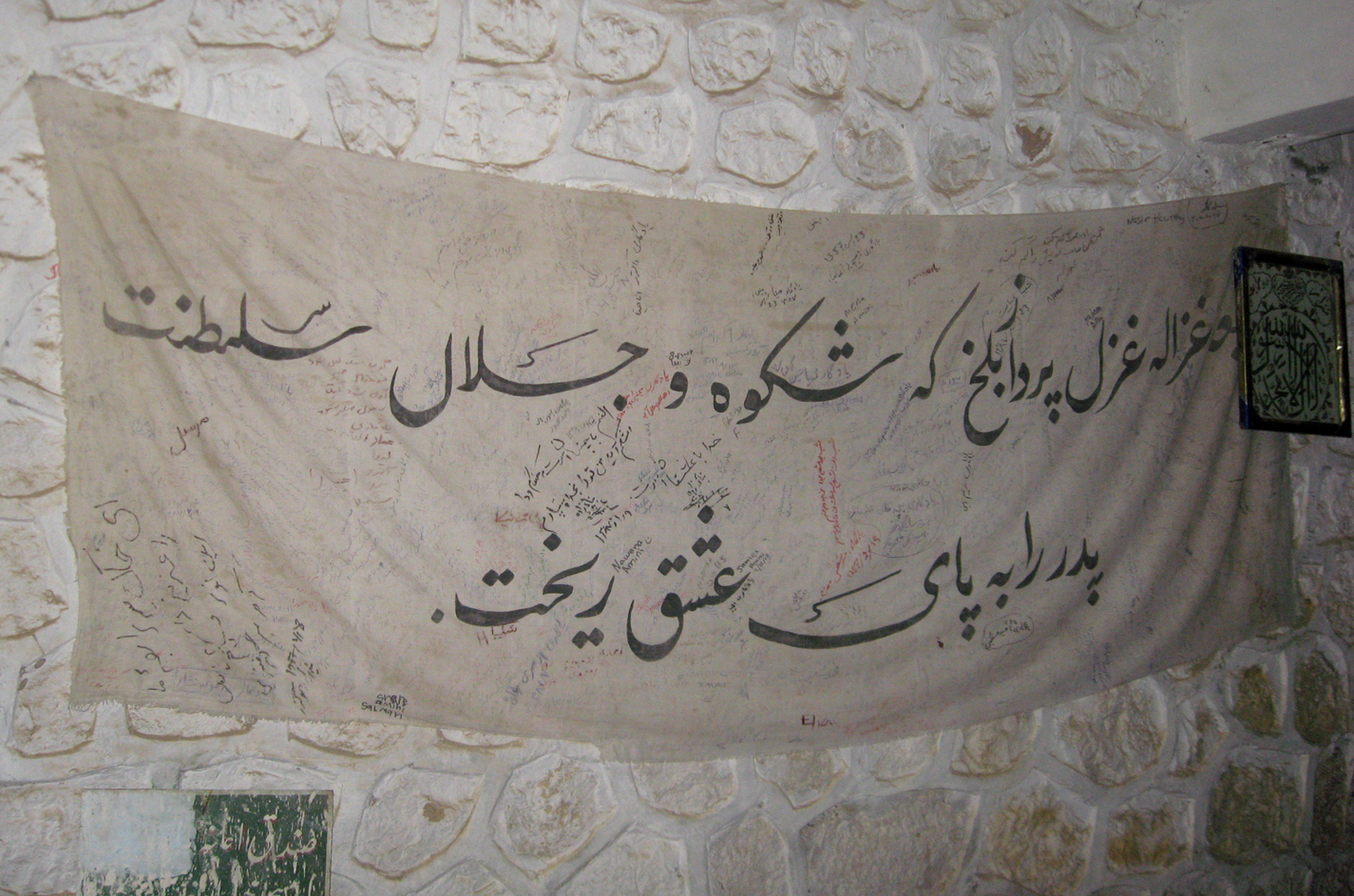
In the town park of Balkh, Afghanistan, there is a modest turquoise-tiled grave attributed to the 10th-century poetess Rabiʿa Balkhi.Footnote 1 A simple reinforced concrete structure was built around it, and a small door led down into a subterranean chamber, where the grave was covered in green cloth (Fig. 1). I visited the tomb on numerous occasions between 2008 and 2019, first as part of family visits and later during anthropological fieldwork. At the grave, I observed practices typically associated with other central Asian shrines: locks and cloth-tying, sweeping of dust, and healing prayers offered by the shrine's dervish (malang). The tombstone above Rabiʿa's grave, embedded in concrete, described her as a sufi who was martyred for her love. On the wall behind the grave, a banner described Rabiʿa as a poetess who “scattered the glory and splendor of her father's kingdom at the feet of love.” This banner was once covered with graffiti: memorial scribblings, visitors’ signatures, and love notes. One intriguing piece of graffiti read, in English, “This is what a feminist looks like.” This banner was later removed—along with other material culture of the shrine—following a “cleaning up” of informal religious practices (Fig. 2).
View of Rabiʿa's grave inside the shrine. Photograph taken by the author, 2008.

Part of the banner at Rabiʿa's shrine. Photograph taken by the author, 2008.
I was first brought to Rabiʿa's shrine by my relatives who lived nearby, and who had farmed and traded in Balkh for generations. My grandfather owned a fabric store in the market near Rabiʿa's shrine, and lived much of his life in a village to the south of the Balkh old city walls. Some of his children went to the nearby school, and his grandchildren still farm the fertile land of a nearby village, and sell their fruit and vegetables in the Balkh market. On visits to my family village between 2008 and 2011, relatives often brought me to the town park as part of broader shrine visitation (ziyārat) in Balkh's sacred landscape. Rabiʿa's grave was one of numerous shrines we visited on these trips. Despite decades of war and revolution, it struck me that cultural practices around shrines were resilient and enduring. Regardless of people's occupation or education, visiting local shrines is a central part of their lives. The curiosity that arose from these ziyārats led to a doctoral project, and I returned to Afghanistan in 2017 to conduct anthropological fieldwork. My research focused on the interplay between sacred and ruined places, exploring how people negotiate senses of “order” and “disorder” in the landscape.
Rabiʿa's shrine was one of many places I walked through with informants in seeking to understand “senses of place.” The themes in this article emerged after I had returned from the field, as I reflected on my material and explored textual and archival sources from the 1960s and 1970s. What I did note, from my earliest visits, is that the shrine is a site of contested narratives. Some visitors to the site consider Rabiʿa to be a Muslim saint whose love was chaste, whereas others see her as a feminist whose love was defiant and very earthly. Some see her as an Afghan woman of Arab origin, and others see her as a “culture hero” of the 10th-century Persianate renaissance.Footnote 2 I begin this article by tracing the origin of these narratives—medieval Persian and later Afghan accounts of Rabiʿa's life, situating them alongside the discovery of her grave in Balkh's town park. I argue that these conflicting interpretations of her tragic life have a genealogy rooted in 20th-century Afghanistan's search for a sense of national culture.
Although Rabiʿa's shrine may appear as if it were always part of the landscape, this article demonstrates that the grave itself was “discovered” in the early 1960s—coinciding with a broader celebration of her life through books and cinema promoted by the Ministry of Information and Culture. The shrine's origins, then, appear to be partly rooted in 20th-century nationalism and the influence of cultural officials. For this reason, at first glance, the shrine may appear to be an “invented tradition”—especially the less formal kind that can emerge “in a less easily traceable manner within a brief and dateable period,” but with memory of the invention being lost within even a few years.Footnote 3
But as I explore in this article, Rabiʿa's shrine did not emerge through top-down imposition by cultural officials. The state did not have the sole power to shape local places in service of nationalism. By contrast, it seems, state officials themselves were often subsumed by local forms of placemaking. Officials were inspired by dreams, visions, and poetry to uncover graves and give meaning to cultural landscapes—drawing on deep-rooted cultural patterns of “placemaking-through-dreams” well documented in sufi tradition and found across the Muslim world. These local forms of placemaking were sometimes celebrated in Kabul, but tended to be treated with silence in the capital city. It seems, in fact, that two distinct lineages of the Rabiʿa narrative emerged. At the local level, she became a Muslim saint subsumed into Balkh's broader landscape of antiquity. At the national level, she was celebrated as an archetypical Afghan woman through state-sponsored film and literature. This insight can illuminate a cultural dimension to the often-contentious dynamics between local and central power.
In “The Afghan Discovery of the Buddha,” Nile Green argues that Afghanistan's historiography underwent a transformation between the 1920s and 1950s. Historians rewrote the nation's history, interpreting its pre-Islamic past in ways quite different from existing chronological histories. They drew on an emergent sense of nationalism, shaped by interaction with archaeological publications on sites such as Bamiyan and Hadda. Green examines the role of Ahmad ʿAli Kuhzad (1907–83), widely considered to be the founder of Afghanistan's modern historiography. Kuhzad's interactions with French archaeologists and translations of their work helped to reshape the Afghan middle class's perception of its past. Kuhzad also worked closely with national cultural institutions such as the Afghanistan National Museum and the Afghan Historical Society. This encouraged a national appreciation of pre-Islamic antiquity, emphasizing a direct relationship between Afghanistan's present and its Buddhist and Kushanid past. In this new historiography, Afghanistan was positioned as a successor to the ancient “Aryana.”Footnote 4
In this article I argue that, in a similar way, Afghan poets were integral to shaping senses of historical geography and national culture.Footnote 5 There were several facets to this. The first was a sense of “poetic genealogy,” in which contemporary Afghan poets were positioned as successors to classical Persian poets who had flourished on Afghan soil.Footnote 6 These classical poets included Jalal al-Din Rumi (d. 1273), Hakim Sana'i (d. 1130), Awhad al-Din Anwari (d. 1189), Abu Mansur Daqiqi (d.c. 976), Nasir Khusraw (d. 1088), and Rabiʿa Balkhi (dates unknown).Footnote 7 Contemporary poets also held significant roles in official institutions. Some worked closely with the Ministry of Information and Culture (Wizarat-i Itlaʿat wa Farhang), and others made a living as journalists with provincial and national publications—which also were closely related to and funded by the ministry. Working through official institutions, poets and journalists drew on the region's heritage of medieval sufism to help shape a sense of national culture. If archaeology shaped the Buddhist and Zoroastrian past as “Aryana,” than the living heritage of Persianate sufism helped create a sense of “Khurasan.” In later national histories, these two strands of historiography were interwoven to create a seamless progression from past to present.
One of the most prominent Afghan writers to help shape this sense of national culture was Ghulam Habib Nawabi (1921–87).Footnote 8 He began his career as a teacher, then became a poet and journalist. He edited the newspapers Islah (Reform), Anis (Companion), and Bidar (Awake), as well as the lifestyle magazine Zhwandoon (Life) and the cultural journal Fulklur (Folklore).Footnote 9 Later, he worked in official institutions where he was directly involved in shaping local cultural life. In Balkh he served as the director for the local Department of Information and Culture, and later as director of religious trusts (awqāf) in both Balkh and Herat. These roles positioned him as a medium between everyday people and the nation's elite.Footnote 10 Drawing on these networks and experiences, he wrote popular books in everyday language that captured an emerging sense of “national culture.” He wrote on the nation's poetic past in biographies of Anwari and Nasir Khusraw. He also wrote about the lives of contemporary poets, such as Mahjuba Herawi (1906–66) and Makhfi Badakhshi (1876–1963). Cultural figures of the past and present were related to each other within the broader framework of national culture.Footnote 11
A crucial aspect to this project was placemaking.Footnote 12 This included imagining the actual places in which classical poets flourished, reshaping the geography through stories and monuments, and emplacing cultural ancestors within contemporary landscapes. In doing so, cultural officials sometimes drew on deep-rooted local forms of placemaking—dreams, visions, and poetry—to unearth and reshape these landscapes of antiquity. This is not to say that local officials drew on dreams and visions disingenuously; it often seems they genuinely believed in them.
This appears to be how Rabiʿa's grave was unearthed in the middle of Balkh's town park in the early 1960s. Nawabi's biography of Rabiʿa, first published in 1951, was inspired in part by affective experiences he had while walking through Balkh's extensive landscape of ruins and shrines.Footnote 13 Afterward, a legend associated with her tragic love and death was absorbed in the public consciousness—and a local legend emerged that her body was buried in the soil near the old citadel. Roughly ten years later, local officials had a vision that her grave lay beneath the earth in Balkh's town park. A grave allegedly belonging to her was excavated, and a small shrine was built around it.Footnote 14 Despite initial scepticism around the historical validity of the grave's discovery, Rabiʿa's grave was quickly integrated into Balkh's broader landscape of antiquity. It has survived decades of war to the present day.Footnote 15
Balkh's Lost History and the “Caravan of the Gone”
BALKHI, RABIA. Famous poetess in Dari and a contemporary of Rudaki (the first great poet in Persian after the advent of Islam, d. 940 A.D.). She was born in Balkh in the tenth century and therefore called Balkhi by Afghans. Some of her ghazals are extant. Legend has it that she fell in love with a Turkish slave, named Baktash, and had to pay for this illicit love with her life.Footnote 16
The tragic love story of Rabiʿa Balkhi is told and retold across Afghanistan today, taking on a number of forms and interpretations. It is often seen as integral to the national identity, although the story itself originates in seminal texts of medieval Persian poetry. According to sources that date to the 13th century, Rabiʿa was a princess and a poetess who lived in the region of Balkh. Her family may have been ethnically Arab, giving her the appellation “adornment of the Arabs” (zayn al-ʿArab), although they ruled over a Persianate principality as a vassal of the Samanid dynasty (819–999). One day, during a royal banquet, Rabiʿa walked out on to the palace veranda. Her eyes fell on Baktash, her brother's servant, who was standing in the garden. Rabiʿa fell in love, and after exchanging romantic letters, she began to compose love poems inspired by him. But her brother soon learned of this secret love, became enraged, and ordered that both of them be killed. Baktash was thrown into a well from which he escaped. When he went in search of Rabiʿa, he found her locked up in a bathhouse. Her brother had ordered that her veins be cut, and she bled to death.
Within a century of her death, a legend associated with Rabiʿa seems to have circulated widely around the cities of Khurasan. This legend described a woman who was famous both for the quality of her poetry and the intensity of her love. We know this because of a possibly lost text by the early sufi poet Abu Saʿid Abu al-Khayr (d. 1049). In his pious travels and pilgrimages, he apparently visited a place associated with Rabiʿa's legend. Once there, he inquired about “the nature of her love,” and concluded that her love was so intense it could only have been of divine origin. Although this text is no longer extant, we know about it from a 13th-century retelling of Rabiʿa's story by the Persian poet Farid al-din ʿAttar (d. 1221).Footnote 17 The motivation of both ʿAttar and Abu Saʿid was to demonstrate that Rabiʿa was a real sufi. In the sufi interpretation, her love for Baktash was not motivated by earthly lust. He was a medium through which divine love manifested.
If Abu Saʿid's lost account is to be believed, then the locally significant place he visited may have been a grave or site related to her martyrdom. That said, we have no way to know where exactly this was. Balkh has been sacked numerous times since the 10th century. In 1220 the Mongols destroyed the city and massacred the majority of its inhabitants. These sackings were followed by cycles of rebuilding, often by dynasties that lacked historical roots in the region. Consequently, most of the shrines and graves were “lost.” Rabiʿa does not feature in the Fada'il-i Balkh (The Merits of Balkh, 1278), a pre-Mongol local history of Balkh.Footnote 18 The sacred landscape described by the Fada'il-i Balkh largely vanished during the Mongol conquests—so even if a grave associated with Rabiʿa existed, it is unlikely to have survived the conquests either.Footnote 19 But even if a tomb or grave associated with Rabiʿa was lost, her memory remained alive in Khurasan through the medium of sufi poetry.
In addition to ʿAttar, and the lost text of Abu Saʿid, she also is mentioned by the poetic biographer Sadid al-Din ʿAwfi (1171–1242). Her narrative is picked up again in the 15th century by the Timurid-era poet ʿAbd al-Rahman Jami (d. 1492), who draws on extant material to describe her in his compendium of sufi biographies. Jami does not provide any unique information, and it is unclear if other sources for her life existed which may have been lost. There is a four-century silence before the Qajar-era poet Rezaqoli Khan Hedayat (1825–98) expanded her love story in his Gulistan-i Aram (The Garden of Eram, 1853–54). Through his epic poem we see Balkh emerge as a much more concrete setting.Footnote 20 Nearly a century later, in the 1930s, a public fascination with Rabiʿa's life seems to emerge in Afghanistan.Footnote 21 By 1948, she had achieved such significance as a hero (qahramān) that a female high school in Kabul was named after her. Since that time, a hospital, market, radio station, and several literary societies have been named in her honor around the country. How, then, did Rabiʿa transform from mythical obscurity into national hero?
In 1966, several years after the discovery of Rabiʿa's grave, a “thousand-year commemoration” of her life was held in the town park of Balkh. This public fascination with Rabiʿa in the mid-1960s seems to echo a broader phenomenon in which classical poets were celebrated as national heroes and cultural exemplars. This was not a uniquely Afghan phenomenon. In the late 1920s, Iranian scholars made a similar attempt to locate the grave of the poet Ferdowsi (d. 1025) on the outskirts of Tus. They believed his grave had been “intact and clearly visible” until the previous century. After locating the grave “in an extreme state of disrepair,” the Pahlavi monarchy built a grand mausoleum over it—surrounded by a garden and public park—in the style of recently excavated Achaemenid monuments.Footnote 22 Not long after, in October 1934, a thousand-year celebration of Ferdowsi was held at this mausoleum.
Similar forms of monumentalization also took place in Central Asia following the collapse of the Soviet Union, as newly independent states celebrated their own national poets. Tajikistan, for instance, commemorated the life of Rudaki (860–940) by building monuments and holding a “1150-year” anniversary.Footnote 23 In Azerbaijan, the tomb of the poet Nizami (1141–1209) underwent multiple renovations to reflect the newly independent state's cultural nationalism.Footnote 24 In post-Soviet Uzbekistan, the poet ʿAli Shir Nawa'i (1441–1501) was widely reinterpreted as the country's national poet. Urban landscapes were monumentalized to commemorate Nawa'i—with a boulevard, park, theater, airport, and even a city dedicated to him.Footnote 25 What underlies these events, it seems, is a particular form of cultural nationalism that positions classical poets as ancestors to contemporary nation–states. It links them to contemporary citizens through the language of kinship.
In the early 1930s, the Afghan monarchy had emerged from a civil war and suppressed a number of local uprisings. Meanwhile, a new generation of historians based in Kabul drew on modern forms of historiography to rewrite the country's past, influenced by recent archaeological discoveries and translated archaeological texts.Footnote 26 These new historical visions told the national story in a way quite different from the chronicle-based histories that were being written up till that point. Both historians and officials were interested in the cultural heroes who had shaped Afghanistan's past, and who served as cultural exemplars for Afghans today. Rabiʿa was one of these heroes, and historians drew on classical sufi sources to narrate her life as early as the 1930s. Embodied through classical poets, sufism represented a civilizational golden age and became a central narrative in the national story. As Rabiʿa was considered one of the first sufis, as well as the first female poet of the Persian language, she was a powerful cultural exemplar.
Situating these cultural exemplars within the materiality of the landscape was critical to telling the national story. Afghan historians looked toward Balkh, the ancient Bactria, as the primordial homeland of the Aryan people and one of the centers of world civilization.Footnote 27 However, very few identifiable monuments actually remained of the ancient town of Balkh. Its antiquity was mostly visible through the crumbling remnants of a vast city wall, and the remains of a Buddhist monastery and a Zoroastrian fire temple—all of which were surrounded by the vast landscape of ruined stupas and small shrines. Besides the old citadel and city walls, there were few signs of monumental or statuesque magnificence comparable to those found in Giza, Persepolis, or Bamiyan. This left a sense of dissonance to many who visited its dusty, crumbling ruins.Footnote 28 There was a disconnect between narrative and place—a disconnect between Balkh's reputation for greatness, and the material culture that actually remained.
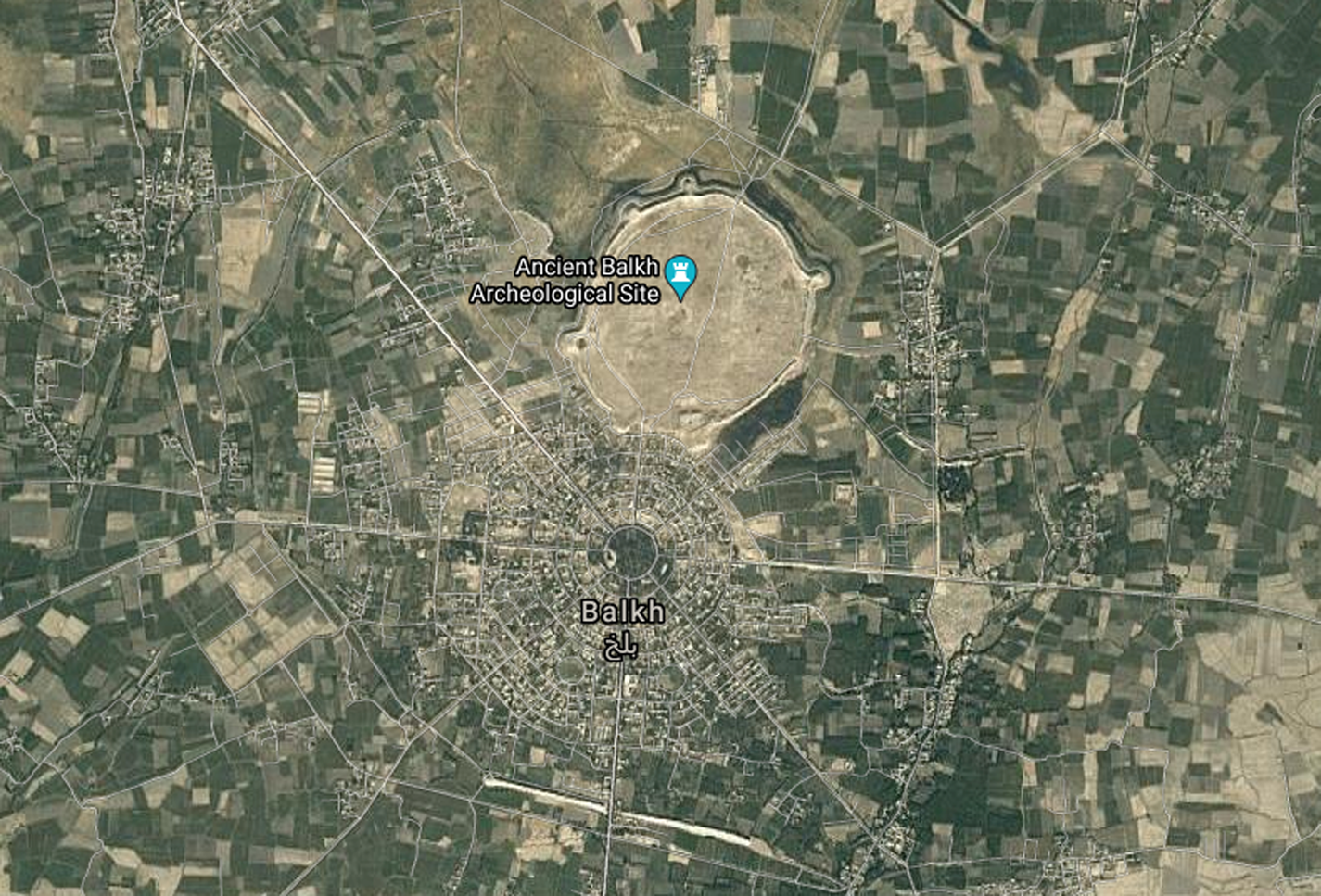
This, in part, motivated state projects to rebuild Balkh. The modern town of Balkh was built between 1935 and 1937 as part of a government wave of “rebuilding” towns in the north after the Afghan state suppressed local rebellions (Fig. 3).Footnote 29 This was both a nationalist and modernist project. On one hand, the project leveled and built over the extensive Uzbek cultural landscape that characterized Balkh from the 16th to 19th centuries.Footnote 30 On the other, it was widely perceived as a symbolic rebuilding of ancient Aryana.Footnote 31 The new town itself was designed in concentric circles. At its center was a park, from which eight roads radiated outward. The town bazaar was built around the first circle, which radiated out into the town's neighborhoods. A short walk north from the town park led to the vast remnants of the old citadel. Directly south led to the ancient southern wall and several important shrines. Walking a little further, one reached the Balkh crossroads. At the crossroads lay two of the most important Buddhist ruins, Takht-i Rustam and Tup-i Rustam, remnants of the Nawbahar monastery.Footnote 32
The modern town of Balkh, to the southeast of the old citadel. Google Earth, 2021.
The park, which lay at the center of the rebuilt town of Balkh, was designed around one of the region's most beautiful archaeological remnants: the Abu Nasr Khwaja Parsa shrine—a comparatively recent structure of Tuqay-Timurid origin.Footnote 33 Nevertheless, for many visitors, it became symbolic of Balkh's lost greatness. It captured a glimpse of its former glory and the magnificence of its antiquity. Robert McChesney describes the Khwaja Parsa shrine as “the centerpiece of the urban plan devised by Aryan-influenced and nationalist-minded officials,” ironically positioning an Islamic monument as the focal point through which citizens would celebrate the nation's pre-Islamic heritage.Footnote 34 This was not just about rebuilding, though. It also involved eliminating the existing cultural landscape. The land in front of the Khwaja Parsa shrine had in fact been an extensive cemetery, which included many graves and marble tombstones. This cemetery was cleared and leveled so that a garden could be planted. McChesney believes this was done to “draw the eye to the [Khwaja Parsa shrine], to clean up its setting, as if it were a jewel.” Many locals, however, remember it as an act of vandalism and desecration.Footnote 35
The rebuilding of Balkh was rarely mentioned or remembered by later visitors, for whom the town park was always already there—a place of serenity and nostalgic reflection on the vicissitudes of history. Visitors stopped in the park to rest after climbing the ancient walls, or exploring the ruined citadel. They observed elderly men sitting in the shade of oriental plane (chinār) trees, and heard pigeons coo in the ruined madrasa's arches. Beds of flowers, and a bubbling water fountain, sit between the Khwaja Parsa shrine and the remnants of the Suban Quli Khan madrasa. This enhanced the aesthetic sense that one was in the presence of a monumental past. Visitors also described a sense of wonder while walking through Balkh's landscape of antiquity. A visiting Iranian professor describes a “lump in his throat” while walking from one ruin to the next.Footnote 36 Nawabi recounts how walking through the shrines brought him to a state of shivering excitement.Footnote 37 These emotional accounts are often followed by imaginative reflections on the civilizational grandeur, and bustling life, that once existed amid these ruins.
For Nawabi, the ruins evoked images of thousands of madrasas and sufi lodges (khanaqāh), teeming with poets, scholars, dancers, and merchants. Other Afghan writers who walked through these ruins wrote poems describing visions and voices from the distant past. These writers describe intense feelings of loss for what Afghanistan once was, but which no longer existed. Sulayman Layiq, for instance, experienced a troubling dissonance as he gazed into the ruins and saw what was not there: no sound from the Friday mosque, nor the perfume market. No lute players, and no reveling dancers. This disconnect produced a ghostly sense of nostalgia, as “shouts emerge from every ruin like the rising wind” and “every lane and every house is nothing but dust in the palm.” He described this unsettling absence and ghostly presence of past peoples, who once lived amid these ruins, as the “caravan of the gone” (kārwān-i raftagān).Footnote 38
Poets visiting ruins, and reflecting on the past, became a common theme in modern Afghan literature. It also seems as if this poetry is a discursive act that, in ways, resembles the liminal quality of dreams and visions. This is especially true of sufi poems, which often take the form of a dialogue with long-deceased personalities of the Islamic tradition. Amira Mittermaier argues that “the Sufi author, far from being an individual creative author, is decentered by being embedded in a network of spiritual-social relations.”Footnote 39 Like dreams and visions, poetry can blur the boundaries between the material and imaginal realms. All three are local forms of knowing history, uncovering graves, and shaping senses of landscape. And they often work in tandem with each other to give meaning to place.
The unearthing of Rabiʿa's grave in the 1960s seems to have come about, in part, from these poetic visions. This comes through most forcefully in one of Nawabi's poems, published in his book Rabiʿa-yi Balkhi. After visiting Balkh's cultural landscape of ruins and shrines, he sat down and wrote a poem in which he fell directly into the voice of Rabiʿa. Speaking to the people of contemporary Balkh, he describes hearing “pained voices” that emerged from the foothills of the Shadiyan mountains, claiming that “martyrs lay in the soil beneath [our] feet.”Footnote 40 He alludes to discussions currently happening in Balkh around the discovery of her grave: “There are conversations occurring in beautiful Balkh that the lover's martyrdom site should possess candles, [that] this disturbed soil should again be built on, and the candle of [divine] knowledge should again be lit.”Footnote 41
The Discovery of Rabiʿa's Grave: Nationalist Project or Local Placemaking?
A burial site associated with Rabiʿa Balkhi was discovered in the center of Balkh's town park some time around 1964. The Tajik historian Akhror Mukhtarov (1924–2007) writes that the site was excavated by the khatīb (prayer leader) of the Khwaja Parsa mosque, and an “antiquarian” named Sayyid Da'ud Agha. They were assisted by government officials. No trained archaeologists took part in the excavations. After digging one and a half meters beneath the soil, they unearthed glazed tiles which they assumed came from Rabiʿa's grave. Mukhtarov writes, “No attention was paid to whether anything lay beneath the tiles, whether in fact it was a tomb, and if so whether that of a man or a woman.”Footnote 42 Most other sources, however, assume it was a grave that was discovered. Regardless of whether glazed tiles or an actual grave was unearthed, it is almost certain that it came from the Khwaja Parsa shrine's premodern cemetery—which was leveled to make way for the park's garden some thirty years earlier.Footnote 43 Exactly how it was located seems to have become clouded in uncertainty within a few years of its discovery. Older residents assert the grave was discovered through either a vision or a dream by local officials. Mukhatov's assertion that government officials "assisted" the excavators is therefore significant.
If the grave was discovered before 1964, it would have been under the local rule of Ghulam Rasul Paramach, a former air force general of Nuristani origin, and governor (nā’ib al-hukūma) of Mazar-i Sharif from 1956 to 1963.Footnote 44 He is largely absent in history books, although older residents still tell stories about his era and controversial style of government. Some remember him as the “architect of Mazar-i Sharif,” who built the modern city, cleaned up banditry, and played a critical role in urban development. Others remember him for his impulsive cruelty and destruction of cultural heritage, demolishing old buildings to make way for concrete apartments. Jonathan Lee notes that Paramach, along with his predecessor Gul Muhammad Khan, were remembered by locals for “adopting a policy of cultural vandalism in a deliberate attempt to eradicate all vestiges of monuments and reminders of the Uzbek rule of the area.”Footnote 45
Paramach seems to have had a predilection for drawing on dreams and supernatural phenomena in performing his role of governor. In one instance, the body of a missing school student was located under mysterious circumstances in one of Balkh's ditches. The local newspaper Bidar reported that Paramach had personally discovered the location of his body by drawing on the supernatural knowledge of mullahs and witchcraft.Footnote 46 In another account, Paramach's notorious destruction of important cultural buildings in Mazar-i Sharif was inspired by a dream in which ʿAli b. Abi Talib (d. 661) allegedly appeared to him and instructed him to modernize the city and expand parts of the shrine complex. It seems plausible that Paramach played a role in the discovery of Rabiʿa's grave in the Balkh town park too. While walking through the town park in 2017, one of my research participants spoke to me of his childhood memories here. As we walked toward Rabiʿa's grave, he recalled his days as a student at Lycee Bakhtar—the same school from which the pupil in the story above went missing:
[In the early 1960s] this place was a field of flowers. I was in school at that time. I used to come here after school to hang out. The governor at that time was a man named Paramach. . . . One night he saw Rabiʿa in a dream. She came to him and said, “my grave is here.” So they went and did a survey. He said, “Dig here.” He's the governor, so what can you say? When they dug up the earth they found a grave, and [Rabiʿa Balkhi's] grave emerged. Then they built the shrine.Footnote 47
The topos of a saintly person uncovering a grave through a dream is a common form of placemaking in Afghanistan. This is precisely how the blessed shrine (rawza-yi mubārak) of Mazar-i Sharif was discovered (which led to the very foundation of the city), as was the shrine of Bibi Nushin in nearby Shibirghan. The latter shrine, evoking themes around Rabiʿa's shrine, also celebrates the life of a young woman who was unjustly martyred. Her grave also was quickly subsumed by broader patterns of shrine veneration.Footnote 48 In Badakhshan, the poet Nasir Khusraw appeared to the local governor in a dream demanding that he rebuild the poet's shrine in a simple manner—rather than lavishly with lapis lazuli.Footnote 49 Similar phenomena have been observed across the Muslim world. Amira Mittermaier cites the story of a Moroccan saint named Sidi Gharib, whose burial site had been lost. He then appeared in a “dream-vision” to another person of good character, who became obliged to uncover the grave and build a shrine over it.Footnote 50
Paramach was probably not the only official involved. His successor, ʿAziz Muhammad Alkozay, was partially responsible for the shrine's construction and formalization. Alkozay served as Balkh's governor from late 1963 to early 1966. He seems to have been involved in surveys around Rabiʿa's grave, and perhaps early plans to build a structure there. The local poet Hanif asserts that Alkozay was deeply interested in the revival of Balkh's glorious past, and that “[Rabiʿa's] resting place (ārāmgāh) was uncovered in the era of his work, and was constructed under his guidance.” Hanif writes:
Thankfully there has been a revival of past glories, and national traditions, in the enlightened era of his royal highness Muhammad Zahir Shah. The former governor of Balkh, ʿAziz Muhammad Alkozay, had a particularly notable role in this. As a result of searches, the burial site (marqad) of that famous girl was discovered a few steps from the shrine of Khwaja Abu Nasr Parsa.Footnote 51
Contradictory accounts occur often in vision-inspired accounts of placemaking. Narratives around Bibi Nushin's shrine in Shibirghan are similarly fragmented, and debates about the true burial location of ʿAli b. Abi Talib are as lively today as they were when his shrine in Mazar-i Sharif was built. Some Afghans are convinced that the fourth caliph lies in the soil of Balkh, but many others find the notion preposterous—a debate still widely settled by citing Jami's (d. 1492) poem that “the sun is one and its light shines everywhere.”Footnote 52 Perhaps the “messiness” of such origin stories is not so much a problem of sources, but a central feature of invented traditions that draw on local forms of placemaking such as dream-visions. And perhaps these continual debates—over who is buried in a place, who discovered it, and what it all means—are part of what gives a place continued relevance and renewal.
The question of who found Rabiʿa's grave becomes even more complex when we return to the role of Ghulam Habib Nawabi. He is certainly the individual most closely connected with the shrine's formalization. He was the journalist and official, mentioned above, who visited the shrines of Balkh and then wrote a poem in Rabiʿa's own voice. He also served as Balkh's director of information and culture from the late 1950s to early 1960s. His biography of Rabiʿa was the first work to truly popularize her story among the Afghan middle class. It included fragments of Nawabi's own poetry, and reflections by other Afghan scholars, which all localized the narrative to Afghanistan's historical geography. At least two editions of the book came out—one published before the grave's discovery and one apparently published afterward. In the later edition Nawabi seemingly acknowledged the grave's discovery, writing, “I hope the day will come when I can portray a drama of Rabiʿa's [life], that the grave and headstone of this martyred girl be constructed, and that her name be made alive and happy.”Footnote 53
What motivated Nawabi's desire to revive Rabiʿa's legacy? It does not seem that he was disingenuous. This project was a deeply personal project for him, and it appears to me that he genuinely believed her grave lay beneath the soil in the Balkh town park. At one point he even traces its discovery back to a local tradition: “When I lived around the Nawbahar of Balkh fifteen years ago,” he writes, “they told me that Rabiʿa's bathhouse is right here.”Footnote 54 This cryptic passage gives the impression that the site of Rabiʿa's martyrdom, the bathhouse in which her veins were cut, had become part of local mythology—complicating the notion that any one single person was responsible for its discovery. The period Nawabi refers to seems to be around 1949–50, as French archaeologists resumed excavations around the ancient metropolis of Balkh. If there was indeed a local legend around the site of Rabiʿa's martyrdom, it likely emerged through a conversation between locals and visitors.
Many of those visitors to Balkh were prominent literary figures from other parts of Afghanistan. At this time, the magazine Balkh carried a number of poems and essays speculating on Rabiʿa's burial place within the cultural landscape. In one poem describing his travels to Balkh, the poet and historian Fikri Saljuqi mentions the “pure soil of Rabiʿa”—an apparent reference to her burial in the region. The historian Najibullah Khan wrote an article expanding Rabiʿa biography, in which he imagined what her grave must have looked like. And even before the grave's discovery, Nawabi wrote an article encouraging the revival of her legacy and the celebration of her anniversary.Footnote 55 It seems then, around 1950, there was a growing sense that her burial place was in Balkh—a sense collectively shaped by national poets and cultural figures.
Drawing on dreams and visions to uncover graves, however, was hardly acceptable to modern forms of historiography that draw legitimacy from archaeology. For this reason, I am inclined to see the discovery of Rabiʿa's grave as an example of cultural intimacy: “those aspects of a cultural identity that are considered a source of external embarrassment but that nevertheless provide insiders with their assurance of common sociality.”Footnote 56 The awareness that dreams are not quite suited to modern historiography also may help to explain another problem—the tendency for contemporary writers to obscure the process whereby Rabiʿa's grave was discovered by placing it in the passive voice. Nawabi, for instance, fails to identify how or who discovered the grave—he simply writes, “the grave of that oppressed martyr has been found.”Footnote 57 The local poet Hanif also describes the discovery in the passive voice: “As a result of searches, the grave of that famous girl was discovered a few steps from the shrine of Khwaja Abu Nasr Parsa.”Footnote 58 Whereas Nawabi ascribes the discovery to a vague local tradition, Hanif puts the discovery down to the hard work of Balkh's current and former governors. Neither mentions a dream or vision.
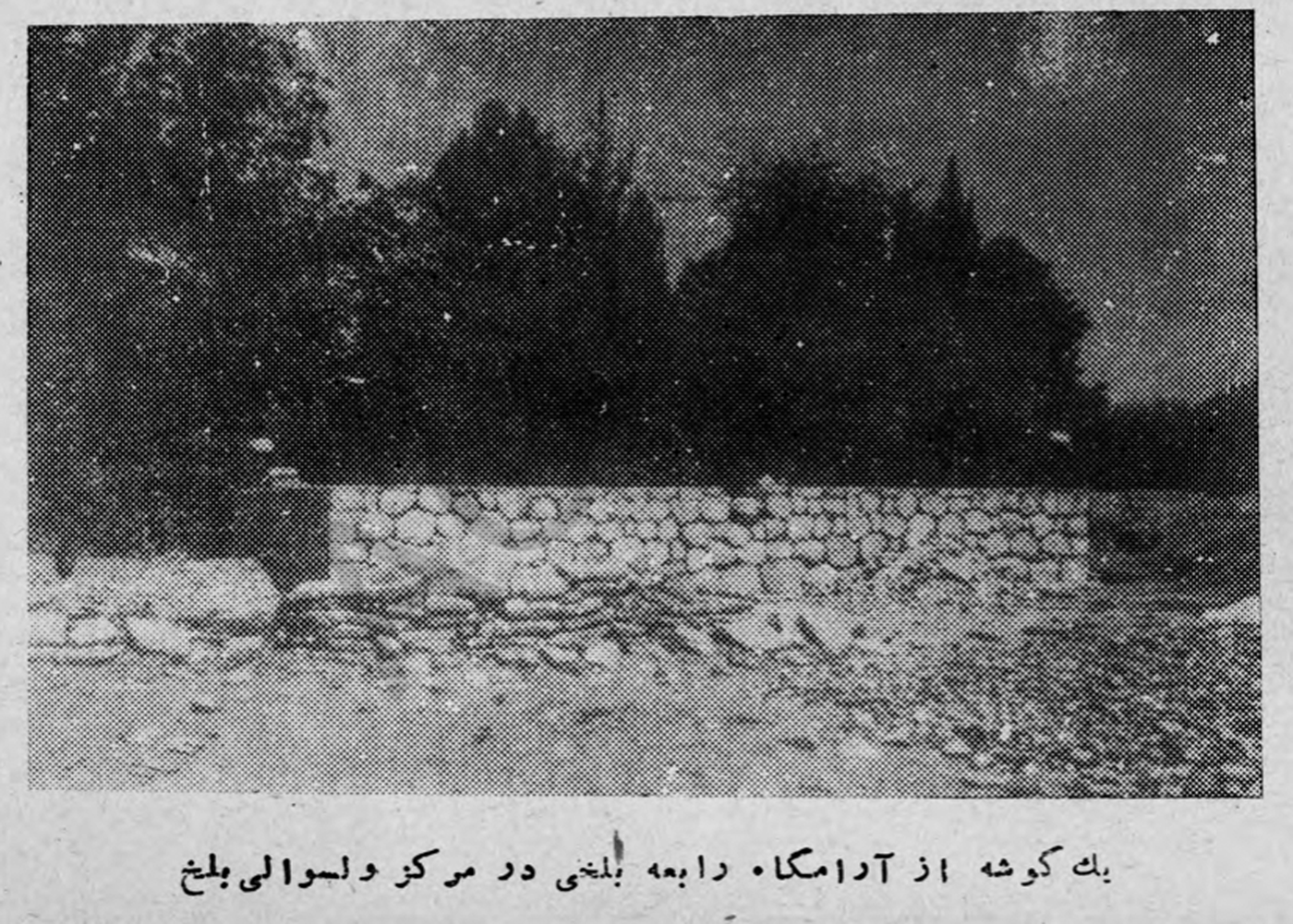
Although details around the discovery of Rabiʿa's grave remain vague, the formalization of her shrine is better documented. On 6 November 1966, Balkh province's Directorate of Information and Culture (Itlaʿat wa Farhang) held a thousand-year anniversary celebrating her life and martyrdom. This anniversary was held in the Balkh town park, next to her tomb—a concrete structure that had just been built around the grave (Fig. 4). This seems to be, for the most part, a locally driven project in which authorities from Kabul were only tangentially involved. The mayor of Mazar-i Sharif, Ghulam Muhammad Ormal, delivered a speech at the anniversary emphasizing Rabiʿa's literary greatness and her early role in the development of sufism. The governor of Balkh province, Mohammad Hussain Masa, concluded the ceremony by laying a bouquet of flowers at her grave. Although speakers at the ceremony praised the royal family's role in “the revival of our ancient glory” and “national traditions,” the local Directorate of Information and Culture was the true architect of both the shrine and anniversary.Footnote 59 Nawabi, its director, delivered a speech outlining the ministry's goal behind such celebrations: to revive Afghanistan's literary and cultural heritage, and to celebrate great intellectual personalities of the past.Footnote 60 But although central authorities were largely absent, two demographics from Kabul were represented—national poets and Afghan women.
View of Rabiʿa's resting place after its construction in 1966. Hanif, Armaghan-i Balkh, 1346/1967, 38.
Afghan poets played a key role in the revival of Rabiʿa's narrative. Perhaps the most impressive poem retelling her tragedy was the lengthy epic, Shuʿla-yi Shurangiz (The Sensational Flame, 1966), by Nasir Tuhuri. Another poet, Latif Nazemi, greatly expanded her love story and later wrote the script for the film Rabiʿa Balkhi (1974). The local poet Hanif dedicated a long qasida to Rabiʿa Balkhi, which he both presented at the anniversary and included in his book Armaghan-i Balkh (The Gift of Balkh, 1968). The literary critic Salahuddin Saljuqi also made a speech marking the anniversary—which seems partly aimed at the grave's sceptics. He asserted there was “no doubt” that Rabiʿa was buried at this site in Balkh. He further claimed that a well-known and adored gravesite, which historians had allegedly documented, was associated with her in the past. But this had been “lost through the course of time.”Footnote 61
During the anniversary, a strong emphasis also was placed on the relationship between contemporary Afghan women and female poets of the past. A delegation from Kabul included three influential women: Saleha Amin Etemadi, the editor of the women's magazine Mermon (Lady); Shafiqa Ebad, the assistant principal of Rabiʿa Balkhi High School; and Shokria Raad, producer of the women's program for Radio Afghanistan. Girls from Sultan Razia high school, in nearby Mazar-i Sharif, also recited poems.Footnote 62 This was tied to one of the aims of the local Directorate of Information and Culture—shaping the nation's future through celebrating its past. Rabiʿa Balkhi's commemoration was not only about the nostalgic revival of past greatness, but an urge to modernize and empower contemporary Afghan women. It is clear, then, that the formalization of Rabiʿa's shrine was shaped by different forms of nationalist sentiment—the country's Sufi heritage and poetic legacy, as well as a modernist push toward female education.
Narrating Rabiʿa: Between Local Tradition and National Imagination
After the anniversary concluded, the Ministry of Information and Culture erected a memorial stone with the following inscription above Rabiʿa's grave:
Shrine (mazār) of Rabiʿa Balkhi
Memorial to the famous poet of Balkh on the thousandth anniversary of her death, by the Ministry of Information and Culture, which was celebrated on 15 ʿAqrab 1345 (6 November 1966). In the words of ʿAbd al-Rahman Jami, Rabiʿa was among the pure-hearted (pāk-dil) knowers and lovers (ʿurafā wa ʿāshiqān), and based on the memoirs of the ancients, she lived in the first part of the 4th century hijri. Her father Kaʿb was the amir of Balkh, and she was called “Adornment of the Arabs” (Zayn al-ʿArab). The unfortunate poetess was martyred (ba shahādat rasīd) by her brother Harith. Farid al-Din ʿAttar wrote about her fate in five hundred verses. For more information see the book Rabiʿa Balkhi by Ghulam Habib Nawabi.
Nevertheless, despite the appearance of antiquity, doubt and skepticism surrounded Rabiʿa's grave in the years following its discovery.Footnote 63 The Afghan journalist ʿAbdul Haqq Waleh (1926–2007), for instance, visited the ruins and shrines of Balkh in 1970.Footnote 64 He described this journey in his entertaining, and often satirical, “Afghan Diary” column for the Kabul Times. Traveling for both pilgrimage and sightseeing, he describes how he “paid homage to the graves of the great burried [sic] among the debris here and there.” He felt particularly drawn to the shrines of the poet Anwari, the saint Baba Ku, and Rabiʿa Balkhi. But he was unimpressed by the discovery of her grave, writing:
The man who made a life study of [Rabiʿa Balkhi] is Ghulam Habib Nawabi. He wrote a book on the 1,000th birthday anniversary of Rabia but most of the copies were left unsld [sic]. So he erected a tomb-stone on her grave which he himself located and inscribed a short biographical sketch of the poetess. At the end of the stone, he cleverly advertised his book: “Those in search of more information about the life and works of this “martyr on [the] altar of love” ought to buy a copy of the book entitled “Rabia Balkhi” by Ghulam Habib Nawabi.Footnote 65
Despite the major local celebration of Rabiʿa Balkhi's anniversary in Balkh and Mazar-i Sharif, there is a noticeable silence around her grave's discovery in the country's respectable historical and cultural journals, as well as national almanacs. Seasoned historians and Kabul-based officials, it seems, responded to the discovery of Rabiʿa's grave by politely ignoring it. This skepticism also was expressed by some locals. Jonathan Lee recalls that one long-standing family in Balkh “always disparaged the shrine and never visited it,” considering it to be fake. International scholars also were skeptical. The Tajik historian Akhror Mukhtarov observes that the mausoleum was not actually built over the excavated site itself, but to one side of it to avoid obstructing the pleasant view of the Khwaja Parsa shrine. Mukhtarov writes, “In our view, if the poetess Rabiʿa were indeed buried in Balkh, the exact location of her grave is yet to be determined.”Footnote 66 The Iranian literary critic ʿAli Nadoshan (1924–2022) visited Rabiʿa's grave in 1970, accompanied by the director of the Balkh Museum. They began their trip at the town park under the shade of the oriental plane trees, then walked to Rabiʿa's grave, the Khwaja Parsa shrine, the old citadel (bālā hisār), and the Nuh Gunbad mosque. Although Nadoshan was deeply moved by the historical landscape of Balkh, he was unimpressed by Rabiʿa's tomb and skeptical of its discovery. He writes:
I was shown a grave belonging to Rabia Quzdar, the renowned poetess. It was a basement which we enetred [sic]. It looked like one of the ancient, wrestling clubs. The big grave built with cement did not match with the feminine delicacy of Rabia. It was said that the grave was discovered a few years ago. I asked if they had found any indication to prove it was her grave. I was told that there was no indication at all. I was astonished to see an unknown grave discovered and then [called] a well-known resting place. When I made inquiries with some Afghan men of letters in Kabul later on, they told me there was no proof about this contention.Footnote 67
By the 1970s, Rabiʿa's legend had thoroughly spread among the middle class and became integrated in oral folklore, told and retold in slightly different variations in homes and schools around the country. Rabiʿa's legend had become so integral to the national story, in fact, that it formed the subject of Afghanistan's first independent movie, the epic Rabiʿa Balkhi, in 1974.Footnote 68 The movie was produced by Nazir Film, the country's only private film company, with support from Afghan Film—an organ of the Ministry of Information and Culture.Footnote 69 Costing three million afghanis, it was “the longest, most expensive, and technically difficult” film ever produced in Afghanistan.Footnote 70 The premiere, held at Aryana Cinema in Kabul on 21 December 1974, was itself a cultural event of national significance. The actors, who came on stage for a meet-and-greet, were even presented with a bouquet of flowers by Dr. Nevin, the Minister of Information and Culture.Footnote 71
Latif Nazemi, who wrote the film script, took considerable license in retelling Rabia's tragedy. This creative retelling helped spread a public imagination of her life beyond the confines of literary circles. The tragedy of her martyrdom acquired new interpretations as it was told and retold in different contexts. As an exemplar of Afghan poetry, she was mentioned in the same breath as Rumi and Sanaʾi. And as an exemplar of Afghan femininity, she was mentioned alongside national heroines like Nazo Ana (d. 1717) and Zarghuna Ana (d. 1771). The Ministry of Information and Culture even played the film for tribal elders attending the Loya Jirga of 1977, which had been convened to approve the Republic of Afghanistan's new constitution.Footnote 72 One must wonder why the ministry was so interested in promoting this film to tribal elders, and what these elders made of the way Rabiʿa was depicted and the values the film promoted.
On one hand, Rabiʿa was portrayed as “a product of the times she lived in”—that is, a royal woman of the Samanid era.Footnote 73 On the other, she is depicted as somewhat contemporary, speaking colloquial Afghan Persian, and relatable to the urban middle class—including the fashionable makeup and hairstyles of Kabul in the 1970s (Fig. 5). Her tragic love story also spoke to a generation of young Afghan women caught between honor predicated on female chastity (nāmūs) and the dream of independent love (promoted through transnational popular culture). The setting of Rabiʿa's life also was localized. Parts were filmed in Babur's Garden and Bagh-i Bala, well-known public parks in Kabul. Other parts were filmed at Bagh-i Jahan-numa in Tashqurghan—a royal palace built in the reign of the Sher ʿAli Khan (r. 1863–79) and an early residence of ʿAbd al-Rahman Khan (r. 1880–1901). The royal family often stopped here, drawing large crowds, during tours of the country's north.Footnote 74 These were landscapes of national significance, and positioned the narrative in the Afghan national story.
Rabiʿa sits on a throne attended by her servants in Rabiʿa Balkhi (film), 1974.

Meanwhile, Rabiʿa's grave was subsumed within Balkh's broader landscape of antiquity. In her Historical Geography of Balkh (1376/1997), Ilhama Miftah speaks of Rabiʿa's grave as if it were always part of this cultural landscape, mentioning it casually alongside Balkh's other shrines and antiquities.Footnote 75 In his Ancient Sites and Historical Monuments of Balkh (1394/2015), Salih Muhammad Khaliq notes that Rabiʿa's resting place in the town park “has no historical building as such,” asserting that a structure was only built over her grave in the 20th century.Footnote 76 Neither author comments on the grave's authenticity nor mentions its discovery. Both seem to consider its genuineness a given fact, and a seamless part of Balkh's historical landscape: the citadel, nearby shrines, and pre-Islamic ruins.
Rabiʿa's grave lay conveniently at the center of this landscape of antiquity. When people visited Balkh, whether for a casual trip (chakar) or pilgrimage (ziyārat), her shrine was one of many they might visit. Nancy Dupree writes in her Historical Guide to Afghanistan (1977):
Scholars may look askance at the newly designated shrine, questioning its authenticity. But young girls come to ask the poetess for inspiration in solving their own romantic problems. As they leave, they tie a strip of cloth to the bars through which one views the underground tomb, to remind her of their quest. The poetry of Rabi'a Balkhi continues to live in the hearts of Afghanistan's young lovers.Footnote 77
It seems clear, then, that within a short time Rabiʿa's tomb became a site of pilgrimage where young lovers could speak to the poetess.Footnote 78 Except for the occasional detractor, such as the local family cited earlier, it was generally assumed that the grave was genuine and considered the burial place of a sufi martyr. But exactly how Rabiʿa's shrine became subsumed within the broader landscape of antiquity is not entirely clear. Hobsbawm notes that invented traditions are difficult to trace when they are partly invented, and partly evolve informally over time.Footnote 79 Perhaps being located at the center of a pilgrimage landscape, widely imbued with spiritual blessedness (baraka), contributed to the blessedness of the newly discovered grave. Simply visiting her grave as part of a sequence of shrine visitations, and its association with martyrdom, ensured that it became invested with spiritual blessedness. It also seems that two distinct ways of narrating Rabiʿa emerged. The first was a set of more “disemplaced” narratives—characterized by story, poetry, and film that had very little to do with her resting place. The second comprised place-based narratives, in which Rabiʿa was incorporated into the broader network of narratives around Balkh's sacred landscape. The relationship between narrative and place is one of mutual constitution—narratives are drawn on to interpret place, and place-based wonder and curiosity in turn shape narrative.
Resilience and Change: Rabiʿa's Shrine through War and Development
The beliefs and practices described by Nancy Dupree still existed when I first visited the shrine in 2008. The shrine's resilience was remarkable given the profound social and political changes the region had been through over the preceding forty years. During the Soviet occupation (1979–89), the town park of Balkh was fought over numerous times by the communist state and mujahidin groups. Rabiʿa's shrine was largely neglected and degraded badly, although the reinforced concrete ensured its survival even when surrounding monuments were severely damaged. Most shrines in Balkh, including Rabiʿa's, were closed to the public when the Taliban took the northern regions in 1998. But shrine visitation, and associated ritual and votive practices, swiftly reemerged when the Taliban fell in 2002.
But although general shrine practices have proven resilient, the ways in which Rabiʿa is imagined and narrated have continued to evolve and change. On several visits to the Balkh town park, I observed and spoke with urban youth, local traders, and farmers from nearby villages around the shrine. Their perceptions of what Rabiʿa symbolizes differ quite markedly from each other. For most local visitors to the shrine, she is a Muslim poet-saint whose grave is a site of spiritual blessedness and for whom one should make duʿa (supplicatory prayer)—similar to many other shrines across Afghanistan. But for others, particularly educated women from urban centers, Rabiʿa is an inspirational icon whose legacy speaks to contemporary social issues such as street harassment, bodily autonomy, and arranged marriage.Footnote 80 The sentiment that Rabiʿa is a feminist icon has steadily grown over the past two decades. On my last trip to Afghanistan in 2019, I became acquainted with the work of a writer's collective called “The Daughters of Rabi'a” (Dukhtaran-i Rabi'a), whose essays and poetry are in dialogue with, and in the genealogy of, the historical Rabi'a.Footnote 81
For political and religious authorities, the problem is not so much the grave's legitimacy, but the informal practices and perceived superstitions (kharāfāt) that seem to emerge organically and prove resistant to control, regulation, and eradication. When I began my doctoral fieldwork in 2017, the dervish at the shrine's door was gone and the graffiti-inscribed banner had been removed. I was told that it had been folded up and stored away. This seemed to coincide with a broader “cleaning up” of informal shrine practices following the lynching of Farkhunda Malikzada in 2015.Footnote 82 This is not unique to Afghanistan. States across the Muslim world attempt to control the unruly, and therefore threatening, spaces of shrines. In Pakistan, for instance, Katherine Pratt Ewing observes “the close intertwining of governmentality—the shaping of and caring for a modern population—and policies toward shrines.”Footnote 83 The state appears to have used Farkhunda's murder as an excuse to purify shrine spaces of undesirable elements, which it had long been at odds with, as shrines are often perceived to exist outside state control.Footnote 84
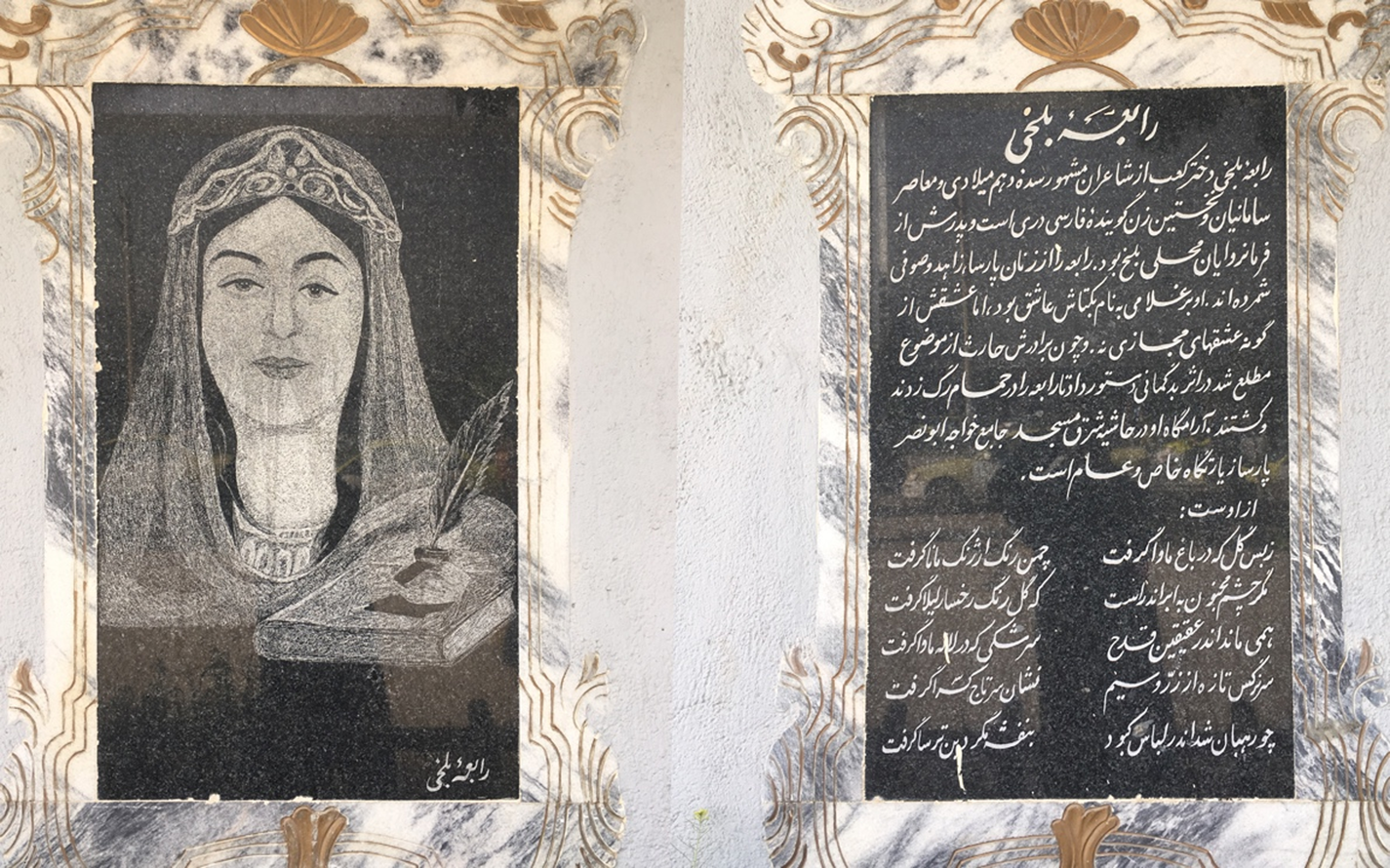
Meanwhile, however, state officials continued to monumentalize the landscape of Balkh province. After the fall of the Taliban in 2001, the capital city of Balkh province, Mazar-i Sharif, was decorated with images, statues, and paintings that memorialized the city's Persianate heritage—celebrating classical poets such as Rumi and Rabi'a as cultural exemplars. In 2005, an avenue in central Mazar-i Sharif was named after Rabiʿa Balkhi.Footnote 85 A large memorial (yādgāh) dedicated to her was built across the road from the central shrine (Fig. 6). Her portrait and biography also were inscribed on the Wall of Poets, a series of portraits and inscriptions that Ata Muhammad Noor, the governor of Balkh, erected outside Sultan Ghiyasuddin High School. Both memorials included an inscription of her famous poem, “New Year in Balkh” (Nawrūz-i Balkh; Fig. 7):
Nongovernmental organizations involved in postwar reconstruction also participated in this cultural revival. In 2012, the Aga Khan Trust for Culture (AKTC) undertook projects to restore the Khwaja-i Parsa shrine, which had fallen into neglect. As part of this work, they renovated Balkh's central park and the tomb of Rabiʿa Balkhi (Fig. 8). Their Final Narrative Report acknowledges the modernity of the town park, but not the circumstances under which her grave was uncovered. It speaks of Rabiʿa's grave as if it were always part of the landscape:
While the location of Rabiʿa's imprisonment and even the truth behind her fate is an issue of debate, what remains certain is that her poetry ranks as some of the finest in the Persian language and that her final resting place is a modest subterranean room directly to the south of the Khwaja Parsa Shrine.Footnote 87
The report speculates that “the circumstances of her death would seem to suggest that she was buried quietly and without much investment.” The rebuilders did not know what kind of structure may have initially been built around her grave, nor did they comment on the origins of the “half submerged cast reinforced concrete structure” which served as her shrine from 1966 to 2012. They claim to have “discovered” the shrine in “a state of disrepair and close to collapse.” Khaliq echoes these sentiments, noting that the previous concrete structure had “a narrow entrance” and “no artistic beauty whatsoever.”Footnote 88
Memorial to Rabiʿa Balkhi near Mazar's central shrine. Photograph taken by the author, 2017.

Rabiʿa's biography and portrait inscribed on Mazar's Wall of Poets. Photograph taken by the author, 2019.
The new structure built over Rabiʿa's grave in 2012. Photograph taken by the author, 2017.
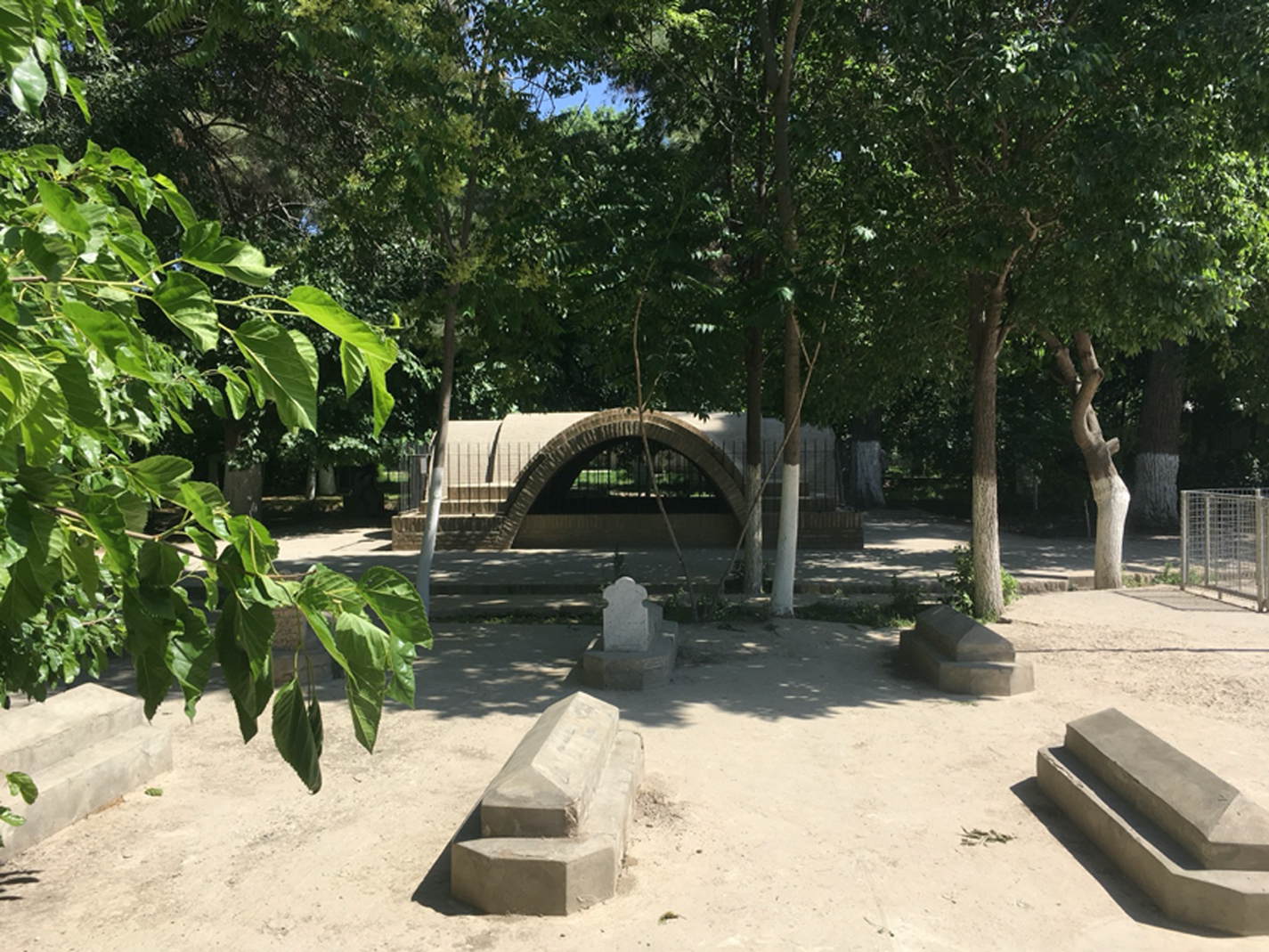
The AKTC demolished the concrete and stone masonry, still intact from 1966, which made up the shrine's walls and roof. They took care not to damage the “fragile grave covered in green cloth” inside, and built a new shrine over the grave in the form of “two large intersecting brick masonry vaults.” These vaults, open on each side, allowed air to circulate through the tomb and offered more intimate views of the grave. The bricks used in the structure were the same type of baked bricks often used in Afghan historic buildings.Footnote 89 This shift in architectural styles, from the modernity of concrete to the “indigeneity” of baked bricks, is indicative of an evolution in taste around the rebuilding (bāz-sāzī) of Afghanistan's cultural heritage. Khaliq thus described the shrine's rebuilding as an improvement (bih-sāzī).Footnote 90
But the inscription of the new tombstone suggests a more important change—a more ethnic, and localized, conception of Rabiʿa's identity. The first tombstone called her “adornment of the Arabs” (zayn al-ʿArab), whereas the second calls her a “Tajik princess” (bānū-yi Tājīk). The language of the new inscription seems to reinforce this sense of ethnic nationalism, choosing Persian in place of Arabic loan words. Although the first tombstone used the Arabic word “shrine” (mazār), the second uses the Persian term “resting place” (ārāmgāh). The Arabic-derived term for “lunar year” (qamarī), is likewise replaced with the Persian mahshīdī. The Arabic term for the month ʿaqrab is now bracketed with the Persian ābān. These ethnic and linguistic changes are sharpened by a shift in the tomb's patronage. The reference to Ghulam Habib Nawabi is removed. Instead, the new tombstone is said to be a gift by a “culture-loving” private citizen of Balkh.Footnote 91
These changes should perhaps be seen in light of the fragmentation of the central state, and the sharpening of local identities. This process took shape during the anti-communist jihad (1979–92), but became most stark during the civil war that followed (1992–2001).Footnote 92 In line with the broader crystallization of macro-ethnic groups, Rabiʿa shifts from being an Afghan woman of Arab heritage to simply “Tajik.” Considered alongside other cultural landscapes in Afghanistan, we notice a broader shift in the way cultural heritage is imagined and reshaped. Influential citizens often work alongside local governors and commanders to erect monuments. Local stakeholders have an increasing influence in “making” places. This speaks to the fragmentation of the central state's administrative power, and therefore its cultural power, through the past forty years of war. The Afghan state lost the ability, if it ever had it, to define the facts of Rabiʿa's life. It also lost the ability to define the meaning of “national culture,” which it once invested so much into shaping.
Local Placemaking, Unstable Nationalism, and the Fate of Monuments
The emergence of Rabiʿa's shrine was not an isolated event. Parallels can be observed throughout the Muslim world. In 1934, a thousand-year celebration was held in Tus, eastern Iran, following the discovery of Ferdowsi's grave there.Footnote 93 Sixty years later, in Tajikistan, a similar millennial celebration was held around a newly built monument to the poet Rudaki. Meanwhile, Uzbekistan monumentalized the urban landscape in honor of ʿAli Shir Nawa'i—positioning him as a national hero and the father of Uzbek literature. In Azerbaijan, places related to the poet Nizami were renovated to better reflect the state's national and linguistic identity. These efforts by state authorities to commemorate, and monumentalize, classical poets are clear expressions of cultural nationalism.
But what is it, exactly, about these classical poets that positions them as cultural exemplars and national heroes? Perhaps, in part, it is their near universal appeal. Even activists and separatists, who disagree vehemently with the state, would agree that poets like Ferdowsi, Rudaki, and Rabiʿa are akin to cultural ancestors who shaped the language we speak today and represent cultural purity in contrast to the corrupt present. These poets are widely lauded as culture heroes, who ushered in a golden age when they revived the national language (and thereby national honor and national values). Their graves were either lost, or their monuments degraded, in a perceived era of social decay, brought on by outsiders who had defiled the national culture and language. By unearthing their graves and renovating their monuments, the scholars and officials of modern nation–states positioned themselves as successors to this pristine past. By formalizing them into the state's monumental landscape, they restored order to the pristine landscapes of antiquity.
In this article, I have argued that another dynamic is at play in Afghanistan. Local officials and cultural elites often draw on dreams and visions as local forms of placemaking and monumentalizing the landscape. In Badakhshan, one local governor had a dream in which Nasir Khusraw appeared to him and instructed him on how to rebuild his shrine. Similar accounts of shrine building exist around the tomb of ʿAli b. Abi Talib in Mazar-i Sharif, as well as Bibi Nushin in Shibirghan. The narrative of a local governor discovering Rabiʿa's grave through a dream, then, is a well-established local form of giving meaning to place. Cultural officials also were often published poets, and I have argued that composing poetry is a related form of placemaking, as the poet can escape the confines of everyday discourse through rhythmic verse—thereby inducing the voices of past heroes, and writing in dialogue with poetic ancestors. Visionary dreams and poetry as ways of “knowing place” are at odds with modern forms of archaeology and historiography. Nonetheless, in the everyday life of Afghan towns and villages, they remain legitimate and compelling ways of understanding a landscape's past.
The reader might assume, at this point, that officials such as Nawabi and Paramach were disingenuous in drawing on local forms of placemaking—perhaps exploiting local superstition in support of personal or nationalist projects. But I do not think this is the case. The evidence suggests that local officials and cultural elites deeply believed in these placemaking projects. These officials were, after all, raised in the cultural milieu of Afghan towns and villages in which dreams and visions are legitimate ways of knowing the past. But they also worked in modern government and educational institutions—where secular forms of monumentalization, and interpreting the past through archaeology, increasingly shaped senses of place and history. Local officials, it seems, often sought a middle ground—resulting in the hybridized form of placemaking visible around Rabiʿa's shrine.
Although Rabiʿa's shrine was incorporated into the broader sacred landscape of Balkh, narratives of her life played out on the national stage in quite a different way—portraying her in a light that mirrors the struggles of contemporary Afghan women. But the state's narrative defining Rabiʿa's life was contested as soon as it was publicized—by journalists, young lovers, and Balkh locals. This very contestation, it seems, ensured Rabiʿa's continued relevance as well as the shrine's ongoing significance. Would it have been closed by the Taliban if it were not seen as a site of moral corruption? And would it have reemerged as a symbol of feminism if it had not been closed by the Taliban? Part of Rabiʿa's symbolic power, it seems, lies in the fact that her narrative is a field in which issues of national significance are debated. Is she a secular feminist or a Muslim saint? An Afghan, or a Tajik? Is this an empty grave or a blessed shrine? Are shrine practices central to Islam or a corrupt innovation? Simmering beneath the surface of these disputes lies one of the key tensions in Afghan society, and perhaps the key theme in Rabiʿa's story—honor predicated on female chastity (nāmūs).
It is unsurprising that these disputes seem to play out again and again over succeeding generations.Footnote 94 In the 1960s, Rabiʿa represented a “lost golden age” of Persianate sufism and exemplary femininity. In the 2000s, she again represented that lost golden age—although now through the lens of third-wave feminism, and nostalgia for the lost innocence of prewar Afghanistan. Rabiʿa's story and shrine, then, is a shared space through which important disputes play out—between state and tribe, historians and poets, officials and locals, “orthodox” Muslims and secular feminists. These groups come together and briefly engage each other over questions central to the nation's past and future. This coming-together is seen in the way poetry and dreams became a medium between locals and officials. Or in the state playing the film Rabiʿa Balkhi to elders at the Loya Jirga. Or in the way the English graffiti, “this is what a feminist looks like,” sat alongside Qurʾanic verses at her grave.
One question I have often returned to is why shrine practices, such as those around Rabia's shrine, seem to persevere with resilience despite decades of war and state collapse. Why do shrines such as Nasir Khusraw, Bibi Nushin, and ʿAli b. Abi Talib remain central to community life despite violent conflict, civil strife, and social change? Indeed, why do shrines often seem to become more symbolically powerful and meaningful in times of violent conflict?Footnote 95 The reasons for this resiliency are complex. They are places of solace, and even alternative sovereignty, long after the states that instituted them have weakened or collapsed. They are places where issues at the heart of Afghan social life are contested, reinterpreted, and replicated across generations. Rabiʿa herself remains symbolically powerful because the themes her life represents—sufism, poetry, and honor—continue to be relevant to how most Afghans interpret their lives. As long as this is the case, it is likely that cultural officials in Afghanistan will continue to draw on local forms of placemaking—dreams, visions, and poetry—in shaping landscapes for future generations.


 Open access

