


Adolescence has been identified as a critical period for sport continuation, being the period where the greatest drop-out occurs. Many factors such as interpersonal constraints, lack of enjoyment, or perceptions of low competence have been associated with this phenomenon (for a review, Crane & Temple, Reference Crane and Temple2014). Emotions experienced during sport activities seem to have some importance in this regard (Mohiyeddini, Pauli, & Bauer, Reference Mohiyeddini, Pauli and Bauer2009). Coping with these emotions is considered a relevant factor influencing adolescent experiences within their sport, both in a positive or in a negative way (Nicholls, Perry, Jones, Morley, & Carson, Reference Nicholls, Perry, Jones, Morley and Carson2013). Coping is defined as the “constantly changing cognitive and behavioral efforts to manage specific internal and/or external demands that are appraised as taxing or exceeding the resources of the person” (Lazarus & Folkman, Reference Lazarus and Folkman1984, p. 141).
Coping helps to regulate emotions generated by stressors. Specific coping strategies are often classified into task- and disengagement-oriented coping dimensions (Gaudreau & Blondin, Reference Gaudreau and Blondin2004). Task-oriented coping (TOC) represents efforts oriented to directly deal with stressful situations, meanwhile disengagement-oriented coping (DOC) is understood as thoughts and behaviors that focus attention away from the stressful events. Given the prevalence of certain coping strategies in adolescent athletes (Nicholls, Levy, & Perry, Reference Nicholls, Levy and Perry2015; Nicholls et al., Reference Nicholls, Perry, Jones, Morley and Carson2013), coping dimensions based on TOC (i.e., effort expenditure, thought control, and logical analysis strategies), and DOC (i.e., venting of emotions and resignation strategies) are of particular interest in our study. Although coping strategies and dimensions are not universally beneficial or detrimental (Lazarus, Reference Lazarus1999), TOC typically predict more desirable consequences in adolescents (e.g., academic competence or psychological adjustment; Compas, Connor-Smith, Saltzman, Thomsen, & Wadsworth, Reference Compas, Connor-Smith, Saltzman, Thomsen and Wadsworth2001).
From the cognitive-motivational-relational theory of emotions (CMRT; Lazarus, Reference Lazarus1999), coping intertwine with cognitive appraisals and emotions. As this is a recursive process, coping can both go before and after emotions (Lazarus, Reference Lazarus1991). According to the theory, a person has a tendency to judge his or her person-environment relationship in order to determine if the environment endangers or has the potential to threat personal goals. This process is known as primary appraisal. CMRT also posits that an additional evaluation (i.e., secondary appraisal) intercedes in this assessment process. Secondary appraisal identifies coping possibilities available for the person in that situation. Primary and secondary appraisals may be modulated over time due to habituation process (Tong et al., Reference Tong, Bishop, Enkelmann, Why, Diong, Khader and Ang2009). The combination of appraisals may result in four possible evaluations (i.e., harm/loss, threat, challenge, or benefit) which, in turn, generate emotions.
Lazarus (Reference Lazarus2000) defined emotions as “an organized psychophysiological reaction to ongoing relationships with the environment, most often, but not always, interpersonal or social” (p. 230). This author identified eight relevant emotions that arise in the domain of sport (i.e., anger, anxiety, shame, guilt, hope, relief, happiness, and pride). Of these emotions, competitive anxiety has received the most attention in the sport literature, and is believed to negatively influence sport continuation (Martens, Vealey, & Burton, Reference Martens, Vealey and Burton1990). Competitive anxiety usually implies that an athlete appraises a situation as having personal significance, and perceives not having the resources to cope with the situation (Wolf, Evans, Laborde, & Kleinert, Reference Wolf, Evans, Laborde and Kleinert2015).
Martens (Reference Martens1977) defined competitive state anxiety as the “tendency to perceive competitive situations as threatening and to respond to them with feelings of apprehension and tension” (p. 23). These feelings include somatic and cognitive symptoms of anxiety (Martens et al., Reference Martens, Vealey and Burton1990). Somatic anxiety refers to “physiological and affective elements of the anxiety experience” (Martens et al., Reference Martens, Vealey and Burton1990, p.6). Regarding cognitive anxiety, some research (e.g., Ponseti, Sesé, & Garcia-Mas, Reference Ponseti, Sesé and Garcia-Mas2016; Wolf, Eys, & Kleinert, Reference Wolf, Evans, Laborde and Kleinert2015) has considered the division of cognitive anxiety components (i.e., worry and concentration disruption), which has shown differences in their relation with other constructs in adolescent athletes (Grossbard, Smith, Smoll, & Cumming, Reference Grossbard, Smith, Smoll and Cumming2009). Worry is conceptualized as non-optimistic concerns regarding potential negative personal and social consequences of poor performance (Sarason, Reference Sarason1984). Concentration disruption implies difficulties in focusing on task relevant cues and thinking clearly in competitive situation (Nideffer & Sagal, Reference Nideffer, Sagal and Williams2006). This tri-dimensional distinction of competitive anxiety is part of a higher conceptual framework (Smith, Reference Smith2008).
Morris and Kavussanu (Reference Morris and Kavussanu2009) found that worry and concentration disruption in adolescents were negatively related with enjoyment. As enjoyment has strong associations with sport commitment (Garcia-Mas et al., Reference Garcia-Mas, Palou, Gili, Ponseti, Borras, Vidal and Sousa2010), we expect similar relations between competitive anxiety and sport commitment. Previous exploratory research has found no conclusive relations (Pons, Ramis, Garcia-Mas, de la Llave, & Perez-Llantada, Reference Pons, Ramis, Garcia-Mas, de la Llave and Perez-Llantada2016). In this study, we aim to test this hypothesis from a stronger methodological approach. Sport commitment is defined as “the psychological construct representing the desire and resolve to continue sport participation” (Scanlan, Carpenter, Simons, Schmidt, & Keeler, Reference Scanlan, Carpenter, Simons, Schmidt and Keeler1993, p. 6). Following CMRT, we expect that coping may play a mediating role (i.e., total or partial) in the relationship between competitive anxiety and sport commitment (Lazarus, Reference Lazarus1999). Therefore, understanding the association of competitive anxiety, coping, and sport commitment might resolve whether specific coping orientations strengthens or mitigate the negative association between competitive anxiety and sport commitment.
Some, but not conclusive, research in the sport context has empirically supported the relations among these variables. Ntoumanis and Biddle (Reference Ntoumanis and Biddle2000) observed that adolescents’ intensity of cognitive anxiety symptoms was associated with DOC. Similarly, Hatzigeorgiadis and Chroni (Reference Hatzigeorgiadis and Chroni2007) found negative associations between TOC and cognitive anxiety, and positive associations between somatic anxiety intensity and DOC. In addition, previous investigations have addressed the impact of coping on some other indicators of sport continuation such as burnout (e.g., Raedeke & Smith, Reference Raedeke and Smith2004). For example, Kim and Duda (Reference Kim and Duda2003) found that sport commitment was positively related with TOC among university students. These studies have investigated the relationships between emotions and coping, or between coping and indicators of sport continuation (i.e., sport commitment). However, few studies have examined the interplay between emotions, coping, and sport commitment among adolescents. Our study aims to shed some light on this gap in the literature by examining the mediating role of coping between competitive anxiety and sport commitment.
Method
Participants
Five-hundred team sport athletes participated in the study of which 36.8% were female. Athletes’ ages were between 13 and 21 (M = 16.42; SD = 1.54) pertaining to 56 teams. All participants were Spanish and practiced the following team sports: Basketball (49.8%), soccer (19.4%), volleyball (14.6%), handball (11.2%), roller hockey (3.4%), and water polo (1.6%).
Measures
Competitive anxiety was assessed with the Sport Anxiety Scale–2 (SAS-2; Smith, Smoll, Cumming, & Grossbard, Reference Smith, Smoll, Cumming and Grossbard2006), using the Spanish version (Ramis, Torregrosa, Viladrich, & Cruz, Reference Ramis, Torregrosa, Viladrich and Cruz2010). This is a 15-item questionnaire containing the subscales of somatic anxiety (e.g., “My body feels tense”), worry (e.g., “I worry that I will not play my best”), and concentration disruption (e.g., “I lose focus on the game”). All items were rated on a 4-point Likert-style scale. The scale had good reliability with Cronbach’s alpha values of .83 for somatic anxiety, .84 for worry, and .81 for concentration disruption. Confirmatory factor analysis showed a good fit, with χ2(87) = 262.7, p < .001, RMSEA = .064, 90% CI [.055, .072], CFI = .965, and TLI = .958.
Coping was assessed through the “Inventaire des Stratégies de Coping en Compétition Sportive” [Coping Inventory for Competitive Sport] (ISCCS; Gaudreau, & Blondin, Reference Gaudreau and Blondin2002). The Spanish version (Molinero, Salguero, & Márquez, Reference Molinero, Salguero and Márquez2010) is composed of 31 items. We selected items from effort expenditure (e.g., “I apply myself by giving a consistent effort”), logical analysis (e.g., “I analyse my past performances”), thought control (e.g., “I try not to be intimidated by other athletes”), venting of emotions (e.g., “I get angry”), and resignation (e.g., “I let myself feel hopeless and discouraged”) strategies, corresponding to TOC and DOC (Gaudreau & Blondin, Reference Gaudreau and Blondin2004). Cronbach’s alpha values were .69 for TOC and .75 for DOC. Congruent with the idea defended by Lazarus (Reference Lazarus2006) that coping dimensions are not strictly task- or disengagement-oriented, we opted for a measurement model with less-restrictive conditions (i.e., Exploratory Structural Equation Model; ESEM). This showed a model fit of χ2(76) = 352, p < .001, RMSEA = .085, 90% CI [.076, .094], CFI = .865, and TLI = .801.
Sport commitment was assessed through the commitment subscale of the Sport Commitment Questionnaire (SCQ; Scanlan et al., Reference Scanlan, Carpenter, Simons, Schmidt and Keeler1993), using the Spanish version (Sousa, Torregrosa, Viladrich, Villamarín, & Cruz, Reference Sousa, Torregrosa, Viladrich, Villamarín and Cruz2007). This subscale is composed of six items (e.g., “I want to keep playing my sport this season”). All items were rated on a 5-point Likert-style scale. Cronbach’s alpha was .79 for the present study. Confirmatory factor analysis showed an excellent fit in our study, χ2(9) = 16.7, p < .001, RMSEA = .041, 90% CI [.000, .072], CFI = .995, and TLI = .992.
Procedure
This study was granted ethical approval by the university ethics committee. We contacted sport clubs and sent them an information letter. A date was arranged to administer the questionnaires with all clubs that agreed to participate. Data was collected in the clubhouse or locker rooms of the participating clubs and at least one trained researcher was present. Completion of the questionnaires took approximately 20 minutes. Those participants who requested (47.2%) were send a report with their main results.
Data Analysis
Preliminary Analysis and Measurement Models
The first step of data analysis included examining missing data, item distribution and testing possible multilevel design effects. The existence of deviant cases was also evaluated. In the second step, we estimated the measurement models. Due to the ordinal nature of subscales, we decided to use Weighted Least Squares Mean and Variance Adjusted (WLSMV) estimator in Mplus 7.0 software. Standard errors corrected for multilevel design effects were used. Goodness of fit was assessed with χ2, root mean square error of approximation (RMSEA), comparative fit index (CFI), and tucker lewis index (TLI). According to Yu (Reference Yu2002), CFI and TLI values > .95 and RMSEA < .06 are indicators of excellent fit for categorical data. We used confirmatory factor analysis (CFA), and exploratory structural equation modeling (ESEM) to define the measurement model for each questionnaire.
Mediation Model
We evaluated if TOC and DOC mediated the relationships between competitive anxiety components and sport commitment. We tested a model where only mediated effects were specified (total mediation model), and a model with direct and mediated effects specified (partial mediation model) using structural equation modeling (SEM). As total mediation is nested within a partial mediation model, we selected the most appropriate mediation model based on (a) goodness-of-fit indexes of each model; and (b) differences of fit between the nested models.
Results
Descriptive Data and Measurement Model
Missing data was 0.3% and consequently, no special difficulties associated with missingness were expected. Intraclass Correlation Coefficient (ICC) of some items was sizeable for the team cluster variable, ranging from .06 to .12. To take into account the multilevel design effects we used TYPE = COMPLEX option in Mplus. Cook’s distance was below one for all participants, suggesting the absence of outliers. Some descriptive results of the sample are provided at Table 1.
Descriptive Statistics of Study Sample (n = 500)
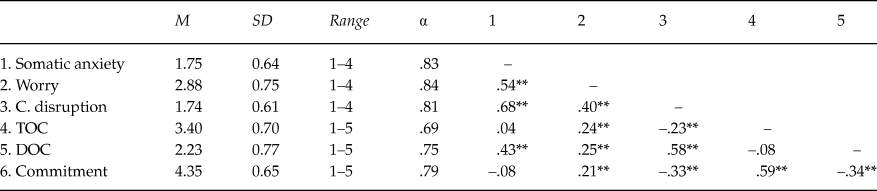
Note: “C. Disruption” refers to Concentration disruption; “TOC” refers to task-oriented coping; “DOC” refers to disengagement-oriented coping; *p < .05, **p < .001.
With the aim to evaluate a whole measurement model, we first evaluated single measurement models for each instrument. After that, we tested the full measurement model including restrictive conditions (i.e., CFA) for competitive anxiety, and commitment factors; and less-restrictive conditions (i.e., ESEM) for coping. The full measurement model achieved acceptable goodness of fit indices (see Table 2).
Fit Indexes of Measurement and Mediation Models

Note: *p < .05, **p < .001.
Mediation Model
We tested total mediation and partial mediation models (see Table 2). Both models showed goodness of fit values close to excellence. Comparison of the two models was computed using DIFTEST option in Mplus, showing significant differences, χ2(3) = 14.6; p < .05, so we opted to select the best fitting model (i.e., partial mediation model).
All statistically significant regression paths of the accepted model are presented in Figure 1. Indirect effects standard errors were computed using the delta method as bootstrapped standard errors are not available for complex data. All indirect effects are presented in Table 3. Competitive anxiety factors had a significant effect on TOC. Concentration disruption also had a positive significant effect on DOC. The coping dimensions had a differential impact on commitment. TOC showed a positive effect on commitment, and DOC showed negative effect. Finally, there was a direct effect of worry on commitment. Results suggest that coping partially mediates the relationship between worry and sport commitment.
Structural equation model of the accepted model.
Note: Continuous lines indicate positive predictions and dashed lines indicate negative relationships. * P < .05. ** P < .001.

Standardized Total and Indirect Effects for the Accepted Model.

Note: “TOC” refers to task-oriented coping; “DOC” refers to disengagement-oriented coping.
Discussion
This study assessed the mediating role of coping in the relation between competitive anxiety and sport commitment in adolescent athletes adopting the CMRT perspective. We tested two models where coping totally or partially mediated the relationship between competitive anxiety and sport commitment. Our results suggest that the partial mediation model better explained the interplay between competitive anxiety, coping and sport commitment in comparison to total mediation model. These findings support and extend previous research regarding the relation between these concepts (e.g., Kim & Duda, Reference Kim and Duda2003; Morris & Kavussanu, Reference Morris and Kavussanu2009; Ntoumanis & Biddle, Reference Ntoumanis and Biddle2000; Pons et al., Reference Pons, Ramis, Garcia-Mas, de la Llave and Perez-Llantada2016).
Previous literature found that competitive anxiety had a negative impact on adolescents’ predisposition to keep participating in sport (Morris & Kavussanu, Reference Morris and Kavussanu2009; Pons et al., Reference Pons, Ramis, Garcia-Mas, de la Llave and Perez-Llantada2016). In this study, competitive anxiety showed both positive and negative influences on sport commitment. Somatic anxiety had a weak influence on sport commitment; meanwhile cognitive anxiety components (i.e., worry and concentration disruption) showed important positive and negative influences on sport commitment. These results retake the traditional debate regarding the debilitative or facilitative role of competitive anxiety in sport competition (Jones & Swain, Reference Jones and Swain1995). Our study suggests that different components may have a positive or negative impact on sport competition. Even when competitive anxiety has traditionally been considered as detrimental, it has been suggested that anxiety may have positive effects on competition, favoring sustained effort and concertation on the task (e.g., Lazarus, Reference Lazarus2000), and helping to re-appraise it as excitement (Brooks, Reference Brooks2014).
This study suggests that, in particular, the cognitive anxiety components predict sport commitment directly and indirectly through coping. Worry showed a positive direct effect on sport commitment. Greater worry was associated with more use of TOC that enhanced levels of sport commitment. Concentration disruption on the other hand was associated with greater use of DOC and less use of TOC, which in turn lowered sport commitment. Present findings suggest that those adolescents who take direct actions (i.e., effort, thinking about possible solutions, and controlling own thoughts) to face inherent demands of the competition are more likely to keep participating within their sport. This is consistent with the postulation that TOC might be associated with more desirable outcomes (Compas, et al., Reference Compas, Connor-Smith, Saltzman, Thomsen and Wadsworth2001).
Worry had positive direct and indirect (through TOC) effects on sport commitment. This finding is not in line with previous suggestions that higher levels of worry are associated with decreased TOC (e.g., Dias, Cruz, & Fonseca, Reference Dias, Cruz and Fonseca2012) and lower sport enjoyment (Morris & Kavussanu, Reference Morris and Kavussanu2009). Although the traditional conceptualization of worry describes it as a negative element of competitive anxiety (Nideffer & Sagal, Reference Nideffer, Sagal and Williams2006), previous findings on the use of the Spanish version of the SAS–2 suggest that Worry may be conceptualized by young athletes as “a sense of responsibility regarding the task at hand” (Ramis, Viladrich, Sousa, & Jannes, Reference Ramis, Viladrich, Sousa and Jannes2015). This conceptualization links with CMRT’s primary appraisal definition (i.e., personal relevance of a situation; Lazarus, Reference Lazarus1999), and share some nuances with the concept of perfectionistic strivings (i.e., setting of very high standards of performance; Stoeber, Reference Stoeber2011). Similar to the findings of this study, recent research (Jowett, Hill, Hall, & Curran, Reference Jowett, Hill, Hall and Curran2016) found perfectionist strivings acted as enhancer of athlete engagement and as protective factor for athlete burnout. Therefore, both concepts could share some psychological processes. Future studies should investigate about the nuances of each concept and the meaning and psychological process they share.
Higher levels of concentration disruption where associated with increased use of DOC and less use of TOC which in turn reduced sport commitment. These findings are congruent with preliminary results presented by Dias et al. (Reference Dias, Cruz and Fonseca2012). Previous research has also indicated that concentration disruption may limit attentional resources available for current task processing (Allen, Jones, McCarthy, Sheehan-Mansfield, & Sheffield, Reference Allen, Jones, McCarthy, Sheehan-Mansfield and Sheffield2013). Concentration disruption may threat attentional focus on the task at hand, which would interfere with the mobilization of resources for confronting competition demands, detracting attention from relevant cues of the task (i.e., TOC) and favoring the attention on alternative cues (e.g., DOC). This process might suggest that concentration disruption and DOC share some attentional resources. This idea is congruent with previous research (e.g., Carver, Reference Carver2001) that suggest that anxiety may be useful in directing movement away from threats, by encouraging athletes to mobilize resources to achieve their goals.
From a practical perspective, our results suggest that future interventions based on coping fundamentals should focus on providing adolescent athletes with strategies to lower concentration disruption manifestations. In addition, training adolescent to use TOC might help them to deal with competitive anxiety in sport, and coaches might learn to judge athletes’ emotional expression not only by their external expression (i.e., somatic anxiety) but also for cognitive indicators. This in turn is likely to enhance sport commitment among adolescents and lower future drop-out from sport.
Some limitations and future directions of this research must be addressed. As this is a cross-sectional study, no causal inferences can be made from our results. We acknowledge that conclusions drawn here are culturally dependent. Some studies suggest differences in coping processes among cultures (e.g., oriental versus occidental; Laborde, You, Dosseville, & Salinas, Reference Laborde, You, Dosseville and Salinas2012). We also consider that coping actions are influenced by type of sport. In this study participants mainly practiced opposition sports so future studies should also consider other sports with other requirements (e.g., exhibition or repetition). Given the difficulties in conducting factorial analysis with coping (Perry, Nicholls, Clough, & Crust, Reference Perry, Nicholls, Clough and Crust2015), future studies should explore alternative approaches (e.g., Pons, Viladrich, & Ramis, Reference Pons, Viladrich and Ramis2017). Furthermore, although the SAS–2 has good psychometric properties, it would be important to further examine its functional, conceptual, and/or psychometric equivalence in different ethnic or cultural groups. This would be particularly important for the worry factor. Finally, in this study, we only selected those coping behaviors of interest for our current objectives, so we acknowledge the comparability issues with other works that used the full instrument.
Present results suggest that competitive anxiety has a relevant association with sport commitment. Specially, cognitive anxiety factors seem to differ in their influence on adolescent sport commitment. This relationship is mediated by athletes’ style of coping. Coping oriented to task issues such as increase of effort, analysis of the situation, and control of own thoughts seem to strengthen this relation in a positive way. Alternatively, coping strategies diverting attention away from the stressful events, such as venting unpleasant emotions or resignation, might negatively influence sport continuation.



