





Introduction
Posttraumatic stress disorder (PTSD) is the most serious and incapacitating mental disease that can result from trauma exposure. Traumatic events including natural disasters, accidents, sexual violence, and child abuse are common all over the world, and their mental health consequences, such as PTSD, are equally widespread. According to estimates, people experience on average about three traumatic events during their lifetime (Kessler et al., Reference Kessler, Aguilar-Gaxiola, Alonso, Benjet, Bromet, Cardoso and Koenen2017).
Although the majority of people who experience traumatic situations recover spontaneously and exhibit a normal pattern of resilience, a significant proportion of those who experience trauma do encounter psychological repercussions, such as acute stress disorder, difficult bereavement, adjustment disorder, and depression. Among these, PTSD is one of the most common. On the one hand, the lifetime worldwide prevalence of PTSD in the general population is around 5.6% (Koenen et al., Reference Koenen, Ratanatharathorn, Ng, McLaughlin, Bromet, Stein and Kessler2017). On the other, PTSD point prevalence varies widely, even when regarding a traumatic event of the same nature. For instance, the meta-analysis conducted in 2019 by Wang et al. (Reference Wang, Wu, Dai, Kaminga, Wu, Pan and Liu2019) on the development of PTSD after being exposed to hurricanes and typhoons yielded a prevalence of 17.81% (95% confidence interval [CI] 12.63–23.67), with data ranging from 1% in the study by Rubens, Vernberg, Felix, and Canino (Reference Rubens, Vernberg, Felix and Canino2013) to a peak prevalence of 62% in the study conducted by Guo et al. (Reference Guo, Tian, Wang, Guo, Gao, Jiang and Yu2016). This variability can also be observed when comparing meta-analyses concerning the same traumatic event (e.g. Dai et al., Reference Dai, Chen, Lai, Li, Wang and Liu2016; Sepahvand, Mokhtari Hashtjini, Salesi, Sahraei, & Pirzad Jahromi, Reference Sepahvand, Hashtjini, Salesi, Sahraei and Jahromi2019 reported a PTSD prevalence after earthquakes of 23.66% and 58%, respectively) and increases further when considering traumatic events of different nature (e.g. 5.02% PTSD prevalence following pregnancy and birth in Yildiz, Ayers, & Phillips, Reference Yildiz, Ayers and Phillips2017 v. 47% PTSD prevalence following war in Sepahvand et al., Reference Sepahvand, Hashtjini, Salesi, Sahraei and Jahromi2019).
Numerous psychological and economical pre- and post-traumatic factors have been proven to raise the likelihood of developing and maintaining PTSD, including personality traits, prior mental health conditions (Perrin et al., Reference Perrin, Vandeleur, Castelao, Rothen, Glaus, Vollenweider and Preisig2014), female sex (Kessler et al., Reference Kessler, Berglund, Demler, Jin, Merikangas and Walters2005; Perrin et al., Reference Perrin, Vandeleur, Castelao, Rothen, Glaus, Vollenweider and Preisig2014), country of origin and sociodemographic variables (Koenen et al., Reference Koenen, Ratanatharathorn, Ng, McLaughlin, Bromet, Stein and Kessler2017), and specific changes in gene expression (Kessler et al., Reference Kessler, Berglund, Demler, Jin, Merikangas and Walters2005; Perrin et al., Reference Perrin, Vandeleur, Castelao, Rothen, Glaus, Vollenweider and Preisig2014). The presence of multiple moderating factors influencing PTSD prevalence explains the wide gap in results between studies.
After experiencing a traumatic incident, it is common to endure some psychological distress and PTSD-related symptoms (Sayed, Iacoviello, & Charney, Reference Sayed, Iacoviello and Charney2015). However, many individuals with PTSD-related symptoms will see the majority or the totality of those symptoms completely disappear within a month, displaying trajectories of resilience and reflecting a path of natural recovery (Littleton, Axsom, & Grills-Taquechel, Reference Littleton, Axsom and Grills-Taquechel2011); in other cases, symptoms will fluctuate throughout time, including remission and re-emergence (Feder et al., Reference Feder, Mota, Salim, Rodriguez, Singh, Schaffer and Pietrzak2016; Galatzer-Levy & Bryant, Reference Galatzer-Levy and Bryant2013).
The World Mental Health Surveys (https://www.hcp.med.harvard.edu/wmh/) of the World Health Organization (World Health Organization, Reference World Health Organization2022) indicate that between 25% and 40% of PTSD-diagnosed people will recover within 12 months, with many of those cases resolving within the first 6 months (Koenen et al., Reference Koenen, Ratanatharathorn, Ng, McLaughlin, Bromet, Stein and Kessler2017). According to meta-analytic statistics (Morina, Wicherts, Lobbrecht, & Priebe, Reference Morina, Wicherts, Lobbrecht and Priebe2014; Steinert, Hofmann, Leichsenring, & Kruse, Reference Steinert, Hofmann, Leichsenring and Kruse2015), however, nearly 50% of PTSD sufferers will have a chronic condition, especially if the mental illness is not treated.
Despite the relevance of the disorder, there is still considerable confusion and debate surrounding its diagnosis. PTSD is diagnosed using criteria established by two primary systems: the Diagnostic and Statistical Manual of Mental Disorders (DSM) and the International Classification of Diseases (ICD). The DSM, published by the American Psychiatric Association, is commonly used in the United States and many other countries. The latest edition, DSM-5-TR (American Psychiatric Association, 2022), categorizes PTSD under Trauma- and Stressor-Related Disorders. It requires exposure to trauma through direct experience, witnessing, learning about a traumatic event involving a close associate, or repeated exposures to aversive details of such events. PTSD diagnosis in the DSM-5-TR includes four symptom clusters: intrusion, avoidance, negative alterations in cognitions and mood, and alterations in arousal and reactivity. Symptoms must persist for more than one month and significantly impair functioning. On the other hand, the ICD, published by the World Health Organization, is widely used globally, particularly in Europe. The latest edition, ICD-11 (World Health Organization, Reference World Health Organization2022), classifies PTSD within Mental, Behavioral, and Neurodevelopmental Disorders. It emphasizes exposure to extremely threatening or horrifying events and identifies three core symptoms: re-experiencing the traumatic event, avoidance of trauma-related thoughts and situations, and a persistent perception of heightened current threat. Symptoms should last for several weeks and cause significant distress or impairment in important areas of functioning.
While both systems have similar criteria, the DSM-5-TR includes a broader range of symptoms, especially related to cognition and mood, whereas the ICD-11 focuses on fewer core symptoms, emphasizing the perception of current threat. Moreover, a different strategy guided the revision process of the two manuals: on the one hand, the experts selected to review the DSM-IV were required to provide a strong empirical basis for each adjustment of the diagnostic criteria; on the other hand, the working group responsible for the publication of the ICD-11 based its decisions solely on a consensus among experts. Finally, the ICD-11 maintained the three symptom clusters from the DSM-4 and introduced two ‘sibling disorders’: PTSD and complex PTSD. The ICD-11 approach is debated by Friedman, Vermetten, and their respective research groups (Friedman, Schnurr, & Keane, Reference Friedman, Schnurr and Keane2021; Vermetten, Baker, Jetly, & McFarlane, Reference Vermetten, Baker, Jetly and McFarlane2016) because it excludes from the diagnostic criteria a number of symptoms that are not specific to PTSD, such as insomnia, irritability, difficulty concentrating, and social withdrawal. According to the authors, this would be inconsistent with the categorization of symptoms of other mental disorders and problematic because it could result in a deprivation of diagnosis to symptomatic individuals.
A second factor that creates significant impediment to reaching consensus between professionals consists in the choice of assessment methodology. There is now widespread agreement that diagnosing PTSD is a challenging endeavor that requires careful consideration of the person's presenting complaints, co-occurring psychological and physical issues, occupational and social functioning, as well as cultural and other contextual variables that may be associated with the presentation and progression of PTSD symptomatology (Friedman et al., Reference Friedman, Schnurr and Keane2021). As a result, a variety of methods for assessing PTSD have been developed, including structured diagnostic interviews conducted by a clinician, self-report psychological exams and questionnaires, and psychophysiological measurements. Structured and semi-structured diagnostic interviews are both common and recommended practices in research settings, but their use in clinical settings is less widespread (Keane, Buckley, & Miller, Reference Keane, Buckley and Miller2003). In general terms, this may be due to the specialized training required to conduct these interviews properly, as well as time or financial restrictions (Friedman et al., Reference Friedman, Schnurr and Keane2021). Self-report assessments are typically more affordable and less time consuming than structured interviews (Friedman et al., Reference Friedman, Schnurr and Keane2021). They can be especially helpful when conducting PTSD screenings or when used in conjunction with structured interviews to provide physicians more information and monitor treatment outcomes over time. Nevertheless, to diagnose PTSD, self-report measures should not be employed in isolation since they lack the validity and reliability of structured clinical interviews (Jablensky, Reference Jablensky2002). Due to biases in answers, misunderstandings of the patient filling in the questionnaire, and contextual variables, any self-report measure has the potential to cause significant inaccuracy (Jablensky, Reference Jablensky2002).
PTSD examination is further complicated when considering the features of the traumatic event that resulted in the disorder. Some research suggested that a person's likelihood for developing PTSD depends on the nature of stressful incident they experience (Santiago et al., Reference Santiago, Ursano, Gray, Pynoos, Spiegel, Lewis-Fernandez and Fullerton2013). Compared to other types of traumatic event exposures, sexual assault and other interpersonal trauma have been shown to have more severe and debilitating psychological effects (Breslau, Reference Breslau2009; Pietrzak, Goldstein, Southwick, & Grant, Reference Pietrzak, Goldstein, Southwick and Grant2011). Particularly, Santiago et al. (Reference Santiago, Ursano, Gray, Pynoos, Spiegel, Lewis-Fernandez and Fullerton2013) have revealed that traumatic experiences seen as non-intentional (e.g., natural disasters) are less likely to cause long-lasting symptoms of PTSD than intentional ones (e.g., assault, rape, torture, etc.). However, no studies have been conducted to date to investigate predictors or risk factors that may regulate the various trajectories of PTSD in people exposed to intentional and non-intentional exposures.
Considering the many challenges involved in assessing PTSD and the effect these have on the number of diagnoses, we conducted an umbrella review (Fusar-Poli & Radua, Reference Fusar-Poli and Radua2018; Ioannidis, Reference Ioannidis2009) to provide an estimation of the prevalence of the disorder following various types of traumatic events. More specifically, we performed an in-depth analysis to evaluate the variability in the prevalence of PTSD depending on the assessment method and the nature of the traumatic event (interpersonal v. not-interpersonal).
Method
The current umbrella review was carried out adopting the Preferred Reporting Items for Systematic Reviews and Meta-Analyses (PRISMA) guidelines (Page et al., Reference Page, McKenzie, Bossuyt, Boutron, Hoffmann, Mulrow and Moher2021) and the Joanna Briggs Institute methodology for umbrella reviews (Aromataris et al., Reference Aromataris, Fernandez, Godfrey, Holly, Khalil and Tungpunkom2014). The PRISMA flowchart (Haddaway, Page, Pritchard, & McGuinness, Reference Haddaway, Page, Pritchard and McGuinness2022) was used to represent the screening phase and the selection process. The study protocol was pre-registered with the International Prospective Register of Systematic Reviews (PROSPERO; CRD42022322800).
Search strategy
Google Scholar, EBSCO (CINAHL Complete, Psychology and Behavioral Sciences Collection, APA PsycInfo, APA PsycArticles), Web of Science, PubMed, and Galileo Discovery were searched of observational studies investigating PTSD prevalence. For each database, titles, abstracts, subject headings, and general keywords were searched with no language or time constraints. The literature search began on the 17th of March 2022, and all databases and additional sources were searched from inception until the 3rd of April 2022. Moreover, further studies were found by means of the ‘related articles’ function provided by ConnectedPapers (https://www.connectedpapers.com/) and by tracing the references from review articles and the identified papers. If two or more meta-analyses included a complete or substantial overlap in primary studies, the most recent or broader one was employed (see online Supplementary material S1 for the search strategy).
Inclusion and exclusion criteria
Studies were included in the umbrella review if they met the following inclusion criteria:
(a) Meta-analysis of individual observational studies (case-control, cohort, cross-sectional, longitudinal and ecological studies) assessing PTSD prevalence;
(b) studies considering any established diagnosis of PTSD defined by the ICD or the DSM;
(c) studies reporting PTSD prevalence after traumatic events;
(d) studies reporting sufficient data for the analyses (e.g. number of PTSD diagnoses among people exposed to the traumatic event and number of individuals who experienced the traumatic event or PTSD prevalence).
Exclusion criteria were the following:
(a) Meta-analysis that did not present study-level data with 95% CIs;
(b) systematic reviews with no quantitative analysis;
(c) reviews that incorporated theoretical studies or published opinion as their primary source of evidence.
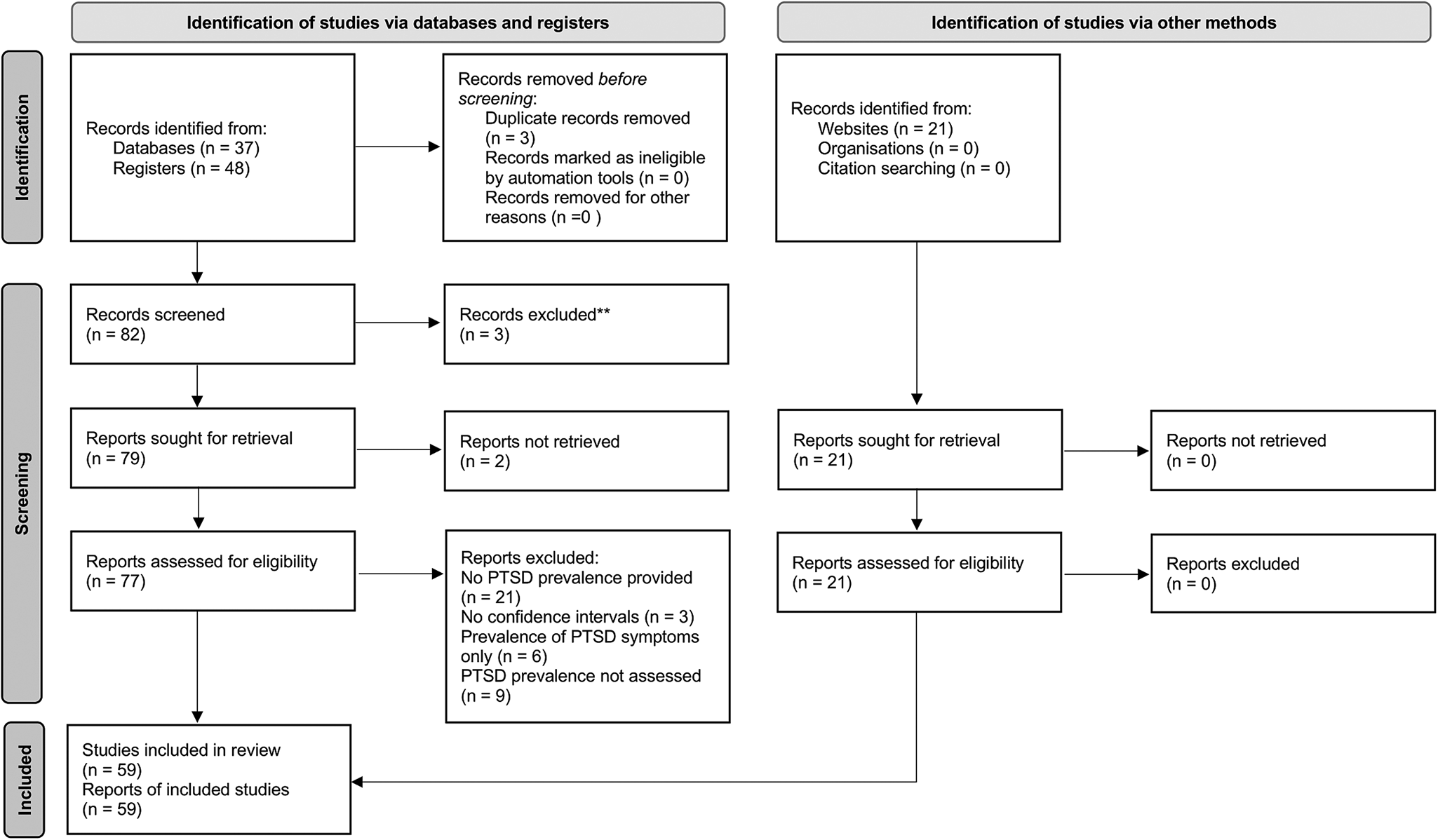
See Fig. 1 for the PRISMA flow diagram of study screening and selection.
PRISMA flowchart of literature search.
Data extraction and selection
A systematic approach was used for data extraction. Each meta-analysis was checked to ensure that it met the eligibility criteria. The following factors were then extracted and entered in an Excel table: first author and year of publication; type of traumatic event; PTSD assessment method; type of study; target population (adults, adolescents, or children); number of cases and total sample size; PTSD prevalence and corresponding 95% CI; heterogeneity; and p-value. The data extracted from the meta-analyses are reported in Table 1.
Characteristics of the meta-analyses included in the umbrella review
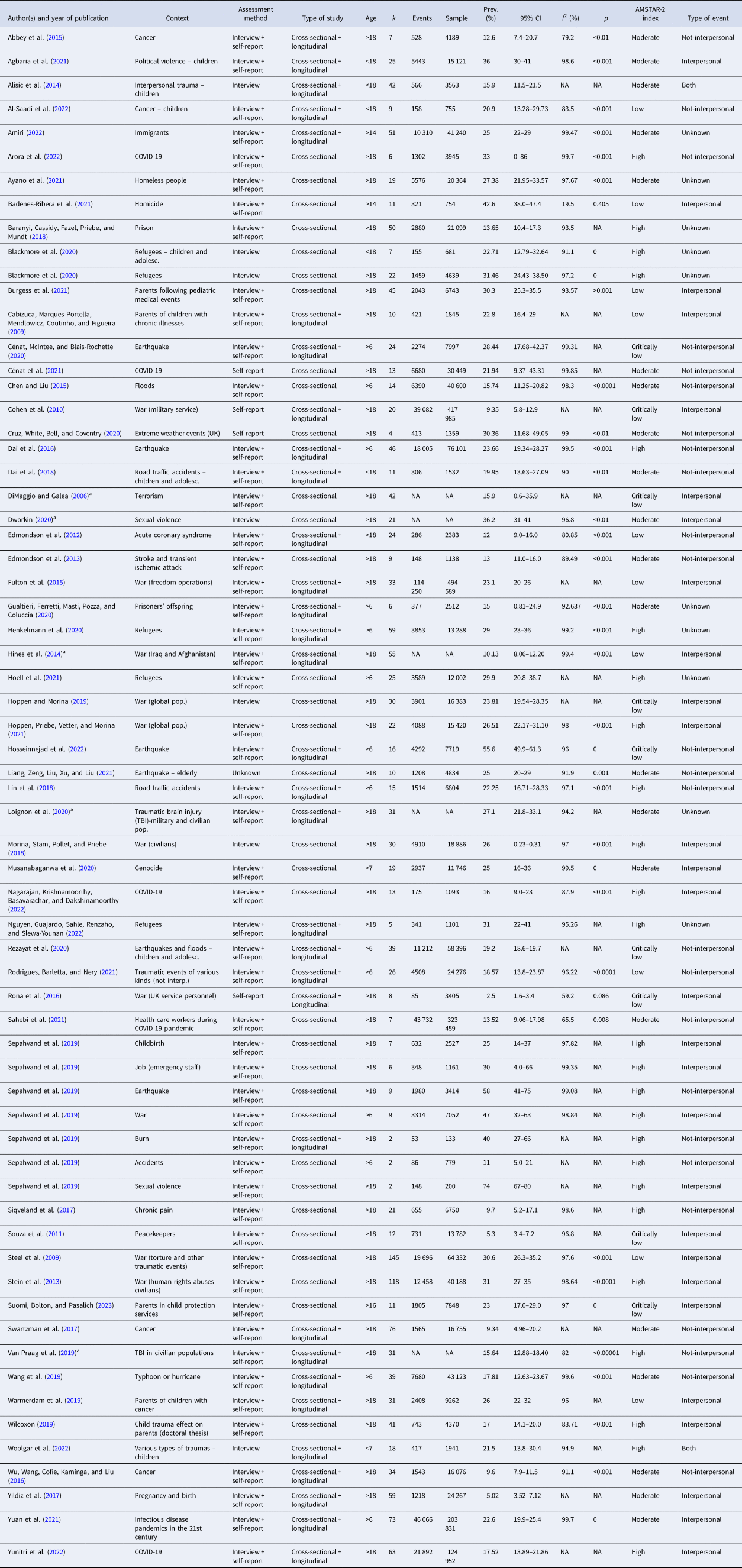
k, number of studies included in the meta-analysis; events, number of PTSD diagnoses among people exposed to the traumatic event; sample, number of people exposed to the traumatic event; CI, 95% confidence interval; I 2, heterogeneity; prev., prevalence; p, p-value; probab., probability; NA, not applicable.
a No sample size provided.
AMSTAR-2 (A Measurement Tool to Assess Systematic Reviews; Shea et al., Reference Shea, Reeves, Wells, Thuku, Hamel, Moran and Kristjansson2017), a 16-point evaluation tool assessing the methodological quality of systematic reviews and meta-analysis, was used to evaluate the quality of the included meta-analyses (for the quality assessment, see online Supplementary material S3). Test–retest reliability, content validity, and inter-rater agreement are all strong points of AMSTAR-2. The following categories served as the foundation for evaluating reviews: (a) formulation of the research question; (b) provision of an a priori design; (c) justification of the study designs of the included studies; (d) a thorough review of the literature; (e) study selection; (f) data extraction; (g) a list of excluded studies, as well as an explanation of why they were excluded; (h) thorough description of the key features of the included studies; (i) risk of bias assessment; (j) details regarding the funding sources; (k) techniques for statistically combining results; (l) assessment of the potential impact of individual study bias risk on the meta-analysis result; (m) discussion/interpretation of the potential impact of individual study bias risk on the meta-analysis result; (n) discussion of the heterogeneity seen in the study results; (o) probability of publication bias; and (p) conflict of interest disclosure for the study's authors. Seven of these 16 domains, referred to as ‘critical domains’, can have a significant impact on the validity of the assessment and its result (domains b, d, g, i, k, m, and o). There are three possible responses for each item: a full yes, a partial yes, or a no.
Although AMSTAR-2 is not meant to be scored, it does provide a method for analyzing flaws found in both critical and non-critical items: studies of ‘high-quality’ reveal no or a single non-critical weakness; studies of ‘moderate-quality’ reveal multiple non-critical flaws but no critical flaws; studies of ‘low-quality’ reveal a single critical flaw with or without non-critical weaknesses; and studies of ‘critically low quality’ reveal multiple critical flaws with or without non-critical weaknesses (Shea et al., Reference Shea, Reeves, Wells, Thuku, Hamel, Moran and Kristjansson2017).Footnote 1
Statistical analysis
Analyses were carried out using software R (R Core Team, 2020) with the packages meta (Balduzzi, Rücker, & Schwarzer, Reference Balduzzi, Rücker and Schwarzer2019), metafor (Viechtbauer, Reference Viechtbauer2010), and tidyverse (Wickham et al., Reference Wickham, Averick, Bryan, Chang, McGowan, François and Yutani2019). Due to the significant level of expected heterogeneity between reviews, a random-effects meta-analyses model was used. The outcomes were the mean PTSD prevalence with 95% CIs, heterogeneity, and p-value. Between-study heterogeneity was assessed with the I 2 metric (Ioannidis, Reference Ioannidis2009). I 2 has a range of 0% to 100%, and for values of 25%, 25–49%, 50–74%, and >75%; it is categorized as low, moderate, large, and very large, respectively (Green & Higgins, Reference Green and Higgins2009). Funnel plot and Egger tests (Egger, Smith, Schneider, & Minder, Reference Egger, Smith, Schneider and Minder1997) were carried out to address potential publication bias (Sterne et al., Reference Sterne, Sutton, Ioannidis, Terrin, Jones, Lau and Higgins2011).
According to the aims of the current work, different meta-analyses were run. First, we run an overall meta-analysis including all the papers meeting the inclusion criteria and aiming at assessing the general prevalence of PTSD. Then, deviating from the registered protocol, we run two additional meta-analyses to understand whether the results could have been influenced by: (i) the inclusion of underage (we thus repeated the analysis on adults only); (ii) the inclusion of meta-analysis with low quality (we thus repeated the analysis removing meta-analysis with low or critically low quality). Second, we run two umbrella reviews on papers where PTSD was assessed using self-report or structured interviews, in order to assess the impact of the methodology applied to determine prevalence of PTSD. Finally, we run two additional umbrella reviews on meta-analysis intentional and not intentional stressful events, in order to assess the impact of the nature of the stressful event on PTSD prevalence.
To directly compare the results of two meta-analyses (e.g., intentional v. not intentional stressful events), independent sample t tests were applied.
Results
The systematic search yielded 106 records. After duplicate removal and title and abstract screening, 77 full-text articles were retrieved. Out of them, 59 articles (including 65 meta-analyses, as one article [Sepahvand et al., Reference Sepahvand, Hashtjini, Salesi, Sahraei and Jahromi2019] consists of six studies, one for each type of traumatic event) met the inclusion criteria for umbrella review (Fig. 1).
Characteristics of the included meta-analyses
The meta-analyses included in this umbrella review had examined the prevalence of PTSD in different populations (adults n = 41, adolescents and children n = 6, heterogeneous samples n = 18) from different countries who have experienced multiple kinds of traumatic events, such as sexual violence (n = 1), natural disasters (n = 10), road traffic accidents (n = 4), illnesses that were either their own or of their loved ones (n = 16), circumstances related to armed conflicts and terrorist attacks (n = 13), immigration status (n = 6), incarceration (n = 2), murder (n = 1), etc. Thirty (46%) meta-analyses considered traumatic events of an intentional nature, 27 (42%) examined non-intentional trauma, and the final 8 (12%) examined the prevalence of PTSD in situations where the precise nature of the traumatic event could not be determined. Table 1 shows the characteristics of the 65 meta-analyses included in the present umbrella review.
All included meta-analyses, except for six (Sepahvand et al., Reference Sepahvand, Hashtjini, Salesi, Sahraei and Jahromi2019, n = 133; Sepahvand et al., Reference Sepahvand, Hashtjini, Salesi, Sahraei and Jahromi2019, n = 200; Sepahvand et al., Reference Sepahvand, Hashtjini, Salesi, Sahraei and Jahromi2019, n = 681; Badenes-Ribera, Molla-Esparza, Longobardi, Sánchez-Meca, & Fabris, Reference Badenes-Ribera, Molla-Esparza, Longobardi, Sánchez-Meca and Fabris2021, n = 754; Al-Saadi, Chan, & Al-Azri, Reference Al-Saadi, Chan and Al-Azri2022, n = 755; Sepahvand et al., Reference Sepahvand, Hashtjini, Salesi, Sahraei and Jahromi2019, n = 779), included >1000 cases, ranging from 1093 to 494 589. Of the 65 meta-analyses considered, 33 (51%) included studies with a cross-sectional research design, whereas 32 (49%) of them reported both longitudinal and cross-sectional studies. Regarding the methodologies used to evaluate PTSD, 53 (82%) of the meta-analyses included studies that used both clinical interviews and self-reports, 7 (11%) reported studies that used only interviews, 4 (6%) included studies that employed only self-report methods, and 1 (1%) did not specify the type of assessment. Furthermore, of the 65 meta-analyses, 25 (38.5%) were of high quality according to the AMSTAR-2 scoring system, 21 (32.3%) were of moderate quality, 10 (15.4%) received a low-quality rating, and 9 (13.8%) were considered of critically low quality (see Table 1).
Overall prevalence of PTSD
The overall prevalence of PTSD ranges from a low of 2.5% (95% CI 1.6–3.4) in a study on service personnel in conflict zones (Rona et al., Reference Rona, Burdett, Bull, Jones, Jones, Greenberg and Fear2016), to a high of 74% (95% CI 67–80) in a paper aimed at investigating the prevalence of PTSD following sexual violence (Sepahvand et al., Reference Sepahvand, Hashtjini, Salesi, Sahraei and Jahromi2019). Figure 2 depicts the distribution of PTSD prevalence by the category of traumatic event. The studies included in the different meta-analyses were generally found to have high levels of heterogeneity ranging from 59.2% (Aromataris et al., Reference Aromataris, Fernandez, Godfrey, Holly, Khalil and Tungpunkom2015) to 92.64% (Cénat et al., Reference Cénat, Blais-Rochette, Kokou-Kpolou, Noorishad, Mukunzi, McIntee and Labelle2021); the only exception was the study by Badenes-Ribera et al. (Reference Badenes-Ribera, Molla-Esparza, Longobardi, Sánchez-Meca and Fabris2021) on the proportion of PTSD diagnoses following the commission of homicide (42.6%; 95% CI 38.0–47.4; I 2 = 19.5%).
PTSD prevalence by type of traumatic event.

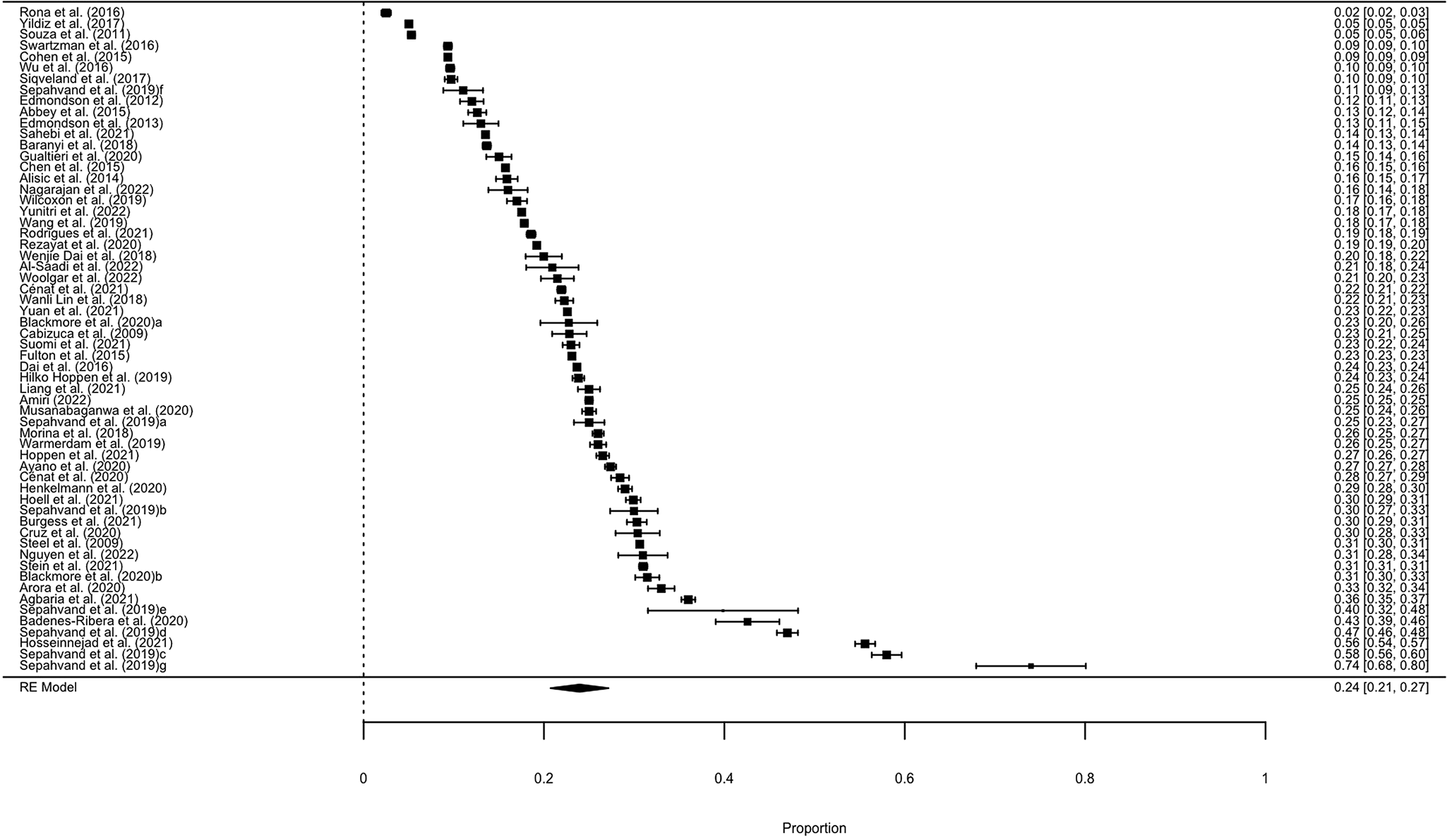
Based on the random-effects meta-analysis model, the overall prevalence of PTSD was estimated to be 23.95% (95% CI 20.74–27.15; p < 0.0001; I 2 = 99.98%; s.e. = 0.02). Five meta-analyses that lacked information on sample size and the number of PTSD diagnoses were ineligible for inclusion in the analysis (DiMaggio & Galea, Reference DiMaggio and Galea2006; Dworkin, Reference Dworkin2020; Hines, Sundin, Rona, Wessely, & Fear, Reference Hines, Sundin, Rona, Wessely and Fear2014; Loignon, Ouellet, & Belleville, Reference Loignon, Ouellet and Belleville2020; Van Praag, Cnossen, Polinder, Wilson, & Maas, Reference Van Praag, Cnossen, Polinder, Wilson and Maas2019). The forest plot (see Fig. 3) illustrates both the PTSD prevalence from each meta-analysis and the overall prevalence. There was no evidence of publication bias or significant small-study effects, as suggested by the visual inspection of the funnel plot (see online Supplementary material S2) and by the Egger test, which was not statistically significant (p = 0.19).
Forest plot with the outcome of the umbrella review on PTSD prevalence.
Repeating the analysis on studies including an adult only sample did not change the results, with a total prevalence of PTSD of 23.03% (95% CI 18.58–27.48, p < 0.0001; I 2 = 99.98%; s.e. = 0.02). The meta-meta-analysis carried out only on studies with high quality yielded a prevalence of PTSD of 24.26% (95% CI 20.46–28.06, p < 0.0001; I 2 = 99.97%; s.e. = 0.04), while the analysis performed on studies with low or critically low quality resulted in a PTSD prevalence of 23.16% (95% CI 17.02–29.30, p < 0.0001; I 2 = 99.98%; s.e. = 0.06). A two-sample t test was performed, and these results proved not to be statistically significantly different (p = 0.75).
Prevalence of PTSD using structured clinical interviews v. self-report measures
To clarify whether the PTSD prevalence depends on the method of assessment used, a comparison of 16 meta-analyses that included both studies using structured clinical interviews and studies employing self-report instruments for the evaluation of PTSD following the same traumatic experience was conducted. The results are displayed in Fig. 4. In 13 out of 16 meta-analyses, the use of structured clinical interview led to lower PTSD prevalence than the use of self-report instruments (Abbey, Thompson, Hickish, & Heathcote, Reference Abbey, Thompson, Hickish and Heathcote2015; Ayano, Belete, Duko, Tsegay, & Dachew, Reference Ayano, Belete, Duko, Tsegay and Dachew2021; Burgess, Wilcoxon, Rushworth, & Meiser-Stedman, Reference Burgess, Wilcoxon, Rushworth and Meiser-Stedman2021; Dai et al., Reference Dai, Liu, Kaminga, Deng, Lai and Wen2018; Edmondson et al., Reference Edmondson, Richardson, Falzon, Davidson, Mills and Neria2012, Reference Edmondson, Richardson, Fausett, Falzon, Howard and Kronish2013; Henkelmann et al., Reference Henkelmann, de Best, Deckers, Jensen, Shahab, Elzinga and Molendijk2020; Hoell et al., Reference Hoell, Kourmpeli, Salize, Heinz, Padberg, Habel and Bajbouj2021; Siqveland, Hussain, Lindstrøm, Ruud, & Hauff, Reference Siqveland, Hussain, Lindstrøm, Ruud and Hauff2017; Steel et al., Reference Steel, Chey, Silove, Marnane, Bryant and van Ommeren2009; Stein et al., Reference Stein, Koenen, Friedman, Hill, McLaughlin, Petukhova and Kessler2013; Swartzman, Booth, Munro, & Sani, Reference Swartzman, Booth, Munro and Sani2017; Wilcoxon, Reference Wilcoxon2019), and this difference was found to be statistically significant in nine studies (Ayano et al., Reference Ayano, Belete, Duko, Tsegay and Dachew2021; Dai et al., Reference Dai, Liu, Kaminga, Deng, Lai and Wen2018; Edmondson et al., Reference Edmondson, Richardson, Falzon, Davidson, Mills and Neria2012, Reference Edmondson, Richardson, Fausett, Falzon, Howard and Kronish2013; Siqveland et al., Reference Siqveland, Hussain, Lindstrøm, Ruud and Hauff2017; Steel et al., Reference Steel, Chey, Silove, Marnane, Bryant and van Ommeren2009; Stein et al., Reference Stein, Koenen, Friedman, Hill, McLaughlin, Petukhova and Kessler2013; Swartzman et al., Reference Swartzman, Booth, Munro and Sani2017; Wilcoxon, Reference Wilcoxon2019). Regarding the remaining three meta-analyses (Agbaria et al., Reference Agbaria, Petzold, Deckert, Henschke, Veronese, Dambach and Winkler2021; Hosseinnejad et al., Reference Hosseinnejad, Yazdi-Feyzabadi, Hajebi, Bahramnejad, Baneshi, Ershad Sarabi and Zolala2022; Lin, Gong, Xia, & Dai, Reference Lin, Gong, Xia and Dai2018), two found no difference in the prevalence of PTSD based on the assessment method (Agbaria et al., Reference Agbaria, Petzold, Deckert, Henschke, Veronese, Dambach and Winkler2021; Hosseinnejad et al., Reference Hosseinnejad, Yazdi-Feyzabadi, Hajebi, Bahramnejad, Baneshi, Ershad Sarabi and Zolala2022), whereas one reported a statistically significant opposite finding (Lin et al., Reference Lin, Gong, Xia and Dai2018).
PTSD prevalence by assessment method.
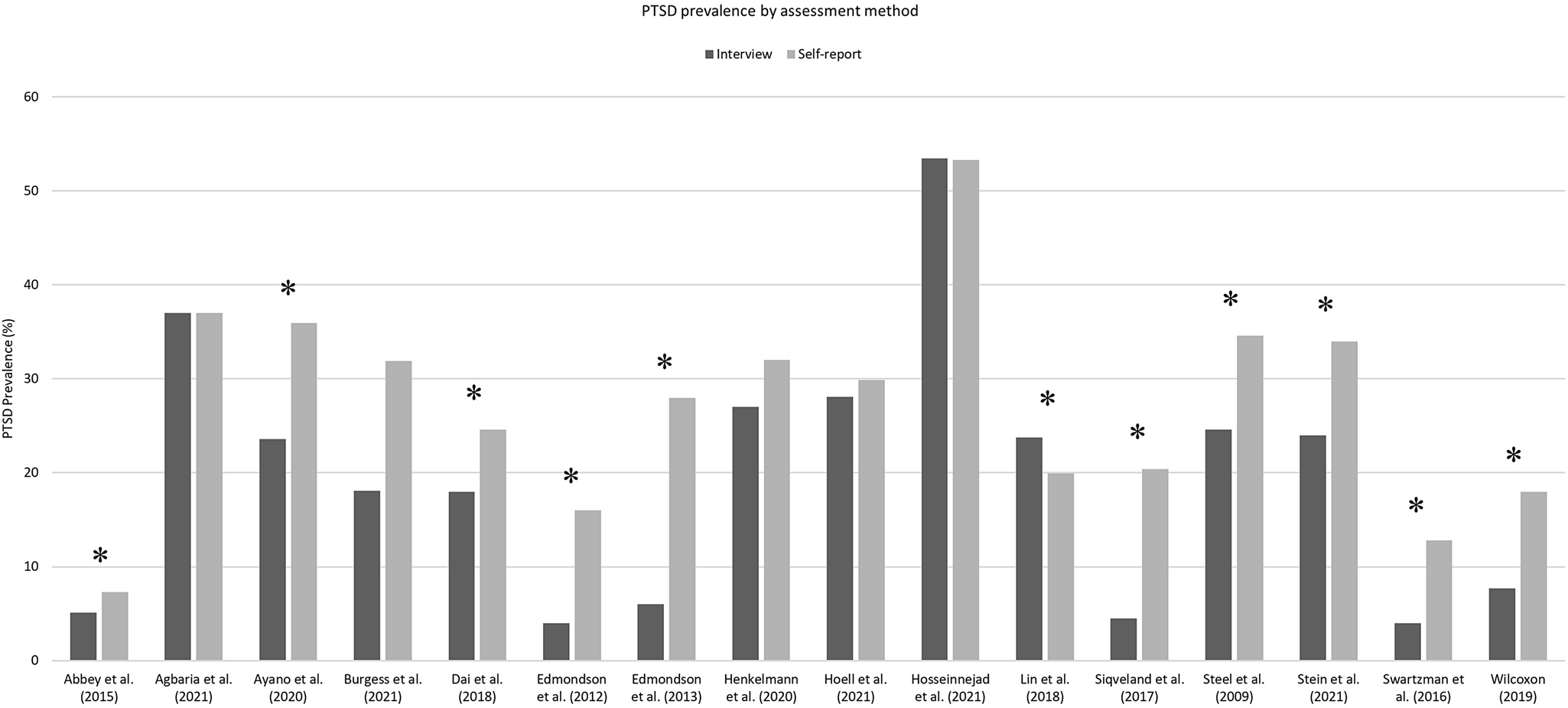
In addition to this qualitative comparison, we performed a two-sample t test to compare the prevalence of PTSD related to the use of these different assessment methods, which proved not to be statistically significantly different (p = 0.08).
Prevalence of PTSD after intentional v. non-intentional events
The meta-meta-analysis conducted on studies evaluating intentional traumatic events (n = 25) revealed a PTSD prevalence of 25.42% (95% CI 19.76–31.09; p < 0.001; I 2 = 99.99%, s.e. = 0.03). A lower PTSD prevalence 22.48% (95% CI 17.22–27.73; p < 0.001; I 2 = 99.96%, s.e. = 0.03) was found in the analysis conducted on studies assessing non-intentional traumatic event (n = 24). However, this difference in the prevalence of PTSD was found not to be statistically significant (p = 0.46). Therefore, the results of the studies conducted by Breslau, Pietrzak, and their respective research teams (Breslau, Reference Breslau2009; Pietrzak et al., Reference Pietrzak, Goldstein, Southwick and Grant2011) were not replicated.
Discussion
The main purpose of this umbrella review was to provide an estimation of PTSD prevalence and clarify whether the prevalence changes depending on the assessment method used and the nature of the traumatic event. The overall PTSD prevalence amounted to 23.95% with a high level of heterogeneity between the meta-analyses. Variability in prevalence rates can be attributed to different factors and their interactions. The methodological differences between the meta-analyses and the studies contained in them, including small samples and sampling methods, the nature and severity of the traumatic event, the composition of the afflicted, the diagnostic method selected, the number of stressful events already experienced by individuals, and so on, might have impacted the heterogeneity of prevalence estimates. The main results of the umbrella review are not influenced by the quality of the meta-analysis included, highlighting the robustness and consistency of the results.
The results are not influenced by the kind of population (adults v. children) included, despite scientific community previously suggested that children and adolescents typically exhibit a lower prevalence of PTSD following exposure to traumatic events compared to adults (Cohen, Issues, & Issues, Reference Cohen, Issues and Issues2010; Copeland, Keeler, Angold, & Costello, Reference Copeland, Keeler, Angold and Costello2007; McLaughlin et al., Reference McLaughlin, Koenen, Hill, Petukhova, Sampson, Zaslavsky and Kessler2013; Tedeschi & Billick, Reference Tedeschi and Billick2017; Van der Kolk, Reference Van der Kolk2003). However, it is essential to acknowledge that this apparent discrepancy in rates might be attributed to the lack of developmentally informed diagnostic criteria (Tedeschi & Billick, Reference Tedeschi and Billick2017). Furthermore, a growing body of evidence supports a multifactorial etiology for the development of PTSD in children, which appears to be even more complex than in adults. This comprehensive framework incorporates a combination of neurobiological, psychological, social, and genetic factors. Among the numerous components modulating the pathogenesis of PTSD in youth, three key factors have been consistently identified in multiple studies: the severity and nature of trauma exposure, levels of parental distress, and the duration of trauma exposure, sometimes acting as protective factors (Foy, Madvig, Pynoos, & Camilleri, Reference Foy, Madvig, Pynoos and Camilleri1996; Tedeschi & Billick, Reference Tedeschi and Billick2017).
The investigation of PTSD prevalence based on the assessment method revealed interesting findings. While on the one hand, the quantitative comparison of the prevalence of PTSD by applying different assessment methods did not yield significant results; on the other hand, from the qualitative comparison it was discovered that, overall, the use of structured clinical interview results in a lower prevalence of PTSD than the use of self-report instruments after considering 16 meta-analyses of studies that had used both clinical interviews and self-report instruments to evaluate disorder prevalence following exposure to traumatic events of the same nature. This difference was found to be statistically significant in 9 out of 16 studies. Regarding the remaining meta-analyses, two studies showed no statistical difference in terms of the choice of assessment method, whereas the last one reported the opposite result, showing a lower prevalence following the use of self-report measures. The outcome of the qualitative comparison is in agreement with previous studies, which confirm that the prevalence of psychiatric disorders is often higher when measured with self-report instruments than when clinical interviews are conducted (Edmondson et al., Reference Edmondson, Richardson, Fausett, Falzon, Howard and Kronish2013). Indeed, although the use of questionnaire-based screening instruments is preferred by many practitioners for clinical settings due to the ease and velocity of administration, low cost, and wide availability in many languages, it is well known that there is considerable variation in sensitivity – the ability of the test to accurately recognize as positive those who present with the disorder (PTSD in this case) – and specificity – the ability of the test to correctly identify as negative those who do not present with the disorder – between diagnostic and screening instruments used to estimate the prevalence of PTSD (Ayano et al., Reference Ayano, Belete, Duko, Tsegay and Dachew2021). Specifically, as questionnaires are often constructed for screening purposes, they provide cut-offs for the likely diagnosis of PTSD biased toward sensitivity rather than specificity (Siqveland et al., Reference Siqveland, Hussain, Lindstrøm, Ruud and Hauff2017; Terhakopian, Sinaii, Engel, Schnurr, & Hoge, Reference Terhakopian, Sinaii, Engel, Schnurr and Hoge2008). This is related to the fact that, as suggested by Henkelmann et al. (Reference Henkelmann, de Best, Deckers, Jensen, Shahab, Elzinga and Molendijk2020), self-report measures only provide the caseness of a mental disorder (i.e. a screening condition qualifying for thorough clinical assessment), whereas clinical interviews provide a formal diagnosis. This supports the perspective, shared by researchers such as Swartzman et al. (Reference Swartzman, Booth, Munro and Sani2017), that self-report measures, despite potentially effective indicators of symptomatology, should be used with caution as diagnostic tools. Regarding the opposite results recorded in a study conducted by Lin's (Lin et al., Reference Lin, Gong, Xia and Dai2018) research group, the discrepancy might be attributed to the different origins of the samples taken into consideration by the individual studies. In particular, the studies that had employed structured interviews were more likely to recruit participants in clinical sites with more serious injuries, whereas the studies that had employed self-report questionnaires were more likely to recruit participants in population-based sites with moderate injuries. Finally, with respect to the meta-analyses in which no difference was recorded on the prevalence of PTSD based on the selection of evaluation technique, the inconsistency of the results with those of previous similar studies could be due to the imbalance in the proportion of studies that had used clinical interviews v. those that had used self-report instruments.
In terms of the traumatic event's nature, the meta-meta-analysis on intentional events yielded a PTSD prevalence of 25.42%, while the prevalence of PTSD following non-intentional events was found to be slightly lower (22.48%), resulting in not statistically difference. This outcome is not in line with earlier research that demonstrated that sexual violence and other intentional traumas had more severe and incapacitating psychological effects than exposure to non-intentional traumatic events (Breslau, Reference Breslau2009; Pietrzak et al., Reference Pietrzak, Goldstein, Southwick and Grant2011; Santiago et al., Reference Santiago, Ursano, Gray, Pynoos, Spiegel, Lewis-Fernandez and Fullerton2013). However, both Santiago et al.'s (Reference Santiago, Ursano, Gray, Pynoos, Spiegel, Lewis-Fernandez and Fullerton2013) and North, Oliver, and Pandya's (Reference North, Oliver and Pandya2012) studies showed that, when controlling for the conditions prior to the traumatic events and the characteristics of the sample, the highlighted differences were no longer present. This suggests that the variation in PTSD prevalence observed when comparing intentional and non-intentional events may be primarily due to population characteristics and contextual issues (e.g., socio-economic factors, occupation, cultural differences, and available resources) and not to an actual different effect of the distinct types of traumatic events on disorder phenomenology. The lack of replication of these results might be due to the difficulty in distinguishing between the interpersonal and non-interpersonal components of specific events. For example, an individual who develops PTSD following a natural disaster may both have been in mortal danger or sustained injuries (natural or non-interpersonal component) as well as suffered the loss of a loved one (interpersonal component). Similarly, individuals diagnosed with PTSD because of being exposed to COVID-19 virus may have developed the disorder in response to one or a combination of several factors, such as fear for their safety, grief caused by the illness or death of a loved one, and forced isolation due to government restrictions and/or contagiousness.
This umbrella review is not free from drawbacks. First, our search was restricted to few datasets, thus some meta-analysis meeting the inclusion criteria could have been missed. Second, our main analyses include a heterogeneous sample of adults and underage individuals and, given the low number of papers presenting data on children only, a direct comparison of PTSD prevalence between adults and children was not performed. However, repeating the main analysis on previous meta-analysis including adults only, the results did not change, thus we are confident that the results here reported are reliable. Third, we did not evaluate the individual studies that were part of the meta-analyses in terms of their quality (since it fell outside the scope of the umbrella review). Fourth, the 29.2% of the meta-analyses that met our inclusion criteria fell within the low or critically low score at the quality evaluation. However, we found that excluding meta-analysis with low quality did not significantly impact the results, thus increasing our confidence on results reliability. Finally, the results obtained suffer from a very high heterogeneity, and their interpretation should thus be extremely cautious.
Conclusion
Through this umbrella review, we have examined the prevalence of PTSD following diverse traumatic events and assessed the impact of different assessment methods, laying a strong foundation for future research, PTSD assessment, and diagnosis evaluations. Future studies on this topic should delve deeper into understanding how each predictor and risk factor influence PTSD prevalence. Novel data and methodologies that account for confounding variables are essential to comprehensively determine whether the disorder's prevalence varies based on sample age (children v. adults) and the type of traumatic event (intentional v. non-intentional).
Finally, it is vital to convert evidence-based insights into updated diagnostic guidelines widely accepted by the scientific community. Precise assessment criteria and systematic investigation protocols should be established to evaluate the disease across various contexts effectively. This concerted effort will improve our ability to diagnose and treat PTSD accurately and tailor interventions more effectively to individual needs.
Supplementary material
The supplementary material for this article can be found at https://doi.org/10.1017/S0033291724002319.
Funding statement
This research received no specific grant from any funding agency, commercial, or not-for-profit sectors.
Competing interests
None.


 Open access

