




1. Introduction
A graph $G$
is called Rank-Ramsey if both its clique number and the rank of its complement are small.Footnote
1
Rank-Ramsey graphs are clearly Ramsey graphs, because
$G$
is called Rank-Ramsey if both its clique number and the rank of its complement are small.Footnote
1
Rank-Ramsey graphs are clearly Ramsey graphs, because $\alpha (G) \leqslant {\textrm {rank}}(\overline {G})$
holds for every graph
$\alpha (G) \leqslant {\textrm {rank}}(\overline {G})$
holds for every graph $G$
. Indeed, an independent set in
$G$
. Indeed, an independent set in $G$
corresponds to a clique in its complement, which has full rank. So, what changes when we replace the traditional independence number
$G$
corresponds to a clique in its complement, which has full rank. So, what changes when we replace the traditional independence number $\alpha (G)$
, with the complement rank?
$\alpha (G)$
, with the complement rank?
This new notion originates in our long-lasting failure to understand the structure of low-rank matrices. The most ambitious attempt at this mystery is the famous log-rank conjecture [Reference Lovász and Saks46] from communication complexity, which attempts to characterise low-rank binary matrices. This conjecture (some would call it a problem) posits, in a form due to Nisan and Wigderson [Reference Nisan and Wigderson50], that any low-rank binary matrix must contain a large monochromatic minor. An equivalent graph-theoretic formulation of this problem, due to Lovász and Saks (also in [Reference Nisan and Wigderson50]), asks whether there exists an absolute constant $c$
such that:
$c$
such that:
 \begin{equation*} \log \chi (G) \leqslant \mathcal{O} \left ( \log ^c {\textrm {rank}}(G) \right ), \end{equation*}
for every graph $G$
. Here
$G$
. Here $\chi (G)$
is the chromatic number of
$\chi (G)$
is the chromatic number of $G$
.
$G$
.
Constructions of Rank-Ramsey graphs as well as impossibility results are deeply connected to the log-rank conjecture, as first suggested in [Reference Lee and Shraibman47]. As we show here, any construction of Rank-Ramsey graphs yields a separation in the log-rank conjecture, and conversely, under certain conditions, proving the impossibility of such graphs may validate the conjecture. We elaborate on this connection in Section 3.
The difficulty of characterising low-rank matrices is profound. Even understanding typical low-rank matrices is a mystery. Indeed, culminating 60 years of excellent research, Tikhomirov [Reference Tikhomirov56] showed that an $n\times n$
matrix with random
$n\times n$
matrix with random $\pm 1$
entries is singular with probability
$\pm 1$
entries is singular with probability $(\frac {1}{2}+o_n(1))^n$
, which is clearly tight up to the little-oh term. There is a rich literature of theorems of the same vein, showing that full-rank matrices are the rule rather than the exception.
$(\frac {1}{2}+o_n(1))^n$
, which is clearly tight up to the little-oh term. There is a rich literature of theorems of the same vein, showing that full-rank matrices are the rule rather than the exception.
Random constructions are key to the study of Ramsey numbers. Already over 75 years ago, Erdős [Reference Erdös21] discovered that asymptotically almost all graphs are Ramsey. In contrast, random graphs typically have logarithmic independence number, but full complement rank. This poses new non-trivial challenges in the construction of Rank-Ramsey graphs and in understanding the range of possible values. We also consider two of the most interesting and deep constructions of Ramsey Graphs [Reference Alon3, Reference Codenotti, Pudlák and Resta15], and both appear of little value in the study of Rank-Ramsey graphs.
As mentioned, our basic definition hinges on the observation that the submatrix that corresponds to an independent set in $G$
has full complement rank. Such an interplay between cardinality (here, of independent sets in
$G$
has full complement rank. Such an interplay between cardinality (here, of independent sets in $G$
) and rank (of the corresponding submatrix in the adjacency matrix of
$G$
) and rank (of the corresponding submatrix in the adjacency matrix of $\overline {G}$
) is an old and fundamental theme in combinatorics. Babai and Frankl exhibit in their book [Reference Babai and Frankl6] numerous fascinating examples of proofs that compare between cardinality and rank. Typically, one proves a desired lower bound on the cardinality of a set by showing that a certain associated matrix has large rank. The historically oldest example known to us of this method is Hanani’s proof [Reference Hanani32] of the de Bruijn-Erdős Theorem.Footnote
2
It is interesting to note that in contrast with such classical proofs, in the study of the Rank-Ramsey problem, rank bounds cardinality from above.
$\overline {G}$
) is an old and fundamental theme in combinatorics. Babai and Frankl exhibit in their book [Reference Babai and Frankl6] numerous fascinating examples of proofs that compare between cardinality and rank. Typically, one proves a desired lower bound on the cardinality of a set by showing that a certain associated matrix has large rank. The historically oldest example known to us of this method is Hanani’s proof [Reference Hanani32] of the de Bruijn-Erdős Theorem.Footnote
2
It is interesting to note that in contrast with such classical proofs, in the study of the Rank-Ramsey problem, rank bounds cardinality from above.
Our results. We first present some constructions of Rank-Ramsey graphs. As mentioned, using the probabilistic method to this end is not an option, since we lack a natural distribution over low-rank matrices. In this view, we opt for explicit constructions of Rank-Ramsey graphs, yet relying at times on some probabilistic machinery. We begin with two constructions of Rank-Ramsey graphs exhibiting a polynomial separation between complement rank and order.
We need to introduce some notation first. We consider the least complement rank of an $n$
-vertex graph whose clique number is at most
$n$
-vertex graph whose clique number is at most $d$
.Footnote
3
$d$
.Footnote
3
Definition.
For every positive $d$
, let
$d$
, let $\nu _d\,:\, \mathbb{N} \to {\mathbb{N}}$
be the function
$\nu _d\,:\, \mathbb{N} \to {\mathbb{N}}$
be the function
 \begin{equation*} \nu _d(n) {\,:\!=\,} \min _{G} {\textrm {rank}}( A_G + I ) \end{equation*}
minimising over all $n$
-vertex graphs
$n$
-vertex graphs $G$
with clique number
$G$
with clique number $\leqslant d$
.
$\leqslant d$
.
As a brief illustration, note that $\nu _d(n) \leqslant \lfloor n/d \rfloor$
: Take the disjoint union of
$\nu _d(n) \leqslant \lfloor n/d \rfloor$
: Take the disjoint union of $\lfloor n/d \rfloor$
cliques
$\lfloor n/d \rfloor$
cliques $K_d$
(and a clique on the remaining
$K_d$
(and a clique on the remaining $n \pmod d$
vertices). Notwithstanding the simplicity of this inequality, it is not easy to beat. In particular, no graph with fewer than
$n \pmod d$
vertices). Notwithstanding the simplicity of this inequality, it is not easy to beat. In particular, no graph with fewer than $10$
vertices can accomplish this.
$10$
vertices can accomplish this.
With this notation, here is our first result:
Theorem 1.1. The following bounds hold:
-
1. $\nu _{41}(n) = \mathcal{O} ( n^{1 - \frac {1}{10000}} )$
.
$\nu _{41}(n) = \mathcal{O} ( n^{1 - \frac {1}{10000}} )$
. -
2. For any sufficiently large
$d$
, there holds
$\nu _d(n) = \mathcal{O} \left ( n^{\log _{296} (232)} \right )$
, where
$\log _{296} (232) \approx 0.957$
.




The proof of Theorem1.1 starts with a base-graph, that beats the above trivial bound. We then take repeated strong products of this graph, to amplify its already low complement rank, and show that one can find a large subgraph of the product, with no cliques above a certain size. The search for a base-graph turns out to be challenging. To this end, we turn to strongly-regular graphs (SRGs): Highly-structured regular graphs with only three distinct eigenvalues, one of which, the Perron eigenvalue, is simple.
A particularly good base-graph would have both low complement rank and small clique number, say, be triangle-free. However, we encounter two immediate barriers. Only seven triangle-free strongly regular graphs are known: $C_5$
, Petersen, Clebsch, Hoffman-Singleton, Gewirtz, Mesner, and the Higman-Sims graph. Whether this list is exhaustive or not is a famous open question (Cf. [Reference Biggs8, Reference Brouwer and Haemers7]). Moreover, another problem arises. We show that triangle-free SRGs must have full complement rank.
$C_5$
, Petersen, Clebsch, Hoffman-Singleton, Gewirtz, Mesner, and the Higman-Sims graph. Whether this list is exhaustive or not is a famous open question (Cf. [Reference Biggs8, Reference Brouwer and Haemers7]). Moreover, another problem arises. We show that triangle-free SRGs must have full complement rank.
To handle these difficulties, we use a ‘clique tensoring trick’, allowing us to produce new graphs with low complement rank from graphs whose spectrum has certain properties, while retaining the clique number. Among the aforementioned list of triangle-free SRGs, a unique good candidate emerges: the Clebsch graph (and for $K_4$
-free, the complement of the Schläfli graph). To our knowledge this is at least the second time the Clebsch graph had appeared in the context of Ramsey theory, the first being the proof of the multicolour Ramsey number,
$K_4$
-free, the complement of the Schläfli graph). To our knowledge this is at least the second time the Clebsch graph had appeared in the context of Ramsey theory, the first being the proof of the multicolour Ramsey number, $R(3,3,3)=17$
, due to Greenwood and Gleason [Reference Greenwood and Gleason25].
$R(3,3,3)=17$
, due to Greenwood and Gleason [Reference Greenwood and Gleason25].
Our second result is another construction of a Rank-Ramsey family.
Theorem 1.2.
For any two constants $c, \varepsilon \gt 0$
with
$c, \varepsilon \gt 0$
with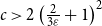 $c \gt 2 \left (\frac {2}{3\varepsilon }+1\right )^2$
, there holds
$c \gt 2 \left (\frac {2}{3\varepsilon }+1\right )^2$
, there holds $ \nu _{ c \log n}(n) \leqslant \widetilde {\mathcal{O}} (n^{\frac {2}{3} + \varepsilon } )$
.
$ \nu _{ c \log n}(n) \leqslant \widetilde {\mathcal{O}} (n^{\frac {2}{3} + \varepsilon } )$
.
The graphs in this second family have complement rank near $\mathcal{O}(n^{2/3})$
, and logarithmic clique number. One can take, e.g.,
$\mathcal{O}(n^{2/3})$
, and logarithmic clique number. One can take, e.g., $\varepsilon =10^{-3}$
and
$\varepsilon =10^{-3}$
and $c=10^6$
.
$c=10^6$
.
A key component in the proof of Theorem1.2 is a matrix-theoretic view of lifts that we adopt. As we elaborate below (Subsection 2.1) lifting is a well-established proof technique in the field of communication complexity. However, we apply it a little differently than usual, and consider the composition of a Boolean function $f\,:\, \{0,1\}^n \to \{0,1\}$
, and a collection of binary matrices, not necessarily all identical. We show a fundamental connection between the expansion of
$f\,:\, \{0,1\}^n \to \{0,1\}$
, and a collection of binary matrices, not necessarily all identical. We show a fundamental connection between the expansion of $f$
as a real multilinear polynomial, and the resulting lifted matrix. This implies a lifting theorem of-sorts: The rank of the lifted matrix is determined by the expansion of
$f$
as a real multilinear polynomial, and the resulting lifted matrix. This implies a lifting theorem of-sorts: The rank of the lifted matrix is determined by the expansion of $f$
, and by the ranks of its constituent matrices.
$f$
, and by the ranks of its constituent matrices.
The Boolean function used in Theorem1.2 is the well-known $\textrm {NAE}\,:\, \{0,1\}^3 \to \{0,1\}$
. This function appeared first in the context of the log-rank conjecture in Nisan and Wigderson’s seminal paper [Reference Nisan and Wigderson50]. The vertices of the lifted graph can be naturally identified with the points of the cube,
$\textrm {NAE}\,:\, \{0,1\}^3 \to \{0,1\}$
. This function appeared first in the context of the log-rank conjecture in Nisan and Wigderson’s seminal paper [Reference Nisan and Wigderson50]. The vertices of the lifted graph can be naturally identified with the points of the cube, $[k]^3$
. We show that within this graph, cliques emerge either (i) From correlations between the lifted matrices, or (ii) From certain degenerate subsets of the cube. The former case is handled by lifting three i.i.d. Erdős-Rényi graphs. The latter issue is dealt with by means of a probabilistic argument. We apply a random construction to find a large subset
$[k]^3$
. We show that within this graph, cliques emerge either (i) From correlations between the lifted matrices, or (ii) From certain degenerate subsets of the cube. The former case is handled by lifting three i.i.d. Erdős-Rényi graphs. The latter issue is dealt with by means of a probabilistic argument. We apply a random construction to find a large subset $S$
of the cube, such that every subset
$S$
of the cube, such that every subset $T \subset S$
of a certain size, is far from ‘cube-like’. That is,
$T \subset S$
of a certain size, is far from ‘cube-like’. That is, $T$
has some axis-projection of size linear in its cardinality. Our lifts are unorthodox in two ways. Firstly, all gadgets (i.e., matrices) are distinct, and in fact, uncorrelated. Secondly, the traditional roles are reversed; the function has constant size, while the gadgets grow asymptotically.
$T$
has some axis-projection of size linear in its cardinality. Our lifts are unorthodox in two ways. Firstly, all gadgets (i.e., matrices) are distinct, and in fact, uncorrelated. Secondly, the traditional roles are reversed; the function has constant size, while the gadgets grow asymptotically.
To present our third result, we require yet another bit of notation. As usual, the Ramsey number $R(s,t)$
is the least number
$R(s,t)$
is the least number $n$
such that every
$n$
such that every $n$
-vertex graph has either an
$n$
-vertex graph has either an $s$
-clique or a
$s$
-clique or a $t$
-anticlique. Extending the analogy, we define the ‘KRamsey’ numbers.Footnote
4
$t$
-anticlique. Extending the analogy, we define the ‘KRamsey’ numbers.Footnote
4
Definition. $R^k(s,t)$
is the least number
$R^k(s,t)$
is the least number $n$
such that every order-
$n$
such that every order- $n$
graph
$n$
graph $G$
has either an
$G$
has either an $s$
-clique, or
$s$
-clique, or
 \begin{equation*} {\textrm {rank}}(A_G + I) \geqslant t. \end{equation*}
We characterise the KRamsey numbers, when the rank is small.
Theorem 1.3.
For $2 \leqslant t \leqslant 5$
and every
$2 \leqslant t \leqslant 5$
and every $s \gt 1$
, there holds
$s \gt 1$
, there holds $R^k(s, t) = (s-1)(t-1) + 1$
.
$R^k(s, t) = (s-1)(t-1) + 1$
.
Unlike the classical Ramsey numbers, KRamsey numbers are not symmetric in their parameters: it is much harder to keep the rank low than it is to avoid large cliques. Indeed, the triangle-free base-graphs used in Theorem1.1, together with the characterisation of Theorem1.3, imply that $R^k(3,n) \gt R^k(n,3)$
for every sufficiently large
$R^k(3,n) \gt R^k(n,3)$
for every sufficiently large $n$
. Also, it is not hard to see that
$n$
. Also, it is not hard to see that $(s-1)(t-1) \lt R^k(s,t) \leqslant R(s,t)$
for every
$(s-1)(t-1) \lt R^k(s,t) \leqslant R(s,t)$
for every $s$
and
$s$
and $t$
. Another stark contrast is, therefore, that while Ramsey numbers always strictly exceed this trivial bound (whenever
$t$
. Another stark contrast is, therefore, that while Ramsey numbers always strictly exceed this trivial bound (whenever $s,t \gt 2$
), for KRamsey numbers this is evidently untrue.
$s,t \gt 2$
), for KRamsey numbers this is evidently untrue.
The proof of Theorem1.3 relies on blowup of graphs, where vertices are replaced with anticliques and edges by complete bipartite graphs. We remark that for every rank $r$
, there exists a finite list of graphs
$r$
, there exists a finite list of graphs $\mathcal{G}_r$
such that every connected graph of rank
$\mathcal{G}_r$
such that every connected graph of rank $r$
is a blowup of a graph in
$r$
is a blowup of a graph in $\mathcal{G}_r$
. These lists appear in our proof, in particular those of ranks
$\mathcal{G}_r$
. These lists appear in our proof, in particular those of ranks $r=4$
[Reference Chang, Huang and Yeh12] and
$r=4$
[Reference Chang, Huang and Yeh12] and $r=5$
[Reference Chang, Huang and Yeh13], found by Chang, Huang and Ye.
$r=5$
[Reference Chang, Huang and Yeh13], found by Chang, Huang and Ye.
Next we consider triangle-free Rank-Ramsey graphs. Following a long line of research [Reference Kim34], the Ramsey number $R(3,t)$
is now known up to a small multiplicative factor [Reference Pontiveros, Griffiths and Morris23]. In this view, in order to improve the bounds on
$R(3,t)$
is now known up to a small multiplicative factor [Reference Pontiveros, Griffiths and Morris23]. In this view, in order to improve the bounds on $R^k(3, t)$
, we must resort to graph parameters other than independence number. Recall that an orthonormal representation of a graph
$R^k(3, t)$
, we must resort to graph parameters other than independence number. Recall that an orthonormal representation of a graph $G$
is an assignment of unit vectors to its vertices such that vectors of non-adjacent vertices are orthogonal. Let
$G$
is an assignment of unit vectors to its vertices such that vectors of non-adjacent vertices are orthogonal. Let $M$
be the Gram matrix of these vectors. The least dimension of such a representation of
$M$
be the Gram matrix of these vectors. The least dimension of such a representation of $G$
is denoted
$G$
is denoted $\textrm {msr}(G)$
. The matrices
$\textrm {msr}(G)$
. The matrices $M$
and
$M$
and $A_G + I$
agree both on the main diagonal, and on the entries of non-edges of
$A_G + I$
agree both on the main diagonal, and on the entries of non-edges of $G$
. The Lovász number
$G$
. The Lovász number $\vartheta (G)$
[Reference Lovász44] is another well-known graph parameter, related to orthonormal representations, whose definition we omit here for brevity. An important relation between these two quantities and with Ramsey graphs is the well-known ‘sandwich theorem’ (see [Reference Knuth39]), which states that for every graph
$\vartheta (G)$
[Reference Lovász44] is another well-known graph parameter, related to orthonormal representations, whose definition we omit here for brevity. An important relation between these two quantities and with Ramsey graphs is the well-known ‘sandwich theorem’ (see [Reference Knuth39]), which states that for every graph $G$
there holds
$G$
there holds
 \begin{equation*} \alpha (G) \leqslant \vartheta (G) \leqslant \textrm {msr}(G) \leqslant \chi (\overline {G}). \end{equation*}
What is the relation between these different graph parameters, that bound the independence number? We show the following separations for triangle-free graphs.
Theorem 1.4.
For infinitely many $n\gt 1$
, there exist
$n\gt 1$
, there exist $n$
-vertex triangle-free graphs
$n$
-vertex triangle-free graphs $G_1$
and
$G_1$
and $G_2$
, with
$G_2$
, with
-
1.
$\vartheta (G_1) = \Theta (n^{2/3})$
and
${\mathrm {rank}}(A_{G_1} + I) = n$
. -
2.
$\mathrm{msr}(G_2) \geqslant n/2$
and
${\mathrm {rank}}(A_{G_2} + I) = (3/8 + o(1))n$
.




The first result comes from an explicit construction of triangle-free Ramsey graphs, due to Alon [Reference Alon3]. These $n$
-vertex graphs have
$n$
-vertex graphs have $\vartheta (G)=\Theta (n^{2/3})$
, so by the Sandwich Theorem, these are Ramsey graphs. The bound on
$\vartheta (G)=\Theta (n^{2/3})$
, so by the Sandwich Theorem, these are Ramsey graphs. The bound on $\vartheta (G)$
is best possible, so they are in fact optimal
$\vartheta (G)$
is best possible, so they are in fact optimal $\vartheta$
-Ramsey graphs.Footnote
5
However, as we show, these graphs are as bad as possible for the Rank-Ramsey property in that they satisfy
$\vartheta$
-Ramsey graphs.Footnote
5
However, as we show, these graphs are as bad as possible for the Rank-Ramsey property in that they satisfy ${\textrm {rank}}(A_G + I) = n$
. These are Cayley graphs of the Abelian group
${\textrm {rank}}(A_G + I) = n$
. These are Cayley graphs of the Abelian group $\mathbb{Z}_N$
, and so our proof is Fourier-analytic. As for the latter result, concerning
$\mathbb{Z}_N$
, and so our proof is Fourier-analytic. As for the latter result, concerning $\textrm {msr}(G)$
, the lower bound follows from a result of Deaett [Reference Deaett17], and our converse follows from the Clebsch-derived family of graphs.
$\textrm {msr}(G)$
, the lower bound follows from a result of Deaett [Reference Deaett17], and our converse follows from the Clebsch-derived family of graphs.
The relations between minimum semi-definite rank, Lovász number, and complement rank are still not sufficiently well-understood. We observe several similarities between the Lovász number and the rank of $A_G+I$
: they are derived from closely related matrices, both are multiplicative in the strong graph product, and both bound the Shannon capacity from above. The possibility that
$A_G+I$
: they are derived from closely related matrices, both are multiplicative in the strong graph product, and both bound the Shannon capacity from above. The possibility that ${\textrm {rank}}(A_G + I) \geqslant \Omega (\vartheta (G))$
is especially intriguing, and we give some supporting evidence in this direction. For example, in every graph with fewer than
${\textrm {rank}}(A_G + I) \geqslant \Omega (\vartheta (G))$
is especially intriguing, and we give some supporting evidence in this direction. For example, in every graph with fewer than $10$
vertices the Lovász number is at least as big as the complement rank. We know of no counterexample. We remark that, if this holds true, then Alon and Kahale’s [Reference Alon and Kahale1] extension of Kashin and Konyagin’s bound [Reference Kashin and Konyagin35] on the Lovász number of graphs with bounded independence number implies a polynomial improvement in our lower-bounds on
$10$
vertices the Lovász number is at least as big as the complement rank. We know of no counterexample. We remark that, if this holds true, then Alon and Kahale’s [Reference Alon and Kahale1] extension of Kashin and Konyagin’s bound [Reference Kashin and Konyagin35] on the Lovász number of graphs with bounded independence number implies a polynomial improvement in our lower-bounds on $\nu _d(n)$
, for every positive constant
$\nu _d(n)$
, for every positive constant $d$
. In Appendix B we draw connections between this problem and other well-known questions in algebraic graph theory, related to the Hoffman and Cvetković bounds on the independence number.
$d$
. In Appendix B we draw connections between this problem and other well-known questions in algebraic graph theory, related to the Hoffman and Cvetković bounds on the independence number.
More key results in Ramsey theory, and regarding the log-rank conjecture, can be observed through the lens of the Rank-Ramsey problem. For instance, there are additional interesting explicit constructions of triangle-free Ramsey graphs, such as Frankl and Wilson’s set intersections [Reference Frankl and Wilson24], or Chung’s fibrations [Reference Chung, Cleve and Dagum9]. They too can be shown not to be Rank-Ramsey. In Appendix A we sketch a shortened version of a noteworthy elementary construction, due to Codenotti, Pudlák and Resta [Reference Codenotti, Pudlák and Resta15], yielding triangle-free Ramsey graphs with ${\textrm {rank}}(A_G - 2I) = \mathcal{O}(n^{3/4})$
. These graphs appear close in spirit to our Rank-Ramsey problem,Footnote
6
with one key difference, which we believe to be central:
${\textrm {rank}}(A_G - 2I) = \mathcal{O}(n^{3/4})$
. These graphs appear close in spirit to our Rank-Ramsey problem,Footnote
6
with one key difference, which we believe to be central: $A_G - 2I$
is not binary. This is crucially important with regards to the log-rank conjecture, where it is well known how to construct non-binary matrices with constant rank and full partition number.
$A_G - 2I$
is not binary. This is crucially important with regards to the log-rank conjecture, where it is well known how to construct non-binary matrices with constant rank and full partition number.
We also give a brief analysis of the Nisan-Wigderson construction [Reference Nisan and Wigderson50] of matrices exhibiting a gap in the log-rank problem. We show that these matrices have large monochromatic principal minors, and therefore yield poor Rank-Ramsey graphs as-is. We stress that this is no contradiction: exhibiting a log-rank separation does not preclude a matrix from having a large monochromatic rectangle.Footnote 7
1.1 Paper organisation
Log-Rank. To start we introduce two central topics that permeate this paper: Matrix-theoretic lifts (Subsection 2.1) and Rank-Ramsey graphs (Subsection 2.2). In Subsection 2.2 we also introduce the Rank-Ramsey numbers, and compute them precisely for graphs of low complement rank. In Section 3, we draw connections between the Rank-Ramsey problem and the log-rank conjecture in communication complexity.
Constructions. Sections 4 and 5 are dedicated to constructions of Rank-Ramsey families. The first utilises minors of Kronecker powers of families derived from SRGs with particular properties, and yields a polynomial separation between complement rank and order for graphs with constant clique number. The latter relies on matrix-theoretic lifts of Erdős-Rényi graphs with the well-known Boolean function $\textrm {NAE}$
, and produces graphs whose clique number is logarithmic.
$\textrm {NAE}$
, and produces graphs whose clique number is logarithmic.
Analysis and bounds. Section 6 revolves around lower bounds on the complement rank of triangle-free Rank-Ramsey graphs. There, we draw connections to other known graph parameters, and also analyse the two best known explicit constructions of triangle-free Ramsey graphs, due to Alon [Reference Alon3], and Codenotti, Pudlák and Resta [Reference Codenotti, Pudlák and Resta15], showing they are far from Rank-Ramsey. In Section 7 we consider the Nisan-Wigderson construction [Reference Nisan and Wigderson50], which first exhibited a polynomial separation for the log-rank conjecture, from a Rank-Ramsey perspective. We find large monochromatic principal minors in said matrices, implying that they induce poor Rank-Ramsey graphs.
2. Preliminaries
Graphs. By default, all graphs in this paper are undirected and simple. We occasionally also consider directed graphs, as well as graphs with self-loops. The order of a graph, $v(G)$
, is the number of vertices, and its size,
$v(G)$
, is the number of vertices, and its size, $e(G)$
, is the number of edges. If two vertices
$e(G)$
, is the number of edges. If two vertices $u,v \in V(G)$
are adjacent, we denote this by
$u,v \in V(G)$
are adjacent, we denote this by $u \sim _G v$
and resp.
$u \sim _G v$
and resp. $u \to _G v$
(in the undirected, resp. directed case). The subscript
$u \to _G v$
(in the undirected, resp. directed case). The subscript $G$
is omitted when the graph is clear from the context.
$G$
is omitted when the graph is clear from the context.
Associated with every order- $n$
graph
$n$
graph $G = ([n], E)$
is its adjacency matrix:
$G = ([n], E)$
is its adjacency matrix:
 \begin{equation*} A_G \in M_n({\mathbb{R}}), \text{ where } \forall i,j \in [n]\,:\, (A_G)_{i,j} = \unicode {x1D7D9} \left \{ i \sim j \right \} \ \ \text{(respectively, $i \to j$, if $G$ is directed)} \end{equation*}
The spectrum of a graph, denoted $\textrm {spec}(G)$
, is the multiset of eigenvalues corresponding to its adjacency matrix. If
$\textrm {spec}(G)$
, is the multiset of eigenvalues corresponding to its adjacency matrix. If $G$
is undirected, its spectrum is real (since
$G$
is undirected, its spectrum is real (since $A_G$
is symmetric). The multiplicity of an eigenvalue
$A_G$
is symmetric). The multiplicity of an eigenvalue $\lambda$
in a (diagonalisable) matrix
$\lambda$
in a (diagonalisable) matrix $A$
is denoted by
$A$
is denoted by $\mu _A(\lambda )$
. The rank of a graph is the real rank of its adjacency.
$\mu _A(\lambda )$
. The rank of a graph is the real rank of its adjacency.
The subgraph induced by a set of vertices $S \subseteq V(G)$
is denoted
$S \subseteq V(G)$
is denoted $G[S]$
. The clique number, the independence number, and chromatic number of a simple graph
$G[S]$
. The clique number, the independence number, and chromatic number of a simple graph $G$
are denoted
$G$
are denoted $\omega (G)$
,
$\omega (G)$
, $\alpha (G)$
and
$\alpha (G)$
and $\chi (G)$
, respectively. We denote the complement of a graph
$\chi (G)$
, respectively. We denote the complement of a graph $G$
, by
$G$
, by $\overline {G}$
. The adjacency matrix of
$\overline {G}$
. The adjacency matrix of $\overline {G}$
is
$\overline {G}$
is $J - (A_G + I)$
. Observe that
$J - (A_G + I)$
. Observe that
 \begin{equation*} \big | {\textrm {rank}}(\overline {G}) - {\textrm {rank}}(A_G + I) \big | \leqslant 1, \end{equation*}
therefore, where an additive error of $\pm 1$
is insignificant, we sometimes refer to
$\pm 1$
is insignificant, we sometimes refer to ${\textrm {rank}}(A_G+I)$
as the ‘complement rank’ of
${\textrm {rank}}(A_G+I)$
as the ‘complement rank’ of $G$
.
$G$
.
A blowup of a graph $G$
is a graph attained by replacing each vertex by a nonempty anticlique and each edge by a complete bipartite graph. If
$G$
is a graph attained by replacing each vertex by a nonempty anticlique and each edge by a complete bipartite graph. If $w(i)$
is the size of the anticlique that replaces vertex
$w(i)$
is the size of the anticlique that replaces vertex $i$
, we denote the resulting graph by
$i$
, we denote the resulting graph by $G^w$
. For matrices, the blowup
$G^w$
. For matrices, the blowup $A^w$
of a matrix
$A^w$
of a matrix $A$
replaces each entry
$A$
replaces each entry $A_{i,j}$
with a
$A_{i,j}$
with a $(w(i) \times w(j))$
-block of entries
$(w(i) \times w(j))$
-block of entries $A_{i,j}$
(so
$A_{i,j}$
(so $A_{G^w} = A_G^w$
). Importantly,
$A_{G^w} = A_G^w$
). Importantly, ${\textrm {rank}}(A^w) = {\textrm {rank}}(A)$
for any
${\textrm {rank}}(A^w) = {\textrm {rank}}(A)$
for any $A$
and
$A$
and $w$
.
$w$
.
Two vertices are called twins if they are non-adjacent and have the same set of neighbours. Discarding twins from a graph is called a reduction, and is the inverse operation to blowup. Both blowup and reduction affect neither the chromatic number, nor the rank of a graph.
Boolean functions. It is well known that any Boolean function $f\,:\, \{0,1\}^n \to \{0,1\}$
is uniquely representable as a multilinear polynomial over the Reals, viz.,
$f\,:\, \{0,1\}^n \to \{0,1\}$
is uniquely representable as a multilinear polynomial over the Reals, viz.,
 \begin{equation*} f(x) = \sum _{S \subseteq [n]} a_S \prod _{i \in S} x_i \in {\mathbb{R}}[x_1, \ldots , x_n] \end{equation*}
As usual, the support of $f$
is the index set of the non-zero coefficients in this representation, denoted
$f$
is the index set of the non-zero coefficients in this representation, denoted $\textrm {mon}(f) {\,:\!=\,} \{ S \,:\, \emptyset \ne S \subseteq [n], a_S \ne 0\}$
. We denote the size of
$\textrm {mon}(f) {\,:\!=\,} \{ S \,:\, \emptyset \ne S \subseteq [n], a_S \ne 0\}$
. We denote the size of $f$
’s support by
$f$
’s support by $\textrm {spar}(f) {\,:\!=\,} |\textrm {mon}(f)|$
, and the degree of
$\textrm {spar}(f) {\,:\!=\,} |\textrm {mon}(f)|$
, and the degree of $f$
is
$f$
is $\deg (f) {\,:\!=\,} \max \{|S| \,:\, S \in \textrm {mon}(p)\}$
. By convention, the constant functions
$\deg (f) {\,:\!=\,} \max \{|S| \,:\, S \in \textrm {mon}(p)\}$
. By convention, the constant functions $f \equiv 0$
and
$f \equiv 0$
and $f \equiv 1$
are defined to have degree
$f \equiv 1$
are defined to have degree $0$
.
$0$
.
Matrices. As usual, the identity matrix is denoted $I$
, and the all-ones matrix
$I$
, and the all-ones matrix $J$
. The trace of a square matrix is the sum of entries on its main diagonal. Aside from the regular matrix product, we use the Kronecker and Hadamard products which we now recall. Let
$J$
. The trace of a square matrix is the sum of entries on its main diagonal. Aside from the regular matrix product, we use the Kronecker and Hadamard products which we now recall. Let $A,C \in M_{m \times n}({\mathbb{R}})$
, and
$A,C \in M_{m \times n}({\mathbb{R}})$
, and $B \in M_{k \times l}({\mathbb{R}})$
be three matrices. The Kronecker product
$B \in M_{k \times l}({\mathbb{R}})$
be three matrices. The Kronecker product $A \otimes B \in M_{mk \times nl}({\mathbb{R}})$
and Hadamard (element-wise) product
$A \otimes B \in M_{mk \times nl}({\mathbb{R}})$
and Hadamard (element-wise) product $A \odot C \in M_{m \times n}({\mathbb{R}})$
are defined by:
$A \odot C \in M_{m \times n}({\mathbb{R}})$
are defined by:
 \begin{equation*} (A \otimes B)_{i,j,x,y} {\,:\!=\,} A_{i,j} B_{x,y} , \text{ and } (A \odot C)_{i,j} {\,:\!=\,} A_{i,j} C_{i,j} \end{equation*}
It is well known that rank is multiplicative under the Kronecker product, and sub-multiplicative under the Hadamard product. We also require the standard Kronecker and the Strong graph products.
Definition 2.1.
The Kronecker Product, $G \otimes H$
, and the Strong Product,
$G \otimes H$
, and the Strong Product, $G \boxtimes H$
, of two simple graphs
$G \boxtimes H$
, of two simple graphs $G=([n],E_G)$
and
$G=([n],E_G)$
and $H= ([k],E_H)$
, are graphs with vertex set
$H= ([k],E_H)$
, are graphs with vertex set $[n] \times [k]$
, where
$[n] \times [k]$
, where

and

In other words, their adjacency matrices are $A_G \otimes A_H$
and
$A_G \otimes A_H$
and $A_G \otimes A_H + A_G \otimes I_k + I_n \otimes A_H$
, respectively.
$A_G \otimes A_H + A_G \otimes I_k + I_n \otimes A_H$
, respectively.
Unlike the usual notion of matrix minors, Generalised Minors allow repeated indices.
Definition 2.2.
Let $A \in M_{k}({\mathbb{R}})$
be a matrix. The Generalised Minor of
$A \in M_{k}({\mathbb{R}})$
be a matrix. The Generalised Minor of $A$
corresponding to the indices
$A$
corresponding to the indices $(i_1, \ldots , i_d) \in [k]^d$
is the matrix
$(i_1, \ldots , i_d) \in [k]^d$
is the matrix $A[i_1, \ldots , i_d] \in M_{d}({\mathbb{R}})$
defined by
$A[i_1, \ldots , i_d] \in M_{d}({\mathbb{R}})$
defined by
 \begin{equation*} \left (A[i_1, \ldots , i_d]\right )_{s,t} {\,:\!=\,} A_{i_s, i_t}, \end{equation*}
for every $s,t \in [d]$
.
$s,t \in [d]$
.
Note that the rank of a generalised minor cannot exceed the rank of its ‘parent’ matrix.
Proposition 2.3.
If $A \in M_{k}({\mathbb{R}})$
be a matrix and
$A \in M_{k}({\mathbb{R}})$
be a matrix and $(i_1, \ldots , i_d) \in [k]^d$
are indices, then
$(i_1, \ldots , i_d) \in [k]^d$
are indices, then
 \begin{equation*}{\textrm {rank}}(A[i_1, \ldots , i_d]) \leqslant {\textrm {rank}}(A)\end{equation*}
Proof. Let $P$
be a
$P$
be a $d \times k$
binary matrix with a
$d \times k$
binary matrix with a $1$
in position
$1$
in position $(x,y)$
iff
$(x,y)$
iff $i_x = y$
. The claim follows from the observation that
$i_x = y$
. The claim follows from the observation that $A[i_1, \ldots , i_d]$
coincides with
$A[i_1, \ldots , i_d]$
coincides with $P A P^T$
, and the fact that
$P A P^T$
, and the fact that ${\textrm {rank}}(P A P^T)\leqslant {\textrm {rank}}(A)$
.
${\textrm {rank}}(P A P^T)\leqslant {\textrm {rank}}(A)$
.
Communication complexity. We follow the standard notation and terminology in communication complexity, as introduced in the excellent book [Reference Kushilevitz and Nisan38]. Let $A \in M_{m \times n}({\mathbb{R}})$
be a binary matrix. A combinatorial rectangle of
$A \in M_{m \times n}({\mathbb{R}})$
be a binary matrix. A combinatorial rectangle of $A$
is a minor with row set
$A$
is a minor with row set $R \subseteq [m]$
and column set
$R \subseteq [m]$
and column set $C \subseteq [n]$
. For a bit
$C \subseteq [n]$
. For a bit $b \in \{0,1\}$
, a
$b \in \{0,1\}$
, a $b$
-rectangle cover of
$b$
-rectangle cover of $A$
is a set of
$A$
is a set of $b$
-monochromatic combinatorial rectangles whose union comprises all
$b$
-monochromatic combinatorial rectangles whose union comprises all $b$
-entries in
$b$
-entries in $A$
. The
$A$
. The $b$
-cover number of
$b$
-cover number of $A$
, and its
$A$
, and its $b$
-nondeterministic communication, are defined as follows:Footnote
8
$b$
-nondeterministic communication, are defined as follows:Footnote
8
 \begin{equation*} {\chi}^{b}(A) {\,:\!=\,} {\min} _{\mathcal{R}} |\mathcal{R}|, \text{ and } \mathrm{N}^{\mathrm{b}}(A) {\,:\!=\,} \lceil \log {\chi} ^{b}(A) \rceil \end{equation*}
where the minimum is taken over all $b$
-rectangle covers of
$b$
-rectangle covers of $A$
.
$A$
.
As usual, the deterministic communication complexity of ${\textrm {D}}(A)$
, is the least cost of a deterministic communication protocol computing
${\textrm {D}}(A)$
, is the least cost of a deterministic communication protocol computing $A$
(where the cost of a protocol is the maximum, over all inputs, of the number of bits transmitted).
$A$
(where the cost of a protocol is the maximum, over all inputs, of the number of bits transmitted).
2.1 Matrix representation of lifts
Lifting is a powerful technique in the study of communication complexity, first introduced by Raz and McKenzie [Reference Raz and McKenzie51]. An application of this method starts with two Boolean functions, $f\,:\, \{0,1\}^n \to \{0,1\}$
and
$f\,:\, \{0,1\}^n \to \{0,1\}$
and $g\,:\, \{0,1\}^b \times \{0,1\}^b \to \{0,1\}$
. Typically
$g\,:\, \{0,1\}^b \times \{0,1\}^b \to \{0,1\}$
. Typically $b$
is much smaller than
$b$
is much smaller than $n$
, and
$n$
, and $g$
is commonly called a gadget. The corresponding lift is the composition
$g$
is commonly called a gadget. The corresponding lift is the composition $f \circ g^n\,:\, (\{0,1\}^{b})^n \times (\{0,1\}^{b})^n \to \{0,1\}$
:
$f \circ g^n\,:\, (\{0,1\}^{b})^n \times (\{0,1\}^{b})^n \to \{0,1\}$
:
 \begin{equation*} (f \circ g^n) \big ( (x_1, y_1), \ldots , (x_n, y_n) \big ) {\,:\!=\,} f \big ( g(x_1, y_1), \ldots , g(x_n, y_n) \big ), \end{equation*}
where $x_i, y_j\in \{0,1\}^b$
.
$x_i, y_j\in \{0,1\}^b$
.
A lifting theorem establishes a relation between the communication complexity of $f \circ g^n$
, the query complexity of
$f \circ g^n$
, the query complexity of $f$
and some property of
$f$
and some property of $g$
. This is done for a particular choice of query and communication models. The logic behind such theorems is this: Generally speaking it is hard to prove lower bounds for a communication model. Lifting theorems accomplish this task by relying on a lower bound in a query model, which is easier to come by. There are numerous examples of such theorems, c.f. [Reference Chattopadhyay, Koucký, Loff and Mukhopadhyay14, Reference Göös, Lovett, Meka, Watson and Zuckerman26, Reference Göös, Pitassi and Watson28, Reference Göös, Pitassi and Watson29, Reference Raz and McKenzie51].
$g$
. This is done for a particular choice of query and communication models. The logic behind such theorems is this: Generally speaking it is hard to prove lower bounds for a communication model. Lifting theorems accomplish this task by relying on a lower bound in a query model, which is easier to come by. There are numerous examples of such theorems, c.f. [Reference Chattopadhyay, Koucký, Loff and Mukhopadhyay14, Reference Göös, Lovett, Meka, Watson and Zuckerman26, Reference Göös, Pitassi and Watson28, Reference Göös, Pitassi and Watson29, Reference Raz and McKenzie51].
We take a matrix-theoretic view of lifts. Rather than compose two Boolean functions, we compose a Boolean function with a collection of binary matrices,
Definition 2.4.
Let $A_1, \ldots , A_n \in M_{m \times k}({\mathbb{R}})$
be binary matrices and let
$A_1, \ldots , A_n \in M_{m \times k}({\mathbb{R}})$
be binary matrices and let $f\,:\, \{0,1\}^n \to \{0,1\}$
be a Boolean function. The
$f\,:\, \{0,1\}^n \to \{0,1\}$
be a Boolean function. The $f$
-lift of
$f$
-lift of $A_1, \ldots , A_n$
, denoted
$A_1, \ldots , A_n$
, denoted $f \big ( A_1, \ldots , A_n \big )$
, is the
$f \big ( A_1, \ldots , A_n \big )$
, is the $m^n \times k^n$
Boolean matrix,
$m^n \times k^n$
Boolean matrix,
 \begin{equation*} f \big ( A_1, \ldots , A_n \big )_{i, j} {\,:\!=\,} f\big ( (A_1)_{i_1, j_1}, \ldots , (A_n)_{i_n, j_n} \big ), \end{equation*}
for $i = (i_1,\ldots ,i_n) \in [m]^n$
and
$i = (i_1,\ldots ,i_n) \in [m]^n$
and $j = (j_1,\ldots ,j_n) \in [k]^n$
.
$j = (j_1,\ldots ,j_n) \in [k]^n$
.
This notion of lifting binary matrices with a Boolean function $f\,:\, \{0,1\}^n \to \{0,1\}$
is intimately related to the multilinear representation of
$f\,:\, \{0,1\}^n \to \{0,1\}$
is intimately related to the multilinear representation of $f$
over the Reals, and to the Kronecker product of matrices.
$f$
over the Reals, and to the Kronecker product of matrices.
Proposition 2.5.
Let $A_1, \ldots , A_n \in M_{m \times k}({\mathbb{R}})$
be binary matrices and let
$A_1, \ldots , A_n \in M_{m \times k}({\mathbb{R}})$
be binary matrices and let $f\,:\, \{0,1\}^n \to \{0,1\}$
be a Boolean function whose multilinear expansion is
$f\,:\, \{0,1\}^n \to \{0,1\}$
be a Boolean function whose multilinear expansion is $f(x) = \sum _{S \subseteq [n]} a_S \cdot \prod _{l \in S} x_l \in {\mathbb{R}}[x_1, \ldots , x_n]$
. Then, the
$f(x) = \sum _{S \subseteq [n]} a_S \cdot \prod _{l \in S} x_l \in {\mathbb{R}}[x_1, \ldots , x_n]$
. Then, the $f$
-lift of
$f$
-lift of $A_1, \ldots , A_n$
can be written as:
$A_1, \ldots , A_n$
can be written as:
 \begin{equation*} f \big ( A_1, \ldots , A_n \big ) = \sum _{S \subseteq [n]} a_S \cdot \underset {l \in [n]}{\bigotimes } Z^S_l \end{equation*}
where $J_{m \times k}$
is the
$J_{m \times k}$
is the $(m \times k)$
all-ones matrix and
$(m \times k)$
all-ones matrix and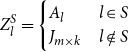 $Z^S_l = \begin{cases} A_l & l \in S \\ J_{m \times k} & l \notin S \end{cases}$
Proof. By the definition of the Kronecker product, $\forall (i,j) \in [m]^n \times [k]^n$
we have:
$\forall (i,j) \in [m]^n \times [k]^n$
we have:
 \begin{align*} \left (\sum _{S \subseteq [n]} a_S \cdot \underset {l \in [n]}{\bigotimes } \begin{cases} A_l & l \in S \\ J_{m \times k} & l \notin S \end{cases} \right )_{i,j} &= \sum _{S \subseteq [n]} a_S \cdot \prod _{l \in [n]} \left (\begin{cases} A_l & l \in S \\ J & l \notin S \end{cases} \right )_{i_l, j_l} \\ &= \sum _{S \subseteq [n]} a_S \cdot \prod _{l \in S} (A_l)_{i_l, j_l} \\ &= f \big ( (A_1)_{i_1, j_1}, \ldots , (A_n)_{i_n, j_n} \big ) = f \big ( A_1, \ldots , A_n \big )_{i,j} \end{align*}
This relationship implies the following powerful bound on the rank of a lifted matrix.
Lemma 2.6.
Let $f\,:\, \{0,1\}^n \to \{0,1\}$
be a Boolean function and let
$f\,:\, \{0,1\}^n \to \{0,1\}$
be a Boolean function and let $A_1, \ldots , A_n \in M_{m \times k}({\mathbb{R}})$
be binary matrices. Then,
$A_1, \ldots , A_n \in M_{m \times k}({\mathbb{R}})$
be binary matrices. Then,
 \begin{equation*} {\textrm {rank}} \left ( f(A_1, \ldots , A_n) \right ) \leqslant \sum _{S \in \textrm {mon}(f)} \prod _{i \in S} {\textrm {rank}}(A_i) \end{equation*}
Proof. Let $\sum _{S \in \textrm {mon}(f)} a_S \prod _{i \in S} x_i$
be the multilinear representation of
$\sum _{S \in \textrm {mon}(f)} a_S \prod _{i \in S} x_i$
be the multilinear representation of $f$
over the Reals. By Definition2.4,
$f$
over the Reals. By Definition2.4,
 \begin{align*} f(A_1, \ldots , A_n) = \sum _{S \in \textrm {mon}(f)} a_S \bigotimes _{i \in [n]} \begin{cases} A_i & i \in S \\ J_{m \times k} & i \notin S \end{cases} \end{align*}
The proof now follows by recalling that ${\textrm {rank}}(J) = 1$
, and that rank is subadditive, and multiplicative under the Kronecker product.
${\textrm {rank}}(J) = 1$
, and that rank is subadditive, and multiplicative under the Kronecker product.
2.2 Rank-Ramsey graphs
The Ramsey number $R(s,t)$
is the smallest
$R(s,t)$
is the smallest $n$
such that every graph
$n$
such that every graph $G$
of order
$G$
of order $n$
contains either an
$n$
contains either an $s$
-clique or an
$s$
-clique or an $t$
-anticlique. In other words, either
$t$
-anticlique. In other words, either $\omega (G)\geqslant s$
or
$\omega (G)\geqslant s$
or $\alpha (G)\geqslant t$
. Observe that
$\alpha (G)\geqslant t$
. Observe that ${\textrm {rank}}(A_G + I)\geqslant \alpha (G)$
, since the minor corresponding to an anticlique in
${\textrm {rank}}(A_G + I)\geqslant \alpha (G)$
, since the minor corresponding to an anticlique in $G$
is all-zeros in
$G$
is all-zeros in $A_G$
, and an identity submatrix in
$A_G$
, and an identity submatrix in $A_G + I$
. This suggests a search for graphs where both the clique number
$A_G + I$
. This suggests a search for graphs where both the clique number $\omega (G)$
and
$\omega (G)$
and ${\textrm {rank}}(A_G + I)$
are small. We call graphs with such properties Rank-Ramsey. To proceed, we introduce some notation.
${\textrm {rank}}(A_G + I)$
are small. We call graphs with such properties Rank-Ramsey. To proceed, we introduce some notation.
Definition 2.7.
For every $d \geqslant 1$
, let
$d \geqslant 1$
, let $\nu _d\,:\, \mathbb{N} \to {\mathbb{N}}$
be the function
$\nu _d\,:\, \mathbb{N} \to {\mathbb{N}}$
be the function
 \begin{equation*} \nu _d(n) {\,:\!=\,} \min _{G} {\textrm {rank}}( A_G + I ) \end{equation*}
minimising over all order- $n$
graphs
$n$
graphs $G$
with
$G$
with $\omega (G) \leqslant d$
.
$\omega (G) \leqslant d$
.
A similar notion for directed graphs is of interest as well,
Definition 2.8.
For every $d \geqslant 1$
, let
$d \geqslant 1$
, let $\eta _d\,:\, \mathbb{N} \to {\mathbb{N}}$
be the function
$\eta _d\,:\, \mathbb{N} \to {\mathbb{N}}$
be the function
 \begin{equation*} \eta _d(n) {\,:\!=\,} \min _{A \in M_n({\mathbb{R}})} {\textrm {rank}}( A + I ) \end{equation*}
minimising over all $n \times n$
binary matrices
$n \times n$
binary matrices $A$
with zeros on the main diagonal, and such that
$A$
with zeros on the main diagonal, and such that $(A+I)$
has no
$(A+I)$
has no $J_{d+1}$
principal minor.
$J_{d+1}$
principal minor.
There is a simple relation between Ramsey numbers and the function $\nu _d$
:
$\nu _d$
:
Proposition 2.9.
For any two positive integers $d$
and
$d$
and $n$
, there holds
$n$
, there holds $n \lt R(d+1, \nu _d(n) + 1)$
.
$n \lt R(d+1, \nu _d(n) + 1)$
.
Proof. If $G$
is a graph attaining
$G$
is a graph attaining $\nu _d(n)$
, then by definition
$\nu _d(n)$
, then by definition $\omega (G) \lt d+1$
. Also, as mentioned,
$\omega (G) \lt d+1$
. Also, as mentioned, $\alpha (G) \lt {\textrm {rank}}(A_G + I) + 1 = \nu _d(n) + 1$
. Therefore, the order of
$\alpha (G) \lt {\textrm {rank}}(A_G + I) + 1 = \nu _d(n) + 1$
. Therefore, the order of $G$
is smaller than
$G$
is smaller than $R(d+1, \nu _d(n) + 1)$
, as claimed.
$R(d+1, \nu _d(n) + 1)$
, as claimed.
Corollary 2.10 [Reference Lee and Shraibman47]. For any two positive integers $n \gt d$
, there holds
$n \gt d$
, there holds
 \begin{equation*} \nu _d(n) = \Omega \left ( n^{1/d} \cdot \left ( \frac {\log n}{d}\right )^{\tfrac {d-1}{d}} \right ) \end{equation*}
Proof. Apply the classical bounds on Ramsey numbers, due to Ajtai, Komlós and Szemerédi [Reference Ajtai, Komlós and Szemerédi2].
The following lemma aggregates several useful properties of our two quantities.
Lemma 2.11.
For every natural number $d$
, it holds that:
$d$
, it holds that:
-
1. Both quantities
$\nu _{d}(n)$
and
$\eta _{d}(n)$
are non-increasing in
$d$
. -
2.
$\eta _d(n) \leqslant \nu _d (n) \leqslant \eta _d(n)^2$
. -
3. Both
$\nu _d$
and
$\eta _d$
are submultiplicative:
$\nu _d(k n) \leqslant k \cdot \nu _d(n)$
, and
$\eta _d(k n) \leqslant k \cdot \eta _d(n)$
.







and moreover, for every $d_1, d_2$
and
$d_1, d_2$
and $n_1, n_2$
, we have:
$n_1, n_2$
, we have:
-
4.
$\nu _{d_1 d_2}(n_1 n_2) \leqslant \nu _{d_1}(n_1) \nu _{d_2}(n_2)$
, and similarly
$\eta _{d_1 d_2}(n_1 n_2) \leqslant \eta _{d_1}(n_1) \eta _{d_2}(n_2)$
.


Proof. We prove each property in turn,
-
1. Obvious: If
$b\gt a$
, then a graph with no
$a$
-clique has no
$b$
-clique either. -
2. The lower bound is obvious. For the upper bound, let
$A$
be the matrix attaining
$\eta _d(n)$
and consider the Hadamard product
$(A+I) \odot (A+I)^T$
. -
3. Let
$G$
be a graph attaining
$\nu _d(n)$
, and let
$H$
be the disjoint union of
$k$
copies of
$G$
. Clearly
$\omega (H) = \omega (G)$
and
${\textrm {rank}}(A_H + I) = k \cdot {\textrm {rank}}(A_G + I)$
. The proof for
$\eta _d$
is identical. -
4. Let
$G_1$
and
$G_2$
be graphs attaining the minimum for
$\nu _{d_1}(n_1)$
and
$\nu _{d_2}(n_2)$
, respectively. Let
$\Gamma$
be the graph whose adjacency matrix is
$A_\Gamma = (A_{G_1} + I) \otimes (A_{G_2} + I) - I$
. By multiplicativity,But for any clique
\begin{equation*} {\textrm {rank}}( A_\Gamma + I) = {\textrm {rank}} \left ( (A_{G_1} + I) \otimes (A_{G_2} + I) \right ) = {\textrm {rank}}(A_{G_1} + I) \cdot {\textrm {rank}}(A_{G_2} + I) \end{equation*}
$S$
in
$\Gamma$
, we have
$|S| \leqslant \omega (G_1) \cdot \omega (G_2)$
, since its projections on either coordinate are cliques in
$G_1$
and
$G_2$
, respectively. The same proof applies to
$\eta$
.














2.2.1 Rank-Ramsey numbers
Maintaining the analogy with Ramsey numbers, we define the Rank-Ramsey numbers,
Definition 2.12. $R^k(s,t)$
is the smallest integer
$R^k(s,t)$
is the smallest integer $N$
such that for every graph of order
$N$
such that for every graph of order $N$
,
$N$
,
 \begin{equation*} \omega (G) \geqslant s \,or\, {\mathrm {rank}}(A_G + I) \geqslant t \end{equation*}
Clearly, $(s-1)(t-1) \lt R^k(s,t) \leqslant R(s,t)$
. The lower bound follows by taking the disjoint union of
$(s-1)(t-1) \lt R^k(s,t) \leqslant R(s,t)$
. The lower bound follows by taking the disjoint union of $(t-1)$
copies of
$(t-1)$
copies of $K_{s-1}$
. For small numbers
$K_{s-1}$
. For small numbers $s$
and
$s$
and $t$
, Rank-Ramsey numbers are strictly smaller than Ramsey numbers. In fact they match the trivial bound
$t$
, Rank-Ramsey numbers are strictly smaller than Ramsey numbers. In fact they match the trivial bound $R^k(s,t) = (s-1)(t-1) + 1$
for all
$R^k(s,t) = (s-1)(t-1) + 1$
for all $2 \leqslant t \leqslant 5$
and any
$2 \leqslant t \leqslant 5$
and any $1\lt s$
.
$1\lt s$
.
Theorem 2.13.
For $2 \leqslant t \leqslant 5$
and every
$2 \leqslant t \leqslant 5$
and every $s \gt 1$
, there holds
$s \gt 1$
, there holds $R^k(s, t) = (s-1)(t-1) + 1$
.
$R^k(s, t) = (s-1)(t-1) + 1$
.
This equality fails for substantially larger values of $t$
. For example, we show later on (Corollary4.6) that
$t$
. For example, we show later on (Corollary4.6) that $R^k(3, 6l+11) \gt 16l$
for every
$R^k(3, 6l+11) \gt 16l$
for every $l \gt 2$
. For
$l \gt 2$
. For $l=6$
this yields
$l=6$
this yields $R^k(3, 47) \gt 96 \gt 93 = 2 \cdot 46 + 1$
. Consequently,
$R^k(3, 47) \gt 96 \gt 93 = 2 \cdot 46 + 1$
. Consequently, $R^k(3,n) \gt R^k(n,3)$
, for every sufficiently large
$R^k(3,n) \gt R^k(n,3)$
, for every sufficiently large $n$
, and in particular, unlike Ramsey numbers, Rank-Ramsey numbers are not symmetric in their parameters. To wit, it is much harder to keep the rank low than to avoid large cliques.
$n$
, and in particular, unlike Ramsey numbers, Rank-Ramsey numbers are not symmetric in their parameters. To wit, it is much harder to keep the rank low than to avoid large cliques.
It is not hard to show that a simple connected graph $G$
has rank
$G$
has rank $2$
iff it is a complete bipartite graph, i.e., a blowup of an edge. Likewise,
$2$
iff it is a complete bipartite graph, i.e., a blowup of an edge. Likewise, ${\textrm {rank}}(A_G) = 3$
if and only if
${\textrm {rank}}(A_G) = 3$
if and only if $G$
is a blowup of a triangle. Chang, Huang and Ye [Reference Chang, Huang and Yeh12, Reference Chang, Huang and Yeh13], showed that every connected graph of
$G$
is a blowup of a triangle. Chang, Huang and Ye [Reference Chang, Huang and Yeh12, Reference Chang, Huang and Yeh13], showed that every connected graph of $\textrm {rank}$ $4$
or
$4$
or $5$
, is the blowup of a graph from an explicit finite list of graphs,
$5$
, is the blowup of a graph from an explicit finite list of graphs, $\mathcal{G}_4$
and
$\mathcal{G}_4$
and $\mathcal{G}_5$
. This is, in fact, true in general. Indeed, if a graph has a pair of twin vertices and we remove one of the two, the rank remain unchanged (as does connectivity). Such reductions can be applied repeatedly. Also, note that such a reduction is the inverse of a blowup.
$\mathcal{G}_5$
. This is, in fact, true in general. Indeed, if a graph has a pair of twin vertices and we remove one of the two, the rank remain unchanged (as does connectivity). Such reductions can be applied repeatedly. Also, note that such a reduction is the inverse of a blowup.
Proposition 2.14.
For every positive integer $r$
, there is a finite list of graphs
$r$
, there is a finite list of graphs $\mathcal{G}_r$
such that every connected graph of rank
$\mathcal{G}_r$
such that every connected graph of rank $r$
is a blowup of a member of
$r$
is a blowup of a member of $\mathcal{G}_r$
.
$\mathcal{G}_r$
.
Proof. As shown by Kotlov and Lovász [Reference Kotlov and Lovász36], a twin-free graph of rank $r$
has at most
$r$
has at most $\mathcal{O}(2^{r/2})$
vertices. The claim now follows with
$\mathcal{O}(2^{r/2})$
vertices. The claim now follows with
 \begin{equation*} \mathcal{G}_r = \left \{\ \Gamma \,:\, {\textrm {rank}}(A_\Gamma ) = r \text{ and } \Gamma \text{ is twin-free }\right \}. \end{equation*}
An adaptation of the results on $\mathcal{G}_4$
and
$\mathcal{G}_4$
and $\mathcal{G}_5$
leads us to the following lemma.
$\mathcal{G}_5$
leads us to the following lemma.
Lemma 2.15.
Let $G$
be a simple graph whose complement is connected. Then,
$G$
be a simple graph whose complement is connected. Then,
-
1.
${\textrm {rank}}(A_G + I) = 4$
if and only if
$\,\overline {G}$
is a blowup of a graph in . -
2.
${\textrm {rank}}(A_G + I) = r$
for
$r \in \{2,3\}$
if and only if
$\,\overline {G}$
is a blowup of an
$r$
-clique.


 .
.


Proof. Let $G$
be an
$G$
be an $n$
-vertex graph with
$n$
-vertex graph with ${\textrm {rank}}(A_G + I) = r$
where
${\textrm {rank}}(A_G + I) = r$
where $r \in \{2, 3, 4\}$
, and
$r \in \{2, 3, 4\}$
, and $\overline {G}$
connected. Then,
$\overline {G}$
connected. Then,
 \begin{equation*} l {\,:\!=\,} {\textrm {rank}}(A_{\overline {G}}) = {\textrm {rank}}(J - (A_G + I) ) \in \left \{r-1, r, r+1\right \} \end{equation*}
So, by [Reference Chang, Huang and Yeh12, Reference Chang, Huang and Yeh13], $\overline {G} = H^w$
is a blowup of a graph
$\overline {G} = H^w$
is a blowup of a graph $H \in \mathcal{G}_l$
with some weights
$H \in \mathcal{G}_l$
with some weights $w$
. But then,
$w$
. But then,
 \begin{align*} r = {\textrm {rank}}(A_G + I_n) &= {\textrm {rank}}(J_n - J_n + A_G + I_n) \\ &= {\textrm {rank}}(J_n - A_{H^w}) \\ &= {\textrm {rank}}(J_n - A_H^w) \\ &= {\textrm {rank}}( (J_{v(H)}-A_H)^w ) = {\textrm {rank}}( J_{v(H)} - A_H ) \end{align*}
therefore $H\in \mathcal{G}_{r-1} \sqcup \mathcal{G}_r \sqcup \mathcal{G}_{r+1}$
and is such that
$H\in \mathcal{G}_{r-1} \sqcup \mathcal{G}_r \sqcup \mathcal{G}_{r+1}$
and is such that ${\textrm {rank}}(J - A_H) = r$
. This yields the above lists.
${\textrm {rank}}(J - A_H) = r$
. This yields the above lists.
We also require the following lemma.
Lemma 2.16.
Let $G$
be an
$G$
be an $n$
-vertex graph whose complement is a disjoint union of blowups of cliques and isolated vertices. Then,
$n$
-vertex graph whose complement is a disjoint union of blowups of cliques and isolated vertices. Then, ${\textrm {rank}}(A_G + I) \cdot \omega (G) \geqslant n$
.
${\textrm {rank}}(A_G + I) \cdot \omega (G) \geqslant n$
.
Proof. Let $k$
be the number of connected components in
$k$
be the number of connected components in $\overline {G}$
, say
$\overline {G}$
, say
 \begin{equation*} \overline {G} = \overline {G}_1 \sqcup \ldots \sqcup \overline {G}_k, \text{ where } \overline {G}_i = K_{l_i}^{w_i} \text{ for every $1 \leqslant i \leqslant k$ } \end{equation*}
(where here, with slight abuse of notation, isolated vertices are denoted by $K_1$
). The clique number is determined by the blowup weights,
$K_1$
). The clique number is determined by the blowup weights,
 \begin{equation*} \omega (G) = \alpha (\overline {G}) = \sum _{i=1}^k \alpha (\overline {G}_i) = \sum _{i=1}^k \left \lVert w_i\right \rVert _\infty , \end{equation*}
and conversely, denoting $l^\star {\,:\!=\,} \max \left \{ l_i \,:\, 1 \leqslant i \leqslant k \right \}$
and
$l^\star {\,:\!=\,} \max \left \{ l_i \,:\, 1 \leqslant i \leqslant k \right \}$
and $L {\,:\!=\,} l_1 + \ldots + l_k$
, and letting
$L {\,:\!=\,} l_1 + \ldots + l_k$
, and letting $w$
be the concatenation of the weights for each of the components, we may bound the rank as follows
$w$
be the concatenation of the weights for each of the components, we may bound the rank as follows
 \begin{align*} {\textrm {rank}}(A_G + I_n) = {\textrm {rank}}(J_n - A_{\overline {G}}) &= {\textrm {rank}}(J_L^w - A_{K_{l_1}^{w_1} \sqcup \ldots \sqcup K_{l_k}^{w_k}}) \\ &= {\textrm {rank}}(J_L - A_{K_{l_1} \sqcup \ldots \sqcup K_{l_k}}) \\ &\geqslant {\textrm {rank}}(J_{l^\star } - A_{K_{l^\star }}) = {\textrm {rank}}(I_{l^\star }) = l^\star \end{align*}
where the last inequality follows by taking a principal minor. The claim now follows, as
 \begin{equation*} n = \sum _{i=1}^k \langle w_i, \unicode {x1D7D9} \rangle \leqslant \sum _{i=1}^k l_i \left \lVert w_i\right \rVert _\infty \leqslant l^\star \sum _{i=1}^k \left \lVert w_i\right \rVert _\infty \leqslant {\textrm {rank}}(A_G + I) \cdot \omega (G) \end{equation*}
The proof of Theorem2.13 now follows.
Proof. Let $G$
be an
$G$
be an $n$
-vertex graph with
$n$
-vertex graph with $n \gt 1$
and
$n \gt 1$
and ${\textrm {rank}}(A_G + I) = t-1$
, and write
${\textrm {rank}}(A_G + I) = t-1$
, and write
 \begin{equation*} \overline {G} = \overline {G}_1 \sqcup \ldots \sqcup \overline {G}_k, \text{ and } r_i {\,:\!=\,} {\textrm {rank}}(A_{\overline {G}_i}) \text{ for every $1 \leqslant i \leqslant k$ } \end{equation*}
where $k \geqslant 1$
is the number of components in
$k \geqslant 1$
is the number of components in $\overline {G}$
. Clearly,
$\overline {G}$
. Clearly, $r_1 + \ldots + r_k = {\textrm {rank}}(A_{\overline {G}}) = {\textrm {rank}}(J - (A_G + I)) \leqslant t$
. The cases
$r_1 + \ldots + r_k = {\textrm {rank}}(A_{\overline {G}}) = {\textrm {rank}}(J - (A_G + I)) \leqslant t$
. The cases $t = \{2,3,4\}$
are thus handled, since if
$t = \{2,3,4\}$
are thus handled, since if $k=1$
then
$k=1$
then $\overline {G}$
is a blowup of a clique (recall Lemma2.15), and if
$\overline {G}$
is a blowup of a clique (recall Lemma2.15), and if $k \gt 1$
each component is an isolated vertex or blowup of a clique, which is covered by Lemma2.16.
$k \gt 1$
each component is an isolated vertex or blowup of a clique, which is covered by Lemma2.16.
It remains to handle $t=5$
, in the cases where not all the non-trivial components of
$t=5$
, in the cases where not all the non-trivial components of $\overline {G}$
are blowups of cliques. Let
$\overline {G}$
are blowups of cliques. Let $\mathcal{H}$
be the list of graphs in Lemma2.15, excluding
$\mathcal{H}$
be the list of graphs in Lemma2.15, excluding $K_4$
. Only one possibility still remains to be dealt with:
$K_4$
. Only one possibility still remains to be dealt with: $\overline {G}$
is a blowup
$\overline {G}$
is a blowup $H^w$
of some graph
$H^w$
of some graph $H \in \mathcal{H}$
, together with (possibly) some isolated vertices. We can rule out the existence of isolated vertices, since then:
$H \in \mathcal{H}$
, together with (possibly) some isolated vertices. We can rule out the existence of isolated vertices, since then:
 \begin{align*} {\textrm {rank}}(A_G + I) = {\textrm {rank}}(J - A_{\overline {G}}) = {\textrm {rank}} \left ( \begin{array}{c|c} J - A_{H^w} & J \\ \hline J & J \end{array} \right ) = {\textrm {rank}} \left ( \begin{array}{c|c} J - A_{H} & \unicode {x1D7D9}^T \\ \hline \unicode {x1D7D9} & 1 \end{array} \right ) \end{align*}
and for all $H \in \mathcal{H}$
, the latter rank is
$H \in \mathcal{H}$
, the latter rank is $5 \gt {\textrm {rank}}(A_G+I) = t-1 = 4$
, a contradiction.
$5 \gt {\textrm {rank}}(A_G+I) = t-1 = 4$
, a contradiction.
Finally we deal with the case $\overline {G} = H^w$
. Maximal independent sets in
$\overline {G} = H^w$
. Maximal independent sets in $H^w$
correspond to blowups of anticliques in
$H^w$
correspond to blowups of anticliques in $H$
. Therefore, the following LP bounds the independence number of blowups of
$H$
. Therefore, the following LP bounds the independence number of blowups of $H$
:
$H$
:
 \begin{align*} \begin{array}{ll@{}ll} \text{minimize} & a &\\ \text{subject to}& x \geqslant 0& \\ & \langle \unicode {x1D7D9}, x \rangle = 1 & \\ & \langle \unicode {x1D7D9}_S, x \rangle \leqslant a &\ \ \ \forall S \in I(H) \end{array} \end{align*}
where $I(H)$
is the set of all independent sets of
$I(H)$
is the set of all independent sets of $H$
. Let
$H$
. Let $\alpha ^{\star }_H$
be the optimum of the above programme. The least optima of this LP over the base-graphs in
$\alpha ^{\star }_H$
be the optimum of the above programme. The least optima of this LP over the base-graphs in $\mathcal{H}$
is exactly
$\mathcal{H}$
is exactly $1/3$
, by direct computation. Therefore,
$1/3$
, by direct computation. Therefore,
 \begin{equation*} \frac {\omega (G)}{n} = \frac {\alpha (H^w)}{\langle \unicode {x1D7D9}, w \rangle } \geqslant \alpha ^{\star }_H \geqslant \frac {1}{3} = \frac {1}{{\textrm {rank}}(A_G + I) - 1} \end{equation*}
and the proof follows by re-arranging.
2.2.2 Warmup: Simple constructions of Rank-Ramsey graphs
As Proposition2.9 shows, any explicit (constructive) sublinear bound on $\nu _d(n)$
yields an explicit Ramsey graph. Moreover, the bound on the independence number is replaced by the possibly stricter requirement concerning the rank. How difficult is it to accomplish this? The directed quantity
$\nu _d(n)$
yields an explicit Ramsey graph. Moreover, the bound on the independence number is replaced by the possibly stricter requirement concerning the rank. How difficult is it to accomplish this? The directed quantity $\eta _1$
is easy to bound. Shigeta and Amano [Reference Shigeta and Amano52] obtained an asymptotically tight estimate,
$\eta _1$
is easy to bound. Shigeta and Amano [Reference Shigeta and Amano52] obtained an asymptotically tight estimate, $\eta _1(n) = \Theta (n^{1/2 + o_n(1)})$
. As a brief warmup, we give the following weaker claim.
$\eta _1(n) = \Theta (n^{1/2 + o_n(1)})$
. As a brief warmup, we give the following weaker claim.
Claim 2.17.
For every positive integer $n$
, there holds
$n$
, there holds $n^{1/2} \leqslant \eta _1(n) \leqslant \mathcal{O} \left ( n^{\log _4 3} \right )$
.
$n^{1/2} \leqslant \eta _1(n) \leqslant \mathcal{O} \left ( n^{\log _4 3} \right )$
.
Proof. For the lower bound, if $A$
is the adjacency matrix of a simple directed graph with no
$A$
is the adjacency matrix of a simple directed graph with no $2$
-cycle, then
$2$
-cycle, then $(A+I) \odot (A+I)^T = I$
, and by sub-multiplicativity indeed
$(A+I) \odot (A+I)^T = I$
, and by sub-multiplicativity indeed ${\textrm {rank}}(A+I) \geqslant n^{1/2}$
. For the upper bound, note the following properties of
${\textrm {rank}}(A+I) \geqslant n^{1/2}$
. For the upper bound, note the following properties of $A_{D_4}$
the adjacency matrix of the directed
$A_{D_4}$
the adjacency matrix of the directed $4$
-cycle,
$4$
-cycle,
-
•
${\textrm {rank}}(A_{D_4} + I) = 3$
. -
•
$A_{D_4} + I$
has no
$J_2$
principal minor.


Consequently $\eta _1(4) \leqslant 3$
, and the proof follows by repeatedly applying property
$\eta _1(4) \leqslant 3$
, and the proof follows by repeatedly applying property $4$
of Lemma2.11.
$4$
of Lemma2.11.
The upper bound can be likewise improved, e.g., to $\eta _1(n) \leqslant \Theta (n^{\log _6 4})$
, as an exhaustive search through digraphs of order
$\eta _1(n) \leqslant \Theta (n^{\log _6 4})$
, as an exhaustive search through digraphs of order $6$
yields
$6$
yields $\eta _1(6) = 4$
. Turning our attention to the undirected quantity
$\eta _1(6) = 4$
. Turning our attention to the undirected quantity $\nu _d(n)$
, we note that
$\nu _d(n)$
, we note that $\nu _1(n)=n$
(the graph must have no edges). Instead, we provide, as part of the warmup, a trivial construction for
$\nu _1(n)=n$
(the graph must have no edges). Instead, we provide, as part of the warmup, a trivial construction for $\nu _d(n)$
. Better estimates provided in the sequel require new ideas.
$\nu _d(n)$
. Better estimates provided in the sequel require new ideas.
Proposition 2.18.
For every two positive integers $d$
and
$d$
and $n$
, we have
$n$
, we have $\nu _d(n) \leqslant \lceil \frac {n}{d} \rceil$
.
$\nu _d(n) \leqslant \lceil \frac {n}{d} \rceil$
.
Proof. Let $G$
be the disjoint union of
$G$
be the disjoint union of $\lfloor \frac {n}{d} \rfloor$
copies of
$\lfloor \frac {n}{d} \rfloor$
copies of $K_{d}$
and a single copy of
$K_{d}$
and a single copy of $K_{n \bmod d}$
. By construction,
$K_{n \bmod d}$
. By construction, $\omega (G) = d$
. Furthermore,
$\omega (G) = d$
. Furthermore, $(A_G + I)$
is a block matrix of
$(A_G + I)$
is a block matrix of $\lceil \frac {n}{d} \rceil$
matrices J, thus
$\lceil \frac {n}{d} \rceil$
matrices J, thus ${\textrm {rank}}(A_G + I) = \lceil \frac {n}{d} \rceil$
.
${\textrm {rank}}(A_G + I) = \lceil \frac {n}{d} \rceil$
.
3. Rank-Ramsey graphs and the Log-Rank conjecture
In this section we briefly overview the connections between the log-rank problem in communication complexity, and Rank-Ramsey graphs. This discussion is mostly expository and not very technical.
On the one hand, we observe that any Rank-Ramsey construction witnesses a gap in the graph-theoretic formulation of the log-rank conjecture. Conversely we show that, under certain conditions, exhibiting a gap in the log-rank problem implies the construction of Rank-Ramsey graphs.
3.1 The log-rank conjecture
What is the relation between the rank of a binary matrix and its communication complexity? As observed by Mehlhorn and Schmidt [Reference Mehlhorn and Schmidt49], every deterministic communication protocol induces a partition of the communication matrix into monochromatic rectangles. This clearly implies that ${\textrm {D}}(A) \geqslant \log {\textrm {rank}}(A)$
for every binary matrix
${\textrm {D}}(A) \geqslant \log {\textrm {rank}}(A)$
for every binary matrix $A$
, where
$A$
, where ${\textrm {D}}(A)$
is the deterministic communication complexity of
${\textrm {D}}(A)$
is the deterministic communication complexity of $A$
. Does a converse hold? This is one of the most notorious open questions in computational complexity. The log-rank conjecture states that
$A$
. Does a converse hold? This is one of the most notorious open questions in computational complexity. The log-rank conjecture states that
 \begin{equation} {\textrm {D}}(A) \leqslant \mathcal{O} \left ( \log ^c {\textrm {rank}}(A) \right ) \end{equation}
for every binary matrix $A$
, where
$A$
, where $c \gt 1$
is some absolute constant.
$c \gt 1$
is some absolute constant.
Our current best lower bound on $c$
is
$c$
is $c \geqslant 2$
, due to Göös, Pitassi and Watson [Reference Göös, Pitassi and Watson28]. The upper bounds that we have remain exponentially far. The current record, due to Sudakov and Tomon [Reference Sudakov and Tomon54] (see also [Reference Lovett45]), states that
$c \geqslant 2$
, due to Göös, Pitassi and Watson [Reference Göös, Pitassi and Watson28]. The upper bounds that we have remain exponentially far. The current record, due to Sudakov and Tomon [Reference Sudakov and Tomon54] (see also [Reference Lovett45]), states that ${\textrm {D}}(A) = \mathcal{O}({\textrm {rank}}^{1/2}(A))$
.
${\textrm {D}}(A) = \mathcal{O}({\textrm {rank}}^{1/2}(A))$
.
3.2 The graph-theoretic perspective
There are several known equivalent formulations of the log-rank conjecture, eschewing the use of terminology from communication complexity. For example, Nisan and Wigderson [Reference Nisan and Wigderson50] proved that the conjecture is equivalent to the following statement: Define $\text{mono}(A)\,:\!=\, \max |B|/|A|$
, over all monochromatic minors
$\text{mono}(A)\,:\!=\, \max |B|/|A|$
, over all monochromatic minors $B$
of
$B$
of $A$
.Footnote
9
The conjecture is that for every binary matrix
$A$
.Footnote
9
The conjecture is that for every binary matrix $A$
there holds
$A$
there holds
 \begin{equation*} -\log \left ( \text{mono}(A) \right ) \leqslant \mathcal{O}( \log ^{c} {\textrm {rank}}(A) ), \end{equation*}
where $c \gt 1$
is a universal constant.
$c \gt 1$
is a universal constant.
Here, we consider the graph-theoretic formulation, due to Lovász and Saks (see [Reference Lovász and Saks46, Reference Nisan and Wigderson50]), which states that there exists an absolute constant $c\gt 0$
such that for every graph
$c\gt 0$
such that for every graph $G$
,Footnote
10
$G$
,Footnote
10
 \begin{equation*} \log \chi (G) \leqslant \mathcal{O} \left ( \log ^{c} {\textrm {rank}}(A_{G}) \right ) \end{equation*}
To motivate the next definition, let us think of the clique number $\omega (G)$
as the largest cardinality of a set of vertices with independence number
$\omega (G)$
as the largest cardinality of a set of vertices with independence number $1$
. We consider, likewise, the largest order of an induced subgraph of
$1$
. We consider, likewise, the largest order of an induced subgraph of $G$
, of independence number at most
$G$
, of independence number at most $d$
:
$d$
:
Definition 3.1.
Let $G$
be a graph, and
$G$
be a graph, and $d$
be a positive integer. Then,
$d$
be a positive integer. Then,
 \begin{equation*} \psi _d(G) {\,:\!=\,} \max _{\substack {U \subseteq V(G) \\ \alpha (G[U]) \leqslant d}} |U| \end{equation*}
An interesting feature of $\psi _d(G)$
is that it captures the chromatic number, up to log factors. This goes back to the classical results on integrality gaps for covering problems [Reference Lovász43]. A similar argument appears in the analysis [Reference Dietzfelbinger, Hromkovič and Schnitger19], of extended fooling sets.Footnote
11
$\psi _d(G)$
is that it captures the chromatic number, up to log factors. This goes back to the classical results on integrality gaps for covering problems [Reference Lovász43]. A similar argument appears in the analysis [Reference Dietzfelbinger, Hromkovič and Schnitger19], of extended fooling sets.Footnote
11
Claim 3.2.
For every graph $G$
of order
$G$
of order $n$
, it holds that:
$n$
, it holds that:
 \begin{equation*} \max _{1 \leqslant d \leqslant \alpha (G)} \frac {\psi _d(G)}{d} \leqslant \chi (G) \leqslant \ln n \cdot \max _{1 \leqslant d \leqslant \alpha (G)} \frac {\psi _d(G)}{d} + 1 \end{equation*}
Proof. Let $H$
be an induced subgraph of
$H$
be an induced subgraph of $G$
attaining
$G$
attaining $\psi _d(G)$
for some
$\psi _d(G)$
for some $1 \leqslant d \leqslant \alpha (G)$
. Then,
$1 \leqslant d \leqslant \alpha (G)$
. Then,
 \begin{equation*} \chi (G)\geqslant \chi (H)\geqslant \frac {\psi _d(G)}{\alpha (H)}\geqslant \frac {\psi _d(G)}{d}. \end{equation*}
The middle inequality follows from the fact that $\alpha (F)\cdot \chi (F)\geqslant v(F)$
for every graph
$\alpha (F)\cdot \chi (F)\geqslant v(F)$
for every graph $F$
. The following colouring algorithm yields the upper bound.
$F$
. The following colouring algorithm yields the upper bound.
-
• Let
$U_1 \,:\!=\, V(G)$
, and repeat until
$U_{i+1}=\emptyset$
: -
• Let
$U_{i+1}\,:\!=\,U_i\setminus S_i$
, where
$S_i$
is a largest independent set in the induced subgraph
$G[U_i]$
. -
• Colour the vertices of
$S_i$
with colour
$i$
.





If this algorithm terminates after $t$
iterations, then it yields a
$t$
iterations, then it yields a $t$
-colouring of
$t$
-colouring of $G$
, whence
$G$
, whence $t\geqslant \chi (G)$
. Note also that
$t\geqslant \chi (G)$
. Note also that $|U_i|\leqslant \psi _{|S_i|}(G)$
. Denote
$|U_i|\leqslant \psi _{|S_i|}(G)$
. Denote $B {\,:\!=\,} \max _{1 \leqslant i \leqslant t} |U_i| / |S_i|$
, i.e.,
$B {\,:\!=\,} \max _{1 \leqslant i \leqslant t} |U_i| / |S_i|$
, i.e., $|S_i| \geqslant \frac {1}{B} |U_i|$
, for
$|S_i| \geqslant \frac {1}{B} |U_i|$
, for $i=1, \ldots , t$
. Thus, for all
$i=1, \ldots , t$
. Thus, for all $i$
, we have
$i$
, we have
 \begin{equation*} |U_{i+1}| = |U_{i}| - |S_i| \leqslant |U_{i}| \cdot \left ( 1 - \frac {1}{B} \right ). \end{equation*}
Iterating, and using this for $i=t-1$
, we get
$i=t-1$
, we get
 \begin{equation*} 1 \leqslant |U_t|\leqslant n \cdot \left ( 1 - \frac {1}{B} \right )^{t - 1} \lt n \cdot e^{-\frac {t-1}{B}} \end{equation*}
Taking logs, we have,
 \begin{equation*} \chi (G) \leqslant t\lt B\cdot \ln n + 1 \leqslant \max _{1 \leqslant i \leqslant t} \left ( \frac {\psi _{|S_i|}(G)}{|S_i|} \right )\cdot \ln n + 1 \end{equation*}
The following two corollaries connect between the growth rates of the functions $\nu _d(n)$
, and the log-rank conjecture. The first corollary shows that Rank-Ramsey graphs witness a gap in the graph-theoretic formulation of the log-rank conjecture. Conversely, the second corollary shows how under certain circumstances, log-rank separations can imply constructions of Rank-Ramsey graphs (see also Subsection 5.3 for an example of the interplay between the log-rank conjecture and Rank-Ramsey graphs).
$\nu _d(n)$
, and the log-rank conjecture. The first corollary shows that Rank-Ramsey graphs witness a gap in the graph-theoretic formulation of the log-rank conjecture. Conversely, the second corollary shows how under certain circumstances, log-rank separations can imply constructions of Rank-Ramsey graphs (see also Subsection 5.3 for an example of the interplay between the log-rank conjecture and Rank-Ramsey graphs).
Corollary 3.3.
For any two positive integers $d$
and
$d$
and $n$
, there exists a graph
$n$
, there exists a graph $G$
such that:
$G$
such that:
 \begin{equation*} \chi (G) \geqslant \frac {n}{d}, \text{ and } {\mathrm {rank}}(A_{G}) \leqslant \nu _d(n) + 1 \end{equation*}
Proof. Let $\overline {G}$
be an order-
$\overline {G}$
be an order- $n$
graph attaining
$n$
graph attaining $\nu _d(n)$
. Then,
$\nu _d(n)$
. Then, $\chi (G) \alpha (G) \geqslant n$
and
$\chi (G) \alpha (G) \geqslant n$
and $\alpha (G)=\omega (\overline {G}) \leqslant d$
. And,
$\alpha (G)=\omega (\overline {G}) \leqslant d$
. And,
 \begin{equation*} {\textrm {rank}}(A_{G}) = {\textrm {rank}}(J - A_{\overline {G}} - I) \leqslant {\textrm {rank}}(A_{\overline {G}} + I) + 1 = \nu _d(n) + 1 \end{equation*}
Corollary 3.4.
For every graph $G$
, there exists some
$G$
, there exists some $1 \leqslant d \leqslant \alpha (G)$
such that,
$1 \leqslant d \leqslant \alpha (G)$
such that,
 \begin{equation*} \chi (G) \leqslant \ln n \cdot \frac {\psi _d(G)}{d} + 1, \text{ and } {\mathrm {rank}}(A_G) \geqslant \nu _d(\psi _d(G)) - 1 \end{equation*}
Proof. Let $1 \leqslant d \leqslant \alpha (G)$
be a number for which the upper bound in Claim3.2 holds. This gives us the left inequality. For the right inequality, let
$1 \leqslant d \leqslant \alpha (G)$
be a number for which the upper bound in Claim3.2 holds. This gives us the left inequality. For the right inequality, let $H$
be an induced subgraph of
$H$
be an induced subgraph of $G$
attaining
$G$
attaining $\psi _d(G)$
. Then,
$\psi _d(G)$
. Then,
 \begin{equation*} {\textrm {rank}}(A_G) \geqslant {\textrm {rank}}(A_H) = {\textrm {rank}}(J-A_{\overline {H}}-I) \geqslant {\textrm {rank}}(A_{\overline {H}}+I) - 1 \geqslant \nu _d(\psi _d(G)) - 1 \end{equation*}
4. Rank-Ramsey graphs from minors of Kronecker powers
In this section we obtain a polynomial separation between $\nu _d(n)$
and
$\nu _d(n)$
and $n$
, for all
$n$
, for all $d \geqslant 41$
.
$d \geqslant 41$
.
Theorem 4.1. The following bounds hold:
-
1.
$\nu _{41}(n) = \mathcal{O} ( n^{1 - \frac {1}{10000}} )$
. -
2. For any sufficiently large
$d$
,
$\nu _d(n) = \mathcal{O} ( n^{\log _{296} (232)} )$
, where
$\log _{296} (232) \approx 0.957$
.




As we know, such gaps are implied by the existence of low-rank Boolean matrices with the desired properties. However, whereas most (non-explicit) constructions of Ramsey graphs found in the literature use the probabilistic method, this avenue is closed for us. This is due to the fact that we have no natural distribution over low-rank Boolean matrices. Consequently, we opt for explicit constructions.
The proof of Theorem4.1 is divided into two parts: first, we find a constant size graph $G$
, beating the trivial bound from Proposition2.18 for some small
$G$
, beating the trivial bound from Proposition2.18 for some small $d$
. Then, we show how to locate a good principal minor within large Kronecker powers of
$d$
. Then, we show how to locate a good principal minor within large Kronecker powers of $(A_G + I)$
, such that the clique number remains low.
$(A_G + I)$
, such that the clique number remains low.
4.1 Part 1: Finding a base graph
Our first goal is to find some graph $G$
, such that
$G$
, such that ${\textrm {rank}}(A_G + I)$
is strictly smaller than
${\textrm {rank}}(A_G + I)$
is strictly smaller than $\frac {v(G)}{\omega (G)}$
. It is even better if
$\frac {v(G)}{\omega (G)}$
. It is even better if $G$
has a small clique number (say,
$G$
has a small clique number (say, $\omega (G)=2$
), as this improves the bounds in the blowup procedure (of part 2). This is equivalent to seeking a graph where the eigenvalue
$\omega (G)=2$
), as this improves the bounds in the blowup procedure (of part 2). This is equivalent to seeking a graph where the eigenvalue $-1$
has a large multiplicity, since
$-1$
has a large multiplicity, since ${\textrm {rank}}(A_G + I) = v(G) - \mu _{A_G}(-1)$
.
${\textrm {rank}}(A_G + I) = v(G) - \mu _{A_G}(-1)$
.
An exhaustive search reveals that there is no such graph with fewer than $10$
vertices. Therefore, we seek larger, highly structured graphs. Strongly-regular graphs are natural candidates for such a search. These are regular, highly symmetric graphs with only three distinct eigenvalues (the Perron eigenvalue, equal to the degree, and two other distinct eigenvalues):
$10$
vertices. Therefore, we seek larger, highly structured graphs. Strongly-regular graphs are natural candidates for such a search. These are regular, highly symmetric graphs with only three distinct eigenvalues (the Perron eigenvalue, equal to the degree, and two other distinct eigenvalues):
Definition 4.2.
Let $v \gt k \gt \max \{\lambda , \mu \} \geqslant 0$
be integers. We say that
$v \gt k \gt \max \{\lambda , \mu \} \geqslant 0$
be integers. We say that $G$
is an
$G$
is an $\textrm {srg}(v,k,\lambda ,\mu )$
(i.e., strongly regular graph with parameters
$\textrm {srg}(v,k,\lambda ,\mu )$
(i.e., strongly regular graph with parameters $v$
,
$v$
, $k$
,
$k$
, $\lambda$
and
$\lambda$
and $\mu$
) if
$\mu$
) if
-
1.
$G$
has order
$v$
. -
2. It is
$k$
-regular.
-
3. Every two adjacent vertices in
$G$
have
$\lambda$
common neighbours.
-
4. Every two non-adjacent vertices in
$G$
have
$\mu$
common neighbours.
Footnote
12


We cannot use strongly regular graphs as base graphs for $d=2$
, because apart from
$d=2$
, because apart from $K_2$
and the complete bipartite graphs
$K_2$
and the complete bipartite graphs $K_{n,n}$
(whose spectrum is symmetric, and thus cannot beat the trivial bound of Proposition2.18), only seven triangle-free strongly regular graphs are known:
$K_{n,n}$
(whose spectrum is symmetric, and thus cannot beat the trivial bound of Proposition2.18), only seven triangle-free strongly regular graphs are known: $C_5$
, Petersen, Clebsch, Hoffman-Singleton, Gewirtz, Mesner, and the Higman-Sims graph. Whether this list is exhaustive or not is a famous open question (Cf. [Reference Biggs8, Reference Brouwer and Haemers7]). But even if such a graph exists, another problem arises.
$C_5$
, Petersen, Clebsch, Hoffman-Singleton, Gewirtz, Mesner, and the Higman-Sims graph. Whether this list is exhaustive or not is a famous open question (Cf. [Reference Biggs8, Reference Brouwer and Haemers7]). But even if such a graph exists, another problem arises.
Proposition 4.3. $G = K_2$
is the only triangle-free strongly-regular graph for which
$G = K_2$
is the only triangle-free strongly-regular graph for which $-1 \in \textrm {spec} (G)$
.
$-1 \in \textrm {spec} (G)$
.
Proof. Say $G$
is in
$G$
is in $\textrm {srg}(v, k, \lambda , \mu )$
, let
$\textrm {srg}(v, k, \lambda , \mu )$
, let $A$
be its adjacency matrix, and let
$A$
be its adjacency matrix, and let $r \gt s$
be its two distinct non-Perron eigenvalues. Observe that
$r \gt s$
be its two distinct non-Perron eigenvalues. Observe that $\lambda = 0$
since
$\lambda = 0$
since $G$
is triangle-free. The following relation among the parameters of strongly-regular graph are well known (e.g., [Reference Brouwer and Haemers7]):
$G$
is triangle-free. The following relation among the parameters of strongly-regular graph are well known (e.g., [Reference Brouwer and Haemers7]):
 \begin{equation*} (1)\ \ k-\mu = -rs,\ \ (2)\ \ \lambda = \mu + r + s, \text{ and }\ \ (3)\ \ (v-k-1)\mu = k(k-\lambda -1) \end{equation*}
If $r=-1$
then
$r=-1$
then $(1) \implies k-\mu = s \lt r \lt 0$
, which implies that
$(1) \implies k-\mu = s \lt r \lt 0$
, which implies that $k \lt \mu$
, a contradiction. Alternatively, if
$k \lt \mu$
, a contradiction. Alternatively, if $s=-1$
, then
$s=-1$
, then $(2) \implies \mu = 1-r \lt 2$
and either
$(2) \implies \mu = 1-r \lt 2$
and either $\mu = 0$
(and
$\mu = 0$
(and $(3) \implies k=1$
, therefore
$(3) \implies k=1$
, therefore $G=K_2$
), or
$G=K_2$
), or $\mu =1$
(and
$\mu =1$
(and $r=0$
). In the latter case, it follows (see [Reference Deutsch and Fisher18]) that the graph must be a Moore graph, since substituting back into
$r=0$
). In the latter case, it follows (see [Reference Deutsch and Fisher18]) that the graph must be a Moore graph, since substituting back into $(3)$
yields:
$(3)$
yields:
 \begin{equation*} v = k^2 + 1 = 1 + k \sum _{i=0}^{\textrm {diam}(G)-1} (k-1)^i, \end{equation*}
thus $G$
is a Moore graph (which is clearly connected of diameter two, as it is strongly-regular). It remains to rule out the Moore graphs. Firstly,
$G$
is a Moore graph (which is clearly connected of diameter two, as it is strongly-regular). It remains to rule out the Moore graphs. Firstly, $G$
can be neither the complete graph, nor an odd cycle over
$G$
can be neither the complete graph, nor an odd cycle over $\gt 5$
vertices, as they are not strongly-regular. Moreover,
$\gt 5$
vertices, as they are not strongly-regular. Moreover, $G$
cannot be
$G$
cannot be $C_5$
, the Petersen graph, the Hoffman-Singleton graph, or the famed (hypothesised)
$C_5$
, the Petersen graph, the Hoffman-Singleton graph, or the famed (hypothesised) $57$
-regular Moore graph, as their spectra are all fully determined (c.f. [Reference Biggs8, Reference Godsil and Royle30]), and do not match
$57$
-regular Moore graph, as their spectra are all fully determined (c.f. [Reference Biggs8, Reference Godsil and Royle30]), and do not match $r=0,\, s=-1$
.
$r=0,\, s=-1$
.
Proposition4.3 appears to rule out the use of strongly regular graphs as base graphs, if we insist on $d=2$
. However, we have a way out: A triangle-free strongly regular graph can have the eigenvalue
$d=2$
. However, we have a way out: A triangle-free strongly regular graph can have the eigenvalue $1$
. This suggests that we find a way to negate the spectrum of such graphs, while retaining triangle-freeness. As the following two simple lemmas show, this is indeed possible.
$1$
. This suggests that we find a way to negate the spectrum of such graphs, while retaining triangle-freeness. As the following two simple lemmas show, this is indeed possible.
Lemma 4.4.
For any two graphs, $G$
and
$G$
and $H$
,
$H$
, $\omega (G \otimes H) \leqslant \min \{\omega (G), \omega (H)\}$
.
$\omega (G \otimes H) \leqslant \min \{\omega (G), \omega (H)\}$
.
Proof. Let $S \subseteq V(G) \times V(H)$
be a clique in
$S \subseteq V(G) \times V(H)$
be a clique in $G \otimes H$
. By definition of the Kronecker product, the projections of
$G \otimes H$
. By definition of the Kronecker product, the projections of $S$
onto
$S$
onto $G$
is a clique, and likewise for
$G$
is a clique, and likewise for $H$
. As the graphs are simple, every vertex appears in these projections exactly once.
$H$
. As the graphs are simple, every vertex appears in these projections exactly once.
Lemma 4.5.
Let $A$
be the adjacency matrix of a graph
$A$
be the adjacency matrix of a graph $G$
and let
$G$
and let $l \gt 2$
be an integer. Then:
$l \gt 2$
be an integer. Then:
 \begin{equation*} \mu _{A \otimes K_l} (-1) = (l-1) \cdot \mu _A (1) \end{equation*}
Proof. Recall that the spectrum of the Kronecker Product of two matrices is the pairwise product of their respective eigenvalues. Since $\textrm {spec}(A_{K_l}) = \{ l^{(1)}, -1^{(l-1)}$
}, it follows that
$\textrm {spec}(A_{K_l}) = \{ l^{(1)}, -1^{(l-1)}$
}, it follows that
 \begin{equation*} \mu _{A \otimes K_l} (-1) = (l-1) \cdot \mu _A (1) + \mu _A \left ( \frac {1}{l-1} \right ) \end{equation*}
but $\mu _A (\frac {1}{l-1}) = 0$
, since
$\mu _A (\frac {1}{l-1}) = 0$
, since $A$
is symmetric and binary, and thus all its eigenvalues are algebraic integers.
$A$
is symmetric and binary, and thus all its eigenvalues are algebraic integers.
In combination, Lemmas4.4 and 4.5 yield some base-graphs and upper bounds on $\nu _2$
, and
$\nu _2$
, and $\nu _3$
.
$\nu _3$
.
Corollary 4.6.
For any $l \gt 2$
, we have
$l \gt 2$
, we have $\nu _2(16l) \leqslant 6l + 10$
, and
$\nu _2(16l) \leqslant 6l + 10$
, and $\nu _3(27l) \leqslant 7l + 20$
.
$\nu _3(27l) \leqslant 7l + 20$
.
Proof. Let $\mathcal{C}$
be the Clebsch graph, and let
$\mathcal{C}$
be the Clebsch graph, and let $\mathcal{S}$
be the Schläfli graph. It is known that:
$\mathcal{S}$
be the Schläfli graph. It is known that:
 \begin{equation*} \omega (\mathcal{C}) = 2,\ \ \mu _{A_{\mathcal{C}}}(1) = 10,\ \ v(\mathcal{C}) = 16 \quad \text{ and }\quad \omega (\overline {\mathcal{S}}) = 3,\ \ \mu _{A_{\overline {\mathcal{S}}}}(1) = 20,\ \ v(\overline {\mathcal{S}}) = 27 \end{equation*}
Consider the graph $G = \mathcal{C} \otimes K_l$
. By construction,
$G = \mathcal{C} \otimes K_l$
. By construction, $v(G) = v(\mathcal{C}) \cdot v(K_l) = 16l$
, and by Lemma4.5, it follows that
$v(G) = v(\mathcal{C}) \cdot v(K_l) = 16l$
, and by Lemma4.5, it follows that $\mu _{A_G}(-1) = \mu _{A_{\mathcal{C}}}(1) \cdot (l-1) = 10(l-1)$
, and therefore
$\mu _{A_G}(-1) = \mu _{A_{\mathcal{C}}}(1) \cdot (l-1) = 10(l-1)$
, and therefore ${\textrm {rank}}(A_G + I) = v(G) - \mu _{A_G}(-1) = 6l + 10$
. Moreover,
${\textrm {rank}}(A_G + I) = v(G) - \mu _{A_G}(-1) = 6l + 10$
. Moreover, $\mathcal{C}$
is triangle-free, and thus by Lemma4.4, so is
$\mathcal{C}$
is triangle-free, and thus by Lemma4.4, so is $G$
. Similarly
$G$
. Similarly $\overline {\mathcal{S}}$
yields the claim about
$\overline {\mathcal{S}}$
yields the claim about $\nu _3$
.
$\nu _3$
.
Remark 4.7.
In a very recent paper, Bamberg, Bishnoi, Ihringer and Ravi [Reference Bamberg, Bishnoi and Ihringer5] constructed a family of Cayley graphs of $\mathbb{F}_{2^n}^2$
that improves upon the constant of our triangle-free construction, lowering the bound from
$\mathbb{F}_{2^n}^2$
that improves upon the constant of our triangle-free construction, lowering the bound from $\nu _2(n) \leqslant (3/8 + o(1))n$
(see Corollary
4.6
), to
$\nu _2(n) \leqslant (3/8 + o(1))n$
(see Corollary
4.6
), to $\nu _2(n) \leqslant (1/4 + o(1)) n$
.
$\nu _2(n) \leqslant (1/4 + o(1)) n$
.
4.2 Part 2: Principal minors of Kronecker powers
Next we use the base-graphs from Part 1 to construct infinite families of graphs with bounded clique numbers, which exhibit a polynomial separation between the order and rank of the complement. Let $G$
be a base-graph, and let
$G$
be a base-graph, and let $H$
be the graph with adjacency matrix
$H$
be the graph with adjacency matrix $(A_G + I)^{\otimes n} - I$
. Clearly
$(A_G + I)^{\otimes n} - I$
. Clearly $\omega (H) = \omega (G)^n$
(take the direct product of
$\omega (H) = \omega (G)^n$
(take the direct product of $n$
copies of a largest clique of
$n$
copies of a largest clique of $G$
, plus self loops). However, as shown below, if
$G$
, plus self loops). However, as shown below, if $\omega (G)$
is sufficiently small, then there is, nevertheless, a large principal minor of
$\omega (G)$
is sufficiently small, then there is, nevertheless, a large principal minor of $A_H$
with no large cliques.
$A_H$
with no large cliques.
Theorem 4.8.
Let $G=([k], E)$
be a graph,
$G=([k], E)$
be a graph, $d \gt 1$
a positive integer, and
$d \gt 1$
a positive integer, and $r \,:\!=\, {\textrm {rank}}\left (A_G+I\right )$
. Then, for every large enough
$r \,:\!=\, {\textrm {rank}}\left (A_G+I\right )$
. Then, for every large enough $n$
there exists a graph
$n$
there exists a graph $H$
such that:
$H$
such that:
-
1.
$\omega (H) \leqslant d$
. -
2.
${\mathrm {rank}}(A_H + I) \leqslant r^n$
-
3.
$v(H) = \frac {k^n}{d} \left ( \sum _{t=1}^{\omega (G)} \#K_t(G) \cdot t^{d+1} \right )^{-\frac {n}{d+1}} - 1$
, where
$\#K_t(G)$
is the number of copies of
$K_t$
in
$G$
.


Proof. Let $M = (A_G + I)^{\otimes n}$
, and let
$M = (A_G + I)^{\otimes n}$
, and let $X_1, \ldots , X_N \overset {\mathrm{iid}}{\sim } [k]^n$
be indices in
$X_1, \ldots , X_N \overset {\mathrm{iid}}{\sim } [k]^n$
be indices in $M$
, sampled independently and uniformly at random (the value of
$M$
, sampled independently and uniformly at random (the value of $N$
will be fixed later). We find an upper bound on the probability that the principal (generalised) minor
$N$
will be fixed later). We find an upper bound on the probability that the principal (generalised) minor $W = M[X_1, \ldots , X_N]$
of
$W = M[X_1, \ldots , X_N]$
of $M$
, contains a principal
$M$
, contains a principal $(d + 1) \times (d + 1)$
all-ones minor. By union bound:
$(d + 1) \times (d + 1)$
all-ones minor. By union bound:
 \begin{equation*} \mathbb{P} \left [ \exists S \in \binom {[N]}{d+1}\,:\, W[\{X_i\}_{i \in S}] = J_{d+1} \right ] \leqslant N^{d+1} \cdot \mathbb{P}_{X_1, \ldots , X_{d+1} \sim [k]^n} \left [ W[X_1, \ldots , X_{d+1}] = J_{d+1} \right ]. \end{equation*}
The choice of $X_1, \ldots , X_{d+1}$
determines a
$X_1, \ldots , X_{d+1}$
determines a $n \times (d+1)$
matrix with entries
$n \times (d+1)$
matrix with entries $x_{i,j}\in [k]$
.
$x_{i,j}\in [k]$
.
By definition of the Kronecker product the above event occurs exactly when
 \begin{equation*} \forall i,j \in [d+1]\,:\, \forall l \in [n]\,:\, (A_G + I)_{x_{l, i}, x_{l,j}} = 1 \end{equation*}
and by independence, the probability of this event equals
 \begin{equation*} \mathbb{P}_{z_1, \ldots , z_{d+1} \sim [k]} \left [ \forall i,j \in [d+1]\,:\, (A_G + I)_{z_i, z_j} = 1 \right ] ^n.\end{equation*}
The latter expression counts the ways to place integer weights on $G$
’s vertices (with self-loops) such that all vertices in the support (i.e., with non-zero weights) form a clique. This is easily bounded by:Footnote
13
$G$
’s vertices (with self-loops) such that all vertices in the support (i.e., with non-zero weights) form a clique. This is easily bounded by:Footnote
13
 \begin{equation*} \mathbb{P}_{z_1, \ldots , z_{d+1} \sim [k]} \big [ \forall i,j \in [d+1]\,:\, (A_G + I)_{z_i, z_j} = 1 \big ] \leqslant \frac {1}{k^{d+1}} \cdot \sum _{t=1}^{\omega (G)} \#K_t(G) \cdot t^{d+1}. \end{equation*}
If this expression is bounded away from $1$
, then a good minor
$1$
, then a good minor $W$
exists. When this is so, a bound on
$W$
exists. When this is so, a bound on $N$
follows:
$N$
follows:
 \begin{equation*} N^{d+1} \cdot \left (\frac {1}{k^{d+1}} \cdot \sum _{t=1}^{\omega (G)} \#K_t(G) \cdot t^{d+1} \right )^n \lt 1 \implies N \leqslant \left ( \frac {k^{d+1}}{\sum _{t=1}^{\omega (G)} \#K_t(G) \cdot t^{d+1} } \right )^{\frac {n}{d+1}} \end{equation*}
We can, therefore, fix some values for $X_1, \ldots , X_N$
, such that
$X_1, \ldots , X_N$
, such that $W=M[X_1, \ldots , X_N]$
contains no all-ones principal minor of size
$W=M[X_1, \ldots , X_N]$
contains no all-ones principal minor of size $d+1$
. By Proposition2.3,
$d+1$
. By Proposition2.3, ${\textrm {rank}}(W) \leqslant {\textrm {rank}}(M) = r^n$
, since
${\textrm {rank}}(W) \leqslant {\textrm {rank}}(M) = r^n$
, since $W$
is a generalised minor of
$W$
is a generalised minor of $M$
. The proof is concluded by letting
$M$
. The proof is concluded by letting $A_H = W-I$
.
$A_H = W-I$
.
We are now ready to prove Theorem4.1.
Illustration of the Kronecker product $\mathcal{C} \otimes K_3$
, where
$\mathcal{C} \otimes K_3$
, where $\mathcal{C}$
is the Clebsch graph. Similarly to blowup, vertices are replaced by anticliques, and edges by bipartite graphs. The key difference is that here edges are replaced by complete bipartite graphs minus the identity matching (so the graph is twin-free).
$\mathcal{C}$
is the Clebsch graph. Similarly to blowup, vertices are replaced by anticliques, and edges by bipartite graphs. The key difference is that here edges are replaced by complete bipartite graphs minus the identity matching (so the graph is twin-free).

Proof. Fix two constants $d \gt 1$
and
$d \gt 1$
and $l\gt 2$
. As in the proof of Corollary4.6, let
$l\gt 2$
. As in the proof of Corollary4.6, let $G = \mathcal{C} \otimes K_l$
, where
$G = \mathcal{C} \otimes K_l$
, where $\mathcal{C}$
is the Clebsch graph (see Figure 1). As shown there,
$\mathcal{C}$
is the Clebsch graph (see Figure 1). As shown there,
 \begin{equation*} v(G) = v(\mathcal{C}) \cdot v(K_l) = 16l,\ e(G) = e(\mathcal{C}) \cdot e(K_l) = 40 \binom {l}{2},\text{ and } {\textrm {rank}}(A_G + I) = 6l + 10 \end{equation*}
By applying Theorem4.8 to $G$
, we obtain, for every large
$G$
, we obtain, for every large $N$
a
$N$
a $K_{d+1}$
-free graph
$K_{d+1}$
-free graph $H$
with:
$H$
with:
 \begin{equation*} {\textrm {rank}}(A_H+I) \leqslant (6l+10)^N, \text{ and } v(H) = \Theta \left ( \frac {(16 l)^{d+1}}{ 16l + 40 \binom {l}{2} \left (2^{d+1} - 2\right ) } \right )^{\frac {N}{d+1}} \end{equation*}
Denoting $n=v(H)$
and re-arranging, we may write:
$n=v(H)$
and re-arranging, we may write:
 \begin{equation*} {\textrm {rank}}(A_H + I) \leqslant \mathcal{O} \left ( n^\delta \right ), \text{ where } \delta = { \frac {(d+1) \ln (6l + 10)}{(d+1) \ln (16l) - \ln \left (16l + 40 \binom {l}{2} (2^{d+1} - 2) \right ) } } \end{equation*}
For the first bound, take $d=41$
and
$d=41$
and $l=26$
.
$l=26$
.
For the second bound, note that for any fixed $l$
, the expression for
$l$
, the expression for $\delta$
decreases with
$\delta$
decreases with $d$
.
$d$
.
 \begin{equation*} \lim _{d\to \infty }\delta = \lim _{d\to \infty } { \frac {(d+1) \ln (6l + 10)}{(d+1) \ln (16l) - \ln \left (16l + 40 \binom {l}{2} (2^{d+1} - 2) \right ) } } = \frac {\ln (6l+10)}{\ln (16l)-\ln 2}. \end{equation*}
The minimum of this expression over the integers occurs at $l=37$
. This yields,
$l=37$
. This yields,
 \begin{equation*} \delta = \frac {\ln (232)}{\ln (296)} + o_d(1) \end{equation*}
as claimed.
5. Rank-Ramsey graphs from lifts of Erdős-Rényi graphs
So far, we have constructed Rank-Ramsey graphs with constant $d$
. In this section we proceed to the range
$d$
. In this section we proceed to the range $d = \Theta (\log n)$
, and prove the following theorem:
$d = \Theta (\log n)$
, and prove the following theorem:
Theorem 5.1.
For any two constants $c, \varepsilon \gt 0$
with
$c, \varepsilon \gt 0$
with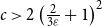 $c \gt 2 \left (\frac {2}{3\varepsilon }+1\right )^2$
, there holds
$c \gt 2 \left (\frac {2}{3\varepsilon }+1\right )^2$
, there holds $ \nu _{ c \log n}(n) \leqslant \widetilde {\mathcal{O}} (n^{\frac {2}{3} + \varepsilon } )$
.
$ \nu _{ c \log n}(n) \leqslant \widetilde {\mathcal{O}} (n^{\frac {2}{3} + \varepsilon } )$
.
These are graphs with a logarithmic clique number, and approaching ${\textrm {rank}}(A_G + I)=\mathcal{O}\left (n^{2/3}\right )$
. For example, one can instantiate Theorem5.1 to obtain:
${\textrm {rank}}(A_G + I)=\mathcal{O}\left (n^{2/3}\right )$
. For example, one can instantiate Theorem5.1 to obtain:
 \begin{equation*} \nu _{10^6 \log n}(n) \leqslant \mathcal{O} \left ( n^{\frac {2}{3} + \frac {1}{1000}} \right ) \end{equation*}
The key ingredient in our proof of Theorem5.1 is our matrix-theoretic view of lifting (Subsection 2.1).
5.1 The functions
$\textrm {NAE}$
and
$\textrm {AE}$


The graphs constructed in Theorem5.1 are the lifts of matrices with the following Boolean functions.
Definition 5.2.
The Boolean functions $\textrm {NAE}\,:\, \{0,1\}^3 \to \{0,1\}$
and
$\textrm {NAE}\,:\, \{0,1\}^3 \to \{0,1\}$
and $\textrm {AE}\,:\, \{0,1\}^3 \to \{0,1\}$
are defined by:
$\textrm {AE}\,:\, \{0,1\}^3 \to \{0,1\}$
are defined by:
 \begin{align*} \textrm {NAE}(x_1, x_2, x_3) {\,:\!=\,} \begin{cases} 0 & x_1 = x_2 = x_3 \\ 1 & otherwise \end{cases}, \, and\, \textrm {AE} {\,:\!=\,} 1 - \textrm {NAE} \end{align*}
The seminal paper of Nisan and Wigderson [Reference Nisan and Wigderson50] exhibited a gap for the log-rank conjecture using recursive compositions of $\textrm {NAE}$
and lifts thereof (with the
$\textrm {NAE}$
and lifts thereof (with the $\textrm {AND}$
-gadget). For more on this, see Section 7.
$\textrm {AND}$
-gadget). For more on this, see Section 7.
Since the $\textrm {NAE}$
function depends only on the Hamming weight of the input, its unique expression as a multilinear polynomial is a linear combination of elementary symmetric functions,
$\textrm {NAE}$
function depends only on the Hamming weight of the input, its unique expression as a multilinear polynomial is a linear combination of elementary symmetric functions,
 \begin{equation*} \textrm{NAE}(x_1,x_2,x_3) = e_2(x_1, x_2, x_3) - e_1(x_1, x_2, x_3) + 1 = x_1 x_2 + x_2 x_3 + x_1 x_3 - x_1 - x_2 - x_3 + 1. \end{equation*}
5.2 Our construction
It is more convenient to formulate the proof in terms of $\textrm {AE}$
, rather than
$\textrm {AE}$
, rather than $\textrm {NAE}$
. Our aim is to bound from above two quantities of the graphs that we construct: (i) Rank, and (ii) Maximum Clique Size.
$\textrm {NAE}$
. Our aim is to bound from above two quantities of the graphs that we construct: (i) Rank, and (ii) Maximum Clique Size.
The rank. The polynomial representation of $\textrm {AE}$
(in particular, its low degree), in conjunction with Lemma2.6, imply that the lift of any three matrices
$\textrm {AE}$
(in particular, its low degree), in conjunction with Lemma2.6, imply that the lift of any three matrices $A_1, A_2, A_3 \in M_k$
,
$A_1, A_2, A_3 \in M_k$
,
 \begin{equation*}M {\,:\!=\,} \textrm {AE}(A_1, A_2, A_3) \in M_{k^3}({\mathbb{R}})\end{equation*}
has low rank, namely ${\textrm {rank}}(M) \leqslant 3k^2 + 3k = \mathcal{O}(k^2)$
.
${\textrm {rank}}(M) \leqslant 3k^2 + 3k = \mathcal{O}(k^2)$
.
The clique number. In our construction $A_1$
,
$A_1$
, $A_2$
and
$A_2$
and $A_3$
are adjacency matrices of simple graphs,
$A_3$
are adjacency matrices of simple graphs, $G_1$
,
$G_1$
, $G_2$
and
$G_2$
and $G_3$
respectively. This guarantees that
$G_3$
respectively. This guarantees that $M$
is a symmetric binary matrix with ones on the diagonal. As an illustration (and an aside), this class of graphs includes the trivial construction of Proposition2.18: if
$M$
is a symmetric binary matrix with ones on the diagonal. As an illustration (and an aside), this class of graphs includes the trivial construction of Proposition2.18: if $G_1 = K_k$
and
$G_1 = K_k$
and $G_2=G_3=\overline {K}_k$
, the resulting lifted graph is a disjoint union of cliques.Footnote
14
$G_2=G_3=\overline {K}_k$
, the resulting lifted graph is a disjoint union of cliques.Footnote
14
Consider a set of vertices $S = \left \{ (x_1, y_1, z_1), \ldots , (x_s, y_s, z_s) \right \}$
in
$S = \left \{ (x_1, y_1, z_1), \ldots , (x_s, y_s, z_s) \right \}$
in $V(G_1) \times V(G_2) \times V(G_3)$
. By definition of
$V(G_1) \times V(G_2) \times V(G_3)$
. By definition of $\textrm {AE}$
, this set forms a clique in the lifted graph if and only if the graphs (with multiplicities, i.e., generalised minors) induced over the constituent graphs are identical. Therefore, informally, cliques of the lifted graph emerge from correlations between
$\textrm {AE}$
, this set forms a clique in the lifted graph if and only if the graphs (with multiplicities, i.e., generalised minors) induced over the constituent graphs are identical. Therefore, informally, cliques of the lifted graph emerge from correlations between $G_1$
,
$G_1$
, $G_2$
and
$G_2$
and $G_3$
. To avoid correlations, we will sample our base graphs i.i.d. from
$G_3$
. To avoid correlations, we will sample our base graphs i.i.d. from $G(k, 1/2)$
, as in the classical lower bound on diagonal Ramsey numbers.
$G(k, 1/2)$
, as in the classical lower bound on diagonal Ramsey numbers.
Large projections. We view the vertices of the lifted graph as lattice points in $[k] \times [k] \times [k]$
. To control the clique size of the lifted graph, we seek to avoid subsets
$[k] \times [k] \times [k]$
. To control the clique size of the lifted graph, we seek to avoid subsets $S \subseteq [k] \times [k] \times [k]$
with small axis projections
$S \subseteq [k] \times [k] \times [k]$
with small axis projections $|\pi _x(S)|$
,
$|\pi _x(S)|$
, $|\pi _y(S)|$
and
$|\pi _y(S)|$
and $|\pi _z(S)|$
. Since our constituent graphs are random, sets with large projections will guarantee ‘sufficient randomness’, and will therefore be less likely to induce cliques in the lifted graph. This intuition is made concrete in the proof of Theorem5.1. Beforehand, we use a probabilistic argument to show that there exist large subsets of the cube, in which every subset above a certain cardinality has some large axis projection.Footnote
15
$|\pi _z(S)|$
. Since our constituent graphs are random, sets with large projections will guarantee ‘sufficient randomness’, and will therefore be less likely to induce cliques in the lifted graph. This intuition is made concrete in the proof of Theorem5.1. Beforehand, we use a probabilistic argument to show that there exist large subsets of the cube, in which every subset above a certain cardinality has some large axis projection.Footnote
15
Lemma 5.3.
Let $a \gt 0$
and
$a \gt 0$
and $1 \gt \eta \gt 0$
be constants. For any sufficiently large
$1 \gt \eta \gt 0$
be constants. For any sufficiently large $k$
, there exists a subset
$k$
, there exists a subset $T \subset [k]^3$
, of cardinality
$T \subset [k]^3$
, of cardinality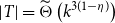 $|T| = \widetilde {\Theta } \left ( k^{3(1-\eta )} \right )$
, such that for every subset
$|T| = \widetilde {\Theta } \left ( k^{3(1-\eta )} \right )$
, such that for every subset $S \subset T$
of cardinality
$S \subset T$
of cardinality $|S| = a \log k$
,
$|S| = a \log k$
,
 \begin{equation*} \max \left \{ |\pi _x(S)|, |\pi _y(S)|, |\pi _z(S)| \right \} \geqslant \eta |S|= \eta a \log k \end{equation*}
Proof. Let $T$
be a sample of
$T$
be a sample of $N$
points, chosen i.i.d and uniformly from
$N$
points, chosen i.i.d and uniformly from $[k]^3$
, with
$[k]^3$
, with $N$
to be determined later. What is the probability that
$N$
to be determined later. What is the probability that $T$
fails to satisfy the statement in the lemma? Say that a subset
$T$
fails to satisfy the statement in the lemma? Say that a subset $S\subset T$
of cardinality
$S\subset T$
of cardinality $|S|=a \log k$
is
$|S|=a \log k$
is $x$
-bad if
$x$
-bad if $|\pi _x(S)| \leqslant \eta a \log k$
. Similarly define
$|\pi _x(S)| \leqslant \eta a \log k$
. Similarly define $y$
and
$y$
and $z$
-bad subsets. Call
$z$
-bad subsets. Call $S$
bad if it is
$S$
bad if it is $x, y$
and
$x, y$
and $z$
-bad. A sample
$z$
-bad. A sample $T$
with no bad subsets is called appropriate. If the expected number of bad subsets
$T$
with no bad subsets is called appropriate. If the expected number of bad subsets $S\subset T$
is negligible, then by Markov’s inequality, whp
$S\subset T$
is negligible, then by Markov’s inequality, whp $T$
is appropriate.
$T$
is appropriate.
The event that $S$
is bad at a certain axis (e.g.,
$S$
is bad at a certain axis (e.g., $x$
-bad) is equivalently formulated as follows: We throw
$x$
-bad) is equivalently formulated as follows: We throw $a \log k$
balls independently into
$a \log k$
balls independently into $k$
bins, and all our balls fall into at most
$k$
bins, and all our balls fall into at most $\eta a \log k$
bins. The probability of this bad event is
$\eta a \log k$
bins. The probability of this bad event is
 \begin{equation*}\binom {k}{\eta a \log k}\left (\frac {\eta a\log k}{k}\right )^{a\log k}\leqslant k^{(\eta - 1) a \log k + \mathcal{O}(\log \log k)} .\end{equation*}
So, the probability that $S$
is bad is at most
$S$
is bad is at most
 \begin{equation*} k^{3(\eta - 1) a \log k + \mathcal{O}(\log \log k)} .\end{equation*}
Consequently, the expected number of bad subsets that are contained in our random set $T$
is at most
$T$
is at most
 \begin{equation*} \binom {N}{a \log k} k^{3(\eta - 1) a \log k + \mathcal{O}(\log \log k)} .\end{equation*}
This expression is $o(1)$
provided that
$o(1)$
provided that
 \begin{equation*}N=k^{3\left (1-\eta \right )-o(1)}\end{equation*}
in which case we can conclude that there exists an appropriate sample $T$
of size
$T$
of size $N$
.
$N$
.
Since $T$
is chosen with repetitions, we have to account for the possibility that the same point is selected more than once. But no point can be chosen more than
$T$
is chosen with repetitions, we have to account for the possibility that the same point is selected more than once. But no point can be chosen more than $a(1-\eta ) \log k$
times. For otherwise any set of
$a(1-\eta ) \log k$
times. For otherwise any set of $a \log k$
triples containing these duplicates would be bad and render
$a \log k$
triples containing these duplicates would be bad and render $T$
inappropriate. It follows that there exists an appropriate set
$T$
inappropriate. It follows that there exists an appropriate set $T' \subset [k]^3$
of cardinality at least
$T' \subset [k]^3$
of cardinality at least $\frac {N}{a(1-\eta ) \log k}$
.
$\frac {N}{a(1-\eta ) \log k}$
.
Appropriate sets allow us to identify a large principal minor of the lifted graph, in which every set of cardinality $a \log k$
is ‘sufficiently random’. With it, we are ready to present our construction.
$a \log k$
is ‘sufficiently random’. With it, we are ready to present our construction.
Proof of Theorem 5.1. As mentioned, our construction proceeds by sampling three graphs $G_1$
,
$G_1$
, $G_2$
, and
$G_2$
, and $G_3$
, independently and uniformly at random from
$G_3$
, independently and uniformly at random from $G \left (k, 1/2 \right )$
. Let
$G \left (k, 1/2 \right )$
. Let $A_1$
,
$A_1$
, $A_2$
and
$A_2$
and $A_3$
be their respective adjacency matrices, and let
$A_3$
be their respective adjacency matrices, and let $M {\,:\!=\,} \textrm {AE}( A_1, A_2, A_3 )$
be their lift.
$M {\,:\!=\,} \textrm {AE}( A_1, A_2, A_3 )$
be their lift.
Pick $a \gt 0$
and
$a \gt 0$
and $1\gt \eta \gt 0$
, construct a subset
$1\gt \eta \gt 0$
, construct a subset $T \subset [k]^3$
as in Lemma5.3, and consider
$T \subset [k]^3$
as in Lemma5.3, and consider $W {\,:\!=\,} M[T]$
. Since
$W {\,:\!=\,} M[T]$
. Since $G_1$
,
$G_1$
, $G_2$
and
$G_2$
and $G_3$
have no self-loops, the main diagonal of
$G_3$
have no self-loops, the main diagonal of $M$
(and hence
$M$
(and hence $W$
as well) is all-ones. Also,
$W$
as well) is all-ones. Also,
 \begin{equation*}{\textrm {rank}}(W) \leqslant {\textrm {rank}}(M) \leqslant 3k^2 + 3k\end{equation*}
in view of Lemma2.6 and the fact that $\textrm {AE}$
has total degree
$\textrm {AE}$
has total degree $2$
.
$2$
.
So, we now have the rank under control and move to deal with the clique number. It remains to show that, with positive probability (over the choice of $G_1$
,
$G_1$
, $G_2$
and
$G_2$
and $G_3$
), the matrix
$G_3$
), the matrix $W$
has no all-ones principal minors of order
$W$
has no all-ones principal minors of order $a \log k$
. Let
$a \log k$
. Let $X$
be the random variable that counts the number of such principal minors. If its expectation is
$X$
be the random variable that counts the number of such principal minors. If its expectation is $\mathbb{E}(X)=o(1)$
, then whp the resulting graph has no
$\mathbb{E}(X)=o(1)$
, then whp the resulting graph has no $(a \log k)$
-clique.
$(a \log k)$
-clique.
Consider a subset $S \subset T$
of cardinality
$S \subset T$
of cardinality $|S|=a\log k$
. What is the probability that
$|S|=a\log k$
. What is the probability that $W[S]$
is an all-ones matrix? According to Lemma5.3,
$W[S]$
is an all-ones matrix? According to Lemma5.3, $S$
has a large projection on some axis, say
$S$
has a large projection on some axis, say $|\pi _x(S)| \geqslant \eta a \log k$
and for convenience we assume that the first
$|\pi _x(S)| \geqslant \eta a \log k$
and for convenience we assume that the first $\eta a \log k$ $x$
’s are all distinct. By definition of the
$x$
’s are all distinct. By definition of the $\textrm {AE}$
function, the adjacency relations among the
$\textrm {AE}$
function, the adjacency relations among the $\eta a \log k$
distinct vertices of
$\eta a \log k$
distinct vertices of $\pi _x(S)$
and the corresponding vertices of
$\pi _x(S)$
and the corresponding vertices of $\pi _y(S),\pi _z(S)$
, must coincide with each other. That is,
$\pi _y(S),\pi _z(S)$
, must coincide with each other. That is,
 \begin{equation*} A_1\left [ x_1, \ldots , x_{\eta a \log k} \right ] = A_2\left [ y_1, \ldots , y_{\eta a \log k} \right ] = A_3\left [ z_1, \ldots , z_{\eta a \log k} \right ]. \end{equation*}
Since $A_1[x_1, \ldots , x_{\eta a \log k}]$
is a proper minor of
$A_1[x_1, \ldots , x_{\eta a \log k}]$
is a proper minor of $A_1$
, with no repeated indices, it is the adjacency matrix of a
$A_1$
, with no repeated indices, it is the adjacency matrix of a $G(\eta a \log k, 1/2)$
graph. Therefore, for any fixed choice of
$G(\eta a \log k, 1/2)$
graph. Therefore, for any fixed choice of $A_2\left [ y_1, \ldots , y_{\eta a \log k} \right ]$
, it holds that the event
$A_2\left [ y_1, \ldots , y_{\eta a \log k} \right ]$
, it holds that the event $A_1\left [ x_1, \ldots , x_{\eta a \log k} \right ] = A_2\left [ y_1, \ldots , y_{\eta a \log k} \right ]$
occurs with probability exactly
$A_1\left [ x_1, \ldots , x_{\eta a \log k} \right ] = A_2\left [ y_1, \ldots , y_{\eta a \log k} \right ]$
occurs with probability exactly
 \begin{equation*} 2^{-\binom {\eta a \log k}{2}}=k^{-\left (\frac {\eta ^2 a^2}{2} - o(1)\right )\log k} \end{equation*}
Consequently
 \begin{equation*} \mathbb{E}(X) \leqslant \binom {|T|}{a\log k} k^{-\left (\frac {\eta ^2 a^2}{2} - o(1)\right )\log k} = k^{ \left ( 3a(1-\eta ) - \frac {\eta ^2 a^2}{2} + o(1) \right ) \log k }. \end{equation*}
It follows that $\mathbb{E}(X) = o(1)$
when
$\mathbb{E}(X) = o(1)$
when $a\gt \frac {6(1-\eta )}{\eta ^2}$
. The proof now follows by fixing
$a\gt \frac {6(1-\eta )}{\eta ^2}$
. The proof now follows by fixing
 \begin{equation*} n {\,:\!=\,} |T| = \widetilde {\Theta } (k^{3(1 - \eta )} ),\ \ c {\,:\!=\,} \frac {a}{3(1 - \eta )},\ \ \varepsilon {\,:\!=\,} \frac {2\eta }{3(1 - \eta )} \end{equation*}
5.3 Rank-Ramsey graphs with logarithmic clique number
In Subsection 5.2, we construct Rank-Ramsey graphs with logarithmic clique number and polynomial rank, approaching $n^{2/3}$
. Conversely, in the study of ‘classical’ Ramsey graphs, Erdős [Reference Erdös21] showed that asymptotically almost all
$n^{2/3}$
. Conversely, in the study of ‘classical’ Ramsey graphs, Erdős [Reference Erdös21] showed that asymptotically almost all $n$
-vertex graphs have logarithmic clique and independence numbers, and this is indeed best-possible up to constants (c.f. [Reference Campos, Griffiths, Morris and Sahasrabudhe11, Reference Erdös and Szekeres22, Reference Thomason55]). This contrast between Ramsey and Rank-Ramsey graphs raises the question: what is the growth rate of
$n$
-vertex graphs have logarithmic clique and independence numbers, and this is indeed best-possible up to constants (c.f. [Reference Campos, Griffiths, Morris and Sahasrabudhe11, Reference Erdös and Szekeres22, Reference Thomason55]). This contrast between Ramsey and Rank-Ramsey graphs raises the question: what is the growth rate of $\nu _{a \log n}(n)?$
Our construction witnesses that for every constant $a\gt 0$
, there holds
$a\gt 0$
, there holds $\nu _{a \log n}(n) = \widetilde {\mathcal{O}}(n^{2/3} + K(a))$
, where
$\nu _{a \log n}(n) = \widetilde {\mathcal{O}}(n^{2/3} + K(a))$
, where $K(a)$
is a constant depending on
$K(a)$
is a constant depending on $a$
. Conversely, we remark that if the log-rank conjecture holds, then by Corollary3.3, there exists a universal constant
$a$
. Conversely, we remark that if the log-rank conjecture holds, then by Corollary3.3, there exists a universal constant $c \gt 1$
, such that for every constant
$c \gt 1$
, such that for every constant $a\gt 0$
,
$a\gt 0$
,
 \begin{equation*} \nu _{a \log n}(n) = \Omega \left ( 2^{\sqrt [c]{\log (\frac {n}{a \log n})}} \right ) \end{equation*}
6. In search of better bounds on
$\nu _2(n)$

The Ramsey numbers $R(3,n)$
have fascinated combinatorialists for decades. Culminating a long line of excellent research, Kim [Reference Kim34] proved that
$R(3,n)$
have fascinated combinatorialists for decades. Culminating a long line of excellent research, Kim [Reference Kim34] proved that $R(3,n)=\Theta (n^2 / \log n)$
. Even the implicit constant is known, up to a factor of
$R(3,n)=\Theta (n^2 / \log n)$
. Even the implicit constant is known, up to a factor of $(4 + o(1))$
[Reference Pontiveros, Griffiths and Morris23]. What about
$(4 + o(1))$
[Reference Pontiveros, Griffiths and Morris23]. What about $R^k(3,n)$
, or equivalently,
$R^k(3,n)$
, or equivalently, $\nu _2(n)$
? Trivially,
$\nu _2(n)$
? Trivially,
 \begin{equation*} \Omega \left ( \sqrt {n \log n} \right ) \leqslant \nu _2(n) \leqslant \left \lfloor \frac {n}{2}\right \rfloor \end{equation*}
where the lower-bound follows from the Ramsey numbers $R(3,n)$
.
$R(3,n)$
.
The base-graphs used in Section 4, derived from the Clebsch graph, yields an improvement of the upper bound to $\nu _2(n) \leqslant (3/8 + o(1))n$
. If we wish to improve the lower bound to
$\nu _2(n) \leqslant (3/8 + o(1))n$
. If we wish to improve the lower bound to $\nu _2(n) \geqslant \Omega (n^{1/2 + \varepsilon })$
for some positive constant
$\nu _2(n) \geqslant \Omega (n^{1/2 + \varepsilon })$
for some positive constant $\varepsilon$
, then of course, bounds on the independence number will not do, as there exist triangle-free graphs with
$\varepsilon$
, then of course, bounds on the independence number will not do, as there exist triangle-free graphs with $\alpha (G) = \Omega (\sqrt {n \log n})$
[Reference Ajtai, Komlós and Szemerédi2]. Instead, we turn to consider other graph parameters. More concretely we investigate parameters that are related to orthonormal representations of graphs, on which a considerable body of research exists. This choice is motivated by the fact that the Gram matrix that corresponds to an orthonormal representation of
$\alpha (G) = \Omega (\sqrt {n \log n})$
[Reference Ajtai, Komlós and Szemerédi2]. Instead, we turn to consider other graph parameters. More concretely we investigate parameters that are related to orthonormal representations of graphs, on which a considerable body of research exists. This choice is motivated by the fact that the Gram matrix that corresponds to an orthonormal representation of $G$
is reminiscent of
$G$
is reminiscent of $A_G+I$
.
$A_G+I$
.
Definition 6.1.
An orthonormal representation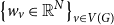 $\left \{ w_v \in {\mathbb{R}}^N \right \}_{v \in V(G)}$
of a graph
$\left \{ w_v \in {\mathbb{R}}^N \right \}_{v \in V(G)}$
of a graph $G$
is an assignment of unit vectors to the vertices of
$G$
is an assignment of unit vectors to the vertices of $G$
, such that
$G$
, such that
 \begin{align*} \forall v,u \in V(G)\,:\, \langle w_v, w_u \rangle = \begin{cases} 1 & v=u \\ 0 & v \not \sim u \\ \star & {otherwise} \end{cases} \end{align*}
The Gram matrix of the vectors $w_v$
in any orthnormal representation of an
$w_v$
in any orthnormal representation of an $n$
-vertex graph
$n$
-vertex graph $G$
, is an
$G$
, is an $(n \times n)$
positive semidefinite matrix
$(n \times n)$
positive semidefinite matrix $W$
that agrees with
$W$
that agrees with $A_G+I$
on the main diagonal, and on
$A_G+I$
on the main diagonal, and on $G$
’s non-edges. It is very suggestive that such matrices can tell us a lot about
$G$
’s non-edges. It is very suggestive that such matrices can tell us a lot about $A_G + I$
. Two of the most studied measures related to
$A_G + I$
. Two of the most studied measures related to $M$
are the Lovász number
$M$
are the Lovász number $\vartheta (G)$
, and the minimum semidefinite rank,
$\vartheta (G)$
, and the minimum semidefinite rank, $\textrm {msr}(G)$
, whose definitions we recall below. Like
$\textrm {msr}(G)$
, whose definitions we recall below. Like ${\textrm {rank}}(A_G + I)$
, these two quantities are related to constructions of Ramsey graphs. By the well-known ‘sandwich theorem’ (see [Reference Knuth39]), for every graph
${\textrm {rank}}(A_G + I)$
, these two quantities are related to constructions of Ramsey graphs. By the well-known ‘sandwich theorem’ (see [Reference Knuth39]), for every graph $G$
there holds
$G$
there holds
 \begin{equation*} \alpha (G) \leqslant \vartheta (G) \leqslant \textrm {msr}(G) \leqslant \chi (\overline {G}) \end{equation*}
How does ${\textrm {rank}}(A_G+I)$
fit into this web of relations? We show the following.
${\textrm {rank}}(A_G+I)$
fit into this web of relations? We show the following.
Theorem 6.2.
For infinitely many $n\gt 1$
, there exist triangle-free graphs
$n\gt 1$
, there exist triangle-free graphs $G_1$
and
$G_1$
and $G_2$
of order
$G_2$
of order $n$
, with
$n$
, with
-
1.
$\vartheta (G_1) = \Theta (n^{2/3})$
and
${\mathrm {rank}}(A_{G_1} + I) = n$
. -
2.
$\textrm {msr}(G_2) \geqslant n/2$
and
${\mathrm {rank}}(A_{G_2} + I) = (3/8 + o(1))n$
.




That is, we show separations between ${\textrm {rank}}(A_G + I)$
, and
${\textrm {rank}}(A_G + I)$
, and $\vartheta (G)$
and
$\vartheta (G)$
and $\textrm {msr}(G)$
.Footnote
16
Understanding the relations between
$\textrm {msr}(G)$
.Footnote
16
Understanding the relations between $\vartheta (G)$
and
$\vartheta (G)$
and ${\textrm {rank}}(A_G + I)$
is particularly interesting in view of striking similarities between the two parameters. See Subsection 6.1 for more.
${\textrm {rank}}(A_G + I)$
is particularly interesting in view of striking similarities between the two parameters. See Subsection 6.1 for more.
It is conceivable to us that $\vartheta (G) = \mathcal{O}\left ({\textrm {rank}}(A_G + I)\right )$
. For instance,
$\vartheta (G) = \mathcal{O}\left ({\textrm {rank}}(A_G + I)\right )$
. For instance, $\vartheta (G) \leqslant {\textrm {rank}}(A_G+I)$
for every graph of order less than
$\vartheta (G) \leqslant {\textrm {rank}}(A_G+I)$
for every graph of order less than $10$
, and we do not know any graph that fails this inequality. We remark that if this indeed holds true, then the results of [Reference Kashin and Konyagin35, Reference Alon and Kahale1] regarding the Lovász number of graphs with bounded independence number, imply a polynomial improvement on the lower bounds on
$10$
, and we do not know any graph that fails this inequality. We remark that if this indeed holds true, then the results of [Reference Kashin and Konyagin35, Reference Alon and Kahale1] regarding the Lovász number of graphs with bounded independence number, imply a polynomial improvement on the lower bounds on $\nu _d$
, namely we have
$\nu _d$
, namely we have $\nu _d(n) = \Omega ( n^{2/(d+1)} )$
, versus the weaker bound
$\nu _d(n) = \Omega ( n^{2/(d+1)} )$
, versus the weaker bound $\Omega (n^{1/d})$
(see Corollary2.10) that follow purely from Ramsey numbers. We refer the reader to Appendix B for a discussion on the connection between this open problem, and other well-known problems regarding the relationship between the well-known Hoffman’s bound and Cvetković’s bound.
$\Omega (n^{1/d})$
(see Corollary2.10) that follow purely from Ramsey numbers. We refer the reader to Appendix B for a discussion on the connection between this open problem, and other well-known problems regarding the relationship between the well-known Hoffman’s bound and Cvetković’s bound.
6.1 Lovász number versus Rank
Let us recall the definition of the Lovász number $\vartheta (G)$
of a simple graph
$\vartheta (G)$
of a simple graph $G$
:
$G$
:
Definition 6.3 [Reference Lovász44]. The Lovász number of a graph $G=(V,E)$
is
$G=(V,E)$
is
 \begin{equation*} \vartheta (G) {\,:\!=\,} \min _{c, W} \max _{v \in V} \frac {1}{\langle c, w_v \rangle ^2} \end{equation*}
where $W\,:\, V\to {\mathbb{R}}^N$
is an orthonormal representation of
$W\,:\, V\to {\mathbb{R}}^N$
is an orthonormal representation of $G$
and
$G$
and $c \in {\mathbb{R}}^N$
is a unit vector.
$c \in {\mathbb{R}}^N$
is a unit vector.
The graph parameters $\vartheta (G)$
and
$\vartheta (G)$
and ${\textrm {rank}}(A_G + I)$
share many properties. E.g., both are multiplicative in the strong product (see Definition2.1), and both are upper bounds on the Shannon capacity of a graph.
${\textrm {rank}}(A_G + I)$
share many properties. E.g., both are multiplicative in the strong product (see Definition2.1), and both are upper bounds on the Shannon capacity of a graph.
Proposition 6.4.
Let $G$
and
$G$
and $H$
be two graphs. Then,
$H$
be two graphs. Then,
 \begin{equation*} \vartheta (G \boxtimes H) = \vartheta (G) \vartheta (H), \, and\, {\textrm {rank}}(A_{G \boxtimes H} + I) = {\textrm {rank}}(A_G + I)\, {\textrm {rank}}(A_H + I) \end{equation*}
Proof. Lovász proved ([Reference Lovász44], Lemma 2 and Theorem 7) that $\vartheta$
is multiplicative in the strong product. As for the rank, by Definition2.1 and the multiplicativity of rank under the Kronecker product,
$\vartheta$
is multiplicative in the strong product. As for the rank, by Definition2.1 and the multiplicativity of rank under the Kronecker product,
 \begin{align*} {\textrm {rank}}(A_{G \boxtimes H} + I) &= {\textrm {rank}}( A_G \otimes A_H + A_G \otimes I + I \otimes A_H + I \otimes I ) \\ &= {\textrm {rank}}( (A_G + I) \otimes (A_H + I) ) = {\textrm {rank}}(A_G + I)\, {\textrm {rank}}(A_H + I) \end{align*}
Corollary 6.5 (See also [Reference Lovász44, Reference Haemers31]). For every graph $G$
it holds that
$G$
it holds that
 \begin{equation*} \vartheta (G) \geqslant \Theta (G) \text{ and } {\mathrm {rank}}(A_G + I) \geqslant \Theta (G) \end{equation*}
where $\Theta (G) {\,:\!=\,} \sup _k \sqrt [k]{ \alpha (G^{\boxtimes k}) }$
is the Shannon capacity of
$\Theta (G) {\,:\!=\,} \sup _k \sqrt [k]{ \alpha (G^{\boxtimes k}) }$
is the Shannon capacity of $G$
.
$G$
.
6.1.1 Best-possible separation of
${\textrm {rank}}(A_G + I)$
from
$\vartheta (G)$


The current best known explicit construction of triangle-free Ramsey graphs is due to Alon [Reference Alon3]. An order- $n$
graph
$n$
graph $G$
in this family satisfies
$G$
in this family satisfies $\vartheta (G) = \Theta (n^{2/3})$
. As we will presently show, there also holds that
$\vartheta (G) = \Theta (n^{2/3})$
. As we will presently show, there also holds that ${\textrm {rank}}(A_{G} + I) = n$
. In other words, these are best-possible
${\textrm {rank}}(A_{G} + I) = n$
. In other words, these are best-possible $\vartheta$
-Ramsey graphs, yet they are worst-possible Rank-Ramsey graphs.
$\vartheta$
-Ramsey graphs, yet they are worst-possible Rank-Ramsey graphs.
Let us briefly recount Alon’s construction: Let $k \gt 1$
be such that
$k \gt 1$
be such that $3 \nmid k$
and letFootnote
17
$3 \nmid k$
and letFootnote
17
 \begin{align*} W_0 {\,:\!=\,} \{ x \in \textrm {GF}(2^k) \,:\, \text{ leftmost bit of $x^7$ is $0$ } \},\quad W_1 {\,:\!=\,} \{ x \in \textrm {GF}(2^k) \,:\, \text{ leftmost bit of $x^7$ is $1$ } \}\end{align*}
and
 \begin{align*} U_0 {\,:\!=\,} \{ (w, w^3, w^5) \,:\, w \in W_0 \} \subset \mathbb{Z}_2^{3k}, \quad U_1 {\,:\!=\,} \{ (w, w^3, w^5) \,:\, w \in W_1 \} \subset \mathbb{Z}_2^{3k} \end{align*}
Then, $G_k {\,:\!=\,} \textrm {Cay}\, ( {\mathbb{Z}}_2^{3k}, \{ u_0 + u_1 \,:\, u_0 \in U_0, u_1 \in U_1 \} )$
is a graph on
$G_k {\,:\!=\,} \textrm {Cay}\, ( {\mathbb{Z}}_2^{3k}, \{ u_0 + u_1 \,:\, u_0 \in U_0, u_1 \in U_1 \} )$
is a graph on $n_k {\,:\!=\,} |{\mathbb{Z}}_2^{3k}|=2^{3k}$
vertices.
$n_k {\,:\!=\,} |{\mathbb{Z}}_2^{3k}|=2^{3k}$
vertices.
Theorem 6.6 [Reference Alon3]. For every $k \gt 1$
with
$k \gt 1$
with $3 \nmid k$
,
$3 \nmid k$
, $G_k$
is triangle-free, and
$G_k$
is triangle-free, and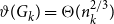 $\vartheta (G_k) = \Theta ( n_k^{2/3} )$
.
$\vartheta (G_k) = \Theta ( n_k^{2/3} )$
.
This bound on $\vartheta$
is tight, as shown by Kashin and Konyagin.
$\vartheta$
is tight, as shown by Kashin and Konyagin.
Theorem 6.7 [Reference Kashin and Konyagin35]. For every $n$
vertex triangle-free graph
$n$
vertex triangle-free graph $G$
, there holds
$G$
, there holds $\vartheta (G) \geqslant (2n)^{2/3}$
.
$\vartheta (G) \geqslant (2n)^{2/3}$
.
Proof. Kashin and Konyagin [Reference Kashin and Konyagin35] (see also [Reference Alon3]) proved $\vartheta (\overline {G}) \leqslant 2^{2/3} n^{1/3}$
for every triangle-free graph. The claim follows, since
$\vartheta (\overline {G}) \leqslant 2^{2/3} n^{1/3}$
for every triangle-free graph. The claim follows, since $\vartheta (G) \vartheta (\overline {G}) \geqslant n$
for every graph of order
$\vartheta (G) \vartheta (\overline {G}) \geqslant n$
for every graph of order $n$
(see [Reference Lovász44], Corollary 2).
$n$
(see [Reference Lovász44], Corollary 2).
In the following claim, we show that ${\textrm {rank}}(A_{G_k} + I) = n_k$
, for every admissible
${\textrm {rank}}(A_{G_k} + I) = n_k$
, for every admissible $k$
.
$k$
.
Claim 6.8.
For every $k \gt 1$
with
$k \gt 1$
with $3 \nmid k$
, there holds
$3 \nmid k$
, there holds ${\textrm {rank}}(A_{G_k} + I) = n_k$
.
${\textrm {rank}}(A_{G_k} + I) = n_k$
.
Proof. Since $G_k$
is a Cayley graph of an Abelian group,
$G_k$
is a Cayley graph of an Abelian group, ${\mathbb{Z}}_2^{3k}$
, its eigenvalues correspond to sums of group characters, evaluated over the generating set. The characters of
${\mathbb{Z}}_2^{3k}$
, its eigenvalues correspond to sums of group characters, evaluated over the generating set. The characters of ${\mathbb{Z}}_2^t$
are the Fourier-Walsh functions, i.e., the parity functions
${\mathbb{Z}}_2^t$
are the Fourier-Walsh functions, i.e., the parity functions $\chi _D\,:\, Z_2^t \to \{ \pm 1 \}$
, for every set
$\chi _D\,:\, Z_2^t \to \{ \pm 1 \}$
, for every set $D \subseteq [t]$
. So, every
$D \subseteq [t]$
. So, every $D \subseteq [n]$
, yields an eigenvalue
$D \subseteq [n]$
, yields an eigenvalue $\lambda _D$
of
$\lambda _D$
of $A_{G_k}$
, where
$A_{G_k}$
, where
 \begin{equation*} \lambda _D = \sum _{\substack {u_0 \in U_0 \\ u_1 \in U_1}} \chi _D(u_0 + u_1) = \left ( \sum _{u \in U_0} \chi _D(u) \right ) \left ( \sum _{u \in U_1} \chi _D(u) \right ) \end{equation*}
which is an even integer, because $|U_1| = |W_1| = 2^{k-1}$
(see [Reference Alon3]) are even. Consequently, all eigenvalues of
$|U_1| = |W_1| = 2^{k-1}$
(see [Reference Alon3]) are even. Consequently, all eigenvalues of $A_{G_k}$
are even, and
$A_{G_k}$
are even, and ${\textrm {rank}}(A_{G_k} + I) = n_k - \mu _{A_{G_k}}(-1) = n_k$
.
${\textrm {rank}}(A_{G_k} + I) = n_k - \mu _{A_{G_k}}(-1) = n_k$
.
6.2 Minimum semidefinite rank
Another obvious point of comparison is the rank. The minimum semidefinite rank, $\textrm {msr}(G)$
, is the smallest rank of an
$\textrm {msr}(G)$
, is the smallest rank of an $n \times n$
orthonormal representation matrix of an order-
$n \times n$
orthonormal representation matrix of an order- $n$
graph
$n$
graph $G$
. It is easy to see that triangle-free graphs have a large
$G$
. It is easy to see that triangle-free graphs have a large $\textrm {msr}(G)$
.Footnote
18
Deaett [Reference Deaett17] showed that
$\textrm {msr}(G)$
.Footnote
18
Deaett [Reference Deaett17] showed that $\textrm {msr}(G) \geqslant n/2$
, for any connected triangle-free graph. In contrast, in Corollary4.6 we prove that
$\textrm {msr}(G) \geqslant n/2$
, for any connected triangle-free graph. In contrast, in Corollary4.6 we prove that $\nu _2(16l) \leqslant 6l + 10$
, which is attained by a family of connected graphs. Therefore,
$\nu _2(16l) \leqslant 6l + 10$
, which is attained by a family of connected graphs. Therefore,
Corollary 6.9.
For any sufficiently large $n$
, there exists an order
$n$
, there exists an order $n$
triangle-free graph
$n$
triangle-free graph $G$
, with
$G$
, with
 \begin{equation*} \textrm {msr}(G) \geqslant n/2 \text{ and } {\mathrm {rank}}(A_G + I) = (3/8 + o(1))n \end{equation*}
We do not know whether a converse of the form ${\textrm {rank}}(A_G+I) = \Omega (\textrm {msr}(G))$
holds.
${\textrm {rank}}(A_G+I) = \Omega (\textrm {msr}(G))$
holds.
7. The Nisan-Wigderson construction
In a seminal paper, Nisan and Wigderson [Reference Nisan and Wigderson50] constructed an infinite family of symmetric binary matrices $A_k$
of dimension
$A_k$
of dimension $2^{3^k}$
. These matrices exhibit a separation between log-rank and communication complexity, and show that
$2^{3^k}$
. These matrices exhibit a separation between log-rank and communication complexity, and show that $c \geqslant \log _2 3$
in the conjectured inequality (1).
$c \geqslant \log _2 3$
in the conjectured inequality (1).
As discussed in Section 3, such separations can be related to Rank-Ramsey graphs. Here, we analyse the Nisan-Wigderson matrices from this perspective, and show that these matrices $A_k$
have very large monochromatic principal minors and yield, therefore, poor Rank-Ramsey graphs.
$A_k$
have very large monochromatic principal minors and yield, therefore, poor Rank-Ramsey graphs.
Claim 7.1.
For every $k \geqslant 1$
there exist subsets
$k \geqslant 1$
there exist subsets $S,T \subset [2^{3^k}]$
of cardinality
$S,T \subset [2^{3^k}]$
of cardinality $2^{3^k (1-o_k(1))}$
each, such that
$2^{3^k (1-o_k(1))}$
each, such that
 \begin{equation*} A_k[S] = \mathbf{0}, \,and\, A_k[T] = J \end{equation*}
We stress that this does not a contradict the discussion of Section 3: Exhibiting a log-rank separation does not preclude a matrix from having a large monochromatic rectangle.
7.1 The construction
The construction of [Reference Nisan and Wigderson50] involves a lift using the $\textrm {AND}$
gadget, with a recursive composition of the function
$\textrm {AND}$
gadget, with a recursive composition of the function $\textrm {NAE}$
(as in Definition5.2) with itself. To describe their result, we require some notation.
$\textrm {NAE}$
(as in Definition5.2) with itself. To describe their result, we require some notation.
Definition 7.2.
For every $k \gt 1$
, the Boolean function
$k \gt 1$
, the Boolean function $\textrm {NAE}^k\,:\, \{0,1\}^{3^k} \to \{0,1\}$
is defined:
$\textrm {NAE}^k\,:\, \{0,1\}^{3^k} \to \{0,1\}$
is defined:
 \begin{align*} \textrm {NAE}^k(x) &{\,:\!=\,} \textrm {NAE} \big ( \textrm {NAE}^{k-1}(x_1, \ldots , x_{3^{k-1}}), \textrm {NAE}^{k-1}(x_{3^{k-1} + 1}, \ldots , x_{2 \cdot 3^{k-1}}),\big.\\ &\big.\quad \textrm {NAE}^{k-1}(x_{2 \cdot 3^{k-1} + 1}, \ldots , x_{3^k}) \big ) \end{align*}
and $\textrm {NAE}^1 {\,:\!=\,} \textrm {NAE}$
.
$\textrm {NAE}^1 {\,:\!=\,} \textrm {NAE}$
.
We denote by $A_k$
the symmetric binary matrix
$A_k$
the symmetric binary matrix $\textrm {NAE}^k \circ \textrm {AND}^{3^k}$
. Moreover:
$\textrm {NAE}^k \circ \textrm {AND}^{3^k}$
. Moreover:
 \begin{equation*} \forall b \in \{0,1\}\,:\, G^{(b)}_k {\,:\!=\,} G \, ( \{ x \in \{0,1\}^{3^k} \,:\, \textrm {NAE}^k(x) = b \}, \{ \{x,y\} \,:\, \textrm {NAE}^k(x \land y) = 1 \} ) \end{equation*}
in other words, $G^{(1)}_k$
(resp.
$G^{(1)}_k$
(resp. $G^{(0)}_k$
) is the graph whose adjacency matrix is the principal minors of
$G^{(0)}_k$
) is the graph whose adjacency matrix is the principal minors of $A_k$
, induced by those indices for which the main diagonal is
$A_k$
, induced by those indices for which the main diagonal is $1$
(resp.
$1$
(resp. $0$
). With this notation, the result of Nisan and Wigderson says:Footnote
19
$0$
). With this notation, the result of Nisan and Wigderson says:Footnote
19
Theorem 7.3 [Reference Nisan and Wigderson50]. Let $A_k {\,:\!=\,} \textrm {NAE}^k \circ \textrm {AND}^{3^k} \in M_{3^k}({\mathbb{R}})$
. Then,
$A_k {\,:\!=\,} \textrm {NAE}^k \circ \textrm {AND}^{3^k} \in M_{3^k}({\mathbb{R}})$
. Then,
 \begin{equation*} \log {\mathrm {rank}}(A_k) \leqslant \mathcal{O} (2^k), \text{ and } {\textrm {D}}(A_k) = 3^k (1 - o_k(1)) \end{equation*}
It easy to bound $\text{rank}(A_k)$
: It is well known (e.g., [Reference Knop, Lovett, McGuire and Yuan37]) that
$\text{rank}(A_k)$
: It is well known (e.g., [Reference Knop, Lovett, McGuire and Yuan37]) that ${\textrm {rank}}(f \circ \textrm {AND}^n) = \textrm {spar}(f)$
for any function
${\textrm {rank}}(f \circ \textrm {AND}^n) = \textrm {spar}(f)$
for any function $f\,:\, \{0,1\}^n \to \{0,1\}$
. So here the rank is the number of monomials appearing in the expansion of
$f\,:\, \{0,1\}^n \to \{0,1\}$
. So here the rank is the number of monomials appearing in the expansion of $\textrm {NAE}^{k}$
, which can be bounded by a simple inductive argument.
$\textrm {NAE}^{k}$
, which can be bounded by a simple inductive argument.
7.2 Finding large monochromatic principal minors
In search of large monochromatic principal minors of $A_k$
, let us first estimate the orders of the two subgraphs,
$A_k$
, let us first estimate the orders of the two subgraphs, $G^{(0)}_k$
and
$G^{(0)}_k$
and $G^{(1)}_k$
.
$G^{(1)}_k$
.
Proposition 7.4.
For every $k \geqslant 1$
, we have that:
$k \geqslant 1$
, we have that:
 \begin{equation*} v\left (G^{(0)}_k\right ) = 2^{3^k} \cdot \left (\frac {1}{3} \pm o_k(1) \right ), \, and \, v\left (G^{(1)}_k\right ) = 2^{3^k} \cdot \left (\frac {2}{3} \pm o_k(1) \right ) \end{equation*}
Proof. Let $p_k$
be the probability that a uniformly random
$p_k$
be the probability that a uniformly random $x \sim \{0,1\}^{3^k}$
is in
$x \sim \{0,1\}^{3^k}$
is in $V(G^{(1)}_k)$
. Then,
$V(G^{(1)}_k)$
. Then,
 \begin{align*} p_k &= \mathbb{P}_{x \sim \{0,1\}^{3^k}} \left [ \left (\textrm {NAE}^k \circ \textrm {AND}^{3^k}\right ) (x) = 1 \right ] \\ &= \mathbb{P}_{x_1, x_2, x_3 \sim \{0,1\}^{3^{k-1}}} \left [ \textrm {NAE} \left (\textrm {NAE}^{k-1}(x_1), \textrm {NAE}^{k-1}(x_2), \textrm {NAE}^{k-1}(x_3) \right ) = 1 \right ] \\ &= 3 p_{k-1}^2(1-p_{k-1}) + 3 p_{k-1} (1-p_{k-1})^2 = 3 p_{k-1} (1-p_{k-1}). \end{align*}
By direct observation we have $p_1 = 3/4$
. Furthermore,
$p_1 = 3/4$
. Furthermore, $x\gt 3x(1-x)\gt \tfrac 23$
for
$x\gt 3x(1-x)\gt \tfrac 23$
for $\tfrac 34 \gt x \gt \tfrac 23$
. Thus, the sequence
$\tfrac 34 \gt x \gt \tfrac 23$
. Thus, the sequence $p_k$
is decreasing to its limit, the unique positive root of
$p_k$
is decreasing to its limit, the unique positive root of $x=3x(1-x)$
, namely
$x=3x(1-x)$
, namely $x=2/3$
.
$x=2/3$
.
We now construct large monochromatic principal minors in $G^{(0)}_k$
and
$G^{(0)}_k$
and $G^{(1)}_k$
.
$G^{(1)}_k$
.
Proposition 7.5.
The matrices $A_k$
have large monochromatic principal minors. That is,
$A_k$
have large monochromatic principal minors. That is,
 \begin{equation*} \min \left \{ \omega \left (G^{(1)}_k\right ), \alpha \left (G^{(0)}_k \right ) \right \} \geqslant 2^{3^k \left ( 1 - o_k(1) \right )} \end{equation*}
Proof. For every positive $k$
, let us denote
$k$
, let us denote
 \begin{equation*} \alpha _k {\,:\!=\,} \alpha \left (G^{(0)}_{k} \right ), \text{ and }\omega _k {\,:\!=\,} \omega \left ( G^{(1)}_k \right ) \end{equation*}
We claim that $\alpha _k \geqslant \omega _{k-1}^3$
and that
$\alpha _k \geqslant \omega _{k-1}^3$
and that $\omega _k \geqslant 2^{3^{k-1}} \alpha _{k-1} \omega _{k-1}$
, for any
$\omega _k \geqslant 2^{3^{k-1}} \alpha _{k-1} \omega _{k-1}$
, for any $k \geqslant 2$
. Let
$k \geqslant 2$
. Let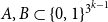 $A,B \subset \{0,1\}^{3^{k-1}}$
be a largest clique of
$A,B \subset \{0,1\}^{3^{k-1}}$
be a largest clique of $G^{(1)}_{k-1}$
and largest anticlique of
$G^{(1)}_{k-1}$
and largest anticlique of $G^{(0)}_{k-1}$
, respectively. Observe that for every
$G^{(0)}_{k-1}$
, respectively. Observe that for every $x_1, x_2 \in A$
, it holds that
$x_1, x_2 \in A$
, it holds that ${\textrm {NAE}}^{k-1}(x_1 \land x_2) = 1$
(whether or not
${\textrm {NAE}}^{k-1}(x_1 \land x_2) = 1$
(whether or not $x_1 = x_2$
). Likewise it holds that
$x_1 = x_2$
). Likewise it holds that ${\textrm {NAE}}^{k-1}$ $(y_1 \land y_2) = 0$
for every
$(y_1 \land y_2) = 0$
for every $y_1, y_2 \in B$
. Therefore, the sets
$y_1, y_2 \in B$
. Therefore, the sets
 \begin{equation*} B' {\,:\!=\,} A \times A \times A \subset \{0,1\}^{3^k}, \text{ and } A' {\,:\!=\,} \{0,1\}^{3^{k-1}} \times A \times B \subset \{0,1\}^{3^k} \end{equation*}
are an anticlique of $G^{(0)}_k$
, and a clique of
$G^{(0)}_k$
, and a clique of $G^{(1)}_k$
, respectively.
$G^{(1)}_k$
, respectively.
Combining the two bounds, it holds that $\omega _k \geqslant 2^{3^{k-1}} \alpha _{k-1} \omega _{k-1} \geqslant 2^{3^{k-1}} \omega _{k-1} \omega _{k-2}^3$
. Taking logs and denoting
$\omega _k \geqslant 2^{3^{k-1}} \alpha _{k-1} \omega _{k-1} \geqslant 2^{3^{k-1}} \omega _{k-1} \omega _{k-2}^3$
. Taking logs and denoting $a_k {\,:\!=\,} \log (\omega _k)$
, we thus arrive at the linear recurrence
$a_k {\,:\!=\,} \log (\omega _k)$
, we thus arrive at the linear recurrence $a_k = 3^{k-1} + a_{k-1} + 3 a_{k-2}$
. Denoting
$a_k = 3^{k-1} + a_{k-1} + 3 a_{k-2}$
. Denoting $a_k=3^k(1-\varepsilon _k)$
, the above translates into
$a_k=3^k(1-\varepsilon _k)$
, the above translates into
 \begin{equation*}3^k(1-\varepsilon _k)=3^{k-1}+3^{k-1}(1-\varepsilon _{k-1})+3^{k-1}(1-\varepsilon _{k-2})\end{equation*}
i.e.,
 \begin{equation} \varepsilon _k=\frac {\varepsilon _{k-1}+\varepsilon _{k-2}}{3} \end{equation}
and we conclude that $a_k=3^k (1 - o_k(1))$
, where the little-oh term is exponentially small in
$a_k=3^k (1 - o_k(1))$
, where the little-oh term is exponentially small in $k$
. To see this consider
$k$
. To see this consider $\lambda ^2-{\frac {\lambda +1}{3}}$
, the characteristic polynomial of Equation 2, the roots of which are
$\lambda ^2-{\frac {\lambda +1}{3}}$
, the characteristic polynomial of Equation 2, the roots of which are $\frac {1 \pm \sqrt {13}}{6}$
.
$\frac {1 \pm \sqrt {13}}{6}$
.
8. Open problems
Many intriguing questions regarding the Rank-Ramsey problem remain unanswered. For starters, the growth rate of the function $\nu _d(n)$
is mostly unknown. For bounded
$\nu _d(n)$
is mostly unknown. For bounded $d$
, we have shown (see Section 4) a polynomial separation between
$d$
, we have shown (see Section 4) a polynomial separation between $\nu _d(n)$
and
$\nu _d(n)$
and $n$
, starting at
$n$
, starting at $d=41$
. Is this true of all
$d=41$
. Is this true of all $d$
? Do there exist triangle-free Rank-Ramsey graphs? Concretely,
$d$
? Do there exist triangle-free Rank-Ramsey graphs? Concretely,
Open Problem 8.1.
Is there a constant $c \gt 0$
such that
$c \gt 0$
such that $\nu _2(n) = \mathcal{O}(n^{1-c})?$
The paper [Reference Linial, Mendelson, Schechtman and Shraibman42] advocates the perspective that rank is a complexity measure of sign matrices and mentions some additional measures of similar nature like $\gamma _2$
, margin complexity and more. Rather than demand that the complement rank be small, one can similarly investigate graphs with low clique number for which
$\gamma _2$
, margin complexity and more. Rather than demand that the complement rank be small, one can similarly investigate graphs with low clique number for which $\gamma _2(\overline {G})$
is also small etc.Footnote
20
$\gamma _2(\overline {G})$
is also small etc.Footnote
20
We saw several connections between Rank-Ramsey numbers and various graph parameters. Our list is far from exhausting all possible interesting ties. Could there be any relation with the Colin de Verdière parameter [Reference De Verdière20])? With other orthonormal representations of graphs (e.g., see [Reference Laurent and Varvitsiotis48])?
In Section 6, we briefly consider minimum semidefinite rank, and show $n$
-vertex triangle-free graphs
$n$
-vertex triangle-free graphs $G$
and
$G$
and $H$
, with both
$H$
, with both $\left (\textrm {msr}(G) - {\textrm {rank}}(A_G + I)\right ) = \Omega (n)$
and with
$\left (\textrm {msr}(G) - {\textrm {rank}}(A_G + I)\right ) = \Omega (n)$
and with $\left ({\textrm {rank}}(A_H + I) - \textrm {msr}(H)\right ) = \Omega (n)$
. The relation between the two is therefore likely nuanced. We find it interesting to understand what is the least distance, under the rank metric, between
$\left ({\textrm {rank}}(A_H + I) - \textrm {msr}(H)\right ) = \Omega (n)$
. The relation between the two is therefore likely nuanced. We find it interesting to understand what is the least distance, under the rank metric, between $A_G + I$
and a PSD representation matrix
$A_G + I$
and a PSD representation matrix $M$
for
$M$
for $G$
. Another quantity which we consider in Section 6, originating in orthonormal representations, is the Lovász number. We give some evidence that the Lovász number bounds the complement rank from below, perhaps up to a multiplicative constant. Thus, we ask:
$G$
. Another quantity which we consider in Section 6, originating in orthonormal representations, is the Lovász number. We give some evidence that the Lovász number bounds the complement rank from below, perhaps up to a multiplicative constant. Thus, we ask:
Open Problem 8.2.
What is the relation between $\vartheta (G)$
and
$\vartheta (G)$
and ${\textrm {rank}}(A_G + I)$
for a simple graph
${\textrm {rank}}(A_G + I)$
for a simple graph $G?$
$G?$
The regime of unbounded $d$
, which we explore in Section 5 is also of great interest. Recall that we construct a graph of logarithmic clique number, and polynomial rank. This is in stark contrast to the classical Ramsey problem, where in almost all graphs both the clique number and independence number are logarithmic. Naturally, we think that maintaining low-rank should be much harder than controlling the independence number. It is therefore quite natural to ask,
$d$
, which we explore in Section 5 is also of great interest. Recall that we construct a graph of logarithmic clique number, and polynomial rank. This is in stark contrast to the classical Ramsey problem, where in almost all graphs both the clique number and independence number are logarithmic. Naturally, we think that maintaining low-rank should be much harder than controlling the independence number. It is therefore quite natural to ask,
Open Problem 8.3.
What is the growth rate of $\nu _d(n)$
, as a function of
$\nu _d(n)$
, as a function of $d$
and
$d$
and $n$
$n$ $(\text{as } d=d(n) \to \infty )?$
In Subsection 2.2 we begin an exploration of the Rank-Ramsey numbers. Unlike the usual Ramsey numbers, which are symmetric (i.e., $R(s,t) = R(t,s)$
for every
$R(s,t) = R(t,s)$
for every $s$
and
$s$
and $t$
), this does not hold for our numbers. In fact, we determine the numbers
$t$
), this does not hold for our numbers. In fact, we determine the numbers $R^k(s,t)$
for every
$R^k(s,t)$
for every $2 \leqslant t \leqslant 5$
, and prove that
$2 \leqslant t \leqslant 5$
, and prove that $R^k(3,n) \gt R^k(n,3)$
for sufficiently large
$R^k(3,n) \gt R^k(n,3)$
for sufficiently large $n$
. It would be interesting to better understand the interplay between the clique number and complement rank.
$n$
. It would be interesting to better understand the interplay between the clique number and complement rank.
Another perspective of Rank-Ramsey numbers, stems from twin-free graphs. Recall that two vertices in a graph are called twins if they are non-adjacent and have the same set of neighbours. Pruning twins from a graph clearly affects neither the rank and nor chromatic number. Therefore, the sets $\mathcal{G}_r$
of all twin-free connected graphs of rank
$\mathcal{G}_r$
of all twin-free connected graphs of rank $r$
, play a crucial role in understanding the log-rank conjecture. Indeed, the log-rank problem (in particular, its graph-theoretic formulation, see Section 3) can be equivalently re-formulated as follows:
$r$
, play a crucial role in understanding the log-rank conjecture. Indeed, the log-rank problem (in particular, its graph-theoretic formulation, see Section 3) can be equivalently re-formulated as follows:
Equivalent formulation of Log-Rank problem
Is there a constant $c \gt 0$
such that
$c \gt 0$
such that $ \displaystyle \log \chi (G) \leqslant \mathcal{O} \left ( \log ^c r \right ) \,\text{for every}\,G \in \mathcal{G}_r\,\text{and every} \, r \gt 1 ?$
It would therefore be interesting to investigate the sets $\mathcal{G}_r$
, for a larger range of values
$\mathcal{G}_r$
, for a larger range of values $r$
.
$r$
.
A. The construction of Codenotti, Pudlák and Resta
Codenotti, Pudlák and Resta constructed [Reference Codenotti, Pudlák and Resta15] an interesting family of explicit triangle-free Ramsey graphs. The construction is elementary.
Theorem A.1 [Reference Codenotti, Pudlák and Resta15]. For every sufficiently large $n$
, there exists an
$n$
, there exists an $n$
-vertex triangle-free graph
$n$
-vertex triangle-free graph $H_n$
such that
$H_n$
such that ${\textrm {rank}}(A_{H_n} - 2I) = \mathcal{O}\left ( n^{3/4} \right )$
.
${\textrm {rank}}(A_{H_n} - 2I) = \mathcal{O}\left ( n^{3/4} \right )$
.
The construction is as follows: Let $G = (L \sqcup R, E)$
be a
$G = (L \sqcup R, E)$
be a $k$
-vertex bipartite graph with girth at least
$k$
-vertex bipartite graph with girth at least $8$
. Let
$8$
. Let $D = (E, \hat {E})$
be the directed graph whose vertices are the (undirected) edges of
$D = (E, \hat {E})$
be the directed graph whose vertices are the (undirected) edges of $G$
, and
$G$
, and
 \begin{equation*} \forall (l,r), (a,b) \in E\,:\, (l, r) \to _{D} (a, b) \iff (l \sim _{G} b) \land (a \ne l) \land (b \ne r) \end{equation*}
It is not hard to see that:
-
1.
${\textrm {rank}}(A_{D} - I) \leqslant k$
. -
2.
$D$
contains no transitive triangle. -
3. There are no back-and-forth edges in
$D$
.



The undirected graph $H$
whose adjacency matrix is
$H$
whose adjacency matrix is $A_H = A_D + A_D^T$
(i.e., omitting orientations) is therefore triangle-free, and has
$A_H = A_D + A_D^T$
(i.e., omitting orientations) is therefore triangle-free, and has ${\textrm {rank}}(A_H - 2I) \leqslant 2 {\textrm {rank}}(A_D - I) \leqslant 2k$
. It remains to fix the base graph
${\textrm {rank}}(A_H - 2I) \leqslant 2 {\textrm {rank}}(A_D - I) \leqslant 2k$
. It remains to fix the base graph $G$
to be bipartite, with large size relative to order, and of girth at least
$G$
to be bipartite, with large size relative to order, and of girth at least $8$
. For this, the graphs
$8$
. For this, the graphs $H_3$
of Wenger [Reference Wenger57] suffice: they have order
$H_3$
of Wenger [Reference Wenger57] suffice: they have order $k$
and size
$k$
and size $n=\mathcal{O}\left (k^{4/3}\right )$
.
$n=\mathcal{O}\left (k^{4/3}\right )$
.
As usual, $\alpha (H) \leqslant {\textrm {rank}}(A_{H} + c I)$
for any
$\alpha (H) \leqslant {\textrm {rank}}(A_{H} + c I)$
for any $c \ne 0$
, so this Theorem yields Ramsey graphs. While these graphs have very high multiplicity of the eigenvalue
$c \ne 0$
, so this Theorem yields Ramsey graphs. While these graphs have very high multiplicity of the eigenvalue $2$
(or
$2$
(or $-2$
, by the clique-tensoring trick of Lemma4.4), they are not Rank-Ramsey, as
$-2$
, by the clique-tensoring trick of Lemma4.4), they are not Rank-Ramsey, as ${\textrm {rank}}(A + I) \geqslant n - {\textrm {rank}}(A - 2I) = (1-o(1))n$
. Crucially, we remark that the matrix
${\textrm {rank}}(A + I) \geqslant n - {\textrm {rank}}(A - 2I) = (1-o(1))n$
. Crucially, we remark that the matrix $A_H - 2I$
is not binary.
$A_H - 2I$
is not binary.
B. Hoffman, Cvetković, Lovász and (Rank-)Ramsey
Any Rank-Ramsey graph is also a Ramsey graph, since ${\textrm {rank}}(A_G + I) \geqslant \alpha (G)$
holds for every graph
${\textrm {rank}}(A_G + I) \geqslant \alpha (G)$
holds for every graph $G$
. How does this bound compare to other known upper bounds on the independence number of a graph? Two of the best-known bounds are Hoffman’s ratio bound, and Cvetković’s inertia bound, both of which relate to the spectra of symmetric weighted adjacency matrices of a graph
$G$
. How does this bound compare to other known upper bounds on the independence number of a graph? Two of the best-known bounds are Hoffman’s ratio bound, and Cvetković’s inertia bound, both of which relate to the spectra of symmetric weighted adjacency matrices of a graph $G$
.
$G$
.
Definition B.1.
Let $G$
be a graph and let
$G$
be a graph and let $w: E(G) \to {\mathbb{R}}$
be a function. The weighted adjacency of
$w: E(G) \to {\mathbb{R}}$
be a function. The weighted adjacency of $G$
is the matrix:
$G$
is the matrix:
 \begin{equation*} A_{G,w} {\,:\!=\,} \left (w(\{x, y\}) \cdot \unicode {x1D7D9}\{x \sim y\}\right )_{x,y \in V(G)} \end{equation*}
Theorem B.2.
(Hoffman Bound) Let $G$
be an
$G$
be an $n$
-vertex graph and let
$n$
-vertex graph and let $w\,:\, E(G) \to {\mathbb{R}}$
be a weight function, such that
$w\,:\, E(G) \to {\mathbb{R}}$
be a weight function, such that $A_{G,w}$
has constant row sums. Then,
$A_{G,w}$
has constant row sums. Then,
 \begin{equation*} \alpha (G) \leqslant h(A_{G,w}) {\,:\!=\,} \left | \frac {\lambda _{min}(A_{G,w})}{\lambda _{max}(A_{G,w}) - \lambda _{min}(A_{G,w})} \right | \cdot n \end{equation*}
Theorem B.3.
(Cvetković Bound [Reference Calderbank and Frankl10, Reference Cvetković16]) Let $G$
be a graph and let
$G$
be a graph and let $w\,:\, E(G) \to {\mathbb{R}}$
be a weight function. Then,
$w\,:\, E(G) \to {\mathbb{R}}$
be a weight function. Then,
 \begin{equation*} \alpha (G) \leqslant c(A_{G,w}) {\,:\!=\,} \left | \left \{ \lambda \in \mathrm{spec}(A_{G,w}) \,:\, \lambda \geqslant 0 \right \} \right | \end{equation*}
For a graph $G$
, let
$G$
, let $h(G) {\,:\!=\,} \inf _{w} h(A_{G,w})$
and
$h(G) {\,:\!=\,} \inf _{w} h(A_{G,w})$
and $c(G) {\,:\!=\,} \inf _{w} c(A_{G,w})$
be the best-possible bounds attained by TheoremsB.2 and B.3, respectively. The Hoffman and Cvetković bounds had been at the centre of several longstanding problems in algebraic graph theory. Sinkovic [Reference Sinkovic53] constructed the first example of a graph for which
$c(G) {\,:\!=\,} \inf _{w} c(A_{G,w})$
be the best-possible bounds attained by TheoremsB.2 and B.3, respectively. The Hoffman and Cvetković bounds had been at the centre of several longstanding problems in algebraic graph theory. Sinkovic [Reference Sinkovic53] constructed the first example of a graph for which $c(G)$
is not tight, resolving decade-long an open question of Godsil [Reference Godsil27]. The comparability of Hoffman and Cvetković had similarly been undetermined until very recently: Kwan and Wigderson [Reference Kwan and Wigderson41] constructed a family of graphs for which
$c(G)$
is not tight, resolving decade-long an open question of Godsil [Reference Godsil27]. The comparability of Hoffman and Cvetković had similarly been undetermined until very recently: Kwan and Wigderson [Reference Kwan and Wigderson41] constructed a family of graphs for which $h(G) = o(c(G))$
, and a week later, Ihringer [Reference Ihringer33] gave an example of a family for which
$h(G) = o(c(G))$
, and a week later, Ihringer [Reference Ihringer33] gave an example of a family for which $c(G) = o(h(G))$
. Both of these separations are polynomial.
$c(G) = o(h(G))$
. Both of these separations are polynomial.
In this paper we consider two other bounds on the independence number $\alpha (G)$
:
$\alpha (G)$
: ${\textrm {rank}}(A_G+I)$
, by means of Rank-Ramsey graphs, and the Lovász theta
${\textrm {rank}}(A_G+I)$
, by means of Rank-Ramsey graphs, and the Lovász theta $\vartheta (G)$
, as discussed in Section 6. These two bounds are intimately related to Hoffman and Cvetković. Clearly
$\vartheta (G)$
, as discussed in Section 6. These two bounds are intimately related to Hoffman and Cvetković. Clearly ${\textrm {rank}}(A_G + I) = n - \mu _{A_G}$ $(-1) \geqslant c(G)$
. Moreover, it is well-known that
$(-1) \geqslant c(G)$
. Moreover, it is well-known that $\vartheta (G) \geqslant h(G)$
, for every graph
$\vartheta (G) \geqslant h(G)$
, for every graph $G$
. Therefore, we may think of
$G$
. Therefore, we may think of ${\textrm {rank}}(A_G+I)$
as a less-tight analogue of Cvetković’s bound, and of
${\textrm {rank}}(A_G+I)$
as a less-tight analogue of Cvetković’s bound, and of $\vartheta (G)$
is an analogue of Hoffman’s bound, and as such the task of comparing
$\vartheta (G)$
is an analogue of Hoffman’s bound, and as such the task of comparing ${\textrm {rank}}(A_G + I)$
and
${\textrm {rank}}(A_G + I)$
and $\vartheta (G)$
related to the well-known problem of comparing the ratio bound versus the inertia bound.
$\vartheta (G)$
related to the well-known problem of comparing the ratio bound versus the inertia bound.
























 Open access

