

Introduction
Social anxiety disorder (SAD) is one of the most prevalent co-occurring conditions amongst cognitively unimpaired autistic people, with estimates as high as half of all adults (Maddox and White, Reference Maddox and White2015). Individuals with SAD have a pronounced fear that when they enter a social situation they will say or do something that will be shaming or embarrassing and that they will be negatively evaluated by others (DSM-5; American Psychiatric Association, 2013). Patients with SAD often have unhelpful beliefs about themselves such as ‘I am different’; ‘I am weird’; or ‘I am inadequate’. They often fear rejection from others and may go to great lengths to prevent their worst fears from happening by engaging in a wide range of safety seeking behaviours (SSB).
Due to early life socio-communication differences, many autistic people have developed deep-rooted negative beliefs about themselves, others and the world (Spain et al., Reference Spain, Sin, Harwood, Mendez and Happé2017). Gaus (Reference Gaus2011) hypothesised that the social anxiety symptoms experienced by autistic people are often mistakenly thought to be core features of autistic spectrum disorder (ASD)Footnote 1 and part of autistic people’s identity. Maddox and White (Reference Maddox and White2015) have suggested that untreated SAD in autistic people may contribute to avoidance, delay social development, and have a significant impact on their well-being.
The complex interplay between social anxiety and social skills differences in autism makes diagnostic decisions regarding autism and co-presenting SAD an immensely intricate process (White et al., Reference White, Schry, Kreiser, Davis III, White and Ollendick2014). Furthermore, it has been found that autistic people may express social anxiety in ways that are both consistent and inconsistent with the DSM-5 criteria (Kerns et al., Reference Kerns, Kendall, Berry, Souders, Franklin, Schultz, Miller and Herrington2014). Maintaining factors for SAD in autistic people are under-researched (Spain et al., Reference Spain, Zıvralı Yarar and Happé2020), yet it appears that there is a specificity to the clinical presentation of SAD for autistic people, with implications for assessment and treatment (White et al., Reference White, Schry, Kreiser, Davis III, White and Ollendick2014; Wilson and Gullon-Scott, 2023).
The National Institute for Health and Care Excellence (2013) recommends therapy based on the Clark and Wells (Reference Clark, Wells, Heimberg, Liebowitz, Hope and Schneier1995) model as a first-line treatment for SAD. Clark and Wells’ (Reference Clark, Wells, Heimberg, Liebowitz, Hope and Schneier1995) highly influential cognitive model was developed and validated in typically developing adults. A recent study on how well the Clark and Wells (Reference Clark, Wells, Heimberg, Liebowitz, Hope and Schneier1995) model fits with the clinical presentation of autistic people with co-occurring SAD found that by and large the model is highly relevant to autistic people (Wilson and Gullon-Scott, 2023), but some adaptations to treatment are recommended to increase the effectiveness of treatment.
It has been suggested that making adaptations to therapy and the therapeutic environment enhances clinical outcomes for autistic people (National Institute for Health and Care Excellence, 2012; Walters et al., Reference Walters, Loades and Russell2016). Several authors have demonstrated that modifying standard cognitive behavioural therapy (CBT) for autistic individuals with co-occurring anxiety and/or depression enhances its efficacy (Bemmer et al., Reference Bemmer, Boulton, Thomas, Larke, Lah, Hickie and Guastella2021; Walters et al., Reference Walters, Loades and Russell2016; White et al., Reference White, Ollendick, Albano, Oswald, Johnson, Southam-Gerow, Kim and Scahill2013).
Autistic people can feel at odds with the world and are often misunderstood by the neurotypical majority. The double empathy problem (Milton, Reference Milton2012), to misunderstand others and being misunderstood by others, is expected to be less prominent when autistic people interact with their peers (Mitchell et al., Reference Mitchell, Sheppard and Cassidy2021). A group-based intervention exclusively open to autistic people may therefore provide a safe environment for learning. Furthermore, psychoeducation created specifically for autistic people (i.e. the impact of masking, the double empathy problem) may also be provided to increase resilience and decrease shame.
There is a steady growth of research, particularly with children and young people, that has shown promising results on the efficacy of modified CBT for anxiety in autism (Bemmer et al., Reference Bemmer, Boulton, Thomas, Larke, Lah, Hickie and Guastella2021; Reaven et al., Reference Reaven, Blakeley-Smith, Culhane-Shelburne and Hepburn2011; White et al., 2013). The financial pressures the National Health Service (NHS) have been under means that finding resource-efficient and efficacious treatment is critical, particularly given the prevalence of co-occurring diagnosis within autistic populations (Hollocks et al., Reference Hollocks, Lerh, Magiati, Meiser-Stedman and Brugha2018). Short-term groups such as modified CBT intervention are generally deemed resource-effective, with reduced therapist input and a low cost which may alleviate some of these pressures by providing a practical and cost-effective treatment.
The evidence base literature has shown that autistic people may express social anxiety in atypical ways. For instance, they may not necessarily be concerned about negative social evaluation, an essential feature of SAD in neurotypical individuals per se but worry about their lack of understanding of neurotypical social norms and their perceived (or real) limited social skills (Maddox and White, Reference Maddox and White2015). Despite this, most elements of the Clark and Wells (Reference Clark, Wells, Heimberg, Liebowitz, Hope and Schneier1995) model are still highly pertinent for autistic people (Pickard et al., Reference Pickard, Hirsch, Simonoff and Happé2020; Wood et al., Reference Wood, Rusbridge, Lei, Lomax, Elliston and Russell2021; Wilson and Gullon-Scott, 2023). For instance, self-focus of attention (including focusing on bodily symptoms), and the extensive use of SSB, are likely playing a pivotal role in maintaining SAD in autistic people.
The difficulties with social interaction and communication that are typical for autistic people also appear to play a central role in the maintenance of anxiety (White et al., 2013). Exercises such as the assertive defence of the self (Padesky, Reference Padesky1997) may potentially support participants building their social confidence so they can fully engage with behavioural experiments that are central in cognitive therapy for SAD (CT-SAD). The double empathy problem (Mitchell et al., Reference Mitchell, Sheppard and Cassidy2021) is expected to be less prominent when autistic people interact with one another, which could allow participants to develop and practise social skills and plan experiments within the group itself (i.e. speaking up, raising their hand, etc.). In addition, online therapy may enable participants to have more control of their environment and control sensory input as well as increasing accessibly.
The present study aimed to create and pilot an adapted SAD treatment protocol for autistic people based on the Clark and Wells (Reference Clark, Wells, Heimberg, Liebowitz, Hope and Schneier1995) model, including assessing its feasibility and acceptability. The following aims were pursued:
-
(1) To co-adapt with autistic people a manualised and bespoke group treatment protocol for SAD based on the Clark and Wells (Reference Clark, Wells, Heimberg, Liebowitz, Hope and Schneier1995) model.
-
(2) To pilot the group intervention with diagnosed or self-identified autistic people.
-
(3) To determine the feasibility and acceptability of the intervention for both participants and the researcher.
Method
Study design
The feasibility and acceptability study consisted of a pilot group intervention, and a study in the form of a focus group. Participants who met the inclusion criteria were offered a place on the pilot where standard questionnaires were used to gain preliminary evidence of its efficacy. Following completion of the therapy group, participants were invited to take part in a focus group to share their experiences and give feedback on the intervention. The qualitative study will be reported separately.
The feasibility of the study will be assessed through investigation of the following criteria:
-
(a) Recruitment: a minimum of six participants is required for the intervention to be viable in a group format.
-
(b) Data collection: data should be collected at a minimum of three interval points during the intervention.
-
(c) Delivery of all the essential components of CT-SAD remotely: setting up and carrying out behavioural experiments including video feedback experiments are central to determine the feasibility of the intervention.
The acceptability of the intervention will be assessed with the following criteria:
-
(a) Retention of participants: a retention of 90% would indicate a high degree of participant satisfaction.
-
(b) Attendance rate: a minimum of 80% attendance would indicate a high level of acceptability to our participants
Participants
Eligible participants were adults with a known or self-identified autism diagnosis with a minimum score of 32 on the Autism Quotient (AQ; Baron-Cohen et al., Reference Baron-Cohen, Wheelwright, Skinner, Martin and Clubley2001) and current SAD with a score of 30 (clinical cut-off for SAD) and above on the Leibowitz Social Anxiety Scale, Self-Report (LSAS-SR; Liebowitz, Reference Liebowitz1987). A score of 32 on the AQ was chosen as a useful cut-off, as 79.3% of autistic people were found to score at this level or higher on this scale, with a 2% false positive rate (Baron-Cohen et al., Reference Baron-Cohen, Hoekstra, Knickmeyer and Wheelwright2006). Information on current and previous psychological and pharmacological treatment was collected. Excluded (see Fig. 1) were those who were currently receiving any type of psychotherapy. Also excluded were individuals with a high risk of suicide such that clinical need exceeded a group intervention, a low English proficiency, a current alcohol or substance misuse, or a history of psychosis.
Consort flow diagram.

Recruitment
Participants were recruited through several agencies including North East Autism Society, The Recovery College, Newcastle University Student Health and Wellbeing service, as well as through advertising on online platforms such as X (formerly known as Twitter) and Viva Engage (Newcastle University social media platform for students and staff). Prospective participants were introduced to the study via an online platform (Qualtrics) where contact details and demographic information were collected. Those interested in the study who gave consent to be contacted by the researcher were assessed according to the inclusion and exclusion criteria. Participants were given an information sheet detailing the aims and objectives of the study and what taking part would entail. Fully informed consent in writing was obtained from eligible participants who wished to take part in the study. A total of eight participants met the inclusion criteria and were offered a place on the course. Four participants had an established diagnosis of autism, and four participants self-identified as autistic and were on a waiting list for an autism assessment.
Prior to their assessment, each prospective participant was asked to complete a battery of self-report measures assessing characteristics of autism, social anxiety and depression to support the screening process. To ensure that social anxiety was a significant feature in their clinical presentation, the clinical interview incorporated questions to determine whether all the criteria from the DSM-5 for SAD were met. The social anxiety and depression measures were also completed at session 1 to be used as our baseline scores. Thereafter, the measures were completed every other session until the last session of the intervention. Measures of social anxiety (LSAS-SR and Social Cognitions Questionnaire; SCQ) were included as primary outcome measures, and the measure of depression was included as a secondary outcome measure.
Intervention
The current intervention was co-adapted with autistic people who informed the modifications made to the standard treatment protocol. Our program is titled ‘Building Social Confidence: a Cognitive Behavioural Therapy (CBT) group for autistic people’ (BSC-CBT). The intervention used in the current study is a CBT program adapted from an established social anxiety treatment program (Warnock-Parkes et al., Reference Warnock-Parkes, Wild, Thew, Kerr, Grey and Clark2022) derived from the Clark and Wells (Reference Clark, Wells, Heimberg, Liebowitz, Hope and Schneier1995) cognitive model of social anxiety. The intervention consisted of material for 12 weekly sessions, with a new theme introduced each week that included psychoeducation and the application of a change method (Table 1). The intervention was tailored to meet the needs of autistic people or self-identified autistic people with co-occurring SAD who may have difficulty implementing cognitive and/or behavioural interventions that were originally designed for neurotypical populations. No social skills training was included in the BSC-CBT treatment protocol.
Session content and adaptations

Development
As suggested by the Medical Research Council (MRC) in their highly influential framework for developing and evaluating intervention (Skivington et al., Reference Skivington, Matthews, Simpson, Craig, Baird, Blazeby, Boyd, Craig, French, McIntosh, Petticrew, Rycroft-Malone, White and Moore2021), our intervention was developed using the existing research evidence for the program theory, involved stakeholders, and was an iterative process. During each phase of the intervention development the treatment plan was amended (Fig. 2). With regard to the development of complex intervention such as this study, the MRC suggests involving stakeholders. In this context, both service users (autistic people) and professionals in the field (psychologists delivering CBT) were consulted during each phase of the intervention development; their contributions directly influenced how the intervention was created and changed according to their feedback. The MRC also suggests carrying out a feasibility study for the development of complex interventions. The main aim of this study was the feasibility and acceptability of the intervention. The emphasis was to reduce uncertainty around recruitment, the feasibility of data collection, the retention of participants, and the acceptability of the intervention for autistic people.
Intervention development flow chart.

Rationale for adaptations
The adaptations made to the treatment protocol for autistic people followed the NICE guidelines (National Institute for Health and Care Excellence, 2012). For instance, it is recommended to use written information and visual tools during therapy with autistic people. An important feature of the intervention was that each week participants were given a written summary, and visual information such as videos and images were used to aid learning. In addition, the protocol emphasised behavioural changes and included special interests (National Institute for Health and Care Excellence, 2012). The inclusion of complex information such as the double empathy problem (Milton, Reference Milton2012) was approved by the autistic people who took part in the intervention development phase, who felt that it was extremely relevant to their experience. Our protocol did not include the use of complicated metaphors, and concrete language was used throughout the course both during session and within the written summaries. The use of technology was an adaptation recommended by autistic people during the focus group. They felt having a systematic and predictable way of communicating with others (i.e. using the chat and hand raising functions) would decrease uncertainty and facilitate connection with the group. Furthermore, the sensory environment has been found to be an important area of adaptation for autistic people (Brice et al., Reference Brice, Rodgers, Ingham, Mason, Wilson, Freeston, Le Couteur and Parr2021). In this context, we made the decision to offer the intervention online, to give participants more control over their sensory input. One of the central adaptations recommended by autistic people during the focus group was to change the formulation SSB examples. Autistic people felt that some of the ‘traditional’ SSBs did not necessarily fit with their experience. For instance, not making eye contact was reported to be a useful strategy that can facilitate engagement in conversations with others. Autistic people also felt that experimenting with ‘masking vs unmasking’ in social situations should be made explicit to encourage participants to embrace their autism identity.
Content and session overview
The pilot consisted of 12 weekly sessions of 2 hours, and we additionally offered one follow-up session at 1-month post-intervention. In addition, each participant was offered two individual 45- minute sessions over the course of the intervention. The first individual session (between sessions 3 and 4) was aimed at creating a bespoke formulation using Clark and Wells’ (Reference Clark, Wells, Heimberg, Liebowitz, Hope and Schneier1995) model and setting up goals. The second individual session was booked to complete a video feedback experiment by reviewing a video made during our weekly group session (session 9). See Table 1 for session content and adaptations.
Each session followed the CBT principles, with agenda setting, mood review, home task review, psychoeducational elements, as well as the introduction of a technique or a change method and setting up a new home task for the week. Participants were also invited to work in pairs and share their thoughts and feelings with the wider group either through speaking up if they felt able doing so or using the chat function of Microsoft Teams. Each week participants were sent a session resource pack containing a session summary and forms where to record their home task.
Measures
The LSAS-SR is a 24-item measure assessing symptoms of social anxiety that has shown reliability when used with autistic adults (Boulton and Guastella, Reference Boulton and Guastella2021). The cut-off score for the LSAS-SR is 30 and levels of severity of social anxiety are as follows: 30–49 mild social anxiety; 50–64 moderate social anxiety; 65–79 marked social anxiety; 80–94 severe social anxiety; ≥95 very severe social anxiety.
The Social Cognitions Questionnaire (SCQ; Wells et al., Reference Wells, Stopa and Clark1993) is a questionnaire that assesses the most common social anxiety disorder related negative automatic thoughts. This questionnaire has not yet been validated in autistic populations. Participants rate both the frequency of the thought (1–5) and the belief in the thought (0–100). Higher scores on this questionnaire indicate a higher severity of symptoms. This questionnaire is a useful tool as it can capture changes in the frequency and the intensity of commonly held beliefs and thoughts related to social anxiety. For a statistical analysis, OxCADAT (2018) recommends calculating separate mean scores for the frequency (mean ranges from 1 to 5) and for belief (mean ranges from 0 to 100), with lower scores indicating a better outcome.
The Patient Health Questionnaire-9 (PHQ-9; Kroenke et al., Reference Kroenke, Spitzer and Williams2001) is a reliable and valid 9-item measure of low mood and depression symptoms commonly used in primary and secondary care settings. The measure has been validated for autistic people (Arnold et al., Reference Arnold, Uljarević, Hwang, Richdale, Trollor and Lawson2019). It was used as one of our secondary outcome measures. The levels of severity of depression symptoms on this scale are as follows: 5–9 mild; 10–14 moderate; 15–19 moderately severe; ≥20 severe depression symptoms.
Sample size
The emphasis of the study being the feasibility and acceptability of the intervention, there was no formal sample size calculation. A small sample size group means that the efficacy of this pilot intervention may be vulnerable to false positive and false negative findings (Kraemer et al., Reference Kraemer and Kupfer2006). Therefore, the pre–post change analysis is presented as a secondary aim. A number of 5–10 participants is thought to be the optimal size for group therapy (Biggs et al., Reference Biggs, Hind, Gossage-Worrall, Sprange, White, Wright, Chatters, Berry, Papaioannou, Bradburn, Walters and Cooper2020). Furthermore, a small group should create enough opportunities for interaction between participants as well as giving everyone sufficient therapeutic input from the facilitators.
Data analyses
Our hypothesis was that our adapted CBT intervention for autistic people would yield a positive result in terms of SAD symptoms reduction. Paired-samples t-tests were carried out to compare pre-treatment with post-treatment scores on all the self-report questionnaires. We aimed for an attendance rate of 80% for the intervention across our sample and to recruit a minimum of six participants for the group intervention to be viable.
Procedure
The intervention was delivered in a group format between 27 October 2023 and 26 January 2024. The focus group took place on 2 February 2024. The follow-up session took place on 1 March 2024. Participants were sent a link to complete outcome measures every other session. The group was facilitated by a BABCP accredited CBT therapist and an assistant psychologist.
Results
Feasibility of recruitment
With regard to recruitment, offering an online group greatly facilitated the process as prospective participants were able to sign up for the intervention from anywhere in the UK. Furthermore, offering remote assessment supported the screening stage, saving a great deal of time as it was possible for the researcher to write assessment notes whilst assessing prospective participants. Participant recruitment for the intervention started in August 2023 and was completed by mid-October 2023. Twenty-three people contacted the researcher to opt in to the study. Twelve individuals who expressed an interest in taking part in the study attended a screening assessment (n=12/23). Eight adults who were assessed were offered a place on the course (n=8/12). Seven participants who were offered the intervention attended and completed the intervention (n=7/8). One participant declined their place on the course due to work commitments. What was remarkable is that seven out of seven participants completed the course, with a 95% total attendance rate across the 12 therapy sessions.
Demographics
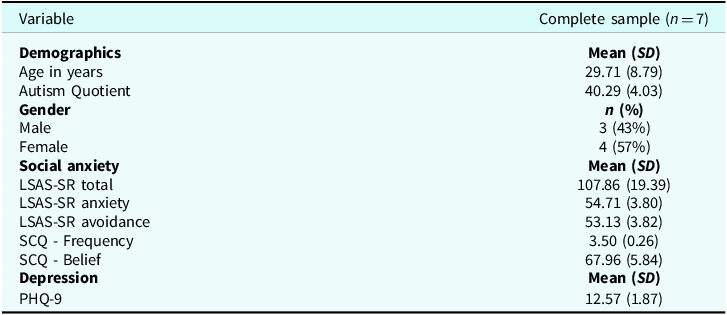
Descriptive statistics were calculated for age, scores on the LSAS-SR and PHQ-9 at baseline (Table 2). Levels of social anxiety were high across our sample, with a mean score on the LSAS of 107.86 (SD=19.39). All participants (n=7) had prior experience of psychological therapy.
Participant characteristics and mean scores at baseline
Feasibility and acceptability of intervention
The excellent completion and attendance rates (respectively 100% and 95%), indicate that the intervention was acceptable to our participants. Out of all the prospective participants who were offered the intervention, one participant (n=1/8) withdrew from treatment at the start of the course. Seven out of seven participants who attended the course completed the intervention. A total of four sessions across all participants were missed, with no participants missing more than one session. One participant (n=1/6) who completed the course did not attend the follow-up session. All participants completed the measures at the start and end of the intervention; one participant (n=1/6) did not attend the focus group. The video feedback experiment which was central to the intervention was carried out by all participants (n=7/7). The group was delivered online, all participants felt able to put their camera on and participated in all the activities including breakout room exercises done in pairs.
Pre–post change
A paired sample t-test on for the SCQ Belief subscale showed that there was a significant effect of the intervention on the pre (mean: 67.96; SD: 15.44) and post (mean: 51.60; SD: 23.94) scores, t 6=2.321, p<.05, d=1.085. Participants’ beliefs in negative social cognitions about themselves significantly reduced following the intervention. The reduction in belief scores were maintained at the follow-up session (t 6=2.867, p<.05, d=1.084). Participants scored significantly lower on the SCQ Belief subscale after attending the intervention at follow-up (mean: 52.85; SD: 23.50) compared with before the intervention at baseline (mean: 67.96; SD: 15.44).
A paired sample t-test on the LSAS-SR showed there was no significant effect of the intervention on this measure. Comparisons of scores pre (mean: 107.86; SD: 19.39) and post (mean: 95.57; SD: 14.80) intervention indicated there was no statistically significant reduction on the LSAS total scores, t 6=1.66, p=.147, d=.629.
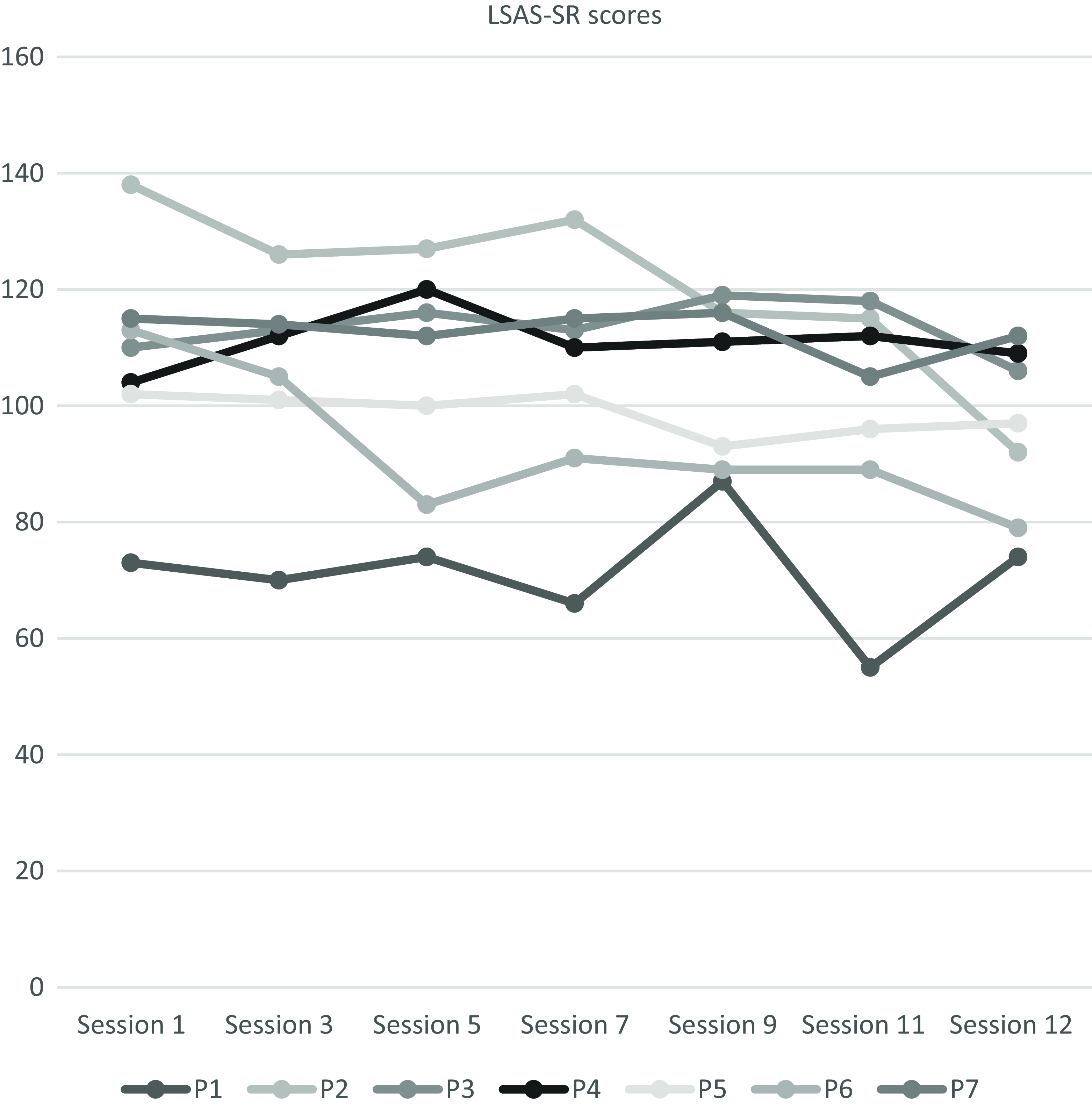
Even though there was no statistical difference between the pre and post scores on the LSAS-SR across our sample, three out of our seven participants experienced a clinically significant drop in their scores of more than 30 points (Fig. 3).
LSAS-SR scores by participants.
Turning to consider the secondary outcome measure, PHQ-9 scores did not overall improve following the intervention. A paired sample t-test showed that there was no significant effect of the intervention on this measure. Comparisons of scores pre (mean: 12.57; SD: 4.96) and post (mean: 9.14; SD: 4.91) intervention indicated there was no statistically significant reduction on the PHQ-9 scores, t 6=2.87, p=.66, d=.877.
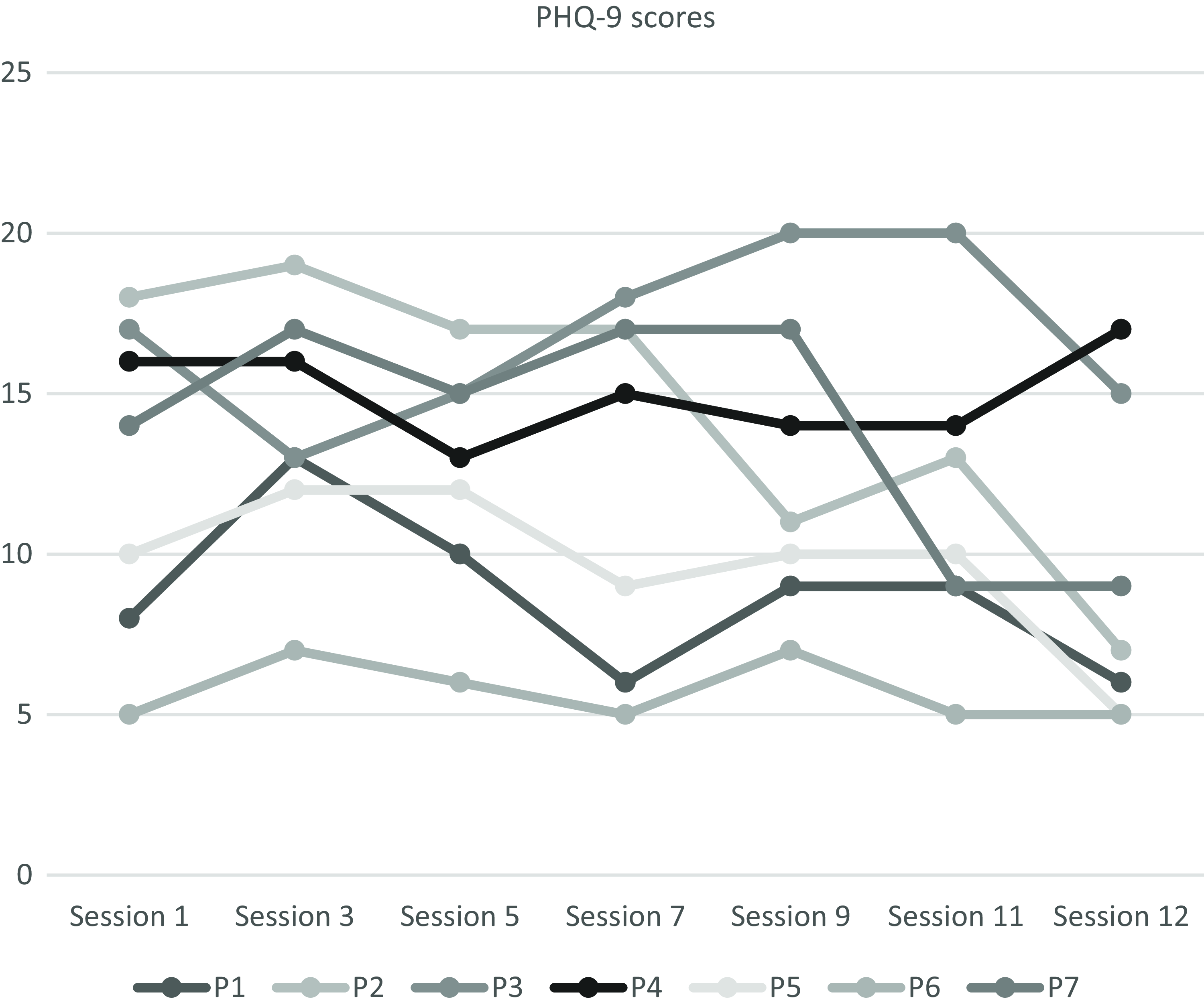
However, it feels important to highlight that out of the five participants who scored above the clinical threshold for depression on the PHQ-9 at baseline (scores ⩾10), three participants moved to subclinical levels by the end of the course indicating remission from depression (Fig. 4). These results are a positive sign that our intervention was beneficial.
PHQ-9 scores by participants.
Discussion
The BSC-CBT pilot group demonstrated that our intervention is a feasible and acceptable intervention for autistic individuals with a diagnosis of SAD.
With regard to feasibility, we met our initial aims of recruiting our intended sample size of a minimum of six participants for the intervention with an attendance rate of at least 80% of sessions, which we considered the minimum therapeutic dose. Furthermore, it was feasible to develop and implement a bespoke CBT intervention for autistic adults with SAD and to successfully deliver it online, including all the essential features of cognitive therapy for social anxiety (i.e. video feedback experiments, surveys, etc.). Guidance on how to deliver CT-SAD remotely for neurotypical individuals greatly supported our research (Warnock-Parkes et al., Reference Warnock-Parkes, Wild, Thew, Kerr, Grey, Stott, Ehlers and Clark2020). Outcome measures were collected every other week, which demonstrates that for services such as Improving Access to Psychological Therapies (IAPT) enough data can be collected to meet requirements with regard to data collection.
Our attrition rate (12%) was relatively low, with seven out of eight prospective participants who were offered the intervention, attending and completing the course. Participants highlighted that despite their social anxiety, they welcomed and thoroughly enjoyed sharing the experience with other autistic people. Positive autism social identity and social connection with other neurodivergent people may have played a part in the success of this intervention. From a clinician standpoint, delivering the intervention in a group format was highly beneficial as it enabled group participants to relate with one another, creating safe opportunities for role-plays, experiments, and social connection. The video feedback experiment was particularly enhanced by the group format as it created a live audience for each participant to conduct behavioural experiments in front of.
Social anxiety symptoms in this sample were high, with a mean score on the LSAS-SR of 107. At baseline all our participants’ scores except one fell in the very severe symptoms range. Even though there was no statistically significant reduction on LSAS-SR scores overall across our sample, three of our participants had a clinically significant decrease in their scores on the LSAS-SR by the end of the course. Similarly, with regard to the PHQ-9 there was no statistical difference between the pre and post measures across our sample, but three participants out of five moved to a subclinical level by the end of the course. As highlighted, the lack of statistical power within this small pilot limits the conclusions that can be drawn following the quantitative analysis. Measures to assess changes in safety-seeking behaviours may benefit any future larger scale study to determine whether the intervention influences behavioural change.
Further research on the content of the intervention could determine what components of the intervention led to positive outcomes and what elements may have hindered recovery for some participants; an extensive qualitative analysis may support findings by analysing participants’ views on their experience of attending the course and make recommendations to improve clinical outcomes.
An interesting finding in the study was the extent to which belief ratings in negative thoughts on the SCQ subscale decreased by the end of the course across our sample. These observed reductions in social anxiety cognitions are a positive sign that the intervention has had a positive impact on participants’ view of themselves. A decline in negative social anxiety-related cognitions is thought to be closely associated with treatment progress (Hofmann, Reference Hofmann2007). As negative self-belief plays a central role in the development and maintenance of SAD, this raises questions about the sensitivity of the LSAS-SR scales in autism as there was no statistically significant improvement in terms of core social anxiety symptoms according to this scale. Given the complex interplay between core autism features and SAD, measures of social anxiety in autistic people may not be sensitive enough to distinguish between social skills differences and SAD symptoms.
Strength and limitations
A strength of this study is that autistic people were involved at every stage of the intervention development. We believe that the co-adaptation of BSC-CBT enhanced its acceptability for this population thanks in part to the collection and use of service users’ experiences both prior and after the pilot intervention.
However, there are several important limitations that must be considered. The lack of a control group means that the pre–post reduction in negative cognitions cannot be directly attributed to the intervention, as other factors such as meeting other neurodivergent individuals may have played a role in changes observed. Furthermore our sample size was small, therefore our study lacked statistical power. In addition, the reliance on self-report measures may not be the most reliable way to measure changes in social anxiety symptoms. This feels particularly true as all the measures we used were developed for neurotypical populations. As aforementioned, autism core features may be overlapping with social anxiety symptoms assessed with the LSAS-SR. Future research could address these issues through having a control group and the inclusion of blind to treatment assignment outcomes assessors to reduce the risk of bias and ensure the validity of findings. An external assessor may also facilitate the collection of qualitative data through a focus group or interviews to ensure participants can feel free to share both their negative and positive experiences. Socioeconomic status and ethnicity data were not collected, which limits the generalisability of our findings.
Implications of the results for practice, policy and future research
Practice
The BSC-CBT intervention challenges the view that autistic individuals may be unwilling or unable to attend a group intervention due to their heightened anxiety about interacting with others. The group was part of the therapeutic process and proved to be both containing and safe for participants. Furthermore, the group format meant that it was possible to carry out video feedback experiments in front of a live audience which was the perfect set-up to activate the fear response and challenge unhelpful beliefs and predictions. The delivery of CT-SAD with a small group of people may be acceptable to service users with an autism diagnosis. It should be highlighted that for neurotypical individuals the benefits of attending group therapy may not be as pronounced as for autistic people, but it also could be considered particularly when service resources are limited.
Policy
There is currently a gap in the provision of treatment for autistic people within the NHS. Group interventions in primary care settings are cost effective and may lessen the burden on statutory services. Our hope is that the BSC-CBT intervention will be further researched to establish its efficacy. We feel that research in real-life settings such as primary care psychological services may be a positive way forward to gather evidence about how well the program may be used within existing talking therapies services.
Future research
We now need efficacy evidence from larger pre–post studies to replicate or challenge these results with a view to conducting a randomised study in the future. As a first step towards this it may be helpful to deliver BSC-CBT groups in a variety of settings including within the NHS to gather further evidence of its efficacy and feasibility with larger samples.
With regard to the next iteration of the intervention, we recommend spreading the content of the group over 14 sessions of no more than 90 minutes per week (see Supplementary material for session-by-session protocol). A minimum of two breaks should also be included (5–15 minutes) to ensure that participants are not overwhelmed and have time to process the content of the group. It may also be helpful to carry out a video feedback experiment earlier in the curriculum, possibly at session 7 or 8 to allow enough time to process new learnings and repeat the experiment if needed.
Conclusion
These findings extend previous research and support the continued adaptation of CBT interventions for autistic people. Furthermore, the evidence of feasibility indicates that further study to evaluate the efficacy of this group intervention is warranted and can be achieved in a range of settings including within the NHS.
Ethical statement
Consideration of the Code of Human Research Ethics of the British Psychological Society (British Psychological Society, 2021) was at the forefront of this during its inception and throughout its delivery. As such, potential ethical issues were identified early in the design process and informed the applications for Newcastle University Ethical Approval. Below are examples of how the code of ethics was adhered to during the project.
Prior to the group we carefully thought about our inclusion criteria and how it may exclude autistic individuals in need of support. In this instance, we shared a list of local services where autistic people can get support and self-refer for psychotherapy within primary care services. We also gave crisis numbers to all prospective participants so they could reach someone if they felt at risk of harming themselves or someone else. A list of exclusion criteria had also been considered in order to minimise the impact of co-occurring diagnosis and risk to group participants. Similarly, a list of local services was made available to everyone taking part in the assessment (i.e. substance misuse services, autism support, etc.). After receiving and reading an information summary leaflet about the study, participants were encouraged to speak to someone they trust about taking part in the study, reflect on the pros and cons of taking part, and sign the consent form if they wished to take part in the study.
Furthermore, a thorough risk assessment was undertaken and co-signed by the project supervisor (F.G.-S.). To avoid disappointment, our recruitment poster clearly stated the main inclusion criteria (autism and social anxiety). Every prospective participant was offered a ‘triage’ assessment to determine whether the therapeutic intervention was best suited to meet their needs. At the start of the triage, it was made clear that the aim of the triage was to determine whether the intervention was the right fit for them. When the intervention was deemed unsuitable for the prospective participants they were signposted to the appropriate service and/or encouraged to speak to their GP for further support.
Participation in the study was entirely voluntary. The group nature of the intervention was highlighted by the researcher at the initial assessment stage. It was additionally emphasised that participants did not have to share personal examples, speak up or answer questions put to the group if they did not wish to. Participants were made aware of their right to withdraw from the study or discontinue with the group at any point during therapy. All this information was clearly stated in our information sheet but also reiterated verbally at the start of the intervention.
Key practice points
-
(1) Autistic people can engage and benefit from CT-SAD when adaptations are made to meet their needs.
-
(2) All of the core components of CT-SAD, including video feedback experiments, can be successfully delivered online in a group format for autistic people.
-
(3) Group delivery can enhance engagement and support practical tasks such as role-plays and behavioural experiments.
-
(4) Group online sessions should not exceed 90 minutes, regular breaks should be scheduled in advance, and the structure and timing of each session should be closely followed to promote safety.
-
(5) Therapists may want to encourage participants to embrace their autism identity, through experimenting with masking/unmasking experiments in and out of session and testing out unhelpful beliefs.
Supplementary material
To view supplementary material for this article, please visit https://doi.org/10.1017/S1754470X25100147
Data availability statement
The data that support the findings of this study are available in anonymised form from the corresponding author (B.B.) on request.
Acknowledgements
The authors would like to thank Dr Emma Warnock-Parkes for her support and guidance throughout this project.
Author contributions
Badri Bechlem: Conceptualization (lead), Data curation (lead), Formal analysis (lead), Investigation (lead), Methodology (lead), Project administration (lead), Writing - original draft (lead). Fiona Gullon-Scott: Supervision (lead), Writing - review & editing (equal).
Financial support
This research received no external funding.
Competing interests
The authors have no competing interests to declare for this study.
Ethical standards
Ethical approval for the study was granted by Newcastle University’s Research Ethics Committee (reference no. 2578/33244). The authors followed the Ethical Principles of Psychologists and Code of Conduct as set out by the BABCP and BPS.


 Open access


Comments
No Comments have been published for this article.