


Introduction
It is now well-known that the prevalence of both diabetes and mental health problems is increasing rapidly, with a greater risk for depression in people with diabetes compared to those without (Nouwen, Reference Nouwen2010; Reference Nouwen2015; Lloyd et al., Reference Lloyd, Roy, Nouwen and Chauhan2012; Roy and Lloyd, Reference Roy and Lloyd2012; Mommersteeg et al., Reference Mommersteeg, Herr, Pouwer, Holt and Loerbroks2013; Salinero-Fort et al., Reference Salinero-Fort, Gómez-Campelo, San Andrés-Rebollo, Cardenas-Valladolid, Abánades-Herranz, Carrillo de Santa Pau, Chico-Moraleja, Beamud-Victoria, Miguel-Yanes, Jimenez-Garcia, López-de-Andres, Ramallo-Fariña and De Burgos-Lunar2018). Comorbid diabetes and depression are linked to increased mortality as well as a greater risk for developing other conditions including heart and kidney disease (Reeves et al., Reference Reeves, Alhurani, Frazier, Watkins, Lennie and Moser2015; Novak et al., Reference Novak, Mucsi, Rhee, Streja, Lu, Kalantar-Zadeh, Molnar and Kovesdy2016; Naicker et al., Reference Naicker, Johnson, Skogen, Manuel, Øverland, Sivertsen and Colman2017; Nouwen et al., Reference Nouwen, Adriaanse, van Dam, Iversen, Viechtbauer, Peyrot, Caramlau, Kokoszka, Kanc, de Groot, Nefs and Pouwer2019). In addition, the combination of diabetes and depression has a far greater impact on well-being compared with depression and other comorbid diseases (Moussavi et al., Reference Moussavi, Chatterji, Verdes, Tandon, Patel and Bedirhan2007). There is evidence that depression can be treated successfully with both psychological and pharmacological interventions in people with diabetes (van der Feltz-Cornelis et al., Reference Van der Feltz-Cornelis, Nuyen, Stoop, Jacobson, Katon, Snoek and Sartorius2010; Nicolau et al., Reference Nicolau, Rivera and Francés2013); however, more research is required to clarify which factors predict the onset of this condition. In addition, there are extra challenges given that emotional distress may be present in people with diabetes due to difficulties with the sometimes overwhelming requirements of self-management which can, in turn, impact on and be influenced by depression (van der Feltz-Cornelis et al., Reference Van der Feltz-Cornelis, Nuyen, Stoop, Jacobson, Katon, Snoek and Sartorius2010; Baumeister et al., Reference Baumeister, Hutter and Bengel2012; Petrak et al., Reference Petrak, Baumeister, Skinner, Brown and Holt2015). Indeed, our own research has demonstrated that both elevated levels of diabetes-related emotional distress and a history of depression were independently associated with major depressive disorder (MDD) (Lloyd et al., Reference Lloyd2015; Lloyd et al., Reference Lloyd, Sartorius, Lloyd, Nouwen and Sartorius2018). A systematic review has suggested that diabetes distress can be reduced with tailored interventions (Schmidt et al., Reference Schmidt, Potter van Loon, Vergouwen, Snoek and Honig2018), although it may be difficult to disentangle diabetes distress from depressive symptoms (Snoek et al., Reference Snoek, Bremmer and Hermanns2015). Longitudinal studies investigating risk factors for the incidence of clinically diagnosed depression in people with diabetes are few and far between; this paper reports the follow-up results from the INTERPRET-DD study which now has data collected in 12 countries (Lloyd et al., Reference Lloyd2015); a study that is unique as it includes both a clinical diagnosis of depression and depressive symptoms as well as a measure of diabetes-related emotional distress, carried out in countries with vast differences in culture and health systems. We aimed to identify specific risk factors for the onset of diagnosed depression as well as depressive symptoms in this cohort of individuals with type 2 diabetes.
This study was initiated within the framework of the Dialogue on Diabetes and Depression (http://diabetesanddepression.org/), an international alliance of associations and organisations and continued under the auspices of the Association for the Improvement of Mental Health Programmes, a non-governmental organisation in Geneva engaged in educational and other programmes dealing with the comorbidity of mental and physical disorders (Sartorius and Cimino, Reference Sartorius and Cimino2012).
Materials and methods
A full description of our protocol is provided in our earlier papers (Lloyd et al., Reference Lloyd2015; Lloyd et al., Reference Lloyd, Sartorius, Lloyd, Nouwen and Sartorius2018). In brief, between September 2013 and May 2015, a sample of consecutive out-patient clinic attenders with type 2 diabetes at each of the study sites was invited to participate in the study, with the aim of including 200 people with type 2 diabetes in each country. The teams of investigators in the collaborating sites (recruited from leading centres of excellence in their country) included at least one psychiatrist and one endocrinologist in each country. The treating physician or diabetologist in the diabetes clinic invited individuals to participate in the study. Diabetes clinics were based in either secondary or tertiary care centres, depending on the facilities available in each country. Written informed consent was obtained for participation in both the baseline and follow-up data collections.
Inclusion/exclusion criteria
Eligible study participants were adults (18–65 years of age) with type 2 diabetes diagnosed at least 12 months before the point of contact attending their diabetes out-patient facilities. Individuals were excluded if they had been diagnosed with type 2 diabetes for less than 12 months as it is usual to experience a period of adjustment when first diagnosed. Other exclusion criteria were a diagnosis of type 1 diabetes, being unable to complete the survey tools due to communication or cognitive difficulties or having any life-threatening or serious conditions (e.g. cancer, stroke in the last 6 months). Those currently admitted or planning an admission for in-patient care to a hospital (unless admitted for diabetes self-management) were excluded as this group may have been receiving more intensive or different treatment for their diabetes and so were less comparable to those not admitted. Women who were pregnant/had had a child in the last 6 months were also excluded, as were those who had received a clinical diagnosis of dependency on alcohol or other substance (not tobacco) or a diagnosis of schizophrenia.
Prior to interview, the site investigators completed an information form for each eligible individual. This form included information from medical records, such as age, duration of diabetes, family history of diabetes and presence/history of diabetes complications. The latter included cardiovascular disease, retinopathy, peripheral neuropathy, peripheral vascular disease and renal disease and associated disorders. Most recent measurements of blood pressure, height and weight were also recorded. A diagnosis of Major Depressive Disorder (MDD) was made at interview so that the proximity of clinical records did not differ. Participants were asked if they lived in what they considered to be a rural or an urban area and reported their highest level of education (defined as no formal, some/completed primary, some/completed secondary school, or higher education which was defined as any college, post-graduate or professional training). Marital status was defined as married/cohabiting v. being single/widowed/divorced which, for our analyses, was dichotomised into living alone v. not living alone. Participants were also asked if they considered that they had a regular income.
Each participant was asked to complete the Patient Health Questionnaire (PHQ-9), the WHO-5 Well-being questionnaire and the Problem Areas in Diabetes Scale (PAID). The PHQ-9 consists of nine items on a four-point Likert-type scale (Kroenke and Spitzer, Reference Kroenke and Spitzer2001). It has good sensitivity and specificity with regard to identifying cases of depression as well as being sensitive to change over time, and it has been used in a number of different countries (Kroenke and Spitzer, Reference Kroenke and Spitzer2001). The WHO-5 is a five-item scale measuring feelings of well-being (World Health Organization, regional office for Europe, 1998). Unlike other scales, it identifies on a six-point scale the absence of positive feelings rather than the presence of negative ones (World Health Organization, regional office for Europe, 1998). The PAID is a 20-item questionnaire which measures the extent of diabetes-related emotional distress (Polonsky et al., Reference Polonsky, Anderson, Lohrer, Welch, Jacobson and Aponte1995). Items include ‘feeling overwhelmed with your diabetes’ and ‘feelings of guilt or anxiety when you get off track with your diabetes management’. Moderate–severe levels of diabetes-related distress are defined as scores (standardised to 100) >40 (Polonsky et al., Reference Polonsky, Anderson, Lohrer, Welch, Jacobson and Aponte1995). All questionnaires were completed using standard self-complete methods in the appropriate language, or assisted one-to-one collection, with the questions read out by the researcher and answered by the participant. Where no existing translation/cultural adaption of the questionnaires were available, they were adapted using standard forward/back translation procedures. In addition, each country's investigators ensured they were culturally applicable through their development over several iterative stages involving discussion and testing with a range of health care professionals and people with type 2 diabetes, focusing on the meaning of terms as well as language.
In order to diagnose MDD, a psychiatric interview was subsequently conducted by a trained interviewer using the MINI International Neuropsychiatric Interview (MINI; V5 or V6 depending on current psychiatric practice at the study site) (Sheehan et al., Reference Sheehan, Lecrubier and Harnett1998). The MINI has been widely used in a range of different populations – including those with serious illnesses and in community surveys and is a reliable tool indicating the diagnostic category according to DSM-5 criteria (American Psychiatric Association, 2013). Individuals diagnosed with MDD (or other psychiatric disorders such as anxiety disorders) were advised to consult their physician for further assessment and treatment. If any individual indicated suicidality (question 9 on the PHQ-9), the psychiatrist conducting the clinical interview initiated immediate appropriate care.
After a minimum of 12 months, baseline respondents were contacted to participate a second time. The same instruments were used with the addition of the Holmes and Rahe Perceived Social Readjustment (HRPSR) Scale (Holmes and Rahe, Reference Holmes and Rahe1967). The HRPSR measures stress in terms of life events that are hypothesised to increase the risk of illness (Holmes and Rahe, Reference Holmes and Rahe1967). Individual scores for life events are weighted according to the perceived level of stress each one might engender. An additional measure was added to account for the degree of upset experienced if an event had occurred, measured on a four-point scale from 0 (not at all) to 3 (very much). This scale was added because the original HRPSR scale assumes that the felt impact of an event is similar regardless of context; our addition of the upset scale gave us a deeper insight into the experience of an event within the individual's overall life context. A composite stress score (CSS) was created that combined the experienced stressful events during the follow-up period with how much they upset the person, calculated as the product of occurrence and affect scores. Two additional items, ‘civil unrest’ and ‘physical, sexual, or emotional abuse’, were added to the life event list. A final unspecified item was added to allow for major life events that were not on the list to be recorded.
Change in MDD status between baseline and follow-up data collection was defined as (1) no MDD at either baseline or follow-up (or during the 3 years prior to baseline, or any time between baseline and follow-up), (2) MDD diagnosed at both baseline (or during the 3 previous years) and follow-up, (3) incident MDD, i.e. the participant reported at least one episode of depression between baseline and follow-up and no depression at baseline or during the previous 3 years, and (4) remission of depression, i.e. MDD diagnosed at baseline or up to 3 years prior and no depression between baseline and follow-up interview. The data reported here pertain only to those who fully participated and who therefore had complete information on socio-demographics, clinical and psychological status at both time points (n = 1616).
Ethical approval
All procedures were approved by the ethics committees in each study setting, complied with the ethical standards of the relevant national and institutional committees on human experimentation and with the Helsinki Declaration of 1975 as revised in 2008, and included participation at both baseline and follow-up data collection. In addition, ethical approval was obtained from the Human Research Ethics Committee at The Open University, UK, where the data were stored for analysis.
Statistical analysis
SPSS version 23 (Hosmer and Lemeshow, Reference Hosmer and Lemeshow2000) was used to analyse the data. For this analysis, we only selected those participants for whom we had data at both baseline and follow-up points and compared those with incident MDD to those with no MDD at either baseline or follow-up.
In order to examine the predictors of incident MDD during the follow-up period, we first carried out univariate analyses on the following baseline variables: country, marital status (living with someone v. living alone), level of education, income, location (urban v. rural area), insulin status, smoking status, exercise, sex, baseline complications, BMI, diabetes duration, age, WHO-5, PAID, PHQ-9, CSS as well as follow-up duration. The statistically significant (p < 0.05) variables were then entered into a bivariate logistic regression. The outcome variable was onset of MDD (no MDD at baseline and a diagnosis of MDD at follow-up) with the predictor variables being insulin, exercise, sex, baseline complications, age, WHO-5, PAID, PHQ-9 and the CSS. In step 1, we adjusted for country, and in step 2, we added the remaining variables with a forward step selection method.
In order to investigate whether self-report of depressive symptoms would yield similar predictors as the diagnosis of depression, a linear regression was carried out, using follow-up PHQ-9 score as the outcome variable and controlling for country in step 1, followed by a forward selection method for the predictor variables above in step 2.
Results
A total of 1616 participants had known MDD status at both baseline and follow-up. Participation rates differed significantly by country ranging from 55.6% in India to 98.5% in Ukraine, and level of education (no formal education v. primary, secondary, higher education; 6.4 v. 10.0, 19.2 v. 22.0, 33.4 v. 10.4 and 29.5 v. 27.7%; p < 0.01). Individuals on insulin were more likely to participate in the follow-up data collection compared with those not on insulin (77.6 v. 72.0%; p < 0.01). Smokers were more likely to participate than non-smokers (81.0 v. 73.2%; p < 0.01). Diabetes distress scores were higher in participants compared to non-participants (17.9 ± 18.4 v. 16.1 ± 18.3; Mann–Whitney test p < 0.05), and the number of complications was higher in participants than non-participants (1.05 ± 1.38 v. 0.81 ± 1.04; p < 0.001); however, PHQ-9 scores did not differ significantly between those who participated in the follow-up and those who did not.
Table 1 shows the MDD status of all those with a psychiatric assessment at both baseline and follow-up with 120 (7.4%) incident MDD cases and 1317 (81.5%) continuing to remain free of a diagnosis of MDD. A surprisingly high rate of incident MDD was apparent in the Ukraine sample, whereas there were no new cases of MDD in the Ugandan sample. Very low incident rates were observed in the Russian, Polish and Kenyan participants. Univariate analyses comparing those who did not develop MDD with those who did (Table 2) found that the mean length of follow-up was the same; however, they were more likely to be female and taking insulin for their diabetes (Table 2). They were also less likely to have reported regularly taking part in physical activity and were more likely to have diabetes complications at baseline. Mean age in this latter group was somewhat lower than those who did not develop depression. Mean scores for the WHO-5, PAID and PHQ-9 were poorer in those with incident MDD or who had received a diagnosis of MDD at both time points compared with those who had never had a diagnosis of MDD. In addition, CSS were significantly higher in those with incident MDD compared to the other group (Table 2).
Country data for those with depression status known at both baseline and follow-up

Univariate analyses of predictors of incident MDD
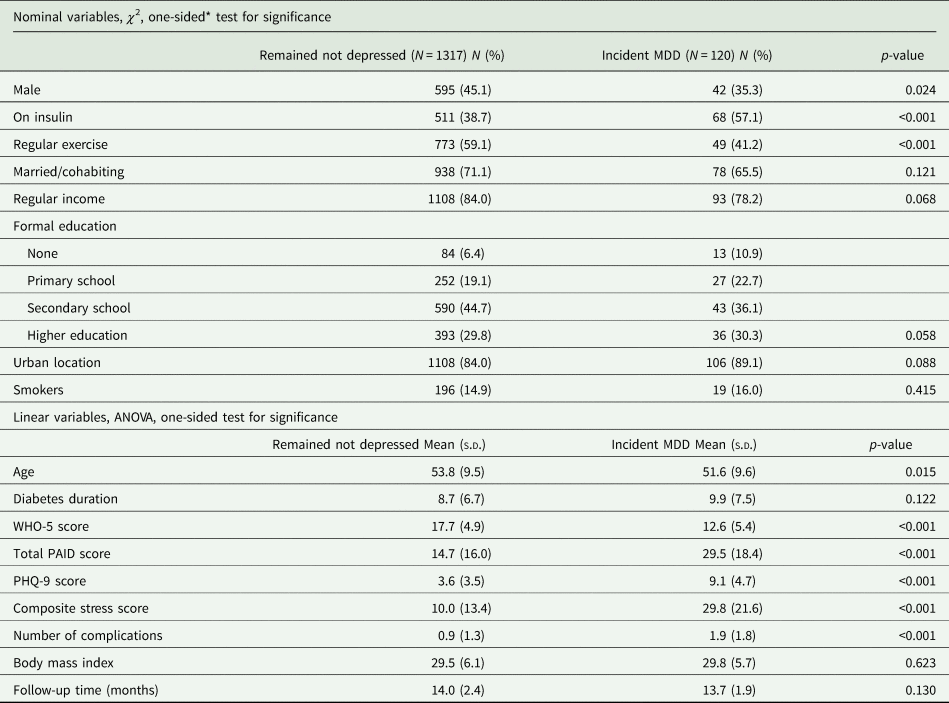
* One-sided significance levels were used because previous research has shown these factors to be implicated in the development and maintenance of depression.
A binary logistic regression analysis using remained non-depressed (i.e. no diagnosis at either time points) v. incident MDD as the binary outcome variable demonstrated that, after adjusting for country of study, higher PHQ-9 and lower WHO-5 scores at baseline and higher CSS during the follow-up period were all significant predictors of incident MDD (see Table 3).
Significant predictors of incident depression diagnosis (MDD) in bivariate logistic regression, adjusted for country

Outcome variable: depression (MDD) status at follow-up (no depression v. incident MDD).
N = 1364. Nagelkerke's R 2 = 0.438. Non-significant factors: diabetes complications, PAID, sex, insulin, age, exercise.
A similar analysis using follow-up PHQ-9 score as the outcome variable found that, after adjusting for country (and excluding baseline PHQ-9 score from the analysis), WHO-5, PAID, CSS, sex and insulin treatment were significant predictors (Table 4). When baseline PHQ-9 score was added to the model (Table 5), the effect of sex and insulin was no longer significant. Therefore, in addition to explaining more of the variance (Adjusted R 2 = 0.495 v. 0.419), the latter model was more parsimonious. Since heteroscedasticity was confirmed in the raw data, which tends for the model to underestimate p-values, a log-transformation was carried out. Results confirmed the significance of predictors above, with sex re-entering the model.
Significant predictors of follow-up PHQ-9 scores in linear regression, adjusted for country (baseline PHQ-9 scores not entered as predictor variables)

N = 1542. Adjusted R 2 = 0.419. Non-significant factors: diabetes complications, PAID, age, physical activity.
Significant predictors of follow-up PHQ-9 scores in linear regression, adjusted for country and including baseline PHQ-9 scores

N = 1531. Adjusted R 2 = 0.495. Non-significant factors: sex, insulin, age, complications, physical activity.
PAID scores at both baseline and follow-up were significantly correlated with CSS (R 2 = 0.374 and 0.512; p = 0.01, respectively). PAID and CSS did not significantly differ according to sex. Figure 1 shows the mean CSS for those who remained non-depressed and those with incident MDD by country.
Composite stress scores by depression status for each country (for participants with a completed Holmes and Rahe).

Overall, the highest CSS were ‘death of a close family member’, ‘change in financial state’, ‘major change in the health of a family member’, ‘major personal injury or illness’, ‘change in sleeping habits’ and ‘change in eating habits’. Mexico reported the highest CSS for ‘major personal injury or death’, with Ukraine participants reporting the highest scores for ‘change in sleeping habits’ and ‘major change in the health of a family member’. Table 6 provides an overview of the most important stressors by country.
Country stressors in order of importance (first six)

The events rated as most upsetting were ‘death of a spouse’, ‘physical, sexual, or emotional abuse’, ‘divorce’, ‘marital separation’, ‘other life event/stressor not specified elsewhere’, ‘fired at work’ and ‘detention in jail or other institution’. The events rated the least upsetting were ‘marriage’, ‘religious holiday’, ‘vacation’, ‘outstanding personal achievement’, ‘pregnancy’ and ‘gain of a new family member’.
Discussion
This study has demonstrated the importance of psychosocial factors as risk factors for the onset of MDD and increased depressive symptoms. The World Health Organisation has identified the treatment of depression and other mental health problems as a priority for the 21st century; however, only a few studies have identified the risk factors that are associated with the development of mental health problems, in particular in people with co-occurring conditions such as diabetes. Exceptions to this include studies in the Netherlands and the USA (Naranjo et al., Reference Naranjo, Fisher, Arean, Hessler and Mullan2011; Nefs et al., Reference Nefs, Pouwer, Denollet and Pop2012; Johnson et al., Reference Johnson, Al Sayah, Wozniak, Rees, Soprovich, Qiu, Chik, Chue, Florence, Jacquier, Lysak, Opgenorth, Katon and Majumdar2014), with Nefs et al. identifying stressful life events (although only measured by a single item), diabetes complications and a previous history of depression as risk factors for subsequent depression (Nefs et al., Reference Nefs, Pouwer, Denollet and Pop2012). Although our incident rate for MDD was slightly lower than the Netherlands study, this may be due to a different measurement tool and lack of a clinical interview to diagnose depression in that study. We have observed differences in the incidence of MDD according to country and there are a number of factors that may explain this. First, there are differences in psychosocial conditions, the clinical manifestation of depression and the nature of care provided in different countries. Second, the different gender and age composition of patients by country (particularly in Russia) could play a meaningful role.
The role of stress
Although it is known that there is a link between diabetes and depression, the role of stress is less clear possibly due to differences in its measurement (Joseph and Golden, Reference Joseph and Golden2017). A few studies have reported a link between stress and diabetes self-management (Smith et al., Reference Smith, Miles, Elkins, Barkin, Ebell and Ezeamama2020), but the impact of stressors not only in relation to diabetes but as part of the individual's broader experience has been less examined. A caveat to this has been the work proposing the concept of ‘syndemics’ which points to a complexity of factors that increase the risk of poor health (Mendenhall et al., Reference Mendenhall, Omondi, Bosire, Isaiah, Musau, Ndetei and Mutiso2015). Mendenhall et al. have observed that the prevalence of diabetes varies in different socio-economic groups, with co-existing stress and struggles living with diabetes greater in the poorest individuals. Acknowledging the cumulative effect of life stress and managing diabetes on mental health can provide a more holistic picture of the individual which has important implications for practice (Fisher et al., Reference Fisher, Chesla, Mullan, Skaff and Kanter2001).
Our adaptation of the Holmes and Rahe scale to include a measure of ‘upset’ has meant that we are able to measure stress in a way that is more likely to represent the actual perceived impact of events within the context of peoples' lives. Our measure does not make any assumptions as to the severity of an event, but rather it is based on the individual's perception once it occurs. In addition, we added specific events that were more culturally relevant to each country (as identified by the country-specific investigative team), to make our data more culturally relevant and country-specific. At the same time, we can identify the most common stressors, some of which challenge our ideas as to what are the most stressful events, such as a change in eating or sleeping habits. These latter events could be related to the physiological aspects of diabetes as well as to depression, especially given the strong correlation between stress and diabetes distress in our study. Our adapted scale could be a useful instrument to screen for vulnerability to depression in future studies.
Cultural factors and risk of depression among people with type 2 diabetes
Culturally specific concerns with regard to variations in reporting depressive symptoms have been suggested (Kirmayer et al., Reference Kirmayer, Gomez-Carrillo and Veissiere2017) and culturally adapted measurement instruments recommended (Tarricone et al., Reference Tarricone, Stivanello, Poggi, Castorini, Marseglia, Fantini and Beradi2012). We have been able to mitigate this by ensuring that we utilised country-specific translations/interpretations for both the PHQ-9 and the MINI and that trained psychiatrists were from the same country/region and were able to ensure that the questions were asked in an appropriate way. A further strength of our study is the use of both a symptom scale and a diagnostic interview to determine the presence/absence of depressive symptoms/MDD.
Our finding that baseline PHQ-9 scores were significantly associated with incident MDD as well as depressive symptoms supports previous work on the association between these two measures, although unlike our prospective study in 12 countries, most research has been cross-sectional in single countries (Darwish et al., Reference Darwish, Beroncal, Sison and Swardfager2018). Recognition of depressive symptoms as a precursor to clinical levels of depression could lead to earlier interventions that reduce the risk of MDD. Although PAID (diabetes distress) scores were not found to be an independent predictor of MDD, our multivariable analysis found it to be a further important predictor of depressive symptomatology (PHQ-9). This is unsurprising, given their known association; however, it provides another potential avenue for the identification of those at risk of depression easily determined during clinical encounters (Schmitz et al., Reference Schmitz, Gariepy, Smith, Clyde, Malla, Boyer, Strychar, Lesage and Wang2014; Darwish et al., Reference Darwish, Beroncal, Sison and Swardfager2018).
A limitation of our study is that only those who had complete data could be included in our analyses and were more likely to have complications, treated with insulin, smoke and have higher diabetes distress scores (although baseline PHQ-9 scores did not differ significantly). These individuals may have been more likely to return to their diabetes centre for care and so were more likely to have been available for follow-up recruitment.
Our findings have implications for clinical practice and the possibilities for reducing the risk of depression. The high (and increasing) prevalence of type 2 diabetes may induce healthcare providers to standardise the clinical management of this condition, in order to reduce professionals' time expenditure and burden to a minimum. Our data show that a more holistic approach, including a discussion of life events, may help to identify individuals at risk of developing psychological distress. Although it may initially increase consultation time, encouraging people with diabetes to discuss stressful events and providing emotional support may help to mitigate the risk of depression, the diagnosis of which has economic implications both at the individual and wider (health system) level. Given that stress and diabetes-related distress are correlated, by mitigating stress, diabetes distress may also be reduced, leading to a positive impact on the well-being of people with diabetes. Given that PHQ-9 scores are a predictor of MDD, early screening could prevent more severe outcomes.
Supplementary material
The supplementary material for this article can be found at https://doi.org/10.1017/S2045796020000438.
Data
The data will not be available at the present time due to it being analysed for country-specific publication in accordance with the INTERPRET-DD investigators' agreement.
Acknowledgements
The authors thank the following: Argentina: Vera Olguita; Bangladesh: Chiranjeeb Biswas, Jalal Uddin, Manirul Islam, Tariqul Alam, Tanjina Hossain; Germany: Arne Herrnberger, Kaschoz Fariq, Julia Leuchtmann, Anna Seeber, and Lina Töws; India: Dr Shayanth Manche Gowda, Dr Roshan Sutar and Dr Abhinav Nahar from Nimhans and Dr Nagamani, Dr Kavitha Muniraj, Mr Owais Haqq, Ms Rajeswari Ashok and Ms Sapna Manjunath from Jnana Sanjeevini Medical Centre; Italy: Viola Bulgari, Andreone Nicola, Bani Moira, Bartoli Francesco, Bertolini Lorenzo, Bonfadini Silvia, Carretta Daniele Claudio Luigi Ambrogio, Carrà Giuseppe, Castelnuovo Gianluca, Cimino Antonino, Clerici Massimo, Crocamo Cristina, Croci Marina, Diani Caterina, Dicembrini Ilaria, Fioravanti Giulia, Gamba Pierluigi, Girelli Angela, Invitti Cecilia, Mannucci Edoardo, Molinari Enrico, Paroli Antonio, Rocca Liliana, Rotella Francesco, Valentini Umberto, Zarra Emanuela, Zenari Luciano; Russia: Irina Agamamedova, Mikhail Antsiferov, Olga Boyarkina, Julia Karacheva, Olga Koteshkova, Valery Krasnov, Taisiya Nikitina, Maria Parpara, Dmitry Tsarenko, Marina Volodina; Poland: Edyta Sutkowska, Anna Królicka, Marta Jakubczyk, Agnieszka Kazimierczyk, Agnieszka Misiołek, Przemysław Łukasiewicz; Serbia: Aleksandra Jotic, Nikola Jovanovic; Uganda: Anthony Makhoba; UK: Aravinda Guntupalli; USA: Larry Cimino. The investigators also wish to express their appreciation of the support that Eli Lilly and Company, the Lundbeck Institute and the institutions participating in the INTERPRET DD study and the member associations of the DDD provided to the development of the programmes included in the DDD initiative.
Author contributions
All listed authors fulfil the ICMJE criteria for authorship.
Financial support
This study was carried out under the aegis of the Association for the Improvement of Mental Health Programmes (AIMH) and supported by AIMH and the collaborating institutions. The meetings of the investigators and data entry were supported in part by unrestricted grants by Eli Lilly and Sanofi companies.
Conflict of interest
Larry Cimino is the president of ProConsult, LLC. He provides services to the Association for the Improvement of Mental Health Programmes on a pro bono basis. He also serves as the president of the Indiana Council on World Affairs. Tomasz Gondek has received honorarium from Janssen-Cilag Polska, VP Valeant Polska, Lundbeck Poland, Apotex Poland (currently Aurovitas Pharma Polska), EGIS Polska, GL Pharma. Cathy Lloyd has received lecture fees from Sanofi. Arie Nouwen has received funding from Omnia-Med, for lecturing at a scientific meeting. Norman Sartorius received a lecture fee from the Lundbeck Neuroscience Institute. Elena Starostina has received lecture fees and fees for the meetings of experts from Novo Nordisk, Boehringer Ingelheim, Astra Zeneca, Sanofi, Promomed, Roche, Novartis, Abbott, MSD, Pfizer, Takeda, Amgen.


 Open access

