





1. Introduction
Any decision we make in daily life involves a combination of risk (our willingness to take a gamble in exchange for a possible reward), time (how we value the future relative to the present), and social preferences (how much we care about the wellbeing of others). Understanding the heterogeneity of these preferences is crucial to explaining differences in life outcomes and the persistent inequalities observed across individuals and societies. A growing body of research suggests that these undefined preferences, when formed in childhood, are not only predictive of but may also causally influence long-term outcomes such as educational attainment, financial stability, health behaviors, and prosocial engagement (Alan & Ertac, Reference Alan and Ertac2018; Sutter et al., Reference Sutter, Kocher, Glätzle-Rüetzler and Trautmann2013; Mischel et al., Reference Mischel, Shoda and Rodriguez1989).
To investigate how such preferences develop during childhood and adolescence, economists have traditionally relied on incentivized experimental tasks, designed to elicit intertemporal, risk-related, and prosocial behaviors under controlled conditions (for a survey, see Sutter et al., Reference Sutter, Zoller and Glätzle-Rützler2019; List et al., Reference List, Petrie and Samek2021). A substantial literature documents how these preferences evolve across childhood and adolescence. Patience increases with age (Sutter et al., Reference Sutter, Yilmaz and Oberauer2015) and children from low socioeconomic status (SES) families make more impatient choices (Falk et al., Reference Falk, Kosse, Pinger, Schildberg-Hörisch and Deckers2021b). Older children are more generous than the younger ones (Fehr et al., Reference Fehr, Bernhard and Rockenbach2008, Reference Fehr, Glätzle-Rützler and Sutter2013) and prosocial behaviors such as fairness and altruism become more structured and norm-based during adolescence (Almås et al., Reference Almås, Cappelen, Sørensen and Tungodden2010). Risk aversion decreases or stabilizes depending on context, and, on average, girls are more risk averse than boys (Sutter et al., Reference Sutter, Zoller and Glätzle-Rützler2019). Gender differences emerge around puberty – particularly in risk and social preferences – while SES and cultural background consistently predict variation in time and social preferences from early childhood (Fehr et al., Reference Fehr, Bernhard and Rockenbach2008; Sutter et al., Reference Sutter, Kocher, Glätzle-Rüetzler and Trautmann2013; Blake et al., Reference Blake, McAuliffe, Corbit, Callaghan, Barry, Bowie, Kleutsch, Kramer, Ross, Vongsachang and Wrangham2015; Andreoni et al., Reference Andreoni, Di Girolamo, List, Mackevicius and Samek2020).
While incentivized experiments offer incentive compatibility and fine control, they are often time-consuming, costly, and logistically demanding, especially in large-scale or repeated settings. In contrast, Psychology has long used questionnaires for eliciting personality traits (for example, Ashton & Lee, Reference Ashton and Lee2009; McCrae & Costa, Reference McCrae, Costa, John, Robins and Pervin2008) and risk taking (for example, Gullone et al., Reference Gullone, Moore, Moss and Boyd2000). Another example is the Strength and Difficulties Questionnaire (Goodman, Reference Goodman1997), which elicits prosociality with self-rated questions like ‘I usually share with others, for example, CDs, games, food’, that resembles economists’ understanding of social preferences. However, a major concern remains whether surveys capture the same underlying preferences as incentivized tasks. Among adults, recent advances have validated short surveys that correlate well with experimental measures (Enke et al., Reference Enke, Rodriguez-Padilla and Zimmermann2022; Falk et al., Reference Falk, Becker, Dohmen, Huffman and Sunde2023), and such tools have been used to map global distributions of preferences (Falk et al., Reference Falk, Becker, Dohmen, Enke, Huffman and Sunde2018). In children and adolescents, however, the evidence is more limited and the correlation between survey and behavioral measures appears much weaker, raising concerns about measurement equivalence across age groups. For instance, Samek et al. (Reference Samek, Gray, Datar and Nicosia2021) elicited risk and time preferences using both experiments and survey questions and discovered only a modest correlation coefficient of 0.09 between experimentally elicited time preferences and survey-based measures of the same among adolescents, and with a slightly higher coefficient of 0.11 for risk preferences. These correlations are lower than for adults. Dohmen et al. (Reference Dohmen, Falk, Huffman, Sunde, Schupp and Wagner2011) report a more substantial correlation coefficient of 0.26. Falk et al. (Reference Falk, Becker, Dohmen, Huffman and Sunde2023) report correlations of 0.37 for negative reciprocity, 0.41 for risk preferences, 0.59 for time preferences and 0.67 for trust. This discrepancy is important to consider when relying on survey-based tools for measuring preferences in children, particularly in large-scale or policy-oriented studies where experimental elicitation is not feasible.
Our study addresses this gap by developing, testing, and validating a novel and scalable survey instrument for measuring time, risk, and social preferences in children and adolescents. We began by designing candidate questions, spanning domains such as time, risk and social Preferences – trust, positive and negative reciprocity. These questions were asked in a sample of children aged 9 years: 160 children answered a survey measuring their preferences regarding risk, time, and altruism and 179 answered a survey focusing on positive reciprocity, negative reciprocity, and trust. Either one week prior to or following the survey, these children participated in a series of incentivized choice experiments, targeting the exact same set of preferences. By comparing children’s survey responses with their behavior in the experimental tasks, we identified the subset of items that best predicted choices in incentivized choice experiments (in terms of maximizing R 2). To strike a balance between explanatory power and brevity, we evaluate all possible survey combinations using both the Bayesian Information Criterion (BIC) and Root Mean Squared Error (RMSE). While RMSE tends to favor larger models, we find that BIC selects fewer survey items with only marginal losses in predictive accuracy – making it the preferred approach for constructing a brief and practical instrument. Our final instrument consists of just 14 survey items yet explains between 11.8% and 34.8% of the variance in behavior across domains, making it a practical and scalable alternative to experimental elicitation. Our findings indicate that hypothetical versions of incentivized tasks outperform general self-evaluation items in predicting children’s behavior. Items that closely resemble the experimental setup or describe concrete, age-relevant situations – such as decisions involving toys, peers, or classroom settings – tend to yield better predictive accuracy. This underscores the importance of contextual relevance in item design and opens new avenues for research on the effectiveness of different item types across developmental stages and cultural contexts.
To validate our selection, we conducted an out-of-sample prediction exercise with a separate group of children for risk and time preferences as well as altruism. This new sample confirms that the selected items retained substantial predictive accuracy in a new population aged 9–16 years old. With this older sample we also investigate self-evaluation questions, closer to what has been used with adults in Falk et al. (Reference Falk, Becker, Dohmen, Huffman and Sunde2023), and we show that these are most useful for eliciting time preferences.
Our contributions are fourfold. First, we construct a novel set of over 100 survey items explicitly designed to measure economic preferences in children and adolescents. These items were carefully tailored to be developmentally appropriate, contextually relevant, and suitable for diverse research settings. The full item pool – along with its child-friendly graphical design – serves as a flexible toolbox for researchers aiming to study preference heterogeneity across populations and institutional contexts. Second, we validate a 14-item short-form survey that reliably approximates behavior in incentivized choice experiments. This is the first validated instrument of its kind that spans risk, time, and social preferences for children and adolescents, and it is comparable in structure and performance to established adult surveys (e.g., Cappelen et al., Reference Cappelen, Enke and Tungodden2025; Falk et al., Reference Falk, Becker, Dohmen, Huffman and Sunde2023). Our results enable researchers to incorporate robust measures of economic preferences into large-scale, cross-national, and longitudinal studies, even when experimental methods are not feasible. Third, we design the survey to be accessible and practical for use in schools, families, and field research. All questions are concise, easy to understand, and accompanied by child-friendly illustrations. The instrument can be administered with minimal supervision and is suitable for both individual and group settings, making it well-suited for use with younger populations. Fourth, we use a transparent and replicable validation procedure. Researchers can apply the same method to identify and validate the best-performing subset of items within their own samples – across different age groups, cultural settings, or socioeconomic contexts. This adaptability makes the instrument and its underlying methodology broadly applicable. By bridging survey and experimental methods in childhood, our study lays the groundwork for a new, scalable approach to measuring economic preferences in developmentally and policy-relevant contexts. Since early-formed preferences play a key role in shaping life trajectories, accurately identifying them is critical for designing effective interventions – whether in education (e.g., improving time management or fostering self-regulation), health (e.g., promoting long-term planning for nutrition and exercise), or financial literacy (e.g., encouraging saving and delayed gratification).
The remainder of the paper is structured as follows: Section 2 reviews the literature on preference elicitation in youth. Section 3 describes our experimental design and survey construction. Section 4 presents the validation strategy and results. Section 5 discusses implications and limitations. Section 6 concludes.
2. Data
We collected our data by visiting 21 third-grade classes in nine public schools located just outside of Copenhagen. Participation in the study was voluntary, and therefore we could not obtain a representative sample. The participating schools are in seven municipalities: in four of them, the average household income is below the national average by 1–10%, while in the remaining three it is higher than the national average by 1–84%. Each class was visited twice, one week apart, for a total of approximately 180 minutes. We contacted 484 parents and received consent from 407 of them (84%). Our final sample consists of 339 observations, as 68 children were absent during one of the two visits. In total, 160 children participated in incentivized choice experiments and answered a 59-item survey on risk preferences, time preferences, and altruism, and 179 children answered a 50-item survey and incentivized experiments measuring positive reciprocity, negative reciprocity, and trust. To avoid spurious interdependencies, we elicited these preferences with the incentivized choice experiments and with the hypothetical questions at two separate visits, one week apart. Given the bifurcated structure of the study, children were exposed to a maximum of 36 survey questions in any single session.
During the activities, children earned tokens that could be exchanged for prizes such as toys or school materials. We paid out one decision for each experiment to ensure a clear distinction between the incentivized experimental games and the non-incentivized hypothetical survey items. Emphasizing the role of incentives in the experimental setting allowed us to clearly communicate the difference between the incentivized and non-incentivized items.
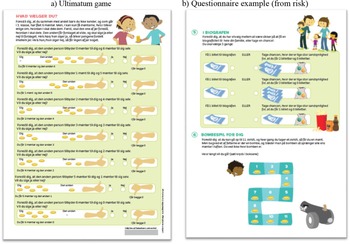
We explained to the children that earning more tokens would result in receiving more gifts. However, we deliberately did not disclose the exact exchange rate (1 token = 2 DKK) to minimize social comparison and avoid strategic behavior. On average, children earned 9.5 tokens – 7.5 from the incentivized choice experiments and 2 tokens as a participation fee. We also took great care in designing decision sheets, collaborating with a professional graphic designer. Figure 1 reports examples of decision sheets. Appendix B describes our procedures in detail, including our script and decision sheets.
Examples of decision sheets: (a) Ultimatum game. (b) Questionnaire example (from risk)

Fig. 1 Long description
The image shows two decision sheets. The left sheet, labeled 'Ultimatum game', features a series of questions with options for responses, accompanied by illustrations of two children. The right sheet, labeled 'Questionnaire example (from risk)', includes questions related to risk assessment, illustrated with images of money, a dice path and children. Both sheets contain multiple-choice questions and visual elements to engage participants.
Our data have two main components: children’s decisions in the six incentivized choice experiments, and their answers to the 109 hypothetical questions we designed to elicit preferences.
2.1. Incentivized choice experiments
We elicit time preferences by asking children to choose between an amount today (4 tokens) or a larger amount (5, 6, 7, or 8 tokens) in a week.Footnote 1 We randomly pick one of these four choices to determine the payoff.Footnote 2 We use the answers to construct a measure of patience using the switching point from today to the delayed payoff. For instance, when a child chooses 4 tokens today rather than 5 in a week, but she chooses 6 tokens in a week instead of 4 today, we assign a patience value of 3. For consistent children, this patience measure equals the number of patient decisions. In the case of multiple switching points (39 observations), we took the average of the switching points.Footnote 3 Appendix A, Table A.14 reports our main results restricting the sample to consistent individuals and, alternatively, using the number of patient choices as a robustness measure of patience.
We elicit risk preferences by asking children to choose between a safe option (an increasing number of tokens from 1 and 11) or a gamble (0 or 10 tokens with the same probability, i.e., the expected value of 5). The gamble was illustrated as a draw between two colors (green or orange), and children were asked to choose which color would represent the winning outcome. At the end of the experiment, we randomly pick one of these 11 choices to determine the payoff, and the winning color.Footnote 4 Then, we construct a measure of risk tolerance using the switching point from the safe option to the gamble. For instance, when a child chooses 7 tokens for sure rather than the gamble but chooses the gamble rather than 6 tokens for sure, we assign a risk-loving value of 6. For consistent children, this risk measure equals the number of risky decisions. As before, in the case of multiple switching points (39 observations), we took the average of the switching points. In Appendix A (Table A.15), we report our main results using only consistent individuals, as well as alternative measures of risk preferences based on the number of risky choices and the first switching point.
We elicit altruism by using a dictator game in which children have to allocate 6 tokens between themselves or another unknown child. Our measure of altruism corresponds to the number of tokens allocated to the other child. For instance, when a child gives 3 tokens, we assign a value of 3.
We elicit negative reciprocity by using an ultimatum game: the first mover has 6 tokens to allocate, and the second mover can choose ‘accept’ or ‘reject’ the allocation. We ask children to play as the second mover first and state each possible allocation if they want to ‘accept’ or ‘reject’.Footnote 5 Then, children play as the first mover. At the end of the experiment, we pair each child with an anonymous third grader from another school and use children’s decisions to determine their payoffs. Our measure of negative reciprocity corresponds to the lowest number of accepted tokens. For instance, if a child declines the offer ‘0 to self; 6 to the other’ but accepts the offer ‘1 to self; 5 to the other’, we assign a value of 1.
We elicit positive reciprocity and trust by using a sequential trust game: the first mover has 4 tokens, and she has to choose how many of these tokens she wants to send to the second mover. Then, tokens are tripled and are sent to the second mover. Finally, the second mover can choose how many of these tokens she wants to send back to the first mover. We ask children to play first as the second mover and state how many tokens they want to send back if the first mover sends 1, 2, 3, or 4 tokens. Then, children play as the first mover and choose how many tokens they want to send to the second mover.Footnote 6 At the end of the experiment, we pair each child with an anonymous third grader from another school and use children’s decisions to determine their payoffs. We construct a measure of positive reciprocity using the average number of returned tokens as the second mover. For instance, if a child never sends back any tokens, we assign a value of 0. If a child always sends back all the tokens, we assign a value of (3 + 6 + 9 + 12)/4 = 7.5. We construct a measure of trust using the amount sent as the first mover. For instance, if a child sends 2 tokens as the first mover, we assign a value of 2.
For both the ultimatum game and the trust game, we informed children that either their decision as first mover or as second mover would be selected for payment. This design introduces role uncertainty as children did not know which decision would be payoff relevant. Previous work has shown that role uncertainty may shift behavior toward more altruistic and less spiteful behavior (Iriberri & Rey-Biel, Reference Iriberri and Rey-Biel2011). For context, we therefore relate our results to previous experimental studies with children in the results section.
2.2. Hypothetical questions
Our survey includes 109 items: 23 to elicit time preferences, 16 for risk preferences, 20 for altruism, 14 for negative reciprocity, 14 for positive reciprocity, and 22 for trust. The development of these items followed a multi-step process. First, we adapted questions from existing instruments used with adults, such as the Preference Survey Module (Falk et al., Reference Falk, Becker, Dohmen, Huffman and Sunde2023) and psychological tools like the Strengths and Difficulties Questionnaire (Goodman, Reference Goodman1997). Second, we tailored the items to align with the cognitive and emotional development of children. This involved rephrasing questions to reflect situations that children are likely to encounter in everyday life – such as decisions involving toys, school, or peer interactions – making them more relatable and easier to understand. Questions that referred to adult-specific domains, such as driving, alcohol, sex, or work, were excluded. We also developed hypothetical versions of standard experimental tasks, including dictator games, trust games, and intertemporal choice tasks (e.g., Harbaugh et al., Reference Harbaugh, Krause, Liday, Vesterlund, Ostrom and Walker2003; Sutter et al., Reference Sutter, Kocher, Glätzle-Rüetzler and Trautmann2013). Finally, recognizing that children’s behavior is shaped in part by socialization, we included items reflecting adult feedback (e.g., from parents and teachers) as well as questions that varied the target of the behavior – for instance, whether it was directed toward family, friends, or unfamiliar peers – a distinction that is especially relevant in the context of social preferences (Harbaugh et al., Reference Harbaugh, Krause, Liday, Vesterlund, Ostrom and Walker2003).
For each preference, we have four types of questions: qualitative (for instance, Are you a child who runs a lot of risks, or do you try to avoid risks?), scenario questions (for instance, Imagine that you are in a queue. Somebody skips the queue and takes your turn. Will you now tell a teacher instead of taking your turn? YES/NO), other’s view (for instance, Do your parents tell you to be more cautious? YES/NO) and the hypothetical version of incentivized choice experiments (for instance, Now you have to imagine that you have six tokens. You have to choose how many of these tokens you want to keep and how many you want to give to another child. The other child is your age and lives in Denmark, but is not someone you know). In short, we prepared our questions specifically for children: the content of each question reflects situations children commonly experience in their daily lives, and the graphical layout is child-friendly. All survey questions can be found in Appendix A, Table A.21.
The data has been collected and stored in accordance with the rules set by the General Data Protection Regulation (GDPR) covering the European Union. As a copy of this data exists as personally identifiable, we are unable to anonymize the data as defined in the GDPR by the Danish Data Protection AgencyFootnote 7 (DPA). We are therefore unable to publicly share the data. Instead, researchers interested in accessing these data must apply alongside the University of Copenhagen for approval from the DPA and adhere to the specified conditions.Footnote 8 This process ensures that data sharing aligns with the highest standards of ethical and legal compliance.
3. Results
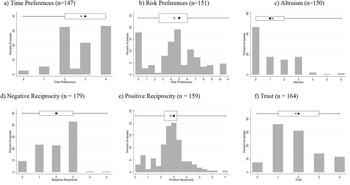
Figure 2 presents the distribution of children’s preferences elicited through the incentivized choice experiments. For each preference, the panel includes a boxplot displaying the mean (×) and median (●). Overall, children’s behavior aligns with previous findings in the literature. Panel (a) shows time preferences (patience): on average, children in our sample choose the patient option in 70% of the decisions, similar to the results in Falk et al. (Reference Falk, Kosse, Pinger, Schildberg-Hörisch and Deckers2021b), but higher than in Angerer et al. (Reference Angerer, Lergetporer, Glätzle-Rützler and Sutter2015), who use a longer delay. In Alan and Ertac (Reference Alan and Ertac2018), around 40% of participants make 9 or 10 patient choices (out of 10), whereas in our data, 33% of children choose the patient option in all 4 decisions. Panel (b) shows risk preferences (risk tolerance): children choose the risky option in 40% of cases, comparable to the 45% reported by Khachatryan et al. (Reference Khachatryan, Dreber, Von Essen and Ranehill2015). The estimated average coefficient of risk aversion in our sample is r = 0.57, matching the estimate from Sutter et al. (Reference Sutter, Kocher, Glätzle-Rüetzler and Trautmann2013). Panel (c) displays altruism: children donate, on average, 19% of their endowment, which is lower than in Harbaugh and Krause (Reference Harbaugh and Krause2000), Bettinger and Slonim (Reference Bettinger and Slonim2006), and Blake et al. (Reference Blake, McAuliffe, Corbit, Callaghan, Barry, Bowie, Kleutsch, Kramer, Ross, Vongsachang and Wrangham2015), who report average donations of 29%, 27%, and 25%, respectively. Panel (d) shows negative reciprocity: 10% of children accept all offers, 23% accept offers of at least 1 token, another 23% accept offers of at least 2 tokens, and 43% only accept offers of 3 tokens or more. Murnighan and Saxon (Reference Murnighan and Saxon1998) report that 27% of third graders accept offers of 1 token, while Sutter (Reference Sutter2007) finds that 35% accept unequal offers of 2 out of 10 tokens. Panel (e) displays positive reciprocity: when the first mover sends 1, 2, 3, or 4 tokens, children return, on average, 1.0, 2.11, 3.32, and 4.51 tokens, respectively. These return amounts are higher and more responsive than the return amounts reported in Harbaugh et al. (Reference Harbaugh, Krause, Liday, Vesterlund, Ostrom and Walker2003), where the returns are 1.63, 2.13, 2.45, and 2.24. Panel (f) shows trust: children in our sample send 47% of their endowment, which is notably higher than the 18% reported in Harbaugh et al. (Reference Harbaugh, Krause, Liday, Vesterlund, Ostrom and Walker2003), and also higher than the estimates in Sutter and Kocher (Reference Sutter and Kocher2007), who find that second graders send 20% and sixth graders send 36%. In Appendix (Tables A.8–A.13), we show preferences by gender and age (above and below median age). To compare these results with other experimental findings with children we refer to Sutter et al. (Reference Sutter, Zoller and Glätzle-Rützler2019).
Distributions of decisions for each type of preference elicited in the incentivized choice experiments. (a) Time Preferences (n = 147). (b) Risk Preferences (n = 151). (c) Altruism (n = 150). (d) Negative Reciprocity (n = 179). (e) Positive Reciprocity (n = 159). (f) Trust (n = 164)

Fig. 2 Long description
The image contains six graphs, each representing different types of children's preferences. Graph (a) shows time preferences with a boxplot indicating mean and median values and a distribution of choices from 0 to 4. Graph (b) illustrates risk preferences with a boxplot and choices ranging from 1 to 10. Graph (c) displays altruism with a boxplot and donation percentages from 0 to 30. Graph (d) shows negative reciprocity with a boxplot and acceptance of offers from 0 to 3 tokens. Graph (e) presents positive reciprocity with a boxplot and return amounts from 0 to 4 tokens. Graph (f) depicts trust with a boxplot and sending percentages from 0 to 50. Each graph includes a sample size indicated by n equals a specific number.
To find the survey questions that provide the best (linear) prediction of individual behavior in the incentivized choice experiments, we use OLS to regress the experimental outcome on various combinations of survey items. Specifically, our analysis considers all possible combinations of 1–5 survey items and uses (adjusted) R2 to compare models with a similar number of predictors.
To compare models with a different number of items, we consider both the Bayesian Information Criteria (BIC),Footnote 9 which penalizes the inclusion of additional regressors, and RMSE from 10-fold cross-validation. Alternative approaches, such as the Obviously Related Instrumental Variables (ORIV) approach (Gillen et al., Reference Gillen, Snowberg and Yariv2019), could in principle address measurement errorFootnote 10 but in our design predictive validity is the most informative benchmark.
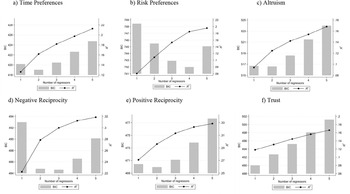
As per construction, R2 increases as more items are added to explain the experimental measure, but the BIC does not increase monotonically.Footnote 11 Figure 3 shows both the R 2 and BIC for the best combinations of survey items (1-5) for all preferences. The Figure shows, for example for time preferences how R2 increases from 0.126 when including one survey item, up to 0.213 when including five items. However, the BIC is minimized with just two items, and this model selection criterion implies choosing the specification with the lowest BIC, i.e. two survey items for time preferences. Note that BIC depends on sample size, so we remove all observations with one or more missing values.
R 2 and BIC for 1–5 regressors. (a) Time Preferences. (b) Risk Preferences. (c) Altruism. (d) Negative Reciprocity. (e) Positive Reciprocity. (f) Trust

Fig. 3 Long description
The image contains six graphs labeled a to f. Each graph shows R squared and BIC values for different preferences. Graph a shows time preferences with R squared increasing from 0.126 to 0.213 as the number of regressors increases from 1 to 5. Graph b shows risk preferences. Graph c shows altruism. Graph d shows negative reciprocity. Graph e shows positive reciprocity. Graph f shows trust. Each graph has the x-axis labeled 'Number of regressors' and the y-axis labeled with R squared and BIC values. Bars represent BIC and lines represent R squared.
The best set of survey items, i.e., the set of items with the lowest BIC, comprises 14 items: 2 for time preferences (R 2 = 0.162), 4 for risk preferences (R 2 = 0.185), 2 for altruism (R 2 = 0.124), 3 for negative reciprocity (R 2 = 0.300), 2 for positive reciprocity (R 2 = 0.348) and 1 for trust (R 2 = 0.118).
To evaluate the models using RMSE, we perform a 10-fold cross-validation procedure, which randomly partitions the data into 10 subsets, and uses 9 of these folds as training data. For each fold, we estimate the model using the training data and compute the RMSE on the remaining dataset. We repeat this procedure 100 times, as the data is randomly partitioned and the results vary across partitions. The average RMSE across the 100 repetitions and 10-folds are presented in the Appendix (Tables A.4). As with the BIC, the objective is to minimize the RMSE. The results show that for time preferences, the RMSE is the smallest for the 5-item model, whereas the BIC selections chose the 2-item model. For risk preferences, the RMSE is the smallest for the 5-item model, where the BIC selections chose the 4-item model. For altruism, the RMSE is the smallest for the 3-item model, but the BIC selection chose the 2-item model. For negative reciprocity, the RMSE is the smallest for the 5-item model, whereas the BIC selection chose the 3-item model. For positive reciprocity, the RMSE is the smallest for the 3-item model, where the BIC selection chose the 2-item model. For trust, the RMSE is the smallest for the 3-item model, where the BIC selection chose the 1-item model. In sum, the RMSE from the cross-validation in Table A.4 generally favors larger models than those chosen by the BIC. We notice though, that the increase in RMSE is small. For instance, for time preferences, the RMSE increases by 2.9% when going from the worst predictive model (1 item) to the most predictive model (5 items).
As our goal is to prioritize model simplicity, we choose the BIC-optimal models. We visualize the procedure in Figure 2 that displays the R2 and BIC for the combinations of survey items that maximize the R2 for each preference.
Table 1 reports the estimated coefficients from the preferred regressions discussed above: all selected survey items are statistically significant at the 5-percent level. Appendix A presents similar results using standardized measures, which account for differences in the scales between the experimental tasks and the survey items.
Regression results for all preferences

Table 1 Long description
The table presents regression coefficients from an OLS analysis of experimental measures against survey items for six preferences: Time, Risk, Altruism, Negative Reciprocity, Positive Reciprocity, and Trust. Key findings include significant positive coefficients for Time-1 (0.298) and Risk-6 (1.011), with PosRec-1 having the highest R2 value of 0.348, suggesting a strong model fit for positive reciprocity. Negative reciprocity also shows strong coefficients, particularly NegRec-4 (0.417). The constant terms vary, with the highest for Risk (2.939) and the lowest for Trust (0.233). Observations range from 147 to 179, indicating variability in sample sizes due to incomplete survey responses. The results highlight significant relationships, especially in risk and reciprocity preferences, with varying model fits across different preferences.
Note: Table shows estimation coefficients from an OLS regression of the experimental measure on the chosen survey items for all six preferences. The number of observations changes because we had to exclude children who did not answer an item of the survey or who left the class during the experiment. Standard errors in parentheses:
*** p < 0.01, ** p < 0.05, * p < 0.10.
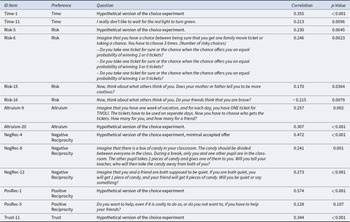
The results in Table 1 show that the hypothetical version of our incentivized choice experiments is included in our survey for all preferences, similar to Falk et al. (Reference Falk, Becker, Dohmen, Huffman and Sunde2023). The survey items are all positively associated with the experimental measures, with one exception: Risk-16 is negatively correlated (see Table 2) with the experimental measure. Risk-16 reads ‘Now, think about what others think of you. Do your friends think that you are brave?’ While one might expect a positive correlation between perceived bravery and risk tolerance, our results contradict this assumption, reinforcing the importance of empirical validation. For the specific correlation, we do not have a good explanation, and we refrain from speculative interpretation, but we chose to retain the item in accordance with our predefined methodology.
Correlations between survey question and behavior in the experiment

Table 2 Long description
The table measures the correlation between survey responses and behavior in an incentivized experiment, focusing on categories like Time, Risk, Altruism, Negative Reciprocity, Positive Reciprocity, and Trust. Positive Reciprocity (PosRec-1) shows the strongest positive correlation with behavior at 0.574, indicating a significant relationship. In contrast, Risk-16 has a negative correlation of -0.215, suggesting an inverse relationship. Most correlations are statistically significant with p-values below 0.05, except for PosRec-5, which has a p-value of 0.107, indicating a lack of statistical significance. The data suggests that behaviors related to Positive Reciprocity and Negative Reciprocity have stronger correlations with survey responses compared to other categories. Caution should be taken in interpreting these correlations as they do not imply causation.
Note: Pearson correlation coefficient between the answer in the survey question and the behavior in the incentivized game for the questions chosen in the validation method, by maximizing R 2 and minimizing the Bayesian Information Criterion. Survey items are translated from Danish.
Table 2 shows the chosen survey items for each preference. Table A.20 in the Appendix shows all the survey items and their correlations with the decisions in our incentivized choice experiments. In bold, we indicate the selected items. In all but one case, the most correlated items are those chosen by our validation exercise.
Finally, we test the validity of the results, and we compare our findings with Falk et al. (Reference Falk, Becker, Dohmen, Huffman and Sunde2023). In Falk et al. (Reference Falk, Becker, Dohmen, Huffman and Sunde2023), the authors assess the quality of their survey and report the correlation between the behavior in the incentivized choice experiments predicted by the survey and actual behavior in the experiment. The correlations in Falk et al. (Reference Falk, Becker, Dohmen, Huffman and Sunde2023) vary from 0.37 (negative reciprocity) to 0.67 (trust). In our data, the correlations vary from 0.34 (trust) to 0.59 (positive reciprocity). Interestingly, Falk et al. (Reference Falk, Becker, Dohmen, Huffman and Sunde2023) report the correlations between two repetitions of the exact same incentivized choice experiment conducted one week apart. The within-subject correlations of behavior vary from 0.59 (risk) to 0.82 (time). Frey et al. (Reference Frey, Pedroni, Mata, Rieskamp and Hertwig2017) report a test-retest correlation below 0.5 for risk preferences elicited using multiple price lists. In conclusion, it is not accurate or fair to evaluate the correlations between survey and incentivized choice experiments against a benchmark of 1.
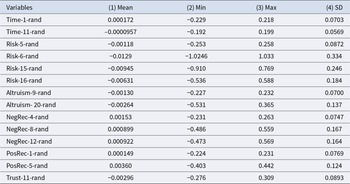
We perform a final check to see whether random survey answering can produce significant associations between the survey items and the experiment, by generating new survey answers at random but keeping the same distribution as the real survey answers. While the simulated data preserves the marginal distribution of each survey item, it breaks any correlation structure between items and behavioral outcomes, as well as among survey items themselves. This ensures that any predictive power observed with the real survey is not an artifact of item-level distributions or random alignment. Then, we regress the random survey items with the experimentally elicited preferences. We repeat this procedure 1000 times. Table 3 shows the parameter estimates based on the simulated survey answers. Reassuringly, the mean estimate is zero for all randomly generated survey answers (see column 1). The minimum and maximum values are symmetrical around zero (see columns 2 and 3), and the distributions are dense around zero with a low standard deviation (see column 4). Hence, data that simulates random answering of the survey does not explain the behavior in the incentivized choice experiments.
Comparison real vs. simulated data (1000 repetitions)

Table 3 Long description
The table compares estimated coefficients from regressing experimental measures on simulated survey data, focusing on mean, minimum, maximum, and standard deviation values. Risk-6-rand exhibits the highest variability with a standard deviation of 0.334, indicating significant fluctuations in the data. Time-11-rand has the smallest mean value at -0.0000957, suggesting minimal average deviation from zero. Other variables like Risk-5-rand and Altruism-9-rand show moderate variability, with standard deviations of 0.0872 and 0.0700, respectively. The data is generated randomly, mirroring the distribution of real data, which may affect the reliability of these findings. Overall, the table highlights variability and central tendency in simulated data across different variables.
Note: Table shows the mean, maximum, minimum, and standard deviation of the estimated coefficients when regressing the experimental measure on simulated survey data. We generate the simulated data randomly with the same distribution as in the real data.
3.1. Alternative short survey
Running the hypothetical experiments can be tedious and challenging to do. To investigate the importance of the hypothetical games for predicting behavior in the incentivized experiments, we redo the analysis, excluding answers to the hypothetical experiments. The resulting survey has only nine items. These nine items include two for time preferences, three for risk, two for altruism, and two for social preferences (reciprocity and trust). The selection is based on the same BIC-guided validation approach used for the full survey. The complete list of items is reported in the Appendix (Table A.20).
The explanatory power for each preference is lower than in the survey with hypothetical experiments. The explanatory power ranges between 1.6% (trust) and 13.4% (risk).Footnote 12 Hence, excluding the hypothetical games drastically lowers the explanatory power. We also notice that the short survey performs worse than the long survey in terms of BIC. In Appendix A, we present the resulting survey along with the regression results (Table A.7), and an illustration of the relationship between R2 and the BIC (Figure A.1), as well as an overview of the development of RMSE (Table A.19). In the Appendix (Table A.3), we also present the results if only the hypothetical experiments are included.
3.2. Validation with a different sample
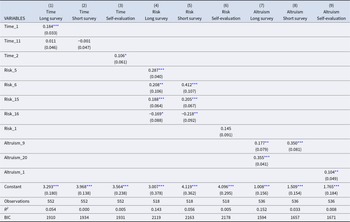
As a final test, we investigate how our survey questions perform when using a different sample of children and adolescents (3rd graders, 5th, 7th, and 8–9th graders). We elicited time, risk, and altruism using incentivized-choice experiments, a hypothetical version of the game, and our previously validated survey questions. In addition, we asked three self-evaluation survey questions similar to those in Falk et al. (Reference Falk, Becker, Dohmen, Huffman and Sunde2023): ‘Are you someone who is ready to give up something today to benefit from it in the future?’ for time preferences. ‘Are you a child that takes risks, or do you try to avoid risks?’ for risk Preferences, and ‘Are you a child who mostly shares with other children without expecting anything in return?’ for altruism.
The resulting dataset allows us to compare three different versions of a survey: A Long Survey that includes all items selected by our initial validation procedure; a Short Survey that excludes the hypothetical game and a Self-evaluation Survey that includes only the self-evaluation question. Table 4 reports our estimates.
Regression results, 2018 sample, Time, Risk, and Altruism

Table 4 Long description
The table presents regression results for Time, Risk, and Altruism variables across different survey types and self-evaluations. Time_1 shows a significant positive effect in long surveys, while Risk_5 is significant in long risk surveys. Altruism_20 has a strong positive effect in altruism long surveys. Constants are significant across all models, indicating consistent baseline effects. Time_11 and Risk_6 show varying significance across survey types, suggesting context-dependent effects. The R2 values indicate varying explanatory power, with risk models generally showing higher values. Observations are consistent across models, ensuring comparability. The BIC values suggest model fit differences, with altruism models generally having lower values.
Note: All regressions are OLS regressions. The hypothetical experiments are Time_1, Risk_5, and Altruism_20. Standard errors in parentheses:
*** p < 0.01, **p < 0.05, *p < 0.10.
The results show that the Long Survey using the hypothetical version of the game is the most predictive model with a higher R2 than the other surveys. When comparing the Short Survey and the Self-evaluation Survey, we find that the Short Survey performs better (higher R2), for Risk Preferences and Altruism. However, the Self-evaluation Survey performs better for time preferences.
3.3. Scalability
In the Appendix (Tables A.8–A.13), we present a variety of robustness tests, splitting the sample by boys and girls, as well as by age (born in the first two quarters vs. the two latter quarters). We observe differences across gender and age. For example, for time preferences, the survey item Time_11 is significant only for girls and the younger ages, but the hypothetical experiment is significant and large across all these subgroups. We recommend using the long survey version to ensure comparability across groups defined by age, gender and socioeconomic background.
Our work not only provides a validated instrument for measuring economic preferences in children but also offers a generalizable framework for survey development and validation. Since our full item set and validation procedures are openly available, researchers in other cultural or institutional contexts can use our approach to construct customized short scales that are tailored to their target population. Further, our child-friendly illustrations and figure files are available upon reasonable request for non-commercial scholarly use. This modular structure enhances the scalability of our tool and supports broader efforts to collect preference data at scale in settings where incentivized experiments are not feasible.
4. Conclusion
This study develops and validates a short-form survey instrument designed to elicit six core economic preferences in children: time preferences, risk preferences, altruism, negative reciprocity, positive reciprocity, and trust. We show that a set of 14 child-friendly survey items predicts behavior in incentivized choice experiments, with explanatory power comparable to validated adult surveys. Our findings demonstrate that the survey captures meaningful individual differences and can be implemented in a scalable, developmentally appropriate way across various research and policy contexts.
The main contribution of our work lies in bridging the methodological gap between experimental and survey-based measures of economic preferences in childhood. While incentivized experiments provide high internal validity, their implementation is resource-intensive and often unfeasible in large-scale, repeated, or field settings. Our validated survey offers a practical alternative that maintains predictive accuracy while reducing cost and complexity. This tool can facilitate preference measurement in schools, field interventions, and longitudinal studies – allowing researchers and practitioners to incorporate individual heterogeneity into the design and evaluation of programs targeting children and adolescents.
Our validated survey instruments offer a promising tool for capturing children’s preferences, which are integral to understanding behaviors with economic and social implications. While the measures demonstrate robustness and reliability within experimental settings, their application to real-world behavior warrants further exploration. Experimentally elicited preferences such as risk aversion, time patience, and prosociality should manifest in field settings – for instance, through educational choices or peer interactions. However, in the case of children, parental influence plays a significant role in shaping and mediating these behaviors, complicating direct causal interpretations. Future research could explore mediation effects via parental influence using structural modeling or matched registered data, to better understand how early preferences translate into real-world behavior such as academic achievement, health-related decisions, and social participation. Although this data linkage is ongoing, initial findings suggest promising avenues for scaling and generalizing our instrument across broader populations. Addressing the interplay between individual preferences and parental decision-making will be essential for interpreting these measures and applying them to the design of effective policies and interventions.
Overall, our work establishes a foundation for scalable and reliable preference measurement in childhood. By enabling researchers to track how individual preferences evolve and how they relate to important life outcomes, this survey instrument contributes to the broader agenda of understanding economic behavior across the life course. It also opens the door to more personalized and effective interventions – whether in education, health, or social policy – tailored to the behavioral profiles of younger populations.
Supplementary material
The supplementary material for this article can be found at https://doi.org/10.1017/eec.2026.10041.
Acknowledgements
We thank the Carlsberg Foundation for generous financial support (Project: 108579). We thank the Department of Economics, the Center for Economic Behavior and Inequality (CEBI), and the Centre for Healthy Ageing (CEHA) at the University of Copenhagen for their financial support. Helene Willadsen gratefully acknowledges financial support from the ERC project DISTRACT (project No. 834540). Numerous collaborators and students have helped us prepare and run this experiment; a special thanks to our dedicated research assistant Nina Maria Pedersen. We thank Thomas Dohmen and participants from CEBI seminars and the CAM/CEBI workshop 2018 for helpful comments. During the preparation of this manuscript, the authors used ChatGPT for proofreading assistance. The authors subsequently reviewed and edited the content as necessary and take full responsibility for the final version of the publication. The replication material for the study is available at: https://doi.org/10.17605/OSF.IO/4QTDZ.
Conflict of interest
The authors have no conflict of interest.


 Open access

