





Introduction
“I thought that was a deer” a 2.5-year-old boy told me, when looking at a picture book of safari animals. A moment before, he had asked me the animal’s name, and I told him it was a Kobus. In this example, the verb “thought” presents the use of mental state verbs (MSVs) in a short interaction with a toddler younger than three years of age. This verb and many others are part of a group of verbs called MSVs that enable us to put our thoughts, ideas, beliefs, feelings, and wishes into words and communicate them to the world. MSVs include six semantic categories: (a) desire and ability verbs (e.g., “want”); (b) emotion and affective verbs (e.g., “love”); (c) cognition verbs (e.g., “know,” “dream”); (d) perception verbs (e.g., “see,” “hear”); (e) physiological verbs (e.g., “sleep,” “wake up”); and (f) moral judgment and obligation verbs (e.g., “need to”) (Bretherton & Beeghly, Reference Bretherton and Beeghly1982; Hall & Nagy, Reference Hall, Nagy, Gopnik and Gopnik1986).Footnote 1 This division is a common way to explore the development of MSV use and was the basis of this study.
Using MSVs is crucial for a child’s language and cognitive development, and it represents the interface between linguistic and cognitive abilities. Linguistically, their development interacts with the syntactic ability to use subordinate sentences with complement (de Villiers & Pyers, Reference de Villiers and Pyers2002; Durrleman & Franck, Reference Durrleman and Franck2015; Pascual et al., Reference Pascual, Aguado, Sotillo and Masdeu2008), pragmatic usage (Hacquard & Lidz, Reference Hacquard and Lidz2022), and semantic development (Montgomery, Reference Montgomery2002). From a cognitive view, MSVs are connected to theory of mind (TOM) (Capps et al., Reference Capps, Losh and Thurber2000; Suzuki & Nomura, Reference Suzuki and Nomura2020; Tager-Flusberg & Sullivan, Reference Tager-Flusberg and Sullivan1995), which is an individual’s ability to understand his own and others’ mental states (Astington & Jenkins, Reference Astington and Jenkins1999; Premack & Woodruff, Reference Premack and Woodruff1978).
The development of MSV use
Studies on MSVs have consistently shown different developmental trajectories of the MSV semantic categories described above. Specifically, young children across different languages and methods tend to use desire verbs earlier and more extensively than cognition verbs. This trend has been observed in children who speak English (Bartsch & Wellman, Reference Bartsch and Wellman1995; Shatz et al., Reference Shatz, Wellman and Silber1983), Spanish (Pascual et al., Reference Pascual, Aguado, Sotillo and Masdeu2008), Italian, German, French (Kristen et al., Reference Kristen, Chiarella, Sodian, Aureli, Genco and Poulin-Dubois2014), Cantonese, Mandarin (Tardif & Wellman, Reference Tardif and Wellman2000), and Hebrew (Egoz-Libshtain, Reference Egoz-Libshtain2009). Tardif and Wellman (Reference Tardif and Wellman2000) proposed that children worldwide follow a common pattern when acquiring MSVs. First, they use desire terms and only later begin referring to thoughts (belief verbs), with knowledge verbs mediating between the two. Note that Tardif and Wellman (Reference Tardif and Wellman2000) divided the cognition verbs into belief verbs (e.g., “think”) and knowledge verbs (e.g., “know”).
The general developmental process of MSVs shows that children begin to use mental state terms in the middle of the second year of life, using the verb “want” from the desire and ability category, which is the most frequently expressed mental verb at this age (Bartsch & Wellman, Reference Bartsch and Wellman1995; Pascual et al., Reference Pascual, Aguado, Sotillo and Masdeu2008). Through the third year of life, their use of MSVs develops significantly. Bretherton and Beeghly (Reference Bretherton and Beeghly1982) found mental terms from all six semantic categories in the speech of thirty 2;4-year-old English-speaking children, based on their mothers’ reports and direct observation. The three most frequently used categories were (a) desire and ability, (b) perception, and (c) physiological terms, followed by (d) emotion terms and (e) judgment and moral obligation terms. Cognition terms were used least often. Similar findings were reported in the vocabulary of 77 German-speaking children, 2;0- and 2;6 years old (Kristen et al., Reference Kristen, Sodian, Licata, Thoermer and Poulin-Dubois2012).
As mentioned, cognition verbs are the last category that children master. Children typically start using them in the third year of life and use them more frequently and in greater variety with increasing age. For example, in a study that followed the spontaneous speech of 25 Spanish-speaking children ages 3–5 years, the diversity of children’s desire and cognition verbs increased with age. The frequency of use of cognition verbs increased as well, and by the age of 5 years, they were used more frequently than were the desire verbs (Pascual et al., Reference Pascual, Aguado, Sotillo and Masdeu2008).
Egoz-Libshtain (Reference Egoz-Libshtain2009) explored the development of MSVs in 56 Hebrew-speaking children, ages 2–8 years, in a cross-sectional design using spontaneous speech. The author found that children used MSVs by the age of 2;0 years, as in other languages. The analysis revealed that children 2;0–2:6 years old use two desire and ability verbs (ratsa “want,” yaxal “able to”), four emotion verbs (ahav “love,” hegeil “disgust,” kaav “hurt,” hetsxik “make laugh”), and one cognition verb (yada “know”). As in other languages, the most frequently used verb was “want”. By the age of 5;0 years, the three semantic categories appeared equally in the children’s vocabulary. After the age of 5;0 years, the number of cognition verbs used grew considerably (e.g., mamtsi “invent,” mitakesh “insist,” merame “deceive”) compared with the other two semantic categories (desire and emotion verbs), and they became the most common MSVs in the children’s language; similar to findings from Spanish (Pascual et al., Reference Pascual, Aguado, Sotillo and Masdeu2008).
The development of MSVs after the age of 5;0 years is less studied than the development at younger ages. Most studies about MSV production in primary school children used narrative tasks to elicit MSVs. Ukrainetz et al. (Reference Ukrainetz, Justice, Kaderavek, Eisenberg, Gillam and Harm2005) found that in narrative tasks, the variety of mental state terms (which the authors describe as internal state terms) increased from ages 5;0–6;0 years to 10;0–12;0 years. Whereas the youngest group (5;0–6;0 years old) never used more than two internal state terms in a story, the two other groups (7;0–9;0 years old and 10;0–12;0 years old) frequently used at least three. Additional evidence for the use of MSVs by primary school-age children is based on studies that compared monolingual and bilingual typically developing children (Kunnari et al., Reference Kunnari, Välimaa and Laukkanen-Nevala2016), or typically developing children compared to neurodiverse populations (for autism, see Rumpf et al., Reference Rumpf, Kamp-Becker, Becker and Kauschke2012; Siller et al., Reference Siller, Swanson, Serlin and Teachworth2014, for language disorder see Altman et al., Reference Altman, Armon-Lotem, Fichman and Walters2016; Tsimpli et al., Reference Tsimpli, Peristeri and Andreou2016). For example, Altman et al. (Reference Altman, Armon-Lotem, Fichman and Walters2016) found that 6;0-year-old, English-Hebrew bilingual children with and without language disorders used mental state terms from seven categories: perception, mental, motivational, emotion, physiological, linguistic, and consciousness, when retelling a story. These studies have shown that typically developing children ages 5;0–12;0 years use MSVs from various categories when telling narratives in picture book tasks. To summarize, MSVs from all semantic categories are part of the everyday language of typically developing children of primary school age.
Developmental differences across languages
Despite the crosslinguistic similarities in the development of MSV use from the different semantic categories, some variations between children-speaking different languages have been reported. Kristen et al. (Reference Kristen, Chiarella, Sodian, Aureli, Genco and Poulin-Dubois2014) found that the use of desire terms by 2;6-year-old Italian or French-speaking children was less varied than those used by German- or English-speaking toddlers compared to the semantic categories of emotion, moral, and cognition terms (based on questionnaires from 297 parents). They suggested that the variations found among the four languages might be attributed to differences in parental mental language input, but this explanation requires more investigation. Another study compared Japanese- and English-speaking children and found that Japanese-speaking children tended to use fewer MSVs than English-speaking children. They suggested that this is driven by differences in maternal input and by the syntactic characteristics of Japanese (Suzuki & Namura, Reference Suzuki and Nomura2020). Tardif and Wellman (Reference Tardif and Wellman2000) also suggested a linguistic explanation for the varying use of MSVs. They explored the spontaneous speech of eight Cantonese-speaking and 10 Mandarin-speaking Chinese children and found that they started to use desire verbs earlier than English-speaking children. Specifically, in Chinese, children’s first vocabulary contains the same frequency of nouns and verbs, while in English, the acquisition of nouns precedes that of verbs. Therefore, Chinese-speaking children might focus more on verbs. However, the Chinese-speaking children used the verb meaning “to think” later compared to English-speaking children. The authors suggested two explanations for this finding. First, the verb is used infrequently in the language of Chinese parents directed to their children. Second, the Chinese verb “to think” is polysemic (the same verb can be used in two meanings: want and think), making its acquisition more complex semantically and syntactically (Tardif & Wellman, Reference Tardif and Wellman2000).
In summary, the development of MSVs is universal, with desire verbs typically preceding cognition verbs. However, there are differences between languages, attributed to multiple sociocultural, linguistic, and cognitive factors. In the specific case of Hebrew, the language evaluated in the current study, research on MSVs is limited, and a tool for exploring the development of MSV use across preschool and school-age children is lacking.
Testing the development of MSV use
Like other language abilities, MSV use can be explored through various methods, such as analyzing language samples by counting the number of MSVs in different contexts, questionnaires, and norm-referenced tests (Dockrell, Reference Dockrell2001), although norm-referenced evaluation is less common in MSV research.
Indirect assessment can be accomplished by using an adult questionnaire to estimate children’s mental vocabulary without directly observing the child. Using a questionnaire to assess children’s language is agreed upon as a valid measure and was strongly correlated with direct assessment (for MSVs, see Bretherton & Beeghly, Reference Bretherton and Beeghly1982; for Communicative Development Inventory (CDI), see Fenson et al., Reference Fenson, Dale, Reznick, Bates, Thal, Pethick, Tomasello, Mervis and Stiles1994). For example, Fenson et al. (Reference Fenson, Dale, Reznick, Bates, Thal, Pethick, Tomasello, Mervis and Stiles1994) described correlations (ranging from .33 to .85) between different versions of the CDI and different direct measures (e.g., picture naming and language samples).
Regarding MSVs, Bretherton and Beeghly (Reference Bretherton and Beeghly1982) compared maternal interviews with direct observation of children age 2;4 years. The mothers were asked to listen carefully to their children’s language and the verbs they used and to mark them on a list of 73 mental terms from the six semantic categories presented above. In addition, the researchers observed and counted the MSVs used by the children in four different situations at home and in the lab. The researchers found a strong correlation between the direct observations and the mothers’ interviews of the children’s use of MSVs. Based on Bretherton and Beeghly’s (Reference Bretherton and Beeghly1982) interview, Olineck and Poulin-Dubois (Reference Olineck and Poulin-Dubois2005) created a parental checklist containing 78 English MSVs, which was used to estimate their use of 30-month-old toddlers. This checklist was adapted to French, German, and Italian and is termed the Internal State Language Questionnaire (Kristen et al., Reference Kristen, Sodian, Licata, Thoermer and Poulin-Dubois2012; Kristen et al., Reference Kristen, Chiarella, Sodian, Aureli, Genco and Poulin-Dubois2014). It was further used to estimate the MSV vocabulary of toddlers ages 24–36 months in different languages, as described in detail above.
When assessing the language of young children, it is also essential to consider the sex of the child, as girls have a slight advantage in the size of their vocabulary (Eriksson et al., Reference Eriksson, Marschik, Tulviste, Almgren, Pereira, Wehberg, Marjanovic-Umek, Gayraud, Kovacevic and Gallego2012; Maital et al., Reference Maital, Dromi, Sagi and Bornstein2000). To control for the effect of sex on the development of the use of MSVs, we included both sex and age among the variables evaluated.
The Hebrew MSV questionnaire
The Hebrew MSV questionnaire used in the current study was developed in two stages. In the first stage, the lists of verbs from the English parental interview of MSVs (Bretherton & Beeghly, Reference Bretherton and Beeghly1982) and from the German Internal State Language Questionnaire (Kristen et al., Reference Kristen, Sodian, Licata, Thoermer and Poulin-Dubois2012) were translated into Hebrew. Note that these questionnaires were developed to explore the MSVs of children ages 20–36 months. Two types of words were excluded in the translation process, i.e., words that are not verbs in Hebrew and do not have a verb with the same stem (e.g., “nice” is translated to the adjective nechmad, which does not have a verb with the same stem) and verbs that describe observed actions (e.g., “smile”, “kiss”). Additionally, when two different words from the original questionnaire translated to the same word in Hebrew, they were included only once in the Hebrew questionnaire (e.g., the verbs “have to” and “must” were translate to one Hebrew verb xayav). Finally, when two verbs from the original questionnaire translated into two words with the same stem in Hebrew (e.g., the verbs “to teach” and “to learn” share the same stem, l.m.d.), they were represented by only one verb in the questionnaire. This was done to avoid confusion between close lexemes (lilmod, lelamed) when completing the questionnaire. Note that in the questionnaire instructions, parents were asked to ignore morphological structure (e.g., different templates) and focus on the meaning of the verbs the children use.
Seven out of the ten verbs from the category of moral and obligation verbs were included in other categories: five were included in the desire and ability category (e.g., “want”) and two in the cognition category (“let” and “may”). Three other verbs were excluded from the questionnaire because they did not translate into verbs in Hebrew (“good,” “bad,” and “naughty”). Thus, the final questionnaire included five semantic categories of MSVs. To complete the process, the final list of 42 Hebrew verbs was translated back to English by a native English speaker (proficient in Hebrew) to verify the accuracy of the translation. All translations matched the original English word or a synonym.
In the second stage, aiming to expand the age range of the questionnaire, 38 MSVs from the study of Egoz-Libshtain (Reference Egoz-Libshtain2009) were added. These verbs were used by Hebrew-speaking children 3–8 years of age in naturalistic situations (Egoz-Libshtain, Reference Egoz-Libshtain2009). Finally, we added ten common physical verbs (e.g., “run,” “sit,” and “jump”) as control verbs to ensure that the children, specifically younger toddlers, use verbs in their everyday language. Nine of these verbs are present in the Hebrew version of the MacArthur-Bates Communicative Development Inventories Words and Sentences (MB-CDI-WS, Maital et al., Reference Maital, Dromi, Sagi and Bornstein2000), suggesting that they are part of the vocabulary of children 2–3 years old. The final questionnaire included 80 MSVs divided into five semantic categories and ten control verbs.
We pilot-tested the questionnaire to explore which morphological template of the verbs should be used. Three options were considered: (1) the infinitive (e.g., laxshov “to think”), (2) the present participle (e.g., xoshev “thinking”), or (3) both. We asked ten parents of children ages 3;6–8;0 years, to complete a pilot version of the questionnaire. The 90 verbs were divided into the three template lists (30 verbs in each list). The lists were presented in varying orders (e.g., 1, 2, 3; 2, 3, 1; 3, 2, 1). Parents were asked to complete the questionnaire, followed by a report on which template was the most transparent and natural for them to complete. Six of the 10 parents preferred the infinitive template, two preferred the present participle template, and two preferred the list that included both templates. The preferred template (the infinitive) is also used in the Hebrew version of the MB-CDI-WS questionnaire (Maital et al., Reference Maital, Dromi, Sagi and Bornstein2000). Therefore, this template was chosen for the current study.
The current study
This study aimed to investigate the development of MSVs in Hebrew-speaking children and to expand our understanding of the development of MSV use beyond the age of 3;0 years into school age. Specifically, we explored the developmental trajectories of five semantic MSV categories using a questionnaire that was developed for this purpose. The questionnaire was designed to address each semantic category separately and to increase the age range to 1;6–10;0 years. Finally, the study explored the validity of the questionnaire, comparing the MSV scores from the questionnaire with the scores obtained from a narrative task that prompted MSV production.
We predicted that the diversity of MSVs would increase with age and that girls would score higher than boys. Following the universal acquisition pattern, we also predicted that the desire category of verbs would be used first and that cognition verbs would be last. Finally, we assumed there would be a correlation between the scores in the questionnaire and the use of MSVs in a semi-naturalistic context, specifically in a narrative task.
Method
Participants
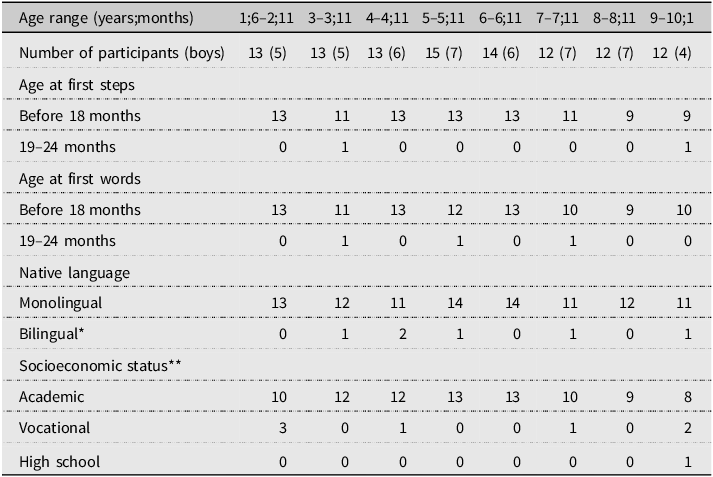
A total of 114 Hebrew-speaking children ages 1;6–10;1 years (range 18–121 months) were recruited by word of mouth. From this sample, 104 children met the study criteria of (a) ages 1;6–10;1 years, (b) no language or communication delay (based on parental report), and (c) Hebrew is their dominant language (for similar inclusion criteria see, Gendler-Shalev & Dromi, Reference Gendler-Shalev and Dromi2021). Four children were excluded due to a mistake in the child’s birth date (parents filled in the current year instead of the child’s birth year), two were excluded because of limited exposure to Hebrew, three because of a reported language or communication disorder, and one was 10;7 years old. As seen in Table 1, based on parental reports, all children had typical motor development, and all but three had typical language acquisition based on the production of first words. However, these three children did not show other signs of language difficulty (they did not receive language therapy, their parents were not concerned about their language, and they were not referred to a pediatrician for developmental assessment). Based on years of primary caregiver’s education, most children were from families with mid-to-high socioeconomic status (see Table 1). Note that data about the age of first steps, first words and parental education were missing for 10 participants (one 3-year-old, two 5-year-olds, one 6-year-old, one 7-year-old, three 8-year-olds, and two 9-year-olds).
Characteristics of the participants

*The few bilingual children were dominant in Hebrew based on parental reports; **Socioeconomic status was reported based on primary caregiver’s years of education.
Materials
The Hebrew MSV questionnaire was developed as detailed in the Introduction. It includes 80 verbs from five semantic categories of MSVs: desire and ability (5 verbs), emotion (28 verbs), cognition (33 verbs), perception (8 verbs), and physiological (6 verbs). The sixth category includes 10 physical verbs as control. Parents were instructed to mark whether their child says or does not say each verb in everyday language, regardless of how it is pronounced or in which context or structure it appears. The score for each child was calculated based on the percentage of verbs used in each MSV category.
A narrative production task aimed to explore the validation of the MSV questionnaire by correlating the MSV scores in the questionnaire with the production of MSVs in a semi-naturalistic context. Children were asked to tell a story according to a sequence of four pictures from “Little Herr Jacob, picture box” (Schubi, a Game of Sequencing Cards for Storytelling and Picture Interpretation). The story was chosen because it contains a deceptive behavior of a dog that leads to a false belief in a man. At the story’s beginning, the man sits on a couch with his dog beside him. In the second picture, the dog is barking at the door, but nobody is there when the man opens the door (in the third picture). In the final picture, the dog sits on the couch, and the man looks at him angrily. The pictures describe a situation of the dog tricking the man into thinking there was someone at the door so he could take the man’s place on the couch. We assumed such content would prompt the production of MSVs (as suggested by Tager-Flusberg & Sullivan, Reference Tager-Flusberg and Sullivan1995). After the children finished telling the story, they were asked three questions. The first was: “Was anyone at the door?”, to verify their understanding of the story. The two other questions aimed to prompt MSV production: “Why did the man open the door?” and “Why did the dog bark?”.
A demographic questionnaire included 15 background information questions, such as age at which motor and language milestones were achieved, signs of atypical language development, information about the language spoken at home and parents’ education.
Procedure
The Ethics Committee of the University of Haifa approved the study (Protocol number 271/21). The two questionnaires were sent to parents via Google Forms only after they provided informed consent to participate in the study: first the demographic questionnaire and then the Hebrew MSV questionnaire. Parents received instructions before the list of verbs, as described in the Material section. Originally, a group of 59 children ages 3;2–10;0 years (mean age: 6;8, SD: 22 months) was recruited for a larger project on MSV development and was tested on the narrative task, the questionnaire and other tasks that are not included in the current paper. Fifty-five additional children were recruited to expand the sample and the age range (13 children were 1.5–3 years old and the rest were 3–10 years old). Only the questionnaires were collected from them. T-test showed no significant difference in age between the full sample (excluding children 1.5–3 years) and the group that participated in the narrative task (t = 0.53, p = 0.597). In addition, no significant difference in MSV use was found between these two groups (t = 0.82, p = 0.41). Children were tested in a quiet room in their house. The pictures of the narrative were shown to the child on a tablet computer screen. At first, the sequence of all four pictures was presented together on the screen, and the child was asked to look at the story in the pictures. After that the pictures were shown individually, and the child was asked to tell the story and then asked three questions while looking at the pictures.
The story and the answers to the questions were recorded and transcribed, and the number of different MSVs from the five semantic categories (type and token) were coded by the first author. Additionally, 12 (20%) stories originally coded by the first author were re-coded by a student who was part of the research to obtain indices of inter-rater reliability. The agreement rate between the two coders was 91%. Only three of 33 verbs were coded differently by the two coders. The disagreements were resolved using the MSV list in Hebrew (Egoz-Libshtain, Reference Egoz-Libshtain2009). Raw data, materials, and statistics can be retrieved from https://osf.io/dpe3n.
Results
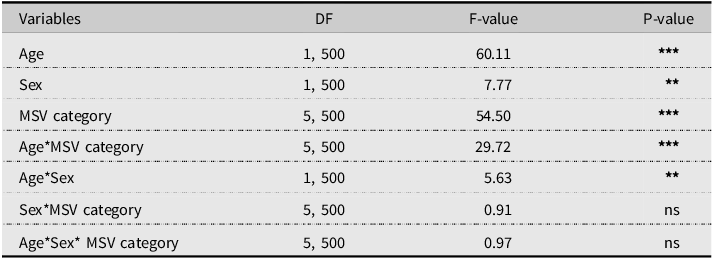
The data were analyzed using linear mixed models to examine the effects of age, sex, and MSV category on the production in the questionnaire. The model was based on 104 independent subjects and six measurements per subject. The first model included fixed factors of age (as a continuous variable), sex (boys versus girls), and MSV category (with six levels) and their interactions, with participants as random factors. As can be seen in Table 2 and in Figures 1 and 2, a significant effect of age (F (1, 500) = 60.11, p < .0001) was found, such that children’s performance increased with age. Furthermore, girls scored significantly higher than boys (F (1, 500) = 7.77, p<.01) (compare Figures 2 and 1, respectively). Finally, the MSV category showed a significant main effect (F (5, 500) = 54.50, p. < .0001), in that children performed differently in each category, as described below. Critically, the interactions between age and MSV category (F (5, 500) = 29.72, p < .0001) and between age and sex were significant (F(1, 500) = 5.63 , p = 0.018). The interaction between Sex and the MSV category and the three-way interaction between the three variables were not significant.
Results of the linear mixed model for predicting performance in the MSV questionnaire
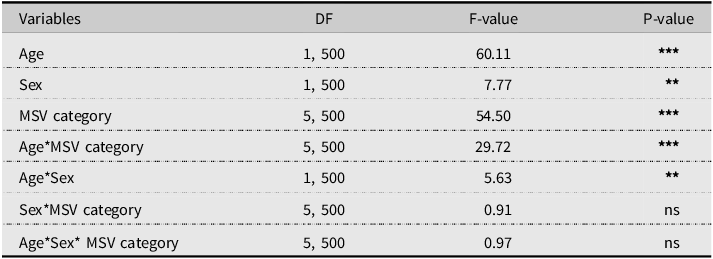
***p< .001; **p<. 05; ns = not significant
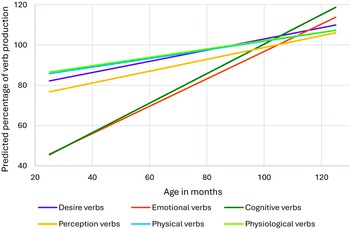
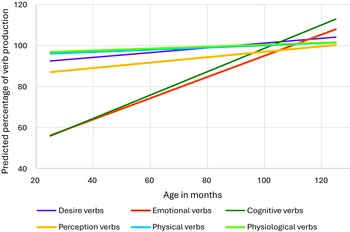
Performance of boys on MSV use by age, for each MSV category. Note that the prediction in the figure exceeds 100% and is for illustration only.

Performance of girls on the MSV by age for each MSV category. Note that the prediction in the figure exceeds 100% and is for illustration only.

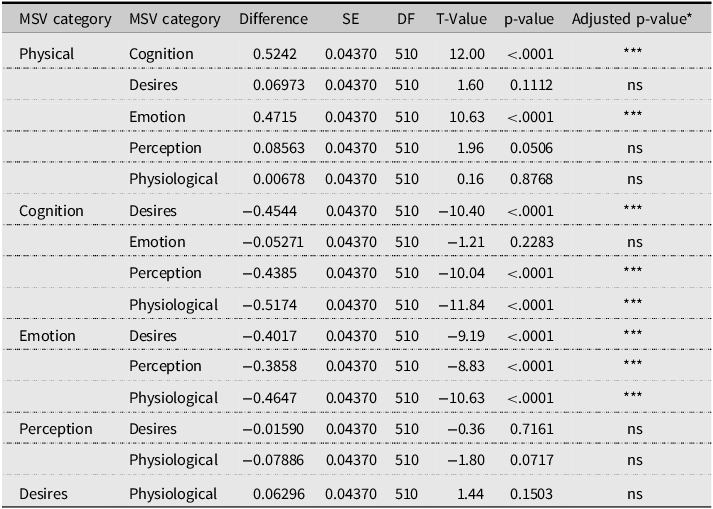
Based on these results, we analyzed the data focusing on a parsimony model that included the significant interactions only. To unpack the interaction of Age and MSV category, we examined how age explained the performance separately for each MSV category. Specifically, the differences between the slopes of age for each MSV category were examined. As seen in Table 3, the slope of the cognition verbs was significantly higher than those of the other MSV categories, excluding the emotion category, in which the slopes were similar (see also Figures 1 and 2). A similar pattern was shown for the emotion verbs. The slopes of the emotion category were significantly higher than those of the other MSV categories, except for the cognition category, in which the slopes were similar (see Figures 1 and 2). Note that the perception verbs had a slightly different pattern from the physical, physiological, and desire verbs, but this difference was not significant.
Comparisons of the effect of age on the different MSV categories

Note: Adjusted p-value for multiple comparisons; ***p < .001; ns = not significant.
To unpack the interaction between age and sex, we divided the data by sex, Figure 1 for boys and Figure 2 for girls. As can be seen, both girls and boys used physical (e.g., “sit”), physiological (e.g., “hungry”), and desire (e.g., “want”) verbs at an early age, but girls used 90% of the verbs by the age of 2;1 years (Figure 2), whereas boys reached 90% at around the age of 4;2 years (Figure 1). Nevertheless, both boys and girls scored 100% at around 6;0–8;0 years. Similarly, the emotion verbs (e.g., “angry”) and the cognition verbs (e.g., “know”) appeared in the lexicons of both girls and boys at the age of 2;1 years, but there was a large difference between the two groups. Whereas boys scored 45% at the age of 2;1 years, girls scored 55% at the same age. As in the other categories, this gap decreased around the age of 7;6 years, when both boys and girls scored 90%.
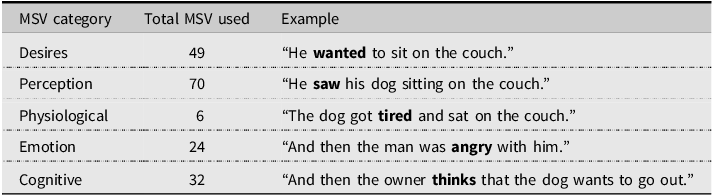
Finally, we explored the validity of the questionnaire by investigating MSV production in the narrative task and its correlation with the scores of MSV use in the questionnaire (excluding the control group of physical verbs). Children produced from 0 to 15 MSVs in their narratives and answers to the questions, including verbs from all five semantic categories (as seen in Table 4).
The total MSV from five semantic categories in the narrative task

Pearson correlations were tested between the MSV scores in the questionnaire (without the control group of physical verbs) and the number of types and tokens of MSVs the child used in the narrative task. There was a significant, positive, low-moderate correlation between the scores of the MSV questionnaire and the type (r = 0.32, p = .01) and the token (r = 0.30, p = .02) of the narrative scores. As expected, there was also a positive correlation between the type and token scores in the narrative task (r = 0.94, p < .001). Note that at the age of 6 years, children scored above 80% in all semantic categories of the questionnaire. Thus, we also tested Pearson correlations at the age range of 3–6 years. Correlations between the scores of the MSV questionnaire, and type and token of the narrative scores were moderate (r = 0.49, p = .05, r = 0.50, p = .05, respectively), stronger than the correlations of the full age range.
To summarize, the results demonstrated that MSV use develops with age, from early childhood to elementary school. We found that girls outperformed boys in the first years of life, but this gap closed around the age of 7 years. Regarding the semantic categories, the physical, physiological, and desire verbs were used earlier than the cognition and emotion verbs. Children started using cognition and emotion verbs at an early age and increased their usage of these MSVs in primary school. Finally, the correlation between the MSV scores on the questionnaire and the score on the narrative task supported the validity of the questionnaire as a tool for estimating MSVs in children.
Discussion
The current study described the use of MSVs in children’s language beyond the age of 3 years and explored the unique developmental path of each MSV category. As part of the study, a parental questionnaire was developed, facilitating the assessment of children’s use of MSVs.
The results demonstrated that Hebrew-speaking children develop the quantity and variety of their use of MSVs from the second year of life to elementary school. The findings regarding the development of MSV use in the first years of life are in agreement with previous studies (Bartsch & Wellman, Reference Bartsch and Wellman1995; Kristen et al., Reference Kristen, Chiarella, Sodian, Aureli, Genco and Poulin-Dubois2014; Pascual et al., Reference Pascual, Aguado, Sotillo and Masdeu2008; Shatz et al., Reference Shatz, Wellman and Silber1983). Moreover, our findings demonstrated the continuity of this development beyond preschool years, especially for emotion and cognition verbs.
The effect of sex showed that girls used a wider variety of MSVs in the first years of development compared with boys, and this gap closed around the age of 7 years (note that both groups reached ceiling scores at the age of 8 years). This finding supports the notion that girls have a language advantage in the early years of development (Bornstein et al., Reference Bornstein, Hahn and Haynes2004; Eriksson et al., Reference Eriksson, Marschik, Tulviste, Almgren, Pereira, Wehberg, Marjanovic-Umek, Gayraud, Kovacevic and Gallego2012; Gendler-Shalev & Dromi, Reference Gendler-Shalev and Dromi2021; Rinaldi et al., Reference Rinaldi, Pasqualetti, Volterra and Caselli2021). Bornstein et al. (Reference Bornstein, Hahn and Haynes2004) found that girls have an advantage in various language measures compared to boys between the ages of 1;8–6;0 years, but not at younger or older ages. Similar to Bornstein et al. (Reference Bornstein, Hahn and Haynes2004), the current research found that the difference between girls and boys, in favor of girls, at the younger age range disappeared around the age of 7 years. Two main hypotheses are suggested to explain this gap: one is based on physiological differences between the sexes and the other on sociocultural differences. The physiological explanation refers to slower brain development in boys (Rinaldi et al., Reference Rinaldi, Pasqualetti, Volterra and Caselli2021), genetic and hormonal differences between the sexes that affect language acquisition (Lange et al., Reference Lange, Euler and Zaretsky2016), and advantages in the oral motor planning of girls compared to boys (Smith & Zelaznik, Reference Smith and Zelaznik2004), all of which support language production. The sociocultural explanation refers to the findings that parents speak more to girls than to boys, providing girls with more exposure to language, which encourages language development (Rinaldi et al., Reference Rinaldi, Pasqualetti, Volterra and Caselli2021). Another explanation suggests that parents expect their daughters to talk earlier than their sons. This expectation might lead parents to have greater awareness of the lexicon of girls (Wehberg et al., Reference Wehberg, Vach, Bleses, Thomsen, Madsen and Basbøll2008). The current findings add to previous literature by emphasizing the need for sex-specific norms in assessing young children’s language. Additional research is required to examine the cause of these differences and the reasons they diminish with age.
A notable finding in the current study is the two patterns of developmental trajectories of the MSV categories. Desire, physiological, and perception verbs showed 70%–80% use at the age of 1;6–2;0 years and reached 90% before the age of 5 years. In contrast, 40%–50% of the verbs in the emotion and cognition categories were used at an early age, which reached 90% around eight years of age. These two trajectories are aligned with results showing that the use of desire and perception verbs usually precedes those of cognition verbs (see Bartsch & Wellman, Reference Bartsch and Wellman1995, and Pascual et al., Reference Pascual, Aguado, Sotillo and Masdeu2008 for desire verbs and Davis & Landau, Reference Davis and Landau2021 for perception verbs). The difference between these two trajectories of MSVs in our study and in previous research raises the question of why emotion and cognition verbs are more complex for children to learn compared to desire, physiological, and perception verbs.
One explanation for this difference might be methodological. The questionnaire was developed to expand the age range that it addresses; therefore, we added to the original list of verbs from Bretherton and Beeghly (Reference Bretherton and Beeghly1982), verbs that were used by Hebrew-speaking children in the study by Egoz-Libshtain (Reference Egoz-Libshtain2009). These verbs were added to the categories of desire, emotion, and cognition verbs and not to the perception and physiological categories because the latter were not included by Egoz-Libshtain (Reference Egoz-Libshtain2009). However, we argue that the noticeable gap between the categories of desire verbs, which are used early in development, versus emotion and cognition verbs, which are used later, supports the different developmental trajectories of the MSV categories. Future studies with additional MSVs in the categories of physiological and perception are warranted to confirm the current findings.
From a theoretical perspective, the different developmental trajectories of the semantic categories of MSVs can be explained both from linguistic and cognitive perspectives. Linguistically, MSVs tend to appear in a syntactic structure of clausal complement sentences (e.g., “The boy thinks that the apple is red”) (de Villiers & Pyers, Reference de Villiers and Pyers2002; Pascual et al., Reference Pascual, Aguado, Sotillo and Masdeu2008), and this structure is usually present in children’s language before they start using MSVs (Shatz et al., Reference Shatz, Wellman and Silber1983). This structure is an essential cue for understanding that the verb in the sentence represents a mental meaning (Hacquard & Lidz, Reference Hacquard and Lidz2022; Papafragou et al., Reference Papafragou, Cassidy and Gleitman2007; Tager-Flusberg, Reference Tager-Flusberg, Baron-Cohen, Tager-Flusberg and Cohen2000) because it implies a thematic relation between an animate entity (“the boy” in the example above) and an intention (“thinking”). Cross-linguistically, desire and cognitive verbs take different types of complements when appearing in the structure of sentential complements: the cognitive verbs take complements with syntactic features of declarative main clauses, while the desire verbs take other clauses. The specific linguistic features that distinguish between declarative main clauses and others vary between languages (Hacquard & Lidz, Reference Hacquard and Lidz2022). For example, finite tense is one of the main features characterizing declarative clauses in English. This increase in syntactic complexity might explain the delay in the development of the use of cognitive verbs. Another support for the role of syntax in the acquisition of verbs comes from research on the acquisition of modal verbs (e.g., “must”), suggesting that these verbs, in their epistemic meaning, might be more complicated for children to learn than the same verbs with their root meaning because they involve greater syntactic representational complexity (Cournane, Reference Cournane2021). In Hebrew, MSVs from all categories take various sentential complements and noun phrases (Egoz-Libshtain, Reference Egoz-Libshtain2009). Additional research is required to define the relations between the semantic category of the MSVs and the type of complements these verbs take. Another linguistic complexity is presented from a pragmatic perspective. Research shows that cognitive verbs are commonly used to express indirect assertions, which are more difficult for young children to acquire (Hacquard & Lidz, Reference Hacquard and Lidz2022).
The cognitive explanation argues that in TOM development, children acquire the concept and understanding of the mental meaning of desires before that of beliefs (Bartsch & Wellman, Reference Bartsch and Wellman1995; Wellman & Liu, Reference Wellman and Liu2004). Two complementary developmental approaches are offered to explain the late appearance of cognition verbs in children’s language. The conceptual growth hypothesis argues that the delay in acquiring cognition (and in our study also emotion) verbs is due to the difficulty in understanding the conceptual meaning (the mental state) that they represent (Papafragou et al., Reference Papafragou, Cassidy and Gleitman2007). This theory reinforces the connection between the development of TOM abilities and MSVs (Bartsch & Wellman, Reference Bartsch and Wellman1995; Suzuki & Nomura, Reference Suzuki and Nomura2020; Tardif & Wellman, Reference Tardif and Wellman2000) by connecting the conceptual development of understanding mental states with the acquisition of the semantic meaning of the cognition verbs. Another approach, the information growth hypothesis, claims that these verbs are acquired late due to a lack of obvious and stable observational correlates, meaning that the children cannot observe the mental states when they occur (Papafragou et al., Reference Papafragou, Cassidy and Gleitman2007). Note that the current research explored MSV production; thus, data on comprehension are needed to explore the above hypotheses. Some research has proposed a complex connection between MSVs, syntax, and TOM abilities, showing that the same syntactic structure of clausal complement sentences plays a crucial role in improving TOM abilities, particularly in false belief (de Villiers & Pyers, Reference de Villiers and Pyers2002). For example, Japanese children who have less exposure to this structure tend to demonstrate a slower development of false belief understanding as demonstrated in false belief tasks and to use fewer MSVs when compared to children who speak English (Suzuki & Nomura, Reference Suzuki and Nomura2020). This finding indicates a tripartite relation between MSVs, TOM, and syntax development, which may explain the protracted developmental process of cognition verbs.
The third explanation for the gap between the categories might be due to a difference in the frequency of verbs from different categories in child-directed speech of parents. In Hebrew, like in other languages, there is a correlation between the patterns of verbs used in the child-directed speech and by the child (Ashkenazi et al., Reference Ashkenazi, Gillis and Ravid2020). Unfortunately, there is no data on the frequency of MSVs from different semantic categories in Hebrew child-directed speech, leaving this question open for future study.
The current findings reiterate those of Egoz-Libshtain (Reference Egoz-Libshtain2009), who explored MSV production using naturalistic data. The similar patterns found in the indirect measures used in the current study and direct measures in Egoz-Libshtain’s (Reference Egoz-Libshtain2009) study support the validation of the MSV questionnaire. Beyond the effect of age, the findings showed a low-moderate correlation between parental reports in the questionnaire and MSV production in the narrative task, for types and tokens. This correlation was moderate for ages 3–6 years and was lower when the full age range of 3–10 years was tested. Therefore, this suggests that children aged 3–10 years who used more MSVs in their narratives received higher scores on the MSV questionnaires. The correlation between the questionnaire scores and MSV use in the narrative, in addition to scores on the questionnaire increasing with age, supports its validity as an assessment tool for MSV use, specifically for the age range of 3–6 years. These findings add to the growing literature supporting the use of questionnaires for language assessment (e.g., the MB-CDI). Parental questionnaires can be helpful tools for evaluating the language of children with cooperation difficulties (e.g., attention deficits and emotional reasons). In these cases, one can obtain valid language information about the child for both research and clinical purposes. For example, the current questionnaire was used to test children with autism (Eilon & Novogrodsky, Reference Eilon and Novogrodskyunder review), presenting a complementary way to assess their language.
The current findings have some limitations. The number of verbs in each category of the questionnaire was not equal. More verbs can be added to the categories of perception and physiological verbs to represent the language of older children. Regarding input, data were not available for the frequency of MSV use in Hebrew in general and specifically in Hebrew child-directed speech. In addition, the participants were all from middle to high socioeconomic status; thus, a more standardized process is needed before using the questionnaire as a clinical test. Finally, the current research did not explore the comprehension of MSVs, which would complete the picture of MSV development. These issues await future research.
In summary, the current study demonstrates that MSV development is a prolonged process, which continues into elementary school, and is influenced by sex during the preschool period. Furthermore, cognition and emotion verbs have a slower developmental trajectory compared with physiological, perception, and desire verbs. Finally, validation of the questionnaire emphasizes its value for evaluating typical and atypical language development in future research.
Replication package
Raw data, materials and statistics can be retrieved from https://osf.io/dpe3n.
Acknowledgments
We express our heartfelt gratitude to the parents and children for their voluntary participation in this study and their willingness to help this study exist. We also wish to extend our appreciation to the research assistants who helped with the data collection and analysis. Finally, we thank the National Institute for Psychobiology in Israel, founded by the Charles E. Smith Family, for supporting this research.
Author contributions
The authors declare equal contribution.
Competing interests
None to declare.

 Open access

