


1. Introduction
Traditional prototyping through physical models, mock-ups, and material experimentation has long served as a critical mode of thinking-through-making, enabling designers to engage with materials, spatial constraints, and the sensory feedback that informs creative decision-making. The material inspires the designer/artisan, they shape the material, and the instrument facilitates this transformative process. It’s a dance of creativity, skill, and responsiveness. This relationship is not unidirectional; rather, it forms a holistic interconnectivity where each element influences and is influenced by the others (Reference GrothGroth, 2016). Embodied knowledge consists of tangible and tacit knowledge, these are the building stones of holistic understanding of crafts and their practice (Reference Pistola, Diplaris, Stentoumis, Stathopoulos, Loupas, Mandilaras, Kalantzis, Kalisperakis, Tellios, Zavraka, Koulali, Kriezi, Vraka, Venieri, Bacalis, Vrochidis and KompatsiarisPistola et al., 2021). The emergence of computational solutions such as GenAI risks shifting this process toward screen-based, disembodied ideation, potentially eroding the tacit, haptic, and experiential forms of knowledge that underpin skilled design practice (Reference Wenngren, Rizk, Wenngren and RizkWenngren et al., 2024).
The quality in making is founded on embodied and tacit knowledge and depends on the interaction of hand, body, tools and materials. As Jarvis states:
“to become skilful in the use of a tool is to learn and appreciate directly, without processes of intermediate reasoning, the qualities of the materials that we apprehend through the tacit sensations of the tool in our hand.” ( Reference Jarvis Jarvis, 2007 )
However, the feeling and intuition which is essential in making, also known as material practice, can’t be taught by just using physical methods. This yields a need towards looking at tacit knowledge learning, based on cognition and how people develop muscle memory (Reference Garcia and VerlindenGarcia & Verlinden, 2024). The sense of practice can’t be fully replicated in a book or video, combining apprehension and comprehension (Reference Zabulis, Partarakis, Demeridou, Doulgeraki, Zidianakis, Argyros, Theodoridou, Marketakis, Meghini, Bartalesi, Pratelli, Holz, Streli, Meier, Seidler, Werup, Sichani, Manitsaris, Senteri and KrivokapicZabulis et al., 2023). Apprehension means mainly taking hold of experience through reliance on tangible, felt qualities of immediate experience; thus understanding through a concrete experience, while comprehension means understanding through reliance on conceptual interpretation and symbolic representation (Reference KolariKolari, 2004). Inspiration towards the study’s approach is taken from two concepts: hybrid crafting and blended learning. Hybrid crafting tries to enhance the physical components with digital ones to make crafting more engaging, with focus on the material enhancement (Reference Golsteijn, Van Den Hoven, Frohlich and SellenGolsteijn et al., 2014). Blended learning combines traditional hands-on learning with virtual or digital tools, focusing on the educational added value (Reference Partarakis and ZabulisPartarakis & Zabulis, 2024). The apprentice can work with physical materials and get virtual guidance by getting feedback overlaid on to their work. Visualisations support an individual’s spatial perception. Reducing the overwhelmed feeling by not only reading the information, but also seeing the process in action and creating more engagement. Animations can show how content moves and interacts, making it a great tool to be integrated in the learning process (Reference Zabulis, Meghini, Dubois, Doulgeraki, Partarakis, Adami, Karuzaki, Carre, Patsiouras, Kaplanidi, Metilli, Bartalesi, Ringas, Tasiopoulou and StefanidiZabulis et al., 2022).
While immersive technologies have been widely studied for skill training, the visual language through which they convey procedural and embodied knowledge remains underexplored (Reference LehrmanLehrman, 2025). This study addresses this gap by analysing and prototyping visual representations that translate tacit aspects of material practice into instructional augmented reality (AR) content. These augmented instructions will be formulated through the structure of affordances in material practice, with the intention to create a more universal solution rather than case-specific outcomes (Reference Steffen, Gaskin, Meservy, Jenkins and WolmanSteffen et al., 2019). Affordances are actionable properties between the world and an actor (Reference GibsonGibson, 1979). In design context they are action possibilities in relation between user and content (Reference NormanNorman, 2013). By embedding assistive and instructive layers into physical workflows, AR can help preserve and mediate embodied knowledge. Ensuring that future designers remain connected to the material and procedural aspects of their craft, even as digital tools advance. Immersive AR instruction can guide users through making processes, offering contextual feedback and demonstrations that bridge the gap between digital abstraction and physical practice. In doing so, AR systems not only facilitate more effective learning and knowledge retention, but also sustain the embodied and interactive qualities of design work that risks being marginalized in a GenAI-driven design landscape (Reference Ji, Hu and EL-ZanfalyJi et al., 2025).
Currently design/artisan tutors have difficulty in conveying exact instructions from their perspective. It is a tricky matter to imply material behaviour, hand positioning and body posture to a layperson. Traditionally, skills and knowledge are transferred by trial and error, and exploration. But through assistance on providing additional cues and insight, the possibility to boost understanding on a deeper level increases. Besides, material practice is context-dependent. For example, one ceramics artisan might provide instructions to a technique differently. Variations of a material are possible as well, such as ceramics with additives. Through all this, the core of practice remains similar. This means that there is room for universality when approached carefully, while also considering the individual, the implied material and its manipulation possibilities (Reference Ji, Hu and EL-ZanfalyJi et al., 2025).
The exploration of augmented reality (AR) as a medium for immersive assistive instruction holds significant implications for the future of design practice and education. As design increasingly engages with interdisciplinary and technologically mediated contexts, the ability to transfer tacit and procedural knowledge effectively becomes critical (Reference NimkulratNimkulrat, 2020). AR-based instructional systems offer designers new tools to embed expertise directly into the design environment, allowing learners and practitioners to engage with processes, materials, and tools in situ rather than through abstract representations. For future designers, this means a shift from static documentation and traditional apprenticeship models toward dynamic, embodied, and context-aware learning experiences. Such systems can enhance knowledge retention, deepen conceptual understanding, and foster experiential learning, all essential for sustaining innovation and craftsmanship in digital-physical hybrid practices (Reference WoodWood, 2006). Moreover, as design education adapts to remote and distributed modes of collaboration, AR-mediated knowledge transfer could play a key role in ensuring that material and embodied aspects of design knowledge remain accessible. This implies to not only designers but also other skilled practitioners in the field, such as craftspeople, artisans, and educators in general.
This study contributes assistance in transferring tacit characteristics within material practice. The study hypothesises assistive augmented reality (AR) content that stimulates knowledge transfer. These contents provide a pathway towards universal knowledge transfer in the practice of making. The aim is to develop a conceptual visual framework which assists designers and creatives to navigate AR assistance in knowledge transfer, to ultimately support the heritage and expansion of the authentic design process.
2. Method
The investigation aims to create a conceptual visual framework. This concept serves as the starting point towards developing 4D instructions, which translates to generating assistive AR solutions for physical prototyping. The development approach for this is done through inductive reasoning. Starting from use cases and then working towards general/abstract elements of the framework. First, the originators of the knowledge to transfer, in this case designers/artisans, need to be consulted and their material practice needs to be captured. This is done through field studies (contextual enquiry at the workplace). Secondly, the gathered overview of all process steps reveals potential touchpoints: possibilities to intervene during making to optimise skill transfer. It is important to gather these process steps from different designers/artisans and different learning materials, making sure the intended information is not biased. Thirdly, through the selection of a specific opportunity, a prototype to enhance a specific process step or sequence can be developed. With this selection, we can decide which building blocks can be utilized to create specific AR elements. Here, a building block represents a learning unit that can be represented by different combination of content, e.g. video, 3D animation, a physical anchor, voice over. Once the building block(s) is/are selected, we move towards the content. Literature study and field research reveal mental modalities which take shape as specific material practice characteristics, such as material property and design intent. With the previous elements considered (opportunity, building block, affordance), we can finally create contextualized AR content. The challenge in creating meaningful content lies in developing and testing AR prototypes to verify their effectiveness in improving the learning experience compared to traditional methods. Firstly, limitations of software result in abstractions of actions instead of accurate representations. Secondly, comprehension of these visualisations can create a barrier, since laymen are unfamiliar or even unknown with the technology. Lastly, measuring understanding and improved learning would require a mixed-method approach due to required insights from experience, in combination with predetermined parameters such as duration and error counting.
In this paper, we focus on basket wickering, a process that hasn’t been prone to industrialisation; every basket made of natural materials is handmade. Visits to both pilot case and expert studios from the HORIZON 2022 Tracks4Crafts project were planned, where workshops were analysed through video capture. These preparations lead to capture and understand how to perform certain actions. It is crucial to know which gestures/postures and use of tools are more prone to difficulty in learning. The experts in question all have their own studios and give workshops. Therefore, they are familiar with the master-apprentice dynamic and have encounters with misunderstandings, frequent issues and or misuses of certain materials or tools. Exposing them to a preliminary setup that employs AR technology gives them the opportunity to hypothesize desired functions, seen in Figure 1.
An in-depth analysis of this study’s specific use case, the willow wicker basket making process was performed by the first author. Here, the different stages of the process were mapped across different sources. These include existing online video material, literature including written documentation and imagery, and our own recordings of a wicker workshop. These sources combined give insight on the local environment and grants the ability to deep dive in the design process. They were compared to each other and filtered based on the specific actions within the process. Related findings are documented in the results section.
From this analysis, a preliminary AR prototype was build, Adobe Aero was chosen as flexible and user friendly AR developing platform. To ensure physical realism and mitigate social isolation by a complete immersive hardware, the decision was made to work with a tablet to display the AR content. Manually animating certain parts of the materials or objects within the wicker content was necessary to provide representable visualisations and was done with Blender.
The analysis will eventually reflect in a conceptual visual framework through imagery. This framework serves as the starting point towards developing 4D instructions, which translates to generating assistive augmented reality solutions for material practice.
Wicker ladies trying out preliminary mixed reality prototype setup, with origami as use case from a previous study (Reference Garcia, Van Dyck, Vereecken, van Vooren, Rodriguez Diez and VerlindenGarcia et al., 2024)

3. Results
3.1. Timeline analysis of use cases
Through the in-depth analysis of the wicker use case for material practice, the following Figure 2 was constructed. This overview highlights the vast information of to-be-found instructions across different media, in addition to the intricate details of a design process. The use case being wicker basket weaving has less association with traditional prototyping in design education, forcing to achieve full understanding of material manipulation and tool handling.
Figure 2 provides an overview across different media in which the study was conducted. On the horizontal axis each row has the material practice process depicted through small images in a specific medium. These horizontal depictions range from workshop visits and capturing of process steps by the author, to guided video material available on the internet and existing literature. The rows are respectively (from visual to descriptive): a detailed YouTube tutorial, a workshop recording made by the author, a descriptive instructions manual from a local wicker expert, a visual media descriptive instruction from a Europe-funded project and a visual media crafts tutorial. Going back further in time we find fundamental books, the second last source is a traditional book with hand drawn illustrations with detailed descriptions, and finally at the bottom an instructions book with even less images and more descriptions. Through this visual presentation, we can identify specific ranges of making process steps across the different media. The overall process steps are indicated through green markings at the top, which are in this case for a wicker basket process: ‘base preparation’, ‘base execution’, ‘bottom edge finish’, ‘wall preparation’, ‘wall execution’, ‘top edge preparation’, ‘top edge execution’. The pink vertical segmentations represent individual process steps. These allow for an overview across media how a step is specifically explained, indicating the amount of visual information. So at the top we find more spread out segmentation, meaning more visual aid. And going down, more pink lines line up together. This means there is less or no visual information of the specific process step in relation to the higher positioned media. This shows that more prominent process steps are depicted even in the lowest media and therefore can be seen as more universal and common, making these steps more relevant for additional assistance visualisations.
Timeline analysis (as schematic figure), mapping sources of the basket wicking process

3.2. Material practice affordances
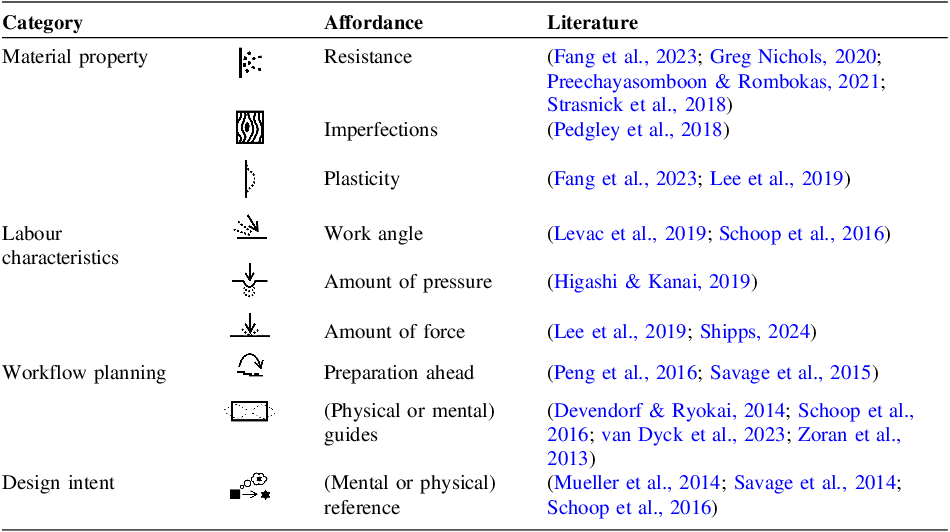
The practice of making can, to some extent, be generalized into concepts of material behaviour and tool utilization. These can both be linked to the mental models that are created for specific activities but also physical habits and routines that become second nature for a seasoned practitioner. There are four categories of affordances when studying literature, based on the findings of Reference Steffen, Gaskin, Meservy, Jenkins and WolmanSteffen et al. (2019) providing filtering information from physical reality and mental recreation. These categories are shown in Figure 3, namely: i) material property, ii) labour characteristics, iii) workflow planning and iv) design intent. The respective literature for these affordances is listed in Table 1.
Material practice affordance mapping of literature; it showcases the type of interactions and visualisations that are being used throughout the different categories of affordances (blue) and the specific affordances themselves (black with icon); each accompanied by an example image from an according study

Figure 3 Long description
Panel A: A diagram showcasing material properties with icons and images representing resistance, imperfections, and plasticity. Panel B: A diagram illustrating labor characteristics with icons and images representing work angle, amount of pressure, and amount of force. Panel C: A diagram depicting workflow planning with icons and images representing preparation ahead and physical or mental guides. Panel D: A diagram showing design intent with icons and images representing mental or physical reference.
Anatomy of embodied practice affordances

Findings throughout this timeline analysis of different media and affordance literature study include the following. As for the timeline analysis in Figure 2, different approaches are noticeable within different contexts. The visualisations for tacit knowledge is often reflected in a limited matter due to the nature of illustration and imagery. The analysis reveals a gradient in the amount of visual information used to describe material practice processes across media. Contemporary digital media (e.g., YouTube tutorials and contemporary craft literature) exhibit higher explicit articulation of process steps, through imagery and illustration. Despite large differences in representational density, the overarching phases of the wicker basket-making process remain consistent across all examined media, constituting a shared structure of craft knowledge. The alignment and clustering of pink segmentation markers in lower-visual media indicate that multiple actions are compressed into single descriptive units. This compression implies experiential familiarity on the part of the reader, whereas high-visual media externalize this knowledge through explicit, step-by-step visual guidance.
As for the affordance literature study seen in Table 1 and Figure 3, several of these material practice affordances are more abstract than others and therefore more widely identified in different fields and academic studies. Especially the ‘human anticipation’ affordances allow for more representation due to the nature of being associated with general instructions. Usually every type of guidance or assistance tool has some sort of anticipation in the planning or result, this includes preparation. On the other hand, the more material-based affordances such as material properties and characteristics of labour are rather specific experimentation within their certain context. Making them less transferable or generalizable towards similar fields, however with different contexts or materials and tools. Therefore, if the field remains the same, or the type of material that is being manipulated is similar, the affordance is transferable to a certain extent.
4. Towards 4D instructions
Field studies reveal the requirements to handle every practice of making use case personally. Material practice is a individualized process where designers/craftspeople, such as the wicker ladies, have differentiating design processes. For example teaching the initial weaving technique or references to make sure the hand positioning is correct. The material might be similar as to the tools, but the refinement into conveying their skills and knowledge might differ exponentially. It is therefore important to identify common grounds to have a baseline to develop on.
Coming from the timeline analysis and the material practice affordance definition, we start to grasp the prototyping and making process. To further build towards a tool to help designers/artisans/creatives engage with augmented reality and therefore build assistive visualisations, the development of a 4D instructions framework we suggested. The main concepts of the visual framework are: scenario mapping - bottlenecks - affordance selection - building blocks - content creation.
Firstly, the scenario mapping is related to laying out the prototyping/making process as showcased in the timeline analysis. Here we made for the wicker use case the distinction between the different media but also made sure to be as precise as possible to depict the individual process steps. This is also sometimes done in literature, but less across different media.
Secondly the bottlenecks, from the timeline analysis, different windows of opportunity are revealed. In the state-of-the-art, the intention to discover specific opportunities is not present within this context of design or content creation towards augmentation and assistance.
Thirdly, based on the previous study, this could be literature or field study, a selection of feasible and relevant affordances to support specific prototyping processes is highlighted. Eventually we end up in the content creation phase. Where with the specific building blocks and selection of the correct affordance, valuable assistive instructions can be developed.
Fourthly, based on convention and relevance, the specific building block is being selected, to depict or demonstrate the bottleneck in the clearest manner. This is often also discussed with the creator/designer, to know which type of building block would suit the context best. We have options between a standard of AR applications: static process animations, video playthrough, reference images/3D objects and object tracked animations. The selection is based on the requirement of realism. More complex craft steps require more spatial insight, they therefore refer to process animations. Whereas easier to understand steps can be explained through video or reference images. As supported by the systematic review of Buchner et al. (2022).
Lastly, based on the selected affordance and the building block(s), the augmented content can be created. While keeping alignment with the material practice through iteration with the experts of the practice.
These material practice affordances are abstractions of the tacit knowledge that convey a specific action (such as handling a tool) and is therefore also transferable towards other material practices to a certain extend.
As opposed to the state-of-the-art research on this topic, only fragments of these affordances came to mind. What is more important is that these earlier studies found in relation to the topic, do not have the intention to research these underlying parts of the learning process and finding a more generalized approach. The inductive search within different use cases allows for the generation of multiple perspectives and hopefully more common grounds to further build assistive instructions. These affordances created from different aspects of a learning process and material manipulation provide a new perspective to understand the prototyping process in material practice or related design techniques. They provide a categorization of different design practice aspects (such as the plasticity of physical engagement with materials), thus forming a sense of universality to further extend to related disciplines. This universality can be seen as a language to communicate certain difficulties or limitations within a prototyping process, but also emphasize opportunities and future developments.
These four material practice affordance categories are an element of the later developed 4D instructions conceptual framework, which will provide guidance towards creating AR content without only having ad-hoc developments/visualisations, in contrast to the majority of anterior studies, visible in Table 1.
5. Discussion and conclusion
This study addresses the main research question by showing that augmented reality (AR) can stimulate knowledge transfer in material practice by making tacit and embodied knowledge representable, and context related. Through the timeline analysis and affordance mapping, the research demonstrates that AR can target specific bottlenecks such as limited representation of fine motor actions, such as specific wicker weaving techniques, where hand positioning and posture are crucial in combination with material handling. Based on the findings, conceptual visual framework was hypothesised that maps processes, identifies instructional gaps, selects relevant affordances, utilizes AR-based building blocks to construct assistive content that eventually tailors to the needs of a given practice.
The framework’s timeline analysis has limitations, as it relies on the depth and time of study from the author and individuality of each designer/material practitioner involved, which are inherently context-dependent. This means outcomes may vary significantly between different materials, tools, individuals, and educational environments. Second, the selection of affordances and opportunities is influenced by the author’s own expertise and experiences, potentially introducing subjective bias into how material practice processes are represented or prioritized. Third, the translation of embodied, tacit knowledge into discrete visualization “building blocks” risks oversimplifying or abstracting aspects of material practice that are experiential and sensory in nature. Finally, the framework does not account for the dynamic feedback and adaptive guidance that would be required for continuous, real-time learner support. Integrating such capabilities would likely require additional computational systems, such as AI-based mediation or user data analysis. These limitations suggest that while the framework offers a valuable conceptual and methodological foundation, its effectiveness and generalizability will depend on contextual adaptation, iterative validation, and future integration with interactive technologies. The framework’s applicability however remains constrained by subjectivity, practitioner individual bias, and the challenges of translating tacit, sensory knowledge into relevant visualizations.
On the one hand, the AR visualisations enhances learners’ ability to understand complex physical actions. On the other hand, making this into a framework helps universalise knowledge by abstracting recurring affordances (e.g., material behaviour, labour characteristics, workflow planning, design intent). The visual framework offers a potential common language for the field towards cross-disciplinary- and cross-material knowledge transfer.
5.1. Future work
Further developments in augmented reality (AR) instructions offer opportunities to enhance material practice within design education by providing context-relevant, visual instructions that complement embodied learning. Large language models (LLMs) could facilitate adaptive and reflective modes of engagement between learners, materials, and tools. This extension could enable real-time AR visualizations and dialogic interaction with AI-based tutors. Beyond supporting procedural accuracy, LLMs offer the opportunity to deepen learners’ engagement and enhance awareness of material practice processes.
Acknowledgement
The authors acknowledge the experts who shared their artisan knowledge and practice. We are grateful to all participants contributing their time and insights to this study. This publication is part of Horizon Europe project Tracks4Crafts. This project is funded by the European Union under grant agreement No 101094507.



 Open access

