

In recent years, the dairy industry, the farmers as well as the public have shown an increasing interest in management systems allowing cow-calf contact (CCC, Sirovnik et al. Reference Sirovnik, Barth, de Oliveira, Ferneborg, Haskell, Hillmann, Jensen, Mejdell, Napolitano, Vaarst, Verwer, Waiblinger, Zipp and Johnsen2020). Systems allowing contact for part of the day may be practical for farmers and provide beneficial CCC while still encouraging calf nutritional and social independence (Veissier et al., Reference Veissier, Caré and Pomiès2013; Johnsen et al., Reference Johnsen, Mejdell, Beaver, de Passillé, Rushen and Weary2018). Technology may be an effective tool to facilitate both free and part-day CCC. We performed a study investigating a cow-driven CCC system using computer controlled access gates (smart gates) to allow the cow to visit her calf, while also encouraging her to spend time without the calf. The study is described in detail in a companion paper (Johnsen et al., Reference Johnsen, Johanssen, Aaby, Kischel, Ruud, Soki-makilutila, Kristiansen, Wibe, Bøe and Ferneborg2021). There are only a few studies documenting the performance of cow and calf in CCC systems in general (Meagher et al., Reference Meagher, Beaver, Weary and von Keyserlingk2019) and for cow-driven systems allowing free or part-day contact specifically. Quarter level milking may synergize well with a suckling calf that often evacuates milk unevenly from the udder. Consequently, there may be an unexplored potential for an automatic milking system (AMS) to provide efficient milk evacuation from the udder in synergy with the calf. CCC often leads to high milk intakes, and calves that suckle their dam freely therefore gain ≈1.3 kg/d (Grøndahl et al., Reference Grøndahl, Skancke, Mejdell and Jansen2007), although they may suffer from a growth check at separation due to low intakes of solid feed (Froberg et al., Reference Froberg, Lidfors, Svennersten-Sjaunja and Olsson2011).
Our objective was to describe the performance of cow and calf in a cow-driven CCC system, reported as machine milk yield in the AMS, calf growth, and intake of supplemental milk and concentrate.
Material and methods
Animals
The materials and methods are described in detail in Johnsen et al. (Reference Johnsen, Johanssen, Aaby, Kischel, Ruud, Soki-makilutila, Kristiansen, Wibe, Bøe and Ferneborg2021). Using a parallel-group design, this study included two groups each with four cow−calf pairs. All four pairs in a group were managed as one stable group.
Experimental design
As described (Johnsen et al., Reference Johnsen, Johanssen, Aaby, Kischel, Ruud, Soki-makilutila, Kristiansen, Wibe, Bøe and Ferneborg2021) the experiment comprised three phases, namely bonding, suckling and separation. At signs of imminent calving and for the first (mean ± sd) 3 ± 0.1 d after parturition, cow−calf pairs were housed in a separate maternity pen and provided time to form a bond and establish nursing (bonding phase). The suckling phase comprised the next 31 ± 4 d, when the cow−calf pairs were housed in a system with a cow area, a calf creep and a meeting area. The four calves in a group (age difference 0–10 d) were housed in a calf creep (15 m2 with lying area and access to ad libitum supplemental whole milk and concentrate, detailed in Johnsen et al., Reference Johnsen, Johanssen, Aaby, Kischel, Ruud, Soki-makilutila, Kristiansen, Wibe, Bøe and Ferneborg2021) and had constant free access to a meeting area (28 m2) which was the only area in which cows and calves could be together. Smart gates controlled the cows’ access into this meeting area. During the suckling phase, the cows' access to the calves differed between groups: while cows had free access during 24 h/d in group 1, in the second group, cows' access to the calves depended on their activity in the AMS. After a successful milking, cows had free access to the calves until the next milking permission was given (5.5 h), then access to the calves was denied. In the cow area, cows had access to cubicles, grass silage, concentrate in automatic feeders and milking in an AMS (DeLaval VMS). Finally, in the separation phase, the cows' access to the calves was gradually decreased over 9 d by limiting their access through the smart gates to the following time slots: 06 : 00–21 : 00 (2 d), 06 : 00–10 : 00 and 17 : 00–21 : 00 (2 d), 06 : 00–10 : 00 (2 d) and finally 0-access (3 d). Independent of phase, physical contact between cows and calves was possible at several places along the fence-line.
Data collection
Calf performance
To monitor calf growth, calves were weighed at birth and thereafter biweekly using a whole-body weigh scale (BioControl AS, Rakkestad, Norway). Daily intakes of supplemental milk and concentrate were collected from the Delpro software (DeLaval International AB, Tumba, Sweden).
Cow milk production
Cow daily machine milk yields and quarter milk yields were collected from the Delpro software (DeLaval International AB, Tumba, Sweden).
Statistical methods
Basic data handling was performed in Excel (version 2016, Microsoft). Descriptive statistics were calculated using the ‘summarize’ syntax in Stata (Stata SE/14, Stata Corp., College Station, TX, USA). Data are presented per phase and across groups, but some parameters will be shown separately for each group. To calculate calf ADG, weekly calf growth was averaged over the two weighings. Mean daily concentrate intake was also calculated for the last three days of the separation phase (i.e. when the cow had no access to the calves). Cow machine milk yield was calculated per 24 h period using estimated milk secretion rate and milking intervals. Data are presented as mean ± sd unless otherwise stated.
Results and discussion
Calf performance
During the suckling phase, calves gained 1.2 ± 0.74 kg/d, but growth varied with group (Table 1). These growth rates are high and comparable to other studies of suckling calves (e.g. Grøndahl et al. Reference Grøndahl, Skancke, Mejdell and Jansen2007). Due to the restrictions in the cows' access to the meeting area in group 2, more suckled milk was likely available for the calves in group 1, which may account for the higher growth (1.5 ± 0.52 kg/d in group 1 v. 1.0 ± 0.77 kg/d in group 2). After separation, calves gained less weight; 0.4 ± 0.81 kg/d. This is probably explained by the varying intake of supplemental milk; most calves drank low amounts before (0.5 ± 0.50 l/d) and after separation (0.7 ± 1.22 l/d). Only 3 calves drank significant amounts of supplemental milk after separation. A previous study showed that calves that drank supplemental milk from the feeder performed better and vocalized less during separation (Johnsen et al., Reference Johnsen, Beaver, Mejdell, Rushen, de Passille and Weary2015; Johnsen et al., Reference Johnsen, Mejdell, Beaver, de Passillé, Rushen and Weary2018). In these studies, calves had higher intake of supplemental milk after separation (≈2–4 l/d), however, calves in the previous study only had access to the cows during the night, which may have increased the motivation to drink supplemental milk. Calves' concentrate intake before separation was 0.3 ± 0.26 kg/d, increasing to 0.9 ± 0.71 kg/d after separation. As shown for calves reared artificially on high milk allowances (Rosenberger et al., Reference Rosenberger, Costa, Neave, Weary and von Keyserlingk2017), concentrate intakes increase with age indicating that the calves compensate for the loss of milk with increased intake of concentrate. During the last three days of separation in the present study, calves consumed 1.2 ± 0.80 kg/d of concentrate.
Calf average daily gain (± sd), concentrate intake and supplemental milk intake for eight dairy calves allowed to suckle their dam for 31 ± 4.1 d (suckling phase) in a cow-directed cow-calf contact system using smart gates to allow cows to visit their calf.

Cows had free (group 1, n = 4 pairs) or restricted (group 2, n = 4 pairs) access to the calves based on previous activity in the automatic milking system. Following the suckling phase, separation occurred gradually over 9 d (separation phase during which the cows' access to the calves was decreased).
Cow machine milk yield
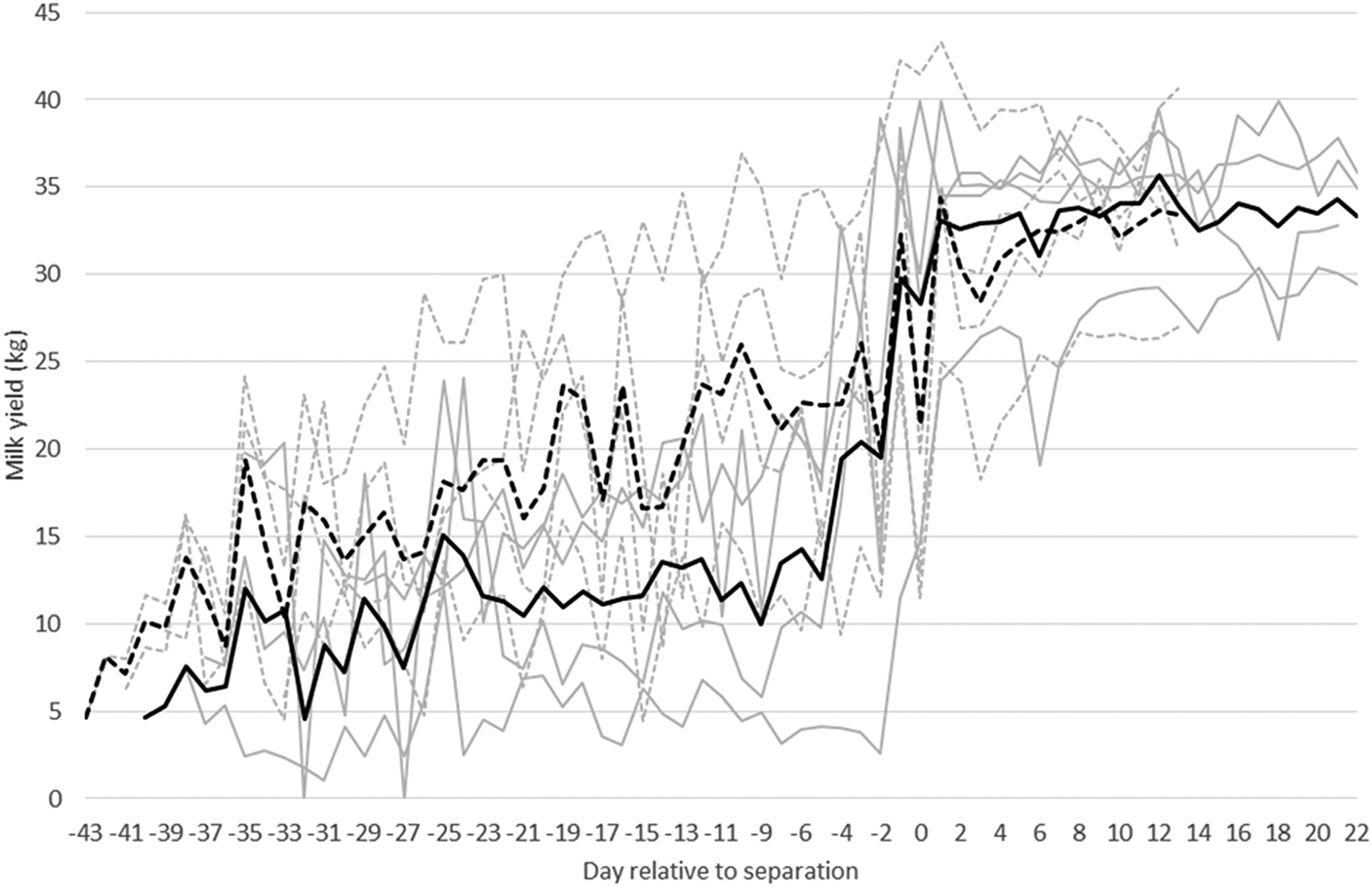
During the suckling phase, cows' machine milk yield in the AMS was 11.4 ± 6.38 kg/d. The difference between the groups (11.4 ± 6.11 and 16.5 ± 7.90 kg/d for groups 1 and 2 respectively), may indicate an effect of the smart gate settings (Fig. 1). In group 2, the lower calf ADG, the increased time spent suckling and the increased frequency of (unsuccessful) attempts of the cows to pass through the smart gate to access their calves (Johnsen et al., Reference Johnsen, Johanssen, Aaby, Kischel, Ruud, Soki-makilutila, Kristiansen, Wibe, Bøe and Ferneborg2021) might indicate that there are benefits from allowing free rather than restricted access to their calves in the suckling period in this CCC-system. However, more research is needed to conclude on this matter. We found a large individual variation, with one cow yielding as little as 4.5 ± 2.0 kg of machine milk per day during the suckling phase, while another produced well above 20 ± 1.5 kg/d. This individual variation might be related to differences in alveolar milk ejection between cows (Johnsen et al., Reference Johnsen, Zipp, Kalber, de Passille, Knierim, Barth and Mejdell2016) as well as differences in milk intake in the calves. In the separation phase, the machine milk yield increased to 25.0 ± 10.37 kg/d, with only subtle differences between the groups. After separation, machine milk yields of CCC cows were comparable to those recorded for non-nursing cows (Meagher et al., Reference Meagher, Beaver, Weary and von Keyserlingk2019), although no direct comparison was made and is quite possible that the suckling system may affect post-separation yields (Barth, Reference Barth2020). The increased AMS milk yield is also in line with the estimated amount of milk drunk by suckling calves (Johnsen et al., Reference Johnsen, Beaver, Mejdell, Rushen, de Passille and Weary2015).
Daily machine milk yields of cows (n = 8) in a cow-driven cow-calf contact system. Milk yields are shown relative to the last day of separation (day 0). Cows had free (group 1, n = 4: solid lines) or restricted access to the calves based on previous activity in the automatic milking system (group 2, n = 4: dashed lines). Thin lines show individual milk yields, while thick lines show average milk yield for each group.

The daily visit frequency in the AMS was on average 3.3 ± 0.9 and 2.5 ± 0.6 times for groups 1 and 2 respectively, showing that restricted access to the calves did not increase milking frequency, but rather indicate the opposite. Milking permission was set to 5.5 h for both groups.
We conclude that cows nurse the calf in a cow-directed CCC system well, resulting in high ADG, and AMS milk yields were, at least, partially maintained during the suckling phase. Although the AMS yields increased in response to separation, calf ADG was decreased. A low sample size limits interpretation beyond description but may provide hints for future research into CCC systems.
Acknowledgements
We thank the staff members of the Norwegian University of Life Science (NMBU) s' Livestock Production Research Centre for their help in the trial. The study was funded by the Research Council of Norway (Project number 304061 ‘SmartCalfCare’) and was supported by Delaval, NMBU – The Livestock Production Research Centre, TINE and Felleskjøpet Agri.


 Open access

