Introduction
Since the fall of communist systems across Central and Eastern EuropeFootnote 1 in the late twentieth century, Slavic Native Faith has matured as a religious movement across the region. This movement shares many essential ideas and goals, but it is comprised of many independent local and national forms. This Element briefly introduces new readers into the fascinating world of this small but complex phenomenon and is designed to encourage further reading.
The various histories and cultures within the region have each had their effects on the local iterations of the movement. Even when working from the same source materials, contemporary practitioners can reach different results. Yet all of them are similarly affected by the broader changes to our world in the twenty-first century, from reacting to environmental damage and climate change, through to cultural shifts due to migration, globalisation, and changing technologies. As such, they are not frozen recreations of the past, but spirituality lived in the present.
Definitions and Importance of the Movement(s)
Slavic Native Faith is a movement, or rather a series of related movements in several countries, with related names in local languages. Although they arose separately and at different times, they shared common inspirations, reacted to similar outside forces, and, especially in the 2000s, came to know each other and to share what they had developed.
The various forms of Slavic Native Faith all share a primary emphasis on Slavic identity and cherish nativeness as a sacred value. Thus, in ritual, preference is given to Slavic costumes, Slavic food and drink, Slavic music, and much more. Participants may indicate the sacredness of an event by strategic use of sporadic linguistic archaicism or folksiness. In practice, some branches of Slavic Native Faith express xenophobic and nationalistic rhetoric. On the whole, however, quieter and less aggressive expressions of patriotism are more numerous, although less likely to be reported in the media.
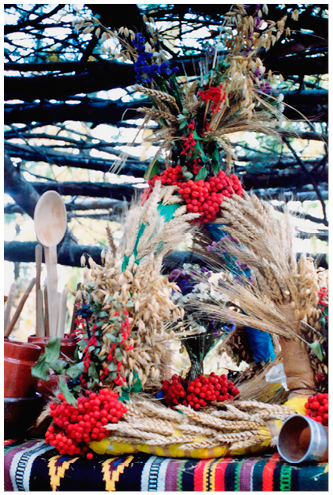
In nearly all current variations of Slavic Native Faith, ritual takes a primary place above other modes of religious practice (see Figure 1). Insofar as training is available for ritual specialists (or other offices that might be translated as ‘priest’ or ‘priestess’), it is likely to emphasise orthopraxy. Furthermore, co-celebration between various communities, even across national borders, has become relatively common, and therefore many ritual practices have travelled far across the contemporary landscape, in contrast to the much more fragmented situation for doctrine.

Figure 1 A decorated sheaf of grain and berries at a Polish autumn equinox celebration in a forest outside of Krakow, Reference Kazakov2005.
Adherents of Slavic Native Faith worship Slavic deities and spirits, acknowledging various forms of polytheism, animism, or monism – that is, various forms of deity which represent an underlying oneness. Doctrinal orthodoxy, however, is not a major concern of most, but not all, communities, and within limits, individual believers generally enjoy considerable latitude in expressing their own theological opinions.
Slavic Native Faith revisits and continues the traditions of the Slavic indigenous religions before the arrival of Christianity. As such, one component of all such religious movements is looking backwards to what has come before. They share a relatively sharp focus on selected source material from specific places, people, and times. They generally favour those sources that can be classed as close to the academic mainstream, although there can be considerable variation in terms of their acceptance or rejection of sources at the fringes of academia. Even what may be held locally as mainstream will differ slightly from educational system to educational system, and inevitably change over time as scholarly fashions for methodologies and theoretical perspectives change. Thus a practitioner in Croatia seeking academic knowledge may reach for the Croatian ethnologist Vitomir Belaj’s (1937–2023) 1998 Hod kroz godinu, whereas a practitioner in Poland may frequently consult the pages of ethnographer Kazimierz Moszyński’s (1886–1959) three-tome Kultura ludowa Słowian (1929–1939) as a trove of authentic lore. But those academic authors are not always as well known outside of their home countries nor do they enjoy the same prestige or even the same position vis-à-vis what counts as mainstream. And, of course, they do not agree between themselves on every academic point, which therefore can lead to local variation in current practices between the two countries.
Native Faith practitioners naturally favour those sources – archaeological, historical, or ethnographic – and those scholarly interpreters thereof, who consider the Slavic religion to be knowable, rather than those scholars who prefer to declare the evidence from the past to be too fragmentary and too unreliable to be reconstructed. And yet, all forms of Slavic Native Faith reject a simple simulacra approach to the past. The social, economic, legal, and technological realities of the twenty-first century are not the same as those of the tenth century. And, as a living religion with living adherents, Slavic Native Faith claims for itself the right to new artistic depictions, new rituals, and the forging of new relationships between humans and other-than-human beings, whether they be Nature, the Ancestors, or the Gods. Therefore, unlike a historical reenactment, Slavic Native Faith often openly embraces what might otherwise appear to be anachronisms within their religious practice. They aim to continue the old religion and therefore to address the present and to look towards the future.
Influences on the development of Slavic Native Faith may also come in, consciously or not, from sources not ‘native’ to the Slavs in a narrow sense. Some communities are in contact with Baltic or Hindu movements. Some have shown interest in techniques known from Siberian, Lappish, or Harner’s Core Shamanism. The broader New Age movement also engages with ancient religion, and therefore creates moments when some ideas transfer between the two. This usually involves a cautious process of indigenising the new elements to harmonise with the old, although at times it may occur in a less mindful manner (Simpson, Reference Simpson, Anczyk and Grzymała-Moszczyńska2012: 25–7).
In the foreseeable future, much like contemporary Pagan movements elsewhere, Native Faith is highly unlikely to become a major religion in any Slavic country. Nevertheless, it has already established itself as a noted feature on the religious landscape of Slavic societies. At the same time, it has gone through a maturation process in which some of the uncompromising radicalism of the early years has yielded to practical concerns, such as legal recognition or raising children.
Furthermore, beyond the numbers of committed believers, Slavic Native Faith has an impact far beyond the religious movement, per se. Pagan themes, images, and symbols figure widely in art and music or in such phenomena as games or historical re-enactment hobbies. Nationalist and Far-Right movements can also mine these movements for symbolic material. Because the effects of Native Faith have permeated into many areas at its periphery, it can be extremely difficult to demarcate its borders as a religion. In this Element, we focus on the self-identified religious movement, but we also try to demonstrate the ways in which that narrow movement has broader impact.
The Element begins with a historical overview – from the extinguishing of indigenous Slavic religion, to the rekindling of its embers into the first few sparks in nineteenth-century Romanticism, to the flickering flame in the early twentieth century, which finally burst into the warm blaze we see today. Ideas have spread between communities, but much of the early development was separate and independent, leaving significant differences between countries today. These are briefly sketched in the country profiles. In the final section, we shall observe how the movement has grown and developed, how it seeks to find meaning for its practitioners as well as contribute significantly to the society around it. For example, in Ukraine, that also includes the many adherents of Slavic Native Faith who are fighting and dying to defend their homeland against foreign invasion. These sacrifices have consequentially changed the perception of Native Faith, increasingly framing it as a patriotic and responsible part of local society.
1 Overview of Slavic Native Faith
It wasn’t until the ninth century CE that successful Christian missionary efforts extended northwards into the Slavic tribes beyond the borders of the Roman Empire. The brothers Cyril (826–869) and Methodius (815–885), although working for the Western Church based in Rome, themselves hailed from the Byzantine Empire, and invented a new alphabet – Glagolitic – to match Slavic phonemes. They translated prayers, masses, and portions of the Bible into a language we know today as Old Church Slavonic. They successfully converted the Great Moravian Empire – an important early Slavic polity in Central Europe – to their faith, along with neighbouring Bohemia, and a portion of what is today southern Poland.
The arrival of this exotic new religious movement in Slavic lands prompted the fall of indigenous religious beliefs and practices of the Slavic tribes. One by one, rulers of each tribe and kingdom found it desirable, expedient, or necessary to convert. The traditional dates given for this conversion are: Great Moravian Empire 863, Bohemia 884, Poland 966, and Kyivan Rus 988. Of course, there were individuals or regions which had converted earlier than their leader’s official conversion date. There were also those who remained faithful to the ways of their ancestors long after the ruling powers had declared the polity’s official conversion. But major religious centres, such as those that once stood in Rethra (a ‘lost city’ probably near the Tollensee), Arkona on the island of Rügen, or Starokyivska Hill in Kyiv, were razed and frequently replaced with Christian churches. Moreover, any structures for indigenous clergy or religious leadership were abolished. It was fashionable in the twentieth century to emphasise a robust ‘double-faith’ (rus: dvoieverie) as having prospered long in the countryside, with covertly cohabiting Pagan and Christian practices. If so, the indigenous faith had lost most of its prestige, leadership, and opportunities to openly share theological knowledge. It is possible, for example, to point to archaeological evidence that Pagan burial practices remained in many places relatively unchanged for decades after alleged conversion (Belaj & Sirovica, Reference Belaj, Sirovica, Kogǎlniceanu, Gligor, Soficaru and Stratton2023). Twenty-first-century scholarship has tended to frame the Pagan survivals as rather piecemeal and perhaps not seen as a distinct religion by their practitioners, rather than representing an intact underground ideology. Nonetheless, for centuries Christian priests would continue to denounce wicked Pagan practices from their pulpit, whether they continued to exist or not.
The evidence for reconstructing and continuing indigenous Slavic religion is substantial in total volume, but highly fragmentary. We have scattered evidence from written chronicles and missionary saints’ Lives, but they are invariably written by Christian clerks unsympathetic to the old religion they were trying to supersede. We have archaeological remains of sanctuaries and images carved in wood or stone that appear to represent deities, but such physical remains are mute about their use. We have surviving folklore collected in the nineteenth and twentieth centuries, but it is mixed with centuries of other influences and innovations, and coloured by Romantic preconceptions. We are also able to suggest hypotheses based on comparison with other Indo-European religions, but this method can only suggest where certain pieces should fall. What we painfully lack is a key to the scattered jigsaw puzzle of facts.
The Romantic Return of Interest
By the time Latin chroniclers began writing the histories of their respective kingdoms, and therefore turned their attention to their origins in the pre-Christian past, the details of indigenous religions had already grown vague in places. Renaissance chroniclers and scholars in Slavic countries began to delve into their nations’ pre-Christian past with increasing pride intermingled with reproach for the benighted beliefs of the ancient Slavs. We see authors like Jan Długosz in Poland (circa 1455) or Vaclav Hájek of Libočany in Bohemia (circa 1539) attempt to reconstruct the pantheons of their ancestors, with controversial results (Álvarez-Pedrosa, Reference Álvarez-Pedrosa2021: 223–6). In 1549, Sigismund von Herberstein (1486–1566), a Slovenian-Austrian diplomat to the Moscow court of Tsar Vasili III, reported the names of the Pagan pantheon of Volodymyr the Great back to the Western, Latin-using parts of Slavdom. This made possible later attempts to reconstruct which parts of the old religion had been shared between Eastern and Western Slavs. Antiquarians like Jan Jiří Středovský (1679–1713) could muddy the waters further by copying descriptions from foreign sources and placing those deities into the geography of his native Moravia, far distant from the places they were originally described (Středovský, Reference Středovský1710).
The greatest boom in new interest in Slavic Paganism came with nineteenth-century Romanticism. One of the milestone texts in the study of Slavic religion was Zorian Dołęga Chodakowski’s (b. Adam Czarnocki, 1784–1825) O Sławiańszczyżnie przed chrześcijaństwem (About the Slavs before Christianity), first published in 1818. Chodakowski may be little known outside of his home country, but he has been noted as both one of the founding fathers of scientific ethnography and archaeology in Poland, and as a spiritual founder of Slavic Native Faith in Poland (Filip, Reference Filip2022). Part academic text and part socio-religious manifesto, About the Slavs demanded attention to, and honouring of, the fading traces of the Slavic past. Chodakowski would remain a hero to subsequent generations, like the poets who published poetry soaked in Slavic Pagan atmosphere in the Lviv-based periodical Ziewonia from 1832 to 1838 (Gajda, Reference Gajda2012, Reference Gajda, Aitamurto and Simpson2013: 51). In his Wiara słowiańska (Slavic Faith) and later Bożyca (The God Book) Bronisław Ferdynand Trentowski (1808–1869) could both present a universalist vision in which all gods are facets of one deity, and yet lament the arrival of the Christian religion for driving his people into superstition and away from the simple truths of their ancestors (Gajda, Reference Gajda, Aitamurto and Simpson2013: 49–50). Rather incongruously, Trentowski’s attempt to build a systematic map of ‘red, black, and white’ Slavic hypostases of divinity was later repurposed to make ‘Cracow Monsters’ a horror serial for Netflix, plundering his work for thrillingly barbaric names, but leaving behind his visions of the philosophy of noble savages.Footnote 2
The influence of the Romantic period can be found in the important themes it introduced into the discourse which have remained visible into the twenty-first century. Central and Eastern European Romanticism tended to focus on the collective sacredness of the nation and its traditions. Chodakowski could complain that baptism into Christianity was an attempt to ‘wash away’ essential features of the national mindset and make Poles ‘alien to themselves’ (Gajda, Reference Gajda, Aitamurto and Simpson2013: 47). When Ján Kollár (1793–1852) wrote his poem cycle Slávy Dcera (The Daughter of Sláva), the figure of Sláva is a Pagan goddess, but also a hypostasis of the Slavic people. A modern echo of this line of thought can be found in Vasyl Skurativskyi’s much contested ethnographic work Berehynia (Reference Skurativskyi1987), and from that, the image of the goddess Berehynia has grown to be one of the most notable symbols of Ukraine and Ukrainian womanhood since post-Soviet independence.
The sacredness of Nature is also an important theme which we find throughout Slavic literature – not always as a gentle bucolic nature, either, but rather a numinous Nature that inspired awe and terror. Artists from several Slavic countries picked up the folklore image of the rusalka, a water spirit both beautiful and treacherous and, inspired by her, composed new poems (Mikhail Lermontov, Alexandr Pushkin), operas (Alexandr Dargomyzhsky, Antonín Dvořák), and paintings (Ivan Kramskoi, Witold Pruszkowski, Jacek Malczewski). The Romantic period often upheld the ancient Slavs as an example of the Noble Savage, a people who had been healthier and more glorious as barbarians before Latin civilisation corrupted them. In the early phase of Romanticism, following Johann Gottfried Herder (1744–1803), the focus was on the Pagan Slavs as arcadian agriculturalists. As the region was wracked by bloody uprisings in the second half of the nineteenth century, however, the focus shifted to the Slavs as merciless warriors. Both farmer and warrior models can easily be identified in the movements we observe today. All of these themes were typically presented in forms replete with mysticism, no longer a tidy interpretatio romana pantheon, but a horde of wild spirits, uncanny and irrational, dazzling and enchanting.
At the beginning of the twentieth century, these Romantic ideas bore fruit in the form of openly religious communities which practised early forms of Slavic Contemporary Paganism. Possibly the earliest among the Slavs was Poland’s small clique known as the Circle of Worshippers of Światowid (and variations on that name), active in some form beginning around 1921. Their ritual practices may have influenced subsequent communities – for example, worshipping in a circle – and their calendars were continued into the 1980s by others. Additional highly influential communities included the nationalist socio-cultural clique Zadruga in Poland, active as a community from 1937; and Volodymyr Shaian’s Order of the Knights of the Sun God in Ukraine, founded in 1943, based on a religious experience he had in 1934.
The Communist authorities cracked down on the leaders of contemporary Pagan groups across all of the Slavic lands in the dark days of Stalinism. However, after the Khrushchev thaw in the mid 1950s, some small degree of discrete underground activity became possible. Within Poland in particular, small-scale continuations of the pre-war communities survived in very fragmentary form. The diaspora abroad, however, especially for the Ukrainian movements, enjoyed some decades of very fecund development of their ideology. We see the alleged ancient Slavic manuscript, Book of Veles material first published in San Francisco in 1957–1959, and both Shaian (Reference Shaian1987) and Sylenko (Reference Sylenko1979) publishing their magna opera in Canada. The first use of the term Ridna Vira as a self-description appears in the diaspora in 1964, with this expression later developing into all of the other forms preferred today in multiple languages (Simpson & Filip, Reference Simpson, Filip, Aitamurto and Simpson2013: 36). The Polish diaspora movements in the United States seem to have died out before the fall of the Communist system back home in Poland, and therefore had no lasting impact. In contrast, the Ukrainian diaspora movements in particular would be waiting to reinject decades of development of Native Faith into the mother country when the time was ripe.
A wave of Russian nationalism took place in the Soviet Union in the 1970s, and it positively reassessed the early history of the Slavs, leading to Pagan-inspired religious activities by the 1980s. This semi-open activity under perestroika and glasnost was important for laying the groundwork for later communities. Russian Slavic Pagan activity of the late 1970s and 1980s included the antisemitic publication Desionizatsia (De-Sionization) by Valerii Emelianov (Reference Emelianov2005[1979]) as well as religious rituals, such as the one as described by Stavr (aka Evgenii Novikov), conducted secretly in the Bitsa Park in Moscow in the same year.Footnote 3 By the end of the 1980s, Pagan rituals were organised more openly and could attract over a hundred people with such Pagan leaders as Dobroslav (Aleksei Dobrovolskii) to lecture about the Native Faith in events organised in Soviet ‘cultural centres’ (Dom Kul’tury) (Shizhenskii, Reference Shizhenskii2013: 31). Aleksandr Asov was able to publish articles about the Book of Veles, and Aleksander Belov was able to promote his martial art Slavyano-Goritskaia bor’ba (Slavic Tumulus Fighting) in the Soviet mainstream journal Nauka i Religiia (Science and Religion).
Meanwhile in Poland, remnants of the pre-war communities still clung to life. Although in the 1970s they were allowed relative freedom, they faced even greater marginalisation as the Roman Catholic Church became the locus of resistance to the Communist system. Maciej Czarnowski, for example, was still printing mimeographed updates to the 1940s Slavic Calendar throughout the 1980s and maintaining his invaluable private archives of everything related to the interwar movements. In 1987, Zdzisław Słowiński was not only able to perform a postrzyżyny (ritual haircut) for his sons on Mount Ślęża, but also invited local journalists to the event (Łapiński & Szczepański, Reference Łapiński and Szczepański1996: 105).
The Post-Communist Boom
In the early 1990s, now without the formal oppression of the Communist system, and spurred on by an urgent need to redefine their national identities in an ideological vacuum, parallel movements arose and grew almost entirely independent of each other in different Slavic countries.
In Poland, the first expression of the new freedom remained linked to the pre-war movements. In 1990, we see the start of re-publication of Jan Stachniuk’s books and, in 1991, the founding of the highly influential Żywioł photocopied zine. This zine included new material along with reprints and translations. It refreshed the Polish memory of the Zadruga clique and other earlier attempts. It also provided early information to Poles about the Ukrainian diaspora (including introducing Polish readers to the term ‘Native Faith’) and other contemporary Pagan movements abroad. The Żywioł zine would serve as the cradle for the creation of a political party and two registered religious organisations.
The return of the diaspora religions to Ukraine began shortly after independence in 1991, when the RUNVira organisation established a foothold in Kyiv. In 1994, Halyna Lozko travelled to Canada in order to be initiated into a tradition descended from Volodymyr Shaian (1908–1974). Lozko would go on to be one of the most influential individuals on the international Native Faith landscape.
After the collapse of the Soviet Union, the leaders of the existing Russian communities were able to go public, and new communities and new publications began to blossom. At the end of the 1990s, Russian Slavic Pagan communities began to create more active networks and the first umbrella organisations, such as the Soiuz Slavianskikh Obshchin Slavianskoi Rodnoi Very (SSO SRV), were founded. The arrival of the internet allowed the intensification of the exchange of ideas, and Russian Native Faith literature was read in many other Slavic countries as well. Moreover, many larger Russian organisations have had member communities in other Slavic countries, especially in Belarus and Ukraine. As can be seen in the country profiles in Section 2, most of the other countries developed their own similar movements from the late 1990s to the early 2000s.
Current Demographics
The demographics of Slavic Native Faith are especially challenging to analyse. There can be definitional questions about which traditions should or should not be included as parts of the movement. Most communities do not keep very precise membership rolls, and although some communities may enforce strict affiliation requirements, it is more typical to observe a core group of leaders surrounded by increasingly diffuse peripheries of participants with lighter engagement or interest. Furthermore, in some countries, such as the Russian Federation, restrictions on religious organisations and concerns about ‘extremist activity’ may not encourage adherents to be highly visible. Different scholars may reach very different figures depending on how they choose to resolve those questions.
Without a detour into methodologies at this juncture, we may therefore present the following as an educated guess. Russia no doubt represents the largest community of Slavic Native Faith, with more than 100,000 adherents. Ukraine comes next with fewer adherents than Russia, but still probably in the tens of thousands. Slovakia may have as many as 3,600, and Poland would have another 3,500 or so core members. These increasingly smaller figures continue on through the smaller Slavic populations of Europe. There are also believers in the diaspora abroad. The total is unlikely to be much over 150,000 worldwide. In no case does the estimated number of adherents approach 0.5 per cent of any country’s population. Therefore, Slavic Native Faith at the start of the twenty-first century is inevitably a minority religion in countries dominated by other ideologies; nevertheless, its influence belies the scarcity of members.
One thing that is very clear, however, is that Slavic Native Faith communities are on the whole becoming more diverse. If the stereotypical image of a 1990s ritual – that is, a handful of young men huddled around a campfire with a bottle of mead – had its kernel of truth, then the image today is much more likely to be whole families attending a gathering, with plenty of children and dogs running around in sunshine. Halyna Lozko once stood out as a female leader in a movement largely headed by men, but today there is close to parity in the priesthood in most countries (Simpson, Reference Simpson2015: 5 and Petric & Borenović, Reference Petric and Borenović2021: 184). The young men of the 1990s are now married and middle-aged, and their children have grown up in the faith. As sociologists of religion like Eileen Barker have noted, later generations of new religious movements are generally a little different from the first generation of converts, often growing mellower and less radical over time, and this seems to be the case here as well (Barker, Reference Barker2014).
Relations with the State
Slavic Native Faith communities, which desire to do so, have had moderate success in official registration as a religious organisation in their respective countries. However, the restrictiveness of registration varies considerably from country to country. Poland, for example, at the time of this writing in September 2025, has 176 officially active religious organisations registered with the state, of which five would be best categorised as Slavic Native Faith. Neighbouring Slovakia, in contrast, has only eighteen registered religious organisations in total, none of which would be classed as any kind of contemporary Paganism or Native Faith. (In Slovakia, there are no registered Buddhist, Hindu, or Muslim organisations, either.) It appears that in many countries, only a minority of the adherents are formal members of an officially registered Native Faith organisation; the rest simply celebrate in informal communities.
Thanks to its current religious policies under which communities of at least ten members may register, as of 2020, Ukraine had the highest number of officially registered contemporary Pagan organisations in the region at 159 (Smorzhevska, Reference Smorzhevska2023), whereas in authoritarian Belarus there were none. In the Russian Federation, the first Slavic Pagan organisation, Moskovskoe Slavianskoe Iazycheskoe Obshchestvo (MSIaO, Moscow Slavic Pagan Community) was registered in 1994. However, in 1997, the law on freedom of conscience introduced new rules for registering and re-registering religious organisations and at the beginning of the 2000s, government authorities became significantly more reluctant to grant registration for Slavic Native Faith communities. By 2025 there were no Slavic Native Faith communities in Russia that still had the official status of a religious organisation. Several communities have attempted to register, but were rejected. Without registration, communities cannot own property or land, therefore, some Russian Slavic Pagan communities have settled for registration as secular social or cultural organisations.
Transnational Organisations
Although they often shared sources of inspiration, and sporadically experienced interpersonal contacts, Native Faith communities in various countries engaged in a series of parallel developments without top-down coordination. It was only after local and national structures had been created that those organisations began to seek participation in transnational structures of any sort.
For the Slavic countries, the first and most seminal such organisation was the World Congress of Ethnic Religions (WCER), later renamed the European Congress of Ethnic Religions (ECER). This congress held its first meeting in 1998 in Vilnius, Lithuania. Although the Congress had been convened under the term ‘Pagan’, delegates to the meeting rejected that label (Strmiska, Reference Strmiska2005: 14). They selected ‘Ethnic Religion’, deciding it was more accurate. In their definition of Ethnic Religion, they declare ‘we mean religion, spirituality, and cosmology that is firmly grounded in a particular people’s traditions. In our view, this does not include modern occult or ariosophic theories/ideologies, nor syncretic neo-religions’.Footnote 4 Although Wicca and Wicca-inspired movements are well-represented in the worldwide contemporary Pagan landscape, they are notably not visible in the ECER.
Although not specifically Slavic in its scope, the WCER/ECER provided an early forum for contact between Slavic groups that had not previously maintained any formal international ties. A 1997 meeting in Užpaliai, Lithuania – before the formal founding of WCER – already included representatives from Poland, Russia, and Ukraine.Footnote 5 The inaugural 1998 WCER meeting in Vilnius included among the international guests Slavic representatives from Belarus, the Czech Republic, Poland, Russia, and Ukraine.Footnote 6 In spite of a diversity of communities in their home countries, the first organisations to send delegates to ECER have generally remained the primary representatives for that country thereafter.
The Assembly of Native SlavsFootnote 7 (ukr: Rodove Slovianske Vìche, rus: Rodovoe Slavianskoe Veche, pol: Rodowy Wiec Słowian, etc.) consists of a series of international meetings that bring together Native Faith organisations from several Slavic nations. The first was held in July of 2003 near Kyiv, Ukraine, with representatives from five Slavic countries: Belarus, Bulgaria, Poland, Russia, and Ukraine (Górewicz, Reference Górewicz2009). The delegates represented specific organisations known to each other from previous cooperation within WCER. Like the WCER/ECER, each country is now typically represented by that organisation which first initiated contact with the Assembly, and not, for example, by a selection of delegates elected from many or all such communities in a given country. However, in some years, representatives of more than one organisation from a single country have attended, as have private individuals attending on their own initiative. Subsequent assemblies have taken place in different Slavic countries, with different host organisations.
The postulates agreed to by the first Assembly included such practical points as maintaining international cooperation and defending the good name of the religion (Górewicz, Reference Górewicz2009: 154). The second Assembly, held in Belarus in 2004, adopted a more rigorous and restrictive set of principles, including the declaration that they only recognise as Slavic Native Faith those members who are of Slavic genetic origin. In later documents this was reworded as ‘belonging to the Slavic family’ without direct reference to genetics. They also exclude any who reject polytheism or who allow membership in both their faith and a monotheistic religion. Russocentrism or Russian imperialism has caused some disputes within the Assembly of Native Slavs and especially the Ukrainian leader, Halyna Lozko, has criticised some Russian and Belarusian participants for not acknowledging the principle of the equality among Slavic nations and languages (Lozko, Reference Lozko2016). In response, her former partner, the Russian editor-in-chief of the international Nouvelle Droit journal Atenei, Pavel Tulaev, publicly accused Lozko of ‘Russophobia’.Footnote 8
In spite of the Russian occupation of Crimea in 2014, the various Slavic Native Faith organisations that participated in the Assembly were able to continue meeting. They held regular meetings in Slovenia, Croatia, and Poland, and at the 2019 meeting in Prague (the sixteenth), they planned the 2020 meeting to take place in Slovakia. The regular meetings of the assembly were interrupted by the COVID-19 pandemic and then the 2022 full-scale Russian invasion of Ukraine. At the time of this writing, the activities of the Assembly appear to be paused.
There is also the Pagan Federation International (PFI), an organisation that grew out of the UK-based Pagan Federation. The group expanded into Central and Eastern Europe with a branch in the Czech Republic in 2006, which did not at that time contain a significant Slavic Native Faith partner. Generally, in Central Europe, PFI has been popularly associated with Wicca, as well as more generalised forms of Anglophone contemporary Paganism, Druidry, and Asatru. But when PFI arrived in Poland in 2007, it included participation from Rodzimy Kościół Polski (RKP, a state-registered organisation that is not part of ECER or the Assembly of Native Slavs). In Russia, Wiccans have been most active in the PFI but they also have some adherents of Slavic Native Faith as members, as, for example, Iggeld (Dmitry Gavrilovb.1968), one of the founding members of the Krug Iazycheskoi Traditsii (KIaT, the Circle of Pagan Tradition). In 2016, PFI was one of the organisations that founded a new Pagan collaborative initiative, Vechevii Tsentr (Veche Centre) that included different forms of Paganism, including communities of Slavic Native Faith.Footnote 9 On 5 March 2022, the PFI terminated the activity of the Russian branch due to Russia’s full-scale invasion of Ukraine. However, individuals with Russian citizenship can remain as members.
The Book of Veles – Not a Unifying Text
The Book of Veles (ukr. Velesova Knyha, rus. Velesova Kniga, Kniga Velesa) is an allegedly ancient manuscript recounting the history of the Slavs, with a starting point centuries or millennia before the common era, depending on the translator. According to its supporters, the manuscript was written on wooden planks. These planks had been studied and copied by Ukrainian writer Yurii Miroliubov, but they disappeared during the Second World War. Miroliubov was able to bring his notes to the United States after the war, and, in the 1950s, the Book of Veles was published in an emigree journal, Zhar Ptitsa. The published text found its way back to the Soviet Union where it evoked interest, but was denounced as a forgery by Soviet scientists.
Since the collapse of the Soviet Union, the contents of the Book of Veles have been published in numerous translations and interpretations, especially by Ukrainian and Russian authors, many of whom have been engaged in the Native Faith movement. Since the 1990s, there have been ongoing debates about the authenticity of the text among Slavic Native Faith believers in different countries. At the current time, it seems that a growing number of adherents classify the manuscript as a forgery.
The many published versions of the Book of Veles may differ from each other so widely that it is difficult to state what the original manuscript contained in some places. The broad outlines generally remain the same: in addition to a historical account, it includes hymns praising various deities. Despite uncertainties, some notions derived from this source have become established in Slavic Native Faith, even outside of those who accept it as an ancient source, such as the idea of Slavs as the ‘grandsons of Dazhbog’ or the three-level cosmos of the Slavs being named specifically Nav (the otherworld, the world of the dead), Yav (the imminent world), and Prav (the world of ideas and gods).Footnote 10
The Book of Veles, and derived concepts like ‘Nav, Yav, and Prav’, represent an example of the transnational flow of ideas that can occur between quite separate communities. Nonetheless, even a well-known text like the Book of Veles can’t be simply taken as ‘typical’ of the hundreds of communities spread across a dozen countries. The story of Slavic Native Faith has played out a little differently in each country, with its own leaders and influential organisations. And therefore, in the following section, we will focus on country profiles that explain some of those differences.
2 Country Profiles
When viewing the Slavic Native Faith movement across many countries, we find a complicated pattern of both striking similarities and deep differences. The following section covers some of the most noteworthy specifics for many of the predominantly Slavic countries today. We begin with Poland as one of the earliest to experience a wave of organised Slavic Native Faith communities. Ukraine is covered next because it hosted many seminal developments in the second half of the twentieth century. Then on to Russia which has dominated much of the international discourse about Slavic Native Faith since the late 1990s. Thereafter, the countries are loosely grouped. Apart from some of the smallest countries, the country profiles include a short overview of the history and a description of the contemporary movement and the most notable organisations.
Poland
Pogaństwo is the Polish-language cognate of the Latin paganismus (paganism), historically used for many non-Jewish and non-Christian religious beliefs. Since the early twentieth century, the word Neopogaństwo (Neopaganism) has been applied to religious or ideological movements that in some way call back to the pre-Christian indigenous religions of Europe. Neopogaństwo is found in newspaper articles of the 1930s to describe the early Polish contemporary Pagan movements, and it was generally accepted by Polish practitioners themselves until the end of the 1990s. In the twenty-first century, the most popular self-description of the religious movement is Rodzimowierstwo (the practice of Native Faith) which derives ultimately from Ukrainian predecessors. Although the colocation ‘rodzima wiara’ can be found in Polish texts in the 1980s, it wasn’t until the 1990s that it was selected by some groups as a proper name, and the single-word form, Rodzimowierstwo, arose in the early 2000s. Neopogaństwo has now acquired a mildly pejorative sense, and therefore may sometimes be applied to other contemporary Pagan currents vis-à-vis their own.
Poland: Early History
The Pagan heritage enjoyed a positive reassessment in the late Enlightenment and the nineteenth-century Romantic period. For example, the scholar and philosopher Bronisław Trentowski (1808–1896) collected all the Slavic theonyms available at that time and assigned them places in a vast pantheon (Pełka, Reference Pełka2008). Novels such as Józef Ignacy Kraszewski’s 1876 Stara Baśń (An Ancient Tale) brought the temples, rites, and beliefs of the ancient Slavs to life for a wide popular audience (Gajda, Reference Gajda, Aitamurto and Simpson2013). The Romantic period also saw the first individuals in centuries openly declaring themselves to be Pagans. The ethnographer Zorian Dołęga-Chodakowski (1784–1825) published a manifesto in 1818 calling for a return to the old faith. Although influential on later generations, Chodakowski did not found a contemporary Pagan organisation of any kind (Gajda, Reference Gajda, Aitamurto and Simpson2013). Visual artists such as Stanisław Jakubowski (1885–1964) and Zofia Stryjeńska (1891–1976) created portfolios of deities whose images remained alive in the Polish imagination (Gardela, Reference Gardeła2024).
The architect and lecturer Jan Sas-Zubrzycki (1860–1935) was an important, but less frequently remembered, figure in establishing a body of terminology and symbols in his books and articles. By 1924, he would come to call this system Bogoznawstwo Sławjan, literally, ‘god-knowing of the Slavs’ (Sas-Zubrzycki, Reference Sas-Zubrzycki1925). The first recorded contemporary Pagan organisation in Poland was the clique around Władysław Kołodziej (1897–1975). This group was inspired by Kołodziej’s religious experience in 1921. Beginning as a small group of friends, their fluctuating membership used several variations on their name over their long history, including Święte Koło Czcicieli Światowida, Lechickie Koło Czcicieli Światowida, and Lechickie Stowarzyszenie Czcicieli Światowida (all ‘Worshippers of Światowid’). They quickly assimilated the Bogoznawstwo theology, vocabulary, and symbols of their older contemporary Sas-Zubrzycki, putting them into religious practice. This group succeeded in writing a Slavic calendar in Nazi-occupied Krakow, and they were able to publish two editions (1946, 1947) in the early years of Communist rule. Kołodziej was jailed by the Communist authorities from 1950 to 1956, but had consolidated enough of a community again in the 1970s in Warsaw to unsuccessfully attempt legal registration of his flock. (Łapiński & Szczepański, Reference Łapiński and Szczepański1996). After Kołodziej’s death, the group limped on with ‘Brother Masław’ as a leader for a few more years, petering out in the 1980s.
The best-known of the early Polish contemporary Pagan groups was the Nationalist Zadruga clique, led by Jan Stachniuk (1905–1963). Launched from a claim that the values inherent in Roman Catholicism had impoverished the Polish nation, the earliest Zadruga publications were primarily anti-Catholic. Over time, they turned increasingly to questions of what the Slavic value system and religion should look like in twentieth-century practice. Stachniuk’s own writing explicitly valued the role of national culture over biological inheritance. Stachniuk and many of his followers fought against the Nazis during the war and were able to briefly cooperate with the new Communist authorities (Tomasiewicz, Reference Tomasiewicz2012). Nonetheless, Stachniuk’s publications fell afoul of the censors, and he was jailed from 1949 until 1955; he never fully regained his health, nor wrote again, before his death in 1963.
Under the People’s Republic, the surviving interwar Neopagans continued to exist in small, informal, and only semi-open groupings (Szczepański, Reference Szczepański2009). Individuals such as Maciej Czarnowski (1910–1997) were able to collect archives of Pagan materials and disseminate mimeographed samizdat (self-published) calendars, updating the late 1940s Kołodziej calendar into the 1980s. As the Roman Catholic Church came to challenge the ruling Communist government, a state policy of greater toleration for other religions was adopted. In 1970, a positive newspaper article covered Kołodziej’s revived activities in Warsaw (Sienkiewicz, Reference Sienkiewicz1970). In 1987, a local activist performed a Slavic ritual postrzyżyny (first haircut) on Mount Ślęża and this was covered in the local newspaper. These small signs signalled the slow, and largely undocumented, buildup of momentum that burst into view as soon as the lid of Communist control was lifted.
Poland: Contemporary Movement
The 1990s saw a boom in the registration of religious organisations of all kinds. At that time, the Ministry of Administration of the Republic of Poland required that communities have at least fifteen adult citizen members in order to register as a ‘religious organisation’, later raising that number to 100.
The first Slavic Native Faith organisation to achieve state registration in Poland was RKP (Rodzimy Kościół Polski – The Native Polish Church) in 1995. Although the founder, Lech Emfazy Stefański (1928–2010), a theatre and television director and actor, had not been a member of Kołodziej’s circle, his successors have emphasised that their organisation continued many aspects of the 1920s–1980s tradition of Święte Koło Czcicieli Światowida.Footnote 11 Stefański selected the now-internationally used ‘hands of god’ symbol as the organisation’s primary emblem. In 2007, RKP began cooperation with the Pagan Federation International.
As of 2025, together with RW and the young organisation RÓD, RKP is one of the three high-visibility state-registered religious organisations for Native Faith in Poland. This organisation has achieved striking success in bringing its events to the attention of the media and the broader public. Then-member and fiction author Konrad Lewandowski’s activism on behalf of the wooden idol of Świętowit in Gajowniki in 2018 garnered countrywide coverage, as did the September 2022 Slavic funeral of actor Kazimierz Mazur. For almost two decades, leader Ratomir Wilkowski has regularly appeared in social media and in the mainstream Polish press to offer a Rodzimowierstwo perspective on a variety of topics (Daraż-Duda, Reference Daraż-Duda2021).
The second organisation, the Association of Native Faith (Zrzeszenie Rodzimej Wiary – ZRW) later shortened to simply Native Faith (Rodzima Wiara – RW), officially registered with the state in 1996. Co-founder Dr Maciej S. Czarnowski (1910–1997), a noted Forest Ecologist, was a pre-war member of Zadruga, placing ZRW/RW firmly in its tradition. Throughout the 1990s, RW represented the Zadruga stream of thought in Poland, frequently employing the specialist jargon and concepts developed by that clique in the 1930s. Beginning in the early 2000s, the organisation’s focus shifted to shed some of its Zadruga trappings, and to re-engage with models drawn directly from folklore and archaeology, often bypassing the mediation of the previous Zadrugan approaches to that heritage.
In April 2024, in response to unpopular decisions about membership, finances, and doctrine from the organisation’s central board, the leaders of regional sections of RW took the unusual step of requesting the Polish Ministry of Interior and Administration to audit whether the organisations’ own by-laws were being upheld.Footnote 12 At the same time as its internal cohesion was being challenged, members of RW were willing to engage in larger structures: RW has been a committed member of the transnational ECER since 1998, a steady participant in the international Assembly of Native Slavs since 2003, and a member of the Poland-wide Native Faith Confederation since 2015. The personal connections of some RW leaders, including the organisation’s Naczelnik (Head), Stanisław Potrzebowski, to past or current far-right politics have caught the eye of anti-Fascist activists (see Kornak, Reference Kornak2009: 22; Witkowski, Reference Witkowski2018).
A third Native Faith group has emerged in Poland: Związek Wyznaniowy Rodzimowierców Polskich RÓD (The Religious Organisation of Polish Native Faith Adherents – KINDRED) was formally registered in January of 2024. Growing out of the Konfederacja Rodzimowiercza and the Stado meetings, in 2017, a number of small- and medium-sized Polish Native Faith communities declared their participation in registering a new religious organisation with the State (Grochowski, Reference Grochowski2020: 216). They succeeded in completing their formal registration only after the PiS government – known for its closeness to the Roman Catholic Church – lost power to a new parliamentary coalition. Currently the ‘broad church’ approach of RÓD and the federated structure appear to be effective among Polish Rodzimowierstwo, and a number of small independent communities have officially joined their ranks. (Grochowski, Reference Grochowski2025: 156–7)
Many Rodzimowierstwo communities in Poland are neither currently registered as a religious organisation with the state nor attempting to do so. Non-registration as a specifically religious organisation may be replaced by other kinds of registration, such as ‘foundations’, and operate without difficulty. Even more communities exist without any registration, operating as like-minded individuals who co-celebrate the holidays, and ‘pass the hat’ when shared costs arise. There are also those Rodzimowiercy who prefer to celebrate the holidays in family units, affirming that family is a sacred value.
Poland has also had organisations that incorporate Zadruga or Native Faith ideas in political or social agendas. For example, in 1998, historian and political activist Tomasz Szczepański founded Stowarzyszenie na rzecz Tradycji i Kultury “Niklot” (The Association for Tradition and Culture – ‘Niklot’), named after Niklot (1131–1160), the last Pagan Obotrite Prince. This group blends Nouvelle Droite (New Right) ideas with those of 1930s Zadruga and is engaged in publishing a small-circulation magazine, Trygław, and holding lectures.
There are zines, blogs, and webpages that attempt to address the whole Rodzimowierstwo landscape, usually focusing on religious aspects and eschewing overtly political discourse. The most notable currently is Gniazdo: Rodzima Wiara i Kultura (The Nest: Native Faith and Culture) magazine. The magazine covers news from the various organisations and communities, mythology, and music, but also forward-looking topics such as Rodzimowierstwo responses to climate change or to emerging new technologies. Roughly the same editorial team (known as Wizja i Dzieło – Vision and Deed) who produce Gniazdo were also involved in creating an independent internet radio station, Radiowid, which began transmission in the summer of 2006. (Szamruchiewicz, Reference Szamruchiewicz2008; Zienkiewicz, Reference Zienkiewicz and Jaska2010) This ceased broadcasting in 2014, but was later reborn in 2020 as a block of programming on the Radio Praga station based in Warsaw.Footnote 13
Created in 2020, iSAP – Słowiańska Agencja Prasowa (the Slavic Press Agency) attempts to disseminate Native Faith messages in the media. It is an officially state-registered association of 20 to 25 journalists covering Slavic culture and faith.Footnote 14 If magazines like Gniazdo are inwardly focused on the committed members of Rodzimowierstwo, then iSAP attempts to bring the voice of Rodzimowierstwo to the homes of all Poles, not just those who are believers in the religion. Their focus often embraces topics of vital concern to Rodzimowierstwo, such as new archaeological discoveries, reviews of books on folklore and history, or upcoming cultural festivals that don’t explicitly invoke the religious context. They also cover explicitly religious events like the ‘All-Poland’ gatherings of Rodzimowierstwo. Regular video updates also appear on YouTube.Footnote 15
There are also religious communities or state-registered religious organisations which fall at the edges of the self-recognised Native Faith movement. For example, Kościół Naturalny (The Natural Church, registered in December 2021) does not represent itself as ‘Rodzimowierstwo’ but many aspects of their practice are derived from Slavic models, perhaps more closely aligned with Slavic Vedism (see Russia and Slovakia). A recent study of mostly solitary witches in Poland – largely following international Wicca-derived practice – found that 63.1 per cent worship Slavic deities, and 62.07 per cent celebrate Slavic holidays, making this another religious movement contiguous with Slavic Native Faith per se, and to some degree, overlapping in participants, at least at times (Jabłońska, Reference Jabłońska2024: 114–15). This is reflected in a burgeoning Rodzimowierstwo-adjacent ‘Slavic Witch’ paradigm, found in books such as Słowiańska Wiedźma (The Slavic Witch) by Dobromiła Agiles (Reference Agiles2021).
Poland: Issues and Challenges
The first attempt at creating an all-Poland discussion summit of the largest and most active communities was held in 1998 at Wiśniowa near Krakow (Górewicz, Reference Górewicz2009: 156). A more successful second try was advertised as the first Ogólnopolski Zjazd Rodzimowierczy (All-Poland Gathering of Native Faith Adherents) in Łódź in 2013. It involved RW, RKP, and the PFI, as well as representatives from some of the independent communities. The forward motion from that event then bifurcated, creating two series of competing ‘All-Poland’ summits, one centred around RKP, and the other centred around RW and the Konfederacja/RÓD. Apart from such discussion-based gatherings, a yearly ritual gathering of Stado, where members of different communities co-celebrate rituals over a weekend in June, allows the exchange of practice and expertise between individuals who wouldn’t normally have many such face-to-face opportunities (Grochowski, Reference Grochowski2020).
The Konfederacja Rodzimowiercza (Confederation of Native Faith) was created in August 2015 from among the participants in the ‘Third’ All-Poland Assembly of Native Faith. This loose framework embraced the registered religious organisation, Rodzima Wiara, as well as many of the communities that had not registered as a religious organisation, such as the Watra Foundation based in Wrocław. It notably did not include Rodzimy Kościół Polski at any time. After 2018, the forward impetus of this Confederation was turned almost entirely towards the creation of RÓD.
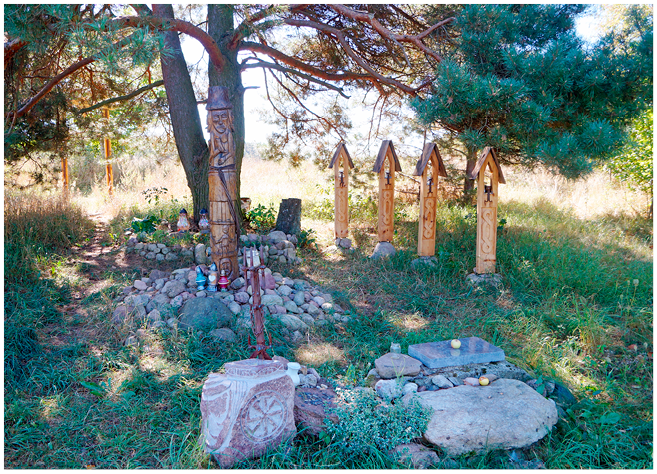
In the 2010s, a number of temple projects were attempted (Nastevičs, Reference Nastevičs2018). An ambitious plan to build a freestanding, roofed wooden temple building near the city centre of Wrocław raised funds and received coverage in the international press, but ultimately ran afoul of municipal planning problems.Footnote 16 However, permanent sanctuaries with open-air sacred space (usually with standing cult images, and often with smaller picnic spaces) have proved more successful. (Grochowski, Reference Grochowski2025: 421–7) One of the most visible of these has been the Gajowniki sanctuary in northeastern Poland, just outside of Białystok (see Figure 2). The sanctuary was established in response to the destruction of a local wooden monument to Światowid. The resulting protests and counter-protests kept the affair in the public eye. Other such temple projects are likely to break ground in the near future.
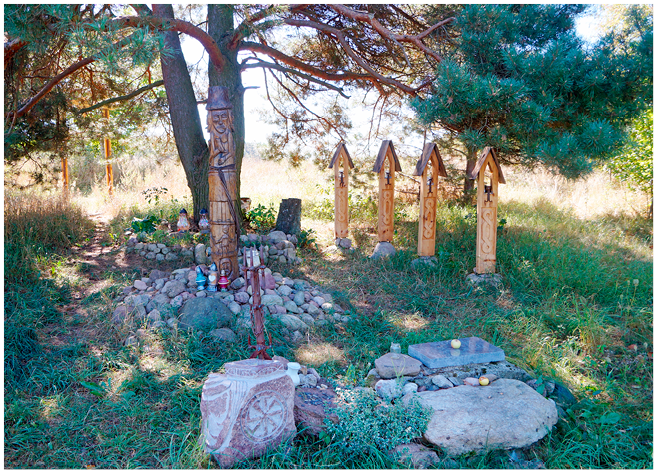
Figure 2 An outdoor Slavic Native Faith sanctuary in Gajowniki, near Białystok in northeastern Poland. 2022.
The greatest successes of Rodzimowierstwo in Poland in the first two decades of the twenty-first century have been in increasing their visibility and the diffusion of their ideas into broader Polish society (Antosik, Reference Antosik2008). Overall, the movement has clearly grown in maturity since the 1990s. However, because of its relatively small size and diffuse borders, there is little clarity about the precise demographics of Rodzimowierstwo in Poland. Recent scholarly estimates can run as low as 1,000 and as high as 10,000, dependent on criteria and definition (see Hornowska & Kośnik, Reference Hornowska and Kośnik2020). In the 2021 Polish census, 3,436 individuals self-identified as belonging to one of four registered Native Faith organisations, with others (perhaps a few hundred more) under a general category of contemporary Pagan affiliation, including Rodzimowierstwo, but also Druidry, Asatru, and Wicca.Footnote 17
Ukraine
There are two words for Paganism in Ukrainian, pohanstvo and iazychnytstvo. The first has stronger negative connotations, related to the word pohanyi (bad), and therefore is rejected by many contemporary Ukrainian Ridnovirs. The second, iazychnytstvo, can also be seen as problematic because it is a term created by Christians, but it is more widely accepted. One of the notable few Slavic Native Faith groupings that object to the word iayzichnitstv is the Native Ukrainian National Faith, (Ridna Ukrains’ka Natsional’na Vira RUNVira) (Lesiv, Reference Lesiv2013: 6; Nonjon, Reference 85Nonjon2021: 1). Hardly any of the adherents or communities approve of the prefix ‘neo-’ because they see this as implying that the faith is not based on the old tradition (Smorzhevska & Khvist, Reference 88Smorzhevska and Khvist2017: 126). The term that today seems most widely used and accepted is Ridna Vira (Native Faith) or Ridnovirstvo (the practice of Native Faith) (Ivakhiv, Reference Ivakhiv2005a: 16; Lesiv, Reference Lesiv2013: 6). Other terms that can be used, sometimes as secondary or alternative descriptions for the faith, are stara vira (old faith) or pravoslav’ia (correct glorification), which is also the common word for Orthodox Christianity, but one which Native Faith groups claim properly belongs to them. Given that many groupings argue that their faith is based on, or connected to, old Indo-European Vedic tradition, such terms as, for example, vedychna (ukr. Vedic) tradition can also be used (Ivakhiv, Reference Ivakhiv2005a, 21; Kurovskii and Kurovskaia, Reference Kurovskii and Kurovskaia2013: 5).
Ukraine: Early History
As elsewhere in Europe, nineteenth-century ideas of nationalism and fascination with local traditions emerged in the area of contemporary Ukraine, although because its regions found themselves under different political regimes, they took different forms. Under the Austro-Hungarian Empire, which held the western part of Ukraine, Ukrainian national identity was restricted, but could be expressed, especially within the Greek Catholic Church. Under the Russian Empire, which held eastern Ukraine, all nationalist aspirations, even in the areas of culture or language, were suppressed. Despite these challenges, Ukrainian intellectuals studied the history and culture of their people. Writers such as Mykhailo Kotsiubynsky (1864–1913) and Lesya Ukrayinka (1871–1913) were drawn to the local folklore and spiritual traditions (Ivakhiv, Reference Ivakhiv2005a: 11; Ivakhiv, Reference Ivakhiv and Strmiska2005b: 215–17). The national poet of Ukraine, Taras Shevchenko (1814–1861), in particular, looms large in Ridnovirstvo discourse today. In his literary work, Shevchenko protested the oppression of Ukrainian peasants by the Russian tsarist regime, including by the representatives of the Russian Orthodox Church. Today’s Ridnovirs can easily find in him a kindred spirit (Lesiv, Reference Lesiv2013: 4, 101–4).
Debates about Slavic ethnogenesis continue to influence contemporary Ukrainian Ridnovirstvo. In the first part of the twentieth century, Yuriy Lypa (1900–1944) suggested that the roots of Ukrainian identity can be traced to the Neolithic Trypillian culture, noted for its high level of advancement for Europe at that time. The narrative of the Trypillian culture as the golden age of Ukrainians has been adopted by prominent Ridnovirs, such as Volodymyr Shaian or Halyna Lozko (Nonjon, Reference 85Nonjon2021: 78: Lesiv, Reference Lesiv2013: 30). Some Ukrainian Ridnovirs employ calendars that claim to derive from the Trypillian culture. Thus, according to the calendar of the Association of the Ukrainian Native Faith, we are currently living in the seventy-sixth century (Lesiv, Reference Lesiv2013: 59).
Historical figures such as the last Pagan Prince of the Kyivan Rus’, Svyatoslav (reigned 945–972), are celebrated by Ridnovirs. A problem with presenting the Kyivan Rus’ as model ancestors, however, is that their memory has been hijacked by Russian historiography as the direct ancestor of the modern Russian state. In this narrative, Ukrainians and Ukraine have been sidelined, and denied any valid separate identity. In turn, ethnic references such as ‘Slavs’ or ‘Slavic tradition’ seem to be entirely too expansive to be useful (Ivakhiv, Reference Ivakhiv2005a: 27–8). Furthermore, they are tainted by the Russocentric idea of Eastern Slavs as a single ethnicity in which Russians are the ‘elder brother’.
Accounts of the revival of Ukrainian Native Faith routinely start from the figure of Volodymyr Shaian (1908–1974), a poet, polyglot, philosopher, and scholar of Sanskrit. In the oft-told foundation story, during his stay in the Carpathian Mountains in 1934, Shaian became engaged in folkloric traditions that he considered reflected ancient Slavic wisdom (Lesiv, Reference Lesiv2013: 49). Shaian was at that time studying and teaching in Polish-held Lviv. Shaian himself indicated that he had delivered a critical assessment of specific Nazi-era Aryan ideas – apparently those of Jakob Wilhelm Hauer (1861–1962) from Germany – and therefore his own later beliefs were developed with at least some passing familiarity with other early twentieth-century attempts at constructing contemporary Paganism. He was convinced that the area of modern Ukraine is the cradle of Aryan culture and Vedas. He presented these ideas to the international academic community in 1937 at an Indology conference entitled ‘Renaissance of pan-Aryan Thought’ in Lviv (Ivakhiv, Reference Ivakhiv2005a: 11; Nonjon, Reference 85Nonjon2021: 37). In the Soviet Union of the time, he had to conceal his religious beliefs in scholarly study of the past, as he later recounted (Shaian, Reference Shayan (Shaian)1950: 5–7).
During the Second World War, Shaian founded the paramilitary group Order of the Knights of the Sun God, the members of which he encouraged to join the Ukrainian Insurgent Army that fought against Soviet troops. Shaian fled Ukraine and ended up in England, where he continued writing and publishing. Looking backwards, Shaian is regarded as one of the vanguard of twentieth-century Slavic Native Faith, however, his published writings, especially in his English years, sometimes had a broadly monist and universalist tone (see Shaian, Reference Shayan (Shaian)1950: 7). By the 1960s, his developing ideas found fertile ground in North America and especially in Canada, where his followers founded communities and published his works (Lesiv, Reference Lesiv2013: 50–1; Nonjon, Reference 85Nonjon2021: 70–3). Even today, one of the most influential publications within Ukrainian Ridnovirs is the Faith of Our Ancestors (Shaian, Reference Shaian1987) that was collected posthumously in Canada (Lesiv, Reference Lesiv2013: 51).
The other founder of modern Ukrainian Native Faith is another post-war emigree, Lev Sylenko (1921–2008), the founder of RUNVira (Ridna Ukrayins’ka Natsional’na Víra, Ukrainian National Native Faith; in North America it is also known as the Church of Ukrainian Native Faith or Church of the Faithful of the Native Ukrainian National Faith). According to the followers of Shaian, Sylenko was originally his disciple, but members of RUNVira reject this (Lesiv, Reference Lesiv2013: 40). Whatever the truth is, by the 1970s there emerged a disagreement between the two men about the nature of Ukrainian Native Faith. A central issue in this disagreement was whether the religion was polytheist or monotheist, Shaian arguing for henotheism and Sylenko for monotheism (Lesiv, Reference Lesiv2013: 40–1).
RUNVira was founded by Sylenko in Chicago in 1966. However, he soon moved to Canada, where the organisation was very active (Lesiv, Reference Lesiv and Rountree2017: 138–9). In 1979, Sylenko published his magnum opus, Maha Vira (The Great Faith), in which he had collected the findings of his study and interpretations of the Aryan tradition (Ivakhiv, Reference Ivakhiv2005a: 12). Drawing also from some Theosophical ideas, Sylenko argued that Ukrainians are the descendants of the ancient Aryans that he calls Oriians, who preserved the old Brahminic wisdom. According to him, Kyiv is the ancient centre of the white race (Lesiv, Reference Lesiv2013: 45; Nonjon, Reference 85Nonjon2021: 72–3). Sylenko asserted that the ancient religion was monotheistic and based on worship of Dazhboh, the god of the sun. Maha Vira still holds the place of a sacred scripture among the RUNVira followers, excerpts of it being read in the rituals; it is used as an authority to settle different issues or disputes (Nonjon, Reference 85Nonjon2021: 72–3; Lesiv, Reference Lesiv and Rountree2017: 147).
Ukraine: Contemporary Movement
The first RUNVira community was officially registered the same year that Ukraine regained its independence, 1991. The organisation spread rapidly but there were also some internal divisions. From the outset, the organisation seemed to attract older generations rather than youth (Ivakhiv, Reference Ivakhiv2005a: 17–9).
The dissemination of the teachings of Shaian in Ukraine has, for the most part, been achieved by his disciple, Halyna Lozko (Zoreslava, b.1952), a philologist, folklorist, and scholar of religion. Her formidable personality and relentless activity within Ukraine as well as in international Native Faith circles have made her one of the best-known leaders and authorities in the movement. In 1993, she founded the organisation Pravoslavia and in 1998, the Obiednannia Ridnoviriv Ukrainy (ORU, Association of Ukrainians of Native Faith) (Ivakhiv, Reference Ivakhiv2005a: 22; Nonjon, Reference 85Nonjon2021: 71). Lozko has published several books as well as edited translations and commentaries of the Book of Veles, which forms one of the cornerstones of her teachings (Ivakhiv, Reference Ivakhiv2005a: 23).
Though Lozko’s writing employs the language of polytheism, she described her views as henotheism. We find a hierarchy of related deities presented somewhat like a genealogical tree; by juxtaposing hen- and gen-, which sound identical in Ukrainian, she ties the concepts together. But she also states that apparently different deities can be different aspects of higher deities. In her writings, Rod is referred to as the highest deity and Svaroh is the batko (forefather or leader) of the Ukrainian pantheon, but sometimes other gods are understood as aspects of Svaroh (Lozko, Reference Lozko2007: 20; and see Ivakhiv, Reference Ivakhiv2005a: 23). Lozko draws inspiration from Ukrainian peasant culture and the way of life that she sees as a harmonious symbiosis with nature (Nonjon, Reference 85Nonjon2021: 73, 75). According to Lozko, Ridnovirstvo challenges globalisation, which she sees as promoting the disappearance of cultures and ethnicities. Lozko also opposes the mixing of ethnicities as one of the main threats posed by modernisation. Here she draws upon French Nouvelle Droite writers and shares their anti-egalitarian and anti-liberal viewpoints. She has also been active in international far-right intellectual circles (Ivakhiv, Reference Ivakhiv2005a: 25–6; Lesiv, Reference Lesiv2013: 51–2).
As the founder and one of the most influential members of the international Assembly of Native Slavs, Lozko collaborated closely with Russian representatives of Slavic Native Faith in its early years. However, from 2014 onwards, Lozko has become more critical of perceived Russian colonialism and chauvinism, including when it appears in pan-Slavic Native Faith networks. Nonetheless, Lozko’s most striking achievement in her career as a Native Faith leader has been the international reach of her influence, her ideas, and her ritual practice. Recognisable elements of her work can be found in the practices of communities from Poland to Croatia, even when they are not consciously cited as hers.
One of the themes in Lozko’s writings is the image of the Great Mother Goddess. According to her, the Trypillian culture, which she considers the golden age of the region, was characterised by matriarchy and living in harmony with nature. However, folklorist Mariya Lesiv (Reference Lesiv2013) notes that despite Lozko’s emphasis on the feminine side of divinity and the fact that women often hold local leadership positions in her organisation, Lozko’s perceptions of gender roles are very traditional and narrow for women (Lesiv, Reference Lesiv2013: 72–3). Nevertheless, many native faith communities affirm the belief that Ukrainian tradition is characterised by the strong position of women. Some of these communities even describe it as feminist (Liuta, Reference Liuta, Aitamurto and Downing2025: 260–3).
One of the biggest Ukrainian Native Faith organisations is the Rodove Vohnyshche Slov’ianskoii Ridnoi Viry (RVSRV, Ancestral Fire of Slavic Native Faith, hereafter Ancestral Fire), founded in 2003 by Volodymyr Kurovsky, who had been initiated as a priest in the ORU. The teachings of Kurovsky feature racist ideology and conservative values, although his writings are primarily focused on spirituality and self-enhancement (Lesiv, Reference Lesiv and Rountree2017: 143). In what is a relative rarity in Slavic Native Faith, Kurovsky claims that he received the core of his knowledge from his grandfather, who was also a magus (ukr., rus. Volkhv). From him he received ancient wisdom given to the Slavs by the gods Svaroh and Lada more than two million years ago. The tradition remained oral until it was written down on 360 wooden planks – much as the Book of Veles is claimed to have been preserved – and the resulting manuscript, Pokon, has now been published by the Ancestral Fire/RVSRV (Kurovskii & Kurovskaia, Reference Kurovskii and Kurovskaia2013: 12–15). According to Kurovsky, Rod is the central deity in Slavic Native Faith, but each ethnicity has their own gods (Ivakhiv, Reference Ivakhiv2005a, 21; Kurovskii & Kurovskaia, Reference Kurovskii and Kurovskaia2013: 8).
Given the prevalent warrior spirit in much of the Slavic Native Faith, it is interesting that Kurovsky argues that among the sixteen ‘Grains of Divine Truth’ (rus. Zeren Bozh’ei Pravdy), given to humans by God to guide their life, is the tenet of nonviolence. However, he also drew upon the Cossack tradition and founded an Order of Cossack–Sorcerers in 1999 (Lesiv, Reference Lesiv2013: 56). Later, Kurovsky revealed his own ancient form of martial art, Triglav, that he claims had been kept secret for centuries. In addition, Kurovsky promotes a Slavic Yoga, Yarga, and a holistic healing and healthy lifestyle system called Zhiva Yarga (Kurovskii, Reference Kurovskii2016). (See also Slovakia.)
Initially, Ancestral Fire subscribed to Ukrainian nationalism but soon began to turn toward pan-Slavism. Kurovsky argues that Slavs descended from ancient gods and therefore their blood is sacred (Lesiv, Reference Lesiv2013: 62). Ancestral Fire publishes its literature in both Ukrainian and Russian. It has had communities in Ukraine, Russia, Belarus, Slovakia, and Germany. Especially after the Russian annexation of Crimea in 2014, criticism of Ancestral Fire for its orientation toward Russia and the use of the Russian language gained momentum within Ukrainian Ridnovirs. Kurovsky’s unwillingness to condemn the Russian aggression was considered opportunism at best, and treason at worst. Ancestral Fire tried to defend itself by referring to the shared Slavic tradition, painting the West and non-Slavic countries as the real enemy of the Slavs (Lesiv, Reference Lesiv and Rountree2017: 142–7; Tarasiuk, Reference Tarasiuk, Aitamurto and Downing2025: 213–15). However, even Kurovsky has not been able to escape Russian anti-Ukrainian propaganda. In 2016, a Russian court ordered Kurovsky to leave Russia for practising prohibited proselytism in his seminars. In the same year, the Russian nationwide TV channel NTV aired a story in which Kurovsky was described as a ‘neopagan’, whose teachings combine ‘fascism’ and nationalism.Footnote 18
It is quite typical that the founders of Native Faith organisations started their spiritual search in some other Slavic community before founding their own. This is also the case for Svitovit Pashnik, who in 1993 was initiated into RUNVira and became the head of a local community. In 2000, he left the organisation and founded a new one, Sobor Ridnoii Ukrains’koii Viry (Council of the Native Ukrainian Faith) with Oleg Bezverkhy. Initially, the group defended monotheism but was later divided on this issue into eastern and western branches (Smorzhevska, Reference Smorzhevska2021: 122–3). Pashnik, who now subscribed to polytheism, briefly joined Ancestral Fire but was expelled from it for disrespecting the hierarchy of the organisation (Lesiv, Reference Lesiv2013: 57; Smorzhevska, Reference Smorzhevska2021: 120–2). In 2007, he founded the Rus’ke Pravoslavne Kolo (RPK, Community of Rus People who Praise Gods).Footnote 19
The centre of the RPK is Zaporizhzhia, a city in southeastern Ukraine. The RPK organises rituals on the island of Khortytsia, known for its natural beauty, archaeological sites from the Bronze Age, and the Museum of the History of Zaporizhzhia Cossacks. According to Pashnik, the island is a sacred place and was originally a ship that carried the deceased to Paradise. The RPK displays its faith in regularly held rituals, even allowing tourists to participate (Smorzhevska, Reference Smorzhevska2021: 117, 119, 124–5). The group reveres the moon god Hors as its main deity, who is also seen as connected to the prosperity of the Ukrainian people. The love of the motherland, as well as the warrior spirit, are important values in the RPK, which aims to train men as ‘warrior-defenders’ (Smorzhevska, Reference Smorzhevska2021: 130–1). After 2014, when the limited war started as Russia occupied Crimea and Russian troops invaded Eastern Ukraine, the women of the group donated traditional Ukrainian didukhs – decorated sheaves of wheat – to Ukrainian soldiers (Smorzhevska, Reference Smorzhevska2021: 134). Pashnik has also published online videos of the commemorative rituals for the members of the community who have fallen while fighting against the Russian invaders.
Though remaining a relatively small minority in the religious landscape, Ridnovirs are actively participating in the discussions about the Ukrainian identity as the case of the Starokyivskaia hill demonstrates. This is the place where Prince Volodymyr set the six statues of his Slavic pantheon in the tenth century, but later had them thrown into the Dnipro and ordered the first Christian church to be built on the site. In 2009, three of the biggest Native Faith organisations, the RUNVira, ORU, and the Ancestral Fire – who seldom agree with each other – erected a three-metre statue of Perun on the Starokyivska. However, three years later it was removed (Lesiv, Reference Lesiv2013: 104–5). In 2013, a new statue was reinstalled in this prominent and symbolically powerful place, but authorities again removed the statue within a few hours. This was subsequently replaced with yet another which still stands today.
Ukraine: Issues and Challenges
Since the 1990s, the values of Ukrainian Ridnovirs have become more liberal, especially among youth (Smorzhevska, Reference Smorzhevska2021: 116). Before Russia’s full-scale invasion of Ukraine in 2022, it was noted that unlike the older generation, who were often engaged with nationalist politics and concerns, the younger Native Faith followers, were more often looking for a spiritual growth, magic, mysteries, music, and affective rituals (Lesiv, Reference Lesiv2013: 49, 74, 164). In addition, the younger generation of Ukrainian Native Faith followers had a more neutral or even positive attitude toward Russia than exiled Soviet-era leaders like Shaian or Sylenko, who had personally experienced the genocide by famine (Holodymor) and Stalin’s oppression (Lesiv, Reference Lesiv2013: 66; Lesiv, Reference Lesiv and Rountree2017: 138, 148–9). Apart from Kurovsky, it seems that the war has severed contacts and cooperation with Russian followers of Slavic Native Faith. Furthermore, the earlier invasion in 2014 has made the image of Ridnovirstvo as a religion of courageous warriors more urgent again. Because patriotism is such a central value for many Native Faith believers, many Ridnovirs have volunteered to fight in the war, and have died at the front.
Russia
There is no term for the religion that all Russian adherents of pre-Christian Slavic religion would accept. Many use the word Rodnoverie (rodnaia vera, native faith) but others criticise it for being an artificial innovation and therefore reject it. Some identify themselves as Pagans (iazychniki) and refer to their religion as Paganism (iazychestvo), while others denounce it for being a Christian pejorative term for non-Christians. Most disapprove of the term neopaganism (neoiazychestvo) but there are some exceptions, such as Vladimir Istarkhov (Vladimir Ivanov) the author of the book Udar Russkikh Bogov (The Blow of the Russian Gods, Reference Istarkhov2001). Earlier, the word Vedizm was also used because the role of ancient Vedic culture in Slavic tradition was emphasised. In the twenty-first century, however, it is less often used and the word Vedizm refers to a larger phenomenon of alternative Eastern spirituality (Sadovina, Reference Sadovina2020). Similarly, the term Pravoslavie (Correct practice of worship) – which refers to Orthodox Christianity but was claimed to mean Pagan ‘worship of truth’ – is seldom used to describe Russian Native Faith.
Russia: Early History
Pre-revolutionary Russian literature and art contain a myriad of different kinds of representations of ancient Slavic Paganism, although this does not seem to have engendered any Russian individuals or groups who revived it as a religion. Both the artistic and scholarly discussions about Paganism reflect either interpreting and rejecting it from a Christian perspective, or attempting to glorify Russian national history even before Christianity, highlighting the ideas of a noble savage past.
While Orthodox Christianity was emphasised as the innately Russian faith, Pagan gods could be portrayed as ‘foreign’, brought to Russia by foreign princes and contrasted with the more genuine and Christian-like faith of the ordinary people (Klein, Reference Klein2004: 18–40). Known Pagan gods could also be juxtaposed with some assumed, original native faith. For example, in his 1831 poem ‘The Last Son of Freedom’, Mikhail Lermontov describes old Slavic Pagan gods as symbols of freedom, defeated by the invading Scandinavian Pagan Variags (Vikings) who founded new principalities.
An alternative interpretation of Slavic Paganism was to present it as some kind of preliminary form of Orthodox Christianity, practised by Russians who were drawn to Christianity even though they were not yet familiar with it. Some scholars also tried to formulate a pantheon of twelve pre-Christian Russian gods that would resemble the Greek and Roman models. The earliest one was the ‘Religion of Muscovites’ by Dutch scholar Michael van Oppenbusch at the end of the seventeenth century (Klein, Reference Klein2004: 18–40). New interest in Slavic Paganism arose at the beginning of the nineteenth century, partly inspired by the discovery of the Tale of Igor’s Campaign in a monastery in Iaroslav in 1795. This manuscript, which originates from the late twelfth century, mentions Pagan gods and beliefs, instigating debates over whether the author was a Pagan and the Christian elements, including references to the enemies as ‘pagans’, were later additions (Beskov, Reference Beskov2015: 9). The idea of Slavic Paganism as a mystical and intense religion of ‘noble savages’ began to appear more often in Russian society at the turn of the twentieth century, especially among the liberal intelligentsia and in Silver Age literature (Klein, Reference Klein2004: 44–6).
The strict control of the Soviet regime did not allow similar contemporary Pagan movements to emerge in Russia as could be found in the period between the world wars elsewhere in Central and Eastern Europe. However, partly connected to the attempts to marginalise the Orthodox Church, the attitude toward pre-Christian faith became more favourable. Paganism featured in a positive light in Soviet children’s literature and popular films, thus paving the way for the interest in and the rise of the later Native Faith movement. The role of Christianity was diminished by highlighting the ‘double faith’ and the Pagan elements in folk customs and worldviews (Rock, Reference Rock2007; Shnirelman, Reference Shnirelman2012: 97–8). The theory of double faith was also supported by Boris Rybakov (1908–2001), one of the most influential Soviet archaeologists, who published two books on ancient Slavic Paganism in the 1980s. Rybakov’s methodology was later questioned and several scholars have also drawn attention to his biases as a Russian nationalist. However, within Russian Slavic Pagans, Rybakov remains one of the most authoritative authors, especially after the credibility of the Book of Veles as an authentic manuscript began to diminish.
Russia: Contemporary Movement
Towards the end of the 1970s, notions about reviving Slavic Paganism as a religion had begun to percolate among those antisemitic and ultra-nationalist thinkers who had denounced Christianity because of its connection to Judaism. The most prominent of these was Valerii Emelianov, whose book Desionizatsia was published as tamizdat in 1979.Footnote 20 There is some evidence that this kind of activity may have been protected or even instigated by some parts of the political elite or security services, but this question requires further studies (Mitrokhin, Reference Mitrokhin2013; Aitamurto, Reference Aitamurto2016: 26–30). In the 1980s, the first Pagan communities began to organise calendar rituals in secluded places. For example, in 1989, the festivals that were organised by the newly founded Moskovskoe Slavianskoe Iazycheskoe Obshchestvo (MSIaO, Moscow Slavic Pagan Community) gathered over a hundred people (Shizhenskii, Reference Shizhenskii2013: 31). In 1986 in Leningrad (now St. Petersburg), Viktor Bezverkhii, a teacher in a military academy, founded the Obshestvo Volkhov (the Association of Magicians) that was later renamed as the Soiuz Venedov (Union of Veneds) and is still active.
The post-Soviet religious liberation allowed the Pagan community to become public, which saw the mushrooming of Pagan publications, ranging from such popular books as Aleksandr Asov’s translations of the Book of Veles that were sold in mainstream bookshops, to small far-right and ultra-nationalist zines. Paganism was disseminated in the martial arts clubs that followed Aleksander Belov’s Slaviano-goritskaia bor’ba (Slavic burial mound fight) that he claimed to be based on an ancient tradition. Also popular were Dobroslav’s (Aleksei Dobrovolskii, 1938–2013) lectures and publications, which combined deep ecology with fierce antisemitism. Dobroslav, who in the Soviet era had served time in prison for his national-socialist and dissident activity, collaborated with Emelianov in the 1980s and in the 1990s was among the founding members of some of the earliest and most influential Rodnoverie communities. In 1990, Dobroslav moved to the remote countryside in Kirov province but remained active in the nationalist Slavic Pagan scene. His cottage became a pilgrimage destination for many (Shizhenskii, Reference Shizhenskii2013).
A different representation of the pre-Christian Slavs and their religion is promoted by the ultra-conservative and racist Drevnerusskaia Ingliisticheskaia Tserkov’ Pravoslavnykh Staroverov-Inglingov (DITPSI, Old Russian Ingling Church of Orthodox Oldbeliever-Inglings, hereafter the Ingling Church) that was founded and registered in Omsk, Siberia, in 1992 by a charismatic leader, Aleksandr Khnievich. Its richly illustrated publications and, especially, their holy scripture – an allegedly ancient manuscript Slaviano-Ariiskie Vedy, 4 vols. – have spread throughout Russia and in some other Slavic countries. In 2009, the DITPSI, which uses the swastika as one of its main symbols and propagates a highly racist ideology, was banned as an extremist organisation, but its teachings still circulate on the internet and continue to be practised. The Inglings’ claim to draw upon the ancient tradition of ‘Aryans’, and their subsequent eclecticism, as well as the focus on ‘Vedic culture’, are reasons not to include the movement as a part of Russian Slavic Paganism. Nevertheless, the Ingling Church has been one of the most visible movements that has claimed to represent pre-Christian Slavic traditions; many people have found Paganism through it. The biggest Rodnoverie umbrella organisations, as well as the international Assembly of Native Slavs, do not acknowledge it and have issued appeals for scholars not to include it in their discussions about contemporary Slavic Paganism.Footnote 21 The claims that the Slaviano-Ariiskie Vedy is a primordial manuscript, as well as the ancient Slavic alphabet being authentic, reveal that a number of concepts can be easily refuted even without deeper knowledge about history and archaeology. Consequently, many Rodnoverie leaders feel that Inglings – or presenting Inglings as legitimate representatives of Slavic Paganism – are seriously damaging the image of the movement, misleading people and therefore one of its main threats.
Given the large number of Russian Slavic Pagan organisations, many of which have remained short-lived, changed their names or merged with others, it is beyond the scope of this Element to enumerate them all. Therefore, the following discussion focuses more on the biggest umbrella organisations and some trends in the movement. In 1997 the organisation Soiuz Slavianskikh Obshchin (Union of Slavic Communities), later Soiuz Slavianskikh Obshchin Slavianskoi Rodnoi Very (SSO SRV, Union of Slavic Communities of the Slavic Native Faith), was founded in Kaluga. From 1997 to 2011, the SSO SRV was headed by Vadim Kazakov, whose publications on, for example, Slavic deities, calendars, and names gained many readers not only in Russia but also in other Slavic countries. At the beginning of the 2020s, it is still one of the most prominent Pagan organisations in Russia.
In the late 1990s, several Pagan groupings, including the MIaSO with its new leadership, were dissatisfied with the prevalence of ultra-nationalist politics in the movement. Consequently, in 2002, another umbrella organisation, Krug Iazycheskoi Traditsii (KIaT, the Circle of Pagan Tradition), was founded in Moscow; its founding document, the Bitsa Appeal, condemned nationalism-chauvinism as incompatible with Paganism (Aitamurto, Reference Aitamurto2016). Despite the bitter disputes of the time, the SSO SRV and the KIaT have later engaged in cooperation with a third visible umbrella organisation, the Velesov Krug (VK, the Circle of Veles) that was founded in 1999 in Moscow. The head of the VK is Veleslav (Ilia Cherkasov), who began his spiritual search in Hinduism and is one of the most prolific writers of Russian Slavic Paganism. Since the early twenty-first century, Veleslav has published literature and lectured on his teaching of Shuinyi put’, which he calls the Slavic form of the left-hand path. Among Rodnoverie authors, the emphasis on dark gods, magic, and the underworld of the dead is somewhat exceptional. The teaching contains an elitist overtone, and Veleslav notes that this challenging path is not for everyone.
Since the 1990s and early 2000s, the Rodnoverie movement and the three biggest umbrella organisations have become less politicised and began to distance themselves from overtly racist and antisemitic rhetoric. However, this does not mean that their members would not subscribe to such convictions. Revealingly, while Veleslav has maintained that the VK is a nonpolitical organisation, some prominent members of it have been active participants in such events as the annual nationalist Russian March. Moreover, flagrantly antisemitic and racist publications by such Rodnover authors as Vladimir Avdeev, Vladimir Istarkhov, Valerii Demin, and Aleksandr Sevastianov have been very popular within Rodnoverie and introduced many people to the movement. Such organisations as the Soiuz Venedov, Skhoron Ezh Sloven, and even SSO SRV have attracted skinheads and neo-Nazis into their events. Several groupings and individuals who have committed racist hate crimes or even terrorist attacks have identified themselves as Rodnovers (Shnirelman, Reference Shnirelman2012: 241–50).
Like the International Assembly of Native Slavs, some Rodnoverie organisations accept only members with Slavic heritage, and some umbrella organisations, such as the SSO SRV, will include only those communities that follow exclusively Slavic traditions. In contrast, the KiaT and a new umbrella organisation, the Sodruzhestvo iazycheskikh obshchin Sibiri – Sibirskoe veche (the Union of Pagan Communities of Siberia – Siberian Assembly), founded in 2015, welcome organisations that follow other traditions, such as Germanic, Celtic, or Hellenic ones. It is not uncommon that individual self-declared Rodnovers might combine elements from Scandinavian or German traditions with reference to their shared historical roots. This mixing of symbolism is especially common among political ultra-nationalists and other groupings that are not so deeply engaged in Slavic religious practice, as such.
Russia: Issues and Challenges
The biggest challenge for Rodnoverie in Russia today is the increasing political authoritarianism that also manifests itself as the persecution of minority religions. The totalitarian regime uses the Russian Orthodox Church to legitimise its position and in return, the Church has gained a hegemonic position. While earlier Paganism was often presented in a quite neutral or even positive light, in the twenty-first century it is – like many other minority religions – predominantly framed as a societal problem or threat in the state-controlled media. This development has narrowed the opportunities for Pagan movements to present their religion in public and has made them vulnerable to persecution.
At the end of the 1990s and early 2000s, the fiercest internal disputes were over the ultra-nationalism and racism prevalent in the movement. In the second decade of the 2000s, this has shifted to disassociating the mainstream of Rodnoverie from the communities and authors that presented unsubstantiated historical conspiracy theories. However, discussions about what Paganism should be and who could be considered as its representative are discussions that are conducted on several fronts. In the 2020s, Russia’s full-scale invasion of Ukraine has again divided the movement, and it can be assumed that these divisions will not fade away soon.
Belarus
Adherents use several terms for self-identification, such as Paganism (iazychestvo), Nature Faith (prirodnaia vera) and Neopaganism (neoiazychestvo) (Shizhenskii, Reference Shizhenskii2015: 125), but there does not seem to be any single term that would be accepted by all in Belarus. Those who use the word Rodnoverie are predominantly people who have connections to Russian fellow believers and draw inspiration from Russian sources, whereas some criticise the word Rodnoverie as an artificial innovation. Some adherents who emphasise Baltic connections have suggested using the term Druwis (faith) for the religion (Wiench, Reference Wiench, Borowik and Babinski1997: 287) though this is not applied very widely.
Belarus: Early History
Romanticism encouraged Belarusians to seek the roots of distinct nationhood in the Pagan past. Important authors in this stream included Jan Czeczot (1796–1847) and Jan Barszczewski (1797–1851).Footnote 22 In discussions about the ethnogenesis of Belarusians, some historians had proposed that the Slavic tribe of the Krywychy were the original inhabitants of the area of contemporary Belarus.Footnote 23 Although the Krywyan or ‘Crivitian’ project has taken many forms during history, it has been an alternative identification to contrast with the Russianness and Russian colonialism which can too easily be read into the word Belarus (originally ‘White Ruthenia’ but over time, increasingly parsed as ‘White Russia’) (Kazakievič, Reference Kazakievič2008).
One of the most prominent propagators of the Krywyan theory was the historian Vatslav Lastovski (1883–1938), who advocated the independence of Belarus at the beginning of the twentieth century and even acted as its prime minister for a while during the civil war in 1918. Lastovski argued that the tribe of Krywiches, or a coalition of tribes, lost their identity through the conquest by Christianity. Lastovski’s writings showed so much sympathy for the pre-Christian faith of the Krywiches that some authors speculate that Lastovski may have privately regarded himself as a Pagan.Footnote 24
Belarus: Contemporary Movement
In the 1980s, some intellectuals and folk music groups began exploring local Belarusian culture and heritage, although the Soviet authorities did not always regard this activity favourably. For example, the popular 1970s folk music group Pesniary, known for Belarusian peasant songs, was pressured to add songs in the Russian language and by Russian composers to their repertoire.Footnote 25 Interest in the national folk tradition increased in Belarus after independence in 1991 and the lifting of Soviet censorship. Despite the number of books on Belarusian traditions, folk groups, and festivals, it is difficult to estimate how many of these activities were designed to promote Native Faith as a religion (Gurko, Reference Gurko and Shnirelman1999).
While the earlier proponents of the Krywyan theory had considered the Krywichi to be a Slavic tribe, in the 1960s, a Soviet archaeologist, Valentin Sedov (1924–2004), proposed that they were actually a Baltic people. Gradually this theory gained popularity, especially in the 1980s and 1990s (Kazakievič, Reference Kazakievič2008: 121–2). In 1988, a group of young enthusiasts, studying Belarusian folklore, founded the Centre of Ethno-cosmology, which they called Kryŭja (also transliterated as Krywya). According to this organisation, the word krivis referred to a pagan priest or leader. In post-Soviet Belarus, the organisation Kryŭja became one of the most prominent propagators of the idea that Belarusians are Slavic-speaking ethnic Balts (Wiench, Reference Wiench, Borowik and Babinski1997: 287; Gurko, Reference Gurko and Shnirelman1999). They argue that their pre-Christian religion remained preserved in the folklore, and therefore it is not appropriate to describe the tradition as being broken.
Politically, Kryŭja draws upon Belarusian traditionalism and the French Nouvelle Droit, especially one of its best-known public intellectuals, Alain de Benoist (b. 1943). This current criticises the modern world for losing its connection to its own great traditions. The glories of one’s own ethnicity and culture are central for this stream of Paganism. Kryŭja can claim that tolerance is inherent in the Pagan worldview but, at the same time, this tolerance is predicated on the conservation of races or ethnicities in a pure form, without mixing. And this ‘protective’ approach also extends to nature and ecological viewpoints, as well as respect for feminine aspects of the divine, according to Kryŭja.Footnote 26
Another group that drew on the Baltic heritage was the Gega Movement (Gega Rukh), founded in 2002. Their political leanings are shown in their reverence for the very marginal pre-WWII Belarusian National-Socialist Party. The group also used the name Kryuski Druvijski Front (Krywian Druvian Front) and presented itself as the Belarusian affiliate of the neo-Nazi Heathen Front. One of the founders of the Gega Movement, Aleksei Dzermant (a.k.a. Derman) also acted for a while as one of the editors of the journal Druvis, published by Kryŭja.Footnote 27
Whilst Kryŭja focused on the Baltic connection, some Belarusians turned toward Russian Slavic Native Faith sources. In the 1990s, authors like Aleksandr Asov and Vladimir Danilev influenced Slavic Belarusian communities (Gurko, Reference Gurko and Shnirelman1999). The Inglings also had followers in Belarus; their books were quite popular at the beginning of the millennium. In addition, some Belarusian Rodnoverie communities have participated in the activities of the Russian umbrella organisation SSO SRV.
Some groups highlight shared Slavic heritage in addition to local tradition. Perhaps the most visible Belarusian Pagan leader internationally is Vladimir Satsevich, a frequent participant in the international Assembly of Native Slavs. However, at the turn of the 2010s, he received criticism for Russo-centrism in this community (Lozko, Reference Lozko2016). In Belarus, Satsevich organises conferences on Slavic tradition that do not necessarily feature Native Faith as a religion per se, but focus on topics such as Slavic brotherhood or criticism of Western liberalism-globalism. These events seem to have enjoyed financial support from both Russia and Belarus. The participants included both representatives of Russian ultra-nationalism movements and invited scholars. Some were organised on the premises of the Belarusian Academy of Science and attended by representatives of state or quasi-state institutions.Footnote 28 The conferences also featured flagrantly antisemitic papers and conspiracy theories with a pro-Russian underpinning. Both Satsevich and other speakers at the conferences regularly refer to Ukraine with the historical and politically loaded word ‘Malorossiia’ (little Russia).Footnote 29
Shared Slavic heritage is the reference point of yet another autochthonous group, Gennadii Adamovych’s Orden Slavianskii krug (Order of the Slavic Circle), founded in 1995. Adamovych, who worked as a university lecturer, claimed to have mastered a traditional Belarusian combat style (Gurko, Reference Gurko and Shnirelman1999).Footnote 30 Later the Orden introduced gymnastics for women, called ‘Slavic enchantress’ or ‘Bereginia Slavic Yoga’, that is claimed to be based on the ancient traditions of Slavic women. This has spread internationally and become very popular in Russia and Ukraine with tens of thousands of practitioners in Russia alone. In addition to the physical exercises, the Bereginia Slavic Yoga promises to offer mental and spiritual wellbeing, although the connection to Paganism as a religion is usually implicit. The movement has conservative underpinnings, and traditional gender roles become evident in such stated goals as finding a husband or keeping one’s husband happy.Footnote 31
None of the Native Faith groups in Belarus are registered as religious organisations, but some are registered as secular organisations (Gronskii, Reference 83Gronskii2015: 64). Given that Native Faith in Belarus is an understudied topic, there is very little information about groups and individuals who do not organise conferences, publish books and magazines, or advertise their activities. However, social media reveals a variety of small-scale group activitiesFootnote 32 (Shizhenskii Reference Shizhenskii2015). For example, on the Russian social media platform Vkontakte, one can find an ‘Ethno-Cultural Union’ that posts photographs of their small-scale celebrations of Pagan holidays in nature as well as their trips to see historical places or places that are considered to have special energy. It is probable that there are many similar low-key groupings in Belarus.
Belarus: Issues and Challenges
The rituals of virtually all Belarusian Native Faith groups are based on ethnographic material, but there are differences in what are considered as relevant sources, how these sources are interpreted, and how faithfully the ethnographic material is followed. Disputes arise about whether folkloric tradition or archaeological evidence and history writing are the most appropriate sources on Belarusian pre-Christian tradition. Nor is there agreement on the role of magic or the supernatural in this tradition (Shizhenskii, Reference Shizhenskii2015: 127–8).
Those who self-identify with the Russian word Rodnoverie are especially criticised for resorting to Russian sources instead of studying the local ones. It has been argued that, for them, having a popular show is more important than diligent study of folklore.Footnote 33 In the other direction, organisations like Kryŭja have been accused of being primarily focused on academic study with little to offer in terms of religious experiences.Footnote 34
The division within Belarusian Native Faith between Baltic and Slavic influences should not be seen as necessarily indicating corresponding pro-Western or pro-Russian political lines (Gurko, Reference Gurko and Shnirelman1999; Gronskii, Reference 83Gronskii2015: 65). For example, in 2012, while still active in Kryŭja, Dzermant was invited to the conference ‘Against the Modern World’, organised by the Eurasianist and Traditionalist Aleksandr Dugin. However, there have also been tensions between Baltic Belarusian and Russian Pagans. For instance, in 2005 a prominent representative of Pagan Nouvelle Droit in Russia, Pavel Tulaev, accused Kryŭja of Russophobia.Footnote 35
Given the totalitarian nature of the Belarusian political system and its relationship to Russia, political tides have also affected Native Faith communities. Since the 2010s, the Kremlin has bolstered the narrative of the unity of the ancient Rus as one nation, composed of Russians, Ukrainians and Belarusians, with Russia as its modern representative. Consequently, attempts to cultivate independent Belarusian culture and identity as professed in Kryŭja have been regarded as politically suspicious.Footnote 36 Part of Russian propaganda about their crusade against alleged ‘Ukrainian Nazis’ has been built on the exaggeration of the role of Native Faith in Ukrainian society and on overstating the prevalence of neo-Nazi radicalism among Ridnovirs. Correspondingly, Russian media has also published alarmist reports about Belarusian Pagans, who are charged with fostering ‘similar nationalism’ to that of Ukraine and the promotion of ‘Orange revolutions’Footnote 37 just like Ukrainian Ridnovirs (Gronskii, Reference 83Gronskii2015: 64).
Slovenia
The relatively small nation of Slovenia (a little over two million inhabitants) nonetheless represents a flourishing selection of contemporary Pagan movements when compared with many of its larger Slavic brethren. Somewhat similar to the Czech Republic further north, in post-Communist Slovenia, Slavic Native Faith has not always been the most dominant form of contemporary Paganism, with a strong presence of eclectic and Celtic forms in the 1990s (Črnič, Reference 82Črnič, Aitamurto and Simpson2013). Within Slovenia, forms of specifically Slavic Native Faith may be called a variety of names: Staroverstvo (Old Faith – with connotations of continuity), Naravoverstvo (Nature Faith – with ecological overtones), or Rodnoverstvo (Native Faith). Although some may use them interchangeably, they can also be used to distinguish separate approaches to similar material (see Petric and Borenović, Reference Petric and Borenović2021: 175 and Račič, Reference Račič2023b: 55).
The first openly active Slavic Native Faith community in Slovenia was Staroverska župa Svetovid (The Old Faith Parish of Svetovid), founded in 2005 under the leadership of Vratislav. This community later cooperated as part of Drustvo Slovenski Staroverci (The Brotherhood of Slovenian Old Faith), founded in 2009 (Črnič, Reference 82Črnič, Aitamurto and Simpson2013: 188–9; Racić, Reference Račič2022: 48). Overlapping with this in membership is Veles – center vsezivljenjskega ucenja, osebne rasti in povezovanja s predniki (Veles – Centre for Lifelong Learning, Personal Growth and Connecting with Ancestors), founded in 2012 and led by Temnozora (Petric & Borenović, Reference Petric and Borenović2021: 181). Two communities have successfully registered as religious organisations with the Republic of Slovenia: Slovenska rodnoverska skupnost ‘Otroci Triglava’ (The Slovenian Native Faith Association – Children of Triglav) officially registered in 2020, and Upasana registered under the leadership of Marko Hren in 2021.
Slovenia is home to the highly unusual case of Pavel Medvešček (1933–2020), who claimed that during his fieldwork in the 1960s and 1970s, he had made contact with a completely hitherto unknown secret society of unmarried elderly men who had maintained ancient knowledge without detection for centuries. They had revealed their secrets to the young ethnographer, but he alleged that he had promised to keep them a secret until 2007, when all his informants were dead (Petric & Borenović, Reference Petric and Borenović2021; Račič, Reference Račič2022). Although there have been marginal claimants elsewhere, this sort of survival claim is not a significant part of the Native Faith movements of any other Slavic nation.
As might be expected, Medvešček’s first book openly explaining his claims Iz nevidne strani neba (From the Invisible Side of the Sky, 2015) found enthusiastic support from some who felt the need for ancient local traditions. But it ran into a wall of scepticism from mainstream academics who found more questions about alleged methodology than they found answers. Was it all credible? (Račič, Reference 86Račič2023a: 498 and Reference Račič2023b: 59–60).
One of Medvešček’s key contributions is his revelation of a previously unrecorded goddess, Nikrmana, a theonym with no known etymology or near parallels elsewhere in Slavic religion. In the secret religion, she was a Great Mother and creatrix of the world. Medvešček also introduced other new cultic vocabulary that had not been recorded by other ethnographers:
[E]xamples from the book could be brtin, krint, and kabrca. Not only are all three words unknown in the area, but the objects they indicate are also never-before-seen. Brtin was a stick made of Laburnum anagyroides, handed down from generation to generation, and was at disposal only to the master of the house. It was believed to have a special healing and fertility power. It was inherited by the son who took over the homestead… Krint was a flat pebble that children of Staroverci took with them to school to repel what was thrust upon them… Kabrca was an earthen flute used in celebrations… shaped like a trocan (triangular structure with multiple meanings).
As Petric & Borenović noted, in contrast to other Slavic countries where few claims of unbroken continuity are made, and if they are made, generally have little influence on the mainstream of their Slavic Native Faith movements, Medvešček’s ideas have made the rounds in Slovenia. Depending on which conclusion is correct, Slovenia’s current practice may either contain more ancient material than most or more recently concocted material than most in the region (Petric & Borenović, Reference Petric and Borenović2021: 177).
Croatia
In Croatia, forms of contemporary Paganism may be known as Neopoganstvo or Novopoganstvo (Neopaganism). Slavic Native Faith is known as Rodnovjerje or Rodna Vjera, and much more rarely as Starovjerje (Old Faith – with this term being more commonly used by Native Faith adherents to describe the indigenous religion before Christianity).Footnote 38
As with many other countries in the region, there was a renewal of interest in the old Slavic religions in the nineteenth century, as evidenced by Croatian authors such as the historian and politician Natko Nodilo (1834–1912) who attempted a reconstruction of Slavic mythology whose influence can still be detected in Croatian ethnography today. But there were no open attempts to practise Nodilo’s Stara vjera (Old Faith) in organised communities until the start of the twenty-first century.
In 2004, the Perunica community was founded, originally with a Žrec (priest) hailing from Poland who had moved to Croatia in 1991, but who had not previously been in contact with the Polish movement.Footnote 39 The decision to form a community followed a celebration of Ivanjski kries (summer solstice) held on the Adriatic island of Cres with participants from the Eko Centrum Caput Insulae Beli and the folk music group Afion.Footnote 40 Later celebrations continued primarily at Žumberak. The community has not yet achieved the status of a registered religious organisation with the Republic of Croatia. However, in 2011, they established a not-for-profit foundation, Perunova Svetinja (Perun’s Shrine) as a legal entity capable of promoting Slavic culture, including folklore with religious content.Footnote 41
In response to growing numbers of participants from a larger geographical range, in 2012, the community underwent a reorganisation. An umbrella Savez hrvatskih rodnovjeraca (Union of Croatian Native Faith) was created with two districts, ‘Perunica’ around Zagreb, and ‘Perun’ around Lovran, Rijeka, Opatija, and the mountainous Učka nature park, each district with their own respective outdoor sanctuaries for celebration.Footnote 42
Initiating cooperation with the international Assembly of Native Slavs brought this group into closer contact with a much wider set of interpretations of Slavic Native Faith, but especially with Halyna Lozko and Ukrainian Native Faith in 2012, and this led to changes to the community’s religious practice, and greater ambition in the scope of their activities (Vukelić, Reference Vukelić2015). In 2013, the Perunova Svetinja foundation undertook the erection of a four-faced cult image to Perun carved in oak by Marko Vrban enclosed in a low fieldstone drywall indicating sacred space at a peak known as Perun Hill.Footnote 43 Similar enclosed, but open to the sky, sanctuaries with wooden cult images have been erected nearby and elsewhere to other gods, especially Veles and Mokoš. In 2014, this Union was the host for the international Assembly of Native Slavs, now able to show off the fruit of a decade of development.
One distinctive feature of Croatian Slavic Native Faith is the prominent influence of Croatian thinkers such as Radoslav Katičić (1930–2019) and Vitomir Belaj (1937–2023), scholars of Slavic mythology in the school of semioticians Vladimir Toporov (1928–2005) and Vyacheslav Ivanov (1929–2007) (see Radulovic, Reference Radulovic, Radulović and Đorđević Belić2021: 270; Tkalčić, Reference Tkalčić2015: 230). Belaj offered a far-reaching and detailed hypothetical reconstruction of Slavic mythology, and this scholarly work is often the starting point for Croatian Native Faith’s approach to the religion. Belaj’s seminal book Hod kroz godinu. Mitska pozadina hrvatskih narodnih običaja i vjerovanja (A Walk Through the Year. The Mythical Background of Croatian Folk Customs and Beliefs) contained a reproduction of a Karelian wood carving identified as a ‘thunder mark’. This image was later cleaned up by a Croatian Wikipedia contributor to create a specific graphic version of the hexafoil ‘Perun symbol’ whose distinctive features (slightly different in interpretation from the original model) are arguably one of Croatia’s most broadly disseminated contributions to international Slavic Native Faith.
Although the Book of Veles does not usually enjoy explicit support as a valid source of ideas or practice in Croatia, it is central to much of Ukrainian practice, and therefore, thanks to Lozko, some influences have trickled into Croatian practice. For example, its influence can be found in such things as the use of the names Prava, Java, and Nava for their three-level cosmology.Footnote 44
Perun, Veles, and Mokoš are recognised as the primary deities, followed by their children Jarilo and Morana. Tkalčić (Reference Tkalčić2015: 219) reported the contemporary importance of the goddess Mokosh in Croatian Rodnovjerje, sometimes expressed as an interest in folklore about Vile (female faeries) as lesser goddesses and the mortal women who learn wisdom from them, Vilenica.
Vukelić noted that ritual leaders can be of either sex, and that adherents do not generally identify this as essential to the role they play in ritual practice. In the activities around the ritual proper, however, males are more likely to be involved in gathering and chopping wood, whereas females are more likely to prepare food. Among the named roles in Perunica’s practice we find the žrec (one who makes sacrifices) a ritual leader, the žrec-krijesnik who tends to the sacred fire, and the vješci (a witch of either sex). The Council of Elders for the parishes have competences related to the administration of the community (Vukelić, Reference Vukelić2015).
Czech Republic
Slavic Native Faith may be referred to as Jazyčnictví (Paganry) and Rodnověří (Native Faith) in the Czech language. Unlike neighbouring Poland or Slovakia, but like Slovenia, Czech Rodnověří is a minority shareholder in a broader landscape of contemporary Paganism in the Czech Republic, rather than being a locally dominant current.
As part of the nineteenth- and early twentieth-century revival of a distinctive Slavic Czech identity and culture – in opposition to German-speaking culture – the Czech lands had a rich artistic engagement with Slavic mythological material. Czech authors were international stars of the Romantic Slavic revival, including giants like the poet and historian František Palacký (1798–1876) and the poet and philologist Václav Hanka (1791–1861). Unfortunately, Hanka sometimes blurred the lines between his fiction and his nonfiction, ‘improving’ some authentic old manuscripts and probably forging some others entirely in order to produce a more complete picture of his imagined Slavic past for a new Czech future (Rychterová, Reference Rychterová, Bak, Geary and Klaniczay2015). In the field of music, Antonín Dvořák (1841–1904) produced several works related to Slavic legends, but his 1901 Rusalka remains probably the internationally best-known opera on the subject. World-famous visual artists such as Alphonse Mucha (1860–1939) blended gorgeous Art Nouveau with ancient Svantovit images, harps, and ruddy-cheeked Slavic maidens surrounded by birds and flowers. The Czech-American sculptor Albín Polášek (1879–1965) carved powerful new images of many Slavic deities, most famously the large granite Radegast who stands high on Mount Radhošť, and who has lent his distinctive image to the logo of one of the Czech Republic’s well-known beers.
In light of this deep artistic engagement, it is surprising to discover that unlike trailblazers elsewhere, no Czechs seem to have developed a significant and lasting Slavic religious movement before the Second World War. Vencálek observed a short-lived 1839 Bratrstvo věrníků nového náboženství slávského (Brotherhood of Faithful to the New Slavic Religion) founded by the polymath Karel Slavoj Amerling (1807–1884) and an equally ephemeral 1934 Triglav group (Dostálová, Reference Dostálová, Aitamurto and Simpson2013: 167; Vencálek, Reference Vencálek, Raimund and Leskovar2018: 170). When the contemporary Pagan movement in the Czech Republic restarted after 1989, it was essentially a fresh start without reference to any of those earlier attempts.
Furthermore, although the Czech nation is classed as Western Slavic, forms of Slavic Native Faith do not represent a majority within the broader Czech contemporary Pagan scene, which has a dominant Celtic stream as well as a significant Germanic stream. This makes contemporary Paganism in the Czech Republic a potential crossroads in which ideas may be passed between the currently active traditions. Reichstäter (Reference Reichstäter2018) noted that disappointment with Slavic identity in earlier eras of Czech history at least partially accounts for the relative weakness of the Slavic stream of contemporary Paganism – estimated to be 17 per cent in a Pagan Federation International survey of their members. However, Reichstäter also noted that the Celtic stream at the current time appears to be giving ground to Slavic and Germanic forms.
For two decades, the most prominent Slavic Native Faith organisation in the Czech Republic was Rodná Víra (Native Faith). This organisation was created by the merger of two informal communities, Rod Jarowita (Kindred of Yarovit) and Rod Mokoše (Kindred of Mokosh) that had developed in the second half of the 1990s. Among the early leadership of what would later become Rod Mokoše, Radek Mikula (Radko) and Richard Bígl (Chotěbud) had established contacts in Russia and Poland, and Giuseppe Maiello (Dervan) attended a Rodzima Wiara event in Poland and the first WCER/ECER meeting in Vilnius in 1998 (Mačuda, Reference Mačuda2014: 102; Dostálová, Reference Dostálová, Aitamurto and Simpson2013: 170). These contacts gave the fledgling community an injection of international inspiration from the beginning. They held their first rituals in 1998, originally under the name Radhošť, and later as Rod Mokoše. The Rod Jarowita branch had formed in a political club, which began organising religious rituals in 1996. These two groups combined their activities, and Rodná Víra registered as a secular association in 2001, and then, after a period of disunity after 2005, Rodná Víra reorganised under the leadership of Vítoslav and registered under that name as a zapsaný spolek (registered association) in 2015Footnote 45 (Dostálová, Reference Dostálová, Aitamurto and Simpson2013: 170–1; Maiello, Reference Maiello2018: 138–41; Vencálek, Reference Vencálek, Raimund and Leskovar2018).
As of this writing, one of the most active Slavic Native Faith communities in the Czech Republic is the rather literally named Slované – náboženská společnost (The Slavs – Religious Association). Its founding father, Zdeněk Ordelt, had previously studied South American shamanism, before turning to his own ancestral beliefs. The community began in 2014 as Slovanský kruh (the Slavic Circle) and quickly rose to take a visible role in the wider milieu. In July of 2016, they hosted the international congress of ECER in Prague.Footnote 46 In 2020, they initiated proceedings with the Ministry of Culture to become the first contemporary Pagan organisation on the official list of registered religious organisations (Horák, Reference Horák2024; 347–8).
Vencálek found in a survey conducted in 2015 that on a political compass, Slavic Native Faith adherents on average fell a little to the right and a little towards the authoritarian, but less so than some other kinds of contemporary Pagans in the Czech Republic, like Germanic or Hellenic Pagans (Vencálek, Reference Vencálek2017: 237–8). On that survey, Slavic Native Faith adherents agreed more strongly with the statement ‘the Czech government doesn’t spend enough resources on environment protection’ than would their compatriots who identified as Wiccans (Vencálek, Reference Vencálek2017: 242). Maiello and Velkoborská noted a relative lack of interest in, and awareness of, debates around LGBTQ+ issues in the Czech contemporary Pagan scene, and the Slavic groups in particular (Maiello & Velkoborská, Reference Maiello and Velkoborská2021: 16, note).
Rituals may be held in places that have some archaeological connection, but they also must have reasonable travel access and a suitable space in which to conduct rites that usually involve lighting a bonfire (Vencálek, Reference Vencálek, Raimund and Leskovar2018). Permanent instalments of wooden cult figures in open-air settings representing various Slavic deities have been erected at some ritual sites, such as the Jarovit image south of Prague. Other images may depict figures from local folklore, such as the ‘Pelíšek’ at Prachovskě Skály.
The suicide of one of the founding members of Rodná Víra in 2011 initiated a new ritual tradition of conducting Czech Native Faith funerals (Maiello, Reference Maiello2018: 148–9). Although the event was an unhappy one for this community, it points forward to how such communities must adapt to their changing demographics. At the time, it even spurred a wider discussion of creating a cemetery for the broader contemporary Pagan community in the Czech Republic, with the proposed name Země předků (The land of ancestors). Although this particular initiative didn’t bear fruit, over time, Czech Native Faith adherents will become increasingly multi-generational and rituals around childbirth, maturity, marriage, and death will become cyclical events in the life of the community.
Alongside Slavic Native Faith, the Czech Republic has also seen the influx of Slavic-Aryan Veda ideas ultimately originating from Russia, most visibly represented by local Czech figures like Mojmír Mičun and Věra Ovečková.Footnote 47
Slovakia
Slavic Native Faith may be known in Slovakia as Rodnoverie, Jazyčníctvo, Slovianstvo, Slovanstvo, Rodné duchovno or Staroverstvo. Although Slovakia is much smaller than neighbouring Poland or Ukraine, and generally later in developing local post-communist movements, the country currently has a variety of Slavic Native Faith communities with a relatively high total number of adherents.
In the Romantic era, Slovaks such as Ján Kollár had been prominent in the rediscovery of the Slavic past. Peter Kellner-Hostinský (1823–1879) developed a system of Slavic vieronauky (‘spiritual science’) but it did not spark an early twentieth-century movement like those to the north (Pecho, Reference Pecho2022).
The most visible Slovakian pioneer at the end of the twentieth century, Miroslav Žiarislav Švický (b. 1967, most commonly referred to as simply ‘Žiarislav’) published Návrat Slovenov: Slovenské prírodné vedomie a viera (Return of the Slavs: Slovak Natural Wisdom and Faith) in 1996 (with a revised edition in 2016). Presented in an encyclopaedic format, this short work nonetheless covers a wide variety of topics, from the deities to food to death. The key to proper Slavic understanding of most of these topics begins in the etymology of ancient Slavic roots. To pick one entry as an example, Svicky emphasised that the ancient Indo-European roots of the Slovak word Boh (God) far predate the arrival of Christianity in Slovakia, drawing parallels instead to the word Bhaga in the Bhagavad Gita. Ultimately, boh should be understood as ‘a powerful natural spirit, a natural force, with which the Slavs considered it necessary to reach agreement’ (Švický, Reference Švický1996: 32–4). Many parts of the argument go uncited in spite of presumably being based on scholarly texts, and the only source cited by name in this passage is the Slovak Romantic author and politician Ľudovít Štúr (1815–1856). The back pages of the book advertise Slovak Indianists who performed Chippewa culture and traditional bows for archery.
The book was followed by a series of music albums, such as Znovuzrodenie (1998), Divopiesne (1999), Liečivé piesne (1999), and Perúnovo drevo (2000) which emphasised the sound of the fujara (a simple shepherd’s flute) and evocative percussion, with vocals that ranged between whispers and throat growls, ‘white voice’, and hypnotic chants.Footnote 48 This was followed by a period of work with the band Bytosti and then a return to mostly solo albums. The whole of his oeuvre (fifteen music albums so far) represents an impressive range of moods and religious contents.
Puchovský has noted that Žiarislav avoids terms such as ‘folk’ or even ‘Pagan’ to describe his musical style, preferring descriptors such as ‘authentic’ or ‘natural’, or neologisms such as novodrevná (new wood) or rodo (from a root meaning family or native) (Puchovský, Reference Puchovský2022: 23). Žiarislav’s interplay of music and ritual at his public concerts creates a kind of temporary sanctuary, as Puchovský describes it, embracing three layers of meaning: Pagan, musical, and national. These musical performances can even act as kind of proselytism, drawing potential new religious adherents into the ritual associated with them. Žiarislav’s prominent position in the Slovak scene and visibility to the Slavic Native Faith movement is reflected in the fact that he was selected to host the international Assembly in 2020, before COVID restrictions caused it to be cancelled.
A related stream, less focused on music, and more focused on natural lifestyles and cuisine would be the Karpatský Pecúch community around Weleslawa (a former co-founder and co-leader of Žiarislav’s activities) and Duchoslav. Their popular books reach many outside of the Slavic Native Faith community who are simply interested in ecological lifestyles (Puchovský, Reference Puchovský2021: 27).
Another significant community is Perúnov Kruh (Perun’s Circle), founded in 1999 by its then-leader Svjatoslav. Perúnov Kruh was one of the notable Slavic Native Faith groups in Central Europe to build their practice around a single regular sanctuary space. In 2002, they dedicated their site at Velestúr with a ritual conducted in both Slovak and Polish thanks to Polish guests at the ceremony. The site itself is significant with the name of the mountain being interpreted as ‘Aurochs of Veles’ with a runic inscription (of controversial date and significance) known nearby since the nineteenth century. Perúnov Kruh’s outdoor sanctuary was expanded and improved over time until it was attacked by vandals in 2007 and completely chopped down in 2019.Footnote 49
From 2006 onwards, Perúnov Kruh engaged in greater interaction with the parallel developments in Žiarislav’s community, as well as geographical expansion into other areas of Slovakia. Although Perunov Kruh has had moments of larger-scale activity, they have recently maintained a lower profile than Žiarislav’s. Also in contrast with Žiarislav’s folklore-based and New Age-influenced Slavic Native Faith, Perunov Kruh and other later-developing communities have a greater archaeological and historical slant to their preferred source material (Puchovský, Reference Puchovský2021: 26). Other smaller Slavic Native Faith communities noted in Slovakia include Rodolesie (Native Woods), Bratstvo Perúnová Sekera (the Brotherhood of Perun’s Axe), Dˇažbogovi vnuci (Dazhbog’s Grandchildren), Mokošin Kruh (Mokosh’s Circle) and Perúnova družina (Perun’s Brotherhood).
Slovakia also has a stream of the Ingling movement imported from Russia that runs parallel to Slavic Native Faith, radically disagreeing on some issues while sharing similar Slavic deities and some rituals, and yet not interacting or cross-fertilising except in specific cases. (It shares all of the typological concerns described in the subsection on Russia.) Kubisa (Reference Kubisa2022) has called the local iteration ‘hnutie slovansko-árijských véd’ (Slavic-Aryan Vedas Movement). This is composed of Aryan-Vedic thought originating in the final years of the USSR, trickling into Slovakia in the early 2000s, meeting with differing Slovak interpretations, and resulting in several evolving local organisations. The most visible proponent for the Slovak public has been Vladimír Laubert (Ladomír), starting with his Slovak translation of Potvrdenie Knihy Svetla/Slovanské ponímanie sveta (Confirmation of the Book of Light, The Slavic Perception of the World) in 2009 (Kubisa, Reference Kubisa2022: 88). Whilst many Slovak Aryan-Vedic streams are distinctly Russophile, the Živa-Jarga (a transliteration into Slovak spelling of ‘Zhiva Yarga’, the Slavic Veda systems of diet and yoga) group received much of their ideology via Ukraine and represent a more liberal and Pan-Slavic strain of thought (Kubisa, Reference Kubisa2022: 89).
As with all other countries represented here, the numbers of adherents vary somewhat depending on definitions of who counts as properly part of Slavic Native Faith, and what criteria are used for ‘belonging’ in movements that don’t themselves have strict membership rules. Puchovský made an educated guess at the total number of Slavic Native Faith adherents in Slovakia, coming to ‘500–1500 believers of varying degrees of involvement’ (Reference Puchovský2021: 26) but the most recent census results published in 2022 suggest that the number is now closer to 3,600 (Puchovský, personal communication, August 2025). Puchovský observed that the most significant changes are occurring in terms of the demographic structure, no longer a youth movement, but increasingly a community with a full range of ages encompassing decades of experience.
Serbia
With contemporary Slavic Native Faith communities arriving relatively late in Serbia, we find the vocabulary of the movement largely based on pre-existing international models of the 2000s. Outsider scholarly perspectives on the movement are likely to class them among Неопаганизам (Neopaganizam), whilst insiders typically protest this classification. Preferred self-descriptions are likely to be Родноверје (Rodnoverje) or sometimes родна вера (Rodna Vera).
In the Romantic period, demand for knowledge about local antiquities was initially higher among the South Slavs than the available supply. Research into these topics was made turbulent by competing visions of where ethnic divisions should lie and where the pure tradition should be sought, and that was further driven by the political tug of war between regional powers like Habsburg Austria and the Ottoman Empire, and local powers like the Kingdom of Serbia. As elsewhere in Slavic lands, the sound scholarly material was sometimes mixed with material of more contentious origin.
Beginning in 1869, Miloš S. Milojević (1840–1897) compiled an influential compendium of folklore Pesme i običaji ukupnog naroda srpskog (Songs and Customs of the Whole Serbian Nation). This book incorporates Pagan interpretations and theonyms gleaned from Milojević’s study of other sources of Slavic mythology (and therefore not explicitly in the original ethnographic data) to return to hypothetical ancient originals, producing an effect much like Středovský’s in Moravia of a local paper trail for deities better attested elsewhere (Radulovic, Reference Radulovic2017: 49–50). Nonetheless, some Rodnover communities in Serbia today continue to accept this collection as a reliable source and may use its songs in their rituals.
In 1874 in Belgrade, Stjepan Verković (1821–1893), born in Bosnia but working for the Serbian government in the area of Bulgaria, published his Veda Slovena (Slavic Vedas). Allegedly a collection of folksongs containing ancient knowledge of Slavic religion before the coming of Christianity, which mainstream scholarly opinion today considers it to be largely falsified (Radulovic, Reference Radulovic2017: 50). Although perhaps less widely employed than Milojević, Verković also has his contemporary adherents.
Radulovic has identified the painter Dragoš Kalajić (1946–2005) as a key precursor for the ideologies of the current Native Faith scene in Serbia. After meeting Julius Evola (1898–1974) in Italy in the 1960s, Kalajić developed his own form of Traditionalism, later supplemented by ideas from Alain de Benoist and the French Nouvelle Droit, as well as ideas culled from Indo-European tradition and the Book of Veles. In the 1990s and 2000s, Kalajić presented his views in books and television appearances that disseminated these ideas to a wider audience, but he did not found a religious community, as such.
As in many other countries, the first Native Faith communities in Serbia arose locally and independently, and only later discovered, and networked with, parallel efforts elsewhere. The first recorded community of this sort grew out of the experiments of one of the founders of the Esotheria publishing house, Maia Mandić.
The Sociologist Piotr Wiench interviewed Maia Mandić in the early 1990s, and she claimed that after her encounter with the writings of Aleister Crowley (1875–1947) and experiments with astral travel, a religious experience caused her to turn to Slavic deities. Seeking, but not finding, any systems of Slavic ritual at that time, she contacted other contemporary Pagan groups and studied their rites. The Slavic rituals she subsequently developed for her community’s use were original creations based ‘80 percent in academic sources, and 20 percent from intuition’ (Wiench, Reference Wiench1998: 52–5). This small Slovenski Krug (Slavic Circle) represented the first documented Slavic Native Faith community in Serbia, but dissolved without leaving direct continuity to later communities (Radulovic, Reference Radulovic2017: 56).
Especially between the mid 1990s and the late 2000s, Serbia stood out among the Slavic Native Faith movements outside of the former Soviet Union for its very close ideological dialogue with the much larger Russian movement. As Milan Petrović, a contributor to the Svevlad portal observed:
Of foreign influences none is more significant than influence from [the] Russian Federation. All other influences combined can’t measure with [the] influx of literature and ideas from Russia.…Traditionally exceptional relations between Russians and Serbs for centuries enabled easy transfer of technology, culture and ideas among these two peoples.…Works of authors such as Asov, Hinevich and Istarhov are translated into Serbian.
The Book of Veles was first published in Serbian translation by Radivoje Pešić in 1997. A Serbian translation of Istarkhov’s Blow of the Russian Gods was published as Udarac Ruskih Bogova in 2000. Throughout the 2000s, a series of Aleksandr Asov’s books were translated and published in Belgrade. Not simply a one-way importation, Asov would also take Verković’s discredited Slavic Vedas and introduce them to a Russian audience. However, this early Russian influence on the Serbian Native Faith scene has been tempered over time by much broader contacts with the international Native Faith movement, as well as independent local developments. As a Vesna Kakaševski-Stewart observed of the twenty-first century Serbian milieu, ‘I haven’t noticed any Russian influence on the Rodnovery scene all these years’ (personal communication, 2024).
In 2002, the self-described ‘research group’ Svevlad began their activities, including holding conferences and publishing books and articles of interest to Native Faith. This group firmly positions itself as an independent community of scholars, and not as a religious group per se. Nonetheless, they have participated as a member organisation in the explicitly religious umbrella organisation of the Assembly of Native Slavs, hosting the 2007 meeting in Belgrade, complete with rituals, prayers, and libations of mead (Radulovic, Reference Radulovic2017: 60–1). Svevlad is associated with two expressly religious communities established in 2013, Velesov Lug (Veles’ Grove) in Novi Sad and Kolo (The Circle) in Belgrade (Radulovic, Reference Radulovic2017: 62).
In 2008, Nikola Milošević created the Starosloveni project which included television appearances, a website, and an online pdf magazine Veles (seven issues, 2010–2014).Footnote 50 Veles contained articles covering Slavic holidays and mythology, but also explored the nineteenth-century Romantic roots of contemporary Slavic movements, and interviews with leaders of Native Faith in other countries, such as Slovakia’s Švický (Veles, 2011: 7–11) However, after 2014, the public activities of the project came to an end.
As of 2024, there are no Slavic Native Faith organisations on the official Serbian Ministry of Justice’s Register of Churches and Religious Communities.Footnote 51 However, in 2012, Udruženje rodnovernih Srbije ‘Staroslavci’ (Association of Native Faith of Serbia ‘Old Slavs’), were able to register with the Serbian Ministry of Public Administration as an association for ‘study and popularisation of Slavic mythology.’ Andrej Stefanović is the founder and head of the community. One of the leading authors in this group, Vesna Kakaševski-Stewart, edited a book entitled Rodna vera: zbornik tekstova o staroj veri Slovena i njenoj obnovi (Native Faith: a Collection of Texts about the Old Faith of the Slavs and Its Renewal), bringing together local and internation perspectives for a Serbian audience, including interviews with Halyna Lozko from Ukraine and Veleslav (Ilia Cherkasov) from Russia. Kakaševski-Stewart was also the editor of their magazine Slava! (appearing 2013–2017, or as they number years, 7521–7525).Footnote 52 For some years, the community kept in close correspondence with the Polish organisation ‘Słowiańska Wiara’, a connection which has since faded. Although the community has not engaged in expensive publishing efforts in recent years, they continue to meet to celebrate holidays.
Serbia also contains a variety of movements adjacent to Slavic Native Faith, but not usually classified as such. There are also Ingling and Anastasia movements.Footnote 53 Authors such as Radomir Ristic represent ‘Balkan Witchcraft’, and local Wicca is free to involve Slavic deities as forms of the Wiccan God and Goddess.
Serbia has been represented in transnational contemporary Pagan structures, such as Svevlad’s participation in the Assembly of Native Slavs. In 2011, the Pagan Federation International-Serbia branch was created, with members from various traditions of contemporary Paganism. Their activities often involved an eclectic use of sources, including Slavic. However, at least some of the more Slavic-oriented members, using rituals from the Slovenski Krug and the Book of Veles, broke away to create a separate Paganske Federacije Srbije (Pagan Federation of Serbia) that seems to have remained active for several years before fading from visibility (Radulovic, Reference Radulovic2017: 58–9). When severe flooding hit Serbia in 2014, Staroslavci and PFI were among the NGOs that mobilised to provide aid.Footnote 54
Bulgaria, North Macedonia, and Bosnia and Herzegovina
There are a number of smaller movements among the southern Slavs which have had very little academic coverage and, without further study, we do not feel confident in presenting overviews of their largely private activities. We hope this is an area that other scholars will fill in better, later. We are presenting them as a block here.
Vladimir Dulov has noted a diversity of contemporary Pagan themes in Bulgaria and, in spite of the country’s contemporary Slavic language, less of a focus on Slavic Native Faith. Even the local community ‘Rodna Viara’, in Dulov’s assessment shows a mixture of Slavic and Old Proto-Bulgarian (Tengrist) influences (Reference Dulov, Aitamurto and Simpson2013: 208). Syncretic communities like Deunov’s White Brotherhood can be more influential.
A small community of North Macedonian Native Faith associated themselves with the Serbian organisation Staroslavci and they had also declared their interest in opening a branch in Montenegro. After unwelcome attention from local media, the North Macedonian branch of Staroslavci folded their public activities, although individuals such as the Serbian-Macedonian artist and author Stefan Cvetković continue to publish and influence regional discourse. (Kakaševski-Stewart, personal communication, 2024)
Bosnia and Herzegovina represent an intriguing case, but one which is very poorly represented in the academic literature. Local iterations of what is called in Bosnia Rodnoverje had enough media presence in the 2010s to present a brief discussion of their activity.
In 2011, a small group calling itself ‘Udruženje Rodnovjernika Bosne i Hercegovine – Svaroži Krug’ (Association of Native Faith of Bosnia and Herzegovina – Circle of Svarog) was founded and remained in the public eye until at least 2013. In a Muslim-majority country where religious and national belonging were closely entwined, they emphasised that their project was spiritual in nature rather than political, and declared that
before the imposition of monotheistic religions, [we] celebrated the same customs and practiced the same religion, which truthfully proves to us that we are all one and the same people, which is only divided by the absurdity of a foreign element – monotheistic religion permeated in nationalist politics.Footnote 55
Svaroži Krug maintained a website, posting both information about their religious calendar and photographs from the events themselves. Some coverage of these events event appeared in local media. For example, the springtime holiday listed as Jurjevo or Jari God on their website involved the burning of an effigy of Baba Jage, an easy topic for photo-reportage.Footnote 56
Slavic Diaspora Abroad
Finally, we may note that Slavs have travelled the world and settled in many countries and continents. Therefore, we find small Slavic Native Faith communities in places such as Canada, the United States, and the United Kingdom. Sometimes these communities seek to maintain connections with communities in the fatherland, and sometimes they are simply starting afresh.
Mariusz Filip has undertaken fieldwork among Polish Rodzimowiercy in the United Kingdom, and notes that in groups such as London’s Zadruga Korzenie (Kindred of Roots) community, he found only a small number of believers who had arrived there with previous contacts with Rodzimowierstwo back home. Many had turned to this religion while abroad, and even the coincidence of their name sharing roots with a 1930s organisation did not indicate any significant ideological connection with that group (personal communication, December 2024). Contact with like-minded individuals in emigration may be found via social media.Footnote 57 The use of Slavic languages appears to largely keep the Slavic Native Faith diaspora somewhat separate from parallel developments in the United Kingdom that take place in English.
The North American forms of Slavic contemporary Paganism include the highly influential diaspora cradles of both the Shaian-derived stream of ORU and the Sylenko-derived RUNVira. Notably, RUNVira continues to operate its headquarters temple in Spring Glen, New York. Even as early as the 1930s, there were individual subscribers to Poland’s Zadruga magazine in the United States, and in the late 1970s a short-lived Temple of Światowid existed in Hackensack, New Jersey headed by a former Roman Catholic priest, Tomasz Kołakowski, who signed himself Pierwszy Zerc Zadrugi (First Sacrificer of Zaduga) (Kołakowski, Reference Kołakowski1979).
But much of the Slavic diaspora in North America’s activity since the 1990s has been from generations that are re-discovering their heritage and their ancestors’ language, rarely with reference to pre-existing Native Faith communities. In the 1990s, personal websites like ‘Okana’s Web’ (now defunct) provided Slavic lore for an English-speaking audience. In the 2020s, there has been a spate of published introductions to Slavic Native Faith designed for beginner practitioners in Slavic religion who do not speak a Slavic language, somewhat similar to the ‘Wicca 101’ genre (beginning in the late 1980s) or the ‘Asatru 101’ genre (in the 2000s) elsewhere in contemporary Paganism. Some of these may embrace controversial material derived from Ingling sources or the Book of Veles, whilst others consciously eschew such material in favour of making a fresh start from scholarly material that has been translated into English. Although largely a nascent movement, diaspora communities have the potential to represent an important growing edge of Slavic Native Faith in the future.
3 Aesthetics: Visual Symbolism and Music
Slavic Native Faith engages all of the senses. To participate in its rituals is to inhale the wood smoke of the ritual bonfire, to feel its warmth upon your face, to taste the contents of the drinking horn, to hear the chanting of voices, to feel the steps of the dances upon the ground. These components are not all accidental, but part of a network of aesthetics and symbolism brought to the occasion by painstaking effort. The embroidered shirts that many wear represent hours and days of wearisome toil, and no small measure of artistic skill. Amulets hanging around necks represent a complex variety of religious concepts and devotions to specific deities, often wrought by craftspersons within the community. The foods and drinks are often homemade, with natural ingredients, and an eye on old traditions and folkways. The folk music that one hears was researched, rehearsed, internalised, and then performed in fresh ways that tell the community that they are participating in ancient traditions – not as a historical reproduction of the obsolete, but as a beautiful culture that will be handed on to future generations. As Zoreslava (Halyna Lozko) told religion scholar Mariya Lesiv in an interview: ‘All this beauty of our Ukrainian rituals, all these embroidered cloths, wreaths, all these objects reflecting nature and human life and culture, together they create such a beautiful world’ (Lesiv, Reference Lesiv2013: 141).
Visual Symbolism
Visual symbols can be found in many places across Slavic Native Faith. These are one the first things one encounters in an internet search of the movement.
One important placement of visual symbols is the ritual space itself. The ritual site is often adorned with an image of the deity or deities, most typically a sculpture in wood, less frequently stone. Low altars are often present when the site is in permanent use, but may be no more than a small carpet of freshly cut boughs in temporary spaces. The locations themselves are often selected for their natural beauty, with spectacular mountaintop vistas, or snug hollows deep in the woods. At the very least, even urban rituals will often occur in a relatively naturalistic park.
Although the whole community’s creativity may be expended on public sanctuaries, many also maintain private home altars. In Russia, for example, these smaller spaces are called Krasnyi kut or ugol (rus. Red Corner, a term shared with Orthodox Christianity). Adherents may populate them with statues or pictures of deities or ancestors, symbols, found objects, different kinds of handicrafts, or basically anything they consider meaningful and symbolic for themselves.
Sometimes an individual’s private space is adorned with images from contemporary art, either forebears of Slavic Native Faith in the nineteenth or early twentieth centuries, or living artists today. There are professional and amateur artists who focus on Slavic gods, folk heroes, or natural landscapes related to sacred sites. The style of this contemporary artwork can range from modern abstract graphics or handicraft sculpture to kitschy grandiose realism more reminiscent of mid twentieth-century totalitarianisms (see e.g. Tulaev, Reference Tulaev2008).Footnote 58
The participants often adorn themselves specially for sacred occasions. In many Native Faith communities, the expectations are not especially demanding: it might be no more than that the clothes are clean and festive. Some might recommend a special tunic for the ceremony itself, and others might have strong expectations of specific colours and styles for those tunics. Quite often, the aesthetics of dress reference historical, folkloric, or national costumes, such as the Ukrainian embroidered linen tunic known as the vyshyvanka. The symbols and patterns hand-embroidered onto the cloth are often seen as meaningful text which can be decoded by a knowledgeable viewer, and often as a kind of charm sewn into the cloth to protect the wearer (see Lesiv, Reference Lesiv2013: 8–9, and 144–52). However, the increasing availability online of embroidered Ukrainian Vyshyvankas sometimes raises concerns about commodification and cultural appropriation, when they are purchased by believers in other counties as a facile way to acquire garb for their rituals.
Jewellery can likewise reference personal beliefs in an outward form. These can be similar to those worn in historical re-enactments of ancient times (see Section 4) or they may be new artistic creations that embody symbols salient for the wearer. Penetrating deeper under the outwardly visible layers of clothing, many adherents of Slavic Native Faith have tattoos that tell important narratives about the person’s beliefs. It is a story that they tell themselves upon their own skin, not always revealing this narrative to the world.
At the same time, participants in a Slavic Native Faith rite are unlikely to be mistaken for a historical reenactment troupe or living museum. As a religion that insists upon its current relevance, the vyshyvanka and archaic-looking amulets may be worn over a clean pair of jeans and some sturdy trainers (See Simpson, Reference Simpson, Anczyk and Grzymała-Moszczyńska2012: 20–1). A pair of medieval shoes would evoke no more than the everyday life of the middle ages, whereas the folk shirt or the amulet are places where one may find reference to Slavic Native Faith’s rich vocabulary of visual symbols.
More-or-less faithful facsimiles of archaeologically recovered religious objects are used as religious symbols by Native Faith. Thus, one can observe replicas of the carved stone column known as the ‘Swiatowid of Zbrucz’ set up at ritual sites or see a reproduction of the small yew-wood figure known as the ‘Swiatowid of Wolin’ around the necks of participants in rites. Details and materials may not be identical to the originals, but the identification is not in doubt. In both of these cases, the items are probably being used in ways and contexts roughly similar to their originals. Other objects may be more controversial in their use – such as small axe-head pendants archaeologically found in Slavic lands – without unambiguous indications of their original cultural use, which may be worn today as a symbol of faith in Perun. Academic theories often remain conjectures in academia, but those same hypotheses become reified in contemporary theological discourse.
Symbols often transcend their archeologically found mediums of clay, stone, metal, and wood, and now move freely across tattooed skin, embroidered cloth, a printed flag, photocopied paper, or pixels on the internet. A symbol scratched on a pot may inspire a graphic designer to create new versions of the symbol, sometimes simplifying and sometimes elaborating, A specific designer’s interpretation of a symbol added to Wikipedia may soon become the standard version from which other uses are adapted.
Authors such as Jan Sas-Zubrzycki were pioneers in developing what seems to have been a completely new, but archaic-sounding vocabulary to describe these symbols, which often had no widely recognised folk name, or had many separate local names. This process of neologism creation has never really ended, with new/old terms being invented or repurposed for different symbols. In the 1990s, some of the rarer symbols known from archaeology were adapted to new uses and assigned names and definite meanings, something that isn’t always obvious in an archaeological context. Thus, the eight-armed swastika became reified as the ‘Kolovrat’, especially in Russia, and a cruciform figure with rake-like ends became reified as the ‘Hands of God’ especially in Poland.
Music
Slavic Native Faith is thoroughly somatic, with distinctive aesthetics across all the senses. Approaching the site of a religious ritual, perhaps trudging along a path deep in the woods, one of the first clues to what lies ahead may be the sound of music wafting on the breeze. Great horns may be blown to announce the start of the rite, chanting – or sometimes beating frame drums reminiscent of Siberian shamanic ceremonies – accompanies the prayers, and the strumming of a guitar or the drone of bagpipe livens up the feasting and dancing afterwards.
Some music performed at rites may be purely sacred, in the sense that the performers are amateurs who only normally perform these songs in a religious context. Some communities may even prepare a photocopied lyrics sheet for some events so that all may join in. Specific music may accompany specific actions, such as the Gori, gori yasno (Burn, burn brightly) chant which encourages the growing flame of a newly kindled ritual fire in many communities in several countries. Other songs may be strictly seasonal, or associated with life events such as weddings. Dancing, especially large circle dances performed to live music, can be an essential part of celebrations of the summer solstice in Ukraine and elsewhere.
But often there is a degree of professionalism among the performers who may also play this or similar music in other contexts. Especially through music, Slavic Native Faith symbolism, aesthetics, and ideas have travelled much further than the sound of a horn in the greenwood. Countless bands and songwriters have incorporated pagan themes in their music – with or without commitment to Paganism as a religion. Each country will have its own leading players. In the Czech Republic, Ahmed má hlad, a band playing an international Slavic repertoire, has been associated with Rodná Víra celebrations from the 1990s. In Russia, one of the oldest of such groups is Doroga Vodana, founded in 2003. In addition to performing folk songs, the band has contemporary pieces and the wizard Iggeld has also written some lyrics for the group. Some of these may transcend linguistic barriers and develop an international following, such as Poland’s Percival Schuttenbach’s archaic Slavic stylings on the soundtrack to the Witcher video games.
Pagans often take pride in the fact that they do not try to convert anyone, but for Slavic Native Faith, music has turned out to be an effective tool for proselytising. Folk and Metal Pagan music has introduced many people to concepts and symbolism from Slavic Native Faith. Festivals and concerts feature pagan-inspired music, and audiences include both Pagans who find religious meanings in the lyrics as well as people who have just come for listening and dancing (Puchovský, Reference Puchovský2022: 27–9). In cases such as the community around Žiarislav in Slovakia, music can be confidently identified as the primary route into this community.
Although the music employed at sacred rites is almost always acoustic folk, the genres of Slavic Native Faith-influenced music reach much further. Genres of metal music have played even a bigger role than folk in spreading the message in some countries.Footnote 59 The internationally known Belarusian Doom Metal band Gods Tower began its career in the early 1990s, and featured scenes of Pagan worship on their album art. According to some accounts, some tried to create Rodnoverie rituals on the basis of Gods Tower’s music, such as the Belarusian-language incantation to a Baltic god of the sun, Sotvar, that can be found on their 1994 demotape Canticles.Footnote 60
A long list of examples of Pagan Metal bands can be found across all of the Slavic countries. Some that have gained significant international following include the Russian female-led Black Metal band Arkona (founded 2002) or the Czech Republic’s Inferno (founded 1997) which blended international aesthetics with local national pride (Vrzal, Reference Vrzal, Aitamurto and Downing2025: 63). Others have taken their political commitments further, such as Poland’s Graveland (founded 1991 as a solo project) which has come under criticism for their lyrics and close associations with far-right publications and groups (Kornak, Reference Kornak2009: 26). However, like the Native Faith in general, the trend of deradicalisation can be seen in the Pagan Metal scene in Slavic countries (Vrzal, Reference Vrzal, Aitamurto and Downing2025: 64–6).
The Slavic religious influence is most easily identified in the lyrics, but it goes far beyond that into album art, stage costumes, the jewellery worn, and the sometimes elaborate stage shows (Piotrowska, Reference Piotrowska, Milanović, Milin and Lajić Mihajlović2020: 315). Especially in the 1990s, the quasi-religious contents and aesthetic of Black Metal could be an important path for the individual to discover adjacent communities (see Simpson, Reference Simpson2000: 107–14). Although this stream is still active, in the twenty-first century it does not have a large a share in the aesthetics of the movement as a whole as it once did.
Native Faith themes can also be found in mainstream pop music in several countries. The Poland-based rap artist Donatan (Witold Czamara) publicly espouses Rodzimowierstwo and uses its themes in his music, most obviously in the 2012 album Równonoc (Equinox) together with the folk band Percival. He was selected to represent Poland in the 2014 Eurovision contest together with the Pop singer Cleo (Joanna Klepko), albeit with a performance that focused more on buxom butter-churners than ancient Slavic deities. The duo have returned to Slavic pop-rap-folk hybrids in the 2024 album 10. In Russia, a popular singer-songwriter is Nikolai Emelin, whose lyrics feature patriotic and pagan themes. His song Rus’ - Vnuki Svaroga was the entry song of the heavy-weight champion in boxing Alexander Povetkin, who has openly talked about his identity as a Pagan.
Especially since 2022, the war in Ukraine has inspired a thematic block of new songs celebrating Ukrainian soldiers and fallen heroes. Much of that has been in a pop-folk range equally suitable for YouTube videos and singing in the trenches. Heavier examples also exist, such as the folk ballad Mech Areia (The Sword of Areia) written by Vasyl Liutyi (Bojan Zhyvosyl) in 2004 but perhaps best known in a Folk-Metal cover by Tin’ SontsiaFootnote 61 which achieved popularity during the Revolution of Dignity (Maidan Revolution) in 2014. It has since been played in public events as well as on Ukrainian national TV (Smorzhevska, Reference Smorzhevska2016: 180).
Cases like these demonstrate that Native Faith music has both an aesthetic and a message that can be appreciated by a wider audience, even if it does not believe in the theology nor participate in the religious rituals.
4 Rituals and Calendars
Communal ritual celebrations are central for most practitioners of Slavic Native Faith. Although there is a strong consensus that the seasonal cycle of festivals lies at the heart of the religion, there are also complex debates on the proper dates and meanings of the holidays. Alongside the calendar cycle, families and communities also celebrate life cycle rituals. As communities mature, rites such as baptisms and funerals increasingly come to the fore.
The rites of Slavic Native Faith which are celebrated by communities are generally led by a ritual specialist. The exact nomenclature and function and variety of such ‘priesthoods’ can vary significantly from community to community. One of the common terms is a cognate of Żerca (pol.) /Zhrets (rus.) (male) and żerczyna (pol.) /zhritsa (rus.) (female) from an Old Church Slavonic word for ‘priest’. Etymologically, it suggests a primary role as ‘one who sacrifices’ but in some communities it may designate a different rank of priesthood than other terms like ‘Volkhv’. The term Volkhv (rus.) was a type of Slavic priesthood described in the Primary Chronicle, with a sense of being a kind of Pagan wizard or shaman. Forms of Vedma (witch) may be used for women. In many communities, the ritual specialist is expected to be knowledgeable and experienced – in some cases specially trained and certified – but it does not automatically bring with it any special power or authority over the community. The same individual may also sometimes play the role of theologian, writing texts about the group’s beliefs, or acting as a spokesperson for the community in the media. The degree to which ritual specialists also perform pastoral duties such as marriage counselling or grief counselling can vary considerably between countries and individuals.
The contents of a particular ritual performance may vary in many respects according to calendar holiday or life cycle event. Some building blocks of ritual are common across most performances, however. Sacrifice, especially food sacrificed into a fire, is one of the most common Slavic Native Faith ritual actions. In some communities or at some times of year, sacrifices may also be made into bodies of water. In many communities, it is generally considered better to sacrifice foods or drinks the adherent has made themselves, like cakes baked from scratch or a mead fermented at home. Often the ritual specialist will make sacrifices on behalf of the whole community, followed by smaller sacrifices made by other participants to accompany their private prayers.
Another oft-repeated element is ritual toasting, most frequently from a drinking horn, but sometimes from another ritual vessel, like a carved wooden scoop, or kovsh. The drink that goes in this vessel may vary considerably from community to community. On the western side of the region, this is most likely to be alcohol, especially mead, but sometimes a homemade wine. Many communities in Russia, Ukraine, and Belarus discourage the use of alcohol and the drink is likely to be a beverage called surya or suritsa – described in the Book of Veles, made of honey and water exposed to the sun – or some other low- or non-alcoholic drink. As the vessel circulates, each takes it in turn and speaks a short toast, most typically with a dedication to a deity or deities, spirits, ancestors, or an important value of the community, but sometimes no more than a simple ‘Slava!’ – Praise! This forms a kind of ad hoc deliberative theology within the group, where each contributes a little to the beings or values that are being praised on the occasion. Depending on the seasonal holiday, this may vary somewhat, depending on the community, such that a winter solstice celebration may repeat the round of toasts at both sundown and sunset, or a summer solstice celebration may raise toasts at both a sacred fire and a sacred body of water.
Calendars
Western Slavic Native Faith calendars are likely to originate in a fundamentally astronomical model – two solstices and two equinoxes – going back to the writings of Sas-Zubrzycki in the 1920s and Kołodziej’s published calendars in the 1940s (Kołodziej, 1946, 1947). These last not only show Kołodziej’s earlier association with Polish astrology calendars – with a Slavic zodiac of his own creation – but also reflect the astronomical expertise brought to the project by one of Poland’s most prestigious astronomers and mathematicians of the time, Tadeusz Banachiewicz (1882–1954). In the twenty-first century the largest celebrations remain on the equinoxes (spring: Jare Gody, autumn: Plony) and solstices (Summer: Kupała, Winter: Szczodre Gody) (see Figure 3). However, since the 1990s and increased contact with Eastern Slavic calendars, as well as the influence of globalised contemporary Pagan ‘Wheel of the Year’ systems, the number of major celebrated holidays has grown to at least six in most communities, often with a handful of lesser holidays, many linked to local folkloric celebrations known from ethnography.

Figure 3 Offerings of kołacz pastry and uncooked grain on a side table at a winter solstice celebration on a mountain in southern Poland. 2005.
The Western Slavic Native Faith calendars, especially in places like the Czech Republic and Slovenia, may be even more strongly influenced by the ‘Wheel of the Year’, which reached its current final form with eight Celtic-Germanic named holidays in the 1970s. In particular, the prominence of Beltane (May Day) and Samhain (Halloween) can raise the importance of celebrations around those dates for some in Native Faith. Roman Catholic-majority countries such as Poland, Slovakia, Slovenia, or Croatia have national holidays on 1 November, and a strong tradition of attending ancestors’ graves. The pre-Christian roots of the Samhain holiday make it a particularly easy holiday to (re)adapt.
Eastern Slavic calendars are more likely to begin with a robust interpretation of the dvoieverie (two faith) model. In this model, almost every Eastern Orthodox Christian holiday is assumed to be a Pagan holiday with a thin veneer of Christianity painted over the top. Therefore, an ancient Pagan calendar can be easily reconstructed by copying the Orthodox calendar and removing the Christian influences. Another influence more prominent in the East than the West is the acceptance of Rybakov’s interpretation of a 12-segmented band on a piece of Tripolye pottery as an ancient Slavic calendar.
Though the ritual calendar of the Eastern Slavic Faith usually follows traditional folkloric celebrations, it can differ from community to community and is subject to change. The diversity is not surprising given the variation of folkloric tradition in this vast geographical area. In addition, many communities and authors study history and conduct ethnographic research. Debates frequently occur about the original terminology, form, and timing of the celebration and about what elements or interpretations are later Christian or Soviet additions. However, the biggest festivals, such as the midsummer festival Kupala (24 June) which usually gathers the biggest number of participants, are celebrated in virtually all communities. Some communities may also have new additions to the yearly calendar, like, for example, celebration of Shevchenko in Ukraine or the birthday of Sylenko in RUNVira (Lesiv, Reference Lesiv2013: 46, 52).
Life Cycle Rituals
In addition to the great seasonal round of holidays, adherents of Slavic Native Faith also organise life cycle rituals that celebrate the turning wheels of individual human lives, such as births, weddings, recognition of adulthood, and funerals. As a tradition with many recent converts, in some cases they may also celebrate the uncoupling from other systems, such as de-baptism/de-Christianization rites (rus. raskreshchivaniia). Once conducted in Russia by a number of communities, these particular rituals seem to have fallen out of fashion.
Some parents may choose to hold rituals of greeting, blessing, gift-giving, and presenting (such as the Polish: okazanie) for newborn children. Like many such events, it can be an occasion for feasting and celebration. However, most Native Faith communities shy away from any suggestion that such infant rites might constitute a formal, baptism-like enrolment as a believer in the religion. As Olga Pawlik found among parents in RKP, ‘Most – if not all – parents in RKP have been subjected to either a Christian or an atheistic upbringing. The memory of being raised in a religion or worldview that didn’t appeal to them is still fresh in their minds’ (Reference Pawlik2015: 42). They can offer their children access to Native Faith religious beliefs and practices, and may encourage a broader ‘religious studies’ knowledge base, but vehemently defend their children’s right to free choice when they reach adulthood.
If there is a moment marking formal membership, it is likely to be in a recognition of adulthood rite, usually a ritual haircut (pol. Postrzyżyny, ukr. postryzhyny) for males or hair-plaiting (pol. kosopleciny/zapleciny, ukr. zaplitannya) for girls. This may be undertaken by a child who has grown up in the religion with participating parents, or it might be treated as a declaration of membership by a convert who has spent some time with the religion and feels ready to commit. Typically, participants will be greeted with a Slavic name at this time. In Poland and the rest of Central Europe, these are frequently selected by the person themselves with full agency. In Russia, although a large communal celebration is also most typical, in some communities, these may be a secret initiation conducted with only the priest and the neophyte present. The person may receive one new Native name or two, one of which is a secret one (Smorzhevskaia & Shizhenskii, Reference Smorzhevskaia and Shizhenskii2010: 64–9).
With no surviving eyewitness accounts of pre-Christian weddings, Slavic Native Faith weddings draw very largely from later folklore for their models. For example, in Poland, most will involve the singing of an old wedding hymn Oj, chmielu, a celebration of fertility that invokes the vigorous upwards growth of the hop plant. The folksong is widely distributed in Polish ethnography and its pentatonic musical scale make it a candidate for the oldest Polish song still in living tradition.Footnote 62 And no wedding would be complete without a proper feast celebrating abundance and prosperity.
Given Slavic Native Faith’s young demographic and recent rise in membership numbers, in most countries, funerals have been less frequent, and consequently the formula for funerals is not as formalised as other rituals. With the inevitable aging of practitioners, this issue will increase in importance. It is often the case of a death, especially of a leading member of the community, that makes the issue more acute (see Maiello, Reference Maiello2018). When the deceased is known to the public, such as the Polish actor Kazimierz Mazur (1948–2022), the rite can draw considerable media attention.
In Russia, many Rodnovers would prefer cremation on an open pyre, which raises legal questions. Although in violation of Russian law, the funeral pyre of Dobroslav in 2013 was organised by his son and fellow believers in the remote village of Vasenevo. They paid the fine with money set aside specifically for that purpose.
Many Ukrainian Ridnovirs have died in the Ukrainian–Russian war since 2014, and this has made the question of developing and performing funeral rituals more acute there. However, wartime has also brought about other new ritual practices. For example, Maryna Liuta (Reference Liuta, Aitamurto and Downing2025: 266) recounts workshops organised by Pagan activists to treat PTSD.
Slavic Native Faith and Historical Re-enactment
Historical reenactment is a popular pastime across the whole of Central and Eastern Europe (CEE). A 2017 study estimated more than 450 reenactment ‘teams’ and close to 10,000 participants in Poland alone. Participants dress in costumes and use equipment appropriate to the historical period and place they are reenacting. Spectacular historical battles are a crowd-pleasing centrepiece for many festivals, but other events may attempt to focus on everyday life of the era. Although reenactments of historical events have been performed for centuries, the current scene in CEE largely grew out of an early wave of interest in the late 1960s and 1970s, such as a 1967 ‘parade of Slavic warriors’ event in Poland and a mid 1970s reenactment fad in Leningrad USSR. This hobby very slowly grew in popularity in the 1980s, and then rapidly expanded in the 1990s and 2000s.
At times, reenactments may become a martial arts tournament, with full-contact fights that can end in real injuries. At other times, they may be a theatrical performance for entertaining a tourist audience. They also can involve experimental archaeology, as participants try to use reconstructions of old tools to better understand how they were used. Frequently such events are hosted by museums or sites of famous historical events, and have a strong educational component for the target audience. The Second World War and the Napoleonic Wars are also popular eras for reenactment. However, when discussing Slavic Native Faith, we are especially interested in those who reconstruct the Early Middle Ages of the ninth to eleventh centuries.
There is clearly a significant overlap between those individuals who wish to continue the pre-Christian religion for religious purposes (Slavic Native Faith) and those who are putting on a performance of the pre-Christian past (historical re-enactment). Both will naturally share a high degree of regard for the historical culture, and both are likely to see that culture as being salient and important for their own contemporary identity – local, ethnic, or national (Pawlęta, Reference Pawlęta2018).
They will differ, however, in terms of what they attempt to ‘do’ with the past: one seeks spiritual meaning, the other performs a simulacra, or at times, a conscious fiction. They will also have differing criteria of ‘authenticity’, as the historical reenactor will attempt to present replicas of known Early Medieval archaeological objects to an audience – whilst keeping cigarettes, coffee, toothbrushes, smartphones, credit cards, and so on present but hidden from that same audience. Indeed, there can be a sense of kayfabe, or pretence, in historical reenactment, blarneying the tourists about hyperreal ‘authentic copies’ even when the performer knows full well the imperfections of the replica and the varying hypotheses about its interpretation. In contrast, to be authentic in a Native Faith context, the reenactment must have an inner affect and a purpose in the believer’s life as they live it in the present day. This is one of the reasons why the adherents of Slavic Native Faith are often offended when their rituals are conflated with reenactments. The fact that ‘reenactment’ in several Slavic languages is a cognate of ‘reconstruction’ (for example, Polish rekonstrukcja), can cause them to take umbrage at being labelled ‘Reconstructionist Paganism’.
Nonetheless, some individuals, and more rarely whole teams, participate in both, often with signifiers to indicate which is which. An individual who owns a full set of replica tenth-century garments – from historically knit socks to fur-lined cap – to wear at reenactment festivals will often not select that outfit for a religious rite. Instead, they might mix hiking boots, blue jeans, and a plain white tunic, with a smaller selection of replicas, such as a woven krajka belt and some replica tenth-century Slavic jewellery. This better expresses what they are doing: keeping their religion firmly rooted in the past, but continuing it into the present.
Simpson’s fieldwork in Poland showed significant overlaps between these two sets of people are significant, but do not represent a majority of all participants on either side (Simpson, Reference Simpson, Aitamurto and Simpson2013: 118). Medieval historical reenactment has become, since the 2000s an important gateway into Slavic Native faith in all countries across the region (Aitamurto, Reference Aitamurto2016: 53). With pre-Christian culture upheld as something worthy of revisiting, both performers and spectators may find themselves drawn to explore the religious parts further.
Some public events can be difficult to strictly categorise between the two cohorts. For example, some public religious Native Faith rites might be construed by onlookers as a historical reenactment. Conversely, Poland’s Rękawka Festival is a city-funded cultural event that mixes an old Krakow folk tradition – begun before the seventeenth century and possibly as old as the mound itself – with historical reenactment of tenth-century practices (Baraniecka-Olszewska, Reference Baraniecka-Olszewska2019). A minority of the actors in the religious rituals performed there will be Native Faith adherents who believe in the deities and spirits they invoke. Those believers might be presenting portions of the same rites for the secular tourist public as they do in fully religious settings.
Native Faith believers who participate in historical reenactments may be motivated to showcase their cultural and spiritual heritage to a broader audience. This cannot easily be described as missionary activity in the classic sense, as it will not even present itself as religious activity, nor usually include anything like an invitation to any religious activities. Nonetheless, although Native Faith does not typically advocate returning to the garments or technologies of medieval times, adherents do believe that the values of those times have important contributions to offer towards living well in the twenty-first century. A reconsideration of those models is what they can hope that the tourists take home.
5 Native Faith as a Source of Values
Religions offer an important source of values for their adherents, in some cases supporting the status quo in the societies where they live, and in others advocating for change. Slavic Native Faith, just as other new religious movements, will challenge societal norms on many points. But at the moment they do not fall very far from average attitudes in their respective countries on many social issues. Consequently, the Russian Rodnovers tend to be more conservative than, for example, their Czech brethren, because of the cultural dynamics in each nation. Yet it is possible to detect certain values shared across many forms of Slavic Native Faith, such as emphasis on the environment, maintenance of ethnic cultures, patriotic support for one’s nation, the importance of family and connection to one’s ancestors, or the need to live a healthy lifestyle.
Health, Family, and Sexuality
Healthy back-to-nature lifestyles, linked with traditional folkways are a common theme across the majority of all Native Faith communities throughout the region (Lesiv, Reference Lesiv2013: 58–9). But beyond that broad generalisation, there are differences. In Russia, some Native Faith communities, as well as many ultra-nationalist movements, abstain completely from alcohol, and link sobriety to the warrior spirit. However, in some cases, this may be limited to banning alcoholic beverages and smoking at festivals and other events. In Poland or Slovakia, excessive drunkenness at a sacred occasion is likely to be treated as an offence against the gods and spirits, but alcohol – especially homemade wines and meads – is a standard element in the ritual.
For ethical and ecological reasons, some in Native Faith may be vegetarians, but this seldom seems to be a prerequisite for participating (Shizhenskii, Reference Shizhenskii2015: 127). Although most communities do not explicitly define dietary norms, Volodymyr Kurovsky in Ukraine makes a detailed system for a healthy diet, including vegetarianism and raw foods. As a part of the Zhiva system, Ancestral Fire also recommends periods of fasting.Footnote 63
A happy and healthy family is an admired ideal for many Slavic Native Faith communities across the region. But there are also differences in implementation. In conservative communities, producing children can be seen as a duty demanded by the ancestors. One set of Russian priestly requirements expects that not only will a zhrets be married, but that if they do not produce children within five years, they lose their status.Footnote 64 In his Slavonic Ethics, Rafał Merski in Poland emphasises links in both directions, with an obligation to show love and respect to one’s parents, and a mandate to seek the ‘gift’ of children of one’s own (Reference Merski2013: 37).
The ideal female is – consciously or unconsciously – most typically portrayed in Native Faith as a caring wife and mother, frequently praised for her beauty. Symbols of fertility, abundance, handcrafts, and food often accompany her. Only in recent years have images of the elderly ‘wise woman’ slowly taken up a larger role in the discourse. A minority of conservative groups may explicitly claim that the role of the woman is to be subservient to the man, but more commonly they claim that the roles for genders are ‘different but equal’ in the family. Native Faith often criticises Christianity for oppressing women and demonising their sexuality, and all communities pay at least lip service to the celebration of femininity and women’s contribution to society (Aitamurto, Reference Aitamurto2013). In many communities, women’s agency and strength are celebrated beyond their role as homemakers, and there has been a very clear growth in female leaders of communities in almost all the countries covered by this Element.
With its emphasis on fertility and family, the discourse of Slavic Native Faith may be said to be binary, gender essentialist, and heteronormative in symbolism and ritual. At the time of writing this, there are few Slavic Native Faith communities in Central and Eastern Europe that would unanimously welcome LGBT+ members or leaders. In practice, as might be expected, the policies and attitudes differ. In Poland and Slovakia, some communities seem to practice a policy of ‘don’t ask – don’t tell’, accepting LGBT+ members at least as long as they do not openly discuss their sexual orientation. In many communities, especially in Russia, however, leaders may use such virulent homophobic rhetoric that it would be difficult to imagine any LGBT+ person wishing to participate in their activities. In contrast, Vukelić’s Reference Vukelić2015 study in Croatia included a LGBT+ respondent, and showed that many, but not all, members of the small community would even accept an LGBT+ ritual leader (Vukelić, Reference Vukelić2015: 95–7). Given that attitudes towards LGBT+ individuals in most Slavic Native Faith communities do not seem far from general societal opinions in their respective countries, we might expect change to take place at a similar speed with the society around them.
The Environment – Back to Nature
Most followers of Slavic Native Faith refer to their own religion as, or at least accept the term, ‘nature religion’. Nature is a central element in its aesthetic and theological discussions. Many subscribe to a range of ‘green’ values (see, for example, Ivakhiv, Reference Ivakhiv2005a or Vencálek, Reference Vencálek2017). Although some are clearly active in environmental movements as individuals, it is much less common to observe Slavic Native Faith communities visibly engaged in environmental campaigns under their own banner. One activity that has been noted in several communities is volunteer clean-up activities of polluted areas like woods or streams that can also act as a kind of weekend teambuilding activity for the community. Sometimes these may occur near ritual spaces used by the community.
Nonetheless, environmental concerns are routinely discussed at religious events with a strongly normative character, indicating that care for the environment is part of the Native Faith lifestyle. Going further, a popular trope is to argue that Christianity and Western rationalism attempt to place Homo sapiens above all other forms of life, and encourages environmental abuse and exploitation. Therefore, the solution to impending ecological disaster is Slavic Native Faith’s return to balance and harmony with religion (Aitamurto, Reference Aitamurto and Lewis2011: 236). This is amplified in ritual practices that regularly treat the natural world as meaningful, powerful, and sacred, as allies with agency who hear human requests and are thanked for their generosity.
Statistically, most followers of Native Faith live in urban centres, and therefore a ‘return to nature’ is often literally a journey to wilder locales. A few individuals advocate actually living full time in the countryside in touch with nature, and the authors know urban dwellers who have made the move to new lifestyles in rural areas. In Russia, the Anastasia movement, and especially its ecovillages, somewhat overlap with Rodnovery (Andreeva, Reference Andreeva2021) and a very small number of ecovillages may revere Slavic gods and have rituals in their honour. Not much research has yet been done on these scattered families and homesteads.
Perhaps surprisingly for observers from outside the region, the conception of nature often also overlaps with nationalism. The blood and the soil are sacred, just as the nation and its territory can be construed as sacred (Ivakhiv, Reference Ivakhiv and Strmiska2005b). Therefore, environmental themes can be expressed in terms that borrow much from the Nouvelle Droite where conservation of the local biota and conservation of the local ethnie go hand in hand (Grochowski, Reference Grochowski2022: 9, 18–19).
Native Faith, Nation, and Race
Native Faith is based in commitment to indigenous traditions, exactly as the label promises. For some individuals, highly localised regional heritages can be as meaningful, and sometimes more meaningful, as their broader national identity. Some may actively seek a Slavic identity that transgresses current political boundaries, or go even further to emphasise Indo-European roots. For most, nativeness is a set of concentric circles of identity, which may shift in and out of focus depending on the context (Simpson, Reference Simpson and Rountree2017).
Nonetheless, some form of nationalism or patriotism is almost always presented as a core value. Participants in Slavic Native Faith see themselves as the special stewards and guardians of the wellsprings of their national cultures. Consequently, the question that cannot be avoided is whether love for one’s own nation includes exclusion of, or aggression toward, others. To what degree this should be or should not be a value for Slavic Native Faith is very much under active discussion in many communities. This runs parallel to similar discussions held in other branches of contemporary Paganism, such as Germanic Asatru.
There are Slavic Native Faith communities that explicitly oppose racism or xenophobia, and actively seek cooperation with representatives of other Native or Indigenous religions. Some of this may take place within international bodies like ECER or PFI, and some may be more local in scope. These adherents of Slavic Native Faith emphasise the inherent tolerance of polytheism, accepting people with different gods and customs. Some of those communities may also refuse to collaborate or co-celebrate in any way with others who express racist or xenophobic ideas.Footnote 65
The majority of Slavic Native Faith communities, however, neither extensively employ ‘race’ as a salient concept, nor do they actively oppose its use in allied communities (see von Schnurbein, Reference Schnurbein2016: 7). Even many far-right communities are more likely to invoke ‘the Nation’ or ‘culture’ than they are to use ‘race’. But there is a highly vocal far-right nationalistic wing to Slavic Native Faith, more influential in the 1990s, which openly attempts to take a leadership role in shaping the values of wider movement. This segment’s frequently xenophobic vision of Slavic nations draws considerable attention from academics (Shnirelman, Reference Shnirelman2012), anti-fascist activists (Kornak, Reference Kornak2009), and the popular press across the region. It would equally be a mistake to ascribe those notions to the whole of the movement, as it would be to pretend that they are not there.
The image of the Slavic man as a fierce warrior, popular in the Native Faith discourse of the 1990s, has now granted more room to other roles found in pre-Christian Slavic tradition. In the relatively peaceful countries of Central Europe, they may well wish to emulate the virtues of farmers or craftsmen or wise men. However, Russia’s full-scale invasion of Ukraine has lent expressions of militarised patriotism in Ukrainian Ridnovirstvo greater legitimacy. Although Ukrainian society may be grateful to have young men who answer the call to arms, it may also bring with it unintended consequences for the future. Some of the Ridnovirs were already radical before enlisting. Honouring war heroes for their sacrifice may at times also make their far-right activity more socially accepted (Umland, Reference Umland2020). How to portray such complicated heritages will be a problem for future historians, when the war is over.
The future expression of the core values of Slavic Native Faith will, then, not merely be a continuation of where it started. War and times of uncertainty can affect its conception of the nation. Climate change may affect the urgency of its environmental activism. A changing society may encourage new discussions about family and gender roles. This Element is snapshot of where those things stand in 2025; it is not yet a tradition writ in stone.
Conclusions
Since the 1990s, political radicalism has been pushed further from the mainstream of Slavic Native Faith in all the countries discussed in this Element. The lessening of radicalism in Slavic Native Faith can be connected to several trends within the movement and in society around it. From within, it is typical for new religious movements to evolve as the first generation gets older and starts families, to become less radical and seek recognition for their group. From outside, societal security promotes post-materialist values whereas times of insecurity promote values of material survival and strengthen intolerance (Inglehart & Baker, Reference Inglehart and Baker2000: 41). During the great societal and economic turmoil of the 1990s, radical viewpoints of ‘us and them’ and the search for scapegoats flourished across the region. Russia, where radicalised forms of Native Faith have remained relatively strong, has not enjoyed the same kind of social development – not in income disparity, nor freedom of speech, nor democracy – as most of her western neighbours. Perhaps when that precarity and social malaise is lessened, the situation there will change more rapidly, too.
At the same time, a sharper division has become visible between the more ‘purely’ religious communities of Native Faith, and the kind of political milieu which uses some of the same Pagan symbols and slogans. These may be seen as damaging Slavic Native Faith’s ‘brand’. Consequently, in many European countries, Pagan organisations have denounced the use of Paganism for the promotion of hatred and intolerance (Aitamurto, Reference Aitamurto2020). After all, if Slavic Native Faith wishes to have an influence on wider society, to further its values beyond its own membership, it must present itself as a respectable partner in society, part of the ‘us’. This attempt is not always welcomed by the rest of society, however.
Discrimination Against Slavic Native Faith Practitioners
Slavic Native Faith practitioners face discrimination, just like members of other religions who find themselves on the margins of the societies they inhabit. In some countries, organisations may be blocked from registration, deregistered, or even criminalised and its members fined for their participation. In other countries, state actors limit specific religious activities, sometimes under the guise of protecting the public from subversive activists or troublemakers.
The Russian Federation presents a special case of religious discrimination, where anticult rhetoric has increasingly impacted religious policies which were predicated on a high degree of state control from the start. Although anti-extremist legislature has curbed racist and far-right activity and hate speech, critics argue that authorities have been far more keen on applying it to the opponents of the political regime or the Russian Orthodox Church (Kuche, Reference 84Kuche2013: 12).
Rodnover books and leaflets were among the first to be banned, and some Rodnover organisations were liquidated as ‘extremist’. In many cases, the charges levelled against them of antisemitism, racism, and incitement to ethnic hatred can be empirically proven. However, some verdicts seem arbitrary.
Until the 2010s, Russian authorities did not persecute Rodnovers as harshly as the representatives of many other minority religions, possibly because of links to Russian nationalism and support from within the ranks of the police and other authorities. Nevertheless, over time, government authorities tightened their control over Russian nationalist movements. The power of the Russian Orthodox Church (ROC) has increased and some Church representatives called for stricter control of Rodnoverie. For example, in 2018, the head of the ROC, Patriarch Kirill (Vladimir Gundiaev, b. 1946) expressed his concern over the spread of Paganism within military personnel and athletes, claiming that, ‘Man cannot turn into an animal. That’s what always distinguished an Orthodox warrior from a pagan one’.Footnote 66
After the 2016 ‘Yarovaya law’, only registered religious organisations have the right to conduct missionary work in the Russian Federation. The law is applied broadly, so that even providing information about a religious or spiritual gathering on social media can lead to charges. Therefore, Rodnoverie communities must often announce their events as ‘folkloric festivals’. In 2021, the authorities interrupted the celebrations of Kupalo organised by an Ingling group by the river Don, and the organisers were charged with illegal missionary work.
In other cases, discrimination against practitioners of Slavic Native Faith takes the form of property destruction at sacred sites. In a fairly typical example, in 2019 unknown perpetrators vandalised an outdoor sacred space at Smrečník near Velestúr, Slovakia.Footnote 67 A well-publicised chainsaw attack on a wooden figure in northeastern Poland would lead to the creation of entirely new shrine nearby (Chołodowski, Reference Chołodowski2018). In Russia, attacks on sacred sites and cult images are very common. In many cases, these are of relatively minor damage – attempts to burn wooden images or tagging the site with spray paint. However, sometimes the damage is more significant, such as knocking down the images and vandalising them beyond repair. Damage may also be perpetrated by agents of the state, as in 2013 when a newly installed wooden figure of Perun was uprooted in central Kyiv with the support of Yanukovych’s ‘Berkut’ special police force.Footnote 68
Adherents of Slavic Native Faith do not make up a large percentage of any country’s population. Moreover, they generally are not demanding a radical departure from their home countries’ cultures and lifestyles. Therefore, in most countries, these groups are only rarely treated as a significant threat by secular authorities or the larger churches. Rather than being attacked as a significant danger, they are frequently ignored as insignificant. That may change as they grow larger and better-established.
Institutionalisation
Though there are solitary practitioners, Slavic Native Faith is often quite community oriented and more organised into communities than Western Pagans in general (Lesiv, Reference Lesiv2013: 42–3). Many small communities of friends are capable of functioning on an informal basis, using consensus or a democratic vote to make decisions for their circle. But over time, especially when communities grow and new members join, there is motivation to create some sort of division of labour and at least a loose hierarchy (Simpson, Reference Simpson, Aitamurto and Simpson2013).
Some larger organisations may institute a very formal hierarchy with titles connected to specific levels of religious education. Especially in Ukraine, Russia and Belarus, it is not uncommon that specific guidelines define what kind rituals or services people with certain level or degree can perform (Lesiv, Reference Lesiv2013: 52, 59–60). In addition to any single leader, the communities and umbrella organisations regularly have some kind of leadership council. At the same time, equality and freedom of thought are values that practitioners believe differentiate their religion from Orthodox Christianity or Roman Catholicism.
Especially in Ukraine and Russia, the largest organisations offer classesFootnote 69 or have online academies to prepare adherents for religious functions. For example, in Russia online courses are offered by the Uchilishche Rodnoi Very Slavian (The School of Native Faith of Slavs) that collaborates with the SSO SRV. They may also establish criteria for mutual recognition of credentials.Footnote 70
Very few Native Faith leaders can afford to be full-time religious professionals. One of these is Volodymyr Kurovsky, who, in addition to his publishing activity, takes lecture tours and offers weekly seminars in his Akademia Razvitiia Cheloveka (Academy of Human Development) in which customers may buy subscriptions. However, such activity also raises criticism for its commercialisation. In Kurovsky’s case, this criticism includes accusations of departing from the authentic tradition and directing his teaching toward commercial occultism and a Russian-centric worldview for financial gains (Lesiv, Reference Lesiv2013: 57; Smorzhevska & Khvist, Reference 88Smorzhevska and Khvist2017: 128–9).
Organising festivals and communicating with adherents and people interested in Slavic Native Faith obviously takes much time. However, the distaste for the commercialisation of religion slows the professionalisation of the clergy. Even when very modest fees are set, they take pains to emphasise that these are only to cover the costs, or rather, a part of the costs for organising the event.
Slavic Native Faith on Both Sides of the Russian Invasion of Ukraine
Russia’s war in Ukraine started in 2014 when it occupied Crimea and – despite its own claims – supported the separatists in eastern Ukraine. In February 2022, Russia started a full-scale invasion. The war has fundamentally changed the Slavic Native Faith scenes in Russia and Ukraine but also affected the entire international Slavic Native Faith community.
Among adherents of Slavic Native Faith, there have been many different attitudes towards the war in its various stages. The scholar of Paganism Dmitry Galtsin (Reference Galtsin2021: 232–3) noted that some interpretations contain apocalyptic features. Both Russian Rodnovers and Ukrainian Ridnovirs often perceive it as a war against Slavs, while differing on their interpretation of which roles each side plays. Some Ukrainian Ridnovirs draw parallels with the present Russian aggression and the invasion of the Kyevian Rus by nomadic tribes from Central Asia. On the other side of the front line, the Russian Rodnovers who support the Kremlin portray modern Ukraine as resembling ancient Khazaria or a Byzantine Empire which threatens and oppresses the Slavs (Galtsin, Reference Galtsin2021: 232–3).
Ukrainian Ridnovirs were among the founders of the famous Azov brigade that had a crucial role in the reconquering of Mariupol in 2014 after it had been briefly under the control of Russian backed anti-government forces.Footnote 71 A wooden statue of Perun, erected by the soldiers from Azov near their base, was widely featured in international media.Footnote 72 However, the Azov brigade also gained notoriety thanks to its connections to far-right international networks and activity. In 2014, the regiment was incorporated in the national guard, and the pagan or far-right symbol – the Black Sun – was removed from its emblems. Today, the Azov brigade includes soldiers from many faith communities, including, for example, Jews and Muslims (Vencálek, Reference Vencálek2023: 42–4). Obviously, many Ukrainian Ridnovirs have also joined other units (Smorževs’ka, Reference Smorzhevska2023). It has also become typical that Pagan soldiers in the front combine Slavic and German deities and symbols and other elements in their spirituality (Nonjon, Reference Nonjon, Aitamurto and Downing2025: 142–5). Given the emphasis on patriotism and warrior virtues, Ridnovirs might have been more active in enlisting voluntarily than the average population and therefore they may also be overrepresented among the casualties.
Since 2014, some Russian Rodnovers have fled Russia and volunteered in the Ukrainian army. However, significantly more joined the war on the Russian side, especially in the period immediately following 2014 (Hudson, Reference Hudson, Aitamurto and Downing2025).Footnote 73 Funds for soldiers were gathered at Rodnoverie rituals, and units, such as Rusich and the Ratibor Group have been formed by Rodnovers.Footnote 74 The biggest one of these was the ‘Svarog Battalion’ which in its heyday contained 700 men and had its own Rodnover shrine.Footnote 75 In November 2014, its leader, Oleg Orchikov (Vargan), the head of a Native Faith community Kolo Drevo Roda (Circle of the Tree of Rod) was arrested by the Donetsk People’s Republic for murder and looting (Vencálek, Reference Vencálek2023, 44–7). In autumn 2023, one of the Rusich leaders, Yan Petrovskii (Slavian, Voislan Torden) was arrested in Finland and was sentenced to life in prison in March 2025.
While Russia has been happy to use neo-Nazi groupingsFootnote 76 in fighting its war, it claims its mission is to ‘de-nazify’ Ukraine. In this narrative, Paganism (real or imagined) has played a key role. In Russian media, the Revolution of Dignity in 2014 is painted as an ultra-nationalist revolt against a legitimate authority, and the involvement of Pagans in it can be held up as proof of the Nazi-sympathising sectarian nature of the demonstrators. Russian propagandists suggest that Pagans hold contemporary Ukrainian society in their grip, persecute Orthodox Church believers, and form a significant part of the Ukrainian Army (Panin, Reference Panin, Clarck and Vovk2020: 79). In response to this, in March 2022, Cheslav Osmomysl’ (Andrei Afans’ev), a Rodnover who has participated in the war since 2014, published a video on VKontakte in which he appealed to Russian audiences to recognise the contribution of the Rodnovers in the war, and to draw a difference between the Russian ‘patriotic’ Rodnovers and Ukrainian ‘neo-Nazi pagans’; he condemned ‘pseudo-experts’ in the Russian media who equate these, discrediting all forms of Slavic Native Faith.Footnote 77
Shifting Concerns
Religions often explode into the public consciousness as a countercultural force, strange and exotic, and are frequently seen as trying to shake up the status quo. Mainstream society often construes that as a quixotic delusion at best, a menace at worst. But gradually, the situation changes. The movement becomes less radical as the surrounding society grows more accustomed to them, maybe even borrowing a modicum of their ideas or aesthetics. They remain marginal, but still somewhere on the map of the society.
Slavic Native Faith in Central and Eastern Europe is going through this process of gradual entrenchment, but at different rates depending on the country. It can be suggested that in Ukraine, esteem for Ridnovirstvo has increased due to the contribution of Ridnovirs in the defence of the country. In contrast, the strengthening of the Moscow Patriarchate in Russia has eroded Rodnoverie’s place in society. For the countries inside the European Union, normative notions of religious freedom are having their effect, and relatively low levels of immediate existential precarity allow them to shift their focus to concerns like traditional and eco-friendly lifestyles. The need to combat climate change and environmental pollution are no small challenge if practitioners wish the raise their children in a healthy environment.
For Slavic Native Faith, the ‘significant other’ against which it reflects itself remains, of course, Christianity. When spokespeople of Slavic Native Faith are explaining their religion and what it offers, they often explicitly or implicitly present what they do or believe in contrast to what Christians do or believe. Occasionally, the criticism can be quite harsh, but it seems that the period of resentment is abating. Even in Russia, the ritual of de-Christianization (raskreshchivaniia) that in some cases could include the burning of Bibles (Smorzhevskaia & Shizhenskii, Reference Smorzhevskaia and Shizhenskii2010: 64–9), has abated.
One reason for the mellowing of the antagonism toward Christianity can be seen as a part of the maturation process, a desire to win by achieving one’s own success, rather than merely tearing down an opponent. Some practitioners have expressed an exhaustion with Slavic Native Faith defining itself in opposition to something else. In some countries, such as Russia, confronting the dominant church may still be dangerous. In other countries, such as the Czech Republic or Slovenia, those churches are foundering in the face of secularism.
Although it is a religion notable for its deep roots in the past, Slavic Native Faith stands with both feet in the present and looks forward to the future. It is sometimes criticized for any sign of inauthenticity in its continuation of the ancient indigenous Slavic religion. In practice this means variance from the prevailing scholarly consensus about the past at this moment in time. However, who might best define what constitutes a ‘Slavic religion’ than the living Slavs themselves? Like any religion before them, the survival of this religious system will depend on how well it addresses the needs of its people in the decades and centuries yet to come.
Founding Editor
†James R. Lewis
Wuhan University
The late James R. Lewis was a Professor of Philosophy at Wuhan University, China. He was the author or co-author of 128 articles and reference book entries, and editor or co-editor of 50 books. He was also the general editor for the Alternative Spirituality and Religion Review and served as the associate editor for the Journal of Religion and Violence. His prolific publications include The Cambridge Companion to Religion and Terrorism (Cambridge University Press 2017) and Falun Gong: Spiritual Warfare and Martyrdom (Cambridge University Press 2018).
Series Editor
Rebecca Moore
San Diego State University
Rebecca Moore is Emerita Professor of Religious Studies at San Diego State University. She has written and edited numerous books and articles on Peoples Temple and the Jonestown tragedy. Publications include Beyond Brainwashing: Perspectives on Cultic Violence (Cambridge University Press 2018) and Peoples Temple and Jonestown in the Twenty-First Century (Cambridge University Press 2022). She is reviews editor for Nova Religio, the quarterly journal on new and emergent religions published by the University of Pennsylvania Press.
About the Series
Elements in New Religious Movements go beyond cult stereotypes and popular prejudices to present new religions and their adherents in a scholarly and engaging manner. Case studies of individual groups, such as Transcendental Meditation and Scientology, provide in-depth consideration of some of the most well known, and controversial, groups. Thematic examinations of women, children, science, technology, and other topics focus on specific issues unique to these groups. Historical analyses locate new religions in specific religious, social, political, and cultural contexts. These examinations demonstrate why some groups exist in tension with the wider society and why others live peaceably in the mainstream. The series highlights the differences, as well as the similarities, within this great variety of religious expressions.