




1 Introduction
The need for software testing is well established. The idea to auto-generate tests is a constant theme in the field of software testing, stretching back many decades (e.g. Miller and Melton Reference Miller and Melton1975; Pesch et al. Reference Pesch, Schnupp, Schaller and Spirk1985; Ince Reference Ince1987; Meyer et al. Reference Meyer, Ciupa, Leitner, Liu, van Leeuwen, Italiano, van der Hoek, Meinel, Sack and Plášil2007). Automatically generating software tests can be done in a number of ways, depending on the specific test-goal: In the past, tests have been generated from UML specifications (Kim et al. Reference Kim, Hong, Bae and Cha1999), based on natural language (Xu et al. Reference Xu, Vasilescu and Neubig2022), and, more recently, using large-language models (Gu Reference Gu2023; Siddiq et al. Reference Siddiq, Da Silva Santos, Tanvir, Ulfat, Al Rifat and Carvalho Lopes2024). But tests have also been generated according to formal or semi-formal specifications (Zeng et al. Reference Zeng, Ciesielski and Rouzeyre2002; Dewey et al. Reference Dewey, Roesch and Hardekopf2014). Particularly when formal methods are used, one often has to deal with a very large, even infinite, number of test cases. Exploring such a large set of tests in a randomized fashion is a natural approach and has been used extensively in various different ways and contexts for a long time (see e.g. Duran and Ntafos Reference Duran and Ntafos1984; Miller et al. Reference Miller, Fredriksen and So1990; Miller et al. Reference Miller, Fredriksen and So1990; Ramler et al. Reference Ramler, Winkler and Schmidt2012; Ramler et al. Reference Ramler, Winkler and Schmidt2012; Casso et al. Reference Casso, Morales, López-García and Hermenegildo2019).
Prolog is a natural fit to generate test cases that follow a logical pattern (as opposed to unstructured testing, as is done, e.g.,, in many forms of Fuzzing (Miller et al. Reference Miller, Fredriksen and So1990). Generating test cases using Prolog has been studied in the past (Pesch et al. Reference Pesch, Schnupp, Schaller and Spirk1985; Hoffman and Strooper Reference Hoffman and Strooper1991; Denney Reference Denney1991; Casso et al. Reference Casso, Morales, López-García and Hermenegildo2019). It has been applied to software-testing in general, but also to specialized areas, such as security testing (Dewey et al. Reference Dewey, Roesch and Hardekopf2014; Zech et al. Reference Zech, Felderer and Breu2019). Some approaches also use randomization to explore the space of test cases (Casso et al. Reference Casso, Morales, López-García and Hermenegildo2019). Randomization solves some of the problems inherent in the SLD resolution algorithm – particularly the fact that it is not complete when the resolution works in a depth-first manner. It may also yield a more diverse set of test cases, because it permits exploring distant parts of an infinite SLD tree. Randomization seems to be a logical fit in the context of test-case generation using Prolog.
In the light of its apparent utility, it is natural to study randomization itself and its properties. What are the possible strategies to implement randomized search strategies for test cases in Prolog running on current state-of-the-art implementations? What is the probability of hitting a particular test case, and how long will it take? To our surprise, we only found very few papers dealing with the properties of randomization itself (see also Related Work below).
In this paper, we study randomized test-case generation using Prolog. Our main contributions are threefold: (i) We propose strategies to implement randomized search in both unmodified Prolog runtimes, and via specific modifications to the usual SLD implementations. (ii) We show how adding randomness naturally turns the SLD resolution into an infinite discrete-time Markov chain and propose to use this framework to study the runtime-effects. We do this for our proposed scheme and give tight asymptotic bounds on the expected time to hit a particular test case. (iii) Finally, we study the effect that various Prolog implementations have on the efficiency of randomizing test-case generation.
We present two ways of adding randomization to Prolog programs. The first way works without altering the semantics of standard Prolog and thus works on existing implementations. It works by adding a predicate, called a guard, that randomly fails to every rule. Crucially, failure is determined by an independent event for every successive call to the same rule. We refer to this strategy as the guard approach. In a second strategy, we propose a modification to the resolution algorithm: Given a goal and a set of matching rules, drop an indeterminate number of rules from the set and permute the remaining ones. Again, we do this in an independent fashion every time a goal is resolved with the input program. This second modification is reminiscent of that proposed in Casso et al. (Reference Casso, Morales, López-García and Hermenegildo2019), but differs in that it also drops a random number of rules from the set. This, in effect, prevents an infinite recursion with probability 1. We refer to the second strategy as the drop-and-shuffle approach.
In the following we study the effects on randomizing the resolution in this way. We give a detailed description of the resulting Markov chain and analyze its probability structure. We show that, provided the parameters are chosen appropriately, the number of test cases produced is finite and given by a simple equation in terms of the selected probabilities. This is true for both approaches to randomization. We also show that, if we repeat the initial query infinitely many times, we will reach each test case after a finite number of steps on average. This hitting time is a well-known concept in the study of Markov chains. We again give a closed formula representation and accompanying asymptotic bound in the depth of the given test case in the SLD resolution tree. Again, this is done for both approaches, though the drop-and shuffle approach permits for a narrower set of parameters to ensure the computed quantities are finite.
Finally, we study the randomization procedures from an empirical perspective and provide comparisons between the two aforementioned approaches. We implement the guard approach to randomization in SWI-Prolog (Wielemaker et al. Reference Wielemaker, Schrijvers, Triska and Lager2012) and the drop-and-shuffle approach in Go-Prolog ichiban/Prolog (Reference Ichiban/Prolog2024). We chose Go-Prolog for its accessible and simple code-base, which lends itself to experimental modifications. We then compare the number of test cases produced before a specific test-goal is seen and the number of iterations that were required to do so.
1.1 Related work
Some early works on test-case generation using Prolog are Pesch et al. (Reference Pesch, Schnupp, Schaller and Spirk1985), Bougé et al. (Reference Bougé, Choquet, Fribourg and Gaudel1985),Hoffman and Strooper (Reference Hoffman and Strooper1991) and Denney (Reference Denney1991). Automated test-case generation in Prolog was described by Pesch et al. (Reference Pesch, Schnupp, Schaller and Spirk1985). The authors state how to test individual syscalls with logic programming. The used specifications state a set of pre-conditions then the actual invocation of the respective syscall and afterwards what the expected post-conditions are. This paper demonstrates that test-case generation using Prolog is very beneficial to test systems in a structured manner. This problem domain does not deal with any problems of recursion since the authors only test input sequences of length one. This means that this paper does not deal with recursion problems that are witnessed for many other test scenarios.
Another approach showcasing Prolog’s capabilities used in test case generation was shown by Hoffman and Strooper (Reference Hoffman and Strooper1991). The authors automated the generation procedure of tests for modules written in C with Prolog.
Bougé et al. (Reference Bougé, Choquet, Fribourg and Gaudel1985) start the testing procedure with the definition of a $\Sigma$
-algebra and respective axioms. The aim of this testing procedure is based on the regularity and uniformity testing hypothesis. Prolog is used to generate test cases and to partition the test cases into test classes following the uniformity hypothesis. The authors also recognize the problems of recursion in Prolog test case generation and apply different search strategies to solve them. Since the paper enforces a length limit on the generated solution, it will not find any test case that exceeds that length.
$\Sigma$
-algebra and respective axioms. The aim of this testing procedure is based on the regularity and uniformity testing hypothesis. Prolog is used to generate test cases and to partition the test cases into test classes following the uniformity hypothesis. The authors also recognize the problems of recursion in Prolog test case generation and apply different search strategies to solve them. Since the paper enforces a length limit on the generated solution, it will not find any test case that exceeds that length.
Denney (Reference Denney1991) also researches test-case generation based on specifications written in Prolog. In his paper, he implements a meta-interpreter in Prolog to be able to track which rules, generated from the specification, were already applied. This is done by constructing a finite automaton. Each arc between states corresponds with respective rules in the Prolog database. Final states in this automaton are test cases produced in the test-case generation process. With this solution, he addresses the problems of recursion, evaluable predicates, and ordering, which are challenging aspects of test-case generation using Prolog. However, the recursion problem is only addressed heuristically, which means that a user has to specify a threshold of how often an arc can be traversed during the execution of test case generator. We argue that the estimation of the threshold is an error-prone task and, if not set correctly, could miss important test cases.
Gorlick et al. (Reference Gorlick, Kesselman, Marotta and Parker1990) also introduce a methodology for formal specifications. For this task, they use constraint logic programming to describe the system under test’s behavior. With this approach, the authors also recognize that they both have a test oracle and a test case generator at the same time. One challenge the authors addressed is, yet again, the recursion problem. To solve this challenge they used a randomization approach. This feature enables the proposed framework to pick probabilistically from the predicates. However, they do not provide any statements about test case duplication or infinite looping.
Casso et al. (Reference Casso, Morales, López-García and Hermenegildo2019) approach assertion-based testing of Prolog programs with random search rules. They rely on the Ciao model and its capabilities to specify pre- and post-conditions for static analysis and the runtime checker. Further, the authors develop a test-case generator based on these conditions. For randomizing the test case search, Casso et. al. use a selection function that randomly chooses clauses to be resolved. The authors do not study the randomization itself, nor its properties. We will revisit this paper and its randomization strategy in section 3, where we will also explain the differences from our approach in more detail.
Prolog was also used in security testing. For web applications, Zech et al. (Reference Zech, Felderer and Breu2013, Reference Zech, Felderer and Breu2019) first build an expert system to filter test cases according to some attack pattern and later apply this risk analysis to filter test cases in the generation process. Since the paper, yet again, only addresses single input sequences, it effectively circumvents the problem of recursion. Prolog was also used in Fuzzing by Dewey et al. (Reference Dewey, Roesch and Hardekopf2014) to use CLP in order to produce fuzzing inputs to compilers.
2 Preliminaries
Given a (usually finite) set $\Sigma$
of elements, we write
$\Sigma$
of elements, we write $\Sigma ^*$
for the set of all finite length sequences
$\Sigma ^*$
for the set of all finite length sequences $w_1\cdots w_l$
with
$w_1\cdots w_l$
with $w_i\in \Sigma$
and
$w_i\in \Sigma$
and $l\in \mathbb{N}_0=\{0,1,2,3,\ldots \}=\mathbb{N}\cup \{0\}$
. The empty sequence is denoted by
$l\in \mathbb{N}_0=\{0,1,2,3,\ldots \}=\mathbb{N}\cup \{0\}$
. The empty sequence is denoted by $\varepsilon$
. We write
$\varepsilon$
. We write $\Sigma ^+=\Sigma ^*\setminus \{\varepsilon \}$
. If
$\Sigma ^+=\Sigma ^*\setminus \{\varepsilon \}$
. If $\Sigma =\{x\}$
is a singleton, we write
$\Sigma =\{x\}$
is a singleton, we write $x^*$
or
$x^*$
or $x^+$
instead of
$x^+$
instead of $\{x\}^*$
. Concatenation is denoted by
$\{x\}^*$
. Concatenation is denoted by $(u_1\cdots u_l)\cdot (v_1\cdots v_r)=u_1\cdots u_lv_1\cdots v_r$
. We write
$(u_1\cdots u_l)\cdot (v_1\cdots v_r)=u_1\cdots u_lv_1\cdots v_r$
. We write $|w|=|w_1\cdots w_l|=l\in \mathbb{N}_0$
.
$|w|=|w_1\cdots w_l|=l\in \mathbb{N}_0$
.
We use the theory of Markov chains. For a detailed introduction and proofs of the following claims, the reader is referred to standard literature on the subject, for example, Norris (Reference Norris1998). We revisit the concepts, notation, and central results from the theory of Markov chains that we will use throughout this paper for convenience.
We consider a countable set $\mathcal{S}$
of states, a mapping
$\mathcal{S}$
of states, a mapping $p\colon \mathcal{S}\times \mathcal{S} \rightarrow [0,1]$
that assigns transition probabilities to pairs of states with the property that for all
$p\colon \mathcal{S}\times \mathcal{S} \rightarrow [0,1]$
that assigns transition probabilities to pairs of states with the property that for all $s\in \mathcal{S}$
it holds that
$s\in \mathcal{S}$
it holds that $\sum _{s'\in \mathcal{S}}p(s,s')=1$
, and an initial state
Footnote
1
$\sum _{s'\in \mathcal{S}}p(s,s')=1$
, and an initial state
Footnote
1 $\mathsf{Init}\in \mathcal{S}$
. Let
$\mathsf{Init}\in \mathcal{S}$
. Let $(X_n)_{n\in \mathbb{N}_0}$
be an infinite sequence of random variables
$(X_n)_{n\in \mathbb{N}_0}$
be an infinite sequence of random variables $X_n\in \mathcal{S}$
. The tuple
$X_n\in \mathcal{S}$
. The tuple $(\mathcal{S}, (X_n)_{n\in \mathbb{N}_0}, p, \mathsf{Init})$
is a Markov chain, if
$(\mathcal{S}, (X_n)_{n\in \mathbb{N}_0}, p, \mathsf{Init})$
is a Markov chain, if $\Pr [X_0=\mathsf{Init}]=1$
and for all
$\Pr [X_0=\mathsf{Init}]=1$
and for all $n\in \mathbb{N}$
and all
$n\in \mathbb{N}$
and all $s_1,\ldots ,s_n\in \mathcal{S}$
:
$s_1,\ldots ,s_n\in \mathcal{S}$
:
 \begin{align*} \Pr [X_n=s_n\mid X_0=s_0=\mathsf{Init},\ldots , X_{n-1}&=s_{n-1}]\\ &=\Pr [X_n=s_n\mid X_{n-1}=s_{n-1}] = p(s_{n-1},s_n) \end{align*}
For two states $s,s'$
we write
$s,s'$
we write $s\leadsto s'$
, if
$s\leadsto s'$
, if $\Pr [X_n=s'\text{ for some }n ]\gt 0$
in the Markov chain
$\Pr [X_n=s'\text{ for some }n ]\gt 0$
in the Markov chain $(\mathcal{S}, (X_n)_{n\in \mathbb{N}},p,s)$
. Intuitively, there is a way to get from
$(\mathcal{S}, (X_n)_{n\in \mathbb{N}},p,s)$
. Intuitively, there is a way to get from $s$
to
$s$
to $s'$
. A set
$s'$
. A set $A\subseteq \mathcal{S}$
is absorbing, if for every
$A\subseteq \mathcal{S}$
is absorbing, if for every $s\in A$
and every
$s\in A$
and every $s'\in \mathcal{S}$
with
$s'\in \mathcal{S}$
with $s\leadsto s'$
it holds that
$s\leadsto s'$
it holds that $s'\in A$
. If
$s'\in A$
. If $A=\{s\}$
is a singleton, the state
$A=\{s\}$
is a singleton, the state $s$
is said to be absorbing. If any two states are reachable from one-another (
$s$
is said to be absorbing. If any two states are reachable from one-another ( $s\leadsto s'$
for any
$s\leadsto s'$
for any $s,s'\in \mathcal{S}$
), the Markov chain is irreducible.
$s,s'\in \mathcal{S}$
), the Markov chain is irreducible.
Let $A\subseteq \mathcal{S}$
be a non-empty set of states and let
$A\subseteq \mathcal{S}$
be a non-empty set of states and let $H^{A}=\inf \{n\in \mathbb{N}_0\mid X_n\in A\}\in \mathbb{N}_0\cup \{\infty \}$
denote the random variable such that
$H^{A}=\inf \{n\in \mathbb{N}_0\mid X_n\in A\}\in \mathbb{N}_0\cup \{\infty \}$
denote the random variable such that $X_H\in A$
visits
$X_H\in A$
visits $A$
for the first time.
$A$
for the first time. $H^A$
is the hitting time of
$H^A$
is the hitting time of $A$
. Then conditioned on
$A$
. Then conditioned on $H^{A}\lt \infty$
and
$H^{A}\lt \infty$
and $X_H=s$
, the sequence
$X_H=s$
, the sequence $(X_{H+n})_{n\in \mathbb{N}_0}$
is a Markov chain with initial state
$(X_{H+n})_{n\in \mathbb{N}_0}$
is a Markov chain with initial state $s$
and is independent of
$s$
and is independent of $X_0,\ldots ,X_H$
. This is called the strong Markov property. It is sometimes useful to consider the hitting times for initial states other than
$X_0,\ldots ,X_H$
. This is called the strong Markov property. It is sometimes useful to consider the hitting times for initial states other than $\mathsf{Init}$
. Write
$\mathsf{Init}$
. Write $H^{A}_{s}$
for the hitting time of
$H^{A}_{s}$
for the hitting time of $A$
with starting state
$A$
with starting state $s$
.
$s$
.
The expected value $h^{A}\stackrel {\text{ def}}{=}\mathsf{E}[H^{A}]$
is known as the mean hitting time. Given any state
$h^{A}\stackrel {\text{ def}}{=}\mathsf{E}[H^{A}]$
is known as the mean hitting time. Given any state $s\in \mathcal{S}$
, we define
$s\in \mathcal{S}$
, we define $h^{A}_{s}=\mathsf{E}[H^{A}_{s}]$
for the mean hitting time of
$h^{A}_{s}=\mathsf{E}[H^{A}_{s}]$
for the mean hitting time of $A$
from initial state
$A$
from initial state $s$
. The mean hitting times are then the unique minimal positive solution to the equations
$s$
. The mean hitting times are then the unique minimal positive solution to the equations
 \begin{equation} \begin{array}{ll} h^{A}_{s}=0 &\quad \text{if $s\in A$}\\ h^{A}_{s}=1 + \sum _{s'\in \mathcal{S}} p(s,s')h^{A}_{s'} &\quad \text{if $s\notin A$} \end{array} \end{equation}
A state $s\in \mathcal{S}$
is recurrent, if
$s\in \mathcal{S}$
is recurrent, if $\Pr [\sum _{n=0}^{\infty }\unicode {x1D7D9}_{X_n=s}=\infty ]=1$
(where
$\Pr [\sum _{n=0}^{\infty }\unicode {x1D7D9}_{X_n=s}=\infty ]=1$
(where $\unicode {x1D7D9}_{A}$
is the indicator random variable for event
$\unicode {x1D7D9}_{A}$
is the indicator random variable for event $A$
). Otherwise, it is transient. It can be shown that a state is recurrent iff
$A$
). Otherwise, it is transient. It can be shown that a state is recurrent iff $\Pr [X_{m}=s\text{ for some } m\geq 1]=1$
in the chain
$\Pr [X_{m}=s\text{ for some } m\geq 1]=1$
in the chain $(\mathcal{S}, (X_n)_{n\in \mathbb{N}_0},p,s)$
(the probability of returning
$(\mathcal{S}, (X_n)_{n\in \mathbb{N}_0},p,s)$
(the probability of returning $s$
, once visited, is 1). One can show that if a Markov chain is irreducible and contains one recurrent state, then all states are recurrent. In the case we call the chain itself recurrent (or transient).
$s$
, once visited, is 1). One can show that if a Markov chain is irreducible and contains one recurrent state, then all states are recurrent. In the case we call the chain itself recurrent (or transient).
3 Randomized test generation with prolog
In this paper, we view a test as a sequence of inputs to a system. For example, given a web-application with a REST-interface, we could think of a test as a sequence of HTTP-Requests using various methods (GET, POST and so forth) against different API-endpoints (e.g. /login, /items/{USERID}/list). Since our focus is on randomization, we do not explicitly model a concept of “valid” test cases. We also do not model the test-oracle which determines the success or failure of the test (e.g. “requests are processed in $\lt{700} \ \textrm {ms}$
”).
$\lt{700} \ \textrm {ms}$
”).
At a very abstract level, such a sequence of test inputs could be generated with the Prolog program shown in listing 1. All valid substitutions for X in the query t(X) are input sequences to our fictional system. Since this program will only ever output test sequences of the type [command1, command1, command1, …], a straightforward approach is to add guard clauses of the form shown in listing 2. Note that the symbols p_cont, p_1,…are meant to represent float constants between 0 and 1, and can be adjusted as needed. In effect, some sub-trees of the SLD-tree are then randomly left unexplored. We refer to this as the guard approach.
A program generating randomized sequences of test inputs.

Guard clauses.

Another, superficially similar strategy was proposed by Casso et al. (Reference Casso, Morales, López-García and Hermenegildo2019). Their randomization is presented as a modification to the Prolog interpreter; equivalently, it can be implemented using meta-predicates. Essentially, Casso et. al. shuffle the list of input clauses whose head unifies with the current goal, instead of iterating over it in the usual left-to-right fashion. They do not drop rules. The termination of the program is instead enforced via depth-control. It is thus not difficult to see that the random approach itself merely alters the order of test cases, but not their number. As such, the questions concerning the number of test cases (that we study here) do not make sense for their approach.
However, one can augment the shuffling approach due to Casso et al. by additionally dropping several items from the set of unifying rules prior to shuffling. We do this with an independent Bernoulli trial for each rule (i.e. the number of dropped rules follows a Binomial). The resulting algorithm shares many properties with our scheme above (in particular, the results from the next section apply). We refer to this approach as the drop-and-shuffle strategy. We proceed to study both approaches below.
3.1 Guard strategy
3.1.1 Number of generated tests
The program $\mathcal{P}$
shown in listings 1 and 2 gives rise to a probabilistic number of test cases. We study the questions: Is this number finite? If so, what is the expected number of test case?
$\mathcal{P}$
shown in listings 1 and 2 gives rise to a probabilistic number of test cases. We study the questions: Is this number finite? If so, what is the expected number of test case?
The Markov chain corresponding to $\mathcal{P}$
with
$\mathcal{P}$
with $\mathsf{Init}=\sharp$
and blocks
$\mathsf{Init}=\sharp$
and blocks $\alpha \in \{1,\ldots ,r\}^*$
surrounded by blue boxes.
$\alpha \in \{1,\ldots ,r\}^*$
surrounded by blue boxes.

The program $\mathcal{P}$
gives rise to an infinite Markov chain, which is based on the SLD-tree corresponding to
$\mathcal{P}$
gives rise to an infinite Markov chain, which is based on the SLD-tree corresponding to $\mathcal{P}$
. Recall that
$\mathcal{P}$
. Recall that $\mathcal{P}$
is governed by some probabilities p_cont, p_1, …, which we will denote by
$\mathcal{P}$
is governed by some probabilities p_cont, p_1, …, which we will denote by $p_c$
,
$p_c$
, $p_1,\ldots , p_r$
. The Markov chain is depicted in Figure 1. Note that we model choice points via the states
$p_1,\ldots , p_r$
. The Markov chain is depicted in Figure 1. Note that we model choice points via the states $s_i$
. This is necessary, because
$s_i$
. This is necessary, because $\mathcal{P}$
will backtrack when a call to command1 fails, and proceed to command2 with probability
$\mathcal{P}$
will backtrack when a call to command1 fails, and proceed to command2 with probability $p_2$
. Double-circles denote output states – that is, whenever such a state is visited, a test case terminating in that state is generated. Node
$p_2$
. Double-circles denote output states – that is, whenever such a state is visited, a test case terminating in that state is generated. Node $\sharp$
corresponds to the empty list.
$\sharp$
corresponds to the empty list. $\bot$
is the only absorbing state. It corresponds a termination of the resolution algorithm.
$\bot$
is the only absorbing state. It corresponds a termination of the resolution algorithm.
The blue boxes denote areas that share a common structure. We call these areas blocks. We can uniquely identify each block by a finite sequence $\alpha \in \{1,\ldots ,r\}^*$
. For any state
$\alpha \in \{1,\ldots ,r\}^*$
. For any state $s$
in the Markov chain, we denote by
$s$
in the Markov chain, we denote by $\mathsf{Block}(x)$
the unique block that contains it. For any label occurring in a block (
$\mathsf{Block}(x)$
the unique block that contains it. For any label occurring in a block ( $s_1,s_2,\ldots ,s_r$
and
$s_1,s_2,\ldots ,s_r$
and $c_1,\ldots ,c_r$
) and a block
$c_1,\ldots ,c_r$
) and a block $\alpha$
, write
$\alpha$
, write $s_1^\alpha$
,
$s_1^\alpha$
, $c_1^\alpha$
, …for the unique state with that label in block
$c_1^\alpha$
, …for the unique state with that label in block $\alpha$
. In this way, we can identify any state in the Markov chain. Put differently, the Markov chain is given by a state space
$\alpha$
. In this way, we can identify any state in the Markov chain. Put differently, the Markov chain is given by a state space $\mathcal{S}=\{s_i^\alpha ,c_i^\alpha \mid 1 \leq i \leq r, \; \alpha \in \{1,\ldots ,r\}^*\}\cup \{\bot ,\sharp \}$
and transition probabilities
$\mathcal{S}=\{s_i^\alpha ,c_i^\alpha \mid 1 \leq i \leq r, \; \alpha \in \{1,\ldots ,r\}^*\}\cup \{\bot ,\sharp \}$
and transition probabilities $p(s,s')$
for
$p(s,s')$
for $s,s'\in \mathcal{S}$
:
$s,s'\in \mathcal{S}$
:
 \begin{align*} p(\sharp ,s_1^{\varepsilon })&=p_c\\[4pt] p(\sharp ,\bot )&=1-p_c\\[4pt] p(s_i^\alpha ,s_{i+1}^\alpha )&=1-p_i && 1\leq i \lt r\\[4pt] p(c_i^\alpha ,s_{i+1}^{\alpha })&=1-p_c && 1\leq i \lt r\\[4pt] p(c_i^\alpha ,s_{1}^{\alpha \cdot i})&=p_c && 1\leq i \leq r\\[4pt] p(s_i^\alpha ,c_{i}^\alpha )&=p_i && 1\leq i \leq r \end{align*}
The dashed upward arrows (which correspond to backtracking to a lower-recursion level) are somewhat more technical to define. Those arrows originate in states of the form $s_r^\alpha$
or
$s_r^\alpha$
or $c_r^\alpha$
. There are several cases to consider:
$c_r^\alpha$
. There are several cases to consider:
-
a) $\alpha \in \{1,\ldots ,r\}^*\cdot i$
for some
$1\leq i\lt r$
$\alpha \in \{1,\ldots ,r\}^*\cdot i$
for some
$1\leq i\lt r$
-
b)
$\alpha \in \{1,\ldots , r\}^*\cdot i \cdot r^+$
for some
$1\leq i \lt r$
-
c)
$\alpha \in r^*$





This motivates the following transition probabilities
 \begin{align*} p(s_r^{\alpha \cdot i},s_{i+1}^\alpha )&=1-p_r && 1\leq i \lt r & \text{case a)}\\[4pt] p(c_r^{\alpha \cdot i},s_{i+1}^\alpha )&=1-p_c && 1\leq i \lt r & \text{case a)}\\[4pt] p(s_r^{\alpha '\cdot i\cdot r\cdots r},s_{i+1}^{\alpha '})&=1-p_r && 1\leq i\lt r & \text{case b)}\\[4pt] p(c_r^{\alpha '\cdot i\cdot r\cdots r},s_{i+1}^{\alpha '})&=1-p_c && 1\leq i\lt r & \text{case b)}\\[4pt] p(s_r^{r\cdots r},\bot )&=1-p_r && & \text{case c)}\\[4pt] p(c_r^{r\cdots r},\bot )&=1-p_c && & \text{case c)} \end{align*}
We call edges from a block $\beta \cdot \alpha$
to a state in block
$\beta \cdot \alpha$
to a state in block $\beta$
or from any block to
$\beta$
or from any block to $\bot$
an upward edge. They correspond precisely to the dashed arrows in Figure 1. If the Markov chain follows such an edge, we say block
$\bot$
an upward edge. They correspond precisely to the dashed arrows in Figure 1. If the Markov chain follows such an edge, we say block $\beta \cdot \alpha$
is left upward or that the chain traverses upward at that point. A block that has been left upward, is never visited again.
$\beta \cdot \alpha$
is left upward or that the chain traverses upward at that point. A block that has been left upward, is never visited again.
It is immediate that every state is visited at most once. There are no two states that can be reached from one-another. Note further that if we omit the dashed arrows and the state $\bot$
, the resulting graph structure is an infinite, finitely branching tree. Yet, it is conceivable that the terminal state
$\bot$
, the resulting graph structure is an infinite, finitely branching tree. Yet, it is conceivable that the terminal state $\bot$
is never reached, because the sequence of states visited from
$\bot$
is never reached, because the sequence of states visited from $\sharp$
is infinite. The following proposition shows that this is not the case, provided
$\sharp$
is infinite. The following proposition shows that this is not the case, provided $p_c\lt 1$
.
$p_c\lt 1$
.
Proposition 1. Let $s\in \mathcal{S}$
be any state. If
$s\in \mathcal{S}$
be any state. If $p_c \lt 1$
, then all sequences originating in
$p_c \lt 1$
, then all sequences originating in $s$
eventually leave
$s$
eventually leave $\mathsf{Block}(s)$
upward. In particular,
$\mathsf{Block}(s)$
upward. In particular, $\bot$
is visited eventually.
$\bot$
is visited eventually.
Proof. Let $\alpha =\mathsf{Block}(s)$
. It is sufficient to show the result for
$\alpha =\mathsf{Block}(s)$
. It is sufficient to show the result for $s=s_1^\alpha$
. We first study the special case that there is an infinite path that never traverses upward. Pick an infinite path
$s=s_1^\alpha$
. We first study the special case that there is an infinite path that never traverses upward. Pick an infinite path $s_0 s_1 s_2\cdots$
through the chain that never traverses upward. For every
$s_0 s_1 s_2\cdots$
through the chain that never traverses upward. For every $n$
, the prefix
$n$
, the prefix $s_0\cdots s_n$
must traverse at least
$s_0\cdots s_n$
must traverse at least $t_n\stackrel {\text{ def}}{=} 1+\lfloor \frac {n}{2r} \rfloor$
edges of the form
$t_n\stackrel {\text{ def}}{=} 1+\lfloor \frac {n}{2r} \rfloor$
edges of the form $(c_i^\beta ,s_1^{\beta \cdot i})$
(for correspondingly many distinct blocks
$(c_i^\beta ,s_1^{\beta \cdot i})$
(for correspondingly many distinct blocks $\beta$
). This is because inside a block, there are only
$\beta$
). This is because inside a block, there are only $2r$
states and no cycles. Hence, the probability of such a prefix is at most
$2r$
states and no cycles. Hence, the probability of such a prefix is at most $p_c^{t_n}$
which tends to 0 as
$p_c^{t_n}$
which tends to 0 as $n\to \infty$
. As a result, the probability of any path that never traverses upward is 0.
$n\to \infty$
. As a result, the probability of any path that never traverses upward is 0.
Now for any $i$
, consider the sub-tree of nodes below
$i$
, consider the sub-tree of nodes below $c_{i}^\alpha$
that are visited. Since every node in the Markov chain can be visited at most once, the only option to remain in this tree indefinitely is for the tree to be infinite. However, the Markov chain is finitely branching. Therefore, the sub-tree of visited nodes below
$c_{i}^\alpha$
that are visited. Since every node in the Markov chain can be visited at most once, the only option to remain in this tree indefinitely is for the tree to be infinite. However, the Markov chain is finitely branching. Therefore, the sub-tree of visited nodes below $c_{i}^\alpha$
is finitely branching. By König’s lemma, this tree contains an infinite path and hence has probability 0.
$c_{i}^\alpha$
is finitely branching. By König’s lemma, this tree contains an infinite path and hence has probability 0.
Corollary 1. Let $\alpha$
be any block. The probability of reaching
$\alpha$
be any block. The probability of reaching $\alpha$
from
$\alpha$
from $s_1^\varepsilon$
(i.e. from the initial block) is:
$s_1^\varepsilon$
(i.e. from the initial block) is:
 \begin{align*} \Pr [H^{\alpha }\lt \infty ] = p_c^{|\alpha |}\cdot \prod _{i=1}^{|\alpha |}p_{\alpha _i}\lt \infty \end{align*}
Consequently, the probability of reaching $\alpha$
from
$\alpha$
from $\sharp$
is
$\sharp$
is $p_c^{|\alpha |+1}\cdot \prod _{i=1}^{|\alpha |}p_{\alpha _i}$
.
$p_c^{|\alpha |+1}\cdot \prod _{i=1}^{|\alpha |}p_{\alpha _i}$
.
Let $s\in \mathcal{S}$
. We denote by
$s\in \mathcal{S}$
. We denote by $N(s)$
the random variable that counts the total number of states visited from
$N(s)$
the random variable that counts the total number of states visited from $s$
(including those in downstream blocks), before
$s$
(including those in downstream blocks), before $\mathsf{Block}(s)$
is left upward. A useful observation is that
$\mathsf{Block}(s)$
is left upward. A useful observation is that $N(s)=H^{E}_{s}$
can also be expressed as a hitting time, where
$N(s)=H^{E}_{s}$
can also be expressed as a hitting time, where $E=\{s_i^\beta \mid \beta \prec \mathsf{Block}(s), \; 1\leq i\leq r\}\cup \{\bot \}$
. Note that it would suffice to take the subset of
$E=\{s_i^\beta \mid \beta \prec \mathsf{Block}(s), \; 1\leq i\leq r\}\cup \{\bot \}$
. Note that it would suffice to take the subset of $E$
which contains
$E$
which contains $s_{\alpha _i+1}^\beta$
for any
$s_{\alpha _i+1}^\beta$
for any $\beta =\alpha _1\cdots \alpha _{i-1} \prec \alpha$
. To define this set, we would have to work around the case
$\beta =\alpha _1\cdots \alpha _{i-1} \prec \alpha$
. To define this set, we would have to work around the case $\alpha _i=r$
– indeed, if
$\alpha _i=r$
– indeed, if $\alpha \in r^*$
, then
$\alpha \in r^*$
, then $E=\{\bot \}$
. So we define
$E=\{\bot \}$
. So we define $E$
as larger than needed purely to simplify notation. Note moreover that
$E$
as larger than needed purely to simplify notation. Note moreover that $E$
depends on
$E$
depends on $\alpha =\mathsf{Block}(s)$
. Since
$\alpha =\mathsf{Block}(s)$
. Since $\alpha$
is usually clear from context, we simply write
$\alpha$
is usually clear from context, we simply write $E$
, but also use the notation
$E$
, but also use the notation $E_\alpha$
when needed.
$E_\alpha$
when needed.
Lemma 1. Let $s\in \mathcal{S}$
and write
$s\in \mathcal{S}$
and write $p_{\mathsf{max}}=\max \{p_1,\ldots ,p_r\}$
. If
$p_{\mathsf{max}}=\max \{p_1,\ldots ,p_r\}$
. If $p_c\lt 1$
and
$p_c\lt 1$
and $\eta \stackrel {\text{ def}}{=} r\cdot p_{\mathsf{max}}\cdot p_c \lt 1$
, then
$\eta \stackrel {\text{ def}}{=} r\cdot p_{\mathsf{max}}\cdot p_c \lt 1$
, then $\mathsf{E}[N(s)]$
is finite.
$\mathsf{E}[N(s)]$
is finite.
Proof. Let $\alpha =\mathsf{Block}(s)$
. It is obvious that
$\alpha =\mathsf{Block}(s)$
. It is obvious that $N(x^\alpha )\leq N(s_1^\alpha )$
for all
$N(x^\alpha )\leq N(s_1^\alpha )$
for all $x\in \mathcal{S}$
with
$x\in \mathcal{S}$
with $\mathsf{Block}(x)=\alpha$
. It therefore suffices to show that
$\mathsf{Block}(x)=\alpha$
. It therefore suffices to show that $N(s_1^\alpha )$
is finite. In the remainder of this proof, we write
$N(s_1^\alpha )$
is finite. In the remainder of this proof, we write $\hat {s}=s_1^\alpha$
.
$\hat {s}=s_1^\alpha$
.
Let now $\beta$
be any block and let
$\beta$
be any block and let $M_\beta$
denote the number of states visited in block
$M_\beta$
denote the number of states visited in block $\beta$
from
$\beta$
from $s_1^\beta$
. Clearly
$s_1^\beta$
. Clearly $M_\beta \leq 2r$
. Let furthermore
$M_\beta \leq 2r$
. Let furthermore $I_\beta =\unicode {x1D7D9}_{H^{\beta }_{\hat {s}}\lt \infty }$
denote the indicator random-variable of the event that
$I_\beta =\unicode {x1D7D9}_{H^{\beta }_{\hat {s}}\lt \infty }$
denote the indicator random-variable of the event that $\beta$
is visited from
$\beta$
is visited from $\hat {s}$
. Note that both random-variables are independent because the underlying random events in
$\hat {s}$
. Note that both random-variables are independent because the underlying random events in $\mathcal{P}$
are independent and we count by
$\mathcal{P}$
are independent and we count by $M_\beta$
only states that are visited once
$M_\beta$
only states that are visited once $\beta$
is entered. We have:
$\beta$
is entered. We have:
 \begin{align*} N(\hat {s})=\sum _{\beta \in \alpha \cdot \{1,\ldots ,r\}^*}I_\beta \cdot M_\beta \end{align*}
There are precisely $r^l$
blocks that have distance
$r^l$
blocks that have distance $l\in \mathbb{N}$
from
$l\in \mathbb{N}$
from $\alpha$
. For each such block
$\alpha$
. For each such block $\beta =\alpha \cdot \beta _1\cdots \beta _l$
, the probability of reaching it from
$\beta =\alpha \cdot \beta _1\cdots \beta _l$
, the probability of reaching it from $\alpha$
is
$\alpha$
is $\Pr [I_\beta =1]=p_c^{l}\cdot \prod _{i=1}^lp_{\beta _i}$
by Corollary 1 (if
$\Pr [I_\beta =1]=p_c^{l}\cdot \prod _{i=1}^lp_{\beta _i}$
by Corollary 1 (if $l=0$
then
$l=0$
then $\beta =\alpha$
and the probability is 1). Then
$\beta =\alpha$
and the probability is 1). Then $\Pr [I_\beta =1]\leq (p_{\mathsf{max}}\cdot p_c)^l$
for all
$\Pr [I_\beta =1]\leq (p_{\mathsf{max}}\cdot p_c)^l$
for all $\beta$
. This gives (using linearity of expectation and that
$\beta$
. This gives (using linearity of expectation and that $I_\beta$
is independent from
$I_\beta$
is independent from $M_\beta$
for all
$M_\beta$
for all $\beta$
):
$\beta$
):
 \begin{align*} \mathsf{E}[N(\hat {s})]&=\sum _{\beta \in \alpha \cdot \{1,\ldots ,r\}^*}\mathsf{E}[I_\beta ]\cdot \mathsf{E}[M_\beta ] \leq \sum _{l=0}^\infty r^l\cdot \big(p_c^l\cdot p_{\mathsf{max}}^l\big) \cdot 2r\\ &= 2r\cdot \sum _{l=0}^\infty \eta ^l = \frac {2r}{1-\eta }\\[-42pt]\nonumber \end{align*}
Let $s\in \mathcal{S}$
. Denote by
$s\in \mathcal{S}$
. Denote by $O(s)$
the number of output states that are visited from
$O(s)$
the number of output states that are visited from $s$
before
$s$
before $\mathsf{Block}(s)$
is left upward. Clearly
$\mathsf{Block}(s)$
is left upward. Clearly $O(s)\leq N(s)$
.
$O(s)\leq N(s)$
.
Theorem 1. Let $p_c\lt 1$
and
$p_c\lt 1$
and $p_c\cdot r\cdot \max \{p_1,\ldots , p_r\}\lt 1$
. Then for any block
$p_c\cdot r\cdot \max \{p_1,\ldots , p_r\}\lt 1$
. Then for any block $\alpha$
 \begin{align*} \mathsf{E}[O(s_1^\alpha )]=\frac {\sum p_i}{1-p_c\sum p_i}\quad \text{ and } \quad \mathsf{E}[N(s_1^\alpha )]=\frac {r + \sum p_i}{1-p_c\sum p_i} \end{align*}
Proof.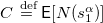 $C\stackrel {\text{ def}}{=}\mathsf{E}[N(s_1^\alpha )]$
is finite by Lemma1. Note that
$C\stackrel {\text{ def}}{=}\mathsf{E}[N(s_1^\alpha )]$
is finite by Lemma1. Note that $C$
is independent of
$C$
is independent of $\alpha$
by the strong Markov property. We recall that
$\alpha$
by the strong Markov property. We recall that $N(s_1^\alpha )=H^{A}_{s_1^\alpha }$
is a hitting time, where
$N(s_1^\alpha )=H^{A}_{s_1^\alpha }$
is a hitting time, where $A=\{s_i^\beta \mid \beta \prec \alpha \}\cup \{\bot \}$
. In the remainder of the proof, we drop the superscript Greek letter for all states in
$A=\{s_i^\beta \mid \beta \prec \alpha \}\cup \{\bot \}$
. In the remainder of the proof, we drop the superscript Greek letter for all states in $\alpha$
; that is,
$\alpha$
; that is, $s_1$
is understood to mean
$s_1$
is understood to mean $s_1^\alpha$
.
$s_1^\alpha$
.
Every path from $s_1$
to
$s_1$
to $A$
must visit
$A$
must visit $s_2,\ldots , s_r$
. Thus, by the strong Markov property,
$s_2,\ldots , s_r$
. Thus, by the strong Markov property, $N(s_1) = \left ({\sum _{i=1}^{r-1}} {H^{s_{i+1}}_{s_i} }\right )+ {H^{A}_{s_r}}$
. By linearity of expectation and Eq. (1)
$N(s_1) = \left ({\sum _{i=1}^{r-1}} {H^{s_{i+1}}_{s_i} }\right )+ {H^{A}_{s_r}}$
. By linearity of expectation and Eq. (1)
 \begin{align} C =\mathsf{E}[N(s_1)] &= \sum _{i=1}^{r-1}h^{s_{i+1}}_{s_i} + h^{A}_{s_r} = \sum _{i=1}^{r-1} 1 + p_i\cdot h^{s_{i+1}}_{c_i} + (1+p_r\cdot h^{A}_{c_r})\nonumber\\ & = \sum _{i=1}^{r-1} 1 + p_i\left(1 + p_c\cdot \underbrace {h^{s_{i+1}}_{s_1^{\alpha \cdot i}}}_{C}\right) + \left(1+p_r\left(1 + p_c \cdot \underbrace {h^{A}_{s_1^{\alpha \cdot r}}}_{C}\right)\right)\nonumber\\ & = r + \sum _{i=1}^{r} p_i + Cp_c\sum _{i=1}^{r} p_i \end{align}
Solving for $C$
proves the second claim of the theorem.
$C$
proves the second claim of the theorem.
The proof for $\mathsf{E}[O(s_1)]$
is similar. We first make a slight modification to Eq. (1) to count only output states:
$\mathsf{E}[O(s_1)]$
is similar. We first make a slight modification to Eq. (1) to count only output states:
 \begin{align*} \begin{array}{ll} h^{A}_{s}=0 &\quad \text{if $s\in A$}\\[3pt] h^{A}_{s}=\begin{cases} 1 + \sum _{s'\in \mathcal{S}} p(s,s')h^{A}_{s'} & s\text{ is an output state}\\[3pt] 0 + \sum _{s'\in \mathcal{S}} p(s,s')h^{A}_{s'} & s\text{ is not an output state} \end{cases}&\quad \text{if $s\notin A$} \end{array} \end{align*}
This can be shown in exactly the same way as equations (1) (see e.g. Norris (Reference Norris1998) for the proof of the classical theorem; the adaption is straightforward). Alternatively, the following intuition can be turned into a formal proof:
Observe that in counting only output states $\mathcal{O}\subseteq \mathcal{S}$
, we are effectively studying a second Markov chain, whose state set consists only of output states (and
$\mathcal{O}\subseteq \mathcal{S}$
, we are effectively studying a second Markov chain, whose state set consists only of output states (and $\bot$
). For
$\bot$
). For $s, s' \in \mathcal{S}$
write
$s, s' \in \mathcal{S}$
write $\mathsf{P}(s,s')$
for the set of all simple paths (without repeating vertices) from
$\mathsf{P}(s,s')$
for the set of all simple paths (without repeating vertices) from $s$
to
$s$
to $s'$
that do not visit
$s'$
that do not visit $\mathcal{O}$
. The transition probabilities
$\mathcal{O}$
. The transition probabilities $p'$
of this second chain are given by the relation
$p'$
of this second chain are given by the relation
 \begin{align*} p'(s,s') = \sum _{w\in \mathsf{P}(s,s')} \prod _{i=1}^{|w|-1} p(w_{i-1},w_i) \end{align*}
So our modified formulas are simply a different way to write Eq. (1) for this modified chain in an iterative fashion.
With these modifications, we see that $(\ast )$
becomes:
$(\ast )$
becomes:
 \begin{align*} C' = \sum _{i=1}^{r} p_i + C'p_c\sum _{i=1}^r p_i \end{align*}
Again, solving for $C'$
establishes the claim.
$C'$
establishes the claim.
Note that for any given state $s_1^\alpha$
, the mean hitting time
$s_1^\alpha$
, the mean hitting time $h^{s_1^\alpha }_{\sharp }=\sum _{n\geq 1}\Pr [H^{s_1^\alpha }_{\sharp }\geq n]\geq \sum _{n\geq 1} 1-p_c=\infty$
(where we use
$h^{s_1^\alpha }_{\sharp }=\sum _{n\geq 1}\Pr [H^{s_1^\alpha }_{\sharp }\geq n]\geq \sum _{n\geq 1} 1-p_c=\infty$
(where we use $\mathsf{E}[X]=\sum _{n\geq 1} \Pr [X\geq n]$
for any random variable that only takes on positive integer values). So although we have a non-zero probability of selecting every test, we won’t, informally speaking, do so on average. Naturally, this is solved by repeating the experiment a sufficient number of times. This is the content of the next section.
$\mathsf{E}[X]=\sum _{n\geq 1} \Pr [X\geq n]$
for any random variable that only takes on positive integer values). So although we have a non-zero probability of selecting every test, we won’t, informally speaking, do so on average. Naturally, this is solved by repeating the experiment a sufficient number of times. This is the content of the next section.
3.1.2 Infinite looping and time-to-hit
As shown in Lemma1, the program in listing 1 terminates eventually. As a result, every state except $\bot$
in the Markov chain we studied above is transient and, moreover, the number of produced test cases is always finite. In testing, one aims at a high test coverage, and the number of test cases we produce in this fashion, though free of duplicates, has a low chance of visiting tests in deep blocks. A natural approach is to loop on the predicate t/1 like so:
$\bot$
in the Markov chain we studied above is transient and, moreover, the number of produced test cases is always finite. In testing, one aims at a high test coverage, and the number of test cases we produce in this fashion, though free of duplicates, has a low chance of visiting tests in deep blocks. A natural approach is to loop on the predicate t/1 like so:

With respect to our Markov chain this amounts to removing $\bot$
and to instead redirect any arc into
$\bot$
and to instead redirect any arc into $\bot$
to
$\bot$
to $\sharp$
. The resulting chain is recurrent (indeed positive recurrent) and we compute the mean hitting time of any state. In what follows, we will assume
$\sharp$
. The resulting chain is recurrent (indeed positive recurrent) and we compute the mean hitting time of any state. In what follows, we will assume $p_1=p_2=\cdots =p_r\stackrel {\text{ def}}{=} p$
such that
$p_1=p_2=\cdots =p_r\stackrel {\text{ def}}{=} p$
such that $r\cdot p \cdot p_c\lt 1$
(as in Theorem1). Moreover, we assume that
$r\cdot p \cdot p_c\lt 1$
(as in Theorem1). Moreover, we assume that $p(\sharp ,s_1^{\varepsilon })=1$
, so that the empty list is never selected as an output. This simplifies the formulas below slightly, but has otherwise no effect on the line of reasoning we give here.
$p(\sharp ,s_1^{\varepsilon })=1$
, so that the empty list is never selected as an output. This simplifies the formulas below slightly, but has otherwise no effect on the line of reasoning we give here.
Given the conditions of Theorem1, there is a constant $C=N(s_1^\alpha )$
that is independent of the value of
$C=N(s_1^\alpha )$
that is independent of the value of $\alpha$
. As noted before,
$\alpha$
. As noted before, $C=h^{E_\alpha }_{s_1^{\alpha }}$
is a mean hitting time where
$C=h^{E_\alpha }_{s_1^{\alpha }}$
is a mean hitting time where $E_\alpha =\{s_i^\beta \mid \beta \prec \alpha ,\;1\leq i\leq r\}\cup \{\sharp \}$
(note that we modified the definition of
$E_\alpha =\{s_i^\beta \mid \beta \prec \alpha ,\;1\leq i\leq r\}\cup \{\sharp \}$
(note that we modified the definition of $E$
used in the previous section by replacing
$E$
used in the previous section by replacing $\bot$
by
$\bot$
by $\sharp$
). Recall that we usually drop the subscript
$\sharp$
). Recall that we usually drop the subscript $\alpha$
, because it is clear from context.
$\alpha$
, because it is clear from context.
If we hop from one state $s_i^\alpha$
to its neighbor
$s_i^\alpha$
to its neighbor $s_{i+1}^\alpha$
we might traverse the tree below
$s_{i+1}^\alpha$
we might traverse the tree below $s_{1}^{\alpha \cdot i}$
with probability
$s_{1}^{\alpha \cdot i}$
with probability $p\cdot p_c$
. That step will visit
$p\cdot p_c$
. That step will visit $C$
states. This means (by Eq. (1)):
$C$
states. This means (by Eq. (1)):
 \begin{align*} h^{s_{i+1}^\alpha }_{s_i^\alpha } = 1 + p(1 + p_cC) \stackrel {\text{ def}}{=} \Delta \end{align*}
More generally the mean hitting time within a block is again independent of $\alpha$
and can be computed as:
$\alpha$
and can be computed as:
 \begin{equation} h^{s_i^{\alpha }}_{s_1^{\alpha }} = h^{s_2^{\alpha }}_{s_1^{\alpha }} + h^{s_3^{\alpha }}_{s_2^{\alpha }}+\cdots + h^{s_i^{\alpha }}_{s_{i-1}^\alpha }= (i-1)\Delta \end{equation}
We define the leave upward time $U_{s_i^\alpha }=h^{E}_{s_i^\alpha }$
where
$U_{s_i^\alpha }=h^{E}_{s_i^\alpha }$
where $E=E_\alpha$
as above. Note that the value
$E=E_\alpha$
as above. Note that the value $U_{s_i^\alpha }\in \mathbb{N}\cup \{\infty \}$
does not actually depend on
$U_{s_i^\alpha }\in \mathbb{N}\cup \{\infty \}$
does not actually depend on $\alpha$
. This justifies writing
$\alpha$
. This justifies writing $U_i=U_{s_i^\alpha }$
. It is obvious that
$U_i=U_{s_i^\alpha }$
. It is obvious that $C=U_{1}$
. Moreover, by using the same derivation as that in Eq. (2):
$C=U_{1}$
. Moreover, by using the same derivation as that in Eq. (2):
 \begin{equation} U_i = (r-i + 1)\Delta \quad 1\leq i \leq r \end{equation}
We already noted that $C=U_1$
. A related quantity is the hitting time of
$C=U_1$
. A related quantity is the hitting time of $\sharp$
from any
$\sharp$
from any $s_i^\alpha$
,
$s_i^\alpha$
, $\alpha =\alpha _1\cdots \alpha _t$
, which we may compute using the intermediate leave upward times:
$\alpha =\alpha _1\cdots \alpha _t$
, which we may compute using the intermediate leave upward times:
 \begin{align*} h^{\sharp }_{s_i^\alpha } = U_{i} + U_{\alpha _t + 1}+ \cdots U_{\alpha _1+1} \end{align*}
Note that we abuse notation: Equation (3) gives $U_{r+1}=0$
. While
$U_{r+1}=0$
. While $s_{r+1}^\alpha$
does not exist and hence the corresponding hitting time is not defined, it is convenient to allow such terms and exploit that
$s_{r+1}^\alpha$
does not exist and hence the corresponding hitting time is not defined, it is convenient to allow such terms and exploit that $U_{\alpha _j+1} = 0$
whenever
$U_{\alpha _j+1} = 0$
whenever $\alpha _j=r$
(
$\alpha _j=r$
( $1\leq j\leq t$
).
$1\leq j\leq t$
).
With this, we may compute:
 \begin{align} h^{\sharp }_{s_i^\alpha } &= U_i + \sum _{k=1}^t U_{\alpha _k+1} = \Delta \cdot \left ((r-i+1) + \sum _{k=1}^t (r-(\alpha _k+1) + 1) \right )\nonumber \\ &= \Delta \cdot \left (1+ \sum _{k=0}^t r- \alpha _k\right )\qquad \text{where }\alpha _0\stackrel {\text{ def}}{=} i \end{align}
Note again that the formula works correctly, if $i=r+1$
: Say
$i=r+1$
: Say $\alpha = rrr$
. Then we are in the process of falling back to
$\alpha = rrr$
. Then we are in the process of falling back to $\sharp$
and the equation gives 0. While the hitting time is again not defined for the non-existent state
$\sharp$
and the equation gives 0. While the hitting time is again not defined for the non-existent state $s_{r+1}$
, we will sometimes have to compute the hitting time of
$s_{r+1}$
, we will sometimes have to compute the hitting time of $\sharp$
from the “right neighbor” of
$\sharp$
from the “right neighbor” of $s_{i+1}$
. In these situations, abusing notation in this way is useful because we need not distinguish between cases where
$s_{i+1}$
. In these situations, abusing notation in this way is useful because we need not distinguish between cases where $i \lt r$
and those where
$i \lt r$
and those where $i=r$
.
$i=r$
.
Finally, we may now compute the hitting time of an arbitrary state in terms of hitting times in intermediate blocks, again using Eq. (1). Let $\alpha =\beta \cdot j$
.
$\alpha =\beta \cdot j$
.
 \begin{align*} && h^{s_1^\alpha }_{\sharp } & = h^{s_j^\beta }_{\sharp } + 1\\ &&&\quad +(1-p)\left(h^{\sharp }_{s_{j+1}^\beta } + h^{s_i^\alpha }_{\sharp}\right) & \big(\text{fall through to $s_{j+1}^\beta $}\big)\\ &&&\quad + p\left(1 + (1-p_c)\left(h^{\sharp }_{s_{j+1}^\beta } + h^{s_i^\alpha }_{\sharp }\right)\right) & \left(\text{no visit to next block $\alpha $}\right)\\ && &= h^{s_j^\beta }_{\sharp } + 1 + p+ \left(h^{\sharp }_{{s_{j+1}^\beta }}+h^{s_i^\alpha }_{\sharp }\right)(1 - pp_c) \end{align*}
This gives
 \begin{align*} h^{s_1^\alpha }_{\sharp } = \frac {h^{s_j^\beta }_{\sharp } + 1 + p + (1-pp_c)h^{\sharp }_{{s_{j+1}^\beta }}}{pp_c} \end{align*}
and together with Eq. (2) and Eq. (4), recalling that $\alpha _{|\alpha |}=j$
, we have:
$\alpha _{|\alpha |}=j$
, we have:
 \begin{align} h^{s_i^\alpha }_{\sharp } &= \frac {h^{s_j^\beta }_{\sharp } + 1 + p + (1-pp_c)h^{\sharp }_{{s_{j+1}^\beta }}}{pp_c} + (i-1)\Delta \nonumber \\ &= \frac {h^{s_j^\beta }_{\sharp }}{pp_c}+\frac {1}{pp_c}\left (1 + p + (1-pp_c)\left(\sum _{k=1}^{|\alpha |}r-\alpha _k\right)\Delta \right ) + (i-1)\Delta \end{align}
The following theorem gives a closed formula:
Theorem 2. Let $s_i^\alpha$
for some
$s_i^\alpha$
for some $\alpha =\alpha _1\cdots \alpha _t$
. Let
$\alpha =\alpha _1\cdots \alpha _t$
. Let $\nu =pp_c$
and
$\nu =pp_c$
and $\nu \cdot r\lt 1$
. Then
$\nu \cdot r\lt 1$
. Then
 \begin{equation} h^{s_i^\alpha }_{\sharp } = \nu ^{-t} + (i-1)\Delta + \sum _{k=1}^{t} \frac {1+ p + (\alpha _k-1)\Delta + (1-\nu )\sum _{s=1}^k(r-\alpha _s)\Delta }{\nu ^{t+1-k}} \end{equation}
Proof. By induction on $t$
. If
$t$
. If $t=0$
, then
$t=0$
, then $\alpha =\varepsilon$
and by Eq. (2), we have
$\alpha =\varepsilon$
and by Eq. (2), we have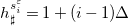 $h^{s_i^\varepsilon }_{\sharp }=1 + (i-1)\Delta$
. Moreover the empty sum in Eq. (6) equates to 0 establishing the induction base.
$h^{s_i^\varepsilon }_{\sharp }=1 + (i-1)\Delta$
. Moreover the empty sum in Eq. (6) equates to 0 establishing the induction base.
Now let $t\gt 0$
and assume the statement holds for
$t\gt 0$
and assume the statement holds for $t-1$
. By induction, we may replace
$t-1$
. By induction, we may replace $h^{s_j^\beta }_{\sharp }$
in Eq. (5) with Eq. (6):
$h^{s_j^\beta }_{\sharp }$
in Eq. (5) with Eq. (6):
 \begin{align*} &\frac {1}{\nu }\left (\nu ^{-(t-1)}+ (\alpha _t-1)\Delta + \sum _{k=1}^{t-1} \frac {1+p+(\alpha _k-1)\Delta +(1-\nu )\sum _{s=1}^k(r-\alpha _s)\Delta )}{\nu ^{t-k}}\right )\\ &\qquad + \frac {1}{\nu }\left(1 + p + (1-\nu )\left(\sum _{s=1}^{t}r-\alpha _s\right)\Delta \right ) + (i-1)\Delta \\ &\quad = \nu ^{-t}+ \sum _{k=1}^{t-1} \frac {1 + p + (\alpha _k-1)\Delta +(1-\nu )\sum _{s=1}^k(r-\alpha _s)\Delta )}{\nu ^{t+1-k}}\\ &\qquad + \frac {(1 + p + (\alpha _t-1)\Delta + (1-\nu )(\sum _{s=1}^{t}r-\alpha _s)\Delta )}{\nu ^{t+1 - t}} + (i-1)\Delta \\ &\quad = \nu ^{-t} + (i-1)\Delta + \sum _{k=1}^{t} \frac {1+ p + (\alpha _k-1)\Delta + (1-\nu )\sum _{s=1}^k(r-\alpha _s)\Delta }{\nu ^{t+1-k}}\\[-42pt]\nonumber\end{align*}
Corollary 2. Let $\nu =p\cdot p_c$
with
$\nu =p\cdot p_c$
with $\nu \cdot r\lt 1$
. Then
$\nu \cdot r\lt 1$
. Then $h^{s_i^\alpha }_{\sharp }\in \Theta (\nu ^{-t})$
for any
$h^{s_i^\alpha }_{\sharp }\in \Theta (\nu ^{-t})$
for any $\alpha =\alpha _1\cdots \alpha _t$
.
$\alpha =\alpha _1\cdots \alpha _t$
.
Proof. Write Eq. (6) as
 \begin{align*} \nu ^{-t} + A + \nu ^{-t-1}\sum _{k=1}^t \frac {B_k +\sum _{s=1}^kD_{s}}{\nu ^{-k}} \end{align*}
for suitable constants (in $t$
)
$t$
) $A\geq 0$
,
$A\geq 0$
, $B_k\geq 0$
, and
$B_k\geq 0$
, and $D_{s}\geq 0$
, whereby
$D_{s}\geq 0$
, whereby $h^{s_i^\alpha }_{\sharp }\in \Omega (\nu ^{-t})$
.
$h^{s_i^\alpha }_{\sharp }\in \Omega (\nu ^{-t})$
.
Choose suitable largest values $B\geq B_k$
for all
$B\geq B_k$
for all $t\in \mathbb{N}$
,
$t\in \mathbb{N}$
, $1\leq k\leq t$
, and
$1\leq k\leq t$
, and $D\geq D_{s}$
for all
$D\geq D_{s}$
for all $1\leq s\leq t$
. Bound Eq. (6) from above by
$1\leq s\leq t$
. Bound Eq. (6) from above by
 \begin{align*} \nu ^{-t} + A + \nu ^{-t-1}\sum _{k=1}^t \frac {B + D\cdot k}{\nu ^{-k}} \leq \nu ^{-t} + A + \nu ^{-t-1}(B+D)\cdot \sum _{k=1}^{t} \frac {k}{\nu ^{-k}} \end{align*}
A well-known calculation via derivatives gives $\sum _{k=1}^{t}k\cdot \nu ^k=\nu \sum _{k=1}^{t}k\nu ^{k-1} \leq \nu \sum _{k=1}^{\infty} $ $k\nu ^{k-1} = \nu \cdot \frac {\mathrm{d}}{\mathrm{d}\nu }\sum _{k=0}^{\infty }\nu ^k =\frac {\nu }{(1-\nu )^2}$
. With that we have
$k\nu ^{k-1} = \nu \cdot \frac {\mathrm{d}}{\mathrm{d}\nu }\sum _{k=0}^{\infty }\nu ^k =\frac {\nu }{(1-\nu )^2}$
. With that we have
 \begin{align*} \nu ^{-t} + A + \nu ^{-t-1}\sum _{k=1}^t \frac {B + D\cdot k}{\nu ^{-k}}\leq \nu ^{-t}+A+(B+D)\frac {\nu ^{-t}}{(1-\nu )^2}\in {\mathcal{O}}(\nu ^{-t})\\[-42pt] \nonumber\end{align*}
3.2 Drop-and-Shuffle strategy
3.2.1 Number of generated tests
To study the number of generated tests in this context, we again have to define a Markov chain. The Markov chain in the shuffle and drop scenario is significantly more complicated than the one we studied previously in subsection 3.1.1. This is because there are now multiple ways a given test case can be output. To distinguish between those, we need to use a larger and more complex state set. We will illustrate this, before defining the Markov chain formally.
Consider again the program in listing 1. When the current goal is command(H), we have a set $R$
of rules whose head unifies with this goal. In this case,
$R$
of rules whose head unifies with this goal. In this case, $R=\{\texttt{command(H) :-} $ $\texttt{command1(H)},\ldots ,\texttt{command(H) :- commandr(H)}\}$
. Recall this is meant to represent
$\texttt{command1(H)},\ldots ,\texttt{command(H) :- commandr(H)}\}$
. Recall this is meant to represent $r\in \mathbb{N}$
distinct rules. In standard SLD-resolution, we would select the first rule that occurs in the input program
$r\in \mathbb{N}$
distinct rules. In standard SLD-resolution, we would select the first rule that occurs in the input program $\mathcal{P}$
, namely command(H) :- command1(H) first, and push the remaining
$\mathcal{P}$
, namely command(H) :- command1(H) first, and push the remaining $r-1$
rules on the stack from right to left. During backtracking, we would then eventually explore each of those rules in the order given in the input program (except in case of an infinite recursion).
$r-1$
rules on the stack from right to left. During backtracking, we would then eventually explore each of those rules in the order given in the input program (except in case of an infinite recursion).
In the drop-and-shuffle strategy, we first perform an independent Bernoulli trial for each rule $\rho \in R$
: With probability
$\rho \in R$
: With probability $p_d$
, we remove
$p_d$
, we remove $\rho$
from
$\rho$
from $R$
. We refer to
$R$
. We refer to $p_d$
as the drop probability. In this way, a set
$p_d$
as the drop probability. In this way, a set $R'\subseteq R$
is computed. The random variable
$R'\subseteq R$
is computed. The random variable $|R'|$
follows a Binomial distribution:
$|R'|$
follows a Binomial distribution: $\Pr [|R'|=k] = \binom {|R|}{k}p_d^{|R|-k}(1-p_d)^k$
. Next, we shuffle the set
$\Pr [|R'|=k] = \binom {|R|}{k}p_d^{|R|-k}(1-p_d)^k$
. Next, we shuffle the set $R'$
. To this end, we select a permutation
$R'$
. To this end, we select a permutation $\pi \in \mathbb{S}(R')$
, where
$\pi \in \mathbb{S}(R')$
, where $\mathbb{S}(M)$
denotes the symmetric group on a given set
$\mathbb{S}(M)$
denotes the symmetric group on a given set $M$
. Conceptually, any probability distribution on
$M$
. Conceptually, any probability distribution on $\mathbb{S}(R')$
is conceivable. In this paper, we follow a simpler approach and select
$\mathbb{S}(R')$
is conceivable. In this paper, we follow a simpler approach and select $\pi$
uniformly at random from
$\pi$
uniformly at random from $\mathbb{S}(R')$
. In this way, we obtain an ordered tuple of elements of
$\mathbb{S}(R')$
. In this way, we obtain an ordered tuple of elements of $R$
without any repetitions.
$R$
without any repetitions.
The result of these two random processes is a tuple $(\rho _{i_1}, \ldots , \rho _{i_k})$
where
$(\rho _{i_1}, \ldots , \rho _{i_k})$
where $k=|R'|$
and
$k=|R'|$
and $\rho _{i_j}\in R$
. To simplify notation, we identify
$\rho _{i_j}\in R$
. To simplify notation, we identify $R'$
with this tuple in what follows. Since both random events – dropping and shuffling – are independent, the probability of each such tuple
$R'$
with this tuple in what follows. Since both random events – dropping and shuffling – are independent, the probability of each such tuple $R'=(\rho _{i_1},\ldots , \rho _{i_k})$
is precisely
$R'=(\rho _{i_1},\ldots , \rho _{i_k})$
is precisely $\Pr [R'] = \frac {p_d^{n-k}(1-p_d)^k}{k!}$
.
$\Pr [R'] = \frac {p_d^{n-k}(1-p_d)^k}{k!}$
.
Remark 1. Note that this random process is different from the classical “drawing without replacement”, where the number of elements that are drawn is usually a fixed parameter.
These observations motivate the following Markov chain $\mathcal{M}=(\mathcal{S},(X_n)_{n\in \mathbb{N}_0}, p, \varepsilon )$
. The state set
$\mathcal{M}=(\mathcal{S},(X_n)_{n\in \mathbb{N}_0}, p, \varepsilon )$
. The state set $\mathcal{S}$
now consists of stacks of choice-points – in loosely the same way a Prolog runtime would maintain them. Before formally defining the state set and transition probabilities, we invite the reader to consider a simplified graphical representation of the chain, as given in Figure 2.
$\mathcal{S}$
now consists of stacks of choice-points – in loosely the same way a Prolog runtime would maintain them. Before formally defining the state set and transition probabilities, we invite the reader to consider a simplified graphical representation of the chain, as given in Figure 2.
Figure 2 gives an overview of the chain. Some details have been omitted or simplified to avoid cluttering the picture. Probabilities are not shown. We have omitted choice points from a higher layer: A state/stack of the form $[H|T][](1,5,2,3)[H|T](1,2,3)$
is thus simply represented as
$[H|T][](1,5,2,3)[H|T](1,2,3)$
is thus simply represented as $(1,2,3)$
, omitting the “lower” parts of the stack. Note that these items are implicitly clear from the path to a given node. Moreover, most backtracking arrows have been omitted. Finally, at any given depth, both the node
$(1,2,3)$
, omitting the “lower” parts of the stack. Note that these items are implicitly clear from the path to a given node. Moreover, most backtracking arrows have been omitted. Finally, at any given depth, both the node $[H|T][]$
and the node
$[H|T][]$
and the node $[H|T]$
each have
$[H|T]$
each have $\sum _{k=0}^r\binom {r}{k}\cdot k!=\lfloor r!\cdot \mathsf{e} \rfloor$
children.Footnote
2
These have also mostly been omitted.
$\sum _{k=0}^r\binom {r}{k}\cdot k!=\lfloor r!\cdot \mathsf{e} \rfloor$
children.Footnote
2
These have also mostly been omitted.
The Markov chain corresponding to $\mathcal{P}$
in the Drop-and-Shuffle approach. Dashed arrows represent backtracking. Double circled nodes produce an output. Hatched nodes are recursive sub-tree roots, which start an entire infinite sub-tree with the same structure as the whole chain (shown as gray triangles).
$\mathcal{P}$
in the Drop-and-Shuffle approach. Dashed arrows represent backtracking. Double circled nodes produce an output. Hatched nodes are recursive sub-tree roots, which start an entire infinite sub-tree with the same structure as the whole chain (shown as gray triangles).

We describe the state set via (the language defined by) a regular expression. First we need two auxiliary languages:
 \begin{align*} \mathcal{S}_{\mathsf{Sel}} & = \{[], [H|T], [][H|T], [H|T][]\}\\ \mathcal{S}_{\mathsf{Com}} & = \{(y_1,\ldots , y_l)\mid 1\leq l \leq r,\;y_i\in \{1,\ldots , r\}, y_i\neq y_j \text{ for all } i\neq j\} \end{align*}
The set $\mathcal{S}_{\mathsf{Com}}$
corresponds to all ordered subsets of command rules, that is, subsets of
$\mathcal{S}_{\mathsf{Com}}$
corresponds to all ordered subsets of command rules, that is, subsets of $\{1,\ldots , r\}$
. Note that the empty subset is excluded, that is,
$\{1,\ldots , r\}$
. Note that the empty subset is excluded, that is, $()\notin \mathcal{S}_{\mathsf{Com}}$
. The set
$()\notin \mathcal{S}_{\mathsf{Com}}$
. The set $\mathcal{S}_{\mathsf{Sel}}$
corresponds to the five probabilistic options the drop-and-shuffle algorithm gives us for resolving goals of the form t(X), including potential choice-points for backtracking. Note that, again, the “empty selection”
$\mathcal{S}_{\mathsf{Sel}}$
corresponds to the five probabilistic options the drop-and-shuffle algorithm gives us for resolving goals of the form t(X), including potential choice-points for backtracking. Note that, again, the “empty selection” $()\notin \mathcal{S}_{\mathsf{Sel}}$
is not included.
$()\notin \mathcal{S}_{\mathsf{Sel}}$
is not included.
We can now define the state set $\mathcal{S}=(\mathcal{S}_{\mathsf{Sel}}\times \mathcal{S}_{\mathsf{Com}})^*\cdot (\mathcal{S}_{\mathsf{Sel}}+\varepsilon )$
. The “empty state”
$\mathcal{S}=(\mathcal{S}_{\mathsf{Sel}}\times \mathcal{S}_{\mathsf{Com}})^*\cdot (\mathcal{S}_{\mathsf{Sel}}+\varepsilon )$
. The “empty state” $\varepsilon \in \mathcal{S}$
is the initial state of the chain; that is,
$\varepsilon \in \mathcal{S}$
is the initial state of the chain; that is, $\mathsf{Init}=\varepsilon$
. We write the pairs
$\mathsf{Init}=\varepsilon$
. We write the pairs $\langle x,y \rangle \in \mathcal{S}_{\mathsf{Sel}}\times \mathcal{S}_{\mathsf{Com}}$
in angular brackets in order to visually distinguish them and improve readability.
$\langle x,y \rangle \in \mathcal{S}_{\mathsf{Sel}}\times \mathcal{S}_{\mathsf{Com}}$
in angular brackets in order to visually distinguish them and improve readability.
Given a state $\varepsilon \neq s\in \mathcal{S}$
, we may write it as
$\varepsilon \neq s\in \mathcal{S}$
, we may write it as $s=w\cdot x$
or
$s=w\cdot x$
or $s=w\cdot \langle x,y \rangle$
with
$s=w\cdot \langle x,y \rangle$
with $w\in \mathcal{S}$
,
$w\in \mathcal{S}$
, $x\in \mathcal{S}_{\mathsf{Sel}}$
, and
$x\in \mathcal{S}_{\mathsf{Sel}}$
, and $y\in \mathcal{S}_{\mathsf{Com}}$
. Because
$y\in \mathcal{S}_{\mathsf{Com}}$
. Because $\varepsilon \notin \mathcal{S}_{\mathsf{Sel}}$
and also
$\varepsilon \notin \mathcal{S}_{\mathsf{Sel}}$
and also $\varepsilon \notin \mathcal{S}_{\mathsf{Com}}$
, this factorization is unique. We make liberal use of this observation when defining the transition probabilities. We first define transitions that descend further into the tree. These correspond to solid arrows in Figure 2. For any
$\varepsilon \notin \mathcal{S}_{\mathsf{Com}}$
, this factorization is unique. We make liberal use of this observation when defining the transition probabilities. We first define transitions that descend further into the tree. These correspond to solid arrows in Figure 2. For any $l\geq 1$
,
$l\geq 1$
, $w\in \mathcal{S}$
, and
$w\in \mathcal{S}$
, and $x\in \mathcal{S}_{\mathsf{Sel}}$
:
$x\in \mathcal{S}_{\mathsf{Sel}}$
:
 \begin{align*} p(w,\,w\cdot x) &=\frac {(1-p_d)^2}{2} & x\in \{[H|T][],[][H|T]\}\\[3pt] p(w,\,w\cdot x) &= (1-p_d)p_d & x\in \{[],[H|T]\}\\[3pt] p(w\cdot x,\, w\cdot \langle x, (y_1,\ldots , y_l) \rangle ) &= \frac {p_d^{r-l}(1-p_d)^{l}}{l!} & x \in \{[H|T][], [H|T]\} \end{align*}
Next, we define transitions that correspond to backtracking. These correspond to dashed arrows in Figure 2. To this end we define the operation $\mathsf{Pop}\colon \mathcal{S} \rightarrow \mathcal{S}$
. Intuitively, this operation pops from the stack until we arrive at a previously unpursued choice point. Looking back at Figure 2, it identifies the target of the backtracking arrow. It may be necessary to remove multiple layers of pairs
$\mathsf{Pop}\colon \mathcal{S} \rightarrow \mathcal{S}$
. Intuitively, this operation pops from the stack until we arrive at a previously unpursued choice point. Looking back at Figure 2, it identifies the target of the backtracking arrow. It may be necessary to remove multiple layers of pairs $\langle x,y \rangle$
when backtracking. For example
$\langle x,y \rangle$
when backtracking. For example $\mathsf{Pop}(\langle [H|T][],(1,3) \rangle \langle [H|T][],(3) \rangle \langle [H|T],(1) \rangle )=\langle [H|T][],(1,3) \rangle []$
. Formally, we define
$\mathsf{Pop}(\langle [H|T][],(1,3) \rangle \langle [H|T][],(3) \rangle \langle [H|T],(1) \rangle )=\langle [H|T][],(1,3) \rangle []$
. Formally, we define $\mathsf{Pop}$
recursively with
$\mathsf{Pop}$
recursively with $\mathsf{Pop}(\varepsilon )=\bot$
and:
$\mathsf{Pop}(\varepsilon )=\bot$
and:
 \begin{align*} &\mathsf{Pop}(w\cdot [][H|T])=w\cdot [H|T] & &\mathsf{Pop}(w\cdot [H|T][])=w\cdot []\\[3pt] &\mathsf{Pop}(w\cdot [])=\mathsf{Pop}(w) & & \mathsf{Pop}(w\cdot [H|T])=\mathsf{Pop}(w)\\[3pt] &\mathsf{Pop}(w\cdot \langle x,(y_1) \rangle )=\mathsf{Pop}(w\cdot x) & & \mathsf{Pop}(w\cdot \langle x,(y_1,y_2,\ldots ,y_l) \rangle )= w\cdot \langle x,(y_2,\ldots ,y_l) \rangle \end{align*}
We can now define all backtracking transitions as follows:
 \begin{align*} p(w\cdot x, \mathsf{Pop}(w\cdot x)) &= 1 & x = [] \text{ or } x= [][H|T]\\[3pt] p(w\cdot x, \mathsf{Pop}(w\cdot x)) &= p_d^r & x=[H|T] \text{ or } x=[H|T][]\\[3pt] p(w, \mathsf{Pop}(w)) &= p_d^2 & w=w'\cdot \langle x,y \rangle \text{ or } w=\varepsilon \end{align*}
The last two model the event that all matching rules are dropped when unifying command(X) or t(X), respectively.
Note the recursive structure of $\mathcal{M}$
: Any state of the form
$\mathcal{M}$
: Any state of the form $w\cdot \langle x,y \rangle$
(
$w\cdot \langle x,y \rangle$
( $x\in \mathcal{S}_{\mathsf{Sel}},\;y\in \mathcal{S}_{\mathsf{Com}}$
) is the root of an infinite sub-tree that has a structure identical to that of
$x\in \mathcal{S}_{\mathsf{Sel}},\;y\in \mathcal{S}_{\mathsf{Com}}$
) is the root of an infinite sub-tree that has a structure identical to that of $\mathcal{M}$
. We call such states recursive sub-tree roots or simply sub-tree roots. These states are drawn with hatched background in Figure 2.
$\mathcal{M}$
. We call such states recursive sub-tree roots or simply sub-tree roots. These states are drawn with hatched background in Figure 2.
To each recursive sub-tree root $s$
corresponds a unique state
$s$
corresponds a unique state $\mathsf{Exit}_s$
that is visited when the chain leaves that sub-tree (via backtracking). In other words: All paths that exit the sub-tree below
$\mathsf{Exit}_s$
that is visited when the chain leaves that sub-tree (via backtracking). In other words: All paths that exit the sub-tree below $s$
must traverse
$s$
must traverse $\mathsf{Exit}_s$
. For example, consider the left-most gray sub-tree in Figure 1 (with the large gray triangle in the background) below
$\mathsf{Exit}_s$
. For example, consider the left-most gray sub-tree in Figure 1 (with the large gray triangle in the background) below $s=\langle [H|T][],(1,2,\ldots ,r) \rangle$
. Its exit-state is the next node to the right:
$s=\langle [H|T][],(1,2,\ldots ,r) \rangle$
. Its exit-state is the next node to the right: $\mathsf{Exit}_s=\langle [H|T][],(2,\ldots ,r) \rangle$
. In general, if
$\mathsf{Exit}_s=\langle [H|T][],(2,\ldots ,r) \rangle$
. In general, if $s$
is of the form
$s$
is of the form $w\langle x,y \rangle$
, then
$w\langle x,y \rangle$
, then $\mathsf{Exit}_s=\mathsf{Pop}(w\cdot \langle x,y \rangle )$
. Note that
$\mathsf{Exit}_s=\mathsf{Pop}(w\cdot \langle x,y \rangle )$
. Note that $\mathsf{Exit}_s$
may be at the same depth as
$\mathsf{Exit}_s$
may be at the same depth as $s$
or at a lower depth than
$s$
or at a lower depth than $s$
. It is never at a higher depth.
$s$
. It is never at a higher depth.
We can now compute the average number of generated tests as before. It is again the mean hitting time $h^{\bot }_{\varepsilon }$
. By an argument identical to Proposition1, the chain will reach
$h^{\bot }_{\varepsilon }$
. By an argument identical to Proposition1, the chain will reach $\bot$
eventually with probability 1, if
$\bot$
eventually with probability 1, if $p_d \gt 0$
. But that does not imply that the hitting time – an expected value – converges for all such values of
$p_d \gt 0$
. But that does not imply that the hitting time – an expected value – converges for all such values of $p_d$
. Indeed, the hitting time is finite only for a subset of possible choices for
$p_d$
. Indeed, the hitting time is finite only for a subset of possible choices for $p_d\gt 0$
, as the following theorem shows:
$p_d\gt 0$
, as the following theorem shows:
Theorem 3. Let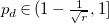 $p_d\in (1-\frac {1}{\sqrt {r}},1]$
. Then the expected number
$p_d\in (1-\frac {1}{\sqrt {r}},1]$
. Then the expected number $h^{\bot }_{\varepsilon }$
of states visited from
$h^{\bot }_{\varepsilon }$
of states visited from $\varepsilon$
is finite and given by:
$\varepsilon$
is finite and given by:
 \begin{align*} h^{\bot }_{\varepsilon } = \frac {1 + 2(1-p_d)}{1- r(1-p_d)^2} \end{align*}
Moreover this hitting time is identical to $h^{\mathsf{Exit}_s}_{s}$
for any recursive sub-tree root
$h^{\mathsf{Exit}_s}_{s}$
for any recursive sub-tree root $s$
and its corresponding exit state
$s$
and its corresponding exit state $\mathsf{Exit}_s$
. We define
$\mathsf{Exit}_s$
. We define $C\stackrel {\text{ def}}{=} h^{\bot }_{\varepsilon }$
and remark that it is a constant property of the chain.
$C\stackrel {\text{ def}}{=} h^{\bot }_{\varepsilon }$
and remark that it is a constant property of the chain.
Proof. The fact that $h^{\bot }_{\varepsilon }=h^{\mathsf{Exit}_s}_{s}$
for any recursive sub-tree root
$h^{\bot }_{\varepsilon }=h^{\mathsf{Exit}_s}_{s}$
for any recursive sub-tree root $s$
is apparent from the definition of the chain: The transition probabilities are prefix invariant. So
$s$
is apparent from the definition of the chain: The transition probabilities are prefix invariant. So $p(x\cdot a, x\cdot b) = p(a,b)$
for all factorizations
$p(x\cdot a, x\cdot b) = p(a,b)$
for all factorizations $s=xa$
with
$s=xa$
with $x\in \mathcal{S}$
.
$x\in \mathcal{S}$
. $h^{\bot }_{\varepsilon }$
is the unique minimal positive solution to the equations Eq. (1). Now, letting
$h^{\bot }_{\varepsilon }$
is the unique minimal positive solution to the equations Eq. (1). Now, letting $C\stackrel {\text{ def}}{=} h^{\bot }_{\varepsilon }$
:
$C\stackrel {\text{ def}}{=} h^{\bot }_{\varepsilon }$
:
 \begin{align*} C &= 1 + p_d(1-p_d)\cdot 1 + p_d^2\cdot 0\\[3pt] &\quad + p_d(1-p_d)\cdot \left (1+ \sum _{k=0}^r \frac {p_d^{r-k}(1-p_d)^k}{k!}\cdot k!\cdot \binom {r}{k}\cdot k\cdot C\right ) \end{align*}
 \begin{align*}&\quad + \frac {1}{2}\cdot (1-p_d)^2\cdot \left (2 + \sum _{k=0}^r \frac {p_d^{r-k}(1-p_d)^k}{k!}\cdot k!\cdot \binom {r}{k}\cdot k\cdot C\right )\\[3pt] &\quad + \frac {1}{2}\cdot (1-p_d)^2\cdot \left (1 + \sum _{k=0}^r \frac {p_d^{r-k}(1-p_d)^k}{k!}\cdot k!\cdot \binom {r}{k}\cdot (k\cdot C + 1)\right )\\[-12pt]\nonumber \end{align*}
We recall that $(x+y)^r=\sum _{k=0}^{r}\binom {r}{k}x^k y^{r-k}$
. Differentiation and subsequent multiplication by
$(x+y)^r=\sum _{k=0}^{r}\binom {r}{k}x^k y^{r-k}$
. Differentiation and subsequent multiplication by $x$
gives
$x$
gives $rx(x+y)^{r-1} = \sum _{k=0}^rk\binom {r}{k}x^{k}y^{r-k}$
. Moreover, recall that
$rx(x+y)^{r-1} = \sum _{k=0}^rk\binom {r}{k}x^{k}y^{r-k}$
. Moreover, recall that $\sum _{k=0}^{r}\binom {r}{k}p_d^{r-k}(1-p_d)^k=1$
. With this, the above simplifies to
$\sum _{k=0}^{r}\binom {r}{k}p_d^{r-k}(1-p_d)^k=1$
. With this, the above simplifies to
 \begin{align*} C = 1 + 2(1-p_d) + Cr(1-p_d)^2 \end{align*}
Now if $p_d\leq 1- \frac {1}{\sqrt {r}}$
, then this implies
$p_d\leq 1- \frac {1}{\sqrt {r}}$
, then this implies $C \geq 1 + \frac {2}{\sqrt {r}} + C$
, which is possible only if
$C \geq 1 + \frac {2}{\sqrt {r}} + C$
, which is possible only if $C=\infty$
. On the other hand, if
$C=\infty$
. On the other hand, if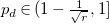 $p_d\in (1-\frac {1}{\sqrt {r}},1]$
then solving for
$p_d\in (1-\frac {1}{\sqrt {r}},1]$
then solving for $C$
establishes the claim. Note that on this interval, the formula has no singularities and is positive.
$C$
establishes the claim. Note that on this interval, the formula has no singularities and is positive.
3.2.2 Infinite looping and time-to-hit
We again construct a recursive analysis of the mean-hitting-time. Recall that in subsection 3.1.2 we analyzed the hitting time of the unique state corresponding to $\tau =(\tau _1,\ldots ,\tau _l)$
(with
$\tau =(\tau _1,\ldots ,\tau _l)$
(with $\tau _i\in \{1,\ldots ,r\}$
) by first considering the hitting time of the unique state corresponding to
$\tau _i\in \{1,\ldots ,r\}$
) by first considering the hitting time of the unique state corresponding to $\tau ^{(l-1)}=(\tau _1,\ldots , \tau _{l-1})$
, and then constructing the full hitting time from that number “bottom-up”. This recursive argument works less well in the present scenario, where many different states correspond to
$\tau ^{(l-1)}=(\tau _1,\ldots , \tau _{l-1})$
, and then constructing the full hitting time from that number “bottom-up”. This recursive argument works less well in the present scenario, where many different states correspond to $\tau ^{(l-1)}$
. Computing the overall hitting time as a sum of those intermediate hitting times is challenging, as we explain below. We therefore develop an approach to compute the hitting time “top-down”.
$\tau ^{(l-1)}$
. Computing the overall hitting time as a sum of those intermediate hitting times is challenging, as we explain below. We therefore develop an approach to compute the hitting time “top-down”.
First, we need to add looping to the Markov chain, as in subsection 3.1.2. Recall that there we merged the two states $\sharp$
and
$\sharp$
and $\bot$
. We do not do that here. Instead, we add an edge from
$\bot$
. We do not do that here. Instead, we add an edge from $\bot$
to
$\bot$
to $\varepsilon$
with probability 1. This is for technical reasons, and we will justify this choice further below.
$\varepsilon$
with probability 1. This is for technical reasons, and we will justify this choice further below.
Recursive sub-tree roots are connected to all ordered subsets of $\{1,\ldots ,r\}$
(most arrows omitted for readability). Each subset of size
$\{1,\ldots ,r\}$
(most arrows omitted for readability). Each subset of size $k$
starts chain of
$k$
starts chain of $k$
subsets. One element (here
$k$
subsets. One element (here $1$
) is the desired next item of the test sequence, and each chain contains at most one state with the desired item at the top (depicted in green).
$1$
) is the desired next item of the test sequence, and each chain contains at most one state with the desired item at the top (depicted in green).

When running the program $\mathcal{P}$
in the drop-and-shuffle strategy, first we randomly select and permute a subset of the two rule-heads t([]) and t([H–T]). To proceed, we need to visit
$\mathcal{P}$
in the drop-and-shuffle strategy, first we randomly select and permute a subset of the two rule-heads t([]) and t([H–T]). To proceed, we need to visit $[H|T]$
or
$[H|T]$
or $[H|T][]$
at depth 0. Once that happens, there are two options: With probability
$[H|T][]$
at depth 0. Once that happens, there are two options: With probability $p_d$
, the next state does not contain
$p_d$
, the next state does not contain $\tau _{1}$
, and thus we cannot visit
$\tau _{1}$
, and thus we cannot visit $\tau$
in this loop iteration (i.e. before returning to
$\tau$
in this loop iteration (i.e. before returning to $\varepsilon$
first). We call such a sub-tree root unproductive. Conversely, with probability
$\varepsilon$
first). We call such a sub-tree root unproductive. Conversely, with probability $(1-p_d)$
, the next state does contain
$(1-p_d)$
, the next state does contain $\tau _{1}$
somewhere within its stack (though not necessarily at the top). Those sub-tree roots and their corresponding sub-trees are called productive (shown in green in Figure 3). If a productive or unproductive state does not have
$\tau _{1}$
somewhere within its stack (though not necessarily at the top). Those sub-tree roots and their corresponding sub-trees are called productive (shown in green in Figure 3). If a productive or unproductive state does not have $\tau _{1}$
at its top, there is an infinite tree below it that will we be explored, but cannot yield the desired test case. We also call such a sub-tree unproductive (shown in gray in Figure 3). Note that productive sets of size
$\tau _{1}$
at its top, there is an infinite tree below it that will we be explored, but cannot yield the desired test case. We also call such a sub-tree unproductive (shown in gray in Figure 3). Note that productive sets of size $k\gt 0$
give rise to precisely
$k\gt 0$
give rise to precisely $k-1$
unproductive sub-trees, though not all of those are traversed before the sub-tree containing
$k-1$
unproductive sub-trees, though not all of those are traversed before the sub-tree containing $\tau$
is visited. Let
$\tau$
is visited. Let $A_\tau$
denote the set of states that output
$A_\tau$
denote the set of states that output $\tau$
:
$\tau$
:
Fact 1. If the chain arrives at an unproductive state, it must first visit $\varepsilon$
before visiting
$\varepsilon$
before visiting $A_\tau$
.
$A_\tau$
.
Note that we are only talking about depth 0 for now, so this fact is obvious. At higher depths, we would need to adjust the definition of “productive” to ensure that all prefixes at lower depths have $\tau _1,\tau _2,\ldots$
at the top.
$\tau _1,\tau _2,\ldots$
at the top.
If the chain arrives at a productive state, the situation is more complex: The chain needs to traverse a number of unproductive sub-trees, depending on the position of $\tau _{1}$
in the ordered set. For example, in the second branch shown in Figure 3, there are two unproductive sub-trees to be traversed before reaching productive sub-tree (and several, indicated by the dots, after). Below the productive state, we find a tree of recursive structure: The goal now is to reach a test case of length
$\tau _{1}$
in the ordered set. For example, in the second branch shown in Figure 3, there are two unproductive sub-trees to be traversed before reaching productive sub-tree (and several, indicated by the dots, after). Below the productive state, we find a tree of recursive structure: The goal now is to reach a test case of length $l-1$
, or to return to
$l-1$
, or to return to $\varepsilon$
and start from scratch (cf. Fact1).
$\varepsilon$
and start from scratch (cf. Fact1).
Starting from a productive state $s$
of size
$s$
of size $m\leq r$
with item
$m\leq r$
with item $\tau _{1}$
at position
$\tau _{1}$
at position $k\in \{0,\ldots , m\}$
, the hitting time is thus
$k\in \{0,\ldots , m\}$
, the hitting time is thus $kC+h^{A_\tau }_{x}$
, where
$kC+h^{A_\tau }_{x}$
, where $C$
is the quantity from Theorem3 and
$C$
is the quantity from Theorem3 and $x\in \mathcal{S}$
is the state arising from
$x\in \mathcal{S}$
is the state arising from $s$
after
$s$
after $k$
items have been popped (e.g. the green state in the lower branch in Figure 3).
$k$
items have been popped (e.g. the green state in the lower branch in Figure 3).
We stress that $h^{A_\tau }_{x}$
depends not only on the remaining test-case suffix
$h^{A_\tau }_{x}$
depends not only on the remaining test-case suffix $(\tau _2,\ldots , \tau _l)$
, but also on the number of (unproductive) backtracking steps – at least
$(\tau _2,\ldots , \tau _l)$
, but also on the number of (unproductive) backtracking steps – at least $(m-k-1)C$
– before returning to
$(m-k-1)C$
– before returning to $\varepsilon$
. The chain may arrive at an unproductive step at some point, and by Fact1, it first needs to visit
$\varepsilon$
. The chain may arrive at an unproductive step at some point, and by Fact1, it first needs to visit $\varepsilon$
before reaching
$\varepsilon$
before reaching $A_\tau$
. Note that this may happen at depth
$A_\tau$
. Note that this may happen at depth $\gt 1$
as well! This prevents us from applying induction in a straightforward way. We thus need the following lemma, which allows us to reduce the hitting time
$\gt 1$
as well! This prevents us from applying induction in a straightforward way. We thus need the following lemma, which allows us to reduce the hitting time $h^{A_\tau }_{x}$
to three quantities we may compute individually and inductively:
$h^{A_\tau }_{x}$
to three quantities we may compute individually and inductively:
Lemma 2. For any recurrent Markov chain, let $A\subseteq \mathcal{S}$
and
$A\subseteq \mathcal{S}$
and $x,y\in \mathcal{S}\setminus A$
with
$x,y\in \mathcal{S}\setminus A$
with $x\neq y$
. Then:
$x\neq y$
. Then:
 \begin{align*} h^{A}_{x}=h^{A\cup \{y\}}_{x} + \Pr [H^{y}_{x} \lt H^{A}_{x}]\cdot h^{A}_{y} \end{align*}
We prove the lemma at the end of this section, as it is purely Markov theoretic. In our immediate setting, the consequence is that
 \begin{align} h^{A_{\tau }}_{\varepsilon} & =h^{A_{\tau }\cup \{\bot \}}_{\varepsilon } + q\cdot h^{A_{\tau }}_{\bot } =h^{A_{\tau }\cup \{\bot \}}_{\varepsilon } + q(1 + h^{A_{\tau }}_{\varepsilon })\nonumber \\ \iff h^{A_{\tau }}_{\varepsilon } & =\frac {h^{A_{\tau }\cup \{\bot \} }_{\varepsilon }+ q }{1- q} \end{align}
for some probability $q$
that depends on
$q$
that depends on $\tau$
. We shall see below that
$\tau$
. We shall see below that $q$
in fact only depends on the length
$q$
in fact only depends on the length $l$
of the test case. Note that by not merging
$l$
of the test case. Note that by not merging $\bot$
and
$\bot$
and $\varepsilon$
, we fulfill the “
$\varepsilon$
, we fulfill the “ $x\neq y$
premise” of the lemma. By choosing
$x\neq y$
premise” of the lemma. By choosing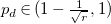 $p_d\in (1-\frac {1}{\sqrt {r}},1)$
, we obtain a recurrent chain.
$p_d\in (1-\frac {1}{\sqrt {r}},1)$
, we obtain a recurrent chain.
It is thus sufficient to compute $q$
and
$q$
and $h^{A_\tau \cup \{\bot \}}_{\varepsilon }$
. We have “widened” the set
$h^{A_\tau \cup \{\bot \}}_{\varepsilon }$
. We have “widened” the set $A_\tau$
by including
$A_\tau$
by including $\bot$
, which means we no longer have to worry about looping back to
$\bot$
, which means we no longer have to worry about looping back to $\varepsilon$
. This effectively allows us to compute the desired hitting-time inductively, applying Lemma2 iteratively. We first turn to computing
$\varepsilon$
. This effectively allows us to compute the desired hitting-time inductively, applying Lemma2 iteratively. We first turn to computing $q$
as a function of
$q$
as a function of $\tau$
.
$\tau$
.
Let $s=\langle x_1,y_1 \rangle \cdots \langle x_m,y_m \rangle \in \mathcal{S}$
be any recursive sub-tree root, where
$s=\langle x_1,y_1 \rangle \cdots \langle x_m,y_m \rangle \in \mathcal{S}$
be any recursive sub-tree root, where $y_i=(y_{i,1},\ldots , y_{i,n_i})\in \mathcal{S}_{\mathsf{Com}}$
for
$y_i=(y_{i,1},\ldots , y_{i,n_i})\in \mathcal{S}_{\mathsf{Com}}$
for $1\leq i \leq m$
. Then the sequence
$1\leq i \leq m$
. Then the sequence $y_{1,1}\cdots y_{m,1}$
is the prefix of
$y_{1,1}\cdots y_{m,1}$
is the prefix of $s$
. It corresponds to the sequence that would be output if state
$s$
. It corresponds to the sequence that would be output if state $s\cdot []$
is reached.
$s\cdot []$
is reached.
Proposition 2.
-
1. Let
$s$
be a recursive sub-tree root with prefix
$\rho$
and
$\tau =(\tau _1,\ldots , \tau _l)$
. ThenIn particular, this probability depends only on
\begin{align*} \Pr [H^{A_{\rho \tau }}_{s}\gt H^{\mathsf{Exit}_s}_{s}] = 1 - (1-p_d)^{2l+1}\stackrel {\text{ def}}{=} q^{(l)} \end{align*}
$l$
and not on the values
$\tau _i$
or
$\rho$
.
-
2. Let
$s$
be a recursive sub-tree root with prefix
$\rho$
and let
$\tau$
be any test case. Then:Informally, the stated mean hitting time is “translation invariant”.
\begin{align*} h^{A_{\rho \tau ^{\cup \{\mathsf{Exit}_s\}}}}_{s}=h^{A_{\tau ^{\cup \{\bot \}}}}_{\varepsilon } \end{align*}





Proof.
-
1. If
$l=0$
, then
$\Pr [H^{A_\rho }_{s} \gt H^{\mathsf{Exit}_s}_{s}] = (1-p_d)p_d + p_d^2 =p_d$
, which is the probability of not selecting
$[]$
,
$[H|T][]$
or
$[][H|T]$
, each of which would eventually output the prefix
$\rho$
. This depends only on
$l=0$
, so write
$q^{(0)}=p_d$
.Now let
$l\gt 0$
: We reach
$\mathsf{Exit}_s$
without visiting the next deeper state by backtracking to it immediately with probability
$p_d^2$
, or by visiting
$[]$
with probability
$(1-p_d)p_d$
which sums up to
$p_d$
. Otherwise we reach the next deeper state with probability
$(1-p_d)$
. Here we either select
$\tau _1$
and apply induction using Fact1, or we do not select
$\tau _1$
. This gives:which is of the form
\begin{align*} \Pr [H^{A_{\rho \tau }}_{s}\gt H^{\mathsf{Exit}_s}_{s}] = p_d + (1-p_d)((1-p_d)\cdot q^{(l-1)} + p_d ) \end{align*}
$A\cdot q^{(l-1)} + B$
with
$A=(1-p_d)^2$
and
$B=p_d(2-p_d)$
. This gives rise to a polynomial (in
$A$
), namely:
$q^{(0)}\cdot A^l + B\cdot \sum _{k=0}^{l-1}A^k$
. Computing the geometric sum and simplifying the term proves the first claim.
-
2. This follows immediately from the definition of
$\mathsf{Exit}_s$
and the recursive structure of the chain.


In what follows, we write $\tau ^{(i)} = (\tau _{1},\ldots ,\tau _i)$
. So
$\tau ^{(i)} = (\tau _{1},\ldots ,\tau _i)$
. So $\tau =\tau _l$
and
$\tau =\tau _l$
and $\tau _0=()$
is the empty test sequence. Write
$\tau _0=()$
is the empty test sequence. Write $A_i$
for the set of states that output
$A_i$
for the set of states that output $\tau ^{(i)}$
. For simplicity, we write
$\tau ^{(i)}$
. For simplicity, we write $h_i=h^{A_i\cup \{\bot \}}_{\varepsilon }$
.
$h_i=h^{A_i\cup \{\bot \}}_{\varepsilon }$
.
Lemma 3. Let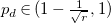 $p_d\in (1-\frac {1}{\sqrt {r}},1)$
and
$p_d\in (1-\frac {1}{\sqrt {r}},1)$
and $i\in \{0,\ldots , l\}$
and let
$i\in \{0,\ldots , l\}$
and let $C$
denote the constant from Theorem 3. Then
$C$
denote the constant from Theorem 3. Then
 \begin{align*} h_{i} & = (1-p_d)^{2i}\left(1+\frac {(1-p_d^2)(1+C)}{2} -\frac {C(1-p_d)^2(r-1)}{p_d(2-p_d)}\right.\\ &\quad -\,\left.\frac {(1-p)(1+p) + (1-p)^3}{2p_d(2-p_d)} - i\cdot (1-p_d)^{2}\cdot \frac {1+C(r-1)}{2}\right) \\ &\quad + \left (\frac {C(1-p_d)^2(r-1)}{p_d(2-p_d)} + \frac {(1-p)(1+p) + (1-p)^3}{2p_d(2-p_d)}\right ) \end{align*}
Proof. For $h_0$
we need the hitting time of the set of four states
$h_0$
we need the hitting time of the set of four states $\bot$
,
$\bot$
, $[]$
,
$[]$
, $[H|T][]$
, and
$[H|T][]$
, and $[][H|T]$
. By Eq. (1) we have
$[][H|T]$
. By Eq. (1) we have
 \begin{align*} h_0=1 + (1-p_d)p_d(1+C) + \frac {1}{2}(1-p_d)^2(1+C)= 1+\frac {1}{2}(1-p_d^2)(1+C) \end{align*}
To compute $h_{i+1}$
, we first look at the hitting time starting from the states
$h_{i+1}$
, we first look at the hitting time starting from the states $[H|T]$
,
$[H|T]$
, $[H|T][]$
, and
$[H|T][]$
, and $[][H|T]$
. We select a productive state with probability
$[][H|T]$
. We select a productive state with probability $(1-p_d)$
and an unproductive one with probability
$(1-p_d)$
and an unproductive one with probability $p_d$
. In either case we traverse some number
$p_d$
. In either case we traverse some number $0\leq k \leq r-1$
of unproductive sub-trees, each of which adds
$0\leq k \leq r-1$
of unproductive sub-trees, each of which adds $C$
steps. In case of a productive state, the number depends on the position of
$C$
steps. In case of a productive state, the number depends on the position of $\tau _1$
in the set of
$\tau _1$
in the set of $k+1$
elements:
$k+1$
elements:
 \begin{align*} h^{A_{i+1^{\cup \{\bot \}}}}_{[H|T]}&=p_d\cdot \sum _{k=0}^{r-1}\binom {r-1}{k}p_d^{r-1-k}(1-p_d)^k \cdot kC & \text{(unproductive)}\\ &\quad+ (1-p_d)\cdot \sum _{k=0}^{r-1}\binom {r-1}{k}\frac {p_d^{r-1-k}(1-p_d)^k}{k+1} & \text{(productive)}\\ &\qquad \cdot \sum _{m=0}^{k}mC + h_{i} + q^{(i)}(m-k)C & \text{(proposition 2 and lemma 2)} \end{align*}
Note the denominator $k+1$
accounts for the probability of placing
$k+1$
accounts for the probability of placing $\tau _i$
at position
$\tau _i$
at position $m=0,1,\ldots ,k$
. At position
$m=0,1,\ldots ,k$
. At position $m$
, there are
$m$
, there are $mC$
unproductive sub-trees before reaching
$mC$
unproductive sub-trees before reaching $\tau _1$
and
$\tau _1$
and $(m-k)$
after. In the third line, we split the recursive hitting time using Lemma2. Note that the exit state
$(m-k)$
after. In the third line, we split the recursive hitting time using Lemma2. Note that the exit state $\mathsf{Exit}_s$
of each recursive sub-tree root
$\mathsf{Exit}_s$
of each recursive sub-tree root $s$
reached in this way is either
$s$
reached in this way is either $\bot$
(if
$\bot$
(if $k=m$
) or the adjacent unproductive recursive sub-tree root (cf. Figure 3). By Proposition2 Item 1 we may use recursion.
$k=m$
) or the adjacent unproductive recursive sub-tree root (cf. Figure 3). By Proposition2 Item 1 we may use recursion.
Computing the inner sum and canceling out the denominator $k+1$
from the second line, we get:
$k+1$
from the second line, we get:
 \begin{align*} h^{A_{i+1^{\cup \{\bot \}}}}_{[H|T]}&=p_d\cdot \sum _{k=0}^{r-1}\binom {r-1}{k}p_d^{r-1-k}(1-p_d)^k \cdot kC \end{align*}
 \begin{align*}&\qquad + (1-p_d)\cdot \sum _{k=0}^{r-1}\binom {r-1}{k}p_d^{r-1-k}(1-p_d)^k \cdot \left (\frac {kC}{2} + h_i + q^{(i)}\frac {kC}{2}\right ) \\ &\quad= p_d(1-p_d)(r-1)C + (1-p_d)\left (h_i + (1+q^{(i)})\frac {(r-1)(1-p_d)C}{2}\right ) \end{align*}
where the Binomial sums are computed as in the proof of Theorem3. The formulas for the remaining states are completely analogous, but we have additional steps for the intermediate detours over $[]$
. It is thus convenient to express them in terms of
$[]$
. It is thus convenient to express them in terms of $h^{A_{i+1^{\cup \{\bot \}}}}_{[H|T]}$
:
$h^{A_{i+1^{\cup \{\bot \}}}}_{[H|T]}$
:
 \begin{align} h^{A_{i+1^{\cup \{\bot \}}}}_{[][H|T]}&= 1+ h^{A_{i+1^{\cup \{\bot \}}}}_{[H|T]} \nonumber\\ h^{A_{i+1^{\cup \{\bot \}}}}_{[H|T][]} &=h^{A_{i+1^{\cup \{\bot \}}}}_{[H|T]} + (1-p_d)q^{(i)}\end{align}
For the second identity, note that visits to $[]$
are counted only in case of failure and are thus weighted by
$[]$
are counted only in case of failure and are thus weighted by $q^{(i)}$
.
$q^{(i)}$
.
We can now turn to $h_{i+1}$
. By Eq. (1):
$h_{i+1}$
. By Eq. (1):
 \begin{align*} h_{i+1}&= p_d^2\cdot 0 + (1-p_d)p_d + (1-p_d)p_d\cdot h^{A_{i+1^{\cup \{\bot \}}}}_{[H|T]} \\ &\quad + \frac {(1-p_d)^2}{2}\cdot \left(h^{A_{i+1^{\cup \{\bot \}}}}_{[][H|T]} + h^{A_{i+1^{\cup \{\bot \}}}}_{[H|T][]}\right) \end{align*}
which, after substitution of ( $\ast$
) and straightforward simplification becomes
$\ast$
) and straightforward simplification becomes
 \begin{align*} h_{i+1}= \frac {1}{2} \left (1-p_d^2 + (1-p_d)^3q^{(i)}\right ) + (1-p_d)h^{A_{i+1^{\cup \{\bot \}}}}_{[H|T]} \end{align*}
We substitute $h^{A_{i+1}}_{[H|T]}$
and Proposition2 Item 2, then simplify, isolating the terms that are dependent on
$h^{A_{i+1}}_{[H|T]}$
and Proposition2 Item 2, then simplify, isolating the terms that are dependent on $i$
:
$i$
:
 \begin{align*} h_{i+1} & = (1-p_d)^2h_i -\frac {1+C(r-1)}{2}\cdot (1-p_d)^{2i+4} \\ &\quad + C(1-p_d)^2(r-1) + \frac {(1-p)(1+p) + (1-p) ^3}{2} \end{align*}
With $\alpha =(1-p_d)^2$
,
$\alpha =(1-p_d)^2$
, $\beta = -\frac {1+C(r-1)}{2}\cdot (1-p_d)^4$
, and
$\beta = -\frac {1+C(r-1)}{2}\cdot (1-p_d)^4$
, and $\gamma =C(1-p_d)^2(r-1) + \frac {(1-p)(1+p) + (1-p)^3}{2}$
we get the following formula (e.g. by iterative substitution):
$\gamma =C(1-p_d)^2(r-1) + \frac {(1-p)(1+p) + (1-p)^3}{2}$
we get the following formula (e.g. by iterative substitution):
 \begin{equation} h_{i+1} = \alpha ^{i+1}h_0 + (i+1) \beta \alpha ^i + \gamma \,\frac {1-\alpha ^{i+1}}{1-\alpha } \end{equation}
Its correctness is easily shown by induction on $i\geq 0$
.
$i\geq 0$
.
Substituting $h_0$
,
$h_0$
, $\alpha$
,
$\alpha$
, $\beta$
, and
$\beta$
, and $\gamma$
into Eq. (8) gives:
$\gamma$
into Eq. (8) gives:
 \begin{align*} h_{i} & = (1-p_d)^{2i}h_0 - i\cdot (1-p_d)^{2(i-1)+4}\cdot \frac {1+C(r-1)}{2} \\&\quad + \left (C(1-p_d)^2(r-1) + \frac {(1-p)(1+p) + (1-p)^3}{2}\right )\frac {1-(1-p_d)^{2i}}{1-(1-p_d)^2} \end{align*}
which simplifies to the desired formula.
Substituting into Eq. (7) gives the following theorem:
Theorem 4. Let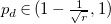 $p_d\in (1-\frac {1}{\sqrt {r}},1)$
,
$p_d\in (1-\frac {1}{\sqrt {r}},1)$
, $r\in \mathbb{N}$
. Denote by
$r\in \mathbb{N}$
. Denote by $C$
the constant from Theorem 3. Let
$C$
the constant from Theorem 3. Let $\tau$
be a test case of length
$\tau$
be a test case of length $l$
and
$l$
and $A_\tau \subseteq \mathcal{S}$
the set of states that output
$A_\tau \subseteq \mathcal{S}$
the set of states that output $\tau$
. Then:
$\tau$
. Then:
 \begin{align*} h^{A_{\tau }}_{\varepsilon} & =\frac {1+ \left (\frac {C(1-p_d)^2(r-1)}{p_d(2-p_d)} + \frac {(1-p)(1+p) + (1-p)^3}{2p_d(2-p_d)}\right ) }{(1-p_d)^{2l+1}} \\ &\quad + \frac {(1+p_d)(1+C)}{2} -\frac {C(1-p_d)(r-1)}{p_d(2-p_d)} - \frac {(1+p_d) + (1-p_d)^2}{2p_d(2-p_d)} \\ &\quad - l\cdot (1-p_d)\cdot \frac {1+C(r-1)}{2} - (1-p_d) +\frac {1}{(1-p_d)} \end{align*}
All that remains is to prove Lemma2:
Proof of Lemma 2.
 \begin{align*} \nonumber\\[-30pt]h^{A}_{x} &= \sum _{n=0}^{\infty }n\cdot \Pr [H^{A}_{x}=n,H^{A}_{x} \lt H^{y}_{x}] + \sum _{n=0}^{\infty }\sum _{k=0}^{n-1}n\cdot \Pr [H^{A}_{x}=n,H^{A}_{x}\gt H^{y}_{x},H^{y}_{x}=k] \end{align*}
Using Fubini’s theorem, the second sum becomes
 \begin{align*} &\sum _{k=0}^{\infty }\Pr [H^{y}_{x}=k,H^{A}_{x}\gt H^{y}_{x}]\sum _{n=k+1}^{\infty }n\cdot \Pr [H^{A}_{x}=n|H^{y}_{x}=k,H^{A}_{x}\gt H^{y}_{x}]\\ &\quad = \sum _{k=0}^{\infty }\Pr [H^{y}_{x}=k,H^{A}_{x}\gt H^{y}_{x}]\sum _{m=1}^{\infty }(m+k)\Pr [H^{A}_{y}=m] \end{align*}
and since $\Pr [H^{A}_{y}=0]$
, because
$\Pr [H^{A}_{y}=0]$
, because $y\notin A$
, and moreover
$y\notin A$
, and moreover $\mathcal{M}$
is recurrent (so
$\mathcal{M}$
is recurrent (so $\Pr [H^{A}_{y}\lt \infty ]=1$
) this is equal to
$\Pr [H^{A}_{y}\lt \infty ]=1$
) this is equal to
 \begin{align*} & \sum _{k=0}^{\infty }\Pr [H^{y}_{x}=k,H^{A}_{x}\gt H^{y}_{x}]\left (k + h^{A}_{y}\right ) \\&\quad = \left (\sum _{k=0}^{\infty }\Pr [H^{y}_{x}=k,H^{A}_{x}\gt H^{y}_{x}]k \right )+ h^{A}_{y} \cdot \Pr [H^{A}_{x}\gt H^{y}_{x}]. \end{align*}
Because $y\notin A$
, we have
$y\notin A$
, we have $H^{A}_{x}\neq H^{y}_{x}$
and so
$H^{A}_{x}\neq H^{y}_{x}$
and so $\Pr [H^{y}_{x}=k,H^{A}_{x}\gt H^{y}_{x}] + \Pr [H^{A}_{x}=k,H^{A}_{x}\lt H^{y}_{x}]=\Pr [H^{A\cup \{y\}}_{x}=k]$
. Hence the remaining two infinite sums add up to
$\Pr [H^{y}_{x}=k,H^{A}_{x}\gt H^{y}_{x}] + \Pr [H^{A}_{x}=k,H^{A}_{x}\lt H^{y}_{x}]=\Pr [H^{A\cup \{y\}}_{x}=k]$
. Hence the remaining two infinite sums add up to $h^{A\cup \{y\}}_{x}$
.
$h^{A\cup \{y\}}_{x}$
.
4 Evaluation
In the following section, we empirically evaluate the randomization approaches outlined in section 3. We implement the strategy via guards using SWI-Prolog (Wielemaker et al. Reference Wielemaker, Schrijvers, Triska and Lager2012). To implement the drop-and-shuffle strategy, we choose Go-Prolog ichiban/Prolog (Reference Ichiban/Prolog2024). Go-Prolog has a small and easily modifiable code-base, which simplifies experiments of this kind. We benchmark these approaches with various choices for the configurable probabilities.
Iterations and results until test case [second, …, second] is reached.

For the benchmarks, we use two programs: a slightly altered version of the program from listing 1 and a program generating basic arithmetic expressions, shown in listing 3. In both cases, we count the number of iterations, which is defined as the number of times the program needs to be re-run to obtain the target result, and the results, which is the number of outputs of the program before we obtain the target result.
4.1 Benchmark 1: Command sequences
The first benchmark is based on listing 1 with two adjustments We limited the number of available commands to three. Moreover, each command/1 predicate simply unifies its argument with a corresponding constant (in our case first, second, and third). We executed each benchmarks 1000 times. The results are shown in Figure 4.
The goal length each benchmark lists on its x-axis is the length of a list consisting solely of the constant symbol second the respective number of times. This guarantees that we would not find this test case with the standard depth-first, left-first search behavior, but also that is not the path that would be picked last with depth-first search. For our implementation, we relied on Janus Andersen and Swift (Reference Andersen and Swift2023) for SWI as the Python-Prolog bridge to gather the results.
Guard-Approach Benchmarks: Every command/1 predicate had an equal probability of $\frac {1}{3}$
for the steady probability. The different plots mark different continuation probabilities
$\frac {1}{3}$
for the steady probability. The different plots mark different continuation probabilities $p_c$
used for the respective queries.
$p_c$
used for the respective queries.
Figure 4a shows the number of results until a specific target test case is found. As expected, the number of results drastically increases with the target list size. Further, only a continuation probability of 0.9 has a higher number of results. Figure 4b shows how many iterations were necessary until the determined target was found. Similar to the number of results, the number of iterations also grows with increasing list size of the expected outcome. As the continuation probability increases the total number of iterations decreases.
Drop-and-Shuffle Benchmarks: As described above, for the Go-Prolog variant we implemented a drop-probability as discussed in section 3. Otherwise, the benchmarks are still conducted using the same pattern as described above for increasing goal lengths. Figure 4c shows the number of produced results whereas Figure 4d shows the number of iterations.
Note that dropping a clause with probability 0.1 is the same as proceeding to explore it with probability 0.9. Hence, the probabilities in Figures 4c and 4d are dual to those above. But note that in this way they do not fulfill the premise of Theorem3
: They are below $1-\frac {1}{\sqrt {r}}\approx 0.423$
. The mean hitting time
$1-\frac {1}{\sqrt {r}}\approx 0.423$
. The mean hitting time $C$
is thus infinite. And yet, we obtain results! This might seem paradoxical, but is due to the fact that we return to
$C$
is thus infinite. And yet, we obtain results! This might seem paradoxical, but is due to the fact that we return to $\bot$
with probability 1, even if there is no finite mean. Indeed, this makes these measurements particularly interesting, because they have no defined mean to converge to – the law of large numbers applies only if the distribution has finite mean!
$\bot$
with probability 1, even if there is no finite mean. Indeed, this makes these measurements particularly interesting, because they have no defined mean to converge to – the law of large numbers applies only if the distribution has finite mean!
Note that the drop-and-shuffle randomization strategy is much more coarse than the guard strategy by design: The 0.1 drop probability applies to both the t predicate as well as the command{1,2,3} predicates. This is quite different from the previous scenario, where $p_c=0.9\gg p_1=\cdots =p_r=0.33$
were distinct. Consequently, both the number of iterations and the number of results are notably higher for the drop-and-shuffle approach: A probability of 0.1 to drop a clause produces significantly more solutions until a specified goal is found. The drop probabilities of 0.14 and 0.18 are rather similar for all specified goal lengths. On the other hand, the number of iterations signals that the number of iterations rises with a higher dropping probability. In Figure 4c, the probability 0.14 outperforms both 0.10 and 0.18.
$p_c=0.9\gg p_1=\cdots =p_r=0.33$
were distinct. Consequently, both the number of iterations and the number of results are notably higher for the drop-and-shuffle approach: A probability of 0.1 to drop a clause produces significantly more solutions until a specified goal is found. The drop probabilities of 0.14 and 0.18 are rather similar for all specified goal lengths. On the other hand, the number of iterations signals that the number of iterations rises with a higher dropping probability. In Figure 4c, the probability 0.14 outperforms both 0.10 and 0.18.
In Gelderie et al. (Reference Gelderie, Luff and Peltzer2024), we conjectured that this is due to an inflection point. But the results of section 3.2 now show that this reasoning is not verifiable: An undefined function cannot have an inflection point. It seems impossible to know whether this is an artifact of the inherent randomness of the measurements (that, we know, cannot converge to a non-existent mean), or some other effect. In any case, it underscores that the drop-and-shuffle approach is unwieldy and difficult to analyze.
4.2 Benchmark 2: Arithmetic expressions
In this section, we provide the results of another benchmark to showcase the behavior of both approaches in a more complicated setting. This time, our goal is to show the behavior of the two randomization approaches in settings other than those considered in the previous sections. We use the program in listing 3, which generates basic arithmetic expressions build from the two binary operators + and $\times$
, as well as the unary operator −. Note that only the numbers 1, 2, and 3 can be used within an expression. Expressions have the form [minus, [plus, [1,3]]]. In the text below, we use the more readable symbolic representation −(+(1,3)) (Polish notation). The value of the previous expression is
$\times$
, as well as the unary operator −. Note that only the numbers 1, 2, and 3 can be used within an expression. Expressions have the form [minus, [plus, [1,3]]]. In the text below, we use the more readable symbolic representation −(+(1,3)) (Polish notation). The value of the previous expression is $-4$
.
$-4$
.
Our benchmark counts the iterations and number of results (defined as above in section 4.1) until an expression that evaluates to a specific target value is found. The target values, along with example expressions of shortest length, are provided in Table 1. As before, we repeat our experiment 1000 times. Clearly, for any target integer value $x$
, there are infinitely many expressions that evaluate to
$x$
, there are infinitely many expressions that evaluate to $x$
. However, some values can be reached with relatively simple expressions, whereas others require more complex, nested expressions that can only be found at lower depths in the SLD-tree.
$x$
. However, some values can be reached with relatively simple expressions, whereas others require more complex, nested expressions that can only be found at lower depths in the SLD-tree.
A program generating arithmetic expressions.

Example expressions of smallest possible size for the target values (in Polish notation)

Note that the results from the preceding sections do not directly extend to the program that we study here: The program is different (though similar in structure), and we now investigate the number of steps needed to reach any output from an infinite set of target outputs. The second point, in particular, is a major difference from the previous setting. Consider, for example, the target value 15. Expressions with value 15 are ubiquitous. Suppose during resolution, we arrive at a partially expanded expression +(a,X), where X is yet to be derived and where the value of a is an arbitrary integer. Then there are infinitely many expressions for X that will give the value 15. The only partial expression that cannot ever be completed to a full expression evaluating to 15 is of the form $\times$
(a,X) for an expression a with a value that is not a divisor of 15. This means, that we have a much larger probability of arriving at a “desired” output than before.
$\times$
(a,X) for an expression a with a value that is not a divisor of 15. This means, that we have a much larger probability of arriving at a “desired” output than before.
Iterations and results until the generated expression has a specific value.

Guard-Approach Benchmarks: For the guard approach, we used the continuation probabilities $p_c=0.3$
to
$p_c=0.3$
to $p_c=0.45$
in increments of
$p_c=0.45$
in increments of $0.05$
. The continuation probability
$0.05$
. The continuation probability $p_c$
was used only for the clause in line 2 of listing 3. All other clauses, including the facts in lines 4–6, were guarded with a fixed probability of
$p_c$
was used only for the clause in line 2 of listing 3. All other clauses, including the facts in lines 4–6, were guarded with a fixed probability of $0.33$
.
$0.33$
.
The results of the guard-approach benchmark is shown in Figures 5a and 5b. The first observation is that lower continuation-probabilities result in a larger number of results until a target clause is reached. This is in contrast to the previous benchmark (cf. section 4.1), where higher probabilities lead to a large number of results. This is likely because we now try reach any one expression from an infinite set of expressions. If the continuation probability is higher, we reach deeper into the SLD tree. Unlike before, however, we are quite likely to find our target that way.
Note that expressions with a negative sign require both more iterations and produce more unwanted results, before being reached. Target values requiring more complex expressions take longer to reach, as expected. There is significant increase in the time required to produce a target result, if three or more sub-expressions are needed (i.e. for −12 and 15). Note also that there is a small peak for expression −4. This is likely, because $-4$
requires on additional operator if compared with
$-4$
requires on additional operator if compared with $4=2+2$
and
$4=2+2$
and $6=2\cdot 3$
.
$6=2\cdot 3$
.
Drop-and-Shuffle Benchmarks: We used a drop-probability $p$
ranging from
$p$
ranging from $0.4$
to
$0.4$
to $0.55$
(in increments of
$0.55$
(in increments of $0.05$
). Values of
$0.05$
). Values of $p\gt 0.55$
took excessively longer to benchmark, and we could not complete 1000 test-runs within four days of running the benchmark for such values of
$p\gt 0.55$
took excessively longer to benchmark, and we could not complete 1000 test-runs within four days of running the benchmark for such values of $p$
. The results of the benchmarks are shown in Figures 5c and 5d.
$p$
. The results of the benchmarks are shown in Figures 5c and 5d.
First, we note that the numbers are orders of magnitude larger than for the guard approach. While the numbers are difficult to compare (unlike section 4.1 probabilities are not completely dual), there appears to be a significant increase in runtime and uninteresting results that do not evaluate to the target value. As we have noted before, the shuffle-and-drop strategy is more coarse and the drop probability affects all clauses, not just the one in line 2 of listing 3. This is the most likely explanation for the excessive runtime.
Next, note that the metrics for target value 15 are consistently lower than for target value −12. We do not observe this effect for the guard approach in Figures 5a and 5b. In absence of mathematical rigor, we can, again, only conjecture as to the cause. There are two ways of reading this result: It shows that 15 is intrinsically easier to reach in the shuffle-and-drop approach than −12, or that −12 is intrinsically harder to reach, when using the shuffle-and-drop approach. We conjecture that the second interpretation is correct. The lowest test case that can produce −12 is at a greater depth than 15 (see Table 1). Moreover, the number −12 it requires even greater depth to reach if the outermost operator is not ‘−’. Looking back to Theorem4 in subsection 3.2.2, we see that the runtime grows exponentially in twice the depth of the test case. This result does not extend to our present setting, but it seems likely that the runtime must grow at least exponentially in the depth of the shortest possible derivation of the desired output, governed by a similar growth-function to that given in Theorem4. If that is the case, reaching −12 becomes much more difficult than reaching 15. While a similar argument would seem to apply to the guard approach as well, where we don’t see this effect, the base of the exponential is smaller and the exponent is not scaled by two (see Corollary2). It is quite possible that the relatively short expressions yielding −12 are dominated by other factors in the guard approach setting, due to the smaller base and exponent.
5 Conclusion
We have presented two approaches to randomize the SLD derivation of test cases in Prolog and studied their performance in terms of expected time to hit a test case, and mean number of test cases produced. To this end, we presented a detailed analysis of the random behavior of test-case generation using Prolog and Markov chains. Our theorems allow a precise calibration of the probabilities to adjust the expected number of test cases per query. When looping on such a query, the rate of growth of the mean-hitting time for a given test case is exponential in its depth, where the base is the product of the involved probabilities. We then compared both strategies and various sets of values for the involved probabilities empirically. We find that the guard approach that uses an unmodified Prolog implementation provides a very fine-grained control over the randomization and thus produces test cases quicker.
In future work, we plan to study the semantics of this approach when negation-as-failure is involved. In particular, randomization may lead to a false refutation of q(t_1,…,t_k) in the goal ∖+ q(t_1,…, t_k). However, this may be acceptable, if it occurs with low probability. In a similar vein, the treatment of negation as failure might require randomization strategies entirely different from those we have presented here, which is another interesting topic for future research.




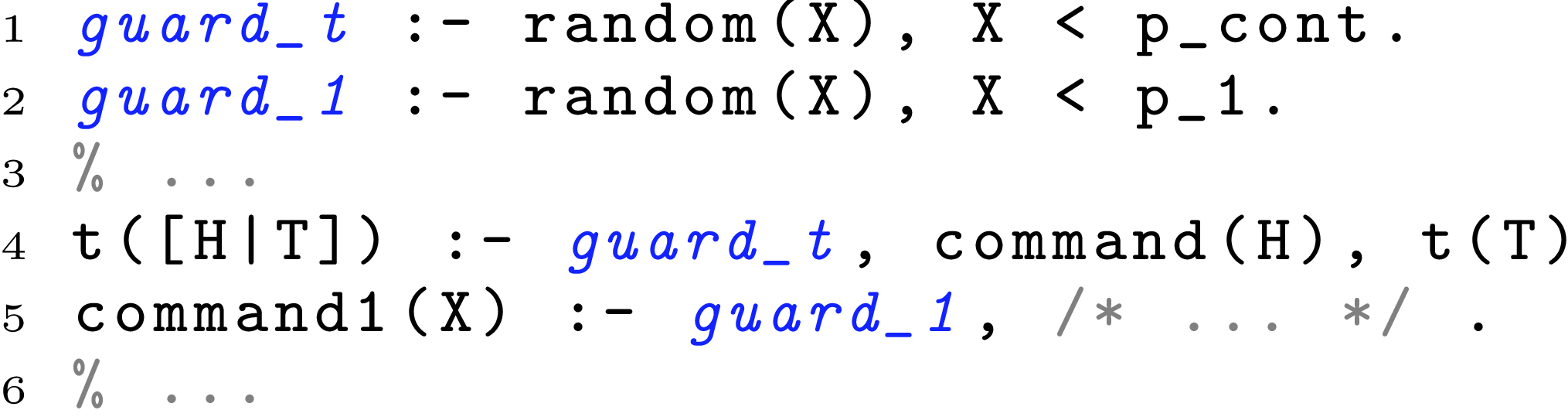


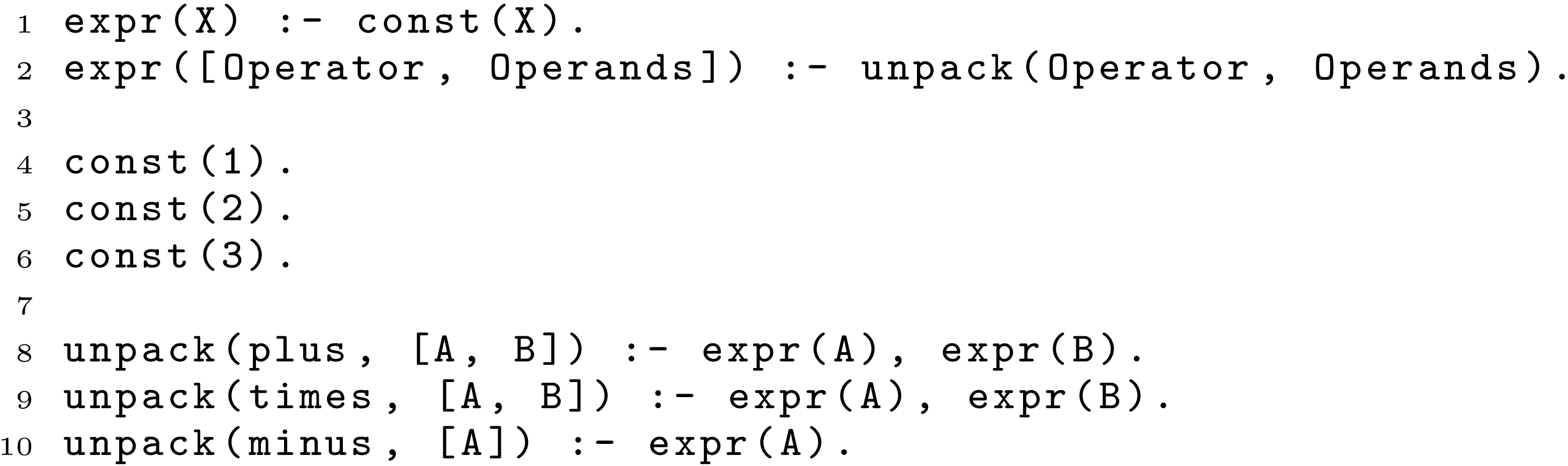


 Open access

