





Introduction
The word “smart” is included twice in the title. Interestingly, the meanings of this word in the two contexts are somewhat different. This is a typical example of the ambiguities caused by the use of this word as a general adjective in largely different contexts. This also casts light on definitional issues that can be found in the professional literature, which often uses the term “smart” as a jolly joker. Therefore, let us elaborate further on the meanings of smartness in the context indicated by the title. However, it must be mentioned before everything that the practice of design, as well as the theories of design, goes through subsequent paradigmatic changes due to external influences and internal necessities. A fact of the matter is that the focus of value generation, artifactual paradigms, enabling technologies, applied methodologies, and business strategies of design are continually enriched (Fig. 1). While useful products and manageable processes were in the focus of industrial design engineering before and in the 1950, the attention shifted to multi-disciplinary systems and related services in the 1980s (Horváth, Reference Horváth2020a). In addition to paying attention to products and services (Biehl, Reference Biehl2017), the concepts of environments and experiences appeared as part of a paradigmatic shift at the turning of the present century. Neuhüttler et al. (Reference Neuhüttler, Woyke and Ganz2017) provided an example of considering value propositions in the development of smart service business models. Smartness can be associated with all forms of value propositions, but it will have a different flavor in each case. Unfortunately, there are only tentative definitions for smart experiences, smart environments, smart systems, and so forth.
Shifting artifact paradigms and value generation in design.

The starting point of our discussion can be that, in human behavioral context, “smart” means (i) behaving with above-average logical reasoning skills, (ii) successfully applying them to solve technical, scientific, social, economic, and political problems, and (iii) having pragmatic, emotional, and ethical concerns. This circumscription has two direct implications: (i) smart humans/systems are better at solving problems than others and (ii) what helps better solve problems also makes the problem solver smarter. Thus, smartness is a measure of the ability to act in a situation based on innate competences and the knowledge and information known. This explains why smart is often associated with the actions and ability to navigate in an unknown place, or solving complicated puzzles, or convincing others about the truth of a claim.
Even if philosophical studies and speculations are also considered, the literature seems to be incomplete on the fundamentals of smartness in nonhuman contexts. Notwithstanding, there are some seminal and influential works that warrant more attention and exposition (Adams, Reference Adams2012). Many authors put an equal sign between smartness and intelligence as a characteristic of behavior and capabilities (Shang and You, Reference Shang and You2019). They consider smartness and intelligence as synonyms and use these two terms interchangeably (Wang, Reference Wang2019). However, we consider them different and demarcate the two notions in this paper, in particular in the context of intellectualized engineered systems (IESs). The bottom line is that we consider intelligence as an ultimate experiential manifestation of being and behaving as human (Herring, Reference Herring1925). As a native gift, it is generic, global, and multi-faceted. On the other hand, smartness is specific, localized, and purposeful. These two natural phenomena have different indicators and measures (Rosenblueth et al., Reference Rosenblueth, Wiener and Bigelow1943).
Rough thoughts on smartness versus intelligence identify discriminators such as awareness versus consciousness, reasoning versus thinking, acquiring versus learning, and self-enhancement versus self-adaptation. Personal intelligence is considered as a kind of given (IQ of individuals is supposed to be stable as they age), while personal smartness is accepted as changing with intellectualization, practicing, and experiencing. Intelligence is often considered a measure of the ability to learn (Meisenberg and Lynn, Reference Meisenberg and Lynn2011). This suggests that intelligence is an intrinsic general property. Smartness is not about the probability but more about the rate of accumulation of competences, knowledge and information of an individual. A human or a system can become smarter by improving the competences through practicing and obtaining more relevant information and knowledge (Rindermann and Ceci, Reference Rindermann and Ceci2009). Eventually, it is the ability to survive through any means.
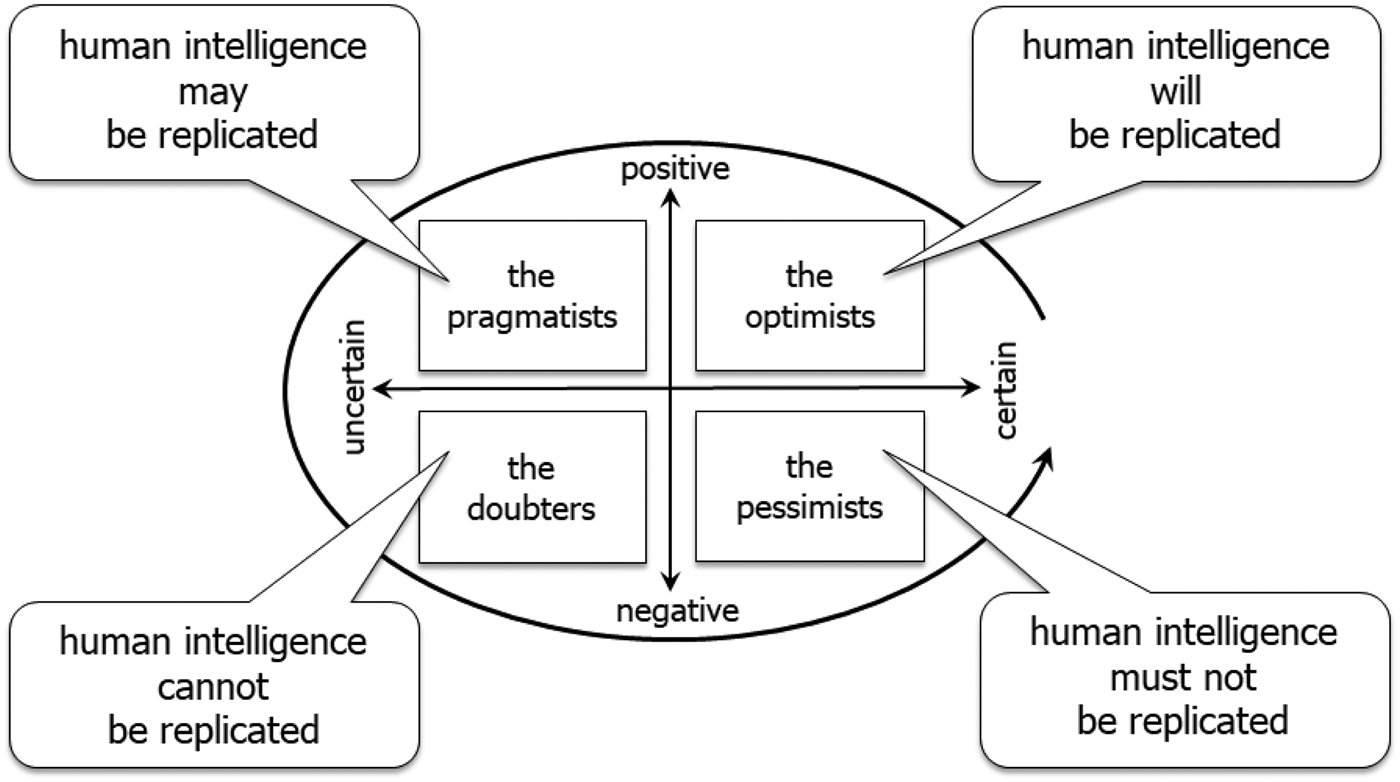
The reproduction of human smartness in IESs is a current hot issue. It is assumed that system smartness means that the access and extraction of information and knowledge for/by IESs is not static and that they may exhibit evolving problem solving capabilities. And this is where artificial narrow intelligence (ANI) comes to the scene (Alippi and Ozawa, Reference Alippi, Ozawa, Kozma, Alippi, Choe and Morabito2019). Current artificial intelligence is an eclectic body of unintegrated knowledge. Several constituents and manifestations of ANI have been developed and studied, and artificial general intelligence (AGI) and artificial explainable intelligence (AEI) research have gained a lot of impetus in the last decade. Three basic and generic forms of artificial intelligence are distinguished: (i) assisted intelligence, (ii) augmented intelligence, and (iii) autonomous intelligence. They offer a rich and rapidly growing set of problem solving technologies. Enabling system-level smartness by applying ANI or AGI or AEI technologies is in the center of current cognitive systems research and development, but its future possibilities and implications are seen and judged differently (Ren and Chen, Reference Ren and Chen2019). As shown in Figure 2, four conflicting worldviews and philosophical positions are competing. For this reason, the future situation does not seem to be clear in the present days, even if the technological trends and future affordances are considered.
Positions concerning the current and future status of artificial intelligence.
We claim that ANI is not more and not less than a popularized and ambitious formulation of the name of a wide but the fragmented domain of research in reproducing various manifestations of human intelligence. In the framework of cybernetics, intellect is achieved by a subsequent integration and abstraction of data, information, and knowledge. We are treating data, information, and knowledge as three distinct tiers. Data are regarded as a collection of facts, information is the meaning of interrelated data, and knowledge is the problem solving power of integrated and abstracted information, while intellect is the ability of properly applying knowledge in various and varying contexts. Sensors gather signals and convert them to data. Information structures capture and encode relations among data and expose their meaning. Advanced reasoning mechanisms (such as artificial neural networks) discover relationships hiding in massive data streams and convert it into patterns of knowledge. Context management learns the conditions (meta-knowledge) of the proper application of problem solving knowledge.
Considering all the facts and issues, what does smart mean in the context of design processes and engineered systems, or in a combined context? The major questions about the essence and forms of relationships between smart design and smart systems are indicated in Figure 3 (Horváth, Reference Horváth2020a). What does smart design have to do with smart systems and what do smart systems have to do with smart design? What is smart design of smart systems? What does connect them? These questions will be addressed in the rest of this paper.
Major questions concerning relationships.

Part 1: Smart design
Dual nature of design smartness
The dual nature of design smartness mentioned in the title of this subsection originates in the word “design” itself, which is used here as an adjective, but it can refer either to a purposeful process or to a purposeful artifact. Both the process and the artifact can be smart, but differently. The fact of the matter is that we focus on the smartness of the design process, since the concept of “purposeful” artifacts eventually leads us to the domain of smart systems. How can the phenomenon (observable process and activities) of smart design be defined with simple terms? Perhaps the simplest definition would be: Smart design is a process enabled by artificial intelligence. However, this definition does not claim more than saying: a house is heated by gas or a vehicle is fueled by petrol. Therefore, for a better articulation, a more detailed definition is deemed to be necessary. The fact is that confusingly abundant definitions of “smart design” can be found in the literature that divides according to whether they concern the design process or the design artifact. Some representative definitions are as follows: “Smart design is for complex challenges”; “Smart design is data-based design”; “Smart design is the use of artificial intelligence technologies in design problem solving and management”; “Smart design is the design approach associated with smart systems”; “Smart design is what brings the user experience to its ultimate limits”; “Smart design is the form of self-adaptation of intelligent systems”; “Smart design operates as if by human intelligence by using automatic computer control”; “Smart design humanizes products, services and experiences through deep research, technological insights, and design strategies”; “Smart design operationalizes the S.M.A.R.T. principles (specific, measurable, actionable, realistic, and time-based) in the context of creative practice”; “Smart design is simultaneous thinking inside the box and outside the box”; and so forth.
It is known and widely accepted that design processes (i) are intellect-based, meaning that they simultaneously need data, information, knowledge, and wisdom; (ii) are dedicated to novel products, services, and other values; and (iii) use exploration, intuition, systematics, heuristics, reasoning, etc. to devise solutions. If this is correct, then what differentiates a smart design process? Pencil-aided design and computer-aided design are seen as an intrinsic creative human activity, which assumes design intuitions, thinking and composition. As a problem solving process, it is characterized by (i) information and knowledge aggregation, processing, and assessment; (ii) extensive search for design solutions; and (iii) combined application of synthesis, analysis, simulation, prototyping, and evaluation actions. However, smart design has different relationships with learned human professionals. Some writers stated that any design method/methodology dealing with a part or the whole of a design process with a smart technology will constitute a smart designing process.
But what designers actually do when they do smart designing? Smartness makes it possible for designers to get additional intelligence, analyze on a wider basis, decide more objectively, and operate under uncertain circumstances, not just in dynamic circumstances. Schuh et al. (Reference Schuh, Zeller, Hicking and Bernardy2019) discussed that smart products are based on digitized (or cyber-physical) products, which consist of physical, intelligent, and connected components, and are capable of a digital upgrading through internet-based services. In their view, the primary function(s) must remain in place in smartification. Vroom and Horváth (Reference Vroom and Horváth2014) used the term cyber-physical augmentation to describe the process of equipping conventional products and systems with smart functionality. Ko et al. (Reference Ko, Marreiros, Morais, Vale and Ramos2012) also exemplified that cyber-physical augmentation can introduce novel primary functions. In another research project, the term “cognitive engineering” was adopted and adapted to describe the interconnected processes of (i) intellectualization of product/systems and (ii) designing physical, cognitive, and affective interaction of humans with smart products/systems (Horváth, Reference Horváth2020b).
It was discussed that the objective of the cognitive engineering of ANI-enabled smart products is to ideate surprisingly genuine and useful behavioral functions and behaviors, such as awareness building, abductive reasoning, operation forecasting, apobetic interaction, and conditioned self-adaptation. Other authors argued that the cognitive engineering also aims at optimizing “human-in-the-loop” and “system-in-the-loop” situations (Woods and Roth, Reference Woods and Roth1988; Roth et al., Reference Roth, Patterson, Mumaw, Roth and Mumaw2002). We believe that, in addition to these, smart designing needs a novel design thinking, which takes counts on the changing role of the subject of design in terms of goal definition and process implementation. It has to be mentioned that we do not have a specific model of design thinking yet that would simultaneously enable researchers, developers, and designers to implement computational support systems, facilitate research, guide education, or support interdisciplinary collaboration in the field of smart design of smart systems.
On the other side of the coin are smart products, services, and experiences as the manifestation of smart designs. This area is still facing an even more intrinsic definitional challenge. The issue is what establishes a smart design (as a value generator)? In the industrial practice, information and communication technologies have been merged into common domestic products and they were called smart. Some say that the products affected mainly by the Internet of Things are smart products (Bello and Zeadally, Reference Bello and Zeadally2019). In this view, various goal-driven combinations of hardware, software, and cyberware technologies endow products with smart functionality. Obviously, this kind of simplifications fails to provide a proper characterization of smart products. The following concise overview of the related publications casts lights on more articulated definitions that consider important functional, implementation, and operational features too.
Bonner (Reference Bonner, Green and Jordan1999) addressed the implications of using intelligence in consumer products. Gutierrez et al. (Reference Gutierrez, Garbajosa, Diaz and Yague2013) tried to provide a consensus definition for the term “smart product,” but ended up with a conclusion that the distinguishing characteristics of smart products and intelligent products are similar. This conclusion that the term “intelligent product” is a synonym of “smart product” is also proposed by the paper of Filho et al. (Reference Filho, Liao, Loures and Junior2017). Actually, are there any features (functions, arrangements, behavior, etc.), which a design should necessarily exhibit to qualify as a smart product? Wuest et al. (Reference Wuest, Schmidt, Wei and Romero2018) proposed pro-activeness as a necessary characteristic to arrive at intelligent products. Rijsdijk and Hultink (Reference Rijsdijk and Hultink2009) proposed a set of abilities (dimensions) to collectively characterize smartness of current and future smart products, namely (i) autonomy, (ii) adaptability, (iii) reactivity, (iv) multi-functionality, (v) ability to cooperate, (vi) human-like interaction, and (vii) personality. Having these, smart products show a range of capabilities that can only be found in nonsmart products to a limited extent. In their study, they measured the reflections of stakeholders on smart products in terms of innovation attributes such as (i) relative advantage, (ii) compatibility, (iii) observability, (iv) complexity, and (v) perceived risk. According to the technology-oriented definition of Abramovici (Reference Abramovici, Chatti, Laperrière, Reinhart and Tolio2014), smart products are cyber-physical systems (CPSs) defined as intelligent mechatronic products capable of communicating and interacting with other CPSs by using different means such as Internet or wireless LAN. In addition, Abramovici et al. (Reference Abramovici, Göbel and Savarino2016) argued that virtual twins are integrative components of smart products.
Hicking et al. (Reference Hicking, Zeller and Schuh2018) claimed that, in order to maintain or improve their competitiveness, SMEs must transform their existing business models considering new smart products and/or the smartification of already existing products. Chowdhury et al. (Reference Chowdhury, Haftor and Pashkevich2018) discussed that the use of smart technologies and components such as sensors, wireless connectivity, control systems, and machine-embedded software has led to a new generation of industrial product-service systems that are called smart product-service systems (S-PSSs). They reviewed the state of progress in the field of S-PSSs and found that S-PSSs are characterized by digital resource-driven value creation processes and business models and offer novel value-creating features such as (i) boundary spanning with digital boundary objects, (ii) intelligent dynamic functional capabilities, (iii) active value creation with customers through digital resource integration, (iv) using digital platform for value co-creation, (v) employing new business models based on S-PSS packages and smart automation services, and (vi) using product generated digital data for improved customer relationship and PSS redesign.
Smart products need to exploit more far-reaching self-organization approaches beyond service composition as investigated in “mainstream” (semantic web) service-orientated software research (Gold et al., Reference Gold, Mohan, Knight and Munro2004). Furthermore, as Mühlhäuser (Reference Mühlhäuser, Mühlhäuser, Ferscha and Aitenbichler2008) argued, smart products can be conceived as “services” from the IT perspective and can leverage off intensive research on “service composition” and sub-issues like service (self-)description and discovery, orchestration and choreography this way. Based on these considerations, he proposed the following “early” definition: “A smart product is an entity (tangible object, software, or service) designed and made for self-organized embedding into different (smart) environments in the course of its lifecycle, providing improved simplicity and openness through improved product-to-user and product-to-product interaction by means of context-awareness, semantic self-description, proactive behavior, multimodal natural interfaces, AI planning, and machine learning.” Artificial intelligence technologies also contributed to the development of personalized interface agents for high functionality interfaces that can operate over a broad spectrum of interaction tasks (Handosa et al., Reference Handosa, Dasgupta, Manuel and Gračanin2020).
The necessity of a more detailed definition is underpinned by the need to exactly specify: (i) who executes or what establishes a smart design process? (ii) what is the subject of a smart design process? (iii) what is the objective of a smart design process? (iv) how is a smart design process conducted? (v) what intellect is used to enable a smart design process? and (vi) what are the affordances and limitations of smart design processes? Like conventional and computer-aided design, smart design also includes creative and reflective design actions. There is a difference between smart design and knowledge-intensive computer-aided design, the latter being supported by (i) lifecycle information management (Yang et al., Reference Yang, Moore, Wong, Pu and Chong2007), (ii) multi-disciplinary collaboration of teams (Zha et al., Reference Zha, Sriram and Lu2003), and (iii) using knowledge warehouses and design ontologies (Sun et al., Reference Sun, Ma, Gao and Chen2010). In a smart design process, the role of humans is changed. It is also an issue of smart design processes to what extent the decision-making and inference mechanism are intervened by humans. Current smart design approaches intend to make designing smarter by including means that support increasing and automating problem solving competences (Parasuraman et al., Reference Parasuraman, Sheridan and Wickens2000). A smart design process often implies that designers are assisted by some sort of tools or platforms, which can offer some good/better outcomes/options, for example, when designers do not necessarily have to be involved in the decision making (Bucklin et al., Reference Bucklin, Lehmann and Little1998). The resources (enablers) of a smart design process are AI-means, knowledge bases, inference engines, validation mechanism, etc. As a bottom line, smart design is closely related to (and is dependent on) structured design thinking and system thinking (Adams et al., Reference Adams, Hester, Bradley, Meyers and Keating2014).
Essence of smart designing
The very essence of smart designing is smartification, which may work toward many different objectives (Luis-Ferreira et al., Reference Luis-Ferreira, Sarraipa and Goncalves2019). As defined by Schuh et al. (Reference Schuh, Zeller, Hicking and Bernardy2019), smartification is understood as the digital refinement of an existing product by embedding digital technologies and smart services. In this intentional framework, theories, methods, technologies, competences, and applications play an equal role. On the one hand, independent from the form of value generation, smartification intends to realize several distinctive characteristics of (smart) value carriers, such as (i) personalization (customization according to the unique characteristics and needs of the stakeholders), (ii) connectedness (opportunity of communicating, integrating, and bundling with other systems, (iii) situatedness (monitoring dynamic internal/external circumstances and influential effects in order to maintain optimal operation), (iv) awareness (consideration of changing and emerging objectives, resources, situation, and constraints), (v) adaptiveness (changing operational goals according to new conditions and affordances), and (vi) proactivity (anticipation of stakeholders’ intentions and plans and new affordances). On the other hand, smart design should cope with many challenging paradigmatic features of value carriers, such as (i) heterogeneity (designing hardware, software, and cyberware constituents in synergy), (ii) compositionality (holism of top-level system operation), (iii) timeliness (operation without time delay (zero-time) or working in near-zero time), (iv) controlling (implementing supervisory and self-control as human-in-the-loop and system-in-the-loop), (v) automation (augmenting interactive operation with autonomous task execution, and (vi) dependability (ensuring security, safety, reliability, resilience, and other operational characteristics).
There is a wide range of enablers for smart design (Zheng et al., Reference Zheng, Wang and Chen2019). They include analog and digital hardware means, software and media tools, as well as learning/reasoning mechanisms, and cyberware including (big) data, synthesized information, and human and system knowledge. As concrete resources, smart designing blends: (i) human creativity, intents, abilities, competencies, and experiences, (ii) networked physical and virtualized computing environments (such as edge, fog, and cloud computing), (iii) penetration into real-life processes and generation of lifecycle-related big data, information, knowledge, and meta-knowledge, (iv) integrated warehouse of manual and digital ideation, conceptualization, architecting, modeling, analysis, simulation, tools, etc., and (v) tailored problem solving intellect offered by artificial intelligence approaches. In combination with traditional design methods, the framework of generative design utilizes ANI and knowledge representation techniques to generate better designs in a shorter time (Akinsolu et al., Reference Akinsolu, Danjuma, Mistry, Liu, Abd-Alhameed, Lazaridis and Excell2019).
Industrial smart design is not separable from the downstream activities of production flows, and smart design cannot neglect smart manufacturing (SM) processes (Subramanyam and Lu, Reference Subramanyam and Lu1991). According to Wang et al. (Reference Wang, Ma, Zhang, Gao and Wu2018), SM refers to a new manufacturing paradigm, where manufacturing machines are fully connected through wireless networks, monitored by sensors, and controlled by advanced computational intelligence using advanced data analytics to complement physical science to improve product quality, system productivity, performance, decision making, and sustainability while reducing costs. SM is an immediate objective in the consumer goods industries, which are driven by fast-changing customer demands and, in some cases, tight regulatory frameworks, and their progress strongly depends on digitalization, digital transformation, and the use of large datasets together with predictive models and solution-finding algorithms (Dai et al., Reference Dai, Vyatkin, Chen and Guan2015). The use of data, models, algorithms, and computer control is supposed to optimize the whole supply chain in the production of manufactured products (Litster and Bogle, Reference Litster and Bogle2019). The core element is the data-driven smartness.
Problematics of a smart design methodology
Some researchers expose smartification as the doctrine of “smart designing of anything.” It is possible, in principle, but actually the doctrine largely depends on the artifactual paradigm and the practice of value generation. Smart design is not computational design or automated design or axiomatic design, but a sophisticated design process completed by a synergistic cooperation of human experts and intellectualized systems. As mentioned earlier, it is enabled by an extensive utilization of AI-based system resources (Smithers et al., Reference Smithers, Conkie, Doheny, Logan, Millington and Tang1990) and system-generated synthetic knowledge, which augments intuitive human knowledge (Horváth, Reference Horváth2020b). Though not exclusively, it has effects on the methodology of designing smart products, systems, services, and experiences too. However, this variety of value manifestations is demanding and calls for a directed articulation. For instance, Loizou et al. (Reference Loizou, Elgammal, Kumara, Christodoulou, Papazoglou and Andreou2019) brought up that traditional requirement engineering approaches may not be sufficient for creating a robust information platform for the conceptualization of smart systems and proposed co-design as an alternate. Others proposed the concepts of digital twins as an approach of lifetime information aggregation in the case of connected designs (Tao et al., Reference Tao, Sui, Liu, Qi, Zhang, Song and Nee2019). Nevertheless, it has been recognized that the approaches proposed so far do not provide an integrated and comprehensive digital-twin approach to support the complete smart product lifecycle from the stages of requirements elicitation, product design, customization, and production monitoring (Boschert et al., Reference Boschert, Heinrich and Rosen2018).
A full-value methodology of smart designing should be built around and upon the recognition that smart design and smart systems are inseparable. In the language of mathematics, they have a bijective relationship, that is, one-to-one correspondence between the various elements of the two domains. It means that each smart system needs a dedicated smart design methodology, and each smart design methodology is tailored to a particular (family of) smart systems. There are no unpaired elements. But it implies that, most probably, there is no generic all-embracing smart design methodology. Having claimed this, it has to be mentioned that this does not exclude the possibility of abstracting a meta-methodology that represents a genotype-methodology from which many different phenotype-methodologies and eventually prototype-methodologies could be derived. Current research still has only a limited contribution to understanding and explanation of this issue. Our proposition is that a systematic methodology of smart design should have five pillars, as shown in Figure 4. Specifically, it should (i) be underpinned by a harmonized composition of fundamental theories, laws, and principles, (ii) have application context-dependent adaptable and sharable procedural scenarios and workflows, (iii) have a pool of application-independent and application-dependent conventional (manual), computational (digital), and intellect-driven (semantic) methods, (iv) exploit a related enabling technological infrastructure and intellectualized toolboxes, tools, and instrument, and (v) a set of consistent and self-decidable applicability and performance criteria.
Open or partially open questions related to a systematic methodology of smart design.

Revisiting the issue of the above-mentioned bijective relationship, smart designing is the core process of creating smart systems, whereas smart systems provide the front and back ends to smart designing in that the environment states are acquired to trigger the smart designing process, and the design decisions will be executed by the smart system. Intellectualized systems are deemed to contribute to smart design as self-contained designing agents, which are able (i) to sense, model, reason, learn, and adapt according to their objectives, states, and environments; (ii) to help address complexity, heterogeneity, interoperation, communication, productivity, etc.; and (iii) to identify major conflicts in these and produce solutions to resolve the conflict. Our literature study explored that there are no comprehensive, tested, and practical underpinning theories documented in the literature yet. Notwithstanding, there are a few of incomprehensive, sketchy, and untested partial methodics and collections of methods proposed.
A fundamental question related to the methodology of smart design is that how much smart design can be independent of the specificities of the designed smart system? In the near future, smart designing mechanisms must be the core of a self-organizing smart system. With the absence of fully automatic smart designing algorithms, one can look into the design methodology/methods that are currently aiming at human designers and analyze how much dependence they have on human designers and how these dependences can be further automated? From the perspective of companies developing consumer durables, Schuh et al. (Reference Schuh, Zeller, Hicking and Bernardy2019) proposed a strategic methodology for smartification, which does not extend to the technical issues of realization product-as-a-service or product-as-an-experience. If ANI (as well as AGI and AEI) plays a central role in the systematic methodology of smart design, then the primary issue is its role in theoretical underpinning, procedural execution, methodological support, instrument provisioning, and assessment. This was found rather under-elaborated. There are some progressive steps and approaches, for instance, in the field of electronics and software design, which are deemed to be application-constrained-specific smart design methodics. As arbitrary examples, the works of Tsukuda et al. (Reference Tsukuda, Arimoto, Asakura, Hidaka and Fujishima1993) and Lin et al. (Reference Lin, Chang and Yang2017) can be mentioned.
The methodology of artificial intelligence-driven smart design is variously and restrictively approached in the literature. Pessôa and Becker (Reference Pessôa and Becker2020) reviewed smart design engineering from the perspective of the 4th industrial revolution. He and Yang (Reference He and Yang2019) casted light on smart design as the issue of artificial intelligence-based design. Mattern (Reference Mattern, Dubber, Pasquale and Das2018) interpreted it as calculative composition and addressed a number of related ethical issues. From the technological side, Tang (Reference Tang1997) proposed a knowledge-based architecture for intelligent design support. The co-creation aspect of smart design was addressed in the paper of McCormack et al. (Reference McCormack, Hutchings, Gifford, Yee-King, Llano and d'Inverno2020), which dealt with real-time collaboration with creative artificial intelligence, and the paper of Fu and Zhou (Reference Fu and Zhou2020), which focused on human and AI co-creation. Quanz et al. (Reference Quanz, Sun, Deshpande, Shah and Park2020) proposed a machine learning-based co-creative design framework. Various application opportunities of AI-based design methodology were studied. Fisher (Reference Fisher1986) considered an AI-based methodology for factory design, while Chien and Morris (Reference Chien and Morris2014) discussed space application approaches of artificial intelligence. Oh et al. (Reference Oh, Jung, Kim, Lee and Kang2019) introduced the concept of deep generative design.
Part 2: Smart systems
Smartness of systems
In the literature, a “cognitive system” is seen as one that performs cognitive work via cognitive functions such as communicating, deciding, planning, and problem solving. The term “smart system” is not congruent with this definition. It emerged some 60 years ago and has gone through at least three metamorphoses. The first mentioning can be traced back to the very beginning of 1970s when the Texas Instruments company developed its first microprocessor. Twenty years later, the term was reinterpreted when the Internet was realized and created the basis of semantic content repositories. In the mid of the first decade of this century, the concept of CPSs was introduced. Usually, they do not only rely on the computer network but are also equipped with reasoning capabilities, which are needed for human-supervised or automated smart problem solving. Some years ago, the concept of systelligence (self-managed system intelligence) emerged. It is supposed to make intellectualized engineering systems capable to sense, stream data, build awareness, infer and reason, monitor operation, plan self-adaptation, and enhance their performance as focused smart problem solvers (Horváth, Reference Horváth2020b). Thus, rapid technological advances may be one of the reasons why system smartness means a different thing for everyone dealing with it!
Bures et al. (Reference Bures, Gerostathopoulos, Hnetynka, Plasil, Krijt, Vinarek and Kofron2020) discussed that smart systems manifest as a heterogeneous, interconnected landscape of various applications of Internet of things, CPSs, and/or smart sensing systems. Furthermore, they saw a typical smart system application as the compositions of autonomous yet inherently cooperating components, including hardware units running upon specific networks and associated software components, achieving smartness by sensing and operation, both in an autonomous and in a collaborative manner. Components proactively sense the environment and provide their knowledge to other components to allow them to take smart and well-founded decisions. A typical conceptualization of a smart system is that it can (i) change its reasoning strategy and activate problem solving agents accordingly and (ii) learn new models to process changing and growing set of (sensor) input data or knowledge base contents. Their computing mechanisms are preprogrammed for doing this, though the needed adaptation and computational resources are determined at run-time. Systems adapt themselves within an anticipated envelope of changes. Smartness does not mean that all decisions are made by the reasoning mechanisms, but with the involvement of humans in the system operation loops (Schirner et al., Reference Schirner, Erdogmus, Chowdhury and Padir2013). This can be done by mixed-initiative reasoning (shared decision making and action taking) (Dautenhahn, Reference Dautenhahn1998).
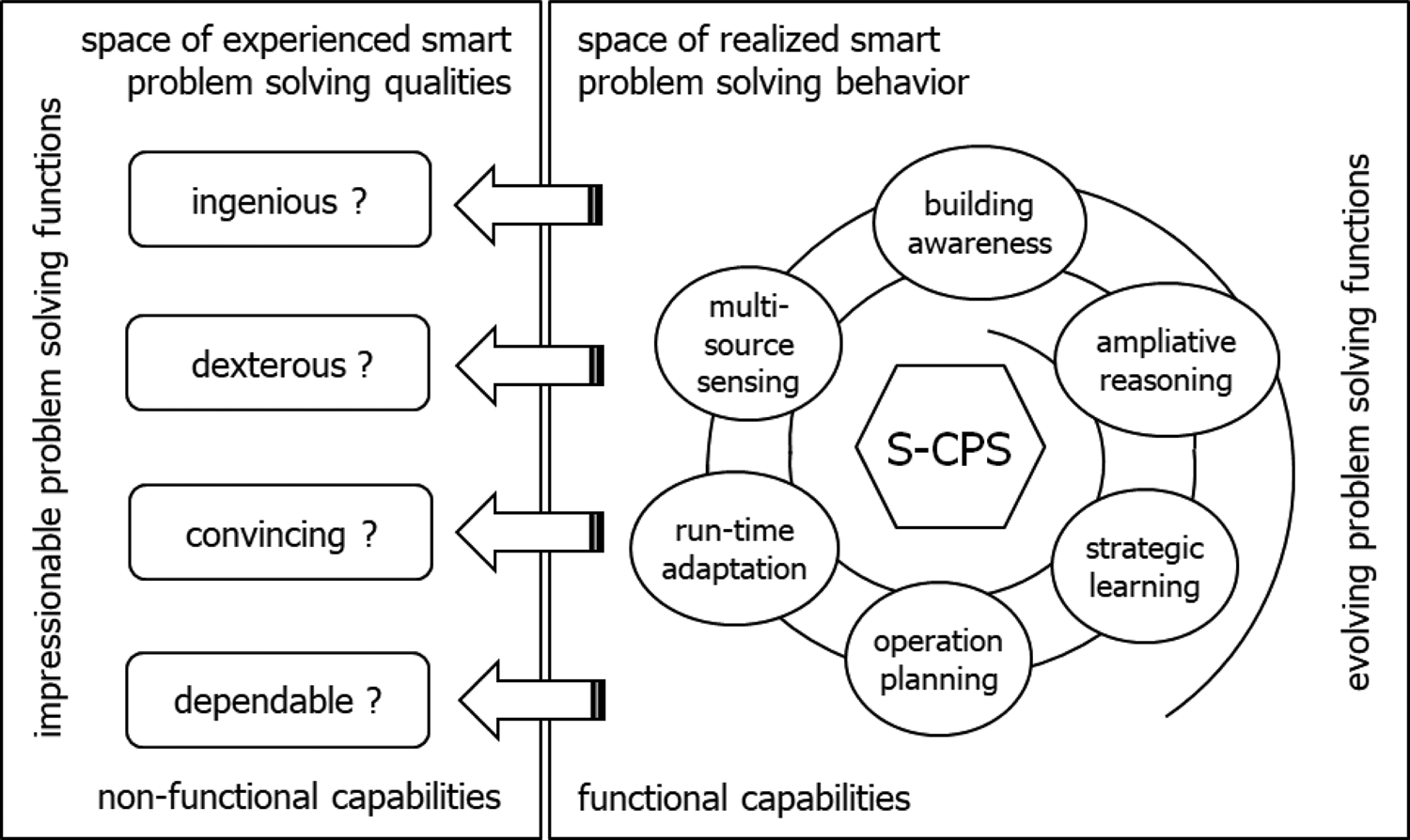
Intellectualized engineered systems present (i) materiality, (ii) agentivity, (iii) intellectuality, (iv) purposiveness, and (v) transformativity. These all are needed for the realization of smartness from a functionality perspective. Behavioral smartness arises when intelligence meets the context. It implies that system smartness is also a judgment from a nonfunctional (experiential) perspective. This judgment may come from the actors of the application environment, including humans and other systems. This duality is shown in Figure 5, which interprets system smartness as an evolving phenomenon. This is enabled by the train of evolving computational problem solving mechanisms and functions. A nonsubjective judgment of the experienced system's performance requires objective criteria and proper measures. These are not available in the literature yet. Nevertheless, based on the analogy of experiencing smartness in human problem solving, we regarded (i) ingenuity (inventiveness in the human context), (ii) dexterity (agility), (iii) convincingness (proficiency), and (iv) dependability (reliability) as observable nonfunctional characteristics in the context of impressionable problem solving performance of smart CPSs (Horváth, Reference Horváth2020a). These characteristics interconnect the experienced quality of smart problem solving and sophistication of system functionalities, as well as the stakeholders of the system.
Dual views on system smartness.
Ulsoy (Reference Ulsoy2019) gave an explanatory example by viewing mechatronic systems as the representative of synergistic integration of mechanics, electronics, and computer science principles in their operation. The role of mechanisms is even more influential in the case of smart CPSs expected to implement complex and interdependent reasoning, learning, and adaptation processes (Tavčar and Horváth, Reference Tavčar and Horváth2018). Obviously, for this reason, their overall design is more challenging than designing their hardware, software, and cyberware components even in the application cases of moderate complexity. This is evidenced by many studies in the literature (Lieberman et al., Reference Lieberman, Fry and Rosenzweig2014; Huang, Reference Huang2016; Mallikarjuna et al., Reference Mallikarjuna, Chronopoulos and Kozin2020).
Parallel with the technological and functional advancement, the holistic operational mechanisms of complex intellectualized engineered systems are getting bigger attention. Computation-based operation mechanisms are seen not only as abstract principles but also as features of the created reality that can be used as an implementation concept of complicated synergic (nonadditive) operations. This is line with Mario Bunge's ontological claim about the mechanisms of the experimented physical reality, which explains why it is doing and what it does (Bunge, Reference Bunge1997). This view regards mechanisms as the highest level functional organization capacity of systems. From a practical perspective, a mechanism synergistically integrates operational principles. Implemented mechanisms lend themselves to central physical and computational processes in concrete systems. A particular dependable mechanism is inseparable from practical systems, since it integrates natural, technological, cognitive, temporal, and social dimensions. According to this mental model, smartness is an outcome of a successful and evidenced implementation of the underpinning mechanisms. There is a probability that this mechanism-oriented thinking becomes more widespread and influential in the context of intellectualized engineered systems. As suggested by Bunge (Reference Bunge2004), the bottom line question is: what constructed mechanism makes a smart system purposefully working?
Many researchers think that a computational intelligence-assisted design framework is strongly needed for smart systems. Their operational and behavioral self-adaptation would need some sort of dedicated system intelligence (Ashby, Reference Ashby1947). In other words, the ability to extend the knowledge base and enhance the reasoning mechanisms would be a measure of the intelligence of systems. In a simplified form, the smartness of intellectualized engineering systems could be measured in terms of their potentiality to solve a range of challenging real-life application problems, while their intelligence could be measured in terms of their abilities to extend their knowledge household and problem solving mechanisms. In the language of system engineering, it is directly related to the innate self-adapting capabilities and possibilities (Sabatucci et al., Reference Sabatucci, Seidita and Cossentino2018). Adaptation can be based on external supervision and on update/upgrade agents, whereas self-adaptation assumes internal supervision and agents to establish a more beneficial modus operando. It assumes, for instance, reflexive goal, situation, and state awareness, supervised and unsupervised learning, operation and performance planning, and functional, structural, and behavioral transformations.
Paradigmatic features of smart systems
What are the signatures of a smart system? This reads as a benign question, but it is not. The reason is that intellectualized engineered systems ontologically (paradigmatically) change over time. This recognition lent itself to a reasoning model that, considering the continuous increase of the level of self-intelligence and the level of self-organization, identified five generations of systems in the context of CPSs (Horváth et al., Reference Horváth, Rusák and Li2017). This model shown in Figure 6 interprets smart CPSs as second-generation systems and identifies self-awareness and self-adaptation as their distinguishing paradigmatic features. According to this model, an intelligent system is supposed to have system-level consciousness and should be able (i) to make (critical) decisions autonomously (without supervision or human intervention) based on (a) novel, (b) abstract, (c) uncertain, and/or (d) incomplete information; (ii) to create, propose, maintain, and devote values and perform value-based decisions that it has or other systems have created; (iii) to define new objectives, reprogram itself, acquire proper knowledge, and resolve its operational conflict even if only imperfect information is available; and (iv) to reproduce itself and survive in situations that were not foreseen at the initial implementation of the system and thus were not part of the original design intentions. Besides this model, various sets of distinguishing features and classifications have been proposed. As the aspects of classification, (i) implemented technological functions, (ii) services for application domains, and/or (iii) engineering performance characteristics have been considered.
Smart systems as a particular generation of cyber-physical systems.

Based on the overall engineering performance characteristics, (i) passive systems, (ii) reactive systems, (iii) active systems, and (vi) proactive systems have been distinguished. The model proposed by Schuh et al. (Reference Schuh, Zeller, Hicking and Bernardy2019) arranged the digital features of products into eight categories according to (i) the type of data collection, (ii) the type of interaction, (iii) the place of product intelligence, (iv) the place of data retention, (v) the type of interconnectedness, (vi) the type of connectivity, (vii) the degree of product intelligence, and (viii) the degree of independence. Some publications claim that the key factors or distinguishing paradigmatic features of smart systems are (i) connectivity and networking capabilities, (ii) operation under self-control or autonomously, (iii) context-sensitive interaction with users/devices, (iv) low-energy consumption and environment friendliness, (v) relying on cloud infrastructures and services, and (vi) using techniques of artificial intelligence. As most frequently identified ones in the literature, we propose (i) multi-level cooperative openness (Trokhimchuck, Reference Trokhimchuck2017), (ii) system-level reasoning and learning capabilities (Akbar et al., Reference Akbar, Khan, Carrez and Moessner2017), (iii) system operation in dynamic contexts (Alegre et al., Reference Alegre, Augusto and Clark2016), (iv) semantic, pragmatic, and apobetic interaction (Jameson, Reference Jameson, Sears and Jacko2007), (v) self-supervised planning and adaptation (Seilonen et al., Reference Seilonen, Pirttioja, Appelqvist, Halme and Koskinen2003), and (vi) ensuring multi-aspect dependability (Kamal Kaur et al., Reference Kamal Kaur, Pandey and Singh2018; Fig. 7).
Paradigmatic features of smart systems.

The concept of multi-level cooperative open-ended systems has significance from the viewpoints of (i) organizing heterogeneous systems into a system of systems, (ii) the independent development of conceptually diverse subsystems, and (iii) facilitating continual incremental evolution (Anders et al., Reference Anders, Siefert, Schiendorfer, Seebach, Steghöfer, Eberhardinger, Reif, Reif, Anders, Seebach, Steghöfer, André, Hähner, Müller-Schloer and Ungerer2016). Multi-level cooperative openness offers flexible interconnection and interoperation among all constituents that incidentally joining or leaving the system ensemble. Open systems are characterized by intrinsic incompleteness and decisional locality (Hewitt and De Jong, Reference Hewitt, De Jong, Brodie, Mylopoulos and Schmidt1984) and imply the need for self-organization potentials (Gershenson et al., Reference Gershenson, Trianni, Werfel and Sayama2018). The cooperative open-ended smart system should be able to ampliatively integrate diverse, multi-source, data streams (Saracco et al., Reference Saracco, Barra, Carrelli and Tiribelli1990). It means that they are supposed not only to semantically merge data streams but also to extract or synthesize additional intellect that is not conveyed in the original data streams. This creates an opportunity to dynamically manage the context information derived from multiple sources.
System-level reasoning (SLR) capabilities enable systems to make decisions similar to those of humans and manage themselves or other linked systems. Two fundamental assumptions are that (i) no learning is possible without the application of prior domain knowledge and (ii) learning is possible without being explicitly programmed. Mathematical logic and ANI development have offered many “standard” reasoning mechanisms, which proved to suffer limitations when applied in specific problem solving contexts. Addressing real-life generic application problems (e.g., control of a self-driving car) needs multiple, interoperating, task-specific problem solving mechanisms, instead of one monolithic one (Geng and Cassandras, Reference Geng and Cassandras2011). This is deemed to be one of the most determining features of smart systems (Wu et al., Reference Wu, Li, Wang, Ma, Kolodziej and Khan2012). The principle of divide-and-conquer is applied to overcome developmental and application complexities and to increase reusability and adaptability. Most of the process-based reasoning mechanisms utilize cyber-physical intelligence and implement inductive inferencing. They may be deterministic (scenario-driven) and nondeterministic (knowledge driven). Typical examples for the former are the scenario-based causal decision-making mechanism proposed by Conrado and De Oude (Reference Conrado and De Oude2014) and the adaptive scenario-based reasoning mechanism of Cheng and Wang (Reference Cheng and Wang2012). The latter is exemplified, for instance, by the semantic similarity-driven query intent discovery mechanism proposed by Fariha and Meliou (Reference Fariha and Meliou2019) and the procedural abduction mechanism synthesized for run-time adaptation by Horváth (Reference Horváth2019). The computational elements of procedural abduction are shown in Figure 8.
The computational elements of procedural abduction concerning run-time adaptation.

Crowder et al. (Reference Crowder, Carbone and Friess2020) discussed the foundations of system-level thinking for artificial intelligent systems. Bijlsma et al. (Reference Bijlsma, Suermondt and Doornbos2019) approached the issue of SLR from the perspective of the knowledge domain. Khan et al. (Reference Khan, Eker, Sreenuch and Tsourdos2014) discussed a typical example of advanced vehicle-level reasoning in an aircraft system. As discussed by Reed and Pease (Reference Reed and Pease2017), algorithmic reasoning mechanisms confront obstacles when they operate on ambiguous, conditional, contradictory, fragmented, inert, uncertain, or imperfect knowledge. Due to the recent trends of artificial intelligence research/development, system-level learning (SLL) has been synergistically interconnected with SLR. One example is deep learning that connects computational reasoning to nonpreprogrammed computational learning. The theory of computational SLL intends to explain and optimize (i) the inference principles of algorithmic and nonalgorithmic learning, (ii) the design and analysis of machine learning algorithms, and (iii) the sorts of computationally learnable problems. Among others, Bayesian, supervised, unsupervised, deep, and adversarial learning strategies are applied. The optimization of the approaches is a concern. For instance, deep convolutional generative adversarial networks apply certain architectural (topological) constraints in unsupervised learning (Gao et al., Reference Gao, Yang, Wang, Sun, Yang and Zhou2018). Fiser and Lengyel (Reference Fiser and Lengyel2019) presented a probabilistic framework for perceptual and statistical learning. In the theoretical work of Kinouchi and Kato (Reference Kinouchi and Kato2013), SLL activity was considered a primitive implementation of consciousness. Kinouchi and Mackin (Reference Kinouchi and Mackin2018) proposed an SLL consciousness model that modifies the configuration and states of a humanoid robot by self-action-decision functions toward autonomous adaptation. Kitagawa et al. (Reference Kitagawa, Wada, Hasegawa, Okada and Inaba2018) investigated multi-stage learning in the context of robot application. Darling et al. (Reference Darling, Guber, Smith and Stiles2016) introduced the concept of emergent learning as a framework for the whole-system strategy of learning and adaptation.
Building context awareness (Alegre et al., Reference Alegre, Augusto and Clark2016) and situation awareness are often mentioned functions not only of humans but also of self-regulating systems (Endsley, Reference Endsley, Parasuraman and Mouloua2018). Dey et al. (Reference Dey, Abowd and Salber2001) have defined the term context-awareness of systems as the capability of using the context to provide relevant information and/or services to the user, where relevance depends on the tasks of the users. Perera et al. (Reference Perera, Zaslavsky, Christen and Georgakopoulos2013) argued that context awareness is an ingredient of the smartness of pervasive computing systems and proposed a comprehensive taxonomy of the context-information-related functionalities, which include (i) context acquisition, (ii) context modeling, (iii) context reasoning, (iv) context distribution, and (v) context processing functions. The idea of dynamic context inferring grew out from the concepts of context-aware computing (Li et al., Reference Li, Horváth and Rusák2020) and context-aware applications (Koch et al., Reference Koch, Lucero, Hegemann and Oulasvirta2019). The last years have witnessed the proliferation of context-aware recommender systems (Haruna et al., Reference Haruna, Akmar Ismail, Suhendroyono, Damiasih, Pierewan, Chiroma and Herawan2017) and context-aware self-managing systems (Shishkov et al., Reference Shishkov, Larsen, Warnier and Janssen2018). Measuring awareness is not only a technological but also a cognitive metrological problem due to its abstractness and the lack of reference (Endsley, Reference Endsley1995). Establishing model-based system self-awareness is a challenging information engineering task that spreads over time and cannot be reduced to elicitation and management of context information (Matthews et al., Reference Matthews, Bryant, Webb and Harbluk2001). It is made complicated by its many facets such as identity, goal, state, spatial, temporal, behavioral, context, and social awareness. They together have led to the issue of all-inclusive awareness and, eventually, to mimicked consciousness of smart systems (da Silva and Gudwin, Reference da Silva and Gudwin2010).
Apart and together, semantics, pragmatics, and apobetics play a key role not only in interpersonal communication and interaction but also in collaboration with smart systems (Horváth, Reference Horváth2012). The bottom line is achieving sufficient informing and successful execution (Cena et al., Reference Cena, Console, Matassa and Torre2019). From a design perspective, they work with different theories, criteria, principles, and approaches. Semantics, pragmatics, and apobetics consider the achievable objectives, the ways of achieving, and the implications and reflections, respectively (Horváth et al., Reference Horváth, Rusák, Hou and Ji2014). Semantics supports sharing meaning and understanding in mental (interpretative) and physical (manipulative) actions (Endert et al., Reference Endert, Fiaux and North2011), whereas pragmatics extends it with the concern about the success of achieving the intended or expected goals of the conducted actions. Apobetics concentrates on the relations between the way and the effects of how actions are made and on the implications caused by the results of actions on the stakeholders, as well as on their reflections. It investigates the quality of triggered cognitive and emotional reflections. Though the need for new methods of human interaction with smart systems and environments is widely recognized (Jameson, Reference Jameson, Sears and Jacko2007), the progress is hindered by the lack of theories of apobetics. Computational sentience is almost neglected in the current literature of interaction research. As Mayer et al. (Reference Mayer, Tschofen, Dey and Mattern2014) posited, the interaction with smart systems (things) requires not only different interaction modalities and technological enablers but also a different mentality. Smartness opens up numerous new interaction possibilities in particular in the cognitive, perceptive, and the affective domains (Luyten and Coninx, Reference Luyten and Coninx2005). System design should differentiate between the modes of executing actions, which can be (i) without any degree of freedom, (ii) with a limited degree of freedom, and (iii) with the maximum degree of freedom. Furthermore, it should take both the purpose of actions and the expected reflections into account (Bujnowski et al., Reference Bujnowski, Palinski and Wtorek2011). Apobetic-level investigations should consider these as problem solving constraints (Yang et al., Reference Yang, Scuito, Zimmerman, Forlizzi and Steinfeld2018).
Involving simultaneous and rapid changes in operational objectives, functionality, architecture, computation, interaction, and security, behavioral adaptation is a challenging paradigmatic feature of smart systems (Dobson et al., Reference Dobson, Hutchison, Mauthe, Schaeffer-Filho, Smith and Sterbenz2019). Systems equipped with this ability have been variously called self-adaptive systems, self-managing systems, or self-organizing systems. Often self-healing systems and self-optimizing systems are also sorted in this category (Romero et al., Reference Romero, Guédria, Panetto and Barafort2020). Sabatucci et al. (Reference Sabatucci, Seidita and Cossentino2018) proposed a meta-model that identifies four types of self-adaptive systems: (i) Type 1 (anticipating changes and possible reactions at design-time), (ii) Type 2 (equipped with alternative strategies for reacting to changes), (iii) Type 3 (aware of its objectives and operates with uncertain knowledge), and (iv) Type 4 (able of self-modifying its specification as biological systems do). To adapt themselves, smart systems need to use: (i) sensory perception (detecting and anticipating changes in the environment), (ii) cognition (reasoning about perceived changes and deciding on the best action), (iii) execution (controlling the implementation of cognitive decisions), and (iv) provisioning assurances (De Lemos et al., Reference De Lemos, Garlan, Ghezzi, Giese, Andersson, Litoiu and Zambonelli2017). The major issue is that there is no general theory to explain self-adaptation in all contexts and there is no clear view on how to realize self-adaptation in a self-supervised manner at run-time (Weyns, Reference Weyns, Cha, Taylor and Kang2019). Self-planning of adaptation is a complicated data-driven task that should consider not only the states of operations and the environmental changes but also the affordances of the system and the availability, inclusion, and exclusion of resources (Yamanobe et al., Reference Yamanobe, Wan, Ramirez-Alpizar, Petit, Tsuji, Akizuki, Hashimoto, Nagata and Harada2017). Run-time planning of adaptation is supposed to happen in a proactive manner (Muccini and Vaidhyanathan, Reference Muccini and Vaidhyanathan2019). Reactive self-adaptation cannot avoid negative events and cannot derive better operation modes. Ideally, proactive self-adaptation may resolve these drawbacks, if it is able to detect the need for adaptation by online testing and define an adaptation plan in a narrow time window. However, current research cannot offer solutions for these yet. In the last years, the MAPE-K methods have been used successfully for the adaptation of software (da Silva et al., Reference da Silva, Andrade and Andrade2020). Figure 9 shows the conceptual workflow of the proactive self-adaptation of CPSs. Currently, (i) no formal proofs of reaching good functional and architectural solutions are known and (ii) the behavior (operation under application circumstances) of a system cannot be validated without deploying it in a real environment. Many authors identified adaptation as a configurable interoperability problem and emphasized that self-management is inseparable from autonomic computing (Rutten et al., Reference Rutten, Marchand and Simon2017).
Operational framework of proactively self-adaptive smart systems.

In the case of smart systems, the criteria of dependability appear in a more complicated form than in the case of nonintellectualized but mission-critical systems (Kamal Kaur et al., Reference Kamal Kaur, Pandey and Singh2018). In the conventional interpretation, dependability integrates such system attributes as availability, reliability, security, safety, integrity, survivability, and maintainability (Avizienis et al., Reference Avizienis, Laprie and Randell2001). Mainly focusing on hardware and software dependability (Bernardi et al., Reference Bernardi, Merseguer, Petriu, Bernardi, Merseguer and Petriu2013), early works proposed redundancy as means of increasing their dependability and model-based analysis and simulation as useful methods (Sharvia et al., Reference Sharvia, Kabir, Walker, Papadopoulos, Mistrík, Soley, Ali, Grundy and Tekinerdogan2016). In the case of smart systems, dependability also concerns the dependability of reasoning mechanisms, system knowledge, and the decisions made, and entails the need for multi-concern intellect analysis and the adoption of novel certification schemes (Biggs et al., Reference Biggs, Nakabo, Kotoku and Ohba2011). It is assumed that intelligence provides more robustness as well as a comprehensive self-management of faults. The current research results still show an existing limit line at designing smart embedded systems for dependability (Srivastava and Singh, Reference Srivastava and Singh2009). The issues related to the evaluation of the dependability of CPSs during the design period are recognized (Gheraibia et al., Reference Gheraibia, Kabir, Aslansefat, Sorokos and Papadopoulos2019), but providing any generic solution is difficult due to the increasing aggregate complexity, the operational and environmental dynamics, and the consequences of self-adaptation (Sondermann-Wölke et al., Reference Sondermann-Wölke, Hemsel, Sextro, Gausemeier and Pook2010). The dependability of complex smart systems is ontologically emergent and compositionality also plays a crucial role in it (Hartmann, Reference Hartmann2014).
Part 3: Coupling of smart design and smart systems
Introducing the concept of connectors
Let us start from what has been discussed in the previous subsections of this paper. The question addressed in this subsection is: does AI create couplings between smart design and smart systems? And, if the answer is affirmative, then what creates what type of relationships? The above discussion of smart design and smart systems revealed that what kind of results of cognitive science, artificial intelligence, computing technologies, and cognitive engineering appear. There are several cognitive enablers that are utilized equally well in smart design and smart systems. The fact of the matter is that these cognitive enablers can facilitate the realization of the concept of partially self-designing smart systems. For this reason, they will be referred to as “connectors” in the rest of this paper. They have a special role in equipping smart systems with design functions and enhancing the methodology of smart designing. As an example of the latter, we may consider (i) helping the exploration of complex solution spaces and affordances, (ii) establishing extended cyber-physical-social environment, (iii) offering application problem-specific reasoning mechanisms, (iv) playing the role of “big brother” in problem solving processes, (v) facilitating transdisciplinary concept synthesis approaches, and (vi) creating the basis for functional design automatons.
With some simplification, we can argue that paradigmatic features of smart systems are (i) multi-level cooperative openness, (ii) SLR and learning capabilities, (iii) system operation in dynamic contexts, (iv) semantic, pragmatic, and apobetic interaction, (v) self-supervised planning and adaptation, and (vi) ensuring multi-aspect dependability. The realization of these system features requires the use of AI connectors in the smart design process. Not considering the forerunning activities (fuzzy front-end) and the successive activities (back-end) of the system design process, a smart design process involves (i) functional, (ii) architectural, (iii) hardware, (iv) software, (v) cyberware, (vi) cognitive, (vii) workflow, (viii) interface, (ix) production, and (x) installation design activities. The artificial intelligence-based connectors can establish M to N enabling the relationships between the features of smart systems and the activities of system design. They may facilitate the process of smart designing, but they can also be embedded in smart systems as operation enablers. This explains how AI-enablers serves as connectors. It is visualized in Figure 10.
Categories of AI-connectors between paradigmatic system features and smart system design.

Primary types of connectors
Intuitively, the AI-based connectors can be sorted into three categories: (i) conceptual (platforms, frameworks, protocols, and experience), (ii) functional (models, mechanisms, and knowledge), and (iii) instrumental (environments, tools, and methods). The connectors in the conceptual category support the blue-printing of smart systems and the cognitive engineering of smartness, while those listed in the functional category support the realization of functionalities. The connectors in the instrumental category are the external enablers of the cognitive design of systems. These will be discussed below. Note that new connectors and/or categories may need to be considered as additional results of artificial intelligence research emerge.
AI-platforms are predesigned modular technological architectures, composed of a core and a periphery, for the seamless integration of cognitive system resources with the potential to easily plugin as many hardware, software, and cyberware components as possible or needed (Mucha and Seppala, Reference Mucha and Seppala2020). They provide most of the interfaces that are needed for their interoperation of components but also allow offer a straightforward approach to customization for purpose. AI-platforms are designed to help connect and integrate components not only physically but also from workflow integration and information sharing points of view (Epstein et al., Reference Epstein, Payne, Shen, Dubey, Felbo, Groh and Rahwan2018). As templates, they support building multiple smart application systems within the same functional and technological framework and by utilizing cloud services. Typical representatives are such as (i) Algorithmia, (ii) DeepMind, (iii) CloudCV, (iv) FairML, (v) PsychLab, (vi) OpenML, (vii) Themis-ML, (viii) ParlAI, and (ix) TuringBox. Different AI-platforms provide different opportunities and restrictions. Customized add-on and plug-in components are used to complement the standard functionality provided by some platforms. Therefore, they can be seen both as a constraint on the intellect development process and as a facilitator of tailoring problem solvers. The advantage of using AI-platforms is that application systems can be developed faster and cheaper than when they are built standalone (Venkataramani et al., Reference Venkataramani, Sun, Wang, Chen, Choi, Kang and Gopalakrishnan2020).
AI-frameworks are the conceptual constructs of the cognitive parts of smart systems including logical, functional, architectural, computational, and interaction aspects. Typically, they are extracted, abstracted, or constructed based on implemented smart systems or parts thereof (Torres and Penman, Reference Torres and Penman2020). In general, they allow for the easier and faster creation of applications by purposefully arranging and interrelating operational concepts. Cena et al. (Reference Cena, Console, Matassa and Torre2019) sketched up a framework for incorporating multi-dimensional intelligence in smart physical objects. The generic functionality offered by AI-frameworks can be selectively changed by additional, purposely developed constituents, thus providing application-specific features and services. Using an AI-framework supports intellectual effectiveness, consideration of the requirements, as well as the needed functionality, its feasibility, and the decision on system-level features. In addition, an AI-framework captures the relationships of the cognitive elements and facilitates their analysis. Opposing formal quantitative models, which provide a theoretical explanation, conceptual frameworks provide insights and understanding. There are also different interpretations of AI-frameworks. For instance, Zysman and Nitzberg (Reference Zysman and Nitzberg2020) proposed a framework for discussing the limits, possibilities, and risks of AI.
AI-protocols are constructed to support the organization of system-internal cognitive workflows or system-external interaction and supervision workflows (Kesavan et al., Reference Kesavan, John and Herszberg2008). As typical in computer science, protocols include a standardized set of rules for preparation, processing, and communicating data, instructions, commands, activities, constraints, acknowledgements, etc. for cognitive problem solving. AI-protocols also enable the collaboration and networking software agents and the proper scaling of artificial intelligence lifecycle on demand (Kuwabara et al., Reference Kuwabara, Ishida and Osato1995). AI-protocols are application-specific and propagate different methods of scenario development or process organization. A current concern is ontological modeling of AI-protocols (Zhou et al., Reference Zhou, Pung, Ngoh and Gu2006), and the development of scalable networking and security protocols (Shu and Lee, Reference Shu and Lee2007).
AI-experience represents the tacit knowledge of designing cognitive capabilities (Simon, Reference Simon1986). It is often called th eknow-how of artificial intelligence. The subjects can be varied, ranging from insights in efficient problem solving approaches, through deploying AI-models and best practices in a given context, to the limitations and affordances of AI-tools. The development of repositories and warehouses for aggregation and availing AI-experience is challenging due to intangibility and abstractness of knowledge and subjectivity of experiences. It is also not clarified how to convert experiential know how into teachable and learnable design principles (Liao et al., Reference Liao, Gruen and Miller2020). Smith (Reference Smith2019) discussed the paradox of being flooded by information about the all-mightiness of artificial intelligence as well as the obvious dreads and lasting uncertainties. While positive experience is seen as a success factor of adopting AI in design, Chen et al. (Reference Chen, Li and Chen2020) reported on the lack of knowledge about the success factors of AI adoption in the telecommunication industry.
AI-models cognitively represent some real-world object or phenomenon as a set of logical arrangement, mathematical equations, taxonomical relationships, and computational concepts (Rajaee and Jafari, Reference Rajaee and Jafari2020). In general, AI-models are generated in three stages, including (i) model generation, (ii) model interpretation, and (iii) model validation. Two subcategories can be identified: (i) explicit models and (ii) implicit models. Explicit models rely on some descriptive or explanatory theories, are preprogrammed based on algorithms, and are represented using computational languages. Examples of explicit AI-models are decision trees, parameterized simulation models, support vector machines, ontology structures, taxonomical constructs, and probabilistic schemas (Hu et al., Reference Hu, Li, Wright, Aydin, Wilson, Maher and Raad2019). Implicit models are pattern-type constructs for which no explicit algorithm is preprogrammed. These are typical in machine and deep learning, where mathematical algorithms are trained to generate models using data and human expert input. They attempt to replicate specific decision processes and replicate decisions that (a team of) experts would make if they could review all available data when the same information is provided. It is expected that implicit models reveal the rationale behind the pattern and decision to help interpret the decision process (Gade et al., Reference Gade, Geyik, Kenthapadi, Mithal and Taly2019). This stimulates research in domain-specific explainable artificial intelligence (Jia et al., Reference Jia, Ren and Cai2020).
AI-mechanisms are physical, software, and/or cyberware entities and related computational activities that produce certain problem solving behavior (Ojo et al., Reference Ojo, Mellouli and Ahmadi Zeleti2019). The idea of mechanism is a central part of the concept of smart systems, which may include multiple various nonampliative (NARMs) and ampliative reasoning mechanisms (ARMs). NARMs are such as (i) classification, (ii) searching/looking up, and (iii) contextualization. ARMs are such as (i) fusion, (ii) inferring, (iii) reasoning, (iv) abstraction, (v) learning, (vi) decision making, and (vi) adaptation (of knowledge). They can be application-neutral and application-specific. Application-neutral ARMs are needed for intelligent and creative reasoning in intellect-intensive applications, which could not be performed by mathematical logic or (i) inductive, (ii) deductive, (iii) abductive, and (iv) retrospective reasoning, or any combination of them. Historically, five major families of ARMs have been developed, such as (i) symbolic, (ii) analogical, (iii) probabilistic, (iv) evolutionist, and (v) connectionist. Their interoperation is restricted by large differences in representational syntaxes and computational approaches (Varshney et al., Reference Varshney, Keskar and Socher2019). A current issue is designing awareness, inferring/reasoning, and adaptation mechanisms toward an optimal problem solving potential. Artificial neural network architectures are the most widespread representatives of AI-mechanisms, producing nontransparent implicit models (Seidel et al., Reference Seidel, Schimmler and Borghoff2018b). Two main targets for current research are (i) dynamic ANN model training and (ii) dynamic architecture generation (layer and node addition or removal).
AI-knowledge primarily means problem solving knowledge, rather than system development knowledge (Horváth, Reference Horváth2020b). The two main constituents of AI-knowledge are (i) codified human knowledge and (ii) self-generated illative knowledge. Accordingly, AI-knowledge is partly generated by knowledge engineering of human knowledge in development time and partly by the AI inferring, reasoning, and learning mechanisms run-time (Feng et al., Reference Feng, Mayer, He, Kwashie, Stumptner, Grossmann and Huang2021). Knowledge engineering includes the codification (aggregation, structuring, representation, and validation) of knowledge (AlGhanem et al., Reference AlGhanem, Shanaa, Salloum and Shaalan2020). The reasoning mechanisms of a system process codified human knowledge and append it with synthetic knowledge patterns that are not part, but derivatives of codified knowledge. Thus, AI-knowledge can be explicit (explainable) and implicit (unexplainable). Explainable knowledge is conclusions derived based on the results of numerical or symbolic computations by a system, and not explainable knowledge is the abstract patterns constructed by machine learning algorithms (Zatsman, Reference Zatsman2020). AI-knowledge is of extreme heterogeneity not only with respect to its cognitive contents but also to its representation, storage, and processing (Kasabov, Reference Kasabov2019). A recognized issue is the verification and validation of AI-knowledge in varying application contexts. The machine readability of system knowledge has become one of the recent targets (Bauguess, Reference Bauguess2018).
AI-environments are combined hardware, software, and cyberware utilities that allow smart system development, though they themselves are not necessarily smart (Malik and Singh, Reference Malik and Singh2020). Therefore, they are seen as integrated tool complexes and often referred to as integrated development toolboxes, if they are extended with resource selection and recommendation functions. Among others, they manage source codes, component libraries, and standard components. Knowledge ontologies are included or linked to AI-environments. Recently, environments have been specialized to particular AI tasks such as deep learning, image processing or speech generation, and optimized for performance (Hechler et al., Reference Hechler, Oberhofer and Schaeck2020). Among many others, the commercialized representatives of AI-environments are (in alphabetical order): (i) AI Platform (Google), (ii) Azure (Microsoft), (iii) Dialogflow (Google), (iv) Holmes AIA (Wipro), (v) MindMeld (Cisco), (vi) Nia (Infosys), (vii) Rainbird (Rainbird Technologies), (viii) Symphony AyasdiAI (Ayasdi), (ix) Tensorflow (Google), and (x) Watson Studio (IBM). These environments offer a wide range of cognitive functions that the human mind uses to perform problem solving, learning, reasoning, motion, manipulation, perception, speech, vision, cooperation, and behavior. AI-environments make it easier to move from the ideas through implementation to deployment faster and more cost-effectively in a humane manner (Crowley et al., Reference Crowley, O'Sullivan, Nowak, Jonker, Pedreschi, Giannotti and Rogers2019).
AI-tools have been developed for handling a particular problem with a proper set of computational functions. As Pichai (Reference Pichai2018) argued, AI tools have the potential to unlock new realms of scientific research and knowledge in critical domains like biology, chemistry, medicine, and environmental sciences. Thus, the arsenal of AI tools is immense (Bawack et al., Reference Bawack, Wamba and Carillo2019). They can be sorted into five general categories: (i) sensing tools (for computer vision, biometrics analysis, health diagnoses, speech recognition, space navigation, etc.) (ii) understanding (for language interpretation, document extraction, automated translation, text analysis, pattern recognition, etc.), (iii) manipulation (logical inferring, decision making, process planning, agent development, robot control, collaboration management, contextual recommendation, etc.), (iv) knowledge engineering (for semantic merging, ontology specification, semantic merging, automated verification, context processing, etc.), (v) problem solving (for task decomposition, scenario-driven reasoning, artifact classification, solution space exploration, creative composition, etc.), and computational learning (for situation probmodeling, genetic evolution, machine learning, deep learning, natural mimicry, etc.) (Minton, Reference Minton2017). AI-tools are already used in knowledge-intensive design, complementing cognitive capabilities of designers (Karan and Asadi, Reference Karan and Asadi2019). Altavilla and Blanco (Reference Altavilla and Blanco2020) posited that using AI-tools can reach the automation level where the tool alone generates or selects the final design outcome and presents the result to the stakeholders at the end of the process.
AI-methods are contemplated as implementation enablers, rather than the principles of operations of smart systems. They provide principles for the effective utilization of artificial intelligence enablers in a context-sensitive manner as well as for the organization of applications. Agre (Reference Agre, Agre, Bowker, Gasser, Star and Turner1997) argued that, in the first 15 years, AI researchers developed a series of technical methods that provide interesting, technically precise accounts of a wide range of human phenomena and cognitive tasks. A characteristic set of methods has been dedicated to algorithmic compositions (Papadopoulos and Wiggins, Reference Papadopoulos and Wiggins1999). AI-methods imply novel design practices. Seidel et al. (Reference Seidel, Berente, Lindberg, Lyytinen and Nickerson2018a) gave an example by investigating a triple-loop model of design activities that is entailed by the application of autonomous AI-tools. Among the road pavers, Haase (Reference Haase1990) discussed that how AI-methods can be used in real-time software products, while Newman et al. (Reference Newman, Hume and Lang2020) presented a systematic approach to using AI-methods in civilian applications and education. Begler and Gavrilova (Reference Begler and Gavrilova2018) reviewed AI-methods for knowledge management systems.
The strength of the interrelationship created by a particular connector determines the applicable design strategy. If the interrelationships among the connectors are zero (or weak), then a traditional sequential design approach can be applied. If the relationships are strong, then a co-design approach is to be applied. The measures of interrelationships vary in every application case.
Part 4: Reflections, conclusions, and future research
Reflections
The concepts or smart design and smart systems are getting more and more attention in research, development, and education. Both of them intends to exploit the recent results of artificial intelligence research, no matter if problem solving methods, intellectualized tools, or application-specific knowledge processing are concerned. Apart from this commodity, they also have an intricate mutual relationship as enablers. On the one hand, tailored to the innovation of smart systems, smart design can change the traditional methodologies of systems engineering and make it more synergetic, efficient, and reliable. On the other hand, smart systems can be used as empowering resources of smart design that not only extend the cognitive space of designing but also offer new affordances. Ultimately, a part of design can be delegated to self-supervised, self-adaptive, smart systems in the near future. The current trends are pointing toward this end, though there are still many known and unknown technological issues and obvious knowledge deficits.
This article has made an attempt to contribute to answering some of the common issues. The intention could not be else by casting light on a possible interpretation and approach, without enforcing strict definitions and other formal specification. Recognizing the fact that research in the contexts of the manifestation and interrelationship of smart design and smart systems is still in an early stage, the content discussed in the paper must be seen as possible ingredients of a conceptual framework. It has been concluded that, toward a comprehensive theory and methodology development, integration and abstraction of the knowledge conveyed by the individual research efforts is needed on a short notice. Furthermore, due to the transdisciplinary nature of the related research phenomenon, experts of the related disciplines (cognitive science, system theory, advance computation, system engineering, artificial intelligence, knowledge engineering, and so forth) need to collaborate and formulate not mono-disciplinary research questions. These are deemed indispensable, but also instrumental, to answering the questions related to their very nature, functionality, implementation, utilization, and impacts of smart designing of smarts systems and employing smart systems in smart design.
Some propositions
What the reader may know or do differently in the light of the above (incomplete) literature analysis and critical systems thinking driven argumentation? Though the lack of undisputable definitions and exhausting explanations is obvious, several propositions can be made. They are as follows:
(a) Smart design is a viable concept in the age of intelligence revolution, since it can provide significant cognitive support to designers to cope with complexities, heterogeneities, compositionality, affordances, and dependability of smart systems.
(b) Smart design should not be seen as axiomatization-based automated design by specialized systems. It is based on an extensive cognitive and creative interaction between humans and systems.
(c) Considering the premature stage of development/evolution, smart design raises many more issues than it can address and solve, but it is rapidly gaining potential as the literature reflects it.
(d) It can be prognosticated without a larger risk that smart design and smart systems will become inseparable in the near future.
(e) Self-supervised (or only partially human-supervised) run-time self-design of smart systems is a realistic idea, though more knowledge is needed about the theoretical fundamentals and practical implementation of self-adaption of complex) is and will be needed.
(f) A theory of smart systems is supposed to provide a unified set of propositions made with the aim of achieving some form of understanding that provides an explanatory power and predictive ability.
(g) Application dependence of smart systems and measuring their performance in various application contexts need further in-depth studies.
(h) It seems that a proper realization of self-adaptation cannot be separated from the assessment of the goals, state monitoring, observing the environment, building awareness, SLR and SLL, and proactive planning.
(i) Self-adaptation plans should be verified before execution and the outcome of adaptation should be validated run-time without suspending system operation.
(j) It is not enough for a smart system to perform smart problem solving operation, but it should also raise the impression that its behavior and the solution are smart.
Future research opportunities
Since smart design and smart systems are in an early stage, an extremely large number of phenomena and related issues need to be studied. Figure 11 shows the major research issues in the domain of self-adaptive smart systems. However, research should extend not only to the technological and cognitive domains but also to human, social, business, and visionary domains. Instead of going into technical details concerning manifestations, causalities, implications, dependences, affordances, constraints, etc., we propose the following for consideration.
(1) Systematic blending of the specific bodies and chunks of knowledge (including the foundational theories) available related to smart design, smart systems, and smart exploitation.
(2) Development of strategic roadmaps that consider both the digital transformation and the proliferation of intellectualization with regards to changing human roles and system affordances and that can be used as templates by both the academia and the industry.
(3) Moving toward transdisciplinary research and development activities that synthesize and amplify the knowledge, methods, competences, and experiences of the stakeholders of smart design and smart systems.
(4) Fully fledged manifestation of the concept of computational mechanisms may lead to the situation when intellectualized engineering systems are built from self-adaptive modules of general or application-specific computational mechanisms, rather than from discrete components, fulfilling not only composability but also compositionality specifications and principles.
Major research issues concerning self-supervised self-adaptive smart systems.

Dr. Imre Horváth is an emeritus professor of the Delft University of Technology, where he focused on cognitive engineering of smart cyber-physical systems. He promoted more than 20 PhD students and has more than 430 publications. He is a fellow of ASME and a member of the Royal Dutch Institute of Engineers. He received two honorary doctor titles, the ASME lifetime achievement award, and the Pahl-Beitz ICONNN award. He has served several international journals as an editor. He is an initiator of the International Tools and Methods of Competitive Engineering (TMCE) Symposia. His current research interest is knowledge science of intellectualized systems.


 Open access

